Directed by Stevan Riley, Everything or Nothing: The Untold Story of 007 is the story of the James Bond franchise and how it was made by three men who would come up with a franchise that’s now lasted for 50 years. The documentary explores the roots of the James Bond story and how it would evolve in the many years through different actors playing Bond as well as all sorts of things that nearly derailed the franchise. The result is a truly engrossing and incredible documentary from Stevan Riley about the James Bond franchise.
The documentary explores the history of James Bond dating back to the 1940s when Ian Fleming was a naval officer working for the British government in World War II. During his time working for a newspaper and vacationing in Jamaica just as the Cold War was to start, he would write the first James Bond novel in Casino Royale that would launch the James Bond books series. Throughout the course of the film, it reveals how Albert “Cubby” Broccoli and Harry Saltzman teamed up to get the rights and create one of the great film franchises in the history of films.
With interviews by the families of Fleming, Broccoli, Saltzman, and associates that includes Christopher Lee who was a step cousin of Fleming. Also interviewed are five of the six actors who played James Bond while Sean Connery’s is only presented in archival audio and video interviews. In the course of the story, things are revealed into why Sean Connery left the franchise the first time around after You Only Live Twice and why George Lazenby only did one film. Also touched upon is the split between Broccoli and Saltzman after the release of The Man with the Golden Gun in which Saltzman sold his shares to United Artists though the two made peace when Broccoli invited Saltzman to the screening of For Your Eyes Only.
Another person that is talked about is Kevin McClory who claimed to have co-written Thunderball with Fleming and Jack Whittingham as it led to all sorts of legal troubles for many years that gave McClory the chance to make Never Say Never Again in 1983 against EON’s production of Octopussy released that same year. Broccoli’s daughter Barbara and his stepson Michael G. Wilson revealed a lot more into many of the legal issues that kept Bond out of the spotlight for six years in the early 1990s which contributed to Cubby Broccoli’s ailing health. It’s among one of the most compelling tales of the Bond franchise story as well as how they got the rights to Casino Royale in the hopes to reinvent Bond in a post 9/11 world.
Stevan Riley’s direction is brilliant for the way he tells the stories through many interviews from people who were in the franchise or were involved like production designer Ken Adam along with fans like former U.S. president Bill Clinton. Through the editing of Claire Ferguson, the film reveals a lot of rare photos and video footage of the films being made in production as well as old family movies from the Saltzman and Broccoli family of their time together during the 1960s. The actors who played Bond reveal small stories about the franchise where Pierce Brosnan revealed how he almost got the part in the mid-80s after Roger Moore’s departure but was derailed when NBC bought the rights to have Remington Steele on their network. It is among the many fun stories about the film’s franchise and it has more than enough material for Bond fans to enjoy.
Everything or Nothing: The Untold Story of 007 is a phenomenal documentary from Stevan Riley that explores the history of James Bond. It is a film that Bond fans must see whether they know a lot about the franchise’s history or for those who are new to the series. It’s definitely something that serves as a great companion piece to the film’s franchise as well as reveal the story about the three men who created a franchise that is now 50 years old and is more beloved than ever. In the end, Everything or Nothing: The Untold Story of 007 is a marvelous film from Stevan Riley.
James Bond Files: The EON Films: Dr. No - From Russia with Love - Goldfinger - Thunderball - You Only Live Twice - On Her Majesty's Secret Service - Diamonds are Forever - Live and Let Die - The Man with the Golden Gun - The Spy Who Loved Me - Moonraker - For Your Eyes Only - Octopussy - A View to a Kill - The Living Daylights - Licence to Kill - GoldenEye - Tomorrow Never Dies - The World is Not Enough - Die Another Day - Casino Royale (2006 film) - Quantum of Solace - Skyfall - SPECTRE - No Time to Die
Non-EON Films: Casino Royale (Climax! TV Episode) - Casino Royale (1967 film) - Never Say Never Again
Bond Documentaries: Bond Girls are Forever - True Bond
© thevoid99 2012
The man who would reinvent the Western in the 1960s, there is no filmmaker who is lauded for this effort better than Sergio Leone. Though he would make a film films that were outside of that genre, the Italian filmmaker helped create a new sub-genre in the form of the Spaghetti Western that brought new levels of violence, protagonists, and a visual style that strayed from the world of the American west. Since his death in 1989, Leone is considered to be one of the great filmmakers as he would end up influencing countless filmmakers in the years to come.
Born in Rome, Italy on January 3, 1929, Leone was the son of filmmaker Vincenzo Leone and actress Edvige Valcarhengi where the former was considered a pioneer in Italian silent cinema. Leone grew up around the film industry as he would often be in the set of his father’s films. It was there he would learn his trade. By age 19, Leone was already the assistant director for Vittorio de Sica during the making of de Sica’s Bicycle Thieves. Leone would spent the late 1940s and most of the 1950s as an assistant director while writing screenplays for the sword-and-sandal films of the time.
Among the works Leone was doing as an assistant director was shooting scenes for movies like Quo Vadis and Ben-Hur as his work in the chariot race scene in the latter made it to the film’s final cut. Still, it was his work in the sword-and-sandal films that got him continuous work as it was very popular in Italy at the time despite the wave of Italian neorealist movies that were emerging as well as the art films by directors like de Sica, Federico Fellini, Michelangelo Antonioni, Luchino Visconti, and many others.
The Last Days of Pompeii
During Leone’s tenure as an assistant director, he was asked to help assist filmmaker Mario Bonnard in making the sword-and-sandal film Gli Ultimi giorni di Pompei. The film was to tell the story about a centurion who seeks revenge for the death of his father in the hands of hooded bandits as it plays into a conspiracy to overthrow the rule of the Roman Empire and accuse the Christians of these crimes. Leone would write the film’s screenplay with a group of writers including Ennio de Concini and Sergio Corbucci. It was there that Leone and Corbucci would also work together for location scouting in Spain as it would give them ideas for the future westerns the two would make in the 1960s.
With Leone serving as assistant director and Corbucci shooting second unit, production went underway as it would star genre mainstay Steve Reeves and famed Spanish actor Fernando Rey. Yet, things grounded to a halt on the first day when Bonnard suddenly fell ill with liver issues preventing him to continue work on the film. Leone was eventually asked to take over during the production as he also helped Bonnard finish a previous film that also had Leone serve as assistant director. It was during the shooting where Leone would devise many framing devices as he was able to take advantage of the CinemaScope film stock to create amazing wide shots.
Despite the constraints he had to work with, Leone was able to do something with the story such as the film’s opening sequence in which a family is massacred as it revealed a lot of Leone’s penchant for graphic violence. It was Leone wanting to establish the kind of power that the villains wanted as it would later drive the protagonist’s vengeance. Even as he would create unique shooting styles for the film’s action that included the climatic scene when Mount Vesuvius erupts that would spell the end of Pompeii.
The film was released in November of 1959 as it was credited largely to Bonnard with Leone getting some credit in the end. The film was a hit in Italy where the sword-and-sandal genre was still popular at the time. The film’s success allowed Leone the chance to finally be promoted as a director as he was ready to take his first steps into his journey as a filmmaker.
The Colossus of Rhodes
With the clout he got his work as an assistant director and helping Mario Bonnard finish The Last Days of Pompeii, Leone was given the chance to make his first film as a director. With the sword-and-sandal genre already giving many filmmakers in Italy work, Leone decided to take part in the genre by creating another epic sword-and-sandal film in The Colossus of Rhodes. While the story was sort of a rehash of his previous film, Leone was able to get the chance to helm the film by himself as he created a project that would be ambitious despite the low budget he had to work with.
One of the film’s biggest coup was getting American film star Rory Calhoun in the lead of Dario while playing the leading lady would be Lea Massari who had just appeared in Michelangelo Antonioni’s landmark 1960 film L’Avventura. The film would revolve around a Greek military hero who arrives to an island to visit his uncle where the island was in turmoil over a rebellion to overthrow a tyrannical king who is unaware that is his insubordinate is staging a coup of his own. This would lead to the film’s protagonist to take part in the rebellion and reveal the coup.
Working with the same crew that he did with his previous film, Leone was able to keep the film’s budget in tact as well as stage some fantastic sequences that required lots of lavish set pieces. Notably the climatic earthquake scene towards the end of the film as it would have Leone maintain something that was big but with a small budget.
The film was released in 1961 where it was modestly successful but something happened along the way that would shake up the Italian film industry as the sword-and-sandal epics started to fail in the box office. The 1963 epic Cleopatra was a highly expensive film that barely recouped its budget while Luchino Visconti’s Il Gatopardo (The Leopard) was a commercial disappointment. This new crisis for the Italian film industry sent many reeling about what to do. For Leone, the end of the swords-and-sandal genre was a blessing as he was about to embark on something that would help revitalize the ailing Italian industry.
A Fistful of Dollars
During this transitional period in the Italian industry, Leone decided to forge ahead on his next project. Having been a fan of the Westerns since his days as a child while his mother starred in the first Italian-produced Western many years ago. Leone wanted to make a Western that would be very different from not just the ideals of its roots but also wanted to employ new ideas to the genre. While Leone loved the works of John Ford and other filmmakers of that genre, he felt that the idealism that was carried by John Wayne became heavy-handed. In wanting to strip down the idealism and go back to something that was more realistic and to the point. He would help create a new sub-genre that would re-shape the Western into new territory that many had not seen.
While Leone was inspired by the works of Dashiel Hammett that included Red Harvest, Leone was also inspired by Akira Kurosawa’s 1961 film Yojimbo. The latter of which Leone believed was inspired by Hammett’s novel as the film was about a samurai who doubles for two feuding gangs in hopes they kill each other off. Teaming up with a group of writers to create the project that was then titled The Magnificent Stranger, the project would be a remake of sorts on Kurosawa’s Yojimbo but refashioned into the Western.
While Leone gathered a cast of actors from Italy and Spain as the production was to be set in Spain as the U.S., Leone had difficulty getting an actor to play the lead role. Leone wanted more established actors like Henry Fonda, James Coburn, and Charles Bronson but they were too expensive for a film that was budgeted at around $200,000. Leone would finally find his lead in the form of a young actor named Clint Eastwood who had only done a few films while working regular in the TV western Rawhide. Eastwood accepted the part for $15,000 as he brought his costumes from the show and flew to Spain.
The film would mark the first of three films Leone would make with Eastwood as Eastwood would prove to be a formidable collaborator for Leone as he asked for less lines during the production. It was around that time that Leone would gain other people who would become part of his collaborative team in the years to come. The first of which was art director/costume designer Carlo Simi who would help create a look that was very different from other Westerns as it would shape the visual style that Leone wanted. The second person that would be part of the team was music composer Ennio Morricone. Morricone was an old schoolmate of Leone as the two reconnected after Leone heard some of Morricone’s work for other films. Their collaboration would widely be considered to be one of the great director-composer collaborations in cinema.
Knowing that he would make a film that was very different from the Italian art films of Federico Fellini and Michelangelo Antonioni, Leone wanted to incorporate something that audiences from the South of Italy would understand. Among them would be a lot of Catholic imagery that would surround some of the set while the violence would also be far more brutal. Leone would also employ cutting styles that would play up to the action that he would later perfect in the coming years as it would be part of a style that would define the genre.
The film was released in October of 1964 where it was not well-received by the critics in Italy who were appalled by the film’s low-budget schematics and its violence. Commercially, the film turned out to be a major hit as it helped the troubled Italian film industry while the film managed to gain attention throughout Europe. The film would become a major success in the continent as it would get better reviews from critics in Europe. Despite the film’s success, Leone was sued by Akira Kurosawa for copyright infringement as it was settled out of court were Kurosawa received 15% of the film’s box office gross as Kurosawa stated that he made more money off of that film than any of his films at the time. The film’s success not only gave Leone clout but also gave rise to an emerging sub-genre that would re-shape the Western.
For a Few Dollars More
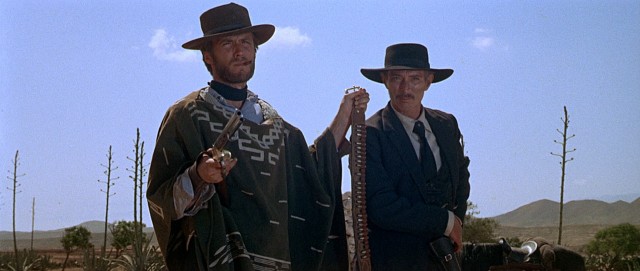
The success of A Fistful of Dollars gave Leone more creative control of what he wanted to do with his next project. Teaming up with up-and-coming producer Alberto Grimaldi, Leone decided to up the ante of the Western by going into more original storylines that would set itself apart from its predecessor. Entitled For a Few Dollars More, the film would revolve around the Man with No Name who teams up with a mysterious man in black to go after a ruthless criminal and his gang so they can collect a bounty on all of these men.
Leone collaborated with Fulvio Montella and Luciano Vincenzoni to create the script for the film while Leone and Grimaldi waited word about Eastwood’s participation in the project as he had not seen A Fistful of Dollars. Eastwood was reluctant to take part in the project until he finally saw the film as he decided to work with Leone for the second time. With Eastwood on board, Leone and Grimaldi got a chance to have more freedom as well as a bigger budget as the film would cost around $600,000 to make. The bigger budget would allow Leone to try and get established actors for the project as he tried to get Lee Marvin and Henry Fonda for the role of Colonel Douglas Mortimer. Unfortunately, they were too expensive as he eventually settled on famed character actor Lee Van Cleef as Mortimer.
With the production once again shot in Almeria, Spain with interiors shot at Cinecetta Studios in Rome, Leone gathered his crew that included Carlo Simi to create a film that was much broader than its predecessor. Even as Leone would work with a cast that was a mixture of Italian, Spanish, and West German actors that would also include Klaus Kinski as one of the bandits in the hunchback Wild. The production gave him more to do with the compositions he wanted as well as the presentation of the showdowns. With cinematographer Massimo Dallamo, Leone got a chance to create lighting schemes and shots that would be much broader in scope.
While the production was a fun one for the most part, Leone and his crew found themselves dealing with actor Gian Maria Volonte who had previously played one of the key villains in A Fistful of Dollars. Volonte and Leone sparred over Leone’s insistence in having multiple takes as Volonte would end overacting during the production as Leone decided never to work with Volonte once filming was finished. Another aspect of the production that made things interesting for Leone was his collaboration with Ennio Morricone who would create pieces for the film before shooting had begun. It would allow Leone a lot of ideas for what he wanted as Morricone’s score broadened to include Fender guitars, whistles, and chimes to play up the sense of suspense and drama.
The film was released in November of 1965 to great acclaim and box office as the film was a major hit in Europe. The film’s release allowed the Italian film industry to produce Westerns that would be known as the Spaghetti Westerns as filmmakers like Sergio Sollima and Sergio Corbucci would arrive to create their own westerns that are considered hallmarks of the genre. The film also gave more attention to both Eastwood and Van Cleef as the latter found himself getting numerous offers to star in European-produced westerns as he became a major star there just as his career in the U.S. was waning. For Leone, the success of A Few Dollars More proved that he was no fluke as he aimed to take his ambitions even further for his next project.
The Good, the Bad, & the Ugly
With two back-to-back big hits under his belt, Leone went ahead to write what would be the third and final film of his trilogy. Entitled The Good, the Bad, & the Ugly, the film would have the Man with No Name face off against two men on a race to find Confederate gold during the American Civil War. It would be a project that would have Leone up the ante in terms of storylines, visual presentation, violence, suspense, and everything else that he had done previously with his films.
,br />
Collaborating with Luciano Vincenzoni, who had co-wrote For a Few Dollars More with Leone, on the film’s screenplay along with the duo of Furio Scarpelli and Agenore Incrocci with American translation by Mickey Knox. The project would involve many ideas that Leone wanted to incorporate into the story that would include the uneasy alliance between the Man with No Name and a bandit named Tuco as well as the themes of war as the film’s three central characters would encounter a battle during the American Civil War. Leone also decided to make the film into a prequel of sorts into how the Man with No Name got his famed poncho and hat along with attributes to the character.
With Carlo Simi and Ennio Morricone back on board for the project, Leone would gain two new collaborators who would be part of his team as well as expand his visual style. The first was editor Nino Baragli who would help devise a cutting style that would become one of the definitive moments of the film with its three-way showdown as he collaborated with Eugenio Alabiso for the film. The other was cinematographer Tonino Delli Colli who was already famous for his work with Italian filmmaker Pier Paolo Pasolini. Delli Colli would provide a much more broader visual style to the film as he would give Leone the wide depth of field that was craved for the film’s shootouts and other big moments such as the battle scene that the characters would encounter.
With Lee Van Cleef immediately joining the project to play the antagonist Angel Eyes, Clint Eastwood was once again reluctant to reprise his role until Leone offered him $250,000 to star in the film as well as taking a 10% gross of profits from the film’s American release even though the previous films hadn’t been shown in the U.S. Also joining the cast is famed character actor Eli Wallach who was already a mainstay with Western as Leone casted him in the role of Tuco. With a cast of Italian, Spanish, and West German actors fitting in for the rest of smaller roles in the film, production went underway in the spring of 1966.
Once again shot in Spain, Leone had ideas that were much bigger that alarmed the film’s cast and crew as Delli Colli would help creating some long shots and scenes that matched up to epic films of the early 1960s. Leone’s ambition definitely was a surprise to some as well as Leone’s sudden desire for perfection. Leone’s filmmaking tendencies wasn’t favored by Eastwood who was becoming disenchanted with the Spaghetti Western sub-genre as well as having trouble with dealing with Leone’s newfound ambition. The result would have the two men falling out as Eastwood decided to never work with Leone after shooting wrapped. The two would become estranged for years until they briefly reconciled toward the end of Leone’s life.
With Morricone creating the music just before the film was to be shot, the music would show a newfound evolution into what the composer would create. Among them was the film’s theme as it featured an array of sounds including a whistle, a Fender guitar, human voices, and various woodwinds as it would become one of the most defining themes in film. Morricone’s score would also delve into operatic arrangements such as the piece Ecstasy of Gold and the theme for the final duel as it would play up to the ambition that Leone wanted for the film as Morricone’s score is often regarded as one of the great film scores in history.
The film was released in late December of 1966 with a running time of 177-minutes where despite the negative reception it got for its violence. The film was a major hit in the European box office as plans for a U.S. release was delayed as United Artists were unsure of how to release the film. After cutting 14 minutes of the original film, much to the dismay of Leone, for its U.S. release, the film became a surprise hit as its subsequent films were also released including a slightly re-cut version of For a Few Dollars More. The Dollars Trilogy not only gave the western genre a shot in the arm but also brought Leone more widespread attention internationally. The film would also finally make Clint Eastwood a star in the U.S. though he and Leone were already moving on with the next phases of their careers.
Once Upon a Time in the West
The success of the Dollars trilogy gave Leone clout internationally as well as the attention of Hollywood. Yet, Leone was unsure about tackling another western as he wanted to move on to different territory. Despite an offer from United Artists to make a film with such big names like Charlton Heston and Kirk Douglas, Leone turned down the offer until Paramount Studios came in with an offer he couldn’t refuse. It would be the chance to work with one of Leone’s favorite actors in Henry Fonda as Leone decided to create a western with Fonda in the starring role.
For this new project, Leone decided the film would be part of another trilogy that would based on key events that would shape the landscape of American culture. The first part entitled Once Upon a Time in the West would be about two men who would come to the aid of a widow as she’s targeted by a railroad baron who has hired a killer as they want her precious land. For the story treatment, Leone would work with up-and-coming filmmaker Bernardo Bertolucci and Dario Argento, who at the time was a film critic before making a name for himself as a horror filmmaker. Leone’s longtime friend Sergio Donati would eventually write with Leone for the film’s screenplay as they wanted to make a western that was different from their previous films as well as many other westerns.
Leone traveled to the U.S. for location scouting as he got to travel to famous landmarks where John Ford had shot some of his westerns as the film was shot partially in the U.S. as well as some of the locations set in Spain. Retaining his team of collaborators for the project, Leone also went ahead to start casting for the film as he grabbed two of Italian cinema’s big names in Claudia Cardinale as the film protagonist Jill McBain and Gabriele Ferzetti as the railroad baron Morton. Though Leone originally wanted Clint Eastwood in the role of Harmonica, Charles Bronson was chosen for the role while playing the role of Cheyenne would be Jason Robards. The film’s biggest shock would be in the antagonist Frank as Leone decided to have Henry Fonda in the role. The idea of Fonda as the villain was shocking as Fonda was unsure about doing the film until Eli Wallach convinced him to play the part.
Leone also brought in many character actors from westerns such as Woody Strode, Al Mulock, Keenan Wynn, and Jack Elam for small parts where Strode, Mulock, and Elam played the three men Harmonica meets in the film’s opening sequence. The sequence would be the start of many key visual moments Leone would devise with cinematographer Tonino Delli Colli where he wanted to slowly build up the element of suspense as well as create something that was more psychological in its motivations for the characters involved. It would also be the first time Leone used flashbacks as a plot device for the film as it revolves around Harmonica’s search for Frank.
Another major change that Leone wanted was to make a film that revolved around a female character as a lot of his previous films were dominated largely by male. It was Leone wanting to take chances with his narrative as the film would also be multi-layered with lots of storylines revolving around the film’s five central characters. With lots of wide shots, unique camera angles, and other visual traits that Leone would refine for this film, the film would be a far more ambitious project that anything Leone would make in his career.
Adding to the film’s grand visual style is the music of Ennio Morricone as he would create four different themes for Frank, Harmonica, Cheyenne, and Jill McBain. The mixture of folk and operatic orchestral music would play a key part to what Leone wanted for the film as Morricone devised harmonica-driven music for Harmonica while Frank is led by a dorbo-guitar riff. Cheyenne would be accompanied by a banjo while Jill’s theme is led by an operatic voice that add to the sweeping tone of the film. Notably with its ending as it revolved around what many believed to be the end of the west by the arrival of the railroad cross country.
The film was released in December of 1968 in Italy where it was well-received en Europe under its original running time of 166 minutes. When it came time for its U.S. release in May of 1969, Paramount decided to cut more than twenty-minutes of footage from the film against Leone’s consent where the film was not well-received in the U.S. and flopped in the U.S. Though the film would later be considered to be one of the great films of the western genre as well as being heralded by some filmmakers and critics as one of the best films ever made. The disappointing reaction the film had in the U.S. had Leone beginning to distrust Hollywood as he went on hiatus for the next few years.
Duck, You Sucker!
In the aftermath of Once Upon a Time in the West, Leone laid low during that period as he watched from afar to see that Spaghetti Western sub-genre that he helped popularize was now becoming derivative as elements of comedy was seeping into the genre. Leone was becoming disenchanted with the genre as he was also seeing a lot of political strife happening in Italy as social changes were going on. In response to the social revolutions that were happening in Italy, Leone decided to make a project that was about the fallacies of revolutions as he collaborated with Sergio Donati and later Luciano Vincenzoni to write a screenplay that was called Giu la testa! which meant in English, “duck your head, asshole!”
Leone’s intention for the project was to be involved as a producer where he would collaborate with another director for the project. Peter Bogdanovich was the first choice as briefly signed on only to leave due to lack of control issues. There were also claims that Sam Peckinpah was to helm the project only to not be involved due to financial issues with U.S. distributors in United Artists. It was around that time that Leone was also casting the film as he hoping to get some big names involved for the film. He eventually got James Coburn for the role of former IRA revolutionary John Nolan while Rod Steiger was cast in the role of Juan Miranda when Leone couldn’t get Eli Wallach for the part due to the studio wanting a bigger name.
With Italian star Romolo Valli signed on for the supporting role of revolutionary leader Dr. Villega, the film was set to go into production with assistant director Giancarlo Santi to helm the project. Yet, Coburn and Steiger refused to work with Santi as they wanted Leone to helm the project as Leone eventually agreed to helm the project full on with Santi shooting second unit. While Leone was able to retain Ennio Morricone and Nino Baragli for the project as Carlo Simi and Tonino Delli Colli were unavailable due to other commitments. Leone was able to hire Giuseppe Ruzzolini to shoot the picture as it was shot mostly in Spain with some of the film shot in Dublin, Ireland.
With the story set during the Mexican Revolution in the early 1900s, Leone wanted to create a film that was about changing times as it relates to the social revolutions of the early 1970s. With the film’s main story that revolves around the conflict between this IRA revolutionary and a poor man, Leone wanted to reveal his own views on revolution as he opens the film with a quote by Mao Zedong on the fallacy of revolution that is followed by robbery scene of Miranda robbing rich people who had earlier said things about the poor.
With Leone’s wanting to carefully plan his visuals, he was also inspired by paintings as he created one notable scene about an execution that looked similar to Francisco Goya’s The Third of May 1808 painting. Leone and Ruzzolini would create lighting schemes that was similar to that while Leone would also use flashbacks to establish Nolan’s background with revolutions and the loss of innocence that he encountered that would be accompanied by lush, operatic music by Ennio Morricone.
The film was released in the fall of 1971 in Italy where it did well commercially in its native country despite lukewarm reviews yet it got big praise from Italian filmmaker Pier Paolo Pasolini who found it to be Leone’s most interesting work to date. For the film’s subsequent releases in the rest of Europe and the U.S., the film went through many drastic cuts as its original 157-cut went through many versions including a slightly shorter version in Europe under the film’s then-working title Once Upon a Time… the Revolution while the U.S. release received a much shorter version of 121-minutes under the title A Fistful of Dynamite where both versions cut the Zedong quote as well as graphic scenes of violence. In 2007, the film was finally restored in its original cut for a DVD release as it also got a brief U.S. theatrical release where many critics praised the film as Leone’s most overlooked work.
My Name is Nobody/A Genius, Two Partners, & a Dupe
With the wave of the Spaghetti Westerns becoming derivative, Leone decided to be involved more as a producer where he would develop projects for other filmmakers at the time. One of them was a parody of the genre that he helped created in a film that was called My Name is Nobody that starred one of the sub-genre’s big stars in Terence Hill as a young gunslinger who teams up with an aging gunslinger going up against a ruthless gang. To play the role of the legendary Jack Beauregard, Henry Fonda accepted the role due to his friendship with Leone. Leone only chose to direct the film’s opening scene and shootout while letting its director Tonino Valerii helm the rest of the film.

The project was a success though both Leone and Valerii were unhappy about the film’s promotion being attested to Leone as it led to Leone to produce a loose sequel of sorts called A Genius, Two Partners, & a Dupe that would also star Hill. The film also featured Klaus Kinski, Miou-Miou, and Patrick McGoohan as it revolves con artists trying to swindle an Indian-hating cavalry man. The project would be directed by Damiano Damiani as Leone directed the film’s opening scene. The project was another commercial success in Europe upon its 1975 release but it was not well-received with critics as Leone was unhappy with the film’s final results as he stayed away from the directing chair in order to stay further in the background producing other films as it would continue a long hiatus period.
Once Upon a Time in America
Following a period during the 1970s and parts of the 1980s where Leone produced various projects for other filmmakers while directing commercials on the side. Leone was trying to develop a project that he had been wanting to do since the late 1960s. It would be in an adaptation of Harry Grey’s 1952 novel The Hoods as Leone wanted to create a gangster film that was unlike anything else out there. A project he originally wanted to do after the Dollars trilogy, Leone took a long time to get it made as he even turned down an offer to direct The Godfather during that period where he would also meet Grey to get him to agree to adapt The Hoods into what would become Leone’s final film in Once Upon a Time in America.
While Leone didn’t have the rights to the project at the time, he would write the film with six co-writers including Franco Arcalli who had co-written Bernardo Bertolucci’s 1972 film Last Tango in Paris as well as editing some of Bertolucci’s films in the 1970s. American writer Stuart Kaminsky was hired to translate the screenplay into English while adding some dialogue to the script as Leone continued to get the project going as it went through a period of development issues as actors like Gerard Depardieu, Jean Gabin, Richard Dreyfuss, James Cagney, Paul Newman, and many others were attached. When Leone finally got the rights to the story with Grey giving him permission, Leone was finally able to do the project with renowned producer Arnon Milchan backing him up.
Though Leone had intended to produce the film while a younger director would helm the project as John Milius was approached, Leone ended up helming the project himself. With the casting still in development, Leone finally got his cast as Robert de Niro got the lead role of Noodles while James Woods played the role Noodles’ friend Max, and Elizabeth McGovern in the role of Noodles’ love interest Deborah. Other actors who were cast for notable supporting parts included Tuesday Weld, Danny Aiello, Treat Williams, Joe Pesci, Burt Young, and William Forsythe as Leone was also looking for young actors to play the young versions of the film’s central characters. A young model named Jennifer Connelly was cast in the role of the young Deborah as filming finally began in June of 1982.
Leone would retain many of his collaborators for the film including cinematographer Tonino Delli Colli and art director Carlo Simi while it would expand to include costume designer Gabriella Pescucci and production designer Walter Massi for the film. Shooting took place largely in New York City with many of the film’s interiors shot at Cinecetta Studios in Rome, Italy along with additional scenes in St. Petersburg, Florida and in Quebec. Leone wanted to explore the world of the gangster era during the Prohibition as the film would span into three different timelines from the early 1900s when the characters were children to the era of Prohibition where Noodles, Max, and their gang were young gangsters on the rise. The third time period the film is set is in the late 1960s where Noodles returns to New York City where he’s given an assignment to kill a politician as he reflects on his past.
Leone wanted to create a story that was very different from other gangster films as it explored many themes of ambition, betrayal, loss, and regret as the story moved back and forth from Noodles’ time in the 1960s to the past as he recalls his time as a young hood who becomes a gangster. It would be a narrative device that Leone wanted in order to create the sense of dramatic impact Noodles would have as he deals with tragedy at an early age as well as loss and regret where it climaxes with this meeting between the man he’s supposed to kill. With editor Nino Baragli helping to flesh out the film’s narrative device, it would give Leone the chance to establish everything Noodles went through as it also featured an ending that many described to be an ambiguous one.
For the film’s score, Ennio Morricone created lots of pieces that he had been working on for years as it lived up to the ambition that Leone wanted. Though he was reluctantly about one of the film’s themes in the lush theme for the character of Deborah that sounded similar to the score for Once Upon a Time in the West. It would prove to be effective as Morricone also used an array of Chinese instruments including the pan flute that would also be effective for the film.
After numerous delays in the editing as the film went through various versions as Leone even thought of releasing the film in two parts as it featured a total running time of six hours. Not wanting to risk a major failure due to the troubled release of Bernardo Bertolucci’s 1976 epic Novocento that had a running time of over five hours. Leone finally cut the film to a running time of 229 minutes as he premiered the film at the 1984 Cannes Film Festival where it received a 15-minute standing ovation. When it came time for the film’s U.S. release, the MPAA had issues over the film’s violence and sexual content that included a very graphic rape scene. When the film was subject to test screenings in the U.S. before its official release, things got worse as James Wood stated in the 2004 documentary Z Channel: A Magnificent Obsession saying “because of one lousy test screening in Chicago. They hired the editor of Police Academy to re-cut the film.”
The Ladd Company and editor Zach Staenberg would cut the 229-minute film into 139-minute film and turn the film’s back-and-forth narrative into a more chronological-based film. Leone was extremely upset by the re-cut version of the film as many of Leone’s friends knew how heartbroken he was by how the studio butchered his film. For the American film critics that saw the original film and had praised it, they panned the re-cut version which flopped in the U.S. while for those that hadn’t seen the original version like L.A. Times critic Sheila Benson who named it the worst film of 1984 only to see the original version when it played on the L.A.-based cable channel Z-Channel a year later and later put the original version as one of the best films of the 1980s.
In the aftermath of the film’s release, Leone spent the last five years of his life trying to develop a project about the Russian Revolution called Leningrad: The 900 Days that would star Robert de Niro as an American photographer covering the war as he falls for a Russian woman. It was among a slew of projects Leone wanted to do as he later gained funding for Leningrad in 1989. Then on April 30, 1989 at the age of 60, Leone died of a heart attack as it marked the end of one of cinema’s great careers.
In the years since Leone’s death, countless filmmakers have acknowledged Leone’s influence on cinema while critics and film buffs also cite Leone as one of the great filmmakers of the 20th Century. In 1992, Clint Eastwood released the western Unforgiven to great acclaim and box office as it won four Oscars including Best Picture and Best Director to Eastwood as he dedicated the film to Leone as well as his Dirty Harry director Don Siegel. In the 1990s, two emerging American filmmakers in Quentin Tarantino and Robert Rodriguez both acknowledge Leone as one of their key influences. Rodriguez’s Mariachi trilogy was directly inspired by the Dollars trilogy while Tarantino’s Kill Bill series featured elements of the Leone visual style as well as the music of Ennio Morricone.
Other filmmakers outside of the Western genre has also acknowledge Leone’s influence such as Rian Johnson whose 2005 high school-noir film Brick had touches of the Leone visual style. Gore Verbinski is another filmmaker who expressed love for Leone as his 2011 animated film Rango featured lots of references to the western including the films of Leone. Since his passing, Leone’s films had also been re-evaluated by critics as the arrival of the DVD helped raise Leone’s reputation where in 2003, MGM released a restored version of The Good, the Bad, & the Ugly with material that got cut out of the film’s original American release. This led to the release of newly-restored versions of For a Few Dollars More, Once Upon a Time in the West, and Duck, You Sucker! as they were finally presented in their original cuts to a new generation of filmgoers.
In 2012, Martin Scorsese commissioned a restoration of Once Upon a Time in America that features more than 20 minutes of footage that was cut from the film’s original release. While the extended version is still in the works for an upcoming DVD/Blu-Ray release, audiences got a chance to see at the 2012 Cannes Film Festival as it was presented by Robert de Niro, James Woods, Elizabeth McGovern, Jennifer Connelly, and Ennio Morricone.
It’s been nearly fifty years since the release of A Fistful of Dollars and nearly thirty years since the release of Once Upon a Time in America. Yet, Sergio Leone has managed to create a legacy that is simply unforgettable. Through the westerns he made in the 1960s and early 70s along with Once Upon a Time in America, there is clearly no doubt that Leone is among one of the great filmmakers to ever step behind a camera. His influence is definitely widespread as he is beloved by film buffs and filmmakers alike. Though Sergio Leone may no longer be around, his legacy will still live on through the films he’s made as there will always be someone to watch them.
Related: Once Upon a Time: Sergio Leone
© thevoid99 2012
Directed by Kathryn Bigelow and written by Bigelow and Eric Red, Near Dark is the story of a young farmhand who falls for a young woman only to learn she’s a vampire as he reluctantly becomes part of a vampire cult. The film explores the world of vampires from a newborn vampire’s perspective as he struggles with this new role. Starring Adrian Pasdar, Jenny Wright, Lance Henriksen, Jenette Goldstein, Bill Paxton, Joshua John Miller, and Tim Thomerson. Near Dark is a visually-entrancing yet chilling film from Kathryn Bigelow.
At a small town in Oklahoma, a farmhand named Caleb (Adrian Pasdar) meets a beautiful young woman named Mae (Jenny Wright) one night as he takes her on a night around the town but she insists on going home. Caleb takes her home but wants to kiss her as they do only for Caleb to be bitten in the neck as he struggles to walk home to his family where he was suddenly abducted by a group of people in a motor home. Caleb learns that Mae is a vampire as she’s part of a group of vampires led by Jesse (Lance Henriksen) as it also consists of Diamondback (Jenette Goldstein), an old man in a boy’s body named Homer (Joshua John Miller), and wild man named Severen (Bill Paxton) as they wonder whether to take Caleb in as he’s about to turn into a vampire.
Caleb tries to leave in order to return home only to realize that he needs blood as Mae gives him some of her own blood to feed on while everyone else kills people for feeding. Caleb reluctantly joins the band of drifting vampires as they keep moving from city to city to quench their appetite as they all attack a bar and burn it while Caleb almost kills a young man (James LeGros) he was trying to feed on but lets him go. This would eventually lead to trouble when the vampires stay at a motel as they’re ambushed by the police only for Caleb to save them. Just as Caleb is about to accepted, Homer comes across a young girl named Sarah (Marcie Leeds) as he tries to capture her as Caleb realizes its her sister as their father Loy (Tim Thomerson) had been trying to find Caleb. After the vampires decide to target Caleb’s family, Caleb decides to do something that would save his family from Jesse and the vampires.
The film is essentially the story of a bored farmhand from a small Oklahoma town who comes across a band of drifting vampires as he reluctantly becomes part of their group only to realize what they need to do to survive as he eventually becomes more unsure once his family is targeted. It’s a story that explores a man trying to deal with being a newborn vampire and all of its consequences as well as his feelings for this beautiful woman who is also a vampire. Yet, this woman is also reluctant about her role as she’s more willing to accept but she becomes more unsure once it involves that man’s family while the rest of the vampires are just looking for people to feed on no matter who they are.
The screenplay is a different take on the myth of the vampires by setting them in a modern time where they’re moving from place to place in order to evade the law. A lot of the film is told from the perspective of Caleb who is just this very simple farmhand who knows nothing about the world of vampires as he is forced to give into survival mode as well as realizing that he’s no longer human. Still, he wants to return home to his family as they would see him be abducted as they would play a key part in the film’s plot in their search for Caleb. This would lead to a climatic third act in which Caleb has to fight off Jesse and this band of vampires who are really unmerciful with anything they come across to.
Kathryn Bigelow’s direction is very stylish in terms of the presentation that she creates as she often sets her scenes at night where the look has this very entrancing visual style that is somewhat reminiscent of film noir. Particularly in setting moods that marks the arrival of the vampires and Caleb’s struggle in this new world where the vampires rule and can do whatever they want. For the daytime scenes, a lot of it is set inside whether it’s in a car or wherever they stay in order to hide from the sun. Bigelow maintains a sense of intimacy in those scenes while also creating some broad yet intense shots for scenes outside whether it’s day or night as includes some very explosive action sequences that is mixed with some dark humor. Notably as the climax is this great mix of action and suspense with a bit of the western mixed around. Overall, Bigelow creates a very exciting and engaging thriller that plays around the myth of the vampires.
Cinematographer Adam Greenberg does amazing work with the film‘s stylish photography to play out the dark mood of the film with amazing lighting schemes for many of the film‘s nighttime exterior scenes as well as police raid sequence in the day with all of those wholes as it‘s a real highlight of the film. Editor Howard E. Smith does superb work with the film‘s editing by employing lots of stylish cuts for the film‘s action and suspense scenes as well as transition wipes to help the film move at a brisk pace. Production designer Stephen Altman and art director Dian Perryman do fantastic work with the set pieces from the motor home the vampires drive in early in the film to the motel room during the police raid with all of its holes and such.
Costume designer Joseph A. Porro does some nice work with costumes as it plays to the different personalities the characters wear from the more leather-cowboy look of Severin to the more ragged look of the other vampires. Sound designer David Lewis Yewdall and sound editor R.J. Palmer do terrific work with the sound to convey the sense of horror that occurs as well as some of the film‘s intense action scenes. The film’s music score by Tangerine Dream is phenomenal for its electronic score to play out the dark mood of the film as it also features some guitars for some of the more intense scenes. The soundtrack features a wide of music from acts like John Parr, Jools Holland, the Cramps, and George Strait as most of it features in the film’s bar scene.
The casting by Karen Rea is incredible for the ensemble that is created as it features some small appearances by Theresa Randle as a woman in a truck, Roger Aaron Brown as a Cajun truck driver, and James LeGros as a teenage cowboy who is almost killed at the bar scene. Marcie Leeds is pretty good as Caleb’s adolescent sister Sarah who is pursued by Homer while Tim Thomerson is great as Caleb’s father Loy who goes on a search to track down his son’s abductors. Jenette Goldstein is excellent as low-key vicious Diamondhead who will always attack when unexpected while Joshua John Miller is superb as the devious childlike vampire Homer. Lance Henrikson is wonderful as the very chilling leader Jesse who ensures everything that vampires are supposed to do as he also deals with the very naïve Caleb.
Bill Paxton is amazing as the very wild Severen as Paxton brings everything to this crazed character who has no qualms about killing anybody while displaying a dark charm and sense of humor as it’s character that is truly unforgettable to watch as it’s also one of Paxton’s great performances. Jenny Wright is terrific as Mae where she brings an innocence to a character who is very dark as she goes into conflict about whether to help Caleb or the rest of the vampires. Finally, there’s Adrian Pasdar in a brilliant performance as Caleb where he displays a sense of naivete` as a man dealing with his new powers while pondering about what to do as a vampire as it’s really an engaging performance from Pasdar.
Near Dark is an outstanding vampire thriller from Kathryn Bigelow that features top-notch performances from Adrian Pasdar, Lance Henriksen, Jenny Wright, and Bill Paxton. The film is quite different from Bigelow’s more action-driven work yet it does have a lot of intensity that will entertain audiences. It’s also a film that plays true to what vampires are as it doesn’t feature mopey pussies who won’t kill or any kind of gooey love story that involves constipated werewolves. The bottom line is that Near Dark is a vampire film that is fun and action-packed that is geared to give audiences a good time as it comes from the wondrous mind of Kathryn Bigelow.
Kathryn Bigelow Films: The Loveless - Blue Steel - Point Break - Strange Days - The Weight of Water - K-19: The Widowmaker - The Hurt Locker - Zero Dark Thirty - The Auteurs #29: Kathryn Bigelow
© thevoid99 2012
Based on the novel Celle qui n’etait plus (She Who Was No More) by Pierre Boileau and Thomas Narcejac, Les Diaboliques is the story about a woman and her husband’s mistress conspiring to kill the man where strange things happen when his body suddenly disappears. Directed by Henri-Georges Clouzot and screenplay by Clouzot and Jerome Geronimi that also features additional contributions by Rene Masson and Frederic Grendel, the film is an exploration of murder and its aftermath where guilt and such start to unfold. Starring Simone Signoret, Vera Clouzot, Paul Meurisse, and Charles Vanel. Les Diaboliques is a chilling suspense film from Henri-Georges Clouzot.
At an all-boy’s school in France, the frail Christina Delassalle (Vera Clouzot) is dealing with her cruel husband Michel (Paul Meurisse) who is the school’s headmaster. Michel also has a mistress in the teacher Nicole Horner (Simone Signoret) as their affair is quite known with the staff as Christina also knows about it. Yet, the affair is taking on a downward turn as Nicole and Christina conspire to get rid of Michel over his cruelty towards everyone including the students as the two women go away for the weekend at Nicole’s apartment in another town. Michel plans to make a visit after learning that Christina wants to divorce as he confronts her at Nicole’s apartment where he drinks the wine that Nicole has poisoned. After Nicole drowns him in a tub, the two put the body in a drunk as she and Christina drive back to the school as they dump in the school’s dirty pool.
Continuing their work as teachers, Christina and Nicole notice something is going on when the school’s gamekeeper Plantiveau (Jean Brochard) has been cleaning the school’s pool. After draining it, Christina and Nicole notice the body is missing where Christina begins to panic and feel guilty over what happened. When Nicole reads a newspaper report about a body being found at the Seine River, Christina goes to the morgue to identify the body where she meets a retired private detective named Alfred Vichet (Charles Vanel) who is intrigued by her story as she wants to find her husband. Alfred decides to help Christina after a claim from a boy abut seeing Michel as she and Nicole wonder if Michel is really alive after Nicole sees a picture. After Nicole decides to leave the school with Christina ailing from her heart condition, Vichet makes a visit with some notes he made as Christina deals with all of the guilt she faces as well as a major surprise.
The film is essentially a psychological thriller that revolves around two women who want to kill a cruel man and get rid of his body only for something to go wrong when the body suddenly disappears. This leads to all sorts of issues for the two women as the wife becomes fraught with guilt and paranoia as she also has a weak heart condition. For her husband’s mistress, she’s the one trying to control the situation only to realize that the disappearance of the body and the possible appearance of this man is beyond her control as a former private detective starts to get involved. This would lead to all sorts of questions and everything as it leads to some harsh revelations about this man and everything else.
The screenplay does a great job in building up the element of suspense by taking things slow by establishing the relationships between Christina, Nicole, and Michel as where it’s an uneasy love triangle that has Michel being cruel to everyone. He’s much harsher to the very ill Christina who wants out of the marriage as she teams up with Nicole to get rid of Michel any way they can. The first half is about the planning to kill Michel and the murder while the second half is about his body disappearing as well as Christina’s guilt as she turns to Vichet for help that would eventually complicate everything. Vichet is the film’s wild card as he would definitely steer things in the third act that would unveil lots of things along with some of the revelations that occur.
Henri-Georges Clouzot’s direction is definitely mesmerizing in terms of the compositions he creates as well as his approach to suspense. Particularly in taking the time to establish the characters and the situations that would drive Nicole and Christina to make plans to kill Michel. Through some very stylish scenes of the two women riding in a truck that would later carry the body as well as some very straightforward but ominous framing to display the sense of terror that might happen. Clouzot also takes the time to shoot certain objects in order to maintain this unsettling atmosphere where his camera would gaze at the pool or something to see if there is something out there.
Clouzot’s direction also becomes much more brooding as the film reaches the second act through these very strange moments such as the mysterious person in the picture as well as a boy’s claim he saw Michel. Even as Clouzot becomes much more atmospheric in his approach to scenery such as Nicole’s walk towards the darkened hallway or Christina’s walk towards the building to see what is out there. This would lead to some startling reveals and scary moments that really makes the suspense payoff along with more ambiguities that are followed towards the end of the film. Overall, Clouzot creates a very fascinating yet hypnotic suspense film that explores the world of murder and guilt.
Cinematographer Armand Thiraud does amazing work with the film‘s stylish black-and-white photography for some of the film‘s nighttime interiors to help set a mood for the scene and help play out its suspense. Editor Madeleine Gug does brilliant work in creating methodical cuts to build up the film‘s suspense as well as some stylish rhythmic cuts for the suspenseful payoffs. Art director Leon Barsacq does excellent work in the look of the school building the characters live and surround themselves in as well as the apartment that Nicole lives in.
The sound work of William-Robert Sivel is terrific for the low-key atmosphere it creates such as the scene in the apartment where Nicole and Christina try to kill Michel as well as some tense moments involving the students during dinner time. The film’s music by Georges Van Parys is wonderful as it is mostly orchestral-based music that only plays at the film’s opening and closing credits of the film.
The film’s ensemble cast is superb as it features some noteworthy small roles from Noel Roquevert and Therese Dorny as Nicole’s neighbors at the apartment building, Pierre Larquey and Michel Serrault as fellow teachers at the school, and Jean Brochard as the gamekeeper Plantiveau. Charles Vanel is great in a small yet crucial role as the private detective Alfred Fichet as he is intrigued by Christina’s desperation as he would piece all of the puzzles about what really happened. Paul Meurisse is excellent as the slimy and cruel Michel Delassalle who is such a jerk to everyone including the women in his life as he’s the guy everyone loves to hate.
Vera Clouzet is brilliant as the guilt-ridden Christina as she tries to deal with Michel’s cruelty and the deed that she did as becomes overwhelmed as it would affect her health. Finally, there’s Simone Signoret in a harrowing performance as Nicole Horner as she maintains a restrained yet dark performance as a woman trying to maintain control of the situation while creating an ambiguity to her character.
Les Diaboliques is an incredible thriller from Henri-Georges Clouzot that features outstanding performances from Simone Signoret and Vera Clouzot. The film is truly a suspense film that doesn’t play to conventions nor does it try to cheat its audience by having them invested in the mystery. It’s also a film that explores the world of guilt and paranoia in the aftermath of committing a crime as well as maintaining that air of mystery of is this guy really dead or not? In the end, Les Diaboliques is a haunting yet enthralling film from Henri-Georges Clouzot.
Henri-Georges Clouzot Films: (Caprice de Princesse) - (Tour pour l’amour) - (The Murderer Lives at Number 21) - (Le Corbeau) - (Quai des orfevres) - (Manon) - (Miquette et sa mere) - The Wages of Fear - (Les Espions) - (La Verite) - (Grands chef d’orchestre) - (La Prisonniere)
Related: Henri-Georges Clouzot's Inferno
© thevoid99 2012

Based on Ian Fleming’s stories, Quantum of Solace is the story of James Bond seeking vengeance as he goes after the Quantum organization by targeting an environmentalist trying to control Bolivia’s water supply. Bond is then joined by a woman who is also seeking vengeance for her parents’ murder as the two team up. Directed by Marc Forster and screenplay by Neal Purvis, Robert Wade, Paul Haggis, and Joshua Zetumer, the film picks up where Casino Royale left of as Daniel Craig returns as the role of Bond for the second time. Also starring Olga Kurylenko, Mathieu Almaric, Gemma Arterton, Jeffrey Wright, Giancarlo Giannini, Rory Kinnear, and Judi Dench as M. Quantum of Solace is a decent but very messy film from Marc Forster.
After capturing Mr. White (Jesper Christensen) to find out who he’s working for, James Bond and M interrogate him only for something to go wrong when M’s bodyguard Mitchell (Glenn Foster) tries to kill M as Bond goes on the chase to go after him as they both realize that Mitchell is a double agent. Mr. White has suddenly disappeared as Bond and M found some banknotes at Mitchell’s apartment that is connected to a contact in Haiti. After finding the contact, Bond meets a woman named Camille Montes (Olga Kurylenko) whom the contact was supposed to kill as he learns that she’s the lover of an environmentalist named Dominic Greene (Mathieu Almaric). Bond watches the meeting as he learns that Montes is really going after a Bolivian general named Medrano (Joaquin Cosio), for killing her family many years ago, while Greene is making a deal with Medrano about getting land in Bolivia.
Bond travels to Austria to follow Greene as he infiltrates a meeting as he captures the pictures of many who are believed to be part of a secret organization known as Quantum. Yet, Bond manages to kill the bodyguard of a man connected to the British prime minister on his way out as M revokes his passports and credit cards forcing Bond to seek help from his old ally Rene Mathis (Giancarlo Giannini) who joins him to Bolivia to find out what Greene is up to as they’re met by a MI6 officer named Strawberry Fields (Gemma Arterton) who wants to take Bond back to London. Instead, Bond takes her to Greene’s party with Mathis to find out what Greene is up to as Montes is also there to find out what is going on. Bond and Montes decide to fly to the land that Greene wants to buy as they are nearly attacked by Bolivian planes where they learn what Greene is up to. With the help of Felix Leiter (Jeffrey Wright), Bond and Montes decides to confront Greene and Medrano to learn about Quantum.
The film is essentially a continuation of its predecessor in Casino Royale where James Bond goes after the people who are running a secret organization that he believes is responsible for the death of someone close to him. Throughout this journey, he learns more about this organization yet his thirst of vengeance eventually starts to become a liability for the MI6 as they try to make sure he doesn’t stray from the mission. It’s a very compelling story that has Bond trying to uncover this organization and seek vengeance as he also helps a woman get her revenge as well. It’s just that the story isn’t given the presentation that could’ve made it more captivating.
The screenplay definitely maintains its sense of mystery and intrigue but it’s very unbalanced with lots of action sequences that loses the luster on its suspense. Still, the script does succeed in making Bond more flawed as he still has a bit of inexperience in him in the way he deals with situations and such as he starts to understand more and more about what it takes to be a 00 agent. Helping him in this mission is Camilla Montes who is this woman seeking revenge for her parents’ death as she starts to piece the puzzle of what Dominic Greene is up to. The Dominic Greene character isn’t a traditional villain as he is really more of an organizer that is working for this mysterious organization yet he’s surrounded by people who will help him do things to make sure they’re taken care of.
Marc Forster’s direction has some moments that are quite engaging in some of the film’s action sequences and dramatic moments but he often delves way too much into action film conventions in terms of their presentation. Fast, choppy editing and shaky camera work give way to moments that almost become nonsensical and very hyperactive that it becomes a bit hard at times to follow through. Another problem with Forster’s direction is that the film has too many action sequences and not enough moments for the film to really invest in its mystery and intrigue despite the way he creates some gorgeous images of the locations and setting. Overall, Forster creates a film that tries to play up to the conventions of action films where it lacks the splendor and intrigue of the James Bond films.
Cinematographer Robert Schaefer does some excellent work with the photography by capturing the beauty of some of the film‘s locations in South America and Europe along with some lovely interior lighting schemes for hotel scenes in Bolivia. Editors Matt Cheese and Rick Pearson do terrible work with the editing as it plays too much into the frenetic fast-cutting style of action films where not much makes a lot of sense while not taking enough time to slow things down for the film‘s dramatic moments. Production designer Dennis Gassner, with set decorator Anna Pinnock and supervising art director Chris Lowe, does superb work with the set pieces such as the suite in the Bolivian hotel as well as General Medrano‘s base for the film‘s climatic face-off.
Costume designer Louise Frogley does nice work with the costumes from the tuxedos and clothes that Bond wears to the dresses that Montes and Fields wear in the party scene. Sound designers James Boyle and Martin Cantwell, along with sound editor Eddy Joseph, do some terrific work with the sound to convey the sense of atmosphere that occurs including the film‘s interrogation scene that is inter-cut with an event in an Italian town. The film’s music by David Arnold is pretty good for its mixture of orchestral bombast as well as plaintive folk music for some scenes set in South America to convey the sense of loss that Bond and Montes are going through. The theme song Another Way to Die by Jack White and Alicia Keys is an okay song with lots of orchestral flairs and guitar bombast but it’s all over the place as it’s just a duet that doesn’t really work.
The casting by Debbie McWilliams is wonderful for the ensemble that is created as it features some noteworthy performances from Simon Kassianides as the Quantum member Yusef, Stana Katic as a Canadian agent Yusef tries to target, Neil Jackson as the contact Bond fights in Haiti, Fernando Guillen Cuervo as Mathis’ Bolivian contact, David Harbour as Felix Leiter’s CIA contact, Glenn Foster as the double-agent Craig Mitchell, and Jesper Christensen as the mysterious Quantum official Mr. White. Other small roles such as Rory Kinner as M’s aide Bill Tanner and Joaquin Cosio as the slimy General Medrano are pretty good though Anatole Taubman as Greene’s henchman Elvis is a weak henchman who sports a very stupid-looking haircut. Gemma Arterton is quite fine as the MI6 official Strawberry Fields who aids Bond at Greene’s party while Giancarlo Giannini is excellent as Mathis who helps Bond go to Bolivia while providing insight about Bond’s thirst for vengeance.
Jeffrey Wright is terrific as Bond’s CIA friend Felix Leiter who goes undercover to find out what Greene is up to as he later helps Bond in going after Greene. Judi Dench is superb as M as she tries to deal with Bond’s tactics as well as whether to trust him with this mission. Mathieu Almaric is all right as the villainous Dominic Greene in trying to organize things for Quantum though he’s not a great villain as Almaric doesn’t really get a lot to do as he’s just a lackey for Quantum. Olga Kurylenko is brilliant as Camilla Montes as this woman who is seeking her own vengeance as she displays a sense of charm to her role in the way she interacts with Bond. Finally, there’s Daniel Craig as James Bond where Craig maintains that same sense of grit and weariness to his role as he also makes Bond more flawed in his pursuits as someone who remains haunted by previous events as it’s another captivating performance from Craig despite the film’s flaws.
Quantum of Solace is a very uneven film from Marc Forster that tries to be more of an action film than a suspense-thriller despite the stellar performances of Daniel Craig and Olga Kurylenko. The film is definitely one of the weakest films of the James Bond franchise due to the fact that it plays too much into conventional action film territory as it doesn’t invest in much time on the mystery and suspense as well as the fact that it’s also one of Forster’s weaker works as a filmmaker. In the end, Quantum of Solace is an okay but very underwhelming film from Marc Forster.
James Bond Files: The EON Films: Dr. No - From Russia with Love - Goldfinger - Thunderball - You Only Live Twice - On Her Majesty's Secret Service - Diamonds are Forever - Live and Let Die - The Man with the Golden Gun - The Spy Who Loved Me - Moonraker - For Your Eyes Only - Octopussy - A View to a Kill - The Living Daylights - Licence to Kill - GoldenEye - Tomorrow Never Dies - The World is Not Enough - Die Another Day - Casino Royale (2006 film) - Skyfall - SPECTRE - No Time to Die
Non-EON Films: Casino Royale (Climax! TV Episode) - Casino Royale (1967 film) - Never Say Never Again
Bond Documentaries: Bond Girls are Forever - True Bond - Everything or Nothing: The Untold Story of 007
Marc Forster Films: (Everything Put Together) - (Monster’s Ball) - Finding Neverland - (Stay (2005 film)) - Stranger than Fiction - (The Kite Runner) - (Machine Gun Preacher) - (World War Z)
© thevoid99 2012