Showing posts with label books. Show all posts

Tuesday, January 24, 2012

Secretary (screenplay book)


I apologize for the bad picture quality
The screenplay book for the 2002 film Secretary is a book that features the actual screenplay used for the film that was written by Erin Cressida Wilson plus additional text relating to the film along with an excerpt of the original short story Bad Behavior by Mary Gaitskill. The book also includes photos and an interview with its director Steven Shainberg about the film. The result is a must-have book for fans of the film.

The screenplay itself does following along with what the story appears in the final version of the film. The major differences is that there’s more scenes, a few more key characters, and different presentation of certain scenes. Among them is the way the film opens which is presented in the way the film has ended. There’s more scenes of cutting early in the story along with more moments such a montage of job interviews where the Lee Holloway character states her famed line “I want to be bored”. It’s among one of several things that don’t work which got changed in the final version of the film.

Certain characters such as Lee’s sister, a friend of Lee’s sister in the arty Allison, and Lee’s brother-in-law are given more exposure although it often strays too much from the main narrative. Particularly late in the story as the marriage of Lee’s sister and her husband unravels which was unnecessary as it was wisely cut from the final version. The character of Allison, which was only shown briefly in the final film, represents a character who befriends Lee though it suggests that Allison wants to be more than just Lee’s friend. It’s an interesting character but it feels out of place with the rest of the film itself. Then there’s Mr. E. Edward Grey where the script doesn’t reveal anything new about him that was already known in the final film. While the actual script is an interesting read, it does pale in comparison to what is shown in its final inception for the film.

The additional material in the book includes a foreword from Molly Haskel about the film’s approach to feminism and exploring the psychological aspects of the film in relation to its main characters. Screenwriter Erin Cressida Wilson’s introduction has talking about her own sexual experiences as well as her love for sadomasochism. Notably as she recalls meeting people who do have secret fetishes as she hoped that the film will get people to come out on their sexual fetishes. Steven Shainberg’s interview has him talking about some of the cinematic influences he used for the film as well as his approach to telling the emotional portions of the story. Shainberg also revealed that he made a short based on the film back in 1990.

The book also features shooting maps on the film where the camera is placed and such along with ideas for compositions. These diagrams give a great insight for aspiring filmmakers about how to present a scene such as Lee’s first meeting with Mr. Grey. The book features various photos presented in the script including a few making of shots and glossy colored photos in the book. Finally, there’s the excerpt of Mary Gaitskill’s Bad Behavior where it reveals the key scene of a secretary’s angry boss becoming frustrated with her as he spanks her next day. Though the original story was more downbeat than the final film presented, the excerpt is still an interesting read of where Shainberg and Wilson got their idea to create the film.

The screenplay book for Secretary is a definite buy for fans of the film as well as those who aspire to be in the world of film. While the actual script does have its flaws that were fixed for its final product. It does show insight of how that script was shaped and how it involved to the final version that is presented on film. In the end, the screenplay book for Secretary is a superb book from the film’s creator.

Related Reviews: Secretary - (Secretary OST) - (Favorite Films #5: Secretary)

© thevoid99 2012

Wednesday, July 13, 2011

Ghost World (graphic novel)


Written by Daniel Clowes, Ghost World tells the story of two young teenage girls who wander around their town bored by their surroundings. With their growing cynicism towards the world, one of the girls meets a cartoonist whom she admires which leads to the disintegration of the two girls’ friendship. Originally a comic book with eight issues that eventually became a graphic novel that was released in 1997. It is a coming-of-age story that strays from the convention of a lot of comic books as encounters themes of alienation and teen angst as it is definitely a fantastic graphic novel from Daniel Clowes.

Enid Coleslaw and Rebecca Doppelmeyer are two teenage girls that had just graduated high school as they look at the town they live in for the summer. Enid recalls her strange meeting with a strange man named John Ellis and a former priest, who supposedly carries child pornography, as she and Rebecca watch a lame comedian. Enid later tries to sell some stuff at a garage sale as she talked about a man she met at a diner they eat while showing Rebecca an aging couple that she believes are Satanists. When Enid decides to go punk, while trying to find some guy only to realize he’s a creep. Later, she recalls to Rebecca about the time she lost her virginity to some dude that turned out to be an unpleasant experience.

When Enid and Rebecca discover a diner that claims to be a vintage 50s diner, they realize the place is more modern than set in the 1950s while looking at a newspaper ad as they play a prank on a man. With their friend Josh reluctantly watching, the prank ends up being very humiliating as Enid and Rebecca feel guilty. When a man named Norman who often sits at an out-of-service bus stop disappears, the two girls look through a photo album as Enid becomes obsessed with finding a record. Yet, Enid’s disdain towards the world and her obsession with who should have sex with Josh as a wedge is happening between her and Rebecca as they move into different directions

Whereas most graphic novels and comics are always about superheroes and vigilantes, Daniel Clowes brings the world back to earth in this exploration of two girls living in a humdrum town. During this eight-part series of stories, Enid and Rebecca dwell into their surroundings after high school as they meet various people in their town. From an antagonistic man named John Ellis to a mysterious guy named Bob Skeetes that Enid looks for. The eccentrics that Enid and Rebecca encounter are the only things that remain interesting in a world that’s become surrounded by commercialism. Both girls are alienated though Rebecca isn’t as alienated since she gains more attention from boys though she wonders if they really like her.

During the course of the story, which is episodic in its narrative, the relationship between Enid and Rebecca changes throughout as it starts to disintegrate in the last two parts of the story. Largely because Enid feels out of place with the world while there’s pressure for her to go to school and succeed. In reality, Enid isn’t keen on conforming to what people expect from her as she desires to just go away and never return. Rebecca meanwhile, believes there is something out there while the attraction towards Josh is something she needed to fulfill the disintegrating relationship she has with Enid. It’s where Rebecca starts to step out of her own and not kind of be a foil for Enid in their exploration about their surroundings.

Daniel Clowes’ approach to developing the relationship between Enid and Rebecca as well as their own personal journey is very unique. Even as it’s about girls which is something very different in a world where most stories about comics and graphic novels are about men. Yet, Clowes make its universal about these girls and their alienation with the world as they try to deal with the people they encounter. It’s a very fascinating story as Clowes creates what is truly a compelling yet touching coming-of-age story.

Ghost World is definitely a superb yet entrancing graphic novel from Daniel Clowes. Anyone that wants a story that is more dramatic and isn’t about superheroes will see this as one of the essential dramatic graphic novels. For fans of the 2001 film adaptation that has never read the graphic novel will definitely see where some of the ideas came for the film itself. In the end, Ghost World is a haunting yet mesmerizing story from Daniel Clowes.


© thevoid99 2011

Tuesday, July 12, 2011

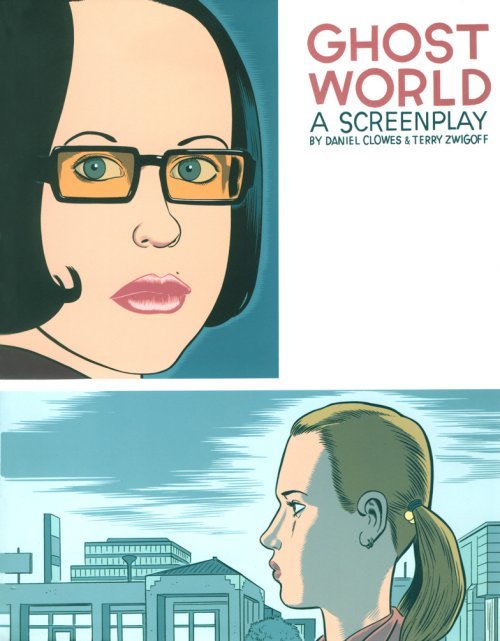
Ghost World (screenplay book)


Originally Written and Posted at Epinions.com on 10/16/04 w/ Additional Edits.


When it was released in 2001, no one thought the little quirky film called Ghost World that was based on Daniel Clowes’ obscure comic book/graphic novel would catch the attention of filmgoers and critics as the film landed in several top ten critics’ poll. Since its release on DVD a year later, the film has often become a favorite among rebellious young women that shortly after the film’s release Clowes and Ghost World director Terry Zwigoff decided to release an accompany screenplay book on the movie featuring thirty-pages worth of material not used in the film.

The script written by Clowes and Zwigoff based on Clowes’ comic book, Ghost World is a story of two young teenage girls scouring around their bored, suburban lifestyle after finishing high school. Then their friendship is put to the test when one of them encounters a loner where amidst the changing tides of their town through Corporate America, everything begins to change. The title Ghost World is a reference to the decline of the American mom-and-pop stores and self-owned business as its being replaced by all of these corporate businesses and how people end up conforming. The protagonist of the story is Enid, a short, dark-haired, slightly overweight girl who refuses to conform to these statures while watching her best friend Rebecca trying to move on with her life in order to buy an apartment and get a job. While the film and its story is more of a black comedy, Ghost World is a story that is filled with a lot of angst and melancholia as two lifelong friends find themselves falling apart around their world.

The film’s screenplay shows many of the scenes and lines shown in the movie and the dialogue is truly confrontational which featured the two girls using profanity excessively through their angst, which was something that bothered many major film studios. The only difference between the final script in the book and the final cut of the film is just a few things that were deleted including the ending which is a bit altered in reference to the fragile friendship of Rebecca and Enid as Rebecca ends up conforming while trying to move on with her life. The only thing in the ending not changed is the last scene involving Enid’s departure that doesn’t explain things that many fans of the film asked.

Other deleted material includes a conversation with Enid and Rebecca just before Enid starts work for her brief job in a movie theater along with more abuse for Rebecca at her coffee shop job. Plus, some scenes are moved like Enid’s father talking about Maxine where in the movie, that scene is shown earlier in the movie but in the script, it comes much later. One scene that was deleted and probably for good reason was a sex scene between Enid and Josh, another character that is often tormented by her and Rebecca.  This deleted scene would cause more damage to Enid and Rebecca’s friendship, along with Enid’s interest in Seymour. Another scene that is more extended in the script is Enid sleeping with Seymour where he would talk to his new girlfriend Dana about his relationship with Enid that was cut for good reason since in the film, the audience would know what Seymour would be saying.

Aside from the film’s script, the book includes a brief comic book thing where Enid and Rebecca commented on the recent success of the film through their sarcastic, bored attitudes. Also shown are unreleased pictures from the set of the film that includes cast members Thora Birch, Scarlett Johansson, Steve Buscemi, and many more. The book also includes an annotations section that includes commentary on some of the film scenes including some things that was a reference to the comic book.  One of the ideas for the film was getting Satanic religion leader Anton LaVey to play an assumed Satanist but he had died years before production began. Director Terry Zwigoff also talks about the character of Seymour which is actually based on him of sorts while he talks about the film’s soundtrack and music, often filled with obscure jazz records that he loved and he can’t tell ‘Nsync from the Backstreet Boys nor he cared to, especially since it wasn’t the type of music Birch or Johansson listened to.

Discussed in other sections is the film’s artwork done by Sophie Crumb, daughter of comic book artist Robert Crumb, who was the subject of Zwigoff’s 1994 documentary Crumb. A section was dedicated to Sophie Crumb and her artwork since Zwigoff felt she was the perfect person to help make the drawings for Enid and her talent really helped shape the film. Then there’s the subject of the Cook’s Chicken place where Buscemi’s Seymour worked and yes, there was a thing called Coon’s Chicken back in 1925 in Northwestern America that went out of business in the 1950s and never did change its name but only for the movie. Also included in the book are two introductions from Terry Zwigoff and Daniel Clowes.

Zwigoff’s introduction discusses his reasons to make Ghost World into a film after reading Clowes comic book since the film was to mark his feature-film debut. Zwigoff also discussed how the story was so appealing, notably in its alienation of what is becoming a very corporate culture. Zwigoff admits to not fitting in with the world and he made the film out of a Woody Allen approach while personally thanking his cast and crew for helping him through. Clowes’ introduction discussed his first meeting with Zwigoff back in 1995 where for years, they wanted to adapt the comic into a screenplay where its first draft was finished in 1997 before several rewrites until it attracted the attention of producer Lianne Halfon, who co-produced the movie with actor John Malkovich. In the end, Clowes feels the film belongs to him, Zwigoff, and Halfon who really was there on set helping the film move forward.

Fans of the film would want this screenplay book along with those aspiring to write screenplays. Those who love to read scripts will find this to be a nice collection though it’s really more of a nice accompaniment to the film for its hardcore fans. Those wanting to learn the craft of writing can get a very good look into the structure and style of the film’s script in its format. So in the end, the screenplay book of Ghost World is an excellent source for fans of the films and those wanting to write scripts.


(C) thevoid99 2011