Showing posts with label clive owen. Show all posts

Wednesday, January 16, 2013

The Hire


The Hire is a collection of eight short films revolving around a mysterious driver in different assignments while driving different variations of the BMW as these shorts were produced for the car manufacturer. Playing the role of the driver is Clive Owen as he ventures into eight different adventures helmed by eight different filmmakers as it also includes a diverse cast of actors to appear in these eight different short films. The result is an incredible collection of shorts from some of the world's best filmmakers.

Ambush (directed by John Frankenheimer and written by Andrew Kevin Walker) is about the driver escorting a man (Tomas Milian) carrying $2 million worth of diamonds as they’re being pursued by a van full of armed men. Chosen (directed by Ang Lee and written by David Carter) is the story about a holy boy (Mason Lee) escorted by the driver as they’re being pursued by criminals at a loading dock where the boy is supposed to be at a sanctuary. In The Follow (directed by Wong Kar-Wai and written by Andrew Kevin Walker), the driver is hired by his manager (Forest Whitaker) to pursue the wife (Adriana Lima) of a film actor (Mickey Rourke) to see if she’s cheating on him. Star (Directed by Guy Ritchie and written by Joe Sweet and Guy Ritchie) is about a spoiled celebrity (Madonna) who orders her driver to drive her to the venue where the results becomes more than she bargains for.

In Powder Keg (directed by Alejandro Gonzalez Inarritu and written by Alejandro Gonzalez Inarritu, Guillermo Arriaga, and David Carter), a war photographer (Stellan Skarsgard) is wounded after taking a photograph as the driver tries to get him to the border so he can be saved. Hostage (directed by John Woo and written by David Carter, Greg Hahn, and Vincent Ngo) is about the driver delivering ransom money to a man (Maury Chaykin) who had kidnapped a CEO (Kathryn Morris) as he later races to save her. In Ticker (Written and directed by Joe Carnahan), the driver escorts a man (Don Cheadle), who is carrying a mysterious briefcase under the orders of a mysterious man (F. Murray Abraham), as they’re under attack from a helicopter while running short on time.

In Beat the Devil (Directed by Tony Scott and written by David Carter, Greg Hahn, and Vincent Ngo), James Brown makes a visit with the Devil (Gary Oldman) to renegotiate an old contract in the form of a wager through a drag strip race in Las Vegas between the driver and the Devil’s driver Bob (Danny Trejo).

The film is a collection of stories involving a driver and all of the adventures he takes in. Some are intense, some are quite funny, some are dramatic, and others are just downright fucking insane. While Star and The Follow don’t exactly follow the conventions of most car-driven films. They do contain some amazing driving sequences as the former is just a straight-out comedy from Guy Ritchie while the latter is a moody piece filled with evocative voice-over narration that plays true to Wong Kar-Wai’s style. Chosen may be an action piece of sorts but Ang Lee inject bits of humor as well as a story about a man and a boy. The rest of the series play to the world of action as the filmmakers each put their stamp into the different stories. Joe Carnahan and John Frankenheimer each create stories involving a passenger that is carrying something where the latter is more slick and professional while the former is more stylish with its mixture of grainy film stock and more clear cinematography.

Alejandro Gonzalez Inarritu’s Powder Keg is definitely the most unconventional in terms of action and drama as it is presented in a grainy film stock courtesy of cinematographer Robert Richardson. John Woo’s Hostage is a strange twist on the hostage story not just because of the kidnapper but what happens afterwards. Then there’s Tony Scott’s Beat the Devil where it’s definitely the strangest one of them all as it’s a mixture of humor and action with a bit of Satanism that involves James Brown and a cameo appearance from Marilyn Manson.

While all of the shorts do stand out on their own, The Follow is clearly the best of them all due to its lingering images from cinematographer Harris Savides and its hypnotic soundtrack. The casting is also great as many of the actors involved are amazing yet the series really belongs to Clive Owen. Owen displays a really low-key approach to his character as he’s just a driver while he does get the chance to be funny but also intense as he really is the star of the series.

The Hire is an extraordinary series of short films that features a superb performance from Clive Owen. The series is a must-see for fans of many of these filmmakers for the way it utilizes different models of BMWs to help tell a story that is engaging but also intense. In the end, The Hire is a fantastic collection of short films from some of the world’s best filmmakers.

© thevoid99 2013

Monday, November 12, 2012

Sin City


Originally Written and Posted at Epinions.com on 1/4/06 w/ Additional Edits


Based on Frank Miller's graphic novel series, Sin City is a collection of stories set in a dark seedy world featuring many of its players as they defy the law and do all sorts of dastardly deeds. Written for the screen, produced, and directed by Robert Rodriguez and Frank Miller with special guest director Quentin Tarantino, Sin City is a dark, violent, gritty film that pushes the limits of the film noir genre. Using the same, digital style of his Spy Kids films, Rodriguez goes a look that is similar to Miller's graphic novels. Starring Rodriguez/Tarantino regulars like Bruce Willis, Mickey Rourke, Josh Hartnett, Michael Madsen, Elijah Wood, and Carla Gugino plus Jessica Alba, Devon Aoki, Alexis Bledel, Rosario Dawson, Nick Stahl, Brittany Murphy, Jamie King, Marley Shelton, Rutger Hauer, Powers Boothe, Benicio del Toro, Clive Owen, and Michael Clarke Duncan. Sin City is a fast, powerful, in-your-face film that brings Frank Miller's vision to life.

It's a rainy night in Sin City as a mysterious man (Josh Hartnett) looks upon a woman (Marley Shelton) as she looks out on the rain. The mood sets for the night when a big, battered ex-convict named Marv (Mickey Rourke) is accused of killing a hooker he loved named Goldie (Jaime King). He escapes the cops as he flees into the home of his lesbian parole officer Lucille (Carla Gugino) for some pills. After stepping into the bar where dancing is a young stripper named Nancy (Jessica Alba) while a waitress named Shellie (Brittany Murphy) gives him a drink. Marv looks for answers on who killed Goldie as her twin Wendy is going after him. Marv goes to a farm where he finds a young, cannibalistic killer named Kevin (Elijah Wood) who works for the town's cardinal Roark (Rutger Hauer) whose brother (Powers Boothe) is a senator. After another escape from the cops, he turns to Wendy and her gang in the seedy section of Old Town as he gets help to seek vengeance on Goldie.

Meanwhile in that same bar, Shellie is trying to evade a violent madman named Jackie Boy (Benicio del Toro) who is trying to figure who is Shellie's new boyfriend who is a big man named Dwight (Clive Owen). Jackie Boy comes to her apartment where he meets Dwight and after a confrontation, Jackie Boy leaves as Dwight decides to go after him. Jackie Boy enters the world of Old Town which is run by venomous hookers led by the sexy Gail which includes the innocent Becky (Alexis Bledel) and the silent samurai Miho (Devon Aoki). After Jackie Boy and his gang try to sweet-talk Becky into coming with them, Miho kills the gang as Dwight and Gail watch. Then they learn a horrible secret about Jackie Boy that threatens a peace treaty between cops and the ladies of Old Town as Dwight tries to return Jackie Boy's body downtown which starts troubling since Jackie Boy is still alive. After encountering a group of Irish mercenaries, Dwight is delayed as Gail is suddenly being tortured by Manute (Michael Clarke Duncan) who is the leader of corrupt cops. With the help of Miho, Dwight evades the Irish mercenaries led by Brian (Tommy Flanagan) as he joins Gail for their war.

The last story involves a burnt-out cop named Hartigan (Bruce Willis) with a bad heart condition who is one-day away from retirement as he tries to rescue a young girl (Mackenzie Vega) from a troubled young man (Nick Stahl) who turned out to be the son of Senator Roark. Despite saving the young girl and wounding Roark's son, Hartigan is in the hospital but is forced to go to jail by the Senator unless he confesses to molesting the young girl. Though the girl who would become Nancy would write to him, trouble emerges eight years later when a creature in yellow appeared as Hartigan decides to bust out. With help from his former partner Bob (Michael Madsen), Hartigan goes to Sin City where he finds Nancy and the Yellow Bastard as Hartigan's promise to protect Nancy is underway.

Shot with digital cameras in Rodriguez's own studio in Austin with top visual effects equipment, this film is truly one of the most visually-inspiring movies to come out in many years. With its ode to the film-noir genre, the film is shot mostly in black-white with dabbles of color to appear. The directing by Rodriguez and Miller is definitely amazing in its ode to the film-noir genre while the violence and sex is very graphic which is true to Miller's vision. This film isn't for those with a bad ticker, it's a film where anything goes and the violence is very uncompromising. From its fast-paced camera angles to the visual effects that plays to the emotions of the films in its color. Many of those visual effects is credited to Rodriguez who not only serves as the cinematographer but editor as well. Rodriguez brings a unique black-and-white style of lighting that is a wonderful ode to film-noir while his editing is fast-paced and to the point while not being a distraction to the story.

If Rodriguez's ability as director, producer, editor, and cinematographer helps, so does his writing in his collaboration with Frank Miller. While the script starts off with an early segment featuring Josh Hartnett and Marley Shelton, the film really starts off with an early part of Hartigan's story with Roark. Then there is the dialogue where its approach is very stylized, it works to the genre. From the narration to the words that are spoken is a true ode to film noir. A lot of that credit goes to Frank Miller who uses the world of 1940s film noir to create an atmosphere that is true to the film while its tone adds excitement to the story. Each segment is filled with excitement where each of them on their own merits have fascinating moments but as a whole, it's brilliant. It's a testament to not just Frank Miller's talents but also Robert Rodriguez. Then there's Quentin Tarantino who does a great job in the Jackie Boy/Dwight car scene which shows a lot of Tarantino's humor as he returns a favor for Rodriguez as he directed that part for $1 which Rodriguez did in his score for Kill Bill Vol. 2 for $1.

Adding flair to the gritty look of Sin City is art director Jeanne Scott and set decorator David Hack along with visual effects supervisors Thierry Delattre and Richard Martin. The film's look shows a town in chaos where it's all authentic from its bar to the motels and everything in between. The visual effects are amazing in its mix of color and black-and-white backgrounds. Then we have the costumes by designer Nina Proctor who does a great job in not just the long trench coat jackets for the men as well as Dwight's Converse shoes but the clothing for the ladies which is filled with the punk-leather of the Old Town girls to the cowboy chaps that Nancy wears. Finally, there's the film score composed by Rodriguez, John Debney, and Graeme Revell that not only adds flair to the genre with its saxophone arrangements but the orchestral arrangements play to the film's wonderful action and dramatic scenes.

Finally, there's the film amazing cast that includes several fine small performances from Mackenzie Vega and Frank Miller as a priest in the Mickey Rourke segment. Josh Hartnett and Marley Shelton also do great work to the film' opening segment while veterans like Rutger Hauer and Powers Boothe do great job in their villainous roles. One of the strangest and memorable performances that deserves the term, "against type" is Elijah Wood as the silent, cannibal killer Kevin who delivers a performance that is clearly the anti-Frodo. Devon Aoki is also memorable as the silent but deadly Miho who brings an amazing presence to the film. Jaime King is excellent in her double duty as the slain hooker and her angry twin sister while Alexis Bledel is good as the innocent, charming young hooker Becky. Nick Stahl brings a creepy, venomous performance as Roark with his love for young girls and slithery demeanor. Michael Clarke Duncan is also good as the big man villain Manute. Michael Madsen is funny in his small role as Bruce Willis' partner while Tommy Flanagan is funny as an Irish mercenary.

Clive Owen delivers a great performance as the cool Dwight who shoots his guns and wears some cool Converse while Benicio del Toro is funny as the demented Jackie Boy. Rosario Dawson is hot, hot, hot as Gail with her fishnet, leather clothing and in-your-face attitude that gives the meaning of "girl power" to a new level. Brittany Murphy is also good as Shellie that is an ode to noir female characters while Jessica Alba is great as the stripper Nancy who knows how to move. Carla Gugino is great as the lesbian parole office who helps out Mickey Rourke while appearing in the film nude most of the time. Mickey Rourke delivers the film's best performance as Marv who is filled with confusion and doubts as he is battered and burnt out while delivering some of the coolest lines and moments throughout the entire film. Bruce Willis is also brilliant as the cop with a bad heart, Hartigan in a heroic performance that proves that Willis still have what it takes to be a hero.

The 2005 one-disc DVD that presents the film in its widescreen format ratio and 5.1 Dolby Digital and DTS sound is great but for fans of Rodriguez's films, it's disappointing. Only because it has a 10-minute TV feature on the making-of the film which includes interviews with cast members, Rodriguez, Miller, and Tarantino.

***Added on 6/21/06, the 2-Disc Version of Sin City***

While the one-disc DVD for Sin City may be for those who just want to see the movie. In December of 2005, a brand-new two-disc set for the film has something that not just fans of the film wanted but has all the elements that co-director Robert Rodriguez has done with his DVDs. For this special edition, two-disc deluxe edition of the film, Rodriguez presents the film in two different versions. One is the theatrical version in all of its glory and a second disc featuring the film separated in its four different segments all extended with over 20 minutes of additional footage. Both version shown on the widescreen theatrical format of 1:85:1 anamorphic format with a 16x9 ratio along with DTS and Dolby Digital 5.1 Surround Sound with Spanish subtitles.

The two-disc DVD also includes several special features and extras plus two different commentaries featuring Rodriguez with Frank Miller and Quentin Tarantino and an audio track of the film's premiere in Austin, Texas.

The first disc of the DVD which is the film in its theatrical version features the three different audio commentaries. First is Rodriguez's commentary with co-director and novelist Frank Miller where Rodriguez and Miller comment on the adaptation from book to film where it was very easy since they didn't change a lot of the dialogue. The two discussed the casting in how Bruce Willis and Mickey Rourke were perfect for their roles while Clive Owen auditioned to play Dwight. Of the commentaries, the one with Rodriguez and Miller is the most fun and insightful as they talk about a lot of the performances and the faithfulness to Miller's graphic novels.

The second commentary is mostly a technical commentary track from Rodriguez as he talks about the challenges of making the film, convincing Miller to do it and the casting. Popping up during the commentary, notably the Big Fat Kill segment is Quentin Tarantino who discusses the scene he shot with Clive Owen and Benicio del Toro as many people assumed it was a scene involving Miller's favorite character Miho killing guys with swords, Hatori Hanzo swords that they borrowed. Bruce Willis joins the commentary for the That Yellow Bastard segment as he talks about the acting challenges and his enjoyment of making the film. The third and final audio track is recorded from the film's premiere screening in Austin, Texas. For this particular track, Rodriguez wanted to give the viewer a chance to watch the film with an audience to bring the sense that the film is being seen with a big audience. The noise full of cheers, claps, and yells definitely brings the right tone since it makes the film more fun to watch.

In the special features of the first disc, there are several documentaries and featurettes about the making of the film. First is the six-minute How It Went Down: Convincing Frank Miller to Make the Film revealed Miller's reason for making Sin City as an anti-film after his horrible experience in Hollywood, notably the Robocop films. Featuring interviews with Miller, Rodriguez, Tarantino, props master Steve Joyner, and cast members Bruce Willis, Benicio del Toro, Carla Gugino, and Josh Hartnett. The small featurette revealed how Rodriguez wanted to make a completely faithful adaptation of the novels with the blessing of Miller. It started with the test shoot that Rodriguez did with Hartnett and Marley Shelton for The Customer is Always Right where Miller was immediately impressed. Rodriguez is considered the more technical director as Miller was the artistic director as Rodriguez felt that Miller should co-direct since its his baby.

Special Guest Director: Quentin Tarantino is a seven-minute featurette that opened with Tarantino and Rodriguez's longtime friendship/collaboration since they both released their debut features at the 1992 Sundance Film Festival. When Rodriguez was to score Kill Bill Vol. 2, he mentioned Sin City as Tarantino decided to return a favor by directing a scene for Sin City. Rodriguez's wife and producer Elizabeth Avellan thought it would be a great idea although Tarantino had some reluctance on shooting digital. In the end, Tarantino was amazed at the digital work that Rodriguez had done with the test short as he directed the car scene of del Toro and Clive Owen that owed to his French New Wave style. The scene showed some of Tarantino's exuberance and how Rodriguez played cinematographer/editor and Miller as the writer for Quentin's scene. It's really one of the enjoyable featurettes in the DVD.

A Hard Top with a Decent Engine: The Cars of Sin City is a seven-minute-and-a-half featurette which revealed the importance of cars in the movie. Cecil D. Evans who serves as the transportation coordinator reveals on finding the cars for the film which gives the movie a sense of style. The ones he found were in Austin like Wendy's '55 Porsche Spyder Convertible, Dwight's red '59 Cadillac Convertible, Hartigan's '55 Buick Convertible, '55 Chevy Police Car, Jackie Boy's '57 Chevy Imperial, Dallas' '41 Chevrolet, Roark Jr.'s '61 Jaguar XKE, the 57' Ford Thunderbird for the Body Transfer, the Priest's 1990 Mercedes 420 SEL, Marv's '68 Chevrolet Corvair, a '49 Chevrolet Taxi, and Mr. Shlubb's '89 Ferrari. Nancy's '57 Chevy Nomad was the only car found outside of Austin while the Yellow Bastard's 1937 Cadillac was the most expensive since it costs $100,000 to rent for a week. Many of the cars were chosen in ode to film noir and they were the kind of cars Frank Miller loved.

Booze, Broads, & Guns: The Props of Sin City is an eleven-minute segment that focuses on the contributions of props master Steve Joyner. Joyner plus property master Caylah Eddleblute reveal the weaponry they find and how they created them through a 3-D clay-like style. Using the books for storyboard and detail with help from graphic designer Troy Engel, they created the weaponry design and detail through computer before creating it into a 3-D machine. Eddleblute had to find the look of the weapons just to get a full idea on the designs for them since Miller draws them with great detail. Transportation captain Joe Llanes was responsible for teaching Jessica Alba how to lasso while props sculptor Brandon Campbell and head props fabricator Marcus Laporte reveal the making of the weapons through a 3-D clay-like machine. Devon Aoki reveals the martial arts props that were used and the swords she got are indeed, Hatori Hanzo swords from the Kill Bill movies that they got from Tarantino's garage as Miller, is so in love with Miho.

Making the Monsters: Special Effects Make-Up is a nine-minute featurette that focuses on the work of Greg Nicotero who is the special effects makeup supervisor. Nicotero reveals that with Miller's help and the books, the look of Marv, Hartigan, Jackie Boy, and Yellow Bastard come to life. While Hartigan's scar was only minor, the look for Marv took them three weeks to do but it worked. For Jackie Boy, Benicio del Toro wanted the look to be more like the book and they had more fun with the look, even when he's covered in paint for a scene. The toughest was the Yellow Bastard where on set, Nick Stahl is in full-make up and look where he's blue but on post-production, he's yellow. The last featurette for Trench Coats & Fishnets: The Costumes of Sin City focuses on the work of costume designer/supervisor Nina Proctor. Proctor reveals the work into the costumes with help from Miller's book as it became a very fun experience. Rosario Dawson and Brittany Murphy praise Proctor's work as they all had fun wearing the costumes while Murphy was totally into character once she wore some six-inch heels.

The last two special features on the first disc are a trailers sections that reveals both the teaser and theatrical trailer that brought anticipation for the films. The second is an interactive feature called the Sin-Chroni-City Interactive Game where you take a character, put him in a place, and connect him with another character and through Frank Miller's voice. You hear background stories, details, and everything about places and the characters in one of the best interactive features available.

The second disc of the DVD includes more special features and the Recut, Extended version of Sin City which are separated into four different segments. In his introduction, Rodriguez cut over 20-minutes of footage for the theatrical release for length reasons. For the Recut version, he chose to separate the four segments into their own individual stories with the option of viewers to watch a segment at any time. Whether its in chronological order for: That Yellow Bastard, The Customer is Right, The Hard Goodbye, and The Big Fat Kill or in the order that the film had. Still, each segment is given new treatment and new ideas that is faithful to Miller's novels.

The first one for The Customer is Right with Josh Hartnett and Marley Shelton isn't done with a lot of work since it's a prologue and the only touch Rodriguez adds is the film's epilogue that also involved Hartnett and a major character from one of the stories. In The Hard Goodbye, a few moments of dialogue, notably Marv's rant in the rain is extended while a scene of him going to his mother's house to retrieve his gun, Gladys has been added. The scene overall is great as it works for the entire segment which shows a more sentimental side of Marv as he goes into his childhood room and later, meeting his blind mother (Lucina Paquet) which shows more of the range that Mickey Rourke has as an actor.

The Big Fat Kill features some extended dialogue and narration from Dwight McCarthy along with an extended scene between Clive Owen's McCarthy and Brittany Murphy's Shellie. The best added scene comes right in the end in the big final battle between the mob and Dwight with the girls of Old Town. Most notably, the battle involves the sweet, little Miho who gets to show everyone what she can do with an ax, a big fucking ax!!!!!! I love Miho, I'll fight Frank Miller to the death for her heart.

That Yellow Bastard is the segment that adds more scenes to the film. First that are added is a bridging sequence that comes between Hartigan's shooting and his meeting with Senator Roark. It's when Michael Madsen's Bob is surrounded by police cars and an ambulance that leads a sequence where everyone including a nurse (Katherine Willis), a DA, Hartigan's superiors, and Hartigan's wife Eileen (Babs George) is asking Hartigan about what happened as he refuses to talk. The second added sequence involves Carla Gugino's Lucille who serves as Hartigan's attorney where she's called for the parole hearing who is disgusted in Hartigan's false intentions to leave the jail. There's also an extended sequence with Nick Offerman's Mr. Shlubb and Rick Gomez's Klump on their way to the motel Hartigan and Nancy were staying. Overall, the extended and added scenes that are filled with more violence reveals the true nature and style of Frank Miller.

Five special features are on the second disc which includes two regular segments of all of Rodriguez DVDs. The first special feature is the actual movie shown in high-speed on green screen. There, you see the entire film in 10 minutes through a fast speed time where you see how all of the performances are done and who's acting with who along with isn't in the frame. It's one of the best featurettes with a wonderful introduction from Rodriguez. The second featurette is The Long Take: 14 Uninterrupted Minutes of Tarantino's Segment which shows an uncensored, uncut outtake of Tarantino directing Clive Owen and Benicio del Toro in their scene with the car. It reveals the exuberant energy of Tarantino as well as the relaxed chemistry between Owen and del Toro.

The two regular Rodriguez DVD special features arrive with the 15-Minute Film School with Robert Rodriguez. The lesson Rodriguez gives is about the advantage of working with digital cameras and shooting a film like this with a cheap budget as opposed to shooting the film with a full studio backing. Since Rodriguez is one of few directors to have his own studio, effects team, and collaborators, he can do a film on green screen and not having to create scenes outside or create production scenes most of the time. Since he uses green screen for lighting purposes and production, Rodriguez was able to save more money and with own effects team, he didn't need to have a visual effects team from other studios where he saved more money.

For performance, actors had to move a little bit faster than usual where after a few days, they get really comfortable acting in a green-screen set. While the production part was easy, the entire film was made on post-production which took a long time but it allowed Rodriguez and his team to think of ideas, using computer dummies, and things to get the ideas of shots and visual photography. Rodriguez closes the featurette saying that if you have some film, visual effects computer software and a digital camera, you can make a film like Sin City while you can take your time in making effects and learning about the technology.

The 10-Minute Cooking School with Robert Rodriguez is easily one of the most enjoyable featurettes. The recipe Rodriguez makes are Sin City Breakfast Tacos. For these tacos, Rodriguez makes his own flour tortillas with flour, baking powder, a bit of salt, some lard, and butter to give the sense of Mexican authenticity. He makes the tacos in two variations both with scrambled eggs. One of them has peeled, diced, chopped potatoes which he fries as he refers to them as Mexican fries and he likes them crisp. The second variation includes diced, fried corn tortilla chips, tomatoes, onions, and jalapeno peppers. Mix them with the eggs and fry the flour tortillas and you got yourselves some damn good tacos. In the words of Marv from an outtake of the film, enjoy those tacos.

The final special feature is Sin City Live Night at Antones-Filmmakers, Cast & Crew Party which features a full performance from Bruce Willis and his own band the Accelerators doing Devil Woman along with clips of performances from Robert Rodriguez's band. Showing up in the clip are not just cast members Nick Stahl and Jessica Alba but director Richard Linklater and his cast including Woody Harrelson from Linklater's film A Scanner Darkly. While Willis may not have been a good recording artist like most Hollywood stars, he does bring in a good live show.

Added to the two-disc edition of Sin City which is a good starting point for people new to the novel is a complete graphic novel of the first Sin City novel for The Hard Goodbye, which reveals in complete detail, Frank Miller's drawing style, some added scenes, and how close the dialogue that Miller wrote is to the actual film. Overall, it's a great book and anyone who is new to the novels will definitely be interested in the entire series of Sin City. In the end, the 2-Disc DVD special edition of Sin City is a must-have for not just fans of the film or of the work of Frank Miller and Robert Rodriguez. It's also one of the best film collections ever assembled on DVD.

***End of 2-Disc DVD section***

In Conclusion, Sin City is a hands down, visual, noirish, violent, sexual, and stylized film from Robert Rodriguez & Frank Miller with a great cast, a great crew, and the contribution of Quentin Tarantino. For anyone interested in the novels will definitely get a new introduction as the vision of Frank Miller definitely comes to life. Anyone interested in film noir will see how closely Rodriguez pays tribute to the genre. So for anyone who wants a great film with lots of violence, sex, and cool dialogue, go see Sin City.

Robert Rodriguez Films: (El Mariachi) - (Roadracers) - (Desperado) - Four Rooms: The Misbehaviors - From Dusk Till Dawn - (The Faculty) - (Spy Kids) - (Spy Kids 2: The Island of Lost Dreams) - (Spy Kids 3D: Game Over) - (Once Upon a Time in Mexico) - (The Adventures of Sharkboy and Lavagirl in 3D) - Grindhouse: Planet Terror - (Shorts) - (Machete) - (Spy Kids: All the Time in the World) - (Machete Kills) - (Sin City: A Dame to Kill For)

(C) thevoid99 2012

Thursday, May 03, 2012

Children of Men


Originally Written and Posted at Epinions.com on 1/7/07 w/ Additional Edits & Revisions.


Based on P.D. James' novel The Children of Men, Children of Men is the story of a dystopian United Kingdom in 2027 where a man tries to save mankind's extinction from infertility by trying to help a young pregnant woman from political radicals and others. Directed by Alfonso Cuaron and screenplay by Cuaron, Timothy J. Sexton, David Arata, Mark Fergus, and Hawk Ostby, the film is a dystopian sci-fi drama where the world is in danger by declining population and infertility where a man tries to bring hope. Starring Clive Owen, Julianne Moore, Michael Caine, Charlie Hunnam, Claire-Hope Ashitey, Pam Ferris, Peter Mullan, Chiwetel Ejiofor, and Danny Huston. Children of Men is a brilliant yet harrowing film from Alfonso Cuaron.

Following the death of the youngest person living on Earth named Diego (Juan Gabriel Yacuzzi) at 18 years old, total has erupted in totalitarian Britain as a former activist named Theo (Clive Owen) goes to an unsecured countryside to meet an eccentric scientist named Jasper (Michael Caine). Still mourning the loss of his son years ago, Theo has given up activism until he was kidnapped by a group of radicals led by his wife Julian (Julianne Moore) and her cohorts Luke (Chiwetel Ejifor) and Patric (Charlie Hunnam). Julian wants some transfer papers for a person to get around the immigration camps as Theo asks his cousin Nigel (Danny Huston) for help since he's a government official though Nigel warns him about the chaos that is to happen from immigrants and anarchists. Theo ends up getting a different kind of transfer paper as he, Julian, Luke, and a midwife accompany a young woman named Kee (Claire-Hope Ashitey) to a drive through the country to reach a mythical ship where a group of scientists are trying to find the cure to end infertility.

Instead, things go wrong during the trip where Theo had to return to a remote farm as Luke takes over. Theo learns that Kee is pregnant with a child as she reluctantly makes the decision to stay with Luke to not make any risks. When Theo learns what Luke and Patric are really doing, he decides to take Kee and Miriam away from the farm as they hide out in Jasper's place. With Jasper's help, they learn that a ship called Tomorrow is the project that will hope to end fertility with Kee as the thing they need. With Theo, Miriam, and Kee go into Jasper's car to the sea while Jasper holds off Luke, the trio continue onto their road trip as they meet Jasper's contact in a man named Syd (Peter Mullan) who sends them to the immigration camps to hide where Kee starts to feel contractions. At the camp, things become troubling forcing Kee and Theo to make their way through the decayed British ghettos where they meet a gypsy named Marchika (Oana Pellea) who reveals that Theo and Kee are fugitives. With trouble brewing as radicals and governments are fighting, Theo and Kee try to find way to get to a boat and evade those that are trying to find them.

Though dystopian ideals is nothing new, the idea of a world in a state of chaos itself due to the fact that there's no future is still something that is scary. What Alfonso Cuaron and his writers bring is the idea that a world where no children is going to come to save mankind as the world is on the brink of collapse as hope finally arrives. Yet, the film's themes of dystopia is really the background in which the film is about a man's revitalized activism takes hold as he tries to save a young woman in having her child that could save the world from the government and those with political motives against the government. The result is truly an intense, harrowing film that Cuaron brings. While the script is filled with provocative tales of science, humanity, and politics, its his direction that brings weight to the film's themes and images.

While Cuaron does add a little bit of humor in terms of dialogue and a few references (including one for fans of Pink Floyd), he still maintains the idea of Britain in a bleak state where the world is in chaos. Some of the film's intense scenes are shot with hand-held cameras with little moments of sunshine to reveal the brief, serene peace of Britain with most of it still shivering with its grey, morose look. Cuaron also doesn't sugarcoat the brutality of totalitarian Britain where officers will kill people, immigrants or not, depending on what's going on as citizens are being watched left and right. The drama and development of characters are true to the situation they're in as it's really Theo's story and how he tries to do right despite his own flaws and idealism. There's even a moment that amidst the brutality in one of the film's fighting, battle sequences where a moment of peace and realism occur into how absurd everything is and it is brief. It is there where in Cuaron's direction, that the film has a moment that can't be replicated into any other film and it's truly an idea that can be felt among its audience.

Helping Cuaron in his visual presentation is his longtime cinematographer Emmanuel Lubezki. Fresh off from shooting Terrence Malick's 2005 film, The New World, Cuaron goes from the beauty of Malick's historical revision of 17th Century Virginia to the bleak futurism of Britain in the 21st Century. Lubezki's lighting and grey vision really adds nuance and atmosphere to every frame where in the interior settings, he brings little amounts of artificiality to bring a realism while his exterior shots are exquisite. To the brief moments of sun to the shade of green and grey in other sequences that reveals Britain in a new light where it's not tinted or given any kind of style. It looks and feels real as Lubezki does incredible work with its look.

Production designers Jim Clay and Geoffrey Kirkland along with visual effects supervisors Frazer Churchill and Timothy Webber did amazing work in recreating futuristic London and Britain with graffiti on the walls plus buildings and bridges that are created by some visual effects to convey the sense of decay of the future. Costume designer Jany Temime also does great work in the costumes of its cast where there's no flashy, bright clothing as everything looks contemporary and dark. Cuaron and editor Alex Rodriguez do some excellent work in the editing in bringing a nice, rhythmic pace to the film's intense scenes while bringing some long shots to convey the action where no cuts were involved. Sound designer Richard Beggs does amazing work in the sound with his sound mixes of battle scenes and screaming along with moments of serenity to convey the atmosphere. Beggs work in this along with Sofia Coppola's Marie-Antoinette are the highlights in the year of sound for film.

The film's score is largely ambient and operatic from composer John Tavener that adds the sense of melancholia and drabness of the world while the film's soundtrack is wonderfully diverse. With cuts by Radiohead, King Crimson, John Lennon, Pulp's Jarvis Cocker, the Libertines, Roots Manuva, Aphex Twin, Digital Mystikz, and a great cover of the Rolling Stones' Ruby Tuesday by Franco Battiato. The soundtrack adds punch to the film's political feel as it's provided in the scenes with Michael Caine who is a hippie with some great taste in music. It's truly one of the year's best soundtracks.

The film's cast is wonderfully assembled with small performances by Juan Gabriel Yacuzzi, Philippa Urquhart as Jasper's catatonic wife, Oana Paella, and Paul Sharma as Ian, a cohort of Luke's. Charlie Hunnam is pretty funny as the psychotic Patric while Danny Huston gives an excellent performance in the one scene he has with Clive Owen. Peter Mullan brings a comical performance as the corrupt cop Syd who has some hilarious one-liners as a man who helps Theo despite his own motives. Pam Ferris of Harry Potter & the Prisoner of Azkaban fame is very impressive as the midwife Miriam whose knowledge of births and history of the infertility epidemic is important to the plot as Ferris is amazing while sporting cool dreadlocks. Julianne Moore is good in her role as Theo's ex-wife Julian who hopes to reconnect with Theo as Moore brings realism and drive to her character who helps revitalize Theo's activism. Chiwetel Ejiofor is excellent as radical Luke who isn't a total villain but whose political motives make him a complex character who wants to do the right thing but is addled with the idea of no future as he's a character who is forced to make sacrifices for his own reasons.

Michael Caine is brilliant as the eccentric, witty hippie-scientist Jasper who always brings a "pull-my-finger" joke whenever the film needed it. Caine brings a wonderful sense of humor and warmth to the film as he's the man who acts like a father figure to Owen's Theo character. Claire-Hope Ashiey is amazing in her performance as Kee, the young woman who is aware of her role as she tries to maintain her pride while knowing that she doesn't trust anyone other than Miriam and Theo. Ashitey is really the film's most breakthrough performance. Finally, there's Clive Owen in another magnificent performance. Owen really shows his depth as a man on the brink of acceptance of his own disillusioned role when he's thrust back into the world of activism. Owen really adds a bit of humor and heart to the character as he becomes an unlikely father figure to Ashitey in which, they have great chemistry together. If there's anyone, aside from Ashitey, that is the highpoint of the cast, it's Clive Owen.

***Additional DVD Content Written from 4/30/12-5/2/12***

The 2007 Region 1 DVD for Children of Men from Universal presents the film in an anamorphic widescreen format to preserve a 1:85:1 theatrical aspect ratio with 5.1 Dolby Digital surround Sound in English, Spanish, and French with Spanish and French subtitles along with English for the hearing impaired. The DVD includes various special features to coincide with the film’s DVD release.

The first big one is a twenty-seven minute documentary short film directed by Alfonso Cuaron entitled The Possibility of Hope. It’s a documentary about the possible end of the world due to many things including globalization and policing borders. With comments from various philosophers and scientists including Slavoj Zizek and Naomi Klein, the documentary film is filled with footage of a world in chaos and the idea that things might not get better but there’s also a semblance of hope that might happen. It’s a very compelling piece from Cuaron that unveils the idea of what might happen if things do go bad like in Children of Men.

Other features includes three deleted scenes that total for nearly two-and-a-half minutes that includes a small scene of Theo giving a homeless man a cigarette while an immigrant is getting illegal dental work, a scene of Theo being confronted by his landlord about rent, and a scene where Theo talks to Arthur that got cut from the final film. The six-minute interview with Slavoj Zizek has the poltical/social commentator discuss the film’s themes and why he thinks it is an important film for the way it plays the world in a state of chaos. He also compares the film to Y Tu Mama Tambien as they’re both road movies with backdrops of a world changing.

The seven-minute, thirty-five second Under Attack featurette is an in-depth look of how the filming was made for two of the film’s intense action scenes including the car scene where Theo, Julian, Kee, Luke, and Miriam encounter rioters and the opening scene where a café blows up. Cuaron, Clive Owen, Julianne Moore, Chiwetel Ejiofor, and crew members reveal how some of it was done while in the car scene. A camera was made above the car to slide and spin around to capture everything that is happening while where’s a driver in front of the car that is unseen while a small crew is up there. It’s truly a wonderful look for those wondering how these scenes are done.

The four-minute, thirty-nine second Theo & Julian featurette discuss the two characters and their development where Cuaron, Owen, and Moore revel into the character’s history and why their story is important to the main plot of the film in relation to Owen’s character. The eight-minute, thirty-seven second Futuristic Design is about the making of the film’s art direction where Cuaron and his team of set designers and costume designer Jany Temime discuss what needed to be done. They wanted to aim a very realistic look while creating shantytowns that was unheard of since England is cold and never had such a thing. The three-minute featurette on how the birth scene is made is shown just as the scene is playing from the way it was originally filmed to the final additions made in the visual effects. The overall DVD is superb for the special features is added while actually providing something that is worth the money for this film’s home video release.

***End of DVD Tidbits***

Children of Men is a sprawling, intense, and harrowing film from Alfonso Cuaron. With a great cast led by Clive Owen, Claire-Hope Ashitey, Michael Caine, Julianne Moore, Pam Ferris, and Chiwetel Ejiofor, and a great crew led by cinematographer Emmanuel Lubezki. This is truly one of 2006's best films as Cuaron continues to delve into different film genres and such. Along with fellow Mexican auteur Alejandro Gonzalez Inarritu's Babel, Cuaron brings a unique vision to the world and how messed up it is whether it's in the present or in the future. In the end, Children of Men is a film that must not be missed by those who love dystopian imagery.


© thevoid99 2012

Friday, December 03, 2010

Closer (2004 film)


Originally Written and Posted at Epinions.com on 12/5/04 w/ Additional Edits.


One of the most successful and prolific filmmakers since the 1960s, Mike Nichols has made some great movies like The Graduate, Working Girl, Silkwood, Carnal Knowledge and hits like Wolf and Primary Colors. Though Nichols is beloved by critics and moviegoers, the director has hit a slump in the few years as his 2000 film What Planet are You From? received the worst reviews of his career. Nichols took a break from features to direct plays and TV films for HBO to great reviews with Wit and in 2003, the Tony Kushner-based play for Angels in America which received enthusiastic reviews. In 2004, Nichols makes a return to the big screen with a provocative character study drama about love and relationships in the film entitled Closer.

Directed by Nichols based on the play by Patrick Marber, who also wrote the film's screenplay. Closer is a film that doesn't play to the typical formulas of romantic films, instead it is a return to the similar territory of sex and relationships at its most brutal that Nichols' old 1971 film Carnal Knowledge had. Set almost entirely in London, the movie is about four different people, two American women and two British men as they explore their own desires and temptations in love and sex. Starring Julia Roberts, Jude Law, Natalie Portman, and Clive Owen, the film might seem something sweet with a cast like this. Instead, it's a darker, hurtful film that doesn't play nice and it's not the kind of movie anyone wants to bring a date to.

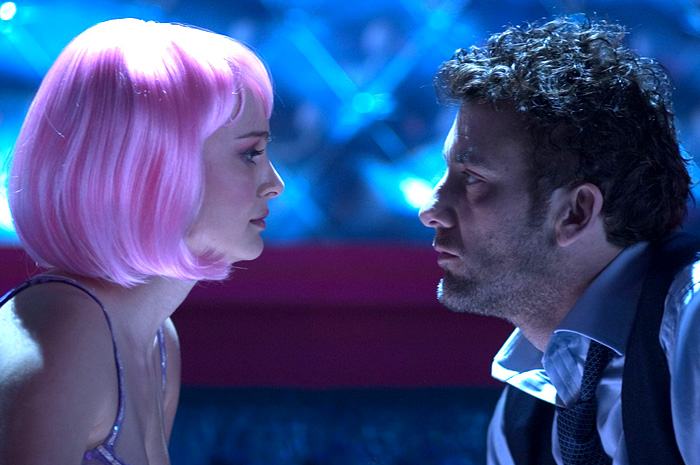
It's a typical day in London as an obituary writer and aspiring author named Dan (Jude Law) runs into a young waitress/stripper named Alice (Natalie Portman) at a crosswalk in London. A cab hits Alice where she was slightly injured as Dan takes her to the hospital where sparks begins to happen. The two have a conversation where Dan takes her to a park where his mother had died. Time goes by as they become a couple where Alice is now a full-time waitress while Dan has just finished a book that is set to be published. Dan takes photos for a photographer named Anna (Julia Roberts) where she is in the middle of a divorce and Dan makes advances towards her. The two kisses but Anna intervenes since she knows Dan has a girlfriend. Alice arrives and suspects something was going on.

Then one night during a sex chat, Dan pretends to be a woman while going on an online chat with a British doctor named Larry (Clive Owen). The chat gets very extreme as Dan, who pretends to be Anna, wants Larry to meet her in an aquarium wearing a white jacket. Larry finally meets Anna but learned that Anna wasn't the person in the chat room as the two get to know each other as Anna is smitten with the rogue, charming Larry. Then a year goes by as Larry and Anna are married while Alice and Dan are having trouble in their relationship as Dan and Anna are rumored to have an affair. At an exhibit Anna made, Larry and Alice meet while Anna and Dan are flirting with each other. Claiming that he has to go on a business trip after the exhibit, Dan gets a cab for Alice and then goes back to the exhibit to flirt with Anna where Larry begins to suspect something.

Then one night as Larry returned home from a business trip, he learns that Anna was having an affair with Dan that had been going on for quite a long time since the night of the exhibit. Alice also learns about it from Dan as she leaves him. Heartbroken and angry, Larry goes to a strip club where he finds Alice where she plays mind games with him. In a room together, Larry demands to know what Alice's name is as she claims its Jane where Alice becomes a sadist in a game of sex. With a divorce for Anna and Larry finalizing, Dan and Anna are officially together until Dan learns that Anna met with Larry for the divorce signing that lead to blackmail. Dan confronts Larry only to learn about something that ruins the relationships for everyone involved as Dan sees Alice for the final time.

While Closer isn't a perfect film, it's still one of the strongest and more subversive efforts from a film studio and director Mike Nichols. Nichols provides a fluid yet momentum-building directing style where he lets the audience get to know the characters. With the story developing in its second and third act, we begin to see the ugliness of everyone involved with the feeling that none of the characters have some sort of resolve in the end. Instead, it's a film where you're not sure who is the innocent one and who was the one driving all of these games. Credit goes to Nichols for not pandering down to a formula where everyone gets happy in the end and instead goes for a human story thanks in large part to Patrick Marber's craftily-structured screenplay that also has wonderful theatrical feel from his own play. Though some might be upset with the cutting of Portman's nude scenes in the film, it doesn't seem necessary since what was shown is enough. If Neil LaBute directed it, he would've done the same thing though his approach of gender studies would be more brutal.

The movie is clearly not a typical Hollywood fare because of Nichols' directing. The script by Marber really has a sense of ambiguity and tension where the characters are trying to discover for themselves what's going on. Also, there's a sense of who is manipulating who in the film and the lines of reality and fantasy are also blurred, especially in the third and final act where the film has an ending where everything is left at a shock to see who was really telling the truth and who wasn't.

The film's masterfully presented technical achievements are spot-on thanks to some non-linear editing style from John Bloom and Antonia Van Drimmlen and the wonderful cinematography of Stephen Goldblatt, notably for his use of lights and colors in the interior scenes. Production designer Tim Hatley and art directors Hanah Mosely and Mark Raggett provide a great look to the film's London look, notably the strip club scenes with Portman and Owen along with Ann Roth's costume design on Portman's stripper costume. Even the sound work of Ivan Sharrock should be complemented for giving the film a distinct sound as if you're watching a theatrical play. Then there's the film's music that features a song that is opened and closed by Damien Rice along with cuts in the strip club scenes by the Prodigy and the Smiths that really sets a sense of intrigue and sadness for its characters.

The heart of the lies in the strong performances of its cast where all the actors refused to play likeable versions of themselves and just get to the point of how the characters should be played along with its complexities. Though Julia Roberts can often be considered to be an overrated and bland actress, this film is her best performance since her Oscar-winning performance in Steven Soderbergh's Erin Brockovich. Roberts is good at playing nice but this is her most mature performance to date where she plays a woman who seeks love but has the same temptations that many older women have. What is more amazing is that Roberts is now stripping down all of her previous likeable roles for something more challenging as Roberts is now getting ready to play an elder stateswoman instead of the Pretty Woman we come to know and love.

Jude Law is wonderful in his role as Dan with his sniveling, cocky attitude and sex appeal. Law brings an understated, restrained performance in the anguished and emotionally tortured Dan. Law also carries a brooding tone in the film's final act where he tries to understand what has happened in a scene with Owen. It's clearly Law at his finest. Clive Owen is the film's biggest standout with his rogue, innocent performance as Larry in the film's first act. Owen has a macho, idiotic sensibility that can be very funny and likeable but as the film begins to darken, we see Owen in a fit of rage where he seems to lose control. Owen has great chemistry with Roberts but in his scene with Natalie Portman, the complexity of heartbreak, anger, confusion, and desire is well balanced in a performance that is a true breakthrough for the British actor.

The film's best and most shocking performance clearly goes to Natalie Portman in what is probably the greatest role of her career. The troubled little girl of The Professional is no more as Portman plays probably the film's most intriguing role in the movie as Alice. Portman brings a sense of lovelorn innocence of the film's first act with her kooky charm and smile where we see why Jude Law falls in love with her. When she's heartbroken, we see the emotional desperation of her character as she is trying to find love but in all of the wrong places. Then when she returns to her world of stripping, Portman goes bare all by not just showing a lot of skin (except for the exposed breasts and other things that got cut) but she also showed a dark, sadistic side that is even more jaw-dropping as she plays games with Owen. Whereas 2003 was the year of her rival Scarlett Johansson who delivered two landmark roles in Lost in Translation and Girl with a Pearl Earring, Portman one-ups Johansson with this performance and her kooky one in Garden State by delivering a sense of beauty, angst, and innocence into a dangerous performance.

Though Closer isn't a perfect film because of its lack of likeable moments, it is still one of the best and more provocative efforts of the year thanks to Mike Nichols' uncompromisingly fluid direction. With credit going to Patrick Marber's script and the performances of Julia Roberts, Jude Law, and most notably Natalie Portman and Clive Owen, Closer is really an adult film that tries to study the behaviors of genders. Though it might not be original, especially compared to Nichols' earlier work and the recent films of Neil LaBute, Closer still works thanks to its story and character study. Though its subversive nature and dialogue might be shocking to a mainstream audience, its performances and director Mike Nichols ability as a storyteller will leave people talking after the movie.

Mike Nichols Films: Who’s Afraid of Virginia Woolf? - (The Graduate) - (Catch-22) - Carnal Knowledge - (The Day of the Dolphin) - (The Fortune) - (Gilda Live) - (Silkwood) - (Heartburn) - (Biloxi Blues) - Working Girl - Postcards from the Edge - (Regarding Henry) - (Wolf (1994 film)) - The Birdcage - (Primary Colors) - (What Planet Are You From?) - (Wit) - (Angels in America) - (Charlie Wilson’s War)

© thevoid99 2010