Showing posts with label jacques tati. Show all posts
Sunday, October 04, 2015
The Auteurs #49: Jacques Tati
Among one of the masters in the art of comedy, Jacques Tati was someone who brought the pantomime style of Charles Chaplin and infuse it with a whimsical persona as well as commentary on a world run amok. Though he only made six feature films and a handful shorts in his career, Tati did manage to bring something new to the world of comedy in the age of post-war cinema from tales of simple small town life to the craziness of the modern world. Much of which is told in manners that are very funny but also has an air of sentimentality and bits of drama while not falling on the wayside in order to entertain audiences old and young. Even as his films have managed to endure more than thirty years since his passing as it plays into times where things were simple and less complicated in a world often succumbing to the pressures of modernism.
Born on October 9, 1907 in Les Pecq in the Yvelines region of France, Jacques Tatischeff was the son of George Emmanuel Tatischeff and Marcelle Claire van Hoof as he was the youngest of two children that included his eldest sister Natalie. George Tatischeff was the son of Dmitry Tatischev who was the General of the Russian Imperial Army and military attaché for the Russian Embassy in Paris which would allow George to use his connection to maintain a high lifestyle for his family with his wife who used her connections in the art world to get her husband work in the art world. For the young Jacques, the carefree lifestyle would allow him to take part in different sports where in his early 20s where he was part of semi-professional rugby team in Paris. Jacques would discover his gift for comedy as he would meet one of his early collaborators in Jacques Broido.
More can be read here at Cinema Axis.
© thevoid99 2015
Saturday, September 19, 2015
The Short Films of Jacques Tati
While he is considered one of the greatest comedy filmmakers in the 20th Century, Jacques Tati only made six feature films from the late 1940s to the late 1970s. Yet, his work in feature-films that he directed are considered some of the finest comedies ever created as Tati would be involved in seven short films from the mid-1930s to the late 1970s. All of which would play into his unique approach to pantomime and physical comedy as well as his love of the simple life.
On demande une brute (Brute Wanted)
Directed by Charles Barrois and written by Tati and Rene Clement, the 23-minute short film revolves around an out-of-work actor who finds himself in a professional wrestling match. Also starring Enrico Sprocani as the clown Rhum, the film is a comical tale where Tati plays the lead role as a man who is forced by his wife to answer an ad unaware of what he really needs to do. It’s a short that plays into Tati’s minimalist approach to slapstick comedy where Tati doesn’t say much as it’s more about the surroundings he is in including the climatic wrestling match where Sprocani’s character would play a key role in the results.
Gai dimanche (Fun Sunday)
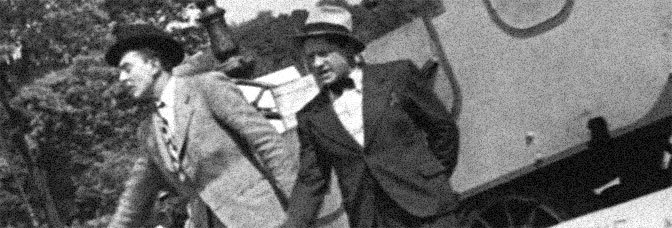
Co-directed with Jacques Berr, the short that stars Tati and Sprocani based on their own script is a story where two guys get themselves involved in a moneymaking scheme. The 21-minute short plays into these two men who decide to be tour guides for money by getting a cheap car and con a group of people where everything goes wrong. Add some bad directions, mishaps, and a runaway chicken, the film is a whimsical comedy that is very simple. While Sprocani would play the leader of the two, it is Tati that is the star due to his approach to physical comedy and being very quiet and restrained which would be a prototype into some of the characters he would create in the years to come.
Soigne ton gauche (Keep Your Left Up)
Directed by Rene Clement and written and starring Tati, the 13-minute short plays into a man’s desire to be a boxer as he gets a chance to become one unaware of what it entails. It’s a simple short that plays into a man who is unaware of what he is getting himself into as he deals with another boxer while a postman would try to help the unfortunate soul in the rules of boxing. Armed with a wonderful soundtrack, some fantastic editing, and stylish direction from Clement. It is definitely the best of the shorts that Tati would do in the 1930s.
L’ecole des facteurs (School for Postmen)
In his very first solo film as a director, Jacques Tati would star and write this 16-minute short that served as a template for his first feature-length film in Jour de Fete as the story revolved around a clumsy cyclist who works as a postman. It’s a film where Tati would create recurring gags which involves his character and bicycle as the postman tries to deliver mail in his route where a lot of hilarity ensues. Most notably as the postman tries to deliver his mail before the mail plane arrives to pick up mail as it features one of the most hilarious climaxes ever.
Cours du soir (Evening Classes)
Made during the production of Playtime, the 27-minute short film that is directed by Tati’s assistant Nicolas Ribowski and written and starring Tati revolves around an acting teacher teaching his students the art of mime. It’s a film where Tati not only display his talents in pantomime where he plays a teacher that could or could not be Monsieur Hulot, despite the fact that he is wearing the clothes and mimic everything that is Hulot, who showcases elements of how to be clumsy. There is also a tribute of sorts to Tati’s early work including the short film L’ecole des facteurs as it’s shot beautifully in color and black-and-white by Jean Badal with a playful score by Leo Petit.
Degustation maison (House Specialty)
Written and directed by Sophie Tatischeff, the film is a simple short film set inside a pastry cafĂ© where a group of people converge to socialize and eat pastry. Set in the small town where Jour de Fete was made, the short doesn’t have much of a plot nor does it feature Tati himself but it does have it sense of spirit in terms of the love of simple small town life that Tati yearns for in the age of modernism.
Forzia bastia (Festive Island)
Tati’s final film is 27-minute short he made in 1978 is a documentary short about UEFA Cup match between the PSV Eindhoven club from the Netherlands against the SC Bastia club from France at Furiani stadium. Though Tati would shelve it, the film was finally finished in 2000 by Tati’s daughter Sophie Tatischeff just 18 years after his passing. The short chronicles the island of Corsica where many of its locals are celebrating and exhilarated over a championship final between the two clubs as many are rooting for Bastia. It’s a documentary short that explores the joy of futbol fans and how much it can bring an entire community just to support their team as it is one of Tati’s finest shorts and a fitting finale for the filmmaker.
These short films of Jacques Tati not only display the man at his funniest but also as a filmmaker who really takes great care into the stories he creates. Even if it allows other filmmakers to help Tati present his vision as well as create something that is their own. It’s a collection of shorts fans of Tati must have as it showcases a man who didn’t just make people laugh but also touch them in ways that are indescribable.
Jacques Tati Films: Jour de Fete - Monsieur Hulot's Holiday - Mon Oncle - Playtime - Trafic - Trafic - The Auteurs #49: Jacques Tati
© thevoid99 2015
Sunday, August 16, 2015
Trafic
Directed, co-edited, and starring Jacques Tati and written by Tati, Jacques Lagrange, and Bert Haanstra, Trafic is the story of Monsieur Hulot working as a car designer as he takes his designs to a show in Amsterdam where the trip goes horribly wrong. The film stars Tati as Hulot for the final time in an informal trilogy of Hulot dealing with modern society as the focus is on the world of cars. Also starring Tony Knepper, Franco Russel, Mario Zanuelli, and Maria Kimberly. Trafic is a whimsical and charming film from Jacques Tati.
The film revolves around a car expo in Amsterdam as Monsieur Hulot’s design for a camper is to be the centerpiece of the expo as he and employees of the company drive from France to Amsterdam for the show where the trip becomes a disaster. It all plays into Hulot’s attempt to get his design on the day of the expo where it starts off with a series of little incidents revolving around a very old truck that is carrying the camper. Things would get worse as Hulot, the driver Marcel (Marcel Fraval) and a publicist named Maria (Maria Kimberly) would deal with traffic and other crazy things. The film’s screenplay is very simple as it relies more on situations rather than plot and dialogue as the latter is used sparingly at times. Instead, the script comments on not just the craziness of these car expos but also cities that is dominated by cars where no one could really go anywhere or get out as traffic becomes overwhelming as Hulot would find himself stuck in these situations.
Jacques Tati’s direction is simple in terms of its compositions but he manages to create images that are quite exhilarating in terms of the set pieces and how he presents the car expos and the world of traffic in the city. Tati would create elaborate gags that would often involve Maria’s dog leaving the car to wander around or people watching the Apollo 11 moon landing on TV as it plays into a world where humanity’s emphasis on cars and new things start to become overwhelming. Especially as the Hulot character is the man who design a car yet is revealed to be someone that is more about the simpler things in life. The camper itself is a unique character in the film as the gadgets it has are quite appealing but also has this air of absurdity to it. Part of Tati’s own approach to comedy would also include intricately-choreographed sequences that involve accidents and the traffic jams to play into not just the craziness of the world of cars.
It is also a commentary of sorts on modern society and its reliance on cars which only makes things very uneasy when it’s surrounded by traffic. Notably the elaborate accident sequence where it is quite comical but would be followed by something that is quite endearing into how humanity would react to something like this. Even the expo would have something that is off-the-wall in Tati’s direction where his usage of wide and medium shots come into play where it is very chaotic as opposed to scenes outside of the city where it’s more quaint. Overall, Tati creates a very witty and mesmerizing film about a man’s disastrous trip to a car expo in a world surrounded by cars and consumerism.
Cinematographers Eduard van der Enden and Marcel Weiss do amazing work with the film‘s very colorful and vibrant photography from the usage of the locations near Amsterdam as well as the interior lights for the scenes inside the expo and scenes set at night including one memorable gag involving Hulot. Editors Jacques Tati, Sophie Tatischeff, and Maurice Laumain do brilliant work with the editing to create unique rhythms for its sense of comedic timing as well as straight cuts to play into the non-comedic moments. Set designer Adrien De Rooy does fantastic work with the look of the expo as well as the camper that Hulot designed.
The sound work of Ed Pelster and Alain Curvelier, with sound mixer Jean Neny, is excellent as it is among one of the film‘s highlights from the way gags are created through sound as well as elements that play into some of the chaotic events including scenes set at the expo. The film’s music by Charles Dumont is wonderful as it is a jazz-based score that plays into the whimsical tone of the film as well as some of the funnier moments and themes for some of its characters.
The film’s phenomenal cast includes some notable small roles from Honore Bostel as Hulot’s boss, Francois Maisongrosse as the boss’ assistant Francois, Franco Ressel and Mario Zanuelli as a couple of drivers Hulot would encounter, Tony Knepper as an eccentric mechanic who helps Hulot and Maria late in the film, and Marcel Fraval as the truck driver who would drive the truck carrying the camper. Maria Kimberly is fantastic as the company’s publicist Maria who deals with the chaos of being late and having to bring her dog to the event as things go wrong. Finally, there’s Jacques Tati in a marvelous performance as Monsieur Hulot where Tati would maintain that sense of pantomime physical comedy as it done in a restrained manner as it is a very fun performance from Tati.
Trafic is a remarkable film from Jacques Tati. While it doesn’t really say anything new about modern society’s fascination with cars and the world of consumerism. It is still a film that manages to have something say that remains very relevant in the modern world while also being very entertaining. In the end, Trafic is a sensational film from Jacques Tati.
Jacques Tati Films: Jour de Fete - Monsieur Hulot's Holiday - Mon Oncle - Playtime - Parade - The Short Films of Jacques Tati - The Auteurs #49: Jacques Tati
© thevoid99 2015
Saturday, May 23, 2015
2015 Cannes Marathon: Parade
(Played Out of Competition at the 1974 Cannes Film Festival)
Written, directed, and starring Jacques Tati, Parade is a film in which Tati serves as the ringmaster and as a clown in a circus where it plays into the interaction between audience and performers. The film serves as a testament to the world of entertainment as it also shows these performances from the perspective of the audiences. The result is an exciting and exuberant film from Jacques Tati.
Shot on location in Sweden as it was filmed for Swedish television in 1973, the film is essentially a circus performance where audience and performers come together to do a show led by Jacques Tati. It is there where Tati not only celebrates the art of mime and performance which he largely based his work on but also allows an audience of young and old to see it in a modern fashion. With the aid of many acrobats, mime performers, gymnasts, jugglers, artists, and musicians, Tati puts on a show that isn’t just whimsical but also heartfelt as it plays into his love of mime and performance. Tati would do some of his own solo performances in the show while letting others do their acts. At the same time, the audience would participate as a middle-aged man would try to get an opportunity to ride a donkey with hilarious results.
Since there’s not much of a script, Tati allows the film to be presented in various formats such as video, 16mm, and 35mm where it has a look that is quite colorful and energetic. Even as Tati would shoot scenes behind-the-scenes where he would converse with his performers on what to do next as the audience themselves are watching. It’s a moment where the fourth wall is broken as it allows the audience to be part of the show as Tati always have the camera focused on two young kids who start off being either disinterested or unsure of what to think of the show. Yet, they become engaged by what is happening as there’s a lot of silliness and exuberance that occurs in these performances. Notably as there’s performers who pretend to be musicians and do silly gymnastic stunts along with jugglers and musicians that add a lot of excitement to these performances.
Tati’s direction also displays a fluidity to the camera work as it was shot in these multiple formats by cinematographers Jean Badal and Gunnar Fischer. Even as Tati knows when to shoot the audience and see their reaction to the performance while having cardboard black-and-white figures also play the role of the audience. It has this blur over what is real and what is fiction as the audience themselves could also be playing fictional roles. With the aid of editors Sophie Tatischeff, Per Carlesson, Siv Lundgren, Jonny Mair, and Aline Asseo, Tati is able to keep things lively as it manages to be straightforward in its approach to cutting. Sound recordist Bengt Nordwall does excellent work in capturing not just the excitement of the audience but also in the sounds that occur in the performances. The film’s music by Francois Bronett is a joyous mix of orchestral dancehall, brass, flamenco, and some rock music to help present the diversity of the performances that occur in the film.
Parade is a spectacular film from Jacques Tati. It’s a film that manages to be thoroughly entertaining as well as bring in some big laughs to anyone from a child to an adult. It’s also a film that doesn’t just celebrate the world of mimes and circus but also allows the audience to be part of the spectacle. In the end, Parade is a dazzling film from Jacques Tati.
Jacques Tati Films: Jour de Fete - Monsieur Hulot's Holiday - Mon Oncle - Playtime - Trafic - The Short Films of Jacques Tati - The Auteurs #49: Jacques Tati
© thevoid99 2015
Thursday, September 25, 2014
2014 Blind Spot Series: Playtime
Directed and starring Jacques Tati and written by Tati and Jacques Lagrange with additional English dialogue by Art Buchwald, Playtime is the story of Monsieur Hulot’s encounter with the modern world and how he and various people become baffled by this new version of Paris. The film is an ambitious story that explores Tati’s fascination with modernism and drawbacks where a famous city‘s identity nearly becomes extinct. Also starring Barbara Dennek as an American tourist. Playtime is an absolutely stunning and evocative film from Jacques Tati.
Set in a futuristic version of Paris where many of its landmarks have been replaced by buildings and places where everything sort of looks the same. The film is a look into a world where American tourists arrive into the city of Paris to see everything and be a part of a world that is ever-changing as there’s inventions and all sorts of things where the French tries to keep up with the modern world. It’s a film that explores the fallacy of modernism as the Monsieur Hulot character arrives in the city looking for work where he would stumble into being part of a tourist group as well as encounter old friends who have become accustomed to modern society. Another character in the film that becomes lost in this modern-day Paris is an American tourist who tries to find something that recalls the Paris of old such as the Eiffel Tower.
It’s a film that portrays this futuristic world as quite cold as well as baffling where old men try to keep up with the new machines as it would culminate with a restaurant opening that becomes disastrous. The restaurant sequence is one of six major sequences that Jacques Tati and co-writer Jacques Lagrange would create as the entire film takes place in the span of an entire day. Much of it would have the Monsieur Hulot character be portrayed as a supporting character where the emphasis of the story is about these encounters with new inventions, new buildings, and everything that is and feels new but also very alienating. Especially as Barbara wants to see landmarks like the Eiffel Tower and the Notre Dame Cathedral as they’re only seen in reflections from glass doors. There isn’t a lot of dialogue in the film as it’s spoken in English and French while there is also a very loose structure in the script so that Tati and Lagrange would focus on the visuals which is a key part to the story.
Tati’s direction is truly gigantic not just in its scope but also in the world that he presents as the film is shot in grand 70mm film. Much of it is presented in grand attention to detail where it is about a world that is new and futuristic. At times, it’s a world that is very enthralling and full of unique quirks but it’s also overwhelming as well as quite cold in the way it looks. There’s very little color to these buildings as Tati creates some elaborate moments such as Hulot trying to attend a meeting where he ends up being part of a tourist group for a trade show. It’s a moment in the film that requires not just these massive wide shots in its 70mm presentation but a moment that plays into how eerie it can be even though it’s told in a humorous fashion. Some of these humorous moments involve Hulot and some of his doppelgangers that he doesn’t know about often causing trouble without really knowing it. Especially as Hulot is baffled by his surroundings where the meeting he was supposed to have is often delayed due to the emergence of tourists and other things.
The direction is also unique in its approach to framing from the way the buildings are shot in certain angles as if to display how similar these buildings look whether it’s shot in parallel angles or in the background. The direction also has Tati doing a lot of things where there could be something happening in the background while something else is happening in the foreground. Even as it would involve scenes where there’s certain precision to the choreography in some parts of the film to play into this strange world that is considered a modern-day metropolis. The climatic restaurant sequence which takes place for much of the film’s second half is quite lavish where it plays into a world that is having a hard time keeping up with the new world. Still, there’s elements of the old world that looms in the film where it plays into the fallacy of modernism in ways that are quite humorous but also melancholic. Overall, Tati creates a very intoxicating yet mesmerizing film about a futuristic world that tries to wow tourists with new wonders as a few struggle with the new world.
Cinematographers Jean Badal and Andreas Winding do amazing work with the film‘s cinematography from the way much of the scenes in the daytime look where there are small bits of actual color to the scenes at night for some of its lighting and shadows plus a notable scene inside a cafĂ©. Editor Gerard Pollicand does excellent work with the editing as it‘s pretty straightforward with some rhythmic cuts to play into the film‘s humor. Production designer Eugene Romand does incredible work with the set design as it is an absolute highlight of the film from the look of the building and its streets to the offices, tourist trades, and the restaurant in such grand detail.
Costume designer Jacques Cottin does nice work with the costumes as it plays to the film‘s look where there is little color with the exception of some of the Hulot doppelgangers as well as the green dress that the American tourist would wear at the restaurant party. The sound work of Jacques Maumont is fantastic for its unique approach to sound mixing where it has some unique sound effects in the way some of the machines work as well as that raucous mix of music and dialogue in the restaurant party. The film’s music by James Campbell and Francis Lemarque is superb for its mixture of low-key, jazz-based music with some traditional French-pieces along with some party music that is played in the film as it’s another of the film’s highlights.
The film’s wonderful cast includes some notable small roles from Georges Montant as Monsieur Giffard who was supposed to meet Hulot at the office building, France Rumilly as a woman selling stylish eyeglasses, Reinhart Kolldehoff as a German businessman, Billy Kearns as a boisterous American businessman at the restaurant party, Nicole Ray as a former singer at the party, Andre Fouche as the restaurant manager, and Yves Barsacq as a friend of Hulot who takes him to his lavish apartment. Barbara Dennek is terrific as an American tourist who arrives to Paris as she tries to capture its old authenticity while being overwhelmed by its new wonders. Finally, there’s Jacques Tati in a marvelous performance as Monsieur Hulot as it’s a sort of a small role where Hulot tries to have a meeting only to endure events and such which has him lost as it’s Tati in one of his funniest yet more somber performances.
Playtime is an outstanding film from Jacques Tati. It’s a film that is grand in not just its visuals and art direction but also captivating in its exploration of modernism and its disconnect with the old world. Especially as it’s a film that is told in such a way that manages to be funny as well as spectacular in its scope. In the end, Playtime is a phenomenal film from Jacques Tati.
Jacques Tati Films: Jour de Fete - Monsiuer Hulot's Holiday - Mon Oncle - Trafic - Parade - The Short Films of Jacques Tati - The Auteurs #49: Jacques Tati
© thevoid99 2014
Tuesday, September 17, 2013
Mon Oncle
Directed and starring Jacques Tati and written by Tati, Jacques Lagrange, and Jean L’Hote, Mon Oncle (My Uncle) is the story of a man who lives in a small town as he finds himself out of step with the modern world as he devotes his time to his nephew much to the chagrin of his corporate executive brother-in-law. The film explores the world of modernism and materialism in a satirical manner where a simple man has a hard time dealing with these new changes as Tati plays the role of his famous character in Monsieur Hulot. Also starring Jean-Pierre Zola, Adrienne Servantie, and Alain Becourt. Mon Oncle is a witty yet delightful film from Jacques Tati.
The film is about a Monsieur Hulot who lives in a small, simple town in France where nearby is this more upper-class yet very modern suburbia that his sister (Adrienne Servantie) and her husband (Pierre Zola) live in with their son Gerard (Alain Becourt). While Hulot is often given opportunities to work at his brother-in-law’s plastic hose factory, Hulot has a hard time not just dealing with what he has to do but also the idea of machines as his brother-in-law’s home is filled with lots of technology that he doesn’t understand. It all plays into the idea of how technology and materialism can confuse someone who lives a very simple yet adjusted lifestyle as the few joys he has is paying attention to his nephew who is bored by his upper-class surroundings as his parents don‘t spend time with him. Even as they prefer to impress people with their home and such as if they’re the toast of the town.
The film’s screenplay doesn’t have much of a plot nor does it have a lot of dialogue as it’s mostly a silent film with sound. There’s people who talk every now and then but it’s more about Monsieur Hulot and his encounter with the world that his sister and her husband live in. Filled with these strange chairs, gadgets that do things by itself, and all of the things that may seem modern. Yet, it becomes baffling for him because he has no idea what it does nor any clue on how to work on such a thing. Even when his sister and her husband have something new, they think know what it does or how it works but it only shows how lazy they’ve sort of become where it’s not enough for them to do things themselves. Even to the point where they neglect their son Gerard as he starts to act out a bit as he hangs around with other boys doing pranks and such while having some fun with his uncle.
Jacques Tati’s direction is definitely a marvel to look at in not just the simplicity in the way he approaches the comedy but also the way he presents the modern world. With the broad compositions that he creates, Tati presents the film where it is about a world that is changing from the opening credits as a building is being constructed where the credits are shown on a construction wall. It sets the tone for what is to come though a lot of it is quite light-hearted as it is followed by dogs roaming around a poor small town where things are in ruins yet things still happen as people live comfortably and talk with one another. Even as Tati would put in a few gags such as a street sweeper often talking to someone and ignoring the work he was supposed to do. There’s even some very heartwarming moments such as Monsieur Hulot having the sunlight reflecting on a singing bird.
That sense of intimacy and naturalism that Tati brings in those little moments are small compared to the setting of the world that Monsieur Hulot’s sister and her family lives in. It’s all very modern but also somewhat oppressive in some ways from the images of cars driving on the road in unison to the way the houses look. Still, Tati finds way to infuse humor into the scenes such as the home of Monsieur Hulot’s sister as it has two windows where if there’s shadows, it looks like a pair of eyes. There’s also some gags that Tati would put in that includes a fountain and later an electric garage door opener as it all showcases how ridiculous the modern world can be. Even as Hulot’s character is so baffled by his surroundings where Tati knows where to put Hulot into the frame as he’s trying to either fix something or help someone while other things are happening. Overall, Tati creates a very fascinating yet funny film about the downsides of modernism.
Cinematographer Jean Bourgoin does amazing work with the film‘s colorful photography from the simple yet understated look of the small town and some of the scenes in the cities to the more vibrant yet artificial coloring of the suburbia where Gerard and his family live. Editor Suzanne Baron does excellent work with the editing by creating some abrupt rhythmic cuts for a few scenes as well as some cuts to play up the film‘s humor. Art director Henri Schmitt does brilliant work with the set pieces from the apartment that Monsieur Hulot lives in to the look of the home of his brother-in-law as well as the factory that he runs.
Costume designer Jacques Cottin does terrific work with the costumes where a lot of the people that Monsieur Hulot‘s brother-in-law and their friends wear posh clothes while Monsieur Hulot wears a simple suit and long overcoat to display his persona. The film’s music by Alain Romans and Frank Barcellini is a real highlight of the film for its playful arrangements of strings and accordions to play up many themes revolving around Monsieur Hulot as well as the film’s humor.
The film’s cast is superb as it features some notable small performances from Betty Schneider as a landlord’s daughter who admires Monsieur Hulot, Yvonne Arnaud as the overworked family maid, Dominique Marie as a posh neighbor Monsieur Hulot’s sister tries to set her up with Hulot, and Lucien Fregis as Monsieur Pichard who works for Hulot’s brother-in-law who is the only one that seems to understand Monsieur Hulot’s alienation. Jean-Pierre Zola and Adrienne Servantie are excellent as Mr. and Mrs. Arpel as a couple who are consumed with modernism and materialism as they definitely lose sight of what is more valuable as Zola brings a comical energy as Monsieur Hulot’s brother-in-law while Servantie is also funny as Hulot’s sister. Alain Becourt is wonderful as Gerard Arpel as a boy who just wants to have fun as he enjoys his time with his uncle while dealing with the monotonous and drab world of his parents.
Finally, there’s Jacque Tati in a tremendous performance as Monsieur Hulot as he brings an amazing physicality to his performance in the way Hulot reacts to his surroundings. Even in scenes where he’s trying to fit in but finds himself unable to as he would either try to fix things or do something nice but mess things up unknowingly. It’s definitely Tati at his best as he does for the Hulot character to make him one of cinema’s great characters.
Mon Oncle is an outstanding film from Jacques Tati. With its humorous take on modernism, consumerism, social status, and materialism. It’s a film that still manages to make sense of a world that is losing itself in order to be more impressive. It’s also a very funny and heartfelt film in which a man takes the time to be with his nephew who shows him the simple pleasures in life. In the end, Mon Oncle is a remarkable film from Jacques Tati.
Jacques Tati Films: Jour de Fete - Monsieur Hulot's Holiday - Play Time - Trafic - Parade - The Short Films of Jacques Tati - The Auteurs #49: Jacques Tati
© thevoid99 2013
Friday, November 04, 2011
Jour de Fete
Directed by Jacques Tati and written by Tati, Henri Marquet, and Rene Wheeler, Jour de Fete (The Big Day) is the story of a postman who unknowingly causes trouble on Bastille Day as a fair is happening in his small town. The film is Tati’s feature-film debut as a director that exemplify his unique approach to physical comedy as he also stars in the film as the postman. Also starring Guy Decomble, Paul Frankeur, and Santa Relli. Jour de Fete is a whimsical though messy film from Jacques Tati.
Bastille Day is coming for a small town as a traveling fair group arrives for the celebration as the whole town is excited. Meanwhile, the postman Francois (Jacques Tati) is riding around town delivering mail as he causes all sorts of trouble in his job while trying to help the festival people in planting a flag stamp. On the day of the festival, Francois wanders around as a lot happens where he gets drunk and watches a film about the American postal service. Prodded by the people in town about the American way of postal service, Francois decides to try and deliver the mail their way leading to a lot of trouble.
The film is about the life of a postman in a small town during Bastille Day where he tries to deliver the mail and ends up causing some trouble. Notably as he sees a film about the American mail service prompting him to keep up with their modern style. While the character is merely a prototype for what Jacques Tati would do with the more silent Monsieur Hulot character in later films. While there’s a few subplots in the film such as a fairground man (Guy Decomble) staring at some young girl (Maine Vallee). It all revolves around this postman as the story at times meanders due to its lack of a strong plot. Particularly in the second act where there’s a lot going on but there is nothing to keep it holding together.
Despite the messiness of the script, Tati’s direction does have some charming elements though the print of the film is messy in some spots. Particularly as Tati was hoping to shoot the film in color as he also shot the film in black-and-white for insurance reasons. While there is some colorization in some parts of the film for the fair scene, it does have a look that is dazzling as Tati engages through what is happening. In his approach to comedy, it is clear that Tati learns from the likes of Buster Keaton and Charlie Chaplin in terms of creating a physicality to the comedy. There’s some great scenery and wide shots that showcase the town and locations as well as some intimate moments. In spite of the film’s script, Tati is able to create a fun and entertaining film.
Cinematographers Jacques Mercanton and Jacques Sauvageot do some nice work with the black-and-white photography for a bright look for the daytime exterior scenes along with some low-light looks for the nighttime stuff though some of the interior shots are presented in a grainy film stock. Editor Marcel Morreau does some very good work with the editing where a bit of jump-cuts play up to some of the gags that revolve in the film.
Set decorator Rene Moulaert does an excellent job with the set pieces created such as the tavern and the game booths for the fair. Costume designer Jacques Cottin does fine job with the costumes to play up small town look with its casual clothing and the much looser look of Francois. The sound work of Jacques Maumont is brilliant for playing up the excitement of the bar scenes and the fair as well as the gags that Francois is involved in. The film’s score by Jean Yavote is the film’s real highlight for playing up the humor with an array of flouring melodies from its woodwinds, strings, and xylophones.
The cast is wonderful as it features some notable appearances from Paul Frankeur as the artist Marcel, Santa Relli as the fairground traveler’s wife, Guy Decomble as the traveler, and Maine Vallee as the young girl that the traveler pines for. Finally, there’s Jacques Tati as the postman Francois who is just a likeable yet helpful guy who is often distracted by other things while being put into pressure to keep up with the times. Tati brings a very humorous yet charming performance in his role despite having to speak as his strength is in his pantomime approach to the performance.
Jour de Fete is a good and charming film from Jacques Tati despite the lack of a strong plot. While it’s a debut feature that has some of the great physical comedy that Tati is known for plus some wonderful colorization for a few parts of the film. It’s a film that doesn’t have a very linear storyline that makes it meander at times. Despite its shortcomings in delivering a strong story, Jour de Fete is still an entertaining film from Jacques Tati.
Jacques Tati Films: Monsieur Hulot's Holiday - Mon Oncle - Playtime - Trafic - Parade - The Short Films of Jacques Tati - The Auteurs #49: Jacques Tati
© thevoid99 2011
Thursday, October 13, 2011
The Illusionist (2010 film)
Directed by Sylvain Chomet and based on an un-produced screenplay by the late Jacques Tati, L’Illusionniste (The Illusionist) is the story about the life of a magician who meets a young lady who is convinced he is the real thing as he struggles to find work during visit to a small town. With a screenplay written by Chomet and Tati’s longtime collaborator Henri Marquet, the hand-drawn animated film is a tribute to the work of Tati as well as giving an audience a chance to revisit the work of one of France’s greatest filmmakers. L’Illsionniste is a charming yet heartwarming film from Sylvain Chomet.
A magician who goes by the stage name Tatischeff is trying to make it as a magician as he ends up entertaining to a very small audience in small theaters in France. With the world changing during the late 1950s, there is little time for work as a magician as he goes to Britain for work where it’s even harder as he has to follow a rock band at one point. After working at a party, the magician meets a drunken Scottish man who takes him to his small town for to provide entertainment for a pub. Watching the magician perform is a young girl named Alice who is amazed by the magician whom she meets later on as he gets her a pair of red shoes to replace the decayed shoes she’s wearing.
With the magician seeking more work around Scotland, he travels to Edinburgh as Alice joins him as he gets a job working for a small theater. While they live at a hotel with a ventriloquist, a clown, and a trio of acrobats, work for the magician starts to struggle as Alice becomes amazed by the city as she desires to look and act like a woman. With the magician taking on various jobs on the side, things begin to look grim while Alice becomes more drawn to the modern world as she falls for a young man. The magician then realizes what is happening to Alice as he tries to come to terms with everything that is going on around him.
While the film is meant to be a project the late Jacques Tati was to do with his youngest daughter Sophie (whom he had never met), it was also rumored to be a film where Tati wanted to reconcile with his eldest daughter Helena in whom he abandoned when she was just a baby. While the motives for wanting to do this project remains unsure, the film has a father-daughter relationship of sorts. Still, it’s about a young girl who admires this amazingly gifted magician in a world where he’s not in favor as much while she is more drawn to it.
While the film doesn’t have a lot of dialogue as the voices for the magician and Alice are provided by Jean-Claude Donda and Eilidh Rankin, respectively, are a mix of various languages. It’s a film that is more of a tribute to Tati as the magician character has a look and persona that is reminiscent of some of the characters that Jacques Tati has played. The film also features a scene where the magician walks into a theater where Tati’s 1958 film Mon Oncle is playing as a clip of that film is shown while the magician mimics the same movement as Tati.
Chomet’s direction is done with an amazing style and look that is distinctive of his work while he also putting some of Tati’s directing style into the film for the way the humor is set up and emphasizing more on action rather than dialogue. While the story might be considered sentimental, it does dwell into that but not that heavily as he puts a lot of humor into the film. Chomet’s animated, hand-drawn style does create a look that is very wondrous and rich for the way characters look as well as the surroundings.
Serving as both the film’s editor and music composer, Chomet’s approach to the former is straightforward by using a few dissolves and jump-cuts to keep the film’s rhythm going. For the music, Chomet plays into the Tati musical style of playful-driven pieces while also going for a more somber score for the dramatic moments of the film. Along with some amazing sound work from Carl Goetgheluck and the look of the set pieces created for the film by production designer Jacques Arhex and art director Bjarne Hansen. The film has a look that is very rich while creating a world that is seemingly modern through its sound. The overall work that Chomet does in his direction is superb and marks as a great tribute to the work of Jacques Tati.
L’Illusionniste is a charming yet touching film from Sylvain Chomet that brings Jacques Tati’s un-produced story to life. While it may not have the more whimsical charm of The Triplets of Belleville, it is still an engaging yet lively film to watch while proving that hand-drawn animation can still weave some magic. For people new to the works of Jacques Tati, the film is a decent introduction though Monsieur Hulot’s Holiday is a much better introduction. In the end, L’Illusionniste is an extraordinary tribute to Jacques Tati from the imaginative mind of Sylvain Chomet.
Sylvain Chomet Films: (The Old Lady and the Pigeons) - The Triplets of Belleville - Paris Je T'aime-Tour Eiffel
© thevoid99 2011
Sunday, August 14, 2011
Monsieur Hulot's Holiday
Directed and starring Jacques Tati with a script written by Tati and Henri Marquet, Les Vacances de M. Hulot (Monsieur Hulot’s Holiday) is the story of a man going on a vacation to a beach where he unknowingly creates chaos every step he takes. The film is a comedy that has Tati bring elements of silent comedy with spoken dialogue in the background as Tati performs mostly without words. Also starring Nathalie Pascaud and Micheline Rolla. Les Vacances de M. Hulot is a very funny film from Jacques Tati as the titular character.
It’s summertime as people are set to go on a holiday as Mr. Hulot is driving to a seaside resort hotel in his sputtering car. Upon arrival, he makes a bad impression on the guests who seemed annoyed by his presence as all they want to do is relax in the lounge and play cards while eating lunch and dinner as scheduled. Mr. Hulot ends up impress a few people including an Englishwoman (Valentine Camax), a beautiful woman named Martine (Nathalie Pascaud), and various other people. During his trip, Hulot creates a lot of chaos while taking his time to do various activities and bring fun to people by attending a costume ball and bringing some joy to a neglected young boy.
The film is about a bumbling man, who always has a smoking pipe in his mouth and stands in a weird way, who ends up creating chaos during his vacation and making a great impression on the small people he meets. That’s pretty much what the film is about as it’s lack of a strong, conventional plot allows Tati to create a film that is about the memory of going on a holiday. Throughout the film, Tati and co-writer Henri Marquet get a chance to take shots at various people in the film including an intellectual who tries to woo Martine or fellow guests who are more interested in listening to talk radio and playing cards rather than go dancing.
The lack of a conventional script and story, along with very little dialogue, does allow Tati to create a film that feels natural and made up as he goes along with it. Though the approach starts out slow and lags a bit through parts of the film, it’s only because Tati wants the audience to get to know various people including the Mr. Hulot character who makes his first impression driving his slow, sputtering car on the way. Yet, he unknowingly creates chaos from the moment he arrives as if he doesn’t think he’s doing anything wrong. Tati creates some nice framing throughout the film while he knows how to create rhythm for comedy and to set up the moment.
At the same time, he makes sure that the comedy feels real as there’s a consistency in the way he allows the humor to play freely. Whether it’s waiting for Martine to get ready for horse-riding or in the way he ends up creating a mess in the hotel with muddy footprints. It’s Tati just playing it freely while he also creates something unexpected in a very funny sequence where he ends up angering a lot of people while a few are impressed. Despite a few flaws in the pacing, Tati creates what is truly a stellar yet very witty film.
Cinematographers Jacques Mercanton and Jean Mousselle do some excellent work with the film‘s black-and-white photography from the sunny look of the exterior beach scenes to gorgeous nighttime scenes in the exterior setting. Editors Suzanne Baron, Charles Bretoneiche, and Jacques Grassi do some wonderful work by employing dissolves and fade-outs to help move the transition forward while keeping the entirety of the film straightforward despite some moments in the film due to its lagging pace.
Production designers Roger Briaucourt and Henri Schmitt do a great job with the look of the hotel many of the characters are staying including Martine‘s summer home as well as tiny huts in the beach. Sound editor Guy Michel-Ange does a very good job with the sound from capturing the sounds of people talking in the background to the annoying door creek at the dinner lounge. The film’s score by Alain Romans is superb with its jazzy score to play up the film’s humor as well as a couple of low-key orchestral pieces for some of the quieter moments of the film that also includes a loud jazz piece that Hulot loves to play.
The casting is brilliant for its array of appearances such as Rene Lacourt and Marguerite as an aging, strolling couple looking around, Andre Dubois as a former military officer leading the activities, Lucien Fregis as the annoyed hotel manager, Raymond Carl as an overwhelmed waiter, Micheline Rolla as Martine’s aunt, Valentine Camax as an Englishwoman who enjoyed Hulot’s company, and Louis Perralt as the intellectual trying to woo Martine with his views on Marxism. Nathalie Pascaud is excellent in a small but radiant role as Martine, a young woman who enjoys Mr. Hulot as he presents a change to the people she is surrounded with.
Finally, there’s Jacques Tati in a fantastic performance as Monsieur Hulot. A man who means well and tries to be a good person only to bumble in every way from the way he plays tennis to the way he conducts things socially. It’s a performance that is reminiscent of the physical, pantomime slapstick comedy of the works of Charlie Chaplin. Yet, Tati chooses to create his own style from the way he stands while keeping this very minimalist in his approach. It’s truly a mesmerizing performance that is entertaining as the Hulot character would be the inspiration for British comedy actor Rowan Atkinson’s famed Mr. Bean character.
Les Vacances de M. Hulot is an enjoyable yet whimsical comedy from Jacques Tati. Audiences wanting something different that is a bit reminiscent of early silent film comedies will definitely want to seek this film out. Anyone new to the works of Tati might see this as a good place to start. Especially for an actor who takes minimalist pantomime comedy to new heights by infusing it with a modern setting. In the end, Les Vacances de M. Hulot is an excellent yet entertaining film from Jacques Tati.
Jacques Tati Films: Jour de Fete - Mon Oncle - Playtime - Trafic - Parade - The Short Films of Jacques Tati - The Auteurs #49: Jacques Tati
© thevoid99 2011
Subscribe to:
Posts (Atom)