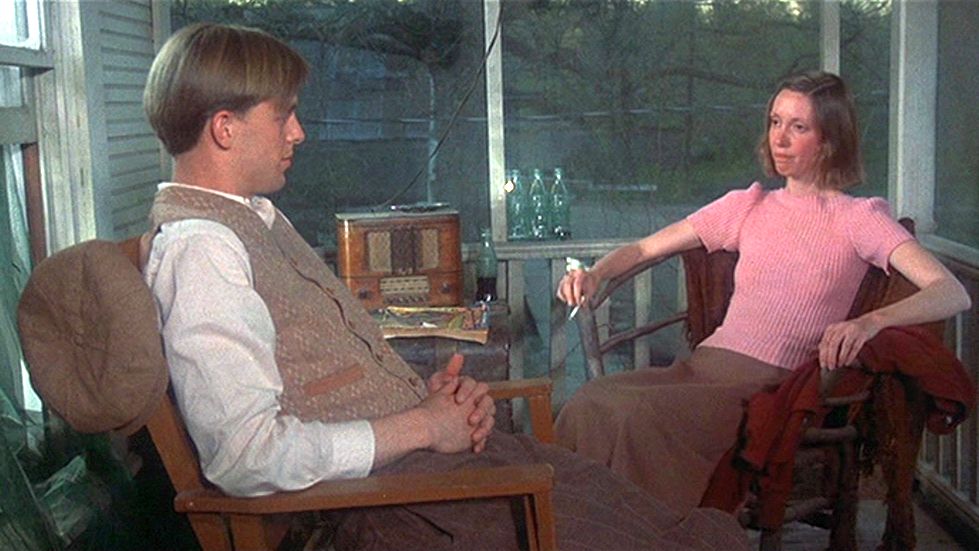
Based on the novel by Edward Anderson, Thieves Like Us is the story of three men who escaped prison as they go on a crime spree throughout the American South during the 1930s. Directed by Robert Altman and screenplay by Altman, Joan Tewkesbury, and Calder Willingham, the film is a loose remake of Nicholas Ray’s 1949 film They Live by Night which was also an adaptation of Anderson’s novel as it blends elements of humor and crime. Starring Keith Carradine, Shelley Duvall, John Schuck, Tom Skerritt, Bert Remsen, and Louise Fletcher. Thieves Like Us is a riveting and mesmerizing film from Robert Altman.
Set during the Great Depression in the American South, the film revolves around a trio of escaped convicts who become bank robbers as they would become successful and notorious only to go way over their head when they are later pursued by the authorities. It’s a film with a simple premise as it play into three men that want to live the good life during the Depression as well as endure some of the trappings of success in their work as bank robbers. The film’s screenplay by Robert Altman, Joan Tewkesbury, and Calder Willingham does follow a straightforward narrative but it’s really more about three guys trying to plan robberies and such as one of them is a young man named Bowie (Keith Carradine) is someone that is learning the ropes of robbing but is eager to wanting to have a good life with a young woman in Keechie (Shelley Duvall). Yet, Bowie is pressured to continue robbing by his partners T-Dub (Bert Remsen) and Chicamaw (John Schuck) as the latter becomes more violent and troubling to the point that he would cause a lot of trouble.
Altman’s direction has elements of style in terms of the compositions and scenes he creates but he also does things that doesn’t play into conventions such as the robberies where he never reveals what happens during the robbery. Instead, it’s about the action outside where Bowie is the getaway driver as he waits for T-Dub and Chicamaw leaving the bank and getting into the car. It’s among these moments in the film that has Altman deviate from what is expected in caper films as he’s more concerned about the characters and how they plan a robbery. Even if it means laying low between robberies where they can get a chance to enjoy themselves as T-Dub would live at a house with Chicamaw and a woman whose young adult daughter is someone he is in love with. Shot largely on location in the state of Mississippi, Altman does maintain that air of realism into the locations such as the swamps and dirt roads along with showing this period of the American South during the Depression that was grimy but also kind of exciting.
Altman’s direction also emphasizes on the usage of radio reports as well as diegetic music to capture the idea of the times where it is either used as a form of entertainment or to intensify the drama during the film’s second act where Bowie, T-Dub, and Chicamaw become fugitives. Altman’s usage of long takes in the drama add to an energetic tone as well as the events that would occur in the third act with Chicamaw becoming violent as Bowie finds himself being a reluctant participant in these violent acts. Even as Bowie wants to take part in a simple life with Keechie but is pulled into wanting to participate in more robberies as it would eventually get more troubling. All of which has Altman showcase these haunting moments of violence that would haunt Bowie whose life is in greater danger just as he’s trying to make changes for himself. Overall, Altman crafts a witty yet compelling film about three convicts making a name for themselves as bank robbers during the Great Depression.
Cinematographer Jean Boffety does brilliant work with the film’s cinematography as it has a low-key approach to the way many of the daytime exteriors look with ideas of grainy photography as well as the way some of the scenes at night are lit. Editor Lou Lombardo does amazing work with the editing as it has an air of style for its usage of jump-cuts as well as a key scene towards the end with its usage of slow-motion as it is a highlight of the film. Costume designer Polly Platt does excellent work with the costumes from the look of the dresses the women wear as well as the clothes the men wear during those times. Sound mixer Don Matthews does fantastic work with the sound in the way music and radio programs sound like inside a car or at a house as well as the atmosphere of the locations including the scenes involving overlapping dialogue.
The film’s superb cast include some notable small roles from Arch Hall Sr. as a young man who picks up Bowie, T-Dub, and Chicamaw early in the film, Al Scott as a prison warden, Ann Latham as T-Dub’s young lover Lula, and Tom Skerritt in a terrific small role as the general store owner Dee Mobley who also runs a small-time criminal operation that he eventually abandoned. Louise Fletcher is fantastic as Lula’s mother Mattie as a woman who lets T-Dub, Bowie, and Chicamaw stay at her home where it eventually becomes chaotic to the point that she would later play a part in their downfall. Bert Remsen is excellent as T-Dub as eldest of the three thieves who walks with a cane and is always trying to ensure that things go well while not wanting to be violent as he enjoys the fruit of success.
John Schuck is brilliant as Chicamaw as the most brutal of the three thieves as well as someone who isn’t satisfied with robbing banks where he becomes more violent and unruly where he would get everyone into trouble. Shelley Duvall is amazing as Keechie as Mobley’s younger sister who falls for Bowie as they embark on a relationship where she knows what he does but also keeps it a secret while dealing with the idea that Bowie would abandon the good life in favor of the thrill of danger. Finally, there’s Keith Carradine in an incredible performance as Bowie as a young thief who contemplates his role as someone who is a robber where he relishes in having money and wanting a good life but becomes disturbed by some of the violence he encounters as it’s a role that has Carradine display humor but also someone who comes to term with the trouble he’s created and the need to make things right.
Thieves Like Us is a sensational film from Robert Altman that features great performances from Keith Carradine and Shelley Duvall. Along with its ensemble cast, evocative cinematography, loose take on theft and notoriety, and an unconventional take on the caper genre. It’s a film that play into the idea of three men wanting to succeed through crime only to go way over their heads once they become notorious. In the end, Thieves Like Us is a phenomenal film from Robert Altman.
Robert Altman Films: (The Delinquents) – (The James Dean Story) – Countdown (1968 film) - (That Cold Day in the Park) – M.A.S.H. - Brewster McCloud - McCabe & Mrs. Miller - (Images) – The Long Goodbye - California Split - Nashville - Buffalo Bill and the Indians or, Sitting Bull's History Lesson - 3 Women - (A Wedding) – (Quintet) – (A Perfect Couple) – (HealtH) – Popeye - (Come Back to the Five and Dime, Jimmy Dean, Jimmy Dean) – (Streamers) – (Secret Honor) – (O.C. and Stiggs) – Fool for Love - (Beyond Therapy) – (Aria-Les Boreades) – (Tanner ’88) – (Vincent & Theo) – The Player - Short Cuts - Pret-a-Porter - (Kansas City) – (The Gingerbread Man) – Cookie's Fortune - Dr. T and the Women - Gosford Park - The Company - (Tanner on Tanner) – A Prairie Home Companion
© thevoid99 2018
Directed by Robert Altman and written by Doran William Cannon, Brewster McCloud is the story of a recluse who lives in a shelter at the Houston Astrodome as he dreams of wanting to fly where he would create a flying machine. The film is an offbeat comedy that plays into a young man wanting to do the impossible as it mixes fantasy and reality into this man’s desire to fly. Starring Bud Cort, Sally Kellerman, Michael Murphy, Rene Auberjonois, Stacy Keach, Margaret Hamilton, Jennifer Salt, and introducing Shelley Duvall. Brewster McCloud is a witty and whimsical film from Robert Altman.
The film is about a young recluse who yearns to fly as he creates a flying machine that would give him the chance to fly as he would deal with others who threaten him leading to a murder investigation led a detective from San Francisco. Set entirely in the city of Houston with the Astrodome in the center of the story, the film follows this titular character (Bud Cort) as he is trying to get an idea of how to fly with these wings he created. The film’s screenplay by Doran William Cannon sets up the main premise yet much of the film is improvised by director Robert Altman who would include small subplots into the film as it relates to Brewster McCloud.
Popping up every now and then is a lecturer (Rene Auberjonois) talking about birds and their wings while another subplot involves this detective in Frank Shaft (Michael Murphy) who arrives from San Francisco to investigate these mysterious murders as the one key evidence in these killings are bird shit. McCloud would try to mind his own business despite being aided by a mysterious woman in a trench coat named Louise (Sally Kellerman) and getting the attention of a tour guide in Suzanne (Shelley Duvall). Still, he is determined to prove that man can fly no matter what obstacles he faces.
Altman’s direction is offbeat as it opens with a band rehearsing the American national anthem until its singer (Margaret Williams) stops it because the band was off-key prompting to start all over again with the opening credits appearing once again. Shot on location in Houston, Texas and in and out of the Astrodome, the film does play into this strange mixture of fantasy and reality as it relates to what Brewster is trying to do in being able to fly. Yet, he also has to make a living as he would be first seen being a chauffeur to a miserly old man (Stacy Keach) while he also deals with an off-duty narcotics officer who tries to plant drugs on him at the zoo. Both men would meet their fate in bizarre ways as it adds to the film’s offbeat tone. Much of Altman’s direction is loose as he does use wide shots to get a look of the locations as well as shots inside the Astrodome. There are also some medium shots and close-ups that play into the characters and their interaction with a location including a scene of Brewster hiding from a security guard where he finds himself party of a touring group.
The film also play into these offbeat moments that happen as if something else is happening during a key scene which adds to Altman’s approach to the story as it play into so much that is happening including overlapping dialogue that would become a trademark of Altman’s style. Even as there is this car chase during the third act where it’s a riff of the car chase in some respects but also play into this confrontation with reality for some of the characters. The film’s climax is about Brewster’s flight and everything he thought about into his attempt to fly and what he would do to make this dream happen just as discoveries are made about these bizarre murders. Overall, Altman crafts an odd yet rapturous film about a young recluse wanting to fly inside the Astrodome.
Cinematographers Lamar Boden and Jordan Cronenweth do excellent work with the film’s cinematography to capture the sunny look of the daytime exterior scenes in Houston as well as the interiors for some scenes at night as well as the interiors of the Astrodome. Editor Lou Lombardo does brilliant work with the editing with some stylish jump-cuts to play into the humor and parts of the suspense as well as some playful montages that play into the bits of fantasy colliding with reality. Art directors E. Preston Ames and George W. Davis, with set decorators Robert R. Benton and Hugh Hunt, do fantastic work with the look of the shelter that Brewster lives in as well as the home of some of the victims along with the place that Suzanne lives in that she takes Brewster too.
Special makeup effects artist/wing designer Leon Ericksen does amazing work with the look of the old man that Brewster works for early in the film as well as the design of the wings. The sound work of William L. McCaughey and Harry W. Tetrick do superb work with the sound as it help capture the sound of the crowd as well as the atmosphere of the stadium when it isn’t full as well as some of the film’s natural elements. The film’s music by Gene Page is terrific for its playful orchestral score with elements of folk and country that include some original songs by John Phillips that play into the sense of adventure.
The casting by Gary Chason is wonderful that include some notable small roles from G. Wood as a skeptical police captain in Crandall who isn’t fond of Shaft, Bert Remsen as the corrupt narcotics officer Breen, John Schuck as the officer Johnson who helps out Shaft, William Baldwin as Suzanne’s boyfriend Bernard who works for the top police official Weeks, Stacy Keach as a stingy and cruel old man who collects money from old folks home in Abraham, Corey Fischer as an officer who helps Crandall, Margaret Hamilton as a singer in Daphne Heap that is cruel to the band playing for her, and Jennifer Salt as a young woman named Hope who helps out Brewster while also being sexually attracted to him. Rene Auberjonois is fantastic as the lecturer as this mad professor who talks about birds and their power in a comical way while William Windom is terrific as the top police official Haskell Weeks who hires Shaft to investigate while trying to smooth things over within the city.
In her film debut, Shelley Duvall is excellent as Suzanne as a tour guide for the Astrodome that meets Brewster when he’s trying to steal her car as they evade the police while learning about what Brewster is doing. Michael Murphy is brilliant as detective Frank Shaft as a man with piercing blue eyes who lead the investigation over these bizarre murders as he’s an offbeat man that is trying to investigate the case where he is the closest to anyone getting any answers of what is going on. Sally Kellerman is amazing as Louise as this mysterious woman who helps Brewster in his quest as she is this caretaker of sorts while also giving him advice on what to do to achieve his dream. Finally, there’s Bud Cort in a marvelous performance as the titular character as this young man that is wanting to fly as it’s an odd performance of a kid who is shy and reclusive yet is so determined to wanting to fly.
Brewster McCloud is an incredible film from Robert Altman. Featuring a great cast, an offbeat premise, dazzling visuals, and humorous moments that play into the film’s mix of reality and fantasy. It’s a film that definitely displays Altman’s unique vision in telling a story in an unconventional manner while playing up the ideas of fantasy and reality. In the end, Brewster McCloud is a sensational film from Robert Altman.
Robert Altman Films: (The Delinquents) – (The James Dean Story) – Countdown (1968 film) - (That Cold Day in the Park) – M.A.S.H. - McCabe & Mrs. Miller - (Images) – Thieves Like Us - The Long Goodbye - California Split - Nashville - Buffalo Bill and the Indians, or Sitting Bull's History Lesson - 3 Women - (A Wedding) – (Quintet) – (A Perfect Couple) – (HealtH) – Popeye - (Come Back to the Five and Dime, Jimmy Dean, Jimmy Dean) – (Streamers) – (Secret Honor) – (O.C. and Stiggs) – Fool for Love - (Beyond Therapy) – (Aria-Les Boreades) – (Tanner ’88) – (Vincent & Theo) – The Player - Short Cuts - Pret-a-Porter - (Kansas City) – (The Gingerbread Man) – Cookie's Fortune - Dr. T and the Women - Gosford Park - The Company (2003 film) - (Tanner on Tanner) – A Prairie Home Companion
© thevoid99 2018
Based on the play Indians by Arthur Kopit, Buffalo Bill and the Indians, or Sitting Bull’s History Lesson is the story of Buffalo Bill trying to stage a Wild West show where he gets the services of a deposed chief in hoping to present a show for the American president. Directed by Robert Altman and screenplay by Altman and Alan Rudolph, the film is an unconventional western that explores a man’s desire to uphold his own mythological persona while dealing with the realities around him including his own conflicts with Native Americans. Starring Paul Newman, Geraldine Chaplin, Joel Grey, Shelley Duvall, Harvey Keitel, Will Sampson, and Burt Lancaster. Buffalo Bill and the Indians, or Sitting Bull’s History Lesson is a whimsical yet engrossing film from Robert Altman.
Set in 1885 during the last years of a conflict involving Native Americans, the film revolves around a legend of the West who learns he’s gotten the services of the famed Chief Sitting Bull (Frank Kaquitts) for his show celebrating the West as it would prove to be more troubling as he would have to stage it in front of President Grover Cleveland (Pat McCormick). It’s a film that explores some of the behind-the-scenes moments of Buffalo Bill Cody (Paul Newman) trying to stage this show as he wants to present the ideas of the West as something wild and with its own sense of mythology. The film’s screenplay by Robert Altman and Alan Rudolph doesn’t just explore Cody trying to present his stage show as this façade of what the Wild West was but is forced to cope with the realities of what really happened. Especially when he meets Sitting Bull who he thought was this savage that enjoys killing people but it’s revealed to be this very calm, quiet, and morally pure which complicate everything that Cody wants to stage to the people.
The script also showcase Cody’s attempt to play up this persona he’s created as he becomes upset over not just Sitting Bull’s presence but also the fact that Sitting Bull doesn’t want to compromise very much as his interpreter Halsey (Will Sampson) has to speak up for him. Cody would also get into some tension with some of the players including Annie Oakley (Geraldine Chaplin) who is more sympathetic towards Sitting Bull. After a stage show with Sitting Bull where Cody expected him to be booed, it goes the other way around as it destroys everything Cody wanted to present in his idea of the American West. Adding to this turmoil is the fact that Cody isn’t just getting older but he’s having a hard time living up to the persona he’s created as his loyal nephew Ed Goodman (Harvey Keitel) is forced to realize this while his biographer Ned Buntline (Burt Lancaster) is trying to tell many about the many myths of Cody and romanticize to the people working at the show.
Altman’s direction is definitely stylish for not just creating a film that is quite chaotic and loose but also play up into this conflict of reality vs. myth with the West as its backdrop. Shot on location at the Stoney Indian Reservation in Alberta, Canada, the film does play into this idea of a man trying to recreate the Wild West in the middle of a forest near the Rocky Mountains as Altman would use some wide shots to establish the beauty of the location. Yet, he would go for more intimate shots in the usage of close-ups and medium shots as it play into the events happening behind the scenes as everyone is trying to stage the show. The presentation of the shows are quite lavish including the recreation of the Battle of Little Big Horn which shows Cody trying to show the battle from his view but the reality turns out to be more troubling.
The conflict of reality vs. myth is what is at stake in the film as Altman showcases these scenes where Cody is surrounded by things that aren’t real as he has opera singers as lovers, a biographer trying to embellish his legend, and people working with Cody trying to create the greatest show possible. Yet, there are things in the second half that showcase Cody’s struggle to create this myth in a moment where Sitting Bull and some of his people from his tribe have left as Cody and his men try to find them. What happens is that unveiling of the reality that Cody couldn’t face as he has to maintain his persona as this mythological figure of the West to President Grover. Though there are times the sense of looseness in the film does meander a bit for the film’s pacing, Altman does try to maintain a sense of liveliness to capture a moment in time with its protagonist being unaware of what is ahead. Overall, Altman creates a very intoxicating yet offbeat film about a legend of the Wild West trying to stage the ultimate show to present his vision of that world.
Cinematographer Paul Lohmann does brilliant work with the film’s cinematography in using some gorgeous natural lighting to capture the beauty of the locations in the day along with some lights for some of the scenes set at night. Editors Peter Appleton and Dennis M. Hill do terrific work with the editing as it’s mostly straightforward with a few jump-cuts to play into some of the humor and moments of the show. Production designer Anthony Masters, with set decorator Dennis J. Parrish and art director Jack Maxsted, does amazing work with the look of the sets for the stage show as well as the room where Cody sleeps in as well as the bar and a few other places at the circus area.
Costume designer Anthony Powell does excellent work with the costumes from the clothes that Cody wears as well as some of the actors to the simpler look of Sitting Bull and his tribe. Makeup artist Monty Westmore does nice work with the look of Cody as well as some of the makeup the characters wear during a performance. Sound editors Richard Oswald and William A. Sawyer do superb work with the sound as it play into the raucous sounds such as the overlapping dialogue and other things in and around the field for the stage show and circus. The film’s music by Richard Baskin is wonderful as it’s mainly an orchestral score filled with woodwinds and brass instruments that is often played on location to create this sense of pageantry into Cody’s own legend.
The film’s incredible ensemble cast include some Jerri and Joy Duce as cowboy trick riders, Bert Remsen as the bartender Crutch, Robert DoQui as an African-American actor who would often play the Indian chiefs in the stage performances, Bonnie Leaders and Evelyn Lear as a couple of opera singers who try to entertain Cody with the latter being the one who would sing in front of the president, Patrick Reynolds as the president’s aide, Patrick McCormick as President Grover Cleveland, and Shelley Duvall as the First Lady. Will Sampson is terrific as Sitting Bull’s right-hand man and interpreter Halsey as a man that is just trying to keep the peace and explain Sitting Bull’s view of things while Frank Kaquitts is superb as Sitting Bull as the revered Indian chief who rarely says anything as he maintains this presence of purity throughout the film.
John Considine is fantastic as Frank E. Butler as the husband of Annie Oakley who would often be the person holding her targets as well as deal with the chaos of the show. Kevin McCarthy is excellent as Major Burke as a military official who would be the one to get Sitting Bull to be involved as he’s this boisterous individual that likes to have fun and make sure everyone have fun. Joel Grey is brilliant as the producer Nate Salisbury as a man trying to keep everything in control while being announcer for the stage shows while Harvey Keitel is amazing as Cody’s nephew Ed Goodman as an assistant for Cody who is trying to keep him calm and deal with Halsey and Sitting Bull.
Burt Lancaster is marvelous as Ned Buntline as a journalist who is writing Cody’s biography as he tries to maintain that air of mystique for Cody though he is aware that the idea of myth won’t last. Geraldine Chaplin is remarkable as Annie Oakley as the famed sharpshooter who is seen with her right arm in a sling as she copes with not just her injury but the treatment of Sitting Bull as she becomes frustrated with Cody and his desire to present his idea of what the Wild West is. Finally, there’s Paul Newman in a phenomenal performance as Buffalo Bill Cody as a man that is trying to live up to the mythical persona he’s created as he copes with not just the reality of the West but also himself as it’s a performance with charm but also humility as it’s one of his finest performances of his career.
Buffalo Bill and the Indians, or Sitting Bull’s History Lesson is a vivacious film from Robert Altman that features an incredible leading performance from Paul Newman. Along with its great supporting cast, gorgeous visuals, and themes on mythology vs. reality, it’s a film that doesn’t play by the rules into the ideas of the Wild West though it does have a few flaws in its pacing. In the end, Buffalo Bill and the Indians, or Sitting Bull’s History Lesson is a sensational film from Robert Altman.
Robert Altman Films: (The Delinquents) – (The James Dean Story) – Countdown - (That Cold Day in the Park) – M.A.S.H. - Brewster McCloud – McCabe & Mrs. Miller - (Images) – Thieves Like Us - The Long Goodbye - California Split - Nashville - 3 Women - (A Wedding) – (Quintet) – (A Perfect Couple) – (HealtH) – Popeye - (Come Back to the Five and Dime, Jimmy Dean, Jimmy Dean) – (Streamers) – (Secret Honor) – (O.C. and Stiggs) – Fool for Love - (Beyond Therapy) – (Aria-Les Boreades) – (Tanner ’88) – (Vincent & Theo) – The Player - Short Cuts - Pret-a-Porter - (Kansas City) – (The Gingerbread Man) – Cookie's Fortune - Dr. T & the Women - Gosford Park - The Company (2003 film) - (Tanner on Tanner) – A Prairie Home Companion
© thevoid99 2017
Based on the novel The Pilgrim Project by Hank Searls, Countdown is the story of two American astronauts competing with one another in a crash project to see who can become the first man to walk the moon during the space race against the Soviet Union. Directed by Robert Altman and screenplay by Loring Mandel, the film is an exploration into the real-life space race that was happening in the 1960s where two men do what it takes to make history. Starring James Caan, Robert Duvall, Joanna Moore, Barbara Baxley, Michael Murphy, and Ted Knight. Countdown is a by-the-numbers and dull film from Robert Altman.
The film revolves around the space race to see who can become the first man to walk on the moon as a veteran astronaut is forced to train a civilian after learning that the Soviets have put a civilian for their first mission to land on the moon. It’s a film with a simple story that follows what happens during a mission training where a man is given the chance to go on the moon despite his inexperience as an astronaut but has to endure a lot of pressure. While the plot itself is unique, it’s Loring Mandel’s script that unfortunately suffers as it doesn’t really do much to be engaging in terms of the story as it is quite predictable while not doing enough to play into the tension between the civilian Lee Stegler (James Caan) and the veteran astronaut Chiz (Robert Duvall) as the former feels bad that he’s taking Chiz’s spot. Adding to the drama are the politics behind the scenes at NASA as well as what his happening at home as Lee’s wife Mickey (Joanna Moore) wonders what could go wrong leading up the mission at hand.
Robert Altman’s direction is definitely very straightforward though it does bear a few elements that would be key to the style that Altman is known for. While the few stylistic moments such as a few close-ups and moments at a party where Altman would put in bits of over-lapping dialogue. Much of it has Altman just using a lot of wide and medium shots to capture some of the locations around Florida with the scenes on the moon shot at the Mojave Desert with some visual effects as it has moments that are gorgeous. The problem is that the script Altman is given doesn’t do anything to give the film any kind of looseness as it just feels by-the-book in what to do as Altman was fired during production of the film. It does feel like that a lot of the film was handled in post-production as it just goes for something that is straightforward yet doesn’t do enough to make it engaging which hurts the film and slows it down to the point that it becomes quite boring. Overall, Altman ends up making a film about astronauts trying to go into the moon into something that is dull to watch.
Cinematographer William W. Spencer does excellent work with the film’s cinematography from the sunny look of the daytime exteriors to the usage of lighting and filters for some of the scenes on the moon. Editor Gene Milford does nice work with the editing as it has bits of slow-motion cuts as much of it is straightforward. Art director Jack Poplin and set decorator Ralph S. Hurst do fantastic work with the look of the crash station and simulators at NASA as well as the space capsule. The sound work of Everett A. Hughes is terrific as it play into the atmosphere at the simulators as well as the way rocket sounds from afar. The film’s music by Leonard Rosenman is good for its orchestral flourishes though there’s moment where it acts as a dramatic or a suspenseful crutch where it does become overwhelming.
The film’s brilliant cast include some notable small roles and appearances from Bobby Riha as Lee and Mickey’s son Stevie, Michael Murphy as a fellow astronaut in Rick, Steve Inhat as a NASA official in Ross, Barbara Baxley as Chiz’ wife Jean, Charles Aidman as a NASA director/doctor in Gus, and Ted Knight as the NASA press secretary/official Walter Larson. Joanna Moore is excellent as Lee’s wife Mickey as a woman who is dealing with some of the problems going on at NASA as she wonders if her husband will survive as well as the idea of things going severely wrong. Robert Duvall is brilliant as Chiz as an Air Force colonel-turned-astronaut who becomes reluctant in training Lee as he is filled with jealousy but is forced to swallow his pride to help Lee knowing that he might not have a chance to walk on the moon. Finally, there’s James Caan in an amazing performance as Lee Stegler as a civilian who has some training in being an astronaut as he endures the pressure of what he has to do while knowing the dangers he is facing as it’s a very reserved performance from Caan.
Despite solid performances from James Caan and Robert Duvall as well as some nice visuals, Countdown is just a terrible film from Robert Altman though it’s not really his fault. For a film about the space race of the 1960s, it’s very boring as it doesn’t really do anything new while it bear little touches of what Altman is known for as fans of his work will see this as just one of his bad films before he would become the great filmmaker that’s been lauded for so many years. Countdown is just a drab and uninteresting film from Robert Altman.
Robert Altman Films: (The Delinquents) – (The James Dean Story) – (That Cold Day in the Park) – M.A.S.H. - Brewster McCloud – McCabe & Mrs. Miller - (Images) – The Long Goodbye - Thieves Like Us – California Split - Nashville - Buffalo Bill and the Indians, or Sitting Bull’s History Lesson – 3 Women - (A Wedding) – (Quintet) – (A Perfect Couple) – (HealtH) – Popeye - (Come Back to the Five and Dime, Jimmy Dean, Jimmy Dean) – (Streamers) – (Secret Honor) – (O.C. and Stiggs) – Fool for Love - (Beyond Therapy) – (Aria-Les Boreades) – (Tanner ’88) – (Vincent & Theo) – The Player - Short Cuts - Pret-a-Porter - (Kansas City) – (The Gingerbread Man) – Cookie's Fortune - Dr. T & the Women - Gosford Park - The Company (2003 film) - (Tanner on Tanner) – A Prairie Home Companion
© thevoid99 2017
Directed by Robert Altman and written and starring Sam Shepard that is based on his play, Fool for Love is the story of a man who finds his former flame in a motel as he tries to get her to come back home. The film is an exploration into a couple’s relationship and their troubled past as well as the motel they’re staying in. Also starring Kim Basinger, Randy Quaid, and Harry Dean Stanton. Fool for Love is an entrancing yet eerie film from Robert Altman.
Set entirely in a motel in the middle of the desert, the film revolves a man who arrives to meet a former flame in an attempt to bring her home as she refuses while her father watches nearby. It is a film where these two people seem to have a history together where they love each other but also can’t stand each other while the woman May (Kim Basinger) is waiting for her date to arrive while her father (Harry Dean Stanton) watches from afar. It is a film that doesn’t just play into the fallacies of love but also into how intense things are where May and Eddie (Sam Shepard) have this love-hate relationship. Sam Shepard’s screenplay does feature a lot of monologues from the major characters in the film but also some flashback scenes that doesn’t just play into their past but also the past of May’s father. Even as May’s date in Martin (Randy Quaid) would arrive late in the film where he would hear some unsettling stories about May and Eddie’s history.
Though it is shot largely in Las Vegas, New Mexico in a motel setting, Robert Altman’s direction does maintain something that is very intimate but also with some stylistic visuals that makes it so much more. Notably in the fact that Altman uses a lot of wide shots to capture the whole setting of the film but also uses some tracking shots and other things to capture some of these conversations. The direction also has Altman use close-ups and medium shots to capture the conversation while using little motel houses to play up the sense of intimacy and tension that looms over May and Eddie. There are also elements of surrealism that relates to May’s father and his recollections of the past where the flashbacks become very prominent in the film’s third act where many secrets are unveiled by both May and Eddie to Martin with May’s father in the room. It’s also something where it does climax into something big but also something that was inevitable as it relates to May and Eddie’s troubled relationship. Overall, Altman creates a very engaging yet haunting film about love in the most complicated way.
Cinematographer Pierre Mignot does excellent work with the film‘s vibrant and colorful cinematography to capture the neon lights of the motel exterior as well as some unique lighting for its interior settings plus some naturalistic images for the flashback scenes. Editors Stephen P. Dunn and Luce Grunenwaldt do nice work with the editing as it‘s very straightforward with a few rhythmic cuts to capture the intensity of the drama. Production designer Stephen Altman and set decorator John Hay do amazing work with the look of the motel homes and its diner as well as the trailer home that May‘s father lives in. Sound mixers Daniel Brisseau and Robert Gravenor do fantastic work with the sound to capture some of the naturalistic sound on location and on set as well as some of the things that goes on outside of the motel. The film’s music by George Burt is wonderful as it is this mixture of eerie orchestral music with some country music textures while much of the soundtrack features some country music pieces by Sandy Rogers and Waylon Jennings to play into the fallacies of love.
The film’s brilliant cast include some notable small performances from Jonathan Skinner as a young Eddie, April Russell and Sura Cox in respective versions as the young and teenage May, Deborah McNaughton as a mysterious woman stalking Eddie known as the Countess, Louis Elgolf as Eddie’s mother, and Martha Crawford as May’s mother in the flashback scenes. Randy Quaid is excellent in a small but memorable performance as May’s date Martin who appears in the film’s third act where he meets Eddie and May’s father as he tries to make sense of what he had just heard from Eddie and May.
Harry Dean Stanton is superb as May’s father as a man who observes what she and Eddie are doing while recalling elements of his own past that would be key to the story. Kim Basinger is great as May as this woman who is trying to start a different life working and living in a motel as she copes with Eddie’s presence and elements of her own past. Finally, there’s Sam Shepard in an amazing performance as Eddie as this man who traveled more than 200 miles to meet May in the hopes that he can bring her home as he is quite impulsive to deal with while revealing more to their troubled relationship to Martin.
Fool for Love is an excellent film from Robert Altman that features top-notch performances from Sam Shepard, Kim Basinger, Harry Dean Stanton, and Randy Quaid. While it might seem like a minor film from Altman in terms of its intimate setting, it is still a very compelling film that explores the fallacies of love. In the end, Fool for Love is a fantastic film from Robert Altman.
Robert Altman Films: (The Delinquents) - (The James Dean Story) - Countdown (1968 film) - (That Cold Day in the Park) - M.A.S.H. - Brewster McCloud - McCabe & Mrs. Miller - (Images) - The Long Goodbye - Thieves Like Us - California Split - Nashville - Buffalo Bill and the Indians, or Sitting Bull’s History Lesson - 3 Women - (A Wedding) - (Quintet) - (A Perfect Couple (HealtH) - Popeye - (Come Back to the Five and Dime, Jimmy Dean, Jimmy Dean) - (Streamers) - (Secret Honor) - (O.C. and Stiggs) - (Beyond Therapy) - (Aria-Les Boreades) - (Tanner ‘88) - (Vincent & Theo) - The Player - Short Cuts - Pret-a-Porter - (Kansas City) - (The Gingerbread Man) - Cookie's Fortune - Dr. T and the Women - Gosford Park - The Company - (Tanner on Tanner) - A Prairie Home Companion
© thevoid99 2015
Directed by Ron Mann and written by Len Blum, Altman is a documentary that explores the life and career of one of American cinema’s great artists in Robert Altman. Featuring audio interviews with his widow Kathryn Reed Altman, their children, and the people who had worked with him. The film plays into Altman and his peculiar approach to filmmaking and storytelling along with rare footage of behind-the-scenes footage and rare home movies provided by his family. The result is an enchanting and exhilarating portrait of one of American cinema’s great voices.
The term “Altmanesque” is something that best describes the style of the kind of films that Robert Altman makes which are based on real things that are happening with overlapping dialogue while refusing to play by traditional and conventional aesthetics that usually happens in mainstream cinema. For those that had worked with him and those like Paul Thomas Anderson who was inspired by him, it’s a term that means many thing. Especially to a man that didn’t live his life by conventional means as he was someone that liked to have a good time and treat his actors and collaborators as part of his family. It’s a film that isn’t just a tribute to Altman but also to his body of work which were all defined by its refusal to play by the rules whether they were successful or not.
Each chapter opens with a collaborator of Altman such as Lily Tomlin, Lyle Lovett, Sally Kellerman, Elliott Gould, Michael Murphy, Paul Thomas Anderson, Keith Carradine, Robin Williams, and several others to each define the term “Altmanesque” in their own way. These chapters would play into Altman’s early life where he served in the U.S. Air Force in World War II and later found his way into the film industry when he co-wrote the screen story for a film called Bodyguard in 1948 for RKO Pictures. The film would also play into Altman’s time doing industrial films and documentaries during the 1950s, his work on various TV series where he would meet his third wife Kathryn Reed, and his first films as a feature-film director where he would clash with studio heads about how to tell a story.
By the time he broke through with M.A.S.H. in 1970, things would definitely go up as Altman would often have his own family on the set where director Ron Mann would reveal not just a few rare short films but also some rare behind-the-scenes moments and such to show how Altman’s children were part of the set. Notably as his son Stephen would start out as a props man and later be his father’s production designer while Matthew Reed Altman would become a camera operator for much of his father’s films. The success that Altman would have for much of the 1970s where he was able to remain independent while working with studios gave him the chance to create a studio of his own in Lion’s Gate Films (not the US/Canada studio of the same name) that launched the career of Alan Rudolph and several others.
The film would play into Altman’s own innovations as a filmmaker where he would find new ways to record a lot of overlapping dialogue through little microphones on the actors while Altman and a sound mixer would find out which dialogue to use and how to mix it right the way to make it feel natural. While his innovations would be used for a lot of films by other filmmakers including Hollywood, the film also played into Altman’s own exile from Hollywood until 1992’s The Player where he made a big comeback. Some of the scenes that Mann would create would be presented through the work of art directors/animators Matthew Badiali and Craig Small who would create some background images of what Altman might’ve been doing during those times.
With the aid of cinematographer Simon Ennis in shooting some of the testimonies from Altman’s collaborators and Kathryn Reed Altman for its ending along with editor Robert Kennedy to compile footage of Altman’s earlier work and rare home films. Even as the sound work of John Laing would help play into Altman’s innovations in capturing overlapping dialogue while the music of Phil Dwyer and Guido Luciani is playful with its jazz-based score. Music supervisor Mike Rosnick would maintain that sense of playfulness with the music to play into the different periods of time.
Altman is a phenomenal documentary film from Ron Mann. It’s a film that anyone who loves the work of Robert Altman must see this not just for some of the rare home movies and interviews he does but also into a study of his methods. For anyone new to Altman might think of the film as a nice place to start though his own work is the best way to look into the man and his work. In the end, Altman is a remarkable film from Ron Mann.
© thevoid99 2015
Based on the novel by Raymond Chandler, The Long Goodbye is the story of a detective who tries to find the people who are involved in the murder of his best friend in Los Angeles. Directed by Robert Altman and screenplay by Leigh Brackett, the film is an update of Chandler’s novel as it’s set in 1970s Los Angeles where a man trying to do what is right finds himself in a world that is very complicated. Starring Elliott Gould, Sterling Hayden, Nina Van Pallandt, Jim Bouton, and Mark Rydell. The Long Goodbye is an entrancing and gripping film from Robert Altman.
A murder has just happened as a man who is accused of his wife’s death goes to his gumshoe friend for help only to be presumed dead in Mexico starting a gumshoe’s journey to find the truth. It’s a film that doesn’t just subvert the ideas of traditional film noir and suspense films but it is also set into a world where it’s about greed and selfishness that clashes with old school ideals. In the middle of this is the gumshoe Philip Marlowe (Elliott Gould) who is a private detective who learns that his best friend’s wife was murdered as he would also deal with his friend’s eventual suicide in Mexico prompting him to believe that something isn’t right. What would happen is that Marlowe would drive all over Los Angeles to find some truth only to encounter a series of strange characters and things that stray from the norm.
Leigh Brackett’s screenplay definitely strays from a lot of the conventions of film noir as well as doing a complete deconstruction of Chandler’s novel such as setting the story in 1970s Los Angeles as opposed to something like the 1940s. While Brackett retains much of the language that is expected in noir in terms of its stylistic and rhythmic approach to dialogue, it’s in the characterization that is subversive. Notably the character of Marlowe as if he was presented in a traditional noir film. He would be someone that is quite aggressive in his findings or be very smart and cooperative while often having some kind of voiceover narration. What Brackett does is turn that persona upside down by presenting Marlowe as an everyman of sorts as someone who bumbles his way into a situation while being difficult towards the police and be concerned about finding the right kind of food for his cat.
It’s not just Marlowe that strays from the ideals of noir but it’s also in the characters he meet such as the novelist Roger Wade (Sterling Hayden) as he is essentially a washed-up alcoholic with money problems who rambles about his life and is abusive towards his wife Eileen (Nina Van Pallandt). Eileen is another character that doesn’t play to the tradition of noir as she could’ve been a love interest but the script allows her to be so much more as it is clear that she might know what happened but there’s complications. Then there’s mob boss Marty Augustine (Mark Rydell) who is a man that just wants his money as he is quite intimidating but sensible unless he doesn’t get what he wants where he turns out to be very dangerous. It all plays into this world that Marlowe is in as it is one where he is being the cuckold while trying to make sense of things as he just wants to know what really happened to his friend and his friend’s wife.
Robert Altman’s direction is quite stylish in terms of staying true to the elements of film noir but it is infused with an offbeat sensibility that makes it a very unconventional film. Notably as he would present it in a world that is very modern but has this sense of conflict of old-school ideas with a new age of individuals who care more about themselves. While it is shot largely in Los Angeles with a few shots in Mexico, the film does play something that is very modern though much of its tone is a mixture of old school noir with an offbeat sense of humor that is more akin to the world of the 1970s. Notably as there are elements that are very quirky such as the fact that Marlowe is always seen lighting a match to smoke a cigarette or a character playing variations of the title song that appears frequently in the film.
Altman’s usage of medium and wide shots not only help play into the vast look of the locations but also play into a world that is very lively and chaotic as Altman knows where to place his actors into a frame. Notably as he doesn’t use a lot of close-ups while keeping things very natural and on location such as an opening sequence where Marlowe is looking for cat food at a 24-hour supermarket at 3 in the morning. Altman’s approach to capturing some of the chaotic moments that involves multiple characters talking with lots of overlapping dialogue do help play into a world that is confusing but also offbeat. Even as he uses some long takes and tracking shots while knowing when to play the elements of suspense and infuse it with something humorous or something much darker. Overall, Altman creates a very engaging and riveting film about a gumshoe private detective trying to uncover a mystery in Los Angeles.
Cinematographer Vilmos Zsigmond does brilliant work with the film‘s cinematography from the usage of available light for some of the nighttime interior scenes along with naturalistic lights for the scenes in the day as Zsigmond‘s photography manages to play something that strays from convention in order to capture a moment in time. Editor Lou Lombardo does amazing work with the editing with its usage of jump-cuts and various rhythmic cuts to play into the suspense as well as the film‘s offbeat humor. Costume designers Kent James and Majorie Wahl do excellent work with the design of the different clothes from the clothes of the men to some of stylish dresses of the women.
The sound work of John Speak and Dick Vorisek is terrific for not just the naturalistic approach to sound but also in the sound editing to capture some of the pieces of music and match it up along with the vast sounds of the party scenes. The film’s music by John Williams is fantastic as it is largely a jazz-based score that only appears in few instances for some of the film’s suspenseful moments while the title song that is written by Williams and Johnny Mercer is played in various styles on location or as part of the score.
The film’s cast is marvelous as it features some notable small appearances from Jack Knight, Pepe Callahan, and Vincent Palmieri as a few of Marty’s hoods, Rodney Moss as supermarket clerk Marlowe meets early in the film and in jail, Jerry Jones and John S. Davies as a couple of LAPD detectives that Marlowe despises, Jo Ann Brody as Marty’s girlfriend, Stephen Coit as the lead detective Farmer, Ken Samson as the Malibu Colony security guard who does great old Hollywood star impressions, David Arkin as young hood named Harry who takes a liking towards Marlowe’s often-topless neighbors, and Arnold Schwarzenegger in one of his early film appearances as a hulking yet silent hood who works for Marty. Henry Gibson is superb as Dr. Verringer as a private hospital doctor who was treating Wade while asking for money. Jim Bounton is excellent as Marlowe’s friend Terry Lennox who asks Marlowe for help as he would later be accused of killing his wife and later be dead prompting Marlowe to find some truth.
Mark Rydell is fantastic as Marty Augustine as this crime boss who just wants what is owed to him as he’s a character that has something that is quite calm but is also very dangerous in one notable moment that is scary. Nina Van Pallandt is amazing as Eileen Wade as Roger’s wife who has been trying to deal with his debt as well as helping Marlowe with the case as she knows a lot more than she seems. Sterling Hayden is brilliant as Roger Wade as a washed-up and troubled novelist who is dealing with money troubles as he deals with the ways of the world while concealing knowledge about the night Terry’s wife was killed. Finally, there’s Elliott Gould in a phenomenal performance as Philip Marlowe as this gumshoe private detective that deals with a case that becomes complicated throughout the course of his journey as Gould brings a humility and wit to his performance that strays from all of the ideas of what is expected in a film noir protagonist.
The Long Goodbye is a magnificent film from Robert Altman. Featuring an incredible performance from Elliott Gould along with a strong supporting cast, enchanting music, and Vilmos Zsigmond’s beautiful photography. The film isn’t just a fascinating take on the world of film noir but it’s also one of Robert Altman’s finest films in terms of taking a genre and put a different spin on it. In the end, The Long Goodbye is an outstanding film from Robert Altman.
Robert Altman Films: (The Delinquents) - (The James Dean Story) - Countdown (1968 film) - (That Cold Day in the Park) - M.A.S.H. - Brewster McCloud - McCabe & Mrs. Miller - (Images) - Thieves Like Us - California Split - Nashville - Buffalo Bill and the Indians, or Sitting Bull’s History Lesson - 3 Women - (A Wedding) - (Quintet) - (A Perfect Couple (HealtH) - Popeye - (Come Back to the Five and Dime, Jimmy Dean, Jimmy Dean) - (Streamers) - (Secret Honor) - (O.C. and Stiggs) - Fool for Love - (Beyond Therapy) - (Aria-Les Boreades) - (Tanner ‘88) - (Vincent & Theo) - The Player - Short Cuts - Pret-a-Porter - (Kansas City) - (The Gingerbread Man) - Cookie's Fortune - Dr. T and the Women - Gosford Park - The Company - (Tanner on Tanner) - A Prairie Home Companion
© thevoid99 2015
Directed by Xan Cassavetes, Z Channel: A Magnificent Obsession is the story about the seminal cable channel that showed eclectic movies ranging from art films, mainstreams films, silent films, and B-movies as it was programmed by the obsessive film buff Jerry Harvey. The documentary is an exploration into the cable channel that founded in 1974 that was present solely in Los Angeles and nearby towns as it would end in 1989 just one year after Harvey killed himself and his second wife Deri Rudolph in a murder-suicide. It was a channel that broke a lot of ground and exposed people who loved films the chance to see films uncut, uncensored, and letterboxed whenever possible. The result is a very fascinating and engrossing documentary from Xan Cassavetes.
Before HBO, Showtime, Starz, Turner Classic Movies, and other cable channels that showed films without commercial interruption, there was a groundbreaking channel based solely in areas around Los Angeles which showcased films uncut, uncensored, and without commercials. In the late 1970s, a man named Jerry Harvey became its programmer as he would showcase a plethora of films ranging form B-movies, westerns, silent films, European art-house cinema, Italian softcore porn films, commercial fare, and all sorts of things. With the help of a few other programmers in Andrea Grossman and Tim Ryerson as well as a local critic in F.X. Feeney who would write reviews for the channel magazine, Harvey would create a programming that was beyond the idea of what can be shown.
What director Xan Cassavetes does is showcase not just the channel’s impact and contribution to the world of cinema but also how it can give films that were either lost or re-cut by studio politics the chance to be seen in a new light. Especially as it relates to films like Michael Cimino’s Heaven’s Gate, Luchino Visconti’s The Leopard, Bernardo Bertolucci’s 1900, and Sergio Leone’s Once Upon a Time in America which were shown in their director’s cut version to great acclaim after being re-cut and botched by studios. All of which through the desire of Jerry Harvey who wanted to show these films to an audience and give them a fairer judgment. Harvey would also expose obscure directors like Stuart Cooper through Z Channel as it became a platform to showcase films that most channels would never show.
The narrative would move back-and-forth not just in Z Channel’s impact but also Harvey’s personal life that was often turbulent from the suicides of his sisters as well as his relationships with women including his first wife Vera Anderson which ended in divorce in 1984 as he would marry his landlord Deri Rudolph some time later. Feeney and friends of Harvey would talk about his eccentric behavior as well as his obsession towards cinema and showing all sorts of films as he was a workaholic. While emerging channels like HBO and Showtime would do very well nationally, they would have a hard time competing with Z Channel in Los Angeles as subscribers would stick to the channel instead of what HBO and Showtime were offering at the time. Yet, HBO and Showtime would eventually do whatever to buy whatever rights to what they can show as it would lead to the channel’s demise in the late 80s as well as all sorts of business things and some setbacks that would eventually contribute to Harvey’s death and the death of the channel.
Among the filmmakers such as Cooper who are interviewed for the documentary are Henry Jaglom, Alan Rudolph, Robert Altman, Paul Verhoeven, Penelope Spheeris, Jim Jarmusch, Quentin Tarantino, and Alexander Payne who would wear his old Z Channel shirt for the doc. Altman, Verhoeven, Rudolph, Spheeris, and Jaglom talk about Harvey’s contributions into raising their profile while Jarmusch, Payne, and Tarantino were among the filmmakers who were avid watchers of the channel as they talked about the films they saw. Actors like James Woods, Jacqueline Bisset, and Theresa Russell also take part in the interview as they reveal what the channel did for them while cinematographer Vilmos Zsigmond praises Harvey for showing the reconstructed version of Heaven’s Gate following the critical scorn the film had received.
With the help of cinematographer John Pirozzi, editor Iain Kennedy, and sound editor Frank Gaeta, Cassavetes would show various film clips of the kind of films that were shown by the channel as well as use super-8 footage of Los Angeles to display a moment in time when the channel was in its prime with an audio recording of the words of Jerry Harvey. The film’s music by Steven Hufsteter is only presented minimally in the opening and closing credits as it is this soft, electronic-based score to play into the impact of the channel.
Z Channel: A Magnificent Obsession is a phenomenal film from Xan Cassavetes. It’s a documentary that explored not just the channel’s influence as well as the impact that Jerry Harvey did for cinema. It’s also a film that showcased what a channel can be under the control of a film-loving programmer that would exposes all kinds of films that will probably make an impact on someone. In the end, Z Channel: A Magnificent Obsession is an incredible film from Xan Cassavetes.
© thevoid99 2014
Directed by Robert Altman and written by Joseph Walsh, California Split is the story of two gamblers who become friends over their love of gambling as they go to casinos in order to have a major score. The film is an exploration into the world of gambling and the effects it has on the people who are entranced by that world. Starring Elliott Gould and George Segal. California Split is an extraordinary film from Robert Altman.
In the world of gambling, one has to figure out how to score and win big so that person can have money and spend. In this film, it’s about these two different men who love gambling as they team up together for one big score after they had been mugged by a gambler who felt ripped off by the two men. Along the way, they do things that will help them win money and have a good time but the lifestyle starts to take its toll on one of the men in Bill Denny (George Segal) as he finds himself in debt. When he decides to go Reno to gamble with the more experienced Charlie Walters (Elliott Gould), something happens to Bill at Reno where Charlie has to sit back and watch while the aftermath would have some profound effect for these two men.
Joseph Walsh’s screenplay explore the world of gambling where it is about playing cards the right way or trying to shoot at a craps table or picking the right horse to win at the racetrack. Still, it is about these two different men who have an interest in gambling. In Charlie Walters, here’s a guy who is very experienced in that world and is very obsessed about what to do and knowing what to pick where he will even throw someone off their game so he can win. In Bill Denny, here’s a man with a job as a magazine writer who is fascinated by gambling and has won a few games here and there but has no experience in winning big.
The two team up together in order to make big money together as Walters is a more compulsive gambler who knows the lifestyle that includes drinks and women while it is still new to Bill. For Bill, he goes deep into this world where he wins but then loses as he finds himself in trouble. There, he goes into a major character development in which he realizes what he has to do to be a full-time gambler that requires a lot of sacrifices. Seeing how Charlie is able to deal with it makes Bill uneasy where he will take a risk to go to Reno for one big score where it wouldn’t see how far Bill will go to win but will also test his friendship with Charlie.
Robert Altman’s direction is quite straightforward for the most part though he does manage to pull in some interesting framing devices for the film. Yet, he keeps the camera in tact to uncover this world of casinos and racetracks to explore a world that is quite chaotic in some aspects but also very organized. For the scenes outside of those environments such as Charlie’s home or the place where Bill works. The direction is very different as it’s tighter and more focused to see how these two men live outside of the gambling world where Bill maybe uneasy about it but has accepted it. For Charlie, he feels more out of place as he longs to make money through gambling. While a lot of the film takes place in California, it’s climax is in the more colder environment of Reno, Nevada where things are a bit different except in the casinos.
Still, there is tension in the direction that occurs where Bill is eager to make his score where he could succeed and fail. The aftermath is the most interesting moment because of where these two men have come to as well as the result of what it takes to gamble. There’s an ambiguity to that world where it can be great when someone wins but also very terrifying when someone loses. Overall, Altman creates a truly mesmerizing yet entertaining film about the world of gambling.
Cinematographer Paul Lohmann does excellent work with the photography from some of the low-key lighting in some of the bars and casinos to the more vibrant look of the Californian exterior settings. Editors Lou Lombardo and O. Nicholas Brown do terrific work with the editing to capture the energy of the casinos and racetracks as well as more methodical moments in the non-gambling scenes. Art director Leon Ericksen and set decorator Sam J. Jones do nice work with the look of Charlie‘s home and the office that Bill works as well as a few touches for the casinos they attend.
Sound editor Kay Rose does wonderful work with the sound to capture the craziness in the race tracks and the casinos to showcase the world of gambling. The music soundtrack consists of an array of music that plays to the world of casino life courtesy of Phyllis Shotwell who provides some funny renditions of standards.
The casting by Scott Bushnell is brilliant for the ensemble that is created as it features appearances from Jeff Goldblum as one of Bill’s editors, Bert Remsen as a drag queen Bill and Charlie meets, Edward Walsh as a gambler who mugs Bill and Charlie early in the film, and screenwriter Joseph Walsh as Bill’s bookie. In a couple of wonderful performances, there’s Gwen Welles and Ann Prentiss as a couple of lady friends of Charlie who hang out with him and Bill as they also encounter their world of gambling.
Finally, there’s the duo of Elliott Gould and George Segal in fantastic performances in their respective roles of Charlie Walters and Bill Denny. Gould brings a lot of humor as the fast-talking Charlie who always hustle in order to make his living as he’s also a man that knows what to do. Segal also brings humor to his role but also a sense of dramatic weight to his character who finds himself in trouble over his gambling losses. The two together make a great duo in the way they interact with each other as they’re a major highlight of the film.
California Split is a marvelous film from Robert Altman that features incredible performances from Elliott Gould and George Segal. Thanks to its intriguing approach to explore the world of gambling, it’s a film that is very funny but also very compelling that explores the world of gamblers and what they have to do to win. For fans of Altman, this film is definitely one of his key works in the 1970s as well as one of his finest films of his career. In the end, California Split is a superb film from Robert Altman.
Robert Altman Films: (The Delinquents) - (The James Dean Story) - Countdown (1968 film) - (That Cold Day in the Park) - M.A.S.H. - Brewster McCloud - McCabe & Mrs. Miller - (Images) - The Long Goodbye - Thieves Like Us - Nashville - Buffalo Bill and the Indians, or Sitting Bull’s History Lesson - 3 Women - (A Wedding) - (Quintet) - (A Perfect Couple (HealtH) - Popeye - (Come Back to the Five and Dime, Jimmy Dean, Jimmy Dean) - (Streamers) - (Secret Honor) - (O.C. and Stiggs) - Fool for Love - (Beyond Therapy) - (Aria-Les Boreades) - (Tanner ‘88) - (Vincent & Theo) - The Player - Short Cuts - Pret-a-Porter - (Kansas City) - (The Gingerbread Man) - Cookie's Fortune - Dr. T & the Women - Gosford Park - The Company - (Tanner on Tanner) - A Prairie Home Companion
© thevoid99 2013
Directed by Robert Altman and screenplay by Barbara Turner from a story by Turner and Neve Campbell, The Company is the story about the Joffrey Ballet company as they prepare and perform for various projects. The film is based on Campbell’s own experience as a ballerina as she stars in the film along with James Franco and Malcolm McDowell along with real-life people from the actual Joffrey Ballet company based in Chicago. The result is a fascinating yet wonderfully exquisite film from Robert Altman.
The film is about the year of the Joffrey Ballet Company of Chicago as they’re setting up for many shows of the year led by its artistic director Alberto Antonelli (Malcolm McDowell) that will include an elaborate show to start at the beginning of the new year. Throughout the entirety of the film, the story is about an entire company as they all deal with the expectations of their performances as well as other things while one of the dancers in Ry (Neve Campbell) is becoming a lead dancer just as she’s starting a relationship with a sous chef in Josh (James Franco). While there’s artistic disputes and other issues that occur in the company, it all comes down to the shows that is in display that leads to the climatic show for the start of the new year.
Barbara Turner’s screenplay doesn’t carry any kind of traditional plot as it explores what goes on behind the scenes where ballets, production designers, choreographers, and many other people do their hardest to put on a good show. Yet, there will be moments when something goes wrong as some feel that Antonelli is a bit of taskmaster while other dancers get injured in the process forcing their understudies to step in as they have to prepared for something like this to happen. For Ry, she goes from understudy to lead dancer by chance where she knows she has to prove herself to Antonelli and her peers. Yet, she succeeds while taking the time to be a waitress at a nightclub and have this relationship with a chef who is fascinated by her world.
The direction of Robert Altman is very engaging for the way he doesn’t just present the scenes in the rehearsal rooms, the studios, and other places but also what goes on when the performance is happening onstage. While Altman uses a lot of elaborate shooting styles in steadicam tracking shots, dollies, and crane shots to help display what goes on and off the stage. Altman is also fascinated by the dancing where he knows where to put the camera so it wouldn’t intrude into the dancing while using wide shots to help capture the presentation of the dance and the stage setting in those shows. The camera is always focused on the dancer and the movements to play out the sense of rhythm and beauty that occurs in the film. With the help of many choreographers, the dances are truly intricate in its sense of rhythm as well as the emotions that are displayed as Altman always has the camera showing what is on display in the dance. While there’s a few moments in the film where it lags a bit, Altman does create a truly mesmerizing film about the world of ballet.
Cinematographer Andrew Dunn does excellent work with the film‘s photography from the lovely exterior looks of the locations in Chicago as well as the lighting for the scenes in the studio as well as the beautiful scenery in the stage with help from lighting designer Kevin Dreyer. Editor Geraldine Peroni does brilliant work with the editing to capture the rhythm of the dancing with methodical cuts along with some stylistic ones for the rehearsals and dramatic scenes. Production designer Gary Baugh, with set decorator Karen Bruck and art director Craig Jackson, does amazing work with some of the set pieces inside the studio as well as the more elaborate staging for some of the shows that are on display including the film’s climatic show.
Costume designer Susan Kaufmann does terrific work with the costumes as a lot of it is casual for the most part while they are much more lavish and stylish in the ballet performances. Sound editor Eliza Paley does nice work with the sound to capture the intimacy of the dancing as well as some of the raucous moments in the parties and other location-based scenes. The film’s music by Van Dyke Parks is wonderful for its mixture of electronic-based music for some of the ballet music background while a lot of the film’s soundtrack consists of classical music for most of the ballet scenes as well as some other types of music outside of ballet like industrial at the club Ry works as well as many renditions of the song My Funny Valentine including a rendition by Elvis Costello.
The casting by Pam Dixon is superb for the ensemble that is created as it mostly features real dancers and people from the Joffrey Ballet Company of Chicago as it adds to the realism that is in display in the film. James Franco is terrific as the sous chef Josh that Ry starts a relationship with as he is intrigued by the world ballet. Malcolm McDowell is marvelous as the company’s artistic director Angelo Antonelli who is making sure things go right while being bit of a taskmaster as he also wants the dancers to be more enthralling and less pretty. Finally, there’s Neve Campbell in a remarkable performance as Ry as this young woman who gets a chance to be a top dancer for the company as she also finds something good in personal life as Campbell also reveals to be a very accomplished dancer as it’s definitely one of her finest performances of her career.
The Company is an incredibly rich film from Robert Altman about the world of ballet. Featuring splendid performances from Neve Campbell and Malcolm McDowell, it’s a film that showcases a lot of what goes on in the world of ballet without using any dramatic tropes or focusing on one character but rather the company as a whole. In the end, The Company is a superb film from Robert Altman.
Robert Altman Films: (The Delinquents) - (The James Dean Story) - Countdown (1968 film) - (That Cold Day in the Park) - M.A.S.H. - Brewster McCloud - McCabe & Mrs. Miller - (Images) - The Long Goodbye - Thieves Like Us - California Split - Nashville - Buffalo Bill and the Indians, or Sitting Bull’s History Lesson - 3 Women - (A Wedding) - (Quintet) - (A Perfect Couple (HealtH) - Popeye - (Come Back to the Five and Dime, Jimmy Dean, Jimmy Dean) - (Streamers) - (Secret Honor) - (O.C. and Stiggs) - Fool for Love - (Beyond Therapy) - (Aria-Les Boreades) - (Tanner ‘88) - (Vincent & Theo) - The Player - Short Cuts - Pret-a-Porter - (Kansas City) - (The Gingerbread Man) - Cookie's Fortune - Dr. T and the Women - Gosford Park - (Tanner on Tanner) - A Prairie Home Companion
© thevoid99 2013