Showing posts with label takeshi kaneshiro. Show all posts

Friday, December 13, 2013

Fallen Angels


Written and directed by Wong Kar-Wai, Fallen Angels is the story about a disillusioned killer who deals with the affections of his partner while a mute wanders around Hong Kong trying to find his way in live. Set in an urban, neo-noir style, the film is an exploration into two men who both go into different journeys where they finds themselves entangled with the women in their lives. Starring Leon Lai, Takeshi Kaneshiro, Michelle Reis, Charlie Yeung, and Karen Mok. Fallen Angels is a stylish yet rapturous film from Wong Kar-Wai.

The film follows two different strands of narrative both revolving two different men and their encounters with women. One is a hitman who rarely meets his contact as they have a relationship that is professional as the contact has feelings for him yet he’s become tired of his role as a killer. The other story involves a wandering mute who takes on many odd jobs and such while meeting a woman who had just lost her boyfriend to another woman. Though the two narratives would collide briefly, it is all told in very different styles ranging from silent-romantic comedy to gritty film noir. Even in a mixture of the two styles where the hitman Wong Chi-Ming (Leon Lai) meets a strange woman called Blondie (Karen Mok) when he is unable to tell his partner (Michelle Reis) that he wants to terminate their partnership. In the other story, the mute called He Zhiwu (Takeshi Kaneshiro) meets a heartbroken woman named Cherry (Charlie Yeung) as he would listen to her as she is going after a woman named Blondie.

Wong Kar-Wai’s screenplay doesn’t play into any kind of conventional narratives as his approach to voice-over narration showcases a sense of melancholia in the character that revolve throughout the film. Notably as Wong is a man who enjoys his work but all of the killings and his partner’s affections for him have troubled him. His encounter with Blondie is quite off where Wong is confused about the relationship yet it becomes his escape. In the story about Zhiwu, here’s this man-child who only speaks in his voice-over narration as he likes to do all sorts of things where his encounter with Cherry has him dealing with love for the very first time. It’s a story that plays into the idea of love in all of its wonderment and unpredictability. Especially as Kar-Wai would infuse a lot of humor and drama into the story that also includes Zhiwu’s relationship with his father (Man-Lei Chan).

The direction of Wong Kar-Wai is just intoxicating in not just the way he presents Hong Kong in all of its beauty. There’s also this air of looseness that is present throughout the film as it is shot with hand-held cameras where it’s constantly moving but always showcase what is going on. Notably as the camera isn’t shaking where it wanders around as if it is another character in the film where it follows everything that is happening. The scenes involving Wong is presented with some very dark moods in its cinematography where there is that sense of grit in the way the violence is portrayed. The scenes of his contact longing for Wong is quite sensual where it also goes to a bit of extremes to showcase how much she is fond of him.

The direction also has Kar-Wai creates some very stylistic shots that includes scenes of Zhiwu riding on his motorcycle through the tunnels as it is among some of the film’s most entrancing moments along with shots in black-and-white photography that adds a certain element of style. The moments the two narratives collide would be in these small moments where it only serves as developments for these characters to find a way to move on. Especially as its third act would force Wong and Zhiwu to embark into new destinies while also deal with the women in their lives. Overall, Wong Kar-Wai creates a very ravishing yet evocative film about two men dealing with love.

Cinematographer Christopher Doyle does incredible work with the film‘s photography from its use of colored lights for the scenes in Hong Kong in many of its interiors and exteriors as it has a certain mood and style that is just gorgeous to look at in every frame of the film. Editors William Chang and Wong Ming-lam do phenomenal work with the editing as it is very stylized with its approach to frame speeds with its flurry of images fluttering in the film to the use of jump-cuts and montages as it‘s another of the film‘s highlight. Costume/production/makeup designer William Chang does amazing work with the look of the film in its set pieces from the hotels and bars the characters are at to the clothes the women wear in the film along with hair that Blondie has.

Sound mixer Raymond Mok does fantastic work with the film‘s sound from the way gunfire is presented to the atmosphere that goes on in the various locations in the film. The film’s music by Frankie Chan and Roel A. Garcia is superb for its mixture of low-key electronic music with a sense of rhythmic music as its soundtracks a lot of Asian pop music and some electronic music as well as a brilliant cover of Yazoo’s Only You by the Flying Pickets.

The film’s excellent cast includes some notable small performance from Toru Saito as a friend of Zhiwu, Fai-hung Chan as a man Zhiwu forced to eat lots of ice cream, and Man-Lei Chan as Zhiwu’s father. Karen Mok is wonderful as the very kooky Blondie as this woman with big blonde hair who falls for Wong. Charlie Yeung is brilliant as the very upset woman known as Cherry who tries to go after a woman named Blondie while turning to Zhiwu for support. Takeshi Kaneshiro is fantastic as Zhiwu as this mute wanderer who takes in all sorts of odd jobs and sell things illegally while trying to find himself in Hong Kong. Michelle Reis is amazing as Wong’s nameless contact as this woman who rarely meets him yet is in love with him as she starts to fall apart when he starts to disappear. Finally, there’s Leon Lai in a superb performance as Wong as this hitman who becomes disillusioned with his work as he tries to find an escapism while dealing with his own complicated love life.

Fallen Angels is a remarkable film from Wong Kar-Wai. Thanks in part to its cast, it’s ravishing look, and its exotic approach to music. The film is truly one of Kar-Wai’s most definitive works as well as a unique tale on love in all of its complexities and faults. In the end, Fallen Angels is an outstanding film from Wong Kar-Wai.

Wong Kar-Wai Films: As Tears Go By - Days of Being Wild - Chungking Express - Ashes of Time/Ashes of Time Redux - Happy Together - In the Mood for Love - 2046 - Eros-The Hand - My Blueberry Nights - The Grandmaster - The Auteurs #28: Wong Kar-Wai

© thevoid99 2013

Wednesday, May 18, 2011

2011 Cannes Marathon: House of Flying Daggers


(Premiered at the 2004 Cannes Film Festival, Out of Competition)


2002’s stylized wuxia film Hero helped raise the profile of Chinese filmmaker Zhang Yimou. Thanks to Quentin Tarantino’s love for Yimou’s work that allowed the film to be shown in the U.S. in 2004, Hero became an international hit for the director as he decided to create another stylized wuxia film that was to come out in that same year. This time around, Yimou takes the stylized action of Hero with a love story between a police captain and a blind dancer called Shi Mian Mai Fu (House of Flying Daggers).

Directed by Zhang Yimou and written by Yimou, Peter Wu, and Bin Wang, Shi Mian Mai Fu is set in the 9th Century during the Tang Dynasty as two police captains plot a scheme against a group of rebels who are fighting a corrupt government. Using a blind dancer to lead them to the rebel leaders, the move becomes complicated as one of the men fall for the dancer. Starring Andy Lau, Takeshi Kaneshiro, and Zhang Ziyi. Shi Mian Mai Fu is an extraordinary yet visually-dazzling film from Zhang Yimou and company.

It’s 859 during the Tang Dynasty as its corrupt rule is in decline leading to a rebellion. The most dangerous rebel group is the House of Flying Daggers who has a fearsome reputation only to be recently sidelined by the death of their leader by police officials. With a new leader taking charge of the House of Flying Daggers, two police captains named Jin (Takeshi Kaneshiro) and Leo (Andy Lau) are given the assignment which will take them 10 days to do. Before the mission, Jin gets drunk at a brothel where he asks the brothel lady (Song Dandan) to bring him someone new. The new girl is a blind dancer named Mei (Zhang Ziyi) who Jin likes only to get into some trouble until Leo arrives to calm things down only to have a dance of his own from Mei to be entertained by.

Mei is eventually arrested following a duel with Leo as he asks her about the whereabouts of the House of Flying Daggers. She refuses to tell as Jin decides to go undercover by pretending to be a rebel by freeing Mei from jail and gain her trust so she can lead him to the House of Flying Daggers’ hiding place. Calling himself Wind, Jin helps the blind Mei lead her across the country to the secret compound while he is followed by Leo secretly gives him orders on what to do. Even warning Jin not to get too close to Mei as an attraction between the two happens. During another encounter with soldiers, things become more complicated as Jin and Mei get closer.

Another secret report to Leo has some harsh revelations about who is after Jin and Mei with Leo unable to help them as more soldiers are approaching. Jin and Mei have a spat where they break up for a while only to be surrounded by more soldiers from a general as they’re saved by the House of Flying Daggers. For Jin, he and a captured Leo learn some shocking discoveries about the House of Flying Daggers along with the people who are in the group.

The film is about two police captains during the Tang Dynasty charming a blind dancer to the whereabouts of a rebel group where one of them falls in love with the dancer. Yet, that is the film’s plot but the progression of the story becomes more intriguing as the relationship between one of the captains and the blind dancer starts to gel though at times, there’s tension. Then there’s the other captain in Leo, a man who is trying to keep his follow officer in check but the warnings he gives about Mei are very strange. Even more intriguing are the identities of the House of Flying Daggers.

The screenplay Zhang Yimou and his co-writers Peter Wu and Bin Wang create definitely plays up to the momentum of the identity of the House of Flying Daggers group. They’re known simply by the way they throw spinning boomerang-knives at their enemies and they’re not seen until the third act. By the time they’re revealed, the entire tone of the film changes somewhat along with the characters that are presented in the story. What happens isn’t just a series of twists and revelations but also the motives of the two characters. Yet, this would lead to even more complications over loyalties with Jin suddenly stuck in the middle of what is happening.

Zhang Yimou’s direction is truly mesmerizing not just in his presentation but also in his approach to a lot of the dramatic elements of the film. Yimou is known for vast compositions with wide shots and lots of action flourishes. Yet, he is also manages to present things in a very simple manner such as scenes of Mei in a field of flowers or Mei and Jin just talking. Largely because he wanted the audience to soak in the landscape of China though a scene set in the snow was shot in Ukraine. There is a heightened atmosphere to the look of the film where it’s not only gorgeous to look at but also plays to the world that the characters are encountering.

Then there’s the action which is presented with not just a great degree of style but also in such precise choreography that is presented by Tony Ching Siu Tung. The movements in the action and fight scenes play like a ballet where it’s not just about the rhythm of the movements but also the staging of it. This is where Yimou really lets the film shine as the stakes in the battles are just as interesting. It’s not just about survival but also the fact that there’s two people in love fighting for their love. Even as there is a climatic duel towards the end of the film that intensify the stakes. Overall, this is a marvelous film from Zhang Yimou who creates a film that is entrancing from start to finish.

Cinematographer Zhao Xiaoding does an amazing job with the film‘s photography from the look of the brothel interiors to the gorgeous shots of the forest with its naturalist yet heightened look. Particularly with the scenes in the bamboo forest where the greenish look of the film is extremely awesome to look at. Xiaoding’s work is definitely the technical highlight of the film. Editor Cheng Long does an excellent job with the film’s editing from playing up to the intense rhythm of the action and fight scenes while maintaining a straightforward approach to the editing in the dramatic scenes. Even as the pacing for the film is very leisured without being too slow or too fast.

Production designer Huo Tingxao, along with art directors Zhong Han and Bin Zhao, does a great job with the set pieces created for the film. Notably the brothel that is rich in its look and color along with the intimacy of the secret home of the House of the Flying Daggers and its forest. Costume designer Emi Wada does a spectacular job with the costumes from the dignified clothes the men wear to the array of colors and layers of clothes that Mei wears throughout her journey as the costumes are another highlight of the film.

Visual effects supervisors Andy Brown and Angie Lam does a very good job with some of the visual effects needed for the film such as Mei‘s drum-dance with nuts flying around or the bamboo battle scenes with soldiers throwing bamboo spears though the latter sequence looked rough in some spots. Sound designer Tao Jing does a superb job with the sound design from the way swords hit each other to the movement of the fights and battle sequences.

The film’s music by Shigeru Umebayashi is another highlight of the film Umebayashi‘s lush yet flourishing score ranging from traditional Chinese music to sweeping orchestral pieces that plays to the dramatic elements of the film and its action sequences. The song that is sung early in the film by Zhang Ziyi is later sung by Kathleen Battle in the final credits that alludes to a legend that is told in the film.

The cast is definitely phenomenal with a large array of extras that are presented in the film to play up to the ambition of the film. For the main cast, there’s only four principle actors as they all do a great job in their performances. Song Dandan is very good as a brothel owner who is keen on pleasing her customers. Andy Lau is great as Leo, a police captain intent on making sure his fellow partner does his duties while giving him vague warnings. Takeshi Kaneshiro is excellent as Jin, a police captain who takes Mei by pretending to be a rebel warrior only to fall for her and be conflicted by his role. Finally, there’s Zhang Ziyi in a radiant performance as Mei. Ziyi brings a wonderful sensuality to her role while bringing something even more remarkable by being blind throughout the film as well as being very agile in her fighting and ballet dancing in what is one of her finest performances of her career.

Shi Mian Mai Fu is a stunning yet exhilarating film from Zhang Yimou featuring a superb cast led by Zhang Ziyi. Fans of Yimou’s films will no doubt enjoy this for this visual splendor, stylish action sequences, and heightened drama. It’s a film that is entertaining but also stimulating in its visual presentation with a third act that really changes everything about the film. In the end, Shi Mian Mai Fu is a brilliant film from Zhang Yimou.

Zhang Yimou Films: (Red Sorghum) - (Codename Cougar) - (Ju Dou) - (Raise the Red Lantern) - (The Story of Qiu Ju) - (To Live) - (Shanghai Triad) - (Keep Cool) - Not One Less - (The Road Home) - (Happy Times) - (Hero) - Riding Alone for Thousands of Miles - Curse of the Golden Flower - A Simple Noodle Story - (Under the Hawthorn Tree) - (The Flowers of War) - Coming Home (2014 film) - The Great Wall (2016 film) - (Shadow (2018 film)

© thevoid99 2011

Thursday, January 13, 2011

Chungking Express


Originally Written and Posted at Epinions.com on 2/7/07 w/ Additional Edits.


Before such moody masterpieces like 2000's In the Mood for Love and 2004's 2046, Hong Kong director Wong Kar-Wai was just another filmmaker  from Hong Kong trying to get international attention. Earlier films like As Tears Go By and Days of Being Wild revealed an alternative to the fast-paced action of other Hong Kong films led by John Woo. Kar-Wai reveled more into mood and colorful visuals to convey stories of youth in the dark world of Hong Kong with elements of violence and romance. In 1994, Kar-Wai made his third feature that would give him a full-on international breakthrough including the attention of Asian film fan Quentin Tarantino for the film Chung Hing Sam Lam (Chungking Express).

Written and directed by Wong Kar-Wai, Chung Hing Sam Lam tells the story of two different romances with two policeman as one of them try to track down an assassin with a blonde wig. One of the cops falls for the mysterious woman while another is in love with a free-spirited diner cashier. A moody mediation on loneliness, Kar-Wai's crime drama reveals the atmospheric tone that would be set in later films while spinning a new take on the Hong Kong films of the time. Starring Brigitte Lin, Tony Leung Chui-Wai, Faye Wong, Takeshi Kaneshiro, and Valerie Chow. Chung Hing Sam Lam is a vibrant, colorful masterpiece from Wong-Kar Wai.

A mysterious woman (Brigitte Lin) in a blonde wig is walking through the slums of Hong Kong while a cop named Cop 223 aka Ah Wu (Takeshi Kaneshiro) is chasing a criminal where for a brief second, Ah Wu and the mysterious woman nearly bumped into each other. Within 57 hours, they would meet again. The woman is a part-time assassin and a smuggler as she with a group of Indians hoping to smuggle drugs through various products and things for them to sell out of Hong Kong. The only problem is that after the woman order the plane tickets, the Indians suddenly disappeared as she runs into new problems into finding them. Ah Wu meanwhile, is feeling heartsick after breaking up with May after a long relationship that lasted for a few years. Often hanging out at a local food counter, Ah Wu often talks with the manager (Chen Jinquan) about his love life where for nearly a month, Ah Wu's breakup with May had happened.

Taking an obsessive hobby in buying cans that were to be expired from April 1st to May 1st (which is his birthday), Ah Wu revels on his heartbreak while doing his duties as a cop. While the food counter manager suggests in going with an employee of his named May (Liang Zhen), Ah Wu doesn't want to. Mulling over everything that goes wrong, he goes to a bar where he sees the mysterious blonde woman. Thinking she wants company, she wants to be alone. Eventually, she gets tired as they stay at a hotel for the night with her in bed sleeping and Ah Wu watching TV and eating food. After that night, Ah Wu continues with his business while the blonde woman settles up some unfinished business.

Back in the food counter, May has now been replaced with a new girl named Faye (Faye Wong). Faye is a free-spirited young woman with a love for the Mamas & the Papas' song California Dreamin'. Ordering a chef salad at the counter is a beat cop known as Cop 663 (Tony Leung Chui-Wai). Faye is immediately attracted to the cop but he often talks to the manager about his stewardess girlfriend (Valerie Chow). The cop has broken up with his girlfriend where he's taken an obsession in buying chef salad and later, fish & chips through the suggestion of the manager. Then one day, the stewardess goes to the food counter to give the manager a letter. Everyone in the restaurant reads the letter including Faye who finds a key in the letter. Learning that the cop has now taken a new shift and beat, she sees him again while getting food for the restaurant. After a brief conversation and moment, Faye is falling for the cop where she has the key and decides to break into his apartment.

With the cop often obsessed with things in the apartment including towels and soaps, Faye decides to make some changes believing that his ex-girlfriend is there and making these radical changes to the apartment and stuff. The cop doesn't notice at first but then becomes suspicious. Then one day when the apartment was flooded, Faye appears where he becomes more suspicious as the cop wonders about his own love life and what Faye knows.

While the film does explore the world of loneliness and romance like other Kar-Wai films, the difference between this and latter-day films like In the Mood for Love and 2046 is in its energy and style. Originally supposed to be a three-segment story with the third being Fallen Angels, Chung Hing Sam Lam is a film about loneliness and lovesickness in all of its innocence and melancholia. More importantly, the film has a unique structure in its story. The first half of the film is a part crime-drama with a study of character in Ah Wu. The second half is a far more energetic, innocent love story that has a lot of quirks. Yet, the theme of loneliness is relevant in both stories where there's a balance in its story. In Kar-Wai's direction, the film is done with a lot of style both visually and cinematically. Especially in conveying moments of action and emotion through half-speeds and having the camera observing what's going on. The direction of Kar-Wai is exquisite and vibrant in every scene and frame. It also has a sense of improvisation where it feels real to the audience. Overall, it's a wonderful film filled with a lot of heart and spirit.

Longtime cinematographer Christopher Doyle along with Andrew Lau Wai-Keung  do amazing work in the film's visual presentation with its colorful photography. The shades of red, blue, green, and white are wonderful to convey the energy of the Hong Kong slums, especially in the Chungking mansions where it's filled with an array of different cultures. In the first half, the camera is mostly hand-held in some of the intense moments with a bit of grainy look to bring a sense of realism. In the second half, the look is more intimate and vibrant, including one beautiful shot involving candles. That sequence is the most breathtaking moment of the film. Longtime collaborator William Chang does excellent work in the art direction with Qiu Weiming to capture the look of the slums and counter where it looks like Hong Kong. Even the apartment of cop 663 (which is really the apartment of Christopher Doyle) is wonderfully decorated to bring the sense of energy. Chang's costume design also works with the blond wig that Brigitte Lin wears to the small t-shirts and youthful clothing that Faye Wong wears.

Chang along with editors Kit-Wai Kai and Chi-Leung Kwong bring a lot of style to the editing. The film has a great rhythm with its use of jump-cuts and half-frame speeds to convey the sense of action and emotion. The editing is superb in every way as Chang and his team do amazing work. Music composer Frankie Chan, Michael Galasso, and Roel A. Garcia create a score that's a bit suspenseful in the first half with ominous arrangements along with moments of sadness to convey the loneliness of the blonde woman and Ah Wu. The rest of the music is filled with a reggae song in the film's first half while the second half is largely dominated by the Mamas & the Papas' California Dreamin' which will never be heard the same way again. The rest of the soundtrack includes a couple of covers by Faye Wong, one is a cover of a Cocteau Twins song and the other is a cover of Dreams by the Cranberries that is wonderful.

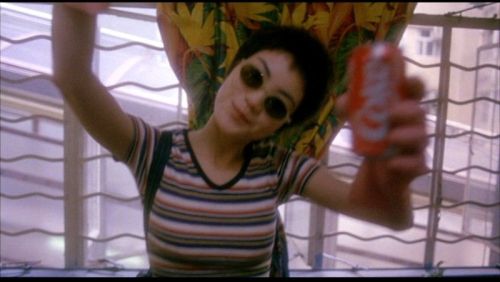
The film’s cast features brief appearances from Liang Zhen as the second May and Valerie Chow as the cop 663's ex-girlfriend stewardess. Chen Jinquan is excellent as the food counter manager who tries to help the situations of the two cops with their girlfriends while dealing with the usual problems with his restaurant. Takeshi Kaneshiro is great as the lovesick, naive Cop 223 who tries to figure out about his own heartbreak and attempt to go into other relationships. Brigitte Lin is great as the mysterious blonde woman by sporting a blonde wig and sunglasses in which, she doesn't show her eyes and real hair. Lin is great for bringing a lot of mystique and ambiguity to a role where she’s a very bad woman and doesn't want to surround herself with anyone or anything. It's a great performance from the iconic actress. Tony Leung Chui-Wai is great as the quiet cop 663 whose obsessions towards food and objects surrounding his ex-girlfriend makes him a great foil of sorts for the Faye Wong character. Leung's understated performance is wonderful in dealing with the ideas of love and all of its hopes and disappointments.

Finally, there's Faye Wong in her feature-film debut as Faye. Wong's free-spirited energy and presence definitely lights up any scene she’s in. From the use of California Dreamin' and Dreams, there is something about Wong’s performance that is just breathtaking and a joy to watch. There's a quirky innocence and playfulness in Wong that is so natural and intoxicating, she's someone that a viewer can fall in love with. Especially in the same way someone like Natalie Portman in Garden State or Maggie Gyllenhaal in Secretary have which is indescribable. Wong has that intoxicating quality that makes anyone want to fall in love with her.

The Region 1 DVD from Miramax and Quentin Tarantino's defunct Rolling Thunder Pictures video label presents the film in its widescreen format ratio of 1:85:1 for 16x9 TVs with Dolby Digital Sound. The DVD includes two different trailers including the original Hong Kong trailer and U.S. trailer. The U.S. version of the film adds extra minutes and scenes with a few, slightly re-edited sequence that doesn't change much of the film. The DVD includes an introduction track from Quentin Tarantino who discusses his introduction to Kar-Wai after seeing his second feature Days of Being Wild. He enjoyed the film and saw Chung Hing Sam Lam at the Stockholm Film Festival in 1994 where Tarantino was also showing Pulp Fiction and fell in love with the film.

In the wrap-up after the film, Tarantino discusses why Kar-Wai made the film. After going through some exhausting problems in editing his martial arts epic Ashes of Time, Kar-Wai decided to do something different. For 23 days, he immediately made Chung Hing Sam Lam. Taking Kar-Wai regulars Tony Leung Chui-Wai and Brigitte Lin, Kar-Wai decided to do some the same improvisational style like one of his favorite directors, Jean-Luc Godard. Lin, who is considered the Greta Garbo of Hong Kong films, retired after doing Chung Hing Sam Lam. Tarantino briefly mentions Faye Wong, who is a popular pop singer in Asia and this was her film debut. Tarantino mentioned Fallen Angels which was supposed to be a third part of the film but Kar-Wai was already tired at the point of making the two stories that he decided to make the third story into a bigger feature-length film. After finishing it in 1994, Kar-Wai released both Chung Hing Sam Lam and Ashes of Time.

***Updated DVD Tidbits 10/11/09***

The 2008 Criterion Collection Region 1 DVD for Chungking Express presents the film in a new, restored high-definition digital transfer with Dolby Digital 5.1 sound which are all supervised by Wong Kar Wai. Presented in its original 1:66:1 aspect ratio in the widescreen format. The DVD includes two special features exclusively for the DVD. The first of which is a feature-length audio commentary track from Asian cinema critic Tony Rayns. The British-based critic reveals a lot about Kar Wai’s background plus his early film career. Particularly at where Kar Wai was at during the making of Chungking Express following the overwhelming difficulties and troubles he was going through making Ashes of Time.

Rayns also reveals tidbits on the production where the film's two different storylines were shot by different cinematographers. The Brigitte Lin/Takeshi Kaneshiro storyline was mostly shot by Andrew Lau Wai-keung, who would later forge a filmmaking career of his own with his most notable success being a co-director for Infernal Affairs. When Wai-keung had to leave production to start work on a film of his own, Kar Wai brought in Christopher Doyle whom he worked with on Kar Wai's second film Days of Being Wild despite a contentious relationship with the two. Rayns reveals the different between Wai-keung's approach in comparison to Doyle which would lead Doyle to become one of Kar Wai's regular collaborators until 2004's 2046 in which the two had a falling out after production of that film.

Rayns talks about Kar Wai's casting choices where the film’s still photographer Piggy Chan Kam-chuen ended up playing the Midnight Express food stand manager. For Brigitte Lin, this was her final film role before going into retirement to raise a family while Rayns delves Takeshi Kaneshiro multi-lingual background as he was just starting to act at this time since he was a pop singer. Rayns also goes into detail about Tony Leung Chiu-Wai's relationship with Kar Wai that began during the troubled production of Days of Being Wild along with directing Faye Wong who didn't have any dialogue early on because she felt tense during her performances. The overall commentary is informative and insightful about Kar Wai, the film, and the Asian film scene along with some details about Kar Wai's recent work and some reasons into why Kar Wai and Christopher Doyle will never work together again.

The second big special feature is a 13-minute clip from a 1996 British TV series called Moving Pictures which features interviews from Wong Kar Wai and Christopher Doyle. The film explores Kar Wai's film collection up to 1995's Fallen Angels as Kar Wai gives a tour of the Chungking mansion area where he based part of the film on. The apartment that Tony Leung Chiu-Wai's character stayed in is actually the apartment of Christopher Doyle which he reveals while was upset over the flooding and losing some things in nice humor. The two also talk about film aesthetics as it's an informative, fun little featurette about Kar Wai and Doyle. Another special feature that also appeared in the previous DVD version from Miramax and Quentin Tarantino's Rolling Thunders Pictures label is the trailer in a remastered form.

The DVD also includes a booklet featuring an essay by film critic Amy Taubin of Film Comment & Sight & Sounds. Entitled Electric Youth, Taubin compares the film to Jean-Luc Godard’s Masculin Feminin since both films featured popular singers of the time in leading roles. Taubin also goes into a bit of Kar Wai's career at the time following the troubled production of Ashes of Time as well as what was happening in Hong Kong three years before being handed back to China from Britain. Taubin goes in depth to the film's plot and characters while revealing that the film despite Quentin Tarantino's endorsement for the film, failed in the U.S. box office upon its 1996 release in that country. The overall essay is definitely a great read for those who love the film as the Criterion DVD itself is a more definitive version than the original Rolling Thunders DVD back in 2002.

***End of DVD Tidbits***

While it doesn't have the same elliptical, moody textures of latter-day films like In the Mood for Love or 2046, Chung Hing Sam Lam is still a vibrant, intoxicating masterpiece from the brilliant Wong Kar-Wai. Fans of Kar-Wai will no doubt consider this film as one of the essentials of his films. Those new to Kar-Wai will find this as a great starting point as well as a nice introduction to Hong Kong films that aren't action films. In the end, for anyone wanting to find a nice movie about love and all of its quirks and disappointment, Chung Hing Sam Lam is the film to see.


© thevoid99 2011