Tuesday, December 07, 2010

V for Vendetta


Originally Written and Posted at Epinions.com on 3/29/06 w/ Additional Edits.


George Orwell's iconic novel 1984 foretold a story about the world being controlled by a totalitarian state where everything and everyone is being watched by a man named Big Brother. Today, Orwell's novel is more relevant through a variety of forms as people sees Orwell's tale right in their face with the chaos of the world. Many films, books, and pieces of music have referenced or used Orwell's idea into art including a graphic novel about a masked vigilante who fights a Fascist government in future Britain by Alan Moore and illustrator David Lloyd called V for Vendetta. The graphic novel became a cult favorite among comic book fans that was so beloved, it even caught the attention of Andy and Larry Wachowski, the creators of The Matrix film series. Though mixed reviews on the latter films of The Matrix chose for them to take a step back from the spotlight, it didn't stop their interest for V for Vendetta which they decided to make into their next project.

Screenplay by the Wachowski brothers with their first assistant director James McTeigue serving as the director, V for Vendetta is an action, political thriller about a futuristic, Fascist-run government in Britain that is threatened by a masked vigilante named V. With people being taken for their subversive ideals, a young woman is also taken where she eventually becomes V's only true ally. Straying away from the excess and mythology of The Matrix, McTeigue, the Wachowskis, and producer Joel Silver chose to create a smart, provocative, and entertaining film that brings enough character and action for a mass audience. Starring Hugo Weaving, Natalie Portman, Stephen Rey, Stephen Fry, Sinead Cusack, Rupert Graves, and John Hurt. V for Vendetta is an excellent, smart action film that challenges the post-9/11 world.

It's futuristic London with years ahead of the 21st Century where everything is restricted and everyone is watched. Even curfew is at stake when a young woman named Evey (Natalie Portman) is about to be raped until she is saved by a masked vigilante named V (Hugo Weaving). After saving her, he reveals to her of his ideas and who he is when he shows her what's about to happen since its hours away for November 5th, which is Guy Fawkes Day. Guy Fawkes was remembered as a man who tried to blow up the building of Parliament in the 17th Century only to be captured and hung. To commemorate this day, V blows up a building in front of the citizens of London and to Evey's horror.

The incident has caught the attention of the country's supreme Chancellor Adam Sutler (John Hurt) who is angry that his own control is now being under attack by an unknown terrorist. He calls for his council member Creedy (Tim Pigott-Smith) to take action. Meanwhile, another of Sutler's insiders, an inspector named Eric Finch (Stephen Rea) has been called to investigate what's going on with help from his assistant Dominic (Rupert Graves). With Evey continuing her work as a production assistant for her boss and TV talk show host, Gordon Deitrich (Stephen Fry), she gets called by him who blamed himself for having to call on her, especially on curfew. While working, V arrives to take charge of the network as he plans to strike again on the next Guy Fawkes Day as he plants a bomb on the TV network station. While trying to escape, Evey tries to help but gets knocked out as V takes her to his underground compound.

Watching the incident closely is Finch who sees that Evey has been captured and could be an accomplice of V. He follows her file closely which reveals that her parents were political activists at the time Sutler was in power shortly after an incident concerning a small plague. Learning that she's in V's underground compound filled with books and artwork, Evey learns from V about his own past which reveals his reasons for wearing a costume and a Guy Fawkes mask. She learned it is from a government lab experiment that went horribly wrong. While she doesn't like his violent approach, she does understand why he's rebelling as V is killing off several people who have burned and experimented on him. One of those targets was a former military commander-turned-TV talk show host named Lewis Prothero (Roger Allam). After reluctantly helping V to reach another of his targets, Evey leaves and hides out in the home of Deitrich.

Finch follows the evidence very closely as he learns that the terrorist known as V might be going after those in an incident following a failed lab experiment One of those people was a former doctor now a coroner named Delia Surridge (Sinead Cusack), who has been wracked with guilt over the incident and had been hiding. When Finch tries to contact her home, she had been found dead only to leave evidence for Finch to find out. Then, Finch begins to question as he and Dominic wonder if any of the incidents including the plagues, water poisoning, and everything else had been under the control of the government. With Evey staying at Deitrich's home, she learns that Deitrich too, has been hiding elements of art including an old copy of the Koran. When he decided to do a show where he lampoons Sutler and V, he gets into trouble as Evey's attempt to escape only gets her captured.

Immediately, Creedy interrogates Evey about the whereabouts and identity of V as she is tortured, abused, beaten, and gets her head shaved in order to reveal the information. While she refuses, she becomes more and more desperate until a letter from next door is revealed by a woman named Valerie (Natasha Wightman) who reveals to herself about her own life. The letters from next door give Evey more of a chance to live as she had escaped and finds herself returning to V. After a brief meeting, she briefly leaves to wait for November 5th while Finch's investigation gains some ground as he learns more about his own government's involvement. There, V goes for his final stand with the people of London watching.

While most films about Fascist governments, especially from a novel like 1984 reveal the idea of a dystopian world where everything is in chaos and leads to a rebellion. In the case for this film, especially in today's world, the film does speak in volumes while bringing a nice balance of no-holds-barred entertainment and bringing in a nice dose of political idealism. While the major flaw in the political part of the film is that the film is one-sided for the most part when it comes to the revolt and subversive ideas of V in destroying the government. It's understandable that V and the people of London are living in a totalitarian time where they're on watch and there's a curfew abroad with trying not to anger the government altogether. McTeigue does a great job in showing the examples of the dystopian world but he doesn't bring enough back-story on how the government party got built or how they came into power.

Still, for the most part, McTeigue and the Wachowski brothers do bring enough sense and humor into the political realm. One of the controversial themes about the film is terrorism. It's not that the film is supporting terrorism but in this post-9/11, it's likely that it won't stop. Terrorism is often inspired by some form of oppression where it's come to the point that it's attack and attack. One of the things that McTeigue and the Wachowski brothers have done isn't see the positive or negative aspect of terrorism but to try and find reasons for it. There, the result only brings more questions than answers. Especially when Evey tries to tell V that violence isn't sometimes the answer. Yet, Evey does come to the point sometimes, action does speak louder than words as she has to learn more about that process, especially when it involves about her own family and colleagues.

The political aspect of the film is wonderfully drawn out and smart despite its flaws which gives the film a nice break from the usual world of action. Still, the action sequences are done with great style which is similar to the approach of The Matrix but owes more to an 1938 film version of the Dumas novel The Count of Monte Cristo, which is referenced throughout the entire film. There's also a bit of 1984 in the political part of the film while the balance of drama, action, and political intrigue does bring a film that works on every level. The script and McTeigue's direction not only work with creating an amazing film but fleshing out real characters, especially in the development of Evey, V, and Finch. The great thing that the Wachowski brothers do is create real people in real situations while feeding off the world they live and hoping to do what they feel is right.

Helping McTeigue in his vision is late cinematographer Adrian Biddle (whom the film is dedicated to after his death in late 2005) who creates a wonderfully gray look for the film's night scenes while bringing out great, colorful lighting in a dreamy sequences involving the character of Valerie. Biddle's cinematography is amazing and wonderful exquisite to bring out the look and tone of the film as his work is amazing and he is a great cinematographer that will be missed.

Helping with the look of the film are production designer Owen Paterson plus art directors Marco Bittner Rosner, Sarah Horton, Sebastian T. Krawinkel, and set decorator Peter Walpole. The look of the film is distinct for the dystopian tone of the black, red flags of the government to the things that Deitrich and V have like the books, artwork, and stuff that fills around the room that suits their personalities. Costume designer Sammy Sheldon also does wonderful work in creating the Guy Fawkes look and the prison look that Evey takes on while presenting, a nice, militaristic look of the government.

Helping to piece the film together in the perspective of what's going on, especially in the third act is editor Martin Walsh who does some great cutting work and perspective cuts that gives a nice pacing and feel into the movie while it giving a nice, leisurely feel to the entire film. Sound designer Glenn Freemantle does some wonderful work with the sound to give the sense of suspense while visual effects supervisors Dan Glass and Matt Johnson help flesh out the look of the film plus the visual designs of the destruction that goes on the film. In the music department, composer Dario Marianelli brings great work in capturing the dystopian feel of the film along with its intense, action sequences. The film's soundtrack is very diverse with not just a bit of jazz cuts plus music from Tom Waits and Cat Power. Added to give the film a nice coda that plays well to the film’s politics is a classic tune from none other than, the Rolling Stones.

Finally, there's the film's superb cast that includes some great, minor performances from Clive Ashborn as Guy Fawkes, Billie Cook as a little girl in love with V's ideas, and Natasha Wightman as Valerie, who brings a nice presence to the film and provides the determination for Evey's change in political idealism. Rupert Graves does excellent work as Finch's partner Dominic. Sinead Cusack is excellent in a small role as a target for V as her performance brings a wonderful sense of importance to the plot while in her scene with V, she commands a dignity that is rarely scene in a confrontational scene. Roger Allam is excellent as this Rush Limbaugh-like talk show host who commands enough attention and demeanor that he does great work as a villain while Tim-Pigott Smith is also excellent as the devious Creedy.

Stephen Fry gives a wonderfully funny, sweet performance as Evey's talk-show superior whose love for art and comedy give Evey reasons to rebel against the government as Fry is a stand-out.John Hurt goes full circle from his performance as Winston Smith in a 1984 film version of 1984 to play a Big Brother-like leader in Adam Sutler. Hurt brings a great, terrorizing presence that is almost scary to watch as his rage in full close-up is enough to reveal the intensity of his performance. This is truly one of Hurt's best work as he stands out in full-form as Sutler.

Stephen Rea also does great supporting work as Eric Finch with his indifferent, observant performance who relies more on his instincts to try and see if things are wrong. Rea is perfect in his role as he tries to bring a perspective of what could be right or if he is doing the wrong thing. Hugo Weaving gives a wonderfully charming yet menacing performance as title role of V. Though most of his performance is in a mask, Weaving brings enough charm and wit to his role that doesn't make him feel like a terrorist but rather a vigilante. Weaving has great chemistry with Natalie Portman throughout the film while revealing his own vulnerability with his body language which brings depth into a role that doesn't require to reveal a lot of emotions. Fortunately, Weaving does masterful work in his performance.

Then, there's Natalie Portman (It's Po'tman motherfucka!), who gives probably one of the best performances of her career. While she falters a bit with the English accent, Portman's ability to display emotions and observance that overshadows whatever flaws she might have. Whereas George Lucas directs Natalie to display awful lines with stilted performances, McTeigue and the Wachowski brothers do great utilization of her talent. Natalie sells every moment of despair and anguish into her torture scenes while making her into a full character who goes from being a fearful young woman to a woman who no longer sees or feels fear but wants to do something. Even stripping down physically, Portman brings a presence that is unique and hypnotic that it's bar-none, one of her strongest. It's clear that in an age of young starlets trying to get the biggest paycheck or get the right movie for an Oscar nod. Natalie Portman is right now the Best Actress of Her Generation. If you don't think so, read this from comedy actor Andy Samberg:

Natalie you are a badass batch (hell yeah)

and I will pay for your dry cleaning when my shit gets in your shoe (what)

as for the drug use, well I can vouch for that

my dick is scared of you, girl

-In the Life of Natalie Portman by Natalie "MotherFucking" Po’tman

Overall, V for Vendetta is a fun, smart action film that has enough bang for the buck while presenting the audience with some smart, political insight. Though this film is not meant to inspire terrorism, it does question the intention of what terrorism is trying to say. It's just a fun movie to watch thanks to Joel Silver, James McTeigue, and the Wachowski brothers with great performances from Natalie "M.F." Po'tman, Hugo Weaving, Stephen Fry, Stephen Rea, and John Hurt. In the end, for anyone wanting to celebrate fireworks and want a revolution, go see V for Vendetta.

(C) thevoid99 2010

Sunday, December 05, 2010

127 Hours


2008 was a huge year for British director Danny Boyle as his film Slumdog Millionaire became the surprise hit of the year. Winning several Oscars including Best Picture and Best Director for Boyle, it was a big surprise considering that Boyle has made a series of strange films about Scottish heroin addicts and zombies running amok in the U.K. prior to Slumdog Millionaire. With Boyle still riding high from that film’s success, the British director decided to take on a much more intimate yet grander project about the impossible. Based on Aron Ralston’s real-life experience in which he was stuck inside a canyon by a boulder. Boyle takes Ralston’s experience into a film that is unlike anything in mainstream cinema (with the exception of a recent film called Buried) entitled 127 Hours.

Based on Aron Ralston’s autobiography Between a Rock and a Hard Place, 127 Hours examines Ralston’s experience in being trapped inside a canyon and how he survived. Directed by Danny Boyle with an adapted script written by Boyle and his Slumdog Millionaire screenwriter Simon Beaufoy. The film reveals Ralston examining his life while figuring out how to get out of his predicament. With James Franco playing the role of Ralston, the film also stars Kate Mara, Amber Tamblyn, Clemence Poesy, Lizzy Caplan, and Treat Williams. 127 Hours is a powerful and intense film from Danny Boyle.

It’s April 2003 as Aron Ralston leaves early in the morning to go hiking and mountain climbing at Robbers Roost, Utah. Upon his arrival, he goes bike riding and then hiking where he encounters two young ladies named Megan (Amber Tamblyn) and Kristi (Kate Mara). He takes them to some special sights where the three have fun. After going their separate ways where the ladies invite Aron to a party later on, Aron continues hiking where he sees goes inside a cave through an opening between canyons. All of a sudden, a boulder falls on Aron trapping his right arm where the boulder wouldn’t move. Stuck and unable to get out, Aron tries to figure out how to get out his situation.

With a mountain knife, a video camera, and a water bottle with very little water. Aron deals with his situation as he tries all sorts of things with own mountain climbing experiences. For the next five days, Aron ponders his own life including his relationship with his parents (Kate Burton and Treat Williams), his sister (Lizzy Caplan), and his ex-girlfriend (Clemence Poesy). Even as he tries to entertain himself and see his surroundings where he makes a fateful decision to get out.

While the idea about a guy being stuck inside a canyon by a boulder for five days doesn’t seem like an exciting idea on film. The story itself is truly compelling about Ralston’s own survival and how he got through it. Screenwriters Danny Boyle and Simon Beaufoy however, was able to make it into an engrossing yet mesmerizing film for 95 minutes. Yet, the first 10-15 minutes were devoted to Ralston going to the Utah canyons and his meeting with two young ladies. Then when Ralston is trapped by the boulder, the story becomes intimate while having flashbacks about Ralston’s own life for the entirety of the film. The screenplay becomes a character study of sorts except having Ralston study himself. Even as the dialogue feels improvised and realistic to Ralston’s own predicament.

Boyle’s direction is truly hypnotic in its presentation as he shoots on location at Robbers Roost, Utah where he often shoots multiple angles and shots of the canyons Ralston is exploring. While some of the canyon scenes were re-created for the film, notably the scenes where Ralston is trapped. Boyle goes a somewhat, cinema verite style by shooting the film from not just the perspective of the audience but also having Ralston himself point the camera at himself. There, he can entertain himself while also being able to face up to his own sins. Even as the camera takes a shot from the perspective at his own water bottle to see how much water he has left.

Fantasy sequences are also unveiled throughout the second act of the film whether it’s a good thing or something that would be horrific. Boyle even has shots where he uses the same images for repetition so Ralston can know what time of day is happening like the brief moment of sunlight passing by or a raven flying above him. These images plus other objects would become symbolic to Ralston’s own troubles. Even as it goes into the third act where he would free himself on the fifth day. There, what Ralston would do would become one of the most graphic but also intense scenes captured on film. Even in the aftermath where he would be free but still trying to survive. The end result isn’t just a film that just goes for the drama of being trapped but also what one has to do to survive. For Danny Boyle, he creates what is probably his most hypnotic and exciting film since 1996’s Trainspotting.

Boyle’s longtime cinematographer Anthony Dod Mantle, along with Enrique Chediak, brings a colorful yet stylish cinematography. While some of the photography style is similar to Mantle‘s work in Slumdog Millionaire. With Chediak, Mantle goes for a realistic look while adding some light for some of the scenes in the cave while also using grainy digital video camera for Ralston’s own perspective shots. The work that Mantle and Chediak do is truly superb as it definitely tops everything Mantle did in his previous collaboration with Boyle. Editor Jon Harris does fantastic work with the film’s stylish, rhythmic editing. Even with the use of multiple split screens to emphasize the numerous perspective shots of what Ralston is doing from his point of view and the camera’s view. Harris’ fluid editing with an array of different pacing speeds for the film’s intensity is truly spectacular.

Production/costume designer Suttirat Anne Larlab, along with set decorator Les Boothe and art director Christopher R. DeMuri, does an amazing job with the recreation of the cove and canyons that Ralston is in along with the boulder. Even for other scenes like the homes that Ralston lived while the costumes are mostly casual. Boyle’s longtime sound designer Glenn Freemantle does a phenomenal job with the film’s sound design in creating the atmosphere that Ralston has surrounded himself with. Even the realism for one of the film’s most intense scenes in the third act. Freemantle’s work is definitely a highlight of the film’s technical field.

Music composer A.R. Rahman brings a vibrant, exciting score that is filled with hypnotic dance-inspired tracks along with slower tracks to emphasize Ralston’s emotions. The soundtrack features an array of tracks including a collaboration between Rahman and Dido plus Sigur Ros, Bill Withers, Plastic Betrand, Esther Phillips, and Frederic Chopin. Many of which are used to either play up some of the humor or the heightened emotions of Ralston. The score and soundtrack is another of the film’s highlights as Rahman makes a triumph follow-up for his work on Slumdog Millionaire.

The casting is definitely inspired with appearances from Koleman Stinger and Parker Hadley as younger versions of Aron and Bailee Michelle Johnson as a younger version of Aron’s sister Sonja while Lizzy Caplan makes a small appearance as Sonja in the film. Other notable but small appearances include Treat Williams and Kate Burton as Aron’s parents, Sean Bott as a friend of Aron, and Clemence Poesy as Aron’s ex-girfriend Rana. Kate Mara and Amber Tamblyn are great in their small but very memorable roles as young female hikers who join Aron early in the film exploring the cave as they later invite him to a party. Mara and Tamblyn really bring a dose of early joy to the film that is needed for something that is more in-your-face.

Finally, there’s James Franco in what is definitely his performance to date as Aron Ralston. Franco definitely brings a lively yet captivating performance where he starts off as this cocky adventurer who likes to have fun and do things. Then when he becomes trapped, Franco goes for the realism in the situation he’s facing while providing a sense of regret and angst to the role. While he’s nearly in every frame of the film, Franco really gives a towering performance that really serves as a true break-out following such memorable turns from the David Gordon Green-Judd Apatow stoner action film Pineapple Express and Gus Van Sant’s Harvey Milk-bio pic Milk. This is the film that will show that Franco is definitely one of the best actors working right now.

127 Hours is a spectacular yet chilling film from Danny Boyle that features a marvelous performance from James Franco. Fans of Boyle’s work will no doubt enjoy this though there’s some moments in the film that isn’t for everyone. Notably the third act yet it is a courageous film that people will see. Even with the recent events about the 33 miners who survived inside an enclosed Chilean cave for 69 days. It’s a film that shows what is great about the human spirit and how someone will do whatever it takes to survive. In the end, 127 Hours is one of the year’s best films as it comes from the dazzling mind of Danny Boyle.


© thevoid99 2010

Saturday, December 04, 2010

Garden State


Originally Written and Posted at Epinions.com on 8/15/04 w/ Additional Edits.


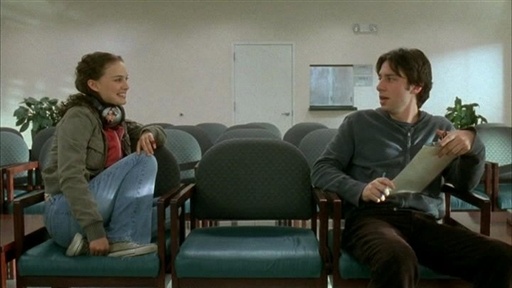
The Sundance Film Festival has always been known as a festival that gives the spotlight to new up-and-coming filmmakers as they rise to the world of cinema. In 2004, TV actor Zach Braff of the show Scrubs released his directorial feature-length debut film, which he also wrote, and starred in entitled Garden State. A big hit at the festival, Garden State is a quirky comedy-drama about an actor from L.A. named Andrew Largeman who returns to New Jersey for the funeral of his mother. After years of being in a medicated state, Largeman wakes up from his monotone, mind-numbing state where he meets a quirky young woman while trying to make amends with his psychiatrist father and old school friends. Starring Braff in the lead role of Andrew Largeman with a cast that includes Natalie Portman, Peter Sarsgaard, Ron Liebman, Jean Smart, Method Man, and Ian Holm. Garden State is a majestic film that is rich in its quirkiness and compassion.

For the 26-year old Andrew Largeman, life has been nothing but one monotone, numbing world as he is often in a trance. Even when he is doing his acting, he's often in a state, including one moment as a waiter in a Vietnamese restaurant. Then one day, his father and psychiatrist Dr. Gideon Largeman (Ian Holm) calls him that Andrew's paraplegic mother had died, drowning in her bathtub. Andrew returns to his home in New Jersey to attend the funeral where he sees his old friend Mark (Peter Sarsgaard) working as a gravedigger with pal Dave (Alex Burns). Mark invites him to a party where Andrew is forced to deal with relatives and his estranged father, who wants to talk to him, especially about his medication that Andrew had forgotten to bring for his depressing state of mind. Later that night, driving his grandfather's Army motorcycle, an officer stops him who turns to be former school pal Kenny (Michael Weston) who is surprised to see him. Andrew goes to the party where he meets Jesse (Armando Riesco), who got rich off of inventing Velcro that makes no sound where Andrew took ecstasy and began to see an orgy of drugs and sex.

The next morning at Mark's house, he meets another old friend named Tim (Jim Parsons) and Mark's mother Carol (Jean Smart). Tim has become a knight for the Medieval Times restaurant franchise while Carol often tells Mark to work on his plans to become a real estate agent but Mark isn't interested except in getting stoned. Andrew leaves to attend a therapy session his father had signed on for him. Andrew comes across a humping dog and a quirky, pathological liar named Sam (Natalie Portman) who recognized from TV as a mentally challenged quarterback. The talkative Sam keeps talking to him as she gives him a chance to listen to the Shins. For the first time ever, Andrew gets out of his state as he meets a psychiatrist named Dr. Cohen (Ron Liebman) who checks his prognosis and thinks Andrew is just feeling fine although he is wondering what just happened after Andrew stop taking his pills.

Andrew sees Sam after his session where he takes her to Jesse's house and then to her home where he meets her mother Olivia (Ann Dowd) and her adopted African brother Titembay (Ato Essandoh). Andrew is intrigued by Sam's quirky personality as she admits to lying a lot and during a burial for one of her dead hamsters, Andrew talks about his mother and her death as Sam is moved by the fact that he had a hard time trying to reveal his sadness after being numb for years. Deciding to stay in New Jersey for a few more days, Andrew tries to avoid his father for a conversation only to hang out with Sam, who gets embarrassed by her mom over a video of her skating in a crocodile costume, and with Mark. Andrew and Sam join Mark in swimming in Jesse's pool where later that night, Andrew reveals how his mom became paraplegic and how he got heavily medicated. Andrew and Sam are left alone with Andrew having a few more days left before returning home.

Mark, who has been happy with Andrew's return wants to give him a going away present while presenting him his collection of Desert Storm cards which he hopes will be worth a lot of money. Mark decides to get Andrew his present with Sam as Mark scams money at a convenience store where Andrew meets another old schoolmate Karl Benson (Geoffrey Arend) who presumed that Andrew had committed suicide. Andrew isn't sure what Mark is trying to do as they go to a hotel where they meet a sleazy, underground porno organizer named Diego (Method Man) who gives Mark direction to meet Albert (Denis O'Haye) and wife Faye (Debbon Ayer). Mark accompanies Sam and Andrew into an abandoned canyon where they meet Albert, who has these weird theories of the world. Mark gives Andrew his present where Andrew is finally forced to confront his own life and father while trying to decide if he wants to return to Los Angeles or stay in New Jersey.

Presenting itself as a quirky film with some funny moments in sad situations or vice versa, Garden State in some ways plays up to the offbeat world of 1970s filmmaker Hal Ashby. While Braff only recalls a bit of Ashby's world, he does manage to bring a vision that isn't just heartbreaking but also absurd and compassionate. With a wonderful screenplay that is filled with witty dialogue and strange yet sympathetic characters, the film's story works in all levels, even in its love story between Andrew and Sam. Braff as a director is truly a visionary with his eye-wielding direction where he brings in wonderful crane shots and spectacular camera movements that is complemented by cinematographer Lawrence Sher.

Sher brings a colorful, dreamy photography that gives richness of the film with help from production designer Judy Becker and art director Laura Ballinger, notably a scene where Andrew's shirt matches a wallpaper design. Another great aspect to some of Braff's direction, especially in faster shot sequences is editor Myron I. Kernstein who helps brings a wonderful pace and crafted editing style that helps Garden State be wonderful in its technical achievements.

One great aspect of the film is its dramatic, acoustic music score from composer Chad Fisher who brings that Ashby quality of offbeat drama and comedy. The film's music really makes Garden State a gem of a film. With cuts from Coldplay, the Shins, Colin Hay of Men at Work, Remy Zero, Nick Drake, Simon & Garfunkel, Frou Foru, Zero 7, and a hilarious cover of Lionel Richie's Three Times A Lady in the funeral scene. It's by far the best film soundtrack of the year and credit goes to Braff, Fisher, and music supervisors Buck Damon and Amanda Scheer-Demme.

Then you have the film's amazing cast with great small performances from Jim Parsons, Alex Burns, Michael Weston, Armando Riesco, Ann Dowd, Ato Essandoh, Geoffrey Arend, Denis O'Hare, Debbon Ayer, and Jackie Hoffman as Andrew’s Aunt Sylvia, who created that shirt that matched the wallpaper. Method Man is funny in his small performance along with Ron Liebman as the quirky, unorthodox Dr. Cohen, and Jean Smart as the loving but stern Carol who is frustrated at Mark's lack of ambition while is willing to believe anything that will get her out of New Jersey. Ian Holm is excellent in the role of Andrew's father Gideon. Holm brings a performance that carries guilt inside as he desperately tries to talk with his son but is having a hard time balancing the role of father and shrink. In the final confrontation, we see Holm at his most restraint where he and Braff have great tension together.

Of the film's supporting cast, no one is as good or as charming as Peter Sarsgaard in the role of Mark. Sarsgaard's character is supposed to be this sleazy, cunning friend who takes a lot of pride in not taking anyone's money, even Andrew's. Sarsgaard brings a likeability and sympathy to his performance as a guy who just has small dreams and doesn't really want to live up to any ambitions or be a failure in favor of simplicity. Sarsgaard has wonderful scenes with Braff and Portman as he proves himself to be one of the best supporting actors in the industry and it's the supporting players that really help carry the leads and story. Sarsgaard is just one of the best supporting actors right now who can be a leading actor but seems comfortable as well in the supporting role.

Natalie Portman meanwhile, brings her most fulfilling performance since her 1994 debut role in Luc Besson's Leon-The Professional. Here, Portman brings a quirkiness and radiance to a performance that is always wonderful to watch. Portman seems comfortable and relaxed in a role where she lets loose and even act like an idiot at times for sheer fun while she manages to display her brilliant mastery in restrained, subtle dramatic performances. With Braff, the two carry a wonderful chemistry that is funny and sad in some sequences where you root for both of them with Portman just being the loveable oddball. This is by far Portman's most complex and charismatic performance for the young actress.

Zach Braff is a wonderful leading man in easily one of the year's best performances. Even for those who haven't seen him in the show Scrubs won't really need to because in this role, he really brings in an engaging, troubled performance as Andrew. Braff doesn't make his character pathetic or plain idiotic but someone who is just lost after years of being in a trance. Braff makes Andrew someone we love and feel sorry for, even with his flaws. Braff is also brilliant with scenes with other actors in the way he reacts to their quirkiness and oddball activities while being the butt of the jokes where he would have words all over his body. This is definitely Braff's breakthrough role into the world of films.

***Updated 3/25/05, DVD Tidbits***

The DVD to Garden State that is shown in its anamorphic widescreen format of 2:35:1 along with 5.1 Surround Sound and Dolby for English and Spanish along with subtitles and captions in English, Spanish, and French. The DVD includes a Fox Searchlight trailer to Danny Boyle's 2004 family film Millions along with a promo for the acclaimed soundtrack to Garden State. The special features includes a 30-minute making-of featurette that includes Braff and his cast and crew where Peter Sarsgaard got into character by practicing the guitar. The making-of feature shows some intimate moments with the crew and cast, notably Braff, Sarsgaard, and Natalie Portman who shows her humorous side more while doing takes and how the motorcycle often doesn't work.

The DVD also includes a 3-minute outtakes and blooper reel where the cast flub their lines including Sarsgaard, Braff, and Portman as she tries to do a funny New Jersey accent and the hilarious outtakes of the humping dog along with a hilarious scene of Sarsgaard almost fainting during a take with Method Man that got Natalie to go into hysterical laughter. The DVD also includes 16 deleted and extended scenes that features optional commentary from Braff, cinematographer Lawrence Sher, production designer Judy Becker, and editor Myron Kerstein. Some of the deleted scenes included extended scenes of the funeral party that featured many of Braff's relatives including his father, an audition scene, extended scenes with Portman and Sarsgaard including the ark scene. The best scene that Braff didn’t want to cut but did for pacing issues was an earlier confrontational scene with him and Ian Holm where Holm delivers a great performance but Braff felt like several of the deleted scene, it was pacing that forced him to cut the scene.

The DVD also includes two audio commentary tracks from Zach Braff. One with Sher, Becker, and Kerstein is more technical driven on talking about some of the details of the films but it's mostly straightforward and relaxed since they’re having fun talking during the commentary while Braff asks Becker who's a better director to work with, him or Ang Lee (since she's credited on production design for Lee's upcoming Brokeback Mountain). The overall filmmakers' commentary is one of the most fun and detailed of commentaries. The second commentary Braff is in is with Natalie Portman which is more fun than the other commentary. Portman not only seemed relaxed but also says some of the funniest things in the commentary with Braff as she talks about her New Jersey-Jewish accent and her quirky approach to the character. She also complains how weird her ears are and how Method Man was nervous in cursing in front of her when she didn't seem to mind since she's a fan of Meth and the Wu-Tang Clan.

While the DVD doesn't include the teaser or full trailer to the film or the Anatomy of a Scene special on the film from Sundance Channel, the Garden State DVD overall is an excellent DVD that the film's fans will love.

***End of DVD Tidbits***

Garden State is truly a majestic film helmed by the multi-talented Zach Braff with a wonderful film crew and cast that include Natalie Portman, Peter Sarsgaard, and Ian Holm in amazing performances. With a great soundtrack as its accompaniment, Garden State is indeed one of 2004's best films with Braff being a triple-threat in the acting, writing, and directing field as he created one of the best debut features ever by a new director. Sundance truly found a winner with Garden State as this film has something for everyone, it's romantic, it's funny, it's dramatic, and it's strange. In the end, Garden State is a wonderfully complex film that marks the emergence of a new visionary.

(C) thevoid99 2010

Friday, December 03, 2010

Closer (2004 film)


Originally Written and Posted at Epinions.com on 12/5/04 w/ Additional Edits.


One of the most successful and prolific filmmakers since the 1960s, Mike Nichols has made some great movies like The Graduate, Working Girl, Silkwood, Carnal Knowledge and hits like Wolf and Primary Colors. Though Nichols is beloved by critics and moviegoers, the director has hit a slump in the few years as his 2000 film What Planet are You From? received the worst reviews of his career. Nichols took a break from features to direct plays and TV films for HBO to great reviews with Wit and in 2003, the Tony Kushner-based play for Angels in America which received enthusiastic reviews. In 2004, Nichols makes a return to the big screen with a provocative character study drama about love and relationships in the film entitled Closer.

Directed by Nichols based on the play by Patrick Marber, who also wrote the film's screenplay. Closer is a film that doesn't play to the typical formulas of romantic films, instead it is a return to the similar territory of sex and relationships at its most brutal that Nichols' old 1971 film Carnal Knowledge had. Set almost entirely in London, the movie is about four different people, two American women and two British men as they explore their own desires and temptations in love and sex. Starring Julia Roberts, Jude Law, Natalie Portman, and Clive Owen, the film might seem something sweet with a cast like this. Instead, it's a darker, hurtful film that doesn't play nice and it's not the kind of movie anyone wants to bring a date to.

It's a typical day in London as an obituary writer and aspiring author named Dan (Jude Law) runs into a young waitress/stripper named Alice (Natalie Portman) at a crosswalk in London. A cab hits Alice where she was slightly injured as Dan takes her to the hospital where sparks begins to happen. The two have a conversation where Dan takes her to a park where his mother had died. Time goes by as they become a couple where Alice is now a full-time waitress while Dan has just finished a book that is set to be published. Dan takes photos for a photographer named Anna (Julia Roberts) where she is in the middle of a divorce and Dan makes advances towards her. The two kisses but Anna intervenes since she knows Dan has a girlfriend. Alice arrives and suspects something was going on.

Then one night during a sex chat, Dan pretends to be a woman while going on an online chat with a British doctor named Larry (Clive Owen). The chat gets very extreme as Dan, who pretends to be Anna, wants Larry to meet her in an aquarium wearing a white jacket. Larry finally meets Anna but learned that Anna wasn't the person in the chat room as the two get to know each other as Anna is smitten with the rogue, charming Larry. Then a year goes by as Larry and Anna are married while Alice and Dan are having trouble in their relationship as Dan and Anna are rumored to have an affair. At an exhibit Anna made, Larry and Alice meet while Anna and Dan are flirting with each other. Claiming that he has to go on a business trip after the exhibit, Dan gets a cab for Alice and then goes back to the exhibit to flirt with Anna where Larry begins to suspect something.

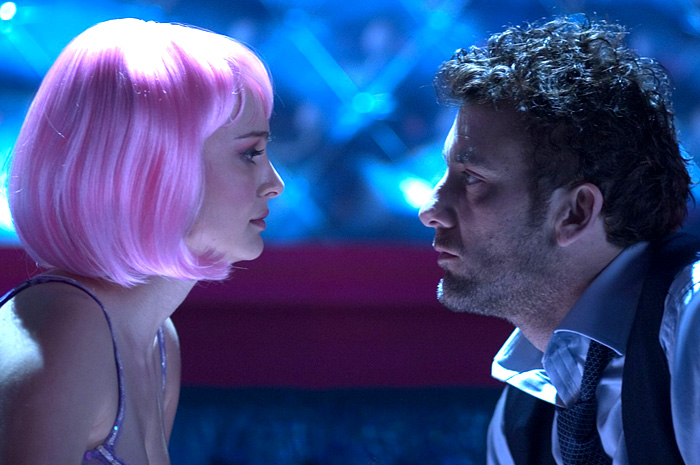
Then one night as Larry returned home from a business trip, he learns that Anna was having an affair with Dan that had been going on for quite a long time since the night of the exhibit. Alice also learns about it from Dan as she leaves him. Heartbroken and angry, Larry goes to a strip club where he finds Alice where she plays mind games with him. In a room together, Larry demands to know what Alice's name is as she claims its Jane where Alice becomes a sadist in a game of sex. With a divorce for Anna and Larry finalizing, Dan and Anna are officially together until Dan learns that Anna met with Larry for the divorce signing that lead to blackmail. Dan confronts Larry only to learn about something that ruins the relationships for everyone involved as Dan sees Alice for the final time.

While Closer isn't a perfect film, it's still one of the strongest and more subversive efforts from a film studio and director Mike Nichols. Nichols provides a fluid yet momentum-building directing style where he lets the audience get to know the characters. With the story developing in its second and third act, we begin to see the ugliness of everyone involved with the feeling that none of the characters have some sort of resolve in the end. Instead, it's a film where you're not sure who is the innocent one and who was the one driving all of these games. Credit goes to Nichols for not pandering down to a formula where everyone gets happy in the end and instead goes for a human story thanks in large part to Patrick Marber's craftily-structured screenplay that also has wonderful theatrical feel from his own play. Though some might be upset with the cutting of Portman's nude scenes in the film, it doesn't seem necessary since what was shown is enough. If Neil LaBute directed it, he would've done the same thing though his approach of gender studies would be more brutal.

The movie is clearly not a typical Hollywood fare because of Nichols' directing. The script by Marber really has a sense of ambiguity and tension where the characters are trying to discover for themselves what's going on. Also, there's a sense of who is manipulating who in the film and the lines of reality and fantasy are also blurred, especially in the third and final act where the film has an ending where everything is left at a shock to see who was really telling the truth and who wasn't.

The film's masterfully presented technical achievements are spot-on thanks to some non-linear editing style from John Bloom and Antonia Van Drimmlen and the wonderful cinematography of Stephen Goldblatt, notably for his use of lights and colors in the interior scenes. Production designer Tim Hatley and art directors Hanah Mosely and Mark Raggett provide a great look to the film's London look, notably the strip club scenes with Portman and Owen along with Ann Roth's costume design on Portman's stripper costume. Even the sound work of Ivan Sharrock should be complemented for giving the film a distinct sound as if you're watching a theatrical play. Then there's the film's music that features a song that is opened and closed by Damien Rice along with cuts in the strip club scenes by the Prodigy and the Smiths that really sets a sense of intrigue and sadness for its characters.

The heart of the lies in the strong performances of its cast where all the actors refused to play likeable versions of themselves and just get to the point of how the characters should be played along with its complexities. Though Julia Roberts can often be considered to be an overrated and bland actress, this film is her best performance since her Oscar-winning performance in Steven Soderbergh's Erin Brockovich. Roberts is good at playing nice but this is her most mature performance to date where she plays a woman who seeks love but has the same temptations that many older women have. What is more amazing is that Roberts is now stripping down all of her previous likeable roles for something more challenging as Roberts is now getting ready to play an elder stateswoman instead of the Pretty Woman we come to know and love.

Jude Law is wonderful in his role as Dan with his sniveling, cocky attitude and sex appeal. Law brings an understated, restrained performance in the anguished and emotionally tortured Dan. Law also carries a brooding tone in the film's final act where he tries to understand what has happened in a scene with Owen. It's clearly Law at his finest. Clive Owen is the film's biggest standout with his rogue, innocent performance as Larry in the film's first act. Owen has a macho, idiotic sensibility that can be very funny and likeable but as the film begins to darken, we see Owen in a fit of rage where he seems to lose control. Owen has great chemistry with Roberts but in his scene with Natalie Portman, the complexity of heartbreak, anger, confusion, and desire is well balanced in a performance that is a true breakthrough for the British actor.

The film's best and most shocking performance clearly goes to Natalie Portman in what is probably the greatest role of her career. The troubled little girl of The Professional is no more as Portman plays probably the film's most intriguing role in the movie as Alice. Portman brings a sense of lovelorn innocence of the film's first act with her kooky charm and smile where we see why Jude Law falls in love with her. When she's heartbroken, we see the emotional desperation of her character as she is trying to find love but in all of the wrong places. Then when she returns to her world of stripping, Portman goes bare all by not just showing a lot of skin (except for the exposed breasts and other things that got cut) but she also showed a dark, sadistic side that is even more jaw-dropping as she plays games with Owen. Whereas 2003 was the year of her rival Scarlett Johansson who delivered two landmark roles in Lost in Translation and Girl with a Pearl Earring, Portman one-ups Johansson with this performance and her kooky one in Garden State by delivering a sense of beauty, angst, and innocence into a dangerous performance.

Though Closer isn't a perfect film because of its lack of likeable moments, it is still one of the best and more provocative efforts of the year thanks to Mike Nichols' uncompromisingly fluid direction. With credit going to Patrick Marber's script and the performances of Julia Roberts, Jude Law, and most notably Natalie Portman and Clive Owen, Closer is really an adult film that tries to study the behaviors of genders. Though it might not be original, especially compared to Nichols' earlier work and the recent films of Neil LaBute, Closer still works thanks to its story and character study. Though its subversive nature and dialogue might be shocking to a mainstream audience, its performances and director Mike Nichols ability as a storyteller will leave people talking after the movie.

Mike Nichols Films: Who’s Afraid of Virginia Woolf? - (The Graduate) - (Catch-22) - Carnal Knowledge - (The Day of the Dolphin) - (The Fortune) - (Gilda Live) - (Silkwood) - (Heartburn) - (Biloxi Blues) - Working Girl - Postcards from the Edge - (Regarding Henry) - (Wolf (1994 film)) - The Birdcage - (Primary Colors) - (What Planet Are You From?) - (Wit) - (Angels in America) - (Charlie Wilson’s War)

© thevoid99 2010

Thursday, December 02, 2010

Heaven's Gate (Take One)


Originally Written and Posted at Epinions.com on 5/23/05 w/ Additional Edits & a New Closing Paragraph.


Throughout the history of cinema, there had been some notable triumphs and milestones that many people will remember for. Then, there are other films that people remember but for all the wrong reasons. While cinema has had its history of failures since the day it began, by the 1960s, many films that were costing lots of money ranging from $20 million at the most were giving studios a lot of financial woes. At that time, those films didn't really mean anything to an audience driven by politics, the counterculture movement, the civil rights movement, and the women’s movement. Even to young filmmakers at the time in the U.S. as they were becoming influenced by the cinema that was coming out of Europe and Asia.

That of course, led to a decade of personal films that meant something to people no matter what genre was as the old Golden Age era was dwindling. Then in 1977, Star Wars came out as the days of personal films that didn't cost a lot of money or make a lot of money were over. Studios knew if they wanted to make a lot of money, they had to spend a lot. This would become a bad lesson as for the next several years, there had been a lot of notable big-budget flops.

Recently, there were films like Gigli, Alexander, Waterworld, Ishtar, and Hudson Hawk. While they became known as turkeys, only a few like Brazil, Once Upon a Time in America (the 3-hour, 45-minute version), The Adventures of Baron Munchausen, and most recently, Francis Ford Coppola's 1982 big-budget flop One from the Heart found audiences through DVD with critics re-evaulating about those films with the exception of Brazil and the uncut version of Once Upon a Time in America that are now considered as classics. Unlike many of those films, there was one massive failure that not only ended the decade of personal, artistic studio films that was led by the directors of the 1970s, but bankrupted a studio company and destroyed the career of a promising director. That film was the 1980 epic-western Heaven's Gate.

Written and directed by Michael Cimino, Heaven's Gate is an epic-western set in the 1890s during the Johnson County Wars in Wyoming between wealthy ranchers and immigrant settlers in the West. Prior to making Heaven's Gate, Cimino had only made two features and written several screenplays for other filmmakers. After 1974's quirky heist film Thunderbolt and Lightfoot with Clint Eastwood and Jeff Bridges, Cimino scored a monster hit with 1978's epic, Vietnam War drama The Deer Hunter that won several Oscars including Best Picture and director for Cimino despite the controversy over its portrayal of the Vietcong army and historical inaccuracies. After the victory at the Oscars, Cimino seemed to be the next big thing as he was slated to direct a monster project on the Johnson County Wars. At a time when big budget films were the thing for movies like Martin Scorsese's New York, New York, Steven Spielberg’s 1941, William Friedkin's The Sorcerer, and Coppola's Apocalypse Now. Yet, it was a huge risk with many of them either becoming flops or just barely recouping the budget.

Cimino however wanted full control on how he wanted Heaven's Gate from the detail of the production, the location setting, and historical accuracy while putting a romantic subplot in the film as well. For his cast, Cimino brought in Christopher Walken, who won the Best Supporting Actor prize for The Deer Hunter along with Jeff Bridges from Thunderbolt & Lightfoot. Also cast in the film was country singer/actor Kris Kristofferson, British actor John Hurt, Sam Waterson, Brad Dourif, Joseph Cotton, and then-French newcomer Isabelle Huppert, who had just won the Best Actress prize at the 1978 Cannes Film Festival for Claude Chabrol’s Violette Noziere. While the film was originally going to include a budget of less than $12 million at the most, a production that featured no major stars seemed to be a major risk. What became a much bigger risk was the amount of creative control Cimino wanted and all hell breaks loose.

Cimino demanded more money and United Artists got into trouble as Cimino began to fight with producers and executives during a grueling shoot that lasted for several months. Finally, when Cimino finished shooting and began post-production, it was becoming more problematic. When Cimino finished The Deer Hunter, it was originally shown at four hours until Cimino decided to cut the film to three hours which was well-received from a test audience. In Heaven's Gate, the film ran as long as nearly five hours to the point that Cimino decided to cut the film at a final three hours and forty-five minutes for its late 1980 release. Once the film was completed, news spread about Heaven's Gate as word got out that the film's final budget escalated to a whopping $40 million, which at the present time would be $120 million.

When it premiered in New York City in November 19, 1980, the critics overnight killed the film with a barrage of negative reviews. While Chicago Sun-Times film critic Roger Ebert admits the attack was unfair, he too didn't like the movie but the worst review of them all came from the New York Times' film critic, Vincent Canby. In his infamous review on November 19, 1980, Canby proclaimed that the film is "an unqualified disaster" while saying nothing in the film works as well as many scenes ran too long. Canby continues to trash the film to the point where no only he talks about the budget but also says watching the film at a near-four hours is "like a forced, four-hour walking tour of one's own living room".

Once Canby's review came out, the film was pulled immediately as Cimino was forced to cut the film to nearly two-and-a-half hours but once it got re-released in early 1981, the film was already dead on its tracks. While Cimino tried to present the film at the Cannes Film Festival in 1981 in competition, the film was still hurt by its American reception as the film received numerous Razzie Award nominations including a Worst Director prize for Cimino. After that, United Artists nearly went bankrupt and Cimino's never recovered as a few years later, a book on the making of the film came out with many of the blame placing on Cimino and its producers. Now nearly 30 years since its release, Heaven's Gate became a running joke as the ultimate turkey of American cinema while the film has a cult following for those who felt the critics reviews at the time were unfair. Well, let's get to it and see what the fuss is about.

The movie begins in 1870 Harvard at a graduation ceremony where two men are on the verge of graduating. One is an American named James Averill (Kris Kristofferson) and the other is a British man named Billy Irvine (John Hurt) as Billy is the class valedictorian. After a long speech from the Reverend Doctor (Joseph Cotten) who urges his graduates to spread culture through the world, Billy mocks the whole speech claiming the world doesn't need any kind of change. After a huge dance and celebration, the two young idealists are on their way to become a part of the world.

Twenty years later, Averill is a marshal for Johnson County, Wyoming as he arrives to the town of Casper to discuss the growing tension between rich cattle baron and poor immigrant settlers is boiling. Leading the Stock Farmers Association is Frank Canton (Sam Waterson) who has hired an enforcer in Nate Champion (Christopher Walken) to maintain order. After talking to train conductor Cully (Richard Masur), Averill wonders what's going on as he goes to the house of the Stock Farmers' meeting where he meets Billy. Billy has become disillusioned with the increasing tension as he now drinks himself to death while he chooses to stay with the Association for political reasons. After confronting Canton, Averill leaves to return to Johnson County.

After meeting with the town's tavern owner John H. Bridges (Jeff Bridges) and the immigrants' political leader Mr. Eggleston (Brad Dourif), Averill goes to meet his lover and French brothel madam Ella Watson (Isabelle Huppert). After presenting her with a new carriage, they ride around town where Averill tells her that things for the immigrants are more problematic as he wants her to leave so she can be safe but she wants to stay with him. After a party with Bridges and Eggleston along with several immigrants, Ella returns to her work one night as Nate arrives where he asks her to marry him.

One morning as Averill stays at the tavern, Nate sees him to talk about Ella as Averill says that Ella is his. Nate, who is in conflict as an immigrant and as Canton's enforcer while Averill learns about the death list of 125 names that included Ella. Averill confronts Nate about Ella's name on the death list leading to a fight. Nate is confused over the news as Averill leaves to the tavern while Nate takes Ella to his cabin where he lives with a trapper (Geoffrey Lewis) and a friend named Nick (Mickey Rourke). Meanwhile back in Casper, Cully sees an unscheduled train pass by as he learns it's Canton and several men including bounty hunters.

Cully tries to make his way to Johnson County only to be killed while Ella stays with Nate for a while seeing despite the fact that he doesn't have much. Averill meanwhile, holds a town meeting with Eggleston and Bridges to announce the death list where the immigrant settlers become unruly. Ella returns home to find a few of Canton's men (one of them is Tom Noonan) as they rape her until Averill comes to the rescue. When Nate arrives, his motives change as he confronts Canton and declares war on him and his men. With Ella unsure on who to turn to, Averill isn't sure if he wants to be part of a war as he quits his job as the town's marshal. With increasing tension mounting, the war between cattle barons and immigrant settlers finally come to ahead in a bloody climax that leads to tragedy and the realization of the American dream.

While the intentions as a revisionist Western to comment on American imperialism seems lost in what Michael Cimino was aiming for. What he offers instead is one hell of a mess in the film's story. From its beautiful yet irrelevant opening scene at Harvard (that was shot in Oxford) to its hazy and enchanting Western scenery, the film doesn't hold itself together. The crime for this film really belongs to Cimino, both in his sloppy writing and his muddy direction. If the film had been shown in its unseen five-hour cut, maybe there would've been more about all the central characters in the film but instead, the audience doesn't really get to know or sympathize with anything.

The film's major fault is in its script. Cimino really should’ve gotten some help in the writing, especially in an epic Western like this. It's because there's not much back-story on some of the characters or why there's tension between Nate Champion and James Averill, or how they even got involved in the Johnson County Wars. Plus, the script really hashes out some very messy dialogue, even in the scenes with immigrants talking in their respective language that really makes no sense. While the portrayal of the cattle barons are well spot-on since their intention is money and power, the portrayal of the immigrant settlers is horribly written. Yes, the audience can understand why they moved West and steal expensive cattle but as the movie develops, they turn from a poor, hungry group of small people into an unruly, violent mob that really loses idea of sympathy as they almost become as sick and depraved as the cattle barons.  If an immigrant that came to America saw this, it's likely they would be horrified by the portrayal of the immigrants shown on the film.

The script is really one of the biggest reasons for the failure of this film while it's also one of the first films that puts in a love story set in some historical landmark. While the love triangle of Averill/Champion/Watson is a big part of the story, it really doesn't go anywhere nor does it provide any kind of motivation for its characters. It was something that is needed to give the audience something else other than its Western like settings. While there's some moments in that subplot that works like Averill and Watson dancing in the town hall building or Watson's intimate moments with Champion in their respective houses. It really doesn't add anything to the film except as an unnecessary distraction. Still, it at least beats the soulless love story subplot in Michael Bay's 2001 crapfest known as Pearl Harbor

If the script a major fault in what Cimino wanted, it's his directing that really screw things up. While he has a great eye for exterior epic-canvas that Sergio Leone would be proud of, in terms of his intentions. It really doesn't do anything for the film. His idea of putting a Harvard prologue to convey the idealism that Averill would bring later on doesn't give any sense of what will happen nor does it do anything for John Hurt's character either. It's a beautiful scene, especially the Harvard dance sequence but for the audience. It seems like they're watching an entirely different film.

There's only a few bright moments in Cimino's directing like the town hall party with a violinist performing on roller skates with Jeff Bridges and Isabelle Huppert dancing in a big circle. Even some parts of the battle scenes are excellent in its classic shoot-out scenario. Unfortunately, it's those same battle scenes that really messes up the film since the audience doesn't know who to root for while at the end, it was supposed to the disillusionment of the American dream for immigrants. Instead, it's just a violent battle were neither party gains anything. Aside from its portrayal of characters, loads of extras, and intentions, the film doesn't really go anywhere and the result is like watching a disaster unfolding right to its ridiculous epilogue scene in the early 20th Century where Averill is on a ship in Rhode Island feeling melancholic by what has happened those years ago. In that ending, it makes the entire movie to be nothing but a complete waste of time to begin with.

There are many reasons why this film failed in the first place aside from its poor script and chaotic directing. The fault should be going to the film's producers as well for letting all of this happen. When the audience look at the film in terms of its production, they will realize how much they spend on extras and the detail of all the buildings they built despite how good they look. What is more baffling was how in the hell did they end up spending $40 million into all of this. This is why both producers and directors should watch out for themselves. Finally, one of the things that is really aggravating was the opening credits where it reads Michael Cimino's... Heaven's Gate that is an example of pure egomania. Sure Federico Fellini and Lars von Trier were also egotistical but they always had strong films to back up their egos.

While the detail of production from art directors Tambi Larsen and James I. Berkey are wonderful to look, notably the tavern and town hall along with the costume design of J. Allen Highfill. The real star of the film in terms of its technical achievements is the cinematography of Vilmos Zsigmond. Zsigmond's use of sepia-orange colors and lighting gives the film not just a sense of authenticity and a look of what the film should look like if it was set in those times. In its exterior scenes, Zsigmond really does a great job in capturing the epic canvas in what Cimino wanted, even in its smoky, hazy settings of the battle sequences and the locations of the outdoors. In the exteriors, Zsigmond's use of candles, sunlight, and lanterns are very spot on for his emphasis on authenticity. If there's one true positive aspect of this film, it's Vilmos Zsigmond.

Another wonderful achievement of the film is the string-drenched score of David Mansfield with his use of mandolins, guitars, and strings that gives the film a haunting tone along with a melancholia about the plight of the immigrants and its revisionist take. Even in the town hall sequence, the music is very vibrant that is performed well by Mansfield and T-Bone Burnett (who makes a cameo in the film as a musician). While the film's editing manages to create a nice, leisurely paced.  Whatever Cimino wanted from his four editors, it seemed like the amount of footage and transitions are often jerky and the rhythm of some of the scenes (notably the battle scenes) is off at times.

Then there's the film's cast that includes appearances from future unknowns like Willem Dafoe, Elizabeth McGovern, and Anna Levine-Thompson while there's nice appearances from Mickey Rourke, Geoffrey Lewis, Tom Noonan, and Richard Masur. In terms of the performance, a lot of it is very uninspiring. The only performance that seems to make any sense of the mess that is this film is John Hurt. Playing a disillusioned drunk who is watching everything unfold, Hurt comes off as pathetic but in Hurt's mind. Since he knew it was a disaster, he decided to make his character be the disaster himself. When the film just goes on, Hurt just rambles on and on about how the world sucks and everything and at least was given a fitting departure.

Brad Dourif is a great character actor but his performance as Mr. Eggleston is badly written since he comes off as a pathetic immigrant trying to get his people to be reasonable only to fall into their trap and later, be ousted as he turns to Averill in the end. Jeff Bridges is excellent as the drunken bar owner who tries to be reasonable as he is one of the very few actors who actually does a worthy performance. Unfortunately, because of the situations he's in, Bridges couldn't make his character memorable enough. It would be more memorable, if he channeled THE DUDE. Neither does Joseph Cotten since he's only in the film for 10 minutes delivering a dull speech that will make anyone fall asleep. Sam Waterson does a fine job in playing the villainous Frank Canton with his desire for money and power but really doesn't do anything since the character comes off as very one-dimensional leaving the very talented Waterson to play a very mediocre character.

Isabelle Huppert, who is one of the greatest actresses of international cinema, only gives a slightly fair performance as a naive brothel madam. Though she can bring some chemistry with any other actor, because of the script, Huppert comes out of this film as an idiot who is in love with two men and really has not motivation for what she's doing. Huppert is really given a very one-dimensional part that really doesn't add up, even as she goes out and fight in the battle sequences. Because of Cimino's sloppy direction, Huppert isn't given anything for an audience to remember her by except get naked frequently, even as she takes a bath in the river. That however, despite the fact that it was unnecessary, is a bright spot since she looks great naked and is still an art-house hottie as once some guy sees her ass, that dude will wish he was Jason Schwartman in I Heart Huckabee's and get a piece of that. Aside from that, it's no wonder why Huppert has had a hard time trying to get recognition in the U.S. despite being an icon in her native France and all over the world with an American cult following.

The GREAT Christopher Walken also suffers from Cimino's directing and script despite giving out some great lines and a shadowy presence. Of all of the performances in the film, no matter how mediocre they are, he was the only one who actually came close to actually delivering a great performance only if Cimino hadn't restrained him too much. Walken brings charm and sensitivity to his scenes with Huppert while bringing in a restrained tone to his scenes with Kristofferson. Unfortunately, that restraint almost makes his character dull unless he's in a shootout or killing people. If Walken had his way, he would've made Nate Champion funny and memorable to the point that we would say, "Hey, it's the GREAT Christopher Walken" where Walken would probably sing and dance and do all those great WHOA moments. And if anyone wondered how he acted his way flawlessly in bombs like Gigli and Country Bears, they will see why.

Finally, there's Kris Kristofferson who is a very fine actor but doesn't bring enough charisma or stature that a character like James Averill should be. Kristofferson does well when he's acting tough and can deliver great dialogue but his character also suffers from Cimino's poor script and directing. When Kristofferson tries to look young in the Harvard prologue, he almost looks ridiculous but he looks even worse with its bad makeup and gray hair in the film's epilogue scene. Kristofferson also falters in his scenes with Huppert since he doesn't seem likely to be the kind of guy you want to bed Huppert. Couldn't they have brought someone like Robert Redford or Robert de Niro to play that character? They could've done a better job but they too would probably suffer from Cimino's directing as well. It's a shame too since the film was supposed to be a star-making turn for Kristofferson though he has managed to survive this flop.

It's been 30 years since the release of Heaven's Gate while many of the actors who partook in this notorious film has gone on to do bigger and better things. Though United Artists did come back with the James Bonds films, it was still wounded by the release of Heaven's Gate. While the film did survive in video and got a critical re-evaluation from the LA-based cable channel, Z-channel when it premiered its uncut version in 1982. The film did nothing to help the career of its director Michael Cimino. After turning down chances to direct other movies including Footloose, he went on to direct a couple of more films in the 80s like 1985's Year of the Dragon with Mickey Rourke and 1987's The Sicilian with Christopher Lambert which got some good reviews but venomous ones from those who still remembered Heaven's Gate.

Things only got worse when a former United Artist executive named Steven Bach released Final Cut about the unmaking of Heaven's Gate where Cimino's reputation was hurt. Cimino would direct two more films in the 1990s, 1990's remake of Desperate Hours with Mickey Rourke and Anthony Hopkins and the 1996 straight-to-video film The Sunchaser with Woody Harrelson. Since then, Cimino has likely disappeared while in 2004, Heaven's Gate was re-released to theaters in the U.S. along with a documentary on the making of the film as many still debate about the film's legacy.

So why is the film so important? It's because of the fact that it's a failure and shows how egomania can destroy a movie that could've great in its potential. Anyone who's a film student should watch this for one reason, what not to do when making a movie. Here's the lessons that should be learned from this film:

1. Whenever you have complete freedom including final cut, you have to understand your limits.

2. When making a big-budget film such as this, make sure you're going to get some money back by hiring some major film stars that can bring in an audience.

3. In terms of writing an epic, make sure you have a full understanding on how an epic works and it's best to get help from other writers, even if only you will have final credit in the writing.

4. If you plan to make a period piece, especially that concerns a part of history. Bring a historian first to help with the script for accuracy and such. Worry about the production later. It's going to take a long time but once you have it right, then you have nothing to worry about.

5. When being called the new hot director, don't listen to anyone that gets into your head. Just figure out what to do and in the meantime, keep your fucking ego in check.

Heaven's Gate is not the remarkable disaster that many claim to be but it's still a magnificent failure.  It's a film, despite Vilmos Zsigmond's marvelous cinematography and David Mansfield's haunting score, that reveals how much is too much when the director goes way over his head into creating an epic film.  While cinephiles might have something to gain from this film from a historical perspective.  Fans of westerns will be turned off by its muddled story along with its disregard towards history.  For fans of Cimino, this is probably the one film they need to check out though it is nowhere near the brilliance of The Deer Hunter.  In the end, Heaven's Gate is a failure but a failure that is actually interesting to watch no matter how seriously flawed it is.


(C) thevoid99 2010

Wednesday, December 01, 2010

Bananas


Originally Written and Posted at Epinions.com on 2/17/06.  Happy 75th Birthday Woody.


Before Allen went into more somber but humorous films that led to masterpieces like Annie Hall, Manhattan, Hannah & Her Sisters, and Crimes & Misdemeanors, some Allen fans preferred the pre-Annie Hall films Allen did. Mostly because they were filled with his brand of slapstick, neurotic humor that came from his days as a stand-up comic. One of those early films that Woody Allen did as a writer/director/star of his films was a 1971 satire film on dictatorship and American imperialism entitled Bananas.

Written with Mickey Rose, Bananas is a slapstick satire about a products tester who gets involved with a politically-motivated woman only to be dumped because he isn't a leader. In order to win her back, the guy goes to the third-world country of San Marcos which is run by a dictatorship where he stumbles into a rebellious revolutionary group and becomes their unlikely leader. Starring Allen, Louise Lasser, Carlos Montalban, Jacobo Morales, Howard Cossell, Don Dunphy, and in an early film appearance, Sylvester Stallone.

For Fielding Mellish (Woody Allen), his life as a products tester hasn't been an fulfilling one while he has troubles trying to get girls and buy porno magazines. Then one day in his apartment, Fielding invites a political activist named Nancy (Louise Lasser) who asks for him to sign a petition for the U.S. government to stop their relations with the third-world country San Marcos, which is currently run by a dictator named General Emilio M. Vargas (Carlos Montalban). The result for Fielding is that he gains a date and pretends to be very political so he can get a shot at Louise. Unfortunately, his attempt to be very political fails as a planned trip to San Marcos is cancelled when Louise dumps him for not being a real leader. Distraught, Fielding quits his job and angers his surgeon parents (Charlotte Rae & Stanley Ackerman) by going to San Marcos himself.

Upon arriving, Vargas learns that an American has arrived and was hoping to get some political insight from Fielding despite his lack of knowledge. After consulting with his advisors, Vargas decides to have Fielding killed by men pretending to be the revolutionary rebels. Fielding survives only to be captured by the real rebels led by Esposito (Jacobo Morales) who takes Fielding as a prisoner and a soldier. Fielding's attempt to become a real revolutionary is hard and clumsy but immediately gains the respects of the troops while scoring with female revolutionary Yolanda (Natividad Abascal). An attempt to kidnap some ambassadors by Fielding doesn't go well yet his contributions helped overthrow Vargas as Esposito becomes the new president of San Marcos.

Unfortunately, Esposito's new laws become very absurd as he changes the official language to Swedish as fellow revolutionary Luis (Miguel Angel Suarez) decides that Fielding becomes the leader. Through some strange plots, Fielding becomes the new leader of San Marcos where the country is in trouble as their only profitable export is bananas. Luis and Fielding (sporting a fake, Castro-like beard) goes to the U.S. to get aid only to have the truth be revealed on who he is. Everyone from Howard Cosell, Miss America Sharon Craig (Dagne Crane) to J. Edgar Hoover (Dorothi Fox) as a black woman in disguise try to implicate Fielding who tries to ponder the mess he's been in.

Part of Allen's genius for comedy isn't just being the brunt of jokes but his love for slapstick comedy. While the film isn't perfect and isn't meant to be taken seriously, Allen does bring a lot of intelligence to his humor. Especially in his approach to satire about third-world dictatorship where the opening scene in the film is Howard Cossell and Roger Grimsby doing their usual Wide World of Sports commentary on the assassination. The film is also funny on its social commentary and how Allen manages to bring his slapstick humor into the forefront. Some scenes are just priceless when Allen is in training to be a rebel or him trying to get food for his troops. It's proof that Woody is a comedic genius for his natural wit and slapstick humor while he and Mickey Rose writes with such natural delivery in how he wants things to be funny while Allen does some great work in the directing.

Helping Allen on the technical front are cinematographer Andrew M. Costikyan and editors Ron Kalish and Ralph Rosenblum who do great work in their respective fields. The locations for New York City and Puerto Rico as San Marcos are wonderful choices, especially to convey the lunacy of the revolution. The music that Allen has selected from film's score composer Marvin Hamlisch are wonderfully comic from the opening credits through everything that goes out on film.

The casting is even more inspiring with the hilarious cameos from the late Howard Cossell and Don Dunphy to small parts from Dagne Craig, Allen Garfield, Dorothi Fox, Miguel Angel Suarez, Charlotte Rae and Stanley Ackerman as Fielding's parents, and in an early film appearance playing a hood in a hilarious subway scene, Sylvester Stallone. In two hilarious supporting performances both contrasting the ideals of leadership, Carlos Montalban and Jacobo Morales are very funny in their roles, notably Morales as Esposito whose ideas of running his country are very absurd. In playing the female lead, Allen's former wife Louise Lasser does great work in playing Nancy who has all the elements to drive Allen's character into taking action. Lasser does have some funny moments though she is often overlooked in comparison to other Allen muses like Diane Keaton and Mia Farrow to supporting players like Dianne Wiest and Judy Davis.

Finally, we have Woody Allen in one of his funniest performances. Allen is known for his schtick as a neurotic, insecure, wimpy kind of guy but it's the kind of character that works for Woody. Woody not only uses his own brand of slapstick but sells every funny moment onscreen. Whether he's trying the exercise-desk machine to trying to buy porno magazines or trying to set the mood. Here’s a guy that people can root for or relate to and it's all due to the genius of Woody Allen.

While some might not get the humor or satire of Bananas, the film is still one of Woody Allen's finer, earlier moments. Though more serious films fans might lean towards films like Annie Hall, Hannah & Her Sisters, and Crimes & Misdemeanors, Bananas, does bring enough laughs to make even to the most serious of film fanatics. Anyone who wants to discover Woody's early work should check this out since all the comedy is all done to entertain and bring some good insight into American imperialism. Overall, Bananas is a true, hilarious gem from the always funny, brilliant Woody Allen.

Woody Allen Films: What's Up, Tiger Lily? - Take the Money and Run - Everything You Always Wanted to Know About Sex (But Were Afraid to Ask) - Sleeper - Love & Death - Annie Hall - Interiors - Manhattan - Stardust Memories - A Midsummer Night's Sex Comedy - Zelig - Broadway Danny Rose - The Purple Rose of Cairo - Hannah & Her Sisters - Radio Days - September - Another Woman - New York Stories-Oedipus Wrecks - Crimes & Misdemeanors - Alice - Shadows & Fog - Husbands & Wives - Manhattan Murder Mystery - Don't Drink the Water - Bullets Over Broadway - Mighty Aphrodite - Everyone Says I Love You - Deconstructing Harry - Celebrity - Sweet & Lowdown - Small Time Crooks - The Curse of the Jade Scorpion - Hollywood Ending - Anything Else - Melinda & Melinda - Match Point - Scoop - Cassandra's Dream - Vicky Cristina Barcelona - Whatever Works - You Will Meet a Tall Dark Stranger - Midnight in Paris - To Rome with Love - Blue Jasmine - Magic in the Moonlight - Irrational Man - (Cafe Society)

The Auteurs #24: Woody Allen: Pt. 1 - Pt. 2 - Pt. 3 - Pt. 4

© thevoid99 2010