Showing posts with label brigitte lin. Show all posts
Monday, September 02, 2019
Police Story
Directed and starring Jackie Chan and written by Chan and Edward Tang, Police Story is the story of a detective who is tasked to protect a witness following a drug bust only for things to get complicated as it relates to corruption and bureaucracy. The film is an action-comedy that follows a detective trying to stop a drug lord while enduring all sorts of chaos in his life as a detective and in his personal life as Chan play the role of Inspector Chan Ka-Kui. Also starring Brigitte Lin, Maggie Cheung, Bill Tung, Chor Yuen, and Charlie Cho. Police Story is an exhilarating and outlandish film from Jackie Chan.
The film follows a police detective who successfully captures a drug lord as he is later tasked to protect the drug lord’s secretary as a potential witness who might have information to bring the drug syndicate down. It’s a film with a simple premise as writers Jackie Chan and Edward Tang play into the world of a Hong Kong detective who took part in an undercover sting operation as he would become the police force’s poster boy much to the dismay of the drug lord Chu Tao (Chor Yuen) who tries to avoid a prison sentence and salvage his drug operating business. Much of the film’s narrative emphasizes on Inspector Chan Ka-Kui being tasked to protect Tao’s secretary Selina Fong (Brigitte Lin) who is reluctant to become a witness against Tao but a series of unfortunate events makes her question her loyalty to Tao while she would also endure some awkward moments with Chan’s girlfriend May (Maggie Cheung) who believes Chan is cheating on her.
It’s among some of the funny storylines in the film yet it does play largely into Chan’s discovery about the corruption within the police force and their ties to Tao as well as how bureaucratic ideals from the police’s superintendent Raymond Li (Lam Kwok-Hung) is trying to do things by the book much to dismay of some of the cops. Even as Chan has an ally in Inspector Chou/”Uncle” Bill Wong (Bill Tung) who is more about instinct than doing things by the book. The film’s third act doesn’t just play into Tao’s corruptive influence but also how far he is willing to go to protect his empire with Chan being the key target.
Chan’s direction is definitely grand in terms of some of the action set pieces he creates but he also balances it with smaller moments that allow him to display his approach to physical comedy. Shot on location in Hong Kong, the direction allows Chan to use the city as a key character in the film as well as help play into some of the film’s grand set pieces such as the opening sequence at the shanty town where Chan’s character is part of a task force where everyone is undercover and trying not to be seen. Chan’s attention to detail in the wide and medium shots of the locations add to the suspense as well as the close-ups where Chan makes sure that these little details add to what is to come in this extravagant and massive action sequence involving a car trying to chase another through the shanty town that is later followed by Chan’s character chasing a double-decker bus by using an umbrella to hold on to it and later walk down a hill to get in front of it. While Chan knows how to set-up and create these intricate and lavish action sequences, he knows when to break away from the action in order to explore his character and his duties that has him playing up some humor that includes a sequence of his character watching over a small station as he’s trying to cook some ramen and answer the phone numerous times as it’s a comical moment that showcases his mastery in physical comedy.
Chan’s direction also play into intimate and touching moments that has his characters interacting with other characters where he knows how to play up the humor as well as moments that has his character trying to reason with May or Selina where it would involve some comical stunt work. Yet, the film does remain this action-comedy with elements of suspense that includes the climatic mall sequence where Selina uncover files from Tao as his goons try to go after her with Chan’s character trying to protect her. The physicality of the action as well as how each shot is presented has an element where Chan can give the audience an idea of what will happen next in the upcoming shot but also allow so much attention to detail in the action. He also isn’t afraid to repeat a certain stunt but show it in different perspectives as it adds to the stakes of what his character is trying to do. Serving as the film’s action choreographer, Chan maintains a certain rhythm where he and others doing the stunts including his actors get a sense of what is happening as well as play into the dangerous physicality they endure. Overall, Chan crafts a majestic and astonishing film about a Hong Kong detective trying to take down a drug lord.
Cinematographer Cheung Yiu-Jo does brilliant work with the film’s cinematography as it play into some of the natural look for some of the exterior scenes in the day along with stylish usage of lights for some interior/exterior scenes at night to get an idea of what is happening. Editor Peter Cheung Yui-Chung does phenomenal work with the editing as it is an immense highlight of the film largely due to its usage of rhythmic cuts, slow-motion cutting, and other stylish cuts to create long sequences for some of the humor but also a rhythm in the action where the editing does a lot to establish what is going on and know when it’s time to cut as there is a poetic element to the editing which is crucial to the film’s presentation. Production designer Oliver Wong does amazing work with the look of the police station base as well as a smaller one and Chan’s apartment as well as Tao’s office in the mall.
Costume designer Ginger Fung does nice work with the costumes from the stylish and posh clothes that Selina wears early in the film to the more casual look that Chan wears. The special effects work of Ng Kwok-Wa does fantastic work with the special effects in helping to create some of the set pieces and in some of the stunts that are created. Sound recordist Shao Lung Chou do superb work with the sound in capturing the atmosphere of the locations as well as the realism of the way fists and kicks are presented during some of the fight scenes. The film’s music by Michael Lai is excellent for its mixture of bombastic orchestral music for the action as well as some woodwind-inspired themes for some of the comedy as it also has bits of rock and electronic while Lai co-writes the theme song with lyrics by James Wong which is sung by Chan.
The film’s wonderful cast feature some notable small roles from Tai Po and Wan Fat as a couple of goons working for Tao, Lau Chi-wing as a prosecutor, Kent Tong as a rookie detective in Tak who is frightened by his first assignment in the attempted bust on Tao, Kam Hing Yin as a police inspector Chan doesn’t get along with, Charlie Cho as a gangster named John Ko, and Fung Hark-On as Tao’s lead henchman Danny Chu Ko who tries to stop Chan from going after Tao and leads the attempted attacks on Selina. Lam Kwok-Hung is terrific as superintendent Raymond Li as a police official who runs the Hong Kong police force as he is someone by the book that is trying to make sure things go right as he has to answer to superiors who expect a lot from him. Bill Tung is superb as Inspector Chou/Uncle Bill as a top police official who is an opposite of sorts for Li as he is more about instinct and action yet also knows how to get things done as he acts a mediator between the police and Li.
Chor Yuen is fantastic as the drug lord Chu Tao as a man trying to run an empire in Hong Kong as he hopes to expand and gain power yet finds himself in trouble as he has to deal with Chan as well as Selina whom he believes he can no longer trust after she got arrested. Maggie Cheung is excellent as Chan’s girlfriend May as a young woman who puts herself in moments that are awkward as she thinks Chan is cheating on her while she would also later help him trying to find Selina and to stop Tao as she also does some unique stunt work. Brigitte Lin is brilliant as Selina Fong as Tao’s secretary who reluctantly becomes a witness against him as she tries to continue working for Tao until she realizes that she is in greater danger where she decides to help Chan in getting Chao arrested for good as she also endure some intense stunt work.
Finally, there’s Jackie Chan in an incredible performance as Sgt. “Kevin” Chan Ka-Kui as it’s a performance filled with charisma, intensity, and humility as it has Chan displaying his many gifts for combining action and comedy where he can put himself in funny and dangerous situations while also prove that his character is someone that is trying not to get into fights but is forced to defend himself and win. It is a quintessential performance from Chan who provides the archetype of what an action hero should be but also one that can do comedy that owes a lot to the silent film stars of the past and make something new out of it as it is a performance for the ages.
Police Story is a magnificent film from Jackie Chan. Featuring a great ensemble cast, dazzling visuals, top-notch set pieces and stunt work, incredible editing from Peter Cheung Yui-Chung, an engrossing music soundtrack, and Chan himself doing all sorts of crazy stunts and comedic moments. The film isn’t just a standard bearer of what action-comedy should be but also a film that never takes itself seriously while being a showcase for one of cinema’s great film stars in Jackie Chan. In the end, Police Story is an outstanding film from Jackie Chan.
Jackie Chan Films: (The Fearless Hyena) – (The Young Master) – (Dragon Lord) – (Project A) – (Armour of God) – (Project A Part II) – Police Story 2 – (Miracles (1988 film)) – (Armour of God II: Operation Condor) – (Drunken Master) – (Who Am I?) – (Jackie Chan: My Stunts) – (1911) – (CZ12)
Related: (Supercop) – (Once A Cop) – (Crime Story) – (Police Story 4: First Strike) – (New Police Story) – (Police Story 2013)
© thevoid99 2019
Saturday, January 22, 2011
Ashes of Time/Ashes of Time Redux
After two feature films, Wong Kar-Wai was emerging as a new voice in Hong Kong cinema who was making films that weren’t the traditional martial arts or crime films of the time. Instead, Kar-Wai stood out as he was making the kind of films that related more to the world of European cinema than the world of his native Hong Kong. For his next feature, Kar-Wai decided to enter the world of the martial arts epic known as wuxia by adapting Louis Cha’s novel The Legend of the Condor Heroes. With getting a cast of some of Asian cinema’s finest actors, the project entitled Ashes of Time wouldn’t just be his most ambitious project to date. It would also become his most complicated and troubled production of his burgeoning career at that time.
The production for Ashes of Time dragged for a year as it went over-budget and over-scheduled largely due to Kar-Wai’s insistence of working without a script. The headaches of the ambitious production shot on location in mainland China’s desert proved to be overwhelming. After shooting completed, Kar-Wai took a break to work on another project that would become Chungking Express as it was released in early 1994. While working on another project that would become Fallen Angels, Kar-Wai went to work on editing and finishing Ashes of Time for its release in the fall of 1994.
The film would received mixed reviews as it also became a box office failure where the film disappeared for years as Kar-Wai’s cult began to grow internationally. Even as audiences became interested in Ashes of Time where the film was shown but in different versions. In 2003, Kar-Wai along with his longtime cinematographer Christopher Doyle and longtime editor/art director William Chang to create a re-assembled version of the film with copies of the film from China and France to be their source since the original negatives were in bad shape.
Another problem for the re-assembled version wasn’t just color-correcting the film but also creating a new score since the soundtrack was heavily-damaged to re-record. With the help of Yo-Yo Ma in creating new cello solos based on Wu Tong’s new arrangements. A new score along with pieces from the original score was re-created for the new assembled version that would be called Ashes of Time Redux.
Written for the screen and directed by Wong Kar-Wai. Ashes of Time (Dung che sai duk) tells the story of a heartbroken swordsman who serves as a middleman between bounty hunters and those seeking help. Along the way, the swordsmen deal with individuals who want revenge on bandits or siblings while he also deals with his own past and regrets. Part wuxia film and part drama, it’s a film that would broaden the wuxia genre as it would help set the course of other films of that genre such as Ang Lee’s Crouching Tiger, Hidden Dragon and the recent films of Zhang Yimou. Featuring choreography from legendary martial arts star Sammo Hung, the film stars such Kar-Wai regulars Leslie Cheung, Brigitte Lin, Tony Leung Chiu-Wai, Carina Lau, and Maggie Cheung along with Tony Leung Ka-Fai, Charlie Yeung, and Jacky Cheung. Ashes of Time/Ashes of Time Redux is a hypnotic yet mesmerizing film from Wong Kar-Wai.
(Note: The following plot description and film analysis is based on the Redux version of the film)
Living alone in the desert as a middleman for bounty hunters and its customers, Ouyang Feng (Leslie Cheung) is a man filled with cynicism as he only cares about making money no matter what side he’s on. It’s spring as one of Feng’s bounty hunters named Huang Yaoshi (Tony Leung Ka-Fai) has arrived for his yearly visit but with a bottle of wine this time. Yaoshi talks about a woman (Carina Lau) he’s fallen for as he learns he’s the wife another bounty hunter (Tony Leung Chiu-Wai). Yet, Yaoshi is in trouble with that bounty hunter as he was an old friend. The problem is that Yaoshi is losing his memory while the other bounty hunter is going blind.
Returning to his home, Yaoshi has an encounter with a drunk yet masterful swordsman named Murong (Brigitte Lin) as a fight ensues. Later, Murong hires Feng to have someone kill the man going after her sister. Feng meanwhile, gets an offer from Murong’s sister to kill her brother as Feng realizes that something isn‘t right as he believes they could be the same person. It’s summer as a young woman (Charlie Yeung) offers her mule and eggs to Feng to find a bounty hunter to fight off some bandits. Feng refuses the offer as the blind swordsman arrives to talk about Yaoshi as he is thinking of taking the young woman’s offer to fight off the bandits.
Yet, the bandits continue to become a threat as another bounty hunter named Hong Quiong (Jacky Cheung) decides to fight them. While he’s a man known for simple things and has a way of handling business. Something is off as Hong gets himself injured as Feng believes that the woman with the eggs and mule is a curse. Hong however, thinks the opposite as he decides to leave with his wife (Li Bai) as Feng becomes haunted by the memories of his former flame (Maggie Cheung) who had already married his brother. Feng meanwhile learns why Yaoshi has come to the desert every year as he waits for the next spring for Yaoshi to arrive.
While the film’s complex story takes place in the span of a year, its loose structure in placing the film on its seasonal settings gives way to an epic that isn’t like anything else. While at times, the pacing lags a bit in a few scenes. It’s a film that is really about a man whose lack of morals about hiring bounty hunters to do their jobs would only have him face his own regrets and mistakes that he’s made in the past. A lot of the story is told from Feng’s perspective in the narration as he reflects on his own past and hopes of attaining glory while looking on at his bounty hunters. Each have their own story to tell through a bit of their own narration as they all deal with their own issues and moral conflict.
The looseness of the story is attributed to Kar-Wai not using a script as his direction of the film is truly mesmerizing. Particularly shooting on location at the desert where he goes for a huge, epic feel. Kar-Wai definitely displays grand visuals for many of the film’s deserts and battle scenes with help from Sammo Hung’s choreography in the fights. Yet, he maintains a sense of intimacy for some of the non-action, dramatic scenes while creating gorgeous shots filled with landscapes being exploded along with a shot of water gushing from a lake. In many ways, it’s a dream-like film of sorts with lush images of water and landscapes set in a rough desert. Yet, it has all of the touches of a Kar-Wai film where despite a few flaws in the story.
Longtime Kar-Wai collaborator Christopher Doyle brings a gorgeous yet hypnotic look to the film’s cinematography. Shot with grainy film stock, Doyle’s photography maintains a gritty look to the film, notably the fight scenes. For the scenes in the jungle, there’s a lush feel with its mesh of green, white, and other colors. A lot of Doyle’s photography plays to a lot of the work he’s done with Kar-Wai as it’s definitely one of the film’s technical highlights.
Another Kar-Wai collaborator in William Chang does a lot of excellent work to the film’s art direction, costume design, and editing. The look of the homes and places that the characters encounter have a decayed film with the exception of the home of Feng’s former lover that is grand yet intimate. The costume design is also exquisite with the ragged robes the men wear and the gorgeous ones that Maggie Cheung wears for her character. In the editing, Chang along with Patrick Tam and Kit-Wai Kai bring a fluid yet mesmerizing editing style that is filled with shimmering speeds for some of the film’s action and dramatic scenes that is a trademark of Kar-Wai’s work. Even as its stylized approach help move the action scenes while the film does a lag a bit in a few places, notably in the first act.
Sound designer Robert MacKenzie and sound editor Nopawat Likitwong do some very good with the film’s sound in creating collages for some of the dramatic action scenes or something intense in more intimate fight scenes. The music of Frankie Chan and Roel A. Garcia (with additional music and re-arrangements by Wu Tong in the Redux version) is wonderful for its bombastic pieces for some of the film’s action scenes along with more soothing pieces that includes some cello solos from Yo-Yo Ma (in the Redux version) for the closing pieces of the film.
The cast is definitely phenomenal with a small appearance from Li Bai as Hong Quiong’s wife along with Maggie Cheung in a small but pivotal appearance as Feng’s ex-love as she brings a radiance that isn’t seen much on film. Carina Lau is very good as the wife of the blind swordsman who becomes the object of affection for Yaoshi. Brigitte Lin is excellent in the role of Murong, a woman disguised as a master swordsman who is intent on seeking war against her sister’s lover. Jacky Cheung is great as Hong Quiong, a master swordsman with simple ideals as his encounter with a young woman makes him re-think about the ways of being a bounty hunter.
Charlie Yeung is wonderful as the young woman who tries to make an offer to Feng with just a basket full of eggs and a mule as she ends up playing a major role in affecting the lives of the bounty hunters. Tony Leung Ka-Fai is brilliant as Yaoshi, a bounty hunter who meets Feng yearly as he is dealing with own issues while losing his memory as he carries a secret that would later impact Feng. Tony Leung Chiu-Wai is superb as the blind swordsman who is dealing with his sudden blindness as well as the appearance of the young woman who asks for help.
Finally, there’s the late Leslie Cheung as Ouyang Feng. A middleman between the bounty hunters and its customers who is trying to deal with regrets and other issues while maintain his role as an outsider. Cheung’s performance is definitely marvelous to watch as a man who is filled with snide cynicism about the ways of the world as he tries to hide his own past. Even in the way he’s restrained throughout while showing that he can be a badass in the few fight scenes he has. It’s definitely one of Cheung’s finest roles of his great career.
(Note: The Following 3 Paragraphs is a compare/contrast about the original Ashes of Time and its Redux version)
In the original Ashes of Time, the film opens with a intense, fast-paced battle scene where Feng fights a bunch of bandits in an epic, sprawling battle that is meant to introduce him. That sequence is cut from the Redux version along with details about Yaoshi that is spoken though the subtitles are improved in the Redux. Also cut are little details and introduction as the material is added in the Redux are the breaks for the seasons as well as additional scenes that are essentially second unit shots of water and skies.
Since the original version (that can be found online) is in such bad condition, the cinematography is brighter and much rougher while the pacing in the original is a bit more ragged where it lags the story more than in the Redux. Other things that the Redux does in order to bring a better visual feel to the film are the visual effects. The BUF visual effects team add a few things to the film including a scene of flies flying up from a lake.
Another major sequence that is cut from the original is another battle scene at the end of the film involving Feng, Murong, Hong Quong, and Yaoshi that is as intense and stylized. It’s understandable why Kar-Wai cut some of the sequences not only to improve the pacing of the film but also clarify things in the story. Another notable thing that is prevalent in the original that was forced to be re-done for the Redux version is the score by Frankie Chan and Roel A. Garcia that is more dramatic in the original. While the score in the original is slightly better than the one in the Redux, the Redux version is a better film in terms of visuals and in storytelling despite the plot’s complexity.
The 2009 Region 1 DVD from Sony Pictures Classics presents Ashes of Time Redux in its theatrical anamorphic widescreen aspect ratio of 1:78:1 with Dolby Digital for Cantonese and 5.1 for French with English subtitles. Among the special features that appears in the DVD is a 42-minute Q&A with Wong Kar-Wai held by The Village Voice film critic J. Hoberman. The interview has Kar-Wai talk about the production and why it took five years to restore, re-cut, and re-do Ashes of Time.
Kar-Wai revealed that because of the economic crisis in Asia in the late 1990s, the warehouse that stored all of the negative prints of his films and many others were to be destroyed. Kar-Wai managed to save his films as did many others where he found that the negative of Ashes of Time was in very bad shape. Thanks to copies that circulated in France and other places, Kar-Wai and his team were able to do work on the restoration which proved to be tough. Even as he told Hoberman about having to make some changes in order to improve things though he knew that not everyone would like it though the original version of the film remains in bad shape. Even as they had to remix and re-do some sound and dialogue (some of which proved to be very difficult due to Leslie Cheung’s suicide in 2003).
Kar-Wai also talked about his collaboration with William Chang and Christopher Doyle. The latter of which, he reveals about Doyle’s personality and how he takes his work seriously as a cinematographer. Even as they often have clashes, notably in In the Mood for Love as Kar-Wai didn’t want hand-held and Doyle did. Kar-Wai also talks about his approach to writing as he does write screenplays but he only uses it as a guide into what he wants since he finds the film when shooting.
The 14-minute Born From Ashes: The Making of Ashes of Time Redux is a special that features rare behind-the-scenes footage of the making of the original film. Featuring interviews with Wong Kar-Wai, Tony Leung Chiu-Wai, Charlie Yeung, Carina Lau, Sammo Hung, and Christopher Doyle. The actors talked about making the film and revealed how difficult it was in just shooting there while Hung talked about how Kar-Wai was able to do something different from the typical martial arts films that were being made at the time. Even as everyone (with the exception of Hung) is interviewed at the 2008 Cannes Film Festival where they’re promoting Ashes of Time Redux as they talked about how great it is to have the film finally come out at Cannes to an audience that wants to see it.
The trailer for Ashes of Time Redux appears in the DVD along with trailers for films like Synecdoche, New York, Rachel Getting Married, Adoration, Kung Fu Hustle, and Waltz with Bashir. It’s definitely a DVD that fans of Kar-Wai must have in their collection.
Ashes of Time/Ashes of Time Redux is an excellent yet spectacular film from Wong Kar-Wai featuring a great ensemble led by the late Leslie Cheung. Fans of Kar-Wai will no doubt want to see this though they will probably be dismayed by the changes Kar-Wai made for this new version. Audiences new to Kar-Wai should see other films like In the Mood for Love and Chungking Express before seeing this one. Notably the Redux version which is more preferred due to its remastered look and a clearer plot. In the end, Ashes of Time/Ashes of Time Redux is a marvelous yet stylish film from Wong Kar-Wai and company.
Wong Kar-Wai Films: As Tears Go By - Days of Being Wild - Chungking Express - Fallen Angels - Happy Together - In the Mood for Love - 2046 - Eros-The Hand - My Blueberry Nights - The Grandmaster - The Auteurs #28: Wong Kar-Wai
© thevoid99 2011
Thursday, January 13, 2011
Chungking Express
Originally Written and Posted at Epinions.com on 2/7/07 w/ Additional Edits.
Before such moody masterpieces like 2000's In the Mood for Love and 2004's 2046, Hong Kong director Wong Kar-Wai was just another filmmaker from Hong Kong trying to get international attention. Earlier films like As Tears Go By and Days of Being Wild revealed an alternative to the fast-paced action of other Hong Kong films led by John Woo. Kar-Wai reveled more into mood and colorful visuals to convey stories of youth in the dark world of Hong Kong with elements of violence and romance. In 1994, Kar-Wai made his third feature that would give him a full-on international breakthrough including the attention of Asian film fan Quentin Tarantino for the film Chung Hing Sam Lam (Chungking Express).
Written and directed by Wong Kar-Wai, Chung Hing Sam Lam tells the story of two different romances with two policeman as one of them try to track down an assassin with a blonde wig. One of the cops falls for the mysterious woman while another is in love with a free-spirited diner cashier. A moody mediation on loneliness, Kar-Wai's crime drama reveals the atmospheric tone that would be set in later films while spinning a new take on the Hong Kong films of the time. Starring Brigitte Lin, Tony Leung Chui-Wai, Faye Wong, Takeshi Kaneshiro, and Valerie Chow. Chung Hing Sam Lam is a vibrant, colorful masterpiece from Wong-Kar Wai.
A mysterious woman (Brigitte Lin) in a blonde wig is walking through the slums of Hong Kong while a cop named Cop 223 aka Ah Wu (Takeshi Kaneshiro) is chasing a criminal where for a brief second, Ah Wu and the mysterious woman nearly bumped into each other. Within 57 hours, they would meet again. The woman is a part-time assassin and a smuggler as she with a group of Indians hoping to smuggle drugs through various products and things for them to sell out of Hong Kong. The only problem is that after the woman order the plane tickets, the Indians suddenly disappeared as she runs into new problems into finding them. Ah Wu meanwhile, is feeling heartsick after breaking up with May after a long relationship that lasted for a few years. Often hanging out at a local food counter, Ah Wu often talks with the manager (Chen Jinquan) about his love life where for nearly a month, Ah Wu's breakup with May had happened.
Taking an obsessive hobby in buying cans that were to be expired from April 1st to May 1st (which is his birthday), Ah Wu revels on his heartbreak while doing his duties as a cop. While the food counter manager suggests in going with an employee of his named May (Liang Zhen), Ah Wu doesn't want to. Mulling over everything that goes wrong, he goes to a bar where he sees the mysterious blonde woman. Thinking she wants company, she wants to be alone. Eventually, she gets tired as they stay at a hotel for the night with her in bed sleeping and Ah Wu watching TV and eating food. After that night, Ah Wu continues with his business while the blonde woman settles up some unfinished business.
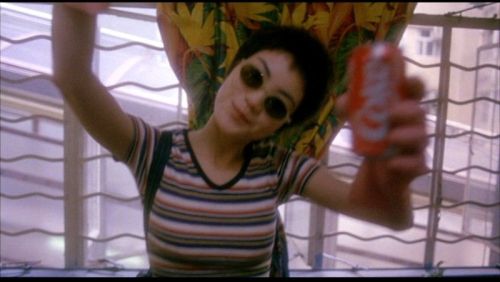
Back in the food counter, May has now been replaced with a new girl named Faye (Faye Wong). Faye is a free-spirited young woman with a love for the Mamas & the Papas' song California Dreamin'. Ordering a chef salad at the counter is a beat cop known as Cop 663 (Tony Leung Chui-Wai). Faye is immediately attracted to the cop but he often talks to the manager about his stewardess girlfriend (Valerie Chow). The cop has broken up with his girlfriend where he's taken an obsession in buying chef salad and later, fish & chips through the suggestion of the manager. Then one day, the stewardess goes to the food counter to give the manager a letter. Everyone in the restaurant reads the letter including Faye who finds a key in the letter. Learning that the cop has now taken a new shift and beat, she sees him again while getting food for the restaurant. After a brief conversation and moment, Faye is falling for the cop where she has the key and decides to break into his apartment.
With the cop often obsessed with things in the apartment including towels and soaps, Faye decides to make some changes believing that his ex-girlfriend is there and making these radical changes to the apartment and stuff. The cop doesn't notice at first but then becomes suspicious. Then one day when the apartment was flooded, Faye appears where he becomes more suspicious as the cop wonders about his own love life and what Faye knows.
While the film does explore the world of loneliness and romance like other Kar-Wai films, the difference between this and latter-day films like In the Mood for Love and 2046 is in its energy and style. Originally supposed to be a three-segment story with the third being Fallen Angels, Chung Hing Sam Lam is a film about loneliness and lovesickness in all of its innocence and melancholia. More importantly, the film has a unique structure in its story. The first half of the film is a part crime-drama with a study of character in Ah Wu. The second half is a far more energetic, innocent love story that has a lot of quirks. Yet, the theme of loneliness is relevant in both stories where there's a balance in its story. In Kar-Wai's direction, the film is done with a lot of style both visually and cinematically. Especially in conveying moments of action and emotion through half-speeds and having the camera observing what's going on. The direction of Kar-Wai is exquisite and vibrant in every scene and frame. It also has a sense of improvisation where it feels real to the audience. Overall, it's a wonderful film filled with a lot of heart and spirit.
Longtime cinematographer Christopher Doyle along with Andrew Lau Wai-Keung do amazing work in the film's visual presentation with its colorful photography. The shades of red, blue, green, and white are wonderful to convey the energy of the Hong Kong slums, especially in the Chungking mansions where it's filled with an array of different cultures. In the first half, the camera is mostly hand-held in some of the intense moments with a bit of grainy look to bring a sense of realism. In the second half, the look is more intimate and vibrant, including one beautiful shot involving candles. That sequence is the most breathtaking moment of the film. Longtime collaborator William Chang does excellent work in the art direction with Qiu Weiming to capture the look of the slums and counter where it looks like Hong Kong. Even the apartment of cop 663 (which is really the apartment of Christopher Doyle) is wonderfully decorated to bring the sense of energy. Chang's costume design also works with the blond wig that Brigitte Lin wears to the small t-shirts and youthful clothing that Faye Wong wears.
Chang along with editors Kit-Wai Kai and Chi-Leung Kwong bring a lot of style to the editing. The film has a great rhythm with its use of jump-cuts and half-frame speeds to convey the sense of action and emotion. The editing is superb in every way as Chang and his team do amazing work. Music composer Frankie Chan, Michael Galasso, and Roel A. Garcia create a score that's a bit suspenseful in the first half with ominous arrangements along with moments of sadness to convey the loneliness of the blonde woman and Ah Wu. The rest of the music is filled with a reggae song in the film's first half while the second half is largely dominated by the Mamas & the Papas' California Dreamin' which will never be heard the same way again. The rest of the soundtrack includes a couple of covers by Faye Wong, one is a cover of a Cocteau Twins song and the other is a cover of Dreams by the Cranberries that is wonderful.
The film’s cast features brief appearances from Liang Zhen as the second May and Valerie Chow as the cop 663's ex-girlfriend stewardess. Chen Jinquan is excellent as the food counter manager who tries to help the situations of the two cops with their girlfriends while dealing with the usual problems with his restaurant. Takeshi Kaneshiro is great as the lovesick, naive Cop 223 who tries to figure out about his own heartbreak and attempt to go into other relationships. Brigitte Lin is great as the mysterious blonde woman by sporting a blonde wig and sunglasses in which, she doesn't show her eyes and real hair. Lin is great for bringing a lot of mystique and ambiguity to a role where she’s a very bad woman and doesn't want to surround herself with anyone or anything. It's a great performance from the iconic actress. Tony Leung Chui-Wai is great as the quiet cop 663 whose obsessions towards food and objects surrounding his ex-girlfriend makes him a great foil of sorts for the Faye Wong character. Leung's understated performance is wonderful in dealing with the ideas of love and all of its hopes and disappointments.
Finally, there's Faye Wong in her feature-film debut as Faye. Wong's free-spirited energy and presence definitely lights up any scene she’s in. From the use of California Dreamin' and Dreams, there is something about Wong’s performance that is just breathtaking and a joy to watch. There's a quirky innocence and playfulness in Wong that is so natural and intoxicating, she's someone that a viewer can fall in love with. Especially in the same way someone like Natalie Portman in Garden State or Maggie Gyllenhaal in Secretary have which is indescribable. Wong has that intoxicating quality that makes anyone want to fall in love with her.
The Region 1 DVD from Miramax and Quentin Tarantino's defunct Rolling Thunder Pictures video label presents the film in its widescreen format ratio of 1:85:1 for 16x9 TVs with Dolby Digital Sound. The DVD includes two different trailers including the original Hong Kong trailer and U.S. trailer. The U.S. version of the film adds extra minutes and scenes with a few, slightly re-edited sequence that doesn't change much of the film. The DVD includes an introduction track from Quentin Tarantino who discusses his introduction to Kar-Wai after seeing his second feature Days of Being Wild. He enjoyed the film and saw Chung Hing Sam Lam at the Stockholm Film Festival in 1994 where Tarantino was also showing Pulp Fiction and fell in love with the film.
In the wrap-up after the film, Tarantino discusses why Kar-Wai made the film. After going through some exhausting problems in editing his martial arts epic Ashes of Time, Kar-Wai decided to do something different. For 23 days, he immediately made Chung Hing Sam Lam. Taking Kar-Wai regulars Tony Leung Chui-Wai and Brigitte Lin, Kar-Wai decided to do some the same improvisational style like one of his favorite directors, Jean-Luc Godard. Lin, who is considered the Greta Garbo of Hong Kong films, retired after doing Chung Hing Sam Lam. Tarantino briefly mentions Faye Wong, who is a popular pop singer in Asia and this was her film debut. Tarantino mentioned Fallen Angels which was supposed to be a third part of the film but Kar-Wai was already tired at the point of making the two stories that he decided to make the third story into a bigger feature-length film. After finishing it in 1994, Kar-Wai released both Chung Hing Sam Lam and Ashes of Time.
***Updated DVD Tidbits 10/11/09***
The 2008 Criterion Collection Region 1 DVD for Chungking Express presents the film in a new, restored high-definition digital transfer with Dolby Digital 5.1 sound which are all supervised by Wong Kar Wai. Presented in its original 1:66:1 aspect ratio in the widescreen format. The DVD includes two special features exclusively for the DVD. The first of which is a feature-length audio commentary track from Asian cinema critic Tony Rayns. The British-based critic reveals a lot about Kar Wai’s background plus his early film career. Particularly at where Kar Wai was at during the making of Chungking Express following the overwhelming difficulties and troubles he was going through making Ashes of Time.
Rayns also reveals tidbits on the production where the film's two different storylines were shot by different cinematographers. The Brigitte Lin/Takeshi Kaneshiro storyline was mostly shot by Andrew Lau Wai-keung, who would later forge a filmmaking career of his own with his most notable success being a co-director for Infernal Affairs. When Wai-keung had to leave production to start work on a film of his own, Kar Wai brought in Christopher Doyle whom he worked with on Kar Wai's second film Days of Being Wild despite a contentious relationship with the two. Rayns reveals the different between Wai-keung's approach in comparison to Doyle which would lead Doyle to become one of Kar Wai's regular collaborators until 2004's 2046 in which the two had a falling out after production of that film.
Rayns talks about Kar Wai's casting choices where the film’s still photographer Piggy Chan Kam-chuen ended up playing the Midnight Express food stand manager. For Brigitte Lin, this was her final film role before going into retirement to raise a family while Rayns delves Takeshi Kaneshiro multi-lingual background as he was just starting to act at this time since he was a pop singer. Rayns also goes into detail about Tony Leung Chiu-Wai's relationship with Kar Wai that began during the troubled production of Days of Being Wild along with directing Faye Wong who didn't have any dialogue early on because she felt tense during her performances. The overall commentary is informative and insightful about Kar Wai, the film, and the Asian film scene along with some details about Kar Wai's recent work and some reasons into why Kar Wai and Christopher Doyle will never work together again.
The second big special feature is a 13-minute clip from a 1996 British TV series called Moving Pictures which features interviews from Wong Kar Wai and Christopher Doyle. The film explores Kar Wai's film collection up to 1995's Fallen Angels as Kar Wai gives a tour of the Chungking mansion area where he based part of the film on. The apartment that Tony Leung Chiu-Wai's character stayed in is actually the apartment of Christopher Doyle which he reveals while was upset over the flooding and losing some things in nice humor. The two also talk about film aesthetics as it's an informative, fun little featurette about Kar Wai and Doyle. Another special feature that also appeared in the previous DVD version from Miramax and Quentin Tarantino's Rolling Thunders Pictures label is the trailer in a remastered form.
The DVD also includes a booklet featuring an essay by film critic Amy Taubin of Film Comment & Sight & Sounds. Entitled Electric Youth, Taubin compares the film to Jean-Luc Godard’s Masculin Feminin since both films featured popular singers of the time in leading roles. Taubin also goes into a bit of Kar Wai's career at the time following the troubled production of Ashes of Time as well as what was happening in Hong Kong three years before being handed back to China from Britain. Taubin goes in depth to the film's plot and characters while revealing that the film despite Quentin Tarantino's endorsement for the film, failed in the U.S. box office upon its 1996 release in that country. The overall essay is definitely a great read for those who love the film as the Criterion DVD itself is a more definitive version than the original Rolling Thunders DVD back in 2002.
***End of DVD Tidbits***
While it doesn't have the same elliptical, moody textures of latter-day films like In the Mood for Love or 2046, Chung Hing Sam Lam is still a vibrant, intoxicating masterpiece from the brilliant Wong Kar-Wai. Fans of Kar-Wai will no doubt consider this film as one of the essentials of his films. Those new to Kar-Wai will find this as a great starting point as well as a nice introduction to Hong Kong films that aren't action films. In the end, for anyone wanting to find a nice movie about love and all of its quirks and disappointment, Chung Hing Sam Lam is the film to see.
Wong Kar-Wai Films: As Tears Go By - Days of Being Wild - Ashes of Time/Ashes of Time Redux - Fallen Angels - Happy Together - In the Mood for Love - 2046 - Eros-The Hand - My Blueberry Nights - The Grandmaster - The Auteurs #28: Wong Kar-Wai
Favorite Films #5: Chungking Express
© thevoid99 2011
Subscribe to:
Posts (Atom)