Set in 1885, the film follows a bank robber, whose partner reluctantly abandoned him during a showdown between them and Mexican mounted police forces, who escapes a Mexican prison with a fellow cellmate as they travel to Monterey, California with a couple of men to rob a bank as well as get revenge on his former partner. It is a film that explores a man who felt cheated by his former partner who had ended up making a decent life for himself as a sheriff in Monterey while he spends five years in prison waiting to get revenge. The film’s screenplay by Guy Trosper and Calder Willingham, with un-credited contributions from Sam Peckinpah and Rod Serling, follows the journey that Rio goes through as he is first seen taking part of a bank robbery with his partner Dad Longworth (Karl Malden) and another robber in Doc (Hank Worden) in Mexico that is successful until Rio and Longworth are chased by the mounted police as they’re stuck on a hill with Longworth leaving to get new horses yet he never returned as Rio gets captured and spent five years in a prison which he would escape with Chico Modesto (Larry Duran).
Upon meeting Bob Emory (Ben Johnson) and his partner Harvey Johnson (Sam Gilman), Rio and Modesto travel to Monterey, California upon learning that Longworth is the sheriff in the town as he has married a Mexican woman in Maria (Katy Jurado) who has a daughter of her own in Louisa (Pina Pellicer). Though the plan is to rob the bank in Monterey, Rio decides to meet Longworth without stating his intentions while falling for Louisa as he spends time with her during a fiesta the next day. Yet, things get complicated where Longworth learn about what the two did where Rio gets punished as he and his gang are forced to leave as they shelter themselves in a beachside village as it plays into Rio’s sense of uncertainty about wanting to rob a bank. Even as Maria learns more about her husband’s past as well as what happened with Rio and Louisa that would complicate matters.
Marlon Brando’s direction is filled with gorgeous compositions as it is shot on various locations in California with Big Sur and the Monterey Peninsula being key locations along with Sonora, Mexico for the scenes set in Mexico including its mountains. Brando’s approach to wide and medium shots add to the beauty of these locations with all of these meticulous attention to detail in the ocean waves that Brando captures to play into a world that feels new to Rio as it is also this escape from the rugged nature of Mexico that Longworth wants to leave behind. Brando also maintains some intimacy in the close-ups and medium shots in the first meeting in five years between Rio and Longworth as it play into the tension as Brando creates unique compositions in these moments. Notably in Rio’s infatuation towards Louisa as he would say some lies in order to woo her but eventually realize that she’s a good young woman whom he doesn’t want to take advantage of.
By the time the film moves into the second half where the tension between Rio and Longworth come to ahead despite the former’s action in saving a woman who is being abused by a man. It would allow Longworth to punish Rio in front of the town as revelations occur as it relates to Rio’s original intentions as he retreats to the beach as regrets come into play along with other revelations as it relates to Rio’s love for Louisa. Even as Maria begins to piece out Longworth’s issue with Rio during the film’s third act where a showdown would occur where the idea of vengeance shifts towards guilt with Rio realizing of what Longworth is trying to hold on to that only makes Longworth much worse. Overall, Brando crafts an exhilarating and mesmerizing film about a gunslinger going after his former partner for abandoning him following a bank robbery.
Cinematographer Charles Lang Jr. does incredible work with the film’s cinematography with its usage of Technicolor film stock to capture the beauty of the exteriors in the beaches and mountains while John P. Fulton provides some special photographic effects for some scenes on the beach as backdrops for a few of the film’s conversations including one between Rio and Louisa. Editor Archie Marshek does excellent work with the editing with its usage of straight cuts to play into the suspense and drama as well as knowing when to allow shots to linger to help amp up the suspense. Art directors Hal Pereira and J. McMillan Johnson, with set decorators Sam Comer and Robert Benton, do amazing work with the look of Monterey as well as the cantina in Sonora where Rio and Longworth went to after the robbery early in the film. Costume designer Yvonne Wood does fantastic work with the costumes in the dresses that the women wear along with the ragged look of Rio as well as the refined look that Longworth has as sheriff.
The makeup work of Yvonne Wood and Wally Westmore, with hair stylist Nellie Manley, do terrific work with the makeup from Longworth’s rugged look early in the film to the mustache he would have as sheriff as well as the look that Rio would have including the aftermath of a beating he would take from Longworth. The sound work of Hugo and Charles Grenzbach do superb work with the sound as it play into the natural elements as well as the sounds of gunfire from afar or up close. The film’s music by Hugo Friedhofer is wonderful for its bombastic orchestral score as it plays into the sense of adventure and suspense as the soundtrack also include a flamenco piece for a key moment in the fiesta sequence.
The film’s marvelous ensemble cast feature some notable small roles from Mina Martinez as a young woman Rio flirts with early in the film following the bank robbery, William Forrest as a bartender in Monterey, Hank Worden as Rio and Longworth’s robbery partner Doc, Philip Ahn as the owner of a beach hostel where Rio would recover in the film’s third act, Ray Teal and John Dierkes as a couple of deputies, Joe Dominguez as a corral owner, Tom Webb as the corral owner’s son, Joan Petrone as a flower vendor Rio flirts with to buy her necklace, Rodolfo Acosta as a Rurales captain, Margarita Cordova as the flamenco dancer, Timothy Carey as a local from Monterey who would be pushy towards the dancer at a bar, Miriam Colon as Longworth’s lover from Sonora whom Rio would meet five years later, and Elisha Cook Jr. as the banker who runs the bank at Monterey that Rio considers robbing. Sam Gilman is terrific as Harvey Johnson as a gunslinger Rio meets in Mexico as he is eager to rob a bank while Larry Duran is fantastic as Rio’s prison mate Chico Modesto who is sort of the film’s conscience as he is willing to help Rio while also knowing the conflict he’s dealing with.
Pina Pellicer is excellent as Louisa as Longworth’s step-daughter who falls for Rio though she is unsure about his intentions while learning about why he’s in Monterey where she begins to see things about Longworth that makes her uncomfortable. Slim Pickens is brilliant as Longworth’s deputy Lon Derrick as a man who doesn’t like Rio while is also infatuated with Louisa despite the fact that she thinks he’s a total creep. Ben Johnson is amazing as Bob Amory as a gunslinger Rio meets in Mexico who joins him on their journey to Monterey while also being someone who has issues with Rio over when to do the robbery as often finds a way to push Rio’s buttons. Katy Jurado is incredible as Longworth’s wife Maria as a woman who is given a great life in her marriage to Longworth only to become suspicious about Rio where revelations about Longworth’s past has her questioning things while discovering some things about Louisa’s relationship with Rio.
Karl Malden is phenomenal as Sheriff Dad Longworth as Rio’s former partner who had abandoned Rio following a showdown between him and Mexican mounted police forces as he creates a new life for himself only to deal with Rio where he is filled with guilt but also not wanting to reveal his own dark past that would eventually alienate him from his family. Finally, there’s Marlon Brando in a tremendous performance as Rio as a bank robber who seeks revenge on his former partner as he is hell-bent on getting revenge until he meets Louisa which complicates things. Brando brings this sense of restraint as a man that is conflicted in his actions but is also someone who is seeking justice of his own while also realizing the complications he is dealing with in his revenge plot as it is one of Brando’s finest performances.
One-Eyed Jacks is a sensational film from Marlon Brando that features incredible performances from Brando, Karl Malden, Katy Jurado, Slim Pickens, Ben Johnson, and Pina Pellicer. Along with its gorgeous visuals, its unconventional study of vengeance and guilt, and an exhilarating music score. The film is a fascinating western that doesn’t play by many of its tropes in favor of exploring the path of two men who were once partners as it leads to this eerie world of vengeance and the revelations of how the past can affect someone’s future. In the end, One-Eyed Jacks is a spectacular film from Marlon Brando.
© thevoid99 2023
Based on the novel by Jack Schaefer, Shane is the story of a man who comes to the aid of a farming family to deal with a gunman who is threatening their lives. Directed by George Stevens and screenplay by A.B. Guthrie Jr., the film is the story of a man just trying to help a family as he also tries to move away from his violent past. Starring Alan Ladd, Jean Arthur, Van Heflin, Brandon deWilde, Emile Meyer, Elisha Cook Jr., Ben Johnson, and Jack Palance. Shane is a rapturous and evocative film from George Stevens.
Set in the mid-1800s years after the American Civil War, the film revolves a farming family who take in a mysterious gunslinger who helps them deal with cattle barons wanting their land. It’s a film with a simple story that plays into a baron trying to drive homesteaders away from their land yet it is more about this man who would stand up to this baron and his men where a farmer’s son would idolize this man. The film’s screenplay by A.B. Guthrie Jr., with additional dialogue written by Jack Sher, doesn’t just explore a family trying to maintain their homestead but also in taking in this mysterious man who is trying to move away from his violent past. The titular character (Alan Ladd) is just a man wanting to do something other than go into gunplay where he would help out this family and do some farming.
He understands the struggle the homesteaders are dealing with against this baron under the Homestead Act as he would also spark some ire on the baron Rufus Ryker (Emile Meyer). Shane would also deal with the attention of a farmer’s son in Joey (Brandon deWilde) who sees him as some iconic figure as he’s reluctant to show him how to draw a gun much to the dismay of the boy’s mother Marian Starrett (Jean Arthur). Shane would help Joe Starrett (Van Heflin) in not just deal with Ryker but also bring some hope to other homesteaders who are being driven by Ryker’s men as it would include the infamous gunslinger Jack Wilson (Jack Palance) who would kill someone during a confrontation. That confrontation would be key in the third act where Starrett tries to make a stand against Ryker but Shane realizes what is at stake where he would have to make a decision for himself and the Starrett family.
George Stevens’ direction is truly stunning not just for the gorgeous visuals and setting of the film but also in playing something that is a bit larger-than-life but also grounded in realism. Shot on location in Jackson, Wyoming with some shooting on sets in Hollywood, the film plays into this growing emergence of the American West where people are trying to make a home in open land growing crops and work hard for themselves and the community. Much of Stevens’ direction uses a lot of wide and medium shots to capture the scope of the locations where the Rocky Mountains are always present in the background as it help display some of the beauty of the West. Even in the way life was in the West as it was hard but at least it’s better than working for someone yet not everything is great as it relates to Ryker and his rule.
Stevens also uses some close-ups in scenes set at home along with a few medium shots for the intimacy as it would include a barroom brawl involving Ryker’s men against Shane and Joe Starrett. When the character of Jack Wilson emerges, there is something that is chilling as the scene where he kills a man is one of the most startling moments in the film and the way the man is killed just shows the dark reality that is emerging. There are some little moments Stevens would put in the film as it would help say a lot by doing so little as it eventually play into what is to come. All of which has Shane not only be back down to Earth but reveal a lot of who he is and what he needs to do to help this family. Overall, Stevens creates an intoxicating and touching film about a gunslinger trying to help a family deal with a cattle baron.
Cinematographer Loyal Griggs does amazing work with the film‘s beautiful Technicolor film stock to capture the beauty of the locations and that attention to detail in the skyline and the Rocky Mountains as well as some of the interiors with the usage of available and artificial light for those scenes. Editors William Hornbeck and Tom McAdoo do excellent work with the editing as it has some unique rhythmic cuts for the action and drama as well as some stylish usage of dissolves to create some superimposed images in the film. Art directors Hal Pereira and Walter H. Tyler, with set decorator Emile Kuri, do brilliant work with the look of the small town that the characters live nearby at as well as the home of the Starrett family.
Costume designer Edith Head does nice work with the costumes from the look of the dresses that the women wear as well as the clothes of the men including the different looks of Shane and Wilson. Sound recorders Gene Garvin and Harry Lindgren do terrific work with the sound to play into some of the chaos as well as the sound of gunfire to create something that is natural. The film’s music by Victor Young is fantastic for its orchestral-based score as it include elements of country-western music as well as some themes that play for certain characters as it is one of the film’s major highlights.
The film’s incredible cast include some notable small roles from Leonard Wright as a homesteader who would leave because of Ryker, Douglas Spencer and Edith Evanson as a couple of Swedish homesteaders who are friends of the Starretts, Paul McVey as the local trading post/bar owner in the town, John Miller as the bartender, Edgar Buchanan as the homesteader Fred Lewis, and John Dierkes as Ryker’s son who helps his father handle things. Elisha Cook Jr. is terrific as a former Confederate turned homesteader in Frank “Stonewall” Torrey who tries to confront Ryker and Wilson during a chilling scene at the bar only to later get into some serious trouble. Ben Johnson is superb as Chris Calloway as a member of Ryker’s gang who would get into a tussle with Shane as he tries to provoke him only to get a serious ass-kicking. Emile Meyer is excellent as Rufus Ryker as a cattle baron that is trying to maintain rule into the land he claims is his as he does whatever he can to get people to work for him or else kick them out of their home.
Brandon deWilde is wonderful as Joey Starrett as a young boy who sees Shane as some larger-than-life figure as he would idolize the man unaware of the realism and what Shane has to do to survive. Jean Arthur is brilliant as Marian Starrett as Joe Starrett’s wife as a woman who is trying to maintain some control as well as dealing with the danger of what is happening as she becomes concerned for her son’s fascination with guns. Jack Palance is phenomenal in his small but eerie role as the gunslinger Jack Wilson as this sadistic and scary man that brings fear and is also one of the fiercest killers in the West. Van Heflin is amazing as Joe Starrett as a farmer/homesteader trying to save his land as well as do whatever it takes to keep where he would also succumb to his own sense of pride. Finally, there’s Alan Ladd in a magnificent performance as the titular character as this laconic gunslinger that is trying to find a life away from violence as he does whatever he can to avoid conflict as it is this towering performance that is also grounded in reality as it is Ladd at his most iconic.
Shane is a tremendous film from George Stevens that features great performances from Alan Ladd, Van Heflin, Jean Arthur, and Jack Palance. Featuring a compelling script, gorgeous visuals, and a powerful music score, the film isn’t just one of the defining films of the western genre but it is also a film that is about a man trying to do what is right in a troubled world during the West. In the end, Shane is an outstanding film from George Stevens.
George Stevens Films: (The Cohens and the Kellys in Trouble) - (Kentucky Kernals) - (Bachelor Bait) - (Laddie) - (The Nitwits) - (Alice Adams) - (Annie Oakley) - Swing Time - (Quality Street) - (A Damsel in Distress (1937 film)) - (Vivacious Lady) - (Gunga Din) - (Vigil in the Night) - (Penny Serenade) - (Woman of the Year) - (The Talk of the Town (1942 film)) - (The More the Merrier) - (That Justice Be Done) - (On Our Merry Way) - (I Remember Mama) - A Place in the Sun - (Something to Live For) - Giant (1956 film) - (The Diary of Anne Frank) - (The Greatest Story Ever Told) - (The Only Game in Town)
© thevoid99 2016
Based on the novel by Dashiell Hammett, The Maltese Falcon is the story of a private detective who finds himself dealing a troubling case that involves the search of a statue that everyone wants. Written for the screen and directed by John Huston, the film is a detective story that would be the inspiration for many ideas of what would become film noir with its unique take on language and character motivations. Starring Humphrey Bogart, Mary Astor, Gladys George, Peter Lorre, and Sydney Greenstreet. The Maltese Falcon is a riveting and stylish film from John Huston.
The film revolves around a private detective who finds himself in the middle of a crazed search for a rare statue that everyone wants as he tries to find out who killed his partner who was tailing a suspect. It all plays into this statue called the Maltese Falcon where it is a statue worth lots of money as the detective Sam Spade (Humphrey Bogart) wants to know why he’s in the middle of this case where a woman named Brigid O’Shaughnessy (Mary Astor) asks Spade and his partner Archer (Jerome Cowan) to tail a man that would lead to the latter’s death. Yet, O’Shaughnessy is part of a scheme into retrieving this rare statue that a slimy man named Joel Cairo (Peter Lorre) and a determined collector named Kasper Gutman (Sydney Greenstreet) want. With Spade falling for O’Shaughnessy and dealing with the case itself as he finds himself into all sorts of trouble with a lot of twists and turns as there’s very few people he can actually trust.
John Huston’s screenplay definitely plays up to the idea of suspense and language that Dashiell Hammett is known for as a lot of the dialogue is very stylized with its sense of rhythm and in the way the words are said. There’s also some exposition into a lot of the things that happen as well as the story of the Maltese Falcon as the statue itself is a plot device that would become known as the Macguffin. It’s the one thing that everyone wants where Huston knows how to weave the plot into these twists and turns where Spade is often at the center of this crazed search. There is also this conflict in Spade as he falls for O’Shaughnessy even though she is a suspect as his secretary Effie (Lee Patrick) is very suspicious of O’Shaughnessy as she is sort of Spade’s conscience and the one person that he can really trust.
Huston’s direction is very stylish with the way he sets the mood for much of the film where it has this air of suspense and intrigue that continuously looms throughout the film. Huston would use a lot of medium shots as well as some close-ups to play into the drama and suspense while infusing some bits of humor into the film. Much of it would include a few eerie camera angles to play into the sense of style in the way the suspense occurs as there is tension in the film such as the people that Spade would meet. There aren’t many moments of violence as Huston is more focused on just building the mystery as well as play into scenario about what to do when the Maltese Falcon is found. Overall, Huston crafts a very engaging and chilling film about a detective caught in a deadly search to find a priceless statue.
Cinematographer Arthur Edeson does excellent work with the film‘s black-and-white photography to create some unique shadows and lighting schemes for some of the film‘s interior and exterior scenes set at night that would be the basis for the look of film noir. Editor Thomas Richards does fantastic work with the editing as it has a bit of style in the transition wipes while keeping things very straightforward to play into the slow-burn of the suspense. Art director Robert M. Haas does amazing work with the look of Spade‘s office that he shared with his partner to the lavish hotel room that Gutman stayed at.
The gown designs by Orry-Kelly are exquisite for its sense of style as it plays to the looks and personality of the female characters. The sound work of Oliver S. Garretson is terrific for some of the sound effects that are created as well as how it adds to the air of suspense. The film’s music by Adolph Deutsch is wonderful for its for its brooding orchestral score that plays into the suspense along with lush themes for the drama.
The film’s incredible cast include notable small roles from Walter Huston as a police captain, Jerome Cowan as Spade’s partner Archer, Ward Bond as Detective Polhaus, Barton MacLane as Lt. Dundy, and Elisha Cook Jr. as Gutman’s henchman Wilmer. Lee Patrick is wonderful as Spade’s secretary Effie as she is often the one person who is a bit smarter than Spade as she doesn’t trust O’Shaughnessy. Gladys George is terrific as Archer’s wife Iva who thinks Spade killed her husband as she is a former lover of Spade as she isn’t sure what is going on as it plays into Spade’s own suspicions about everything. Sydney Greenstreet is brilliant as the larger-than-life collector Gutman who is eager to have the Maltese Falcon at any cost as he is full of charisma and a presence that is quite intimidating at times.
Peter Lorre is fantastic as the smarmy Joel Cairo as this very flamboyant individual who is very mysterious as Lorre brings that nice sense of sliminess but also charm that makes him so enjoyable to watch. Mary Astor is superb as Brigid O’Shaughnessy as this woman who is the archetype of a femme fatale as she is someone that is quite manipulative while never seeming to get her story straight as she tries to woo Spade into making her feel like a victim. Finally, there’s Humphrey Bogart in a marvelous performance as Sam Spade where Bogart has this intensity and wit to his role that makes him quite cool but also be quite tough as there’s no bullshit about his character yet he isn’t afraid to show some humility as it’s one of Bogart’s finest performances.
The Maltese Falcon is a sensational film from John Huston that features a remarkable performance from Humphrey Bogart. The film is definitely one of the standards in what a mystery should be while making it more about characters and the search for answers rather than action. In the end, The Maltese Falcon is a phenomenal film from John Huston.
© thevoid99 2014
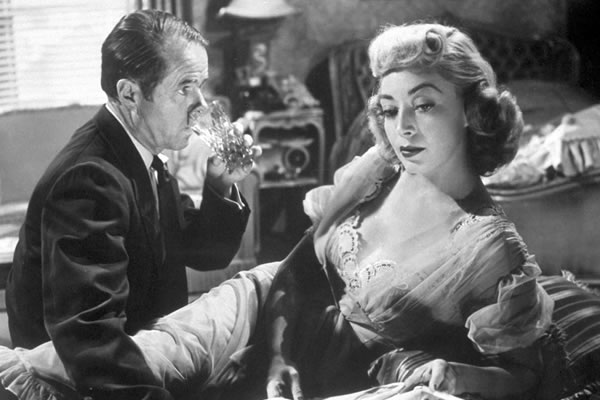
Based on the novel Clean Break by Lionel White, The Killing is the story of a racetrack robbery led by a criminal seeking one last job before he can start a new life with his girlfriend. Directed by Stanley Kubrick and screenplay by Kubrick and Jim Thompson, the film is a part-heist film set in a film noir style that explores the complexity of a heist and its aftermath. Starring Sterling Hayden, Coleen Gray, Vince Edwards, Jay C. Flippen, Elisha Cook Jr., Marie Windsor, and Timothy Carey. The Killing is a complex yet evocative heist film from Stanley Kubrick.
A plan to steal $2 million from a horse racetrack is underway as Johnny Clay (Sterling Hayden) is hoping for the robbery to succeed so he can marry his longtime girlfriend Fay (Coleen Gray). Helping Johnny with the plans is his friend Marvin Unger (Jay C. Flippen), corrupt cop Randy Kennan (Ted de Corsia), racetrack cashier George Peatty (Elisha Cook Jr.), and racetrack bartender Mike O’Reilly (Joe Sawyer). With everything set in place, Johnny hopes nothing can go wrong as he also hires a wrestler named Maurice (Kola Kwariani) to cause a ruckus as well as a sharpshooter named Nikki (Timothy Carey) to shoot a horse during the race.
While Johnny and the rest of the gang continue to make their plans and continue with their daily lives, George tells his wife Sherry (Marie Windsor) about the robbery in hopes to impress her. Instead, she would devise a plan of her own by having her lover Val Cannon (Vince Edwards) involved to steal the money. On the day of the robbery, everything goes as planned where everyone does their job and such. Yet, it would be followed by trouble that Johnny would unforeseen as he would do whatever he can to salvage all that he and his crew had worked hard for.
When planning a heist with a large payday, the one thing any group of people don’t want to do is screw things up as it’s just about five guys stealing $2 million from a horse racetrack and then split the money fairly. Led by this veteran criminal, it’s all about these five guys who want to use the money to start a better life and with no regrets. Johnny Clay is just a criminal that wants to lead a straight life for his girlfriend while a couple of guys in Marvin and Randy are just men that want the money for something better. Mike is a man that hopes to get the money to help his ailing wife (Dorothy Adams) while George just wants to impress his wife.
Stanley Kubrick’s screenplay explores the intricacies of planning a heist where a lot of the film’s narrative is told by an unseen narrator (Art Gilmore). The narration reveals a lot on who these characters and when these events take place as it would lead to the heist where the narration takes a backseat to the action that is happening. Kubrick’s script has a nice structure to how he creates momentum that leads to the heist where the first act explores the five main characters including Johnny Clay who is the organizer and makes sure things don’t go wrong. Yet, something would go wrong in George Peatty because he wants to get his wife’s attention as she would play a part in the heist on her own by hiring her lover.
The second act is about the planning and how Johnny Clay is so careful into making sure everything goes right. Even as he does things like stay at a motel, drop a key for Mike to pick up, and hope that things go well. The third act is about the heist where it’s all about these men positioning themselves into doing the job that is later followed by a troubling aftermath where the very professional Clay has to think fast. Through the stylish dialogue of Jim Thompson, the screenplay definitely plays to the rhythm of film noir as it helps drive the story as the dialogue also reveals information and motivation for the characters.
Kubrick’s direction is definitely entrancing in the way he plays out every scenario that happens throughout the film. Particularly in how he opens the film with this scene where it shows three of the five participants wandering around the cashier station and bar with a message that is being passed around them. With a lot of tracking shots to follow the actors and compositions that has a group of them in a frame. Kubrick’s direction is always interested in the planning of the heist as he always his camera positioned feet away from these meetings. Largely to establish the drama that is unfolding where something could go wrong or could go right.
The direction also has Kubrick create scenes to let the suspense play out slowly as it leads up to the heist where he carefully reveal how Clay plays his role. For the film’s climatic heist sequence, Kubrick has the fight scene be replayed to establish what one of the participants is doing in the background and what is the focus on. It is to see how the heist is played out as its participants play their role which adds to the suspense as well as to establish how flawless the plan is. Then there’s the aftermath where it does go into the schematics of film noir in terms of its drama and suspense that leads to an ending that is captivating for everything Jim Clay goes through. Overall, Kubrick creates a truly exhilarating yet haunting heist film.
Cinematographer Lucien Ballard does brilliant work with the film‘s very stylish and entrancing black-and-white photography that is filled with many lighting schemes for some of the film‘s nighttime interiors to the gorgeous exteriors of the daytime scenes. Editor Betty Steinberg does excellent work with the film‘s stylish cutting by using dissolves and fade-outs to play with the transitions as well as rhythmic cuts for the horse race scenes. Art director Ruth Sobotka does nice work with the set pieces in the apartments that the characters live in to the room where the race track keeps the money.
The sound work of Earl Snyder is fantastic for capturing the atmosphere of the horse racetrack as well as using the racetrack announcer‘s voice to repeat the action that occurs in the heist. The film’s music by Gerald Fried is superb for its thrilling orchestral score to play out the suspense and drama that occurs in the film.
The film’s amazing ensemble cast features some notable small performances from Dorothy Adams as Mike’s ailing wife, James Edwards as a parking lot attendant, Tito Vuolo as the motel manager, Kola Kwariani as the former pro wrestler Maurice, and Timothy Carey as the sharpshooter Nikki. Other roles such as Coleen Gray as the good-natured Fay and Marie Windsor as the conniving Sherry are wonderful to watch as is Vince Edwards as Sherry’s opportunistic lover Val. Jay C. Flippen and Ted de Corsia are excellent in their respective roles as Marvin and the corrupt policeman Randy. Joe Sawyer is terrific as the kind bartender Mike while Elisha Cook Jr. is superb as the weak cashier George. Finally, there’s Sterling Hayden in an incredible performance as the very professional Johnny Clay as he’s just a man hoping that the job goes right while hoping to do right for his girlfriend as there’s a real complexity to his character.
The Killing is a gripping yet hypnotic suspense film from Stanley Kubrick. Featuring a top-notch ensemble cast led by Sterling Hayden along with some amazing technical work that is highlighted by Lucien Ballard’s cinematography. The film is definitely one of the most intriguing heist films that explores the planning of a heist and how things can go wrong as Kubrick creates something that is truly engaging. In the end, The Killing is an outstanding film from Stanley Kubrick.
Stanley Kubrick Films: Fear and Desire - Killer's Kiss - Paths of Glory - Spartacus - Lolita - Dr. Strangelove or How I Learned to Stop Worrying and Love the Bomb - 2001: A Space Odyssey - A Clockwork Orange - Barry Lyndon - The Shining - Full Metal Jacket - Eyes Wide Shut
Related: Stanley Kubrick: A Life in Pictures - The Auteurs #18: Stanley Kubrick
© thevoid99 2012