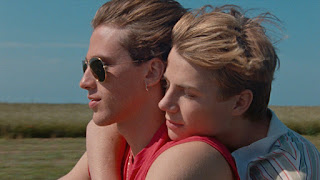
The film is the story of a young man who is arrested as it relates to the death of another young man he met in the summer as he tells a case worker and his teacher about what happened in this summer in which he fell in love. It is a film that explore this relationship between two young men and a pact they would make in case one of them dies where something did happen. Francois Ozon’s screenplay has this back-and-forth reflective narrative where its 16-year old protagonist Alexis Robin (Felix Lefebvre) is arrested where he talks to a case worker (Aurore Broutin) about what happened though he is reluctant to divulge into information about his relationship with the 18-year old David Gorman (Benjamin Voisin).
Alexis met David when the former was on a boat that capsized as he was saved by the latter as the two become friends with David’s mother (Valeria Bruni Tedeschi) taking a liking to Alexis thinking he would be a good influence on her son. Alexis doesn’t tell his parents (Isabelle Nanty and Laurent Fernandez) about David fearing that his more conservative father would disapprove. The script reveals the pact that they created but also Alexis’ own reluctance to open up as his literature professor Lefevre (Melvil Poupaud) suggests writing about what happened and such. Notably as a young English au pair in Kate (Philippine Velge) was thrown into the mix that created tension between the two young men.
Ozon’s direction definitely bear some style in terms of the looseness of his overall presentation yet a lot of it is straightforward as it is shot on location in Normandy. There are wide and medium shots as it capture the scope of these locations along with some intimate shots at a fishing shop that David’s mother own where Alexis would work at. There are close-ups in Ozon’s direction as it play into the drama where Alexis is being interrogated but also in some emotional moments in the film. There are different tones that Ozon maintain throughout the film with the second act being this lively and romantic film as it relates to these two young men just falling in love but also complications as David is someone that wants to experience different things that include Kate. It would be the source of chaos that would loom throughout the film as well as what happened to David.
Ozon’s approach to the scenes where Alexis is being questioned and interrogated are a bit more claustrophobic in its framing as if the world is closing on Alexis. Notably as he becomes distant with his parents worrying about him including his own father, despite his own conservative views on life, as he tries to reach out to David’s mother. Ozon also play into this pact that Alexis and David make as it is a strange promise the two made but one that needs to be honored. Even as its aftermath ends up being a moment of growth where Ozon ends the film on a cold day signifying not just the end of the summer but the end of a part of Alexis’ life but also the beginning of a new adventure. Overall, Ozon crafts a somber yet intoxicating film about a young man who falls in love with another man during a whirlwind summer in Normandy.
Cinematographer Hichame Alaouie does amazing work with the film’s cinematography with its usage of colorful lighting for some of the scenes at night as well as some natural lighting for some of the daytime interior/exterior scenes. Editor Laure Gardette does excellent work with the editing with some jump-cuts as well as other rhythmic cuts to play into the drama and the light-hearted moments in the film. Production designer Benoit Barouh, with set decorator Frederic Delerue and art director Teddy Barouh, does fantastic work with the look of the fishing shop owned by David’s mother as well as the homes of David and Alexis. Costume designer Pascaline Chavanne does brilliant work with the costumes as it play into the look of the 1980s as well as a dress that Alexis would wear for a key scene in the film’s third act.
Visual effects supervisor Mikael Tanguy does terrific work with some of the film’s minimal visual effects as it is largely bits of set dressing for some of the exteriors to give it a 1980s look and feel. The sound work of Jean-Paul Hurier and Brigitte Taillander do superb work with the film’s sound in playing to the atmosphere of the film’s locations as well as how music would sound at a club and on location. The film’s music by Jean-Benoit Dunckel is wonderful for its low-key orchestral score that play into the drama and romance while the music soundtrack feature music from the Cure, Bananarama, Rod Stewart, and French/Euro pop music of the 1980s.
The casting by Elodie Demey and Anais Duran is incredible as it feature some notable small roles from Antoine Simon as a drunk that Alexis and David meet early in the film, Yoann Zimmer as a friend of Alexis in Luc who doesn’t like gays, Bruno Lochet as a man named Bruno who runs a morgue, Laurent Fernandez as Alexis’ stern yet caring father, Isabelle Nanty as Alexis’ warm and loving mother, and Aurore Broutin as a case worker who is handling Alexis’ case as she tries to find answers knowing the severity of his crime. Melvil Poupaud is superb in his small role as Alexis’ literature teacher who is convinced that something did happen as he knows that the only way to get an answer was for Alexis to write about it. Valeria Bruni Tedeschi is fantastic as David’s mother as a woman who is enthralled by the presence of Alexis believing he would be a good influence of her son while later be ravaged by grief and seeking answers. Philippine Velge is excellent as Kate as a British tourist whom Alexis befriends as she unknowingly attracts the attention of David as she didn’t realize she would be the source of tension between Alexis and David.
Finally, there’s the duo of Felix Lefebvre and Benjamin Voisin in incredible performances in their respective roles as Alexis Robin and David Gorman. Voisin provides an energetic performance as the wilder David as a young 18-year old who is trying to find himself but also is someone who wants to evolve and seek new adventures. Lefebvre’s performance as the 16-year old Alexis is a bit more reserved as someone that is just trying to figure himself out but would also be emotional as it relates to loss and heartbreak. Lefebvre and Voisin together are electrifying in the way they react towards one another but also in how much these two men love each other.
Ete 85 is a sensational film from Francois Ozon. Featuring a great ensemble cast, gorgeous visuals, a study of young love and identity during the 1980s, and a wondrous music soundtrack. It is a film that is this fascinating coming-of-age story that play into young love but also the idea of promises and its effect on many. In the end, Ete 85 is a phenomenal film from Francois Ozon.
Francois Ozon Films: See the Sea - Sitcom - Criminal Lovers - Water Drops on Burning Rocks - Under the Sand - 8 Women - Swimming Pool (2003 film) - 5x2 - Time to Leave - Angel (2007 film) - Ricky - Le Refuge - Potiche - In the House - Jeune & Jolie - (The New Girlfriend) – (Frantz (2016 film)) – (Double Lover) – (By the Grace of God) – (Everything Went Fine) – (Peter von Kant) – The Auteurs #33: Francois Ozon
© thevoid99 2022
One of the key figures to emerge as part of a new wave of French directors of the 1990s, Francois Ozon is a filmmaker who refuses to be pegged into a certain genre or persona. Arriving in the 1990s as an openly-gay bad boy who would later become one of France’s top filmmakers who would explore themes on death, feminism, and ambition. Ozon would continuously refine his approach to storytelling while going back-and-forth from making serious films to something more lively while not being afraid to acknowledge his influences in such filmmakers as Douglas Sirk and Rainer Werner Fassbinder. With a new film set to come out in 2014, Ozon is already a filmmaker who has cultivated a devoted following as he continuously reinvents himself with every film he does.
Born on November 15, 1967 in Paris, France, Ozon arrived into the film world in the mid-1980s at the prestigious La Femis film school in Paris at a time when French cinema was still thriving but hasn’t managed to create some excitement in the aftermath of the French New Wave. During his studies at La Femis, Ozon discovered the films of such filmmakers as Douglas Sirk and Rainer Werner Fassbinder as they would be profound influences into his work. Aware of the emergence of gay and lesbian cinema that was coming out of the U.S. independent film scene as well as the controversial work of Spain’s Pedro Almodovar. Ozon would finally would begin honing his craft through a series of short films that he would make for a good part of the decade.
More can be read at this link at Cinema Axis.
© thevoid99 2014

Written and directed by Francois Ozon, Jeune & Jolie (Young and Beautiful) is the story of a young woman who becomes a teenage prostitute following the loss of virginity during a summer vacation in Germany. The film is an exploration of a young woman coming to terms with her sexuality while keeping her new profession secret from her mother. Starring Marine Vacth, Geraldine Pailhas, Frederic Pierrot, and Charlotte Rampling. Jeune & Jolie is a ravishing yet haunting film from Francois Ozon.
The film is about a young woman exploring her sexuality as she had just turned 17 where she secretly becomes a prostitute. After some trouble and the eventual discovery by her mother, Isabelle (Marine Vacth) copes with her encounters as she becomes confused about the role she took and her own beauty. It’s a film that is about this young woman who loses her virginity to a German boy during a summer vacation in the country as the film is told through four seasons in the life of this young woman. The script has a very unique yet odd narrative structure where much of the first half is very straightforward from Isabelle’s time in the summer to becoming a prostitute to men who are older than her in various places in Paris during after school hours.
The film’s second half not only has her reveal, through flashbacks, into what drove into prostitution and why she didn’t stop immediately as it causes tension between herself and her mother Sylvie (Geraldine Pailhas). Especially as Isabelle accuses Sylvie of straying from her marriage to Isabelle’s stepfather Patrick (Frederic Pierrot). Isabelle’s confusion and her unwillingness to open up to her family and her friends adds to her melancholic state as she would later talk to a psychiatrist about her work and the moment that forced to quit for good. All of which would lead to a third act where Isabelle not only confronts her actions but also deal with the incident that drove her to stop becoming a prostitute.
Francois Ozon’s direction is very mesmerizing for the way he explores a young woman coming of age as she discovers her sexuality as much of the film is set in France while the first scenes in the summer are shot in Germany where Isabelle would lose her virginity. Ozon’s compositions in some of the wide and medium shots in Germany have a sense of beauty as it would shift once the film moves to France where it’s not as colorful as it would play to the melancholia of Isabelle as she lives this double-life as a 17-year old girl going to school and hang out with friends while she would have this other life sleeping with men who are older than her as she claims to be 20 year old.
Ozon’s use of close-ups on Isabelle are entrancing not just for her beauty but in how men are willing to fall for her as Ozon’s presentation of the sex is very seductive and not graphic. Even as some of it plays for laughs as it relates to Isabelle’s younger brother Victor (Fantin Ravat) and their stepfather as the latter is baffled by his stepchildren’s fascination with sex. Yet, Ozon keeps it simple and restrained in his approach to humor and drama where it would lead to a climax where Isabelle confronts her fears. Overall, Ozon crafts a very evocative and chilling film about a young woman coming to her terms with her sexuality.
Cinematographer Pascal Marti does excellent work with the film‘s very colorful and lush cinematography for the German beach scenes to the low-key lighting and mood for the hotel interior scenes in Paris. Editor Laure Gardette does wonderful work with the editing with its stylish cuts that includes a montage of Isabelle and her classmates talking about a poem by Arthur Rimbaud as well as some straightforward cuts to play into the drama. Production designer Katia Wyszkop does brilliant work with the apartment that Isabelle and her family lives to the look of the hotel rooms and hallways that she goes to as a prostitute.
Costume designer Pascaline Chavanne does terrific work with the clothes from the casual look that Isabelle wears at home and around her friends to the more adult-like clothing she wears as a prostitute. Sound editor Benoit Gargonne does nice work with the sound from the quiet atmosphere of the hotels to the array of sounds of a party that Isabelle attends with her friends. The film’s music by Philippe Rombi is superb for its somber and melancholic score that plays into moods that Isabelle goes through while its film soundtrack includes some electronic pieces by M83 and Crystal Castles at a party scene plus songs by Francoise Hardy that plays to Isabelle’s evolution as a person.
The casting by Sarah Teper is amazing for the ensemble that is created as it features some notable small roles from Djedje Apali and Nathalie Richard as friends of Sylvie and Patrick, Laurent Delbecque as a classmate of Isabelle, Jeanne Ruff as Isabelle’s best friend Claire, Serge Hefez as Isabelle’s psychiatrist in the film’s second half, Akela Sari as the family maid Mouna, and Lucas Prisor as the German boy that Isabelle loses her virginity to. Johan Leysen is terrific as one of Isabelle’s aging clients as a man who treats her very well while Fantin Ravat is wonderful as Isabelle’s younger brother Victor who is intrigued by the world of sex as he is also coming of age.
Frederic Pierrot is excellent as Isabelle’s stepfather Patrick who brings some humor to the film as he tries to deal with the boundaries while being baffled by his stepchildren’s discovery of sex as he also tries to help out Sylvie with her problems. Geraldine Pailhas is fantastic as Isabelle’s mother Sylvie as a woman who eventually learns what her daughter does as she tries to cope with the news and her own failings as a mother. In a cameo performance of sorts, Charlotte Rampling is remarkable in small yet radiant performance as a woman Isabelle meets late in the film as it’s one that is really unforgettable. Finally, there’s Marine Vacth in a brilliant performance as Isabelle as this young woman who becomes fascinated by sex as she becomes a prostitute where she deals with her beauty and sensuality as well as coming to terms with her identity as it’s a real breakthrough for the young actress.
Jeune & Jolie is a sensational film from Francois Ozon that features a dazzling performance from newcomer Marine Vacth. It’s a film that is told with such sensitivity and curiosity in the way a young woman explores her sexuality and the power of sex while dealing with the consequences of her actions which would later lead to her becoming a woman. In the end, Jeune & Jolie is a marvelous film from Francois Ozon.
Francois Ozon Films: Sea the Sea - Sitcom - Criminal Lovers - Water Drops on Burning Rocks - Under the Sand - 8 Women - Swimming Pool - 5x2 - Time to Leave - Angel (2007 film) - Ricky - Le Refuge - Potiche - In the House - (The New Girlfriend) - (Frantz (2016 film)) - (Double Lover) - (By the Grace of God) - Summer of 85 - (Everything Went Fine) - (Peter von Kant) - The Auteurs #33: Francois Ozon
© thevoid99 2014

Based on the play The Boy in the Last Row by Juan Mayorga, Dans la maison (In the House) is the story about a 16-year old student whose visits to a house of another student has him creating story that intrigues his teacher as he encourages him to continue further as it leads to troubling consequences. Written for the screen and directed by Francois Ozon, the film is a look into the world of fantasy and reality as a teacher’s encouragement for his student to venture more would lead to some very surprising results. Starring Kristin Scott Thomas, Fabrice Luchini, Ernst Umhauer, and Emmanuelle Seigner. Dans la maison is an incredibly rich and mesmerizing film from Francois Ozon.
The art of writing requires the writer to go deep into a world and see something as if they’re watching something happening in front of them and thinking that else is happening around them. The film is about the art of writing as it involves a jaded literature teacher and his 16-year old student as the latter writes an assignment about his weekend that intrigues the teacher who believes the student has a gift for writing. The boy would make more visit to his friend’s home where he becomes an acquaintance to the family while the teacher encourages him to get more into deep with the story where the results would have some serious consequences for those involved. It’s all part of a world in which a teacher who tries to guide his pupil to discover his talents even further yet the idea of reality and fiction eventually blurs.
Francois Ozon’s screenplay explores this conflict into the world of reality and fiction as there’s these two individuals who definitely seem like there’s nothing for them. For the teacher Germain (Fabrice Luchini), he feels like he has nothing to prove as a teacher as his students are just kids who don’t really seem to care about literature until someone actually writes the assignment in the form of a gifted 16-year old student in Claude (Ernst Umhauer). Claude writes about spending his time at the home of his classmate Rapha (Bastien Ughetto) to help with him with math as Claude is intrigued by Rapha’s father (Denis Menochet) and mother Esther (Emmanuelle Seigner). Germain’s wife Jeanne (Kristin Scott Thomas) would also read Claude’s stories as she is also intrigued as it gives her some distraction from her failing art gallery in a subplot for the film.
Once the story progresses where Germain becomes a character of Claude’s story as he would pop up in the story to help Claude with what to do next. Things become much more complicated as Jeanne invites Rapha’s parents to her gallery while Germain would get an uneasy confrontation from Rapha’s father over an article Rapha wrote in school. Eventually, the idea of reality and fiction becomes confusing and troubling as it progresses to the point where Claude starts to believe things are really happening though it begs the question about fiction and reality. Even as Claude and Germain try to figure out how to end things where Germain thinks he’s created a monster while Claude becomes confused about everything he’s experienced in the home of this quaint yet loving family as they’re going through some troubles of their own.
Ozon’s direction is very entrancing for the way he explores the world of French high school life where students are more concerned with other things than education while teachers are just trying to get through the day. While some of Ozon’s compositions are simple in terms of its framing with some moments that are just hypnotic. The way he infuses the idea of reality and fiction has some moments of humor but also is quite dramatic where Germain is commenting on what Claude is doing and the dramatic impact it will play into the story. Notably as it plays to some tension as it features scenes of Rapha’s father dealing with his own issues at work as well as Claude’s growing attraction towards Esther.
Things do become much more provocative as the film progresses though it’s done with some restraint where Germain starts to imagine that something dreadful might’ve happened. There is an element of suspense in the story once the story that Claude is writing does go into dark places as Germain becomes more involved in guiding Claude to go more out there with his writing by giving him books and such. Even as the drama and suspense intensify in the third act where Claude is trying to find a resolution to end his story where things do become chaotic though it was expected due to Germain’s involvement. Overall, Ozon crafts a very rich and exhilarating film about the art of writing and the consequences from one man’s encouragement.
Cinematographer Jerome Almeras does excellent work with the film‘s cinematography as it‘s mostly straightforward and colorful with some low-key lighting schemes for some of the nighttime interior scenes. Editor Laure Gradette does fantastic work with the editing that includes a stylized opening credits sequence of a day in life in school along with some very methodical cuts to build up the suspense. Art director Pascal Leguellec does wonderful work with the art direction from the look of Jeanne’s gallery to the quaint home of Rapha’s family
Costume designer Pascaline Chavanne does nice work with the clothes as it‘s mostly casual with some stylish look in the school uniforms and the clothes that Jeanne and Esther wear. Visual effects supervisor Mikael Tanguy does terrific work with the minimal visual effects look for Jeanne‘s twin bosses. Sound editor Benoit Gargonne does some superb work with the sound to capture the atmosphere of the scenes in school to the more intimate moments at Rapha‘s home. The film’s music by Philippe Rombi is brilliant as it is filled with lush orchestral arrangements and somber piano pieces to play up some of its drama and suspense.
The casting by Sarah Teper is amazing as it features some notable small roles from Yolande Moreau as twin owners of Jeanne’s art gallery and Jean-Francois Balmer as Germaine’s superior. Denis Menochet is excellent as Rapha’s father who is dealing with his own issues at work while Bastien Ughetto is terrific as Rapha who befriends Claude as he becomes confused by his feelings while being confused by Germain’s concern towards him. Emmanuelle Seigner is wonderful as Rapha’s mother Esther who is wary about Claude at first only to realize that he pays some attention to her while dealing with the issue she’s having with her husband. Ernst Umhauer is brilliant as Claude as a man with a sense of imagination and a gift for writing as he becomes more invested in his visits to Rapha’s family as he starts to lose sight of himself.
Kristin Scott Thomas is superb as Germain’s wife Jeanne who is dealing with her own issues as she’s intrigued by Claude’s writings as she gives out her own opinions that would prove to be fruitful in the writing process. Finally, there’s Fabrice Luchini in a marvelous performance as Germain as a jaded teacher who is amazed by Claude’s writing as he encourages him to write better only for things to go out of control as Luchini brings a lot of dramatic weight as well as some humor in his performance.
Dans la maison is an outstanding film from Francois Ozon. Thanks to a captivating theme on the art of writing as well as top-notch performances from Fabrice Luchini, Kristin Scott Thomas, and Ernst Umhauer. It’s a film that is definitely engaging for the way things can become real even if it’s fiction as it explores some of the ideas of what writing is and what it can be. Overall, Dans la maison is a tremendous achievement from Francois Ozon.
Francois Ozon Films: See the Sea - Sitcom - Criminal Lovers - Water Drops on Burning Rocks - Under the Sand - 8 Women - Swimming Pool - 5x2 - Time to Leave - Angel (2007 film) - Ricky - Le Refuge - Potiche - Jeune & Jolie - (The New Girlfriend) - (Frantz (2016 film)) - (Double Lover) - (By the Grace of God) - Summer of 85 - (Everything Went Fine) - (Peter von Kant) - The Auteurs #33: Francois Ozon
© thevoid99 2013

Written and directed by Francois Ozon, Ricky is the story about a couple who gain a baby only to realize that it has angel wings on its back. The film is about two people dealing with their newborn child’s abnormality as it’s told in a dramatic style with bits of humor. Starring Sergi Lopez, Alexandra Lamy, Melusine Mayance, and Arthur Peyret. Ricky is a strange yet heartfelt film from Francois Ozon.
The film is a simple story of two factory workers who meet, fall in love, and have a baby who later grows wings on its back. The film is more about this family dealing with this baby’s abnormality where a mother in Katie (Alexandra Lamy) and her young daughter Lisa (Melusine Mayance) are trying to figure out what is coming out of the baby’s back. While Katie at first accuses her Spanish boyfriend Paco (Sergi Lopez) for the bruises on the baby’s back as he leaves. Once they realize that the baby named Ricky (Arthur Peyret) has wings and can fly, they try to keep it secret until the whole world knows about it as Paco returns to find a way to make money for the family that will also ensure Ricky’s safety. Instead, things beyond their control only make matters much more complicated. Largely as writer/director Francois Ozon is trying to explore the world of family as they all try to come together to deal with something as strange as a baby with wings.
Though the plot is a simple one, its story is largely dramatic where there elements of realism into the way Katie and Lisa deal with Ricky’s growing wings. Eventually, things do get unveiled where it does have an element of comedy and fantasy though it makes it makes some of the narrative a bit uneven. Still, Ozon does play with the conventions of how of Katie and Paco meet and fall in love as well as the conception of Ricky. Though Lisa is understandably wary towards Paco at first, she eventually realizes that he is a good, kind-hearted man but also flawed since he’s also a guy. The direction is quite simple as it’s very low-key and restrained as far as the drama is concerned. While the compositions are direct and to the point, the scenes involving Ricky flying does have this element of fantasy as well as the idea of something that can be described as a miracle. Overall, Ozon creates a very worthwhile though uneven film about a baby with wings and a family coming together.
Cinematographer Jeanne Lapoirie does excellent work with the cinematography from the use of lights in many of the film‘s interiors to some of the low-key lighting schemes for some of its nighttime exterior scenes. Editor Muriel Breton does nice work with the editing as it‘s mostly straightforward except for some rhythmic cuts for the scene of Ricky flying in the supermarket. Production designer Katia Wyszkop does terrific work with the set pieces from the look of Lisa and Ricky’s room to look of the supermarket.
Costume designer Pascaline Chavanne does some good work with the costumes as it‘s mostly casual. Visual effects supervisor Mathilde Tollec does some fine work with the scenes of Ricky flying where it has a realistic look but also can look wobbly at times. Sound editor Olivier Goinard does some terrific work with the sound to capture some of the chaos involving the media‘s search for Ricky. The film’s music by Philippe Rombi is brilliant as it features a somber yet serene score with some orchestral textures and piano pieces as it’s a highlight of the film.
The film’s cast features some notable small roles from Jean-Claude Bolle-Reddat as a journalist who is covering Ricky’s story late in the film, Andre Wilms as a doctor who is concerned about Ricky’s well-being, and Arthur Peyret as the very adorable baby Ricky. Melusine Mayance is excellent as Ricky’s older half-sister Lisa who is concerned for Ricky as well as the impact it’s having over everyone around her. Sergi Lopez is terrific as Paco as a man who is trying to be a good father only to be accused of doing something to Ricky where he eventually returns to try and do the right thing for the family. Finally, there’s Alexandra Lamy in a superb performance as Katie as a woman dealing with her newborn’s son abnormality while wanting to keep it secret as she becomes unsure of what to think about everything she’s dealing with.
Ricky is a good although somewhat silly film from Francois Ozon. While it has moments that are exciting as well as engaging, it’s really one of Ozon’s weakest films as it doesn’t have a lot of the more dramatic elements of his work as well as some of its more archaic humor. In the end, Ricky is a worthwhile and fine film from Francois Ozon.
Francois Ozon Films: See the Sea - Sitcom - Criminal Lovers - Water Drops on Burning Rocks - Under the Sand - 8 Women - Swimming Pool - 5x2 - Time to Leave - Angel (2007 film) - Le Refuge - Potiche - In the House - Jeune & Jolie - (The New Girlfriend) - (Frantz (2016 film)) - (Double Lover) - (By the Grace of God) - Summer of 85 - (Everything Went Fine) - (Peter von Kant) - The Auteurs #33: Francois Ozon
© thevoid99 2013

Based on the play by Pierre Barillett and Jean-Pierre Gredy, Potiche is the story about a trophy wife who takes over her husband’s umbrella factory following a worker’s strike as she hopes to improve things for everyone despite her family’s misgivings. Written for the screen and directed by Francois Ozon, the film explores a woman trying to find meaning in her life as she feels underestimated by her own family. Starring Catherine Deneuve, Gerard Depardieu, Fabrice Luchini, Jeremie Renier, Karin Viard, Evelyne Dandry, and Judith Godreche. Potiche is a stylish and light-hearted comedy from Francois Ozon.
In the 1970s where women are striving for equality in their roles, the film is about a trophy wife whose husband is a tyrannical boss of an umbrella factory where a worker‘s strike forces the wife to take over and change things. With the help of an old lover, she becomes a figure of hope for her small community as well as giving voice to the women around her world much to the chagrin of her husband who is striving to regain his role. It’s a film that plays into a world where a woman who enjoys being a caretaker of sorts until she is asked by a local mayor/former lover to handle a strike that could destroy the town. While her family and her husband don’t think she could handle all of that responsibility, she decides to disprove that in order to reveal why she should never be underestimated.
Francois Ozon’s screenplay definitely plays into the role of women in a crucial period in time where they’re demanding to have the same kind of equality in men. While Suzanne Pujol (Catherine Deneuve) seems to enjoy the role of being a trophy housewife, she is unable to deal with lack of her respect her husband Robert (Fabrice Luchini) treats her while her adult children in Joelle (Judith Godreche) and Laurent (Jeremie Renier) dismiss her opinions. When she is asked by the town’s mayor Maurice Babin (Gerard Depardieu) who is also a union leader, she does so as she improves things where Joelle and Laurent help her as does Robert’s secretary Nadge (Karin Viard) who decides to break off her affair with Robert. While there is a bit of a subplot involving Suzanne and Maurice’s old relationship as the latter still carries a torch for her, it does play into Suzanne’s growth as a character. Even in the third act where her husband’s return to the factory would have her do something that would define her more as a powerful woman.
Ozon’s direction definitely plays to a certain style that recalls some of the films of the 1970s where he aims for something that is very light-hearted and humorous. Notably in the comedy as it’s more subtle than slapstick as well as using flashbacks to express the youth that Suzanne has as well as the mystery about whether Laurent is really Robert’s son. There are also moments where Ozon just keep things simple in the compositions as well as some montages that play up the development of Suzanne’s life. There are also moments where Ozon uses TV stock footage to play up the sense of the times as it would upset Robert as he strives to regain some control. While it’s third act is a bit more dramatic in terms of what Robert does to regain his control, it does pick up the mood when Suzanne makes a decision that will show her growth as a woman. Overall, Ozon creates a very fascinating and delightful film about a woman’s desire for respect.
Cinematographer Yorick Le Saux does great work with the film‘s very stylish and colorful cinematography from the lush look of the film‘s daytime exteriors to the lighting in some of the film‘s interiors including the nightclub Suzanne and Maurice attend. Editor Laure Gardette does excellent work with the editing with the use of split-screens and montages along with rhythmic flairs to play up some of the humor and drama. Production designer Katia Wyszkop does amazing work with the set pieces from the look of the umbrella factory’s interiors to the Pujol home and the design of the umbrellas.
Costume designer Pascaline Chavanne does fantastic work with the costumes as it all plays to a particular sense of style of the times including the dresses that Suzanne wears. The sound work of Benoit Gargonne, Jean-Paul Hurier, and Pascal Jasmes is wonderful for the atmosphere that is created in the house and clubs along with some of the scenes at the town. The film’s music by Philippe Rombi is brilliant for its playful yet serene orchestral music that captures the sense of romance as well as some of its humor. The soundtrack consists largely of French disco music including the Bee Gees and a song sung by Catherine Deneuve.
The casting by Sarah Teper and Michael De Nijs is superb for the ensemble that is created as it features appearances from Evelyne Dandry as Suzanne’s sister, French pop singer Elodie Frege as the young Suzanne in the flashback scenes, and Sergi Lopez as a Spanish truck driver Suzanne gets a ride from late in the film. Karin Viard is wonderful as the secretary Nadge as she starts off as Robert’s mistress to a woman who takes control of her role as she becomes an ally of Suzanne. Judith Godreche is terrific as Joelle as a woman who is unsure about her mother taking over the business as she becomes conflicted over her loyalties. Jeremie Renier is excellent as Laurent as the son who also feels unappreciated by his father as he joins his mother where he helps give ideas into helping the business.
Fabrice Luchini is great as the very cruel and conniving Robert Pujol as a man who has little respect for people including his worker and his family as he struggles to regain control through schemes. Gerard Depardieu is marvelous as Maurice Babin as a union leader and local political figure who helps out Suzanne to stop the strikes while dealing with his own feelings towards her. Finally, there’s Catherine Deneuve in a delightful performance as Suzanne Pujol as a woman who feels unappreciated and underestimated by those around her as she is eager to prove herself that she isn’t some trophy housewife. Deneuve also displays some subtle moments of humor to showcase her very lively personality as it’s definitely one of best performances of her remarkable career.
Potiche is an extraordinary and splendid comedy from Francois Ozon led by the brilliant performance of Catherine Deneuve. Along with a wonderfully stylish look and a terrific supporting cast led by Gerard Depardieu. It’s a film that is very playful and witty while creating heartfelt message about the empowerment of women. In the end, Potiche is a marvelous film from Francois Ozon.
Francois Ozon Films: See the Sea - Sitcom -Criminal Lovers -Water Drops on Burning Rocks - Under the Sand - 8 Women - Swimming Pool - 5x2 - Time to Leave - Angel (2007 film) - Ricky - The Refuge - In the House - Jeune & Jolie - (The New Girlfriend) - (Frantz (2016 film)) - (Double Lover) - (By the Grace of God) - Summer of 85 - (Everything Went Fine) - (Peter von Kant) - The Auteurs #33: Francois Ozon
© thevoid99 2013

Directed by Francois Ozon and written by Ozon and Mathieu Hippeau, Le Refuge is the story of a woman whose lover had passed away as she learns she is pregnant. Wanting to isolate herself, she meets up with her lover’s gay brother as he joins her in their grief. The film is an exploration into the world of death as it involves two different people who don’t know each other as they’re connected by someone they know and care for. Starring Isabelle Carre, Louis-Ronan Choisy, Pierre Louis-Calixte, and Melvil Poupaud. Le Refuge is a compelling yet touching drama from Francois Ozon.
When death happens to someone that is loved dearly, the reaction can be overwhelming. For a woman named Mousse (Isabelle Carre), the death of her boyfriend Louis (Melvil Poupaud) from a drug overdose has left her devastated as she also learns she is pregnant. By taking refuge at a country home somewhere in the French coast, she is later joined by Louis’ brother Paul (Louis-Ronan Choisy) who stops by as the two are still trying to comprehend Louis’ death as well as what to do with Mousse’s baby. It’s all part of this story that Francois Ozon and co-writer Mathieu Hippeau are doing where it’s more about these two people, who don’t really know each other, come together based on grief as well as the prospect of someone coming into the world.
While there isn’t much of a story in the script, it’s more driven by characters and their reaction to death as Mousse is living all alone not wanting anyone to know that she is keeping the baby while she is also trying to kick her heroin habit through methadone syrups. The only people that know that Mousse is pregnant is Paul and a handyman named Serge (Pierre Louis-Calixte) who later forms a relationship with Paul. While she and Paul take the time to get to know one another, there are revelations into their own relationships with Louis as both of them do venture out of their own as they also need each other to deal with their grief.
Ozon’s direction is very understated as he doesn’t really aim for a particular visual style as he keeps things simple and to the point. A lot of the compositions are very straightforward but also direct as it’s shot largely in the French countryside near a beach as it represents a world that is calm as well as detached from any sense of a more chaotic world. While there some establishing shots of those locations, Ozon doesn’t go for a lot of close-ups in order to get coverage of the characters and their surroundings while the scenes in Paris are more eerie as well as discomforting. The drama is also restrained in order to capture the characters’ reaction towards their loss where Mousse would make a decision regarding her child in the end of the film as it plays to something much bigger than Louis’ death. Overall, Ozon creates a very delicate yet mesmerizing film about grief and the anticipation for a new person coming into the world.
Cinematographer Mathias Raaflaub does excellent work with the cinematography from the use of low-key colors in the scenes in Paris to using more brighter colors for some of the daytime scenes in the beach and countryside while keeping things low-key in its interior scenes. Editor Muriel Breton does nice work with the editing as it is very simple without a lot of cutting styles with a few rhythmic cuts for a club scene in the film. Production designer Katia Wyszkop does terrific work with the look of the country home that Mousse stays in. Costume designer Pascaline Chavanne does wonderful work with the costumes as it‘s low-key and simple to express the personality of the characters.
Sound editor Benoit Gargonne does superb work with the sound to play up some of the quietness of the film including a few scenes where the piano is played around the house. The film’s music by Louis-Ronan Choisy is amazing as it is melancholic with just the sounds of a plaintive piano and a somber guitar to express the sense of loss in the film.
The casting by Sarah Teper is brilliant as it features mostly a small cast that includes Emile Berling as the drug dealer who gives Louis the fatal drug, Jean-Pierre Andreani as Louis/Paul’s father, Marie Riviere as a woman Mousse meets at the beach, and Claire Vernet as Louis/Paul’s mother who tells Mousse early in the film to get an abortion as Mousse is startled by that comment until Paul later reveals some things about Louis’ relationship with their mother. Pierre Louis-Calixte is very good as the handyman Serge that Paul befriends while Melvil Poupaud is excellent in his small role as Louis. Louis-Ronan Choisy is wonderful as Paul as a man who arrives to see Mousse as he shares his grief over his brother as he later helps her. Finally, there’s Isabelle Carre in a splendid performance as Mousse as a woman dealing with loss and her pregnancy as she tries to come to terms with everything as it’s a very intoxicating performance to watch.
Le Refuge is an enriching yet subtle film from Francois Ozon that is highlighted by the evocative performance of Isabelle Carre. The film is definitely one of Ozon’s most intriguing as well as his most restrained film to date. Even as he goes into further exploration into the world of grief as well as the arrival of a new life. In the end, Le Refuge is a remarkable film from Francois Ozon.
Francois Ozon Films: See the Sea - Sitcom - Criminal Lovers - Water Drops on Burning Rocks - Under the Sand - 8 Women - Swimming Pool - 5x2 - Time to Leave - Angel (2007 film) - Ricky - Potiche - In the House - Jeune & Jolie - (The New Girlfriend) - (Frantz (2016 film)) - (Double Lover) - (By the Grace of God) - Summer of 85 - (Everything Went Fine) - (Peter von Kant) - The Auteurs #33: Francois Ozon
© thevoid99 2013

Based on the novel by Elizabeth Taylor, Angel is the story of a writer who is eager to succeed while enduring all sorts of trials and tribulations throughout the course of her life. Directed by Francois Ozon and screenplay by Ozon and Martin Crimp, the film is a look into the life of a woman who is eager to succeed yet deals with the reality she tries to run away from in her life. Starring Romola Garai, Michael Fassbender, Sam Neill, Lucy Russell, and Charlotte Rampling. Angel is a gorgeous yet extravagant melodrama from Francois Ozon.
The film is essentially a rise-and-fall tale told in a melodramatic style about a young girl named Angel Deverell (Romola Garai) who craves to live a life that doesn’t exist as she constantly writes stories filled with imagination and fantasy in the hopes to succeed and live a rich, fabulous life. Once she’s published and becomes successful, she has everything a woman could want in the early 20th Century including the love of her life in an artist named Esme` (Michael Fassbender) and a supportive assistant in Esme’s sister Nora (Lucy Russell). When World War I arrives and Esme` decides to enlist, Angel’s world crumbles little by little as her book sales decline as well as her detachment from reality leading to elements of tragedy and despair.
Francois Ozon’s screenplay that features additional dialogue from Martin Crimp play into that rise and fall schematic where they use a traditional structure to convey the journey of this woman who is ambitious and talented but also very self-centered, melodramatic, and is practically a dreamer. Still, there is something about Angel Deverell that is intriguing for someone who has this idea about what people should strive for and how she expects to be treated. While her publisher Theo (Sam Neill) is intrigued by her ambition as well as the stories she writes. She is disliked by his wife Hermione (Charlotte Rampling) who sees Angel as an outrageous dreamer with no sense of reality. While she does have another admirer in Nora who would eventually become Angel’s caretaker, there are things in Angel’s world that includes the house called Paradise that seems very surreal.
The film’s second half has this sense of collision between reality and fiction where Angel deals with World War I from afar as she starts to not just lose touch with an ever-changing world. She is in complete denial over the fact that her work is too detached from that ever-changing world which doesn’t reflect anything that she is surrounded by. It’s a character who is very flawed and can be very despicable towards people as she would try to get Esme` to paint things that doesn’t really suit what he’s feeling as he couldn’t live up to her idea of what he should be as he is carrying a secret of his own that only his sister and later Theo would know. The third act isn’t just about the tragedy Angel deals with but also some harsh truth that she faces not just about herself but also the world that she had wanted to leave behind in the beginning of the film.
Ozon’s direction is very stylish in not just the way he presents the film as this rise-and-fall melodrama but also in the moments where reality and fantasy collide. Notably as there’s scenes where Angel is traveling with these artificial backdrops to play up this idea that she’s living a life that is extraordinary and lives up to what she thinks is the way to live. There’s compositions that do play up something that would recall these period-costume films filled with lavish set pieces and gorgeous costumes. Even as it plays to that idea of melodrama where a woman is so full of herself as she has to make a grand entrance to make people believe she is great. It’s all part of this world in the film’s first half that builds up to Angel being a woman that people admire and revere for her work.
By the film’s second half, Ozon goes for less artificiality while upping the melodrama even more where it plays into Angel’s sense of denial about the real world as well as the fact that Esme` is a man eager to find himself only to come back the war a ravaged and detached man. With Esme` wanting to pull away from Angel, he has no choice but to come back to her as she welcomes back in a grand style oblivious to what he is feeling. It does lead to this very dreary third act where the shots are much tighter and the drama is stripped-down a bit to unveil the sense of loss of not just what Angel is feeling but also the realization of a world that has changed and in no need of her at the moment which does lead to an ending that is quite extravagant in some respects to who Angel Deverell is. Overall, Ozon creates a very fascinating and exhilarating film about the rise-and-fall of a dreamer.
Cinematographer Denis Lenoir does brilliant work with the film‘s very gorgeous cinematography that is filled with lush images for some of its exteriors and interiors as it‘s colorful as well as intoxicating to look at. Editor Muriel Breton does nice work with the editing to create some wonderful jump-cuts to play with the rhythm while keeping things methodical for some of its drama. Production designer Katia Wyszkop, with set decorator Gerard Marcireau and art director Alexandra Lassen, does amazing work with the set pieces from the lavish home that is Paradise to some of the halls and places set in the early 20th Century.
Costume designer Pascaline Chavanne does fantastic work with the costumes to play up Angel‘s vivacious personality as it has her becoming a young woman being poor to someone being glamorous with all of these expensive dresses. Visual effects supervisor Daniel Trujillo does terrific work with some of the backdrops that is created in Angel‘s travels to showcase her idea of the world as she‘s disconnected from reality. Sound editor Benoit Hillebrant does excellent work with the sound to capture some of the atmosphere of the intimate moments of the film as well as some of the livelier moments such as the play Angel attends based on one of her books. The film’s music by Philippe Rombi is just exquisite for its serene yet soaring orchestral flourishes with some lush string arrangements and melancholic piano pieces to play up the melodrama.
The casting by Karen Lindsay-Stewart is superb for the ensemble that is created as it features some notable small roles from Simon Woods as an art curator looking into Esme’s work, Christopher Benjamin as Esme` and Nora’s uncle Lord Norley, Jemma Powell as a woman Esme` knew in Angelique, Janine Duvitski as Angel’s aunt Lottie, and Jacqueline Tong as Angel’s mother whom Angel would later claim that she was a famous concert pianist. Charlotte Rampling is wonderful in a small but crucial role as Theo’s wife Hermione who watches Angel from afar with some disdain while later gaining her pity to see how far she’s fallen. Sam Neill is excellent as Angel’s publisher Theo who takes on the young writer as he’s amazed by her work while also falling for her from afar as he also tries to deal with her disconnect from the real world.
Lucy Russell is great as Nora as a woman who goes from an admirer of Angel to someone who is devoted to make sure she is in a good state of mind while forcing to carry secrets to not make Angel lose control. Michael Fassbender is amazing as Esme` as a man eager to succeed with his own approach to art while dealing with the expectations he’s been saddled with when he’s with Angel as he is later undone by his time in World War I. Finally, there’s Romola Garai in a magnificent performance as the titular character as a woman who is clearly someone filled with imagination but couldn’t handle the idea of reality as Garai isn’t afraid to make the character very un-likeable at times while displaying a bit of sympathy to a woman who later endures tragedy in her life.
Angel is a splendid and delightful film from Francois Ozon that features a mesmerizing performance from Romola Garai. Along with a supporting cast that includes Michael Fassbender, Sam Neill, Lucy Russell, and Ozon cohort Charlotte Rampling. The film is definitely one of Ozon’s most stylish as well as intriguing films that explores the plight of dreamers. While it’s a film that can be overwhelming at times, it is still fascinating to showcase a woman’s rise and fall as she is disconnected from reality. In the end, Angel is an extraordinary film from Francois Ozon.
Francois Ozon Films: See the Sea - Sitcom - Criminal Lovers - Water Drops on Burning Rocks - Under the Sand - 8 Women - Swimming Pool - 5x2 - Time to Leave - Ricky - The Refuge - Potiche - In the House - Jeune & Jolie - (The New Girlfriend) - (Frantz (2016 film)) - (Double Lover) - (By the Grace of God) - Summer of 85 - (Everything Went Fine) - (Peter von Kant) - The Auteurs #33: Francois Ozon
© thevoid99 2013

Written and directed by Francois Ozon, Sitcom is the story about a once-revered family who starts to free-fall into a state of decadence following the purchase of a small white rat. The film is a satire into the world of families with references to American sitcoms as well as adding an element of surrealism to the film. Starring Evelyne Dandry, Francois Marthouret, Marina de Van, Adrien de Van, and Stephane Rideau. Sitcom is a wild and zany black comedy from Francois Ozon.
Change is something that can threaten the livelihood of a family, especially one that is rich and live the life of a family that is quite normal. The premise of this film is about a man named Jean (Francois Marthouret) who brings home a lab rat as a gift for his family much to the chagrin of his wife Helen (Evelyne Dandry) who is afraid of rats. Immediately, things start to happen as members of the families behave in a strange manner while it would also affect the lives of those close to the family. Things progress into something much stranger where Jean is oblivious to what is happening until he has an encounter with the lab rat he had given his family.
Francois Ozon’s screenplay is a bit of a satire of sorts in which a family’s life comes undone by this new arrival where the nerdy son Nicolas (Adrien de Van) becomes an extroverted gay man while the very upbeat daughter Sophie (Marina de Van) becomes obsessed with death and sadomasochism following a suicide attempt. Though the film starts out at the end where something gruesome happens, the film then goes back to see what led to this event where everything went wrong as it relates to this little lab rat. Due to the encounters with this little lab rat, members of this very normal rich family descend into a world of decadence where all sorts of things happening that just pushes the limits of what is decent in the world. Still, Ozon finds ways to create something that doesn’t play to convention as well as some twist and turns to unveil things that play into the changes of this family.
Ozon’s direction is quite stylish in not just some of the compositions he creates but also the way he plays out some of the idea of a family coming undone. A lot of it is presented with this mix of black comedy where a lot of things are off and zany. At the same time, there’s an absurdity to the comedy where it involves family members doing strange things including orgies and sadomasochist games. Ozon isn’t afraid to even do things that can be very disgusting but let it play out naturally as if there aren’t any rules as far as bad taste is concerned. Overall, Ozon creates a very off-the-wall yet entertaining film about the decline of a normal family.
Cinematographer Yorick Le Saux does excellent work with the film‘s cinematography from some of the look of the interiors in the house the characters live in to the some of the lighting schemes set at night along with a beautiful shot of the family in a swimming pool. Editor Dominique Petrot does nice work with the editing as it plays to an element of style that captures the energy of the humor as well as the intensity of some of the drama. Production designer Angelique Puron does wonderful work with the look of the house the characters live in that includes the beach painting wall in Nicolas’ room and the strange pictures that Sophie has in her room. Costume designer Herve Poeydemenge does terrific work with the costumes to play up the development of the characters as some of them become more outlandish as the film progresses.
Sound editor Benoit Hillebrant does superb work with the sound to capture some of chilling moments of the film as well as some wilder moments in the humorous scenes. The film’s music by Eric Neveux is quite good for some of the darker moments that is played out in the film such as the characters’ encounter with the rat while the rest of the music consists largely of classical pieces by Gustav Mahler, Wolfgang Amadeus Mozart, Ludwig Van Beethoven, and Frederic Chopin as well as a dance-pop song in Corona’s The Rhythm of the Night.
The film’s cast is brilliant as it features some notable small performances from Jean Douchet as a family shrink, Jule-Emmanuel Eyoum Deido as the maid’s husband Abdu whose encounter with rat has him do strange things, Lucia Sanchez as the family maid Maria who becomes more outlandish with her hairdos, and Stephane Rideau as Sophie’s boyfriend David who becomes saddened by Sophie’s dark attitude. Adrien de Van and Marina de Van are terrific in their respective roles as siblings Nicolas and Sophie as they go into many changes with Adrien becoming more out while Marina is more dramatic. Francois Marthouret is excellent as Jean as a man who is oblivious to the changes until he’s confronted by his family about doing into therapy where he would have his own encounter with the rat. Finally, there’s Evelyne Dandry in a wonderful performance as Helen as a woman who is shocked by these changes only for her encounter with the rat to make a big change in her own behavior.
Sitcom is a strange yet off-the-wall black comedy from Francois Ozon. Featuring a great cast as well as very provocative themes about the idea of family, it is a film that definitely pushes the ideas of what is considered to be bad taste. Even as it is one of Ozon’s most outlandish films during an early period of his career in the late 90s. In the end, Sitcom is a fucked-up yet enjoyable film from Francois Ozon.
Francois Ozon Films: See the Sea - Criminal Lovers - Water Drops on Burning Rocks - Under the Sand - 8 Women - Swimming Pool - 5x2 - Time to Leave - Angel (2007 film) - Ricky - The Refuge - Potiche - In the House - Jeune & Jolie - (The New Girlfriend) - (Frantz (2016 film)) - (Double Lover) - (By the Grace of God) - Summer of 85 - (Everything Went Fine) - (Peter von Kant) - The Auteurs #33: Francois Ozon
© thevoid99 2013
Originally Written and Posted at Epinions.com on 12/4/06 w/ Additional Edits & Revisions.

Written and directed by Ozon, Le Temps qui reste (Time to Leave)is the story of a young, successful fashion photographer who learns he is about to die from a brain tumor. Alienating everyone in his life including his boyfriend, he turns to his old grandmother and a waitress for help on reflecting his own life. The film is an exploration into the world of death as a young faces what is inevitable. Starring Melvil Poupaud, Daniel Duval, Marie Rivere, Louise-Anne Hippeau, Christian Sengewald, Valeria Bruni-Tedeschi and Jeanne Moreau. Le Temps qui reste is a harrowing yet poignant film about death from Francois Ozon.
When death is becoming certain, it always reveals a certain reaction into how one deals with it. In this film, a photographer named Romaine (Melvil Poupaud) learns that he has a malignant brain tumor with very little time to live. Despite the suggestion to do chemotherapy, Romaine decides not to as he starts to push everyone around him including his family, his boyfriend Sasha (Christian Sengewald), and those closes to him leaving the family upset and Sasha heartbroken by Romaine's decision to end the relationship. The only person that Romaine decides to tell is his ailing grandmother (Jeanne Moreau) while he also meets a waitress named Jany (Valeria Bruni-Tedeschi) who is desperate to have a child with her husband Bruno (Walter Pagano). In these final moments, Romaine decides to settle everything in his life including doing some things for Jany and Bruno as an act of generosity.
What Francois Ozon does with his screenplay is studying the world of death from the view of a 31-year old man. Instead of creating a high, melodramatic, woe-is-me kind of drama, Ozon goes for a realistic yet cynical study of a young man dealing and accepting his fate. It also reveals that Romaine still hasn't changed early on in the film once he is already aware that he's going to die. Ozon could've made him into a full-on, tragic character but instead, he goes for someone that is like everyone. A character that is flawed like everyone who goes into an emotional, existential journey dealing with who he is and everything.
It's in Ozon's screenplay that allows the audience to give their own interpretation about Romaine's behavior and his melancholic state as he recalls childhood flashbacks and how he takes pictures of things around him including his sister, grandmother, Sasha, Jany, and everything else that surrounds him. The pacing that Ozon takes is deliberate to convey the fact that once someone faces certain death, time slows down. The elliptical pacing won't be for everyone, even for a film that has a running time of 77-minutes. It's something that Ozon chooses to do just to give that atmosphere in his directing. Ozon's directing is more fluid than every with every scene and composition, notably the film's final moments where Romaine begins to accept his fate fully. It's by far some of the most beautiful and harrowing shots composed in film.
Helping Ozon in his visual presentation is longtime cinematographer Jeanne Lapoirie whose photography is as crisp and elegant in many of the film's exterior settings while the interior shots are wonderfully lit to convey the mood of Romaine in his final days. Art director Katia Wyzkop does wonderful work in creating the different places that Romaine goes from the vast, colorful garden house of his grandmother to the posh world that his parents live. Longtime costume designer Pascaline Chavanne does some amazing costume work for Romaine's mother and grandmother as well as the clothes of Romaine that reveal his descent. Editor Monica Coleman does some wonderful jump-cut and freeze-frame cuts to give the idea that Romaine is taking pictures while the slow, elliptical pacing is deliberate for what Ozon wanted. The sound work by Brigitte Tallandier, Aymeric Devoldere, and Jean-Pierre Laforce do wonderful work in giving the moment of silence to convey Romaine's feelings with the sound of the last scene playing through the credits. The music is filled with classical, orchestral cuts to convey the melancholia while it's largely dominated by the piano pieces of Avro Part.
The film's cast is wonderfully assembled with the performances of minor characters like Ugo Soussan Trabelsi as the young Romaine, Alba Gaia Kraghede Bellugi as the young Sophie, Henri de Lorme as Romaine's doctor and Walter Pagano as Bruno. Marie Reverie and Daniel Duval are also excellent as Romaine's caring parents who are unaware of his fate while dealing with his temperamental attitude. Louise-Anne Hippeau is also good as Sophie, Romaine's suffering, fragile sister who is trying to find some care from Romaine. Christian Sengewald is very good as Sasha who is hurt by Romaine's neglect only to be forced to go into his own as he finally finds some acceptance from Romaine.
Valeria Bruni-Tedeschi is wonderful as the sweet Jany who seeks Romaine to give her a child as she sees him as someone who is nice and beautiful where she is unaware of how important she becomes in his final days. The legendary Jeanne Moreau gives a wonderfully understated performance as Romaine's grandmother who understands that her time is now fleeting as she provides the only sense of comfort and wisdom for Romaine. Moreau remains to be an enigmatic beauty and graceful figure that though she's only in the film for about five minutes, her moment is very lasting. Melvil Poupaud is wonderful as the complex, troubled Romaine where he starts out with an arrogant, indifferent attitude only to develop on what he's going to lose and everything only to gain a sense of self in the end. Poupaud, who looks like Eric Bana, definitely takes risks by making himself physically worn out towards the end of the film as he gives a brave performance.
The 2006 Region 1 DVD of Time to Leave presents the film in widescreen with DTS and Dolby Digital 5.1 Surround Sound as it's in English subtitles. The special features of the DVD includes the film's original theatrical trailer as well as several trailers including Gregg Araki's brilliant Mysterious Skin from the Strand Releasing company. Two other special features are featured where the first is 18-minutes worth of deleted scenes including a 30-second conversation between Romaine and his father, three extra minutes of Romaine's grandmother talking about his grandfather, a strange meeting with Bruno, a childhood flashback, Romaine discussing depression with his doctor, an alternate scene involving Sophie's letter, a church scene where Romaine talks about faith and how he felt God abandoned him, and an extended take on the film's final sequence.
The second big special feature is a 76-minute making-of featurette. The special features Ozon with his crew including Jeanne Lapoirie, Pascaline Chavanne, and Katia Wyzkop figuring out everything to shoot. Ozon is hands-on a technical director always looking into the camera while directing his actors to try and act natural while in one sequence, he tells Christian Sengewald about a shot where Ozon replied, "Yeah, you suck". One of the most interesting moments in the making-of is with Jeanne Moreau whose experience and wisdom was in awe of the crew and cast while she helped Ozon cut a few lines to make the dialogue flow better. Moreau talked about working with Ozon since she saw his work as a short-film director and was glad how he can direct her without being intimidated. Melvil Poupaud discusses the joy he worked in Ozon in how he wanted to create such a unique character while discussing how hard it was to become very thin for the part. It's a great making-of featurette that reveals Ozon as a director.
Le Temps qui reste is an entrancing yet enchanting film from Francois Ozon that features a chilling yet brilliant performance from Melvil Poupaud. It's a film that explores the world of death with a very low-key style while channeling all of its complexities in the way one reacts. It's also one of Ozon's most mature features that showcases a once-known cinematic bad boy growing up and taking a heavy subject matter by presenting with such delicacy and care. In the end, Le Temps qui Reste is a remarkable film from Francois Ozon.
Francois Ozon Films: See the Sea - Sitcom - Criminal Lovers - Water Drops on Burning Rocks - Under the Sand - 8 Women - Swimming Pool - 5x2 - Angel (2007 film) - Ricky - The Refuge - Potiche - In the House - Jeune & Jolie - (The New Girlfriend) - (Frantz (2016 film)) - (Double Lover) - (By the Grace of God) - Summer of 85 - (Everything Went Fine) - (Peter von Kant) - The Auteurs #33: Francois Ozon
© thevoid99 2013

Directed by Francois Ozon and written by Ozon and Emmanuele Bernheim, 5x2 is the story about the life of a couple from how they met and how they dissolved told backwards in five different parts of their lives. The film is an exploration into the world of love and marriage on how it fell apart and how did they get together in the first place. Starring Valeria Bruni-Tedeschi and Stephane Freiss. 5x2 is an entrancing yet captivating drama from Francois Ozon.
There is always a scheme whenever love comes into play. Boy meets girl. Boy marries girl. Then comes a baby and later a family. Then they either grow old together and die or they get divorced and find someone else. In this film, it’s about the end of a relationship told backwards in five different settings as it involves Marion (Valeria Bruni-Tedeschi) and Gilles (Stephane Freiss) as it begins with the two finalizing their divorce and spend one final day together as it’s clear that it’s over. The subsequent episodes of Marion and Gilles’ life reveal not just some of the aspects of their dissolution but also the question of where they right for each other to begin with?
What Francois Ozon and co-writer Emmanuele Bernheim do is take five moments of the life of Marion and Gilles told backwards to discover not just where the root of their dissolution but also how they met in the final episode of the film. The three episodes in between the film’s beginning and ending not only reveal moments where their marriage starts to fall apart but also the reasons into why they never should’ve been together in the first place. The screenplay plays into many themes of marriage including infidelity and family where is it all worth it to get married. Yet, Marion and Gilles would face many challenges in their marriage including on their wedding day where Marion’s encounter with an American tourist (Jason Tavassoli) would continue to add these questions that the film raises.
Ozon’s direction is very entrancing for the way he explores these five different moments as a lot of it is very bleak and unsettling from his approach to framing the actors in a scene to the way he presents these intimate moments with such subtlety and restraint. Even in the drama as it is very low-key and minimalist while it does have some moments of brutality that makes things very uncomfortable. Each segment Ozon brings is told in 20 minutes where he allows enough coverage to unveil the events that caused this relationship to be doomed as some of its told unconventionally while its final segment is definitely the most conventional which is quite different from the rest of the film as it unveils some happy moments. Overall, Ozon crafts a very provocative and intriguing look into the world of marriage and its drawbacks.
Cinematographer Yorick Le Saux does brilliant work with the film‘s cinematography that includes some very stark colored schemes for most of the film‘s first half to more gorgeous lighting schemes in the wedding scene. Editor Monica Coleman does great work with the editing to help create this unique structure for the film as well as using rhythmic cuts to play out some of the film‘s drama. Production designer Katia Wyszkop does excellent work with some of the set pieces from the look of the wedding reception to the home of Gilles and Marion that reveal some of the bleakness of the film. Costume designer Pascaline Chavanne does fantastic work with the costumes to showcase the sense of de-evolution into the characters as their clothes start from being cold to more light-hearted as the film progresses.
The sound work of Jean-Pierre Duret, Benoit Hillebrant, and Jean-Pierre Laforce is terrific to play out some of the dark intimacy of the film as well as some of the more raucous moments in the wedding reception and the first meeting between Gilles and Marion. The film’s music by Philippe Rombi is wonderful for the melancholia that is created in its low-key piano score to convey that sense of doom while its soundtrack consists of music ranging from Italian pop ballads, techno, and contemporary music including the Platters’ Smoke Gets In Your Eyes.
The casting by Antoinette Boulat is terrific for the ensemble that is created as it features some small roles from Jean-Pol Brissart as the divorce judge, Yannis Belkacem as Gilles and Marion’s son Nicholas, Jason Tassavoli as the American tourist Marion meets on her wedding night, Geraldine Pailhas as Gilles’ girlfriend in the final segment of the film, Antoine Chappey as Gilles’ gay brother Christophe, Marc Ruchmann as Christopher’s boyfriend Mathieu, Francoise Fabian as Marion’s domineering mother, and Michael Lonsdale in superb performance as Marion’s more quiet and insightful father.
Valeria Bruni-Tedeschi and Stephane Freiss are remarkable in their respective roles as Marion and Gilles. Freiss brings a chilling performance to a man who seems lost in his marriage as he becomes far more despicable as he later shown to be a much kinder and more enjoyable man before he meets Marion. Bruni-Tedeschi showcases a more complex performance as a woman filled with bitterness over how things went wrong while she seems to be someone who tries to hold on to everything but does things that will play into their dissolution.
***DVD Content comes from the Original Review at Epinions.com that was Written and Posted on 6/2/06***
The 2005 Region 1 DVD from Thinkfilm and Lions Gate shows the film in a wonderful widescreen format with an excellent 5.1 Dolby Digital sound in French with English subtitles. While the DVD is more superior to what Focus Feature had done for his previous feature, Swimming Pool, they both leave fans wanting for more. The special features of 5x2 includes preview trailers for other films like Kontrol, an auditions feature, a making-of special, lighting tests, and deleted scenes. The auditions feature done in late 2002 features Stephane Freiss and a dark-haired Valeria Bruni-Tedeschi acting out a scene from a movie not by Ozon but from another film. The audition revealed the strong chemistry Freiss and Bruni-Tedeschi had while the two looked relaxed and having fun at the same time. The lighting test is a one-minute clip of Ozon photographing his actors to get the right light as the two were looking very comfortable.
The 16-minute making-of featurette is really the making of the wedding scene which reveals more of Ozon's working style. While Ozon, like most directors, uses monitors, he also goes behind the camera looking for the right shots as he directing his stand-ins to dance the waltz with music in the background. This special shows how talented Ozon is as director as he can direct two to many more while trying to get the timing right and the actors to feel comfortable as the scene shows how much fun they were having. It's a true delight for fans of the director.
The 18-minute deleted scenes section reveals five clips that got cut from the film where it was obviously for pacing issues or plot reasons. The first is a prologue sequence of Marion waking up in her apartment with Gilles sleeping as he wakes up which leads to the two to make love and then cuts to the first scene of the film. The second scene involves an extended party sequence with Christophe where Gilles reveals his depression and his unemployed status. The third deleted scene is an extended sequence that involves Marion's encounter with the American which opens up more interpretation to the audience. The fourth deleted scene is the first meeting of Marion and Gilles in an office which shows more of Marion's youthful energy as opposed to the relaxed behavior of Gilles. The final scene is merely an outtake of Marion doing synchronized swimming which is really one of the funniest outtakes of the film.
While the Region 1 DVD is great, the Region 2 special French 2-disc DVD edition that contains more features. One is a Venice Film Festival feature, where Bruni-Tedeschi won a Best Actress prize, and audio commentary from Francois Ozon himself, in French obviously. On that DVD includes a different version of the film called 2x5 which Ozon shows the film in its exact, chronological order with some re-editing and new perspective that's only available in France. While American fans might want the Region 1 DVD, they'll have to pay a lot more the Region 2 French version.
***End of DVD Content***
5x2 is a marvelous film from Francois Ozon that features brilliant performances from Valeria Bruni-Tedeschi and Stephane Freiss. The film isn’t just one of Ozon’s great triumphs but also one of the most compelling films about the world of marriage told in an unconventional fashion. It’s also an intriguing film for the fact that it uses its backwards-storytelling gimmick to be effective to raise questions about how things went wrong. In the end, 5x2 is a fantastic film from Francois Ozon.
Francois Ozon Films: See the Sea - Sitcom - Criminal Lovers - Water Drops on Burning Rocks - Under the Sand - 8 Women - Swimming Pool - Time to Leave - Angel (2007 film) - Ricky - The Refuge - Potiche - In the House - Jeune & Jolie - (The New Girlfriend) - (Frantz (2016 film)) - (Double Lover) - (By the Grace of God) - Summer of 85 - (Everything Went Fine) - (Peter von Kant) - The Auteurs #33: Francois Ozon
© thevoid99 2013


