Showing posts with label kenji misumi. Show all posts

Monday, October 05, 2020

Lone Wolf and Cub: Baby Cart in the Land of Demons

  Based on the manga series by Kazuo Koike and Goseki Kojima, Lone Wolf and Cub: Baby Cart in the Land of Demons is the fifth film of the series where the father-son duo continue their deadly trek through Japan as they face off against five skilled assassins each carrying information as well a fifth of the fee. Directed by Kenji Misumi and screenplay by Kazuo Koike and Tsutomu Nakamura, the film explore the father/son duo as they each encounter five different challenges as it play into their spiritual journey as it eventually lead to their final path for vengeance as Ogami Itto and Daigoro are once again portrayed respectively by Tomisaburo Wakayama and Akihiro Tomikawa. Also starring Michio Okusu and Shingo Yamashiro. Lone Wolf and Cub: Baby Cart in the Land of Demons is an eerie yet evocative film from Kenji Misumi.


The film follows a father-son duo who continue their trek towards Hell through rural Japan as they’re approached by five skilled assassins who each offer information as well as a fee for the man to kill an abbot with an important letter relating to their clan leader. It’s a film with a simple premise with its screenplay having an odd structure where the first act has Ogami facing off against five different assassins who carry a fifth of the fee that Ogami is given to kill someone but also information of his task. The second act has Ogami learning of what is at stake and who the abbot is delivering to which only complicates this mission he has to take part in. The script also has Daigoro go into an adventure of his own where he encounters a pickpocket (Tomomi Sato) and manages to help her as it play into his own bravery while the third act is about the mission but also revelations about the contents of the letter.

Kenji Misumi’s direction is definitely full of wondrous visuals as well as action set pieces that are intense and riveting. Shot on various locations in rural Japan as well as beaches and deserts, Misumi plays into this ongoing journey that Ogami and Daigoro have continue to embark on where they deal with these five different assassins who each provide a different skill but also carry a message and beaded necklaces for Ogami to wear after each confrontation. Misumi’s compositions do have some style in the wide and medium shots where it’s not just for the locations but also in the setting as it includes a world that is thriving but also with a sense of chaos. Notably in Daigoro’s encounter with a pickpocket where Daigoro gets himself in trouble but the authority is moved by his bravery as does the pickpocket. Misumi’s usage of the close-ups add to some of the suspense and drama as well as the stakes of what Ogami has to deal with.

With the aid of fight choreographer Eiichi Kusumoto, Misumi does maintain that sense of energy in the action and fights while there is that sense of honor and pride that Ogami carries as well as some of the assassins he faces who are all aware of Ogami’s reputation. Even as they warn Ogami of the forces he’s dealing with that include the forces that are protecting the abbot but also those who are counting on him to succeed in killing him. The third act is about the task and what is at stake as it would involve those going after Ogami but also the clan that Ogami is working for where it is clear that not everything is black-and-white. Especially with the latter into what is at stake as well as the presence of a woman who claims to be the mistress of the clan lord as she knows what is at stake as it relates to thins that the clan lord doesn’t want the world to know. Overall, Misumi crafts a gripping and intoxicating film about an assassin and his son trekking through Japan as they carry out an assassination mission with huge implications.

Cinematographer Fujio Morita does brilliant work with the film’s cinematography with its usage of natural lighting to capture some of the lush colors of the locations with some low-key lighting, courtesy of Hiroshi Mima, for some of the interior/exterior scenes at night. Editor Toshio Taniguchi does excellent work with the editing as it has some style in the action as well as some straightforward cuts to play into the suspense. Production designer Shigenori Shimoishizaka does fantastic work with the look of the clan leader’s palace as well as the design of the boat’s interiors that the abbot is in. The makeup work of Hideo Yumoto and Toshio Tanaka is terrific for the look of some of the characters including the women such as the pickpocket and the mistress. The sound work of Tsuchitaro Hayashi, with sound effects by Toru Kurashima, is amazing for its sound work to play into the action as well as some of the sparse sounds of drama and suspense. The film’s music by Hideaki Sakurai is incredible for its mixture of jazz and traditional Japanese percussion music that help play into the suspense and action.

The film’s superb ensemble cast feature some notable small roles from Minoru Ohki as Ogami’s nemesis Lord Retsudo who is intent on trying to finish him once and for all, Shingo Yamashiro as Lord Kuroda Narikata as the lord these assassins are trying to help, Koji Fujiyama as the pickpocket’s assistant, Bin Amatsu as a village investigator trying to nab the pickpocket, Eiji Okada as Lord Narikata’s adviser, Tomomi Sato as the pickpocket “Quick-Change” O-Yo, and Hideji Otaki as Abbot Jikei who is the assassination target that Ogami must kill as well as in another role as one of the messengers that Ogami confronts. In the roles of the four other assassins, Akira Yamauchi, Taketoshi Naito, Fujio Suga, and Rokko Toura are fantastic as men who each provide a certain skill as well as a message to Ogami. Michiyo Okusu is excellent as Shiranui as Lord Narikata’s mistress who is instrumental in the mission at hand while she also is carrying a secret relating to what is at stake where she is willing to help Ogami.

Finally, there’s the duo of Tomisaburo Wakayama and Akihiro Tomikawa in their phenomenal respective roles as Ogami Itto and Daigoro. Tomikawa’s performance remains this air of innocence and wit as a young boy who is aware of the journey he and his father are venturing while he dabbles into a moment of misunderstanding for himself where he shows his bravery. Wakayama’s performance maintains that air of understated emotion as a man who continues this trek through Japan on his way to Hell as he copes with loss but also eager to do what he can in his journey where he also learns that not everything is black-and-white in his current mission.

Lone Wolf and Cub: Baby Cart in the Land of Demons is a sensational film from Kenji Misumi that features a great cast, dazzling visuals, a hypnotic music score, a suspenseful story, and killer action. It’s a film that isn’t just this compelling samurai film but also a man whose encounter with tragedy as he and his son continue in this journey to Hell. In the end, Lone Wolf and Cub: Baby Cart in the Land of Demons is a spectacular film from Kenji Misumi.

Lone Wolf and Cub: Sword of Vengeance - Baby Cart at the River Styx - Baby Cart to Hades - Baby Cart in Peril - White Heaven in Hell

© thevoid99 2020

Saturday, April 25, 2020

Lone Wolf and Cub: Baby Cart to Hades


Based on the manga series by Kazuo Koike and Goseki Kojima, Lone Wolf and Cub: Baby Cart to Hades is the third film of the series in which the father/son duo who continue their journey through Japan as the former saves a prostitute from humiliation after killing her client as he would do a job for the yakuza to kill a governor. Directed by Kenji Misumi and screenplay by Kazuo Koike, the film explore the father/son duo as they deal with an unruly world as well as a growing sense of corruption that would involve the Yakuza and other factions as Itto Ogami/Lone Wolf and Daigoro/Cub are reprised respectively by Tomisaburo Wakayama and Akihiro Tomikawa. Also starring Go Kato, Yuko Hama, Isao Yamagata, and Michitaro Mizushima. Lone Wolf and Cub: Baby Cart to Hades is a ravishing and evocative film from Kenji Misumi.

The film follows a father-son duo as they continue their journey through Edo-era Japan as they remain in pursuit of the clan who had disgraced him as he would encounter a lowly group of samurai warriors and later a yakuza who was about to punish a prostitute for killing a client as he is later asked by the yakuza leader to kill a power-hungry governor. It’s a film that play into Itto Ogami and his son Daigoro as they encounter a sense of unruliness around them as the lowly group of samurai warriors would rape a couple of women only to be taken care of by their leader Kanbei (Go Kato) who is revealed to be a man with a sense of honor. This idea of code and honor would continue after Ogami chooses to protect a prostitute he and Daigoro met on a boat early in the film as the yakuza leader in Torizo (Yuko Hama) is amazed by taking all sorts of physical and mental torture for this prostitute as she learns about his true identity. Kazuo Koike’s script is largely straightforward while it does feature some flashbacks as it relates to the governor Sawatari Genba (Isao Yamagata) who is eager to win the favor of Ogami’s enemies.

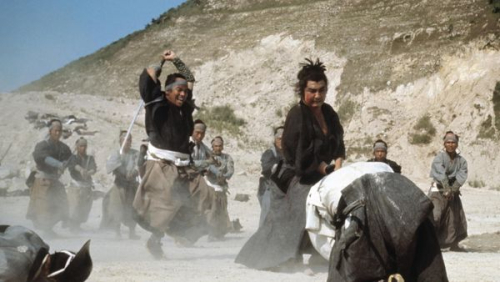
Kenji Misumi’s direction does maintain a sense of style from its previous films while he also restrains some of the violence though images of dismembered body parts, blood sprays, and such still are shown in the film. Yet, Misumi does showcase this air of chaos and discontent in the way a young woman and her mother are raped by a gang of lowly samurai warriors or how the prostitute is mistreated by her client. Shot in various rural locations in Japan, Misumi does use the locations as characters in the film from the bamboo forest early in the film where Ogami disposes a trio of ninjas while the scene in the desert hill serves as the climax between Ogami and the governor’s army. The usage of the wide shots don’t just play into the scope of the locations but also in how Daigoro would place himself on a spot to get someone’s attention or just to get a view of what he’s seeing whenever his father is about to attack.

With the aid of fight choreographer Eiichi Kusumoto, Misumi’s approach to the fighting is more restrained as it’s more about who makes the first move as well as a sense of respect during duels as it’s something both Torizo and Kanbei have believing there’s still some semblance of honor despite the former’s lack of belief towards codes with her yakuza. Misumi’s close-ups and medium shots help play into the drama and air of suspense as well as these stylish flashbacks as it relates to the governor that Ogami is hired to kill. Its climax doesn’t just play into this growing disconnect over thirst of power and honor but also the idea of what a samurai really is as it’s something both Ogami and Kanbei are asking. Overall, Misumi crafts a rapturous yet chilling film about a father-son duo who trek through Japan as they encounter unruliness in their path.

Cinematographer Chikashi Makiura does incredible work with the film’s cinematography with its gorgeous usage of natural lights for many of the daytime exteriors while the nighttime scenes feature lighting by Hiroshi Mima who help provide a low-key look to the film along with the flashbacks which were shot in black-and-white. Editor Toshio Taniguchi does excellent work with the editing as its emphasis on style in the jump-cuts, dissolves, and other stylish cuts help play into the action as well as the suspense and drama where things do slow down to play more into emotional reactions than action. Production designer Yoshinobu Nishioka does amazing work with the look of the yakuza’s main base including an inn that they run as well as the lavish home of the governor. The makeup work of Hideo Yumoto and Toshio Tanaka do terrific work with the look of a few characters from the one-armed man hiding in Torizo’s closet to the ragged look of Kanbei’s gang.

The special stunt effects by Daizen Shishido is amazing for some of the action that occurs including scenes that involve aerial attacks from ninjas and samurais as it help play into the action. The sound work of Tsuchitaro Hayashi, with sound effects by Toru Kurashima, is superb for the atmosphere of the locations as well as sounds of gunfire, swords, and arrows that occur during battle. The film’s music by Hideaki Sakurai is phenomenal for its array of themes from a Western-like theme for the main characters with its guitars and strings as well as percussive-based music for its suspense and sounds of strings and warbling synthesizers for the film’s climatic battle.

The film’s wonderful ensemble cast feature some notable small roles from Jun Hamamura as the one-armed retainer that Torizo had been hiding that Ogami knew, Sayoko Kato as the prostitute that Ogami and Daigoro protects, Michitaro Mizushima as a former aide of Governor Genba from the film’s flashbacks, and Isao Yamagata as the power-hungry Sawatari Genba who is hoping to gain the favor of the shogunate and his clan upon learning about Ogami whom he realizes is a threat. Yuko Hamada is excellent as the yakuza leader Torizo as a woman who learns about Ogami’s true identity as she sees someone that she respects as well as asking for help as it relates to the governor whom she despises. Go Kato is amazing as Kanbei as a leader of a ragged group of lowly samurai warriors who encounters Ogami early in the film as he is aware of who he is as they would later meet where Kanbei is a man of respect and honor as he is trying to answer the question of identity and being a true samurai.

Finally, there’s the duo of Akihiro Tomikawa and Tomisaburo Wakayama in their respective roles as Diagoro and Ogami Itto with the former as the young boy who observes everything around him while often luring warriors into traps as well as be the one to bring kindness to the prostitute. The latter showcases more restraint as a man still haunted by loss yet is still keen on his path towards Hell where he deals with a sense of unruliness around him while surprised to find that there are those who do have some kind of honor as it is a rapturous performance from Wakayama.

Lone Wolf and Cub: Baby Cart to Hades is a sensational film from Kenji Misumi. Featuring a great ensemble cast, dazzling visuals, stylish action sequences, and a chilling music score, the film is definitely an exhilarating samurai-adventure film that isn’t just filled with lots of action but also drama and suspense. In the end, Lone Wolf and Cub: Baby Cart to Hades is a phenomenal film from Kenji Misumi.

Lone Wolf and Cub: Sword of Vengeance - Baby Cart at the River Styx - Baby Cart in PerilBaby Cart in the Land of DemonsWhite Heaven in Hell

© thevoid99 2020
Friday, April 24, 2020

Lone Wolf and Cub: Baby Cart at the River Styx


Based on the manga series by Kazuo Koike and Goseki Kojima, Lone Wolf and Cub: Baby Cart at the River Styx is the second film of the series in which an assassin-for-hire continues his journey through Edo-period Japan where he battle a group of female assassins hired by the clan who killed his wife and disgraced his name. Directed Kenji Misumi and screenplay by Kazuo Koike, the film explores a man continuing his path to find redemption as he well as seeking justice for the loss of his wife while accompanying his young son his path as the role of Itto Ogami and his son Daigoro are reprised by Tomisaburo Wakayama and Akihiro Tomikawa. Also starring Kayo Matsuko, Akji Kobayashi, Minoru Ohki, and Shin Kishida. Lone Wolf and Cub: Baby Cart at the River Styx is a majestic yet exhilarating film from Kenji Misumi.

The film follows the duo of Lone Wolf and Cub as they trek through Japan seeking whatever work Itto Ogami can do as an assassin as they’re eventually hired by a clan to kill a clan leader for disrupting their business while Ogami is being pursued by samurai warriors including a group of female assassins working for the man who disgraced Ogami. It’s a film with a simple premise that manga co-writer Kazuo Koike creates as it play into Ogami and Daigoro going on this journey as they’re eventually hired by a clan who is known for making indigo dye and have a monopoly on it but someone had betrayed them and is willing to share their secret method to a shogun whom Ogami is in conflict with. Ogami agrees to do the job yet the shogun’s own ninja clan team up with a clan of female assassins to try and eliminate Ogami for good. There isn’t much of a plot yet it is more about Ogami and Daigoro continuing on their path and the forces he face as they’re forced to deal with Ogami. Among them are a trio of brothers known as the Hidaris who are fierce warriors with iron-like weapons as they’re hoping to protect the man who had stolen the indigo dye methods.

Kenji Misumi’s direction is stylish not just in its compositions and settings but also its emphasis on suspense and drama. Most notably as Daigoro is given more to do and actually take part in a bit of the action including a scene where he tends to his ailing father after a scuffle that left him wounded for a bit. Shot on various locations in Japan, Misumi does use some wide shots for not just a scope of the locations including a gorgeous scene shot in a greenish forest. It’s also in the compositions he creates in some extreme close-ups and medium shots with the latter used for meetings between Ogami and the indigo dye clan or the group of people conspiring to kill Ogami. Misumi also creates images that do play into the beauty of Ogami’s journey despite the claims that Ogami and Daigoro are walking towards the River Styx on their way to Hell.

With the aid of fight choreographer Eiichi Kusumoto, Misumi’s approach to the sword fights, battles, and duels do play into this air of urgency of whenever Ogami has to attack. Even in a scene on a boat where he meets the Hidari brothers and sees what they’re able to do while he stays in the room with them as it showcases an act of respect between warriors. Ogami’s first confrontation with Akari Yagyu clan leader Sayaka (Kayo Matsuo) does have an air of style as well as some strange moments that occur after their first confrontation ends. The film’s third act that takes place in sand dunes do showcase this air of style in its setting where the Hidari brothers are confronted by members of the indigo dye clan as the violence remains stylized with limbs cut off and blood being sprayed as it is just a taste of what is to come upon meeting Ogami. Overall, Misumi crafts a ravishing and enchanting film about an assassin-for-hire and his young son trekking through Japan while dealing with a horde of new enemies.

Cinematographer Chikashi Makiura does brilliant work with the film’s cinematography as it features some gorgeous natural lighting and colors for some of the daytime exterior scenes including shots in the forest while the scenes at night with lighting by Hiroshi Mima add to the low-key yet somber beauty of the film as it is a major highlight of the film. Editor Toshio Taniguchi does excellent work with the editing as it has elements of style in its jump-cuts, stylish dissolves, and other cuts that help play into the action, drama, and suspense. Production designer Akira Naito does fantastic work with the look of the hut that Ogami and Daigoro stay at for a bit, some of the homes of the clans, and the boat where Ogami meets the Hidari brothers. Costume designer Yoshio Ueno does nice work with the costumes in the robes that Sayaka wears as well as the clothes that the Hidari brothers wear.

Special stunt effects by Daizen Shishido is amazing for some of the action including characters jumping in the air with mechanical effects by Shin-Ei Art Workshop adding to the film’s visual effects. The sound work of Tsuchitaro Hayashi, along with sound effects by Toru Kurashima, do superb work with the sound in the creation of some of the sound effects as well as . The film’s music by Hideaki Sakurai is incredible for its array of dissonant and eerie music score filled with offbeat percussive music that help build up the suspense as well as traditional Japanese string instruments that play into the drama as it is a major highlight of the film.

The film’s wonderful cast feature some notable small roles from Akiji Kobayashi as the leader of the Kurokuwa group in Ozuno who conspires with Sayaka to kill Ogami, the quartet of Izumi Ayukawa, Reiko Kasahara, Yukiji Ikeda, and Yuriko Mishima as four of Sayaka’s assassins, the trio of Minoru Ohki, Shin Kishida, and Shogen Nitta as the Hidari brothers, and Kayo Matsuo in a fantastic performance as Sayaka as a clan leader loyal to the lead shogun as she hopes to kill Ogami for her master only for her confrontations with Ogami leading to many revelations for her. Finally, there’s the duo of Akihiro Tomikawa and Tomisaburo Wakayama in their respective roles as Ogami Daigoro and Ogami Itto as the son-father duo with the former being a three-year old boy who is aware of what is happening around him yet proves to be formidable whenever danger is around. Wakayama’s performance as the latter is more restrained in terms of someone who is in total control but is also aware that he has a big target on his back and is always ready while he ponders if the path he’s chosen for himself and his son is the right one.

Lone Wolf and Cub: Baby Cart at the River Styx is a spectacular film from Kenji Misumi. Featuring a great ensemble cast, intoxicating visuals, evocative music, and a simple yet thrilling premise, the film is an exhilarating samurai film with lots of action, suspense, and drama as it plays into a father-and-son duo trekking through Japan as they encounter enemies and such during their path. In the end, Lone Wolf and Cub: Baby Cart at the River Styx is a tremendous film from Kenji Misumi.

Lone Wolf and Cub: Sword of Vengeance - Baby Cart to HadesBaby Cart in PerilBaby Cart in the Land of DemonsWhite Heaven in Hell

© thevoid99 2020

Wednesday, April 15, 2020

Lone Wolf and Cub: Sword of Vengeance


Based on the manga series by Kazuo Koike and Goseki Kojima, Lone Wolf and Cub: Sword of Vengeance is the story of an assassin who wanders from town to town for whatever job he’s asked to do while he’s accompanying his infant son as he seeks vengeance for the death of his wife. Directed by Kenji Misumi and screenplay by Kazuo Koike, the film is a samurai film where a man tries to protect his child while getting revenge on those who tried to destroy his life and disgrace his name. Starring Tomisaburo Wakayama, Akihiro Tomikawa, Fumio Watanabe, and Shigeru Tsuyuguchi. Lone Wolf and Cub: Sword of Vengeance is a gripping and exhilarating film from Kenji Misumi.

Set during the Edo era of Japan, the film revolves around an assassin-for-hire who was once a revered executioner until his wife was murdered and was then accused of a crime by a clan leader and an investigator leading him to become a ronin. It’s a film that play into a man as he treks through parts of rural Japan as he is willing to work as an assassin as long as he gets paid while raising his young son. The film’s screenplay by Kazuo Koike is straightforward with some flashbacks about the life of Ogami Itto (Tomisaburo Wakayama) and his infant son Daigoro (Akihiro Tomikawa) as he would have him on a cart during their trips as they trek through small towns and castles as they would be hired by a chamberlain to kill a clan leader and his gang of thieves and bandits in a remote village near a hot spring spa pool. There he deals with these bandits but doesn’t attack them in order to be their hostage until things eventually become complicated as he also thinks about the past

Kenji Misumi’s direction does have a lot of unique style in terms of the presentation as well as creating something that stray from the conventions of a revenge film. Shot in these rural locations in Japan in the woods and in nearby locations of old castles, Misumi presents this world of a man living during the Edo period of Japan as it play into a moment in time when everyone worked for some clan or has a role relating to top clans in Japan. The role that Itto has is an executioner as the first scene of the film has him preparing the execution of a child who is the lord of a clan as it’s a role that Itto takes seriously and with pride though it has made him an enemy among other clans. Especially for one who has his wife killed but also puts a tablet in his small temple that makes him a criminal leading to a showdown with the investigator and his army.

Misumi’s usage of wide and medium shots aren’t just about capturing the locations but also the scope of some of the battles and how Itto handles those who try to kill him with the aid of fight choreographer Eiichi Kusumoto in showing how samurai warriors take careful steps into attacking someone as Misumi would use tracking shots and wide angles to capture where Itto is at as well as what he does to slay an attacker. Misumi also creates some stylish imagery as it play into the path Itto and his son are on including a flashback as its usage of close-ups and medium shot shows the path that Daigoro has chosen as it would relate to a scene of Itto watching two boys playing with a ball. There is also this air of intrigue that occur in the third act as it relates to Itto’s growing reputation as this mysterious ronin with others not knowing his true identity. The violence of the film is stylized with blood squirting out and body parts dismembered as it play into the brutality of samurai sword-fighting as well as Itto’s resolve to do what is necessary to survive and live for his son. Overall, Misumi crafts a riveting and evocative film about a ronin samurai warrior trekking through Edo-period Japan as an assassin-for-hire with his infant son.

Cinematographer Chikashi Makiura does brilliant work with the film’s cinematography in capturing some of gorgeous colors of the daytime exterior scenes as well as use low-key available light for scenes in the right and low-key lighting from Hiroshi Mima for some of the scenes set at night. Editor Toshio Taniguchi does excellent work with the editing as it has elements of style in its usage of jump-cuts, slow-motion shots, and other stylish cuts that help play into the action and suspense. Production designer Akira Naito does amazing work with the look of the places that Itto goes to including his old home and the house near the hot spring water pool and the design of the cart itself.

The sound work of Tsuchitaro Hayashi, with sound effects by Toru Kurashima, is fantastic for its sound work that include some creative sound effects for some of the sword swings and how body parts sound when they get dismembered. The film’s music by Hideaki Sakurai is incredible for its mixture of traditional Japanese percussive, woodwind, and string instrument flourishes with some grimy electric guitars to help set a mood for the scene as well as maintain that eerie air of discomfort throughout the film.

The film’s superb ensemble cast features some notable small roles from Keiko Fujita as Itto’s wife Azami, Reiko Kasahara as a madwoman who believes Daigoro is her son, Shigeru Tsuyuguchi and Yunosuke Ito as members of the Yagyu clan that has brought trouble to Itto, Fumio Watanabe as the aging Yagyu clan leader Bizen-no-kami who wants to destroy Itto’s life, Tomoko Mayama as the prostitute Osen who is treated with kindness by Itto, and Akihiro Tomikawa as Itto’s young son Daigoro who observes everything his father does while joining him on this journey of uncertainty. Finally, there’s Tomisaburo Wakayama in a phenomenal performance as Ogami Itto as a once-revered executioner who goes into a path of uncertainty as an assassin for hire as he copes with the death of his wife and being disgraced by rival clans as it is a performance of restraint but also terror whenever he’s being confronted as it is a fierce and chilling performance from Wakayama.

Lone Wolf and Cub: Sword of Vengeance is a sensational film from Kenji Misumi that features an incredible leading performance from Tomisaburo Wakayama. Along with its ensemble cast, gorgeous visuals, eerie music score, and story of vengeance and ideals. It’s a samurai film that doesn’t play by convention in order to study a man’s path of loss and disgrace as he tries to find redemption and justice for what he’s lost. In the end, Lone Wolf and Cub: Sword of Vengeance is a spectacular film from Kenji Misumi.

Lone Wolf and Cub: Baby Cart at the River StyxBaby Cart to HadesBaby Cart in PerilBaby Cart in the Land of DemonsWhite Heaven in Hell

© thevoid99 2020