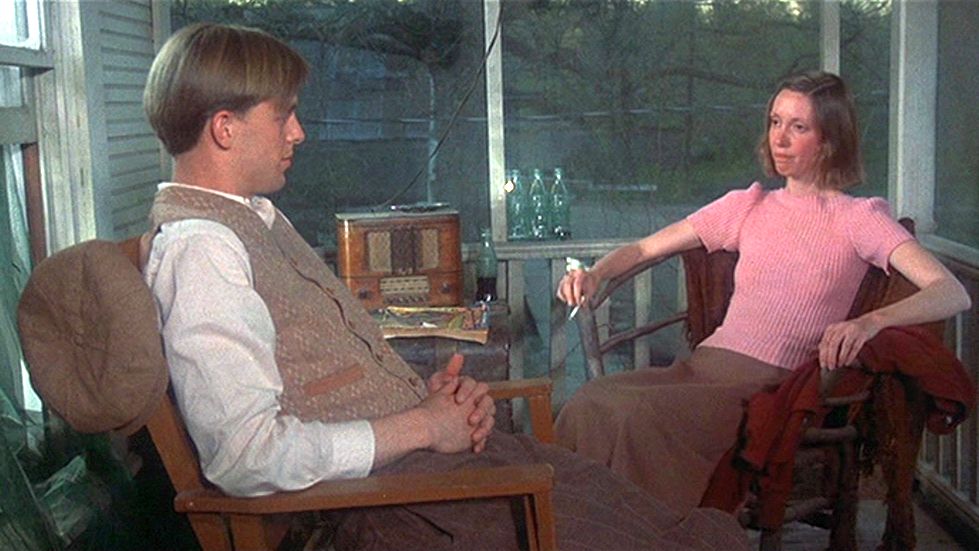
Based on the novel by Edward Anderson, Thieves Like Us is the story of three men who escaped prison as they go on a crime spree throughout the American South during the 1930s. Directed by Robert Altman and screenplay by Altman, Joan Tewkesbury, and Calder Willingham, the film is a loose remake of Nicholas Ray’s 1949 film They Live by Night which was also an adaptation of Anderson’s novel as it blends elements of humor and crime. Starring Keith Carradine, Shelley Duvall, John Schuck, Tom Skerritt, Bert Remsen, and Louise Fletcher. Thieves Like Us is a riveting and mesmerizing film from Robert Altman.
Set during the Great Depression in the American South, the film revolves around a trio of escaped convicts who become bank robbers as they would become successful and notorious only to go way over their head when they are later pursued by the authorities. It’s a film with a simple premise as it play into three men that want to live the good life during the Depression as well as endure some of the trappings of success in their work as bank robbers. The film’s screenplay by Robert Altman, Joan Tewkesbury, and Calder Willingham does follow a straightforward narrative but it’s really more about three guys trying to plan robberies and such as one of them is a young man named Bowie (Keith Carradine) is someone that is learning the ropes of robbing but is eager to wanting to have a good life with a young woman in Keechie (Shelley Duvall). Yet, Bowie is pressured to continue robbing by his partners T-Dub (Bert Remsen) and Chicamaw (John Schuck) as the latter becomes more violent and troubling to the point that he would cause a lot of trouble.
Altman’s direction has elements of style in terms of the compositions and scenes he creates but he also does things that doesn’t play into conventions such as the robberies where he never reveals what happens during the robbery. Instead, it’s about the action outside where Bowie is the getaway driver as he waits for T-Dub and Chicamaw leaving the bank and getting into the car. It’s among these moments in the film that has Altman deviate from what is expected in caper films as he’s more concerned about the characters and how they plan a robbery. Even if it means laying low between robberies where they can get a chance to enjoy themselves as T-Dub would live at a house with Chicamaw and a woman whose young adult daughter is someone he is in love with. Shot largely on location in the state of Mississippi, Altman does maintain that air of realism into the locations such as the swamps and dirt roads along with showing this period of the American South during the Depression that was grimy but also kind of exciting.
Altman’s direction also emphasizes on the usage of radio reports as well as diegetic music to capture the idea of the times where it is either used as a form of entertainment or to intensify the drama during the film’s second act where Bowie, T-Dub, and Chicamaw become fugitives. Altman’s usage of long takes in the drama add to an energetic tone as well as the events that would occur in the third act with Chicamaw becoming violent as Bowie finds himself being a reluctant participant in these violent acts. Even as Bowie wants to take part in a simple life with Keechie but is pulled into wanting to participate in more robberies as it would eventually get more troubling. All of which has Altman showcase these haunting moments of violence that would haunt Bowie whose life is in greater danger just as he’s trying to make changes for himself. Overall, Altman crafts a witty yet compelling film about three convicts making a name for themselves as bank robbers during the Great Depression.
Cinematographer Jean Boffety does brilliant work with the film’s cinematography as it has a low-key approach to the way many of the daytime exteriors look with ideas of grainy photography as well as the way some of the scenes at night are lit. Editor Lou Lombardo does amazing work with the editing as it has an air of style for its usage of jump-cuts as well as a key scene towards the end with its usage of slow-motion as it is a highlight of the film. Costume designer Polly Platt does excellent work with the costumes from the look of the dresses the women wear as well as the clothes the men wear during those times. Sound mixer Don Matthews does fantastic work with the sound in the way music and radio programs sound like inside a car or at a house as well as the atmosphere of the locations including the scenes involving overlapping dialogue.
The film’s superb cast include some notable small roles from Arch Hall Sr. as a young man who picks up Bowie, T-Dub, and Chicamaw early in the film, Al Scott as a prison warden, Ann Latham as T-Dub’s young lover Lula, and Tom Skerritt in a terrific small role as the general store owner Dee Mobley who also runs a small-time criminal operation that he eventually abandoned. Louise Fletcher is fantastic as Lula’s mother Mattie as a woman who lets T-Dub, Bowie, and Chicamaw stay at her home where it eventually becomes chaotic to the point that she would later play a part in their downfall. Bert Remsen is excellent as T-Dub as eldest of the three thieves who walks with a cane and is always trying to ensure that things go well while not wanting to be violent as he enjoys the fruit of success.
John Schuck is brilliant as Chicamaw as the most brutal of the three thieves as well as someone who isn’t satisfied with robbing banks where he becomes more violent and unruly where he would get everyone into trouble. Shelley Duvall is amazing as Keechie as Mobley’s younger sister who falls for Bowie as they embark on a relationship where she knows what he does but also keeps it a secret while dealing with the idea that Bowie would abandon the good life in favor of the thrill of danger. Finally, there’s Keith Carradine in an incredible performance as Bowie as a young thief who contemplates his role as someone who is a robber where he relishes in having money and wanting a good life but becomes disturbed by some of the violence he encounters as it’s a role that has Carradine display humor but also someone who comes to term with the trouble he’s created and the need to make things right.
Thieves Like Us is a sensational film from Robert Altman that features great performances from Keith Carradine and Shelley Duvall. Along with its ensemble cast, evocative cinematography, loose take on theft and notoriety, and an unconventional take on the caper genre. It’s a film that play into the idea of three men wanting to succeed through crime only to go way over their heads once they become notorious. In the end, Thieves Like Us is a phenomenal film from Robert Altman.
Robert Altman Films: (The Delinquents) – (The James Dean Story) – Countdown (1968 film) - (That Cold Day in the Park) – M.A.S.H. - Brewster McCloud - McCabe & Mrs. Miller - (Images) – The Long Goodbye - California Split - Nashville - Buffalo Bill and the Indians or, Sitting Bull's History Lesson - 3 Women - (A Wedding) – (Quintet) – (A Perfect Couple) – (HealtH) – Popeye - (Come Back to the Five and Dime, Jimmy Dean, Jimmy Dean) – (Streamers) – (Secret Honor) – (O.C. and Stiggs) – Fool for Love - (Beyond Therapy) – (Aria-Les Boreades) – (Tanner ’88) – (Vincent & Theo) – The Player - Short Cuts - Pret-a-Porter - (Kansas City) – (The Gingerbread Man) – Cookie's Fortune - Dr. T and the Women - Gosford Park - The Company - (Tanner on Tanner) – A Prairie Home Companion
© thevoid99 2018
Based on the novel by Ken Kesey, One Flew Over the Cuckoo’s Nest is the story of a criminal who pretends to be mentally ill in order to avoid jail time where he finds himself in a mental hospital where he deals with a world that is far crueler. Directed by Milos Forman and screenplay by Lawrence Hauben and Bo Goldman, the film is an exploration of a small-time thief who hopes to take it easy only to deal with authorities who treat people in the most inhumane way. Starring Jack Nicholson, Louise Fletcher, Will Sampson, Danny DeVito, Christopher Lloyd, Scatman Crothers, William Redfield, and Brad Dourif. One Flew Over the Cuckoo’s Nest is a tremendous yet engrossing film from Milos Forman.
Wanting to avoid jail time by staying in a mental hospital in the hopes that he can relax and have fun, a small-time criminal finds himself dealing with a very strict nurse who treats many patients in very inhumane ways where he rebels against her rules and the system in the hospital. Set in the fall of 1963, the film plays into a man that thinks he will be out of the hospital in 90 days and go back to doing all of the shenanigans he’s done though his crime was statutory rape where he had no clue the girl he slept with was 15. During his stay at this hospital in Oregon, Randall Patrick “Mac” McMurphy (Jack Nicholson) doesn’t just see a world where a group of sick men are being goaded and forced to unload into their own issues but also see that there’s a possibility that they might not get better. By being this rebellious figure who wants to watch baseball and go fishing, McMurphy would be this figure that would antagonize the orderlies and this head nurse in Nurse Ratched (Louise Fletcher).
The film’s screenplay doesn’t just explore this environment that is this mental hospital in Oregon but also the people who are there as many of them have trouble with the real world. Among these men that McMurphy meets include a young man with a bad stutter named Billy (Brad Dourif), a profane and confrontational man in Taber (Christopher Lloyd), a delusionist in Martini, an epileptic in Seflet (William Duell), a man prone to childish tempers in Cheswick (Sydney Lassick), a paranoid intellectual in Harding (William Redfield), and a quiet yet tall Native American that McMurphy calls Chief (Will Sampson). Many of them are revealed to be men with real problems but need the time to feel better as McMurphy helps them have a chance to live normal lives while being antagonistic towards Ratched and the other doctors who believe that McMurphy is dangerous but not entirely crazy until Ratched makes a decision that would change things for the film’s second half.
Especially when McMurphy knows more about the patients in his ward and what is happening to him where it raises a lot of questions into the state of inhumanity that he would endure. Especially as the other patients are also being tested against their will where McMurphy would have some revelations about his own and the people around him. It would cause a series of events for him to revolt and try to escape but also endure the growing state of what Ratched and the doctors at the hospital are doing where it is obvious that the men in the ward really need help and McMurphy is the one person that really seems to care and offer them a glimpse of a world without problems no matter how fucked up it is. Yet, it’s a world that is better and can be organized instead of being pressed on and treated like an animal in this abusive and controlling mental hospital under the control of this heartless bitch.
Milos Forman’s direction is quite intimate for the fact that it was shot largely in Salem, Oregon as well as nearby areas including the Oregon State Hospital where much of the film is shot. While there are some wide shots that occur outside of the hospital including a sequence where McMurphy and the gang go on a fishing trip with one of McMurphy’s girlfriends in a day of fun. Much of the film has Forman use close-ups and medium shots to play into the world of the hospital where it is very controlled as Forman’s compositions would have this sense of repression that looms throughout the film. Once the McMurphy character comes in, it’s as if the hospital is starting to come alive little by little as it also has an air of imagination where McMurphy looks into a TV that isn’t on where he comments about a baseball game.
The direction also has Forman find ways to balance humor and drama where the latter becomes very prevalent in the film’s second half as it relates to what McMurphy is dealing with and the outcome of what he has to endure. The usage of extreme close-ups do come into play it does feel very unsettling in terms of what McMurphy has to be put through as well as the other patients. Some of which are here because they actually need help but are being treated inhumanely. Even as the film’s climax that relates to McMurphy’s attempt to escape and throwing a party for himself and the patients would showcase a group of men needing an escape from their own problems and a chance that there is hope for them in the real world. Yet, it is followed by the harshness of reality in the form of Nurse Ratched who is pretty much a monster that needs to be taken down in the hopes that those who suffer from mental illness can be saved and treated humanely. Overall, Forman creates a riveting yet exhilarating film about a small-time criminal trying to buck the system at a mental hospital.
Cinematographers Haskell Wexler and Bill Butler do amazing work with the film‘s cinematography from the look of the many interiors inside the hospital for the scenes set in day and night as well as some of the exteriors in the locations near Salem, Oregon. Editors Richard Chew, Sheldon Kahn, and Linda Klingman do brilliant work with the editing with its usage of rhythmic cuts to play into the drama and some of the film‘s humor while creating moments that are engaging in some of the livelier moments of the film. Production designer Paul Sylbert and art director Edwin O’Donovan do fantastic work with some of the minimal set pieces created such as the ward room and its bathroom that featured a prop that would be key to the story.
Costume designer Aggie Guerard Rodgers does nice work with the costumes design as it‘s mostly casual for all of the patients as well as the look of Nurse Ratched‘s uniform. The sound work of Mark Berger is superb for the atmosphere that is created in the ward with its usage of calm music to soothe the patients to the raucous sounds that would occur upon McMurphy‘s arrival and presence. The film’s music by Jack Nitzsche is wonderful for its low-key, folk-based score that plays into some of the elements of drama and humor as well as what is going on outside of the hospital.
The casting by Jane Feinberg and Mike Fenton is incredible as it features notable small roles from Nathan George as the attendant Washington, Marya Small as a girlfriend of McMurphy in Candy, Louisa Moritz as Candy’s friend Rose, Kay Lee as a night supervisor at the hospital, and Scatman Crothers in a hilarious performance as the night orderly Turkle who finds himself in big trouble. Other noteworthy small performances as some of the patients in the film include Josip Elic as the somewhat-catatonic Bancini, Michael Berryman as the deformed Ellis, Delos V. Smith as the hippie-like patient Scanlon, Willam Duell as the epileptic Seflet, and Vincent Schaivelli as the annoyed Frederickson. Dean Brooks superb as the hospital administrator Dr. Spivey as a man that is trying to understand what is going on while believing that McMurphy isn’t a totally bad influence despite Ratched’s opinion.
Danny DeVito and Christopher Lloyd are excellent in their respective roles as the delusional Martini and the aggressive Taber who both enjoy McMurphy’s presence while William Redfield is brilliant as the educator Harding who copes with the idea that his wife might be cheating on him. Sydney Lassick does amazing work as the child-like Cheswick as a man who has been repressed by his surroundings where he is fit to have tempers where McMurphy is the one person that can help him. Brad Dourif is phenomenal as Billy Bibbit as a young man with a bad stutter who is reluctant to enter the real world while being given the chance to live through McMurphy. Will Sampson is remarkable as the Chief as a tall and silent Native American who is an observer as well as this mysterious being that McMurphy befriends as well as someone who seems to revel in McMurphy’s presence.
Louise Fletcher is great as Nurse Ratched as this head nurse of a ward that is trying to maintain control and oppress everything as there is this coldness to her along with the fact that she is really just a straight-up bitch. Finally, there’s Jack Nicholson in a tour-de-force performance as Mac McMurphy as a small-time criminal who goes to the hospital to avoid jail time only to find himself in bigger trouble by antagonizing Nurse Ratched as it’s a performance that is manic but also one filled with depth as Nicholson creates a character that we all can root for.
One Flew Over the Cuckoo’s Nest is an outstanding film from Milos Forman that features great performances from Jack Nicholson and Louise Fletcher. Along with a phenomenal supporting cast as well as a compelling screenplay, the film isn’t just a unique study into madness and oppression. It’s a film that also showcases a world of men being treated inhumanely by an unjust world that was supposed to help them only to make them less human. In the end, One Flew Over the Cuckoo’s Nest is a spectacular film from Milos Forman.
Milos Forman Films: (Black Peter) - (Loves of a Blonde) - (The Fireman’s Ball) - (Taking Off) - (Visions of Eight) - (Hair) - (Ragtime) - (Amadeus) - (Valmont) - (The People vs. Larry Flynt) - (Man on the Moon) - (Goya’s Ghost)
© thevoid99 2016
Directed by Kathryn Bigelow and written by Bigelow and Eric Red, Blue Steel is the story about a rookie police officer who falls for a man who she thinks might be her stalker. The film is an exploration of a woman who finds herself in a strange love affair while investigating a series of gruesome murders by someone with .44 Magnum. Starring Jamie Lee Curtis, Ron Silver, Clancy Brown, Elizabeth Pena, Kevin Dunn, Richard Jenkins, Philip Bosco, and Louise Fletcher. Blue Steel is a chilling yet mesmerizing film from Kathryn Bigelow.
The film is about a rookie New York police officer who loses her badge following a robbery in which she kills a robber who had a gun pointed at her as the robber’s weapon wasn’t found in the crime scene. During her suspension, she meets a commodities broker where they have a relationship as she is unaware that he has the gun from the robbery and is a psychopath who has been killing people all over the city. When one of the bullet shells features her name, Megan Turner (Jamie Lee Curtis) is re-instated as a detective where she aids in the investigation where she makes some chilling discoveries about her new boyfriend Eugene Hunt (Ron Silver). Particularly as she discovers about his troubled state of mind as he continues to evade the police in this strange cat-and-mouse game.
It’s a film that is definitely a thriller of sorts but with an antagonist who could be mentally ill but also has this strange obsession towards Megan and the robbery she was in as he becomes entranced by the power of killing someone. The film’s screenplay does play into some of the aspects that is expected in a suspense film. Notably in Megan becoming involved in the investigation of these murders as she is baffled by why a bullet shell has her name. Though she is new to her role as a cop, she is still determined to do what is right though her encounter with the robber early in the film showcases not just her inexperience but also how dangerous she could be. She also has to deal with the fact that her father (Philip Bosco) isn’t fond of her being a cop while Megan is often very cagey about why she wanted to be one.
The character of Eugene isn’t a conventional antagonist as he is someone who seems like a nice guy but there’s something about him that is off. Since he witnessed the robbery that Megan was involved in and became entranced by the 44. Magnum. He is this man who is amazed by the power of killing someone as he shoots random people for kicks as he would struggle with his identity which could play to the fact that he is mentally ill. After his encounters with Megan and their relationship suddenly takes on a creepy turn, it becomes clear that Eugene is much smarter and more dangerous than Megan and the police force realize as he is unpredictable in his movements. Even as he would go to places that would play into Megan’s emotions as she is someone with a lot of emotional and mental scars forcing Megan to deal with Eugene at the risk of breaking the law.
Kathryn Bigelow’s direction is truly hypnotic in not just the way she presents late 80s New York City where it is still this unpredictable city but also from the perspective of a police officer and the man she would later deal with. Much of the dramatic compositions that Bigelow would create are very simple with its use of close-ups and medium shots as well as infusing some humor into a few scenes. Yet, she is still emphasizing on its suspense to build up some of the terror that occurs such as the film’s robbery scene where it is all about Megan confronting the robber and the impact that it would have where Eugene would see the gun and later hide it. The usage of montages and dream-like sequences would play into some of the emotional state of Megan as it would also add some suspense into the hideous actions that Eugene would use.
While some of the violence that Bigelow presents are quite gruesome including the scenes of Eugene just killing someone. It’s the intimate moments such as Eugene’s surprise appearance at the home of Megan’s parents that is just uncomfortable to watch. It’s a scene in the third act where Megan is already aware of how dangerous and unpredictable Eugene is as he is there to watch TV with the parents about the killings where Megan knows that one wrong move and everything can go to shit. It’s one of these moments where Bigelow can infuse a sense of psychological wits and play with the rhythms of the suspense where its climax is similar to a Western shootout. Overall, Bigelow crafts a very powerful and rapturous suspense film about a cop going after a psychotic killer.
Cinematographer Amir Mokri does excellent work with the film‘s stylish cinematography with its use of lights and shades for some of the film‘s interior settings while giving some of its exterior scenes a look ranging from grimy to chilling in some of its scenes at night. Editor Lee Percy does brilliant work with the editing with its use of montages, rhythmic cuts, and some slow-motion moments to play up some of the film‘s action and suspense. Production designer Toby Corbett and set decorator Susan Kaufman do nice work with some of the set pieces such as the precinct building that Megan works at to the restaurants and such where she and Eugene go to in the film‘s first half.
Costume designer Richard Shissler does terrific work with the costumes where much of it is pretty casual. Sound editor Richard King does amazing work with the film‘s sound to play into some of the tension that occurs in the suspenseful moments as well as the moments of violence. The film’s music by Brad Fiedel is fantastic for its largely ambient score to play into some of the drama and suspense.
The casting by Risa Bramon Garcia and Billy Hopkins is great as it includes some notable small yet memorable performances from Tom Sizemore as the robber that Megan confronts early in the film and Richard Jenkins as Eugene’s lawyer who tries to stop the investigation. Elizabeth Pena is terrific as Megan’s friend Tracy who tries to assure Megan over her issues as a cop while Kevin Dunn is superb as Megan’s superior who is a hard-ass authority figure but becomes aware that Megan might be right about Eugene. Philip Bosco and Louise Fletcher are excellent as Megan’s parents with Bosco as the disapproving father and Fletcher as the more supportive mother who Megan knows is being abused by her husband which adds to Megan’s emotional issues. Clancy Brown is brilliant as Detective Nick Mann who leads the investigation over the mysterious murders where he would also believe Megan about Eugene as he would later become a target.
Ron Silver is fantastic as Eugene Hunt as this very disturbing individual who has a charming and nice side when he’s with Megan early in the film but is matched by this very dark and unpredictable side of him that allows him to kill people while doing things that he might be unaware of what he’s doing as it’s a very chilling performance from Silver. Finally, there’s Jamie Lee Curtis in an astonishing performance as Megan Turner. Curtis brings a lot of intensity and emotional weight to her role as a rookie cop dealing with her inexperience while realizing that the man she’s dating is a killer as it’s one where Curtis allows herself to be a badass as well as being someone who can navigate this strange cat-and-mouse game.
Blue Steel is a remarkable film from Kathryn Bigelow that features an incredible leading performance from Jamie Lee Curtis. Along with a strong supporting cast and a captivating take on the idea of stalkers and a look into the mind of a killer. The film is definitely one of Bigelow’s finest work to showcase her knack for suspense and action. In the end, Blue Steel is a spectacular film from Kathryn Bigelow.
Kathryn Bigelow Films: The Loveless - Near Dark - Point Break - Strange Days - The Weight of Water - K-19: The Widowmaker - The Hurt Locker - Zero Dark Thirty - The Auteurs #29: Kathryn Bigelow
© thevoid99 2013