Showing posts with label marie dubois. Show all posts

Wednesday, January 08, 2014

Shoot the Piano Player


Based on the novel Down There by David Goodis, Tirez sur le pianiste (Shoot the Piano Player) is the story a washed-up piano player who finds himself entangled in a world of crime after his brother gets himself in trouble with gangsters. Directed by Francois Truffaut and screenplay by Truffaut and Marcel Moussy, the film is a unique take on the crime genre where it involves this piano player who is mourning the suicide of his wife as he also gains the affections of a waitress. Starring Charles Aznavour, Marie Dubois, Nicole Berger, Michele Mercier, and Albert Remy. Tirez sur le pianiste is a witty yet engaging film from Francois Truffaut.

The film is about a once revered piano player who finds himself in a mess caused by his brother who had cheated a couple of gangsters. While he is trying to remain content with his life, the waitress at the café he works at wants to help him make a comeback as he also tries to sort out the mess his brother has made. It’s a film that could’ve had a typical scenario that is expected in a crime film but what Francois Truffaut and co-screenwriter Marcel Moussy do is inject with some humor as well as some moments of drama. Notably as the life of Charlie Kohler (Charles Aznavour) is one that is complicated as he was once the famed concert pianist Edouard Saroyan who was playing in grand halls until the suicide of his wife Therese (Nicole Berger). Kohler refuses to go back to that world as well have anything to do with his brothers until he learn about their troubles as he reluctantly decides to help them.

The script features a lot of voiceover narration as it’s largely told by Charlie as he tries to figure out his own life and how not to get into any trouble yet the presence of the gangsters has him uneasy where he finds himself gaining the affections of the waitress Lena (Marie Dubois) who knows who he was once. While Charlie also has some liasons with a prostitute named Clarisse (Michele Mercier) who lives next door, he prefers to live alone yet the presence of Lena and her plans to help him gain a comeback does intrigue him. Still, the chaos his older brothers Chico (Albert Remy) and Richard (Jean-Jacques Aslanian) cause has Charlie realizing that he might be the one to save them as well as their youngest brother Fido (Richard Kanayan).

Truffaut’s direction is definitely very stylized in not just his compositions with the use of close-ups and wide shots but also in the way he creates a scene. Notably as he creates something loose and lively in the café that Charlie works at where Truffaut spends part of his time seeing what the people are doing while men stare at the ladies with Charlie contently playing his piano. Much of the direction is often shot on various locations around Paris where much of the camera work is hand-held where it’s also filled with these images that are very entrancing in the style that he creates. Even as Truffaut would also include some very risqué moments of sex where it’s obvious what he is implying in the way Charlie conducts his life. The scenes involving the gangsters do have some moments of suspense but also some offbeat humor that includes a scene where Fido is in a car with the gangsters where they just talk casually. It’s among these little moments that Truffaut does where he puts his own spin in the crime film but also find a way to pay tribute to those films. Overall, Truffaut creates a very lively and exciting film about a piano player dealing with his past as well as the trouble his brothers have caused.

Cinematographer Raoul Coutard does fantastic work with the film‘s black-and-white photography where it does play into a sense of style for much of the film‘s exterior scenes in day and night where much of those scenes in the latter have great usage of the city lights. Editors Claudine Bouche and Cecile Decugis do amazing work with the film‘s editing where it does play into a sense of style from its use of jump-cuts, dissolves, and montages that is used in the film. Production designer Jacques Mely does nice work with some of the set pieces in the film such as the apartments that Charlie and Lena lived in as well as the café they work at. The sound work of Jacques Gallois is excellent for the sense of atmosphere that occurs in the location as well as some of the sound effects in the gun fights. The film’s music by Georges Delerue is brilliant for its sumptuous yet somber film score with its orchestral flourishes while containing lots of classical piano pieces as its soundtrack.

The film’s superb cast includes some notable small performances from Daniel Boulanger and Claude Mansard as the two gangsters tailing Charlie over his brothers’ antics, Serge Davri as Charlie and Lena’s smarmy boss, Albert Remy as Charlie’s older brother Chico who comes to Charlie for help, Richard Kanayan as Charlie’s younger brother Fido whom he takes care of as he has a thirst for trouble, Jean-Jacques Aslanian as Charlie’s older brother Richard who hopes Charlie returns to the family to make them strong again, and Claude Heymann as the music impresario that discovered Edouard yet made a deal that would affect Edouard’s life and success. Michele Mercier is excellent as the prostitute Clarisse that Charlie occasionally sleeps with as she deals with the chaos that the gangsters create.

Nicole Berger is amazing as Edouard’s late wife Therese as she only appears in a flashback sequence as this woman who has trouble dealing with Edouard’s success while revealing a secret that plays into her guilt. Marie Dubois is fantastic as Lena as this young waitress who knows about Charlie’s true identity as she wants to help him get a comeback while dealing with the chaos over his family. Finally, there’s Charles Aznavour in a remarkable performance as Charlie Kohler/Edouard Saroyan as a pianist who is trying to live a quiet life as a loner only to deal with the chaos in his family’s activities as well as his past and the effects that it caused in his own troubled life.

Tirez sur le pianiste is a phenomenal film from Francois Truffaut. Thanks to its unique take on the crime genre as well as it’s amazing cast, the film is definitely one of Truffaut’s finest films. Particularly as it has a sense of energy and style that is just intoxicating to watch. In the end, Tirez sur le pianiste is a sensational film from Francois Truffaut.

Francois Truffaut Films: The 400 Blows - Jules & Jim - Antoine & Colette - The Soft Skin - Fahrenheit 451 - The Bride Wore Black - Stolen Kisses - Mississippi Mermaid - The Wild Child - Bed and Board - Two English Girls - Such a Gorgeous Kid Like Me - Day for Night - The Story of Adele H. - Small Change - The Man Who Loved Women - The Green Room - Love on the Run - The Last Metro - The Woman Next Door - Confidentially Yours

The Auteur #40: Francois Truffaut (Pt. 1) - (Pt. 2)

© thevoid99 2014

Tuesday, September 20, 2011

Mon oncle d'Amerique


Directed by Alain Resnais and written by Jean Gruault that is based on the writings of Henri Laborit, Mon oncle d’Amerique (My American Uncle) is the story of Laborit’s exploration into the lives of three different people as they all become studies of Laborit’s social experiment. One has a man leaving his family farm for a more corporate lifestyle while a woman becomes an actress and has an affair with an upper-class writer. Starring Gerard Depardieu, Nicole Garcia, Roger Pierre, and Henri Laborit as himself. Mon oncle d’Amerique is an intriguing yet stylish drama from Alain Resnais.

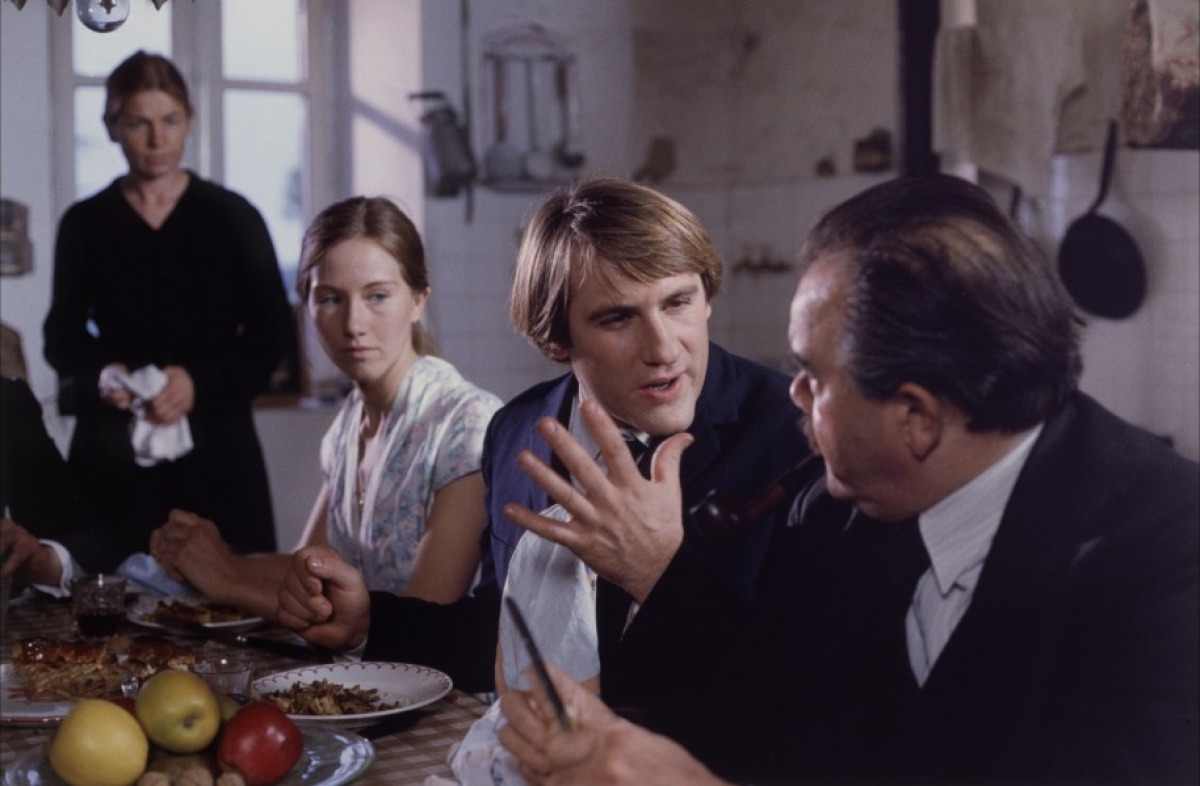
For Henri Laborit’s study of behavior and its impact, he takes on three different subjects for this experiment. The first is a man named Rene (Gerard Depardieu) who lived his life as a farm boy and was raised to live a life of hard work and such. When he leaves the world of farming with his girlfriend Therese (Marie Dubois), he later becomes an accountant for a small textile firm to become a success and has a family. Then when a merger is happening as a man named Veestrate (Gerard Darrieu) is observing the firm, Rene finds himself being threatened with new changes in his life.

The second subject is a woman named Janine who leaves a life being raised by Communist parents to become an actress. After succeeding, she meets the third subject in a political minister named Jean (Roger Pierre). The two have an affair as Jean is trying to create a book based on his own childhood experiences with his grandfather. When Jean leaves his family to be with Janine, Jean’s health starts to get troubles until Janine meets with Jean’s wife Arlette (Nelly Borgeaud) with some news. When Janine ends the affair, she doesn’t see Jean for two years as they see each other at the island Jean had spent his childhood at. Yet, things become complicated as Janine has a new job where she has a meeting with Rene about his new job that would eventually make some big changes for the three subjects.

The film is essentially a multi-layered study about three people making decisions that would change their lives as Henri Laborit studies them and see how humans behave through the situations they’re in. Throughout the film, the narrative shuffles into three or four different storylines with Laborit serving as a narrator to all that is happening along with voice-over narrations from the subject themselves about their own backgrounds. Eventually, the narratives would mesh into two as Janine is the only that interacts with the other two subjects in the film.

Jean Grualt’s screenplay allows the different narratives to cross-cut with one another in order to emphasize Laborit’s study and to compare the three different backgrounds of these individuals. Rene is from a farm as he starts off in a life of hard work and having a religious background while dealing with the fact that his father and uncle have a hard time dealing with the progressing times. When Rene takes on a corporate life where he lives comfortably, that life is threatened by different ideas of change of his own as he finds himself given offers that he couldn’t refuse but remains unsure about his duties. Then there’s Janine and Jean, two people from very different backgrounds who get together for large portion of the film’s second act. Janine comes from a working class family that supports Communism while Jean is from a rich family whose grandfather takes him to an island to study nature.

The film’s title refers to a story that Jean read as a kid thinking that an American uncle has left treasure somewhere in the island he often goes to. Yet, it’s all about the idea of memory as it’s one thing in his childhood Jean clings to as he shares it with Janine late in the film. Their relationship is based on their interest towards each other as Janine would later feel guilty over the fact that Jean leaves his family. It all goes back to Laborit’s decision over the way he studies human behavior and the decisions they make as it comes down to this third act where Janine would briefly meet Rene. By this time, Janine’s life has changed in the two years she had left Jean where the meetings she would make would have an impact on the other subjects she encounters. The script is definitely complex for this study but also doesn’t become boring for the way it’s presented.

Alain Resnais’ direction is truly mesmerizing for the way he presents the film and cross-cutting through the different narratives in the film. For a lot of the dramatic moments, there is a way Resnais would show scenes in different perspectives from where it’s actually happening or how it’s reflected in Laborit’s study. The scenes with Laborit’s allows him to comment on what is happening as he uses lab rats for example where the actors would later dress up as rats to exemplify his point. Meanwhile, each subject draws upon three iconic actors as inspirations. For Jean, it’s Danielle Darrieux while Janine’s inspiration is Jean Marais, Rene is in Jean Gabin. The footage of the actors Resnais chooses would enhance the feelings and emotions that the three subjects are dealing with.

Throughout the film, the subjects are placed into different tests which would impact the development of the film. For Janine, it’s all about what to do when she’s confronted by Arlette and the decision that she would make. For Jean, it’s about what to do once he sees Janine again and what should he do. For Rene, it’s about taking a prestigious job offer that would threaten the comfort of his life. Resnais maintains a controlled intimacy to these dramatic moments while creating some startling compositions for the way they react to their surroundings. Yet, they would all be confronted by some person who is trying to get them to lose control. While it’s a film that does start off in a very difficult manner due to its cross-cutting approach. The overall film is truly a haunting yet exhilarating portrait of human nature from Alain Resnais.

Cinematographer Sacha Vierny does a superb job with the film‘s cinematography from the colorful look of the scenes where Janine acts on stage to the more naturalistic yet lush look of the film for many of its exterior locations. Editor Albert Jurgensen does a great job with the film’s unconventional editing approach with its rhythmic cuts to cross-cut from one story to another without moving too fast. The editing also works for creating montages to compare and contrast between the behaviors of the lab rats and the main subjects in the conflict they deal with as the editing is a major highlight of the film.

Production designer Jacques Saulnier does an excellent job with the differing set pieces created such as the posh world of Jean and the working world that Rene and Janine delve into as well as the set pieces created for Janine‘s stage career. Costume designer Catherine Leterrier does a fantastic job with the dresses that Janine wears on and off-stage as well as the suits the men wear. The film’s score by Arie Dzierlatka is wonderful for its varied arrangements from somber yet broad orchestral pieces to more low-key pieces for some of the dramatic moments on the film.

The casting for the film is incredible that features appearances from Jean Daste as Rene’s boss, Alexandre Rignault as Jean’s grandfather, Laurence Badie as Veestrate’s wife, Bernard Malaterre and Laurence Roy as Jean’s parents, Veronique Silver and Jean Lescot as Janine’s parents, Genevieve Mnich and Maurice Gauthier as Rene, and Gerard Darrieu as the cold Veestrate. For the roles of the younger versions of the subjects, Ina Bedart and Stephanie Loustau as the younger versions of Janine, Guillaume Boisseau and Damien Bossieau as the young Jean, and as the younger versions of Rene, Ludovic Salis and Francois Calvez as they all give terrific performances.

Marie Dubois is very good as Rene’s supportive though grounded wife Therese as is Nelly Borgeaud as Jean’s more dramatic wife Arlette. Henri Laborit is excellent as himself by being calm and relaxed throughout the entirety of the film. Roger Pierre is brilliant as Jean, a bourgeois minister whose life is shaken by his affair with Janine as well as dealing with the fact that he is trying to finish a book that he’s wanted to do for many years. Gerard Depardieu is great as Rene, a farm boy turned textile firm accountant whose life unravels by changing times and uncertainty over the decisions he’s making. Finally, there’s Nicole Garcia in an amazing performance as Janine. Garcia’s performance is filled with the anguish and radiance of a woman trying to please Jean while fulfilling her own ambitions as it’s a truly mesmerizing performance.

Mon oncle d’Amerique is a phenomenal film from Alain Resnais that features an amazing cast led by Nicole Garcia, Gerard Depardieu, Roger Pierre, and Henri Laborit. While it’s not an easy film to follow and it is very unconventional, it is a very fascinating film about the studying of human behavior and ambition. The film is one of Resnais’ finest films for the way he plays with conventional storytelling and the study of characters through the situations they go through. In the end, Mon oncle d’Amerique is a superb yet provocative film from Alain Resnais.

Alain Resnais Films: Night and Fog - Hiroshima Mon Amour - Last Year at Marienbad - (Muriel) - (The War is Over) - (Je T’aime, je t’aime) - (Stavisky) - (Providence) - (Life is a Bed of Roses) - (Love Unto Death) - (Melo) - (I Want to Go Home) - (Gershwin) - (Smoking/No Smoking) - (Same Old Song) - (Not on the Lips) - (Private Fears in Public Places) - Wild Grass - (You Haven’t Seen Anything Yet) - (Life of Riley)

© thevoid99 2011