Showing posts with label paul laverty. Show all posts
Wednesday, May 16, 2018
2018 Cannes Marathon: I, Daniel Blake
(Winner of the Palme d’Or and Palm DogManitarian Award at the 2016 Cannes Film Festival)
Directed by Ken Loach and written by Paul Laverty, I, Daniel Blake is the story of a disabled man who learns he won’t be getting benefits as he befriends a single mother struggling to get by. The film is an exploration of a man dealing with his health and the need to get what he’s earned as he also deals with the modern world and their indifference towards him and others trying to get by. Starring Dave Johns and Hayley Squires. I, Daniel Blake is an engrossing and searing film from Ken Loach.
The film is a simple story of a man who had just recovered from a heart attack as he realizes that he is unable to work due to his health as he is seeking health benefits only to see that things have changed and certain requirements are needed which he is unable to comprehend. Along the way, he befriends a single mother with two kids who is struggling to find a job as she is in debt and needs to take care of her children as he offers to help her out. Paul Laverty’s screenplay follows the titular character (Dave Johns) who is already dealing with the loss of his wife as well as his failing health where he knows he can’t do any kind of work where he hopes to get health benefits feeling he has done so much. Yet, he is dealing with the fact that he has to fill documents online and digitally as he doesn’t own nor knows how to use a computer as he has hard time trying to fulfill the requirements. Even as he has to attend meetings that end up being a waste of time.
When he goes to a welfare center, he also hears the complaints from this young woman in Katie Morgan (Hayley Squires) who is being sanctioned for arriving late as she had no idea where the building was. Daniel sees what has happened to her as he tries to help her out while filing his own appeal for his benefits which becomes more difficult despite the help of a young neighbor in China (Kema Sikazwe) and a welfare worker in Ann (Kate Rutter). Still, Daniel’s struggle forces him to come to terms with the way the government treats him and many others as he makes a defying act to the system that won’t give him what he wants.
Ken Loach’s direction is understated in its approach to telling the story of this man and his fight against a system that wants to prevent him from getting what he deserves. Shot on location in Newcastle, the film does play into this world of the working class as well as those who haven’t caught up with the ideas and methods of the 21st Century. While there’s some wide shots in Loach’s compositions of the locations as well as one key scene late in the film that play into Daniel’s defiance against the system. Much of Loach’s approach to compositions is emphasized on close-ups and medium shots to play into the intimate moments in the welfare center and the food bank as well as the interactions with the characters.
Notably in scenes that play into the struggle of people in a system that is complicated where Daniel struggles to understand what he had to do to get these benefits as if there is something de-humanizing to what is happening to him. Loach’s direction also showcase a scene at the food bank where Katie breaks down due to her hunger as it emphasizes that she and Daniel are among those that are struggling. Even as it has this arc where Katie’s desperation for work would lead her into a terrifying path that would force Daniel to get the attention of the system in a grand way. Overall, Loach crafts a rapturous and poignant film about a man’s desire to get health benefits for himself and others in need of help.
Cinematographer Robbie Ryan does excellent work with the film’s cinematography as it is largely straightforward in terms of its approach to natural lighting for some of the scenes at night while being completely natural for the scenes in the day. Editor Jonathan Morris does brilliant work with the editing as it has a few transitional fade-outs for much of the film with some rhythmic cuts to play into some of the big dramatic moments. Production designers Fergus Clegg and Linda Wilson do fantastic work with the look of the apartments that Daniel and Kate live in as well as the welfare center and the food bank with all of the food that is available.
Costume designer George Slater does nice work with the costumes as it is largely casual to play into the look of the characters and the city they live in. Sound editor Kevin Brazier and sound recordist Ray Beckett do terrific work with the sound as it is natural in its setting as well as capturing the chaos that emerges in some of the film’s dramatic moments. The film’s music by George Fenton is wonderful for its low-key score that is a mixture of piano and orchestral music that is used sparingly in parts of the film including its final credits.
The casting by Kahleen Crawford is superb as it feature some notable small roles from Steven Richens as a friend of China in Piper, Micky McGregor as a convenience store security guard named Ivan, Kate Rutter as the sympathetic welfare worker Ann, Sharon Percy as a less sympathetic welfare worker in Sheila, Kema Sikazwe as Daniel’s neighbor China who sells counterfeit shoes to make a living, and the duo of Dylan McKiernan and Briana Shann in their respective roles as Katie’s kids Dylan and Daisy who learn a few trades from Daniel as well as get a perspective on the way the world works.
Hayley Squires is incredible as Katie Morgan as a single mother who had just moved to Newcastle from London as she deals with her new surroundings, hunger, and the struggle to feed her children as she becomes desperate as it’s a somber performance from Squires. Finally, there’s Dave Johns in a phenomenal performance as the titular character as a 59-year old carpenter who has a heart condition as he’s trying to get benefits that will ensure his own security as he deals with the modern world and all of its demands as it is a gripping and realistic performance that showcases some of the struggles that people from a previous generation or two cope with modern society in not getting what they deserve as Johns’ performance is truly a major highlight of the film.
I, Daniel Blake is a tremendous film from Ken Loach that features great performances from Dave Johns and Hayley Squire. Along with Paul Laverty’s compelling script, naturalistic visuals, and themes about respect and the need to get what one person truly deserves. It’s a film that does have a lot of political insight into the idea of welfare and how a man decides to defy the system in an attempt to get his benefits for himself and others shackled by the expectations of the 21st Century. In the end, I, Daniel Blake is a magnificent film from Ken Loach.
Ken Loach Films: (Cathy Comes Home) - (Poor Cow) – Kes - (Save the Children Fund Film) - (Family Life) - (The Price of Coal) - (Black Jack) - (The Gamekeeper) - (Looks and Smiles) - (Which Side Are You On?) - (Fatherland) - (Hidden Agenda) - (Riff-Raff) - (Raining Stones) - (Ladybird Ladybird) - (Land and Freedom) - (A Contemporary Case of Common Ownership) - (Carla’s Song) - (The Flickering Flame) - (McLibel (1997 film)) - (My Name is Joe) - (Bread and Roses) - (The Navigators) – Sweet Sixteen - (Ae Fond Kiss…) – (Tickets) – (McLibel (2005 film)) – The Wind That Shakes the Barley - It's a Free World - Looking for Eric - (Route Irish) – (The Angel’s Snare) – (The Spirit of ’45) – Jimmy's Hall
© thevoid99 2018
Saturday, May 14, 2016
2016 Cannes Marathon: Jimmy's Hall
(Played in Competition for the Palme d’Or at the 2014 Cannes Film Festival)
Directed by Ken Loach and screenplay by Paul Laverty that is based on Donal O‘Kelly‘s play, Jimmy’s Hall is the story about the Irish socialist Jimmy Graton who holds a dancehall for people who support his cause that would eventually led to his deportation to the U.S. in 1933. The film is a dramatic account about Graton’s life in the 1930s from his formation of the Revolutionary Workers’ Group as well as his fights with the Irish government as he is played by Barry Walton. Also starring Simone Kirby and Jim Norton. Jimmy’s Hall is a riveting and compelling film from Ken Loach.
Set in 1932 Ireland during the worldwide Great Depression, the film revolves around the year in the life of Jimmy Gralton who had return to Ireland after a decade in exile where he is asked by old friends and other young local to reopen a community hall much to the ire of old enemies that include land owners, religious leaders, and other political figures. It’s a film that plays into a man who was known for his radical views of the world where he is seen as a Communist yet he is really a man of the people that wants to do what is right while offering the town’s elder priest a chance to discuss things peacefully. Instead, there are forces that want to get rid of Gralton in order to maintain the status quo while the people realize that there is a lot more at stake than just themselves and their home.
Paul Laverty’s screenplay doesn’t just explore Gralton’s desire to reopen this community hall where people can dance to music, have meetings, and learn about everything from art, dance, and anything they want to know about. It’s about why he built in the first place 10 years earlier and the events that led to his first exile where he would go to America for nearly a decade where he saw the stock market crash of 1929 and its outcome. He is reluctant to stir trouble as he just wants to help his mother in running their local farm but he couldn’t ignore the problems that are emerging in Ireland as it relates to the poor and uneducated not getting a fair shake. Even as the people who are supposed to help them in local bishops condemn them instead of doing what is right. Still, Gralton just wants to stay out of trouble just as he reconnects with a former flame, who is now married with children, where he eventually realizes that his attempts to speak about against the government would lead him to a permanent exile.
Ken Loach’s direction is quite simple but also engaging for the way he creates a film that is political but also not overtly political. Shot on the actual locations where the story was based in the county of Leitrim in Ireland, the film does play into something that is almost like a recreation with a few flashback scenes of Gralton’s life when he built the hall. Much of the direction is intimate in its usage of close-ups and medium shots to play into the meetings as well as some of the things that goes on inside this hall where people listen to traditional Irish music as well as the American jazz that Gralton has brought to the country. There aren’t many moments of violence though the scenes that do display violent moments such as a young woman being beaten by her father who loathes Gralton. There are also these intense moments as it relates to the confrontation as well as the actions of Gralton and his associates where the film’s third act would play into Gralton’s own exile and eventual deportation. Through Laverty’s simplistic script, Loach would let many things play out easily and not really bring in a lot of exposition except for a few moments as it relates to a lot of the historical context of what Ireland was going through during the Depression. Even as the eventual deportation of Gralton would showcase a lot of what is going on that even those trying to get rid of Gralton couldn’t ignore. Overall, Loach crafts a provocative yet fascinating film about a man trying to create a peaceful environment during one of Ireland’s toughest periods in time.
Cinematographer Robbie Ryan does brilliant work with the film‘s colorful cinematography in capturing many of the naturalistic landscapes in a lot of the film‘s daytime exterior scenes along with some stylish usage of blue light filters for a key scene set at night. Editor Mike Andrews does excellent work with the editing as it is very straightforward as it doesn‘t go for a lot of style with the exception of a few transitions for the flashbacks in its first act. Production designer Fergus Clegg and art director Stephen Daly do fantastic work with the look of the hall that is big enough to be a lot of things while it would also have dances and concerts set at night to play into something that feels like a lively community as opposed to the look of these large and cold estates of the landowners.
Costume designer Eimer Ni Mhaoldomhnaigh does wonderful work with the costumes as it plays to the look of the early 1930s as it is casual but also colorful including a dress that Gralton bought for his former flame Oonagh. Sound editor Kevin Brazier does nice work with the sound as it is play into some of the lively atmosphere in the parties at the hall as well as some of the quieter moments involving the landscape. The film’s music by George Fenton and Fletcher Henderson is incredible for its mixture of jazz and traditional Irish folk music to play into that mixture of two different worlds that is American jazz and Irish music as something that would give many of the locals at the hall something new to enjoy.
The casting by Kahleen Crawford is superb for the ensemble that is created as it include some notable small roles from Aileen Henry as Gralton’s mother, Andrew Scott as the sympathetic and more progressive Father Sheamus, Karl Geary and Shane O’Brien as a couple of Gralton’s friends who try to fight for him, Denise Gough as a teacher at the hall, Aisling Franciosi as a young woman named Marie O’Keefe who goes to the hall against her father’s wishes, Brian F. O’Byrne as Commander O’Keefe who despises Gralton as he tries to stop him by any means necessary, and Francis Magee as Gralton’s old friend Mossie who helped build the hall with Gralton as he was just released from prison upon Gralton’s return to Ireland. Jim Norton is excellent as Father Sheridan as a religious leader who was once a major opponent of Gralton as he is not happy about his return where he tries to stop him only to be faced with questions about his own role and whether he really does help the people.
Simone Kirby is amazing as Oonagh as a former lover of Gralton who had since remarried since his exile as she reconnects with him without being unfaithful only to realize the dangers of her association with him. Finally, there’s Barry Walton in a phenomenal performance as Jimmy Gralton as a former organizer who is reluctantly back in a war of words against the authority where he tries to create peaceful discussions while calling out those such as Father Sheridan for his indifference towards people he is supposed to care for as it’s a performance of humility and charisma.
Jimmy’s Hall is an incredible film from Ken Loach that features a sensational performance from Barry Walton. Featuring a great cast as well as fascinating viewpoints on some of Ireland’s own conflicts during the Great Depression. It’s a film that showcases a man just trying to say something for common people in an age where everyone is suffering while the rich and powerful show indifference towards them. In the end, Jimmy’s Hall is a tremendous film from Ken Loach.
Ken Loach Films: (Cathy Comes Home) - (Poor Cow) - Kes - (Save the Children Fund Film) - (Family Life) - (The Price of Coal) - (Black Jack) - (The Gamekeeper) - (Looks and Smiles) - (Which Side Are You On?) - (Fatherland) - (Hidden Agenda) - (Riff-Raff) - (Raining Stones) - (Ladybird Ladybird) - (Land and Freedom) - (A Contemporary Case of Common Ownership) - (Carla’s Song) - (The Flickering Flame) - (McLibel (1997 film)) - (My Name is Joe) - (Bread and Roses) - (The Navigators) - Sweet Sixteen - (Ae Fond Kiss…) - (Tickets) - (McLibel (2005 film)) - The Wind That Shakes the Barley - It's a Free World... - Looking for Eric - (Route Irish) - (The Angels’ Share) - (The Spirit of ‘45) - I, Daniel Blake
© thevoid99 2016
Thursday, April 21, 2011
The Wind That Shakes the Barley
Originally Written and Posted at Epinions.com on 5/22/09.
One of Britain's most revered and controversial directors. Ken Loach has made films often dealing with social struggles and political issues. Loach's affiliation with socialist idealism has often put him at odds with people in the film industry despite being a prominent figure in the late 60s and 1970s through TV and film. By the 1980s, he became independent as his films were no longer commercially viable though a revival came in the 1990s. Even as he was considered to be influential by many directors including Steven Soderbergh who put footage of Loach's first film Poor Cow in his 1999 film The Limey. Then in 2006, Loach was in the spotlight again for his most profiled film yet about the Irish conflict with the British with the film The Wind That Shakes the Barley.
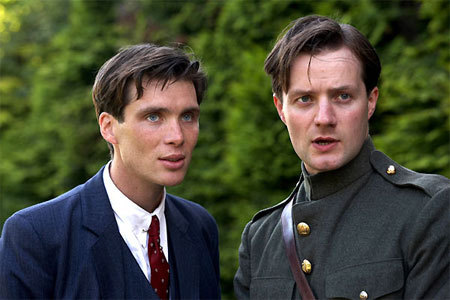
Directed by Ken Loach and written by Paul Laverty, The Wind That Shakes the Barley tells the story of two brothers fighting in the Irish War of Independence against the British and later, the Irish Civil War. A film that reveals in the Irish conflict against the British as well as its own conflict within the country, the film also upholds Loach's social idealism as well in this haunting yet realistic tale of conflict. Starring Cillian Murphy, Padraic Delaney, Liam Cunningham, Orla Fitzgerald, and Roger Allam. The Wind That Shakes the Barley is a haunting yet mesmerizing masterpiece from Ken Loach.
It's 1920 Ireland as a group of men playing hurling come home only to be visited by angry members of the British Army known as Blacks & Tans. A young man named Micheal O'Suillebhean (Laurence Barry) is tortured and killed for not saying his name. For a young man named Damian O'Donovan (Cillian Murphy), who was about to leave to become a doctor in London. This incident along with another incident involving a railway guard and a train driver (Liam Cunningham) being beaten has forced Damien to join the Irish Republic Army. Leading the local column of the army is Damien's brother Teddy (Padraic Delaney) as they all prepare to fight a war with the British. After some small victories in attack barracks for supplies and killing four officers at a pub, the little victories seem to go well. Unfortunately, a young named Chris Reilly (John Crean) was forced by a landowner in Sir John Hamilton (Roger Allam) to give out information.
The O'Donovan brothers plus several members of the IRA including the train driver named Dan were captured. Teddy was tortured for information which he refused to give while Damien befriends Dan as they share socialist views. After trying to play mental games with an officer, Damien is beaten as a young soldier named Johnny Gogan (William Ruane) was unable to kill Damien. Later on, Johnny helps free several members as three were forced to be left behind. After capturing Sir Hamilton and Chris Reilly, the news about the three left behind forced Damien to make decisions under the orders of the IRA. Months later with the British having trouble defeating the Irish, an Irish government was made but problems still happened over how to get funding for guns and such with Dan stating claims about what to do.
The battle rages on despite some losses and attacks at the home of Damien's girlfriend Sinead (Orla Fitzgerald) in which she was tortured. The Irish won the war as for a while, it seemed like absolute victory but it didn't grant complete independence from the British. Teddy is convinced that the treaty will avoid further wars against the British but Damien disagrees as he and Dan demand total independence from Britain. Thus starting the Irish Civil War with Teddy on the Free State side and Damien, Dan, and several of the old gang at the Anti-Treaty side. What would happen would tear apart a family as well as Ireland itself for many years.
The film is about conflict that relates to Ireland's struggle for independence that would later lead to civil war until 1949 when it broke completely from England. While screenwriter Paul Laverty creates a film that is part history-lesson but also part drama, it does reveal the Irish struggle against the British and why the treaty divided Ireland. Particularly with its views on socialism that was prominent for those who were against the treaty. While Laverty shows into why those who went for the treaty just so they could avoid war with Britain. Still, it's more of a socialist film with a socialist point of view spurned by its director Ken Loach. It doesn't mean he is trying to force his ideals to the audience but does make his point about what the Irish had to go through.
The screenplay is well structured with the first act about the Irish conflict with the British and Damien's decision to join the IRA and what he had to do. The second act being about the victory against the British and the hopes for an independent Ireland. The third act is about the Irish Civil War and the conflict between the brothers Damien and Teddy. All of that is well-told from the eye-wielding, engaging direction of Ken Loach. Loach's direction is filled with great long shots of the Irish countryside that has a wide depth of field. He also goes for close-ups to be part of the battle scenes while done with great style and almost documentary-like. Though there's no shaky hand-held work as it's mostly shot on steadicams and some still, tripod shots. Loach's direction is indeed phenomenal in playing up to the drama as well as being true to the history of Ireland as he creates a film that is engaging and powerful.
Cinematographer Barry Ackroyd does fantastic work with the film's greenish, colorful look of Ireland with its rough yet haunting shots of the film's exteriors on the countryside. While there's not a lot of bright colors in the film, the dark colors of both exterior and interior settings to play up to the grim tone of the film. Editor Jonathan Morris does some excellent work with the editing in the use of smooth transitions, rhythmic jump-cuts, and fade outs to help structure the story as well as it give it a leisurely pace for its 127-minute running time where it isn't too slow but not too fast either.
Production designer Fergus Clegg along with art directors Michael Higgins and Mark Lowry do spectacular look with the look of 1920s Ireland from the pubs, homes, and places that are filled with dark colors and old cars that is shown throughout the film. Costume designer Eimer Ni Mhaoldomhnaigh does stellar work with the costume that plays up to the 1920s look in terms of dresses, hats, suits, and such along with its dirty look of the IRA militia group. The sound work by Ray Beckett and Kevin Brazier do great work in the location sound work that is captured from the battle scenes to the raucous fight and pub scenes that goes on. The music of George Fenton is wonderfully plaintive with broad arrangements and melodies relating to Irish folk music along with the use of traditional ballads in Gaelic and English to play up to the film's historical tone.
The casting by Oonagh Kearney is phenomenal with some notable small roles from Diarmuid Ni Mheachair as a sick boy Damien treats, Nora Lynch as the sick boy's mother, Fiona Lawton as an Irish government official, Mary Murphy as Sinead's sister Bernadette, Mary O'Riordan as Sinead's grandmother Peggy, Damien Kearney as IRA member Finbar, Martin Lucey as IRA official Congo, and Myles Horgan as the crazed IRA soldier Rory. Other memorable small roles from Aiden O'Hare as IRA soldier Steady Boy, Laurence Barry as Micheal O'Suillebhean, John Crean as Chris Reilly, and William Ruane as British soldier turned IRA soldier Johnny Gogan. Noted character actor Roger Allam has a very memorable role as Sir John Hamilton, a British official who captures members of the IRA only to be captured later on.
Orla Fitzgerald is excellent as Sinead, a fellow Irish messenger to the IRA who is also Damien's longtime love as she helps fight the British and side with Damien over the treaty. Liam Cunningham is superb as Dan, a Socialist who fights for the IRA in his hopes for a free Ireland as he reveals why there should be a free Ireland. Cunningham's performance is truly the film's best supporting performance as he delivers such passion and angst into his role. Padraic Delaney is great as Teddy O'Donovan, the older brother who runs a local section of the IRA in his hopes for Irish independence from the British. Yet, when he becomes part of the pro-treaty side, he is conflicted though his intentions are to hope for a peaceful Ireland unaware of his brother's passion for a free Ireland.
Finally, there's Cillian Murphy in what is truly a tour-de-force performance as Damien O'Donovan. Murphy's performance is filled with lots of development as he starts out as an innocent man with dreams to be a doctor. Then after facing the harsh realities of what is going on to his people, he becomes a passionate, angry young man. Murphy's energetic, passionate, and broad performance as it's really the best film role of his career. Even as he goes into fights while leading the IRA during the Civil War as he stands by in his views in his belief for what is right for his country.
The film premiered at the 2006 Cannes Film Festival where it played in competition and became the surprise hit of the festival. The acclaim and surprising reaction helped the film win the Palme D'or beating several contenders vying for the prize. A month later, the film was released in Britain and Ireland to some controversy but did gain rave reviews through a year later when it came out in the U.S. For Ken Loach, the film raised his profile as he began to make more films frequently once again.
The Wind That Shakes the Barley is a harrowing yet powerful film from Ken Loach helmed by Cillian Murphy's superb performances. Fans of Ken Loach films will definitely enjoy the engaging approach and devotion to history over the Irish conflict with British and the Irish Civil War. It's a film that is both a great historical drama while also being a wonderful history lesson about Ireland. While some might not agree with Loach's Socialist views, the film does reveal the issues raised from the Irish over their conflict with Britain. In the end, it's a superbly crafted and mesmerizing film from Ken Loach.
Ken Loach Films: (Cathy Come Home) - (Poor Cow) - Kes - (The Save the Children Fund Film) - (Family Life) - (The Price of Coal) - (Black Jack) - (The Gamekeeper) - (Looks and Smiles) - (Which Side Are You On?) - (Fatherland) - (Hidden Agenda) - (Riff-Raff) - (Raining Stones) - (Ladybird Ladybird) - (Land and Freedom) - (A Contemporary Case of Common Ownership) - (Carla’s Song) - (The Flickering Flame) - (McLibel (1)) - (My Name is Joe) - (Bread & Roses) - (The Navigator) - Sweet Sixteen - (Ae Fond Kiss…) - (Tickets) - (McLibel (2)) - It’s a Free World... - Looking for Eric - (Route Irish) - (The Angel's Snare) - (The Spirit of '45) - Jimmy's Hall - I, Daniel Blake
Subscribe to:
Posts (Atom)