Showing posts with label rob lowe. Show all posts
Tuesday, July 09, 2019
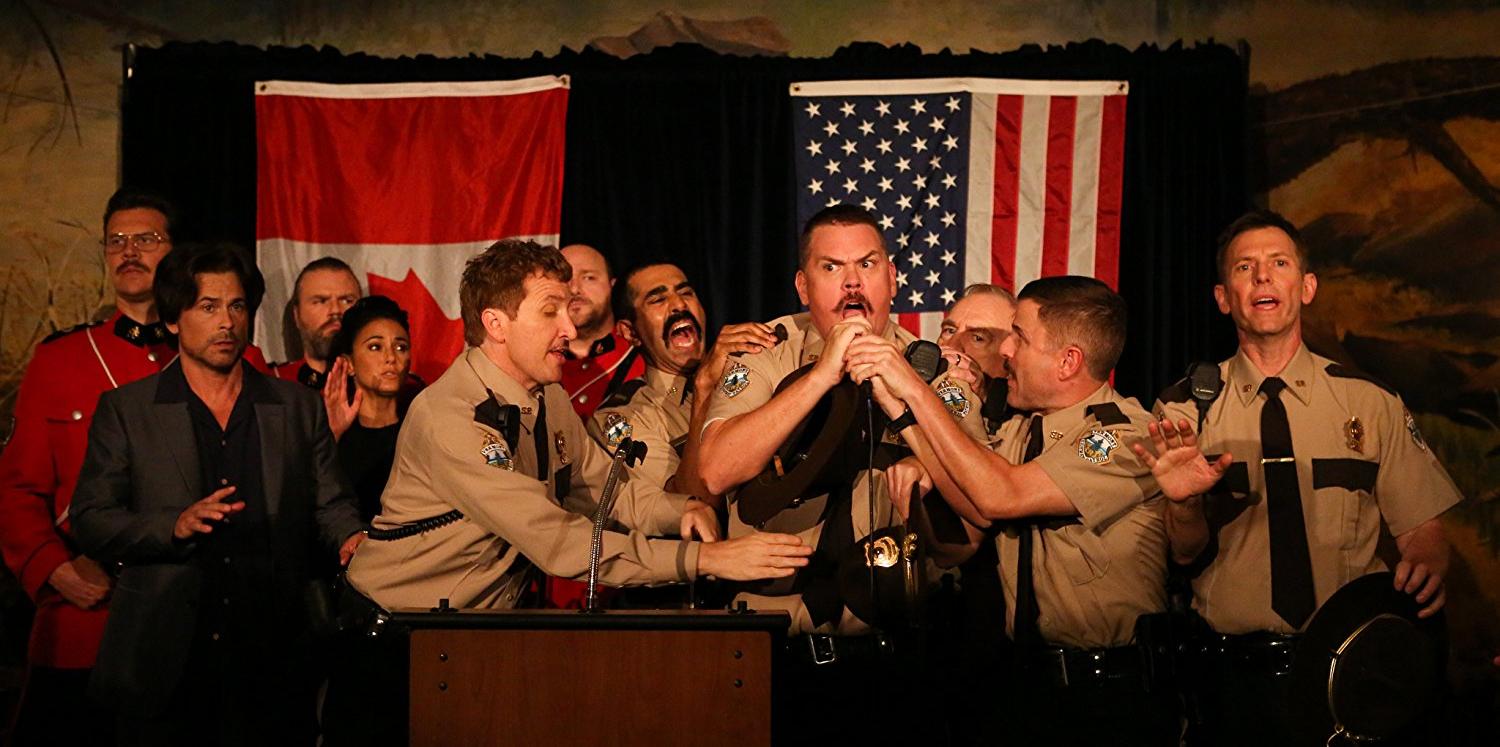
Super Troopers 2
Directed by Jay Chandrasekhar and written and starring the Broken Lizard troupe of Chandrasekhar, Kevin Heffernan, Steve Lemme, Paul Soter, and Erik Stolhanske, Super Troopers 2 is a sequel to the 2001 film that has a group of highway state troopers getting back in the game to deal with a border dispute with Canada over a piece of land. The film is a comedy that follows the five troublemakers who now deal with new problems as well as being out of the job for some time. Also starring Marisa Coughlan, Rob Lowe, Emmanuelle Chirqui, Tyler Labine, Will Sasso, Paul Walter Hauser, Lynda Carter, and Brian Cox returning as Captain John O’Hagen. Super Troopers 2 is an entertaining and wild film from Broken Lizard.
Several years after events from the first film that also involved a tragic incident involving actor Fred Savage, the film follow a group of former highway state troopers who are asked to get back on board to watch over a section of land in Canada that is to be transferred back to the U.S. much to the dismay of the locals. It’s a film that play into five guys who get their old jobs back but have to complete a task to keep the job yet they have to deal with a trio of Canadian Mounties who don’t want to lose their jobs as well as all sorts of shit. The film’s screenplay by the Broken Lizard troupe explore the five men trying to get back on board but also maintain their sense of shenanigans and pranks as they also reunite with Captain John O’Hagen who is leading the task despite issues with the Canadians in this small Quebecois town who really don’t want to become Americans. Adding to the turmoil for the troopers is the discovery of some of narcotics, firearms, and other things where they’re aided by a cultural attaché in Genevieve Aubois (Emmanuelle Chirqui) as well as deal with the town’s mayor Guy Le Franc (Rob Lowe).
Jay Chandrasekhar’s direction is largely straightforward though it opens with this fantasy sequence of the troopers as a rock band on tour and pulling a prank on a couple of troopers. Shot on location in Ware, Massachusetts, Chandrasekhar’s direction play into this area that doesn’t share much difference between America and Canada but there is still this air of culture clash in the post-Barack Obama era of America. While many of Chandrasekhar’s compositions are simple in the wide and medium shots along with some close-ups, Chandrasekhar does maintain a sense of energy into the humor while creating moments that are surreal as it relate to the adventures of the troopers with Farva (Kevin Heffernan) trying to cause trouble and Thorny (Jay Chandrasekhar) trying to keep things under control despite his growing addiction to one of the drugs he’s found that’s made him super-sensitive. While the film has a subplot in which Rabbit (Erik Stolhanske) trying to start a relationship with Aubois, Chandrasekhar does maintain a focus on the narrative of the troopers and its eventual climax involving the Mounties as it involves this smuggling ring and the intention of the smugglers. Overall, Chandrasekhar crafts a witty and exciting film about state troopers trying to watch over a land transfer from Canada to America.
Cinematographer Joe Collins does excellent work with the film’s cinematography as it is largely straightforward with some low-key lighting for some of the interiors set at night including a bordello scene in the film. Editor Spencer Houck does nice work with the editing as it has some stylish cuts including a few montage sequences and some rhythmic cuts to play into the humor. Production designer Cabot McMullen, with set decorator Sophie Carlhian and art director Lawrence Sampson, does fantastic work with the building the troopers station themselves in as well as the interior of the bordello and a restaurant they go to late in the film. Costume designer Debra McGuire does terrific work with the costumes as it is largely straightforward including the uniforms the troopers wear.
Special effects makeup artist Rob Fitz does brilliant work with some of the fake gore used in the film’s opening fantasy sequence as well as a surreal sequence involving drugs. Visual effects supervisors Brian Kubovcik and Jason Piccioni do amazing work for a few visual effects scenes that involve drugs including a commercial involving a women’s prescription drug. Sound designer Lawrence Zipf does superb work with the sound as it help play into the atmosphere of the bars and some of the film’s exterior locations. The film’s music by Eagles of Death Metal is wonderful for its mixture of blues and rock as it play into the film’s humor while music supervisor Ann Kline create a soundtrack that is mainly focused on rock, folk, and country music with a few songs from Eagles of Death Metal.
The casting by Venus Kanani and Mary Vernieu is marvelous as it feature some notable small roles and appearances from Fred Savage as himself, Seann William Scott and Damon Wayans Jr. as a couple of troopers, Clifton Collins Jr. as a tour bus driver, Bruce McCullough as a Canadian border officer, and Jim Gaffigan reprising his role as a passenger from the first film who endures the antics of the troopers. Other notable small roles include Paul Walter Hauser as Aubois’ obnoxious boss, Marisa Coughlan as the Spurburry police chief/Foster’s girlfriend Ursula, and Lynda Carter as Governor Jessman who gives the troopers a chance to get their jobs back. The trio of Tyler Labine, Hayes MacArthur, and Will Sasso are terrific in their respective roles as the Canadian Mounties in Sgt. Christopher Bellefuille, Staff Sgt. Major Henri Podigen, and Sgt. Major Roger Archambault who both have legit grudges towards the troopers for taking their jobs as they played a few pranks on the troopers yet aren’t really bad guys because they’re losing their jobs.
Rob Lowe is superb as the mayor/Montreal Canadiens hockey legend Guy “The Halifax Explosion” Le Franc as a man who is trying to show the troopers the town he lives in as well as the fact that the locals don’t like the troopers where he does whatever he can to not help them with the transfer. Emmanuelle Chirqui is fantastic as Genevieve Aubois as a cultural attaché trying to smooth over the transition while having feelings for Rabbit. Brian Cox is excellent as Captain O’Hagan as the troopers’ former chief who is tasked with running the troopers and ensuring that no trouble occur while he would engage in his own idea of shenanigans following a prank from the Mounties.
Finally, there’s the Broken Lizard troupe in brilliant performance with Paul Soter as the reserved yet playful Carl Foster who is trying to work and maintain his relationship with Ursula while Steve Lemme’s performance as the more playful MacIntyre “Mac” Womack is full of energy as someone that likes to play pranks. Erik Stolhanske’s performance as Robbie “Rabbit” Roto as the long-standing rookie of the gang who enjoys pranks while finding himself falling for Aubois. Kevin Heffernan’s performance as Rodney “Rod” Farva is hilarious as this obnoxious, foul-mouth, ill-tempered, and idiotic trooper who gets into a lot of trouble as well as bring trouble to the troopers. Finally, there’s Jay Chandrasekhar as Arcot “Thorny” Ramathorn as the senior trooper who is trying to keep things at bay while becoming addicted to feminine-sensitivity prescriptions.
Super Troopers 2 is a remarkable film from Jay Chandrasekhar and the Broken Lizard troupe. Featuring a great cast, lots of bawdy humor, and themes of political relations between countries and their cultural differences. It’s a film that doesn’t take itself seriously while providing some commentary on U.S. foreign relations post-Barack Obama. In the end, Super Troopers 2 is a marvelous film from Jay Chandrasekhar and Broken Lizard.
Broken Lizard Films: (Puddle Cruiser) – Super Troopers - Club Dread - Beerfest - (The Slammin’ Salmon) – (Broken Lizard Stands Up) – (Freeloaders (2012 film))
© thevoid99 2019
Monday, July 09, 2018
The Outsiders
Based on the novel by S.E. Hinton, The Outsiders is the story of two young greasers who go on the run following a self-defense murder of a drunken rich kid in Tulsa as they deal with their roles in the world. Directed by Francis Ford Coppola and screenplay by Kathleen Rowell, the film is coming-of-age story involving teenage kids from poor/working class environments dealing with the prejudice of their world as well as seeing if there’s a good life outside of these restrictions. Starring C. Thomas Howell, Matt Dillon, Ralph Macchio, Rob Lowe, Emilio Estevez, Tom Cruise, Patrick Swayze, Diane Lane, Leif Garrett, Darren Dalton, Glenn Withrow, Michelle Meyrink, and Tom Waits. The Outsiders is an enchanting and evocative film from Francis Ford Coppola.
Set in the early 1960s in Tulsa, Oklahoma, the film revolves around a rivalry between two different gangs from different parts of the town that represent the social divide in the city. From the south of Tulsa are a group of kids from the working class/poor section of the town known as the greasers who wear denim, leather, and have grease on their hair while the kids from the north of Tulsa are the Socs who are rich kids who have their life set by their parents, wear letterman jackets, and posh clothes. In the middle of this conflict are a couple of young greasers who sneak into a drive-in movie venue where they befriend a young woman as they would later have an ugly encounter with her drunken boyfriend that ended with one of them killing a Soc in self-defense. With the help of another greaser, the two young men leave Tulsa and hide out where they deal with their roles as greasers as well as wondering if there’s more to offer as they encounter heroism as well as tragedy.
The film’s screenplay by Kathleen Rowell (that was largely re-written by Francis Ford Coppola) focuses on three young greasers in Ponyboy Curtis (C. Thomas Howell), Johnny Cade (Ralph Macchio), and Dallas “Dally” Winston (Matt Dillon) who spend a lot of time bumming around Tulsa as Curtis is still reeling from the death of his parents some years ago as he lives with his older brothers Darrel (Patrick Swayze) and Sodapop (Rob Lowe) where there’s tension Ponyboy and Darrel. Johnny is also from a dysfunctional family home as his friendship with Ponyboy is very close where they end up having to fight off a gang of Socs led by Bob Sheldon (Leif Garrett) who is angry over the fact that his girlfriend Cherry Valance (Diane Lane) befriended Ponyboy and Johnny as they didn’t play up the stereotypes of the greasers. Much of the film’s second act is set outside of Tulsa where Johnny and Ponyboy hide in an abandoned church where they change their look and view on the world until they reunite with Dally who gives them news about what they did to Sheldon.
Much of the film’s second half isn’t just about the act of heroism from Johnny, Ponyboy, and a reluctant Dally but also the fallout of Sheldon’s murder leading to a climatic rumble between the greasers and Socs with fellow greasers Two-Bit Matthews (Emilio Estevez), Steve Randle (Tom Cruise), and Tim Shepard (Glenn Withrow) helping out the Curtis brothers and other greasers with a sudden appearance from Dally. Yet, it’s the aftermath of the rumble that would change things as it relate to the reality of the world and the sacrifice that Johnny made into his act of heroism.
Coppola’s direction is intoxicating for not just shooting the film on location in Tulsa, Oklahoma and nearby locations but also in emphasizing some elements of realism into the film. There are also elements of styles in the compositions as the film and ends with Ponyboy Curtis reflecting on a memory and writing it all down on paper as if a book is coming to life. The usage of the locations doesn’t just play into this life in a 1960s town in the Midwest where there isn’t much to do but there is also this air of social divide as Coppola doesn’t dwell into the environment that the Socs live in as he prefers to show some of the dirtier side of the city including drive-ins, local shops, and other places that greasers would hang out at. While he would use some wide shots to establish some of the locations including a crane shot of sorts for the scene where Ponyboy and Johnny are confronted by Bob and his friends at the greasers’ turf.
Coppola would also create some stylish shots in the compositions in the way characters interact with one another that would include scenes where Ponyboy is presented in the background and Johnny in the foreground in a medium shot during the film’s third act in a chilling yet somber scene. There are also these dreamy moments during a key scene in the second act where Coppola create this shot of Ponyboy talking to Johnny about some of the stuff he read and this idea of purity and innocence that is presented in a golden shot of sorts. It’s an innocence that Ponyboy would struggle to carry towards the third act as it also play into some of the fallacies of masculinity as it relates to Dally who always act tough and thinks he’s smarter than everyone. Yet, he is unprepared for not just this reality in loss but also the reality that he’s still young who is in need of growing up. Overall, Coppola creates a majestic yet touching film about a gang of teenage greasers dealing with growing pains and the realities of their environment including the social divide.
Cinematographer Stephen H. Burum does brilliant work with the film’s cinematography with its emphasis on low-key colors for some of the film’s daytime and nighttime exteriors as well as the usage of golden sunlight for a few key scenes as it play into Ponyboy’s innocence. Editor Anne Goursaud does excellent work with the editing as it help play into some the drama with some stylish dissolves and other cuts that also help play into some of the film’s energetic moments. Production designer Dean Tavoularis and set decorator Gary Fettis do fantastic work with the look of the abandoned church that Ponyboy and Johnny hide at outside of Tulsa as well as some of the interiors of the home where the Curtis brothers lived in.
The special visual effects work of Robert Swarthe is terrific for a lone sequence that relates to the assault of Ponyboy and Johnny by the Socs as it has an element of surrealism. Sound designer Richard Beggs does amazing work with the sound in creating sound textures for Ponyboy’s dream sequence as well as the natural atmosphere of some of the film’s locations. The film’s music by Carmine Coppola is wonderful for its rich and somber orchestral score that play into the dramatic elements of the film while the soundtrack features a couple of songs in the film from Them and a song by Stevie Wonder that was co-written with Carmine Coppola.
The casting by Janet Hirshenson is incredible for the ensemble that is created as it include some notable small roles and appearances from novelist S.E. Hinton as a nurse, William Smith as a store clerk Dally tries to threaten late in the film, Gailard Sartain as man that Ponyboy briefly talks to following the act of heroism, Sofia Coppola as a young girl asking for change, Tom Waits as a guardian of sorts for Dally in Buck Merrill, Glenn Withrow as a fellow greaser in Tim Shepard, Michelle Meyrink as Cherry’s friend Marcia, and Darren Dalton as a Soc named Randy Anderson who was Bob’s friend as he would have a conversation with Ponyboy during the third act stripping away the image of a Soc. Leif Garrett is terrific in his small role as the Soc Bob Sheldon who was Cherry’s boyfriend who berates her while being drunk as he has an immense disdain towards the greasers.
Diane Lane is fantastic as Cherry Valance as a mid-upper class girl who is part of the Socs though she dispels its stereotypes upon befriending Ponyboy and trying to help him over what happened. Tom Cruise and Emilio Estevez are excellent in their respective roles as Steve Randle and Two-Bit Matthews as a couple of greasers who are friends of the Curtis brothers with Randle as a tough kid who works with Sodapop while Matthews is a slacker of sorts who does watch over Ponyboy and Johnny during an encounter with the Socs. Rob Lowe is superb as Sodapop Curtis as the middle brother who works at a gas station with Randle as he is always trying to mediate between Darrel and Ponyboy. Patrick Swayze is brilliant as Darrel Curtis as the elder brother of Sodapop and Ponyboy who is trying to be responsible despite being too hard on Ponyboy.
Ralph Macchio is amazing as Johnny Cade as Ponyboy’s best friend who is a sensible person as he deals with what he had to do to save Ponyboy as well as pondering his own place in the world. C. Thomas Howell is marvelous as Ponyboy Curtis as a 14-year old greaser who is coping with loss as well as pondering a life outside of being a greaser as it’s a performance full of innocence and grace. Finally, there’s Matt Dillon in a phenomenal performance as Dally Winston as a young yet tough greaser who is cool but lacking in sensitivity as he is always tough where he tries to do whatever he can to protect Ponyboy and Johnny.
The Outsiders is a remarkable film from Francis Ford Coppola. Featuring an ensemble cast of future stars as well as gorgeous visuals, compelling themes of innocence and identity, and a lush musical score by Carmine Coppola. It’s a film that is engaging as well as displaying elements of realism and fantasy into the idea of growing pains in early 1960s Tulsa. In the end, The Outsiders is an incredible film from Francis Ford Coppola.
Francis Ford Coppola Films: (Tonight for Sure) – (The Bellboy and the Playgirls) – Dementia 13 - (You’re a Big Boy Now) – (Finian’s Rainbow) – (The Rain People) – The Godfather - The Conversation - The Godfather Pt. II - Apocalypse Now/Apocalypse Now Redux - One from the Heart - Rumble Fish - The Cotton Club - (Peggy Sue Got Married) – (Garden of Stone) – (Tucker: The Man & His Dreams) – New York Stories-Life Without Zoe - The Godfather Pt. III - Bram Stoker's Dracula - (Jack) – (The Rainmaker) – (Youth Without Youth) – Tetro - (Twixt)
© thevoid99 2018
Tuesday, May 28, 2013
Behind the Candelabra
Based on the book Behind the Candelabra: My Life with Liberace by Scott Thorson and Alex Thorleifson, Behind the Candelabra is the story about Thorson’s affair with the famed pianist Liberace during the late 1970s where they endured all sorts of trials and tribulations to keep the affair a secret from the public. Directed by Steven Soderbergh and screenplay by Richard LaGravenese, the film is a look into the life of one of the great entertainers of the 20th Century and the secret life he had with a young man as Liberace is played by Michael Douglas and Matt Damon as Scott Thorson. Also starring Dan Aykroyd, Scott Bakula, Cheyenne Jackson, Rob Lowe, Tom Papa, Paul Reiser, and Debbie Reynolds as Frances Liberace. Behind the Candelabra is a majestic yet sensational film from Steven Soderbergh.
Liberace was known as a man of flamboyance and showmanship who loved to dress in lavish designer suits that is often very excessive while his piano designs play up to his personality. Yet, the man was an entertainer who believed that too much of a good thing is wonderful. Still, there is the private side of Liberace that the public didn’t really know about until after his death in February of 1987 where it was revealed that he was gay. What this film is about is Liberace’s love affair with a young man named Scott Thorson who wouldn’t just be Liberace’s assistant and chauffer in his shows but the relationship they had was loving but also tumultuous. Largely as Liberace would start to stray from the relationship making Thorson more insecure as he becomes addicted to drugs. It’s a story that is told in the span of a decade where the relationship would have its ups and downs though there was a real love between these two men.
Richard LaGravenese’ screenplay takes it time to explore how this relationship was formed with Thorson attended a show with another gay man in Bob Black (Scott Bakula) who knew Liberace as he would introduce Thorson to the man. Since Thorson was a young animal trainer who aspired to be a veterinarian, Liberace invited to his home to help tend one of his sick dogs as a love affair ensued though Thorson isn’t aware that he’s becoming one of many lovers Liberace has had previously that had come and gone including his protégée Billy Leatherwood (Cheyenne Jackson) and a butler named Carlucci (Bruce Ramsay). What wasn’t expected is that the affair would become much deeper to the point that Liberace would hire a drug-addicted plastic surgeon in Dr. Jack Startz (Rob Lowe) to make Scott look a bit like Liberace himself.
That would eventually play to some of the troubles of the relationship as Thorson begins to feel insecure as he is addicted to drugs while he isn’t taken seriously by some of Liberace’s personnel including manager Seymour Heller (Dan Aykroyd). Adding to the insecurities is the fact that Liberace likes to sleep with other men including a young dancer named Cary (Boyd Holbrook) which would eventually play to their split where Thorson would try to expose Liberace in the early 80s only to fail. While there are some dramatic liberties that LaGravenese does with his screenplay in order to dramatize the story, he does make sure that it is still a love story that has an element of camp but also drama. The dialogue is also quite stylish as it plays up to some of Liberace’s own campy personality on and off the stage as well as maintaining some realism over the intensity of the relationship between the two men.
The direction of Steven Soderbergh definitely plays up to that sense of excess that Liberace is known for where he utilizes a lot of stylish compositions but also keep things at a minimum to explore the complexity of this relationship between Liberace and Thorson. With the use of tracking shots, wide shots, and other camera angles, he creates a film that is about the secret life of a man seen from the perspective of a younger man. There are also shots that would mirror similar situations where Thorson is watching Liberace talking to younger men that also echoed a similar scene where Billy Leatherwood is shot in a close-up while Thorson and Liberace are blurred in the background though their dialogue can be heard quite clearly.
There are also moments in the direction where Soderbergh creates an element of camp that includes a very funny scene of Liberace and Thorson watching Johnny Carson where Liberace is aghast over how old he looks. Even the scenes of Liberace playing the piano in his stage performances maintain that sense of decadence where Soderbergh knows that excess is best. Through his very colorful yet lavish cinematography, under his Peter Andrews alias, where he uses lights to create a sense of atmosphere in the film’s humor and drama. Soderbergh also creates an element of drama in its third act where not only does Thorson deal with loss in a big way but also betrayal. Through his editing, under the Mary Ann Bernard alias, where Soderbergh creates some fantastic montages and rhythmic cuts to play up the drama that comes in that third act.
Even in some of the attention to detail where it reveals a moment in time when all of that excess would finally come to haunt Liberace in the end. It’s in these moments where Soderbergh does restrain things to create a sense of calm and normalcy where it definitely has a melancholia in the imagery that he’s conveying. Since the film is about Liberace, Soderbergh knows that he can’t end the film on a down note. It has to end in style and the way he chooses to end the film isn’t just about Liberace but also the love he had with Scott Thorson. Overall, Soderbergh creates a very heartfelt and engaging film about Liberace and his secret relationship with Scott Thorson.
Production designer Howard Cummings, along with set decorator Barbara Munch and art director Patrick M. Sullivan Jr., does brilliant work with the set pieces from the look of Liberace‘s home to his stage shows where everything is excessive and lavish that includes two of everything and little model pianos to play up Liberace‘s sense of generosity to those he love. Costume designer Ellen Mirojnick does amazing work with the costumes as they‘re always filled with style from the fur coats, the suits, capes, and everything else that is all a part of Liberace‘s world of decadence. The makeup and hair design work is also worth noting for the hair styles that play up the world of the late 70s and early 80s as well as Liberace’s own hair and how his face evolved through his plastic surgeries including Thorson who also looked a younger version of Liberace after his surgery.
Visual effects supervisor Thomas J. Smith does superb work with some of the film‘s minimal visual effects such as the TV stuff that Liberace watches that he‘s in along with some backdrop dressing for some scenes in Las Vegas and Palm Springs. Sound editor Larry Blake does excellent work with the sound to capture the atmosphere of the performance as well as some of the intimate moments between Liberace and Thorson as it would also play into their dissolution. The music adaptation by the late Marvin Hamlisch is fantastic for the piano pieces Hamlisch selects as well as some playful score music from the composer as he makes the music a major highlight that isn’t just about Liberace but also a great tribute to Hamlisch himself whom the film is dedicated to.
The casting by Carmen Cuba is marvelous for the actors that is assembled for this film as it features appearances from David Koechner as an adoption attorney, Josh Meyers as Liberace’s attorney in Thorson’s palimony suit, Jane Morris as Scott’s adopted mother Rose, Nicky Katt as the drug dealer Mr. Y, Cheyenne Jackson as Liberace’s protégée Billy Leatherwood, Bruce Ramsay as Liberace’s gay butler Carlucci, and Boyd Holbrook as a Young Americans dancer named Cary whom Liberace gets interested in as he would usurp Scott. Other notable small performances include Paul Reiser as Thorson’s attorney in the palimony suit, Tom Papa as Liberace’s head assistant Ray Arnett, and Scott Bakula as Bob Black who would introduce Scott to Liberace.
Debbie Reynolds is amazing as Liberace’s mother Frances where Reynolds looks unrecognizable as an old European woman who adores her son while is one of the few people who is very kind to Thorson as Reynolds steals every scene she’s in. Rob Lowe is hilarious as the freaky-looking plastic surgeon Dr. Jack Startz as a man who looks like he’s had too many facelifts while doesn’t really know what he’s talking about as he claims to know so much. Dan Aykroyd is superb as Liberace’s manager Seymour Heller who doesn’t have much of an opinion towards Scott as he’s very straightforward while being Liberace’s great protector from all sorts of things as he is also the guy who takes care of things.
The film’s best performances definitely go to the duo of Michael Douglas and Matt Damon in their respective roles as Liberace and Scott Thorson. Damon exudes all of the naiveté and frustrations of a young man who is caught up in Liberace’s world as he seeks to find himself while dealing with Liberace’s affairs with other men. Douglas is a real surprise as he plays up all of the charm that is Liberace while not being afraid to go camp as he can be funny but also quite dramatic. The two together make a fantastic duo in the way they play off each other in all of its moments whether it’s funny, romantic, or dramatic as they are key reasons for the film’s success.
Behind the Candelabra is a tremendous film from Steven Soderbergh that features outstanding performances from Michael Douglas and Matt Damon. The film isn’t just a very genuine and compelling love story but also a look into the life of one of the great entertainers of the 20th Century and the secret life that he had. If this film is Steven Soderbergh’s final contribution to cinema, at least he goes out with a winner and in grand style. In the end, Behind the Candelabra is a fabulous and sensational film from Steven Soderbergh.
Steven Soderbergh Films: sex, lies, & videotape - Kafka - King of the Hill - The Underneath - Gray’s Anatomy - Schizopolis - Out of Sight - The Limey - Erin Brockovich - Traffic - Ocean's Eleven - Full Frontal - Solaris (2002 film) - Eros-Equilibrium - Ocean’s Twelve - Bubble - The Good German - Ocean’s Thirteen - Che - The Girlfriend Experience - The Informant! - And Everything is Going Fine - Contagion - Haywire - Magic Mike - Side Effects - Logan Lucky - (Unsane) - (High Flying Bird)
The Auteurs #39: Steven Soderbergh Pt. 1 - Pt. 2
© thevoid99 2013
Wednesday, December 14, 2011
Thank You for Smoking
Based on the novel by Christopher Buckley, Thank You for Smoking is the story of a tobacco spokesman who tries to help sell cigarettes while trying to be a good father to his 12-year old son. Written for the screen and directed by Jason Reitman, the film explores the world of the tobacco industry and its tactics in the form of a black comedy. Starring Aaron Eckhart, Cameron Bright, Katie Holmes, Maria Bello, Rob Lowe, Adam Brody, David Koechner, William H. Macy, Sam Elliot, J.K. Simmons, and Robert Duvall. Thank You for Smoking is a witty feature-film debut from Jason Reitman.
Nick Naylor (Aaron Eckhart) is a tobacco lobbyist whose job is to speak for tobacco companies as they’re often under target for giving its customers lung cancers and other diseases. Naylor manages to win people over by talking about the good that tobacco does as he’s the darling of the tobacco company while his best friends are also lobbyists in firearms spokesman Bobby Jay Bliss (David Koechner) and alcohol spokeswoman Polly Bailey (Maria Bello). Naylor’s success at a talk show against anti-tobacco groups has gained the attention of the legendary tobacco company head the Captain (Robert Duvall) over Naylor’s idea to spend $50 million for an anti-teen smoking campaign that would give teenagers the choice to smoke.
While Nick is also a good father to his son Joey (Cameron Bright) whom he takes to on a trip to California to meet with film producer Jeff Megall (Rob Lowe). Nick would also meet Washington news reporter Heather Holloway (Katie Holmes) for a profile on him as the two have an affair. During Nick’s trip with Joey in California, the Captain asks Nick to do a job for him in which he is to give money for former Marlboro Man figure Lorne Lutch (Sam Elliot) where Joey watches putting Nick in an uncomfortable position. Nick’s career is suddenly shaken by a kidnapping attempt on him that left him unable to smoke again while Heather’s article does more damage to his reputation. With Nick’s boss BR (J.K. Simmons) doing damage control and Nick in trouble, he gets some surprising help as he faces off against the anti-tobacco campaign leader Senator Finistirre (William H. Macy) in front of Congress.
The film is about a lobbyist who tries to be a good role model to his own son while selling tobacco to the public. While he knows that he’s selling a product that is harmful but he doesn’t apologize for it nor force people to go buy it. He’s part of a group of people whom he’s comfortable with and often talks his way into getting people to sway his way for the good of the people he’s working for. Yet, he would face things that would put him in an uncomfortable position as he has to bribe a former tobacco spokesman to stop from talking while he’s also being seduced by a reporter with ambitions of her own.
Jason Reitman creates a script that is essentially a character study of a lobbyist’s life and the product he’s supporting as he has people trying to stop tobacco. It’s also a classic rise and fall tale of sorts though it’s third act would have Nick Naylor finding a way to redeem himself. While the characters that Nick meets are essentially characters that represent some form of caricature in a film that is partially a satire. Yet, the whole film is told through Naylor’s perspective as he narrates what he does and the tribulations he faces as he’s just trying to do what he thinks is right. While there’s parts of the script that doesn’t work such as Naylor’s son Joey and a kidnapping subplot. Reitman does create a solid and engaging story.
Reitman’s direction is quite fluid in the way he presents the film with lots of style such as a montage of Naylor and his son arriving to Los Angeles shot in super 8 film stock. Other scenes such as Naylor’s monologue about what he does and how he believes he’s contributing to society where Reitman has Naylor hitting a home run. Reitman creates lots of intimate scenes with compositions where he always have more than one person in a frame or is shooting from afar. Yet, he also knows who to aim for during such big scenes while shooting from a certain perspective. Overall, Reitman creates a film that is very intriguing as well as entertaining.
Cinematographer James Whitaker does a superb job with the film‘s sepia-laden cinematography to complement a stylish look from the restaurant that Nick eats at to the Californian exteriors to emphasize the world Nick hoped to conquer. Editor Dana E. Glauberman does a nice job with the editing in creating Nick and Joey’s California montage to a few jump-cut and stylish cuts in scenes where Nick talks about the people he works and hangs out with.
Production designer Steve Sakland and set decorator Kurt Meisenbach do some fine work with the set pieces created such as Jeff Megall‘s Asian-inspired office and Nick‘s own apartment. Costume designer Danny Glicker does a very good job with the costumes created such as the suits that the men wear to the business-like wardrobe the women wear. Sound editors Perry Robertson and Scott Sanders do fantastic work with the sound work to capture the atmosphere of the Congressional hearing to the intimate scenes of the restaurant that Nick eats at.
The film’s score by Rolfe Kent is wonderful as it features playful jazz and blues-style music to complement its sense of humor along with more intense orchestral pieces for its dramatic moments. Music supervisors Peter Afterman and Margaret Yen do some terrific work with the soundtrack that features a wide array of music from blues, country, and pop to play the whimsical tone of the film.
The casting by Mindy Marin is brilliant for the ensemble cast that is created which includes notable appearances from Adam Brody as Jeff’s hyperactive assistant, Kim Dickens as Nick’s ex-wife Jill, Daniel Travis as Jill’s boyfriend, Connie Ray as Lorne’s wife, talk show host Joan Lunden as herself, Todd Luiso as an anti-tobacco protester, Marianne Muellerleile as Joey’s teacher, and Rob Lowe as the very funny and eccentric Hollywood producer Jeff Megall. Robert Duvall is excellent as the wise tobacco legend the Captain while Sam Elliot is wonderful as the bitter Lorne Lutch. J.K. Simmons is superb as Nick’s devious boss BR who tries to use Nick for his own gain while making himself look good for the tobacco company. William M. Macy is terrific as Nick’s nemesis in Senator Finistirre who tries to outwit Nick in a war of words in his quest to ban tobacco.
David Koechner and Maria Bello are very good in small but funny roles as Nick’s lobbyists friends with Koechner as the more wilder person of the two with Bello as the reasonable one. The weak links in the cast are Cameron Bright and Katie Holmes as Bright doesn’t really display much of a personality to his character despite some of the good one-liners he has in the role of Nick’s son. Holmes meanwhile, is really miscast as ambitious reporter since she doesn’t really exude the sexiness nor the humor that is needed for this character. Finally, there’s Aaron Eckhart in a fabulous performance as the charming Nick Naylor. Eckhart has a wit and personality that is fun to watch while also bringing a serious side to his character as it’s definitely one of best roles of his career.
Thank You for Smoking is a funny yet smart film from Jason Reitman that features a phenomenal performance from Aaron Eckhart. While it’s a film that is a bit flawed due to a few casting choices as well as ideas that doesn’t work, it is still a pretty engaging film about the tobacco industry and those who try to oppose it in the wrong way. In the end, Thank You for Smoking is an insightful and humorous film from Jason Reitman.
Jason Reitman Films: Juno - Up in the Air - Young Adult - Labor Day - (Men, Women, & Children) - Tully - The Front Runner - Ghostbusters: Afterlife - The Auteurs #30: Jason Reitman
© thevoid99 2011
Subscribe to:
Posts (Atom)


