Showing posts with label simone simon. Show all posts

Sunday, April 23, 2017

Le Plaisir


Based on the short stories of Guy de Maupassant, Le Plaisir is a film that tell three different stories of life in late 19th Century France involving ballrooms, a painter’s studio, a countryside retreat, and bordellos. Directed by Max Ophuls and screenplay by Ophuls and Jacques Natanson, the film revolves around the world of 19th Century France in all of its trials and tribulations. Starring Jean Gabin, Simone Simon, Danielle Darrieux, Daniel Gelin, Claude Dauphin, Gaby Morlay, Madeleine Renaud, Ginette Leclerc, Pierre Brasseur, and Jean Servais as the voice of Guy de Maupassant. Le Plaisir is an evocative and exuberant film from Max Ophuls.

Set in the late 19th Century just years before the 20th Century, the film tell three different stories all based on the theme of pleasure in all of its fallacies. While it is presented as an anthology film, they all play into that theme with the middle section in Le Maison Tellier being the most dominant of the three while the opening story Le Masque and the closing story Le Modele both are given smaller time yet manage to provide enough to play into its theme. Le Masque is set in the world of ballrooms where a man in a mask (Jean Galland) arrives to dance with a young woman (Gaby Bruyere) only to pass out as a doctor (Claude Dauphin) makes a discovery and wonders why this man wears a mask. Le Maison Tellier revolves around a bordello madam (Madeleine Renaud) who takes her fellow prostitutes to the country where her niece is having her first communion while her brother (Jean Gabin) falls for one of the prostitutes in Rosa (Danielle Darreiux). In Le Modele, an artist (Daniel Gelin) falls for a model (Simone Simon) who would be his muse as their relationship starts off as idyllic only to turn into total chaos.

Max Ophuls’ direction is definitely exquisite not just for the setting that he creates but also in the intricate camera work that approaches for all of the stories. The scenes in Le Maison starts off as very extravagant with everyone going into the ballroom but once the man in the mask faints and falls ill. The tone of the story changes where it becomes more intimate with Ophuls maintains an intimacy in the medium shots and close-ups as opposed to the more lavish scenes in the ballroom where Ophuls would use tracking shots and some crane shots to play into the grandness of the ballroom. For Le Maison Tellier, the segment starts off at night in the city where it’s raucous while the scenes in the country are quainter and peaceful which makes the madam and her prostitutes a little uneasy as well as the sense of purity during the community scene as it is too much for Rosa to bear.

Ophuls’ approach to the scenes are more intimate but also has a mixture of long tracking shots as well as some slanted camera angles. In Le Modele, Ophuls would return to broader compositions as it relates to the world of art but it also has some style as it relates to the world of the artist and the model as they’re at odds with each other. Ophuls’ usage of slanted angles and some wide shots play into the tension while the rest of the film would feature moments that are somber. Notably in Le Maison Tellier where bordello regulars learn that the bordello is closed for a small period of time as the men are in a park trying to figure out what to do or what to talk about. It’s a moment that is presented with a simplicity as Ophuls isn’t aiming for style except in the film’s narration by the voice of Guy de Maupassant who would voice his thoughts on the story from time to time. Overall, Ophuls creates a majestic yet compelling film about the lives of different people and their encounter with pleasure.

Cinematographers Christian Matras and Philippe Agostini do brilliant work with the film’s black-and-white photography with the latter shooting many of footage for Le Modele while the former would create some extravagant lighting for the ballroom scenes in Le Masque and the more naturalistic daytime exteriors in Le Maison Tellier. Editor Leonide Azar does excellent work with the editing as it is very straightforward where it doesn’t go for any kind of style with the exception of a few rhythmic cuts here and there. Production designer Jean d’Eaubonne and set decorator Robert Christides do fantastic work with the design of the ballroom as well as the bordello and the artist’s studio to play into the world of extravagance.

Costume designer Georges Annenkov does amazing work with the design of the costumes from the dresses that the women wear to the costume of the masked man. The sound work of Louis Haller is terrific for its simplicity as it plays to the raucous world of the ballrooms and bordello to the calm atmosphere of the church during the communion scene. The film’s music by Joe Hayos is wonderful for its orchestral-based score that is largely based on the music of the times including the music that people danced too at the time.

The film’s incredible ensemble cast an array of noteworthy performances with Jean Servais in a superb performance as the voice of Guy de Maupassant. From the Le Masque, the performances of Jean Galland as the masked man, Claude Dauphin as the doctor, Gaby Bruyere as the masked man's dance partner, and Gaby Morlay as an old woman taking care of the masked man are all great in displaying the anguish of youth and aging. From Le Modele, the performances of Daniel Gelin and Simone Simon in their respective roles as the artist and the model are remarkable in displaying a love affair that starts out right only to become tumultuous. Much of the film’s ensemble that appears in Le Maison Tellier are fantastic with the small performances from Jocelyne Jany as the madam’s niece, Antoine Balpetre as a patron at the bordello, Rene Blancard as a mayor who is also a regular patron at the bordello, and Henri Cremieux as another rich patron of the bordello.

In the role of some of the prostitutes, there’s Mathilde Casadesus, Ginette Leclerc, Mila Parely in wonderful performances as a trio of prostitutes who have a hard time with the air of silence during the night during their country stay. Pierre Brasseur is very funny as a traveling salesman who tries to sell garments to the prostitutes where he does something very wrong. Jean Gabin is brilliant as the madam’s brother who falls for a young prostitute as he tries to deal with getting his daughter’s first communion to go well. Danielle Darrieux is sublime as Madame Rosa as a young prostitute who is in love with her boss’ brother as she becomes moved by the communion procession as well as the sense of purity in the country. Finally, there’s Madeleine Renaud in a radiant performance as Julia Tellier as a brothel madam who goes to the country to see her niece’s first communion as she doesn’t just cope with life in the country but also how her prostitutes react to a very different environment.

Le Plaisir is a sensational film from Max Ophuls. Featuring a great ensemble cast, amazing camerawork, dazzling art direction, and captivating stories on life’s pleasures and their flaws. It’s an intriguing film that tell three different stories of late 19th Century life and the many complexities of what people will do to find happiness. In the end, Le Plaisir is an incredible film from Max Ophuls.

Max Ophuls Films: (The Bartered Bride) - (The Merry Heirs) - (Liebelei) - (A Love Story (1933 film)) - (Everybody’s Woman) - (The Tender Enemy) - (The Trouble with Money) - (Yoshiwara) - (The Novel of Werther) - (Sarajevo (1940 film)) - (The Exile) - (Letter from an Unknown Woman) - (Caught (1949 film)) - (The Reckless Moment) - La Ronde - The Earrings of Madame de... - Lola Montes - (The Lovers of Montparnasse)

© thevoid99 2017

Friday, April 21, 2017

La Ronde (1950 film)


Based on the play by Arthur Schnitzler, La Ronde is a collection of stories involving infidelity where one person meets this person and that person meets another person. Directed by Max Ophuls and screenplay by Ophuls and Jacques Natanson, the film is an exploration into what makes people fall in love and commit adultery in the most whimsical of ways. Starring Anton Walbrook, Simone Signoret, Serge Reggiani, Simone Simon, Daniel Gelin, Danielle Darrieux, Fernand Gravey, Odette Joyeux, Jean-Louis Barrault, Isa Miranda, and Gerard Philipe. La Ronde is a witty and delightful film from Max Ophuls.

Set in 1900 Vienna, the film follows a series of infidelities where a man meets a woman and that woman meets another man who would be with this woman who would be with this man and so on. It’s a film with a simple premise as it’s largely told by a narrator (Anton Walbrook) from the modern world who would tell these stories involving people falling in love. Among them is a soldier who meets a prostitute as he would later fall for this chambermaid who falls for the son of the people she’s working for as he would have an affair with a married woman. That is the narrative in a nutshell as it is largely told by this narrator who would often break down the fourth wall or appear in a story as a supporting character. It’s a very unique approach to the narrative as it covers one affair after the other as the characters that are in this merry-go-round of love affairs prove to be very interesting and why people would fall in love with this person or that person.

Max Ophuls’ direction is definitely intoxicating to watch from the way he recreates 1900 Vienna as well as not be afraid to break the fourth wall. Shot largely in a soundstage as Vienna, Ophuls would use the setting to create some intricate camerawork with the tracking shots and some crane shots where it would often last for minutes rather than shoot something for less than a minute. Ophuls’ usage of close-ups and medium shots would maintain an intimacy for much of the film while he would also use some slanted camera angles for stylish reasons to play into a character that is in a transition from one lover to another. There are some wide shots in the film as it’s more about the romances and relationships while the narrator would often be seen driving a merry-go-round or do something that relates to the story where he would hold a reel of film and cut it out and back to a certain part of the story. Overall, Ophuls creates a whimsical yet splendid about people falling in love with this person and that person.

Cinematographer Christian Matras does brilliant work with the film’s black-and-white photography with its usage of shades and shadows for some of the interiors along with some unique lighting for some of the exterior scenes set at night. Editor Leonide Azar does excellent work by creating some unique cutting styles including a few transitional wipes and some rhythmic cuts to play into some of the comedy and conversations. Production designer Jean d’Eaubonne does fantastic work with the set design from the different homes of some of the characters to the design of the merry-go-round. The costumes of Georges Annenkov are wonderful for its stylish look in the dresses the women wear as well as the suits that the men wear. The sound work of Pierre-Louis Calvet is superb for the natural elements of the sound as it doesn’t try to go for anything artificial. The film’s music by Oscar Strauss is amazing as it is this very lively orchestral score that play into the humor and romance with some songs sung by the narrator.

The film’s incredible ensemble cast feature performance that are just fun to watch starting with Anton Walbrook as the film’s narrator/game master who leads the audience to the story and break the fourth wall at times while taking on small supporting roles as an outsider as he’s a joy to watch. From the side of the men, we have Gerard Philipe in a superb performance as a young count who is in love with the actress while he would lament over his own love affairs. Jean-Louis Barrault is terrific as a poet who is in love with a young grisette named Anna as well as the actress while Daniel Gelin is excellent as a young man who would have an affair with a maid and a married woman. In the role of the young soldier, Serge Reggiani is fantastic as the soldier who would start things off in his tryst with a prostitute and later the maid. Fernand Gravey is excellent as the husband of the cheating wife who is having a relationship with a young grisette as he laments over his marriage.

From the women, we have Isa Miranda in a wonderful performance as a stage actress who is having an affair with a poet and a young count while Odette Joyeux is brilliant as a young grisette who spends her time with this married man but is in love with this poet. Danielle Darrieux is amazing as this married woman who is in love with this young man that she’s having an affair with yet still has love for her husband despite their passionless marriage. Simone Simon is radiant as a young maid who is dating this young soldier yet manages to fall for this man whose parents she works for while Simone Signoret is great as a prostitute who starts the entire story with her brief liaison with a soldier as she would start a chain of affairs for everyone involved.

La Ronde is a phenomenal film from Max Ophuls. Featuring a great ensemble cast, a witty story about infidelity, and an unconventional approach to its narrative. It’s a film that manages to be something fun as well as provide some unique ideas about infidelity in a humorous way. In the end, La Ronde is a spectacular film from Max Ophuls.

Max Ophuls Films: (The Bartered Bride) - (The Merry Heirs) - (Liebelei) - (A Love Story (1933 film)) - (Everybody’s Woman) - (The Tender Enemy) - (The Trouble with Money) - (Yoshiwara) - (The Novel of Werther) - (Sarajevo (1940 film)) - (The Exile) - (Letter from an Unknown Woman) - (Caught (1949 film)) - (The Reckless Moment) - Le Plaisir - The Earrings of Madame de... - Lola Montes - (The Lovers of Montparnasse)

© thevoid99 2017

Thursday, October 27, 2011

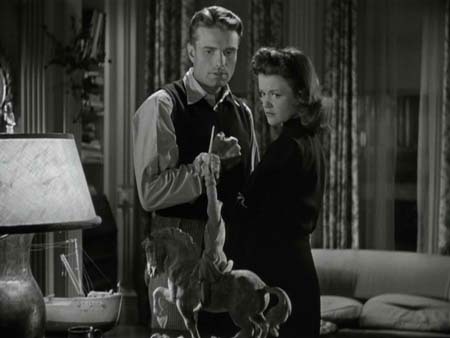
Cat People (1942 film)


Directed by Jacques Tourneur and written by DeWitt Bodeen, Cat People is about a woman whose new married life is in danger by a curse that she believes will make her into a panther. The film is considered to be one of the finest horror films of the 1940s as it mixed noir and drama to create a fascinating story. Starring Simone Simon, Kent Smith, Jane Randolph, and Tom Conway. Cat People is a stylish yet mesmerizing film from Jacques Tourneur.

Irena (Simone Simon) is a Serbian-born fashion designer who meets a charming architect named Oliver (Kent Smith) at a zoo as the two begin a relationship. The relationship goes well as Oliver is intrigued by some of the things Irena has including a statue of a warrior impaling a cat that Irena claims is King John of Serbia who believes cats are evil. The two get married as they celebrate with friends including Oliver’s business associate Alice (Jane Randolph) where Irena sees a woman who says something to her in Serbian. Suddenly, the newly wedded life of Irena and Oliver starts to deteriorate due to Irena’s behavior as she goes on walks to the zoo as she is fascinated by a panther at the place.

After going to meet Dr. Louis Judd (Tom Conway) for some evaluation, based on Alice’s suggestion, Irena believes she has inherited an ancient curse that turns her into a panther. Yet, her behavior makes her believe that Oliver and Alice are having an affair though it isn’t true despite Alice’s admission that she is in love with Oliver. Irena starts to stalk Alice in secrecy as things between her and Oliver start to sour though Oliver wants to help her. While Dr. Judd believes that something is really wrong with Irena, he tries to stage an intervention where something terrifying starts to happen as Oliver and Alice believe that the story Irena told Oliver could be true.

The film is about a woman who comes from a world where she believes she is part of a group of people that turns into panthers. Though she yearns for a normal life with a man who loves her, her evasive behavior and her fear would eventually drive that marriage apart as he would eventually fall for another woman that is also just trying to be helpful. The script delves into the woman’s anxiety and why she is so consumed with fear as the first act is about the relationship between her and Oliver. The second act is about the marriage and its disintegration due to the fear that she’s having. The third is about her reacting to that fear and how she uses her curse to spread fear against those she feel have wronged her.

Jacques Tourneur’s direction is definitely stylish as he presents the film in different ideas for a lot of the romantic moments as well as the suspenseful moments. For a lot of the light-hearted scenes including the romance and melodrama, Tourneur keeps the direction straightforward in its framing and in the camera movements. Yet, he also utilizes soft close-ups to play up Irena’s emotions and her yearning to be loved. Once the film progresses into something darker, the framing becomes more eerie in a scene where Irena is being examined as it includes a dissolved animated sequence revolving around cats. Then the film becomes more suspenseful where there’s a great scene of Irena following Alice as she walks on her way home as it’s about the rhythm of how the two women walk and the way it sounds.

It adds to the sense of horror that something could happen as there’s little bits of action that happens in the film. Yet, Tourneur manages to play up the suspense by keeping it simple and not show very much. Notably the scene where Alice dives into the pool as she tries to find out what is lurking around that pool. It’s that element of horror and the way that it looks that gives the film a very entrancing look. The overall work that Tourneur does is phenomenal in the way he creates an engaging yet evocative film.

Cinematographer Nicholas Musuraca does an amazing job with the film‘s stylish black-and-white photography for the way he keeps a lot of the lighter moments simple with bright gray. For scenes at night in the interior setting such as Oliver and Alice’s work station and some scenes at Irena’s apartment are gorgeous in the way the lighting is presented including some of the shading as Musuraca’s work is definitely outstanding. Editor Mark Robson does a very good job with the editing by maintaining a methodical pace to play up the film’s suspense while keeping it straightforward for the dramatic moments of the film.

Art directors Albert S. D’Agostino and Walter E. Keller, along with set decorators A. Roland Fields and Darrell Silvera, do a nice job with the set pieces created such as Irena‘s home and the big office that Oliver and Alice work at. The gowns by Renie is wonderful for the way it looks as it plays to the personalities of the women with Alice as very dominant and Irena sporting darker clothing. The visual effects by Linwood G. Dunn and Vernon L. Walker is pretty good for the animation and spirals that is created as it has a sense of charm. Sound recordist John L. Cass does a great job with the sound work to play up the suspense of the film such as Irena following Alice and other suspenseful scenes where the sound is sparse yet chilling.

The film’s score by Roy Webb is brilliant for its somber yet dramatic orchestral pieces including a few chilling arrangements to play up the suspenseful portions of the film.

The film’s cast is excellent as it features an appearance from Jack Holt as a business friend of Oliver and Alice along with Alec Craig as a zookeeper that Irena talks to and Elizabeth Russell as the Serbian woman that talks to Irena at a restaurant. Tom Conway is wonderful as the smart but cautious Dr. Judd who always carries a cane with while trying to figure out Irena as he often talks to Alice and Oliver about Irena. Jane Randolph is great as Alice, Oliver’s friend who is a woman that handles her own business while trying to be a friend to Irena only to realize that something isn’t right about her.

Kent Smith is very good as Oliver, Irena’s husband who tries to figure out what to do while lamenting over her behavior as he finds comfort in Alice’s presence. Finally, there’s Simone Simon as Irena as Simone’s performance is entrancing for the way she despairs over her curse and the idea that her husband is having an affair. It’s a complex yet adventurous performance that allows Simone to be dramatic but also display a dark sense of humor to her character in one key scene of the film.

Cat People is an extraordinary yet spellbinding film from Jacques Tourneur that features a radiant yet haunting performance from Simone Simon. The film is definitely one of the best suspense/horror films of the 1940s as well as a great example of what a film like this could do with a small B-movie budget. It’s also a great introduction for those that is interested of what horror films were like back then where it didn’t have to rely on gore or easy tricks. In the end, Cat People is an engaging yet well-crafted thriller from Jacques Tourneur.

Related: Out of the Past - Cat People (1982 film)

© thevoid99 2011

Thursday, September 01, 2011

La Bete Humaine


Written and directed by Jean Renoir, with story credit by Emile Zola and dialogue by Denise Leblond, La Bete Humaine (The Human Beast) is the story of a train engineer who falls for the wife of his superior following a horrifying incident involving murder. During the affair, things become more complicated as the engineer is being asked to do things for his lover. Starring Jean Gabin, Simone Simon, and Fernand Ledoux. La Bete Humaine is a chilling yet intoxicating film from Jean Renoir.

Jacques Lantier (Jean Gabin) is a train engineer who loves his job as he works with his friend Pecqueux (Julien Carette) as they take care of their train. When Lantier is given a 36-hour leave so his train can get a few repairs, he goes out to visit his godmother (Charlotte Clasis) and an ex-girlfriend (Blanchette Brunoy) for his leave. Meanwhile, Lantier’s supervisor Rouboud (Fernand Ledoux) wants to go to La Herve with his wife Severine (Simone Simon) whom he suspects is having an affair with her godfather Grandmorin (Jacques Berlioz). During a ride to La Herve with Grandmorin, Lantier steps in for a ride as he notices something is happening as the Grandmorin is found dead.

During questioning, Lantier claims that he didn’t see anything though he did see Rouboud and Severine walk by Grandmorin’s compartment. Rouboud is glad that Lantier isn’t saying anything though a judge (Andre Tavernier) believes that a man named Cabuche (Jean Renoir) is the suspect. Still, Rouboud tries to hide things as Severine feels unhappy as she turns to Lantier for comfort as they eventually get into an affair. With Rouboud becoming more unhinged by what’s going on as he’s hiding something, Lantier also starts to feel uncomfortable by his affairs and what Severine wants to do. When he sees Severine with another man in Dauvergne (Gerard Landry), Lantier realizes what is going on as he becomes consumed with guilt.

The film is a study of guilt as it’s all centered around two men and a woman in this world of murder and adultery. Yet, Jean Renoir creates a story where there’s this simple man who loves being a train engineer as he calls his train Lison. Yet, he is also someone that has own issues where he displays some violent tendencies as he discusses it with his mother who is still worried about him. Then there’s Rouboud who is a rich man that operates the train station that Lantier works with who is a proud man but is wondering if his wife loves him as he becomes more secretive and distant following the murder of Grandmorin. Then there’s Severine who is in the middle of this as this innocent, poor woman is really a manipulator that is willing to make men do anything and pushes them to the edge.

The script works as a study of guilt and motivations yet it’s in Renoir’s direction where the film really takes hold. Opening with this amazing, five-minute montage of a train speeding throughout the French countryside. Renoir manages to keep the film pretty straightforward while his compositions are very striking in the way he creates love scenes or some intense, dramatic moments. It’s also more about what he doesn’t show as it’s focused on sounds or using an image to obstruct what is really happening. That is part of Renoir’s genius as a filmmaker while keeping the intensity going during a key moment of the film that involves Lantier’s troubled behavior that leads to climatic moment in the film. Overall, Renoir creates a film that is very engrossing for its study of behaviors and guilt.

Cinematographer Curt Courant does a great job with the black-and-white cinematography from the sunny look of the French countryside to the dark look of the nighttime exterior and interior settings to help enhance the suspenseful tone of the film. Editors Suzanne de Troeye and Marguerite Renoir do an amazing job with the editing as many of the cuts are straightforward with the exception of a few jump-cuts to play with the film’s rhythm, along with its train montages, and the dissolves for some of the transitional moments of the film.

Production designer Eugene Lourie does an excellent job with the set pieces created such as the ballroom that Lantier goes to with friends where he sees Severine dancing with another man as well as the look for the train compartments. Costume designer Laure Lourie does a very good job with the costumes from the black dresses that Severine wears to the working-class suits of Lantier and more revered suits that Rouboud wears. Sound engineer Robert Teisseire does a nice job with the sound to the way trains are sounded to how it plays for some of its suspenseful moments. The music by Joseph Kosma is exhilarating for its sweeping compositions from fast-paced pieces for its suspenseful moments to more slower, mid-tempo pieces for the dramatic moments of the film.

The cast is truly incredible with notable appearances from Colette Regis as Pecqueux’s wife, Blanchette Brunoy as Lantier’s ex-girlfriend, Charlotte Clasis as Lantier’s godmother, Andre Tavernier as a judge, Gerard Landry as a man whom Severine likes, Jacques Berlioz as Grandmorin, and Jean Renoir as dirty man accused of murder. Julien Carette is excellent in a memorable supporting role as Pecqueux, Lantier’s fellow train engineer who becomes suspicious over what is going on. Fernand Ledoux is great as Rouboud, a station supervisor dealing with his wife’s supposed affairs as well as the things he’s done as he becomes more distant as the film progresses.

Simone Simon is radiant as the innocent though melodramatic Severine, a woman who is abused by her husband as she seeks comfort in Lantier only to manipulate him in order to deal with things. It’s a truly eerie performance as Simon brings a complexity to a woman that is really more of a troublemaker than a victim. Jean Gabin is brilliant as Jacques Lantier, a man with simple pleasures whose new role as a lover for a married woman eventually takes its toll as he would explore his own demons. It’s a very compelling performance from the legendary actor as he creates a character that finds himself in a very bad situation based on a lie he creates.

La Bete Humaine is a mesmerizing yet intriguing film from Jean Renoir featuring a phenomenal performance from Jean Gabin. The film is definitely one of Renoir’s finest films due to its study of character and motivations as well as the world he creates at a train station. While Rules of the Game and Grand Illusion might be better introductions, this is still one of his key films proving why he is such a beloved filmmaker all over the world. In the end, La Bete Humaine is a triumphant suspense film from Jean Renoir.

Jean Renoir Films: (Backbiters) - (La Fille de l’eau) - (Charleston Parade) - (Une vie sans joie) - (Marquitta) - (The Sad Sack) - (The Tournament) - (The Little Match Girl) - (Le Bled) - (On purge bebe) - (Isn’t Life a Bitch?) - (Night at the Crossroads) - Boudu Saved from Drowning - (Chotard & Company) - (Madame Bovary (1933 film)) - (Toni) - A Day in the Country - (Life Belongs to Us) - (The Lower Depths (1936 film)) - (The Crime of Monsieur Lange) - Grand Illusion - (La Marseillaise) - Rules of the Game - (Swamp Water) - (This Land is Mine) - (Salute to France) - (The Southerner) - (The Diary of a Chambermaid (1945 film)) - (The Woman on the Beach) - The River - (The Golden Coach) - (French Cancan) - (Elena and Her Men) - (The Doctor’s Horrible Experiment) - (Picnic on the Grass) - (The Elusive Corporal) - (The Little Theater of Jean Renoir)

© thevoid99 2011