Showing posts with label tyrone power. Show all posts

Saturday, October 30, 2021

Nightmare Alley (1947 film)


Based on the novel by William Lindsay Gresham, Nightmare Alley is the story of a small-time carny who finds himself part of a carnival where he falls for a performer as he schemes his way out of the world as well as showcase his ambitions that would lead to his downfall. Directed by Edmund Goulding and screenplay by Jules Furthman, the film is a stylish suspense-drama set in the world of the circus as it plays into a man trying to charm his way to fame and success only to embark on a nightmare of his own. Starring Tyrone Power, Joan Blondell, Coleen Gray, and Helen Walker. Nightmare Alley is a riveting and enchanting film from Edmund Goulding.

The film revolves around a carny who joins a carnival where he learns about a performance where he can know things as he falls for another performer where they create an act that gets the attention of a psychiatrist who would play into his downfall. It is a film that explores a man wanting to scheme his way into getting riches through the world of carnivals where he would play a part in helping a performer following an unfortunate event while falling for another performer whom he would help. Jules Furthman’s screenplay is straightforward in its narrative yet it is more about the schemes and journey of its protagonist Stanton “Stan” Carlisle (Tyrone Power) who is first seen as a carnival barker as he looks around where he notices an act performed by Zeena (Joan Blondell) who has the mental ability to know what is on that person’s mind as it is an act that she perfected with her alcoholic husband Pete (Ian Keith).

Stan befriends and woos Zeena but also notices that Pete is becoming unreliable where Stan would take over for Pete as he would use Zeena’s code and methods for his own show with another carnival performer in Molly (Coleen Gray). Upon taking his act with Molly to the cities and the big time, Stan becomes successful but he also gets the attention of the renowned psychiatrist in Lilith Ritter (Helen Walker) who decides to work with Stan based on recordings of her sessions as part of a bigger scheme that Molly doesn’t approve of. Even as it would play into the idea of faith and those who are ravaged in grief where the script play into the morals of trying to manipulate people with knowledge as it would play into Stan’s own downfall.

Edmund Goulding’s direction does have some style in some of the imagery and compositions that he creates from the craziness of the carnival circuits to the lavish world of the cities. Shot largely on location in California with a few bits in Chicago, Goulding creates a film that play into the contrasting world of the carnivals and the more high-class shows that Stan would play to a posh crowd. There are wide shots to play into the locations and places that the characters are where Goulding knows where to place the camera to get a look into what someone in the audience is seeing or an incident that Stan is witnessing. There are also medium shots and close-ups that play into some of the conversations including moments of Stan trying to flirt with a woman or moments that are dramatic as it play into some of the suspense in how Stan deals with his schemes and trying to manipulate people claiming he knows something about them as much of it is a guess. Goulding’s direction also play up this air of style in the way he play into presentation of the circus for some of the scenes at night such as the scene where Stan bullshits a local sheriff who was about to arrest Molly for indecent exposure.

Goulding’s direction would become stylized when Stan meets Lilith as she would take part in a scheme as a way to make money but also push Stan to his limits. Notably in a scene involving a man in a skeptic in Ezra Grindle (Taylor Holmes) following a performance where Molly is reluctantly involved as it is a key moment that begins the film’s third act. It would push the limits of what is moral and immoral as Stan is an immoral figure of sorts but even he would have his limits as he definitely found a match in Lilith who proves to be far more immoral as well as someone who is smarter than Stan in this idea of human nature. Overall, Goulding crafts an intoxicating yet eerie film about a carny who schemes is way to stardom and success only to meet his match in a devilish shrink.

Cinematographer Lee Garmes does incredible work with the film’s black-and-white cinematography with its stylish usage of shadows and light for some of the exterior scenes at night in the circus along with some vibrant lighting for the interior scenes in some of the posh shows that Stan and Molly perform at. Editor Barbara MacLean does excellent work with the editing as it is straightforward with some rhythmic cuts for some of the film’s dramatic and suspenseful moments. Art directors J. Russell Spencer and Lyle Wheeler, with set decorator Thomas Little, do amazing work with the look of the circus sets as well as the posh places and such that Stan and Molly would be in along with Lilith’s home apartment.

Costume designer Bonnie Cashin does fantastic work with the design of the costumes in the clothes that Zeena and Molly wear in their performances along with the stylish clothes of Lilith as well as the tuxedo that Stan wears in his performances. The sound work of Roger Heman Sr. and E. Clayton Ward do superb work with the sound as it play into the atmosphere of the carnivals with its crowd and such to the eerie and quiet moment during the scene where Stan tries to scheme Grindle. The film’s music by Cyril Mockridge is wonderful for its orchestral score that ranges from soaring and intense to play into the suspense as well as some somber pieces for the dramatic moments.

The film’s marvelous ensemble cast feature some notable small roles from Julia Dean as an old woman who is enchanted by Stan, James Burke as a sheriff, and Roy Roberts as a carnival owner late in the film. Ian Keith is terrific as Zeena’s alcoholic husband Pete as a man who helped perfect Zeena’s act but is burned out while Mike Mazurki is superb as Bruno as a carnival performer who is protective of everyone as he doesn’t trust Stan. Taylor Holmes is fantastic as Ezra Grindle as a posh friend of Lilith who is skeptical of Stan’s gifts while is also someone who is still dealing with his own crises of faith. Helen Walker is excellent as Lilith Ritter as a psychiatrist who is intrigued by Stan’s performances as she decides to take part in his scheme where Blondell displays a lot of charm to a woman who is truly a cunning and devious figure who is smarter than Stan.

Coleen Gray is brilliant as Molly as a young performer who joins Stan in his act while she is someone who is also a moral compass as she becomes troubled by his schemes as she felt that their act owes a lot to what Zeena has done. Joan Blondell is amazing as Zeena as a performer who has mastered the gift of manipulation in knowing people’s secrets while is also protective of her craft while lamenting over her husband’s issues. Finally, there’s Tyrone Power in a phenomenal performance as Stanton “Stan” Carlisle as a carny who is eager to make some big cash and do more as he charms his way to get what he wants as well as create the ultimate show only to later cope with guilt and the fact that he has gone too far in his schemes as it is a dark yet charismatic performance from Power in one of his career-defining performances.

Nightmare Alley is a sensational film from Edmund Goulding that features a great leading performance from Tyrone Power. Along with its ensemble cast, dazzling visuals, themes of morality and the power of knowledge to manipulate, and its sumptuous music score. It is a film noir suspense-drama that play into the fallacies of ambition as well as a man trying to manipulate those only to meet his match in someone far more immoral. In the end, Nightmare Alley is a spectacular film from Edmund Goulding.

Related: Nightmare Alley (2021 film)

Edmund Goulding Films: (Sun-Up) – (Sally, Irene and Mary) – (Paris (1926 film)) – (Women Love Diamonds) – (Love (1927 film)) – (The Trespasser) – (The Devil’s Holiday) – (Reaching for the Moon) – (Grand Hotel) – (Blondie of the Follies) – (Riptide) – (The Flame Within) – (That Certain Woman) – (White Banners) – (The Dawn Patrol) – (Dark Victory) – (The Old Maid) – (We Are Not Alone (1939 film)) – (‘Til We Meet Again) – (The Great Lie) – (Forever and a Day) – (The Constant Nymph) – (Claudia (1943 film)) – (Of Human Bondage) – (The Razor’s Edge (1946 film)) – (Everybody Does It) – (Mister 880) – (We’re Not Married!) – (Down Among the Sheltering Palms) – (Teenage Rebel) – (Mardi Gras)

© thevoid99 2021

Saturday, March 05, 2011

Marie Antoinette (1936)


Originally Written and Posted at Epinions.com on 11/7/06.


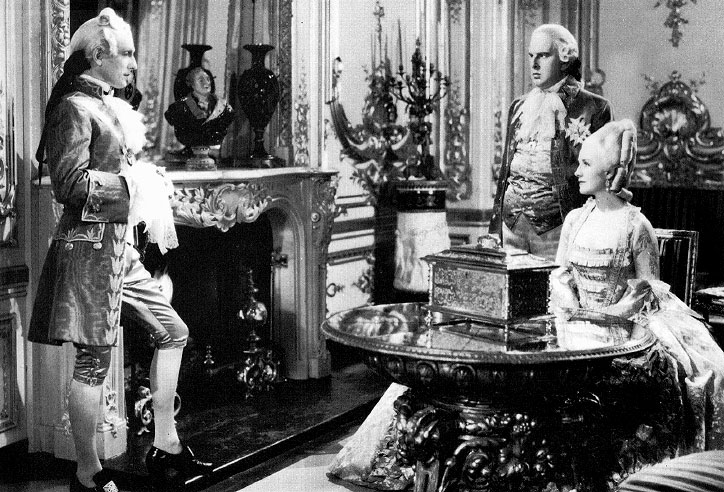
The story of Marie Antoinette has been told in various forms with many known to the fact that she was the Queen of France born from Austria who was later beheaded in 1793 during the French Revolution. Since then, the stories have become legend to such tales as her spats with King Louis XV's mistress Madame du Barry, the infamous tale of the Affair of the Necklace, and the widely debated yet legendary supposed affair with Swedish Count Axel Fersen. In 1938, MGM studios to make a project on the life of Marie Antoinette into a motion picture at the request of the late Irving Thalberg. Basing on the biography of Stefan Zweig, the 1938 epic tale of Marie Antoinette tells the tale of the young woman who becomes Queen of France as she tries to win the heart of King Louis XVI, feuds with Madame du Barry, get scandalized by the Affair of the Necklace, and to her great demise. Directed by W.S. Van Dyke with a script by Donald Ogden Stewart, Ernest Vajda, and Claudine West, Marie Antoinette is a dramatic yet old-school 1930s take on the life of the French Queen with MGM studio actress Norma Shearer in the title role after a two-year absence. Also starring John Barrymore, Tyrone Power, Robert Morley, Anita Louise, and Joseph Schildkraut. Marie Antoinette is a fine, elegant costume drama that goes into her legend.

Being called by her mother and Queen of Austria Maria Theresa (Alma Kruger), young Antoine is wanting to hear the news from her courtesan Feldi (Cecil Cunningham). Feldi gives in by telling Antoine that she's to be married. Once meeting her mother, Antoine learns that she will be marrying the Dauphin of France, Louis XVI (Robert Morley) where she'll be accompanied by ambassador Mercey (Henry Stephenson) to Paris. Upon arriving in Versailles, Antoine is now christened as Marie Antoinette where she meets King Louis XV (John Barrymore), the shy Louis XVI, and Duke Phillipe d’Orleans (Joseph Schildkraut). Upon her meeting with the Dauphin, Louis tries to tell in a speech where the meeting is awkward as the king announces the wedding in a beautiful ceremony. Marie's beauty is transfixed as she attracts the likes of Princess Lambelle (Anita Louise) while being attended to by Comtess de Noailles (Cora Witherspoon). On the night she and the Dauphin are to consummate their marriage, Marie is forced to learn of Louis's insecurities as he admits that he didn't want to get married but wants to try and like Marie.

The marriage wouldn't be consummated for seven years as Marie has very few allies and is often ridiculed by the likes of Madame du Barry (Gladys George), who gives her a present as a joke about her unconsummated marriage. With the Duke of Orleans as her ally, she escapes herself through parties and such often being with Princess Lambelle and Comte d'Artois (Reginald Gardiner). In one such party at a gambling house, hoping to win a wager over her necklace, she finds a Swedish count named Axel Fersen (Tyrone Power) to pretend to be a Russian but loses the wager. Hearing about her parties, Count Mercey arrives to tell her that she must behave accordingly to the rules of Versailles while publicly acknowledging Madame du Barry in front of the king. Marie does but only to be further ridiculed by du Barry over the Dauphin's lack of public appearance since it's often that she's accompanied by the Duke of Orleans.

After a meeting with the king, Marie learns that her marriage is to be annulled as the Duke of Orleans chose to cut ties with her as she finds out why he associated himself with her. Hoping to talk to Mercey about everything, she finds herself comforted by Count Fersen, who knew her as a kid since they used to have the same music teacher and such where they fall in love. Hoping to take her back to Austria, Fersen has plans to see her again as she must return to Versailles for some news. After a confrontation with his grandfather, the Louis XVI tells Marie that the king is dying as he is faced with all of the decisions and things into becoming a king. With the news that Marie is now Queen of France, she secretly meets Count Fersen as she hopes to run away with him. Fersen, realizing of her new role, decides not to interfere with her destiny as he chooses to go to America to aid them in the revolution as he and Marie parted ways.

Years after the birth of their first two children, things seem to go well for Marie and Louis XVI but for France, the country is badly in debt and people are starving. With the Duke of Orleans already masterminding every amount of trouble of making the people turn against the monarchy, Marie and Louis XVI hope everything will turn around. Then one day, Marie was offered a huge, expensive necklace that was given to her but she turns it down considering the economic turmoil yet a plot involving a countess and a cardinal lead to the infamous Affair of the Necklace that would soil Marie's reputation for the worse. With the people of France declaring revolution, Louis hopes to have his troops support him but instead, they mock him. With Princess Lambelle choosing to stay in Versailles with Marie, the monarchy are now trapped as government officials hope to rid of the system as the French Revolution is underway.

Hoping to escape, she finds help from none other than Count Fersen who makes a plan for the entire family plus Lambelle to escape to Austria where Marie hopes to get aid. Everything goes well but when someone recognizes the king, everything falls apart as everyone is captured. Marie is forced to watch in horror as she sees Lambelle killed in front of her eyes while the Duke of Orleans helped succeed in aiding the execution of Louis XVI. With their two children, they have a final dinner on the day before he's executed as everything becomes tense as Marie hopes to count on Count Fersen one more time but not even he could help her as she awaits her doom.

While the film is true to the history set in two parts with the first half of Marie playing the role of bringing France an heir and the second about the French Revolution. The interpretation of the film is more of a dramatic retelling rather than a serious, historical type of film. Director W.S. Van Dyke definitely creates a sumptuous, epic, costume drama with all of the lavishness of the times. Still, despite a well-structured script and a faithfulness to history and legend, the film does lack a sense of serious historical context. Largely due to the fact that since the source they used was from the Stefan Zweig biography, Van Dyke wanted to make a film that was entertaining where some parts of the film is dramatized but then again, that was the approach of the times. While the legendary yet debated affair of Fersen is expanded more in several scenes, the role of the Duke of Orleans is much bigger since the character is played a villain when in reality, he was someone not liked by Marie Antoinette yet he did play his part in the execution of Louis XVI.

Despite those flaws, the film at a running time of nearly 150-minutes moves pretty fast due to the structure while the portrayal of Marie Antoinette is somewhat sympathetic to her. She's not portrayed as some monster or a careless queen but someone who is naive of her role while searching for love. Van Dyke's approach was right since he wanted audiences to have the main character to be likeable. More importantly, the dramatic direction and staginess might be dated to today's audience but back then, it worked since the drama works to carry the story and bring sympathy to Marie as Van Dyke does some fine work. Even capturing the lavishness of the 18th Century by actually shooting some parts of the film in Versailles.

Helping Van Dyke with his lavish vision is cinematographer William Daniels whose black-and-white photography filled with nice, soft touches in some of the film's more romantic settings as the picture looks wonderful though it probably would've looked amazing in color. The production design from art director Cedric Gibbons is wonderful for the lavishness and period to detail of the 18th Century with the advantages of the film shot in Versailles. The costumes of Adrian and Gile Steele are also wonderful for the lavishness and the bouncy sides of the dresses. Editor Robert Kern does nice perspective cutting for some of the sequences while bringing style to the editing that gives a leisurely flow to the film that isn't too slow and not too fast either. Herbert Stothart adds an epic, triumphant feel to the film's orchestral score in the first half while a more engaging, suspenseful tone in the film's second half as the music works to play to the times.

The film's large cast that includes such notable small performances from Cecil Cunningham, Cora Witherspoon Marilyn Knowlden as Princess Therese, Scotty Beckett as the young Dauphin, Alma Kruger as Empress Maria Theresa, and Reginald Gardiner. Gladys George is great in her role as lecherous, slimy Madame du Barry with her insults and power-hungry desire to be more than a madam as George brings a lot of vamp to the character. Henry Stephenson is also excellent as the wise Count Mercey, who reminds Marie of her role and is shown more in his attempts to save her from execution. Anita Louise is also good as Princess de Lambelle whose loyalty for Marie is matched by her role as being Marie's partner-in-crime of spending and such. Joseph Schildkraut is wonderfully good as the evil, manipulative Duke of Orleans, a character that is expanded for the film. While not much is known about the man, Schildkraut is excellent in the role of a traditional villain who can create great schemes and such. John Barrymore is great as the power-hungry, decadent King Louis XV with his love for du Barry and his role over his grandson as the legendary Barrymore proves his brilliance in the great role.

In his film debut, the late Robert Morley is extremely impressive as the awkward, insecure Louis XVI. While Morley may not pass as a young 15-year old Dauphin, Morley does have the physique and indecisive personality that the man had while in later scenes, we see him try to be powerful in an awkward way. Morley really owns the character as his performance earned him an Oscar nomination for Best Supporting Actor. Tyrone Power is also great as the very good-looking, charming Axel Fersen. Power's performance is the opposite of Morley as he is someone who knows how to comfort Marie while being the one who knows when not to be involved in her destiny. It's a superb performance from the great Tyrone Power.

Finally, there's Norma Shearer in the role of Marie Antoinette which is nothing short of brilliant. Shearer may not look like the 14-year old Antoinette of Austria in the film’s early sequence but her exuberance in the film's first half is wonderful as is her dramatic portrayal of the young queen. In the second half, Shearer really takes stage as a woman trying to protect her family while being aware of the country's economic despair. It's a great performance from Shearer who really exudes the woman who started out dreaming of being a queen only to be sinned for her naivete as Shearer herself, would be nominated for an Oscar for Best Actress while winning the Volpi Cup at the 1938 Venice Film Festival.

Despite some flaws and an overly-dramatic acting style and interpretation, W.S. Van Dyke's version of Marie Antoinette is an entertaining film led by the wonderful performances of Norma Shearer and Robert Morley. While some might feel that the acting style and dramatic approach might seem dated, it's too easy to think of that since this is a film that is more of a historical, dramatic epic that does its job in entertaining. When comparing it to the recent, 2006 film version by Sofia Coppola, it's really incomparable largely due to the sources, interpretation, and everything else the two films have. Still, the best source on Marie Antoinette's life on a non-literary media is a 2006 PBS documentary recently shown on television that gives a lot of historical context. Yet, the 1938 version of Marie Antoinette is a great companion piece of her life to both the documentary and Coppola's film version.

Related Review: Marie Antoinette (2006)

(C) thevoid99 2011