The film follows the titular character who arrives in Lisbon to see her estranged husband whom she hadn’t seen in a long time only to learn that he had died three days earlier. It is film with a minimalist premise as it follows this woman who tries to understand the life her husband had in the remaining Fontainhas slum in Lisbon as well as cope with this loss of a man she thought she knew. The film’s screenplay is largely loose as it doesn’t have a traditional structure in favor of something that feels improvisational as well as reflective as it plays into the titular character’s plight where she goes through these claustrophobic slums and later the woods to figure out what is going on. Even as she meets a priest (Ventura) who harbors some resentment towards her where he constantly defends her husband despite the fact that he did a lot of terrible things.
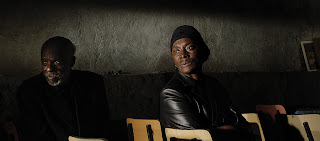
Pedro Costa’s direction is told in an extremely minimalist style in which is presented in its 1:33:1 aspect ratio with no camera movements similar to the static-camera shooting style of Yasujiro Ozu. While there are some wide shots prevalent in the film to establish some of the locations, Costa emphasizes on close-ups and medium shots to play into some of the conversations as well as Vitalina’s encounter with her surroundings including her late husband’s home. Shot on digital, Costa shoots the film largely on dark settings with very few scenes shot in daylight exterior settings to maintain a mood that is eerie as it play into this idea of ghosts haunting Vitalina. The fact that it is shot on location at the remnants of the Fontainhas slums in Lisbon adds to the realist feel of the film though the emphasize on long shots and lack of camera movements does make the film uneasy to watch at times as well as be slow in its pacing. Still, Costa maintains this minimalist approach to play into this woman’s plight as there are monologues where she talks to her ghost husband as if he is there. Overall, Costa crafts a riveting yet chilling film about a woman dealing with the death of her estranged husband upon her arrival to Lisbon.
Cinematographer Leonardo Simoes does incredible work with the film’s cinematography with its emphasis on natural and available lighting to maintain this intoxicating yet eerie look of the film as it is shot largely in the dark as it is a highlight of the film. Editors Vitor Carvalho and Joao Dias do excellent work with the editing as it is largely straightforward to play into the film’s pacing as well its emphasis to let shots linger for more than a minute. Set designer Andre Salgueiro Martins does nice work with the look of some of the homes in the slums in its interiors as well as a few exterior bits. The visual effects work of Vitor Carvalho and Irma Lucia is terrific for its minimal elements as it mainly serves as set dressing. Sound designer Hugo Leitao does amazing work with the sound to play into the atmosphere of the locations in great detail with a lot of emphasis on the natural elements of sound including how music is heard from afar as the only music piece heard is a score piece from Costa’s other films that is played briefly in the film’s final credits.
The film’s wonderful cast largely feature non-professional actors as it mainly feature people living in the slums with Ventura being a standout as a priest who bears some resentment towards the titular character yet understands her anger towards her estranged husband while he is dealing with Parkinson’s. The performance of Vitalina Varela as herself is phenomenal as she portrays the anguish and confusion of a woman traveling from Cape Verde to Lisbon to comprehend not just the death of her husband but why he left her in a world that barely has anything.
Vitalina Varela is an incredible film from Pedro Costa that features a chilling leading performance from its titular character playing herself. Along with its realist and minimalist presentation, gorgeous digital photography, and its exploration of loss and resentment in a world that many ignore. It is a film that isn’t easy to watch due to its slow-pacing and lack of a strong plot but it is still intriguing to showcase a woman coping with the loss of a man she thought she really knew. In the end, Vitalina Varela is a phenomenal film from Pedro Costa.
Pedro Costa Films: (O Sangue) – (Casa de lava) – Ossos - No Quatro da Vanda - (Ou git votre sourire enfoui?) – Colossal Youth - (Ne change rien) – (Cavalo dinheiro)
© thevoid99 2023

The film follows a man living in the Fontainhas shantytowns near Lisbon, Portugal as he deals with the fact that the shantytowns are almost extinct as he struggles to find a new home after his wife had left him. It is a film that plays into a man dealing with his surroundings but also meeting these neighbors whom he refers to as his children as they deal with their new lives including Vanda Duarte who has ended her heroin addiction though she is on methadone and trying to raise her own child Beatriz. While there isn’t much of a narrative in the film as it mixes elements of fiction and documentary, Pedro Costa does showcase a world that is almost gone but also where many of the inhabitants of Fontainhas have gone to where its protagonist Ventura is trying to get a home there but not just for himself but also for other neighbors. Even as he deals with the fact that he’s living on the outskirts with a friend as well as coping with health issues and the deaths of those he knew in Fontainhas.
Costa’s direction definitely aims for a minimalist approach as it is shot on digital video cameras with largely static wide-medium shots in a 1:33:1 aspect ratio where there are some close-ups but the camera never moves. It is a similar approach that Costa did with his previous film of his Fontainhas trilogy yet there is a more vibrancy to the look of the film with its usage of available light as Costa shoots the film with co-cinematographer Leondardo Simoes. Costa would keep this minimalist approach with shots ranging from a few minutes to capture everything that is happening with Vanda talking to Ventura in her own room as it’s shot at the corner of a room where both of them are on Vanda’s bed watching TV while Vanda’s young daughter Beatriz is playing with a toy and dancing to music. There are also moments set in the night where Costa and Simoes shoot on available light as there is an atmosphere to the way things are presented as the cameras that Costa and Simoes have are more high-definition that removes some of the crude aspects from Costa’s previous film from the trilogy.
Costa’s approach to shooting for long takes does give the film’s pacing a somewhat sluggish feel but it doesn’t meander in order to showcase Ventura throughout the entirety of the film as he eats with Vanda’s husband or visiting his daughter as they ponder the whereabouts of his wife and son whom they both believe is alive. Costa also play into this sense of loss late into the film with some long, unbroken takes such as Ventura, Vanda, and her husband eating as they lament over those who didn’t survive where music is being played in another room loudly as it plays into the natural approach to sound due to the sound work of Olivier Blanc, Vasco Pedroso, and Jean-Pierre Laforce. Editor Pedro Marques helps maintain this approach to shots that last long while knowing when to and to not cut during a key moment such as Ventura visiting an old friend whose leg injury still pains him after all of these years. It has these moments that doesn’t just play to the social politics of what Ventura and his neighbors went through but also the fact that despite being in a new home. They still have struggles that keep them away from the conventions of modern-day society as they’re still seen as outsiders.
The film’s cast that largely consists of non-actors as it features appearances from Vanda’s infant daughter Beatriz as well as Alexandre “Xana” Silva as a mysterious figure in Ventura’s life, Paolo Nunes as the man who still has issues with his leg, Paula Barrulas as Paulo’s girlfriend, Isabel Cardoso as Ventura’s wife Clotilde, Gustavo Sumpta as Vanda’s husband whom Ventura often hangs out with as they eat dinner, and Cila Cardoso as Ventura’s daughter. Alberto “Lento” Barros is excellent as Ventura’s housemate whom he would live with in various shacks as they deal with their isolation while Vanda Duarte is brilliant as a woman trying to clean herself up as she sees Ventura as a father figure as they both lament over their own sense of loss. Finally, there’s Ventura in an amazing performance as this retired 75-year old laborer whose wife leaves him with a few clothes and that is it as he laments over the world around him but also in wanting a new home but realizes that there are complications that add to this social and political disarray as it relates to the destruction of Fontainhas.
Juventude de Marcha is a sensational film from Pedro Costa. While it is a film that isn’t easy to watch due to its pacing and minimalist approach. It is still this entrancing film that showcases an old man dealing with his surroundings and the social/political chaos that is around him as it relates to people in his community with those accepting their fates with others unable to be part of society. In the end, Juventude de Marcha is a phenomenal film from Pedro Costa.
Pedro Costa Films: (O Sangue) – (Casa de lava) – Ossos - No Quatro da Vanda - (Ou git votre sourire enfoui?) – (Ne change rien) – (Cavalo dinheiro) – Vitalina Varela
© thevoid99 2022


