Saturday, September 18, 2010

George Washington


Originally Written and Posted at Epinions.com on 1/14/06 w/ Additional Edits, New Content and New Conclusion.


When people think of the American South, they will either think of Gone with the Wind or Deliverance depending on one's taste. Yet the South is filled with images that are either romantic or very desolate in whatever area it is. Still, it's part of what makes America interesting. While areas like New Orleans, Atlanta, and parts of Florida bring out interesting locations, the South has places where stories our told. In more recent years, those places do bring out more interesting stories whether its Patty Jenkins' serial-killer tale Monster or Shainee Gabel's dreamy haze of A Love Song for Bobby Long. Then, there is one director from the South who is not only considered to be one of the most gifted of his generation but has put his own, unique spin on the American South in an Arkansas-born, North Carolina native named David Gordon Green.

Born in 1975, David Gordon Green lived in the South all of his life while being aware that Hollywood wasn't making stories about the South in its realistic way. For the young filmmaker, he cites several influences into his work that included the Southern films of the 70s, Robert Altman, and the stripped-down, Dogme 95 style of Harmony Korine. Another director Green was inspired by was the brilliant, reclusive Terrence Malick for his unconventional style of narrative and visual storytelling for films like Days of Heaven and Badlands. In 2000, after a couple of short films, Green released his debut feature. A coming-of-age tale about young, rural, and mostly black children in the South dealing with death and the moral aftermath entitled George Washington.

Written & directed by David Gordon Green, George Washington is tale of a young boy who vies to become someone important through the perspective of a young girl he befriends. Taking the same elliptical approach of Malick, Green brings a realistic yet dreamy feel of the American South from its impoverished areas to the beauty that surrounds it. With an ensemble cast that is filled with unknowns like Candace Evanofski, Donald Holden, Rachel Handy, Damien Jewan Lee, Curtis Cotton III along with future Green regulars Paul Schneider and Eddie Rouse. George Washington is a brilliant, poetic masterpiece from one of American cinema's most promising director.

It's a hot moment in the summer as a 13-year old girl named Nasia (Candace Evanofski) is breaking up with her boyfriend Buddy (Curtis Cotton III) because he's immature. She turns to Buddy's friend George Richardson (Donald Holden) for companionship despite the fact that he's odd due to the fact that his skull is sensitive to water and he has to wear a helmet at all times. Often hanging out with their friends including the big, tough Vernon (Damien Jewan Lee) and the only white kid in the group, a girl named Sonya (Rachel Handy) who has an affinity for theft. At the railroad station where George's uncle Damascus (Eddie Rouse) just got fired from, they meet a bunch of adults they know including the boss' son Rico (Paul Schneider).

One day when Nasia is hanging out with family including cousin Denise (Ebony Jones) when Vernon asks her why she broke up with Buddy. She gives him her answer while Buddy meets George one day in church as they chose to remain cool about the whole thing. During a trip to the local swimming pool, George meets a young white boy named Tyler (Christian Gustoitis) who is sporting a neck brace. George also found a ratty dog in the street that had no owner as he chose to keep it but hide from his uncle who hates animals. With his father (Alan Thompson) in jail, George lives with his Aunt Ruth (Janet Taylor) and his sister Whitney (Derricka Rolle) in a home that is often broken down while Damascus makes his living chopping wood. Then one day when George hangs out with Vernon, Buddy, and Sonya in abandoned, park where they stop in a wet bathroom. The gang simply starts playing when Buddy accidentally pushes George into a wall which hit his helmet. George continues the pushing game when things go terribly wrong.

George, Vernon, and Sonya watch in dismay knowing what had happened as they know if their family knew, they would be in trouble. George felt the guiltiest while Vernon understood that it was an accident. George in the next days would ponder his life including his own aspirations to become someone important where he would talk to Nasia about those ambitions and their surroundings. Then one day, George finds Tyler drowning in the pool and at the risk of his own health, he saves the boy by diving into the pool. While his head did swell, George managed to be OK as he finds himself thinking of the idea that he could be a superhero. While Rico and his buddies Augie (Scott Clackum) and Euless (Jonathan Davidson) find George's ambitions to be silly, they cheer him on as Rico helps him with conducting traffic. Vernon meanwhile, is anguished with guilt and sadness as Sonya is now his only friend though she admits, she has hard time trying to feel.

With Vernon and Sonya being questioned by authorities, they turn to crime while Nasia wonders why George hasn't talked to anyone. George begins to take his idea of being a hero seriously until he has to confront with reality while remaining hopeful for himself and his friends.

The idea of a coming-of-age film is about the transition from childhood to adulthood and in Green's approach, he picks a moment in time when that transition comes. While the film has no real plot, it's not about plot but more about how young children are changed by a single incident in their life. Taking a narrative approach that is similar to the works of Terrence Malick, notably 1978's Days of Heaven, the film is told from the perspective of a young girl who recalls the things she sees and hears. The story is really about children growing up and becoming aware of adulthood while looking at their own surroundings while one of them becomes more drawn to his aspirations into becoming a superhero.

Green's writing is filled with the narrative voice-over that Malick is known for but he takes it from Nasia's approach where she sees things from her breakup with Buddy to the oddball world of George. While the film moves slowly, it's only to build a momentum of what is to come in this incident that changes the film's tone. It doesn't exactly start off innocently since Green introduces the audience to the rural world they live in and the people they're surrounded by. Especially the young men who work at the railroad station who sees the kids as equals since they all live in this downtrodden, shabby area that they live in. This provides not just the authenticity in the world they live in but the way they speak since it's very rural to the point where they're either talking about real things or just rambling.

In the directing, Green goes for a variety of style ranging from Malick's wandering, epic scale to the shaky, intimacy of Harmony Korine. There's moments where the film does resemble a bit of Malick's 1998 film The Thin Red Line in the way the characters walk from a landscape to the railroad station. Green goes for a full-on observant while letting the actors basically act natural where everything feels real, especially in the locations they're in. It's a true Southern film from the broken down corner stand that is next to old stores to the shabby, unpainted houses of the neighborhoods. Using the camera to create a dreamy yet authentic look of the South is purely one of the most beautiful films seen while Green's intentions as a storyteller is to just go for it in what is happening.

Helping Green in capturing his vision is longtime cinematographer Tim Orr whose lush coloring brings a true look to a hot summer in the South. Using the yellow-sun as a light to convey the hot summer of North Carolina, the film does have that similar, poetic quality of Malick's film but in a more rural, intimate setting. Orr's camera work brings out the desolate yet enchanting world of the American South that mixes its starkness and beauty. Helping Orr in the visual department is longtime Green collaborator, production designer Richard Wright along with art director Mike Chapman in choosing the locations and housing for the film where they create everything from the dirty corners filled with garbage to the broken homes that the kids live in where everything isn't clean. Even the clothing from costume designer Michael Tully also work in bringing the authenticity the look of the film.

Longtime editors Zene Baker and Steve Gonzales do great work in bringing out the elliptical approach of the film where though it seems slow in its 89-minute running time, it gives the film a nice momentum. Their use of dissolves, fade-out, and jump cuts brings style to the film as it help Green convey his unconventional style of directing. Finally, there's the music that features a quirky yet haunting score by the Dynamite Brothers team of Michael Linnen and David Wingo which features a lot of music of the South that isn't hip-hop but more acoustic, country-inspired drench atmosphere along with elements of ambient and melodic rock music. The score of the Dynamite Brothers brings out that true feel of the South that is a great alternative to that world of Crunk.

Finally, there's the film's superb ensemble cast that includes some fine, small performances from Janet Taylor, Jonathan Davidson, Alan Thompson, Scott Clackum, Beau Nix as Rico's father, Joyce Mahaffey as Tyler's mom, Derricka Rolle, Ebony Jones, and Christian Gustoitis. Longtime Green collaborator Paul Schneider does wonderful work as Rico, one of the few adult friends the kids have who they can talk to while bringing some encouragement to George. Eddie Rouse is also great as George's irksome uncle who might seem crazy and strict at first only to reveal why he's bothered by animals.

Now we come to the richer ensemble of the young children in the film. Rachel Handy is excellent as the lone white girl who has a fondness for theft while having troubles in dealing with the fact that she is somewhat emotionless. It's a fine performance for a young girl who is filled with confusion. Damien Jewan Lee is excellent as the tough-minded Vernon who is willing to do anything to protect his friends but once he is forced to deal with an incident, a sensitivity is shown as Lee possesses all of those complicated emotions into growing up. Curtis Cotton III is excellent as Buddy, a kid who strives to be cool and have all the things a kid could want while dealing with the heartbreak of his relationship with Nasia. Candace Evanofski is great as the mature and innocent Nasia who also brings a worldly view of things, especially in her rich narration that encompasses a young girl who sees things with an indifference while realizing that she's growing up. Finally, there's Donald Holden who is great as the awkward, strange George who isn't sure about anything only to realize what he wants to do while being a dreamer. It's great work from all of those kids who aren't professional actors as they all bring a natural, realistic quality into their performances.

When the film was released through several film festival circuits in 2000 including Atlanta and Toronto, the film was filled with a lot of buzz from those festivals. In Atlanta, the film won the top prize while critics were widely praising the film for its unique take on the South. One of those critics who would later champion the young David Gordon Green is famed Chicago Sun-Times critic Roger Ebert who praised the director for his vision. The film even caught the attention of the legendary but reclusive filmmaker Terrence Malick who would later take Green as his protegee. While the film also garnered a limited release in theaters, it helped create buzz for David Gordon Green as the film received nominations for the Independent Spirit Awards for its young ensemble cast and first-film nods for Green.

***Additional DVD Content & Conclusion Written on 9/18/10***

The 2002 Criterion Collection DVD presents the film with new digital transfer supervised by David Gordon Green that is enhanced for 16x9 televisions under the 2:35:1 aspect ratio for widescreen.  The transfer is truly gorgeous as it complements the dreamy cinematography of Tim Orr.  Included in the DVD is a full-length commentary track by Green, Orr, and actor Paul Schneider.  The commentary track has the men discuss some of the film’s technical aspects, the performances, and inspiration behind the film.  The most notable inspiration for the film is definitely the work of Terrence Malick.  Green admits to using the character of Nasia in the similar vein of the Linda Manz character in Days of Heaven.  Green also talks about The Thin Red Line where he and Orr sneaked to the premiere to see the film.  Green talks about Malick’s editing style which also served as an inspiration.

Green also talked about using non-actors instead of professional in order to get a natural feel.  While a lot of the performances were rehearsed and scripted, Green did allow actors to improvise naturally for a realistic feel.  Even as Schneider talks about the improvisation for a scene where he was looking for chili dogs in his pant suits which wasn’t scripted.  Orr mostly talks about the technical aspects of the photography and how he and Green wanted the film to look like something where it didn’t come from a certain period in film.  Even with the use of music.  The commentary overall is mostly loose with the Green, Orr, and Schneider talking to each other with Schneider providing some of the funnier moments as it is definitely a fun, insightful commentary to listen to.

An eight-minute deleted scene is presented with commentary by Green, Orr, and Schneider is about a town meeting discussing issues in the community that is led by Rico Rice with George at the meeting.  The commentary reveals that the scene was meant to increase George’s desire to be more heroic.  Yet, one of the reasons Green cut the scene due to some topical issues discussed in the scene.  Schneider talked about the fact that Donald Holden didn’t want to wear the wrestling uniform during the scene because his relatives were in that scene.  Schneider convinced him and they just did it before Schneider had to go back to his other job, where he worked.

The second big special feature is a 2001 video interview with the young cast in the film.  The 13-minute feature with the cast as all the actors talk about the film, working with David Gordon Green, and how they were different from their characters.  It’s an enjoyable piece where the actors seem relaxed in the interviews while reflecting on how great the film is and how it sort of changed them.  Even as it ends with Curtis Cotton III saying he’s better than Denzel Washington.  Along with the film’s theatrical trailer comes a big interview piece with David Gordon Green from the Charlie Rose show.

The 14-and-a-half minute interview has Green discussing about his background, the film, and his desire to make films.  Green talks about that he was the kid who was more into art films like Nicolas Roeg’s Walkabout rather than Star Wars.  A lot of the conversation features Green talking about his cast, the film, and future plans which included a romantic film, that would eventually become his second film All the Real Girls.  Also included in the DVD are two early short films Green made during his tenure at the North Carolina School of the Arts.  The first of which is Pleasant Grove.  The 15-minute short is really a precursor of sorts to George Washington in relation to the story about George and his dog.  The short features Paul Schneider and Eddie Rouse along with a commentary track by David Gordon Green, cinematographer Tim Orr, and actor Paul Schneider.

Green discusses about the short and how it would be the inspiration for George Washington while Tim talks about his own background despite the fact that he didn‘t shoot Pleasant Grove.  Even though the short is shot on video, it is a wonderful short that does set the stage for George Washington.  The second short Physical Pinball, that stars Eddie Rouse and Candace Evanofski, is about a father realizing that his tomboy daughter is becoming a girl.  Featuring cameos from Paul Schneider and Green cohort Ben Best.  It’s a wonderful coming-of-age short where a man tries to deal with his daughter becoming a girl.  Even in the awkwardness of buying tampons for her as there’s a sweetness to it along with a beautiful feel to the film’s grainy look.

The third and final short that appears in the DVD is a 1969 short called A Day with the Boys by Clu Gulager that features cinematography by Laszlo Kovacs.  The short tells the story about a group of boys playing throughout the day while they later invite a middle-aged man into playing with them where everything seems fine until something bad happens.  It’s a wonderful short featuring Kovacs’ lush cinematography as the short is said to be an inspiration to George Washington.  Green’s comments on the short has him saying it was the direction, compositions, and uses of freeze-frame editing that drew him and cinematographer Tim Orr to use these similar compositions for their film.

Also in the DVD is a booklet that features a statement by David Gordon Green about the film and its intentions.  Also in the booklet is an essay from the controversial film critic Armond White that explores a lot of the film’s themes, images, and beauty.  The Criterion DVD is truly one of the finest in its collection in displaying a formidable talent in David Gordon Green early in his career.

George Washington is a majestic film filled with wondrous images and profound themes on death and innocence.  Helmed by David Gordon Green’s superb vision along with an amazing ensemble cast.  It’s a film that truly recalls the beauty of the decaying South as well as the soul within a child.  Fans of Green work will no doubt cite this as is finest film to date as it would permeate to his other films in the years to come.  Yet, George Washington is truly one of the best debut films ever made from the always intriguing David Gordon Green.

David Gordon Green Films: All the Real Girls - Undertow - Snow Angels - Pineapple Express - (Your Highness) - (The Sitter) - (Prince Avalanche) - Joe (2013 film) - (Manglehorn) - (Our Brand is Crisis) - (Stronger (2017 film)) - Halloween (2018 film) - (Halloween Kills) - (Halloween Ends)

© thevoid99 2010

Friday, September 17, 2010

Blog News 9/17/10

If anyone has noticed.  I've deleted a lot of blog post from the past few years in order to make room for new reviews as well as old ones that I wrote for Epinions.com.  I haven't been writing lately due to other things at the moment.  I'm still working on a DVD review of David Gordon Green's George Washington which will come in a few days.  I also hope to have reviews of films by Todd Haynes and Stop-Loss that was delayed due to various reasons.  I hope to have some music reviews in the coming days for new releases by Deerhunter (along with old reviews) and the upcoming soundtrack for The Social Network by Trent Reznor and Atticus Ross in anticipation for David Fincher's film.

Thursday, September 16, 2010

Deerhunter-Cryptograms


Originally Written & Posted at Epinions.com on 5/6/08


Atlanta's Deerhunter is one of the new bands emerging from the indie music scene thanks to critical buzz, word-of-mouth, and support from other bands. The band led by its singer and main songwriter Bradford Cox is known for their noisy live show and Cox's abrasive stage presence. Also featuring drummer Moses Archuleta, guitarist Locket Pundt, bassist Josh Fauver (who had replaced original bassist Justin Bosworth who died from skateboarding injuries in 2004), and guitarist Colin Mee (who left in early 2008 and recently replaced by Whitney Petty). After 2004's self-titled debut that's also called Turn It Up Faggot, the band went on the road where in 2005, they recorded their second album that would give them the critical breakthrough. After a tour with the Yeah Yeah Yeahs in late 2006, the album entitled Cryptograms was released in January 2007.

Produced by Chris Bishop with the songs written by the band with lyrics by Bradford Cox. Cryptograms is a unique album that mixes shoegaze, ambient, and no wave with Bradford Cox's unique lyrics ranging from dream-like experiences, mental illness, and other strange subjects from the unique singer/multi-instrumentalist. With five instrumental tracks and loads of strange songs, it's an album that is truly confrontational yet hypnotic. The result is one of the most fascinating releases of 2007 that is truly worth the critical buzz.

A near three-minute instrumental intro with layers of trickling water, croaks, and other noises that is followed by a warbling bass line and guitar feedback that starts to emerge as sounds of guitar and keyboard sirens start to arrive. The title track then appears to be accompanied with the same warbling bass line from the previous track with Moses Archuleta's sputtering drums that is followed by melodic guitar riffs from Locket Pundt and Josh Fauver's bass lines. With Bradford Cox singing through a distorted yet haunting vocal style, he sings very descriptive lyrics as the song starts to go into full, noise-rock mode with Pundt and Colin Mee's guitars. The song intensifies as Cox's vocals gets more intense as does the song. White Ink is a five-minute instrumental track appear after the water trickles start to fade with enchanting, shoegaze-inspired guitars emerging as it plays hypnotically with melodic plucks in the background.

Lake Somerset arrives with pounding bass lines by Fauver and distorted vocals by Cox for this bouncy, throbbing track with rhythmic drum tracks and jangly plucks from Pundt and Mee's guitars. Cox sings through his distorted vocals as Fauver's bass line throbs to the song's crashing, mid-tempo intensity as noisy guitars arrive with Cox still singing through undescribable lyrics as the song continues to intensify. Providence is another shoegaze-inspired instrumental with swooning guitars and washes that creates a moody, ambient tone that is hauntingly melodic and soothing as an acoustic instrument played by Cox is accompanying the main instrumentation as more trickles of water appear in the coda. Octet is an eight-minute track that opens with a hypnotic yet dreamy sound of keyboards, water, and guitar flourishes that is later followed by soft, pounding bass lines as it creates a bouncy rhythm that is accompanied by Archuleta's hi-hat taps. With wailing vocals in the background, the track begins to intensify as Cox starts to sing through his growling distortion of vocals as everything starts to come together with wavy guitars by Pundt and Mee.

Red Ink is another dream-inspired instrumental with xylophone chimes and bells by Cox that is accompanied by soothing, shoegaze-driven guitars as it creates a hypnotic tone with wavy guitars and keyboards to lead the entire track as it starts to create a fuzz-like sound. Spring Hall Convert is a haunting song led by melodic guitar plucks and Cox's soothing vocals that feature troubling, yet descriptive lyrics that is accompanied by its soft, yet pounding rhythm through the drums and bass. The song is probably the album's big standout as Cox's vocals reach into a soothing yet haunting quality along with its melodic guitar track as the rhythm guitar intensifies slowly to maintain its haunting rhythm. Strange Lights arrives with a fast washy guitar track and a bouncy rhythm led by a pounding bass line and mid-tempo drums as Cox sings with a clear yet double-tracked vocals through Chris Bishop's crisp production. Cox's descriptive vocals is filled with dreamy imagery as his vocals are purely hypnotic as it plays true to the song's shoegaze-inspired style.

Hazel St. opens with a melodic bass line by Josh Fauver as it creates a smooth yet momentum-building track for a bouncy rhythm with upbeat drums and melodic guitar riffs through plucking chimes and waves of noise. Cox's eerie vocals shine in the song as he sings descriptive yet haunting lyrics as the song maintains an ethereal yet hypnotic tone that is truly dream-like. Tape Hiss Orchid is a near, two-minute instrumental of guitar textures and soothing waves that is truly inspired by the shoegaze genre of the late 80s and early 90s. The album's closer is the haunting song Heatherwood that opens with a reverb guitar melody that plays out through the unique drum beat that is followed by shaking percussions. Cox sings with his dreamy vocals and haunting lyrics as he leads the way along with a bouncy bass line and melodic guitar plucks as Cox continues to sing as he sings the words, "Was not seen again" as those words close out the album.

With Chris Bishop's crisp yet layered production the album is truly one that has the band creating a unique sound that isn't overly pretentious, doesn't stray into bloated, art-rock pretenses. Instead, it's an album that is truly haunting and adds a tone that is soothing yet dream-like. The result is truly solid as Cryptograms along with Fluorescent Grey EP is a record that is just amazing to hear in an age where most bands just try to create the most endearing, polished piece of music to be played on radio. What Deerhunter does is take the sound of British shoegaze and add a bit of noise and atmosphere that's more in touch with American indie rock for something is extremely unique. In the end, Cryptograms is an album that must be heard and Deerhunter proves that they got a bright future ahead of them.


Related Reviews: (Yeah Yeah Yeahs/Deerhunter/Imaad Wasif-Atlanta, GA Tabernacle 10/14/06) - NIN/Deerhunter-Duluth, GA Gwinnett Arena 8/13/08 - (Atlas Sound-Let the Blind Lead Those Who Can See But Cannot Feel) - (Atlas Sound-Logos) - (Lotus Plaza--The Floodlight Collective) - Deerhunter-Atlanta, GA Variety Playhouse 10/1/10

(C) thevoid99 2010

Thursday, September 09, 2010

Brazil (Criterion DVD Box Set)


Originally Written and Posted at Epinions.com on 4/13/05 with Additional Content and a New Conclusion.


The only American in the British comedy troupe Monty Python, Terry Gilliam stood out for his quirky and abstract animation sequences that came between some of the comedy sketches in their Monty Python's Flying Circus shows. Gilliam would often appear in the sketches sometimes as a small part where in the 70s when Monty Python branched out into films, Gilliam would co-direct the films like Monty Python & the Holy Grail and 1983's Monty Python & the Meaning of Life. When Monty Python disbanded shortly after the Meaning of Life, Gilliam went on his own to direct his own films after doing two solo features for 1977's Jabberwocky based on Lewis Carroll's story and Time Bandits in 1981 that included Python-mates Michael Palin and John Cleese (who wrote the film with Gilliam and Python's Eric Idle) along with Sean Connery. With the year 1984 looming and its relevance to the bleak, totalitarian novel of George Orwell, Gilliam decided to make his own version of 1984 with a bit of the over-the-top, surreal style of Federico Fellini that would become his masterpiece, 1985's Brazil.

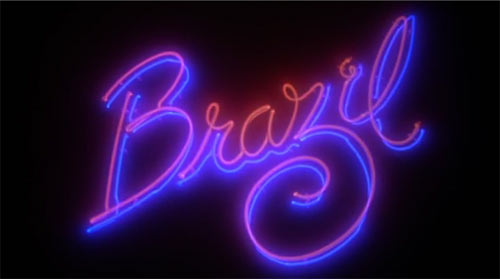
Set in the 20th Century in a different world, Brazil is a grand, otherworldly film that combined Orwell's bleak, Metropolis-like vision of 1984 with many of Gilliam's Python's hijinks in tow. It's part sci-fi, part-comedy, part-drama, part-fantasy, and part-action all rolled into one. Though the film is called Brazil, it doesn't set itself in the country of Brazil or has anything to do with Brazil except for its song that is played throughout the film. What the film is about is an oppressed, meek man named Sam Lowry who often dreams into another world whenever he's feeling oppressed by his bleak world around him. After a mistake that has an innocent man killed, Lowry investigates to correct an error where he bumps into the girl of his dreams, a terrorist, and all sorts of people including those he works for at the Ministry of Information. Playing Lowry is Jonathan Pryce who makes a cowardly, meek man into an unlikely hero. With a cast that includes Gilliam's Python-mate Michael Palin along with Jim Broadbent, Katherine Helmond, Bob Hoskins, Kim Griest, Ian Holm, Ian Richardson, Peter Vaughn, Charles McKeown, and Robert de Niro. Brazil is a flat-out masterpiece that proves that there's no escape to imagination.

It's a typical day in the Ministry of Information when a technician (Ray Cooper) kills a fly in the ceiling, only to have that dead fly drop into a mechanized typewriter where an error occurs. The error forces a group of police-like guards to take a man named Mr. Buttle (Brian Miller) to have him be executed by the Information Retrieval group. Witnessing the capture is a woman named Jill Layton (Kim Griest) who notices that it's an error. The next day, a nervous office manager named Kurtzmann (Ian Holm) keeps peeping through his employees as he notices glitches in his computers where workers would watch movies. He calls for one of his loyal employees in Sam Lowry, only that he has overslept in his dream where he's a superhero, flying to find his dream girl. He wakes up to learn that he's overslept and the electricity in his apartment isn't working. He arrives where he bumps into his friend Jack Lint (Michael Palin) who works at the Information Retrieval office.

Lowry fixes Kurtzmann's computer problems as he heard that Lowry is up for a promotion at the Retrieval group but Lowry has turned it down because he enjoys his anonymity. He learns that his promotion has been pressured by his own mother Ida (Katherine Helmond), who knows the boss Eugene Helpmann (Peter Vaughn). Ida, who is currently getting a plastic surgery procedure to look young by Dr. Jaffe (Jim Broadbent) takes Sam to have dinner with friend Mrs. Terrain (Barbara Hicks) and her braces-wearing daughter Shirley (Kathryn Pogson). Ida and Mrs. Terrain hopes to have the two to get together but neither have any interest in another where Sam often feels pressured by his mother to not work for Information Retrieval. The problems with his mother, only makes Sam escape into his own dream world where he suddenly wakes up to learn that his air conditioning has broken down.

He calls Central Services to have his air conditioning fixed, only to learn that it will take them days to arrive. Then, a few minutes later, a man named Harry Tuttle (Robert de Niro) has arrived to fix the air conditioning since he intercepted Sam's call. Tuttle, who used to work for Central Services, fixes Sam's air conditioner without dealing with papers and claims, it's all for the work and to help someone. During the fixing, Central Services suddenly arrives with its fix-it guys Spoor (Bob Hoskins) and Dowser (Derrick O'Connor) to check up but because they didn’t have the forms to fix things, they’re forced to come back. Tuttle thanks Sam as he escapes through gliding down a wire as Sam learns he’s a terrorist because he fixes things without papers or money.

When Sam goes to work with Kurtzmann, Kurtzmann learns that an error did occur with Buttle when really, it was supposed to be Tuttle that should've been executed. Kurtzmann wants to deliver a check to Mrs. Buttle (Sheila Reid) but nerves have driven Kurtzmann to the edge. Sam will deliver the check personally as his fellow workers are secretly watching Casablanca. When Sam goes to deliver the check, Mrs. Buttle wants to know what has happened to her husband as he is attacked by her children as he witnesses Jill, wondering who she is since she resembles the girl in his dreams. He saw her earlier as she is now being suspected for being in cahoots with the terrorist group. Sam wants to know who she is but because he can't get information from his office, he has a reason now to take the promotion at Information Retrieval.

Upon returning home to his apartment, he learns that Spoor and Dowser has made things worse, especially when they learned that Tuttle was here. They have the paperwork where everything is screwed up. Sam goes to sleep to dream more where he battles a samurai warrior (Winston Dennis) to save his dream girl. Sam is waken up when a singing telegram girl (Diana Martin) arrives to tell him that his mother has invited him to a party. Sam doesn't want to go at first until he learns that Helpmann will be there. Sam arrives where he sees his mother, looking younger than ever while Mrs. Terrain looks worse thanks to an acid-like experimental procedure made by Dr. Chapman (Jack Purvis). Sam finally sees the wheelchair-bound Helpmann as he helps go into the bathroom and Helpmann decides to return a favor for Sam’s father by giving Sam the job which Sam accepts.

Sam takes his first day at Information Retrieval where he works with a talkative boss named Warrenn (Ian Richardson) and borrowing the computer of his neighbor Lime (Charles McKeown) where he finds more information on Jill, who is suspected for all sorts of crime and is a fugitive. He goes to Jack for guidance as he learns that Jack's job is to torture people as Jack suggest to change into a better suit with his daughter Holly (Holly Gilliam) watching. Sam, in a new suit, goes to find Jill where he sees her at the reception board where he goes after her and tries to tell her about Mr. Buttle. Jill doesn't trust Sam at first, only to give in when he doesn't give up, especially since he loves her. She takes him to a plant where she’s carrying a delivery but after an explosion, she is suspected for the bombing as she and Sam are captured. Sam, is returned to his office where Warrenn forces him to work overtime.

Sam comes home to find his apartment a complete mess that he cannot control as Spoor leaves him out. Then, Tuttle arrives to help Sam where after Tuttle's escape, Jill arrives as Sam decides to sneak into Helpmann’s secret elevator to delete Jill's files as the two fall in love, only to be captured by the Ministry. There, Sam wonders what is going on, where is Jill, and what is going to happen to him.

With an original screenplay written by Gilliam, Charles McKeown, and Tom Stoppard, Brazil has many elements that aren't just cerebral but also filled with satirical humor. The credit really goes to Gilliam for his extraordinary vision by bringing Orwell's bleak, totalitarian vision of bureaucracy that is almost inescapable and find humor in it. Imagine living in a world where like in Brazil where you're living in poverty, all the machines don’t work well, and forced to live in this state. It's a bleak film but one that has humor and spectacular visions. Gilliam and his fellow writers really create a fantastic story in which, our protagonist is someone an audience can connect with. Lowry is a dreamer, who doesn't want to be noticed and wants to live in his dream without facing any kind of realities or responsibility. It's a fantastic screenplay that deserved its recognition by the Oscars even though they were just nominated.

If the script of Brazil is intelligently witty, Gilliam as a director pulls all the stops into his vision. Here, he perfectly captures a totalitarian bleakness that is very otherworldly and now, it makes sense with our own American idealism where the American dream is over and we're forced to live in a country run by idiots. Gilliam is really a storyteller like Fellini that uses extravagance to advance a story that blurs the line of reality and fantasy. It's top-notch directing at its best and as for the film's ending. I won't reveal it but it is a happy ending when you think about but it makes you really think and it's one that Gilliam fought over for when he made Brazil and it’s true to his vision.

If Gilliam's directing is in its imaginative form, complementing that vision is cinematographer Roger Pratt who brings in a diverse approach to the film's vision, with little color in many of the film's bleakest scenes and productions while bringing a lot of colorful lighting in Lowry’s dream sequences, including the samurai battle scene with its mix of gray and color. Helping out in the visual department is production designer Norman Garwood along with art directors Keith Pain and John Beard for capturing the bleak, utopian nightmare of the Metropolis-like city with its poverty-stricken city and its upper class styles that really shows the contrast of the rich and poor, even in the building where Sam and Jack Lint works at.

For the film's retro-30s look, costume designer James Acheson brings in a costume style of 1930s-like suits for the males except for Robert de Niro's Tuttle character while most of the women wear these wonderful clothing with boot-like hats along with Gilliam's wife Maggie Weston for creating strange makeup and hair for Katherine Helmond's character. With a wonderfully diverse score from the late Michael Kamen, the orchestral arrangements that are filled with rich strings play up to the film's suspense and dreamy tone along with dreamy layers for the song of "Brazil".

Credit for capturing the behavior of the bureaucracy of Brazil is its cast that includes several fine small performances from Brian Miller, Ray Cooper, Barbara Hicks, Shirley Pogson, Jack Purvis, Diana Martin, Derrick O’Connor, Holly Gilliam, Charles McKeown, and Sheila Reid. While Bob Hoskins and future-Oscar winner Jim Broadbent had small roles, both actors delivers some hilarious standout moments in their respective roles as repairman and surgeon in their own unique way. Playing against type in a role that now stands as ironic is Robert de Niro as Harry Tuttle, who only appears in a few scenes but he is extremely funny whenever he's on board.

Ian Richardson and Peter Vaughn are great in their roles as the superiors of the building that Sam Lowry works for while Ian Holm really stands out with his neurotic performance as Kurtzmann. Katherine Helmond gives a funny, aloof performance as Sam Lowry's mother while Kim Griest is excellent in her role as Jill Layton with her tough-as-nails attitude and beauty. Of the supporting cast, the real standout is Michael Palin for his eccentric, strange performance as Jack Lint, with his nice guy, ignorant role as a man who doesn’t think torture is a bad thing.

In terms of performance from the whole cast, no one stands out better as Jonathan Pryce as the protagonist Sam Lowry. Pryce brings a complex and human performance as a man that couldn't stand the oppression he's living in and all the gadgets he has to be surrounded with. Pryce brings sympathy to Lowry in scenes involving his mother and her friends. Lowry is the guy we know and when he's in the dream sequence, Pryce is larger than life. He brings both comedy and drama into a great performance as this will be the role he will be remembered for as he continues to do great films like most recently, Pirates of the Caribbean.

***The Following Content is Additional Material Relating to the Criterion DVD Box Set Written on 9/9/10***

The 1999 3-disc Criterion DVD set is one of greatest releases from the Criterion Collection. The film is presented in its original 1:85:1 aspect ratio for widescreen while the film is assembled from both the American and European theatrical releases for the ultimate cut of the film at 142-minutes. Featuring a new remastered Dolby stereo surround soundtrack, the remastered film (which was remastered again in 2006 for a single-disc release) is all supervised by Terry Gilliam.

The only special feature in the first disc of the DVD aside from English subtitles for the hearing impaired is a full-length audio commentary track by Terry Gilliam. Gilliam talks about the making of film while reflecting on everything that is happening as he’s watching what he says is the fifth and final cut of the film. The only scenes that don’t appear in the final version that was assembled from the American and European theatrical releases are the clouds at closing credits and an extended scene at the end that appears in the shortened, studio-cut version of the film.

Gilliam praises the work of Jonathan Pryce and co-screenwriter Tom Stoppard throughout. Pryce for his physical comedy and expressions during scenes while Gilliam praises Stoppard for some of the dialogue and ideas he had. The name “Brazil” came from the idea of shooting the opening sequence in Brazil at the rain forest where it was later revised for the scene where a man kills a fly and the mess up of Tuttle/Buttle occurs. Gilliam also talks about Robert de Niro who was very nervous about doing the film though it was a small role. Yet, de Niro was very relaxed during the making of the film as Gilliam has fond memories.

Terry also talked about the casting of Jill where he wanted an unknown. While it’s been known that Gilliam had issues with Kim Griest, Gilliam underplays those issues as he liked her performance and felt she was right along despite the people who auditioned for the film. Among them were Ellen Barkin, Rosanna Arquette, Kathleen Turner, Jamie Lee Curtis, Rebecca de Mornay, and Madonna. Gilliam also talked about the scene with his daughter Holly and Michael Palin which she hated to do. She only had two days of work and in the second day, she didn’t want to say her lines. So in order to film her, Terry recalled having to operate the camera while his wife Maggie held the boom mic so she can do her famous line to Jonathan Pryce.

Gilliam also talks about his struggle with the studios as he reveals his hatred for Hollywood and the studio system. Even as he feels that filmmaking is a collaborative effort where it’s not just the director but the actors and crew members that are all trying to tell a story. The commentary also includes some technical details and other things Gilliam tries to recall as it’s definitely one of the most enjoyable commentaries for a film.

The second disc is a production notebook of everything that went on with the making of the film as well as the battle to release it. Featuring numerous special features, the second disc includes rare documentaries and interviews with those involved in the film. The first is a 56-minute documentary called The Battle of Brazil: A Video History by journalist Jack Mathews. The documentary chronicles the funding for the film and the battle to release it. Featuring interviews with Terry Gilliam, producer Arnon Milchan, studio executives Frank Price, Bob Rehme, and Marvin Antonowsky, L.A. film critic Kenneth Turan, and a 1985 audio interview with former Universal studios chief Sidney Sheinberg. The film goes into detail over the battle of the film.

It begins in the early 80s where Terry Gilliam met Arnon Milchan about a project he wanted to do called this project called Brazil. Milchan liked the idea but had a hard time selling studios about the project. At the 1983 Cannes Film Festival where Gilliam was promoting Monty Python’s The Meaning of Life and Milchan working to get buyers for Once Upon a Time in America. The two met Bob Rehme of Universal where he said yes to the project though Gilliam got an earlier offer from 20th Century Fox to do Brazil if he would direct the film Enemy Mines.

Things were going great until Rehme was out of the job as other people from Universal became concerned. When Gilliam submitted his first cut of 142-minutes, executives got worried and wanted him to cut the film. Though that cut was released in Europe by 20th Century Fox to critical acclaim, the executives at Universal were still unsure following a poor test screening in the U.S. Universal head Sidney Sheinberg decided to get involved and cut the film into 94-minutes taking out a lot of the fantasy sequences and focused on the love story. Gilliam got upset while he was still trying to cut a shorter version of 130-minutes for U.S. audiences as a battle ensued.

Gilliam made the battle public as he even got Robert de Niro to do a rare interview on national TV with Gilliam to support the film. Gilliam’s guerilla tactics worked as Jack Mathews was reporting all that was happening capturing both sides. Gilliam held secret screenings and then one for the L.A. Film Critics Association where the film won Best Picture, Best Director, and Best Screenplay. While Gilliam won the battle to release Brazil in the U.S. in New York City and Los Angeles in December of 1985. The film wasn’t a major commercial success though its reputation has grown since. Gilliam was happy that he at least, allowed directors to fight for their vision more.

The second documentary is a 30-minute documentary called What is Brazil? by Rob Hedden. A behind-the-scenes documentary with cast and crew interviews during the production as they ask what is Brazil? Gilliam talks about his collaboration with Tom Stoppard, who admittedly reveals not liking collaborations very much while is unsure what script Gilliam is shooting. The doc also has Michael Palin talking on the phone during the interview while pretending to be other characters. One of the highlights of the documentary is the lost eyeball sequence that was supposed to be part of the dream sequence but got cut out due to length.

The next series of special features is the Production Notebook that reveals everything about the film and its look. Among them is numerous texts and notes relating to the many drafts of the screenplay for Brazil. Featuring pictures and draft notes from Charles Alverson, who helped write in the numerous drafts of the script. The numerous texts and development for Brazil in script is truly mesmerizing with characters such as “the Oppressor” who was eventually cut out since there was no room for a true, main antagonist due to the involvement of Charles McKeown and Tom Stoppard in numerous drafts.

Also included in the script development section is a nine-minute video featuring Gilliam, McKeown, and Stoppard talking about the writing process. Whereas Stoppard was brought in for three drafts as he brought ideas that changed things. Gilliam brought McKeown to put some ideas back from previous drafts and keep the stuff that Stoppard wrote that Gilliam felt worked. The three men reveal how difficult it was to find a balance for the script where all three would be satisfied for what would be shot.

The storyboard material presented in the DVD reveal lots of text about the detail of what Gilliam wanted along with drawings that he made for the fantasy sequences in all nine of the dreams presented and where they were originally supposed to be in the film in its various drafts. The second dream sequence included the cut eyeball scene where Sam in his dream tries to save Jill. Others are variations while the final involved Helpmann as Father Christmas.

The production design section reveals in-depth detail in the work Gilliam and production designer Norman Garwood. A lot is revealed into re-creating a city that is in ruins with storyboards and stills into how looked early on to what it would look like in the film. Even in the creation of props and slogans that was needed to create this world as Garwood goes into detail of what Gilliam wanted. The costume design section features audio commentary costume designer James Acheson about the costumes in a five-minute segment. Acheson through pictures and still goes into detail of what inspired the costumes while talking about how easy it was to work with Robert de Niro and Katherine Helmond about their costumes. Yet, he says the least favorite costume he made was the samurai. The segment also featured a rare video clip of a stuntman working on the Icarus suit that Sam wears in his dream to show he would fly.

The next section is the special effects where it features audio commentary from Richard Conway discussing some of the raw footage unveiled during the making of the film. Among them is the flying sequence which features a mechanic dummy flapping his wings and going up in the air while Conway revealed how difficult it was. Even where Jonathan Pryce tried to do it with a harness that only lasted 10 seconds. For the deleted eyeball sequences, stills, storyboards, Conway’s commentary, and pictures of the eyeballs are revealed which were a nightmare to make as it got cut because not everything worked. Other effect details revealed are the miniatures used for second-unit shots relating to cars, sets that were built, and the famous brick hands that capture Sam in the dream sequence on the ground. Conway also admits that making the Samurai costume and the visual effects for that character was a nightmare while he and James Acheson felt even more sorry for Winston Dennis to play that character. Other raw footage revealed is the forces of darkness dragging Jill’s cage in a rare, raw shot while a scene with Mrs. Terrain’s remains was another awful experience due to the smell.

The last major special feature is a nine-minute interview with late composer Michael Kamen about the film’s score. Kamen talks about creating a score around the song Brazil, a song he didn’t like very much, while talking about variations he made including a few score pieces that didn’t make it to the film revealed through raw footage. Even the first dream sequence played to a musical piece by Strauss. One of the hardest parts about the score was getting permission from the song’s publisher so that Kamen could get credit for the arrangements. With the help of Ray Cooper, Kamen was about to work around the song and create suites which he was proud of doing.

Two other features included in the second disc is the film’s theatrical trailer and a photo gallery of production and publicity stills relating to the film which includes rare posters and such.

The third and final disc of the DVD set is the 94-minute Love Conquers All version of Brazil presented in rough form and in full screen. The film itself in this shortened version is in fact an abomination. Many of the film’s fantasy sequences are cut. There’s a lot of continuity errors. No motivations or proper introduction of characters. A lot of the satirical and political elements of the film is cut out. A lot of subplots relating to Buttle/Tuttle confusion and Sam’s mother is cut out with characters not being fully realized. The pacing in several scenes are off and musical cues are misused.

Included in the third disc is a full-length commentary track by Gilliam expert David Morgan. Morgan’s commentary reveals what is cut and what is added to the Love Conquers All version. Morgan reveals that this version of the film really confuses the audience of what they’re seeing. Notably with the bad edits and cut material along with the humor being poorly-timed. It’s a must-see just to see how bad a studio can mess up a film for their own intent.

Also included in the entire set is a booklet featuring an essay by Jack Mathews. Mathews’ essay summarizes its history, the battle, and its impact while presenting what is Gilliam’s final cut of the film. The Criterion DVD box set for Brazil is definitely a must-have for fans of the film. Even as it reveals loads of details into the production of the film, the battle to release it, and everything else. It’s definitely Gilliam’s masterpiece as fans get to see the film in its most completed form.

Brazil is truly one of the greatest films ever made from the wondrous mind of Terry Gilliam. Featuring a towering leading performance from Jonathan Pryce plus an amazing supporting cast that includes Robert de Niro, Michael Palin, Kim Griest, Katherine Helmond, Bob Hoskins, Jim Broadbent, Ian Holm, and Peter Vaughn. It’s a film that is truly ambitious while not being overly pretentious nor with an overblown message. While audiences might be befuddled by its plot description, they won’t be once they see the film which displays a smart sense of humor. In the end, Brazil is a mesmerizing, witty, and dazzling film from Terry Gilliam that gives voice to the oppressed dreamers.


© thevoid99 2010

Rush: Beyond the Lighted Stage


Whenever people jot down the greatest bands of all-time.  Whether it’s the Beatles, the Rolling Stones, the Who, Led Zeppelin, the Clash, Pink Floyd, Nirvana, or anything else.  There’s always an argument into why these bands are great.  Then there’s Rush.  The Canadian power-trio formed in 1968 by Alex Lifeson and Geddy Lee, with the addition of Neil Peart in 1974, were a band that not many people understood.  Despite selling more than 40 millions and having more gold and platinum albums next to the Beatles and the Rolling Stones.  They were not a band that were big enough for the mainstream or the darling of critics.  By 2010, the band’s popularity is still thriving than ever as the year also the band’s story be told through a documentary called Rush:  Beyond the Lighted Stage.

Directed by Sam Dunn and Scot McFayden of Metal:  A Headbanger’s Journey and Iron Maiden:  Flight 666Rush:  Beyond the Lighted Stage chronicles the band’s early years to 2009 as the band is currently riding a wave of pop culture.  From the early hard rocking years through the late 70s/early 80s period of popularity and onto the synthesizer period of the 1980s.  Dunn and McFayden interview the band along with associates and fans of the group including musicians like Gene Simmons of Kiss, Vinnie Paul of Pantera, Tool’s Danny Carey, Mike Portnoy of Dream Theater, Billy Corgan and Jimmy Chamberlain of Smashing Pumpkins, Trent Reznor of Nine Inch Nails, and Sebastian Bach along with actor/musician Jack Black and South Park co-creator Matt Stone.  The result is a fascinating, entertaining, and thrilling documentary one of the greatest rock band of all-time.

The documentary is broken into several chapters of Rush’s history from the band’s early beginnings to their most recent tour promoting the 2007 album Snakes & Arrows.  Particularly into the backgrounds of Alex Lifeson and Geddy Lee in their suburban backgrounds and how they met in junior high.  Even as there’s brief profiling on original John Rutsey, who is heard through an audio interview in the early 70s, as he is mentioned and why he was out of the band due to health issues.  The meeting of Neil Peart in 1974 after the release of the first album led to some funny stories about the band opening for Kiss.

Stories about the band’s rise following the release of 2112 and why they wore the kimonos in an age where jeans and t-shirt weren’t cool which the band wanted to wear.  Even as they talk about the critical lashing they received over the years and how their fans dismissed it despite a critical re-evaluation in some circles in recent years.  With the release of 1981’s Moving Pictures, the band became popular as they moved into the age of synthesizers known as the Synthesizer Period of the 1980s that divides fans to this day.  Even as it would eventually get the band back into hard rock territory while Neil Peart studied drum techniques with Freddie Gruber.  The story of Neil Peart’s family tragedy is touched upon on how it shut the band down with Lifeson and Lee worried about Peart’s state as he went on a cross-country trip through North America where he finally returned in 2001 to record Vapor Trails.

The documentary is considered to be a Holy Grail to Rush fans as archive footage of the band’s early years, rare interviews, and such is finally presented in this 107-minute tale that chronicles the band and all of their albums.  Even as some are profiled briefly while it allows fans, famous and non-famous, a chance to talk about those periods and how much Rush means to them.

The band themselves come off as just real guys who are relaxed, funny, and intelligent.  While Lee and Lifeson are more accessible, even as they give autograph to fans.  Peart, is presented as someone who is very private though he does reveal a lot in the interviews he’s given despite the fact that he’s very shy and not wanting to get a lot of accolades.  Band personnel like manager Ray Danniels also fill in to the band’s history along with Peart’s parents and the mothers of Lee and Lifeson.

Some of the film’s entertaining moments come from the famous fans in the film like Jack Black and Sebastian Bach, who each give more light-hearted, comical interviews.  Notably Bach who explains that 2112 led him to read Ayn Rand’s The Fountainhead at such a young age.  Musicians like Mike Portnoy, Vinnie Paul, Danny Carey, Metallica’s Kirk Hammett, and Ozzy Osbourne/Black Label Society guitarist Zack Wylde delve into the complexity of the band’s music.  Even to some of the criticism towards the synthesizer period where Trent Reznor is revealed to be a fan of that period while Billy Corgan contends that “middle of the road Rush” is still someone’s left field.

The archive footage shown, including a scene of a young Alex Lifeson arguing with his parents about his future is really a treasure for fans.  Even as the fans themselves get to be revealed in talking about their love for the band in an almost-geek like fashion.  Rush’s devotion to its fans is shown as it is clear that their fan base is one of the strongest.  Even as it’s clear that no matter how much the mainstream ignores them or how much flack they get from the critics.  Rush has always endured through many trends with a strong loyalty of fans proven by album sales and sellout concert tours.

Rush:  Beyond the Lighted Stage
is a remarkable documentary from Sam Dunn and Scot McFayden.  Fans of Rush will no doubt be happy to see the band’s history told in such a respectful way while giving them archival footage that they will enjoy.  Those new to the band with a keen interest will no doubt be amazed by the band’s history and the testimony from fans and musicians into why they’re one of the best.  Even as Matt Stone that the band deserves to have their props, otherwise you’d be a dickhead.  This is definitely one of the finest music documentaries ever made without any of the sentimental Behind the Music trite or skimming over things like most programs about individuals.  Dunn and McFayden get it right with Rush:  Beyond the Lighted Stage.

© thevoid99 2010

Monday, September 06, 2010

The Imaginarium of Dr. Parnassus


Originally Written and Posted at Epinions.com on 1/17/10.


One of the most beloved but controversial directors in cinema, Terry Gilliam is a director who is known for a broad vision that doesn't fit in with what Hollywood wants. Despite acclaimed features like Time Bandits, Brazil, The Fisher King, and 12 Monkeys that were moderate commercial hits. Gilliam would often have budget troubles which had been notorious for his 1988 flop The Adventures of Baron Munchausen. Though his films would often have a devoted following of fans since his days working as a member of Monty Python, funds for his projects were not easy for him to get.

The 2000s however, would be a very rough decade for Gilliam. Production for his ambitious yet radical re-telling of Miguel de Cervantes' Man of La Mancha entitled The Man Who Killed Don Quixote. The project that starred Johnny Depp and Jean Rochefort as Don Quixote was filled with lots of trouble as the $32.1 million film was officially scrapped in November 2000 as it was documented for the 2002 documentary Lost in La Mancha. 2003 was also a tough year for Gilliam as he worked on his next project The Brothers Grimm where he and Tony Grisoni couldn't get proper credit for their script re-write while Gilliam battled it out with Bob and Harvey Weinstein over who should shoot the film and final cut privileges.

The film was eventually released in the fall of 2005 after several delays to some mixed reviews and decent box offices. Gilliam also released another film that same year to film festivals with Tideland, a surreal adaptation of Mitch Cullin's novel that was widely panned by critics in its fall 2006 release. Yet, the film's DVD release wasn't well-received by Gilliam as his troubles to keep getting funding for projects were troubled. In late 2007, a new project by Gilliam was finally in the works which was considered another ambitious project about Gilliam's themes of imagination. Starring in the film was Heath Ledger who had previously worked with Gilliam in The Brothers Grimm. Things seem to go well until January 22, 2008 when the young actor died of an apparent overdose of prescription pills.

Ledger's death seemed to mark the end of another Gilliam project but the director didn't give up as he decided to keep the footage that he shot with Ledger. At the same time, the parts that Ledger didn't film would be filled by other actors. The project was finally finished in 2009 despite a lot of trouble as Gilliam dedicated the film to Ledger along with producer William Vince entitled The Imaginarium of Dr. Parnassus.

Directed by Terry Gilliam with a script he co-wrote with collaborator Charles McKeown, The Imaginarium of Dr. Parnassus tells the story of a traveling circus troupe leader who makes a deal with the Devil to live a thousand years. When the Devil comes to collect the deal by taking the doctor's daughter, the doctor makes a deal to save her by trying to obtain five souls with help from a mysterious outsider as they travel to different worlds inside the doctor's imagination machine. Playing the title character is Christopher Plummer while the outsider named Tony is played by Heath Ledger in his final performance as the film revels in Gilliam's themes of man versus reality. Also starring Lily Cole, Tom Waits, Verne Troyer, Andrew Garfield, Peter Stormare, and in the other roles of Tony, Johnny Depp, Jude Law, and Colin Farrell. The Imaginarium of Dr. Parnassus is a whimsical, entertaining, and spellbinding film from Terry Gilliam and company.

Dr. Parnassus (Christopher Plummer) is in modern-day London with a traveling circus troupe trying to entertain people throughout the city. Yet, with help from his daughter Valentina, a young performer named Anton (Andrew Garfield), and a dwarf named Percy (Verne Troyer). The troupe tries to entertain people but would often be dismissed or heckled by people who seem uninterested. For the 1000-year old doctor, it's a struggle as the Devil (Tom Waits) is lurking around to collect on a deal that the doctor made many years back. The deal was that for any child the doctor has at the age of 16, the Devil must collect while the doctor would be granted immortality as he met the devil many years ago when the doctor was just a monk.

Then on one night while traveling through London, a shadow of a man being hanged under the bridge as he was saved. Waking up, the man whose name is Tony (Heath Ledger) has no idea who he is as the doctor reluctantly takes him in while Valentina falls for him much to Anton's dismay. Attempts to stage the show, while getting people inside the imaginarium mirror where people would go into the mind of Dr. Parnassus where their own imagination would enamor them, has unfortunately been troubled as the Devil makes a deal with the doctor to have five souls to believe in the imaginarium where if Dr. Parnassus succeeds, he could keep his daughter.

Anton hears what is going on as he tries to take a woman into the imaginarium but only to cause trouble. Tony has a new idea to revamp the entire stage on the day of Valentina's sixteenth birthday. There, Tony woos his way to get women inside where he would sport different faces inside as everything seems to go well until a group of Russian men would chase Tony inside the imaginarium. The Devil ends up collecting their souls while Anton would make a discover of Tony's true identity. With less than hours away before the Devil can collect his prize, Valentina learns what was all of this about with Tony deciding to make a desperate move to save her as the Devil is ready to make more trouble.

The film recalls a lot of Gilliam's themes of man vs. reality where the character of Dr. Parnassus is a man who likes to tell stories in order to entertain people. For the Devil, Dr. Parnassus' ability to get people's attention was something that he was intrigued by as he gave the doctor immortality to keep telling stories and entertain. Yet, immortality comes with a price where Parnassus wanted to experience things that humans want and often joining the doctor in this long journey is Percy, who is the film's conscience of sorts. Yet, the experience to love would only come at a price for the doctor as the film does become a battle between the desire of one's soul with the help of a few characters.

Terry Gilliam and co-writer Charles McKeown create a film that is about a man dealing with the harsh realities to entertain people and his own immortality where he faces changing times and the Devil lurking around to collect on a deal. Inside the imaginarium where the doctor hopes to get people inside where they can live a certain fantasy. The doctor's job is to make it happen though the Devil would appear to tempt people and collect their soul. The script is well-structured though at times, the story lags a bit in its pacing as Gilliam and McKeown does bring a lot of depth, humor, and drama to the story and the characters in the story. Notably Tony who carries a dark secret about who he is since he can't remember where inside the imaginarium. He takes on a different face and personality which would reveal the kind of person that he really is while the Tony in the real world has no clue and tries to hide it from himself. The script is overall fantastic in what Gilliam and McKeown created in terms of what its idea of imagination.

The direction of Gilliam is definitely superb as it revels in a grim world of reality with wondrous fantasy. Shot mostly in London with sets and visual effects pieces in Vancouver, Gilliam does create a film that sort of lives up to his grand, ambitious ideas where things are huge and everything seems unreal. The scenes where the Devil first meets Dr. Parnassus at a monk place is truly fascinating along with scenes in the desert and such. In London, there's a look that is very gritty where Gilliam doesn't go for a wide depth of field. It's mostly close-ups and location shots of where the characters are while inside the carriage where the imaginarium is stored, it's more intimate and at times, claustrophobic. The scenes inside the imaginarium are truly whimsical and fantastic as it plays up to Gilliam's strange mind and visual swirls that are reminiscent of his work with Monty Python. From the way Gilliam composes several effects shot to its comical tone, it is definitely a Gilliam film all the way as it is his most rewarding work since Fear & Loathing in Las Vegas.

Gilliam's longtime cinematographer Nicola Pecorini does fantastic work with the film's stark, gritty visuals for the nighttime scenes in London along with the dazzling look of the imaginarium stage when it's revamp and inside a mall. The look for the scenes inside the imaginarium are colorful with bright lights and colors as Perconi's work is superb. Editor Mick Audsley does some very good work with the editing to maintain a certain rhythm and style along with smooth transitions for some of the film's dramatic and comical scenes. For the more intense, adventure-like sequences, the film is cut with a fast-paced rhythm as the editing is well-crafted.

Production Anastasia Masaro with set decorators Caroline Smith and Shane Vieau along with a couple of art directors plus Gilliam do a spectacular job with the film's set designs. From the carriage that carries the imaginarium stage to the stage itself where at first, it was a ragged stage that wasn't well put together until it was revamped into something classier. The look of the film in its set designs is phenomenal like a lot of the set works in Gilliam's films. Costume designer Monique Prudhomme is excellent for the ragged clothing that everyone wears when they're not performing to the more dazzle look that everyone else wears where at one point, Verne Troyer has to look like an African child for Tony's revamp of the imaginarium stage that can be seen as offensive but there's a humor to it that even the character knows that it's wrong.

The visual effects are truly amazing in its whimsical look from the candy world that Anton stumbles to the more romantic yet troubled look that Tony and Valentina venture through. Led by its team supervised by Richard Bain and John Paul Docherty, the look of the imaginarium along with the design of the monk structure that Dr. Parnassus was a part of, it's truly dazzling. The sound design of Andre Jacquemin is excellent for many of the film's adventure sequences along with the sound of the carriage and locations. The music score of Mychel and Jeff Danna is wonderful for its circus like tone with playful musical pieces along with lush orchestral pieces for the film's dramatic and adventure sequences with big, heavy arrangements on some of its darker elements. One of the most comical elements of the music involves a group of policemen wearing lingerie stockings and high heels as they sing a song that is truly silly but fun.

The casting by Irene Lamb and Maureen Webb is excellent with some notable appearances from Peter Stormare as a politician in a fantasy sequence plus Maggie Steed as a woman with a lot of Louis Viutton objects who goes inside the imaginarium, Paloma Faith as a woman who is wooed by Tony into the imaginarium but doesn't get there, and Richard Riddel as a drunk who heckles the troupe early in the film. Verne Troyer gives what is probably his best performance of his career as Percy, Dr. Parnassus' longtime traveling companion who is really the straight man of the film while making sure Dr. Parnassus isn't doing anything wrong as he is also the film's conscience of sorts. Tom Waits is great as the Devil but is known as Mr. Nick who is a charmer and a man that is willing to tempt Parnassus into playing games as Waits is just fun to watch throughout the film.

Andrew Garfield is really good as Anton, a performer who likes to do magic tricks and wow the crowd while struggling to maintain his feelings for Valentina until Tony comes in and intervenes. Lily Cole is also good as Valentina, Dr. Parnassus' daughter who yearns for a better life while trying to take care of her father as she also deals everything else around her including Tony. Christopher Plummer is great as the film's title character, a man tormented by his own immortality while struggling to keep things going while dealing with the devil as it is definitely a mesmerizing performance from the veteran actor.

Finally, there's Heath Ledger in his final performance as Tony and as far as final performances go. This is certainly a fitting bow though it doesn't top the brilliance of his penultimate role as the Joker in The Dark Knight. Ledger's performance is full of charm, wit, and humor as it clearly shows an actor who was seemingly having a good time and it's a shame that audiences will never get to see the likes of him ever again as it definitely a fantastic performance from the late, great actor. Helping Ledger in filling the role of Tony through imaginarium are Johnny Depp, Jude Law, and Colin Farrell as they all do a fantastic job. Depp with his light-comic performance with a sense of wit. Law with his playful yet smarmy tone and Farrell with a greasy yet charming performance as they all embody part of Ledger's persona as the three actors do great work while it is great to note that they gave their earnings to Ledger's daughter Mathilda.

The Imaginarium of Dr. Parnassus is a remarkable yet enjoyable film from Terry Gilliam and company featuring a fantastic final performance from Heath Ledger. Along with top-notch performances from Christopher Plummer, Tom Waits, and Verne Troyer plus Johnny Depp, Jude Law, and Colin Farrell filling in for Ledger. It's a film that shows that Terry Gilliam still has it when it comes to whimsical and ambitious ideas. While it may not rank with a lot of his great films like Brazil, The Fisher King, 12 Monkeys, and a couple of other films. It is certainly a film that is definitely his best in quite a long time after a decade of trouble. While mainstream audiences might enjoy the film for its entertaining factor and whimsical humor along with some star power. The film is a bit eccentric in some places but it's what happen when they see a Terry Gilliam film. In the end, The Imaginarium of Dr. Parnassus is an excellent film from Terry Gilliam along with a fond farewell from Heath Ledger.


© thevoid99 2010

Saturday, September 04, 2010

Blog News 9/4/10

For those of you that have been following this blog.  Thank you for reading.

Coming this month and the months to follow will be more Criterion DVD reviews for Brazil, Solaris, Che, George Washington, The Leopard, and My Own Private Idaho.  I would also hope for a review of the upcoming Criterion DVD to The Thin Red Line as well.  New film reviews are definitely coming but it depends on the film.  Even as it might relate to whatever projects from LAMB.  Reviews for new theatrical releases however, might not be coming until October.

Plans for any music reviews is currently on hold as it's not likely I will delve into any 2010 album releases until very late in the year though I do plan on attending the upcoming Deerhunter concert this coming Oct.

Then there's the Auteurs profile series.  The first one for Sofia Coppola has been a success as I plan to do more.  For the second one.  I'm leaning towards Todd Haynes as I hope to review Superstar:  The Karen Carpenter Story, Poison, and Dottie Get Spanked while posting my other reviews that I wrote on his films.  Originally, I had Terrence Malick as my premier profile in the Auteurs series but that will be delayed once there's news about the release for his upcoming film The Tree of Life.  

After Todd Haynes, the next director to be profiled will be Darren Aronofsky to celebrate the upcoming release for his new film Black Swan.  I will post extended DVD reviews of Pi, Requiem for a Dream, and The Wrestler (once I obtain the DVD for that) along with a review of The Fountain (which currently does not have a proper DVD release).  After that, I hope to do David Fincher next though I will have a review of The Social Network coming next month.

Friday, September 03, 2010

The Auteurs #1: Sofia Coppola


With many revered names in the world of female directors like Agnes Varda, Lina Wertmueller, Gillian Armstrong, Jane Campion, and more recently, Kathryn Bigelow who became the first woman to win the Oscar for Best Director. The women director is now becoming more prominent in the film industry with names like Catherine Hardwicke, Nora Ephron, and Nancy Meyers creating commercially-successful films. While Sofia Coppola is another name in the list of top female directors, Coppola doesn’t belong with the commercial-driven names like Hardwicke, Ephron, and Meyers nor is part of the more art-house names like Varda, Wertmueller, and Campion. Coppola does however have a name that is quite prestigious with an audience often anticipating her next project.

With Coppola set to return in 2010 with her fourth feature-length film Somewhere, she’s already made three feature films, a short, and a small number of videos/ads. Despite that short list of work, she’s already adored by critics and with filmgoers looking for something unique. While Coppola also has her detractors who find her films to be shallow, not overly-serious, pretentious, lacking depth, or dull. She is one of the most interesting filmmakers of the last 15 years. Yet, her career began much longer before she became an acclaimed auteur as she was born to a family that has a very prestigious name.

The Coppola family name begins with Carmine Coppola, a music composer who worked with Arturo Toscanini with the NBC Symphony Orchestra in the 1940s. Carmine was married to a woman named Italia as they became the parents of three kids. The eldest named August with Francis in the middle, and the youngest named Talia. While Carmine maintained a viable career in composing while eldest son August became a novelist and academic. It was Francis Ford Coppola who would help pave the way for the second generation of Coppolas to emerge into the world of films.

Despite having a difficult start in the world of films, he teamed with a young filmmaker named George Lucas to form American Zoetrope in 1969 that would be an independent studio for new filmmakers. In 1972, Francis Ford Coppola garnered amazing success with The Godfather that put his name on the map. The film starred Marlon Brando, Al Pacino, James Caan, Diane Keaton, John Cazale, Robert Duvall, and Francis’ sister Talia. The success of that film would spawn a very successful sequel in The Godfather Pt, II two years later while earlier that same year, Coppola won the Palme D’or at the Cannes Film Festival with The Conversation.

With Francis Ford Coppola already a successful writer, director, and producer in the 1970s while his wife Eleanor was a documentary filmmaker. They would help spawn another generation of Coppolas with Francis’ siblings as well. August would be the father of eccentric but award-winning actor Nicolas Cage while Talia Shire in her marriage to Jack Schwartzman would be the mother of actor/musicians Jason and Robert Schwartzman. Francis and Eleanor would have three children. Their eldest in Gian-Carlo in 1963 with Roman to follow in 1965. In 1971, Francis and Eleanor would welcome a third child in a girl named Sofia as she would appear in The Godfather during the famous Baptism scene.

During Francis’ demanding career, the director often maintained to have his family around him. Even when they were there to see him nearly break down during the making of his 1979 Vietnam War film Apocalypse Now where Eleanor shot behind the scenes footage that would become the basis of the 1992 documentary Hearts of Darkness: A Filmmaker’s Apocalypse. Though it was a successful film, it would be the beginning of the end for Coppola’s dream to have an independent-based studio.

While the 80s proved to be a very tough decade for Francis Ford Coppola with a series of big-profile failures like One from the Heart and The Cotton Club along with the tragic death of Gian-Carlo in 1986 of a boating accident. It was a decade where Francis’ children were starting to get into their feet into the world of films. Roman would serve as a second unit director for other filmmakers including his father as he later become a very successful and acclaimed music video director. Sofia meanwhile, would appear in her father’s films during that decade in small roles such as The Outsiders, Rumble Fish, and Peggy Sue Got Married.

Then in 1989, Sofia took a hand in screenwriting when she collaborated with her father for a short segment in the anthology film New York Stories that also featured shorts by Martin Scorsese and Woody Allen. Francis’ short entitled Life Without Zoe was the tale of a little rich girl who was dealing with the absence of her parents while living in a hotel under the guardianship of a butler. The film does recall themes of loneliness in relation to a protagonist meeting a new foreign exchange student. Yet, the film is presented as a light-hearted comedy for kids. While it had a look that is quite extravagant and stylish due to Vittorio Storaro’s cinematography and Sofia doing the costume design. It was a short that is described as style over substance with a story that was very weak.

Life Without Zoe was panned by critics as the weakest segment of New York Stories. Yet, it would Francis Ford Coppola’s next project that would put Sofia more in the limelight but for all of the wrong reasons. The Godfather, Pt. III was widely anticipated by audiences as many hoped to hear more stories about the Corleone family one last time. With Winona Ryder set to play Mary Corleone, the daughter of Michael, it looked like that Francis was going to have another hit. Instead, Ryder backed out due to illness and left the film and Francis was unable to find a replacement until deciding to let Sofia play Mary at the last minute.

Upon its late 1990 release, The Godfather Pt. III got some good reviews but was considered a major disappointment in comparison to its predecessors. Yet, the film’s biggest criticism was towards Sofia and her performance as Mary Corleone. Though Sofia would later appear in a few films as an actress including a cameo in her brother Roman’s 2001 film CQ. Sofia never took on a major film role again as she stated later in her career that she had no interest in being an actress.

In the early 1990s, Sofia Coppola took on various projects with friend Zoe Cassavettes, the daughter of the late John Cassavetes, while was dating acclaimed video director Spike Jonze at the time. Coppola also took part in appearing in various music videos for acts like Sonic Youth, the Black Crowes, and Madonna. It was also around the same time that Sofia was getting into fashion where she made friends with Sonic Youth bassist Kim Gordon.

Then in 1993, Sofia took her first directorial job directing a music video for the alternative rock band Walt Mink for the song Shine that was shot by Spike Jonze. Coppola would hone her directing skills again for the Flaming Lips’ This Here Giraffe while also co-directing a short film with Ione Skye and Andrew Fleming called Bed, Bath, and Beyond in 1996. While Sofia would eventually direct a few more videos including the White Stripes’ I Just Don’t Want To Do With Myself in 2003 and appear in Spike Jonze’s video for the Chemical Brothers’ Elektrobank. The stigma over her performance in The Godfather, Pt. III still loomed as she decided to finally make her first feature as a director that begins with her first sole short.


Sofia Coppola’s 1998 short film about a 7th grade queen who decides to poison some boys inspired by Flowers in the Attic. While one of her friends gets in trouble and two others not wanting to go along with the plan, she becomes an outcast over a conversation that got misinterpreted. The short was co-written with Stephanie Hayman, a longtime friend whose sister Leslie appeared in the Flaming Lips video and later in the role of the eldest Lisbon girl Therese in The Virgin Suicides.

Shot in black-and-white by Lance Acord, who would be one of Sofia’s regular collaborators. The film featured cameos from Coppola’s friend Zoe Cassavetes and renowned film director Peter Bogdanovich as a principal. Also in the film was Sofia’s cousin Robert Schwartzman, who would also play a role in Sofia’s upcoming film The Virgin Suicides. The short would recall Sofia’s themes of alienation and girlhood while it would be accompanied by a soundtrack of girl-driven indie rock from artists like Kim Deal’s the Amps and Kim Gordon’s Free Kitten. The sense of style in the sequence of a girl’s arrival in slow-motion and jump-cuts with the Amps playing in the background revealed that this wasn’t going to be a typical short film. The result was a fascinating debut that would set the stage of what would come.


In 1993, Jeffrey Eugenides released The Virgin Suicides which was the story about the suicides of five teenage girls who come from a strict, Catholic family as it’s told from the perspective of a neighborhood boy. Coppola loved the book so much that she wanted to get the rights so she can adapted it on her own. With help from her father Francis who would serve as an executive producer. Coppola got the rights to turn the book into a film with Eugenides involved in the production.

Inspired by her own childhood growing up in the 70s along with the look of that era, Coppola created a dream-like world that painted 1970s Michigan into something that was beautiful. Yet, underneath the beauty was a sense of melancholia that would haunt the film throughout along with the four neighborhood boys who are transfixed by the Lisbon girls. With Giovanni Ribisi serving as a narrator in the perspective of one of the teenage boys recalling what had happened. The film takes the audience into this tragic world about five teenage girls feeling disconnected from the world that’s around them.

With a cast that included the likes of James Woods and Kathleen Turner as the Libson parents along with cameos by Danny DeVito and Scott Glenn. The film was mostly driven by its young cast that included Robert Schwartzman, Jonathan Tucker, Hayden Christensen, and Josh Hartnett as the role of Trip Fontaine with Michael Pare as the older Trip. For the roles of the girls, Coppola chose her friend Leslie Hayman as the eldest Therese along with A.J. Cook and Chelse Swain in the respective roles of Mary and Bonnie plus Hanna R. Hall as the youngest in Cecilia. For the role of the second youngest in Lux, Kirsten Dunst got the part as her role would mark a huge transition for the young actress from child actress to pre-adult film roles.

The film starts off with the suicide attempt of Cecilia as the boys recall many things that led to that attempt and then the suicide that followed during a party with the girls. After that, the girls try to go back to normalcy as Lux falls for the school’s heartthrob Trip Fontaine as its told by the older Trip who was still transfixed by Lux. Even as the other boys are amazed by the beauty of these girls while understanding their disconnected state of mind through the strictness of their parents.

Coppola’s direction is very striking in its presentation from the way the camera lets the audience into the world of the girls. Even in a remarkable sequence where the boys used records to communicate with the girls. The film plays as both a fantasy but grounded through the harsh reality that the girls couldn’t deal with. Coppola’s use of shooting through trees, capturing shots when people are on vehicles, and soft close-ups would become trademarks of her style. With the help of Edward Lachman as cinematographer, Coppola succeeded in taking a dream-like feel for her debut film.

Another noted factor into the film was the music. While it was a mix of 1970s music from acts like Styx, Heart, Todd Rundgren, 10cc, and other acts along with 70s-style power-pop from the 90s band Sloan. The music was mostly dominated by the eerie, ambient-like score of Air. Air’s score channeled through the dark overtones that surrounded the film as it plays to the melancholia of the girls as well as the tragedy that would come. It would also show that Coppola’s approach to music was very different in the way that Hollywood would often present music through films.

The film premiered at the 1999 Cannes Film Festival for the Director’s Forthnight while it got even bigger attention months later at the Toronto Film Festival. The film finally got a theatrical release in 2000 to rave reviews and moderate box office as it marked the arrival of a new director. Coppola achieved a lot of acclaim as the stigma over her performance in The Godfather Pt. III was now becoming a thing of the past. The film would be considered to be a remarkable debut for a new director. Yet, Sofia would have an even bigger surprise for her next feature film.


If Lick the Star and The Virgin Suicides recalled the difficulty of being a teenage girl, Lost in Translation would be the film that would recall the uncertainty of adulthood. The story of a fading movie actor going to Tokyo to endorse a whiskey where he would meet a lonely college graduate is by far Coppola’s most personal to date. Inspired by her travels to Tokyo during her days of promoting her Milk Fed clothing line with friend Stephanie Hayman. The film was also a reflection of the turmoil that was surrounding Coppola’s marriage with Spike Jonze.

Unlike the broader Virgin Suicides, Lost in Translation is more intimate as it follows two people lost in Tokyo where they’re both staying at the Hyatt Hilton. The film introduces Bob Harris, played by Bill Murray, as an actor whose life is unraveling. His marriage isn’t going anywhere while he arrives learning from a fax that he forgot his son’s birthday. Even as he has to deal with his fading career along with a group of Japanese assistants wanting him to do a commercial for whiskey. One notable scene is the film where Harris is being directed by a Japanese commercial director in Japan where Harris has no idea what he is saying while the translator is saying “with more intensity”. Harris replies, “Is that all he says? It seems like he’s saying more than that”.

While Bob is dealing with jet lag, culture-shock, and the problems at home, he finds someone to talk to in a young, 25-year old philosophy graduate named Charlotte, played by Scarlett Johansson. Charlotte is also dealing with her own drama from her husband away at work as a photographer (Giovanni Ribisi) along with culture shock and a visiting movie starlet, played by Anna Faris. Bob and Charlotte plot a move to try and leave Tokyo while they have their own fun visiting the city and talk about their own problems. While Charlotte would get an idea of where to go, despite her crumbling marriage, Bob’s own confessions about marriage would lead him to unravel. One of the film’s memorable moments is the ending where Bob whispers something to Charlotte’s ear. Since the release of the film, no one knows exactly what Bob said to Charlotte.

Coppola’s entrancing direction that is complemented by Lance Acord’s cinematography. While the film was sort of reminiscent of the sheen, colorful look of Wong Kar Wai’s films. Its perspective came from those who had never been to Japan where the feeling of culture-shock is quite prevalent. The film also revealed Japanese in all sorts of personalities from the fun-going Charlie, who Charlotte knows, to the more crazy-going TV talk-show host in which Bob attends as a guest.

Among the highlights that includes the subtle performances of Bill Murray and Scarlett Johansson is the music. The soundtrack featured some new material from My Bloody Valentine’s Kevin Shields who hadn’t released any new original material since 1991. A mixture of shoegaze, dream-pop, and electronic music with dabbles of Japanese folk-pop. The soundtrack dwelled on the sense of alienation that surrounds its characters as well as the romanticism between Bob and Charlotte though it’s mostly platonic.

The film premiered at the 2003 Venice Film Festival to massive acclaim as it also became a hit with audiences and critics all over the world. The film would give Bill Murray several acting honors including an Academy Award nomination while Scarlett Johansson received a British Academy Award for Best Actress. Yet, it was Sofia Coppola that became the big winner as she won an Oscar for Best Original Screenplay while being nominated for Best Director as the first American woman to achieve that. While Lost in Translation has lost a bit of its acclaim over the years as some claim to be boring and pretentious. It is still considered one of the best films of the 2000s to many critics and film buffs.


If Lost in Translation was Coppola’s most successful work, then Marie Antoinette is her most divisive film.  Based on Antonia Fraser’s biography on the infamous Queen of France just before the French Revolution.  Coppola created a film that was more of an anti bio-pic while focusing on the person herself.  With Kirsten Dunst playing the title role, the film was quite radical for what was expected in an 18th Century costume-drama period piece.  It wasn’t a Merchant-Ivory period film as Coppola chose her ideas in a post-modern fashion.  Even as she was given access to shoot the film on location in the palace of Versailles with help from historical advisors.

While the award-winning costumes of Milena Canonero were true to the period, it also had a New Romantics feel.  The New Romantics movement of the late 1970s/early 1980s was an anti-punk period in the U.K. that was more about fashion and having a good time.  The music of Adam Ant and Bow Wow Wow were part of that scene as Coppola chose to include music from that period along with post-punk acts like Gang of Four, Siouxsie & the Banshees, New Order, and the Cure.  At the same time, Coppola’s approach to casting the film was also quite shocking to what was expected in the period film.

The eccentric ensemble not only included legendary 60s pop singer Marianne Faithfull as Queen Maria Teresa but also Rip Torn as King Louis XV.  Along with the likes of Steve Coogan as Count Mercy, Rose Byrne as the Duchess of Polignac, Asia Argento as Madame du Barry, and Jason Schwartzman as King Louis XVI.  It was an ensemble that was against the ideas of who could play these real individuals.  Even more subversive was that most of the actors chose to play their parts quite straightforward and without accents.  Coppola’s decision to do that was so she could have a young audience relate to these characters talk the same way people are talking in the 21st Century.

In focusing on just Marie Antoinette and some of the people around her, Coppola created a character study of sorts about this young girl who is basically used to unite two countries through marriage to a young man in a similar situation.  Expected to create heirs, both Marie and Louis XVI were unable to produce heirs until years later as they were very young with Louis being a shy, awkward 15-16 year old kid with an interest in locks.  For Marie, she surrounds herself with other young women who were more interested in being youthful.  By the time King Louis XV dies, this great sense of responsibility starts to overwhelm them as Louis XVI does step up but is surrounded by men with greater interests.

The film doesn’t try to be historically accurate as it bases on legends and other stories like Marie Antoinette’s much-rumored affair with Count Fersen (Jamie Dornan).  By the time the story goes into Marie’s fall from grace, Coppola chose to end the film in an abrupt way of sorts by having Marie, Louis, and their children leave Versailles one last time and then a shot of her bedroom destroyed.

When the film finally made its premiere at the 2006 Cannes Film Festival with lots of anticipation.  The result was mixed.  While some praised the film for its radical take as well as its extravagant feel to the period film.  Others were upset over its lack of serious historical context while some wanted a scene of Marie Antoinette being be-headed.  Some criticized the film for being superficial, overly-stylized, and its use of music that also included Aphex Twin, Air, the Strokes, and other modern acts.

Though it would recoup its $40 million budget through worldwide box office grosses of over $60 million.  It was considered a failure through the U.S. box office while reviews were also mixed during its release.  While Coppola had no regrets making the film the way she did.  She did however, took a hiatus following its U.S. release to become a mother to her just newborn daughter Romy.  Since its release, the film has gained some fans who loved it for its highly-stylized interpretation as well as its study of alienation in the eyes of a young girl who would become the Queen of France.  The film also marked the end of an unofficial trilogy for Coppola that focused on young alienated women in the transition of their lives.


***Additional Content Written from 6/20/13-6/25/13***

After a break between films that included the birth of her first daughter Romy, Sofia Coppola decided to go back to more simpler territory with her fourth feature film. This time around, Coppola decided to explore the world of celebrity culture and its drawbacks in a film that reveled into that world of decadence and ennui. It was a world that Coppola knows very well as she decided to infuse that knowledge of the world with the new experience of being a parent as she decided to call the film Somewhere.

The film would once again explore Coppola’s fascination with alienation as it would revolve around a movie star whose life of decadence has left him lost as he finds himself taking care of his 11 year-old daughter as her mother has checked herself into a hospital. In the course of the film, the man re-thinks about his life as he also deals with his role as a parent to a girl who is growing up as he is aware of how much he doesn’t know her. The film would have Coppola take a very in-depth look into the world of celebrity where a film star can feel lost in his fame as his life of parties and meaningless sex starts to become boring.

Since Coppola chose to direct the film mostly in Hollywood, it would be set mostly at the infamous Chateau Marmont hotel where many celebrities had stayed. Coppola was able to gain access to the hotel as she also wrote a script that was filled with less dialogue in order to create something that was more akin to silent films. At the same time with a budget of $7 million, Coppola also decided to strip things down a bit to find something that was more improvisational and real while maintaining a sense of beauty.

While Coppola was able to retain collaborators in editor Sarah Flack, music supervisor Brian Reitzell, sound designer Richard Beggs, and production designer Anne Ross. There were also some changes as Coppola gained Stacey Battat as her costume designer while regular cinematographer Lance Acord was unable to take part in the project. Coppola instead got the renowned cinematographer Harris Savides to helm the film as he and Coppola aimed to have a very striking visual look that felt real and dream-like as it would recall some of the works of Chantal Akerman.

For the lead role of Johnny Marco, Stephen Dorff was cast while Elle Fanning was cast to play Marco’s daughter Cleo. Coppola wanted the two to spend time together to get the sense of them being father and daughter as Dorff also stayed at the Chateau Marmont for the duration of the production. Coppola would also employ various people to show up like Benicio del Toro, model Erin Wasson, and the band Rooney that featured her cousin Robert Schwartzman in cameo appearances. The production largely took place in the summer of 2009 in Los Angeles and Milan, Italy where Coppola chose to lampoon the world of Italian award shows in the scenes set in Italy.

Another major change in Coppola’s approach to the film was the music as a lot of it was played on location rather than adding it on post-production to sort of go against the idea of scoring films. While she asked her partner Thomas Mars and his band Phoenix to create music for the film, the band contributed their song Love Is Like a Sunset for the opening and closing moments of the film as score pieces while Coppola also used a demo of the Strokes’ I’ll Try Anything Once as the only other piece of music that plays to a key moment of the film as it was added in post-production. It was Coppola returning to not just the world of minimalism but also creating a film that didn’t rely on conventions in order to stand out against some of the ideas that was happening in mainstream American cinema.

The film premiered at the 2010 Venice Film Festival where it was well received and surprised audiences and critics when it won the Golden Lion as it was awarded by filmmaker Quentin Tarantino as he and his jury voted unanimously for the film. The film was later given a limited theatrical release in December of that year in Britain and in the U.S. where it received excellent reviews and did modestly well in the box office. Yet, it also received criticism as some felt that Coppola was repeating herself while adding elements that were very pretentious. Still, the film was a success for Coppola as she took another break as she gave birth to her second daughter Cosima in May of 2010.

The Bling Ring


After a break following the release of Somewhere as she had been approached to direct the fourth book of the Twilight film franchise. Coppola decided to return to the exploration of teenagers with her fifth and most recent film to date as it centers around the real-life Bling Ring robberies of 2008 and 2009. Basing the film from Nancy Jo Sales’ Vanity Fair article The Suspects Wore Louboutins, Coppola decided that the film wouldn’t just be a continuing fascination with the world of celebrity culture and Hollywood. It would also be a film that played into the sense of disconnection between kids and the real world as they become entranced by a culture that thrives on decadence.

Retaining many of the collaborators that had worked with her on Somewhere including cinematographer Harris Savides, the film would be very different from her previous film in terms of scene presentation and themes that Coppola wanted to explore. Yet, Coppola would also have access to shoot the film in the suburbs of Los Angeles and Hollywood as well as finding ways to recreate these real-life moments without doing to much to dramatize the situations. While Coppola had admittedly been oblivious to the incidents and the world of celebrity culture, she was still intrigued by it to see what these kids were doing.

With longtime Coppola collaborator Kirsten Dunst making a cameo as herself, Coppola chose to work with mostly unknowns for the film as she discovered Katie Chang and Israel Broussard who would play the ringleaders of the Bling Ring group. Also cast were Taissa Farmiga, Claire Julien, and Emma Watson to fill out the roles of the group with Leslie Mann playing Watson’s mother. With other small roles given to British rock singer Gavin Rossdale and Stacy Edwards, Coppola shot the film in March of 2012 with an $8 million budget as it would be Coppola’s first film shot in digital but also be shot in 35mm film.

While the film would be a blend of crime drama with some comedy and suspense, Coppola wanted to maintain some air of realism into the production as she was able to get access to the home of notorious socialite Paris Hilton who would also make a cameo for the film. There, Coppola wanted to see what the kids would do if they had broke into Hilton’s mansion and see her rooms and such where it had a sense of fantasy for these kids as if they could be part of that culture. Coppola would also get the chance to create moments of the thefts to see how far these kids will go as well as some of craziness that occurs in the homes of these people to see that they were dumb enough to leave their keys under the floor mat. One notable moment of the film that showcases Coppola’s brilliance as a filmmaker is a master wide shot of two of the kids stealing from the home of Audrina Partridge in one entire take as it’s shot from afar and then moves closer very slowly.

While Coppola had been known for bringing music that more suited to her tastes, she and longtime collaborator Brian Reitzell decided to do something different by bringing the kind of music that these kids would listen to. A lot of it would feature the contemporary rap and hip-hop music of the times as it had a sense of energy and vibrancy that Coppola wanted. While Coppola would include music of her own liking like Can, Klaus Schulze, and Phoenix, she also was able to get a then-unreleased song by R&B singer Frank Ocean into the soundtrack thanks to the help of rapper Kanye West.

During post-production in the fall of 2012 along with some re-shoots, tragedy struck the production when cinematographer Harris Savides died of brain cancer in October of 2012. Coppola would dedicate the film to him as she got Christopher Blauvelt to shoot remaining material for the film. The film made its premiere at the 2013 Cannes Film Festival opening the Un Certain Regard section in May of that year. While it was well-received at the festival as it came out to American theaters a month later. The film would get a mixed reception from American critics where some praised Coppola’s look into the lives of these kids while some blasted the film for being very shallow and repetitive. Yet, the film would still prove to a hit with audiences maintaining Coppola’s role as one of the cinema’s gifted filmmakers.

***Additional Content Written from 11/5/23 to 11/26/23 with a New Conclusion***

A Very Murray Christmas
Due to her friendship with Bill Murray dating back to Lost in Translation, Coppola and Murray decided to collaborate on a small TV project that would be based on Christmas variety shows. Collaborating with Mitch Glazer who had also served as an associate producer on Lost in Translation due to his long-standing friendship with Murray, Coppola decides to create a Christmas special set in the Carlyle Hotel in New York City as it is considered one of the finest hotels in New York City. The project would revolve around Murray trying to host a Christmas special at the Carlyle for a TV program on Christmas Eve as a snowstorm derails everything as he spends much of his time at the Carlyle entertaining himself, hotel guests, and the staff. Coppola would bring in several of her collaborators in film editor Sarah Flack, production designer Anne Ross, and costume designer Stacey Battat into the fold while Murray brings in longtime friend musician/actor Paul Shaffer as himself as well as the show’s musical director.

John Tanzer would serve as the show’s cinematographer as it would be shot largely on location at the Carlyle as it would also feature appearances from Murray’s old co-star from Scrooged in New York Dolls vocalist David Johansen, Jason Schwartzman, and the band Phoenix. The ensemble would also include Rashida Jones, George Clooney, Miley Cyrus, Maya Rudolph, Michael Cera, Dmitri Dmitrov, Amy Poehler, Jenny Lewis, Julie White, and Chris Rock as they would play guests with Clooney, Cyrus, and Rock as themselves. Coppola would aim for Christmas specials from the past including ones inspired from 1970s variety TV presentations as Christmas specials back then were prevalent through some good events such as Bing Crosby’s shows or the bad such as the notorious Star Wars Holiday Special with the latter having a cult interest among fans of the franchise

The production was announced in October of 2014 after plans for an adaptation of The Little Mermaid for Universal Studios fell apart as the production commenced in the spring of 2015 as the project was picked by Netflix, which was becoming one of many new subscription streaming services emerging, for its December 2015 premiere on the service. Clooney and Cyrus’ appearance came after plans to get rapper Rick Ross fell apart for the special’s fantasy sequence as much of the action took place at the hotel’s Bemelmans Bar. Notably as it features a lot of music with some of it played on location as it adds to Coppola’s fascination with celebrity as well as this desire of people wanting to connect with one another that is prevalent with all of Coppola’s films. The TV special premiered at Netflix on December 4, 2015 as it received favorable reviews for its humor and overall presentation. While it wasn’t lauded in comparison to Coppola’s films, the TV special still managed to do well while also receiving two Primetime Emmy nominations for Outstanding Television Film and Outstanding Music Direction for Paul Shaffer.

La Traviata
In 2016, Coppola was asked by the Italian state broadcaster Rai Com in filming a stage production of Giuseppe Verda’s opera La Traviata with Francesca Nesler being involved as a co-director. The project was also a collaboration with Valentino Garavani who was designing the costumes for the opera. The project would also mark Coppola’s first collaboration with French cinematographer Philippe Le Sourd who had been nominated for an Oscar for his work in Wong Kar-Wai’s 2013 film The Grandmaster. Christopher Nolan’s production designer Nathan Crowley would take part in designing the sets as it would be this elaborate project that served as a stop-gap of sorts for Coppola as it would make its premiere in early 2017 in Italy and for European television as well as a limited theatrical release all over the world with the exception of the U.S.

The Beguiled
When plans for an adaptation of The Little Mermaid for Universal Studios fell apart though it lead to a hilarious parody trailer from Funny or Die starring Annasophia Robb and Evan Peters. Coppola shifted gears to do something absolutely different away from the world of celebrity culture as she read Thomas P. Cullinan’s 1966 novel about a wounded Union soldier who is taken into an all-girl’s school in the American South during the Civil War where his presence would cause sexual tension and terror. The book had been previously adapted into a film in 1971 by Don Siegel starring Clint Eastwood, Geraldine Page, Elizabeth Hartman, and Jo Ann Harris as Coppola resisted doing a remake of the film yet was prompted by her longtime production designer Anne Ross into doing something completely different. Notably as Coppola chose to focus more on the women and girls at the school while also playing into the tension from this wounded Union soldier.

For the script, Coppola chose to strip away much of the Southern Gothic elements along with African-American characters as Coppola wasn’t comfortable with writing about slaves during the American Civil War as she chose to have the slaves fleeing the school during the war. Instead, Coppola maintained an intimacy into the script as it would have eight central characters in the Union soldier Corporal John McBurney, the headmistress Miss Farnsworth, the teacher Edwina Morrow, and the five remaining students at the school. With longtime Coppola collaborators Kirsten Dunst playing Morrow and Elle Fanning as one of the students in Alicia who would try to woo McBurney. The ensemble would include Nicole Kidman as Miss Farnsworth and Colin Farrell as Cpl. McBurney while the four young students were assembled by Coppola’s longtime casting directors in Courtney Bright and Nicole Daniels in the emerging Australian actress Angourie Rice plus Oona Laurence, Addison Riecke, and Emma Howard.

Production began in the fall of 2016 with many of its exteriors shot on location at the Madewood Plantation House near Napoleonville, Louisiana while the interiors at the school where many of the characters inhabit are shot at the home of actress Jennifer Coolidge who allowed Coppola all-access to the home with cinematographer Philippe Le Sourd and production designer Anne Ross creating an atmosphere into its interiors with the usage of candle lights and available lighting for scenes at night. Coppola wanted to play into this sense of alienation that these women are dealing with inside this school with Morrow’s character falling for Cpl. McBurney as it also play into whether Miss Farnsworth is desiring him as well. Coppola retained a few elements from the Siegel film but wanted to maintain this sense of disconnect as there are a few male characters in Confederate soldiers/officers who would inspect but also play into a world where the women are sheltered as they bring in this man who would only create chaos into their world.

The film made its premiere at the 2017 Cannes Film Festival that May where it played in competition for the Palme d’Or as the film was given a much better reception than the one Coppola had previously more than a decade ago with Marie Antoinette. Coppola would win the festival’s Best Director prize making her the second woman to win the prize as it had been previously won by Yulia Solntseva for her 1961 film Chronicle of Flaming Years. The film would be given a limited release in the U.S. through Focus Features in late June of 2017 followed by a wider release as the film made more than $24 million against its $10 million budget. The film would be praised by critics though some claimed Coppola had done some whitewashing on the source material though Coppola defended her choices to not have African-American characters in not wanting to depict them as slaves during that time.

On the Rocks
Having dealt with criticism over the fact that a lot of her films featured largely a white cast, Coppola decided to change gears for her next project as it would be her second collaboration with A24 who had entered into a deal with Apple to make movies for their burgeoning streaming service in Apple TV+. Inspired by a story her friend told her about her own husband traveling with a female co-worker, Coppola decided to make a film in which a woman suspects her husband is having an affair with her co-worker as she turns to her womanizing father to help confirm the truth. The film would be Coppola’s first original script since Somewhere as it played into not just a woman’s relationship with her father but also someone trying to juggle both a family life and a professional life on her own.

In wanting to make something that didn’t play to a predominantly white and privileged culture, Coppola casted Rashida Jones in the lead role of Laura Keane despite the fact that Jones is biracial whose father is famed music producer Quincy Jones and her mother is actress Peggy Lipton. Bill Murray would reunite with Coppola to play Keane’s father Felix as the ensemble would also include Marlon Wayans as Keane’s husband Dean as well as Jessica Henwick as Dean’s co-worker Fiona whom Laura suspects is his mistress. The cast would also include Murray’s longtime friend Kelly Lynch as well as Jenny Slate and Barbara Bain in small roles. Retaining many of her collaborators for the film, it would be shot in largely in New York City and parts of Mexico as production began in the middle of 2019. Coppola also wanted to play into the struggles of motherhood as it relates to Laura being a full-time mother to two kids while her husband is often away at work.

Coppola also wanted to play into her own relationships with her own father as it was something she and Jones bonded on as they’re both from famous families with very-famous fathers. The film also had Coppola go for a different approach to her music soundtrack despite having Phoenix provide its score as she also turned to Murray’s longtime friend Paul Shaffer in producing songs that Murray’s character would sing as it would also include a jazz-based soundtrack. When post-production began in 2020 where Coppola worked with longtime collaborators in editor Sarah Flack and sound designer Richard Beggs. The COVID-19 pandemic happened forcing everyone to stay home as Coppola would work with her post-production team at home as plans for the film’s theatrical release was suddenly shut down though it would make its premiere at the New York Film Festival that September but in a different presentation.

Its premiere on September 22, 2020 at the New York Film Festival was an unusual one as it had be shown remotely as it would followed by a very limited theatrical release in early October through A24 only to be shown exclusively on Apple TV+ later that month. Though it would only gross $1 million in the very limited theatrical release despite the fact that many film theaters had closed due to the pandemic. The film did garner rave reviews with critics with a lot of positive notices to both Murray and Jones in their performance. Despite the fact that the film came out during one of the worst times in the world where everyone had to stay home, the film would help Apple TV+ become a key player in the world of streaming as it would also confirm Coppola’s status as a premier filmmaker.

New York City Ballet

New York City Ballet 2021 Spring Gala from Ivan s3m on Vimeo.


When the COVID-19 pandemic was coming to an end, Coppola was asked by Chanel to create a short film for the re-opening of the New York City Ballet which had been shut down due to the pandemic. Teaming with her frequent collaborator in cinematographer Philippe Le Sourd as well as the ballet’s choreographer Justin Peck, Coppola would create five segments in the 26-and-a-half minute short with four of them shot in black-and-white and its finale in color. Coppola wanted to capture the sense of artistry and movement of the dancers in the company as they have been unable to perform for more than a year because of this worldwide event. The short made its premiere in 2021 as it helped the company get some much-needed attention as the short was well-received for bringing light into the world of ballet without the demands of charity.

Priscilla
Through her deal with Apple, Coppola had hoped to do an adaptation of Edith Wharton’s The Custom of the Country as a limited TV series but the project fell apart as executives for Apple were uninterested forcing Coppola to do something else as she still had a relationship with A24 for another film. It was reading Priscilla Presley’s memoir where Coppola had an idea for another film although a film about Elvis Presley by Baz Luhrmann was in production as Coppola wanted to do something completely different from what Luhrmann is doing. While there was an adaptation of Priscilla’s novel made in 1988 as a two-part TV movie starring Susan Walters as Priscilla and Dale Midkiff as Elvis. Coppola chose to create something that was similar to her own work as it relates to Priscilla’s own life as well as the shadow she lived in being married to a musical and cultural icon. Coppola approached Priscilla Presley about doing her own adaptation as Presley agreed while being an executive producer for the film though Elvis and Priscilla’s daughter Lisa Marie had issues with Coppola’s script over the way her father is portrayed.

For the role of Elvis, Australian actor Jacob Elordi of the controversial HBO series Euphoria was cast while the role for Priscilla was given to Cailee Spaeny through the suggestion of Kirsten Dunst whom Spaeny worked with in Alex Garland’s 2024 film Civil War. Shooting began in the fall of 2022 in Toronto with some exteriors in Memphis even though Coppola wasn’t able to get access to Graceland nor the songs that Elvis Presley sang due to the $20 million budget that she was given as opposed to $85 million budget that Baz Luhrmann had for his film on Elvis which was released in the summer of 2022. Coppola chose to focus largely on Priscilla’s life from the day she met Elvis while he was stationed in West Germany serving the Army to the early 1970s when she chose to leave him.

With many of her collaborators in tow that include cinematographer Phillippe Le Sourd, costume designer Stacey Battat, editor Sarah Flack, and the band Phoenix supervising the music soundtrack that would be unconventional as it would include music by Dan Deacon, Spectrum, Tommy James and the Shondells, Alice Coltrane, and the Ramones along with original score music by Sons of Raphael. Coppola got the services of Tamara Deverell who had recently got nominated for an Oscar for her production design work on Guillermo del Toro’s remake of Nightmare Alley as she would help create many of the interiors for Graceland with a lot of attention to detail as this place that is idyllic but also suffocating at times. Even as Coppola wanted to showcase Elvis as a flawed individual as it was a source of contention between Coppola and Lisa Marie though Coppola wanted to be fair to him as it relates to telling Priscilla’s story. Even as Coppola wanted to play into Priscilla’s perspective as well as show happy times between she and Elvis but also the things that led to their dissolution.

Production finished in December of 2022 though tragedy emerged a month later when Lisa Marie Presley died of a heart attack on January 12, 2023 at the age of 54 leading some a personal battle over control of the estate between Priscilla and her grandchildren including actress Riley Keough. Coppola chose to stay away from the drama as the film made its premiere at the Venice Film Festival on September 4, 2023 despite an ongoing strike from both the Writer’s Guild of America and the Screen Actors Guild that wouldn’t allow Spaeny and Elordi to promote the film though the two were given a waiver to appear at the festival. The film would be well-received with Spaeny winning the festival’s Volpi Cup for Best Actress as the film would make festival appearances throughout the fall following its U.S. theatrical release in late October through A24 to rave reviews with its box office currently at $18 million so far as of November 2023 with MUBI slated to release the film internationally later in the year.

25 years since the release of her first short film followed by eight feature films, a TV special, another short film, and a filmed opera along with commercials and music videos. Sofia Coppola has already created a legacy that not many second generation filmmakers would crave for as well as being a major influence to other filmmakers with some preferring her over her father. Through the story she’s telling about many trying to connect or feel disconnected with the world they live in whether it’s about teenage girls, young thieves, a movie star in an existential crisis, a fading film actor, the wife of the King of Rock n’ Roll, the Queen of France, a schoolmistress and other young women, and a woman reconnecting with her father to deal with her marriage. Sofia Coppola is an artist who makes film about people who feel alone but shows the world that those who feel lonely are not alone.

Sofia Coppola Soundtracks: Air-The Virgin Suicides - The Virgin Suicides OST - Lost in Translation OST - Marie Antoinette OST - (The Bling Ring OST)


© thevoid99 2010