Showing posts with label alain delon. Show all posts

Monday, November 20, 2017

Rocco and His Brothers


Based on an episode from the novel Il ponte della Ghisolfa by Giovanni Testori, Rocco e i suoi fratelli (Rocco and His Brothers) is the story of a family in Milan who deal with their surroundings where a man tries to maintain the unity of his family who deal with their new surrounding and its vices. Directed by Luchino Visconti and screenplay by Visconti, Suso Cecchi d’Amico, Pasquale Festa Campanile, Massimo Franciosa, and Enrico Mediola from a story by Visconti, d’Amico, and Vasco Pratolini, the film is an exploration of the life of a family struggling to be together amidst their need to succeed and find happiness. Starring Alain Delon, Renato Salvatori, Annie Girardot, Katina Paxinou, Spiros Focas, Max Cartier, and Claudia Cardinale. Rocco e i suoi fratelli is an evocative and rapturous film from Luchino Visconti.

The film follows a family from Southern Italy who travels to Milan to join their eldest son to live in a new environment hoping they wouldn’t struggle yet they would deal with the demands of the modern world and the vices it would bring that would shake the unity of the family. It’s a film told in five parts as it feature five brothers who are from Southern Italy as they all try to make it in Milan with the youngest being a child with their mother Rosaria Parondi (Katina Paxinou) hoping the move would be a good change for the family. The film’s screenplay does have this structure that is told in five parts as it goes from the eldest son in Vincenzo (Spiros Focas) to the youngest in Luca (Rocco Vidolazzi) with the titular character Rocco (Alain Delon) in the middle. The first act revolves around Vincenzo being engaged to a young woman in Ginetta (Claudia Cardinale) and the second eldest in Simone (Renato Salvatori) trying to make it as a boxer where he falls for a prostitute in Nadia (Annie Girardot). The second act is about Rocco while the third is about the younger brother Ciro (Max Cartier) and Luca.

When the Parondi family arrives to learn about Vincenzo’s engagement to Ginetta, it is a surprise where things don’t exactly go well forcing Vincenzo to be with his family and help them find a home and work for his brothers. When Ginetta becomes pregnant, Vincenzo would marry her as he would make the decision to be with Ginetta and their growing family leaving his mother and brothers to fend for themselves despite wanting to help them. It’s around this time that Simone becomes fascinated by boxing due to his physique but also wants more as he isn’t interested in doing menial work like Vincenzo and Rocco where he would meet Nadia and would do whatever to please her. Even if it means stealing from the laundromat that Rocco works at which would be the start of his own downfall from someone that was loyal to his family to becoming selfish and lazy. Simone’s development is crucial to the story as is Rocco who is this saintly figure of sorts that is doing whatever he can to help his family. Even if it means sacrificing his own happiness for the good of his family where the second act is about him doing his military service where he would meet Nadia a few years after their arrival in Milan.

The second act wouldn’t just play into Rocco searching for his own place in life which also means having to reluctantly become a boxer as Simone’s trainer realize that Rocco has a lot more to offer to the sport than Simone. It’s also for the fact that Rocco is willing to help his family as well as try to mend fences between his mother and Vincenzo in order to meet his growing family. Yet, Rocco’s time with Nadia, who sees him as a way out of prostitution and immorality, would cause problems with Simone. The third act which begins with Ciro, who grows into a responsible young man with a steady job and a girlfriend, who begins to be the one providing for himself, Luca, and their mother as he would be forced to deal with Simone’s self-destructive lifestyle with Nadia that becomes too much for Rosaria to deal with. Ciro’s development is crucial in the third act as he started off as a teenager focusing on his studies and then become a man with responsibilities watching everything around him. Even as he has to be the one to guide his youngest brother Luca about the struggles they all have to deal with.

Luchino Visconti’s direction is definitely intoxicating for the way he captures life in early 1960s Milan as this epicenter of post-war modern Italy. Also shot on location near Lake Como, Visconti would create this world which would seem foreign to a family like the Pardoni who come from the rural landscape of Southern Italy where they had land that was their own despite the struggles they endure. In the city, they had to work harder to get a home and the things needed in a home. While there are a lot of wide shots that Visconti would use to capture the world of Milan and areas that represent this world that is modern as it’s filled with pool halls, boxing arenas, and posh hotels. Visconti creates something where it is a world that is enthralling but also a little off for characters like Rocco who had lived most of his life in the countryside which is a world Visconti doesn’t show at all. Instead, he opens the film with the Pardoni family, minus Vincenzo, arriving on a train station in Milan where they’re in awe of their new surroundings.

While the setting of the film is quite vast, there is still an element of intimacy into the characters that Visconti is interested in as he would use close-ups and medium shots to get a glimpse into the life they have. Especially in the apartments where there’s a scene of Rocco coming into Vincenzo’s apartment late in the second act as it show the kind of life Vincenzo has which is what Ciro is aiming for while still living with his mother and Luca. The film’s third act is about this desire to return to the South as it’s something Rocco wants where he copes with all that he tries to do for his family including Simone who would constantly put the family into shame. Especially in the film’s climax where all of the goading he gets for his troubles would finally test Rocco in his desire to help and forgive with Ciro having to tell Luca about what he would face as well as the realities of what is to come if the family ever returns to the South. Overall, Visconti creates a ravishing yet visceral film about a rural family dealing with modernism, sacrifice, and major challenges in the big city.

Cinematographer Giuseppe Rotunno does incredible work with the film’s black-and-white photography to capture the look of modern Italy from the sunny look of the scene outside of the hotel to low-key approach of lighting for the boxing scenes as well as a scene where Simone confronts his former manager. Editor Mario Serandrei does brilliant work with the editing as it emphasizes on a lot of the dramatic elements with its usage of rhythmic cuts to play into some of the intense moments as well as stylish montage of sorts for a key sequence in the third act. Production designer Mario Garbuglia does excellent work with the look of the apartment that the Pardoni family would live in as well as some of the places the brothers would work at and the gym where Simone and Rocco would train.

Costume designer Piero Tosi does terrific work with the costumes as it play into the ragged look of the men early on and the clothes they would wear in the coming years to the fabulous dresses that Nadia would wear to play into the lifestyle of decadence that she craves for. The sound work of Giovanni Rossi is superb in capturing the atmosphere of the city from the things heard from afar as well as some of the raucous sounds at the gym and the apartment building Rosaria would live in. The film’s music by Nino Rota is phenomenal for its lush orchestral score as it play into the melodrama while creating themes that range from being upbeat to using more heavy strings for the eerie moments in the drama as it is a highlight of the film.

The film’s marvelous cast feature some notable small roles from Alessandra Panaro as Ciro’s girlfriend, Corrado Pani as Simone’s friend Ivo, Claudia Mori and Adriana Asti as a couple of laundromat workers who flirt with Rocco, Suzy Delair as the laundromat manager, and Paolo Stoppa as Simone’s manager Cerri as a man who discovers Simone and sees his potential only to find himself into trouble when Simone descends into alcoholism. Claudia Cardinale is fantastic in a small role as Vincenzo’s fiancée Ginetta as a young woman that is willing to be part of Vincenzo’s family despite the mistreatment they received from her family. Rocco Vidolazzi is terrific as Luca as the youngest of the five brothers who is often with his other as he would observe everything around him while having to bear the responsibility of what he will need to do when he gets older. Spiros Focas is superb as Vincenzo as the eldest of the five brothers who is trying to create a family of his own while doing whatever he can to help his mother and brothers. Max Cartier is superb as Ciro as the second youngest of the five brothers who spends much of the film observing his older brothers while trying to make his own mark in his life where he also voices his opinions about what to do.

Katina Paxinou is excellent as Rosaria Pardoni as the mother of the five brothers who frets over the situation of the family while hoping they would get a good life as she wonders if the move to Milan was a good idea. Annie Girardot is brilliant as Nadia as a prostitute who is a woman that lives a decadent lifestyle that has her bringing in some bad vices to Simone until she would fall for Rocco where she hopes to make some changes in her life until Simone wants her back. Renato Salvatori is amazing as Simone as the second eldest brother who is eager to succeed in the city where he becomes a boxer but succumbs to his infatuation with Nadia that would eventually be his downfall as he becomes selfish, lazy, and destructive in the shame he would bring to his family. Finally, there’s Alain Delon in a tremendous performance as Rocco Pardoni as the middle brother who is trying to do what is right for his family as well as maintain order including helping Simone with his troubles as it’s a very restrained performance from Delon that is filled with anguish and humility.

Rocco e i suoi fratelli is an outstanding film from Luchino Visconti. Featuring a great cast led by Alain Delon as well as great visuals, Nino Rota’s sumptuous score, and a heartbreaking story on family dealing with the modern world. It’s a film that explores the life of a family trying to start over in a new world that demands so much and filled with vices that would test their unity. In the end, Rocco e i suoi fratelli is a magnificent film from Luchino Visconti.

Luchino Visconti Films: (Obsessione) – (Giorni di gloria) – (La Terra Firma) – (Bellissima) – (Appunti su un fatto di cronaca) – (We, the Women) – SensoWhite Nights (1957 film) – (Boccaccio ’70-Il lavoro) – The Leopard - Sandra – (The Stranger (1967 film)) – The Witches (1967 film)- The Witch Burned AliveThe Damned (1969 film) – (Alla ricerca di Tadzio) – Death in Venice – (Ludwig) – (Conversation Piece) – The Innocent (1976 film)

© thevoid99 2017

Monday, November 13, 2017

Le Cercle Rouge


Written and directed by Jean-Pierre Melville, Le cercle rouge (The Red Circle) is the story of a master thief who meets a prison escapee and a former cop where they team up for a heist as they deal with an inspector. The film is a study of three men planning a heist to ensure that everything goes exactly as planned while they’re being pursued by a police investigator. Starring Alain Delon, Gian Maria Volonte, Yves Montand, and Andre Bourvil. Le cercle rouge is a ravishing and intoxicating film from Jean-Pierre Melville.

The film follows two different criminals who meet as they team up for a heist with a former cop while one of the criminals is being pursued by a police investigator who was accompanying him to prison. It’s a film that play into men who are trying to pursue one another or flee from someone as its title refers to that place where everyone comes together through some form of destiny. Jean-Pierre Melville’s screenplay opens with these two paralleling narratives into these two criminals in the thief Corey (Alain Delon) and a prisoner named Vogel (Gian Maria Volonte) as the former is being released from prison while the latter makes an escape on a train as a manhunt would follow led by Inspector Mattei (Andre Bourvil) who was accompanying Vogel. Corey would go on the run after robbing a former associate and be involved in a scuffle with that associate’s goons as he discovers that Vogel had hidden himself in the trunk of his new car.

The two would learn about their respective situations as Corey has some vital information about a robbery he wants to do as Vogel knows a former cop named Jansen (Yves Montand) who is an expert marksman that is dealing with alcoholism. While Corey and Vogel plan the robbery with Jansen scoping out everything in this posh jewelry store, Inspector Mattei is in pursuit of Vogel as he tries to figure out how to capture him alive as he would encounter a series of mysteries that Vogel is involved in. Even as he would delve into the crime underworld to get what he wants while straying away from being corrupted as he had seen a lot of people in the force succumb to vices.

Melville’s direction definitely has some stylistic scenery in the way he captures the idea of a heist film though much of his compositions are straightforward. Shot on various locations in France including parts of Paris, the film does play into this idea of characters meeting as if it was destiny as much of the first act is about Inspector Mattei’s pursuit of Vogel and Corey on the run from people in the criminal underworld. Melville’s approach to compositions has him focusing on the scope of the locations with the wide shots in Vogel running from the authorities and how he would meet Corey through accidental means with Corey unaware that Vogel hid in the trunk of his car. The usage of close-ups and medium shots that play into the suspense as well as Vogel and Corey’s first meeting as Melville would create shots that are simple to establish who they are as well as the need to make a big score. The introduction of Jansen is surreal as it plays into his alcoholism where he would see all of these animals coming into his home as it is a key moment in the second act.

One notable sequence during the second act is where Jansen goes to the jewelry shop as it’s about the room where all of the jewels are on display and what is in the room. The attention to detail as well as the geography of where the cameras might be as well as a lock for what might be a vault is shown through wide and medium shots as Melville gives the audience an idea of what has to be done. The heist sequence itself is definitely the highlight of the film as it’s this long sequence that goes on for nearly 30 minutes as it about what these three men would do and the role they would play. It is paced slowly but it’s crucial to show how meticulous these three men are in making sure everything goes right as there is barely a word said throughout. The aftermath is filled with thrills as it play into Inspector Mattei trying to find Vogel as well as the men who robbed the jewelry store as its climax is about Mattei trying to set a trap. Overall, Melville crafts a riveting and evocative film about three men planning a jewelry heist as they’re being pursued by the criminal underworld and a determined police investigator.

Cinematographer Henri Decae does brilliant work with the film’s cinematography with its natural yet grey exteriors to play into the cold weather for the rural locations as well as the usage of lights for some of the scenes at night including the bright and extravagant look at the nightclub scenes. Editor Marie-Sophie Dubus does amazing work with the editing as it is stylized with usage of jump-cuts, transition wipes, and other rhythmic cuts to play into the suspense and the drama. Production designer Theo Meurisse and set decorator Pierre Charron do excellent work with the look of the dusted apartment where Corey and Vogel hide out as well as the rooms in the police station and at the nightclub where one of Vogel’s old friends run.

The costumes of Colette Bardot are fantastic as it is mainly straightforward with many of the men wearing suits while there’s some stylish clothing for the dancers at the nightclub. The sound work of Jean Neny is superb for the atmosphere of the nightclub as well as the sparse usage of low-key sounds for the heist sequence. The film’s music by Eric Demarsan is terrific as it’s a mixture of jazz and orchestral music that is used sparingly during the course of the film with bits appearing during the heist.

The film’s incredible cast feature some notable small roles from Francois Perier as Vogel’s old contact Santi who runs a nightclub, Pierre Collet as a prison guard that Corey befriends early in the film, Andre Eykan as Corey’s old associate Rico whom he robs, and Paul Amiot as the police chief who is suspicious towards Inspector Mattei over his methods. Yves Montand is brilliant as Jansen as a former cop who is struggling with his alcoholism as he is asked by Corey to work with him and Vogel where he would unveil his true sense of professionalism when being sober as well as someone who is always looking out at anything he see that could go wrong. Gian Maria Volonte is amazing as Vogel as an escape convict who is trying to evade Inspector Mattei where he teams up with Corey while maintaining a low profile in his role for the heist.

Andre Bourvil is phenomenal as Inspector Mattei as a man who is trying to pursue Vogel and investigate other crimes as he’s an unconventional inspector that has methods where he can get the job done but he’s also a man of justice. Finally, there’s Alain Delon in a sensational performance as Corey as a master thief who has been released from prison who gets a tip about a place that is for a job where he tries to ensure that nothing goes wrong while befriending Vogel and Jansen as it’s an understated performance from Delon.

Le cercle rouge is a magnificent film from Jean-Pierre Melville. Featuring a great cast, gorgeous visuals, an engaging story, and inventive sequences that play into the meticulous nature of a heist. It’s a film that explores men trying to create the ultimate heist without incident unaware of the meeting they will have with the man trying to pursue them in this unlikely form of destiny. In the end, Le cercle rouge is a tremendous film from Jean-Pierre Melville.

Jean-Pierre Melville: 24 Hours in the Life of a ClownLe silence de la mer - Les enfants terribles - (Quand tu liras cette letter) - Bob le flambeur - (Two Men in Manhattan) – (Leon Morin, Priest) – (Le Doulos) – Magnet of DoomLe deuxieme souffléLe samourai - Army of Shadows - (Un flic)

© thevoid99 2017

Wednesday, March 04, 2015

Purple Noon


Based on the novel The Talented Mr. Ripley by Patricia Highsmith, Plein Soilel (Purple Noon) is the story of a young man who is trying to get his rich friend back to America only for things to go wrong. Directed by Rene Clement and screenplay by Clement and Paul Gegauff, the film is an exploration into a man trying to be part of a world he has no idea about as things eventually go wrong when he becomes jealous and angry. Starring Alain Delon, Maurice Ronet, and Marie Laforet. Plein Soilel is an intriguing yet exhilarating film from Rene Clement.

The film revolves around a young man who is being paid $5000 to bring his rich friend back to America where the task goes wrong in an act of jealousy. It plays into this young man named Tom Ripley (Alain Delon) who is constantly around the son of a rich man who is supposed to return home and live a life of responsibility. Instead, Philippe Greenleaf (Maurice Ronet) just wants to have fun though he treats his girlfriend Marge (Marie Laforet) quite poorly at times where a boat trip with Ripley becomes disastrous due to Philippe’s selfishness as it would set the stage for everything that Ripley would do. The film’s screenplay has a unique structure where the first half is about Ripley’s friendship with Greenleaf as he is trying to get him home. Yet, things become complicated where the disastrous boat trip has Ripley be pushed into a lifeboat and stranded for some time where he gets sunburned only for Marge to be the one that is really concerned as it’s one of many reasons why she leaves the boat trip.

Marge is an interesting character as she is someone who is repulsed by Greenleaf’s treatment of her as well as sleeping around with other women yet she is in love with him as she would wonder about his whereabouts after the boat trip. The film’s second half plays more into the events after the boat trip where Ripley becomes the story as he would roam around Italy as he would pretend to be Greenleaf. It plays into the world of identity as well as an ambiguity into Ripley’s motivations as he would do things to get ahead in the world but also raise suspicion over his actions.

Rene Clement’s direction is mesmerizing as Clement aims for something that feels intimate but also a richness to play into the beauty of the various locations in Italy. Much of it involves Clement’s approach to medium shots and wide shots as the cities are major characters in the film as well as the Mediterranean Sea as the scenes on the boat feature some unique camera angles and compositions that are rich. Clement’s usage of hand-held cameras are also very evident as it plays into Ripley’s own adventure as the close-ups are also interesting as well as the compositions. It adds to the sense of ambiguity into what Ripley is doing as well as some are playing into his façade or know that he is lying. Even as it plays into the idea of whether he would get away with it right to the end. Overall, Clement creates a very thrilling and very intelligent film about a young man who forges a new identity in the wake of a bad boat trip.

Cinematographer Henri Dacae does incredible work with the film‘s rich and colorful cinematography as it pays great attention to detail into the look of the Mediterranean Sea as well as creating some unique lighting schemes and such for some of the interior settings in the film. Editor Francoise Javet does excellent work with the editing as it has an air of style with its usage of jump-cuts and dissolves to play into Ripley‘s own transformation and encounters with the world of the rich. Production designer Paul Bertrand does amazing work with the look of the apartments and hotel rooms that Ripley would stay in as it plays into his own evolution as a character as well as the boat where things would go from carefree to sinister into what Ripley would do.

Costume designer Bella Clement does brilliant work with costumes from the posh and stylish clothes that Greenleaf wears throughout the film as well as the dresses that Marge would wear as it has this air of style and vibrant colors that are fun to watch. The sound work of Jean-Claude Marchetti is terrific for some of the sparse sound work that goes on in the sea as well as the raucous moments in the Italian cities including Rome. The film’s music by Nino Rota is fantastic for its lush, orchestral-based score along with string-based pieces and accordions that play into the world of Italy as it’s one of Rota’s more overlooked scores.

The film’s phenomenal cast includes some notable small roles from Elvire Popesco as a ballet patron Greenleaf and Ripley socialize with, Nicolas Petrov as the ballet Boris, Frank Latimore as a drunk named O’Brien, Ave Ninchi as a woman Greenleaf flirts with in Rome, Barbel Fanger as Greenleaf’s father who appears late in the film, Erno Crisa as Inspector Riccordi, and Romy Schneider as a companion of one of Greenleaf’s friends in Freddy Miles. Bill Kearns is superb as Greenleaf’s friend Freddy Miles as a man who likes to be a playboy and do things that rich young kids do while he later becomes suspicious about Ripley over Greenleaf’s whereabouts.

Marie Laforet is amazing as Marge as this woman who is torn for her hatred of Greenleaf’s playboy lifestyle as well as being in love with him as she becomes close with Ripley as the two cope with Greenleaf’s disappearance. Maurice Ronet is excellent as Philippe Greenleaf as this young playboy who likes to spend his money while avoid responsibility as he mocks Marge’s work as a writer as he is also quite cruel to Ripley. Finally, there’s Alain Delon in a tremendous performance as Tom Ripley as this young man who is asked to retrieve his friend back to America only for things to go wrong as he starts to forge a new identity as it’s a very charming and exquisite performance from Delon.

Plein Soilel is a remarkable film from Rene Clement that features a truly glorious performance from Alain Delon. It’s a film that is presented with such style as well as captivating ideas on identity and what a man is willing to do to play into another man’s lifestyle. In the end, Plein Soilel is a ravishing and rapturous film from Rene Clement.

Rene Clement Films: (The Battle of the Rails) - (Mr. Orchid) - (The Damned (1947 film)) - (The Walls of Malapaga) - (La Chateau de verre) - (Forbidden Games) - (Knave of Hearts) - (Gervaise) - (This Angry Age) - (The Joy of Living) - (The Day and the Hour) - (Joy House) - (Is Paris Burning?) - (Rider on the Rain) - (The Deadly Trap) - (…and Hope to Die) - (Wanted: Babysitter)

Related: (The Talented Mr. Ripley)

© thevoid99 2015

Saturday, December 07, 2013

L'Eclisse


Originally Written and Posted at Epinions.com on 9/1/08 w/ Additional Edits & Revisions.


Directed by Michelangelo Antonioni with a script he co-wrote with Tonino Guerra, Elio Bartolini, and Ottiero Ottieri. L'Eclisse tells the story of a literary translator who meets a young, energetic stockbroker where for the summer, they engage in a passionate romance. Afterwards, the two try to go for a steady relationship that comes into conflict with their individual lifestyles. Starring Antonioni regular Monica Vitti along with Alain Delon, Francisco Rabal, and Louis Seigner. L'Eclisse is an eerie yet engaging film from the late Michelangelo Antonioni.

After breaking up with Riccardo (Francisco Rabal) after a tumultuous relationship, Vittoria (Monica Vitti) decides to leave him pondering what she does next. After trying to tell her mother (Lilla Brignone) about the break-up, she meets a young stockbroker named Piero (Alain Delon) who is trying to get some stock for Vittoria's mother. Despondent over the break-up, she gets the attention of neighbor Anita (Rosanna Rory) where they decide to hang out with Marta (Mirella Riccardi), who shows her things and objects from Africa. After a wild night where Vittoria dressed up and darkened her skin to look African, dogs go loose where Vittoria ponders her newfound loneliness. She decides to go with Anita on a trip.

Back in Rome, the stock market takes a dive as Piero tries to help Vittoria's mother with her losses as he's overwhelmed with all that he has to deal with. Vittoria watches in how the people are losing their stock as she has a brief chat with Piero that leads to an attraction. After a night of dealing with stock losses, Piero decides to go to Vittoria's apartment to chat with her as he waits outside where a drunk (Cyrus Elias) steals his car as it's later plunged into a nearby lake. The next day, Piero and Vittoria check out the scene as they walk and chat as an attraction ensues. Yet, Vittoria is resistant of Piero's advances but when she tried to call him, she's unsure. The next day, they meet again as they go to Piero's apartment as she sees his rooms filled with rich things and a quiet town as their affair begins. Yet, the affair is doomed due to Piero's devotion to his work and Vittoria's mood swings as changing times also affects them and the people around them.

The theme of alienation, that is prominent with several of Michelangelo Antonioni's films, is key to what the film is about. Yet, it's also about loss. For Vittoria, a relationship comes to an end for her prompting her to engage in various mood swings where at times, she's happy but most of the time is feeling depressed. For Piero, a young man driven by gambles and making money for himself and everyone else loses control when the stock market takes a dive as his world of materialism becomes unhinged. The two protagonists engage in an affair yet their own different environments and personalities is what keeps them in having a relationship. What the film is really about is two people, lost in their own worlds, getting together only to realize how different they are. Antonioni and co-screenwriter create a film that's essentially a study on isolation. Not just emotionally but also physically.

The physicality of the theme of isolation is largely due to the eerie, mesmerizing direction of Antonioni. With very little dialogue, lots of sound work, and atmospheric compositions, Antonioni also sets the stage of what might happen as the world changes. There's scenes where the physical locations and objects like a water barrel or Rome itself sets up the sense of loneliness as the two protagonists are desperate for some kind of connection. The film's final sequence that involves a series of images of the physical locations to emphasize the film's theme while adding to the fate of Vittoria and Piero's relationship.

Antonioni's direction is something not everyone will enjoy as the film starts off slow (like a lot of his films) yet often come out very rewarding in its second and third act. There's a scene in the film where Vittoria is doing an African pantomime but with darkened skin that might conjure up the idea of black face. Now, it's a scene that will make audiences uncomfortable. It again reveals the troubled mood swings of Vittoria as she tries to make herself happy until one of her friends at the party tells her to stop. Antonioni isn't trying to imply anything racist but is more interested in what this woman is trying to do in order to keep her mood upbeat. Yet, it's followed by a scene of dogs running around a road where her mood goes down once again. What those scenes and many other confirms is the genius of Antonioni and how he's willing to study the themes of loss and isolation.

Cinematographer Gianni Di Venanzo does spectacular work with the film's black-and-white look with wonderful interior, nighttime shading and the exterior look of the film where at night. The night lights in those scenes are very exquisite and adds a moodiness to emphasize the film's title. Even the final sequence with shots of grey colors are wonderful for its mood as Di Venanzo's work is wonderful to watch. Editor Eraldo Da Roma does excellent with the film's slow yet methodical pacing to allow the audience to interpret in what's going on as it's rhythm works to convey the moodiness Antonioni wanted.

Art director Piero Poletto does excellent work with the set design in the look of Marta's home filled with African artifacts while the home of Piero is more posh and materialistic to convey his unique personality. Costume designers Bice Brichetto and Gitt Magrini do great work with the costumes from the slim yet gorgeous skirts that Monica Vitti to the suits that Alain Delon wears. The sound work of Renato Cadueri and Claudio Maielli is amazing for its haunting approach to the capturing of the winds, the frenzy of the stock market, and the ghost-like feel to the locations the protagonists are in. The music of Giovanni Fusco is mostly filled with dark yet subtle arrangements as it plays to the film's eerie mood of the film.

The small yet amazing cast is wonderfully assembled with small performances from Cyrus Elias as a drunk who steals Piero's car and Louis Seigner as an old yet wise advisor of Piero. Rosanna Rory and Mirella Riccardi are good as two of Vittoria's friends who try to help raise Vittoria's mood with Rory as Anita is a character dealing with her marriage with Riccardi as the more adventurous Marta. Lilla Brignone is excellent as Vittoria's mother, a woman driven by gambles and the stock market until the crash as her money and livelihood becomes threatened. Francisco Rabal is very good as Vittoria's bland yet good-natured boyfriend who is desperate to want to remain together despite their problems.

The film's leading performances from Monica Vitti and Alain Delon are a major highlight of the film. Vitti displays an intoxicating beauty mixed in with troubled emotions as her character is intriguing to watch as a woman dealing with mood swings and trying to fit into a world that she doesn't really know much about. French actor Alain Delon is great as the energetic Piero, a man driven by gambles and success until the crash as he ponders if there's more to a world of gambling and materialism. The chemistry between Vitti and Delon is wonderful to watch with their banter and attraction to each other as it's filled with sex appeal and restrained emotions.

L'Eclisse is an incredible film from the late Michelangelo Antonioni thanks to the superb performances of Monica Vitti and Alain Delon. While fans of Antonioni and Italian cinema might see this as essential, it's a film that is also essential to the world of art-house, international cinema. Though mainstream audiences might be turned off by its slow pacing and lack of a traditional plot. It's a film that is more in tune with emotions and atmosphere as it conveys Antonioni's themes of loss and isolation. In the end, L'Eclisse is an engrossing yet harrowing film from the late, great Michelangelo Antonioni.

Michelangelo Antonioni Films: (Story of a Love Affair) - (I Vinti) - (The Lady Without Camelias) - Le Amiche - (Il Grido) - L'Avventura - La Notte - Red Desert - Blow-Up - Zabriskie Point - (Chung Kuo, Cina) - The Passenger - (The Mystery of Oberwald) - Identification of a Woman - (Beyond the Clouds) - Eros-The Dangerous Thread of Things

© thevoid99 2013

Saturday, October 05, 2013

Spirits of the Dead


Histoires extraordinaire (Spirits of the Dead) is an omnibus film from Federico Fellini, Louis Malle, and Roger Vadim that takes three different stories based on the works of Edgar Allen Poe. The three segments each explores the world of horror in many different ways as well as individuals who deal with their sins. The result is a truly fascinating and entertaining omnibus film from Federico Fellini, Louis Malle, and Roger Vadim on the works of Edgar Allen Poe.

Metzengerstein

Directed by Roger Vadim. Screenplay by Roger Vadim, Pascal Cousin, and Daniel Boulanger. Starring Jane Fonda and Peter Fonda. Cinematographer Claude Renoir. Editor Helene Plemiannikov. Production designer Jean Andre. Costume designer Jacques Fonteray. Music by Jean Prodromides.

The segment is about a countess who has inherited a renowned estate as she lives a life of debauchery and excess with no consequences. When she is rejected by her baron cousin who lives nearby, she seeks vengeance only to get a mysterious horse that she becomes attached to. It’s a piece that is filled with an array of beautiful imagery through Roger Vadim’s direction as well as sense of style in the way the clothes display that sense of decadence as well as the sense of guilt and melancholia that Countess Frederique Metzengerstein (Jane Fonda) would deal with over what she did to Baron Wilhem Berliftizing (Peter Fonda). Even as the mysterious horse in a tapestry the countess has might play into the fate that she would encounter with the horse she had just received where both Fonda siblings give fantastic performances where Jane speaks perfect French while Peter is more quiet as his lines are dubbed in French.

William Wilson

Directed by Louis Malle. Screenplay by Louis Malle, Clement Biddle Wood, and Daniel Boulanger. Starring Alain Delon and Brigitte Bardot. Cinematographer Tonino Delli Colli. Editors Franco Arcalli and Suzanne Baron. Production/costume designer Ghislain Uhry. Art director/costume designer Carlo Leva. Music by Diego Masson.

Louis Malle’s segment explores the life of a cruel young man (Alain Delon) who shares the same name of a doppelganger who would set the rights of what his counterpart has done. Yet, it has a narrative that is told in a reflective manner as Wilson confesses to a priest (Salvo Radone) about the rivalry he has with his doppelganger dating back to childhood where it would culminate in a game where Wilson tries to cheat a socialite named Giuseppina (Brigitte Bardot). It’s a very complex and eerie film about identity and such that features a brilliant Alain Delon that is complemented by Malle’s very intense and mesmerizing direction as well Bardot’s very charming and cool performance.

Toby Dammit

Directed by Federico Fellini. Screenplay by Federico Fellini and Bernardino Zapponi. Starring Terence Stamp. Cinematographer Giuseppe Rutunno. Editor Ruggero Mastroianni. Production/costume designer Piero Tosi. Art director Fabrizio Clerici. Visual effects by Joseph Nathanson. Music by Nino Rota.

The segment is about a washed-up Shakespearean actor who goes to Rome to accept an award and to star in a Catholic western as he starts to lose his mind following an encounter with a little girl who lost her ball. It’s a film that is filled with many of the visual traits of Federico Fellini as it’s all style where it’s playful but also gorgeous to look at thanks to Giuseppe Rutunno’s cinematography. The film also features a truly delightful score by Nino Rota that also features a truly magnificent sequence of the titular character driving all over Italy on a Ferrari as he’s played with such complexity by Terence Stamp who adds a melancholia and craziness to the character.

The film is about the sins and such of various individuals all told in very different places as the segments by Roger Vadim and Louis Malle are all period pieces that do play with Edgar Allen Poe’s story. In Metzengerstein, Vadim decided to make Poe’s story about a long-standing family feud be more complex as its protagonist would become a woman as she falls for her rival only to be upset by his rejection. In William Wilson, Malle sets his story in the 19th Century Austria where it plays into a man’s identity and the idea of a double where his double is man that is the exact opposite of the other man.

Both Vadim and Malle bring a sense of faithfulness to their respective stories yet it is Federico Fellini who does a whole lot more in his loose-adaptation of Never Bet the Devil Your Head where he sets in modern-day Italy as it’s all full of style to play up the troubled mind of an alcoholic actor as he’s doing interviews and attend a lavish party that has him realize how undeserving he is as he’s being paid a Ferrari to do a film. It’s Fellini’s segment that is the best of the three as well as one of his most outstanding works of his career.

Histoires extraordinaire is a marvelous omnibus film that chronicles the work of Edgar Allen Poe. Featuring some fantastic segments by Roger Vadim and Louis Malle that features excellent performances from Jane and Peter Fonda, Brigitte Bardot, and Alain Delon. The film also features a magnificent segment by Federico Fellini that is one of his great masterworks that includes an incredible performance by Terence Stamp. In the end, Histoires extraordinaire is a remarkable omnibus film from the trio of Federico Fellini, Louis Malle, and Roger Vadim.

Federico Fellini Films: (Variety Lights) - The White Sheik - (L’amore in Citta-Un’agenzia matrimoniale) - I Vitelloni - La Strada - Il bidone - Nights of Cabiria - La Dolce Vita - (Boccaccio ‘70-Le tentazoni del Dottor Antonio) - 8 1/2 - Juliet of the Spirits - (Fellini: A Director’s Notebook) - Fellini Satyricon - (I Clowns) - Roma - Amarcord - Casanova - Orchestra Rehearsal - City of Women - And the Ship Sails On - Ginger and Fred - (Intervista) - (The Voice of the Moon)

Louis Malle Films: (The Silent World) - (Elevator to the Gallows) - (The Lovers) - (Zazie dans la Metro) - (Vive le Tour) - (A Very Private Affair) - (The Fire Within) - (Viva Maria!) - (The Thief of Paris) - (Calcutta (1969 film)) - (Murmur of the Heart) - (Humain, trop humain) - (Lacombe, Lucien) - (Black Moon) - (Pretty Baby) - (Atlantic City (1980 film)) - (My Dinner with Andre) - (Crackers) - (Alamo Bay) - (God’s Country) - (And the Pursuit of Happiness) - (Au Revoir Le Enfants) - (May Fools) - (Damage) - (Vanya on 42nd Street)

Roger Vadim Films: (And God Created Woman) - (No Sun in Venice) - (The Night Heaven Fell) - (Les laisons dangereuses) - (Blood and Roses) - (Please, Not Now!) - (The Seven Deadly Sins) - (Love on a Pillow) - (Castle in Sweden) - (Vice and Virtue) - (Circle of Love) - (La Curee) - (Barbarella, Queen of the Galaxy) - (Pretty Maids All in a Row) - (Helle) - (Ciao! Manhattan) - (Don Juan, or If Don Juan Were a Woman) - (The Murdered Young Girl) - (Game of Seduction) - (Night Games) - (Hot Touch) - (Surprise Party) - (And God Created Woman (1988 film))

© thevoid99 2013

Saturday, September 17, 2011

Le Samourai


Originally Written and Posted at Epinions.com on 1/13/10 w/ Extensive Revisions.


One of the key figures of French cinema, Jean-Pierre Melville was one of the first film directors to create films outside of studios and through his own means. A major influence to the French New Wave movement, Melville's idea to shoot on real locations was something different to his work in comparison to the French films being made during the 1950s. In the 1960s, he was revered by many as making acclaimed films throughout the decade. One of them would be considered one of his finest which featured of France's best actors of that time in Alain Delon entitled Le Samourai (The Samurai).

Directed by Jean-Pierre Melville and based on the novel The Ronin by Joan McLeod. Le Samourai tells the story of a hitman who lives by a strict code of rules and maintains a certain form of perfection in his job. During an assignment where something goes wrong as he finds himself in trouble. Adapted into script by Melville and Georges Pellegrin, the film is a mixture of 1940s American crime films with 1960s French New Wave style along with the mythology of the Japanese samurai as Alain Delon plays the title character. Also starring Francois Perier, Nathalie Delon, and Cathy Rosier. Le Samourai is a smart, hypnotic, and stylish thriller from Jean-Pierre Melville.

Jef Costello (Alain Delon) is a hitman that lives in an apartment with a little caged bird that's based on a strict lifestyle from the ideas of the samurai. For one particular assignment, Costello steals a car with his set of keys to find which one to start the car as he goes to a secret place to get a gun, money, and a new license plate for the job. After visiting his girlfriend Jane (Nathalie Delon) to create an alibi of where he was at between 7PM and 2AM as he goes to a nightclub to kill its owner. He succeeds only to be seen by the nightclub's pianist Valerie (Cathy Rosier) as he is suddenly pursued by the police and caught. Despite having no criminal record, the police superintendent (Francois Perier) believes that Costello fits the description of the assassin.

During a line-up description where Valerie attends, the bartender (Robert Favart) and a couple of witnesses claim it's Costello as Jane is asked to come to the police station. Yet, Jane's former lover Weiner (Michel Boisron) claims to have seen someone fitting Costello's description at an apartment at around 1:45 AM as Costello was let go due to lack of evidence. While the superintendent decides to have Costello followed, Costello decides to meet his employer (Jacques Leroy) at a bridge where things go wrong as he is aware that he's followed. Costello hopes to meet Valerie into why she didn't say anything as an attraction ensues.

With the superintendent hoping to catch Costello by placing a bug in his apartment, Costello goes on the search for the man his employer is working for as paranoia starts to happen. Based on evidence found at Costello's apartment, the superintendent and his men question Jane who realizes that something is wrong. With the cops tailing him and a man wants him for a new contract to kill someone, Costello makes a move where he would get himself in the clear.

The film is a tribute of sorts to 1940s gangster films where the character of Jef Costello has a look that is very 1940s with a Fedora hat, a suit, and trench coat. Yet, with its French New Wave aesthetics and a tone that is similar to Japanese cinema. It's a film that definitely transcends various styles while taking a genre and turning into something that is very different from what audiences would expect in a thriller. It doesn't have a lot of action nor does it have any fast-building moments of suspense. It's a film that takes it time like the character of Jef Costello does in planning things out.

The screenplay that Jean-Pierre Melville and Georges Pellegrin create is definitely inspired by the works of Japanese cinema. Notably the samurai films of Akira Kurosawa where the film begins with a fictional quote that is attributed from The Book of Bushido. It is in that quote where audiences get to know who Jef Costello is for the first 10 minutes which almost has no dialogue at all. A man who lives a certain lifestyle. Not with a lot in his apartment and by a strict code of rules. A perfectionist who does his job and that is it. He creates alibis, steal cars with set of keys that where he needs to find the right one. Go somewhere far away from the city of Paris to get a gun, a bit of money, and the license plate removed.

Then when a mistake happens when he is suddenly seen, everything goes to hell and tries to get himself out of trouble only to realize he's in a whole lot of trouble from both the cops and the people who hired him to kill a man. At the same time, there's a police superintendent who is an antagonist of sorts but is one with morals and lives by his own set of rules. Knowing that he Jef Costello could be the killer of the nightclub owner, he does what he has to do to get the truth. Even if he has to harass a young woman with threats and a chance to have her name cleared up. The script is about what men will do for their own means as it's really a battle of wits between two very disciplined men.

Melville's direction is definitely full of stylish shots and striking compositions to give the film a tone that is quiet and hypnotic. The first ten minutes is nearly dialogue free until Jef comes to Jane's apartment where she only says his name near the 10 minute mark. A lot of what happens is just Jef Costello doing what he's doing in preparation for what he's going to do. Yet, there's not much dialogue that Jef Costello says throughout as he remains this stoic persona who maintains his cool unless he gets into some trouble where he makes some moves of his own. Melville's camera is always on something from the shot of objects to establishing shots that would prove to be crucial to the story and what is going to happen. Even in scenes where there's great tracking shots that move slowly to what Costello is doing or what is going on around him. The result is Melville maintaining a sense of style and wit into his direction that works to the fullest.

Cinematographer Henri Decae does an amazing job with the film's colorful look with the dark look of Jef's apartment to the bright colors of the apartments where Valerie and Jane stays in. The exterior look of Paris is often filled with low lights depending on its mood which plays up to what Melville needed while the scenes in the police station are shot with a sense of claustrophobia and lights that conveys a far chilling mood. Decae's work is truly superb in its lighting schemes and camera movements for what Melville needed. The editing by Monique Bonnot and Yolande Maurette is great in its slow yet methodical pacing for the first act of the film to more fast-paced cuts in some of the film's action sequences. With the use of rhythmic jump-cuts to keep some of the momentum going, one of the film's striking moments in the editing is the use of side-wipe transitions which is definitely a tribute to the work of Akira Kurosawa, who is famous for those transitions as the editing works in maintaining its sense of style.

The production design/set decoration work of Francois de Lamothe is brilliant for its mood and personalities of where the characters live in. From the dark yet open-space look of Jef's apartment to the stark yet clean look of the police station and office. The art direction and set design is truly fascinating while the look of the club in its clean, glamour look is the epitome of cool but also something that isn't entirely accessible. The sound editing of Robert Pouret is excellent for its sense of atmosphere from the tense feel of the police station to the chaotic work that is Paris in its trains and the city itself. The nightclub scenes are presented in an intimate fashion with jazz music playing in the background throughout. The music score of Francois de Roubaix is wonderful for its jazzy feel with its sense of melancholia and nightclub rhythms that keeps the momentum going in some places while it is mostly played for a calm, suspenseful feel.

The casting is superb with some memorable small roles from Andre Salgues as a garage keeper, Michel Boisrond as Jane's other lover Weiner, Robert Favart as the nightclub's barkeeper, Catherine Jourdan as a hatcheck counter at the club, Jacques Leroy as an employer of Jef, and Jean-Pierre Rossier as the man who ordered the hit on the nightclub owner. Cathy Rosier is very good as Valerie, a jazz-pianist who is smitten by Jef while being the only real witness to see what had happened as she is very understated throughout the film. Nathalie Delon is also good as Jane, Jef's secret lover who maintains his alibi while being very cool when she is being confronted by the police superintendent.

Francois Perier is great as the superintendent who suspects Jef Costello while trying to do all the he can with some rules to catch the guy. Perier is often very calm and at times, plays it cool a bit in his scene with Nathalie Delon as it is definitely remarkable role for the late, great actor. Finally, there's Alain Delon in what is definitely one of his most iconic performances as Jef Costello. Though restrained for the most part and not with a lot of dialogue to speak. Delon's stoic performance is nothing short of cool as he maintains a sense of discipline and charisma to his character. It is definitely one of Delon's finest work of his career.

Released in 1967, the film was considered to be one of Jean-Pierre Melville's finest work. The film would have such an influence on young filmmakers that several paid tribute to the film in various ways. John Woo payed tribute to it with his 1989 film The Killer while he would end up writing an essay for the film's 2005 Criterion release. In 1999, Jim Jarmusch paid tribute to Melville and the film with his own samurai-style hitman story called Ghost Dog: The Way of the Samurai with Forest Whitaker's character maintaining the same code of rules and a set of keys just like the Jef Costello character.

Le Samourai is a cool, stylish film from Jean-Pierre Melville featuring a phenomenal performance from Alain Delon. Fans of hitman stories and stylish thrillers will no doubt enjoy this film while it also serves as a worthy introduction to the works of both Jean-Pierre Melville and Alain Delon. It's a film that kind of gets to a slow start at first but once the audience gets into it, it become a whole, worthwhile experience. In the end, Le Samourai is a fantastic, unconventional film from Jean-Pierre Melville.

Jean-Pierre Melville Films: 24 Hours in the Life of a Clown - Le silence de la mer - Les Enfants Terribles - (When You Read This Letter) - Bob le Flambeur - (Two Men in Manhattan) - (Leon Morin, pretre) - (Le Doulos) - Magnet of Doom - Le deuxieme souffle - Army of Shadows - Le Cercle rouge - (Un flic)

© thevoid99 2011

Tuesday, November 02, 2010

The Leopard


Originally Written and Posted at Epinions.com on 5/25/08 w/ Additional & Re-Edited Content.


One of Italy's finest directors, Luchino Visconti helped take part in Italy's postwar cinema into the venture of neo-realism with other contemporaries like Vittorio de Sica and Roberto Rosselini. Visconti's contributions in the 1950s helped shaped Italian cinema as he also marked the arrival of other important directors like Federico Fellini and Michelangelo Antonioni. By the 1960s, Visconti remained revered for his take on realism while also dabbling into other themes of filmmaking. In 1963, Visconti made one of his most personal films based on a novel by Guiseppe Tomasi di Lampedusa about the decline of the Sicilian empire just as Italian unification was to happen in the mid to late 1800s. The film adaptation would become one of Visconti's finest films of his career simply entitled Il Gattopardo (The Leopard).

Directed by Luchino Visconti with an adapted script written by Visconti, Pasquale Festa Campanile, Enrico Medioli, Massimo Franciosa, and Suso Cecchi d'Amico. The film is the story of a Sicilian prince whose life of prestige and royalty is coming to an end during the period of Risorgimento for Italian unification. Forced to deal with change around him, he becomes aware that his time is up with a new world starting to emerge. With an all-star cast starring Burt Lancaster, Claudia Cardinale, Alain Delon, Serge Reggiani, Mario Girotti, and Pierre Clementi. Il Gattopardo is an epic, fascinating, and beautiful film from Luchino Visconti.

Prince Don Fabrizio Corbera of Salina (Burt Lancaster) is living a great life of nobility and prestige as he is praying with his family and Father Pirrone (Romolo Valli). Yet, when they hear noises about a dead soldier near their garden, he gets word of a new revolution taking place for the unification of Italy. With is wife Maria Stella Corera (Rina Morelli) distraught, Corbera is convinced that the revolution will be short-lived. Often turning to Pirrone for spiritual counsel, he receives a visit from his beloved nephew Tancredi Falconeri (Alain Delon), who is taking part of the revolution for the middle class led by Garibaldi. Corbera suddenly becomes aware that times might change after all with his old order of nobility, royalty, and everything else is fading away.

During a battle in Palermo where Tancredi received a wound in his right eye, he returns home as he accompanies his relatives to their holiday home. Father Pirrone is suddenly becoming aware of the changing times as he joins the family for a holiday in Sicilian countryside of Donnafugata while Tancredi chats with his older cousins Concetta (Lucilla Morlacchi) and Francesco Paolo (Pierre Clementi). With the family choosing to meet Don Ciccio Tumeo (Serge Reggiani) and Don Calogero Sedara (Paolo Stoppa) for church service, Father Pirrone later tells Fabrizio about Concetta falling for Tancredi. Yet, later at a dinner Tancredi meets Sedara's daughter Angelica (Claudia Cardinale) as the two become attracted to each other much to Concetta's dismay.

During a hunt wit Don Ciccio, Ciccio admits to having problems with Sedara's plans for an Italian unification convinced that it will do nothing for Fabrizio. Fabrizio is aware of Sedara's scheming yet when Tancredi has interest in Angelica. He realizes that Tancredi's marriage to Angelica might help him in power much to Ciccio's pleas to not have it happen. After negotiating with Sedara over land and such, Fabrizio realizes that it might not be an easy alliance after all. When Tancredi returns wearing a uniform for the King's army, he's accompanied by Count Cavriaghi (Mario Girotti) who hopes to court Concetta. Angelica is surprised by her engagement to Tancredi, Concetta is more dismayed as she ignores Cavriaghi. Then comes the arrival of Cavaliere Chevelley (Leslie French) who reveals what future role Fabrizio might play politically.

Realizing his role, stature, and prestige might no longer be of use after all, Fabrizio and his family arrives at the ball of Don Diego (Howard Nelson Rubien) which is also Angelica's society debut. Realizing that he no longer fits in with anything or anyone, Fabrizio is saddened by his newfound loneliness despite being asked to waltz with Angelica. With Tancredi set for his own future, Fabrizio ponders everything he's lost as the world around him is changing.

The film is essentially about the last days of a Sicilian prince's reign as he tries to deal with the changing world around him only to realize he's unable to adapt to the changes while everyone and everything around him is. While the script and story is less-plot driven and more about character and its historical surroundings. It definitely tells of how a man is trying to hold on to this world that he's been living in for all of his life and then when everything is changing. He couldn't really adapt to it and when he tries to, for his gain, he realizes that it's only for his nephew who is clueless about all of these revolutionaries and political revolts. The character of Tancredi is someone who wants to change but only to realize that he's blinded by his youth where in the beginning, he believes in one thing and by the end of the film. He's into something else as if he's following some political faction for his gain and role in society.

The script is wonderfully structured with the first act opening in a quaint, serne countryside to the chaos in Palermo before the family goes on holiday at Donnafugata. The second act is about the arrival of Angelica and Fabrizio trying to hold on to his role as Prince only to get himself into these negotiations with Don Sedara who wants a lot of things while attaining an important, political role. The third act is Fabrizio's revelation and the alienation he goes through as he tries to cope with the changes that is in front of him. Not just the new generation of people he couldn't relate to but his old order who are conforming to the times.

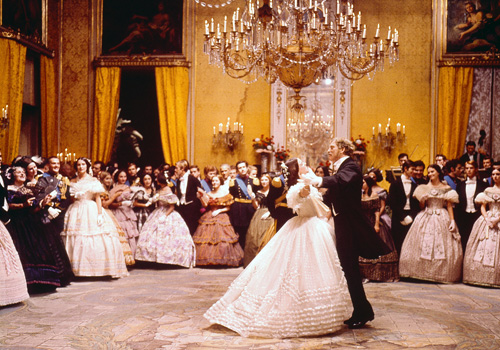
Luchino Visconti's direction is very fluid and mesmerizing in every scene he's shooting. From its wondrous, epic scope in the film's exterior settings in the country to the intimacy and atmosphere in the film’s interior sequences. Visconti's framing of the ball scene is wonderful in how he captures everything that goes on in the frame. The compositions later on are truly superb to capture the emotion of what is happening to the character of Fabrizio. The presentation and the way the dances are choreographed and capture show Visconti's talent in the directing front. The Don Diego ball sequence at forty-five minutes is truly mesmerizing with Visconti revealing everything that goes on. The result is truly a solid, engrossing, and certainly enchanting film that just doesn't stay true to the period but brings it to life in front of the audience.

Cinematographer Guiseppe Rotunno does amazing work with the film's look in its Technicolor, 35mm film stock with gorgeous coloring in every frame from the yellow, wheatfields in the countryside exteriors and hill tops on location in Sicily. Rotunno's camera work in the interiors with its use of day light for it sense of aura to the nighttime scenes in the interiors are filled with an array of color and richness that is exquisite in every frame shot. Rotunno's work is truly one of the film's highlights. Editor Mario Sarandrei does an excellent job in the transitional cuttings from scene to scene with the use of fade-outs and dissolves to help structure the story and most of all, maintain a meditative pacing style for the audience to get to know the characters and its surroundings.

Art director Mario Garbuglia along with set decorators Laudomia Hercolani and Giorgio Pes create exquisite interior set pieces for the homes that the character live in with authentic detailing of the furniture and silk for the look of the beds and such. The art direction in this film is truly divine for its attention to detail of the period of the mid-1800s in Italy. The costume design of Piero Tosi is just gorgeous to look at for its attention to detail and the sense of fluidity to the period. Notably in the ball scene where the dresses the women wear are jaw-droppingly beautiful for its coloring and stitching that is another highlight in its technical work. The music score of Nino Rota is truly mesmerizing from its sweeping arrangements, somber melodies, and orchestral power. The score is truly one of Rota's best work as he also arranged an old composition by Guiseppe Verdi in the waltz sequence as Rota's work is really one of the film's most memorable moments.

The casting of the film is superb with notable small performances from Howard Nelson Rubien as Don Diego, Ivo Garrani as Colonel Pallavicino, and Pierre Clementi as Fabrizio's son Francesco Paolo. Mario Girotti aka Terrence Hill is wonderfully dashing as the charming Count Cavriaghi who tries to woo Concetta with little success. Leslie French is great as Cavaliere Chevelley who tries to help out Fabrizio in his upcoming role while being clueless to his metaphorical line about his role and the world. Serge Reggiani is excellent as the loyal Don Ciccio who tries to warn Fabrizio about Sedara as he's forced to watch in horror the deal Fabrizio makes. Rina Morelli is good as Fabrizio's wife and princess who is trying to deal with the changes while being distraught towards Tancredi's rejection over her daughter Concetta. Paolo Stoppa is great as the scheming Don Sedara who hopes to gain everything from his deal despite his lack of manners and taste.

Romolo Valli is brilliant in his role as Father Pirrone, Fabrizio's spiritual guide who is one of the few trusted allies Fabrizio has while also wanting to speak matters of the heart when he wants some confessions from Fabrizio. Lucilla Morlacchi is excellent as Concetta, Fabrizio's eldest daughter who has fallen for her cousin Tancredi only to become cold by his rejection and his changing persona as she becomes bored by her own surroundings. Claudia Cardinale is superb in her role as Angelica, a beautiful woman who is touched by the kindness of Fabrizio while being aware of Concetta's feelings for Tancredi. Cardinale's sincere performance is lovely to watch, especially in her waltz with Burt Lancaster that shows how compassionate her character is to the man who is about to leave the world. Alain Delon is great as the charming Tancredi, a young man whose youthful ideals and enthusiasm is met with great love by his uncle despite his opinions. Yet, when he trades one faction for another, it becomes clear that he's merely a follower who is willing to try and maintain a position of power no matter where it comes from. It's a truly amazing performance from the French actor in his glory days in the early 1960s.

Finally, there's Burt Lancaster in what is truly one of his best performances in his legendary career. Lancaster's understated, world-weary performance is definitely one for the ages. Though in its full, uncut 185-minute Italian version, his performance is dubbed by another actor. Lancaster makes the most of it with his restraint and glorious presence as a prince who is trying to adapt to the changing time. Lancaster is most touching when he's not speaking or doing anything as he delves into all the emotions into what he's losing. It's a truly mesmerizing and powerful performance from the late yet legendary actor who even at the height of his fame is willing to take risks as an actor.

***The Following is DVD Content Relating to Il Gattopardo that was Written & Added on 11/2/10***

The 2004 3-disc Region 1 Criterion Collection DVD for Il Gattopardo presents the film in its two different versions in its two different discs.  The first disc is the definitive 185-minute cut of the film with a new high-digital transfer that is supervised by the film’s cinematographer Giuseppe Rotunno.  The film is also is presented with the its original Super Technirama letterboxed/widescreen aspect ratio of 2:21:1 along with restored sound and image.  The first disc also includes a new English subtitle translation and a full-length commentary track by film scholar Peter Cowie.

Cowie’s commentary reflects on many of the film’s themes, its historical setting, and on the life of Luchino Visconti.  Cowie also discusses what scenes were cut from the original film for the U.S. release which also included scenes where Don Fabrizio and Don Ciccio at the hunting scene is shortened in the America version along with a scene where Father Pirrone is talking about faith at an inn.  Cowie reveals Visconti’s own background as he grew up in an aristocratic family where during his time in Paris, he met Coco Chanel.  This would later him get some work for Jean Renoir where Renoir taught him the world of films.  Cowie says that during the early 60s, the most important Italian directors at that time were Visconti, Michelangelo Antonioni, Vittorio de Sica, and Federico Fellini.

Cowie also revealed that despite the fact that Burt Lancaster was the bigger star, Alain Delon was the only actor who got his own private dressing room which seemed insulting.  Though Lancaster remained professional throughout the film despite not speaking Italian with the rest of the cast.  Cowie also dwells on Claudia Cardinale, who was becoming one of Italy’s premier actresses at that time as she was breaking out internationally thanks to this film along with Fellini’s 8 ½.  The work of cinematographer Giuseppe Rotunno is widely discussed as he became a prominent cinematographer for the Italian industry, and a regular collaborator of Visconti.

For many of the historical aspects about the film, Cowie believes that the period of Italian reunification of the 1860s would spark the groundwork for the world of the Mafia in Sicily.  Cowie also dwells on the music of Nino Rota during the ballroom scene.  Even as he revealed that when worked with Francis Ford Coppola for a 2001 DVD release for The Godfather, they found audio tapes of Rota improvising various themes.  Cowie also goes deep into the discussion of the characters in the film while revealing many of the film’s themes that involve Don Fabrizio.  Cowie’s commentary is truly delightful and very informative with its relaxed and rhythmic tone.

The second disc of the DVD is filled with special features and documentaries relating to the film.  The first is a one-hour making-of documentary called A Dying Breed:  The Making of The Leopard.  Featuring interviews with Claudia Cardinale, screenwriters Suso Cecchi D’Amico and Enrico Medioli, and cinematographer Giuseppe Rutunno, plus several others including the late American filmmaker Sydney Pollack.  The six-part documentary recalls on everything that lead up to the making of the film and its release.  The first part talks about the contrast of backgrounds between Luchino Visconti and Giuseppe Tomasi di Lampedusa.  Even as some wondered if Visconti’s approach to the novel were too much since di Lampedusa died before the film ever came out.  By the time it was in the adaptation stage, it was very difficult since Visconti’s take on the book was much different from di Lampedusa.  Cut out of the story from the book were the last two chapters, the epilogues, where Visconti wanted to focus more on the Prince in his final moments for the third act of the film.  

Even the characterization of Tancredi and Angelica were different from what they were in the book as Visconti wanted them to be a more joyful, loving couple unaware of what will happen to them.  The casting of the film proved to be very difficult as they needed a big name to headline the film.  After the idea of casting a Russian actor to play Don Fabrizio didn’t work, they went to Laurence Olivier to see if he could go for the part.  The problem was that Olivier wasn’t available as producer Goffredo Lombardo made a real breakthrough in getting Burt Lancaster involved.  Though Visconti didn’t initially liked the idea of Lancaster as Don Fabrizio, he reluctantly agreed to the casting as the relationship between Lancaster and Visconti didn’t start out well.  

Yet, as the filming went on with Rutunno being the messenger for both men.  Lancaster and Visconti became the best of friends until Visconti’s death as Pollack revealed that the film proved to be a real acting breakthrough for Lancaster.  Even as Claudia Cardinale helped smooth out whatever issues Visconti and Lancaster had early on as she acted with Lancaster in English and with Alain Delon in French.  Cardinale had worked with Visconti in other film as did Delon as they were able to help things move quite seamlessly.  With the actors cast, production was set as costume designer Piero Tosi talked about the design of the costumes.  Notably the look of the soldiers where they wore early versions of blue jeans as their uniform while Rutunno and art director Mario Garbuglia talk about the look of Sicily and locations which were difficult to find.

Once the locations were found, Garbuglia and Rutunno went to great detail to recreate the interior designs of the home from the way it should be lit to the look of the walls.  For the ballroom sequence, it was a very difficult shoot due to the fact that there were several mirrors inside of the rooms.  Yet, Rutunno and Visconti were able to find ways to get the camera angles without the mirror showing the camera.  Tosi also talked about the costumes, notably the dress that Claudia Cardinale had to wear which was difficult to make.  Cardinale recalled the one thing she didn’t like about wearing the dress was the corset because it was half her size.

The fifth part of the documentary discusses about Visconti’s personality and his approach to making films.  Garbuglia and Tosi revealed that despite having a bad temper, Visconti was caring towards his collaborators and actors.  Cardinale also recalled about guiding her during her first dinner scene and got her to laugh in such a way.  The final part of the documentary recalls the American release where the people involved the film revealed how the Americans got it wrong.  Even as they had trouble with Visconti, who didn’t speak English and wasn’t very kind with the American producers at 20th Century Fox.  While Burt Lancaster was involved by dubbing his own voice with Sydney Pollack directing Lancaster during the syncing.  Pollack confesses that the American version of the film was lousy.  While he revealed that Lancaster ranked the film as his best role, the only qualm Lancaster had was that in the definitive version.  It wasn’t his voice while Pollack contended that it was the silent moments and graceful movements that gives reasons into why it’s one of Lancaster’s greatest roles of his career.

The second big feature is a 20-minute interview with producer Goffredo Lombardo.  Lombardo discusses about getting the film made because of the novel’s popularity as he went through early developments for the film until getting Luchino Visconti attached to the project.  Lombardo was responsible for getting Burt Lancaster involved as he had a hard time trying to talk to American producers, who treated the Italian producers with indifference.  Lancaster talked with Lombardo and decided to be involved after seeing a Visconti film called Rocco and His Brothers.  Though he knew Visconti wasn’t a fan of Lancaster, a meeting in Rome with Lancaster changed things.

Lombardo also discussed the production of the film as well as its release.  The reception for the film was good but in the way the film has been received many years later as a classic.  Lombardo also revealed that the film came out during a troubled period for Italian cinema because of a financial crisis.  Lombardo ends the interview talking about the idea of the DVD as he believes it’s a great thing so that it can be seen by people at their home.

The third and final big special feature is a fourteen-minute video interview with University of Pennsylvania professor Millicent Marcus about the Risorgimento period in Italy during the 19th Century.  Marcus revealed that the fall of the Roman Empire led to a separation of Italy where various sections of the country were run by different countries.  By the 1800s, there was a movement to reunify the country which finally happened in the mid-1800s.  Marcus revealed that the character of Chevelley was based on Camillo Benso, one of the leading figures of the Risorgimento.  Marcus talks about Giuseppe Garibaldi, a military figure who helped lead many battles that would lead to Italy’s reunification as Marcus reveals that he was seen as a romantic hero.

Marcus talks about the battle of Palermo, which was the big battle scene in the film as she talked about everything that was happening in that scene.  Even as it relates to the character of Tancredi where the battle would have a major effect on his views.  He starts out being a member of the revolution and then becomes part of the anti-revolution.  The Risorgimento was viewed as a failure because of power plays involving politics though there was an eventual reunification of the country though the real winner was the middle class.  Not the revolutionaries nor the aristocracy.  Marcus also talks about the idea of revolution in its various meanings while her last statement revolves around Don Fabrizio’s love of astronomy about how things would often go back.

Additional special features include a stills gallery that features rare pictures of Visconti on set, film posters, and scenes that didn’t make it to the final film or were in the original 205-minute cut of the film.  Also included in the promotional section of the special features are three trailers.  The original Italian trailer and two American trailers, the first of which featured Burt Lancaster presenting the trailer.  Finally, there’s two Italian newsreels that relates to the premieres of Il Gattopardo in Rome, where it was also an award ceremony for some of the finest in the Italian film industry including the film’s producer Goffredo Lombardo as well as Dino de Laurentiis and actress Gina Lollobrigida.

The third disc of the DVD is a remastered transfer of the 161-minute American release of the film from 20th Century Fox.  The film is presented in the widescreen aspect ratio of 2:35:1 with a remastered sound as it features the voices of Burt Lancaster and Leslie French in their respective roles as Don Fabrizio and Chevelley.  While the print of that version of the film does look great though doesn’t carry as much depth of field as the original did.  It’s not a bad version of the film as the differences isn’t what was cut from the original film as the only thing added was a text that appears after the opening credits about the Risorgimento.  The problem with the American version are in two factors.  First is the dubbing which affects the performances as they don’t have the same sense of regality in the original.  

Though there’s some moments where Lancaster is in great form as he dubs himself, the scenes where he displays some high emotions don’t seem right.  The other issue in the film is that the pacing, in some parts of the film, is off where things move slower in some parts including the ballroom scene while other scenes, notably the sequence where Don Fabrizio and his family go to their summer home where the scene at the inn was cut along with another scene of Tancredi talking to some soldiers.  It’s where some things become confusing because the audience has no idea what is happening.  To compare it to the original version, it would be a decent, adequate film.

Accompanied with the Criterion DVD set is an essay by film historian Michael Wood about the film.  Wood talks about the similarities between Visconti and novelist Giuseppe di Lampedusa.  Even as they have a fascination with the history of Italy as they both came from different ideas of aristocracy.  Wood also goes into the psychological aspects of the characters, notably Tancredi whose motivations are more to do with power as he’s unaware of the bleak future he and Angelica would have.  Yet, Wood reveals that the film is about a man of the old order trying to find a place in a world that is rapidly changing as he would make his way towards death.

The 3-disc DVD for Il Gattopardo is definitely one of the Criterion Collection’s finest releases as audiences get a chance to see the film in its definitive version.  Even as it includes the shorter, American version so audiences can see what 20th Century Fox did wrong though it’s not an entirely bad film.  It’s truly a must-have DVD for film buffs and fans of great Italian cinema.

***End of DVD Tidbits***

When it first played in Italy in the spring of 1963 with a cut of 205-minutes, reviews were good though some complained about the length of the film. Visconti eventually trimmed twenty-minutes of the film for its premiere at the Cannes Film Festival which won the Palme D'or. Despite the success at Cannes, 20th Century Fox decided to release the film with a new cut of 161-minutes and dubbing that included Burt Lancaster's own voice for the American version. The American version received mixed reviews while the film by itself lost its stature with Lancaster often saying it's one of the best films he's done. For years, Il Gattopardo had been rarely seen in its full version as in 1980, four years after Luchino Visconti's death. The film's cinematographer Giuseppe Rotunno supervised a restored version of the 185-minute cut that Visconti preferred to cinemas all over the world. The film was immediately hailed as a lost classic while its uncut version was seen by Americans in California in the groundbreaking pay-cable channel known as Z Channel.

Luchino Visconti's Il Gattopardo in its 185-minute, Italian version is a magnificent film for the ages led by a masterful and sprawling performance by the legendary Burt Lancaster. Fans of Italian cinema no doubt consider this film as essential in its full glory while it's suggested to avoid the American version since it doesn't carry the same sense of prestige and beauty of its full Italian version. With great technical work from Guiseppe Rotunno, Piero Tosi, and Nino Rota along with super supporting performances from Alain Delon, Claudia Cardinale, Lucilla Morlacchi, and Romolo Valli. It's a must-see for fans of art-house cinema while traditional audiences should be patient for its pacing and epic scope. In the end, Luchino Visconti's Il Gattopardo is classic period-piece cinema at its finest.

Luchino Visconti Films: (Obsessione) – (Giorni di gloria) – (La Terra Firma) – (Bellissima) – (Appunti su un fatto di cronaca) – (We, the Women) – SensoWhite Nights (1957 film)Rocco and His Brothers - (Boccaccio ’70-Il lavoro) – Sandra – (The Stranger (1967 film)) – The Witches (1967 film)- The Witch Burned AliveThe Damned (1969 film) – (Alla ricerca di Tadzio) – Death in Venice – (Ludwig) – (Conversation Piece) – The Innocent (1976 film)

© thevoid99 2017