Produced by David O. Selznick, directed by William A. Wellman, and screenplay by Robert Carson, Dorothy Parker, and Alan Campbell from a story by Wellman and Carson, A Star is Born is the story of a farm girl from North Dakota who goes to Hollywood in the hopes of becoming a movie star where she meets an actor whose career is on his way down as he helps her become a star only to see her rise big while he continues to spiral. The film is a romantic drama that explores the different trajectories between two people who meet and fall for each other only for their fates in their professional lives to change drastically. Starring Janet Gaynor, Fredric March, Adolphe Menjou, May Robson, Andy Devine, Lionel Stander, and Owen Moore. A Star is Born is a majestic and rich film from producer David O. Selznick and director William A. Wellman.
The film is the simple story of the rise of a young farm girl who meets a movie star at a dinner party in Hollywood as she would become an actress of her own right while the movie star she meets and marries would endure a fall of his own just as hers is on the rise. It’s a film with a simple premise as it play into the different paths two people endure upon their initial meeting as one dreams of making while the other has made it but has become burned out by stardom. The film’s screenplay, which feature additional contributions from producer David O. Selznick, Ben Hecht, Ring Lardner Jr., John Lee Mahin, Budd Schulberg, and Adela Rogers St. Johns, opens with the young woman Esther Victoria Blodgett (Janet Gaynor) coming home from a movie theater in her small North Dakota home having seen a film starring Norman Maine (Fredric March) as she hopes to be an actress in the movies as she is encouraged by her grandmother Lettie (May Robson) to follow her dreams.
While Blodgett struggles to get work, she meets an unemployed assistant director in Danny McGuire (Andy Devine) as they both live in the same boarding house as he would get her a job working as a server at a Hollywood party where she meets Maine properly after she and McGuire saw him days earlier at the Hollywood Bowl drunk. At the party, she and Maine become friends as the latter is impressed by her charms as he believes she can be an actress as he would introduce her to producer Oliver Niles (Adolph Menjou) who sees her potential as he would put her and Maine into a film that would be successful while Blodgett would get a new name in Vicki Lester as she and Maine would later marry. The script has a unique structure with the first act being about Blodgett’s early struggles and her meeting with Maine while the second act is about her rise and her marriage to Maine that also interacts with Maine’s struggle to be sober. The third act is about his fall and attempts to revive his already troubled career as he’s known more as Lester’s husband with Blodgett trying to help him.
William A. Wellman’s direction is largely straightforward in terms of the compositions he creates while it also play into some of the romanticism about the one in hundred thousand chance of someone making it in Hollywood as the film is shot on location in studio lots in Hollywood and locations nearby. With additional yet un-credited direction from Jack Conway, Wellman does maintain this world that is enchanting of what Hollywood is where there are some wide and medium shots to capture the beauty of it but there’s also some realism into what Blodgett has to face. The medium shots also play into the way characters interact as well as the relationship between Blodgett and Maine as there is something special in their growing love for one another. Wellman also maintains that sense of grandeur of the world that is Hollywood but also infuse that realism into its third act as it relates to Maine’s downward spiral as he struggles to stay sober and get his act together only to deal with adversity and disdain with some calling him a has-been. Overall, Wellman crafts a mesmerizing and wondrous film about a woman’s rise to stardom as she also witness her husband’s fall from grace.
Cinematographer W. Howard Greene does brilliant work with the film’s Technicolor cinematography in one of its early usage of the format where it does capture the beauty in some of the colors including the dresses that Blodgett would wear but also the locations that she and Maine would go to as it’s a highlight of the film. Editors James E. Newcom and Anson Stevenson do some excellent work with the film’s editing as it has bits of style in a few transitions while also playing into the frenzy of Blodgett’s rise and the slow burn through some straightforward editing in Maine’s fall. Production designer Lansing C. Holden and art director Lyle R. Wheeler do amazing work with the look of the house where Maine and Blodgett meet as well as some of the places including the small camper they used for their honeymoon.
Costume designer Omar Kiam does fantastic work with the design of the many dresses that Blodgett would wear along with the stylish clothes that the other women would wear in the film. The film’s special effects by Jack Cosgrove is terrific to help play with some of the visuals including a scene involving the camper. Sound recordist Oscar Lagerstrom does superb work with the sound in the way certain objects sound on location including the scene involving the camper and at the Academy Award ceremony where Maine makes a spectacle of himself. The film’s music by Max Steiner is wonderful for its soaring orchestral score that has elements of bombast with its strings and percussions while it also feature themes that are serene and somber to play into the drama.
The casting by Charles Richards is marvelous as it feature some notable small roles from J.C. Nugent as Blodgett’s father, Clara Blandick as Blodgett’s aunt, Guinn “Big Boy” Williams as a posture coach, Jonathan Hale as a night court judge, Elizabeth Jenns as a fellow actress/former girlfriend of Maine, Edgar Kennedy as the boarding house landlord Pop Randall, Peggy Wood as a Hollywood secretary in Miss Phillips, and Owen Moore as the film director Casey Burke. Andy Devine is superb as Danny McGuire as an unemployed assistant director who would get Blodgett the job as a server at a party as he would be part of Blodgett’s circle of friends as a way to ground her and to get himself some work. Lionel Stander is fantastic as the press agent Matt Libby as a man who does publicity for the studio while is also someone that isn’t fond of Maine due to his troubles as well as say things that are uncalled for. May Robson is excellent as Blodgett’s grandmother Lettie as a woman who encourages Blodgett to go after her dreams as well as arrive late in the film for a pep talk as well as be someone who is full of spunk and will.
Adolphe Menjou is brilliant as producer Oliver Niles as a man who is a friend of Maine who takes notice of Blodgett’s talents as he is also protective of both of them as well as wanting what is best for both of them. Finally, there’s the duo of Fredric March and Janet Gaynor in sensational performances in their respective roles as Norman Maine and Esther Victoria Blodgett/Vicki Lester. March’s performance as the tormented and troubled Maine showcases a man who had it all as well as a lot of problems as he helps Blodgett become a star but deals with the decline of his career as some of it is attributed to himself. Gaynor’s performance as Blodgett is one of grace and charm but also a woman who is grounded in her humble beginnings as she is happy to be noticed but also wants to protect her husband. March and Gaynor radiate with the chemistry as the capture the sense of joy and tragedy they would endure as well as the idea of stardom as they represent those two different trajectories.
A Star is Born is a remarkable film from William C. Wellman and producer David O. Selznick with great performances from Janet Gaynor and Fredric March. Along with top-notch supporting performances from Adolphe Menjou, May Robson, Lionel Stander, and Andy Devine as well as a sumptuous music score and gorgeous early usage of the Technicolor film format. The film is definitely a touching and riveting romantic drama that play into a lot of conventional ideas expected of the times but also with an intriguing study of fortunes between two people. In the end, A Star is Born is a marvelous film from William C. Wellman and producer David O. Selznick.
Related: A Star is Born (1954 film) – (A Star is Born (1976 film)) – A Star is Born (2018 film)
© thevoid99 2019
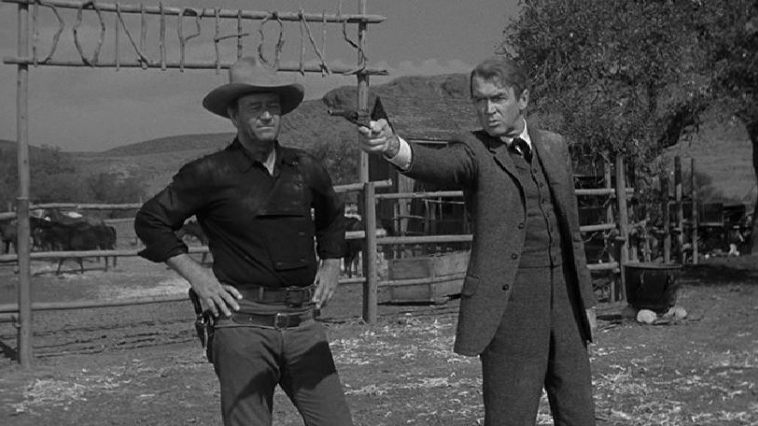
Based on the short story by Dorothy M. Johnson, The Man Who Shot Liberty Valance is the story of an attorney whose encounters with a notorious outlaw has him teaming up with a gunslinger to deal with him in order to protect the people at a small town in the West. Directed by John Ford and screenplay by James Warner Bellah and Willis Goldbeck, the film is an exploration of two men with different ideas of the world who team up to face off against someone who just wants to bring chaos into the world. Starring John Wayne, James Stewart, Vera Miles, Lee Marvin, Edmond O’Brien, Andy Devine, John Carradine, Jeanette Nolan, Woody Strode, Strother Martin, and Lee Van Cleef. The Man Who Shot Liberty Valance is a grand yet evocative film from John Ford.
The film is essentially a reflective story in which a senator recalls a time in his life when he was just an attorney arriving into a small town in the West where he tries to stand up against a notorious outlaw where he later teams up with a gunslinger and a few others in making a stand against him. Especially as he would later become a pillar of hope in a town that is still ravaged with fear prompting this attorney from the East to make a difference. The film’s screenplay begins with Ranse Stoddard (James Stewart) and his wife Hallie (Vera Miles) arriving to the small town of Shinbone as the local press wonder why he’s there. He then tells them the story of how he first came to the town 25 years earlier where he would meet Hallie and stand up to the outlaw known as Liberty Valance (Lee Marvin) after trying to stop him from robbing a widow during a stagecoach robbery. After being healed by Hallie and a local rancher in Tom Doniphon (John Wayne), Stoddard would do whatever he can to help the town.
Stoddard is a man that is educated and isn’t willing to be violent as he is trying to make sure there’s some law and order in this small town he’s arrived in as he also wants to be there for the people whether it’s to defend them in a court of law or teach them how to read and write. He would live at the restaurant that Hallie works at while doing his law practice at the local newspaper run by its publisher Dutton Peabody (Edmond O’Brien) who would befriend Stoddard as they would team up for an election on statehood. While Doniphon appreciates what Stoddard is doing, he feels that Stoddard is also just making things troubling because of Valance who wants to maintain his own power by beating up anyone or kill someone. Doniphon is a no-nonsense man who can read and write but knows how lawless the West can be as he is the only man that can out-gun Valance.
John Ford’s direction is definitely rapturous in terms of some of the visuals he creates as well as the fact that much of the story is told in a reflective manner by Stoddard to a journalist. Shot on the studio backlots at Paramount Studios in Hollywood, the film is more intimate in terms of its location even though there are a few scenes set in the desert as much of it is shot at a soundstage as the fictional town of Shinbone. While there are some wide shots of some of those locations, Ford would emphasize more on close-ups and medium shots for much of the film as it relate to the intimacy in the story as well as capturing some of the conversations and moments with the characters. Notably in the scenes that show Stoddard doing all sorts of things whether in educating some of the locals, cleaning the dishes at the restaurant where he’s staying at, or looking at Peacock’s articles. While much of the film is dramatic with some suspense, Ford would infuse the film with bits of humor such as a scene where Doniphon would show Stoddard how to shoot a gun as it would reveal how tough Stoddard really is.
As for some of the action, there are moments where the violence is quite brutal such as the Stoddard’s first encounter with Valance where Valance would whip him such a visceral way. The scenes where Valance is around is always filled with dread as the man is quite unpredictable as he would just scare people with his presence or through his violent actions. There is a showdown that would occur between Stoddard and Valance but it’s a very unusual showdown early in its third act. Notably as it would be followed by its aftermath as it relates to not just what happened to Valance but also who shot him as it would create this myth that is very unsettling. Overall, Ford creates a mesmerizing yet intense film about a lawyer and a gunslinger standing up against a notorious outlaw.
Cinematographer William H. Clothier does brilliant work with the film’s black-and-white photography from the sunny look of the daytime exteriors to some of the stylish usage of shadows and shades for some of the interior/exterior scenes at night. Editor Otho Lovering does excellent work with the film’s editing as it has some stylish rhythmic cuts to play into the action and suspense as well as some straightforward cuts for the drama. Art directors Eddie Imazu and Hal Pereira, with set decorators Sam Comer and Darrell Silvera, do fantastic work with the look of the saloons, restaurants, and Doniphon’s ranch as well as the interiors of some of the buildings in the film.
Costume designer Edith Head does nice work with the costumes from the look of the hats and clothes the men wear to some of the dresses that Hallie wears. Sound recordists Charles Grenzbach and Philip Mitchell do terrific work with the sound as it play into raucous sound of the meetings as well as in some of the moments of suspense as it relates to the showdown between Stoddard and Valance. The film’s music by Cyril J. Mockridge and Alfred Newman is wonderful for its mixture of bombastic orchestra music with its large brass arrangements and string flourishes for some of the dramatic moments as the score also include some folk-based music of the times.
The film’s superb cast include some notable small roles from Denver Pyle and O.Z. Whitehead as the father-son duo of Amos and Herbert Carruthers, Willis Bouchey as a train conductor, Joseph Hoover as a journalist interviewing Stoddard in the film’s beginning, Jeanette Nolan and John Qualen as the Swedish immigrant couple in the Ericsons who work with Hallie at the restaurant, John Carradine as a speaker for a convention representing those in favor of territory rights, Ken Murray as the local doctor Doc Willoughby, Strother Martin and Lee Van Cleef as two of Valance’s henchman in their respective roles as Floyd and Reese, and Woody Strode as Doniphon’s ranch hand Pompey as an African-American that is very helpful as well as wanting to be educated by Stoddard. Andy Devine is terrific as the local marshal Link Appleyard as a man that has a hard time upholding the law as he’s afraid of Valance as he is kind of the film’s comic relief. Edmond O’Brien is excellent as Dutton Peabody as the local newspaper publisher who is full of gusto in the things he says while admittedly being a drunk but a man that can rile up Valance through his words.
Vera Miles is amazing as Hallie as a local woman who runs a restaurant as she is courted by Doniphon as she would fall for Stoddard whom she sees as a man that can help her as well as make her into something more. Lee Marvin is brilliant as Liberty Valance as a brutish outlaw who likes to wreak havoc on the people as he tries to assert his own power and whatever he can to play into his role in the West. James Stewart is incredible as Ranse Stoddard as an attorney who is trying to help the locals in the small town as he also stands up to Valance where he is forced to see what he has to do to deal with him. Finally, there’s John Wayne in a phenomenal performance as Tom Doniphon as it is a performance where Wayne display some charm as well as humility as a gunslinger that is the one person that can deal with Valance but also is aware of what Stoddard is trying to do for the town as he would take action that would prove to be catastrophic for both men.
The Man Who Shot Liberty Valance is a sensational film from John Ford that features great performances from John Wayne, James Stewart, Vera Miles, and Lee Marvin. Along with its dazzling visuals and a compelling take on heroism, it’s a film that explore what some will do to help people not be afraid from the presence of an outlaw but also into the myths of the West. In the end, The Man Who Shot Liberty Valance is a tremendous film from John Ford.
© thevoid99 2017
Based on the short story The Stage to Lordsburg by Ernest Haycox, Stagecoach is the story of a group of strangers riding on a stagecoach through strange circumstances as they trek through the dangerous Apache territory. Directed by John Ford and screenplay by Ben Hecht and Dudley Nichols, the film is a thrilling tale involving nine people going on a journey hoping to survive in the American west as it’s considered one of the definitive films of the western genre. Starring Claire Trevor, John Wayne, Thomas Mitchell, John Carradine, Andy Devine, and George Bancroft. Stagecoach is an exciting yet powerful film from John Ford.
The film revolves around a group of different people riding on a stagecoach from the small town of Tonto in the Arizona territory to Lordsburg in New Mexico as they have to trek through the dangerous territory where the Apache wreaks havoc. Yet, the film is more about the people that is riding a stagecoach that includes a prostitute, a drunken doctor, a whiskey salesman, a gambler, a banker, and the pregnant wife of a cavalry officer as they ride with two men driving the stagecoach to get through this treacherous journey. They’re later joined by a criminal known as the Ringo Kid (John Wayne) who helps them as have to endure some circumstances including the Apache led by Geronimo (Chief White Horse).
The film’s screenplay has a unique structure where the first act is about these six different passengers and two stagecoach drivers as they’re all very different while being aware about the Ringo Kid who just escaped prison and is seeking revenge against another criminal. While the passengers know about the Ringo Kid and his reputation, he’s a character that doesn’t fit the mold of what is expected in a criminal as he’s a man of honor as he tells one of the stagecoach drivers in Marshal Curly Wilcox (George Bancroft) that he will go back to prison after getting his revenge. The second act is about these characters including Ringo seeking shelter at a place run by a Mexican named Chris (Chris-Pin Martin) where they have to wait for the Apache to see if they will go after them knowing they’re in Apache territory.
One of the interesting aspects of the film’s screenplay are the characters that are present in this story. Aside from Ringo, the Marshal, and the Marshal’s dim-witted but sweet stagecoach driver Buck (Andy Devine), there’s these six passengers who sort of know each other but don’t want anything to do with each other. Dallas (Claire Trevor) is a prostitute who is driven out of Tonto because of a woman’s league while Lucy Mallory (Louise Platt) is a pregnant cavalry officer’s wife who dislikes Dallas because of what she is. There’s also a drunken doctor named Doc Boone (Thomas Mitchell) who is driven out of town because of his drunken behavior as he befriends the whiskey salesman Mr. Peacock (Donald Meek) who is part of stagecoach trip. There’s also this Southern gambler named Hatfield (John Carradine) who served in the Confederate army as he knows Mallory while the banker Henry Gatewood (Berton Churchill) is a man that just embezzled $50,000.
While they’re aware of what they have to do to reach their destination, not everyone is on board as it plays into the desperation of the characters until they stop at this shelter where nearly everyone bands together to not only help the pregnant Lucy but also hide from a possible attack from the Apache. It is in these moments that everyone forgets their differences and work together where Ringo makes an offer to Dallas about a life that she could have. While the third act involves a climatic chase scene involving the stagecoach and the Apache, it also plays into the sense of honor that Ringo has towards the people’s he’s with and what he needs to do once he reaches Lordsburg.
The direction of John Ford is truly sensational in not just the sense of intimacy he creates in the drama but allowing to balance it with something that is sprawling and vast in some of the location settings he provides for the scenes in the stagecoach. Shot in the Arizona-Utah border as well as parts of Monument Valley that would become a playground for Ford for many years. The film has this look that is very broad where Ford can create something that is sweeping and epic though it’s only presented in the Academy full-frame theatrical aspect ratio as the widescreen format wasn’t invented at the time.
While Ford is able to maintain something that is thrilling and vast in many of the scenes with the stagecoach including some stylized hand-held shots, tracking shots, and other stylized camera work to play up that intensity. Ford also knows when to slow things down so that he can get the chance for the audience to get to know the characters and how they have to survive the sense of impending danger. One of the interesting aspects of Ford’s direction is where he puts the actors in a frame such as a scene where the passengers sit on a table to eat lunch where it plays to the sense of tension between the characters. It’s a very simple yet poignant scene to establish these differences until later in the film where everyone bands together as Ford uses some wide and medium shots along with some close-ups to help intensify the drama.
The film’s chase scene involving this band of Apache warriors led by Geronimo is certainly one of the most thrilling moments of the film. It is followed by a sequence where Ringo learns what Dallas really does as well as the fact that he’s going to embark on a showdown. The suspense does build up very slow where Ford knows what he needs to show and what he doesn’t need. Notably as it shows what kind of man Ringo is as someone who is a man who always gives his word as even someone like the marshal knows that he’s someone that does good. Overall, Ford creates a very sensational film about a band of people working together to survive against danger.
Cinematographer Bert Glennon does excellent work with the film‘s black-and-white photography to play up the sense of beauty for many of the exterior scenes including some of the shots in Monument Valley along with low-key lights in some of the film‘s interior scenes. Editors Otho Lovering and Dorothy Spencer do brilliant work with the editing with its tight yet rhythmic approach to cutting in the film‘s action scenes while being very straightforward with its approach to drama and suspense. Art director Alexander Tubuloff does superb work with the set pieces from the look of the stagecoach and shelters to the look of the towns the characters go to.
The costumes of Walter Plunkett is terrific for the look of the different clothes the men wear as well as the dresses the women wear. The sound work of Frank Maher is fantastic for the atmosphere it creates including the sound of coyotes and gunfire in the desert. The film’s fantastic music consists of many traditional pieces adapted by Gerard Carbonara that includes some sweeping orchestral scores and some more mid-tempo country-folk pieces.
The film’s cast is truly remarkable for the ensemble that is created that includes appearances from Chris-Pin Martin as the Mexican shelter owner, Chief White Horse as Geronimo, Tim Holt as a cavalry lieutenant who accompanies the stagecoach in the film’s first act, and Tom Tyler as the criminal Ringo is going after upon his arrival to Lordsburg. Berton Churchill is very good as the very suspicious and cowardly banker Gatewood while Donald Meek is terrific as the kind whiskey salesman Mr. Peacock. Andy Devine is very funny as the sweet-natured stagecoach driver Buck while George Bancroft is superb as Marshal Curly Wilcox who leads the stagecoach while being wary of the Ringo Kid. Thomas Mitchell is brilliant as Doc Boone as a drunk doctor who might seem incompetent but turns out to be a complete professional.
Louise Platt is wonderful as Lucy Mallory as a woman who is uncomfortable with Dallas’ presence until she realizes how much she needs her help as they become friends while being intrigued by Hatfield. John Carradine is excellent as Hatfield as a gambler who is fascinated by Mallory while helping out Ringo and the marshal handle the Apache as he becomes Lucy’s protector. Claire Trevor is amazing as Dallas as a woman who has to find a new home as she deals with what she has to face as well as the offer that Ringo has as it’s a very complex yet engaging performance from the actress. Finally, there’s John Wayne in a truly spectacular performance as the Ringo Kid from the way he’s introduced from that zoom shot to the way he handles things. It’s definitely a performance where Wayne gets to prove himself to be the badass as well as the everyman that audiences can identify with as it’s certainly a performance for the ages.
Stagecoach is an outstanding film from John Ford that features a magnificent performance from John Wayne. Along with a great supporting cast and amazing technical work, it’s a film that definitely has many elements into why the western is such a beloved genre. It’s also a film that is very entertaining as well as engaging about the way people work together and put their differences aside with help from a criminal who has a sense of honor. In the end, Stagecoach is a phenomenal film from John Ford.
© thevoid99 2013