Showing posts with label carina lau. Show all posts
Wednesday, December 11, 2013
Days of Being Wild
Written and directed by Wong Kar-Wai, Days of Being Wild is the story of a notorious playboy who tries to find his identity while dealing with his own romantic entanglements as those women seek solace in other men. The film is the first part of an informal trilogy that would be followed by 2000’s In the Mood for Love and 2004’s 2046 that explores the idea of love and loneliness as it’s all set in 1960s Hong Kong. Starring Leslie Cheung, Andy Lau, Maggie Cheung, Carina Lau, Jacky Cheung, Tony Leung Chiu-Wai, and Rebecca Pan. Days of Being Wild is a ravishing yet captivating film from Wong Kar-Wai.
The film is a multi-layered story that revolves the lives of a cruel playboy whose entanglements with two different women has them feel hurt while the playboy goes on a journey of his own to find out his true identity when the escort who had raised him told him about his true parentage. It’s a film that explores the idea of rejection and loneliness all in the world of his playboy named York (Leslie Cheung) who likes to wander around in the many situations he’s in where he woos a woman and then moves on to something else. For the two women he woos in Su Li Zhen (Maggie Cheung) and Mimi (Carina Lau), both of them go into different journeys after the rejection where Zhen talks to a cop named Tide (Andy Lau) while Mimi is being pursued by York’s friend Zeb (Jacky Cheung). York would also go into his journey to find his real mother as his relationship with his guardian in the aging escort Rebecca (Rebecca Pan) starts to disintegrate.
Wong Kar-Wai’s script has this very unique narrative where it doesn’t follow any conventional narratives where its first act is about York’s antics with Su Li Zhen and later his affair with Mimi. The second act is about Zhen meeting Tide where the latter is just a beat cop doing his job as Zhen just talks to him where the two become friends for a while. The second act also plays into the tumultuous relationship between York and Mimi where it’s filled with a lot of indifference from York who is more concerned about his adopted mother’s life with another man and her desire to move to the U.S. It all plays to this third act where York travels to the Philippines to find his biological mother but he would endure the similar kind of pain Zhen and Mimi endured but in very different ways.
Kar-Wai would add bits of voice-over narration to express the loneliness the characters face. Especially where York keeps talking about a bird that just flies continuously only to land when it dies which serves as a metaphor for the life he’s leading. A life that is often quite empty where he would meet a major character in the film’s third act who witnesses the emptiness of York’s life up close. The third act would also play into a lot of ambiguities over the fate of these characters including an unnamed gambler (Tony Leung Chiu-Wai) who appears at the end of the film.
Kar-Wai’s direction is truly evocative in the way he presents life in 1960s Hong Kong where it’s a world that is quite exciting. Going for a hand-held style that is quite loose but also with a sense of control, it plays to this sense of change that is occurring in the 1960s where the attitudes of men start to lose its way a bit as the two women that York encounters would both deal with tribulations over the fallout of their relationship with him. Zhen and Mimi would have similar reactions to the way they were rejected by York as Kar-Wai’s compositions shows them in very fragile moments where the framing is very succinct with very little emphasis on close-ups in favor of wide and medium shots. Even where the two women would meet two men who were willing to help as it plays into how they would react to this gesture.
The direction also has Kar-Wai take great care into the way he presents not just Hong Kong but also the Philippines as it has this air of style that is seductive in its imagery. While much of the Hong Kong presentation is a bit dreary with some unique palettes to convey a mood, there is something about the scenes in the Philippines that is more dream-like but also off in some ways where York would encounter elements of danger. Notably as Kar-Wai would utilize some strange camera angles to present something that is a bit surreal but also grounded in the way York had lived his life. Yet, it is followed by an ending that is described as ambiguous but also something where things are changing over everything that the characters in the film have endured. Overall, Kar-Wai crafts a very abstract yet intoxicating film about rejection and loneliness.
Cinematographer Christopher Doyle does phenomenal work with the film‘s cinematography with its use of grainy colored palettes and dark lighting schemes for some of the film‘s interior scenes along with its emphasis on the color green to play with its mood as Doyle‘s work is truly a major highlight of the film. Editors Kit-Wai Kan, Patrick Tam, and William Chang do fantastic work with the editing where it is quite straightforward in its presentation while they do create a few montages and some rhythmic moments for some of the film‘s darker moments. Production/costume designer William Chang does amazing work with the look of the apartments and such for the scenes set in Hong Kong and in the Philippines along with some of the clothes that Mimi wears to play into her exotic style.
Sound recorder Benny Chu does excellent work with the sound to convey some of the intimacy that goes on in some of the scenes along with the craziness and textures into the sense of longing that occurs. The film’s music by Terry Chan is wonderful as it is mostly low-key with its orchestral-based music and jazz pieces while the soundtrack includes lots of jazz pieces as well as Latin-based cuts to play into the world that the characters live in.
The film’s cast is brilliant for the ensemble that includes some notable small appearances from Tita Munoz as York’s mother, Danilo Antunes as Rebecca’s mother, and Tony Leung Chiu-Wai as the unnamed gambler at the end of the film. Jacky Cheung is excellent as York’s friend Zeb who helps York go to the Philippines while trying to woo Mimi. Rebecca Pan is wonderful as York’s adopted mother Rebecca who seems to despise him for wanting to find the truth of his real parentage while also being someone who feels like she’s got nothing more to give. Carina Lau is amazing as Mimi who is also called Lulu and Leung Fung-ying as this woman who falls for York only to feel jealous over his other affairs as she starts to fall apart. Andy Lau is fantastic as the policeman Tide who befriends Su Li Zhen as he listens to her troubles while offering to be someone to talk to as he laments over his feelings for her.
Maggie Cheung is superb as the shy and melancholic Su Li Zhen as a woman whose encounter with York has her feeling hurt and alone while she tries to figure out how to move on. Finally, there’s Leslie Cheung in a phenomenal performance as York as this cruel playboy who likes to play around with women while trying to find out about his roots as he’s also a man who wanders into every situation he’s in no matter how foolish it can be.
Days of Being Wild is a seductive yet gorgeous film from Wong Kar-Wai. Armed with a great cast, lush visuals, and a rapturous film soundtrack, the film is truly one of Kar-Wai’s finest work in terms of what he’s all about in his exploration of love and loneliness. Especially in the way he delves into the themes of rejection and wandering through life in its most poetic manner. In the end, Days of Being Wild is a sensational film from Wong Kar-Wai.
Wong Kar-Wai Films: As Tears Go By - Chungking Express - Ashes of Time/Ashes of Time Redux - Fallen Angels - Happy Together - In the Mood for Love - 2046 - Eros-The Hand - My Blueberry Nights - The Grandmaster - The Auteurs #28: Wong Kar-Wai
© thevoid99 2013
Saturday, January 22, 2011
Ashes of Time/Ashes of Time Redux
After two feature films, Wong Kar-Wai was emerging as a new voice in Hong Kong cinema who was making films that weren’t the traditional martial arts or crime films of the time. Instead, Kar-Wai stood out as he was making the kind of films that related more to the world of European cinema than the world of his native Hong Kong. For his next feature, Kar-Wai decided to enter the world of the martial arts epic known as wuxia by adapting Louis Cha’s novel The Legend of the Condor Heroes. With getting a cast of some of Asian cinema’s finest actors, the project entitled Ashes of Time wouldn’t just be his most ambitious project to date. It would also become his most complicated and troubled production of his burgeoning career at that time.
The production for Ashes of Time dragged for a year as it went over-budget and over-scheduled largely due to Kar-Wai’s insistence of working without a script. The headaches of the ambitious production shot on location in mainland China’s desert proved to be overwhelming. After shooting completed, Kar-Wai took a break to work on another project that would become Chungking Express as it was released in early 1994. While working on another project that would become Fallen Angels, Kar-Wai went to work on editing and finishing Ashes of Time for its release in the fall of 1994.
The film would received mixed reviews as it also became a box office failure where the film disappeared for years as Kar-Wai’s cult began to grow internationally. Even as audiences became interested in Ashes of Time where the film was shown but in different versions. In 2003, Kar-Wai along with his longtime cinematographer Christopher Doyle and longtime editor/art director William Chang to create a re-assembled version of the film with copies of the film from China and France to be their source since the original negatives were in bad shape.
Another problem for the re-assembled version wasn’t just color-correcting the film but also creating a new score since the soundtrack was heavily-damaged to re-record. With the help of Yo-Yo Ma in creating new cello solos based on Wu Tong’s new arrangements. A new score along with pieces from the original score was re-created for the new assembled version that would be called Ashes of Time Redux.
Written for the screen and directed by Wong Kar-Wai. Ashes of Time (Dung che sai duk) tells the story of a heartbroken swordsman who serves as a middleman between bounty hunters and those seeking help. Along the way, the swordsmen deal with individuals who want revenge on bandits or siblings while he also deals with his own past and regrets. Part wuxia film and part drama, it’s a film that would broaden the wuxia genre as it would help set the course of other films of that genre such as Ang Lee’s Crouching Tiger, Hidden Dragon and the recent films of Zhang Yimou. Featuring choreography from legendary martial arts star Sammo Hung, the film stars such Kar-Wai regulars Leslie Cheung, Brigitte Lin, Tony Leung Chiu-Wai, Carina Lau, and Maggie Cheung along with Tony Leung Ka-Fai, Charlie Yeung, and Jacky Cheung. Ashes of Time/Ashes of Time Redux is a hypnotic yet mesmerizing film from Wong Kar-Wai.
(Note: The following plot description and film analysis is based on the Redux version of the film)
Living alone in the desert as a middleman for bounty hunters and its customers, Ouyang Feng (Leslie Cheung) is a man filled with cynicism as he only cares about making money no matter what side he’s on. It’s spring as one of Feng’s bounty hunters named Huang Yaoshi (Tony Leung Ka-Fai) has arrived for his yearly visit but with a bottle of wine this time. Yaoshi talks about a woman (Carina Lau) he’s fallen for as he learns he’s the wife another bounty hunter (Tony Leung Chiu-Wai). Yet, Yaoshi is in trouble with that bounty hunter as he was an old friend. The problem is that Yaoshi is losing his memory while the other bounty hunter is going blind.
Returning to his home, Yaoshi has an encounter with a drunk yet masterful swordsman named Murong (Brigitte Lin) as a fight ensues. Later, Murong hires Feng to have someone kill the man going after her sister. Feng meanwhile, gets an offer from Murong’s sister to kill her brother as Feng realizes that something isn‘t right as he believes they could be the same person. It’s summer as a young woman (Charlie Yeung) offers her mule and eggs to Feng to find a bounty hunter to fight off some bandits. Feng refuses the offer as the blind swordsman arrives to talk about Yaoshi as he is thinking of taking the young woman’s offer to fight off the bandits.
Yet, the bandits continue to become a threat as another bounty hunter named Hong Quiong (Jacky Cheung) decides to fight them. While he’s a man known for simple things and has a way of handling business. Something is off as Hong gets himself injured as Feng believes that the woman with the eggs and mule is a curse. Hong however, thinks the opposite as he decides to leave with his wife (Li Bai) as Feng becomes haunted by the memories of his former flame (Maggie Cheung) who had already married his brother. Feng meanwhile learns why Yaoshi has come to the desert every year as he waits for the next spring for Yaoshi to arrive.
While the film’s complex story takes place in the span of a year, its loose structure in placing the film on its seasonal settings gives way to an epic that isn’t like anything else. While at times, the pacing lags a bit in a few scenes. It’s a film that is really about a man whose lack of morals about hiring bounty hunters to do their jobs would only have him face his own regrets and mistakes that he’s made in the past. A lot of the story is told from Feng’s perspective in the narration as he reflects on his own past and hopes of attaining glory while looking on at his bounty hunters. Each have their own story to tell through a bit of their own narration as they all deal with their own issues and moral conflict.
The looseness of the story is attributed to Kar-Wai not using a script as his direction of the film is truly mesmerizing. Particularly shooting on location at the desert where he goes for a huge, epic feel. Kar-Wai definitely displays grand visuals for many of the film’s deserts and battle scenes with help from Sammo Hung’s choreography in the fights. Yet, he maintains a sense of intimacy for some of the non-action, dramatic scenes while creating gorgeous shots filled with landscapes being exploded along with a shot of water gushing from a lake. In many ways, it’s a dream-like film of sorts with lush images of water and landscapes set in a rough desert. Yet, it has all of the touches of a Kar-Wai film where despite a few flaws in the story.
Longtime Kar-Wai collaborator Christopher Doyle brings a gorgeous yet hypnotic look to the film’s cinematography. Shot with grainy film stock, Doyle’s photography maintains a gritty look to the film, notably the fight scenes. For the scenes in the jungle, there’s a lush feel with its mesh of green, white, and other colors. A lot of Doyle’s photography plays to a lot of the work he’s done with Kar-Wai as it’s definitely one of the film’s technical highlights.
Another Kar-Wai collaborator in William Chang does a lot of excellent work to the film’s art direction, costume design, and editing. The look of the homes and places that the characters encounter have a decayed film with the exception of the home of Feng’s former lover that is grand yet intimate. The costume design is also exquisite with the ragged robes the men wear and the gorgeous ones that Maggie Cheung wears for her character. In the editing, Chang along with Patrick Tam and Kit-Wai Kai bring a fluid yet mesmerizing editing style that is filled with shimmering speeds for some of the film’s action and dramatic scenes that is a trademark of Kar-Wai’s work. Even as its stylized approach help move the action scenes while the film does a lag a bit in a few places, notably in the first act.
Sound designer Robert MacKenzie and sound editor Nopawat Likitwong do some very good with the film’s sound in creating collages for some of the dramatic action scenes or something intense in more intimate fight scenes. The music of Frankie Chan and Roel A. Garcia (with additional music and re-arrangements by Wu Tong in the Redux version) is wonderful for its bombastic pieces for some of the film’s action scenes along with more soothing pieces that includes some cello solos from Yo-Yo Ma (in the Redux version) for the closing pieces of the film.
The cast is definitely phenomenal with a small appearance from Li Bai as Hong Quiong’s wife along with Maggie Cheung in a small but pivotal appearance as Feng’s ex-love as she brings a radiance that isn’t seen much on film. Carina Lau is very good as the wife of the blind swordsman who becomes the object of affection for Yaoshi. Brigitte Lin is excellent in the role of Murong, a woman disguised as a master swordsman who is intent on seeking war against her sister’s lover. Jacky Cheung is great as Hong Quiong, a master swordsman with simple ideals as his encounter with a young woman makes him re-think about the ways of being a bounty hunter.
Charlie Yeung is wonderful as the young woman who tries to make an offer to Feng with just a basket full of eggs and a mule as she ends up playing a major role in affecting the lives of the bounty hunters. Tony Leung Ka-Fai is brilliant as Yaoshi, a bounty hunter who meets Feng yearly as he is dealing with own issues while losing his memory as he carries a secret that would later impact Feng. Tony Leung Chiu-Wai is superb as the blind swordsman who is dealing with his sudden blindness as well as the appearance of the young woman who asks for help.
Finally, there’s the late Leslie Cheung as Ouyang Feng. A middleman between the bounty hunters and its customers who is trying to deal with regrets and other issues while maintain his role as an outsider. Cheung’s performance is definitely marvelous to watch as a man who is filled with snide cynicism about the ways of the world as he tries to hide his own past. Even in the way he’s restrained throughout while showing that he can be a badass in the few fight scenes he has. It’s definitely one of Cheung’s finest roles of his great career.
(Note: The Following 3 Paragraphs is a compare/contrast about the original Ashes of Time and its Redux version)
In the original Ashes of Time, the film opens with a intense, fast-paced battle scene where Feng fights a bunch of bandits in an epic, sprawling battle that is meant to introduce him. That sequence is cut from the Redux version along with details about Yaoshi that is spoken though the subtitles are improved in the Redux. Also cut are little details and introduction as the material is added in the Redux are the breaks for the seasons as well as additional scenes that are essentially second unit shots of water and skies.
Since the original version (that can be found online) is in such bad condition, the cinematography is brighter and much rougher while the pacing in the original is a bit more ragged where it lags the story more than in the Redux. Other things that the Redux does in order to bring a better visual feel to the film are the visual effects. The BUF visual effects team add a few things to the film including a scene of flies flying up from a lake.
Another major sequence that is cut from the original is another battle scene at the end of the film involving Feng, Murong, Hong Quong, and Yaoshi that is as intense and stylized. It’s understandable why Kar-Wai cut some of the sequences not only to improve the pacing of the film but also clarify things in the story. Another notable thing that is prevalent in the original that was forced to be re-done for the Redux version is the score by Frankie Chan and Roel A. Garcia that is more dramatic in the original. While the score in the original is slightly better than the one in the Redux, the Redux version is a better film in terms of visuals and in storytelling despite the plot’s complexity.
The 2009 Region 1 DVD from Sony Pictures Classics presents Ashes of Time Redux in its theatrical anamorphic widescreen aspect ratio of 1:78:1 with Dolby Digital for Cantonese and 5.1 for French with English subtitles. Among the special features that appears in the DVD is a 42-minute Q&A with Wong Kar-Wai held by The Village Voice film critic J. Hoberman. The interview has Kar-Wai talk about the production and why it took five years to restore, re-cut, and re-do Ashes of Time.
Kar-Wai revealed that because of the economic crisis in Asia in the late 1990s, the warehouse that stored all of the negative prints of his films and many others were to be destroyed. Kar-Wai managed to save his films as did many others where he found that the negative of Ashes of Time was in very bad shape. Thanks to copies that circulated in France and other places, Kar-Wai and his team were able to do work on the restoration which proved to be tough. Even as he told Hoberman about having to make some changes in order to improve things though he knew that not everyone would like it though the original version of the film remains in bad shape. Even as they had to remix and re-do some sound and dialogue (some of which proved to be very difficult due to Leslie Cheung’s suicide in 2003).
Kar-Wai also talked about his collaboration with William Chang and Christopher Doyle. The latter of which, he reveals about Doyle’s personality and how he takes his work seriously as a cinematographer. Even as they often have clashes, notably in In the Mood for Love as Kar-Wai didn’t want hand-held and Doyle did. Kar-Wai also talks about his approach to writing as he does write screenplays but he only uses it as a guide into what he wants since he finds the film when shooting.
The 14-minute Born From Ashes: The Making of Ashes of Time Redux is a special that features rare behind-the-scenes footage of the making of the original film. Featuring interviews with Wong Kar-Wai, Tony Leung Chiu-Wai, Charlie Yeung, Carina Lau, Sammo Hung, and Christopher Doyle. The actors talked about making the film and revealed how difficult it was in just shooting there while Hung talked about how Kar-Wai was able to do something different from the typical martial arts films that were being made at the time. Even as everyone (with the exception of Hung) is interviewed at the 2008 Cannes Film Festival where they’re promoting Ashes of Time Redux as they talked about how great it is to have the film finally come out at Cannes to an audience that wants to see it.
The trailer for Ashes of Time Redux appears in the DVD along with trailers for films like Synecdoche, New York, Rachel Getting Married, Adoration, Kung Fu Hustle, and Waltz with Bashir. It’s definitely a DVD that fans of Kar-Wai must have in their collection.
Ashes of Time/Ashes of Time Redux is an excellent yet spectacular film from Wong Kar-Wai featuring a great ensemble led by the late Leslie Cheung. Fans of Kar-Wai will no doubt want to see this though they will probably be dismayed by the changes Kar-Wai made for this new version. Audiences new to Kar-Wai should see other films like In the Mood for Love and Chungking Express before seeing this one. Notably the Redux version which is more preferred due to its remastered look and a clearer plot. In the end, Ashes of Time/Ashes of Time Redux is a marvelous yet stylish film from Wong Kar-Wai and company.
Wong Kar-Wai Films: As Tears Go By - Days of Being Wild - Chungking Express - Fallen Angels - Happy Together - In the Mood for Love - 2046 - Eros-The Hand - My Blueberry Nights - The Grandmaster - The Auteurs #28: Wong Kar-Wai
© thevoid99 2011
Friday, January 14, 2011
2046
Originally Written and Posted at Epinions.com on 5/25/06 w/ Additional Edits.
2000's In the Mood for Love by Hong Kong director Wong Kar-Wai brought him his biggest success internationally. Notably for its visual flair and unconventional approach to storytelling. Even his style of directing on set and last-minute additions before the film was released gave him a reputation that is considered legendary. After doing some work including commercials and a short film segment for the omnibus film series Eros with Steven Soderbergh and Michelangelo Antonioni, Kar-Wai returned to work on an unlikely venture. A sequel of sorts to In the Mood for Love taking Tony Leung Chui-Wai's character of Mr. Chow into a series of surreal affairs in the future in a room number for the film's title called 2046.
Written and directed by Wong Kar-Wai, 2046 is a film about Mr. Chow's post life after his affair with Su Li-Zhen where embarks on a series of strange affairs while telling erotic stories set in the year 2046 in a time when people are trying to recapture lost memories on a train. More ambitious in its visual style and storylines than its predecessor, 2046 reveals more of Kar-Wai's unconventional approach to storytelling. With a cast that includes such regulars as Tony Leung Chui-Wai, Faye Wong, and Maggie Cheung plus Zhang Ziyi, Gong Li, Takuya Kimura, and Lam Siu-Ping. 2046 is another of Wong Kar-Wai's enduring films that stimulates not in its visual beauty but its heartbreaking take on love.
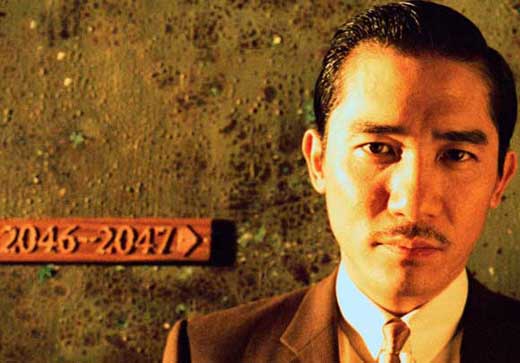
The year 2046 in Hong Kong is very different as the trains of 2046 are for people trying to recapture the lost memories through its varied rooms and androids. On the train is a Japanese man named Tak (Takaya Kimura) is trying to persuade an android (Faye Wong) to revisit a lost memory. That trip to revisit a time is a part of fiction as Chow Mo-wan (Tony Leung Chui-Wai) is reeling from the break-up with his lost love Su Li Zhen (Maggie Cheung) during a trip in Singapore. He along with his friend Ah Ping (Lam Sui-Ping), they return to Hong Kong in 1967, amidst its chaotic period in politics. Returning to give up his reporter job to become a consultant, Chow has become a womanizer of sorts as he comes across a woman named Lulu (Carina Lau). After a night with her, he walks out of her room where he recognizes the number 2046, a old hotel room number he stayed in from his lost affair. Turning to his hotel landlord Mr. Wang (Wang Sum), he moves into the room next door known as 2047 while room 2046 is being redecorated.
The series of affairs and one-night stands inspired Chow to write a series of erotic stories for the paper about a futuristic time in Hong Kong in the year 2046 where people go on trains with androids to reclaim lost memories. Just as the room was finished, a hooker named Bai Ling (Zhang Ziyi) moves in as he's become infatuated with her beauty. It's Christmas 1967 as the two would have dinner that eventually began as a secret affair. While Chow enjoys her company, he doesn't adore and only uses her for his stories as their relationship begins to heat up. Then when Bai Ling realizes the kind of man that Chow really is, their relationship falters. Chow would only see her in passing as he continues his un-fulfilling yet inspiring lifestyle.
Often infatuated with Mr. Wang's daughter Wang Jingwen (Faye Wong), he sees her again who still has trouble trying to contact her Japanese boyfriend (Takaya Kimura) through letters as her father still has bad blood with the Japanese over World War II. Chow becomes an unlikely correspondence through the letters as he begins a relationship with Wang Jingwen who helps him write his work after being impressed with her own writing. During a Christmas dinner, she feels hopeless that she'll never speak to her boyfriend as Chow gives a chance to call him where he decides to use them into another story. Suddenly, the tone of the story changes as he tells the story of Tak who falls for an android with a delayed response where he tells a secret through a hole.
The haunting elements of his stories forces Chow to give up his womanizing lifestyle as by 1970, he becomes reacquainted with Bai Ling, who is set to depart to Singapore. Chow tells about his time in Singapore including what happened last Christmas where he met a mysterious woman named Black Spider (Gong Li) who nearly resembles and carries the name of his lost love. For Chow, he has to recall his own memories as his own world of fiction and reality becomes blurry where he's trying to figure himself even more and the people around him.
While 2046 is not as simple as its predecessor, In the Mood for Love. The film does have a more complex approach in telling the story of Mr. Chow. Particularly in his development from this sensitive, quiet man in the preceding film, In the Mood for Love to a gloomier, meaner individual in 2046. In many ways, the film is about a man whose emotions towards rejection makes him colder yet the pain is drawn out in fiction as he becomes more withdrawn in all of these relationships he had with other women. It's in Wong Kar-Wai's story that really reveals the melancholia of love and all of its heartbreak, whether its in the 1960s or in the futuristic setting of 2046. The film just doesn't take those romantic from his previous film but also bringing a character from another Kar-Wai film, Days of Being Wild.
It's not just in Kar-Wai's script, or lack thereof since he never works with a script, that reveals a far more complex plot that blurs the idea of reality and fiction. It's in his direction where he's a master of atmosphere and tone. Using wandering images plus a very surreal look of 2046 Hong Kong where the trains are used for time travel, Kar-Wai goes very deep into the concept of loss and isolation. Fortunately in his script, he manages to take a structure where the audience isn't loss on what's going on or where they are. It's in Kar-Wai's direction that the audience is transported into a world of melancholia and emptiness where it's in Mr. Chow's journey of self-discovery. Even in Kar-Wai's presentation of mood and colors, he takes the audience to a world where things are moving a bit slower as opposed to the fast-paced world of the future while everything is lost. Kar-Wai's concept of the future is very bleak despite its look while the train and androids represent everything that people hold dearly. There, the ending of his previous film is clearly more understood while the ending in this film, shows a development of Mr. Chow and his trying to understand the way love and fate works.
Helping Kar-Wai in his unique, colorful presentation are two of his most enduring collaborators, Australian cinematographer Christopher Doyle and jacks-of-all-trade William Chang Suk Ping. In the photography, Doyle along with Lai Yiu Fai and Kwan Pun Leung create an enormous array of colors and settings of many of the film's interiors of the 1960s sequences where it's similar to the look of In the Mood for Love but only with a decaying feel. The cinematography in those sequences reveal the changing times while showing the atmosphere and withdrawn feel of the characters. In the 2046 section, it's more colorful with its shade of red and white lights to convey the sense of emotions and the lack of emotions in its androids. Truly its some of the best cinematography ever done.
Production designer/costume designer/editor William Chang Suk Ping helps creating the distinctive visuals of the film. With art director Alfred Yau Wai Ming, the film's 1960 look of colors and props reveal the changing times of late 1960s Hong Kong and the dingy look of late 1960s Singapore. It's in the atmosphere of the 1960s look where it represents the gloomy mood of Mr. Chow while the look of 2046 is very different and very polished. Even the costumes of the 1960s from the tight clothing of Bai Ling to the more conservative look of Wang Jingwen reveal the contrasts of their personalities while the costumes of the future are done with an array of things including paper mache. The film's look in its design and costume are done with immense brilliance while Chang's best work is clearly in the editing. Using a shimmering pacing style for some of the film's sequences, it doesn't move too slow or too fast but conveys the ever-decaying mood of Mr. Chow. It's wonderfully cut to convey the perspective of characters while holding together its unique yet complex structure. Overall, William Chang Suk Ping's work in any medium should be commended.
The visual effects team of BUF from France does a great job for creating a surreal yet gargantuan look of Hong Kong in the future. The film's look in its visual effects complement the style of Kar Wai and his collaborators where it presents a surreal yet beautiful look of the future filled with large buildings with neon colors and a green-brown background with everything looking what the future should look like. For the sound work, Kar-Wai regular Tu Duu Chih and French sound designer Claude Letessier do amazing work in bringing the right kind of feel and tone for its atmosphere from the quietness in the hotel rooms of the 1960s sequences to the metallic yet ominous feel of the 2046 scenes.
The film's music which is composed by Peer Raben and Shigeru Umebayashi is more sweeping and epic than In the Mood for Love which had a more waltz-like tempo in its score. For this film, the music conveys the sense of gloom and loss where its arrangements are more lyrical as it builds up the momentum of the film. The music also features not just cuts from Polish composer Zbigniew Preisner, famed for his work with the late Krzysztof Kieslowski, but also Georges Delerue, and pop cuts from Secret Garden, Angela Gheorghiu, Xavier Cugat, Connie Francis, and Nat King Cole singing a Christmas classic.
Finally, there's the film's cast which includes several notable small performances from Dong Jie as Wang Jingwen’s little sister and as an android plus Carina Lau reprising her role as Mimi/Lulu from Days of Being Wild and as an android along with Kar-Wai regular Chang Chen as her lover in both the 1960s and futuristic sequences. Maggie Cheung is also great in her brief appearance as the Su Li Zhen in the early 1966 sequence while Lam Sui-Ping is wonderfully funny as Ah Ping who reminds everyone of his humorous presence. Wang Sum is also excellent in his role as the Japanese-hating Mr. Wang while Gong Li commands a great presence and atmosphere in her performance as Black Spider who carries a secret past that becomes one of the film's most devastating moments. Japanese actor Takuya Kimura is wonderful in his role as Tak, a fictional character who represents all the remorse and sadness of Mr. Chow as he brings a mostly, minimalist performance to many of his scenes where it's truly a marvel of a performance.
Zhang Ziyi is great in her role as the young, emotional hooker Bai Ling who commands a great presence and authority to her role in many of the film's sequences as her character develops into a young woman who longs for the love of Mr. Chow. It's truly one of Ziyi's great performances. Faye Wong delivers the best of the female performances as Wang Jingwen who captures the heart of Mr. Chow through her sadness to connect with her own lost love. Though, the two never got into a more intimate relationship, Wong manages to capture the sense of hopefulness and will for Mr. Chow to re-think his own lifestyle while Wong also brings a wonderfully haunting yet emotional quality to her role as the android who is devoid of emotions.
Then we have Tony Leung Chui-Wai in the role of Mr. Chow. Taking his character to more darker yet withdrawn areas, Leung manages to create a different version of Mr. Chow that was opposed to the sensitive yet quiet man from In the Mood for Love. In 2046, he displays a lot of charm in front of everyone but inside, he's gloomier and meaner. Still, Leung manages to make Mr. Chow a man who is flawed and with a lot of internal conflict of someone who gives up on long love yet cannot yearn for it. Looking more like a modern-day, Asian Clark Gable, Leung brings new dimensions to his famed character as it stands out as another of his great performances.
The Region 1 DVD from Sony Pictures Classic is a truly marvelous DVD with loads of special features and a presentation that works for Kar-Wai's visually haunting film. The first film of Kar-Wai to be shot on a widescreen format of 2:40:1 anamorphic ratio. The look of the film is wonderful while it's done in 5.1 Dolby Digital sound in Cantonese with English and Spanish subtitles. Overall, the film looks and sounds great in its DVD presentation while it also features an array of great little extras. First is a 37-minute Behind the Scenes special featuring interviews with Kar-Wai and the cast where they talk about the film, Kar-Wai's style and the collaborators, notably William Chang Suk Pin about the look and feel of the costumes. The special is informative about Kar-Wai's working habits as they go behind the scenes on everything.
Two deleted scenes are presented except a much-talked about martial arts sequence that possibly never made the final cut or was never filmed. The first is a scene involving Black Spider trying to find Mr. Chow in his room as she ends up staying in the room 2046. The second deleted scene involves another strange meeting with Mr. Chow with meeting of Wang Jingwen's android character from their own collaboration which is one of the more emotional scenes. An alternate ending is also shown which shows Mr. Chow sitting in a bar, though it blurs things even more about the film's ending. The 16-minute interview featurette from a French TV program features interviews with Wong Kar-Wai and Tony Leung as they spoke in English where they talked about the film's concept and their own relationship into working. Zhang Ziyi speaks in Cantonese as she talks about her insecurities into working with Kar-Wai only to be helped by Leung where she found her niche into working with Kar-Wai. The interview also reveals Kar-Wai's non-script approach and how the actors got the freedom to interpret their own characters where for Ziyi, it was challenging yet fun.
The five-minute little featurette called Anatomy of Memories is about the making-of the visual effects of 2046 Hong Kong and the process it took from late 2003 through 2004 where a line-test was revealed in the film's premiere at the 2004 Cannes Film Festival. The film revealed in Kar-Wai's presentation and how he wanted Hong Kong to be bigger with large skyscrapers, smog, and have a neon, techno-like color with the help of his collaborator William Chang Suk Pin. The seven-minute Music Montage special is a collection of scenes played through a few pieces of the film's music, notably its opera track to convey the emotions that Kar-Wai wanted for the film. The featurette on the film's music is a collection of liner notes with the film being played to the clip of the music where that scene is in as Kar-Wai often borrows some of its music from the films of Rainer Werner Fassbinder and Krzysztof Kieslowski.
Two more little specials arrive where the first is in a numerology section about the card numbers, the money that Mr. Chow is paid, and the significance of the number 2046 where it's the year Hong Kong will be under a full rule of China. The second is a gallery of the film's posters from all of the countries to revealed the varied countries and looks of the posters for that country. The previews section from Sony Classics features trailers for such films as Thumbsucker, Junebug, Layer Cake, Heights, and Ingmar Bergman's Saraband. Overall, Sony Classics created a wonderful DVD that complements all the energy and creativity of Wong Kar-Wai.
When production began in 2001 for 2046, Kar-Wai's notoriety to shooting in long periods of time with lots of improvisation and last-minute changes made it a long shoot. There was a running joke on the set that the film would be released in the year 2046. Still, despite a two-year shoot which was nearly halted by the SARs epidemic, Kar-Wai still manage to finish production. During production, he embarked on a few other projects on the side that included his short for The Hand in the 2004 omnibus feature Eros with Michelangelo Antonioni and Steven Soderbergh; the BMW commercial short called The Follow with Clive Owen, Forrest Whitaker, Mickey Rourke, and model Adriana Lima; and a music video for the song Six Days for DJ Shadow.
By late 2003, Kar-Wai and the BUF visual effects team along with William Chang Suk Pin spent months trying to work on the editing and visual effects for the film. Though it was submitted and set for a world premiere, at the 2004 Cannes Film Festival. The film remained unfinished as on the date it was set to premiere and in competition for the Palme D'or, the film print arrived out of its laboratory three hours late as the date for the film had to be rescheduled. The unfinished film got mixed reviews though it wasn't the first time an unfinished film caused a lot of attention as Francis Ford Coppola released an unfinished of his 1979 masterpiece Apocalypse Now at the Cannes Film Festival and co-won the Palme D'or. Still, Kar-Wai manage to get the film done eventually in 2004 while his longtime cinematographer Christopher Doyle announced that 2046 would be the last time he would work with Kar-Wai. Despite Kar-Wai's notoriety in his work ethic, the film proved to be another success for its Hong Kong director.
Though not as potent or as simplistic as In the Mood for Love. 2046 is still an engrossing, hypnotic, and heartbreaking film from Wong Kar-Wai thanks to a dedicated film team and performances from Tony Leung Chui-Wai, Zhang Ziyi, Gong Li, Faye Wong, and Takuya Kimura. Though its suggested to watch In the Mood for Love for some back story, 2046 does manage to be its own film where it gives a great summary to not just the work of Kar-Wai but his unique take on love, memory, and the future. For a film that stimulates you on the visual sense and goes right into your heart, Wong Kar-Wai's 2046 is the film to see.
Wong Kar-Wai Films: As Tears Go By - Days of Being Wild - Chungking Express - Ashes of Time/Ashes of Time Redux - Fallen Angels - Happy Together - In the Mood for Love - Eros-The Hand - My Blueberry Nights - The Grandmaster - The Auteurs #28: Wong Kar-Wai
© thevoid99 2011
Subscribe to:
Posts (Atom)