Showing posts with label chang chen. Show all posts

Monday, September 25, 2017

2017 Blind Spot Series: A Brighter Summer Day


Directed by Edward Yang and screenplay by Yang, Hung Hung, Lai Ming-Tang, and Alex Yang, A Brighter Summer Day is the story of a boy living in 1960 Taiwan as he becomes infatuated with street gang violence, rock n’ roll, romance, and other things during a tumultuous time in the country. The film is a look into a period of time in the course of four years where innocence is lost as well as the emergence of Western culture into Taiwan and how it would affect the youth of the country as it is partially based on a real-life incident that would haunt the country for many years. Starring Chang Chen, Lisa Yang, Chang Kuo-Chu, Elaine Jin, Wang Chuan, Chang Han, Chiang Hsiu-Chiung, Wong Chi-Zan, Lawrence Ko, Tan Chih-Kang, Chang Ming-Hsin, Jung Chun-Lung, Zhou Hui-Guo, Tang Hisao-Tsui, Lin Hong-Ming, Bosen Wang, Chen Hung-Yu, Hsu Ming, and Cho Ming. A Brighter Summer Day is a majestic and evocative film from Edward Yang.

Set more than a decade after the Chinese Civil War, the film revolves the life of a teenage boy in 1960 Taiwan as he finds himself in the middle of a gang war over social and political differences while dealing with his first crush and the chaos in his family life. The film takes place in the course of an entire school year for this young boy as he deals with not just growing pains but also this crisis in identity at a time when many young kids and teenagers are trying to find their place in the world in this island wondering if they’re going to return to China or just settle in Taiwan for good. For their adult-parents and relatives, it’s not just wondering if they’re going to return to China but also the future of their own children whether they would remain in Taiwan or return to China.

The film’s screenplay that is written by Edward and Alex Yang with Hung Hung and Lai Ming-Tang follows a lot of different storyline and characters throughout the film yet the main narrative revolves around Xiao S’ir (Chang Chen) who is a fourteen year old boy who was once a bright and hard-working student as he’s first seen in this scene set in 1959 where his father (Chang Kuo-Chu) is pleading with an administrator to keep him in school forcing S’ir to attend night school with other juvenile delinquents. In this school, S’ir would befriend several students who are part of two different street gangs that come from different social circles. The Little Park kids are boys whose families work for the government while the 217 gang are children of military personnel as it causes some tension with S’ir leaning toward the Little Park kids as his father works for the government as well. He also befriends a few kids from the 217 faction as well as have his first major crush on a young girl named Ming (Lisa Yang) who he sees at the school.

The storyline relating S’ir is the main narrative as there’s also little subplots as it relates to his older brother Lao Er (Chang Han) who has been going to pool halls at night where he owes money to local hoods forcing him to steal family heirlooms where his older sister (Wang Chuan) is suspicious as it’s already creating problems for a family that is starting to crack due to financial issues and Mr. Xiao’s problems with the way things are working within the government which would get him in trouble with the authorities. The script also shows the sense of tension between the two factions which would intensify when the Little Parks’ leader Honey (Lin Hong-Ming) return when he hears that the two factions are making a deal which only causes more trouble. It would change things in the second half from this story about gangs in Taipei to the troubling aftermath involving violence and S’ir dealing with growing pains as well as the chaos in his family when his father is away. It would lead him to explore ideas of love and sex but also things he is unprepared for as it leads to a very eerie third act.

Edward Yang’s direction is truly entrancing for not just some of the compositions he creates but also for the setting and emphasis on what is happening during this time in Taiwan. Shot on location various locations in and around Taipei and other parts of Taiwan, the film is presented with this tone of something that is changing where everyone is still attached to the old ideas of pre-civil war China but it’s become less important as the reality of what Taiwan would become is evident. Yang would use a lot of wide shots to play into these rural locations as well as the different places these characters would go to such as an ice cream parlor or the home of a few posh kids who also attend the school that S’ir goes to. Yang would use some crane shots for a few of the wide shots while he would maintain an air of intimacy with his approach to close-ups and medium shots.

Yang’s direction also have these brief but intense moments of violence such as a gang attack during the second act where it’s more about the element of surprise and the intensity of the violence with S’ir watching very closely. It’s a moment that would play into his growth as a person where he is dealing with so much at a young age while still wanting to retain some idea of innocence by listening to Elvis Presley records with friends or play sports like baseball and basketball. The third act begins with the arrest of Mr. Xiao as it would set the tone for his own revelation about his own connections in the government. It would also play into S’ir as he would deal with jealousy, heartbreak, and the realities of his own upbringing as he lives in a rural area of Taipei while a few of his friends live in posh houses and have all of the freedoms that he couldn’t have. All of which would lead to something horrific as it would affect not just families but also kids forcing to come to terms with themselves in this small island they might live in forever. Overall, Yang crafts an intoxicating and rapturous film about the year in the life of a young boy coming of age in 1960s Taiwan.

Cinematographers Chang Hui-Kung and Li Long-Yu do amazing work with the film’s cinematography in the way it captures the gorgeous colors of some of the trees and mountain-field locations as well as the usage of lighting for some of the scenes set at night. Editor Bowen Chen does excellent work with the editing as it is largely straightforward for much of the film with the exception of the gang attack scene with its swift and frenetic editing that play into the action as well as sense of terror. Production designer Yu Wei-Yen and set decorator Edward Yang do brilliant work with the look of the home of the Xiao family as well as the ice cream parlor where they have a rock n’ roll band play every once in a while as well as some of the buildings at the town.

Costume designer Wu Le-Chin does fantastic work with the costumes from the khaki-like uniforms of the students as well as some of the clothes that was prevalent during the late 1950s/early 1960s including denim blue jeans in which a young girl is wearing. The sound work of Tu Duu-Chih is superb for the way it captures the atmosphere of live music as well as some of the natural sounds on a certain location. The film’s soundtrack consists a mixture of traditional Chinese and Japanese music as well as some rock n’ roll to play into the cultural divide between the old and new generation as much of the rock n’ roll music consists of songs made famous by Elvis Presley.

The film’s incredible cast feature some notable small roles and appearances from Cho Ming as the local store owner Uncle Fat, Tang Hsiao-Tsui as a young girl named Jade who would go out with Sly and later Ma, Bosen Wang and Zhou Hui-Guo as a couple of students in Deuce and Tiger respectively, Hsu Ming as a government official named Wang who is a friend of Mr. Xiao, Chang Ming-Hsin and Jung Chun-Lung as a couple of other students at the school who are in gangs in Underpants and Sex Bomb respectively, Stephanie Lai as S’ir’s youngest sister, Chiang Hsiu-Chiung as S’ir’s older middle sister who is religious, Lin Hong-Ming as a former gang leader in Honey who deals with his disappearance and disillusionment with gangs, and Lawrence Ko as one of S’ir’s close friends in Airplane who has an interest in girls and rock n’ roll like S’ir. Tan Chih-Kang is terrific as the rich delinquent Ma as a teenager that has managed to get a lot of girls while Chen Hung-Yu is superb as Sly as a member of the 217 gang whose father has connections to get people to play at venues he owns.

Wang Chuan is fantastic as S’ir’s eldest sister who knows how to speak English and can transcribe lyrics while eager to go to college in America. Chang Han is wonderful as S’ir’s eldest brother Lao Er as a young man who finds himself dealing with a gambling debt as well as trying to redeem himself only to be tempted back to that world of gambling. Wong Chi-Zan is brilliant as Cat as a young delinquent who befriends S’ir as he aspires to be a singer to express his love for Elvis. Elaine Jin is excellent as S’ir’s mother who copes with the financial struggles with the family as well as her concern for S’ir in his education. Chang Kuo-Chu is amazing as S’ir’s father as this government official that is eager to try and get his son back to day school as well as doing what he can to support his family only to become a suspect of espionage relating to his connection with Chinese officials. Lisa Yang is remarkable as Ming as a young teenager who is dating a gang leader as she struggles with her own family issues but also her identity as she becomes close to S’ir. Finally, there’s Chang Chen in a phenomenal performance as Xiao S’ir as a teenage boy who deals with growing pains as well as his own identity and role in the world while coping with love, rock n’ roll, and other things as it’s a very restrained as well as displaying that anguish and confusion into what teenagers go through.

A Brighter Summer Day is an outstanding film from Edward Yang. Featuring a great cast, gorgeous visuals, a riveting story of identity and growing up, and its setting during a crucial period in Taiwan’s history. It’s a film that offers so much in a story that is complex as well as displaying an intimate look into the life of a young boy in 1960s Taiwan. In the end, A Brighter Summer Day is a magnificent film from Edward Yang.

Edward Yang Films: (In Our Time-Desires/Expectations) – (That Day, on the Beach) – (Taipei Story) – (The Terrorizers) – (A Confucian Confusion) – (Mahjong) – Yi Yi

© thevoid99 2017

Sunday, September 08, 2013

The Grandmaster (2013 film)


Note: This Review is Based on the Original 130-minute full-length Chinese Cut of the Film.


Directed by Wong Kar-Wai and screenplay by Kar-Wai, Zou Jingzhi, and Xu Haofeng from a story by Kar-Wai, The Grandmaster is the story about the life of Wing Chun grandmaster Ip Man who was famous for teaching kung fu where one of his greatest students was Bruce Lee. The film tells the story of Ip Man’s life from the 1930s to his time in Hong Kong following the Second Sino-Japanese War as he is played by longtime Kar-Wai regular Tony Leung Chiu-Wai. Also starring Zhang Ziyi, Chang Chen, Zhang Jin, Song Hye-kyo, and Wang Qingxiang. The Grandmaster is a majestic yet exhilarating film from Wong Kar-Wai.

The film is essentially about the life of Ip Man in the course of thirty years of his life where he starts off as this revered master in the small town of Foshan who was considered the best martial arts master in the South of China to being a man who would popularize kung fu after the Chinese Civil War where he moved to Hong Kong for the rest of his life. During his journey, Ip would encounter many things that would shape his life where he successfully defeated the revered Northern grandmaster Gong Yutan (Wang Qingxiang) in a game of wits only to later be challenged by his daughter Gong Er (Zhang Ziyi) where they both had a mutual sense of respect towards each other. Yet, war would eventually emerge when the Japanese take over China where Yutan’s successor Ma San (Zhang Jin) would join the Japanese only to lose his own path as he, Ip Man, and Gong Er would all feel lost in changing times as they’re in Hong Kong.

The film’s screenplay isn’t a traditional bio-pic though it does have a unique structure that does tell the story. The first act is about Ip Man’s reputation as a master and how he proved himself to be worthy of being Gong Yutan’s successor for the South as well as Ip Man’s complex relationship with Gong Er where they would correspond through letters after their battle. The second act is about the Second Sino-Japanese War in the 1930s in which Ip Man’s family life is ruined as he is forced to live in poverty while Gong Er tries to challenge Ma San over his actions in the hopes to defend the honor of her late father. The third act is about all three individuals in early 1950s Hong Kong though only Gong Er and Ip Man would contact each other during this period where Ma San finds himself lost and having to deal with a master known as the Razor (Chang Chen).

Much of the film’s narrative is quite straightforward as it includes some voice-over narration from Ip Man as some of it is told from his perspective. Yet, the second act is more about Gong Er’s conflict with Ma San who would collaborate with the Japanese during the Second Sino-Japanese War where a confrontation would eventually occur. Yet, that confrontation would be unveiled in the film’s third act in a flashback scene that would have some serious repercussions into the fates that they would live in the years to come. The third act is very melancholic in not just what happen to both Ma San and Gong Er but also the loneliness that Ip Man would deal with as he is someone who is still able to pass on his knowledge to the world as he spends that portion in the film trying to find himself again.

The direction of Wong Kar-Wai is very stylish which is really nothing new to say since Kar-Wai is always a filmmaker who is known for style over substance. Still, what he presents is definitely just entrancing to look at from the fight scenes to the exotic imagery that Kar-Wai creates in the drama. With the help of action choreographer Woo-ping Yuen, Kar-Wai’s approach to action isn’t about the energy but rather the way the movements feel and how there’s a certain dance to these confrontations. Some of which are quite lavish from fights in the rain to others that are just intense as there’s a lot of stakes that get involved. All of which is important to the story as well as what these characters are fighting for.

Kar-Wai would balance the film with some drama as well as a bit of romantic tension between Ip and Gong Er as they respect each other but there’s also something about them that has them wanting each other. Yet, Ip has his family and Gong Er knows that as she would devote her life to reclaim her family’s honor but she would eventually pay the price for her actions. Many of the compositions that Kar-Wai would create would have this very lingering gaze to not just the way he creates pictures but also play into changing times as it’s seen from Ip’s perspective as he realizes what he has to do. Overall, Wong Kar-Wai creates a very mesmerizing yet thrilling film about Ip Man and his legacy that would bring kung fu into the world.

Cinematographer Philippe Le Sourd does fantastic work with the film‘s cinematography from the use of low-key, sepia-drenched lights for some of the film‘s nighttime scenes and interiors to the use of colors in the scenes set in the snow to play up the sense of moodiness in the film. The work of editor/Production-costume designer William Chang, along with co-art directors Tony Au and Alfred Yau, is brilliant where Chang creates that element of style in the editing to play up some of the emotion and action that is quite prevalent in his work while his set/costume design is just amazing to watch in the way it plays to the look of the times.

Visual effects supervisor Isabelle Perin-Leduc does superb work with some of the film‘s visual effects such as a few backdrops for the fight scenes as well as some of the slow-motion elements that occur in the fights. Sound editor Robert Mackenzie does excellent work with the sound to create an atmosphere in some of the dramatic moments while using some nice sound effects for the fights including the sound of punches and kicks. The film’s music consists of pieces by Frankie Chan, Stefano Letini, Traithep Wongpaiboon, Nathaniel Mechaly and Shigeru Umebayashi that plays into many of the film’s different tones from some bombastic orchestral pieces to some somber yet serene moments involving the string arrangements as its soundtrack, that includes some Chinese opera and pop songs of the times, is truly incredible to listen to.

The film’s cast is marvelous for the ensemble that is used as it features some notable small appearances from action choreographer Yuen Woo-ping as Ip Man’s master Chan Wah-shun, Song Hye-kyo as Ip Man’s wife, Lo Hoi-ping as Ip Man’s uncle Deng, and Chang Chen as a master named the Razor who would run a small crime organization in Hong Kong. Shang Tielong is terrific as Gong Yutian’s longtime right-hand man Jiang who would later become Gong Er’s protector as he would also befriend Ip Man. Wang Qingxiang is superb as Gong Yutian as an old grandmaster who tries to find his successor but tries to deal with changing times and Ma San’s affiliation with the Japanese. Zhang Jin is excellent as Ma San who would become a successor of Gong Yutian only to use his skill to advance himself in power where he is forced to deal with his choices.

Zhang Ziyi is remarkable as Gong Er as a woman who has these expectations to be like every other woman yet she is someone who wants to honor her father and the family legacy as she strikes a friendship with Ip Man while dealing with the consequences of her actions in the third act. Finally, there’s Tony Leung Chiu-Wai is phenomenal as Ip Man where Leung brings a restraint to his performance where he is quite stoic in his performance whether it’s in drama or in action. Leung also proves to be a badass but in a very low-key way as it’s definitely one of his finest performances of his career.

***The Following is an Overview of the 108-Minute American Cut of the Film***

The American cut of the film is quite different from the original 130-minute Chinese cut where Wong Kar-Wai and his editor William Chang created a cut under the order of Harvey Weinstein who is distributing the film to American audiences. The resulting factor isn’t a very good one and more indication that Weinstein needs to be kept out of the editing room.

There aren’t a lot of additions made to this cut as includes a brief meeting between Ip Man and Razor in Hong Kong where it’s about respect as well as a flashback scene of Gong Er reflecting on her happiest moments that includes a moment where she was a child looking at her father’s work. These are moments that do add a nice touch to the story as well as showcase more dimensions to the lead characters. Unfortunately, it doesn’t help the result of the shortened version that Kar-Wai had to present because the narrative isn’t just more disjointed but also loses a lot of its emotional impact and motivations.

Some of the material that is cut involves bits of dialogue as well as some moments about Ip Man’s family and some scenes relating to the Second Sino-Japanese War in the late 1930s. They there’s some added text exposition that is laid out on screen, it ends up being unnecessary as it tends to explain too much. Even as the original cut does have some text to fill in parts of the story but doesn’t reveal too much including any mention of Ip Man’s greatest student in Bruce Lee. In the American cut, it does mention Bruce Lee which wasn’t really necessary as the Chinese cut only implied Lee’s presence in the story. Among the things that is cut out in the American version is Ip Man’s relationship with Gong Er as a lot of it taken out for much of its second act. Even as Gong Er’s story in the second act about getting her revenge on Ma San is moved to the third act in a flashback sequence just after she meets Ip Man in Hong Kong.

In moving Gong Er’s story of her vengeance to the third act really doesn’t do much to what Kar-Wai wanted to tell originally as the third act in the Chinese cut is more about Gong Er’s own journey to get vengeance and the vows that she takes. By moving it to the third act, it doesn’t carry the same emotional impact and melancholia that Kar-Wai wanted as the sequence of Gong Er’s journey for vengeance goes immediately to her confrontation with Ma San in the train. It’s that element of the editing that really loses a lot of the film’s emotional punches as it adds to the messiness of the narrative.

In turn, the American cut of the film is only worth seeing for anyone that wants to see a Wong Kar-Wai film in the big screen. Yet, they will have a hard time dealing with the narrative as well as not grasp into some of the melancholia and emotional elements that Kar-Wai wanted in his original cut.

***End of American Cut Overview***

The Grandmaster is a sensational film from Wong Kar-Wai that features brilliant performances from Tony Leung Chiu-Wai and Zhang Ziyi. The film is definitely one of Kar-Wai’s more stylish films but also an engaging one for the way it tells the story of Ip Man. It’s a film that has something for fans of martial arts films but also has something for audiences that love drama as Kar-Wai manages to put both genres into one captivating story without making it uneven. In the end, The Grandmaster is a remarkable film from Wong Kar-Wai.

Wong Kar-Wai Films: As Tears Go By - Days of Being Wild - Chungking Express - Ashes of Time/Ashes of Time Redux - Fallen Angels - Happy Together - In the Mood for Love - 2046 - Eros-The Hand - My Blueberry Nights - The Auteur #28: Wong Kar-Wai

© thevoid99 2013

Tuesday, August 27, 2013

Eros


Eros is an omnibus film from three different filmmakers that explores the world of eroticism in three different continents from its filmmakers Michelangelo Antonioni, Steven Soderbergh, and Wong Kar-Wai. Each segment explores the world of love and sex in various different ways told by these three filmmakers. The result is one of the most fascinating anthology films that features two incredible segments from two of its contributors but also a disappointing one from Michelangelo Antonioni.

The Dangerous Thread of Things

Directed by Michelangelo Antonioni. Screenplay by Michelangelo Antonioni and Tonino Guerra from a book by Michelangelo Antonioni. Starring Christopher Buchholz, Regina Nemni, and Luisa Ranieri. Cinematography by Marco Pontecorvo. Edited by Claudio Di Maurio Set design by Stefano Luci. Costume design by Carin Berger. Sound editing by Gianluca Carbonelli. Music by Enrica Antonioni and Vinicio Milani.

The first segment explores a bickering couple (Christopher Bucholz and Regina Nemni) who spend the day together as they deal with their disintegrating relationship as the man later meets a beautiful woman (Luisa Ranieri) whom he wants to have sex with. It’s a segment that is essentially all style but very little substance. While many of the compositions are beautiful and definitely recalls a lot of Antonioni’s great work from the 1960s that includes Marco Pontecorvo‘s lush cinematography and Claudio Di Maurio‘s stylized editing. It feels more like this bad mix of pretentious art-house cinema mixed in with vapid soft-core porn though nothing really wrong with that. Plus, the acting isn’t very inspired while the music is also very off as it adds to the sense of pretentiousness that is rampant in this very terrible short.

Equilibrium

Written, shot, edited, and directed by Steven Soderbergh. Starring Robert Downey Jr., Alan Arkin, and Ele Keats. Set design by Philip Messina. Costume designed by Milena Canonero. Sound editing by Larry Blake. Casting by Debra Zane.

The segment revolves a man (Robert Downey Jr.) who talks to his psychiatrist (Alan Arkin) about a recurring fantasy he has with this mysterious woman (Ele Keats) while dealing with the pressure he’s having working as an advertising agent. It’s a film that explores a sense of repression and fantasy where it mixes reality and fiction where the psychiatric sessions are shot in black-and-white while the fantasy scenes are shot in color. It’s filled with many ambiguities about what is real and what is fantasy where it also involves voyeurism as Soderbergh puts bits of humor as the psychiatrist is also a voyeur who is more concerned with what’s outside rather than this man’s problems. With great performances from Robert Downey Jr. and Alan Arkin, the segment is easily the most entertaining.

The Hand

Written and directed by Wong Kar-Wai. Starring Gong Li and Chen Chang. Cinematography by Christopher Doyle. Edited and set/costume designed by William Chang. Sound design by Claude Letessier and Du-Che Tu. Music by Peer Raben.

The third and final segment is about the relationship between a high-class prostitute (Gong Li) and her tailor (Chen Chang) as the tailor makes dresses for her yet keep their relationship professional no matter how troubled she may be and the desires they have for each other. This one is easily the most sensual in not just in its story but also in the performances of Li and Chang as they play into people who care for each other but are separated by circumstances. With its exotic soundtrack filled with old Chinese music and dazzling images courtesy of cinematographer Christopher Doyle and editor/set-costume designer Wiliam Chang. Kar-Wai creates a piece that is just intoxicating to look that is backed up by a very heartbreaking and enthralling story about love.

The film is essentially an exploration into the world of eroticism and how it can delve into the psyche of individuals. With inserted artwork by Lorenzo Mattotti that is filled with these gorgeous images of people making love that comes in between each segment that includes some bossa-nova music in the background. It all reinforce the idea of eroticism as both Steven Soderbergh and Wong Kar-Wai each manage to create interesting takes on eroticism. Soderbergh in a lightly-comedic fashion that is filled with ambiguities while Kar-Wai adds a melancholia to this love story about a tailor and a prostitute. The one person that definitely seems to miss the mark is Michelangelo Antonioni as he seems to want to reach into the great work he did in the 1960s to comment on loneliness and sex but ends up making something that just feels very empty despite the gorgeous visuals he creates.

Eros is an excellent omnibus film thanks in part to the contributions of Steven Soderbergh and Wong Kar-Wai. Fans of the two filmmakers will no doubt enjoy their segments as it represents some of the best work they did. Especially Kar-Wai whose segment is easily the best of the three for his sensitive portrayal on love. The film sadly also features a very disappointing segment from the late Michelangelo Antonioni in one of his final contributions to cinema. In the end, Eros is an extraordinary anthology film that explores the world of eroticism.

Michelangelo Antonioni Films: (Story of a Love Affair) - (I Vinti) - (The Lady Without Camelias) - (Le Amiche) - (Il Grido) - L'Avventura - La Notte - L’Eclisse - Red Desert - Blow-Up - Zabriskie Point - (Chung Kuo, Cina) - The Passenger - (The Mystery of Oberwald) - Identification of a Woman - (Beyond the Clouds)

Steven Sodberbergh Films: sex, lies, & videotape - Kafka - King of the Hill - The Underneath - Gray’s Anatomy - Schizopolis - Out of Sight - The Limey - Erin Brockovich - Traffic - Ocean's Eleven - Full Frontal - Solaris (2002 film) - Ocean’s Twelve - Bubble - The Good German - Ocean’s Thirteen - Che - The Girlfriend Experience - The Informant! - And Everything is Going Fine - Contagion - Haywire - Magic Mike - Side Effects - Behind the Candelabra - Logan Lucky - (Unsane) - (High Flying Bird) - The Auteurs #39: Steven Soderbergh Pt. 1 - Pt. 2

Wong Kar-Wai Films: As Tears Go By - Days of Being Wild - Chungking Express - Ashes of Time/Ashes of Time Redux - Fallen Angels - Happy Together - In the Mood for Love - 2046 - My Blueberry Nights - The Grandmaster - The Auteurs #28: Wong Kar-Wai

© thevoid99 2013

Sunday, May 19, 2013

2013 Cannes Marathon: Happy Together


(Winner of the Best Director Prize to Wong Kar-Wai at the 1997 Cannes Film Festival)


Written and directed by Wong Kar-Wai, Happy Together is the story about a tumultuous romance between two men as they travel from Hong Kong to Buenos Aires where they endure more trouble as they make up, break up, and do all sorts of things. The film is a look into the world of love and its complications told from the perspective of a man overwhelmed in his troubled relationship. Starring Tony Leung Chiu-Wai, Leslie Cheung, and Chang Chen. Happy Together is a rich yet exotic film from Wong Kar-Wai.

The film is about a relationship between two different men as they travel to Argentina in hopes to visit the Iguazu Falls. Instead, they get lost on their way as they get separated only to meet again in Buenos Aires to resume their relationship but it becomes back-and-forth as one becomes frustrated while the other becomes very selfish. As much as Ho Po-Wing (Leslie Cheung) and Lai Yui-fai (Tony Leung Chiu-Wai) have their differences in personalities and drive, they definitely love each other but there comes the question about whether or not they are right for each other? Ho is a very volatile individual who likes to party, get into fights, and be very controlling though he is often apologetic for his behavior but gets into that dangerous cycle again. Lai is a more responsible and sensitive man who is willing to help but doesn’t feel appreciated for what he does for Ho.

The film’s screenplay does have a structure of sorts though it’s very loose as Wong Kar-Wai is more interested in this very tumultuous relationship where it begins with the two arriving in Argentina where they attempt to travel to the Iguazu Falls by car but things don’t go well aside from the fact that the car is a piece-of-shit. Ho and Lai split up where the latter has to find work in order to raise money so he can return to Hong Kong while Ho just wanders around partying with various people and getting into fights where one fight has him coming back to Lai. The two end up being together in Lai’s apartment but the cycle of chaos and selfishness returns where Lai has to work to buy cigarettes and make food for Ho while Ho would blow the money gambling and such. It then raises questions into why does Lai put up with Ho’s selfishness? Another question is why can’t Ho just step up and actually do something for Lai other than teach him tango?

A lot of the film is told from the perspective of Lai as he tries to deal with his relationship with Ho while the narrative would later introduce another character in a Taiwanese immigrant named Chang (Chang Chen) who is definitely the kind of person that Lai needs in his life. While Chang is also someone trying to raise money to return to Taiwan, he’s an individual that is embarking on a journey of his own though his voice-over narration doesn’t reveal whether or not that he’s gay. Chang just adds a new dynamic for Lai’s character development though it also increases his sense of melancholia over how troubled his relationship with Ho is where things finally reach a breaking point.

The direction of Wong Kar-Wai is just intoxicating to watch with its hypnotic imagery and stunning approach to presentation. While it plays to a lot of the visual styles that Kar-Wai is known for that includes slow frame-speeds towards lingering images and motifs that includes lots of references to the Iguazu Falls such as the lamp Ho bought for Lai. It is told with a sense of restraint for the scenes in Lai’s apartment that is a bit cramped but also comforting though it would devolve into chaos once Ho stays there. There is an intimacy to those moments though Kar-Wai would maintain some energy to the scenes where Lai has to cook in the kitchen at his apartment building where it’s always chaotic and then walk up the stairs to his apartment carrying food.

For the scenes in Buenos Aires, Kar-Wai makes the city a character onto itself where it does have this strange yet ethereal quality for what happens in night such as tango dances and what goes on in the city. Notably a sequence where the Obelisco de Buenos Aires shown in the middle of the frame while the frame also contains the clock showing what time it is as it time moves forward. It plays into that world where Lai starts to feel lost as he is obsessed about going to the Iguazu Falls. The direction has Kar-Wai playing up that sense of frenetic style as the film is shown in this heightened yet grainy black-and-white film stock early on before going into full-on color where it plays up that mood of melancholia. Even in the end where once again the colors have this sense of style but also the fact that it plays about the outcome of this relationship as well as Lai’s journey to find strength in himself. Overall, Wong Kar-Wai creates a truly evocative and riveting drama about love gone wrong.

Cinematographer Christopher Doyle does phenomenal work with the photography from the use of grainy black-and-white to play up the turmoil of Ho and Lai‘s relationship to the use of colored lighting schemes to heighten that mood with the use of blue to showcase the images of the Iguazu Falls as well as some of the scenes in the morning as Doyle‘s work is a major highlight of the film. Editors William Chang and Wong Ming-lam do amazing work with the film‘s very stylized editing with its use of jump-cuts as well as playing around with frame-speeds to create these exotic images that play up some of its melancholia.

Production/costume designer William Chang does excellent work with not just the look of Lai‘s small yet quaint apartment but also the Chinese restaurant he and Chang work at as well as the Cantina the two go to while the costumes are mostly casual with some style to play up the different personalities of the three men. The sound work of Chi-Tat Leung and Du-Che Tu is brilliant for the atmosphere is created in some of the film’s locations including Iguazu Falls plus some of the moments at the places the characters encounter. The film’s soundtrack is wonderful for its intoxicating mix of music that features elements of tango-based music from Astor Pataleon Piazzolla as well as ballad by Caetano Veloso plus some frenetic music by Frank Zappa and a cover of the Turtles song Happy Together by Danny Chang.

The film’s small cast consists a lot of interesting appearances from the people in the film though it really belongs to its three principle actors. Chang Chen is great as Chang as a man who is intrigued by Lai’s presence in the restaurant they work as he is eager to go to the lowest point of South America where he would become the one sense of hope in Lai’s troubled life. Leslie Cheung is remarkable as the volatile Ho as a man who wants to party and do crazy things as he often takes advantage of Lai’s kindness while he also tries to apologize to him unaware of how valuable Lai is. Finally, there’s Tony Leung Chiu-Wai in an incredible performance as Lai as a man lost in a trouble relationship as he tries to pull away only to come back as Leung displays that sense of vulnerability and despair as a man who is unsure about who he is in a land that is foreign to him.

Happy Together is a magnificent film from Wong Kar-Wai that features superb performances from Tony Leung Chiu-Wai, Leslie Cheung, and Chang Chen along with some amazing technical contributions from Christopher Doyle and William Chang. The film is definitely one of Kar-Wai’s finest films in terms of its visual style and exploration into the world of troubled relationships. It’s also a film that dares to ask questions while not giving any answers into this relationship that is very chaotic but also very loving. In the end, Happy Together is an outstanding film from Wong Kar-Wai.

Wong Kar-Wai Films: As Tears Go By - Days of Being Wild - Chungking Express - Ashes of Time/Ashes of Time Redux - Fallen Angels - In the Mood for Love - 2046 - Eros-The Hand - My Blueberry Nights - The Grandmaster - The Auteurs #28: Wong Kar-Wai

© thevoid99 2013

Friday, January 11, 2013

Crouching Tiger, Hidden Dragon


Based on the wuxia novel Crane Iron Pentalogy by Wang Dulu, Crouching Tiger, Hidden Dragon is the story about a swordsman trying to stop a young thief from stealing a legendary sword as he and another warrior try to stop the thief and her master. Directed by Ang Lee and screenplay by James Schamus, Wang Hui-Ling, and Tsai Kuo-Jung, the film is a stylized martial arts drama set in ancient times as it revolves around themes of honor as well as identity. Starring Chow Yun-Fat, Michelle Yeoh, Chang Chen, Cheng Pei-pei, Sihung Lung, and Zhang Ziyi. Crouching Tiger, Hidden Dragon is a majestic yet visually-gorgeous film from Ang Lee.

Returning from Wudan after a period of meditation, legendary swordsman Li Mu Bai (Chow Yun-Fat) meets with his longtime friend Yu Shu Lien (Michelle Yeoh) as he plans to give up life as a warrior and give the legendary Green Destiny sword to their friend Sir Te (Sihung Lung). Shu Lien accompanies Mu Bai to Peking where she gives Sir Te the sword while encountering the daughter of the town’s governor named Jen (Zhang Ziyi) who is set to marry a bureaucrat in an arranged marriage. Later that night, a mysterious young woman had stolen the Green Destiny sword as Shu Lien, Sir Te’s guard Bo (Xian Gao), and many others try to retrieve it. Mu Bai and Shu Lien believe that the infamous Jade Fox (Cheng Pei-pei) might’ve been involved as a police inspector named Tsai (De Ming Wang) and his daughter May (Li Li) are after Fox over the death of Tsai’s wife years ago.

Fox also killed Mu Bai’s master years ago as Mu Bai, Bo, Tsai, and May decides to confront the mysterious Jade Fox until her mysterious masked apprentice appears with the Green Destiny causing problems as Mu Bai knows who is the thief. Fox meanwhile, confronts her apprentice over the fact that she was able to fight against Mu Bai very well. Later that night, Jen receives a visit from her lover in a desert bandit named Lo (Chang Chen) who learns about Jen’s upcoming nuptials as he wants to take her away back to the desert where they first met. Jen refuses only for Lo to interrupt the wedding procession until he’s captured by Mu Bai and Shu Lien. With the recently-returned Green Destiny sword stolen again, Mu Bai and Shu Lien return to Shu Lien’s home where some revelations occur about the thief as Mu Bai tries to offer her something which then leads to a final confrontation with Jade Fox.

While the film is a martial-arts adventure film that revolves around a legendary sword, it’s a film that explores the confines of duty and what is expected from people as well as breaking out of this repression. In this multi-narrative story, there’s two warriors who definitely have feelings for each other but could never express it due to the fact they lost someone they cared for and felt that it would insult that person’s memory. There’s also this story about the daughter of a governor who is set to be married only to be in love with a desert bandit she had encountered some time ago. It definitely leads to all sorts of complications when a sword is stolen as there’s those who are involved trying to retrieve this famed sword.

The film’s screenplay isn’t just complex in its narrative but also in the way the characters are presented. Li Mu Bai is a man who has endured enough training and fighting who feels like there is nowhere to go until he encounters this young thief whom he believes has the potential to be something greater and undo whatever mistakes that had been made by his masters years ago. Mu Bai’s friend Yu Shu Lien is a woman who knows what she should do as a woman but feels repressed by the fact that she and Mu Bai have feelings for each other but is still saddened by the death of her lover who was also Mu Bai’s best friend. Then there’s Jen Yu, a governor’s daughter who is feels stilted by her duty as she wants to do the things Shu Lien does while there’s something about her that becomes intriguing.

Notably as the screenplay features a flashback narrative about how Jen meets this desert bandit Lo where they fall in love as Lo becomes the escape that Jen craves for only for other things to complicate matters. The character of Jade Fox isn’t just this venomous antagonist who wants to kill Mu Bai over the fact that she never got the chance to grow as a warrior. She becomes upset that her apprentice has started to surpass her in skill as she starts to become envious and eventually corruptive. Eventually, a showdown occurs where Mu Bai wants to become the one person who can provide Fox’s apprentice something more.

Ang Lee’s direction is definitely stylish not just in terms of the presentation of the martial arts scene but also in the film’s dramatic moments. Shot on location in the mountains and deserts of China as well as locations around Beijing, it’s a film set in a period where there isn’t a lot of conflict happening and times are definitely changing in some ways. Lee’s approach to framing and not employing lots of close-ups allows the film to present the characters in the environment they’re in whether it’s the lushness of the forests or in the homes of government officials. Lee always find a way to put the actors in a frame where it isn’t show-dressing but rather express what is happening as there’s a lot of intrigue that occurs.

For the fight scenes, Lee employs the services of choreographer Yuen Wo Ping for a very stylized approach to martial arts where it involves lots of flying and moves where it is about the intensity of the fight as well as what is at stakes. Lee also employs bits of humor such as an elaborate scene at a restaurant where a bunch of men try to gang up on someone only for everything to wrong. Lee also knows when to give the audience a break from the fighting for a moment of serenity where it allows the characters to find themselves or to figure out what to do next. Overall, Lee creates an exquisite yet spellbinding film about love and identity.

Cinematographer Peter Pau does brilliant work with the film‘s photography from the lushness of the forests to the vast look of the scenes in the deserts while the nighttime interior and exterior scenes play to the element of style as well as a mood that was needed for those scenes. Editor Tim Squyres does amazing work with the editing by employing lots of rhythmic cuts for some of the film‘s fight scenes that were very stylized along with more methodical cuts in the dramatic moments. Production/costume designer Timmy Yip does fantastic work with the set pieces in the look of the restaurant with all of its chaos as well as the stylish clothes that Jen wears.

Visual effects supervisor Rob Hodgson does terrific work with the visual effects for some of the scenes of flying as well as other stylistic moments to play up that sense of fantasy. Sound editor Eugene Gearty does wonderful work with the sound to create an intimacy in the quieter scenes while splicing lots of different sound effects for the fight scenes. The film’s music by Tan Dun is mesmerizing for its mixture of somber string pieces with cellos provided by Yo-Yo Ma as well as bombastic, percussion-based music for the film‘s fight scenes.

The film’s ensemble cast is excellent as it features some memorable small roles from Li Fazeng and Hai Yan as Jen’s parents, Xian Gao as the guard Bo, Li Li as Inspector Tsai’s daughter May, and De Ming Wang as Inspector Tsai. Sihung Lung is wonderful as Sir Te who knows about the feelings between Mu Bai and Shu Lien while dealing with the theft of the Green Destiny. Cheng Pei-pei is great as the venomous Jade Fox who deals with her enemies as well as the fact that her apprentice is starting to surpass her in every way. Chang Chen is superb as the bandit Lo who is in love with Jen while trying to stop her from getting married.

Zhang Ziyi is amazing as Jen as a young woman dealing with the role she is forced to play as well as desire to rebel in order to find happiness as a young woman. Michelle Yeoh is brilliant as Yu Shu Lien who is determined to retrieve the Green Destiny sword while dealing with her own feelings for Mu Bai. Finally, there’s Chow Yun-Fat in a marvelous performance as Lu Mu Bai as a man who feels lost in his role as he deals with loss and uncertainty while trying to retrieve the Green Destiny sword and deal with his feelings for Shu Lien.

Crouching Tiger, Hidden Dragon is an outstanding film from Ang Lee that features incredible performances from Chow Yun-Fat, Michelle Yeoh, Chang Chen, and Zhang Ziyi. The film is definitely among one of the great films of the martial arts genre as well as a unique take on the world of fantasy. It is also one of Lee’s best films for exploring big themes on identity and repression as it serves as one of his most definitive works. In the end, Crouching Tiger, Hidden Dragon is a phenomenal film from Ang Lee.

Ang Lee Films: Pushing Hands - The Wedding Banquet - Eat Drink Man Woman - Sense & Sensibility (1995 film) - The Ice Storm - Ride with the Devil - The Hire: Chosen - Hulk - Brokeback Mountain - Lust, Caution - Taking Woodstock - Life of Pi - Billy Lynn's Long Halftime Walk - The Auteurs #19: Ang Lee

© thevoid99 2013

Friday, January 14, 2011

2046


Originally Written and Posted at Epinions.com on 5/25/06 w/ Additional Edits.


2000's In the Mood for Love by Hong Kong director Wong Kar-Wai brought him his biggest success internationally. Notably for its visual flair and unconventional approach to storytelling. Even his style of directing on set and last-minute additions before the film was released gave him a reputation that is considered legendary. After doing some work including commercials and a short film segment for the omnibus film series Eros with Steven Soderbergh and Michelangelo Antonioni, Kar-Wai returned to work on an unlikely venture. A sequel of sorts to In the Mood for Love taking Tony Leung Chui-Wai's character of Mr. Chow into a series of surreal affairs in the future in a room number for the film's title called 2046.

Written and directed by Wong Kar-Wai, 2046 is a film about Mr. Chow's post life after his affair with Su Li-Zhen where embarks on a series of strange affairs while telling erotic stories set in the year 2046 in a time when people are trying to recapture lost memories on a train. More ambitious in its visual style and storylines than its predecessor, 2046 reveals more of Kar-Wai's unconventional approach to storytelling. With a cast that includes such regulars as Tony Leung Chui-Wai, Faye Wong, and Maggie Cheung plus Zhang Ziyi, Gong Li, Takuya Kimura, and Lam Siu-Ping. 2046 is another of Wong Kar-Wai's enduring films that stimulates not in its visual beauty but its heartbreaking take on love.

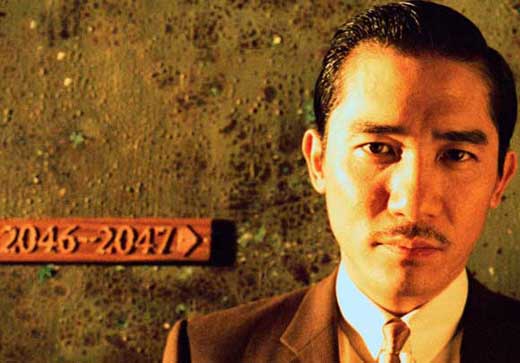
The year 2046 in Hong Kong is very different as the trains of 2046 are for people trying to recapture the lost memories through its varied rooms and androids. On the train is a Japanese man named Tak (Takaya Kimura) is trying to persuade an android (Faye Wong) to revisit a lost memory. That trip to revisit a time is a part of fiction as Chow Mo-wan (Tony Leung Chui-Wai) is reeling from the break-up with his lost love Su Li Zhen (Maggie Cheung) during a trip in Singapore. He along with his friend Ah Ping (Lam Sui-Ping), they return to Hong Kong in 1967, amidst its chaotic period in politics. Returning to give up his reporter job to become a consultant, Chow has become a womanizer of sorts as he comes across a woman named Lulu (Carina Lau). After a night with her, he walks out of her room where he recognizes the number 2046, a old hotel room number he stayed in from his lost affair. Turning to his hotel landlord Mr. Wang (Wang Sum), he moves into the room next door known as 2047 while room 2046 is being redecorated.

The series of affairs and one-night stands inspired Chow to write a series of erotic stories for the paper about a futuristic time in Hong Kong in the year 2046 where people go on trains with androids to reclaim lost memories. Just as the room was finished, a hooker named Bai Ling (Zhang Ziyi) moves in as he's become infatuated with her beauty. It's Christmas 1967 as the two would have dinner that eventually began as a secret affair. While Chow enjoys her company, he doesn't adore and only uses her for his stories as their relationship begins to heat up. Then when Bai Ling realizes the kind of man that Chow really is, their relationship falters. Chow would only see her in passing as he continues his un-fulfilling yet inspiring lifestyle.

Often infatuated with Mr. Wang's daughter Wang Jingwen (Faye Wong), he sees her again who still has trouble trying to contact her Japanese boyfriend (Takaya Kimura) through letters as her father still has bad blood with the Japanese over World War II. Chow becomes an unlikely correspondence through the letters as he begins a relationship with Wang Jingwen who helps him write his work after being impressed with her own writing. During a Christmas dinner, she feels hopeless that she'll never speak to her boyfriend as Chow gives a chance to call him where he decides to use them into another story. Suddenly, the tone of the story changes as he tells the story of Tak who falls for an android with a delayed response where he tells a secret through a hole.

The haunting elements of his stories forces Chow to give up his womanizing lifestyle as by 1970, he becomes reacquainted with Bai Ling, who is set to depart to Singapore. Chow tells about his time in Singapore including what happened last Christmas where he met a mysterious woman named Black Spider (Gong Li) who nearly resembles and carries the name of his lost love. For Chow, he has to recall his own memories as his own world of fiction and reality becomes blurry where he's trying to figure himself even more and the people around him.

While 2046 is not as simple as its predecessor, In the Mood for Love. The film does have a more complex approach in telling the story of Mr. Chow. Particularly in his development from this sensitive, quiet man in the preceding film, In the Mood for Love to a gloomier, meaner individual in 2046. In many ways, the film is about a man whose emotions towards rejection makes him colder yet the pain is drawn out in fiction as he becomes more withdrawn in all of these relationships he had with other women. It's in Wong Kar-Wai's story that really reveals the melancholia of love and all of its heartbreak, whether its in the 1960s or in the futuristic setting of 2046. The film just doesn't take those romantic from his previous film but also bringing a character from another Kar-Wai film, Days of Being Wild.

It's not just in Kar-Wai's script, or lack thereof since he never works with a script, that reveals a far more complex plot that blurs the idea of reality and fiction. It's in his direction where he's a master of atmosphere and tone. Using wandering images plus a very surreal look of 2046 Hong Kong where the trains are used for time travel, Kar-Wai goes very deep into the concept of loss and isolation. Fortunately in his script, he manages to take a structure where the audience isn't loss on what's going on or where they are. It's in Kar-Wai's direction that the audience is transported into a world of melancholia and emptiness where it's in Mr. Chow's journey of self-discovery. Even in Kar-Wai's presentation of mood and colors, he takes the audience to a world where things are moving a bit slower as opposed to the fast-paced world of the future while everything is lost. Kar-Wai's concept of the future is very bleak despite its look while the train and androids represent everything that people hold dearly. There, the ending of his previous film is clearly more understood while the ending in this film, shows a development of Mr. Chow and his trying to understand the way love and fate works.

Helping Kar-Wai in his unique, colorful presentation are two of his most enduring collaborators, Australian cinematographer Christopher Doyle and jacks-of-all-trade William Chang Suk Ping. In the photography, Doyle along with Lai Yiu Fai and Kwan Pun Leung create an enormous array of colors and settings of many of the film's interiors of the 1960s sequences where it's similar to the look of In the Mood for Love but only with a decaying feel. The cinematography in those sequences reveal the changing times while showing the atmosphere and withdrawn feel of the characters. In the 2046 section, it's more colorful with its shade of red and white lights to convey the sense of emotions and the lack of emotions in its androids. Truly its some of the best cinematography ever done.

Production designer/costume designer/editor William Chang Suk Ping helps creating the distinctive visuals of the film. With art director Alfred Yau Wai Ming, the film's 1960 look of colors and props reveal the changing times of late 1960s Hong Kong and the dingy look of late 1960s Singapore. It's in the atmosphere of the 1960s look where it represents the gloomy mood of Mr. Chow while the look of 2046 is very different and very polished. Even the costumes of the 1960s from the tight clothing of Bai Ling to the more conservative look of Wang Jingwen reveal the contrasts of their personalities while the costumes of the future are done with an array of things including paper mache. The film's look in its design and costume are done with immense brilliance while Chang's best work is clearly in the editing. Using a shimmering pacing style for some of the film's sequences, it doesn't move too slow or too fast but conveys the ever-decaying mood of Mr. Chow. It's wonderfully cut to convey the perspective of characters while holding together its unique yet complex structure. Overall, William Chang Suk Ping's work in any medium should be commended.

The visual effects team of BUF from France does a great job for creating a surreal yet gargantuan look of Hong Kong in the future. The film's look in its visual effects complement the style of Kar Wai and his collaborators where it presents a surreal yet beautiful look of the future filled with large buildings with neon colors and a green-brown background with everything looking what the future should look like. For the sound work, Kar-Wai regular Tu Duu Chih and French sound designer Claude Letessier do amazing work in bringing the right kind of feel and tone for its atmosphere from the quietness in the hotel rooms of the 1960s sequences to the metallic yet ominous feel of the 2046 scenes.

The film's music which is composed by Peer Raben and Shigeru Umebayashi is more sweeping and epic than In the Mood for Love which had a more waltz-like tempo in its score. For this film, the music conveys the sense of gloom and loss where its arrangements are more lyrical as it builds up the momentum of the film. The music also features not just cuts from Polish composer Zbigniew Preisner, famed for his work with the late Krzysztof Kieslowski, but also Georges Delerue, and pop cuts from Secret Garden, Angela Gheorghiu, Xavier Cugat, Connie Francis, and Nat King Cole singing a Christmas classic.

Finally, there's the film's cast which includes several notable small performances from Dong Jie as Wang Jingwen’s little sister and as an android plus Carina Lau reprising her role as Mimi/Lulu from Days of Being Wild and as an android along with Kar-Wai regular Chang Chen as her lover in both the 1960s and futuristic sequences. Maggie Cheung is also great in her brief appearance as the Su Li Zhen in the early 1966 sequence while Lam Sui-Ping is wonderfully funny as Ah Ping who reminds everyone of his humorous presence. Wang Sum is also excellent in his role as the Japanese-hating Mr. Wang while Gong Li commands a great presence and atmosphere in her performance as Black Spider who carries a secret past that becomes one of the film's most devastating moments. Japanese actor Takuya Kimura is wonderful in his role as Tak, a fictional character who represents all the remorse and sadness of Mr. Chow as he brings a mostly, minimalist performance to many of his scenes where it's truly a marvel of a performance.

Zhang Ziyi is great in her role as the young, emotional hooker Bai Ling who commands a great presence and authority to her role in many of the film's sequences as her character develops into a young woman who longs for the love of Mr. Chow. It's truly one of Ziyi's great performances. Faye Wong delivers the best of the female performances as Wang Jingwen who captures the heart of Mr. Chow through her sadness to connect with her own lost love. Though, the two never got into a more intimate relationship, Wong manages to capture the sense of hopefulness and will for Mr. Chow to re-think his own lifestyle while Wong also brings a wonderfully haunting yet emotional quality to her role as the android who is devoid of emotions.

Then we have Tony Leung Chui-Wai in the role of Mr. Chow. Taking his character to more darker yet withdrawn areas, Leung manages to create a different version of Mr. Chow that was opposed to the sensitive yet quiet man from In the Mood for Love. In 2046, he displays a lot of charm in front of everyone but inside, he's gloomier and meaner. Still, Leung manages to make Mr. Chow a man who is flawed and with a lot of internal conflict of someone who gives up on long love yet cannot yearn for it. Looking more like a modern-day, Asian Clark Gable, Leung brings new dimensions to his famed character as it stands out as another of his great performances.

The Region 1 DVD from Sony Pictures Classic is a truly marvelous DVD with loads of special features and a presentation that works for Kar-Wai's visually haunting film. The first film of Kar-Wai to be shot on a widescreen format of 2:40:1 anamorphic ratio. The look of the film is wonderful while it's done in 5.1 Dolby Digital sound in Cantonese with English and Spanish subtitles. Overall, the film looks and sounds great in its DVD presentation while it also features an array of great little extras. First is a 37-minute Behind the Scenes special featuring interviews with Kar-Wai and the cast where they talk about the film, Kar-Wai's style and the collaborators, notably William Chang Suk Pin about the look and feel of the costumes. The special is informative about Kar-Wai's working habits as they go behind the scenes on everything.

Two deleted scenes are presented except a much-talked about martial arts sequence that possibly never made the final cut or was never filmed. The first is a scene involving Black Spider trying to find Mr. Chow in his room as she ends up staying in the room 2046. The second deleted scene involves another strange meeting with Mr. Chow with meeting of Wang Jingwen's android character from their own collaboration which is one of the more emotional scenes. An alternate ending is also shown which shows Mr. Chow sitting in a bar, though it blurs things even more about the film's ending. The 16-minute interview featurette from a French TV program features interviews with Wong Kar-Wai and Tony Leung as they spoke in English where they talked about the film's concept and their own relationship into working. Zhang Ziyi speaks in Cantonese as she talks about her insecurities into working with Kar-Wai only to be helped by Leung where she found her niche into working with Kar-Wai. The interview also reveals Kar-Wai's non-script approach and how the actors got the freedom to interpret their own characters where for Ziyi, it was challenging yet fun.

The five-minute little featurette called Anatomy of Memories is about the making-of the visual effects of 2046 Hong Kong and the process it took from late 2003 through 2004 where a line-test was revealed in the film's premiere at the 2004 Cannes Film Festival. The film revealed in Kar-Wai's presentation and how he wanted Hong Kong to be bigger with large skyscrapers, smog, and have a neon, techno-like color with the help of his collaborator William Chang Suk Pin. The seven-minute Music Montage special is a collection of scenes played through a few pieces of the film's music, notably its opera track to convey the emotions that Kar-Wai wanted for the film. The featurette on the film's music is a collection of liner notes with the film being played to the clip of the music where that scene is in as Kar-Wai often borrows some of its music from the films of Rainer Werner Fassbinder and Krzysztof Kieslowski.

Two more little specials arrive where the first is in a numerology section about the card numbers, the money that Mr. Chow is paid, and the significance of the number 2046 where it's the year Hong Kong will be under a full rule of China. The second is a gallery of the film's posters from all of the countries to revealed the varied countries and looks of the posters for that country. The previews section from Sony Classics features trailers for such films as Thumbsucker, Junebug, Layer Cake, Heights, and Ingmar Bergman's Saraband. Overall, Sony Classics created a wonderful DVD that complements all the energy and creativity of Wong Kar-Wai.

When production began in 2001 for 2046, Kar-Wai's notoriety to shooting in long periods of time with lots of improvisation and last-minute changes made it a long shoot. There was a running joke on the set that the film would be released in the year 2046. Still, despite a two-year shoot which was nearly halted by the SARs epidemic, Kar-Wai still manage to finish production. During production, he embarked on a few other projects on the side that included his short for The Hand in the 2004 omnibus feature Eros with Michelangelo Antonioni and Steven Soderbergh; the BMW commercial short called The Follow with Clive Owen, Forrest Whitaker, Mickey Rourke, and model Adriana Lima; and a music video for the song Six Days for DJ Shadow.

By late 2003, Kar-Wai and the BUF visual effects team along with William Chang Suk Pin spent months trying to work on the editing and visual effects for the film. Though it was submitted and set for a world premiere, at the 2004 Cannes Film Festival. The film remained unfinished as on the date it was set to premiere and in competition for the Palme D'or, the film print arrived out of its laboratory three hours late as the date for the film had to be rescheduled. The unfinished film got mixed reviews though it wasn't the first time an unfinished film caused a lot of attention as Francis Ford Coppola released an unfinished of his 1979 masterpiece Apocalypse Now at the Cannes Film Festival and co-won the Palme D'or. Still, Kar-Wai manage to get the film done eventually in 2004 while his longtime cinematographer Christopher Doyle announced that 2046 would be the last time he would work with Kar-Wai. Despite Kar-Wai's notoriety in his work ethic, the film proved to be another success for its Hong Kong director.

Though not as potent or as simplistic as In the Mood for Love. 2046 is still an engrossing, hypnotic, and heartbreaking film from Wong Kar-Wai thanks to a dedicated film team and performances from Tony Leung Chui-Wai, Zhang Ziyi, Gong Li, Faye Wong, and Takuya Kimura. Though its suggested to watch In the Mood for Love for some back story, 2046 does manage to be its own film where it gives a great summary to not just the work of Kar-Wai but his unique take on love, memory, and the future. For a film that stimulates you on the visual sense and goes right into your heart, Wong Kar-Wai's 2046 is the film to see.


© thevoid99 2011