Showing posts with label danny devito. Show all posts

Monday, February 29, 2016

One Flew Over the Cuckoo's Nest


Based on the novel by Ken Kesey, One Flew Over the Cuckoo’s Nest is the story of a criminal who pretends to be mentally ill in order to avoid jail time where he finds himself in a mental hospital where he deals with a world that is far crueler. Directed by Milos Forman and screenplay by Lawrence Hauben and Bo Goldman, the film is an exploration of a small-time thief who hopes to take it easy only to deal with authorities who treat people in the most inhumane way. Starring Jack Nicholson, Louise Fletcher, Will Sampson, Danny DeVito, Christopher Lloyd, Scatman Crothers, William Redfield, and Brad Dourif. One Flew Over the Cuckoo’s Nest is a tremendous yet engrossing film from Milos Forman.

Wanting to avoid jail time by staying in a mental hospital in the hopes that he can relax and have fun, a small-time criminal finds himself dealing with a very strict nurse who treats many patients in very inhumane ways where he rebels against her rules and the system in the hospital. Set in the fall of 1963, the film plays into a man that thinks he will be out of the hospital in 90 days and go back to doing all of the shenanigans he’s done though his crime was statutory rape where he had no clue the girl he slept with was 15. During his stay at this hospital in Oregon, Randall Patrick “Mac” McMurphy (Jack Nicholson) doesn’t just see a world where a group of sick men are being goaded and forced to unload into their own issues but also see that there’s a possibility that they might not get better. By being this rebellious figure who wants to watch baseball and go fishing, McMurphy would be this figure that would antagonize the orderlies and this head nurse in Nurse Ratched (Louise Fletcher).

The film’s screenplay doesn’t just explore this environment that is this mental hospital in Oregon but also the people who are there as many of them have trouble with the real world. Among these men that McMurphy meets include a young man with a bad stutter named Billy (Brad Dourif), a profane and confrontational man in Taber (Christopher Lloyd), a delusionist in Martini, an epileptic in Seflet (William Duell), a man prone to childish tempers in Cheswick (Sydney Lassick), a paranoid intellectual in Harding (William Redfield), and a quiet yet tall Native American that McMurphy calls Chief (Will Sampson). Many of them are revealed to be men with real problems but need the time to feel better as McMurphy helps them have a chance to live normal lives while being antagonistic towards Ratched and the other doctors who believe that McMurphy is dangerous but not entirely crazy until Ratched makes a decision that would change things for the film’s second half.

Especially when McMurphy knows more about the patients in his ward and what is happening to him where it raises a lot of questions into the state of inhumanity that he would endure. Especially as the other patients are also being tested against their will where McMurphy would have some revelations about his own and the people around him. It would cause a series of events for him to revolt and try to escape but also endure the growing state of what Ratched and the doctors at the hospital are doing where it is obvious that the men in the ward really need help and McMurphy is the one person that really seems to care and offer them a glimpse of a world without problems no matter how fucked up it is. Yet, it’s a world that is better and can be organized instead of being pressed on and treated like an animal in this abusive and controlling mental hospital under the control of this heartless bitch.

Milos Forman’s direction is quite intimate for the fact that it was shot largely in Salem, Oregon as well as nearby areas including the Oregon State Hospital where much of the film is shot. While there are some wide shots that occur outside of the hospital including a sequence where McMurphy and the gang go on a fishing trip with one of McMurphy’s girlfriends in a day of fun. Much of the film has Forman use close-ups and medium shots to play into the world of the hospital where it is very controlled as Forman’s compositions would have this sense of repression that looms throughout the film. Once the McMurphy character comes in, it’s as if the hospital is starting to come alive little by little as it also has an air of imagination where McMurphy looks into a TV that isn’t on where he comments about a baseball game.

The direction also has Forman find ways to balance humor and drama where the latter becomes very prevalent in the film’s second half as it relates to what McMurphy is dealing with and the outcome of what he has to endure. The usage of extreme close-ups do come into play it does feel very unsettling in terms of what McMurphy has to be put through as well as the other patients. Some of which are here because they actually need help but are being treated inhumanely. Even as the film’s climax that relates to McMurphy’s attempt to escape and throwing a party for himself and the patients would showcase a group of men needing an escape from their own problems and a chance that there is hope for them in the real world. Yet, it is followed by the harshness of reality in the form of Nurse Ratched who is pretty much a monster that needs to be taken down in the hopes that those who suffer from mental illness can be saved and treated humanely. Overall, Forman creates a riveting yet exhilarating film about a small-time criminal trying to buck the system at a mental hospital.

Cinematographers Haskell Wexler and Bill Butler do amazing work with the film‘s cinematography from the look of the many interiors inside the hospital for the scenes set in day and night as well as some of the exteriors in the locations near Salem, Oregon. Editors Richard Chew, Sheldon Kahn, and Linda Klingman do brilliant work with the editing with its usage of rhythmic cuts to play into the drama and some of the film‘s humor while creating moments that are engaging in some of the livelier moments of the film. Production designer Paul Sylbert and art director Edwin O’Donovan do fantastic work with some of the minimal set pieces created such as the ward room and its bathroom that featured a prop that would be key to the story.

Costume designer Aggie Guerard Rodgers does nice work with the costumes design as it‘s mostly casual for all of the patients as well as the look of Nurse Ratched‘s uniform. The sound work of Mark Berger is superb for the atmosphere that is created in the ward with its usage of calm music to soothe the patients to the raucous sounds that would occur upon McMurphy‘s arrival and presence. The film’s music by Jack Nitzsche is wonderful for its low-key, folk-based score that plays into some of the elements of drama and humor as well as what is going on outside of the hospital.

The casting by Jane Feinberg and Mike Fenton is incredible as it features notable small roles from Nathan George as the attendant Washington, Marya Small as a girlfriend of McMurphy in Candy, Louisa Moritz as Candy’s friend Rose, Kay Lee as a night supervisor at the hospital, and Scatman Crothers in a hilarious performance as the night orderly Turkle who finds himself in big trouble. Other noteworthy small performances as some of the patients in the film include Josip Elic as the somewhat-catatonic Bancini, Michael Berryman as the deformed Ellis, Delos V. Smith as the hippie-like patient Scanlon, Willam Duell as the epileptic Seflet, and Vincent Schaivelli as the annoyed Frederickson. Dean Brooks superb as the hospital administrator Dr. Spivey as a man that is trying to understand what is going on while believing that McMurphy isn’t a totally bad influence despite Ratched’s opinion.

Danny DeVito and Christopher Lloyd are excellent in their respective roles as the delusional Martini and the aggressive Taber who both enjoy McMurphy’s presence while William Redfield is brilliant as the educator Harding who copes with the idea that his wife might be cheating on him. Sydney Lassick does amazing work as the child-like Cheswick as a man who has been repressed by his surroundings where he is fit to have tempers where McMurphy is the one person that can help him. Brad Dourif is phenomenal as Billy Bibbit as a young man with a bad stutter who is reluctant to enter the real world while being given the chance to live through McMurphy. Will Sampson is remarkable as the Chief as a tall and silent Native American who is an observer as well as this mysterious being that McMurphy befriends as well as someone who seems to revel in McMurphy’s presence.

Louise Fletcher is great as Nurse Ratched as this head nurse of a ward that is trying to maintain control and oppress everything as there is this coldness to her along with the fact that she is really just a straight-up bitch. Finally, there’s Jack Nicholson in a tour-de-force performance as Mac McMurphy as a small-time criminal who goes to the hospital to avoid jail time only to find himself in bigger trouble by antagonizing Nurse Ratched as it’s a performance that is manic but also one filled with depth as Nicholson creates a character that we all can root for.

One Flew Over the Cuckoo’s Nest is an outstanding film from Milos Forman that features great performances from Jack Nicholson and Louise Fletcher. Along with a phenomenal supporting cast as well as a compelling screenplay, the film isn’t just a unique study into madness and oppression. It’s a film that also showcases a world of men being treated inhumanely by an unjust world that was supposed to help them only to make them less human. In the end, One Flew Over the Cuckoo’s Nest is a spectacular film from Milos Forman.

Milos Forman Films: (Black Peter) - (Loves of a Blonde) - (The Fireman’s Ball) - (Taking Off) - (Visions of Eight) - (Hair) - (Ragtime) - (Amadeus) - (Valmont) - (The People vs. Larry Flynt) - (Man on the Moon) - (Goya’s Ghost)

© thevoid99 2016

Saturday, April 19, 2014

Batman Returns


Based on the DC Comics by Bill Finger and Bob Kane, Batman Returns is the sequel to the 1989 film in which Batman faces a new foe in the Penguin who teams up with a business tycoon to take down the Batman while a mysterious vigilante in Catwoman also creates trouble. Directed by Tim Burton with a screenplay by Sam Hamm and Daniel Waters from a story by Hamm, the film is a darker story than its predecessor as Bruce Wayne/Batman deals with his new foes as Michael Keaton reprises his role with Michelle Pfeiffer as Selina Kyle/Catwoman, and Danny Devito as Oswald Cobblepot/the Penguin. Also starring Pat Hingle, Michael Gough, Michael Murphy, Cristi Conaway, and Christopher Walken as Max Shreck. Batman Returns is a superbly thrilling film from Tim Burton.

The film is an exploration into Bruce Wayne adjusting to his role as Gotham’s peacekeeper as new enemies emerge during the Christmas holidays to wreak havoc on the city. Among them is a deformed man known as the Penguin who wants to take over Gotham where he kidnaps the industrialist Max Shreck as the two team up to control Gotham. Adding to the chaos is a woman named Selina Kyle who was a secretary of Shreck as she was pushed out of a window and fell many stories to the ground. Kyle would survive the fall as she becomes Catwoman as she becomes a vigilante of her own as she causes problems for Batman where she briefly aligns with the Penguin. Yet, Kyle’s life is more complicated when she falls for Bruce Wayne unaware that he’s Batman and vice versa as it would lead to a very troubling climax.

The film’s screenplay by Sam Hamm and Daniel Waters, with additional work by Wesley Strick, doesn’t just explore Bruce Wayne being this hero for Gotham but also encounter these new forces. The real villain in the film is Max Shreck as he is this industrialist that wants to create a new power-plant for Gotham when the city doesn’t need it. When Kyle accidentally learns what Shreck is doing, Shreck tries to kill her as he would use the Penguin to usurp Gotham’s mayor (Michael Murphy) to become the new mayor so Shreck can build his power plant. Though Penguin had his own plans to create chaos in Gotham, he teams up with Shreck for power while trying to discredit Batman with the help of Catwoman. One of the aspects of the script that is unique is the fact that it’s a film about identity as it relates to Batman, Penguin, and Catwoman.

Whereas Bruce Wayne tries to cope with his dual role as he is also seeking some balance as a man where he wouldn’t need to keep secrets. Though he accepts his role as Gotham’s hero, it’s not one that he easily accepts as he has few allies in the city. The Penguin maybe an antagonist but not a conventional one as the film begins with his birth as he arrives as a deformed baby his rich parents would dump into a sewer just days after his birth. In being this outcast, he wants to destroy Gotham only to become a pawn in Shreck’s plans that forces him to become more determined for Gotham’s end. Then there’s Selina Kyle who starts out as this timid secretary who lives with a cat as her near-death experience in the hands of Shreck has her becoming this unstable woman that not only wants to get revenge on Shreck but her encounter with Batman would create a very complicated relationship as their real-life personas are in love with each other while there’s a strange attraction between the two in their other personas. Catwoman isn’t a villain nor a hero but a true anti-hero who is only in it for herself.

Tim Burton’s direction is definitely more extravagant in some respects but also very offbeat in its mix of dark humor, action, and suspense. Yet, there’s a looseness to the story where Burton is able to make all of these elements fuse together though not all of these moments work. Still, he is able to create some exotic scenes and action sequences that are very exciting as it includes a very memorable moment where Catwoman introduces herself to Batman and the Penguin. The use of close-ups, wide shots, and medium shots gives Burton some room to breathe in the way he creates some of these moments while being able to explore the complexity of identity in the film in shots that are much more simpler. Especially in the romantic attraction between Wayne/Batman and Kyle/Catwoman as there’s an element of sensuality in that attraction.

The direction is also stylish in the way some of the action scenes and in some of the humor that is presented though a lot of its very dark. Especially in the film’s climax as it involves Batman, the Penguin, Catwoman, and Shreck as it features extravagant set pieces as well as a lot of penguins where some of it is real and some are robotic. The usage of animals do add some style to the film where they would aid whoever is needed as its climax is both enthralling but also somber where it would play into Batman/Wayne’s struggle to find a balance in his dual role. Overall, Burton crafts a very exciting and stylish film about Batman coming to terms with his identity and the new foes he faces.

Cinematographer Stefan Czapsky does excellent work with the film‘s cinematography from the look of the exteriors of Gotham as well some of the lighting in the sewer home of the Penguin and his army as well as the shadows in the Batcave. Editors Chris Lebenzon and Bob Badami do nice work with the editing as it‘s pretty straightforward with some stylish cutting for some of the film‘s action scenes as well as some of its humorous moments. Production designer Bo Welch with set decorator Cheryl Carasik and supervising art director Tom Duffield, does amazing work with the set pieces from the look of the city square in Gotham to the Batcave as well as the Penguin‘s lair, and the apartment Kyle lived in. Costume designers Bob Ringwood and Mary E. Vogt do fantastic work with the look of Catwoman‘s costumes as well as the clothes of the Penguin and the suits that Max Shreck wears.

Makeup designers Stan Winston, Ve Neill, and Ronnie Specter do brilliant work with the makeup design of the Penguin as well the look of his band of freaks that he leads. Visual effects supervisor Michael L. Fink does terrific work with some of the visual effects that includes some early ideas of CGI as well as the use of miniatures in some of the action sequences. Sound editors Richard L. Anderson and David E. Stone do superb work with the sound to create some layering of sounds in the action scenes as well as some of the scenes set in Gotham. The film’s music by Danny Elfman is incredible for its mixture of bombastic orchestral pieces to some more serene and enchanting pieces to play into some of the melancholia as the film’s soundtrack also includes a few Christmas pieces and a collaboration with Siouxsie & the Banshees for the song Face to Face.

The casting by Marion Dougherty is great for the ensemble that is created as it features cameo appearances from Jan Hooks as a PR assistant, Vincent Schiavelli as one of the Penguin’s henchmen, Anna Katarina as the poodle lady who works for the Penguin, and in the role of Penguin’s parents, Paul Reubens and Diane Salinger who had appeared in Burton’s first film Pee-Wee’s Big Adventure. Other notable small roles include Andrew Bryniarski as Shreck’s son Chip, Cristi Conaway as the Ice Princess who lights Gotham’s Xmas tree, and Michael Murphy as the city’s mayor. Reprising their roles from the first film, Pat Hingle and Michael Gough are terrific in their respective roles as Commissioner Gordon and Alfred Pennyworth where Gordon becomes one of the few men who trusts Batman while Pennyworth helps Batman/Wayne in uncovering some of the mysteries relating to the Penguin.

Christopher Walken is brilliant as the very manipulative and power-hungry Max Shreck as Walken has this charm that makes him a very unique villain that doesn’t have any personas but is willing to use people for his own means. Danny DeVito is fantastic as the Penguin as a man who learns about his family as he becomes manipulated into becoming a politician only to realize that he is who he is as he wants to destroy Gotham and its hero Batman. Michelle Pfeiffer is phenomenal as Selina Kyle/Catwoman as this woman who despises Shreck for his plans and later trying to kill her as she becomes this very unstable woman that wants to create chaos as she also falls for Wayne/Batman. Finally, there’s Michael Keaton in a superb performance as Bruce Wayne/Batman as Keaton displays more aggression in his role as Batman while still being a bit brooding as he showcases Wayne’s struggle to balance his dual roles as he also has some great chemistry with Pfeiffer in their different personas.

Batman Returns is an excellent film from Tim Burton that manages to be a worthy sequel to its 1989 predecessor. Armed with an amazing cast as well as dazzling set pieces and Danny Elfman’s sumptuous score that includes a song by Siouxsie & the Banshees. While it is a darker film than its predecessor, it is still an engaging one for the way it explores identities and one man’s desire to balance his role as a man and crime fighter. In the end, Batman Returns is a marvelous film from Tim Burton.

Tim Burton Films: (Pee-Wee’s Big Adventure) - Beetlejuice - Batman - (Edward Scissorhands) - Ed Wood - (Mars Attacks!) - (Sleepy Hollow) - (Planet of the Apes (2001 film)) - (Big Fish) - (Charlie & the Chocolate Factory) - (Corpse Bride) - (Sweeney Todd: The Demon Barber of Fleet Street) - (Alice in Wonderland (2010 film)) - (Dark Shadows) - (Frankenweenie) - (Big Eyes) - (Miss Peregrine's Home for Peculiar Children) - (Dumbo (2019 film)) - Beetlejuice Beetlejuice

Batman Films: (Batman (1966 film)) - Batman Forever - Batman & Robin - Batman Begins - The Dark Knight - The Dark Knight Rises - Batman v Superman: Dawn of Justice - The Lego Batman Movie - The Batman (2022 film)

© thevoid99 2014

Monday, August 12, 2013

Anything Else


Written, directed, and starring Woody Allen, Anything Else is the story about an aspiring writer who falls in love with a woman while in New York City as he has hard time trying to figure out what to do with his life in love and as a writer where he gets some bad advice from a struggling artist. The film explores a young man’s life as he tries to find himself in New York City. Also starring Jason Biggs, Christina Ricci, Stockard Channing, Jimmy Fallon, Adrian Grenier, and Danny DeVito. Anything Else is a horrific film from Woody Allen.

The film revolves around the life of a writer who is at a transitional point in his career while his relationship with his girlfriend is becoming rocky due to his neuroses and her craziness. Meanwhile, the writer takes some very bad advice from a struggling artist, with a history of mental illness, over what to do with his life and career. It’s a film that explores a man trying to find out what to do with his life and career as it’s going into some trouble as it’s all told from his perspective. Woody Allen’s script unfortunately creates a story that is messy where he has this young writer dealing with the decisions of his life as well as his relationship with this young woman who is very fleeting in her decisions and never sticks to anything. It’s a story that has this very troubled narrative told by its protagonist where it would have flashbacks but never makes sense of what is happening.

Allen’s direction has him trying to bring back elements of some his earlier work in terms of storytelling where its protagonist would break the fourth wall down to talk to the audience about what he’s thinking and such. It’s a device that doesn’t work where it tends to bring a lot of unnecessary exposition as well as dragging the story a bit. The direction does have some nice moments in the compositions including a scene where Allen’s David Dobel character snaps after being denied a parking space where he destroys that person’s car. Yet, there’s a lot of moments in the film where things do get out of control where the protagonist Jerry Falk (Jason Biggs) has to deal with his girlfriend’s messy life including a visit from her boozy and unstable mother (Stockard Channing) as it gets old at times and the comedy just doesn’t work. Overall, Allen creates a very awful and nonsensical film about a man trying to find his role in life.

Cinematographer Darius Khondji does excellent work with the film‘s cinematography as it‘s got some gorgeous shots of the New York City locations as well as some of the film‘s interior settings. Editor Alisa Lepselter does fine work with the editing to play out some of the drama including a few montages but couldn‘t tighten up some of the messier moments in the film. Production designer Santo Loquasto, with set decorator Regina Graves and art director Tom Warren, do nice work with the set pieces from the apartment that Jerry lives in to some of the places he goes to in the city.

Costume designer Laura Jean Shannon does superb work with the costumes as it‘s mostly casual with more stylish clothes worn by the female characters. Sound editor Robert Hein is terrific for some of the chaos that is played out in some of the locations and parties the characters go to. The film’s soundtrack includes a lot of jazz music and standards from Billie Holliday, Lester Young, Peggy Lee, Diana Krall (who makes an appearance in the film), and Teddy Wilson as it’s one of the highlights of the film.

The casting by Laura Rosenthal and Juliet Taylor is pretty good as it features appearances from Adrian Grenier and Erica Leershen as a couple of actors Jerry meets, David Conrad as a doctor who examines Amanda who raises Jerry’s suspicions, KaDee Strickland as Jerry’s ex-fiancĂ©e who he dumps for Amanda, and Jimmy Fallon as Amanda’s boyfriend Bob before she meets Jerry. Danny DeVito is terrific as Jerry’s loyal agent Harvey Wexler as he has some funny moments except for a scene late in the film that is just overdone. Stockard Channing is excellent as Amanda’s boozy mother Paula who is often full of drama as she’s trying to get herself back up only to create more trouble for Jerry.

Woody Allen is OK as the very troubled David Dobel who offers Jerry some bad advice about everything in life as he creates a lot of trouble where Allen also show some moments where he can go really crazy. Christina Ricci is terrible as Amanda as she’s this flighty woman who is always doing something crazy while complaining about how fat she is and such as it’s just a performance that is grating to watch. Finally, there’s Jason Biggs in an absolutely dreadful performance as Jerry Falk as Biggs is just very awkward to watch at times while he overdoes the nebbish persona that Allen has perfected for so many years as it is just very bad and extremely un-funny to look at.

Anything Else is a fucking terrible from Woody Allen that features dire leading performances from Jason Biggs and Christina Ricci. The film is definitely one of Allen’s worst films in terms of its attempt to rehash old ideas without really doing anything new with some very flat humor. In the end, Anything Else an appalling film from Woody Allen.

Woody Allen Films: What's Up Tiger Lily? - Take the Money and Run - Bananas - Everything You Always Wanted to Know About Sex* (*But Were Afraid to Ask) - Sleeper - Love and Death - Annie Hall - Interiors - Manhattan - Stardust Memories - A Midsummer's Night Sex Comedy - Zelig - Broadway Danny Rose - The Purple Rose of Cairo - Hannah & Her Sisters - Radio Days - September - Another Woman - New York Stories: Oedipus Wrecks - Crimes & Misdemeanors - Alice - Shadows and Fog - Husbands and Wives - Manhattan Murder Mystery - Bullets Over Broadway - Don't Drink the Water - Mighty Aphrodite - Everyone Says I Love You - Deconstructing Harry - Celebrity - Sweet and Lowdown - Small Time Crooks - The Curse of the Jade Scorpion - Hollywood Ending - Melinda & Melinda - Match Point - Scoop - Cassandra’s Dream - Vicky Cristina Barcelona - Whatever Works - You Will Meet a Tall Dark Stranger - Midnight in Paris - To Rome with Love - Blue Jasmine - Magic in the Moonlight - Irrational Man - (Cafe Society)

The Auteurs #24: Woody Allen Pt. 1 - Pt. 2 - Pt. 3 - Pt. 4

© thevoid99 2013

Tuesday, August 24, 2010

The Virgin Suicides


Originally Written and Posted on Epinions.com on 9/20/03 with Additional Edits and New Content.


When the name Coppola is mentioned in a sentence, the immediate reaction is Francis Ford Coppola, the man behind great films like The Conversation, Apocalypse Now, Peggy Sue Got Married, and The Godfather Trilogy featuring the highly celebrated first two films of the series. While Francis Ford Coppola has remained a respected director, a new generation of Coppolas started to emerge. With his nephew Nicholas Cage, already an Oscar-winning actor with a celebrated career, Coppola's children are now following their father's footsteps as directors. There's Roman Coppola, who recently earned good reviews for his debut feature CQ while helming such award-winning music videos for bands like the Strokes and Fatboy Slim's Praise You with then brother-in-law and Being John Malkovich director Spike Jonze. The other Coppola that is making a name is Roman's younger sister Sofia, who wowed audience with her 1999 full-feature directorial debut The Virgin Suicides.

The Virgin Suicides is a movie based on the Jeffrey Eugenides novel that was adapted by Coppola into a screenplay. The film takes place in an idyllic suburbia in the mid-1970s as neighborhood boys discover their own sexuality while watching the self-destruction of a group of young sisters as they're being trapped into their strict family home. While Sofia Coppola does capture a sense of tranquility and authenticity of the times like her father Francis did in The Godfather, Sofia brings a deeper tone to the film where at first, everything seems innocent but there's something amiss. With an ensemble cast that includes veterans like James Woods, Kathleen Turner, Scott Glenn, Danny Devito, and Michael Pare along with up-and-coming stars like Kirsten Dunst, Josh Hartnett, Jonathan Tucker, Robert Schwartzman (the singer for the California pop-rock band Rooney), Hayden Christensen, and Chelse Swain (sister of Dominique). The Virgin Suicides is a breathtaking debut from Sofia Coppola.

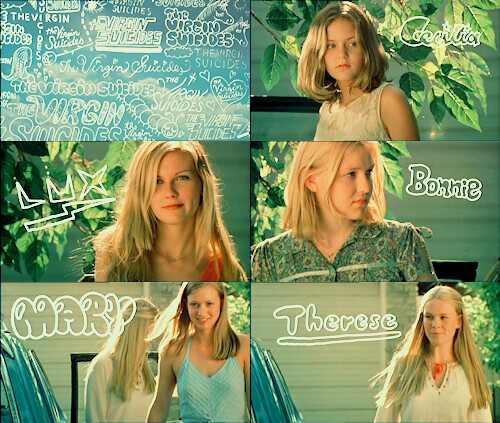
The stroy begins, it starts off with a narrator (Giovanni Ribisi) talking about how his old neighborhood back in the mid-1970s was never the same without the Lisbon girls. The narrator talks about how he and a few of his friends that included his friends Tim Weiner (Jonathan Tucker) and Chase Buell (Anthony Desimone) are transfixed by the beauty and mystique of the five Lisbon girls. There was the youngest, 13-year old Cecilia (Hanna R. Hall), 14-year old Lux (Kirsten Dunst), 15-year old Bonnie (Chelse Swain), 16-year old Mary (A.J. Cook) and the eldest, 17-year old Therese (Leslie Hayman) that all lived in a quiet, idyllic home with their strict mother (Kathleen Turner) and math teacher father (James Woods). To everyone, life seems fine for the Lisbons but Cecilia was rushed into the hospital after a horrifying suicide attempt.

After some counseling from Dr. Horniker (Danny Devito), the Lisbons reluctantly try to give the Lisbon girls a social life as they try to question about why she tried to commit suicide at 13. The neighbors think she was influenced by a young Italian immigrant who had a crush on an older woman, while the neighborhood boys talk to a young mob son named Paul Baldino (Robert Schwartzman) who saw Cecilia's suicide attempt through the tunnels of his house.

The Lisbons decides to throw a party for the girls with a lot of reluctance from Mrs. Lisbon, as Cecilia is feeling unhappy about the party while all the neighborhood boys attend and talk with the Lisbon girls. Things go fine until a mentally challenged kid named Joe (Paul Sybersma) comes to the party to bring laughs but Cecilia walks away from the party and something horrible happens.  Cecilia's death brought an awareness of suicide around the town and Mrs. Lisbon seeks the advice of priest, Father Moody (Scott Glenn) as the Lisbons try to move on life without Cecilia. The Lisbon girls would go to school as nothing really happened while their father moves on teaching math to students. There the second part of the film begins with a young, good-looking student named Trip Fontaine (Josh Hartnett) who seems to have everything his way as he loved by all the girls in school and seems to get away with everything including smoking marijuana. One day while sneaking into the wrong classroom, he falls for Lux who at first isn't really interested in him.

He seeks the advice of his father as he finally gets a chance to impress Lux by calling her a Stone Fox and is invited to family dinner where there after, Lux kisses him and he is in heaven. With the prom approaching, Trip asks Mr. Lisbon if he and a few of his friends could take his daughters to the school dance and Mr. Lisbon says yes since he thinks Trip is a nice boy. With the girls already happy and buying prom dresses, Trip gets a few of his buddies (one of them is Hayden Christensen) as they accompany the girls to the prom but Lux is way into Trip's stoner activities of booze and dope.  Upon their arrival for the prom, Lux and Trip won the King and Queen of the school dance but things go wrong after an intimate encounter where Trip ditches Lux at the school football field leaving her late past curfew and costing her sister's chance of freedom. Trip meanwhile, never recovered from what he did to Lux as the older Trip is filled with many regrets

Following Lux's failure to make curfew, the girls are banned from school with Lux forced to burn her own record collection.  In reaction to her isolation, Lux makes out with various strangers on her roof as seen by the boys as it was only short-lived.  With the girls not back at school, Mr. Lisbon is fired as the neighborhood boys try to make contact through playing records through the phone.  What happens later would become an event that the boys would be haunted by for the rest of their lives.

What makes The Virgin Suicides a very complex, breathtaking film is how Sofia Coppola takes the audience back in time to the childlike innocence of the 1970s away from Vietnam and Nixon. With cinematographer Edward Lachman, the authentic look of 70s suburbia is filled with majestic colors while on some scenes, there's colors of orange, blue, and dreary earth colors to encompass the mood of its characters and scenes.

Coppola's script adaptation is also strong with its many innocent and dark moments without being melodramatic or making things predictable. The film's ending, as ambiguous as it was delve into the loss of innocence through the teenage boys as they deal with what had happen. The film in many ways delve into the themes that Coppola has explored in her other films which is the theme of alienation and disconnection. Particularly the latter as the Lisbon girls yearn to connect with the boys as they become more detached from reality. It's not to say that it's the fault of the Libson parents entirely. They just don't understand the way things are during the 1970s. Mr. Libson is an aloof sort of man with Mrs. Lisbon being the disciplinarian. Coppola's portrayal of the characters is quite unique, even as it's told through the perspective of one of the neighborhood boys. When it comes to the story of Trip, it's told through an older, burned-out Trip (Michael Pare) as Coppola takes Eugenides' novel into a dreamy yet entrancing story of loss and regret.

Helping Coppola and Lachman capturing that vision is production designer Jasna Stefanovic and costume designer Nancy Steiner, who bring in a nice detail to the look of the 70s while using parts of Los Angeles and Toronto to capture the nice location setting of the film. With longtime Coppola associate Richard Beggs bringing in fine sound design work for the film's haunting quality, the film is nicely paced and stylized by editors James Lyon and Melissa Kent. Another great factor to the film is its use of music ranging from such 70s classic from acts like 10CC, Heart, Todd Rundgren, Styx, the Hollies, and the Bee Gees, to the haunting, electronic film score from the French electronic duo Air.

In the performance front, the best performance easily goes to Kirsten Dunst who stands out above all as the precocious, sexy Lux who is filled with mystique about her character as she plays the sex kitten. Dunst as Lux, remains her best film role to date as she has since had become a prominent star with big roles in Bring It On and the Spider-Man while taking on great roles in smaller films like Peter Bogdanovich's The Cat's Meow and as Marie Antoinette in Sofia Coppola's 2006 bio-pic.. Josh Hartnett even stands out as the hunky stoner Trip Fontaine as he brings a sheer cool to his character that makes him a heartthrob for all women while his ability as a serious actor, is still in question. The roles of the Lisbon sisters including Hannah R. Hall as the doomed Cecilia stands out in a few film moments while the neighborhood boys that included Jonathan Tucker is filled with excellent performances along with Coppola's cousin Robert Schwartzman as Paul Baldino.

The performances of veterans like James Woods and Kathleen Turner are flawless and masterful as the strict but caring Lisbon parents. Especially Woods, who plays a different sort of character as a father and teacher who tries to show kids something but they easily become uninterested and he's still talking. The small roles of Danny Devito, Michael Pare, and Scott Glenn are very memorable, especially Glenn who plays against type from his usual, villain type of roles to play a man of guidance. Giovanni Ribisi as the narrator is another standout since he help makes the film come all together with his inspiring narration.


***Additional DVD Content Written from 8/30/18-9/8/18***

The 2000 Region 1 DVD from Paramount Classics and Zoetrope presented the film in a 16:9 widescreen aspect ratio with 5.1 Surround Sound in English and French along with hard for hearing subtitles in English. The special features from the 2000 DVD include the film’s theatrical trailer as well as a photo gallery of photos from the film’s production. One major special feature is a music video for Air’s Playground Love directed by Roman and Sofia Coppola that recreates a few scenes of the film that involves a chewing gum that comes to live to sing the song. The video is a creative moment that include cameos from Roman and Sofia as they’re about to shoot the film’s prom scene that includes the chewing gum singing.

Another special feature from the 2000 DVD is a making-of documentary from Sofia’s mother Eleanor who was famous for shooting footage for the making of Apocalypse Now by her husband Francis Ford Coppola that would later be used in the documentary Hearts of Darkness: A Filmmaker’s Apocalypse. The 20-minute documentary feature Coppola directing the film with her parents watching as Francis is one of the film’s executive producers while her older brother Roman does the film’s second unit work. Jeffrey Eugenides would make an appearance chatting with Josh Hartnett about the character of Trip while James Woods is first seen in the documentary’s opening scenes praising the crew on the production which he says is one of his most enjoyable experiences. It’s a fun documentary short that has a mother filming her daughter making her first feature-length film.

The 2018 Region 1/Region DVD/Blu-Ray from the Criterion Collection presents the film in a new 4k digital restoration supervised by cinematographer Edward Lachman and with the approval of its screenwriter/director Sofia Coppola in its original 1:66:1 aspect ratio with a 5.1 Surround Sound (uncompressed DTS-HD Master Audio Soundtrack for the Blu-Ray) mix. Among the special features retained from the 2000 DVD release from Paramount are the film’s trailer, the making-of documentary film by Eleanor Coppola, and the music video for Air’s Playground Love. Among the new special features added for the DVD/Blu-Ray release include Coppola’s 1998 short film Lick the Star in a new remastered transfer approved by Coppola.

The 15-minute interview with novelist Jeffrey Eugenides has him talk about the novel as well as the film where he reveals not just how faithful Coppola was with the book but also in providing her own interpretation that was more driven by women since the book was told mainly from the point of view of four teenage boys. Eugenides talks about what inspired him to write the book as well as how he was surprised that the many of his readers were young teenage females and young women as he knew that its popularity would lead to many studios wanting to adapt his book into a film. Yet, he felt that Coppola was the one who really got it as well as he was on set for a few days where Josh Hartnett came to him for ideas on the character of Trip Fontaine. It’s an interview that has Eugenides not only rave about the film but also Coppola as he believed that she has a voice of her own through the films she would make in the years to come.

The 26-minute interview section with screenwriter/director Sofia Coppola, cinematographer Edward Lachman, Kirsten Dunst, and Josh Hartnett entitled Revisiting “The Virgin Suicides” has the four talk about their experience in making the film as well as their take on the story. Coppola revealed that she discovered Eugenides’ book in the early 1990s at a time when she was trying to figure out what to do in art and learned that the book would be made into a film by another filmmaker. Coppola was afraid what that film would be like as she received advice from her father into adapting a few chapters of the book into a script where she eventually adapted the entire novel and would submit to producers of the adaptation that was in development that had fallen apart because of issues with the original director. Coppola also talked a little bit about her first short film Lick the Star which she did as a test to see if she can make a film as it gave her ideas of what she would do with her first feature-length film.

Dunst and Hartnett both talked about their own experience as Dunst (who was 16 during production) and Hartnett (who was to turn 20 during the production) also talked about Coppola’s direction and how their idea of acting changed by doing this film. Dunst in particular as she had done a lot of big budget and Hollywood films prior as she felt she became a different actress after this film. Lachman talks about working with Coppola, who was new to filmmaking, as the two both had similar ideas of what the film should look like where he also talked about the lighting cues that he wanted to create. Coppola also talked about the first-time experience as she admitted that she didn’t think she would find her calling as a filmmaker but credits Eugenides’ book for giving her the idea of becoming one.

The 13-minute video essay piece Strange Magic by Tavi Gevinson has the film writer/blogger talk about the film as well as her own experiences with both the book and film during her days as a teenager. Gevinson says the film would inspire her to start a fanzine and later her own blog in Rookie that would become an online magazine that focused on pop culture, fashion, and feminism. Gevinson would reveal things she wrote about the film as well as why she felt the film had connected with a lot of teenage girls since its release as well as some of the details on the film’s visuals. Gevinson also talks about a lot of the film’s idea of teenage life which she felt had a lot of relevance to her own experiences as it is a fascinating piece from Gevinson who definitely has a lot of interesting to say about the film.

The DVD/Blu-Ray set also includes a booklet that features an essay by novelist Megan Abbot entitled They Hadn’t Heard Us Calling about the film. Abbot talks about some of the film’s themes as well as how the film would relate itself to the other films Coppola would later do in the years to come. Abbot also talked about the differences between the book and film as well as how Coppola would create this air of distance of the neighborhood boys and the Lisbon girls with the latter desperate wanting to connect in their repressive home. It’s a remarkable essay to one of the finest debut films ever made in the 20th Century.

***End of DVD Tidbits***

The Virgin Suicides is a phenomenal film from Sofia Coppola, who redeems herself for the notoriety she had achieved for her much-criticized performance in The Godfather Part III. Coppola's striking visuals along with eerie storytelling brings strength to the film along with the performances of Dunst, Hartnett, Turner, and Woods. Fans of Coppola will doubt see this as one of her finest as it is a fascinating feature-film debut by a new director. Even as it's a worthy introduction to her work as this film would set the pace of what would come from the already prestigious director. In the end, The Virgin Suicides is a tremendous debut film by Sofia Coppola.


Sofia Coppola Soundtracks: Air-The Virgin Suicides - The Virgin Suicides OST - Lost in Translation OST - Marie Antoinette OST - (The Bling Ring OST) - (Priscilla OST)


© thevoid99 2010