Showing posts with label scott glenn. Show all posts

Friday, October 21, 2022

The Keep (1983 film)

Based on the novel by F. Paul Wilson, The Keep is the story of a group of Nazi soldiers in 1941 Romania who enter an ancient fortress that possesses a mysterious entity that would eventually wreak havoc on everyone. Written for the screen and directed by Michael Mann, the film is a fantasy-horror film that explore this mysterious object that is filled with dark entities that would prove to be troubling for everyone. Starring Scott Glenn, Alberta Watson, Gabriel Byrne, Jurgen Prochnow, Robert Prosky, and Ian McKellan. The Keep is a fascinating but messy film from Michael Mann.

The film revolves around a mysterious fortress in 1941 Romania that the Nazis plan to use during the war where it is revealed that a mysterious entity has emerged within the fortress killing many where a Jewish professor, his daughter, a mysterious man, and other deal with this mysterious entity. It is a film that explore this entity inside a fortress in a small Romanian village near the Carpathian Mountains where the Nazis hoped to have control of the Dinu Pass. Michael Mann’s screenplay does showcase this air of conflict between two German officers in Captain Klaus Woermann (Jurgen Prochnow) and the more sadistic Nazi official Major Erich Kaempffer (Gabriel Byrne) as the former doesn’t want to bring any harm to the Romanian villagers but is also a much more humane individual than the latter who would arrive later following an incident in the fortress in which two soldiers tried to steal a metallic cross thinking it is silver and full of riches only to unleash the mysterious entity known as Radu Molasar (Michael Carter).

Captain Woermann turns to the local pastor Father Mihail Fonescu (Robert Prosky) for advice as Father Fonescu suggests getting the Jewish historian Theodore Cuza (Ian McKellan) who is at a concentration camp with his daughter Eva (Alberta Watson) as they’re retrieved despite Cuza’s ailing health while a mysterious man named Glaeken Trismegestus (Scott Glenn) arrives from Greece to deal with this entity. Mann does maintain this air of intrigue yet the fact that there’s so much going on and a lot of ambiguity into this entity doesn’t do much with the story though it is clear that there is a lot more that Mann wanted to say as it plays into the state of the world as well as the fortress itself as one of the first scenes in the film has Captain Woermann meet a man in Alexandru (W. Morgan Sheppard) who has been watching over the fortress as he made a warning towards Captain Woermann as he and his two adult sons are never seen again. It’s one of these things in the film that feels like it got cut out as there’s a lot of things that are unexplained in the film.

Mann’s direction is definitely stylish in terms of not just the vast scope he presents but also brings in this mixture of horror, drama, suspense, and war into one entire film. Shot partially on location at Llanberis in Wales as well as additional locations in Spain with much of the interiors of the fortress shot at Shepperton Studios near London. Mann definitely maintains some unique compositions including a lot of wide shots to get a look of some of the areas within this fortress that is filled with this air of death. Even in some of the exteriors where Mann uses some medium shots to get a look into the locations as well as the village where the Germans arrive with Captain Woermann wants to ensure civility. There are close-ups that do play into the drama and tension throughout the film yet the script doesn’t do enough to play into the suspense mainly due to the fact that the film was tampered with during post-production as there are scenes in the film that do feel longer as it has a lot more to say but got cut as some of the cutting feels awkward.

The scene where the two soldiers try to get this silver icon out of the wall that would lead to the chaos is a terrifying moment as is the reveal of Radu Molasar but there are elements in which Mann wanted to do so much more but it never goes all the way. Even as the presence of Molasar would loom over the village as Father Fonescu starts to act crazy where there is so much that feels like there is more to say. The film’s climax that involves Trismegestus and Molasar feels unfinished which lead to an abrupt ending of sorts as it does play like it was meant to be longer. Mann clearly wanted more to do but the result is something messy with so many questions into the stakes and the motivations of Molasar as it never is fully realized. Overall, Mann crafts a compelling but under-realized film about a group of people dealing with a mysterious entity at a Romanian fortress during World War II.

Cinematographer Alex Thomson does incredible work with the film’s cinematography as it is a highlight of the film with its usage of striking lighting for some of the interiors inside the fortress as well as some naturalistic looks for some of the daytime exterior scenes. Editor Dov Hoenig, with additional and un-credited work by Tony Palmer, does nice work with the editing as it has some moments to play into the suspense but the additional work from Palmer unfortunately has some jarring moments in the editing as it help play into the truncated tone of a film that felt longer. Production designer John Box, with set decorator Michael Seirton plus art directors Alan Tomkins and Herbert Westbrook, does amazing work with the look of the fortress including many of its interiors as well as the design of some of the interiors in village houses. Costume designer Anthony Mendleson does fantastic work with the costumes as it play into the period of the times including the Nazi uniforms that Major Kaempffer wears along with his own soldiers.

Makeup effects supervisor/prosthetics designer Nick Maley, with creature designer Enki Bilal, does excellent work with the look of some of the design of the corpses with Bilal creating the look of Molasar. Special effects supervisor Nick Allder, along with visual effects supervisors Robin Browne and Wally Veevers, does terrific work with some of the film’s visual effects as it play into the usage of practical effects and optical shots for some of the powers that Molasar has as well as the glowing eyes of Trismegestus. Sound editor William Trent, with re-recording mixer Doug Turner, does fine work with some of the sound in the way gunfire and other sound effects sound though there’s moments where the sound is muddled due to a lot of the chaos that went on during the film’s post-production. The film’s music by Tangerine Dream is phenomenal with its intoxicating electronic score that has elements of lush synthesizers with elements of guitars as it help play into the mood of the film as it is one of its major highlights.

The casting by Jeremy Zimmerman is superb as it feature some notable small roles and appearances from Frederick Warder and Bruce Payne as the two guards who tried to steal a silver icon that would unleash the terror that would haunt everyone, David Cardy and John Eastham as Alexandru’s sons who help him watch over the fortress, W. Morgan Sheppard as the fortress caretaker Alexandru whom Captain Woermann respects as he warns him about what is inside, and Michael Carter as the mysterious entity Radu Molasar who is this mysterious creature that is terrorizing everyone as it is a chilling performance though he is hampered by the film’s screenplay. Robert Prosky’s performance as Father Mihail Fonescu is an example of someone being miscast since Prosky doesn’t speak with a Romanian accent as he is someone who is trying to help Captain Woermann while dealing with some of the changes in Dr. Cuza’s behavior.

Ian McKellan is fantastic as Dr. Theodore Cuza as a Jewish professor who used to live in the village as he is taken from the concentration camp where he has an encounter with Molsar who cures his ailments as McKellan manages to even play into some over-the-top acting as a man trying not to get killed by the Nazis. Alberta Watson is good as Eva as Dr. Cuza’s daughter who is accompanying him as she is the lone female figure in the film who is seen by the Nazis as someone they can rape yet is also someone who is trying to understand what is going on as Watson has her moments in a role that is underwritten. Jurgen Prochnow is excellent as Captain Klaus Woermann as an infantry officer who reluctantly takes the assignment as he deals with the chaos involving the entity while also lamenting over Major Kaempffer’s sadistic tactics as he is a humane man that wants to protect the villagers and his soldiers from the chaos as well as questioning the ideas of the Nazis.

Gabriel Byrne’s performance as Major Erich Kaempffer as a Nazi officer who leads a band of commandos as he is a sadistic figure that spews Nazi rhetoric as it’s a role that is underwritten where Byrne doesn’t really get to do much but be an asshole. Finally, there’s Scott Glenn in a superb performance as Glaeken Trismegestus as a mysterious figure who seduces Eva while is also someone that is filled with a lot of ambiguity as Glenn is hampered by the script as it feels like there is more about him but is rushed because of the botch editing of the film though Glenn is able to bring in a performance is still intriguing.

The Keep is a good but extremely messy and flawed film from Michael Mann. While it has some incredible visuals from Alex Thomson as well as a great score by Tangerine Dream and some amazing set design. It is a film that feels like there is more to say in its original 210-minute cut that Mann had intended but instead the final version is at the 97-minute running time which feels more like a preview of something much darker. In the end, The Keep is a superb but undercooked film from Michael Mann.

Michael Mann Films: The Jericho MileThief (1981 film) - Manhunter - L.A. TakedownThe Last of the Mohicans (1992 film) - Heat (1995 film) - The InsiderAli - Collateral - Miami Vice - Public Enemies - Blackhat - Blackhat - Ferrari – (Heat 2) - The Auteurs #73: Michael Mann Pt.1 - Pt. 2

© thevoid99 2022

Wednesday, February 06, 2013

The Paperboy


Based on the novel by Pete Dexter, The Paperboy is the story about a reporter and his younger brother trying to investigate the murder of a sheriff by trying to free a man accused of the murders. Yet, things become complicated when the young man finds himself being attracted to the incarcerated man’s lover as it leads to all sorts of trouble. Directed by Lee Daniels and screenplay by Daniels and Dexter, the film is an exploration into the world of the American South as it reveals the motives of people as well as those who are unaware of what they’re in for. Starring Matthew McConaughey, Zac Efron, Nicole Kidman, John Cusack, David Oyelowo, Macy Gray, and Scott Glenn. The Paperboy is a dark yet disturbing film from Lee Daniels.

The film is the story about this idealistic reporter and his younger brother trying to see whether this man had killed a sheriff some years ago. In order to get answers, the reporter brings his British associate for help along with a woman who had been writing letters to this incarcerated man claiming she’s in love with him. Eventually, things become complicated as the reporter is trying to find the truth in the hopes he can unveil the mystery while his younger brother is attracted to this woman who is quite messed up herself as she desires this man she’s been writing letters to. It’s a film that is filled with lots of ambiguity not just in the characters but the situations that occur where the story is told largely by this maid whom the brothers adore though she’s not present in a lot of what happens in the film.

The screenplay by Lee Daniels and its novelist Pete Dexter is quite unique for the fact that it’s a story about a group of people investigating a murder that happened a few years ago as it’s set in the late 1960s. Through the narration of the maid Anita (Macy Gray), she reveals a lot about what happened as it begins with the mysterious murder of this feared sheriff as a man named Hillary Van Wetter (John Cusack) was accused of the murder. For the reporter Ward Jensen (Matthew McConaughey) and his associate Yardley Acheman (David Oyelowo), they return to Ward’s hometown to investigate the murder to see if what Van Wetter is really innocent. With the help of Ward’s younger brother Jack (Zac Efron) as their driver, they also bring in Van Wetter’s lover Charlotte Bless (Nicole Kidman) into the mix though they had never met.

During the course of the investigation, a lot happens as Jack finds himself attracted towards Charlotte as he also to deal with other things in his home life as he often antagonizes the more clean-cut and ambitious Yardley. Jack is also bewildered by his brother as there’s also something about him that is ambiguous yet his intentions as a reporter is still clear as he’s hoping to find the truth and do what is right rather than what sells stories. While the story is really about Jack and all that he encounters during this investigation. The fact that it’s told by Anita does make it strange since she is really a minor character in the film and she does give a lot of exposition that is unnecessary. Particularly since the stuff she reveals is something the audience can already figure out.

Lee Daniels’ direction is quite stylish in the way he presents a typical period time set in the summer of 1969 in a small town in Florida. Notably as he makes sure that it’s not clean-cut where he utilizes moments that are definitely shocking and tawdry. Even as it’s an environment where there’s an element of racism where African-Americans aren’t treated fairly and people do say racial slurs towards them. Even towards someone as refined as Yardley who is this British man that has no idea of what life is like in America where he describes Ward’s hometown as a shit-hole. Even Ward doesn’t want to come back to place but reluctantly does so since the crime happened near his home. While the film is a melodrama of sorts, there’s also elements of camp in some of the things that happen.

Notably a scene where Charlotte and Hillary first meet where it’s completely off-the-wall in terms of its presentation. It’s a film that isn’t afraid to not be shocking though it does go overboard at times. Still, Daniels is intrigued by the world that the characters venture into where it does get darker in the third act as lots of revelations are unveiled. Particularly about certain characters as some of them aren’t exactly as they seem to be. Notably for Jack and Charlotte as they’re definitely the most clear-cut characters of the film who are aware of their complications and don’t carry a lot of secrets. That is probably one of the reasons why Jack is so attracted to her though he has to deal with the fact that she is devoted to Hillary where it does lead to a powerful climax. Overall, Daniels creates a compelling film that is messy at times but still engaging for the sense of style that he brings to this very grimy story.

Cinematographer Roberto Schaefer does brilliant work with the film‘s colorful yet gritty look to capture the beauty and ugliness of 1969 Florida with its small town look and sunny beaches as well as the chilling scenes in the swamps. Editor Joe Klotz does great work with the editing with its use of jump-cuts and multiple split screens to add an element of style to the film. Production designer Daniel T. Dorrance, along with set decorator Tim Cohn and art director Wright McFarland does excellent work with the set pieces from the garage that Ward and Yardley work at to the decayed look of the swamp home that the Jensen brothers encounter.

Costume designer Caroline Eselin does wonderful work with the costumes from the trashy look of Charlotte with her stylish clothes to the more straight-laced clothes the men wear. Sound mixer Jay Meagher does terrific work with the sound to capture the atmosphere of the swamps as well as some of the places the characters go to. The film’s music by Mario Grigorov is superb for some of themes created ranging from melancholic piano pieces to brooding electronic cuts where the latter adds an element of suspense. Music supervisor Lynn Fainchtein creates a fantastic soundtrack that features a lot of the soul and pop music of the late 1960s to complement the times.

The casting by Leah Daniels and Billy Hopkins is phenomenal for the ensemble that is created as it features notable small roles from Scott Glenn as Jack and Ward’s father W.W., Nikolette Noel as W.W.’s new girlfriend Nancy whom the boys dislike, and Ned Bellamy as Hillary’s disturbing uncle Tyree. Macy Gray is OK as the Jensen’s maid Anita whom the boys adore though Gray doesn’t really do much to make her character more interesting as she’s also the film’s narrator. John Cusack is unfortunately miscast as Hillary Van Wetten as this very repulsive man who is in love with Charlotte as there’s a seediness to him where it seems like Cusack is trying to do his impression of Nicolas Cage at times. David Oyelowo is very good as the snobbish Yardley who is a man with refined tastes as he doesn’t like Jack very much at all while he has an agenda of his own that would conflict with Ward’s intentions for the story.

Nicole Kidman is amazing as the very tawdry and trashy Charlotte as a woman who is so intent on meeting Hillary as she finds herself fascinated by Jack while reluctantly helping him and Ward out in the investigation where she finds herself in big trouble. Matthew McConaughey is incredible as Ward Jensen as he is this man with an idealism to help spread the truth where he goes into conflict with his estranged father while getting the kind of help he can from Ward while he is carrying a secret of his own. Finally, there’s Zac Efron in a remarkable performance as Jack Jensen as this former swimmer turned paperboy who deals with the events that are surrounding him as well as his attraction towards Charlotte where Efron finally gets to show his chops as a serious actor as he can be confrontational as well as being un-likeable at times.

While it is a film that does have some flaws, The Paperboy is still an interesting yet unsettling film from Lee Daniels. Thanks to the top-notch performances from Zac Efron, Nicole Kidman, and Matthew McConaughey, it’s a film that explores a period in time where things are secretive as well as being nothing as it seems to be including people. It’s also a film that isn’t afraid to not take itself so seriously though it does make the film a mess at times. In the end, The Paperboy is a pretty good film from Lee Daniels.

Lee Daniels Film: (Shadowboxer) - Precious - (The Butler)

© thevoid99 2013

Monday, January 21, 2013

Nashville


Originally Written and Posted at Epinions.com on 3/13/07 w/ Additional Edits & Revisions.


Directed by Robert Altman and written by Joan Tewkesbury, Nashville is a multi-layered story about different groups of people coming together for a country music convention where the world of politics and celebrity collide in the course of five day that leads to a climatic concert. The film explores the world of celebrity culture through a variety of stories that features more than 20 characters. With an all-star cast that includes Keith Carradine, Lily Tomlin, Shelley Duvall, Michael Murphy, Geraldine Chaplin, Henry Gibson, Ronee Blakley, Gwen Welles, Barbara Baxley, Ned Beatty, Jeff Goldblum, Allen Garfield, Scott Glenn, Elliott Gould, Julie Christie, and many more. Nashville is a superb, sprawling, yet eerie film from Robert Altman.

Replacement party candidate Hal Phillip Walker is set to appear in Nashville, Tennessee in the hopes to win another primary for the U.S. Presidency as a BBC news reporter named Opal (Geraldine Chaplin) is making a documentary about the city. Opal accidentally interrupts a recording session for country legend Haven Hamilton (Henry Gibson) as she meets his son Bud (Dave Peel) while she attends another session featuring gospel singers led by a local housewife in Linnea Reese (Lily Tomlin). Linnea's husband Delbert (Ned Beatty) has a meeting with Californian businessman John Triplette (Michael Murphy) while a mysterious man (Jeff Goldbum) arrives on a motor-tricycle where a cook named Wade Cooley (Robert DoQui) and waitress/aspiring singer Sueleen Gray (Gwen Welles watch). Another aspiring singer in Winifred Albuquerque leaves her husband Star (Bert Ramsen) at a traffic jam as Nashville is waiting for the arrival of famed country singer Barbara Jean (Ronee Blakley).

Delbert, Triplette, Haven, Bud, and Haven's mistress Lady Pearl (Barbara Baxley) are at the airport to meet Barbara Jean and her husband Barnett (Allen Garfield) while a soldier named Pfc. Glenn Kelly (Scott Glenn) watches while a folk trio named Bill (Allan F. Nichols), Mary (Cristina Raines), and Tom Frank (Keith Carradine) arrive to the city as does a woman known as L.A. Joan (Shelley Duvall) who meets her uncle Mr. Green (Keenan Wynn). Jean is sent to the hospital as many await to give interviews or to meet her as Mr. Green later gets a visit from musician Kenny Fraiser (David Hayward) asking to rent a room. Jean's appearance is canceled as everyone in town including African-American country singer Tommy Brown (Timothy Brown) play gigs all over the city while Linnea gets some strange calls from Tom Frank who sleeps around with some of the women in the city. Sueleen auditions for a man named Trout at a club where she passes the audition despite her poor vocal quality. At a show at the Grand Old Opry, Connie White (Karen Black) fills in for Jean who steals the show much to the dismay of Barbara Jean who is still at the hospital. With a big concert at the Parthenon still set, Bill and Mary's relationship is deteriorating as Triplette asks them to play.

Barbara Jean finally plays a show but the performance was shambolic making Triplette and Barnett worried if she will be involved for the big show. At a club later that night, Tom Frank reveals his vulnerability in a song called I'm Easy as Linnea watches while Sueleen attends the gig she received where it's revealed to be not what she expected. On the day Hal Phillip Walker arrives for the show, all of the people big and small in the past four day come together for the big moment where reality and tragedy collide.

Given upon the film's attitude towards idol-worship and politics, the timing couldn't have been any better for a film like Nashville. Even in today's view where whatever cynicism that had been growing in the mid-70s has only served as a reminder to today's harsh times. While a lot of credit should go to Altman for his improvisation, chaotic style in collaboration with his actors. Much of the credit should also go to screenwriter Joan Tewkesbury for telling this story of ordinary people including celebrities and political officers coming together in a place as American as Nashville.

A lot of the film reveals the kind of cynicism and disillusionment that came out of the 1960s. The character of Lady Pearl reveals these feelings when reflecting on her love for the Kennedys and her anger towards her own state for letting Richard Nixon win that state because they didn't want to vote for someone who is Catholic. A lot of the film's political overtones from the voice of P.A. guy talking about the candidate Hal Phillip Walker, who is never seen throughout the entire film.

It's not just politics that drives the course of this story, but also celebrity in which, you have some major celebrity figures in characters like Haven Hamilton, Barbara Jean, Connie White, and Tommy Brown. There's a scene in which the African-American Brown, based on the country singer Charley Pride, is called a racial slur, not by a white man but from one of his own. There's also a scene in where Barbara Jean starts to ramble where it shows the folly and downside of celebrity where it becomes a disappointment to somebody in the audience.

Largely because they're forced to see this iconic figure be something they don't want to see, human. Jean is an interesting character who starts to fall apart from the pressures of celebrity as well as the competition against rival Connie White. There's even a couple of walk-on cameo appearances from Altman regulars Elliot Gould and Julie Christie playing themselves intrigued by this event going on in Nashville.

The city itself is a major character since it's the melting pot of not just where country music is but also the place where Hal Phillip Walker hopes to win. There's a moment where John Triplette uses Nashville hoping to get more votes though he has no care for them. Right before the film's climatic concert, there's a scene of Triplette and Barnett arguing about political motives that revels in how a country has become unsure of their own future concerning the government. After this argument comes this tragedy that would foreshadow an event in the years to come. Plus, in this tragedy comes this wave of disillusionment, loss, and confusion. It is there that someone takes this tragic moment and tries to create something to get people together. This is where the genius of Robert Altman occurs.

Altman isn't concerned about politics, lifestyles, or the cult of celebrity but people, real people even if they're celebrities or political lackeys. Altman's observant yet improvisational direction proves that there's a lot of life in any part of a place like Nashville. Even in a scene where Opal goes to a car dump to prepare narration for her documentary as she is trying to figure out what to say. Altman shows the folly of humanity and how events can lead to surrealism. The character of Linnea Reese is a woman who is a loving mother and wife who cares for her deaf children while her husband is more distracted by this political event rather than paying attention to what his son is trying to say. Altman reveals the folly of people trying to follow something as confusing in politics and celebrity. The moments in the film are often filled with overlapping dialogue to convey the atmosphere of what is going on and where these people are. What are they reacting to or what are they thinking. Altman isn't trying to reveal any kind of answers rather than letting the audience themselves involved in what they think is happening. The result is a truly superb, sprawling direction from the late, great Robert Altman.

Cinematographer Paul Lohmann does excellent work in capturing the wonders that is Nashville from the Parthenon, the Grand Old Opry, and the clubs that make this place unique with its colorful, documentary-like camera work. Set decorator Robert M. Anderson also plays to the film's authentic look of the city with its intimate look for the clubs to the colorful, spacious home of the Reese family. Costume designer Jules Melillo does great work in creating the lavish costumes of the country singers as well as the laid-back clothes of the folk trio Bill, Mary, & Tom to the look of regular people. Editors Dennis M. Hill and Sidney Levin do great work in putting together the stories and characters together with some wonderful editing to move one story to another and see how they all relate to another. Sound editor William A. Sawyer along with Chris McLaughlin and James E. Webb also do amazing work with the sound to convey the sense of tension and atmosphere in the scenes that's happening, notably the way the music is captured.

With many of the actors including Altman contributing music to the film, the soundtrack is wonderfully memorable from the songs Ronee Blakley sings that is pure traditional country to the other songs by Karen Black, Henry Gibson, and Timothy Brown that shows the wonders of country in the 1970s. The musical performances are memorable with Gwen Welles doing a hilariously bad rendition of the songs she sings. Lily Tomlin also does some wonderful music while the real standout is Keith Carradine and his Oscar-winning song I'm Easy. The performance of It Don't Worry Me by Barbara Harris truly memorable while other songs features contributions from Richard Baskin and Gary Busey. It's one of the finest soundtracks ever assembled.

Then, we have the film's large, ensemble cast and it's truly filled with some of the most memorable characters assembled on film. From notable small performances from Gailard Sartain as a diner patron, screenwriter Joan Tewkesbury as the voice of Tom's lover and Kenny's mother, Howard K. Smith as a TV reporter, Merle Kilgore as Trout, composer Richard Baskin as a piano player named Frog, James Dan Calvert and Donna Denton as the Reese's deaf children, and cameos from Altman regulars Elliott Gould and Julie Christie as themselves. Notable small performances from Bert Remsen as Star, Jeff Goldblum as the tricycle man, and David Arkin as Norman are exceptionally memorable for their individual moments. Allan F. Nichols and Cristina Raines are also excellent as the bickering couple of Bill and Mary who are stuck in a tempting love triangle with band mate Tom. Gwen Welles is great as the naive dreamer Sueleen whose belief that she can sing is undermined by the fact that she can't until this moment of humiliation. Robert DoQui is also great as Gwen's friend who reminds her of her lack of talent despite his cynical attitude.

Karen Black is excellent as the bitchy, vain Connie White who has a nicer personality onstage but offstage, she's a mean, egotistical singer with little respect for Barbara Jean. Timothy Brown is also excellent in his brief role as the Charley Pride-inspired Tommy Brown while Scott Glenn is also good in his small role as a soldier who had a nice story about Barbara Jean. Barbara Harris gives a comical, memorable performance as a struggling singer named Albuquerque who is hoping for her own break where she has an amazing scene in the film's finale. David Hayward is also great as the mysterious Kenny who seems lost in the world he is surrounded by as a musician trying to find a place to fit in. Dave Peel is wonderful as the sweet, intelligent Bud Hamilton who enjoys the role of helping his father's business matters while aspires for something more. Allen Garfield is great as Barbara Jean's frustrated, caring manager who is trying to take care of his wife but couldn't deal with the way she's being used.

Keenan Wynn is wonderful as Mr. Green, L.A. Joan's uncle who is dealing with his wife's illness and his niece's single-minded personality. Shelly Duvall is wonderful as the loopy, icon-obsessed L.A. Joan who is more concerned about public events and icons rather than her own aunt. Barbara Baxley gives a wonderfully touching performance as the sweet yet cynical Lady Pearl whose loss of hope for politics reveal a dark anger to the way she reacts towards her own background. Henry Gibson is great as country legend Haven Hamilton who is trying to organize things while dealing with his own celebrity and his city's reputation. Ned Beatty is excellent as the neglectful Delbert Reese while Altman regular Michael Murphy is also great as the political lackey John Triplette, who makes an insulting comment on Nashville. Ronee Blakley gives a wonderful performance as the fragile yet enchanting Barbara Jean whose presence as a singer is wonderful to watch only to see her fall apart with her rambling.

Geraldine Chaplin is wonderful as the eccentric, loopy Opal who tries to create a story but isn't sure what to do while being selfish for her own gain. Altman regular Keith Carradine is great as the burned out, womanizing Tom Frank who has a great moment with his performance of I'm Easy. In her feature-film debut and first of many films for Altman, Lily Tomlin gives a phenomenal performance as Linnea Reese with her caring, conflicted woman who loves her children but tries to deal with her husband's neglect and her own role as a wife.

Nashville is a magnificent film from Robert Altman that features an outstanding ensemble cast and a captivating screenplay from Joan Tewkesbury. The film is definitely one of the great examples of what a multi-layered ensemble film should be as it doesn't lose sight on the big themes while allowing small moments to play out. It's also a film that is also not afraid to tackle big subjects that are more relevant than ever since its original release. In the end, Nashville is a tremendous film from Robert Altman.

Robert Altman Films: (The Delinquents) - (The James Dean Story) - Countdown (1968 film) - (That Cold Day in the Park) - M.A.S.H. - Brewster McCloud - McCabe & Mrs. Miller - (Images) - The Long Goodbye - Thieves Like Us - California Split - Buffalo Bill and the Indians, or Sitting Bull’s History Lesson - 3 Women - (A Wedding) - (Quintet) - (A Perfect Couple) - (HealtH) - Popeye - (Come Back to the Five and Dime, Jimmy Dean, Jimmy Dean) - (Streamers) - (Secret Honor) - (O.C. and Stiggs) - Fool for Love - (Beyond Therapy) - (Aria-Les Boreades) - (Tanner ‘88) - (Vincent & Theo) - The Player - Short Cuts - Pret-a-Porter - (Kansas City) - (The Gingerbread Man) - Cookie’s Fortune - Dr. T & the Women - Gosford Park - The Company (2003 film) - (Tanner on Tanner) - A Prairie Home Companion

© thevoid99 2013

Saturday, March 26, 2011

Sucker Punch


Since scoring a major hit with 2007’s adaptation of the Frank Miller graphic novel 300, Zack Snyder is considered to be one of the hottest directors working in Hollywood. With his dazzling visuals and slow-motion action edits, he’s created a style that has won over audiences. While his 2009 adaptation of the famed Alan Moore graphic novel Watchmen wasn’t a big hit and received mixed reviews. Snyder still got lots of attention and praise from some including Christopher Nolan who asked him to direct a re-boot of the Superman franchise for a 2012 release. Snyder accepted the job while he is set to wow audiences once again with his fifth feature film entitled Sucker Punch.

Directed by Zack Snyder based on his own original story. Sucker Punch tells the story of a young girl in the 1950s being sent to a mental institution by her step-father. Befriending fellow inmates, she and her inmates use their imagination to create a world where they attack their foes into an epic battle. Screenplay by Snyder and Steve Shibuya, the film is a mixture of fantasy and action as it’s all told from the perspective of a young girl as she’s joined by other young women and a wise man to war. Starring Emily Browning, Jena Malone, Vanessa Hudgens, Abbie Cornish, Jamie Chung, Jon Hamm, Oscar Issac, Carla Gugino, and Scott Glenn. Sucker Punch is a decent although messy film from Zack Snyder.

After the death of her mother and an awful confrontation with her stepfather (Gerard Plunket), Baby Doll (Emily Browning) is sent to a mental hospital. Running the hospital is an orderly named Blue Jones (Oscar Issac) who likes to keep tabs on things and create problems. During her stay, the hospital’s psychiatrist/dance instructor Madam Gorski (Carla Gugino) suggests for Baby Doll to retreat into a fantasy world. Baby Doll fantasizes a world where Blue runs a brothel where all the girls are dancers for the brothel. Baby Doll befriends Rocket (Jena Malone) who shows her what goes on as well as introducing her to fellow inmates including Rocket’s older sister Sweet Pea (Abbie Cornish), Blondie (Vanessa Hudgens), and Amber (Jamie Chung).

During a dance session with Madam Gorski, Baby Doll fantasizes about escaping into another world with help from a wise man (Scott Glenn) who reveals that in order to escape. Baby Doll will have to acquire four objects to escape while the fifth one is a mystery. During a battle with samurais in her fantasy, Baby Doll realizes she has the power to help her friends escape as Rocket goes along with the plan along with Blondie, Amber, and a very reluctant Sweet Pea. During a dance performance which allows Baby Doll to go into her fantasy world with the rest of her friends, she fantasizes being in a World War I battle to retrieve a map that is needed. The mission becomes a success as Baby Doll’s public performance for the mayor (Alan C. Peterson) allowed Amber to get the lighter needed for fire.

Blue suspects something is going on as Madam Gorski is helping Baby Doll prepare for her own dance recital for the city’s High Roller (Jon Hamm). With two objects in a knife and key is needed, the girls are on their way to freedom. Yet, Madam Gorski is suddenly the target where the attempt to get the knife succeeds but with a price. With the key still needed, Baby Doll also has to find out what the fifth object is once the High Roller arrives as she makes another plan to escape.

The film is about a girl who retreats into a fantasy world and then goes into another fantasy world so she can escape with her friends. While in theory, it’s an interesting idea that requires a narrative that is strong and has characters that are very engaging. Unfortunately, the script is handled quite clumsily where things get a bit confusing while there’s excessive elements that could’ve been pulled. At the same time, some characters either don’t get enough to do while there’s some moments where there’s too much exposition that goes on in the film. Though it starts off very well while has some very interesting moments during the middle. The story falls apart by the third act while there’s moments where the focus on objects suddenly become confusing towards the end of the film.

While it’s Zack Snyder’s first original project with a script co-written with Steve Shibuya. Snyder and Shibuya try to cram a lot of ideas into the story where it’s supposed to be a prison break film mixed in with lots of fantasy relating to samurai films, World War I films, and sci-fi. While a lot of that has exciting moments, when it comes to the scenes at the hospital/brothel scenes, it loses not only some momentum. It creates a story that is very uneven and at times, the pacing lags where for a film that has a 110-minute running time, it feels longer than that. While the story is interesting and has some moments along with some fully-realized characters. It’s just that it’s not a very strong story that ends up being very messy.

Snyder’s direction for the film is truly spectacular in its visuals where for all of the hyper-fantasy sequences he creates. It definitely shows ambition and is presented with a large canvas. The problem is that it’s also a bit overwhelming at times while the pacing in its transition from the hospital/brothel scenes to the fantasy sequences are off. While he can create simple moments in the conversation scenes with the girls, there’s times when the just goes overboard with style. Snyder’s trademark of slowing the action down with slow-motion edits does have their moments. Yet, it’s also overdone at times where Snyder could’ve just had the camera go on for another 30 seconds without slowing it down.

Snyder’s emphasis on visuals and creating a fantasy world is truly dazzling. The problem is that Snyder is really pulling a lot of film references to help with his ideas. Even in the first 10 minutes where once Baby Doll is at the hospital and there’s a conversation about her being lobotomized. It then leads into this other reality and then to a fantasy. While some viewers will think of a film like Inception, the film that Snyder is really drawing ideas from not just in narrative but scope is Terry Gilliam’s Brazil. Brazil is a dystopian fantasy story about a man who dreams to escape his dismal world by pretending to be a hero who fights evil forces including a huge samurai. For anyone who knows that film, will be aware that there’s a lot of references to that film as well as Blade Runner and The Matrix. The only thing Snyder doesn’t really have is a lot of humor which is prevalent in Gilliam’s work. While Snyder does have a lot of great visual ideas and can create amazing action sequences. It’s clear that with this film, he’s becoming a bit of a parody of himself while is in need to really tighten his ideas into a cohesive story.

Cinematography Larry Fong does an excellent job with visual look of the film from the blue-gray look of the mental hospital to the more colorful world of the dressing room and brothel scenes. Even as he creates different color schemes for each of the big fantasy sequences whether it’s the yellowish look of the medieval and futuristic scenes to the grayish, gritty look of the World War I sequence. Fong’s work is definitely one of the film’s technical highlights. Editor William Foy does some good work with the editing in creating rhythmic yet hypnotic work in the action sequences. Even in creating some good transitions to help build the momentum. Still because of the messy narrative, the editing at time suffers due to its emphasis on style.

Production designer Rick Carter and art directors Stefan Dechant and Grant Van Der Slagt do some amazing work with the art direction from the look of the Japanese temple where Baby Doll meets the wise man to the look of the stage where Baby Doll performs her routine to the mayor. Another notable feature is the look of the hospital to portray the bleak world the girls really live as the objects also play a part for the story. Costume designer Michael Wilkinson does some wonderful work with the costumes from the brothel clothing the women wear to the leather-driven clothes the girls wear in the fantasy as it‘s another of the film‘s technical highlights.

Visual effects supervisor John “D.J.“ Des Jardin does a spectacular job with visual effects from the recreation of the zeppelins in the World War I sequence to the look of the dragon in the medieval scenes. The visual effects really play up to the hyper-fantasy world that Baby Doll lives in along with the exterior look of the mental hospital the girls live in early in the film. Sound editor Scott Hecker and sound designer Rick Hrmoadka does some nice work with the sound from the layers of fire and gunplay that goes on. Even in the smaller moments about how shoes tap on the floor as the sound work is truly extraordinary.

Music composers Tyler Bates and Marius De Vries do some good work in the music as they bring in a mix of broad orchestra mixed in with electronics for the film’s score. Yet, the soundtrack is mostly dominated by a mixture of alternative rock and electronic stuff. Three songs by the Smiths, Eurythmics, and the Pixies are covered by Emily Browning while the rest of the soundtrack features variations of Bjork’s Army of Me and a mash-up of Queen’s We Will Rock You and I Want It All. Other tracks include very hypnotic, industrialized covers of Jefferson Airplane’s White Rabbit, the Stooges’ Search and Destroy, and crazy cover of The Beatles’ Tomorrow Never Knows by the Kills/Dead Weather’s Alison Mosshart and Autolux’s Carla Azar. The last song played on the film is a campy cover of Roxy Music’s Love Is the Drug by Oscar Issac and Carla Gugino as it’s a fun soundtrack that plays to the film’s dazzling visual style.

The casting by Michelle Allen, Kristy Carlson, and Lora Kennedy has some good moments but some of it isn’t inspiring. In small parts, there’s some memorable appearances by Gerard Plunket as Baby Doll’s stepfather, Alan C. Peterson as the mayor, Malcolm Scott as the fat cook, and Frederique de Raucourt as Baby Doll’s little sister in the first major sequence of the film. Jon Hamm is pretty good as the High Roller/doctor but he’s only in the film for about 5-6 minutes. He appears briefly early in the film and then appears for a brief minute as the High Roller, and then has a big moment near the end of the film. Hamm is a very high-profiled actor but he’s really wasted throughout in his small appearance.

Scott Glenn is superb as the wise man who guides Baby Doll and the girls into battle and helping find the objects in the hyper-fantasy scenes as he just goes out there and be cool. Glenn’s performance is one of the highlights as he’s a guy who really can’t suck no matter how bad a film can be. Oscar Issac is very good as the devilish Blue Jones with his sleazy persona and an intimidating presence that makes him into a hammy yet fun villain to root against. Carla Gugino is excellent as Madam Gorski, the therapist/dance instructor who allows the girls a chance to escape through their minds as her role is a bit ambiguous. Still, Gugino sports a campy Polish accent that allows her character to be one of the most enjoyable moments of the film.

Jamie Chung and Vanessa Hudgens are all right in their respective roles as Amber and Blondie. While they don’t get much to do except kind of be eye-candy. They have their moments when they’re in battle or be in some kind of spectacle while having a great rapport with the rest of the girls. They’re just don’t have enough chops to really play to the drama which is probably why they’re not given much to do. Emily Browning is pretty good as Baby Doll when she’s doing action scenes or leading the gang to have a jailbreak. The problem is that she doesn’t express herself very much as she either cries or gets worried while having a very icy expression throughout the film. There’s something that doesn’t really work in the performance as she seems unsure in her performance.

The film’s best performances easily goes to Abbie Cornish and Jena Malone in their respective roles as the sisters Sweet Pea and Rocket. Cornish is wonderful as the reluctant, cynical Sweet Pea who is trying not to get into trouble while wanting to protect Rocket. Even as she tries to get everyone to calm down and just be careful while getting into the action proving to be a real capable badass. Jena Malone is phenomenal as Rocket, the most outspoken person of the group who shows Baby Doll what goes on in the hospital and be the first to always be on board to escape. Malone not only shows that she can kick some ass but delivers the film’s often cheesy dialogue with great ease. Cornish and Malone also have some amazing chemistry as the sisters with Cornish being the most cautious and Malone as the most outgoing where they play off each other so well. Particularly since, with the exception of Baby Doll, they’re characters have a small back-story that is interesting which explains why they’re often together. If there’s a real highlight of the film, it’s Abbie Cornish and Jena Malone.

Sucker Punch is an entertaining, visually-ambitious but somewhat disappointing film from Zack Snyder. Due to a messy script, a lack of a cohesive story, and too many ideas that tend to overwhelm the story. It’s a film that needed more work though it isn’t a total waste of time. Fans of Snyder’s work will enjoy the visuals but if they’re looking for a engaging story. It’s not the right place. While the performance of some of the cast is either lackluster or uninspiring with the exception of Abbie Cornish, Jena Malone, Scott Glenn, Oscar Issac, and Carla Gugino. It doesn’t have a lot to offer which will definitely worry some viewers as they see that Snyder is going to direct the next Superman film coming in 2012. In the end, Sucker Punch is an okay but underwhelming spectacle from Zack Snyder.

Zack Snyder Films: (Dawn of the Dead (2004)) - 300 - Watchmen - (Legend of the Guardians: The Owls of Ga’Hoole) - Man of Steel - Batman v Superman: Dawn of Justice - Justice League - Zack Snyder's Justice League - (Army of the Dead) - Rebel Moon

© thevoid99 2011

Thursday, January 06, 2011

Apocaplyse Now/Apocalypse Now Redux


Apocalypse Now

From 1972 to 1974, Francis Ford Coppola was clearly the hottest director in American cinema. He had released three films in that period. Two of which were The Godfather movies that both won Best Picture while in between was The Conversation that won the Palme D’or at the 1974 Cannes Film Festival. Then Coppola chose to produce a film based on an idea by John Milius which was a Vietnam film that is also an adaptation of Joseph Conrad’s Heart of Darkness. The project was called Apocalypse Now as Coppola and Milius worked on the project that included ideas from Michael Herr based on his article The Battle of Khe Sanh.

The project was originally going to be directed by George Lucas who turned it down to make Star Wars. Coppola ended up taking on the project as the director as he decided to make it into an ambitious film about Vietnam with a budget ranging from $12-14 million. Yet, finding the location proved to be tough as he found it in the Philippines despite the warning from his mentor Roger Corman to not shoot there. From March of 1976 to May of 1977, the production of Apocalypse Now was a chaotic experience as Harvey Keitel was replaced by Martin Sheen after a few days. What was to be a five-month shoot became longer.

When Marlon Brando arrived three months into production, he arrived overweight and not having read the material Coppola wanted him to read. Things got worse due to typhoons and in early 1977, Martin Sheen suffered a heart attack. After shooting wrapped, Coppola and company returned to California for what would be a two-year work on the film not just for editing but also for its sound. Even as Coppola and his longtime editor Walter Murch brought together a team of sound mixers and editors to create a new quadraphonic sound mix that would eventually become 5.1 Dolby Stereo Surround Sound.

The editing and sound work took a long two years as the film was screened in rough sketches including a showing at the 1979 Cannes Film Festival where it would co-win the Palme D’or with Volker Schlondorff’s The Tin Drum. In August of 1979 after extensive post-production and with a final budget of $31.5 million, which was massive at the time. Apocalypse Now was finally released.

Directed by Francis Ford Coppola with the screenplay written by Coppola, John Milius, and narration by Michael Herr as its told by Martin Sheen’s brother Joe Estevez. Apocalypse Now is the story of an army captain going upriver through Cambodia to assassinate a colonel who had supposedly gone insane. A classified mission as he’s accompanied by a Navy patrol boat crew where they would encounter strange things including a surf-crazed Lt. Col as they go deep into a dark jungle. Starring Marlon Brando, Martin Sheen, Robert Duvall, Laurence Fishburne, Sam Bottoms, Frederic Forrest, Albert Hall, Harrison Ford, G.D. Spradlin, and Dennis Hopper. Apocalypse Now is an eerie yet hypnotic masterpiece from Francis Ford Coppola.

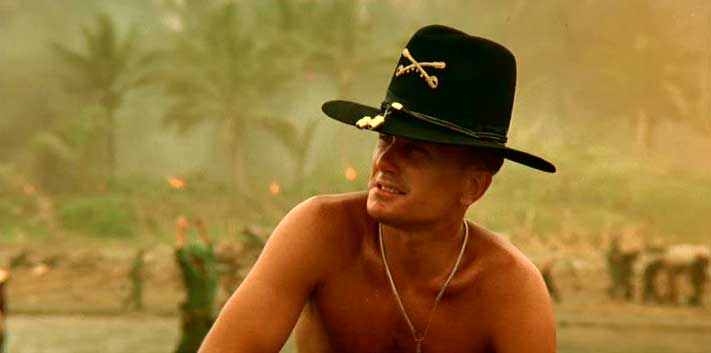
It’s 1970 in Saigon as a burned-out and troubled special forces soldier by the name of Captain Benjamin L. Willard (Martin Sheen) is awaiting for his next assignment. He then gets a call for his next assignment as he’s briefed by Lt. General Corman (G.D. Spradlin), Col. Lucas (Harrison Ford), and a government official (Jerry Ziesmer) about his mission, which is also classified. The mission is to upriver to Nung River where he must find and kill Colonel Walter E. Kurtz. Kurtz is a special forces soldier who has feared to have gone rogue while forming an army of his own somewhere in Cambodia. Another captain (Scott Glenn) was supposed to kill Kurtz but has since disappeared.

Willard takes the mission as he joins the crew of a Navy patrol boat headed by Chief Phillips (Albert Hall) that also includes a surfer named Lance B. Johnson (Sam Bottoms), a guy named Chef (Frederic Forrest), and a young kid named Clean (Laurence Fishburne). Willard doesn’t tell anyone about his mission as he tells Phillips to go to a rendezvous point to meet Lt. Col. Kilgore (Robert Duvall) for transport to Nung River. Kilgore leads an air cavalry of helicopters as he decides to transport the team after learning that Lance is part of the patrol. He takes the team to a day of an attack where Willard and crew saw the chaos that Kilgore has created.

During the journey upriver, Willard begins to read about Kurtz’s background as they would make at a stop at a USO show with Playboy Bunnies. Later on during the journey, they stop to investigate a boat against Willard’s orders which leads to dire consequences. The journey darkens when they stop at a U.S. outpost at a bridge where a fight with the North Vietnamese is occurring where Willard receives more information about Kurtz and the captain who was supposed to assassinate him. With Lance on LSD and causing trouble, more chaos ensues as they’re getting closer where an encounter with villagers lead to dire consequences. After telling the crew what he’s doing as they reluctantly take him upriver.

Upon arriving into Kurtz’s outpost as Willard gives orders to call an air strike if he doesn’t return. He meets a freelance photographer (Dennis Hopper) who explains to Willard about Kurtz’s brilliance. Willard then meets Kurtz as he tells Kurtz why he is here. Even as Kurtz knows why as it’s clear that Willard is going to have a much harder time to complete his mission.

While the film is simply about an assassin going on a journey to find his target. It’s a much more complex film than what the plot suggests. Since Francis Ford Coppola and his co-screenwriters were basing their ideas from Joseph Conrad’s Heart of Darkness. Conrad’s novel explored the psychology of one of its protagonists as he goes into this journey in the Congo rivers. Along the way, he finds a world filled with chaos and despair as he gets closer to the man he’s trying to find. That idea is what probably attracted Coppola and John Milius to create Apocalypse Now by setting it in the Vietnam War.

Unlike the war films about Vietnam that were being made in the late 1970s, there is no political context since Coppola isn’t interested in going into ideas of anti-war or pro-war. Instead, he’s interested in this journey that Captain Willard is taking on. Willard is definitely a man that has seem to be in too many battles and is unable to return home as the same man he used to be. He is someone addicted to war and being of use for his country. When he’s finally given a mission, he goes head-on as he also decides to dwell into the psychology of Col. Kurtz.

The narration by Michael Herr, that is told by Joe Estevez (who filled in due to his brother’s health problems at the time), recalls Willard’s thoughts as he is going into his surroundings while reading about Kurtz. The voice-over narration of Willard also serves as a development for his character as it becomes clear that the closer he’s getting to Kurtz. The more troubled he becomes as he tries to keep his sanity together.

While the film is in some ways about Willard, it’s also about the journey with the patrol crew that Willard surrounds himself with. The characters of Chief, Chef, Clean, and Lance are just as interesting with all of their different personalities. Though Willard doesn’t try to interact or bond with them very much, they do effect his thoughts as at one point during the journey. Chief realizes that something bad is happening as he tells Willard that he has no idea where he is going. Even as Willard doesn’t tell them anything until the third act.

Another character Willard encounters in the journey is Lt. Col. Kilgore. Kilgore is an eccentric character who likes to create chaos and has a love for surfing. He is also someone who is very much into war and victory but also has a certain respect for the enemy. At one point, he says that anyone who had the guts to fight against him deserves a drink of water where a wounded Vietcong soldier is lying on the ground though he is waving a canteen around.

Then there’s Colonel Kurtz. A man with an amazing background in military and humanitarian services. Yet, the mystery of why he turned rogue and gave up all of these accomplishments to lead an army of his own. Though not everything is answered, it is clear that war had done a lot to damage the man as there’s a great monologue about the horrors he had seen in battle. Even as he has done a lot to protect himself where he’s become feared by those he opposed and those he had done his duties for.

The screenplay is definitely a complex story that involves a lot into the ideas of war as well as humanity in general. Capturing all of that terror is the direction of Francis Ford Coppola. Coppola’s broad, hypnotic direction is really the highlight of the film as he opens the film with an eerie scene of a jungle being bombed as it dissolves with burned-out face of Willard. The film has a dream-like yet eerie look where once the journey upriver takes place. It plays up as this eerie journey to Hell as Coppola mostly uses eerie camera shots for the movements on the boat. Many of the scenes in the river were obviously inspired by Werner Herzog’s 1972 film Aguirre, the Wrath of God. Even in using hand-held shots for the film’s battle scene along with aerial shots from helicopters.

It’s not just Coppola’s stylized shots that are the highlight of his direction. It’s also the way he creates the tension in the drama. Even as it leads to the climatic meeting between Willard and Kurtz where he just lets the camera roll as a keen observer wondering what kind of man Kurtz is. The way Coppola underplays the drama and maintain the tension between Willard and Kurtz is astounding as they’re surrounded by this world of chaos. Overall, this is Francis Ford Coppola at his finest.

Helping Coppola wield his surreal yet lush vision is cinematographer Vittorio Storaro. Storaro’s dream-like yet hypnotic photography is filled with arrays orange-like colors mixed in with dark green and elements of blue for a few nighttime scenes. For many of the daytime scenes including the famed air-cavalry which is mostly straightforward while adding a mostly dark, sepia-like tone for many of the scenes of the river. Not only is this Storaro’s best work as a cinematographer but it’s also the film’s real technical highlight.

The editing of Walter Murch, Richard Marks, Lisa Fruchtman, and Gerald G. Greenberg is phenomenal for the way the film moves in its leisured though chaotic approaching to pacing. Even in the more intense action scenes, the film moves with a kinetic rhythm that plays up to the excitement of war. For the scenes in the jungle and the journey, it moves slow but in a more methodical way as helps create the dramatic tension of the film. It’s definitely an idea of what great editing is.

Production designer Dean Tavoularis, along with set decorator George R. Nelson and art director Angelo P. Graham do a spectacular job with the look of the villages that Kilgore attacks as well as the apartment of Willard. Even the temple has a look that is truly mystical with its feeling of death as the art direction for the film is superb. The sound work by sound designer Walter Murch and sound editor Richard P. Cirincione is truly masterful for the way it invented the kind of sound that audiences hear in today’s film world. With additional help mixer Richard Beggs, the sound work is brilliant for the film’s spectacular air-cavalry attack as it’s another of the film’s technical achievements.

The music by Carmine Coppola and Francis Ford Coppola is another of the film‘s highlights for its calm but brooding tone of the film. With its use of soothing string arrangements mixed with electronics and percussions performed by Mickey Hart of the Grateful Dead. The score is truly mesmerizing for the way it captures the horrors of war. The film’s soundtrack includes a cover of Creedence Clearwater Revival’s Suzie Q in the Playboy USO show scene, the Rolling Stones’ Satisfaction during a water-skiing scene on the patrol boat, and Richard Wagner’s Ride of the Valkyries for the air cavalry attack. Another song that is used for the opening scenes of the film as well as the climatic ending is the Doors’ The End.

The casting by Terry Liebing and Vic Ramos is definitely inspiring for the use of memorable appearances of actors big and small. Among those who make an appearance in the film are famed music promoter Bill Graham as the USO Playboy promoter, Jerry Ziesmer as a government agent who tells Willard what to do about the mission, R. Lee Emrey as a helicopter pilot, Scott Glenn as the original assassin who becomes a part of Kurtz’s soldiers, and as Playboy Bunnies, Colleen Camp, Linda Carpenter, and Cynthia Wood. Also in the film making cameos as a film crew are Francis Ford Coppola and cinematographer Vittorio Storaro in the battle scene following the air-cavalry attack.

Other notable small but memorable appearances include Harrison Ford and G.D Spradlin as army officers debriefing Willard about his mission and Dennis Hopper as a crazed photographer who praises Kurtz and his ideologies. In the roles of the patrol boat crew, a then 14-year old Laurence Fishburne as wonderful as the young soldier Clean who has issues with Willard’s presence. Frederic Forrest is very good as Chef, a man obsessed with Playboy Bunnies while fearing over his own surroundings. Sam Bottoms is excellent as Lance, a surfer who gets himself into drugs as he tries to find a way to escape from the horrors of war. Albert Hall is great as Chief, the patrol boat leader who questions Willard’s authority while realizing that something bad is about to happen.

Robert Duvall is superb as Lt. Col. Kilgore, a man who cares for his soldiers while being someone that is completely eccentric. Even when he cares about making great waves for good surfs. It’s one of Duvall’s finest performances as he spouts one of the film’s most memorable lines. Martin Sheen is phenomenal as the film’s protagonist Captain Willard. A troubled man who is a product of the war as he goes deep into the dark jungles of Cambodia to find his target. He’s someone with little remorse as he often alienates himself from the patrol boat crew that is taking to his journey. It’s definitely Sheen at his best as he brings a lot to a character that is losing his humanity.

Finally, there’s Marlon Brando in what is definitely his last great performance as Col. Kurtz. While he would do more films over the years until his death in 2004, this would be one of Brando’s most iconic roles of his career. Playing a man troubled by war as well as the horrors of what he sees as inhuman. It’s a role that not only has Brando bald and overweight but also someone who is burned out as if he’s one the brink of insanity. It’s definitely a great role from the legendary actor.

When the film did premiere in August of 1979, it initially received mixed reviews as it did do well in the box office. At the Oscars, it would win two for Best Cinematography to Vittorio Storaro and Best Sound as well as several awards. The film would become Coppola’s last great hit as he spent the 80s in debt following the release of his 1982 film One from the Heart. Though he would be able to recover from his financial troubles in the 1990s, it would be many years before he decided to revisit his 1979 film.

Apocalypse Now Redux

In 1998, Francis Ford Coppola along with new American Zoetrope chief Kim Aubry decided to work on a new version of Apocalypse Now with additional footage that was cut from the film. With help from editor Walter Murch and cinematographer Vittorio Storaro to help with the new transfer of the film. Coppola also brought in some of the film’s cast to do new dubbing for the film while some new music was made with help from Mickey Hart. The result would be an expanded version of Apocalypse Now called Apocalypse Now Redux.

The 202-minute version is a different film of sorts in comparison to the original 153-minute cut of the film. A few scenes get altered like a water-skiing scene that was shown early in the film before Willard and crew meets Kilgore. In the Redux version, it’s shown much later with Willard reading the dossier on Kurtz. There’s also a new introduction to Kilgore as he arrives on a helicopter. Also altered in the Redux version is the ending that Coppola for years had issues with because he felt that audiences were confused about it. The new ending isn’t much of an alteration as it would clarify things about what Willard has done in the end.

The Redux version also includes some more humor in the film like a scene of Willard stealing Kilgore’s surfboard as well as a scene where Willard and crew try to hide the surfboard and their boat from Kilgore’s crew. Other new scenes in the longer cut include a rainy scene where Willard finds the Playboy Bunnies helicopter has landed on an abandoned army medical camp where Chef and Lance spend their time with a couple of Bunnies while Clean is waiting to score with one. Other new scenes have more interplay with Willard and crew as well as a scene where Kurtz reads some articles from Time magazine to Willard as he’s surrounded by children.

One significant scene that is restored for the Redux scene is the French Plantation scene. It’s where following the tragic death one of the patrol crew members, they stop at a foggy area as they encounter a group of French soldiers protecting a plantation in Cambodia. It is in this sequence where Chief’s duty of honor occurs during the funeral as they bury a fallen one while Willard and the remaining crew eat. The scene includes a child (Roman Coppola) reading a poem while the plantation head (Christian Marquand) talks about why the French shouldn’t give up as it features a cameo from Henri Martin Affair who argues with the plantation head. The scene also includes Willard’s encounter with Roxanne (Aurore Clement) who is a member of the family as she gets Willard in touch with his humanity as they smoke opium.

The scenes in the film definitely adds more to the story as they also fill in gaps that were probably unexplained in the original cut of the film. At the same time, it allows the film to move a bit faster while maintaining a leisured pace for the film. The new scenes have the same look and feel that Vittorio Storaro’s photography have as the French Plantation scene is the best looking scene in the Redux version. The score, which features additional material that wasn’t in the original film by Carmine Coppola, definitely brings more tension thanks in part to Mickey Hart’s percussion work and arrangements.

The performances from the cast who were in the original cut are given more nuance. Particularly Brando, Sheen, and Duvall as they show more humanity while Sheen gets to be funnier in a few scenes. More importantly, minor characters such as a couple of Playmates in Colleen Camp and Cynthia Wood are given more to do. For the French plantation scene, cameos by Francis’ sons Roman and Gian-Carlo as children of the plantation are good as is Henri Martin Affair as an old man commenting about the plantation’s history. Christian Marquand is great as the owner who talks about the French’s war record as he says they will not lose in Vietnam. Finally there’s Aurore Clement as Roxanne, a widow in the plantation who befriends Willard as she briefly gets him in touch with the humanity he seems to be losing.

Apocalypse Now Redux premiered at the 2001 Cannes Film Festival to a very positive reaction as the film was given a limited release in theaters where it did modestly successful. While audiences and critics were divided over the new scenes with the French Plantation receiving the brunt of the criticism. Still, it was successful enough for Coppola to help his revived American Zoetrope studio to keep going. In 2010, Coppola released both versions of the film along with the 1992 making-of documentary Heart of Darkness for a special Blu-Ray release as the legacy of Apocalypse Now remains intact.

Apocalypse Now is definitely one of the greatest war films ever from the dazzling yet eerie mind of Francis Ford Coppola. Featuring a great ensemble led by Marlon Brando, Martin Sheen, and Robert Duvall. It’s a film that is definitely hypnotic with grand visuals and intense moments that are truly unforgettable. Whether it’s the original cut or the extended Redux edition. It’s definitely a film that everyone must see whether they’re into war films or not. In the end, Apocalypse Now is a haunting yet mesmerizing film from Francis Ford Coppola.

Francis Ford Coppola Films: Dementia 13 - (You’re a Big Boy Now) - (Finian’s Rainbow) - (The Rain People) - The Godfather - The Conversation - The Godfather Pt. II - One from the Heart - The Outsiders - Rumble Fish - (The Cotton Club) - (Peggy Sue Got Married) - (Garden of Stone) - (Tucker: The Man and His Dream) - New York Stories - The Godfather Pt. III - Bram Stoker’s Dracula - (Jack) - (The Rainmaker) - (Youth Without Youth) - Tetro - (Twixt)

Related: Hearts of Darkness: A Filmmaker's Apocalypse

© thevoid99 2011

Tuesday, August 24, 2010

The Virgin Suicides


Originally Written and Posted on Epinions.com on 9/20/03 with Additional Edits and New Content.


When the name Coppola is mentioned in a sentence, the immediate reaction is Francis Ford Coppola, the man behind great films like The Conversation, Apocalypse Now, Peggy Sue Got Married, and The Godfather Trilogy featuring the highly celebrated first two films of the series. While Francis Ford Coppola has remained a respected director, a new generation of Coppolas started to emerge. With his nephew Nicholas Cage, already an Oscar-winning actor with a celebrated career, Coppola's children are now following their father's footsteps as directors. There's Roman Coppola, who recently earned good reviews for his debut feature CQ while helming such award-winning music videos for bands like the Strokes and Fatboy Slim's Praise You with then brother-in-law and Being John Malkovich director Spike Jonze. The other Coppola that is making a name is Roman's younger sister Sofia, who wowed audience with her 1999 full-feature directorial debut The Virgin Suicides.

The Virgin Suicides is a movie based on the Jeffrey Eugenides novel that was adapted by Coppola into a screenplay. The film takes place in an idyllic suburbia in the mid-1970s as neighborhood boys discover their own sexuality while watching the self-destruction of a group of young sisters as they're being trapped into their strict family home. While Sofia Coppola does capture a sense of tranquility and authenticity of the times like her father Francis did in The Godfather, Sofia brings a deeper tone to the film where at first, everything seems innocent but there's something amiss. With an ensemble cast that includes veterans like James Woods, Kathleen Turner, Scott Glenn, Danny Devito, and Michael Pare along with up-and-coming stars like Kirsten Dunst, Josh Hartnett, Jonathan Tucker, Robert Schwartzman (the singer for the California pop-rock band Rooney), Hayden Christensen, and Chelse Swain (sister of Dominique). The Virgin Suicides is a breathtaking debut from Sofia Coppola.

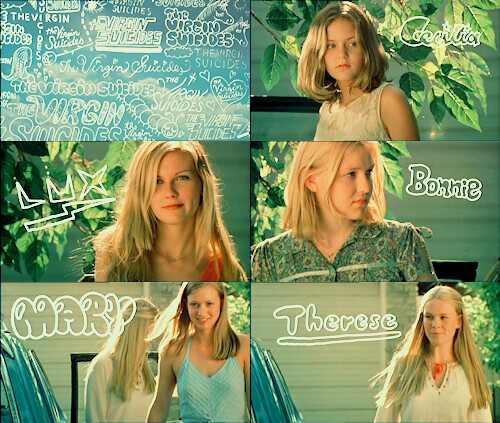
The stroy begins, it starts off with a narrator (Giovanni Ribisi) talking about how his old neighborhood back in the mid-1970s was never the same without the Lisbon girls. The narrator talks about how he and a few of his friends that included his friends Tim Weiner (Jonathan Tucker) and Chase Buell (Anthony Desimone) are transfixed by the beauty and mystique of the five Lisbon girls. There was the youngest, 13-year old Cecilia (Hanna R. Hall), 14-year old Lux (Kirsten Dunst), 15-year old Bonnie (Chelse Swain), 16-year old Mary (A.J. Cook) and the eldest, 17-year old Therese (Leslie Hayman) that all lived in a quiet, idyllic home with their strict mother (Kathleen Turner) and math teacher father (James Woods). To everyone, life seems fine for the Lisbons but Cecilia was rushed into the hospital after a horrifying suicide attempt.

After some counseling from Dr. Horniker (Danny Devito), the Lisbons reluctantly try to give the Lisbon girls a social life as they try to question about why she tried to commit suicide at 13. The neighbors think she was influenced by a young Italian immigrant who had a crush on an older woman, while the neighborhood boys talk to a young mob son named Paul Baldino (Robert Schwartzman) who saw Cecilia's suicide attempt through the tunnels of his house.

The Lisbons decides to throw a party for the girls with a lot of reluctance from Mrs. Lisbon, as Cecilia is feeling unhappy about the party while all the neighborhood boys attend and talk with the Lisbon girls. Things go fine until a mentally challenged kid named Joe (Paul Sybersma) comes to the party to bring laughs but Cecilia walks away from the party and something horrible happens.  Cecilia's death brought an awareness of suicide around the town and Mrs. Lisbon seeks the advice of priest, Father Moody (Scott Glenn) as the Lisbons try to move on life without Cecilia. The Lisbon girls would go to school as nothing really happened while their father moves on teaching math to students. There the second part of the film begins with a young, good-looking student named Trip Fontaine (Josh Hartnett) who seems to have everything his way as he loved by all the girls in school and seems to get away with everything including smoking marijuana. One day while sneaking into the wrong classroom, he falls for Lux who at first isn't really interested in him.

He seeks the advice of his father as he finally gets a chance to impress Lux by calling her a Stone Fox and is invited to family dinner where there after, Lux kisses him and he is in heaven. With the prom approaching, Trip asks Mr. Lisbon if he and a few of his friends could take his daughters to the school dance and Mr. Lisbon says yes since he thinks Trip is a nice boy. With the girls already happy and buying prom dresses, Trip gets a few of his buddies (one of them is Hayden Christensen) as they accompany the girls to the prom but Lux is way into Trip's stoner activities of booze and dope.  Upon their arrival for the prom, Lux and Trip won the King and Queen of the school dance but things go wrong after an intimate encounter where Trip ditches Lux at the school football field leaving her late past curfew and costing her sister's chance of freedom. Trip meanwhile, never recovered from what he did to Lux as the older Trip is filled with many regrets

Following Lux's failure to make curfew, the girls are banned from school with Lux forced to burn her own record collection.  In reaction to her isolation, Lux makes out with various strangers on her roof as seen by the boys as it was only short-lived.  With the girls not back at school, Mr. Lisbon is fired as the neighborhood boys try to make contact through playing records through the phone.  What happens later would become an event that the boys would be haunted by for the rest of their lives.

What makes The Virgin Suicides a very complex, breathtaking film is how Sofia Coppola takes the audience back in time to the childlike innocence of the 1970s away from Vietnam and Nixon. With cinematographer Edward Lachman, the authentic look of 70s suburbia is filled with majestic colors while on some scenes, there's colors of orange, blue, and dreary earth colors to encompass the mood of its characters and scenes.

Coppola's script adaptation is also strong with its many innocent and dark moments without being melodramatic or making things predictable. The film's ending, as ambiguous as it was delve into the loss of innocence through the teenage boys as they deal with what had happen. The film in many ways delve into the themes that Coppola has explored in her other films which is the theme of alienation and disconnection. Particularly the latter as the Lisbon girls yearn to connect with the boys as they become more detached from reality. It's not to say that it's the fault of the Libson parents entirely. They just don't understand the way things are during the 1970s. Mr. Libson is an aloof sort of man with Mrs. Lisbon being the disciplinarian. Coppola's portrayal of the characters is quite unique, even as it's told through the perspective of one of the neighborhood boys. When it comes to the story of Trip, it's told through an older, burned-out Trip (Michael Pare) as Coppola takes Eugenides' novel into a dreamy yet entrancing story of loss and regret.

Helping Coppola and Lachman capturing that vision is production designer Jasna Stefanovic and costume designer Nancy Steiner, who bring in a nice detail to the look of the 70s while using parts of Los Angeles and Toronto to capture the nice location setting of the film. With longtime Coppola associate Richard Beggs bringing in fine sound design work for the film's haunting quality, the film is nicely paced and stylized by editors James Lyon and Melissa Kent. Another great factor to the film is its use of music ranging from such 70s classic from acts like 10CC, Heart, Todd Rundgren, Styx, the Hollies, and the Bee Gees, to the haunting, electronic film score from the French electronic duo Air.

In the performance front, the best performance easily goes to Kirsten Dunst who stands out above all as the precocious, sexy Lux who is filled with mystique about her character as she plays the sex kitten. Dunst as Lux, remains her best film role to date as she has since had become a prominent star with big roles in Bring It On and the Spider-Man while taking on great roles in smaller films like Peter Bogdanovich's The Cat's Meow and as Marie Antoinette in Sofia Coppola's 2006 bio-pic.. Josh Hartnett even stands out as the hunky stoner Trip Fontaine as he brings a sheer cool to his character that makes him a heartthrob for all women while his ability as a serious actor, is still in question. The roles of the Lisbon sisters including Hannah R. Hall as the doomed Cecilia stands out in a few film moments while the neighborhood boys that included Jonathan Tucker is filled with excellent performances along with Coppola's cousin Robert Schwartzman as Paul Baldino.

The performances of veterans like James Woods and Kathleen Turner are flawless and masterful as the strict but caring Lisbon parents. Especially Woods, who plays a different sort of character as a father and teacher who tries to show kids something but they easily become uninterested and he's still talking. The small roles of Danny Devito, Michael Pare, and Scott Glenn are very memorable, especially Glenn who plays against type from his usual, villain type of roles to play a man of guidance. Giovanni Ribisi as the narrator is another standout since he help makes the film come all together with his inspiring narration.


***Additional DVD Content Written from 8/30/18-9/8/18***

The 2000 Region 1 DVD from Paramount Classics and Zoetrope presented the film in a 16:9 widescreen aspect ratio with 5.1 Surround Sound in English and French along with hard for hearing subtitles in English. The special features from the 2000 DVD include the film’s theatrical trailer as well as a photo gallery of photos from the film’s production. One major special feature is a music video for Air’s Playground Love directed by Roman and Sofia Coppola that recreates a few scenes of the film that involves a chewing gum that comes to live to sing the song. The video is a creative moment that include cameos from Roman and Sofia as they’re about to shoot the film’s prom scene that includes the chewing gum singing.

Another special feature from the 2000 DVD is a making-of documentary from Sofia’s mother Eleanor who was famous for shooting footage for the making of Apocalypse Now by her husband Francis Ford Coppola that would later be used in the documentary Hearts of Darkness: A Filmmaker’s Apocalypse. The 20-minute documentary feature Coppola directing the film with her parents watching as Francis is one of the film’s executive producers while her older brother Roman does the film’s second unit work. Jeffrey Eugenides would make an appearance chatting with Josh Hartnett about the character of Trip while James Woods is first seen in the documentary’s opening scenes praising the crew on the production which he says is one of his most enjoyable experiences. It’s a fun documentary short that has a mother filming her daughter making her first feature-length film.

The 2018 Region 1/Region DVD/Blu-Ray from the Criterion Collection presents the film in a new 4k digital restoration supervised by cinematographer Edward Lachman and with the approval of its screenwriter/director Sofia Coppola in its original 1:66:1 aspect ratio with a 5.1 Surround Sound (uncompressed DTS-HD Master Audio Soundtrack for the Blu-Ray) mix. Among the special features retained from the 2000 DVD release from Paramount are the film’s trailer, the making-of documentary film by Eleanor Coppola, and the music video for Air’s Playground Love. Among the new special features added for the DVD/Blu-Ray release include Coppola’s 1998 short film Lick the Star in a new remastered transfer approved by Coppola.

The 15-minute interview with novelist Jeffrey Eugenides has him talk about the novel as well as the film where he reveals not just how faithful Coppola was with the book but also in providing her own interpretation that was more driven by women since the book was told mainly from the point of view of four teenage boys. Eugenides talks about what inspired him to write the book as well as how he was surprised that the many of his readers were young teenage females and young women as he knew that its popularity would lead to many studios wanting to adapt his book into a film. Yet, he felt that Coppola was the one who really got it as well as he was on set for a few days where Josh Hartnett came to him for ideas on the character of Trip Fontaine. It’s an interview that has Eugenides not only rave about the film but also Coppola as he believed that she has a voice of her own through the films she would make in the years to come.

The 26-minute interview section with screenwriter/director Sofia Coppola, cinematographer Edward Lachman, Kirsten Dunst, and Josh Hartnett entitled Revisiting “The Virgin Suicides” has the four talk about their experience in making the film as well as their take on the story. Coppola revealed that she discovered Eugenides’ book in the early 1990s at a time when she was trying to figure out what to do in art and learned that the book would be made into a film by another filmmaker. Coppola was afraid what that film would be like as she received advice from her father into adapting a few chapters of the book into a script where she eventually adapted the entire novel and would submit to producers of the adaptation that was in development that had fallen apart because of issues with the original director. Coppola also talked a little bit about her first short film Lick the Star which she did as a test to see if she can make a film as it gave her ideas of what she would do with her first feature-length film.

Dunst and Hartnett both talked about their own experience as Dunst (who was 16 during production) and Hartnett (who was to turn 20 during the production) also talked about Coppola’s direction and how their idea of acting changed by doing this film. Dunst in particular as she had done a lot of big budget and Hollywood films prior as she felt she became a different actress after this film. Lachman talks about working with Coppola, who was new to filmmaking, as the two both had similar ideas of what the film should look like where he also talked about the lighting cues that he wanted to create. Coppola also talked about the first-time experience as she admitted that she didn’t think she would find her calling as a filmmaker but credits Eugenides’ book for giving her the idea of becoming one.

The 13-minute video essay piece Strange Magic by Tavi Gevinson has the film writer/blogger talk about the film as well as her own experiences with both the book and film during her days as a teenager. Gevinson says the film would inspire her to start a fanzine and later her own blog in Rookie that would become an online magazine that focused on pop culture, fashion, and feminism. Gevinson would reveal things she wrote about the film as well as why she felt the film had connected with a lot of teenage girls since its release as well as some of the details on the film’s visuals. Gevinson also talks about a lot of the film’s idea of teenage life which she felt had a lot of relevance to her own experiences as it is a fascinating piece from Gevinson who definitely has a lot of interesting to say about the film.

The DVD/Blu-Ray set also includes a booklet that features an essay by novelist Megan Abbot entitled They Hadn’t Heard Us Calling about the film. Abbot talks about some of the film’s themes as well as how the film would relate itself to the other films Coppola would later do in the years to come. Abbot also talked about the differences between the book and film as well as how Coppola would create this air of distance of the neighborhood boys and the Lisbon girls with the latter desperate wanting to connect in their repressive home. It’s a remarkable essay to one of the finest debut films ever made in the 20th Century.

***End of DVD Tidbits***

The Virgin Suicides is a phenomenal film from Sofia Coppola, who redeems herself for the notoriety she had achieved for her much-criticized performance in The Godfather Part III. Coppola's striking visuals along with eerie storytelling brings strength to the film along with the performances of Dunst, Hartnett, Turner, and Woods. Fans of Coppola will doubt see this as one of her finest as it is a fascinating feature-film debut by a new director. Even as it's a worthy introduction to her work as this film would set the pace of what would come from the already prestigious director. In the end, The Virgin Suicides is a tremendous debut film by Sofia Coppola.


Sofia Coppola Soundtracks: Air-The Virgin Suicides - The Virgin Suicides OST - Lost in Translation OST - Marie Antoinette OST - (The Bling Ring OST) - (Priscilla OST)


© thevoid99 2010