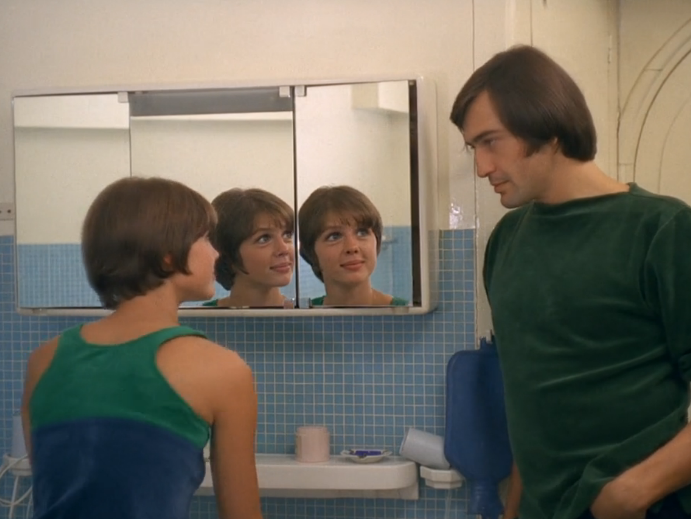
Based on the novel by Jules Verne, Le Rayon vert (The Green Ray) is the story of a Parisian woman who copes with her loneliness while on her summer vacation. Directed by Eric Rohmer and screenplay by Rohmer and Marie Riviere, the film is the fifth part in a thematic series entitled Comedies and Proverbs that follows a woman as she copes with her surroundings in this summer vacation. Starring Marie Riviere, Beatrice Romand, Rosette, Carita, Vincent Gauthier, Amira Chemakhi, and Maria Luisa Garcia. Le Rayon vert is a majestic and somber film from Eric Rohmer.
The film follows a woman whose vacation plans with a friend and her boyfriend is cancelled as she struggles to find enjoyment in her vacations as she also deals with loneliness. It’s a film with a loose and simple premise that does use Jules Verne’s novel as a reference but also be mentioned as it relates to a rare phenomenon that is a green ray of light during sunset as it would be a key moment for its protagonist Delphine (Marie Riviere) to want to experience. The film’s script by Eric Rohmer and Marie Riviere doesn’t do much with Verne’s novel in order to explore Delphine’s own doubts and uncertainty as she would go on vacations around various locations in France and then briefly return to Paris as she would be accompanied by a friend to a location and meet different people but feel unfulfilled.
Rohmer’s direction is ravishing in its presentation as it is shot on various locations in France where Paris is featured prominently yet the places that Delphine goes to such as Cherbourg, the French Alps, Biarritz, and Saint-Jean-de-Luz. Rohmer would use wide shots of these locations yet he aims for something more intimate as it relates to Delphine’s own personal journey as the first act mainly takes place in Cherbourg as Delphine is with one of her friends in Francoise (Rosette) as they meet other travelers where despite befriending a few kids. Delphine becomes lost as Rohmer would film these conversations through close-ups and medium shots while knowing when to move the camera as it often gazes into a conversation about ideas that Delphine believes in which would go on for a few minutes. The second act is partially set in Paris and the French Alps where she returns to the former to see tourists and locals enjoy the location but she is unable to find happiness as she is being flirted with a man whom she’s not interested in.
The scene in the French Alps play into this air of un-fulfillment and uncertainty where Rohmer would shoot Delphine on the mountains hiking as she becomes uninterested in her surroundings and then decides to return home. Early in its third act in Biarritz, she would listen to a group of elderly people talking about books including the book that the film is partially based on. It is a moment that has Delphine trying to find some meaning in her life as she would meet a Swedish tourist in Lena (Carita) that would lead to some major revelations about herself and the world she’s in. Even as the people who are her friends are with someone or are attached with Delphine struggling to understand what women will do to have someone in their life. The film’s ending relates to that green ray of light as it’s something Delphine would want to see but it would be in the most unexpected ways. Overall, Rohmer crafts a touching yet enchanting film about a woman’s summer vacation that leads to a journey of identity.
Cinematographer Sophie Maintigneux does brilliant work with the film’s 16mm cinematography with its grainy look for some of the interiors as well as maintaining its usage of natural lighting for many of the film’s locations. Editor Maria Luisa Garcia does excellent work with the editing as it is largely straightforward with a few rhythmic cuts to play into the drama and conversations. Sound mixer Dominique Hennequin and sound recordist Claudine Nougaret do terrific work with the sound in capturing the atmosphere of the locations as well the overlapping conversations between people in some scenes. The film’s music by Jean-Louis Valero is superb for its plaintive and low-key string-based score that play into Delphine’s melancholic mood as it appears sparingly throughout the film.
The film’s wonderful cast feature some notable small roles from Beatrice Romand as a friend of Delphine living in Paris, Amira Chemakhi as a woman Delphine meets in Paris, Maria Luisa Garcia as Delphine’s friend Manuella who offers Delphine to go to Ireland, Carita as the Swedish tourist in Lena, Rosette as Delphine’s friend Francoise, and Vincent Gauthier as a man named Jacques that Delphine would meet late in the film. Finally, there’s Marie Riviere in an incredible performance as Delphine as a woman whose plans for a vacation with her boyfriend and a friend is cancelled prompting her to go on a vacation on her own where she travels to various places in France as she deals with her loneliness where Riviere displays a restraint and melancholia to a woman who deals with trying to enjoy herself and connect with others as it play into expectations she can’t live up to.
Le Rayon vert is a phenomenal film from Eric Rohmer that features a spectacular performance from Marie Riviere. With its low-key yet simple premise, exploration of loneliness in a vacation setting, and the gorgeous locations in France, it’s a film that explores a woman coming to terms with who she is through an unconventional summer vacation as well as to experience a rare event in the world. In the end, Le Rayon vert is a sensational film from Eric Rohmer.
Eric Rohmer Films: (The Sign of Leo) – The Bakery Girl of Monceau - Suzanne's Career - (Paris vu par-Place de l‘Etoile) – La collectionneuse - My Night at Maud's - Claire's Knee - Love in the Afternoon (1972 film) - (L’enfance d’une ville) - (The Marquis of O) - (Perceval le Gallois) - (Catherine de Heilbronn) - (The Aviator’s Wife) - (Le Beau Mariage) – Pauline at the Beach - (Full Moon of Paris) - (Four Adventures of Reinette and Mirabelle) - (Boyfriends and Girlfriends) - (Les Jeux de societe) - (A Tale of Springtime) - (A Tale of Winter) - (L’Arbre, le maire et la mediatheque) - (Le trio en mi bemol) - (Les Rendez-vous de Paris) - (Summer’s Tale) - (Autumn Tale) - (The Lady and the Duke) - (Triple Agent) - (Romance of Astrea and Celadon)
© thevoid99 2019
Written and directed by Eric Rohmer, Pauline a la plage (Pauline at the Beach) is the story of a teenage girl who spends the summer with her older cousin as they both endure love and complications relating to love. The third film in a thematic series known as Comedies and Proverbs, the film is an exploration of a young girl dealing with first love while her cousin tries to find fulfillment through love and sex only to deal with its shortcomings. Starring Amanda Langlet, Arielle Dombasle, Pascal Greggory, and Feodor Atkine. Pauline a la plage is a rich and intoxicating film from Eric Rohmer.
The film revolves around a 15-year old girl and her older cousin as they spend the summer on the beaches of Normandy where they both encounter love with some complications along the way. It’s a film with a simple premise as its writer/director Eric Rohmer play into a young woman dealing with first love but also a cousin trying to find fulfillment through sex and love as they both deal with complications with love. Notably as the titular character (Amanda Langlet) is being persuaded by her cousin Marion (Arielle Dombasle) to find someone as she meets an old flame in Pierre (Pascal Greggory) who is wind-surfing and is willing teach both women to wind-surf.
Yet, the emergence of a middle-aged man named Henri (Feodor Atkine) would change everything as Marion would pursue Henri much to Pierre’s chagrin while befriending Pauline who would also have her own first taste of love in a young man similar to her age in Sylvain (Simon de la Brosse). Still, Pauline does ask questions about love getting different ideas and answers from Marion, Pierre, and Henri which would add to confusion as well as complications for all involved. Most notably a moment where Pierre sees a naked woman in Henri’s home that would raise a lot of questions while Pauline and Marion were out visiting Mont Saint-Michel.
Rohmer’s direction is low-key in its approach to simplicity where it is shot on location in the beaches of Normandy as well as nearby locations including Mont Saint-Michel. While it features some wide shots in some of the locations as well as lot of coverage into the beaches that Pauline and the other characters go to. Much of the direction has Rohmer maintain an intimacy in his usage of close-ups and medium shots that play into these people falling in and out of love with Pierre still having feelings for Marion but is cautious into not wanting to hurt her. Even as he befriends Pauline whom he knows is too young for her but wants to ensure that she doesn’t go through some of the mistakes he and Marion made. The scene where Pierre sees this woman named Louisette (Rosette) naked at Henri’s home, it would become this moment in the film that play into not just morals but also if Pierre should tell Marion about what he saw.
Rohmer would create some compositions that play into the drama as well as shots of Pauline standing on a beach looking at the ocean. Particularly as it symbolizes this need of uncertainty and excitement yet it can also be unforgiving just like love can be. Rohmer would open and close the film with a shot of a cottage gate as it also symbolizes the start and end of something as it relates to Pauline and Marion. The latter of which is a woman who had been married before to someone she didn’t love but still has a lot to offer although Henri would tell Pauline in a monologue about his fascination for Marion but not in a way that is expected which often arouses jealousy from Pierre’s point of view. Overall, Rohmer crafts an evocative and riveting film about a teenage girl and her adult cousin trying to find love in all of its complications at the beaches of Normandy.
Cinematographer Nestor Almendros does brilliant work with the film’s cinematography with its naturalistic yet colorful look of many of the daytime exterior scenes of the beaches and homes as well as the interiors for some of the scenes at night. Editors Cecile Decugis and Christopher Tate do excellent work with the editing as it is largely straightforward with a few jump-cuts to play into the drama and bits of humor. Sound mixer Georges Prat does nice work with the sound to capture the sound of waves and other natural elements in the locations as well as scenes of music being played on a record player. The film’s music by Jean-Louis Valero is wonderful as it is largely music played on location that include elements of pop for the kind of music couples dance to.
The film’s superb cast feature some notable small roles from Marie Bouteloup as Henri’s young daughter who appears briefly in the film and Michel Ferry as a friend of Sylvain. Rosette is terrific as the candy basket seller Louisette as a woman that sells candy in the beach whom Henri is attracted to while Simon de La Brosse is fantastic as Sylvain as a teenage boy slightly older than Pauline who would become her boyfriend only to be roped into a situation created by Henri. Pascal Greggory is excellent as Pierre as a young windsurfer who was a former lover of Marion that expresses concern in her pursuit of Henri whom he isn’t fond of only to find himself trying to reveal some truths that would eventually put him into trouble.
Feodor Atkine is brilliant as Henri as a middle-aged man who lives in the beaches of Normandy as someone whom Marion would pursue yet is someone that wants more as he also befriends Pauline while trying to explain to her his desires and wants in a woman that proves to be more than just physical. Arielle Dombasle is amazing as Marion as a woman that is eager to have a good time and wants to find the right man yet still has no clue in finding the right man due to her own ideals and desire that would eventually confuse Pauline. Finally, there’s Amanda Langlet in an incredible performance as the titular character as a 15-year old girl who is trying to understand love as she would endure first love but also the many complications as it relates to Henri’s actions and how Sylvain gets roped in forcing her to try and understand everything as well as realize that there’s still so much to learn.
Pauline a la plage is a tremendous film from Eric Rohmer. Featuring a great ensemble cast, Nestor Almendros’ gorgeous cinematography, and its takes on love and desire seen by a young woman experiencing these things. It’s a film that is low-key in its presentation while asking many questions into what people want in a relationship as well as some of its fallacies. In the end, Pauline a la plage is a ravishing film from Eric Rohmer.
Eric Rohmer Films: (The Sign of Leo) – The Bakery Girl of Monceau - Suzanne's Career - (Paris vu par-Place de l‘Etoile) – La collectionneuse - My Night at Maud's - Claire's Knee - Love in the Afternoon (1972 film) - (L’enfance d’une ville) - (The Marquis of O) - (Perceval le Gallois) - (Catherine de Heilbronn) - (The Aviator’s Wife) - (Le Beau Mariage) - (Full Moon of Paris) - The Green Ray - (Four Adventures of Reinette and Mirabelle) - (Boyfriends and Girlfriends) - (Les Jeux de societe) - (A Tale of Springtime) - (A Tale of Winter) - (L’Arbre, le maire et la mediatheque) - (Le trio en mi bemol) - (Les Rendez-vous de Paris) - (Summer’s Tale) - (Autumn Tale) - (The Lady and the Duke) - (Triple Agent) - (Romance of Astrea and Celadon)
© thevoid99 2019
Written and directed by Eric Rohmer, L’Amour l’apres-midi (Love in the Afternoon (or in its U.S. title, Chloe in the Afternoon)) is the story of a married man whose life and marriage is threatened by the appearance of a former flame where he thinks about having an affair. The sixth and final film of Rohmer’s Six Moral Tales, the film plays into the idea of temptation as well as life outside of marriage. Starring Bernard Verley, Francoise Verley, Zouzou, and Daniel Ceccaldi. L’Amour l’apres-midi is an evocative and witty film from Eric Rohmer.
The film follows a married businessman who has it all fantasizes about the idea of being with other women as that fantasy starts to come reality by the appearance of an old flame who has returned to his life. It’s a film that plays into a man who is thinking about having an affair yet is dealing with a lot in his life as well as the fact that he and his wife are about to have another child. Eric Rohmer’s screenplay has a simple structure where its prologue is about Frederic (Bernard Verley) and his life being married to Helene (Francoise Verley) while running a business that is doing modestly well that can afford him two attractive secretaries whom he doesn’t flirt with.
Still, Frederic thinks about being with other women as it’s just a fantasy that leads to the first part with the arrival of his former flame Chloe (Zouzou) who has returned to Paris and is looking for a new place to live. She and Frederic would resume their friendship with the latter learning about the former’s relationships in the past as he is thinking about engaging an affair with her. The film’s second part which is its third act is about the aftermath of the birth of his son as he becomes conflicted about his relationship with both Helene and Chloe with the latter wanting the things he has believing a child would fulfill her. It adds to Frederic’s own conflict about his infatuation towards Chloe as he’s already have a family with Helene whom he still cares for.
Rohmer’s direction doesn’t bear a lot of style for much of the film in favor of its simple approach to showcasing a man’s family life and his temptation to commit adultery. Shot on location in Paris, Rohmer doesn’t go for a lot of wide shots in the film as it’s more about the exchanges and interaction between characters and the settings they’re in whether it’s a mall, an office, a small apartment, or at a café. Even in the usage of close-ups and medium shots that play into some of the emotional moments of the film that include these exchanges between Frederic and Chloe. During the film’s prologue section, Rohmer would create this sequence that does play into fantasy where Frederic would meet characters from previous entries of the Six Moral Tales to play into this idea of control as if Frederic could get any woman he wanted.
Once Chloe enters the film, it does bear bits of humor yet Rohmer maintains that simplicity into their interactions and scenes together. Most notably a scene in the mall where Frederic is shopping with Helene and their daughter where they bump into Chloe as it’s the only time Helene and Chloe meet. Helene wouldn’t know anything about Frederic’s time with Chloe only thinking it’s innocent yet the film’s third act play into these ideas of adultery as well as what Chloe wants. Rohmer doesn’t make things easy in his compositions into the conflict that Frederic faces as it does raise a lot of moral questions into what he could gain but also what could he lose. Overall, Rohmer crafts an intoxicating and captivating film about a man thinking about having an affair with a former flame.
Cinematographers Nestor Almendros, Jean-Claude Riviere, and Philippe Rousselot do brilliant work with the film’s cinematography with its low-key yet naturalistic approach to lighting with much of the work done by Almendros who would use available light for some of the film’s interiors. Editors Cecile Decugis and Martine Kaflon do excellent work with the editing as it is largely straightforward with a few montages that includes the dream sequence. Set decorator Nicole Rachline does terrific work with the look of Frederic’s office as well as his home and the small apartment that Chloe would live in.
Costume designer Daniel Hechter-Vog does nice work with the costumes as it is largely casual with a few stylish bits including a shirt that Frederic is convinced to buy. The sound work of Jean-Pierre Ruh and Michel Laurent, along with mixing by Jacques Carrere, do superb work with the sound to capture the atmosphere of the locations as well as edit some of Frederic’s narration into what he’s dealing with. The film’s music by Arie Dzierlatka is wonderful for its low-key yet playful orchestral score that help play into the humor along with some somber pieces for the drama.
The film’s amazing cast feature some notable small roles from Suze Randall as an English nanny, Irene Skobline as a saleswoman who convinces Frederic to buy a shirt, Sylvaine Charlet as Chloe’s landlady, Malvina Penne and Babette Ferrier in their respective roles as Frederic and Gerard’s secretaries in Fabienne and Martine, and Daniel Ceccaldi in a terrific performance as Frederic’s business partner Gerard who is fascinated by Chloe though he prefers the company of his secretaries though the relationship is more platonic than romantic. From the previous films of the Six Moral Tales series, there’s Haydee Politoff as Haydee from La Collectionneuse, Francoise Fabian as Maud and Marie-Christine Barrault as Francoise from My Night at Maud’s, and the quartet of Laurence de Monaghan as Claire, Gerard Falconetti as Gilles, Aurora Cornu as Aurora, and Beatrice Romand as Laura from Claire’s Knee as they all appear in cameo appearances from the film’s dream sequence.
Zouzou is brilliant as Chloe as a former flame of Frederic who is trying to find some stability in her life as she finds solace in Frederic yet realizes she wants so much more which adds to Frederic’s internal conflict. Francoise Verley is excellent as Helene as Frederic’s wife as a schoolteacher who is content with her life yet is aware that something isn’t going right with Frederic as well as the chaos of family life. Finally, there’s Bernard Verley in an incredible performance as Frederic as a businessman who has it all yet feels unfulfilled where he fantasizes about having affairs with other women where it would become a reality once Chloe returns to his life as he deals with wanting to stray from the life he has in favor of something more exciting but also with a lot of baggage as well.
L’Amour l’apres-midi is a phenomenal film from Eric Rohmer that features great performances from Bernard Verley, Francoise Verley, and Zouzou. Along with its themes of adultery and fantasy as well as its gorgeous look and setting, music, and its connection to past films from the Six Moral Tales series. It’s definitely a film that play into the idea of infidelity and the need of emotional fulfillment and stability. In the end, L’Amour l’apres-midi is a sensational film from Eric Rohmer.
Related: (I Think I Love My Wife)
Eric Rohmer Films: (The Sign of Leo) – The Bakery Girl of Monceau - Suzanne's Career - (Paris vu par-Place de l‘Etoile) – La collectionneuse - My Night at Maud's - Claire's Knee - (L’enfance d’une ville) - (The Marquis of O) - (Perceval le Gallois) - (Catherine de Heilbronn) - (The Aviator’s Wife) - (Le Beau Mariage) - Pauline at the Beach - (Full Moon of Paris) - The Green Ray - (Four Adventures of Reinette and Mirabelle) - (Boyfriends and Girlfriends) - (Les Jeux de societe) - (A Tale of Springtime) - (A Tale of Winter) - (L’Arbre, le maire et la mediatheque) - (Le trio en mi bemol) - (Les Rendez-vous de Paris) - (Summer’s Tale) - (Autumn Tale) - (The Lady and the Duke) - (Triple Agent) - (Romance of Astrea and Celadon)
© thevoid99 2019
Written and directed by Eric Rohmer, Le Genou de Claire (Claire’s Knee) is the story of a diplomat who meets a young girl whose stepsister has him falling for her a month before his upcoming wedding. The fifth film in Rohmer’s Six Moral Tales, the film is an exploration of temptation and longing where a man pines for a young woman while observing her relationship with a young man who treats her terribly. Starring Jean-Claude Brialy, Aurora Cornu, Beatrice Romand, and Laurence de Monaghan. Le Genou de Claire is a ravishing film from Eric Rohmer.
Set in Lake Annecy for the month of July, the film revolves around an engaged diplomat who meets an old friend where he later befriends a young girl whose stepsister has caught his eye. It’s a film that plays into a man going on a vacation as he’s about to get married where he is trying to observe those around him as well as raise questions about his upcoming nuptials. Eric Rohmer’s screenplay has a unique structure where the first half of the film is about Jerome Montcharvin (Jean-Claude Brialy) spending his time at Lake Annecy where he meets his old friend in the novelist Aurora (Aurora Cornu) who is surprised by the news of his engagement.
Jerome would meet a young girl named Laura (Beatrice Romand) who lives near Aurora who is also a friend of mother as Laura is learning about love where she would have a crush on Jerome. When Laura’s older step-sister Claire (Laurence de Monaghan) arrives for the film’s second half, Jerome is intrigued by her. Most notably her knees as it would be an obsession while he would turn to Aurora about his fascination towards Claire as well as his disapproval in her relationship with a young man in Gilles (Gerard Falconetti) whom he feels doesn’t treat her well.
Rohmer’s direction is definitely simplistic in its presentation where it is shot largely in Lake Annecy where it is this world between France and the Swiss Alps near Lake Geneva. While there are wide shots of the location including its mountains and nearby town, much of Rohmer’s direction is relied on intimacy and exchanges between the characters. Notably in the first half where it’s about Jerome and Laura where the latter would learn about the ideas of love as she would ask Jerome why he’s getting married. The usage of close-ups and medium shots add to the conversations where Rohmer emphasizes on the latter and some precise compositions for the characters to interact as well as observe some of the action that is happening. Most notably in the film’s second half when Claire is properly introduced where she is seen reading and in her bikini where Jerome asks her where is Aurora and Laura. The relationship between Jerome and Claire doesn’t begin right away until Jerome helps Claire and Gilles get some fruit where he takes notice of her knees.
There is a conflict that Jerome would endure as he would converse with Aurora about pursuing Claire but also deal with the moral implications that include telling her about Gilles. Even as he also thinks about Laura who is already having her own first idea of love with a boy her age as the film’s climax that revolves around Jerome and Claire is an indication of what Jerome knows and what he’s thinking about. It is followed by an aftermath that is shown from Aurora’s perspective of what happened where one character does learn something but another still has lots to learn about love. Overall, Rohmer crafts a riveting yet compelling film about an engaged diplomat’s attraction towards a young woman.
Cinematographers Nestor Almendros, Jean-Claude Riviere, and Philippe Rousselot do amazing work with the film’s cinematography with Almendros leading the charge with its naturalistic photography of many of the film’s locations as well as a few of the scenes set at night. Editors Cecile Decugis and Martine Kalfon do excellent work with the editing as it is largely straightforward with a few jump-cuts for some of the dramatic moments of the film. The sound work of Jean-Pierre Ruh and Michel Laurent do terrific work with the sound as it is largely straightforward with the way it captures many of the sounds on location.
The film’s superb cast include a few notable small roles from Fabrice Luchini as a young man named Vincent that Laura would spend time with during the film’s second half, Michele Montel as Laura’s mother, and Gerard Falconetti as Claire’s selfish boyfriend Gilles. Laurence de Monaghan is fantastic as Claire as a young woman who is in a relationship with a young man who doesn’t treat her well as she is fascinated by Jerome but doesn’t initially find him interesting. Beatrice Romand is excellent as Laura as a teenage girl who would have a crush on Jerome as she is learning about the ideas of love while having many questions about adulthood as it’s a reserved yet mature performance from Romand.
Aurora Cornu is brilliant as Aurora as a novelist friend of Jerome who is the film’s conscience of sorts as a woman whom Jerome turns to as she also observant of everything else around her. Finally, there’s Jean-Claude Brialy in an amazing performance as Jerome Montcharvin as a diplomat set to be married where he deals with the presence of Claire but also Laura’s crush as he turns to Aurora for advice but also reveal a lot about what goes into being in love as he observes Claire’s relationship with Gilles from afar and with disdain towards Gilles in her treatment of Claire.
Le Genou de Claire is a tremendous film from Eric Rohmer. Featuring a great cast, gorgeous locations, beautiful cinematography, and a touching theme of love and longing from afar as well as young love. The film is definitely one of Rohmer’s finest as well as a film that explore the morality of young love. In the end, Le Genou de Claire is a spectacular film from Eric Rohmer.
Eric Rohmer Films: (The Sign of Leo) – The Bakery Girl of Monceau - Suzanne's Career - (Paris vu par-Place de l‘Etoile) – La collectionneuse - My Night at Maud's - Love in the Afternoon (1972 film) - (L’enfance d’une ville) - (The Marquis of O) - (Perceval le Gallois) - (Catherine de Heilbronn) - (The Aviator’s Wife) - (Le Beau Mariage) - Pauline at the Beach - (Full Moon of Paris) - The Green Ray - (Four Adventures of Reinette and Mirabelle) - (Boyfriends and Girlfriends) - (Les Jeux de societe) - (A Tale of Springtime) - (A Tale of Winter) - (L’Arbre, le maire et la mediatheque) - (Le trio en mi bemol) - (Les Rendez-vous de Paris) - (Summer’s Tale) - (Autumn Tale) - (The Lady and the Duke) - (Triple Agent) - (Romance of Astrea and Celadon)
© thevoid99 2019
Written and directed by Eric Rohmer, Ma nuit chez Maud (My Night at Maud’s) is the story of a devoted-Catholic engineer who spends the night with a divorced woman as his ideas become challenged. The third film (fourth film in order of its release) as part of Rohmer’s Six Moral Tales follows a man coping with his ideals as he meets a woman with a vivacious personality who challenges his beliefs. Starring Jean-Louis Trintignant, Francoise Fabian, Marie-Christine Barrault, and Antoine Vitez. Ma nuit chez Maud is an evocative and engrossing film from Eric Rohmer.
Set during the Christmas holidays at the French town of Clemont-Ferrand, the film follows a devoted-Catholic engineer who is invited by an old friend to a show where they spend the night with a divorced woman that would have implications for this engineer whose beliefs and ideals are questioned. It’s a film that play into a man staying one night at the apartment of this woman where he later copes with its aftermath just as he is smitten with another woman he encounters in the town that he would see in church on Sundays. Eric Rohmer’s screenplay has this unique three-act structure where the first act follows the life of its protagonist in Jean-Louis (Jean-Louis Trintignant) as he attends the Sunday service while working as an engineer in this town he’s just arrived in. Upon meeting his old friend in Vidal (Antoine Vitez) who is a university lecturer at the town’s college, Vidal would invite Jean-Louis to attend a concert which would begin the second act that largely takes place at the apartment home of a former lover of Vidal in Maud (Francoise Fabian).
In meeting Maud, discussions about the theories of Blaise Pascal where it leads to an argument between Jean-Louis, Vidal, and Maud about these ideas where Vidal leaves to risk driving in the snow with Jean-Louis staying in as he gets to know Maud as a woman who endured heartbreak while revealing her ex-husband had cheated on her some years ago as it’s been a year since she got divorced. The film’s third act isn’t just about Jean-Louis trying to engage into a relationship with Maud but also have the courage to talk with this young blond woman in Francoise (Marie-Christine Barrault) whom he first sees at the Sunday service.
Rohmer’s direction is very intimate in its presentation and setting where it is shot on location in Clemont-Ferrand during the Christmas holidays. While there are some wide shots on top of the mountains to get a look into the town as well as characters walking the mountains, much of the film has Rohmer use medium shots and a few close-ups as it mainly play into the interaction between characters. Notably the scene at Maud’s apartment where much of the film’s second act takes place as there’s not a lot of camera movements in the film in favor of straightforward compositions where Rohmer show Jean-Louis, Maud, and Vidal discussing the theories of Pascal as well as the difference between Atheism and Catholicism as Maud and Vidal practice the former. It also play into this air of sexual and romantic tension between Jean-Louis and Maud once Vidal leaves the apartment with Jean-Louis not wanting to give in to temptation yet Maud is sympathetic to his morals as she is also still reeling from her divorce. Still, there is this air of attraction of their opposite views where Jean-Louis would sleep on her bed with her though nothing sexual happens.
Rohmer does display that restraint while also showcasing this town that Jean-Louis is new to as there’s some beautiful driving scenes into some of the streets and narrow roads where it’s entrancing as well as the lighting display in some parts of the city. Still, Rohmer uses the city as a character with its winter setting that include the film’s third act where Jean-Louis gets to know Francoise and learn they have a lot in common but she isn’t exactly what she seems to Jean-Louis. Overall, Rohmer crafts an intoxicating yet compelling film about an engineer whose Catholic ideals are challenged upon meeting an Atheist woman who is willing to show him a different world.
Cinematographers Nestor Almendros, Emmanuel Machuel, Jean-Claude Gasche, and Philippe Rousselot do amazing work with the film’s black-and-white photography with Almendros doing much of the work in its approach to low-key lighting for the interiors as well as the usage of grey for the scenes in the street and snowy exteriors in the day. Editors Cecile Decugis and Christine Lecouvette do excellent work with the editing as it is largely straightforward in its presentation with a few jump-cuts for a few low-key dramatic moments. Set decorator Nicole Rachline does fantastic work with the look of Maud’s apartment with its stylish decoration which is a direct contrast to the more quaint homes of Jean-Louis and Francoise. The sound work of Jean-Pierre Ruh, Jacques Maumont, and Alain Sempe do superb work with the sound to play up its natural setting in its exterior locations as well as how music sounds at a concert hall.
The film’s wonderful cast include a few notable small roles from Marie Becker as Maud’s daughter Marie, Anne Dubot as a date of Vidal in its third act, Guy Leger as the Catholic priest who performs the Sunday sermons, and Leonid Kogan as himself who performs at the concert that Jean-Louis and Vidal attend. Antoine Vitez is fantastic as Vidal as an old friend of Jean-Louis who is fascinated by the ideas of Marxism as he would introduce Jean-Louis to Maud while wanting to challenge Jean-Louis ideals on faith. Marie Christine-Barrault is excellent as Francoise as a biology student that Jean-Louis is smitten with as he would see her at Sunday service where he would later talk to her in the third act thinking she is this ideal women when she’s really far more complex but also shares many of Jean-Louis’ ideals on faith.
Francoise Fabian is brilliant as Maud as a divorced single mother who spends much of her time at home dealing with her divorce and her heartbreak while befriending Jean-Louis despite their different views on the world. Finally, there’s Jean-Louis Trintignant in an amazing performance as Jean-Louis as a devoted Catholic engineer who meets Maud one night as he is challenged by her ideals while trying to comprehend his emotions and morals about embarking on a relationship with Maud and his feelings for Francoise.
Ma nuit chez Maud is an incredible film from Eric Rohmer. Featuring a great cast, gorgeous photography, an intimate setting, and themes of faith. It’s a film that explores a man whose meeting with a woman with different beliefs raises questions into his own self and temptations while dealing with the fact that he’s smitten by another woman who shares his ideals. In the end, Ma nuit chez Maud is a sensational film from Eric Rohmer.
Eric Rohmer Films: (The Sign of Leo) – The Bakery Girl of Monceau - Suzanne's Career - (Paris vu par-Place de l‘Etoile) – La Collectionneuse - Claire’s Knee - Love in the Afternoon (1972 film) - (L’enfance d’une ville) - (The Marquis of O) - (Perceval le Gallois) - (Catherine de Heilbronn) - (The Aviator’s Wife) - (Le Beau Mariage) - Pauline at the Beach - (Full Moon of Paris) - The Green Ray - (Four Adventures of Reinette and Mirabelle) - (Boyfriends and Girlfriends) - (Les Jeux de societe) - (A Tale of Springtime) - (A Tale of Winter) - (L’Arbre, le maire et la mediatheque) - (Le trio en mi bemol) - (Les Rendez-vous de Paris) - (Summer’s Tale) - (Autumn Tale) - (The Lady and the Duke) - (Triple Agent) - (Romance of Astrea and Celadon)
© thevoid99 2019
Directed by Eric Rohmer and written by Rohmer, Patrick Bauchau, Haydee Politoff, and Daniel Pommereulle, La collectionneuse (The Collector) is the story of an art-dealer and a painter whose holiday in the French countryside is disrupted by a Bohemian woman who is notorious for being a collector of men. The fourth film (third in its release) in a thematic series of films relating to morality known as Six Moral Tales, the film is the study of three people trying to enjoy themselves with one of them creating chaos during this time of relaxation. Starring Patrick Bauchau, Haydee Politoff, and Daniel Pommereulle. La collectionneuse is a ravishing and somber film from Eric Rohmer.
Set in the countryside near the South of France, an art-dealer and his painter friend both choose to spend the summer on a holiday at the home of a friend who is out of town only to learn that a young Bohemian woman is also staying there. It’s a film with a simple premise that is told in a loose style as it’s mainly told from the perspective of the art-dealer Adrien (Patrick Bauchau) who laments over a break-up with his fiancée as he uses the vacation to escape from heartbreak but also focus on work.
The film’s screenplay by Rohmer and his three lead actors in Bauchau, Haydee Politoff, and Daniel Pommereulle as they would write their own dialogue play into this idea of escape as Haydee (Haydee Politoff) is a young woman who knows the owner as she had slept with him where she is known for bedding many men as if she’s a collector. While Adrien is interested in Haydee though he prefers to observe her, it is the painter Daniel (Daniel Pommereulle) that would sleep with her although their relationship wouldn’t last as Haydee becomes intrigued by Adrien who starts to raise questions about having a relationship with her.
Rohmer’s direction is low-key in its simplicity while creating some gorgeous compositions to play into the characters and the environment they’re in. Shot on location near St. Tropez in the South of France, Rohmer’s direction does use wide shots to get a scope of the locations including the town near the countryside home as it plays into a world that is vibrant and stylish that is a sharp contrast to something that is quieter and naturalistic at the house and its nearby beach. Yet, Rohmer aims for simple compositions though there aren’t a lot of close-ups where it’s more about a simple medium or medium-wide shot to play into the characters being in a frame or in a room. It adds to this sexual tension though there aren’t any sex scenes or any nudity that occur but rather through sound and the aftermath of sex.
Rohmer would also maintain this air of dramatic tension and intrigue throughout the film since it is largely told from Adrien’s perspective. Even as Rohmer would have the camera linger around him as it play into his surroundings as well as observing Haydee’s time with other men including Daniel. Adrien does get tempted to be with Haydee as they would kiss from time to time yet it never goes all the way once the film reaches its third act where an antiques collector named Sam (Seymour Hertzberg) would take an interest in Haydee. It would be a moment of moral confusion for Adrien as it relates to Haydee as he copes with his fondness for her but also come into question if he’s just another collection to her conquests or something more. Overall, Rohmer crafts an intoxicating and fascinating film about two men spending the holiday at the south of France with a mysterious young woman.
Cinematographer Nestor Almendros does incredible work with the film’s cinematography with its usage of naturalistic lighting for many of its daytime interior/exterior scenes as well as the usage of available light for the scenes set at night. Editor Jacquie Raynal does nice work with the editing as it is largely straightforward to play into the drama and some of the tension that occur between its main characters. The film’s music by Blossom Toes and Giorgio Gomelsky is fantastic as it’s largely low-key as it plays in the background of a radio or to play into some of the drama involving Adrien and Haydee.
The film’s terrific cast include a few notable small roles from Dennis Berry as a young conquest of Haydee in Charlie, Mijanou Bardot as Adrien’s fiancée Carole, Annik Morice as a friend of Carole in the film’s prologue, Alain Jouffoy as a writer Daniel meets with early in the film in its prologue, and Seymour Hertzberg as the antiques collector Sam who becomes fascinated by Haydee. Daniel Pommereulle is excellent as the artist Daniel as a man who is hoping to have some fun where he would engage in an affair with Haydee only to lose interest and treat her terribly. Haydee Politoff is brilliant as Haydee as a young Bohemian woman who travels from place to place as well as engage in sexual affairs with men as she becomes fascinated by both Daniel and Adrien with the latter being a challenge but also gain some life experience for her. Finally, there’s Patrick Bauchau in an amazing performance as Adrien as an arts dealer dealing with heartbreak as well as Haydee’s presence where he’s intrigued by her but copes with the moral implications of being one of her conquests as well as the desire to be something more.
La collectionneuse is a remarkable film from Eric Rohmer. Featuring a great cast, gorgeous photography by Nestor Almendros, amazing locations, and themes of temptation and conquests. It’s a film that explores two men and a young woman living at a countryside home where there’s a lot to be expected with one of the men raising questions about this young woman’s lifestyle choice. In the end, La collectionneuse is a marvelous film from Eric Rohmer.
Eric Rohmer Films: (The Sign of Leo) – The Bakery Girl of Monceau - Suzanne's Career - (Paris vu par-Place de l‘Etoile) - My Night at Maud’s - Claire’s Knee - Love in the Afternoon (1972 film) - (L’enfance d’une ville) - (The Marquis of O) - (Perceval le Gallois) - (Catherine de Heilbronn) - (The Aviator’s Wife) - (Le Beau Mariage) - Pauline at the Beach - (Full Moon of Paris) - The Green Ray - (Four Adventures of Reinette and Mirabelle) - (Boyfriends and Girlfriends) - (Les Jeux de societe) - (A Tale of Springtime) - (A Tale of Winter) - (L’Arbre, le maire et la mediatheque) - (Le trio en mi bemol) - (Les Rendez-vous de Paris) - (Summer’s Tale) - (Autumn Tale) - (The Lady and the Duke) - (Triple Agent) - (Romance of Astrea and Celadon)
© thevoid99 2019

Directed by Jean-Luc Godard and written by Eric Rohmer, Tous les garcons s’appellent Patrick (All the Boys are Called Patrick) is the story of two roommates who meet a young womanizer who flirts with both of them on separate occasions. It’s a 21-minute short film that plays into the idea of these two young women who meet this young man named Patrick (Jean-Claude Brialy) who is also a pick-up artist. For Charlotte (Anne Collette) and Veronique (Nicole Berger), the two were supposed to meet each other later in the day only for both of them to be wooed by Patrick where things definitely become complicated later that day.
It’s a short film that play into the idea of women being pursued by this young man as well as what it can do to disrupt their friendship. The script by Eric Rohmer doesn’t just play into these two women being wooed by the same guy but also deal with the implications into how it would affect their friendship. Jean-Luc Godard’s direction is definitely stylish in terms of the close-ups and medium shots he creates as well as shoot it on location in Paris. With this approach to cinema verite, Godard adds a realism to the look and feel of the film with the aid of cinematographer Michel Latouche for the film’s black-and-white photography that captures Paris becoming this vibrant hotbed for cinema.
Even as Godard puts in references as it relates to the changes that is emerging while utilizing some stylish jump-cuts with the aid of editor Cecile Decugis. With the sound work of Jacques Maumont to play up the atmosphere of the locations, Godard also uses the music of Ludwig Van Beethoven to play up the looseness of the film. Godard’s approach to the directing the actors is also evident as the performances of Jean-Claude Brialy, Nicole Berger, and Anne Collette are all a joy to watch in terms of not just the naturalistic approach to their performances but also in how real it feels.
Tous les garcons s’appellent Patrick is an excellent short film from Jean-Luc Godard and screenwriter Eric Rohmer. Featuring a great cast and an inventive premise, the short is truly one of the finest examples of what would become the French New Wave in its visual approach and ways to tell stories in a new way. In the end, Tous les garcons s’appellent Patrick is an amazing film by Jean-Luc Godard.
Jean-Luc Godard Films: Charlotte et son Jules - Breathless - The Little Soldier - A Woman is a Woman - My Life to Live - The Carabineers - Contempt - Band of Outsiders - A Married Woman - Alphaville - Pierrot Le Fou - Masculin Feminin - Made in U.S.A. - Two or Three Things I Know About Her - La Chinoise - Weekend - One Plus One (Sympathy for the Devil) - (Joy of Learning) - (British Sounds) - Tout va Bien - (Letter to Jane) - (One A.M.) - (Number Two) - (Here and Elsewhere) - (Every Man for Himself) - (Passion) - (First Name: Carmen) - Hail, Mary - (Soft and Hard) - (Detective) - (King Lear (1987 film)) - (Keep Your Right Up) - (Nouvelle Vague) - (Allemagne 90 neuf zero) - (JLG/JLG - Self-Portrait in December) - For Ever Mozart - (Historie(s) de Cinema) - (In Praise of Love) - (Notre musique) - (Film Socialisme) - (Adieu au Language) - (The Image Book)
© thevoid99 2016
Written, co-edited, and directed by Eric Rohmer, Suzanne’s Career is the story of a young man who meets a beautiful and independent woman only to see his best friend make a play for her. The film is an exploration into love and a man’s reaction about his friend taking a prospective girlfriend from him in what is the second part of Rohmer’s Six Moral Tales series. Starring Catherine See, Philippe Beuzen, Christian Charriere, and Diane Wilkinson. Suzanne’s Career is a compelling yet exhilarating film from Eric Rohmer.
The film explores a young medical student who meets a beautiful young woman who becomes the new girlfriend of his best friend who is a notorious playboy. It’s a film that is largely told from the perspective of Bertrand (Philippe Beuzen) who would meet Suzanne (Catherine See) one day as he is hanging out with his friend Guillaume (Christian Charriere). It plays into Bertrand’s love-hate attraction towards Suzanne as he wonders why she is always with the wrong men including Guillaume as she would also pay for their food and such as she would eventually be broke. Eric Rohmer’s screenplay explores Bertrand trying to cope with Suzanne as he would spend some time with her trying to understand what she wants as he is unsure if he should make a move on her. Even as he would be going out with another young woman in Sophie (Diane Wilkinson) in double-dates where he is unsure into what Suzanne wants.
Rohmer’s direction is very engaging for the way he explores Bertrand’s difficulty into understanding Suzanne and her methods as it is a film that plays into a man coming of age into the ideas about women. Rohmer definitely goes for a cinema verite style where he shoots the film in various locations in France with some unique usage of close-ups and medium shots to play into the action. Serving as co-editor with Jackie Raynal, Rohmer keeps the editing straightforward with bits of jump-cuts while getting some reactionary cuts to play into the observations of Bertrand that includes a moment where he knows what Suzanne might be feeling.
Through the black-and-white photography of Daniel Lacambre, Rohmer creates something that does feel rich in its look as it also include some low-key lighting for some interior scenes set in Bertrand’s apartment as it plays into his own loneliness and hesitance to embark on a relationship. There’s also moments where Suzanne might be giving him signals as it plays to Bertrand’s own naivete as well as him understanding about women and why men are fools when it comes to them. Overall, Rohmer creates a very captivating yet touching film about a young man falling for a complicated yet carefree woman.
The film’s cast includes some notable small roles from Patrick Bauchau, Pierre Cottrell, and Jean-Claude Biette as men that briefly went out with Suzanne that Bertrand knows while Diane Wilkinson is excellent as the more intellectual Sophie whom Bertrand isn’t fond of at first as she would eventually play a key role in his development late in the film. Christian Charriere is superb as Guillaume as a playboy who dates Suzanne for a time only to dump her as he claims that she is needy while being a dick towards Bertrand. Catherine See is fantastic as Suzanne as this very independent and modern woman has a lot of attributes that intrigues Bertrand as she is quite opinionated while telling Bertrand about what he should do to win her over. Finally, there’s Philippe Beuzen in an amazing performance as Bertrand as this shy young student who is intrigued by this young woman as he copes with how to win her over as well as his own insecurities and naivete about women.
Suzanne’s Career is an enchantingly rich and fascinating film from Eric Rohmer. With its ensemble cast and a premise that is very universal, it’s a film that isn’t just an exploration into young love but also the world of morals that revolves around a young man’s affections towards a woman. In the end, Suzanne’s Career is a phenomenal film from Eric Rohmer.
Eric Rohmer Films: (The Sign of Leo) - The Bakery Girl of Monceau - (Paris vu par-Place de l‘Etoile) - La Collectionneuse - My Night at Maud’s - Claire’s Knee - Love in the Afternoon (1972 film) - (L’enfance d’une ville) - (The Marquis of O) - (Perceval le Gallois) - (Catherine de Heilbronn) - (The Aviator’s Wife) - (Le Beau Mariage) - Pauline at the Beach - (Full Moon of Paris) - The Green Ray - (Four Adventures of Reinette and Mirabelle) - (Boyfriends and Girlfriends) - (Les Jeux de societe) - (A Tale of Springtime) - (A Tale of Winter) - (L’Arbre, le maire et la mediatheque) - (Le trio en mi bemol) - (Les Rendez-vous de Paris) - (Summer’s Tale) - (Autumn Tale) - (The Lady and the Duke) - (Triple Agent) - (Romance of Astrea and Celadon)
© thevoid99 2015
Written and directed by Eric Rohmer, The Bakery Girl of Monceau is the story of a law student who finds himself falling for a young woman working in a Parisian bakery as he was supposed to meet another woman. The film is the first part of a series of films relating to morality entitled Six Moral Tales as it plays into a man deciding about what to do as he is caught between two women. Starring Barbet Schroeder, Claudine Soubrier, and Michele Girardon. The Bakery Girl of Monceau is a fantastic short film from Eric Rohmer.
The film revolves a law student who has been trying to get the attention of a woman he had seen pass by him as an attempt to meet her for a date has him meeting a young woman working at a bakery that he falls for. It’s a simple 23-minute short film that takes a premise of this young man (Barbet Schroeder) who is supposed to meet this woman on a date yet he keeps coming to this bakery to wait as he was hungry as he is smitten by this young woman working at a bakery named Jacqueline (Claudine Soubrier). The film is told from the man’s perspective but from a different voice that is narrated by Bertrand Tavernier which plays into this man’s thoughts and the moral implication he’s in over which girl he wants to take.
Eric Rohmer’s direction is quite simple as it is shot on location in the Monceau section of Paris where Rohmer aims for that cinema verite style of shooting on exact locations with something that feels loose and real. There aren’t a lot of close-ups nor any music score to accompany the film other than what is played on location. Instead, Rohmer keeps things simple to capture a man dealing with his situation as Rohmer’s usage of medium shots and grainy 16mm film through the black-and-white photography of Bruno Barbey and Jean-Michel Meurice add something that feels free in the way Rohmer sets up scenes including the moments the man would have with Jacqueline. Co-editing with Jackie Raynal, Rohmer does bring in a sense of style through its jump-cuts as well as in some rhythmic cuts to play into the man’s dichotomy about which woman he should be with. Overall, Rohmer creates an engaging yet heartfelt film about a man who falls in love with a young woman on a day he was supposed to go out with another woman.
The film’s cast includes some notable small roles from Fred Junk as the young’s man’s friend Schmidt and Michele Girardon as the woman Sylvie whom the young man was supposed to meet on their date. Claudine Soubrier is amazing as Jacqueline as this young woman who intrigues the young man as she is someone with just simple ideas about things in the world. Finally, there’s Barbet Schroeder in an excellent performance as the young man who copes with the situation he is in as he tries to make sense of what he is going through while eating numerous pastries as it’s a performance with some charm and wit as it plays into his character’s struggles.
The Bakery Girl of Monceau is an exquisitely enchanting film from Eric Rohmer. It’s not just a witty short film but also one that plays into a man finding himself in the middle of a very complicated situation. In the end, The Bakery Girl of Monceau is a delightful film from Eric Rohmer.
Eric Rohmer Films: (The Sign of Leo) - Suzanne‘s Career - (Paris vu par-Place de l‘Etoile) - La Collectionneuse - My Night at Maud’s - Claire’s Knee - Love in the Afternoon (1972 film) - (L’enfance d’une ville) - (The Marquis of O) - (Perceval le Gallois) - (Catherine de Heilbronn) - (The Aviator’s Wife) - (Le Beau Mariage) - Pauline at the Beach - (Full Moon of Paris) - The Green Ray - (Four Adventures of Reinette and Mirabelle) - (Boyfriends and Girlfriends) - (Les Jeux de societe) - (A Tale of Springtime) - (A Tale of Winter) - (L’Arbre, le maire et la mediatheque) - (Le trio en mi bemol) - (Les Rendez-vous de Paris) - (Summer’s Tale) - (Autumn Tale) - (The Lady and the Duke) - (Triple Agent) - (Romance of Astrea and Celadon)
© thevoid99 2015