Showing posts with label jesse eisenberg. Show all posts

Monday, March 03, 2025

A Real Pain


Written, directed, and co-starring Jesse Eisenberg, A Real Pain is the story of two mismatched Jewish-American cousins who travel to Poland to honor their late grandmother. The film is a buddy-road movie in which two cousins travel to Poland as they both deal with their differences as well as their own issues in a trip to pay tribute to their late grandmother. Also starring Keiran Culkin, Jennifer Grey, Will Sharpe, Kurt Egyiawan, Liza Sadovy, Ellora Torchia and Daniel Oreskes. A Real Pain is a heartfelt and witty film by Jesse Eisenberg.

The film follows two Jewish-American cousins who both travel to Poland to honor their late grandmother as they take part in a heritage group tour through the country to connect with their late grandmother and their roots. Along the way, they deal with their growing differences as well as deal with their grandmother’s past and the current state of their lives. Jesse Eisenberg’s screenplay is straightforward in its narrative as it is a character study of sorts in the two protagonists, he creates in the strait-laced family man David Kaplan (Jesse Eisenberg) and the free-spirited Benji Kaplan (Keiran Culkin). Using the money they inherited from their grandmother, they travel from New York City to Poland where they part of this group tour that include the retiree couple from Shaker Heights, Ohio in Mark and Diane (Daniel Oreskes and Liza Sadosky, respectively), the recently-divorced Marcia (Jennifer Grey), a Rwandan genocide survivor in Eloge (Kurt Egyiawan) who converted to Judaism, and their British tour guide in James (Will Sharpe).

Eisenberg’s script brings a lot of depth to the people that David and Benji are with, as Mark and Diane are interested in learning about the former’s family roots while Marcia is also trying to find herself having gone through some recent events in her life. Eloge’s interest in Poland has more to do with his own interest in Judaism as well as wanting to learn the similarities of what he went through and the Jewish community during the Holocaust. During this trip, David and Benji deal with one another as the latter often speaks out over certain things while hiding things about himself that David would later share with the group. The two also leave the group early to see their grandmother’s home in Krasnystaw to honor her with Benji wanting to go there due to the close relationship he had with her.

Eisenberg’s direction is straightforward in terms of its compositions as it is shot on locations in Poland as well as some locations in New York City including JFK International Airport. Notably as he aims for intimate compositions in his presentations for scenes in the airplanes, trains, and buses as well as scenes in hotel rooms and restaurants through close-ups and medium shots. Eisenberg also uses wide shots for some of the locations including shots in various landmarks in cities and towns of Poland include Warsaw, Lublin, and Krasnystaw. Even as Eisenberg would create scenes such as Benji and the tourists reenacting the Warsaw Uprising with its monument behind them as it highlights Benji’s willingness to keep things lively to make the tour a bit more fun for everyone. It is among these lively moments that Eisenberg put into the film though the tour is an exploration of one of the most horrific events of the 20th century. Eisenberg also play into the differences between David and Benji with the former often sending phone messages to his wife back in New York City whenever he is alone while Benji would wander in a hotel where he and David would go on a roof to smoke some marijuana that Benji smuggled.

Eisenberg also plays into the darker elements of the trip as it relates to certain places that James takes the group to including a gravesite where Benji becomes annoyed by James being factual and to be aware that these are real people. It is among some of the somber moments in the film, including a dinner where David reveals to the group about Benji who went to the bathroom. One of the film’s most stark moments involves the group visiting the Mjdanek concentration/extermination camp as Eisenberg keep things simple and at a distance. Even in some of the buildings as it is among the stunning and discomforting moments in the film. Eisenberg still maintains a balance of comedy and tragedy as it plays into David and Benji’s trip to Krasnystaw to find their late grandmother’s home as well as the idea of what is next for them. Overall, Eisenberg crafts a touching and comical film about two mismatched Jewish-American cousins traveling to Poland to honor their late grandmother.

Cinematographer Michal Dymek does brilliant work with the film’s cinematography in capturing the naturalistic look of the locations in Poland in the daytime as well as some of the usage of light for some of the interior/exterior scenes at night. Editor Robert Nassau does amazing work with the editing with its usage of jump-cuts to play into the some of the comical moments as well as giving the film some offbeat moments in the drama. Production designer Mela Melak does excellent work with the look of David’s home in New York City in its interiors as well as the look of some of the hotel rooms that they stay in. Costume designer Malgorzata Fudala does nice work with the costumes as it is casual that all the characters wear including a baseball cap that David wears and the loose clothing that Benji wears.

Visual effects supervisor Yuval Levy does terrific work with the visual effects as it set-dressing in some of the locations including bits in New York City and the videos that David has on his phone. Sound editor Tim Korn does superb work with the sound in the way a location sounds as well as in some of the sparse moments in the film. Music supervisor Erick Eiser does wonderful work in compiling the music as it features piano pieces by Frederic Chopin that is performed by Tzvi Erez as it adds a somber mood to the film.

The casting by Jessica Kelly is marvelous as it feature a couple of small roles from Ellora Torchia as David’s wife Priya and Jakub Pruski as their son Abe. Daniel Oreskes and Liza Sadovy are superb in their respective roles as the retired couple Mark and Diane as they travel to Poland for the former to learn about his ancestor’s homeland as they both make some witty comments about themselves and their trip. Kurt Egyiawan is fantastic as Eloge as a Rwandan genocide survivor who converted to Judaism as he is someone fascinated by the religion which plays into his own conversion as well as wanting to understand the similarities of how he and those from the Holocaust endured. Will Sharpe is brilliant as the British tour guide James who is full of facts and such though, he is taken aback by Benji’s criticism for not being emotionally connected into the landmarks and such.

Jennifer Grey is amazing as Marcia as California divorcee who just moved back to New York as she travels to Poland to find herself as well as her own roots as she is also going through her own emotional issues in relation to her life. Jesse Eisenberg is incredible as David Kaplan as the straitlaced cousin with a wife and child who is anxious and wanting to be things on schedule where he also deals with his cousin’s behavior as well as things that he is upset about towards him. Finally, there’s Kieran Culkin in a phenomenal performance as Benji Kaplan as a free-spirited slacker who has no filter in what he says while is also someone with some issues. Eisenberg and Culkin together are a joy to watch as they bring a lot of chemistry as these two mismatched cousins who deal with each other as well as why they are not as close as they used to be.

A Real Pain is a sensational film by Jesse Eisenberg that features great performances from Eisenberg and Kieran Culkin. Along with its ensemble cast, usage of Frederic Chopin’s piano pieces, gorgeous imagery, and study of two men going on a journey to honor their grandmother. The film is a funny as well as heartfelt story about two cousins who try to reconnect despite their differences by going to Poland to learn about themselves and their late grandmother. In the end, A Real Pain is a phenomenal film by Jesse Eisenberg.

© thevoid99 2025

Monday, April 12, 2021

Night Moves (2013 film)


Directed and edited by Kelly Reichardt and written by Reichardt and Jonathan Raymond, Night Moves is the story of two radical environmentalists and a former marine who plan to blow up a dam as they deal with their planning as well as what would happen afterwards. The film is an exploration of political and social actions involving three people who believe in something as they later question what they’re doing as well as its aftermath. Starring Jesse Eisenberg, Dakota Fanning, Alia Shawkat, Katherine Waterston, Logan Miller, Kai Lennox, James LeGros, and Peter Saarsgard. Night Moves is a haunting and evocative film from Kelly Reichardt.

The film plays into two young environmentalists who are both radicalized by the movement as they turn to a former marine in creating a bomb to blow up a dam near a river in Oregon. Yet, it is the aftermath of the event that would trouble them as it play into the fallacies of not just the radicalism but also revelations about what happened. The film’s screenplay by Kelly Reichardt and Jonathan Raymond essentially has a two-act structure where the first half is about the planning and the event that lead to blowing up this dam while its second half is about the troubling aftermath. Yet, the script does explore these two young people who feel like the world is in trouble and believe that this act in blowing up a dam will be good for the environmental cause as they turn this former marine who also has a record as he knows what to do. While the character of Harmon (Peter Sarsgaard) doesn’t entirely agree with their views, he does believe that both Josh (Jesse Eisenberg) and Dena (Dakota Fanning) have a point about the ways of the world which is why he helps them.

It’s the film’s second half that really play into this aftermath where something did go wrong as it relates to what happened and the fact that someone was at the dam when it blew up. Harmon tells both Josh and Dena that they should keep their mouths shut and not contact each other or say anything. Yet, things do go wrong with Dena becoming uneasy and Josh convinced Dena is going to say something. It adds to this struggle as well as the fact that Josh’s own livelihood is at risk since he works and live at a farm while Dena works at a spa. The narrative focuses more on Josh’s paranoia and Dena’s growing guilt as it relates to the second half of the film.

Reichardt’s direction is entrancing for much of the imagery that she creates as well as this air of realism that occurs into the world of radicalism. Shot on location at southern Oregon with the actual dam in the Galesville Reservoir at the Klamath Mountains, the film does play into a world that is bit disconnected from the world of the cities where Josh works in this farm that is bit of a community of its own with Dena working at a spa yet is someone that supposedly comes from a rich family. Much of Reichardt’s compositions are straightforward as it play into the planning of the first half of the film with its usage of medium shots and close-up to play into the characters interacting or dealing with some kind of crisis. There are some wide shots to establish some of the locations yet Reichardt prefers to focus on the characters as she play into the preparedness of their plan and how they try to isolate themselves and not look suspicious. The scene of planting the bomb is also tense in the three trying not to be seen as there’s a wide shot of a car stopping near the dam.

Also serving as the film’s editor, Reichardt doesn’t aim for style but does maintain a slow rhythm to play up the suspense without making it noticeable in order to get a reaction from a characters. Notably in its second half where it’s all about the drama and the aftermath of this bombing where something bad did happen as much of the film focuses on Josh who also believes that some of his fellow farmers might know what he has done. Reichardt’s compositions add to the sense of paranoia but also chooses to create scenes where audiences can get an idea of what is happening but not show anything. Notably in its climax that is followed by an aftermath that plays into uncertainty for a key character in the film but also a decision that forces that person to start a new life or continue to move without any direction. Overall, Reichardt crafts a mesmerizing and eerie film about two radical environmentalists and a former marine bombing a dam and then deal with its troubling aftermath.

Cinematographer Christopher Blauvelt does brilliant work with the film’s cinematography with its emphasis on low-key yet natural lighting, usage of available light for the scenes at night, and other lighting schemes to maintain air of realism into the look of the film. Production designer Elliott Hostetter, with set decorator Virginia Yount and art director Almitra Corey, does excellent work with the look of the boat that Dena and Josh bought as well as the house Josh lives in and the spa that Dena works at. Costume designer Vicki Farrell is terrific for the casual look of the characters that include winter hats, flannel, and jeans to play into the world they live in.

Sound editor Julia Shirar and sound designer Kent Sparling do amazing work with the sound as it help play into the atmosphere of the locations as well as how the characters sound from afar as well as some of the sparse aspects of the sound on a certain location. The film’s music by Jeff Grace is wonderful for its mixture of ambient, folk, and country that play into its suspense and its setting while music supervisors Lyle Hysen and Chris Swanson provide a soundtrack that features a mixture of folk, country, ambient, and indie rock from A Place to Bury Strangers, Coliseum, Sun Rai, and Bear in Heaven.

The casting by Mark Bennett and Laura Rosenthal is superb as it feature some notable small roles from James LeGros as a feed farm factory clerk, Kai Lennox as a hiking camper that annoys Harmon, Dena, and Josh, Katherine Waterston and Barry Del Sherman as the farm owners that Josh works for, Logan Miller as a young farmer who often says dumb things, and Alia Shawkat as a farmer named Surprise that Josh is friends with. The trio of Peter Sarsgaard, Dakota Fanning, and Jesse Eisenberg are incredible in their respective roles as Harmon, Dena, and Josh as they all maintain a low-key and reserved performances in their respective roles. Sarsgaard adds a weariness and gravitas to his role as a man that knows what to do but is also someone who is aware of the stakes. Fanning’s performance has this air of urgency as someone who is determined to do this mission but starts to unravel following the aftermath as she becomes consumed with guilt. Eisenberg’s performance is one of restraint as someone that is determined to do the deed but becomes paranoid following its aftermath as well as being unsure of what to do as he too is consumed with guilt.

Night Moves is a phenomenal film from Kelly Reichardt featuring great performances from Jesse Eisenberg, Dakota Fanning, and Peter Sarsgaard. Along with its ensemble supporting cast, gorgeous visuals, and its restrained yet eerie tone, the film is a compelling look into a couple of young people who team with a former military officer in creating an act of radical terrorism only to deal with the troubling aftermath and the realities of their ideals. In the end, Night Moves is a sensational film from Kelly Reichardt.

Kelly Reichardt Films: River of Grass - Old Joy - Wendy & Lucy - Meek's Cutoff - Certain Women - First Cow – Showing Up - The Auteurs #72: Kelly Reichardt

© thevoid99 2021

Wednesday, April 07, 2021

The End of the Tour


Based on the memoir Although of Course You End Up Becoming Yourself by David Lipsky, The End of the Tour is the story of Lipsky interviewing novelist David Foster Wallace in a five-day tour promoting Wallace’s novel Infinite Jest. Directed by James Ponsoldt and screenplay by Donald Marguiles, the film is a dramatic re-telling of Lipsky’s recordings with Wallace during this promotional trip as Lipsky gets to know the gifted but troubled novelist as he deals with newfound fame and expectations as Jesse Eisenberg plays Lipsky and Jason Segel as Wallace. Also starring Anna Chlumsky, Ron Livingston, Mamie Gummer, Mickey Sumner, and Joan Cusack. The End of the Tour is a compelling and somber film from James Ponsoldt.

Set almost entirely in the winter of 1996, the film revolves around a writer/journalist in David Lipsky as he is given an assignment to interview novelist David Foster Wallace during a five-day promotional tour for his best-selling novel Infinite Jest which has garnered loads of acclaim with Wallace being positioned as one of the greats. Yet, the film is really more about a man trying to get to know this novelist for a piece for Rolling Stone magazine yet both deal with their own issues in being lonely with Wallace struggling to deal with newfound fame as well as rumors about himself. Donald Marguiles’ screenplay is largely straightforward though it begins in 2008 where Lipsky gets the news of Wallace’s suicide as he goes over audio tapes that he recorded during their 1996 road trip as he reflects on that experience. The five-day tour that is a bit of a road trip with a flight from Bloomington-Normal, Illinois to Minneapolis where Lipsky and Wallace deal with the promotion as the former is trying to see if all of these claims of greatness towards the latter are really true.

James Ponsoldt’s direction is largely straightforward in terms of the compositions he creates as well as taking a simple story about a five-day promotional tour and turn it into this study of fame, expectations, and adulation. Shot largely on location in Michigan as well as additional locations in New York City and Minneapolis, the film plays into a moment in time where books were still big as well as pre-Internet media where both Lipsky and Wallace talk about its potential power. While there are some wide shots in some of the locations that the characters go to, much of the direction is intimate whether it’s in a car, a diner, a hotel room, or at a house through medium shots and close-ups. Notably as it play into two men just talking and trying to get to know each other as Lipsky is someone who had just released a book and wonders how Wallace had just achieved greatness. Yet, Wallace is this man who prefers the company of dogs at his home while he does have a couple of acquaintances he would meet in Minneapolis.

The scene where Lipsky chats with one of Wallace’s friends is a moment that showcase a few of the dark aspects of Wallace who believes Lipsky is flirting with her even though he has a girlfriend back in New York City. It adds to Lipsky’s intrigue towards Wallace as he is pressured from his editor to talk about these rumors about Wallace’s supposed heroin addiction when the reality is actually disappointing as it plays into Wallace’s persona as a man who wears regular clothing and a bandana as the theme of identity comes into play. Polsoldt plays up that tension as Lipsky is forced to have revelations about Wallace’s struggle with this newfound celebrity status as well as these expectations in relation to these great writers of the past. Notably in the third act towards the end of the tour as Lipsky wonders if everything Wallace is doing is an act but it turns out to be not as simple as he wishes it would be since great writers in the past played a persona that diverged from their true being. Yet, the reality shows a man just trying to hold on to a sense of self as well as destroy the façade of celebrity. Overall, Polsoldt crafts a riveting and evocative film about a writer/journalist reflecting on his five-day tour with David Foster Wallace.

Cinematographer Jakob Ihre does excellent work with the film’s cinematography as it aims for a straightforward and natural approach with some lighting for some of the scenes set at night. Editor Darrin Navarro does nice work with the editing as it also play into being straightforward with some rhythmic cuts that play into reaction shots and conversations. Production designer Gerald Sullivan, with set decorator Yvette Granata and art director Sarah M. Pott, does fantastic work with the look of Wallace’s home and its lack of mystery as well as a bookstore in Minneapolis where he promotes the book. Costume designer Emma Potter does terrific work with the costumes as it is largely casual including the ragged look of Wallace as it plays into the fashion of the 1990s.

Hair stylist Stephanie Strowbridge does superb work with the look of Lipsky’s different hairstyle from a ragged look in 1996 to a more subdued hairstyle in 2008. Visual effects supervisor Matthew Bramante does wonderful work with the visual effects as it is mainly bits of set-dressing for some of the exteriors to play into the look of the 1990s. Sound editor Ryan Collins does amazing work with the sound as it plays into the atmosphere of some the locations including a scene at Mall of America. The film’s music by Danny Elfman is good for its low-key ambient score with music supervisor Tiffany Anders cultivating a brilliant soundtrack that features music from R.E.M., Wang Chung, Tindersticks, Brian Eno, Alanis Morrisette, Fun Boy Three, Felt, Pulp, the Association, Tracey Ullman, Nu Shooz, Pavement, Chaka Khan, and the Magnetic Fields.

The casting by Avy Kaufman is marvelous as it feature some notable small roles from Becky Ann Baker as a bookstore manager for one of Wallace’s signings, Anna Chlumsky as Lipsky’s girlfriend Sarah who is in awe of Wallace’s book, Mamie Gummer and Mickey Sumner as a couple of friends of Wallace in their respective roles in Julie and Betsy with the latter being a poet that Lipsky is interested in, Ron Livingston as Lipsky’s editor Bob Levin who reluctantly gives Lipsky the story to interview Wallace, and Joan Cusack as Wallace and Lipsky’s chaperone in Minneapolis in Patty Gunderson.

Finally, there’s the duo of Jesse Eisenberg and Jason Segel in tremendous performances in their respective roles as David Lipsky and David Foster Wallace. Eisenberg brings a reserved performance as a writer who is trying to understand who Wallace his as all of his romantic ideas of what he wants Wallace to be turns out to be false as he tries to figure out what makes Wallace great. Segel’s performance as Wallace is also reserved yet it has its quirks as someone who just wants to be a normal guy whose house is a mess and eats junk food as Segel plays it straight without being someone who wants to be pretentious or be this idea of a what great writer as he isn’t sure if he’s that great. Eisenberg and Segel had great rapport together as they just both look and feel relaxed while also showing some humor in their time together.

The End of the Tour is a phenomenal film from James Ponsoldt that features incredible performances from Jesse Eisenberg and Jason Segel. Featuring a great supporting ensemble cast, a compelling narrative, and a superb music soundtrack, the film is a fascinating story of a real-life interview between David Lipsky and the late David Foster Wallace just as the latter is ascending to fame despite his own issues with it that would haunt him for the rest of his life. In the end, The End of the Tour is a sensational film from James Ponsoldt.

James Ponsoldt Films: (Off the Black) – Smashed - The Spectacular Now - (The Circle 2017 film))

© thevoid99 2021

Saturday, December 03, 2016

Batman v Superman: Dawn of Justice


Based on the characters from DC Comics, Batman v Superman: Dawn of Justice is about two superheroes who both go into conflict with each other unaware that a mogul is stirring the pot from underneath to get them to kill each other. Directed by Zack Snyder and screenplay by David S. Goyer and Chris Terrio, the film is a sequel to 2013’s Man of Steel where Superman copes with being a polarizing figure in the world with Batman being uneasy with Superman’s action from that film as Superman/Clark Kent/Kal-El is once again played by Henry Cavill and Batman/Bruce Wayne is played by Ben Affleck. Also starring Amy Adams, Jesse Eisenberg, Laurence Fishburne, Diane Lane, Jeremy Irons, Holly Hunter, and Gal Gadot as Diana Prince/Wonder Woman. Batman v Superman: Dawn of Justice is an enthralling but messy film from Zack Snyder.

The film revolves around a growing conflict between two superheroes who both want to do good but have different ideas of what to do with it as they would eventually have a showdown unaware that a mogul is trying to get them to fight each other for his own gain. It’s a film that plays into not just actions but also its consequences where it begins with the climatic showdown between Superman and Zod at Gotham from Man of Steel but it is seen from the perspective of Bruce Wayne who would watch thousands of innocent people killed including some of his employees at a building he owns with one of them losing his legs. Superman not only copes with being a polarizing figure trying to do good though innocent people would be killed in these attempts as members of the United States government want to question his intentions. Still, Clark Kent would question the intentions of Batman who had been doing vigilante work on his own brand of justice where even the people of Gotham are afraid of him.

The film’s screenplay by David S. Goyer and Chris Terrio definitely play not into this conflict between these two men but also questioning themselves where Wayne and several others aren’t sure if Superman is really trying to do good as there are those who are also willing to discredit Superman. The one person that is doing that and more as well as stirring the pot between Batman and Superman is this mogul in Lex Luthor (Jesse Eisenberg). While Wayne’s longtime butler Alfred Pennyworth (Jeremy Irons) believe that Superman isn’t the enemy and Kent’s adoptive mother Martha (Diane Lane) tries to assure her son to do good no matter all of the bad that is happening. Even Kent’s girlfriend/fellow journalist Lois Lane (Amy Adams) tries to assure Clark that he is doing good while she would do her own investigation into a bullet shell she found in Africa during an assignment that went wrong where Superman saved her but he would be accused of killing several people.

While the film’s script does establish the characters including their motivation as well as their own suspicions. The narrative however is a total mess due to the fact that there is so much that is going on as well as a lot of exposition of how Luthor views the world and this subplot that relates to these other individuals with superpowers that Wayne would learn. One of which would reveal to be Wonder Woman who would be integral to the film’s climax as she brings some weight into unveiling the truth of what is happening and who is the real enemy. Yet, the journey for Wonder Woman to be involved is a clunky one in the script as other aspects that relate to the suspicion Wayne and Kent have toward each other as well as the government’s suspicion on Superman aren’t fully realized.

Zack Snyder’s direction definitely has a lot of stylistic elements not just in the conventional aspects of bombastic action films but it does have moments where he does break away from the action. Shot on various locations in Detroit, Chicago, and parts of New Mexico as Africa, the film does play into a world that is uncertain about what is going to happen with Superman being seen as a savior for some but others see him as a false idol. Snyder does use a lot of wide shots to establish some of the locations as well as some medium shots to play into the vastness of the crowds along with some of the conversations. There are some close-ups where Snyder does play into some of the intrigue such as a meeting between Wayne and Diana Prince at a museum where the former is intrigued by the latter. It’s among one of the highlights of the film that shows Snyder just restraining himself a bit as well in his slow-motion action scenes.

The direction does have moment that feature moments that are surreal such as a few dream sequences of what Wayne is dealing with as it relates to the death of his parents and the idea of Superman as a threat. There are moments that drive the story such as Superman attending the U.S. Senate Committee in the hope that he can announce his intentions which would lead to a key plot point in the film. It’s just that Snyder tends to draw things out while also trying to find time to introduce other characters that is to be part of something bigger. It is part of the reason for the film’s uneven tone where there is this story about Superman going against Batman but also wanting to tell the story of these two men working together for something good. The film’s climax where the two team up with Wonder Woman to face a monster called Doomsday is quite thrilling but it is followed by a more drawn-out ending that goes a little overboard. Overall, Snyder does create an exhilarating yet flawed film about two superheroes being manipulated by a tyrannical mogul who wants them both dead by killing each other.

Cinematographer Larry Fong does excellent work with the film‘s stylish cinematography with its usage of de-saturated colors and some low-key grainy camera work for some of the nighttime interiors as well as the usage of blue and sepia for some of the daytime exteriors. Editor David Brenner does nice work with the editing as it does go into the typical fast-cutting style that is expected in action films though it does allow each scene to establish what is going on while it also has some stylish jump-cuts. Production designer Patrick Tatapoulos, with set decorator Carolyn “Cal” Loucks and supervising art director Troy Sizemore, does brilliant work with the look of the Luthor estate as well as the home and land of Bruce Wayne along with the secret room where he does his own investigation with Alfred. Costume designer Michael Wilkinson does fantastic work with the design of the costumes that Superman, Batman, and Wonder Woman wear as well as those gorgeous dresses that Prince wears in social gatherings.

Visual effects supervisor John “D.J.“ Des Jardin does amazing work with the visual effects as it play into some of the design of the cities and the powers of Superman as well as in the look of the monster that is Doomsday. Sound designers Chuck Michael and Jussi Tegelman, with sound editor Scott Hecker, do superb work with the sound with the layer of sound effects and the way Doomsday sound along with how some of the locations are presented with the sound. The film’s music by Tom Holkenberg aka Junkie XL and Hans Zimmer is wonderful for its mixture of bombastic orchestral score provided by Zimmer with some of Holkenberg‘s approach to rock and electronic power as it has some amazing themes including the one for Wonder Woman‘s arrival.

The casting by Jo Edna Boldin, Kristy Carlson, and Lora Kennedy is great as it feature some notable small role and appearances from news reporters Soledad O’Brien, Anderson Cooper, and Charlie Rose as themselves along with the famed astrophysicist Neil deGrasse Tyson as himself. Other small roles from Jeffrey Dean Morgan and Lauren Cohan as Bruce’s parents in the flashback scene of their murder, Michael Cassidy as the young Bruce, Mark Edward Taylor as an executive at Wayne Enterprises who would be killed in the film’s opening sequence, Christina Wren and Harry Lennix in their respective roles as Major Farris and Secretary Swanwick who are among the few that believe that Superman was set-up in Africa, Kevin Costner in a cameo appearance as Clark’s adoptive father Jonathan Kent, and Robin Atkin Downes as performance-capture model of the monster that is Doomsday.

Other noteworthy small roles include Scoot McNairy as a former Wayne Enterprises employee Wallace Keefe who has a legit grudge towards Superman, Tao Okamoto as Luthor’s assistant Mercy Graves, and Callan Mulvey as the Russian terrorist Anatoli Knyazev whom Wayne suspects to have some affiliation with Luthor as he would also be involved in setting up Superman for an incident in Africa. Holly Hunter is terrific as Senator June Finch as a woman that wants to question Superman to see if his intentions are good while becoming uneasy about Luthor and his obsession towards Superman. Diane Lane is fantastic as Martha Kent as Clark’s adoptive mother who tries to assure her son about his role in the world as she would also become a key factor in the climax into what Superman has to fight for.

Laurence Fishburne is superb as Daily Planet editor-in-chief Perry White who is frustrated with Kent’s frequent absences and the compromises he had to make to keep his paper afloat. Jeremy Irons is excellent as Alfred Pennyworth as Wayne’s longtime butler/guardian who is kind of the conscience of sorts while getting to say some funny lines as well as have Wayne see reason about what Superman is doing. Amy Adams is amazing as Lois Lane as Kent’s colleague/lover who is trying to see what really happened in Africa as well as try to help Kent see that he is someone trying to do good. Jesse Eisenberg is brilliant as Lex Luthor as a mogul who despises Superman and will do anything to destroy him where Eisenberg has this darkly-comic approach to the character that is quite offbeat but fun to watch.

In the role of Diana Prince/Wonder Woman, Gal Gadot is phenomenal as the Amazonian warrior who disguises herself as an antiques dealer who doesn’t appear much but her scenes do provide some importance while showing what she can do when she is Wonder Woman when she joins the fight against Doomsday as she steals the show. Henry Cavill is marvelous as Clark Kent/Kal-El/Superman as someone who is struggling with his role as a superhero while dealing with its consequences and expectations where he also finds himself in conflict with Batman over different ideas of doing good. Finally, there’s Ben Affleck in a remarkable performance as Bruce Wayne/Batman as a vigilante who brings fear to his enemies as he wonders if Superman is really on Earth to bring chaos as well as have suspicion towards Luthor where he makes a discovery about others who might join in the fight for good where Affleck really brings in the sense of ingenuity and awesomeness that is Batman.

Despite its flaws due to a messy script and some drawn-out storylines including its ending, Batman v Superman: Dawn of Justice is still a terrific film from Zack Snyder. Featuring a great cast, a fantastic score, dazzling visual effects, and an intriguing yet flawed premise, it is a superhero film that is exciting while setting the stage for something bigger to come. In the end, Batman v Superman: Dawn of Justice is a stellar film from Zack Snyder.

Zack Snyder Films: (Dawn of the Dead (2004 film)) - 300 - Watchmen - (Legend of the Guardians: The Owls of Ga’Hoole) - Sucker Punch - Man of Steel

DC Extended Universe: Suicide Squad - Wonder Woman - Justice League - Aquaman - Shazam! - Birds of Prey - Wonder Woman 1984 - Zack Snyder's Justice League - The Suicide Squad (2021 film) - (Black Adam) – (Shazam! Fury of the Gods) – (Aquaman and the Lost Kingdom) – (The Flash) – (Blue Beetle) – (Batgirl)

Batman Films: (Batman (1966 film)) - Batman (1989 film) - Batman Returns - Batman Forever - Batman & Robin - Batman Begins - The Dark Knight - The Dark Knight Rises - The Lego Batman Movie - The Batman (2022 film)

Superman Films: (Superman) - (Superman II) - (Superman III) - (Superman IV: The Quest for Peace) - (Superman Returns) - (Superman II: The Richard Donner’s Cut) - Superman (2025 film)

© thevoid99 2016

Saturday, August 24, 2013

To Rome with Love


Written, directed, and starring Woody Allen, To Rome with Love is a multi-layered film with four different stories about people living or vacationing in Rome, Italy. Among these stories include a funeral director who unknowingly has singing talent, a man who becomes a celebrity for mysterious reasons, a couple on their honeymoon, and an architect who guides a young man into the world of love. All of which play into the fascination of the city. Also starring Alec Baldwin, Jesse Eisenberg, Ellen Page, Greta Gerwig, Judy Davis, Roberto Benigni, Alison Pill, Ornella Muti, and Penelope Cruz. To Rome with Love is an interesting but very lackluster film from Woody Allen.

The film revolves around four different stories all set in the city of Rome as it plays to the desires of various people and how it can be a bit overwhelming as well as the realization that not everything is as it’s cracked up to be. One story involves a revered architect (Alec Baldwin) who meets a young man (Jesse Eisenberg) who is living in the old apartment the architect lived as a student as he observes the young man’s obsession with a neurotic actress (Ellen Page). The second story is about an American woman who meets and falls for an Italian man as they announced their engagement where the woman’s father learns that his future son-in-law’s father has a gift for singing opera. The third story revolves around an ordinary business clerk (Roberto Benigni) who suddenly becomes a celebrity as he’s baffled by his new fame. The fourth and final story is about a couple who come to Rome for their honeymoon where the bride is suddenly lost in the city forcing the groom to hire a hooker (Penelope Cruz) to pretend to be his wife for his relatives.

While Woody Allen creates a very interesting concept that revolves around these four different stories that sort of cross-cuts from one another. The result as a whole is very messy. There’s parts in some of these stories that are funny and exciting but there’s also moments where it kind of drags and such that sort of loses steam. The story about the funeral director who only sings in the shower is quite interesting as it has a lot of humor which includes Allen playing the American girl’s father but the humor loses steam late in the story. The story about the architect guiding this young man about his love life is very troubled due to the writing where it becomes unclear where the architect is real or he’s just acting as a Greek chorus.

The story about this business clerk’s sudden new fame is also funny but it gets ridiculous as it goes on where some of the humor is forced. The segment about the newlywed couple who each venture into different journeys in Rome where the groom unexpectedly has a hooker hang out with his rich relatives while the bride spends time with a film actor is definitely the best of the four. All of these all play into people being fascinated by the riches and cultures of Rome yet it would all play to the idea that not everyone can endure all of these wonders as some just prefer something much simpler.

Allen’s direction is quite unique in the way he presents Rome as he makes it a major character in the film. Yet, it starts off with a very beautiful montage of cars driving through the streets of Rome where the camera stops on this traffic policeman (Pierluigi Marchionne) who comments about the wonders of Rome. Allen does create some dazzling compositions that plays to the beauty of the city as well as some moments where he wanted to keep things naturally funny. Yet, the script’s drawbacks does drag the story where Allen has a hard time keeping up with the momentum of some of the humor where some of it feels forced and unfocused. While the segment about the funeral director who can sing opera has some very spectacular moments including the staging of his operas where sings in a shower. It doesn’t do enough to make the film more engaging than it needs to be despite some of the moments in the newlywed couple segment. Overall Allen creates a very incoherent and underwhelming film about life in Rome.

Cinematographer Darius Khondji does brilliant work with the film‘s cinematography as it is filled with some gorgeous images of the city in the day and night as well as some of the nighttime interior scenes. Editor Alisa Lepselter does nice work with the editing in creating some lively montages while playing up to the film‘s unique narrative structure with some very inspired transitions. Production designer Anne Seibel, with set decorator Raffaella Giovannetti and art director Luca Trachino, does excellent work with the set pieces from the hotels and homes the characters stay at to the staging of the operas.

Costume designer Sonia Grande does terrific work with the costumes as it‘s mostly casual with the exception of the red dress Cruz‘s hooker character wears. Sound editor Robert Hein does superb work with the sound to play up some of the atmosphere of the locations including the sound of the funeral director singing in the shower at his home. The film’s wonderful soundtrack is filled with a lot of different blend of music ranging from jazz, classical, opera, and some Italian pop tunes that include various renditions of Volare.

The casting by Juliet Taylor, Patricia Kerrigan DiCerto, and Beatrice Kruger is amazing for the ensemble that is created for this film as it includes some small appearances from Riccardo Scamarcio as a hotel thief who tries to rob a movie star, Ornella Muti as a famous Italian actress, Antonio Albanese as the revered actor Luca whom the newlywed bride Milly is charmed by, Cecilia Capriotti as a sexy secretary who sleeps with Leopoldo over his fame, Monica Nappo as Leopoldo’s very simple wife, Lino Guanciale as a man Jack tries to set Monica up that would fuel his jealousy, famed Roman newscaster Cristiana Palazzoni as herself, and Pierluigi Marchionne playing himself as a charming traffic policeman. In the singing funeral director segment, Fabio Armiliato is great as Giancarlo as a simple funeral director with a great tenor voice who is reluctant to become an opera singer.

Flavio Parenti is terrific as Giancarlo’s son Michelangelo as is Alison Pill as Michelangelo’s American fiancee Hayley who tries to defend her father for what he wants to do. Judy Davis is pretty good as Hayley’s mother despite the fact that her character doesn’t get to do much while Woody Allen is funny as Hayley’s father who tries to launch Giancarlo’s career much to the chagrin of Michelangelo. Alec Baldwin is excellent as the revered architect who observes Jack’s fascination with Monica while giving Jack advice on what not to do. Jesse Eisenberg is quite fine as Jack as a young architect who falls for Monica. Greta Gerwig is alright as Jack’s girlfriend Sally though is quite underused while Ellen Page has her moments as Monica though the script doesn’t allow her to make her character more interesting as she’s just this neurotic actress who is kind of a poser.

Roberto Benigni is superb as a clerk who deals with his newfound celebrity where Benigni brings a lot of humor to his role as a man baffled by this new sense of fame. Alessandro Tiberi and Alessandra Mastronardi are wonderful as the newlywed couple Antonio and Milly who both take on unexpected journeys into Rome. Finally, there’s Penelope Cruz in a remarkable performance as the prostitute Anna who pretends to be Antonio’s wife while giving him advice on love and such as it’s a very lively performance from Cruz.

To Rome with Love is a very messy and often incoherent film from Woody Allen despite the beauty of its location and some funny moments from some of its cast including Roberto Benigni and Penelope Cruz. While it is definitely a lesser film from Allen, there are moments that showcase that he still has a few things to say no matter how overbearing it can be. In the end, To Rome with Love is a disappointing film from Woody Allen.

Woody Allen Films: What's Up Tiger Lily? - Take the Money and Run - Bananas - Everything You Always Wanted to Know About Sex* (*But Were Afraid to Ask) - Sleeper - Love and Death - Annie Hall - Interiors - Manhattan - Stardust Memories - A Midsummer's Night Sex Comedy - Zelig - Broadway Danny Rose - The Purple Rose of Cairo - Hannah & Her Sisters - Radio Days - September - Another Woman - New York Stories: Oedipus Wrecks - Crimes & Misdemeanors - Alice - Shadows and Fog - Husbands and Wives - Manhattan Murder Mystery - Bullets Over Broadway - Don't Drink the Water - Mighty Aphrodite - Everyone Says I Love You - Deconstructing Harry - Celebrity - Sweet and Lowdown - Small Time Crooks - The Curse of the Jade Scorpion - Hollywood Ending - Anything Else - Melinda & Melinda - Match Point - Scoop - Cassandra's Dream - Vicky Cristina Barcelona - Whatever Works - You Will Meet a Tall Dark Stranger - Midnight in Paris - Blue Jasmine - Magic in the Moonlight - Irrational Man - (Cafe Society)

The Auteurs #24: Woody Allen Pt. 1 - Pt. 2 - Pt. 3 - Pt. 4

© thevoid99 2013

Thursday, April 19, 2012

Roger Dodger


Written and directed by Dylan Kidd, Roger Dodger is the story of a womanizing businessman who takes his visiting 16-year old nephew on a night on the town to meet women. There, the man tries to teach his nephew the ways to get laid and be a ladies man. Starring Campbell Scott, Jesse Eisenberg, Elizabeth Berkley, Jennifer Beals, and Isabella Rossellini. Roger Dodger is a witty yet engrossing comedy from Dylan Kidd.

Roger Swanson is a cynical and chauvinistic advertising copywriter who had just been dumped by his own boss Joyce (Isabella Rossellini). Needing to hang around in bars to tell women all of the things they’re doing with the wrong men, Roger is looking to score. Then on a workday where Joyce is having a party as he is uninvited, Roger’s 16-year old nephew Nick (Jesse Eisenberg) makes an unexpected visit as he arrived for an interview with Columbia University. The two chat as Roger decides to take the socially-awkward Nick on a night on the town to show the way to win the heart of a woman and score. After a few pointers, the two arrive at a bar where they meet two beautiful women in Andrea (Elizabeth Berkley) and Sophie (Jennifer Beals). Though Roger tries to help Nick score with the two ladies, Nick’s shy persona manages to win them over despite Roger’s aggressive behavior.

Later that night, Roger decides to crash Joyce’s party to give Nick another shot to score. There, Nick meets Joyce’s drunk secretary Donna (Mina Badie) while Roger hopes to get some revenge on Joyce after learning that is friend Donovan (Ben Shenkman) is going out with her. Though Nick takes a chance to score with Donna, he couldn’t leaving Roger upset over the night as Nick desperate pleads for one more shot. What would happen have Roger question about what he’s doing for his young nephew.

The film is essentially the tale of a man teaching his young nephew how to score with women only to get a few lessons about what kind of man he really is. It’s a plot that is quite simple as writer/director Dylan Kidd explores a man who is essentially a scorned prick that has very cynical views about women and the way he treats them. When he’s dumped by his much older yet more experienced woman who treats Roger the same way he treats women. This would lead him to find a way to exact revenge while helping out his young nephew in the ways of winning this woman over. Though there’s a lot about Roger that is un-likeable, he is still an interesting character who is trying to navigate the world of winning a woman over while telling them that they should go for a guy like him instead of the usual sleaze balls that are all over New York City.

With his nephew on board, Roger would show him how to win a girl over through confidence and a coolness though it is a bit much to the more awkward Nick. What happens is that Nick’s awkwardness and honesty manages to win over some older ladies while he also does something that his uncle is able to do. He acts like a gentleman in the most surprising way much to his uncle’s chagrin although it’s all about trying to get laid. Kidd’s screenplay is very loose in its storytelling as it’s driven by lots of dialogue that is quite engaging about the way men try to win over a woman. He also creates character that are very unique and flawed while finding a way for Roger to show that he isn’t a total prick late in the film. After all, he is an uncle who realizes he is responsible for this young kid that is way over his head in his quest to get laid.

Kidd’s direction is very engaging in its cinema verite style as he always has the camera on something. Shot on location in New York City and with a hand-held camera, Kidd goes for a style that is entrancing where he is often shooting from afar for a few scenes. Some of it is to create the kind of atmosphere that is New York City as a man takes this young teen to a world where it’s go-go-go. With these entrancing shots and amazing close-ups, Kidd definitely creates a film that is very smart but also engrossing for its compelling story of a man teaching a teen how to score.

Cinematographer Joaquin Baca-Asay does excellent work with the wonderful look of the NYC nightlife for its gorgeous exterior settings to more low-key yet atmospheric touches for the interior scenes. Editor Andy Keir does a fantastic job with the editing to play up the swift rhythm of the conversations at the bar to the methodical pacing for Roger to help teach Nick in the ways to woo a woman. Production designer Stephanie Beatrice, along with set decorator Brenna Griffin and art director Dina Varano, does nice work with the set pieces created such as Joyce‘s lavish apartment and its lobby to the more simple look of Roger in his home apartment.

Costume designer Amy Wescott does very good work with the costumes from the stylish dresses the women wear to the more casual look of Nick. Sound recordist Theresa Radka does terrific work with the sound to capture the raucous world of the NYC nightlife in its parties, bars, and some of exterior parts of the city. The film’s score by Craig Wedren is superb for its low-key electronic-jazz score that features pieces co-written with former Nine Inch Nails keyboardist Lee Mars to play up the energy of the NYC nightlife.

The casting by Laylee Olfat and Marcia Turner is brilliant for the array of actors that is cast for this film. Among the small but notable appearances for the film, there’s Morena Baccarin as a woman in the bar Roger tries to warn, Courtney Simon as Nick’s mother, Chris Stack as a co-worker of Roger‘s, Mina Badie as Joyce’s secretary whom Nick meets at a party, and Ben Shenkman as a friend of Roger who would end up being Joyce’s new boyfriend. Isabella Rossellini is wonderful as Roger’s boss/ex-girlfriend Joyce who treats Roger in a similar way in the way he treats women only to torment him with her wisdom. Elizabeth Berkley and Jennifer Beals are great in their respective roles as Andrea and Sophie who are wowed by Nick’s awkwardness as well as his honesty.

Campbell Scott is amazing as the smarmy Roger who tries to score with women with his thoughts on life and everything else while teaching his young nephew in how to win a woman. It’s a very charismatic and broad performance from Scott as he definitely rises up to the challenge and more for this part. Finally, there’s Jesse Eisenberg in a true breakthrough performance as Nick. Bringing a real sense of low-key humor to his awkward character, there’s an innocence to Eisenberg’s performance as this young kid who has no clue on how to woo a woman while doing things in the most surprising manner. It is definitely one of the great performance for any newcomer as it’s definitely the start of a tremendous career for Eisenberg.

Roger Dodger is an extraordinary comedy from Dylan Kidd that features top-notch performances from Campbell Scott and Jesse Eisenberg. Along with a wonderful supporting female cast that features Elizabeth Berkley, Jennifer Beals, and Isabella Rossellini. It’s a film that allows audience to see how a man tries to navigate his nephew into scoring with them. In the end, Roger Dodger is a smart and entertaining film from Dylan Kidd.

© thevoid99 2012

Tuesday, February 22, 2011

The Squid & the Whale


Originally Written and Posted at Epinions.com on 8/9/06 w/ Additional Edits.


Childhood and growing up is often a very difficult stage for anyone. When the subject of parents divorcing come up. For some, it's very painful in where children are forced to take sides and deal with the anger of not having a very stable family. That was something Noah Baumbach had to deal with as a young teen when his own parents, novelist Jonathan Baumbach and Village Voice critic Georgia Brown divorced. In 1995, Baumbach broke through with his independent debut feature Kicking & Screaming about the difficulties of post-college life. His 1997 follow-up Mr. Jealousy about a man's jealousy towards his girlfriend's former relationships didn't do as well in comparison to his debut feature. Baumbach kept a low profile in doing various projects including co-writing 2004's The Life Aquatic with Steve Zissou with its director Wes Anderson. In 2005, with Anderson serving as a producer, Baumbach returned with some said was a revealing yet funny look into the world of divorce with The Squid & the Whale.

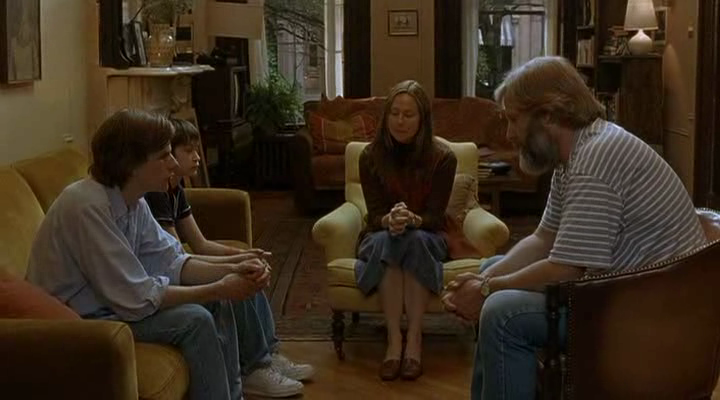
Written and directed by Baumbach, The Squid & the Whale is about two young boys growing up in the 80s in Brooklyn when their parents had decided to divorce. From the perspective of the older son, he takes on the side of his writer father after learning that his mother had affairs with other men. His younger brother meanwhile, has taken the side of his aspiring writing mother while discovering the world of sex. Baumbach chooses to study and bring humor to the subject of divorce where its revealed to be his most personal film yet. Starring Jeff Daniels, Laura Linney, Jesse Eisenberg, Owen Kline, Anna Paquin, and William Baldwin. The Squid & the Whale is one of 2005's heartbreaking yet funny films about family situations from Noah Baumbach.

It's 1986 in Brooklyn where the Berkman family led by novelist/teacher Bernard (Jeff Daniels) and wife/aspiring writer Joan (Laura Linney) are playing tennis with their sons, 16-year old Walt (Jesse Eisenberg) and 10-year old Frank (Owen Kline). Joan's writing talents is now flourishing while Bernard is still trying to get a publisher for his novel where the marriage is starting to fall apart after years of tension. Bernard has suspected Joan of having affairs with different men for years as he tells Walt while Joan is fed up with Bernard's high-intellectual attitude. Then one day when the kids went to school where Bernard tells them about a family conference for the evening, Bernard and Joan announced that they're going to divorce. While the parents agreed to have joint custody where the boys would stay with a parent for some days, the announcement devastates the young Frank. More problems get complicated when the family isn't sure what to do with the family cat who is also going to live by the same schedule the boys do. Bernard tells the boy that he's moved out to a house some blocks away from Joan's home.

Things become complicated for the boys as Frank remains devastated while Walt gets some advice from friends about joint custody. Walt also starts to be smitten by a student named Sophie (Halley Feiffer) who learned that Walt is going to be part of the school talent show. Frank however, due to the shock of his divorce his becoming frustrated with his tennis lessons as his teacher Ivan (William Baldwin) is concerned. Frank’s behavior also becomes stranger where he starts to engage in drinking alcohol and other things. On the day it was supposed to be Joan's day with the kids, Walt tells his mother that he won't live with her anymore after hearing about her affairs. A split between the boys go on as Frank's anger starts to go towards Bernard, especially when he decided to have one of his students in Lili (Anna Paquin) to live with him. When Walt is about to go on another date with Sophie, Bernard decides to join them where he took the two to see Blue Velvet by David Lynch where Bernard tells Walt some awful advice about Sophie.

Frank decides to run away back to his mother's house where he learned that she is now dating Ivan and had just got her story picked up for a top New York magazine. The young Frank becomes confused by everything as Bernard is now dating Lili in whom Walt has a crush on. Though Frank likes having Ivan around, he remains emotionally confused while Walt's relationship with Sophie becomes troubling due to the advice his father gave him. During the talent contest where his parents, Ivan, Sophie, and Lili attended, Walt wins the contest while claiming that Pink Floyd's Hey You was originally written by him. Walt is still angry about his mother's new relationship where Sophie notices that Walt is eyeing other girls. Walt even attempts to flirt with Lili one night where it becomes a disaster.

The effects of the Berkmans' split finally unfolds when the boys began to have some trouble in school as Frank's strange behavior gets noticed while Walt is accused of plagiarism. Walt is forced into psychological evaluation by a counselor (Ken Leung) where old memories of his childhood starts to emerge. Realizing what's going on all this time, Walt's confusion starts to emerge to the point that the boys are now caught in the middle of a nasty war between their parents.

The film's tag line pretty much sums up what the film is saying... joint custody blows. In what is a very personal story, Noah Baumbach manages to capture all the angst, confusion, and humor that surrounds the world of divorce. While most films about divorce are often very serious or take the route of comedy. Baumbach chose an interesting approach by having the story be more about the boys instead of the parents though they get an equal amount of back story. Baumbach's approach to realism is very evident in not just the affects of the boys but how they too get into conflict where the character of Walt is trying to be his father with all of this intellectual jargon about Kafka when has no idea on who he is. The subplot of Frank's emotional journey is equally as troubling as Walt's own exploration where Frank embarks on activities that are really disgusting but is understandable for his own emotional confusion.

The script that Baumbach concocts is really one of the best scripts ever written since it contains some very funny, realistic dialogue and some great development of characters. The dialogue is often filled with some of the most inane, intellectual commentary about art on how a certain book by Dickens or a film by a director is mentioned and Bernard says, "it's minor stuff". Even some of the funnier dialogue is done with great timing about everything as the characters themselves, notably the Berkmans are done with great depth as Joan admits to her own guilt and her desire to be a writer. Bernard's own struggle to reinvigorate his own writing career and the boys dealing with their own parents divorce and their own individual goals.

On the directing front, Baumbach goes for a realistic yet home-like feel where the film is shot on location in Brooklyn for 23 days in the summer of 2004. His approach is real yet entertaining from some of the funny moments where it feels natural to the more emotional moments that is relatable to anyone remembering when they're young. Overall, Baumbach has created a smart, funny, yet heartbreaking tale of divorce and the affects of its children.

Helping to create a colorful yet grimy Super 16mm feel of mid-1980s Brooklyn is Robert Yeomen, Wes Anderson's cinematographer. While the film does look a bit like some of Anderson's own films, Yeomen goes for a different style to convey the intimacy of the different worlds of the Berkmans while bringing some lighting to the exteriors of Brooklyn. Production designer Anne Ross does great work in getting the look of Brooklyn from the arty world of Joan's house to the delapidate look of Bernard's home while catching some 1980s objects and albums while costume designer Amy Westcott does great work in getting the 80s clothing along with the intellectual look of the parents. Editor Tim Streeto does some great editing where the film has a nice rhythm and use of jump-cuts that gives the film a nice pace for its 81-minute running time. Sound mixer Allan Byer also does great work in providing the intimate atmosphere of the Brooklyn neighborhoods.

The film has a great soundtrack assembled by Randall Poster that features a wonderfully melancholic score from Luna's Dean Wareham and Britta Phillips that plays to the film's humorous vibe and angst-ridden storyline. The soundtrack features some great cuts which is dominated mostly by the work of Bert Jansch plus a couple of songs by Loudon Wainwright III. Other cuts which are mostly 80s music includes Bryan Adams, the Cars, Lou Reed, the Feelies, the famous theme of Risky Business by Tangerine Dream, and a cover of Mr. Mister's Kyrie sung by Owen Kline's sister Greta. Other cuts from John Phillips, Anna and Kate McGarrigle, and Blossom Dearie reveal a folk side to the film while another famous cut that dominates the film is Pink Floyd's Hey You which Baumbach got to use where he thanks Roger Waters in the final credits. Though the song is really about the aftermath of the character Pink's building the wall, in this film, Baumbach chose to reinterpret the song to convey the troubling family circumstances which definitely gives some new meaning as the original song and Eisenberg's performance of it is in great use.

The film overall has a great cast that includes some memorable small performances from Ken Leung as the school counselor, David Benger as Frank's friend Carl, Adam Rose as Walt's friend Otto, and Noah Baumbach's brother Nico as a friend of Bernard who invited him for a college seminar. Halley Feiffer is wonderful in her role as Sophie, a young woman is sweet and caring yet is disturbed by Walt's attitude and his attempt to be like his father as it's an excellent performance from the young actress. Anna Paquin is also excellent as the more sexual vivacious Lili who writes disturbing poetry about her body while trying to seduce Walt and Bernard, in which the latter is even creepier since Jeff Daniels played her father in 1996's Fly Away Home. William Baldwin is great in the role of Ivan, a man who isn't a dim-wit as Bernard claims to be as he is a caring, sensitive teacher who tries to be the best buddy for young Frank as it's a great, restrained performance from the actor.

The film's real breakthrough performance goes to the young Owen Kline, who is son of actors Kevin Kline and Phoebe Cates, that got the part through the suggestion of Baumbach's then-girlfriend/actress Jennifer Jason Leigh. Kline's performance is very natural in the way he conveys the confusion and sadness of a young boy dealing with his parents' divorce while leaning towards stranger paths discovering things like sex and alcohol. It's a great performance from the young actor who proves to have the same chops his parents have. Jesse Eisenberg gives another riveting performance as Walt, by making him less likeable and more confused in his own journey following the divorce. Eisenberg, who made a name for himself with the brilliant Roger Dodger, gets more to do in the way he tries to be like his father while is forced to deal the realities when it comes to girls and why his parents divorced. Overall, it's both Eisenberg and Kline that are the heart of the film and story as these two are actors to watch in the years to come.

Laura Linney brings another great performance as the driven yet frustrated Joan Berkman. Linney conveys all of the warmth and care of a mother while having some great, intense scenes with Eisenberg in the way they convey their tension. Linney is aware that her character is flawed and makes her more complex in understanding her own infidelities where she doesn't make Joan sympathetic or looked with disgust. It's a great performance from Linney as she also some great scenes with Jeff Daniels. Daniels delivers what might be his best performance in a long time since he's often played supporting parts and rarely leading roles. In a role that was supposed to be for Bill Murray, Daniels conveys all of the things that Bernard is. In one word, Bernard is an asshole and Daniels makes him a memorable yet enjoyable character despite saying some of the most awful things about art and people. It's a great performance from Jeff Daniels as he's great with other actors while he manages to bring a lot of depth and complexity to a character as unlikeable as Bernard.

When the film premiered at the 2005 Sundance Film Festival, it was a surprise hit as Baumbach won writing and directing awards while later winning several awards for his screenplay including getting an Oscar nomination for his script. The film also honored Jeff Daniels and Laura Linney for their performances which they both received Golden Globe nods as Daniels got more attention in a role that some said was a comeback. The film was also a comeback for Baumbach as later that year, he married Jennifer Jason Leigh who is set to appear in his next feature that also stars Nicole Kidman. Overall, thanks to a great script, a great cast, and great premise on the affects of divorce, The Squid & the Whale is one of 2005's most heartbreaking and funny films about family.


© thevoid99 2011

Sunday, October 03, 2010

The Social Network


In 2004, the world of social networking through the Internet changed with the arrival of founding of Facebook.  A networking site that allows a user to interact with family and friends by posting messages or posting pictures.  By July 2010, it has over 500 million users around the world while courting controversy over privacy issues and such.  Despite the fact that it helped its founders Mark Zuckerberg, Chris Hughes, Dustin Moskovitz, and Eduardo Saverin become billionaires at a very young age.  It also created friction among its creators where in 2009, a book about the founding of Facebook called The Accidental Billionaires by Ben Mezrich arrived to tell the story of the early years of Facebooks’s creation.  The book grabbed the attention of renowned director David Fincher and famed producer/writer Aaron Sorkin for their adaptation called The Social Network.

Directed by David Fincher and an adapted screenplay by Aaron Sorkin, The Social Network tells the story about the founding of Facebook in its early years through its creators when they were just students at Harvard.  During the creation of Facebook and its rise, friction among its founders over credit and glory ensue that leads a chilling story of greed and betrayal.  With an all-star cast that includes Jesse Eisenberg, Andrew Garfield, Justin Timberlake, Rooney Mara, Brenda Song, Rashida Jones, Armie Hammer, Joseph Mazzello, Patrick Mapel, and Max Minghella.  The Social Network is an eerie yet exhilarating film from David Fincher.

It’s the fall of 2003 as Mark Zuckerberg (Jesse Eisenberg) is on a date with Erica Albright (Rooney Mara) where things end up badly.  Upset, Zuckerberg blogs about Erica and then has an idea about all the parties that are going on in Harvard.  Zuckerberg, a computer programming student, comes up with an idea called Facemash where he posted polls about which girl was hotter and such and overnight, it becomes big.  With help from friend and roommate Eduardo Saverin (Andrew Garfield) who comes up with an algorithm code, Zuckerberg gets attention for Facebook, good and bad.  Among those interested in Zuckerber’s work as a programmer are twin rowers Tyler and Cameron Winkle Voss (Armie Hammer w/ Josh Pence as the body double) and Divya Narendra (Max Minghella).

After asking Zuckerberg to create a program for their website to connect with Harvard students to another.  Zuckerberg agrees while learning that Saverin has been accepted to a prestigious club.  Zuckerberg, along with programmer Dustin Moskovitz (Joseph Mazzello) and Chris Hughes (Patrick Mapel), decided to create his own site that was called The Facebook with Saverin bringing a thousand dollars to start the site.  While Zuckerberg’s ideas increase, the Winklevoss twins and Narendra are suddenly left in the cold as they kept being rebuffed by Zuckerberg.  Even as they issues a cease-and-desist against Zuckerberg which he refuses to comply to.  With Saverin’s social connections to get more people in the site, they decided to expand to other big college campuses in the Northeast and Stanford in California where they get the attention of Napster co-founder Sean Parker (Justin Timberlake).

With the Facebook growing in numbers through prestigious college campuses and the Winklevoss trying to stop the site by even going to Harvard’s president (Douglas Urbanski).  Nothing is stopped as Saverin’s new girlfriend Christy Lee (Brenda Song) arranges a meeting with Sean Parker to meet with Zuckerberg and Saverin.  Though Saverin was skeptical about Parker, Zuckerberg is charmed as he and Moskovitz move to California to expand Facebook while Saverin stays in New York City to talk to advertisers to help with the financial things for the company.  With Parker’s help in California, Facebook expands all the way to the U.K. as the Winklevoss twins and Narendra decide to sue.  Meanwhile, Saverin finds himself out of picture as he tries to freeze his own money only to come back to sign some documents which would eventually lead to an all-out war against Zuckerberg.

The film is a classic tale of how one rises to the top and become filthy rich and yet, is being faced by the people he had fucked over to rise to the top.  For this film about the creation and founding of Facebook, it is much more complicated considering that Mark Zuckerberg who is a guy that likes to work on his computer a lot.  He is very socially awkward and seems more interested in trying to create a better Facebook with money coming to him all of the time.  Yet, he is also an asshole.  Still, if someone wants to make it in business.  They have act like assholes in order to get their way.  Yet, there’s a price to be paid when that person ends up screwing his friends around out of their share of the pie.

Screenwriter Aaron Sorkin creates a storyline that is similar to Akira Kurosawa’s Rashomon as it’s all told in a couple of depositions where Zuckerberg is facing off against those he screwed over.  While the narrative moves back and forth from the creation of Facebook to the different depositions where Zuckerberg is explaining himself.  Even in his deposition against Eduardo Saverin, he is joined by a lawyer (John Getz) and a paralegal (Rashida Jones).  Even through these depositions, Sorkin gets a chance to have the Winklevoss twins and Narendra tell their side as well as Saverin.

While the Winklevoss twins and Narendra might seem like a trio of rich, preppy assholes who got cheated out of millions of dollars.  Yet, there’s a bit of sympathy for them considering that they tried to restore some of Zuckerberg’s already trouble reputation while making him part of an elite club.  Instead, Zuckerberg screws them though they gave him an idea about Facebook.  Then there’s Eduardo Saverin, the co-founder who brings in the money to create Facebook and then is pushed out of the picture once Sean Parker comes in.  Here’s a guy who is very smart, comes up with an algorithm code, brings in the money, and has all of the social connections to get people to join Facebook.  What happens to him is just as sad as he’s the character that gains the most sympathy.

Sorkin’s portrayal of characters including the brash Sean Parker, are wonderful in their complexity while breaking away from whatever stereotype what audiences might perceive of them.  Even in Mark Zuckerberg who is a very complicated character that doesn’t really know how to interact with people but can create ideas that would make Facebook what it is by 2010.  While some might sympathize with Zuckerberg for just trying to create something that will bring people together.  Others will hate him for how he screwed people over or how he treats them.  Yet, it is Sorkin’s genius to create memorable characters along with fast-paced dialogue and intense, dramatic moments is what makes the story so compelling.

The direction of David Fincher is truly his most accessible and most intriguing work to date.  Fincher creates a drama that is filled with a bit of suspense along with some humor and heavy drama.  Setting the film in Cambridge as Harvard, he goes into the world of Harvard in all of its social circles.  Fincher starts the film off with a bar scene that is long as he goes back and forth into the conversation.  The framing of that scene sets the stage along with the following sequence of following Zuckerberg through Harvard with this tracking shot.  Most of Fincher’s direction of scenes is very intimate inside the dorms while going inside the parties and capturing the intensity of Zuckerberg and his cohorts creating something.

Fincher succeeds in creating dramatic tension with not doing a lot for the deposition scenes.  Even as he focuses the camera on Zuckerberg, who seems very distracted by the things around him including the rain outside.  It’s all because Zuckerberg is trying to think about other things concerning his own site as Fincher’s camera is intent on capturing this young man at his most confrontational.  The overall direction of Fincher is truly mesmerizing and it’s definitely his most solid and entrancing work of his career so far.

Cinematographer Jeff Cronenweth does a phenomenal job in creating a look and tone for the visual aspects of the film.  Cronenweth’s dark, low-lighting look for many of the film’s interior scenes is truly intoxicating in its dark tone.  For some of the daytime, interior scenes, the film is more lively as Cronenweth’s camera is always on the action.  Even as Croenweth’s photography for some of the scenes in California is exquisite as his work overall is great.

Editors Kirk Baxter and Angus Wall do an amazing job with the film‘s editing in creating a rhythmic pace to keep up with the rapid dialogue.  Even as they slow down to create dramatic tension.  Notably for some of the deposition scenes where the editing takes it time for the actors to have their monologues as it’s a great example of what editing should be. 

Production designer Donald Graham Burt, along with set decorator Victor J. Zolfo and art directors Curt Beech and Keith P. Cunningham do fantastic work with the look of the Harvard dorms, the classrooms, and everything else that Harvard looked liked.  Even the designs of the clubs and slick restaurants to play up to Mark Zuckerberg’s rise while the deposition scene with the Winklevoss twins is very classy to represent the old-school world of those twins.  Costume designer Jacqueline West does excellent work with the costumes from the more ragged, casual clothing of Zuckerberg to the more posh, intimidating clothes that the Winklevoss twins wear.  Sound designer Ren Klyce does superb work with the film’s sound mixing and editing to create moods for the scenes involved in the film.  Notably the deposition where at one point, rain is heard to mix with the dialogue and music to play with what Mark is thinking about.  Klyce’s sound work is truly one of the film’s technical highlights in capturing the tense atmosphere that goes on for the film.

The film’s soundtrack features a large array of music ranging from the White Stripes, Roots Manuva, the Cramps, 10cc, the Dead Kennedys, Bob Marley & the Wailers, Cage, Super Furry Animals, and to close the film, the Beatles’ Baby You’re A Rich Man.  The soundtrack definitely plays up to the party atmosphere of the film as it is presented in large contrast to the film’s dark, unsettling score.

The film’s original score is created by Nine Inch Nails mastermind Trent Reznor and longtime cohort Atticus Ross.  Featuring a cover of Edvard Grieg’s In The Hall of the Mountain King, Reznor and Ross’ score is a mixture of dark ambient music filled with soothing piano and swooning synthesizers to play up to some of the melancholia and drama that goes on.  When it gets tense, the score becomes more menacing with fuzzy bass lines, discordant electronics, and driving guitars.  While some of the pieces feature music from the 2008 NIN instrumental album Ghosts I-IV, the music Reznor and Ross creates is perfect to complement the complex mind of Mark Zuckerberg as that score is real highlight of the film.

The casting by Laray Mayfield is excellent for its array of actors to fill in small and big roles.  Among the memorable small roles are Steve Sires as Bill Gates in a seminar scene, screenwriter Aaron Sorkin as an ad executive, Dakota Johnson as a Stanford girl Sean sleeps with, Malese Jow as Christy’s friend, and Patrick Mapel as Facebook co-founder/original spokesperson Chris Hughes. Other notable small but more substantial performances come from Brenda Song as the sexy Christy who becomes Eduardo’s girlfriend, Joseph Mazzello as programmer/Facebook co-founder Dustin Moskovitz, John Getz as Mark’s attorney Sy, Douglas Urbanski as former Harvard president Larry Summers, Dustin Fitzsimmons as a club president, and Rashida Jones as a paralegal who helps Mark with his legal situations while giving him a monologue about what he should do.

Rooney Mara is excellent in a small role as Erica Albright, a composite of a real individual who would become the inspiration for Zuckerberg’s idea to create Facebook. Even as Mara holds her own against Jesse Eisenberg as a girl who felt confronted by a guy she had a hard time relating to.  Max Minghella is very good as Divya Narendra, a rich student who felt screwed by Zuckerberg and wants to get violent on him. Armie Hammer, as the Winklevoss twins, is phenomenal in playing these rich, preppy, popular jocks who get shafted while wanting to try and be respectable in their approach only realizing how much they want to kill Zuckerberg. Justin Timberlake, meanwhile, gives a rousing performance as Sean Parker. The brash co-founder of Napster who is everything Zuckerberg wants to be while charming his way into the world of Facebook as he is cocky and arrogant. It’s a great performance from Timberlake who finally gets a role and performance that truly serves as an acting breakthrough.

Another notable breakthrough is Andrew Garfield as Eduardo Saverin, a co-founder of Facebook who becomes the site’s original investor and business manager. Garfield is excellent as the guy who has all of the social connections but is suddenly thrown out of the loop once Parker comes in as he struggles to get Zuckerberg’s attention. It’s truly a remarkable performance for the young British actor. The film’s real break-out performance is Jesse Eisenberg as Mark Zuckerberg, the CEO and co-founder of Facebook. Known for playing eccentric, comical, and nerdy characters in films like Roger Dodger, The Squid & the Whale, Adventureland, and Zombieland. Eisenberg does an exhilarating job in playing the troubled yet brilliant Zuckerberg in all of his flaws. Eisenberg also makes Zuckerberg into a somewhat sympathetic figure but also one to despise. Eisenberg can talk fast, be quite uncaring, be in his own head, and also very arrogant in scenes where he gets confronted as it’s definitely the best performance of his career.

***Additional DVD Content Posted on 2/9/11***

The 2-disc Region 1 DVD from Sony presents the film in its original 2:40:1 theatrical aspect ratio in anamorphic widescreen.  Featuring 5.1 Dolby Digital sound in English and French plus subtitles in English (for the hearing impaired), French, and Spanish.  The first disc of the DVD is the film itself as the only special features it includes are two audio commentary tracks.

The first commentary track is from director David Fincher.  Fincher talks about a lot of the film’s location settings, technical ideas, and the cast.  Particularly Jesse Eisenberg who he really liked in Noah Baumbach’s The Squid and the Whale and The Education of Charlie Banks.  Even as he reveals what Eisenberg brought to the role of Mark Zuckerberg in which he brings a humanity to a character that is inaccessible at times.  Fincher praises the likes of Andrew Garfield, Rooney Mara, Brenda Strong, Justin Timberlake, Armie Hammer (along with his double Josh Pence), and Max Minghella.

Fincher also talks about the reasons why they weren’t able to shoot at Harvard along with some ideas about the story and Aaron Sorkin’s screenwriting.  He also revealed that he originally wanted Elvis Costello & the Attractions’ Beyond Belief to be the song in the opening credits but everyone else didn’t like it.  Fincher admits that it was an idea as he also talked about the musical contributions of Trent Reznor and Atticus Ross.  Even as he wanted something that was a bit reminiscent of the high school film of the 80s but more modern.  Fincher’s commentary is fun to listen to as it features lots of bleeps because it’s a PG-13 movie.

The second commentary track is from screenwriter Aaron Sorkin and cast members Jesse Eisenberg, Andrew Garfield, Justin Timberlake, Armie Hammer, and Josh Pence.  Sorkin and the actors talk about the production as well as Fincher’s directing style which is notorious for having actors do numerous takes which was something the actors didn’t really seem to mind.  Eisenberg felt it was the right approach so that he and the other actors could get a chance to find their footing during the shoot.  Even in the opening scene with Rooney Mara where and Mara had to find the way to get the rhythm of their conversation just right and make it feel natural.

Andrew Garfield discussed his approach to playing Eduardo Saverin as well as his chemistry with Eisenberg where they had to hang out with each other for a while before working.  Garfield and Eisenberg praised the work of Joseph Mazzello whom Garfield was jealous of as a kid because Mazzello was in Jurassic Park.  Armie Hammer and Josh Pence talk about their roles as the Winklevoss twins as Hammer revealed an encounter with one of the twins that freaked him out.  Justin Timberlake revealed that he had to audition for the part of Sean Parker which he worked hard on and didn’t want to come into the film because of who he is.

Sorkin revealed about his approach to the screenplay of the film while he revealed that the music he originally wanted to use in the credits sequence was Paul Young’s cover of Love for the Common People.  Fincher thought that wouldn’t work as he decided to go with Trent Reznor and Atticus Ross’ music.  Sorkin revealed that the one scene he wished was cut was his cameo as all of the actors disagreed and thought he did pretty good.  The overall commentary is fun as it brings insight to the characters and the story.

The second disc includes loads of special features relating to the film.  Leading the pack of special features is a one-and-a-half hour, four-part making-of documentary entitled How Did They Ever Make a Movie of Facebook?  Directed by David Prior, the documentary features interviews with actors, crew members, producers, screenwriter Aaron Sorkin, and director David Fincher.  Even as it focuses on what was shot in the three central locations for the film plus how did they manage to put Armie Hammer’s face into Josh Pence for several scenes in the film.

For many of the exterior scenes in Harvard, it was all shot in Boston and nearby colleges since there was no permission to shoot at Harvard.  Even as a few interiors were shot in the month of October where the whole principal photography phase was 70 days.  Both Hammer and Pence had to learn how to row though Pence was more experienced since he did row in his school days.  Even as the opening bar scene was rehearsed early in the day with Jesse Eisenberg and Rooney Mara where they finally shot the scene later that night with a bunch of extras.

For a lot of the film’s interior scenes which included the restaurant and club scenes.  All of it was shot in Los Angeles including the house Zuckerberg and his team stayed in during their California trip.  Some exteriors were also shot for the film that was to be set in Harvard while the dorm room scenes and a few interiors were shot in the lot.  Notably the depositions as it was all shot on a built set.  The documentary is an insightful, fun featurette that reveals the making of the film.

Another big featurette is a 4-minute multi-angle breakdown of the Ruby Skye VIP room scene.  Featuring four camera angles and four different audio tracks, it reveals how the club scene was created from its early stages to principal photography.  There are four shots that are going either by themselves individually or all together in a composite form.  The first audio is Jesse Eisenberg and Justin Timberlake rehearsing in another room reading Aaron Sorkin’s dialogue with Sorkin and David Fincher watching in the first angle.  The second audio track is an interview with editors Kirk Baxter and Angus Wall along with sound designer Ren Klyce about how difficult it was to create the club scene for all of the sound work and editing.

The third video and audio is about the location scouting of the club as Fincher and crew discussing how it would be shot and what angles would be used.  The fourth and final video/audio clip is the principal photography where the first assistant director gets extras to come in and dance to the music while making sure they keep dancing when music isn’t played so Timberlake and Eisenberg do their dialogue.  Even as Fincher is watching everything through a monitor as he also directs Eisenberg and Timberlake about what they should do during their conversation.  It’s definitely a wonderful and captivating featurette.

Two other special features involve the film’s technical work.  The first is an eight-minute featurette about the film’s look from David Fincher and cinematographer Jeff Cronenweth.  Fincher and Cronenweth revealed that because of Harvard’s refusal to have the film be shot on location, they had to find locations where they can shoot places that are similar to Harvard.  Even in look where all of it had to be captured to create a similar mood to the way Harvard looked.  Helping capturing some of those images, particularly inside the dorm room were the cameras Fincher and Cronenweth used which was the Red One camera.

Since Fincher had always expressed interest in digital filmmaking and in high-definition, the Red One was the camera that was able to give him the look he needed.  The hard part was trying use lenses to capture broader shots for depth of field.  Notably the overhead shot of the Harvard archway where three cameras were used to capture the entire archway as it had to become one entire frame.

The second is a seventeen-minute, twenty-second featurette on the film’s post-production that features editors Kirk Baxter and Angus Wall and sound designer Ren Klyce.  Baxter and Wall reveal the difficulty of the editing since things were moving so fast that the film was edited during production as filming continued.  Even as they’re aware of Fincher’s notorious for shooting many takes of a scene which was more difficult because of Sorkin’s screenplay.  Even in capturing the right note of the performances which had to be handled through Klyce’s sound editing.

Klyce’s sound editing, mixing, and design work helped to create moods, notably the opening scene of the film.  Even as Klyce had to mix the dialogue of Jesse Eisenberg and Rooney Mara in one mix, the mix of the people in the bar talking, and the music of the White Stripes in the background.  What Klyce had to do was get all of those sounds mixed in together for this opening sequence.  Even when Eisenberg’s character had to work on the computer where Klyce and Fincher took a more realistic approach as opposed to the ways computers sounded in the past.

Three other special features involve the film’s music from composers Trent Reznor and Atticus Ross.  The first is a nineteen-minute featurette on the score with interviews from Reznor, Ross, and David Fincher.  Reznor and Ross revealed their approach to the music where Reznor would do a lot of the performance with Ross providing the arrangements and dissect all of the pieces that was played.  Even as the two try to figure out what rhythm this piece would be used or that piece.  The track Hands Cover Bruise became the main theme that Fincher loved which he felt would become the basis for the score and the emotional accompaniment of Mark Zuckerberg.

The hardest track Reznor and Ross had to do was Edvard Grieg’s In the Hall of the Mountain King because it was requested by Fincher.  Reznor revealed that because Fincher wanted a Wendy Carlos approach of the piece, Reznor took it the wrong way where the first draft was played to a dismal reaction from personnel to Reznor’s dogs.

Also included in that section is a four-and-a-half minute feature on the Swarmatron instrument Reznor and Ross used for the score.  It’s an instrument that features ribbons for Reznor to rub on while using a tuning button to create pitches for the sound.  He said he wanted to use something that was organic and imperfect in the realm of electronic music.  Reznor and Ross revealed what scenes featured the instrument as it contained a swooning if discomforting sound to help set the mood for the scenes.

The third and final music special is a rough draft of Edvard Grieg’s In the Hall of the Mountain King.  Played to the Henley Regatta scene, the featurette features four different audio mixes.  One is a rough version of the first draft of the track in music only which sounded more like Wendy Carlos’ approach to the track with dated 70s-style synthesizers that didn’t feel right.  In the final mix of that first draft with the sound in the film, it still didn’t work because the track’s intensity with the feel of the race just didn’t match.  Even as the text that preceded the scene revealed what it took to get to the final version.  When the final version of the track is presented in a music-only mix and then in the final mix with the film’s sound, it’s an indication of what worked.

Though the only thing the DVD is missing are the trailers for the film.  It is still an amazing DVD that fans of David Fincher must have.  Even as aspiring filmmakers get a chance to understand Fincher’s filmmaking process including how the film was shot and edited.  Fans of NIN will definitely want the DVD for the music features and to see Trent Reznor and Atticus Ross at work on the film’s score.  In the end, it’s a spectacular DVD that supports one of 2010’s great films.

***End of DVD Tidbits***
The Social Network is, without a doubt, one of the year’s best films from David Fincher and screenwriter Aaron Sorkin. Fans of Fincher’s work will no doubt enjoy the film for its visual feel and tone while fans of Sorkin will enjoy his approach to the story. Featuring an amazing cast led by Jesse Eisenberg, Andrew Garfield, and Justin Timberlake plus a hypnotic score by Trent Reznor and Atticus Ross. It’s a film that truly dwells into one of the great social phenomenon of the 21st Century and how its creator became rich. It’s definitely a film that is engaging, entertaining, and also intriguing. In the end, The Social Network is a remarkable yet provocative film from David Fincher.


© thevoid99 2010