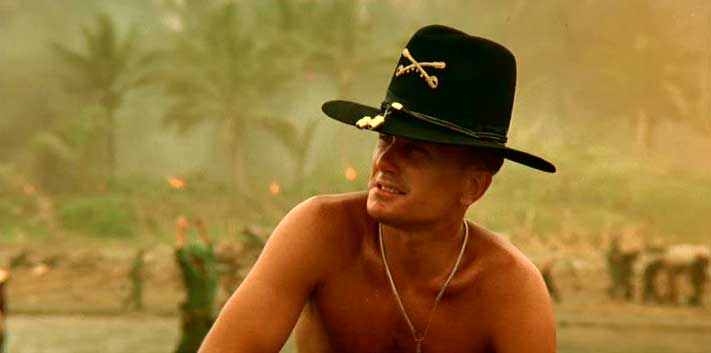
Apocalypse Now
From 1972 to 1974, Francis Ford Coppola was clearly the hottest director in American cinema. He had released three films in that period. Two of which were The Godfather movies that both won Best Picture while in between was The Conversation that won the Palme D’or at the 1974 Cannes Film Festival. Then Coppola chose to produce a film based on an idea by John Milius which was a Vietnam film that is also an adaptation of Joseph Conrad’s Heart of Darkness. The project was called Apocalypse Now as Coppola and Milius worked on the project that included ideas from Michael Herr based on his article The Battle of Khe Sanh.
The project was originally going to be directed by George Lucas who turned it down to make Star Wars. Coppola ended up taking on the project as the director as he decided to make it into an ambitious film about Vietnam with a budget ranging from $12-14 million. Yet, finding the location proved to be tough as he found it in the Philippines despite the warning from his mentor Roger Corman to not shoot there. From March of 1976 to May of 1977, the production of Apocalypse Now was a chaotic experience as Harvey Keitel was replaced by Martin Sheen after a few days. What was to be a five-month shoot became longer.
When Marlon Brando arrived three months into production, he arrived overweight and not having read the material Coppola wanted him to read. Things got worse due to typhoons and in early 1977, Martin Sheen suffered a heart attack. After shooting wrapped, Coppola and company returned to California for what would be a two-year work on the film not just for editing but also for its sound. Even as Coppola and his longtime editor Walter Murch brought together a team of sound mixers and editors to create a new quadraphonic sound mix that would eventually become 5.1 Dolby Stereo Surround Sound.
The editing and sound work took a long two years as the film was screened in rough sketches including a showing at the 1979 Cannes Film Festival where it would co-win the Palme D’or with Volker Schlondorff’s The Tin Drum. In August of 1979 after extensive post-production and with a final budget of $31.5 million, which was massive at the time. Apocalypse Now was finally released.
Directed by Francis Ford Coppola with the screenplay written by Coppola, John Milius, and narration by Michael Herr as its told by Martin Sheen’s brother Joe Estevez. Apocalypse Now is the story of an army captain going upriver through Cambodia to assassinate a colonel who had supposedly gone insane. A classified mission as he’s accompanied by a Navy patrol boat crew where they would encounter strange things including a surf-crazed Lt. Col as they go deep into a dark jungle. Starring Marlon Brando, Martin Sheen, Robert Duvall, Laurence Fishburne, Sam Bottoms, Frederic Forrest, Albert Hall, Harrison Ford, G.D. Spradlin, and Dennis Hopper. Apocalypse Now is an eerie yet hypnotic masterpiece from Francis Ford Coppola.
It’s 1970 in Saigon as a burned-out and troubled special forces soldier by the name of Captain Benjamin L. Willard (Martin Sheen) is awaiting for his next assignment. He then gets a call for his next assignment as he’s briefed by Lt. General Corman (G.D. Spradlin), Col. Lucas (Harrison Ford), and a government official (Jerry Ziesmer) about his mission, which is also classified. The mission is to upriver to Nung River where he must find and kill Colonel Walter E. Kurtz. Kurtz is a special forces soldier who has feared to have gone rogue while forming an army of his own somewhere in Cambodia. Another captain (Scott Glenn) was supposed to kill Kurtz but has since disappeared.
Willard takes the mission as he joins the crew of a Navy patrol boat headed by Chief Phillips (Albert Hall) that also includes a surfer named Lance B. Johnson (Sam Bottoms), a guy named Chef (Frederic Forrest), and a young kid named Clean (Laurence Fishburne). Willard doesn’t tell anyone about his mission as he tells Phillips to go to a rendezvous point to meet Lt. Col. Kilgore (Robert Duvall) for transport to Nung River. Kilgore leads an air cavalry of helicopters as he decides to transport the team after learning that Lance is part of the patrol. He takes the team to a day of an attack where Willard and crew saw the chaos that Kilgore has created.
During the journey upriver, Willard begins to read about Kurtz’s background as they would make at a stop at a USO show with Playboy Bunnies. Later on during the journey, they stop to investigate a boat against Willard’s orders which leads to dire consequences. The journey darkens when they stop at a U.S. outpost at a bridge where a fight with the North Vietnamese is occurring where Willard receives more information about Kurtz and the captain who was supposed to assassinate him. With Lance on LSD and causing trouble, more chaos ensues as they’re getting closer where an encounter with villagers lead to dire consequences. After telling the crew what he’s doing as they reluctantly take him upriver.
Upon arriving into Kurtz’s outpost as Willard gives orders to call an air strike if he doesn’t return. He meets a freelance photographer (Dennis Hopper) who explains to Willard about Kurtz’s brilliance. Willard then meets Kurtz as he tells Kurtz why he is here. Even as Kurtz knows why as it’s clear that Willard is going to have a much harder time to complete his mission.
While the film is simply about an assassin going on a journey to find his target. It’s a much more complex film than what the plot suggests. Since Francis Ford Coppola and his co-screenwriters were basing their ideas from Joseph Conrad’s Heart of Darkness. Conrad’s novel explored the psychology of one of its protagonists as he goes into this journey in the Congo rivers. Along the way, he finds a world filled with chaos and despair as he gets closer to the man he’s trying to find. That idea is what probably attracted Coppola and John Milius to create Apocalypse Now by setting it in the Vietnam War.
Unlike the war films about Vietnam that were being made in the late 1970s, there is no political context since Coppola isn’t interested in going into ideas of anti-war or pro-war. Instead, he’s interested in this journey that Captain Willard is taking on. Willard is definitely a man that has seem to be in too many battles and is unable to return home as the same man he used to be. He is someone addicted to war and being of use for his country. When he’s finally given a mission, he goes head-on as he also decides to dwell into the psychology of Col. Kurtz.
The narration by Michael Herr, that is told by Joe Estevez (who filled in due to his brother’s health problems at the time), recalls Willard’s thoughts as he is going into his surroundings while reading about Kurtz. The voice-over narration of Willard also serves as a development for his character as it becomes clear that the closer he’s getting to Kurtz. The more troubled he becomes as he tries to keep his sanity together.
While the film is in some ways about Willard, it’s also about the journey with the patrol crew that Willard surrounds himself with. The characters of Chief, Chef, Clean, and Lance are just as interesting with all of their different personalities. Though Willard doesn’t try to interact or bond with them very much, they do effect his thoughts as at one point during the journey. Chief realizes that something bad is happening as he tells Willard that he has no idea where he is going. Even as Willard doesn’t tell them anything until the third act.
Another character Willard encounters in the journey is Lt. Col. Kilgore. Kilgore is an eccentric character who likes to create chaos and has a love for surfing. He is also someone who is very much into war and victory but also has a certain respect for the enemy. At one point, he says that anyone who had the guts to fight against him deserves a drink of water where a wounded Vietcong soldier is lying on the ground though he is waving a canteen around.
Then there’s Colonel Kurtz. A man with an amazing background in military and humanitarian services. Yet, the mystery of why he turned rogue and gave up all of these accomplishments to lead an army of his own. Though not everything is answered, it is clear that war had done a lot to damage the man as there’s a great monologue about the horrors he had seen in battle. Even as he has done a lot to protect himself where he’s become feared by those he opposed and those he had done his duties for.
The screenplay is definitely a complex story that involves a lot into the ideas of war as well as humanity in general. Capturing all of that terror is the direction of Francis Ford Coppola. Coppola’s broad, hypnotic direction is really the highlight of the film as he opens the film with an eerie scene of a jungle being bombed as it dissolves with burned-out face of Willard. The film has a dream-like yet eerie look where once the journey upriver takes place. It plays up as this eerie journey to Hell as Coppola mostly uses eerie camera shots for the movements on the boat. Many of the scenes in the river were obviously inspired by Werner Herzog’s 1972 film Aguirre, the Wrath of God. Even in using hand-held shots for the film’s battle scene along with aerial shots from helicopters.
It’s not just Coppola’s stylized shots that are the highlight of his direction. It’s also the way he creates the tension in the drama. Even as it leads to the climatic meeting between Willard and Kurtz where he just lets the camera roll as a keen observer wondering what kind of man Kurtz is. The way Coppola underplays the drama and maintain the tension between Willard and Kurtz is astounding as they’re surrounded by this world of chaos. Overall, this is Francis Ford Coppola at his finest.
Helping Coppola wield his surreal yet lush vision is cinematographer Vittorio Storaro. Storaro’s dream-like yet hypnotic photography is filled with arrays orange-like colors mixed in with dark green and elements of blue for a few nighttime scenes. For many of the daytime scenes including the famed air-cavalry which is mostly straightforward while adding a mostly dark, sepia-like tone for many of the scenes of the river. Not only is this Storaro’s best work as a cinematographer but it’s also the film’s real technical highlight.
The editing of Walter Murch, Richard Marks, Lisa Fruchtman, and Gerald G. Greenberg is phenomenal for the way the film moves in its leisured though chaotic approaching to pacing. Even in the more intense action scenes, the film moves with a kinetic rhythm that plays up to the excitement of war. For the scenes in the jungle and the journey, it moves slow but in a more methodical way as helps create the dramatic tension of the film. It’s definitely an idea of what great editing is.
Production designer Dean Tavoularis, along with set decorator George R. Nelson and art director Angelo P. Graham do a spectacular job with the look of the villages that Kilgore attacks as well as the apartment of Willard. Even the temple has a look that is truly mystical with its feeling of death as the art direction for the film is superb. The sound work by sound designer Walter Murch and sound editor Richard P. Cirincione is truly masterful for the way it invented the kind of sound that audiences hear in today’s film world. With additional help mixer Richard Beggs, the sound work is brilliant for the film’s spectacular air-cavalry attack as it’s another of the film’s technical achievements.
The music by Carmine Coppola and Francis Ford Coppola is another of the film‘s highlights for its calm but brooding tone of the film. With its use of soothing string arrangements mixed with electronics and percussions performed by Mickey Hart of the Grateful Dead. The score is truly mesmerizing for the way it captures the horrors of war. The film’s soundtrack includes a cover of Creedence Clearwater Revival’s Suzie Q in the Playboy USO show scene, the Rolling Stones’ Satisfaction during a water-skiing scene on the patrol boat, and Richard Wagner’s Ride of the Valkyries for the air cavalry attack. Another song that is used for the opening scenes of the film as well as the climatic ending is the Doors’ The End.
The casting by Terry Liebing and Vic Ramos is definitely inspiring for the use of memorable appearances of actors big and small. Among those who make an appearance in the film are famed music promoter Bill Graham as the USO Playboy promoter, Jerry Ziesmer as a government agent who tells Willard what to do about the mission, R. Lee Emrey as a helicopter pilot, Scott Glenn as the original assassin who becomes a part of Kurtz’s soldiers, and as Playboy Bunnies, Colleen Camp, Linda Carpenter, and Cynthia Wood. Also in the film making cameos as a film crew are Francis Ford Coppola and cinematographer Vittorio Storaro in the battle scene following the air-cavalry attack.
Other notable small but memorable appearances include Harrison Ford and G.D Spradlin as army officers debriefing Willard about his mission and Dennis Hopper as a crazed photographer who praises Kurtz and his ideologies. In the roles of the patrol boat crew, a then 14-year old Laurence Fishburne as wonderful as the young soldier Clean who has issues with Willard’s presence. Frederic Forrest is very good as Chef, a man obsessed with Playboy Bunnies while fearing over his own surroundings. Sam Bottoms is excellent as Lance, a surfer who gets himself into drugs as he tries to find a way to escape from the horrors of war. Albert Hall is great as Chief, the patrol boat leader who questions Willard’s authority while realizing that something bad is about to happen.
Robert Duvall is superb as Lt. Col. Kilgore, a man who cares for his soldiers while being someone that is completely eccentric. Even when he cares about making great waves for good surfs. It’s one of Duvall’s finest performances as he spouts one of the film’s most memorable lines. Martin Sheen is phenomenal as the film’s protagonist Captain Willard. A troubled man who is a product of the war as he goes deep into the dark jungles of Cambodia to find his target. He’s someone with little remorse as he often alienates himself from the patrol boat crew that is taking to his journey. It’s definitely Sheen at his best as he brings a lot to a character that is losing his humanity.
Finally, there’s Marlon Brando in what is definitely his last great performance as Col. Kurtz. While he would do more films over the years until his death in 2004, this would be one of Brando’s most iconic roles of his career. Playing a man troubled by war as well as the horrors of what he sees as inhuman. It’s a role that not only has Brando bald and overweight but also someone who is burned out as if he’s one the brink of insanity. It’s definitely a great role from the legendary actor.
When the film did premiere in August of 1979, it initially received mixed reviews as it did do well in the box office. At the Oscars, it would win two for Best Cinematography to Vittorio Storaro and Best Sound as well as several awards. The film would become Coppola’s last great hit as he spent the 80s in debt following the release of his 1982 film One from the Heart. Though he would be able to recover from his financial troubles in the 1990s, it would be many years before he decided to revisit his 1979 film.
Apocalypse Now Redux
In 1998, Francis Ford Coppola along with new American Zoetrope chief Kim Aubry decided to work on a new version of Apocalypse Now with additional footage that was cut from the film. With help from editor Walter Murch and cinematographer Vittorio Storaro to help with the new transfer of the film. Coppola also brought in some of the film’s cast to do new dubbing for the film while some new music was made with help from Mickey Hart. The result would be an expanded version of Apocalypse Now called Apocalypse Now Redux.
The 202-minute version is a different film of sorts in comparison to the original 153-minute cut of the film. A few scenes get altered like a water-skiing scene that was shown early in the film before Willard and crew meets Kilgore. In the Redux version, it’s shown much later with Willard reading the dossier on Kurtz. There’s also a new introduction to Kilgore as he arrives on a helicopter. Also altered in the Redux version is the ending that Coppola for years had issues with because he felt that audiences were confused about it. The new ending isn’t much of an alteration as it would clarify things about what Willard has done in the end.
The Redux version also includes some more humor in the film like a scene of Willard stealing Kilgore’s surfboard as well as a scene where Willard and crew try to hide the surfboard and their boat from Kilgore’s crew. Other new scenes in the longer cut include a rainy scene where Willard finds the Playboy Bunnies helicopter has landed on an abandoned army medical camp where Chef and Lance spend their time with a couple of Bunnies while Clean is waiting to score with one. Other new scenes have more interplay with Willard and crew as well as a scene where Kurtz reads some articles from Time magazine to Willard as he’s surrounded by children.
One significant scene that is restored for the Redux scene is the French Plantation scene. It’s where following the tragic death one of the patrol crew members, they stop at a foggy area as they encounter a group of French soldiers protecting a plantation in Cambodia. It is in this sequence where Chief’s duty of honor occurs during the funeral as they bury a fallen one while Willard and the remaining crew eat. The scene includes a child (Roman Coppola) reading a poem while the plantation head (Christian Marquand) talks about why the French shouldn’t give up as it features a cameo from Henri Martin Affair who argues with the plantation head. The scene also includes Willard’s encounter with Roxanne (Aurore Clement) who is a member of the family as she gets Willard in touch with his humanity as they smoke opium.
The scenes in the film definitely adds more to the story as they also fill in gaps that were probably unexplained in the original cut of the film. At the same time, it allows the film to move a bit faster while maintaining a leisured pace for the film. The new scenes have the same look and feel that Vittorio Storaro’s photography have as the French Plantation scene is the best looking scene in the Redux version. The score, which features additional material that wasn’t in the original film by Carmine Coppola, definitely brings more tension thanks in part to Mickey Hart’s percussion work and arrangements.
The performances from the cast who were in the original cut are given more nuance. Particularly Brando, Sheen, and Duvall as they show more humanity while Sheen gets to be funnier in a few scenes. More importantly, minor characters such as a couple of Playmates in Colleen Camp and Cynthia Wood are given more to do. For the French plantation scene, cameos by Francis’ sons Roman and Gian-Carlo as children of the plantation are good as is Henri Martin Affair as an old man commenting about the plantation’s history. Christian Marquand is great as the owner who talks about the French’s war record as he says they will not lose in Vietnam. Finally there’s Aurore Clement as Roxanne, a widow in the plantation who befriends Willard as she briefly gets him in touch with the humanity he seems to be losing.
Apocalypse Now Redux premiered at the 2001 Cannes Film Festival to a very positive reaction as the film was given a limited release in theaters where it did modestly successful. While audiences and critics were divided over the new scenes with the French Plantation receiving the brunt of the criticism. Still, it was successful enough for Coppola to help his revived American Zoetrope studio to keep going. In 2010, Coppola released both versions of the film along with the 1992 making-of documentary Heart of Darkness for a special Blu-Ray release as the legacy of Apocalypse Now remains intact.
Apocalypse Now is definitely one of the greatest war films ever from the dazzling yet eerie mind of Francis Ford Coppola. Featuring a great ensemble led by Marlon Brando, Martin Sheen, and Robert Duvall. It’s a film that is definitely hypnotic with grand visuals and intense moments that are truly unforgettable. Whether it’s the original cut or the extended Redux edition. It’s definitely a film that everyone must see whether they’re into war films or not. In the end, Apocalypse Now is a haunting yet mesmerizing film from Francis Ford Coppola.
© thevoid99 2011