Showing posts with label stanley tucci. Show all posts
Tuesday, December 06, 2016
The Impostors
Written, directed and co-starring Stanley Tucci, The Impostors is the story of two struggling actors who accidentally stow away on a cruise to run from an egomaniacal actor while meeting with an array of offbeat passengers and crew members. The film is a farcical comedy where it involves many people who pretend to be someone else while dealing the need to act in order to save themselves. Also starring Oliver Platt, Alfred Molina, Lili Taylor, Campbell Scott, Hope Davis, Steve Buscemi, Michael Emerson, Billy Connolly, Dana Ivey, Allison Janney, Richard Jenkins, Tony Shalhoub, and Isabella Rosselini. The Impostors is a rip-roaring and exhilarating film from Stanley Tucci.
Set during the Great Depression in New York City, the film revolves around the misadventure of two struggling actors who receive tickets to a show starring an egomaniacal actor where they insult him at a bar only to go on the run and find themselves as stowaways on a cruise ship. It’s a film that play into two men who are trying to make it as actors but upon learning they’re on a cruise ship where they pretend to be stewards. Stanley Tucci’s screenplay is quite loose where it plays into these misadventures of Maurice (Oliver Platt) and Arthur (Stanley Tucci) to them trying to get food as they’re unemployed as well as what goes on in the ship as they encounter a series of offbeat passenger and crew members. Among them is a deposed queen (Isabella Rosselini), a heartbroken singer (Steve Buscemi), a once-rich-turned poor widow (Dana Ivey) with her grieving daughter (Hope Davis), a possibly gay tennis pro (Billy Connolly), and other oddball characters. Adding to the turmoil is the fact that the famed but arrogant actor Jeremy Burtom (Alfred Molina) is also on the ship.
Tucci’s direction is definitely stylish starting with an opening credits sequence where Maurice and Arthur cause trouble as a way to avoid paying for coffee and food as it’s presented like a silent movie. Then it becomes partially straightforward with elements of slapstick comedy where some of it is shot partially in New York City while much of it is shot on a soundstage for the scenes set on the cruise ship. While Tucci would create some amazing compositions with the wide and medium shots, much of it presented loosely where he allows his actors to just create performances that are exaggerated. While it does help to tell the story, there is an element where it feels self-indulgent at times but Tucci wants to create something where the actors are there to have fun and allow themselves to over-act at times. Overall, Tucci creates a silly yet extremely fun film about two actors who stowaway on a cruise and try to find a way to solve problems through the power of acting.
Cinematographer Ken Kelsch does excellent work with the film‘s cinematography from the colorful and sunny look of the daytime New York City exteriors to the look of the many interiors on the cruise ship as well as some of its exteriors. Editor Suzy Elmiger does brilliant work with the editing as its usage of jump-cuts and other rhythmic cuts play into its humor and lively tone. Production designer Andrew Jackness, with set decorator Catherine Davis and art director Chris Shriver does amazing work with the look of the cruise ship with its exteriors as well as some of the interiors of the rooms and ballroom in the ship. Costume designer Juliet Polcsa does fantastic work with the design of the clothes from the clothes of the men including the lavish look of Burtom and the dresses that the women wear.
Hair stylists Victor DeNicola and Carla White do nice work with the hairstyles the women wore in those times along with some of the wigs that some of the characters wear. Sound editor Robert Hein does terrific work with the sound in the way some of the sound effects are presented as well as the sparse moment in the play scene. The film’s music by Gary DeMichele is wonderful for its ragtime/jazz-based score that played into the period of the times while music supervisor Margot Core creates a soundtrack that play into that period including some old music in French as it relates to the destination of where the ship is going to.
The casting by Ellen Lewis is incredible for the ensemble that is created as it feature some notable small roles from David Lipman as a baker Arthur harasses and gives Maurice tickets to a show, Matt Malloy as a fellow actor that Maurice and Arthur knows who had been humiliated by Burtom, Lewis J. Stadlen as a band leader, Elizabeth Bracco as an entertainment director for the cruise, Allan Corduner as the ship’s captain, Michael Emerson as Burtom’s assistant, Teagle F. Bougere as a sheik who has a fondness for a certain French song, Matt McGrath as an Italian detective named Marco who is afraid to kill as he has feelings for one of the ship’s directors in Lily, and Woody Allen in an un-credited yet funny performance as a neurotic stage director Maurice and Arthur audition for. Richard Jenkins and Allison Janney are superb in their respective roles as the con artists Johnny and Maxine as Americans who pretend to be French as they both try to woo Mrs. Essendine and the sheik. Tony Shalhoub is stellar as the ship’s first mate Voltri as a man who runs the ship but also has some very dark motives of his own.
Dana Ivey is wonderful as the widowed Mrs. Essendine who is upset that her late husband didn’t leave her a cent while Hope Davis is terrific as her daughter Emily who grieves for her father and acts melancholy until she notices the heartbroken singer. Isabella Rossellini is fantastic as the veiled queen who laments over being deposed and not want to be seen as she is fun to watch while Campbell Scott is hilarious as the German cruise director Meistrich who has a thing for Lily where he is just a hoot. Billy Connolly is excellent as the tennis pro Sparks who definitely bear some homosexual tendencies as he is fond of Maurice while Steve Buscemi is amazing as the suicidal and heartbroken singer Happy Franks.
Lili Taylor is brilliant as a cruise director in Lily who befriends Maurice and Arthur as she tries to help them hide as well as deal with Meistrich. Alfred Molina is phenomenal as the egomaniacal actor Jeremy Burtom as a man who is quite full of himself and isn’t aware that he’s just a hack. Finally, there’s the duo of Stanley Tucci and Oliver Platt in remarkable performances in their respective roles as Arthur and Maurice as two unemployed struggling actors trying to get work where an awkward moment with Burtom leads them to accidentally stow away on a cruise where they do whatever they can to hide as they use their acting skills to save them.
The Impostors is a sensational film from Stanley Tucci. Featuring a great cast, amazing set pieces, lively music, and a willingness to just let loose and have fun. It’s a film that is aware that it’s being indulgent while giving the actors a chance to just act out and be funny. In the end, The Impostors is a spectacular film from Stanley Tucci.
Stanley Tucci Films: (Big Night) - (Joe Gould’s Secret) - (Blind Date (2007 film))
© thevoid99 2016
Sunday, December 06, 2015
Spotlight (2015 film)
Directed by Thomas McCarthy and written by McCarthy and Josh Singer, Spotlight is the story of reporters for The Boston Globe who uncover a major scandal involving sexual abuse of children in the hands of Catholic priests in Boston in 2002. The film is a dramatization of the events that would shake up the world of Catholicism in the hands of a group of journalists who struggle with their own upbringing as well as uncovering the truth to an entire city. Starring Michael Keaton, Mark Ruffalo, Rachel McAdams, Liev Schrieber, Brian d’Arcy James, Billy Crudup, John Slattery, and Stanley Tucci. Spotlight is a riveting and exhilarating film from Thomas McCarthy.
Set from the summer of 2001 to early 2002 in Boston at The Boston Globe, the film revolves the famed Spotlight investigative journalist team who are asked by the paper’s new editor to do a story about a sex abuse scandal involving a Catholic priest at a parish in Boston. There, the journalists not only uncover more about what happened but also cover-ups and the fact that they themselves had a chance to tell the story years ago but never did. It’s a film that isn’t just about a sex scandal involving priests who abused children for many years in Boston but also the fact that the Catholic church in Boston was willing to cover up and do things in their power to pretend that it never happened. Even as the journalists try to figure out what are they hiding as they realize that this is bigger than one priest but an entire city that was involved and maybe the entire world.
The film’s screenplay by Thomas McCarthy and Josh Singer opens with a chilling scene of priest making a settlement with lawyers over a sex scandal which establishes what is common in Boston that people know but don’t want to talk about. It then cuts to the arrival of new Boston Globe editor Marty Baron (Liev Schreiber) who is aware that he has to gain the trust of the staff including the Spotlight team where he asks them to follow-up on a column about a sex abuse scandal from a Catholic priest. Leading the Spotlight team is Walter “Robby” Robinson (Michael Keaton) who is joined by Michael Rezendes (Mark Ruffalo), Sacha Pfeiffer (Rachel McAdams), and Matt Carroll (Brian d’Arcy James) as they were looking for something to do where Rezendes would try to talk to attorney Mitchell Garabedian (Stanley Tucci) is reluctant to talk publicly to Rezendes yet eventually reveals what is at stake.
With the team talking to victims as well as revelations that they had a chance to tell the story years ago when Robinson was part of the team. While Robinson does admit guilt on his own part for not taking the chance to cover the story, he would redeem himself in not just going further once it becomes clear that the story is bigger than one parish but rather a whole city. Especially as it becomes clear that many who work for the paper are Catholic where they seem to know what is happening but they are either too scared to reveal what happened or are in denial. By the film’s third act where it becomes clear that there is evidence to get one priest to finally confess about his actions. Robinson realizes that it’s not one name they need to go after but the almost 100 names that they’ve uncovered including one living in Carroll’s neighborhood.
McCarthy’s direction is quite engaging for the way it plays into the atmosphere of the newspaper world where many are struggling with the new age of internet news and the decline of print. Even as it plays into events such as 9/11 as the world of the newspaper and journalism is a very busy one where many colleagues talk and socialize about what stories to tell. McCarthy’s usage of tracking shots, wide, and medium shots don’t just play into that atmosphere but also help flesh out the drama where the camera would pull back in scenes where the Spotlight team try to gather whatever they can use to tell the story. While McCarthy does use close-ups for some intimate moments where the characters talk to victims or what they do in their personal lives as it relates to Pfeiffer accompany her grandmother to church on Sundays. It helps establish not just what kind of city Boston is but also why it has this very unique relationship with the Catholic church.
McCarthy would also know how to build up drama such as a scene where Rezendes gains access to old testimonial records with the aid of Garabedian as he tells the team that they should unleash the story now. Yet, it becomes clear that these scandals have taken a personal toll for the team as well as one of its key editors in Ben Bradlee Jr. (John Slattery) who admit to being a lapse Catholic. Even as there are those who were thinking about returning to church to regain some idea of faith but the scandal has damaged that faith as they aren’t sure if revealing this to the city would destroy all of that for those who still believe in the church. It adds to the dramatic conflict as the decision that is made doesn’t just hit home for the entire team but would also for an entire city and maybe the entire world. Overall, McCarthy creates a chilling yet visceral drama about a group of newspaper journalists uncovering a sexual abuse scandal in their home city.
Cinematographer Masanobu Takayanagi does excellent work with the film‘s cinematography from the usage of natural lights for many of the daytime exteriors as well as the usage of lights for the scenes set at night in the interior/exterior settings. Editor Tom McArdle does amazing work with the editing as it‘s mostly straightforward with a few jump-cuts for dramatic purposes as well as montages to play into the team at work. Production designer Stephen H. Carter, with set decorator Shane Vieau and art director Michaela Cheyne, does fantastic work with the look of the set of The Boston Globe building as well as the room where the Spotlight team works at plus the home of a few characters in the film.
Costume designer Wendy Chuck does terrific work with the costumes as a lot of it is casual with the exception of the clothes that some of the priests and cardinals wear. Visual effects supervisor Colin Davies does nice work with the minimal visual effects in the film which is essentially set dressing for some of the exteriors to make the city look like Boston circa-2001. Sound designer Paul Hsu does superb work with the sound to play into the atmosphere of the rooms at the Boston Globe to the machines where the papers are printed and other parts of the city. The film’s music by Howard Shore is brilliant for its very low-key piano score that has a few orchestral flourishes as it‘s mostly straightforward to play into the drama as well as the heaviness of what is happening while music supervisor Mary Ramos provides a more low-key soundtrack filled with bands based on Boston that only appears in the background.
The casting by Kerry Barden, John Buchan, Jason Knight, and Paul Schnee is incredible as it features some notable small roles from Neal Huff as one of the victims in Phil Savino, Len Cariou as Cardinal Bernard Law whom Baron meets early in the film, Paul Guilfoyle as one of the people involved with the church in Peter Conley, Jamey Sheridan as one of the church’s attorneys in Jim Sullivan whom Robertson knows, Maureen Keiller as columnist Eileen McNamara who would create the column that would start the investigation, Gene Amoroso as investigative reporter Stephen Kurkjian, Richard Jenkins as the voice of a noted psychiatrist for the victims, and Billy Crudup as attorney Eric MacLeish who is reluctant to reveal the settlements he took part in as well as reveal some revelations about the paper. John Slattery is fantastic as Ben Bradlee Jr. as one of the editors of the Globe who tries to make sure everything Spotlight does is under wraps where he realizes how big the story is prompting to get Baron on their side.
Stanley Tucci is excellent as Mitchell Garabedian as a man who is trying to defend the victims as he is reluctant to provide information because of the church where he gives Rezendes tips about what to find. Liev Schreiber is brilliant as Marty Baron as the new editor-in-chief who tries to understand more about the world of the Catholic church in Boston as he is a Jewish man trying to see what is going on where he learns more about what is really happening prompting him to put more support on Spotlight. Brian d’Arcy James is superb as Matt Carroll as a Spotlight reporter who helps piece many of the stories and sources that happens while making a chilling discovery about how close to home the scandal is at.
Rachel McAdams is amazing as Sacha Pfeiffer as a Spotlight reporter who talks to the victims in the streets while she would also talk to a former priest only to realize more of what is happening as she copes with how the news will affect her grandmother. Mark Ruffalo is phenomenal as Michael Rezendes as a Spotlight reporter who meets with Garabedian where he would go into the records with Carroll and Robertson where he would later uncover a major breakthrough for the story. Finally, there’s Michael Keaton in a remarkable performance as Walter “Robby” Robertson as the Spotlight chief who leads the charge where he would make some revelations into what he discovered as well as carry the guilt that he had the chance to reveal it years ago where he realizes the chance to do things right for himself and for Boston.
Spotlight is a tremendous film from Thomas McCarthy. Featuring a great ensemble cast, an intriguing story, well-crafted direction, and top-notch technical work, the film isn’t just a fascinating newspaper drama. It’s a film that explores people coping with something they either knew or didn’t want to know as they try to find a way to expose it to their city and the world in the hopes that something like this never happens again. In the end, Spotlight is a sensational film from Thomas McCarthy.
Thomas McCarthy Films: (The Station Agent) - The Visitor - Win Win - (The Cobbler)
© thevoid99 2015
Sunday, March 09, 2014
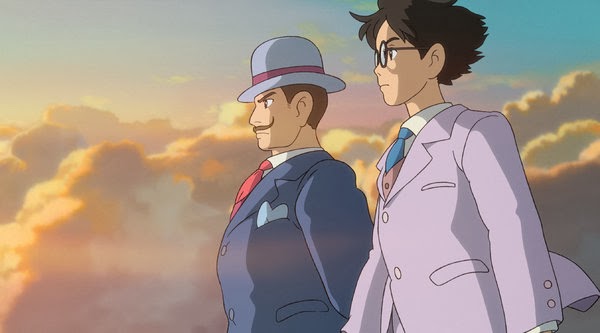
The Wind Rises
Written and directed by Hayao Miyazaki from his manga, Kaze Tachinu (The Wind Rises) is a fictionalized bio-pic about the life of Jiro Horikoshi as he was the man that designed the Mitsubishi A5M and its successor A6M Zero that played a key part in World War II. The film is a more dream-like portrait about Horikoshi’s life with some dramatic embellishments while not deviating too much from the real-life story. For the American-dubbed version of the film that is supervised by Gary Rydstrom, the voice cast includes Joseph Gordon-Levitt, Emily Blunt, John Krasinski, William H. Macy, Elijah Wood, Stanley Tucci, Mae Whitman, Mandy Patinkin, Jennifer Grey, and Werner Herzog. Kaze Tachinu is a mesmerizing film from Studio Ghibli and Hayao Miyazaki.
The film is fictionalized bio-pic about the life of Jiro Horikoshi that is presented in a dream-like fashion where it goes from Horikoshi as a young boy to becoming the man who would design the Mitsubishi A5M and its successor the A6M Zero that would become the key planes used in World War II. With a mixture of reality and a dream-like world, the film plays into Horikoshi’s desire to create the ultimate airplane that can endure wind resistance and not be intimidated by the advanced technology of other countries. Even as Horikishi (Joseph Gordon-Levitt) seeks the advice of the famed Italian plane designer Giovanni Battista Caproni (Stanley Tucci) in his dreams. Through Hayao Miyazaki’s screenplay, the film does have a conventional narrative in terms of structure that plays to Horikoshi’s life but he infuses with bits of surrealism and dreamy textures to make it much more interesting.
Notably as the film plays into key events that would mark Horikoshi’s development from his encounter at the 1923 Great Kanto Earthquake as well as his trip to Germany to see how the Germans created their airplanes. These moments would drive Horikoshi to see if he can create a war plane for Japan that would define them as they endure the Great Depression and such. While there would be some failures along the way, Hirokoshi would eventually find more inspiration when he re-meets Naoko (Emily Blunt) whom he had met years ago during a train ride with her sister where they encountered the Great Kanto Earthquake of 1923. His relationship with Naoko would prove to be a major catalyst to Horikoshi’s development as a man and as an engineer where he would try to balance both roles and later deal with his what he’s achieved.
Miyazaki’s direction is definitely dazzling in the way he creates Japan in the early half of the 20th Century as it’s a world that is trying to catch up with the modern world. Especially as he infuses bits of surrealism into the dream sequences that Horikoshi would have as it features some vast scenes of planes flying around and all sorts of things. Notably in the designs of the planes and how imaginative they look as it plays to what Horikoshi would want to create. The look of Japan from its different backgrounds of mountains, forests, and cities are presented with such great detail as there’s aspects in the background that are just as mesmerizing to look at. Even in the design of the characters which have all of the quintessential elements that is expected in Miyazaki’s work as an animator.
With the aid of cinematographer Atsushi Okui to help in the lighting where much of the animation is in 2-D hand drawn animated style with some computer-based animation for some of the backgrounds. Miyazaki creates something that is truly rich in scope but also infuse it with such artistry in the way the planes are flown as well as the way nature is presented as if it has the feel of a live-action film. Even in some of the compositions and camera work where it has a sense of action but also some drama and humor that just adds to the beauty of the film. Overall, Miyazki creates a truly evocative and sensational film about a dreamer who would create one of the greatest designs for a plane despite the fact that it’s being used as an instrument of war
Editor Takeshi Seyama does amazing work with the film‘s editing in its approach to rhythm for some of its action scenes as well as the dream sequences as it features lots of jump-cuts and disjointed rhythmic cuts to play into that sense of surrealism. Sound designer Koji Kasamatsu and sound editor Gwendolyn Yates Whittle (for its English version) do fantastic work with the sound in creating some of the sound effects used in the film with Whittle providing some low sound textures for some of the English dialogue as background textures. The film’s music by Joe Hisaishi is brilliant for its mixture of lush orchestral pieces with some playful and offbeat music driven by accordions and string instruments.
For the film’s English-language version, the cast includes some contributions from Elijah Wood as a co-worker of Horikoshi, Jennifer Grey as Mrs. Kurokawa, Darren Criss as another worker in Katayama, Mandy Patinkin as one of Horikoshi’s top bosses, Mae Whitman as Horikoshi’s sister Kayo, Zach Callison as the young Horikoshi, William H. Macy as Naoko’s father, Edie Merman as Horikoshi’s mother, and Werner Herzog in a superb voice performance as a German tourist Horikoshi meets in a retreat in the famed Magic Mountains in Japan. Martin Short is very funny as the comical boss Mr. Kurokawa who provides some humor as well as some guidance for Horikoshi while Stanley Tucci is brilliant as the famed Italian plane designer Giovanni Battista Caproni as Tucci sports an Italian accent as he displays warmth and humor into the role of the man who would guide Horikoshi.
John Krasinski is excellent as the voice of Horikoshi’s close colleague Kiro Honjo who aids Horikoshi in some of the designs as he would create his own planes that would also revolutionize planes in Japan. Emily Blunt is wonderful as Naoko as this woman who Horikoshi would meet early on as a young girl and later as a woman who would provide an inspiration and drive for Horikoshi after some of the failures he had to deal with. Finally, there’s Joseph Gordon-Levitt doing fantastic voice work as Jiro Horikoshi as this young man who dreams of designing an airplane that would define Japan in all of its glory though he is aware of what they’re being used for as he hopes they can provide some meaning into his life.
Kaze Tachinu is a remarkable film from Studio Ghibli and Hayao Miyazaki. It’s a film that is filled with rich images and a captivating story that manages to be wondrous as well as somber for what Jiro Horikoshi wanted to make. While it has some dark elements, it is balanced by the themes of being a dreamer which makes the story far more engaging. If this film is to become Miyazaki’s final contribution to cinema, he at least goes out with a winner. In the end, Kaze Tachinu is a phenomenal film from Hayao Miyazaki and Studio Ghibli.
Hayao Miyazaki Films: (The Castle of Cagliostro) - (Nausicaa of the Valley of the Wind) - (Castle in the Sky) - My Neighbor Totoro - Kiki’s Delivery Service - (Porco Rosso) - Princess Mononoke - Spirited Away - (Howl’s Moving Castle) - (Ponyo) - (The Boy and the Heron)
© thevoid99 2014
Monday, September 10, 2012
Margin Call
Written and directed by J.C. Chandor, Margin Call is the story of a group of investment bank employees dealing with a financial collapse during the 2007-2008 financial crisis. The film explores the world of finances told by a group of people in the span of 36 hours as they all try to figure out how to get out of the crisis. Starring Kevin Spacey, Jeremy Irons, Penn Badgley, Simon Baker, Demi Moore, Zachary Quinto, Paul Bettany, Mary McDonnell, and Stanley Tucci. Margin Call is a captivating ensemble drama from J.C. Chandor.
After laying off several workers including firm manager Eric Dale (Stanley Tucci), Dale asks one of his risk analyst Peter Sullivan (Zachary Quinto) to look over a report he had been trying to finish with a warning. Sullivan works late to look into Dale’s report where he makes a startling discovery as he calls junior risk analyst Seth Bregman (Penn Badgley) and trading desk head Will Emerson (Paul Bettany) about what he sees. They call their floor head Sam Rogers (Kevin Spacey) about the report as they realize that due to excessive marketing, the firm assets in mortgage-backed securities have decreased more than 25% as the firm is in danger of losing a whole lot more. Rogers asks Bregman and Emerson to locate Dale who has disappeared as they were unable to find him as the four men are called to a meeting.
They meet Rogers’ superior Jared Cohen (Simon Baker) and chief risk management officer Sarah Robertson (Demi Moore) to confirm Sullivan’s reports as Robertson realizes that everything Sullivan and Dale found is true. This would get the attention of the company’s CEO John Tuld (Jeremy Irons) who wants to know what is going on. After Sullivan reveals to Tuld what he found, Tuld decides to do some damage control as he looks for someone to put the blame on while getting his people to find Dale. After Cohen suggests something that would help the firm, Rogers believes that it’s only going to cause more trouble as he later asks his traders to make great sales with those making a 93% reduction in assets will get seven-figure bonuses while telling them what is going on. After the market closes, Rogers sees something that makes him uneasy as he’s forced to make a decision about his future.
The film is about 36 hours in the day of a market collapse that a risk analyst discovers as his bosses and executives try to see how to cut the losses and look for someone to blame. Meanwhile, a floor manager tries to assure his traders about what is to happen as they’re forced to look at something that is very ugly while they try to find the manager who was working on this report. When there’s people that confirms that the report is true and that trouble is brewing, top people try to see how to salvage their money in order to save face. Yet, there are those that is aware that something like this could’ve been prevented and there’s some good people who will be not just losing their jobs but also their reputations.
Characters like Sarah Robertson and Jared Cohen are people who kind of run the whole thing as Robertson is someone who knows more than what is going on. Cohen just wants to believe that nothing will go wrong as is CEO John Tuld who is hoping that something will work out. There’s no villains in a story like this but people who are just trying to keep the market going and just make money yet there are those who fall as the third act is about who to get rid of and who to keep. This would make Rogers uneasy as he doesn’t want to lose anybody as it eventually becomes too much for him.
J.C. Chandor’s direction is quite straightforward in terms of its visual presentation and the way he frames his actors in a scene. Yet, he does manage to create compelling moments that does drive the drama. Even in the meetings that take place as there’s a lot of tension as Chandor has his camera focused on one or more characters to establish what is being discussed. The camera definitely has a sense of claustrophobia that is felt as things are becoming more uncomfortable as the film progresses. Overall, Chandor creates a very engaging and smart drama that explores the world of finances and market collapses.
Cinematographer Frank DeMarco does nice work with the photography to capture the lights of the computers and lights inside the offices at night as well as some of the nighttime exteriors of the city. Editor Pete Deaubreau does terrific work with the editing by creating fast-forwards on some of the film‘s city shots as well as montages for the film‘s fire-sale trading scenes in the third act. Production designer John Paino and set decorator Robert Covelman do brilliant work with the look of the offices and meeting rooms where the characters meet to have their discussions where it looks like a place of immense importance.
Costume designer Caroline Duncan does very good work with the costumes as a lot of it are suits that many of the male characters along with the suit that Sarah Robertson wears. Sound supervisor Damian Volpe does some fine work with the sound to capture the intimacy of the meetings as well as the raucous nature of the city. The film’s music by Nathan Larson is excellent for its chilling, ambient-driven score to play out the drama that unfolds throughout the film.
The casting by Tiffany Little Canfield and Bernard Tesley is brilliant for the ensemble that is created as it features some small appearances from Mary McDonnell as Sam’s ex-wife Mary and Aasif Mandvi as an executive who works with Robertson and Cohen. Stanley Tucci is wonderful as manager Eric Dale who deals with being fired as well as making a warning to Sullivan about what was about to discover. Demi Moore is excellent as management officer Sarah Robertson who reveals to know more about what is happening as she realizes that everything Sullivan has confirmed is true. Simon Baker is terrific as division head Jared Cohen who tries to deal with Rogers’ feelings as well as the trouble that is happening as he makes a drastic suggestion. Jeremy Irons is great as the CEO John Tuld who is looking for a solution to deal with the matter as he turns to Sullivan and Rogers for what is being faced while being upfront about what he will do.
Penn Badgley is very good as the idealistic Seth Bregman who adores his job as he realizes the impact of the financial crisis will be as he later faces the possibility of something much harsher. Paul Bettany is superb as the more hardened Will Emerson who provides a lot of insight into the world while realizing that what he’s facing is far worse than he realizes. Zachary Quinto is amazing as Peter Sullivan who makes the discovery that would unveil the financial collapse as he comes to terms with the reality of what is happening as well as the fact that things will get worse. Finally, there’s Kevin Spacey in a marvelous performance as floor head Sam Rogers who tries to deal with the crisis while becoming morally troubled by what his superiors are doing as he is forced to do things that he didn’t want to do as it’s one of Spacey’s finest performances.
Margin Call is a unique yet compelling drama from J.C. Chandor that features an incredible ensemble cast that includes Kevin Spacey, Zachary Quinto, Jeremy Irons, Paul Bettany, Penn Badgley, Demi Moore, Simon Baker, and Stanley Tucci. While it’s a film that is about a world that not many people know about, it does create a very fascinating study on the world of the financial market and how things can fall apart where people would make drastic decisions that would be questionable. In the end, Margin Call is an extraordinary film from J.C. Chandor.
J.C. Chandor Films: All is Lost - A Most Violent Year - (Trile Frontier) - (Kraven the Hunter) - (The Auteurs #73: J.C. Chandor)
© thevoid99 2012
Friday, May 04, 2012
Captain America: The First Avenger
Based on the Marvel comic by Joe Simon and Jack Kirby, Captain America: The First Avenger is the story of how a young man named Steve Rogers became Captain America through an experiment as he helps Americans during World War II to fight one of Adolf Hitler’s evil henchmen. Directed by Joe Johnston and screenplay by Christopher Markus and Stephen McFeeley, the film is an origin story about Captain America and his rise to power as he’s played by Chris Evans. Also starring Hayley Atwell, Hugo Weaving, Stanley Tucci, Dominic Cooper, Derek Luke, Neal McDonough, Sebastian Stan, Toby Jones, and Tommy Lee Jones. Captain America: The First Avenger is a stylish yet exhilarating film from Joe Johnston.
A Nazi officer named Johan Schmidt (Hugo Weaving) has arrived in a small Norwegian village with a group of soldiers to retrieve a mysterious tesseract that possesses unlimited power. Meanwhile, a young man named Steve Rogers has tried out to be in the military but is rejected due to his sickly physical appearances and other ailments. With his friend Bucky Barnes (Sebastian Stan) accompanying to an exhibition hosted by famed inventor Howard Stark (Hugo Weaving), Steve sees another recruitment office where he gets the attention of Dr. Abraham Erskine (Stanley Tucci) who admires Steve’s determination as he gets him enlisted. Despite Steve’s small appearance where Colonel Chester Phillips (Tommy Lee Jones), an act of self sacrifice does manage to impress British agent Peggy Carter (Hayley Atwell).
After Erskine reveals to Steve about an experiment that he collaborated with Schmidt that went out of control due to Schmidt’s power, he reminds Steve that it’s about being a good man that matters. With Steve taking part of the experiment led by Erskine and Stark, the success becomes a surprising success only for one of Schmidt’s assassins (Richard Armitage) to take a formula where Steve, in his new powers, manages to stop him from taking the formula. Though Phillips remains unsure of Steve, U.S. Senator Brandt (Michael Brandon) has Steve play the role of a costumed hero named Captain America for a tour to sell war bonds. During a stop in Italy, Steve learns that his friend Bucky is captured by some men of Schmidt along with many POWs. With Phillips refusing to help in order to avoid taking a risk, Carter and Stark decided to aid Steve in the secret mission that turns out to be a major success.
Though the mission has Steve meeting Schmidt for the first time under his real face, he also learns what Schmidt is doing. With a team that includes Bucky, Dum Dum Dugan (Neal McDonough), Gabe Jones (Derek Luke), Japanese-American Jim Morita (Kenneth Choi), British soldier James Montgomery Falsworth (J.J. Feild), and French Resistance soldier Jacques Dernier (Bruno Ricci). Steve and his team manages to destroy Schmidt’s factories and bases as well as capturing his biochemist Arnim Zola (Toby Jones) who reluctantly reveals information to Phillips. Realizing what Schmidt will do with the power of the tesseract, Steve decides to go ahead to create a mission that will stop him from destroying the world.
The film is essentially an origin story of how Steve Rogers became Captain America through an experiment back in the 1940s during World War II. Yet, it’s a very compelling story since Steve Rogers is just this young guy who doesn’t have a lot of physical strength and probably the last guy anyone would want in an army. Yet, he just wants to help out and is willing to do anything for his country where he would impress some people and later become this symbol of American patriotism. Of course, he would have to face this Nazi officer who sports a red skull due to a botched experiment as he’s obsessed with the occult and power that would make him far more powerful that Hitler.
The screenplay that Christopher Markus and Stephen McFeeley does play to a certain formula that is expected in an origin story based on superheroes. What makes it different is the fact that Steve Rogers isn’t like a lot of the people who would become superheroes. He’s a guy with an idea about what a hero should be and is from an era that was about doing what is right for the country. When he gets the power to be super-strong and be able to do things better than most humans. He becomes more confident but is grounded by Erskine’s words that to be a true soldier is to just simply be a good person. That is the opposite of a character like Schmidt who craves power but only to become more intent on destroying the world including the people he’s really working for.
Other characters such as Peggy Carter, Dr. Erskine, Colonel Phillips, Howard Stark, and Bucky Barnes are well-rounded supporting characters that surround themselves with Rogers. Dr. Erskine is a man who is intrigued by Rogers’ determination as he sees someone who is pure of heart. This may not impress the more no-nonsense Col. Phillips but Rogers’ determination and willingness to fight does eventually win him over. These characters including the charming Howard Stark and the supportive Bucky Barnes do flesh out more of Rogers character but it’s Peggy Carter that is really won over by Rogers. Notably as she sees him as a man that just wants to do his job while there’s also some romantic tension between the two as they’re both intent on winning the war.
Thanks to the film’s adventurous and character-driven screenplay, director Joe Johnston is able to create a film that is very entertaining as well as giving the audience a superhero to root for. With its gorgeous set pieces with some visual effects to play up the world that Rogers is in. With lots of amazing sequences involving a chase scene early in the film as well as some battles, Johnston always play up an element of suspense to see what might happen and how Captain America will succeed. Notably as it is to establish what Captain America is facing where he has to prove that he’s not just some lab rat used to promote war bonds.
The film also had Johnston take his time to allow Rogers to relax and be human where he is sort of awkward in the way he deals with women while is also a guy that likes to hang out with his buddies. The compositions that Johnston gives are quite simple but also engaging since it also involves some small moments of humor and drama. Notably the scene between Dr. Erskine and Rogers about the upcoming experiment and Schmidt’s origins as the Red Skull. Johnston knows how to balance action, drama, and humor while also including a wonderful musical montage where Steve has to play Captain America selling war bonds that is pretty cheesy but also entertaining. Overall, Johnston does an incredible job in creating a film that is exciting and also heartfelt in the way it portrays Captain America.
Cinematographer Shelly Johnson does excellent work with the film‘s very stylish cinematography that is filled with elements of sepia washes for some of the film‘s interior scenes along with more low-key blue-green shots for some of the film‘s battle scenes. Editors Robert Dalva and Jeffrey Ford do nice work with the editing in creating wonderful montages for the war bonds stuff and Captain America‘s battles against Schmidt‘s men that is intercut with Schmidt‘s own reaction. Production designer Rick Heinrichs and set decorator John Bush do fantastic work with the set pieces such as the design for Captain America’s shield, the expo held by Howard Starks, and other 1940s sets and things to play up that world that Rogers lives in.
Costume designer Anne B. Sheppard does wonderful work with the costumes to play up that period of the 1940s including the different versions of the Captain America outfit. Visual effects supervisor Christopher Townshend does superb work with the visual effects to play up the look of the Red Skull and some of the set pieces while some of the effects of Steve Rogers early in the film doesn‘t look that great in some spots though it was effective to display his character.. Sound designers Stephen Hunter Flick, Shannon Mills, Daniel Pagan, and Jason W. Jennings, along with sound editor Howell Gibbens, do terrific work with the sound from the atmosphere of the expo to the battle scenes to display the element of suspense and action that occurs.
The film’s score by Alan Silvestri is brilliant for its soaring orchestral touches with elements of big-band brass music to play up the 1940s period. Notably as it includes some themes that is very patriotic including an original song co-written with David Zippel called Star Spangled Man in the film’s musical montage that is quite fun to hear.
The casting by Sarah Finn, Randi Hiller, and Priscilla John is outstanding for the ensemble that is created as it includes a cameo appearance from Stan Lee as a war general along with small appearances from Natalie Dormer as Col. Phillips’ secretary, David Bradley as a Norwegian tower keeper, Richard Armitage as Schmidt’s assassin, and Michael Brandon as Senator Brandt. Other notable roles include Kenneth Choi, J.J. Feild, and Bruno Ricci as fellow soldiers of Captain America’s team, Toby Jones as Schmidt’s cautious assistant Arnim Zola, Neal McDonough as the bowler-sporting soldier Dum Dum Dugan, and Derek Luke as the intelligent yet crafty soldier Gabe Jones. Stanley Tucci is superb in a very warm yet mesmerizing performance as Dr. Erskine who gives Rogers the experimenting while giving him wisdom about what it takes to be a good man and a good soldier. Sebastian Stan is very good as Steve’s friend Bucky who wants to protect Steve from joining only to aid him in defeating Schmidt.
Dominic Cooper is terrific as the arrogant but witty Howard Stark who provides the tools that Rogers needs while Tommy Lee Jones is excellent as the no-nonsense Colonel Phillips who spouts out some very funny lines in the film. Hugo Weaving is wonderful as the villainous Johan Schmidt who is willing to try and attain a lot of power while being intimidating to those who oppose him including the people he’s working for. Hayley Atwell is phenomenal as Peggy Carter in the way she maintains her role as an agent while proving to be quite handy with a gun as she also has some amazing chemistry with the film’s star in Chris Evans. In the role of the titular character, Evans brings a real sense of the everyman in this character as well as someone who knows that he just want to do what is right. It’s a truly charismatic and very grounded performance that proves that Chris Evans is really an incredible actor who doesn’t get much notice.
Captain America: The First Avenger is a spectacular and thrilling film from Joe Johnston that features an outstanding performance from Chris Evans. Along with top-notch supporting work from Hayley Atwell, Hugo Weaving, Stanley Tucci, and Tommy Lee Jones. It’s a film that does manage to create a superhero film with style and substance as well as a character to root for. Particularly as Joe Johnston is able to give the film a look and feel that feels true to the comic’s roots. In the end, Captain America: The First Avenger is a remarkable film from Joe Johnston.
Joe Johnston Films: (Honey, I Shrunk the Kids) - (The Rocketeer) - (The Pagemaster) - (Jumanji) - (October Sky) - (Jurassic Park III) - (Hidalgo) - (The Wolfman (2010 film))
Marvel Cinematic Universe: Infinity Saga: Phase One Films: Iron Man - The Incredible Hulk - Iron Man 2 - Thor - The Avengers (2012 film)
Marvel Phase 2 Films: Iron Man 3 - Thor: The Dark World - Captain America: The Winter Soldier - Guardians of the Galaxy - The Avengers: Age of Ultron - Ant Man
Marvel Phase Three Films: Captain America: Civil War Doctor Strange - Guardians of the Galaxy Vol. 2 - Spider-Man: Homecoming - Thor: Ragnarok - Black Panther - Avengers: Infinity War - Ant-Man & the Wasp - Captain Marvel - Avengers: Endgame - Captain Marvel - Spider-Man: Far from Home
Multiverse Saga: Phase Four: Black Widow (2021 film) - Shang-Chi and the Legend of the Ten Rings – Eternals – Spider-Man: No Way Home – Doctor Strange in the Multiverse of Madness – Thor: Love and Thunder – Werewolf by Night - Black Panther: Wakanda Forever - The Guardians of the Galaxy Holiday Special
Phase Five: Ant-Man & the Wasp: Quantumania - Guardians of the Galaxy Vol. 3 – The Marvels – (Deadpool & Wolverine) - (Captain America: Brave New World) - (Thunderbolts*)
Phase 6: The Fantastic Four: First Steps - (Avengers: Doomsday) - (Avengers: Secret Wars)
Related: MCU is Cinema: Pt. 1 - Pt. 2 - Pt. 3 – Pt. 4 – (Part 5) – (Part 6) – (Part 7) - The MCU: 10 Reasons Why It Rules the World
Marvel Phase 2 Films: Iron Man 3 - Thor: The Dark World - Captain America: The Winter Soldier - Guardians of the Galaxy - The Avengers: Age of Ultron - Ant Man
Marvel Phase Three Films: Captain America: Civil War Doctor Strange - Guardians of the Galaxy Vol. 2 - Spider-Man: Homecoming - Thor: Ragnarok - Black Panther - Avengers: Infinity War - Ant-Man & the Wasp - Captain Marvel - Avengers: Endgame - Captain Marvel - Spider-Man: Far from Home
Multiverse Saga: Phase Four: Black Widow (2021 film) - Shang-Chi and the Legend of the Ten Rings – Eternals – Spider-Man: No Way Home – Doctor Strange in the Multiverse of Madness – Thor: Love and Thunder – Werewolf by Night - Black Panther: Wakanda Forever - The Guardians of the Galaxy Holiday Special
Phase Five: Ant-Man & the Wasp: Quantumania - Guardians of the Galaxy Vol. 3 – The Marvels – (Deadpool & Wolverine) - (Captain America: Brave New World) - (Thunderbolts*)
Phase 6: The Fantastic Four: First Steps - (Avengers: Doomsday) - (Avengers: Secret Wars)
Related: MCU is Cinema: Pt. 1 - Pt. 2 - Pt. 3 – Pt. 4 – (Part 5) – (Part 6) – (Part 7) - The MCU: 10 Reasons Why It Rules the World
© thevoid99 2012
Sunday, April 01, 2012
The Hunger Games
Based on the novel by Suzanne Collins, The Hunger Games is the story about a post-apocalyptic world where a young girl volunteers, in place of her younger sister, to be part of a game where kids kill other kids in a televised contest. In the game, she has to survive while she would befriend one of her competitors. Directed by Gary Ross and script adaptation by Ross, Collins, and Billy Ray, the film is the first part of a trilogy of stories about a young girl who would eventually rebel against the games that would force her to kill various people. Starring Jennifer Lawrence, Josh Hutcherson, Liam Hemsworth, Elizabeth Banks, Woody Harrelson, Lenny Kravitz, Wes Bentley, Stanley Tucci, Toby Jones, Alexander Ludwig, Isabelle Furhman, Willow Shields, and Donald Sutherland. The Hunger Games is a sprawling yet chilling film from Gary Ross.
In the aftermath of an apocalyptic period that left parts of Panem in poverty and separated in 12 different districts. Children between the ages of 12 and 18 are selected to participate in a brutal game of survival where only one survives in game known as the Hunger Games. Katniss Everdeen (Jennifer Lawrence) is a young girl whose younger sister Primrose (Willow Shields) has just turned 12 as the selections of who will represent the district is ahead. Led by its representative Effie Trinket (Elizabeth Banks), Primrose is selected until Katniss decides to volunteer while a teen named Peeta Mellark (Josh Hutcherson) is also selected to represent District 12. Sent to the lavish Capitol City, Katniss and Peeta meet their mentor Haymitch Abernathy (Woody Harrelson) who shows them what to do while Cinna (Lenny Kravitz) helps them get ready to be introduced for the world.
The game’s director Seneca Crane (Wes Bentley) meets with President Snow (Donald Sutherland) to discuss the upcoming games while Katniss and Peeta try to deal with the media attention where Haymitch helps them in doing what is to be said as they’re portrayed as star-crossed lovers. With Katinss being the odds on favorite despite the competition that is ahead, the Hunger games go underway. In the course of two weeks, many are immediately killed as Peeta reluctantly joins the sadistic Cato (Alexander Ludwig) in an alliance while Katniss tries to evade everything despite making a few friends along the way. Yet, she realizes what is going on as many watching where rules are eventually changed as she does everything she can to survive this game.
The film is the story of a young girl from a post-apocalyptic world who volunteers for her younger sister to be in the games. Unaware of how brutal the games are as well as what the powers that be are trying to do in order to make the game much more complicated. She does all that she can to survive but she becomes emotionally attached to those she starts to care about including her old friend Peeta who is the underdog in these games. Yet, it would be seen by these people who run the game as they hope to make a big event out of their relationship where emotions run high and things become complicated.
The story about the game itself where children have to kill children in order to survive definitely harkens back to the story Lord of the Flies. The screenplay that is created succeeds in exploring the circumstances these characters have to do. It’s not just in the game they’re playing but also make an impression for those watching on TV all over the country. Behind the scenes become much more complicated as the game’s director sees something that can get ratings but the actions of Katniss will end up threatening everything where even the country’s president starts to notice. A lot of its narrative is told from the perspective of Katniss Everdeen who is this young woman that is just trying to take care of her younger sister and mother in this poverty stricken town. She also has a boyfriend in Gale Hawthorne (Liam Hemsworth) whom she also cares for. When she volunteers to spare her sister’s life from participating in these games where it’s very likely that she’ll die. She realizes that it’s not just training to survive that she must do.
Since it’s a media event, she has to be presentable to a public clamoring for people to root for. She may be the most skilled person in these games where she would make a grand impression on Crane. She is also the most troubled due to the emotional baggage that she’s carrying as her mentor Hamish is a former participant that remains haunted by his own participation as he tries to help her out as well as Peeta. Peeta may not be as interesting as Katniss as his only skills of survival is his strength and to hide via camouflage. He is aware of the dangers and the fact that he’s a long shot while he also has feelings for Katniss. Though the script does have a few flaws since there is a lot of exposition needed to be explained. It does succeed in creating an element of suspense and terror that occurs as well as creating a world that is truly surreal.
Gary Ross’ direction is pretty good for the way he creates this very different world through amazing wide shots for its locations, in North Carolina, as well as being in the center of the chaos that occurs in these games. He definitely knows how to build suspense in the scenes during the game where it’s all about the uncertainty of survival and what people will do to get ahead. Though a lot of the film in that section isn’t as plot-driven as the film’s first half, Ross does do enough to make it very engaging. Even in moments where he knows to slow things down so that some of the characters can catch a break and strategize.
While it’s among a lot of the highlights of the film that Ross does, the one part of the direction that doesn’t entirely work is the approach to shooting the film on hand-held cameras. In some parts of the dramatic moments of the film as well as the action scenes, the hand-held camera shots do become too shaky where it becomes confusing over what is happening. While it’s not as shaky as some of the current action films of the 2010s, it does become jarring at time where there’s a demand for the camera to remain still. Ross is able to create some amazing tracking shots and controlled camera work yet it’s the hand-held material that really falls flat for the film. Despite the flaws in the direction, Ross is able to succeed in making a solid and entertaining action-thriller.
Cinematographer Tom Stern does a nice job with the film‘s colorful yet lush cinematography from the naturalistic look of the forest scenes to the more extravagant lighting schemes for the capital city scenes. Editors Stephen Mirrione and Juliette Welfing, w/ additional work from Christopher S. Capp, do excellent work in the editing to play up the chaos of the Hunger Games while not delving too much into traditional fast-edits for the action scenes despite the shaky hand-held camera work. Production designer Philip Messina, along with set decorator Larry Dias and art director John Collins, do great work with the set pieces such as the design of the capitol city world as well as the interiors for the training room and penthouses the games‘ participants live in.
Costume designer Judianna Makovsky does an extraordinary job with the lavish costumes created for the film that includes the dresses that many of the female characters and participants wear for the interviews portion of the pre-game scenes. Makeup designer Ve Neill does brilliant work with the crazy look of Effie Trinket as well as some of the camouflage that Peeta wears. Visual effects supervisor Sheena Duggal does some very good work with some of the visual effects made such as the capital city exteriors, the game console room where creatures are created, and the fire that Katniss has to wear on her costume to make her first impression to the public.
Sound editor Lon Bender and sound designer William R. Dean do terrific work with the sound from the naturalistic environment of the Hunger Games location as well as the sound of cannons to signify a death in the game as well as raucous crowd sounds in the capitol city scenes. The film’s score by James Newton Howard wonderful for the bombastic orchestral pieces that is created in some of the film‘s tense moments, notably in the Hunger Games scene, while some of the music is mixed in with dabbles of folk and country courtesy of music supervisor T-Bone Burnett who also compiles a soundtrack ranging from folk to country to play the poverty-world that Katniss and Peeta lived in at District 12.
The casting by Debra Zane is superb for the ensemble that is created for the film as it includes notable small roles from Toby Jones as a Hunger Games reporter, Willow Shields as Katniss’ sister Primrose, Liam Hemsworth as Katniss’ friend Gale, Stanley Tucci as the games’ flamboyant emcee Caesar Flickerman, Lenny Kravitz as the sympathetic make-up artist Cinna, and Elizabeth Banks in a very lavish performance as games representative Effie Trinket. In the roles of some of the participants of the Hunger games, there’s standout performances from Amanda Stenberg as the young District 11 participant Rue, whom Katniss befriends, and Isabelle Fuhrman as the sadistic Clove. In the role of the vicious Cato, Alexander Ludwig is terrible in the part as he is very unconvincing in playing a smug, despicable character. Wes Bentley is excellent as the controlling Seneca Crane who tries to mastermind the game on his own terms.
Donald Sutherland is wonderful as the devious President Snow who tries to control everything around him including the games. Woody Harrelson is brilliant as the troubled mentor Haymitch Abernathy who tries to show Katniss and Peeta the ropes to survive while aiding them outside the confine of the games. Josh Hutcherson is good as Peeta who tries to deal with his odds as well as his feelings for Katniss though it’s not entirely remarkable as Hutcherson seems lost in his portrayal of the young kid who doesn’t have a lot of survival skills other than to hide and have physical strength. Finally, there’s Jennifer Lawrence in a marvelous performance as Katniss Everdeen as Lawrence brings a real sense of grit and determination to a character trying to survive as well as wonderment when she deals with the world she’s in. It’s a true star-making performance for the young actress as she makes Katniss Everdeen her own.
The Hunger Games is a stellar yet thrilling film from Gary Ross that features a mesmerizing performance from Jennifer Lawrence. While the film is flawed due to a few directorial decisions, it is still a very engaging story that explores a dystopian world where it’s all about survival that features a strong female protagonist. In the end, The Hunger Games is an enjoyable suspense-drama from Gary Ross.
Gary Ross Films: (Pleasantville) - (Seabiscuit) - (Free State of Jones) - Ocean's 8
The Hunger Games Films: The Hunger Games: Catching Fire - (Mockingjay Pt. 1) - (Mockingjay Pt. 2)
© thevoid99 2012
Subscribe to:
Posts (Atom)