Based on the novel by E.M. Forster and a play by Santha Rama Rau, A Passage to India is the story of class conflict in colonial India where a false charge of rape trouble relations between the British and Indians. Written for the screen, edited, and directed by David Lean, the film is a study of class and racial identity in 1920s India where a woman copes with her actions and how it affects change during a tense time in Indian history. Starring Peggy Ashcroft, Victor Banerjee, Judy Davis, James Fox, Nigel Havers, and Alec Guinness. A Passage to India is a rich and majestic film from David Lean.
Set during a tumultuous period during British-colonial India, the film revolves around a young woman who arrives to the country wanting to discover India with her beau’s mother as they befriend an Indian doctor whom the young woman would later accuse of rape during an outing. It’s a film that play into events that would shape a country and its relation with the British during a time when British was ruling India as there is this divide between them. Especially when it’s in the hands of a woman whose interest in India behind British influence would eventually get her into a world of the unknown where she becomes confused and lost. Even as there are forces in both the upper-class British and the people favoring India’s independence from Britain would use this woman and this kind doctor in a trial.
David Lean’s screenplay doesn’t just explore this cultural and social divide between the British and India but also a number of intervals with an interest towards each other’s cultures. The film’s first act is about the arrival of Adela Quested (Judy Davis) and Mrs. Moore (Peggy Ashcroft) as the latter is arriving to see her son Ronny (Nigel Havers) who is engaged to the former. Upon their arrival, they’re surrounded by many British expatriates who live in posh and lavish homes that is very clean which is a direct contrast to the poor and shabby condition of the people in India. It’s something that Mrs. Moore notices as she wants to see India as it is as does Adela where they both wonder why Indians are not allowed to enter British country clubs. Mrs. Moore would meet Dr. Aziz Ahmed (Victor Banerjee) who is hoping to be accepted by the British as he is intrigued by the kindness of Mrs. Moore as he would also find a friend in the local school superintendent Richard Fielding (James Fox). Fielding would introduce Mrs. Moore and Adela to a scholar in Professor Godbole (Alec Guinness) who is an eccentric with unique views on the world and life.
The second act is about this journey to the Marabar Caves in the country where Fielding misses the train leaving Dr. Ahmed to accompany Adela and Mrs. Moore to the caves. It’s the moment in the film where Adela’s own interest towards India, that included an earlier solo journey to ruins, would come to ahead as her own sense of emotional anguish towards Ronny and the blistering heat of the country would create chaos. Especially when Dr. Ahmed becomes a victim of a lie with Fielding and Mrs. Moore knowing that he’s innocent but the British residents already have opinions that Dr. Ahmed did rape Adela because he’s Indian. The script doesn’t just showcase this cultural and social divide but also the beginning of Britain’s rule on India as the third act is about the aftermath of the trial. An aftermath that does have some serious consequence for those involved as well as revelations about the identities of its characters.
Lean’s direction is definitely vast in its setting as well as the scale of the story for its tumultuous time period. Shot on the Cinemascope film stock on a 1:85:1 aspect ratio and largely on various locations in India with some interiors shot at Shepperton Studios in Britain. Lean definitely uses a lot of wide shots to capture the gorgeous locations with great depth of field of the mountains and forests while creating something that is also intimate for some of the scenes in the streets with the medium shots. The scenes set in the country clubs and British residences have this air of space and openness that is beautiful but also quite stuffy to play up the sense of arrogance of those residents. The scenes set in the streets and slums in India are definitely more crowded and shabby to play the contrast of the world of the British living in India. The character of Dr. Ahmed is someone who is Indian but wants to be part of that world of British society as he is dressed early in the film like many of the British residents as it kind of represents this conflict of identity.
Also serving as the film’s editor, Lean would go for something straightforward with some dissolves and montages for scenes in the trial where Adela tries to remember what happened. It adds to a lot of the drama and elements of suspense where it is about the event that would put the relations between Britain and India on the line. The scenes set on the actual Barabar Caves as the Marabar Caves would have this air of mystique that would play into Adela’s own mind as there is something about that couldn’t be explained. The film’s third act that revolve around the trial’s aftermath play into this further division between the British and Indians with a few of them in the middle who aren’t happy in how things played out. Especially as some reject their own identities with some grudgingly accept their own roles in the world. Overall, Lean creates a ravishing and riveting film about a young woman’s encounter with Indian culture and the trouble she unknowingly causes over relations between Britain and India.
Cinematographer Ernest Day does brilliant work with the photography in capturing some of the gorgeous exterior scenes in the day including the interior in the caves with natural light as well as some of the beauty of some of the exterior scenes at night along with some of its interiors. Production designer John Box, along with art directors Cliff Robinson, Leslie Tomkins, Herbert Westbrook and Ram Yedekar as well as set decorator Hugh Scaife, does amazing work with the sets from the club houses and homes of the British residents to the shabby look of the home of Dr. Ahmed. Costume designer Judy Moorcroft does fantastic work with the costumes from the clothes that the British women wear as well as the clothes of the men including the suits that Dr. Ahmed wear as well as the clothes that many of the Indian citizens wear.
The sound work of Graham V. Hartstone, Nicolas Le Messurier, Michael A. Carter, and John W. Mitchell do excellent work with the sound from the way many of the raucous sounds of the street is captured as well as the eerie tension that is heard during the trial scene. The film’s music by Maurice Jarre is incredible for its mixture of bombastic and serene orchestral flourishes with some lush string sounds as well as bits of traditional Indian music to play into the setting of the Indian landscape.
The casting by Priscilla John is superb as it include notable small roles and appearances from Sandra Hotz as Mrs. Moore’s daughter Stella, Art Malik and Saeed Jeffrey as a couple of Dr. Ahmed’s friends who try to represent him on trial, Roshan Seth as Dr. Ahmed’s attorney with pro-Indian independence ideas, Richard Wilson and Antonia Pemberton as a rich British couple in the Turtons who are very prejudiced toward the Indians, Ann Firbank as Mrs. Callender, and Clive Swift as Major Callender as a British resident who tries to manipulate Adela over what happened. Michael Culver is terrific as British official Major McBryde who serves as the prosecutor for trial of Dr. Ahmed while Nigel Havers is fantastic as Mrs. Moore’s son Ronny Heaslop as a magistrate who is engaged to Adela as he is also very prejudiced towards Indians as he doesn’t think they have a lot to offer socially or politically.
Alec Guinness is excellent as Professor Godbole as an eccentric spiritual figure who is a friend of Fielding as he serves as someone that is just trying to stay away from the political turmoil of India as he’s more about concerned about spirituality. James Fox is brilliant as Richard Fielding as a British school superintendent who is a friend of Dr. Ahmed as he tries to figure out what is going on while being disgusted with the prejudice of many of his British colleagues as he is this very kind person that represents the best aspects of humanity. Victor Banjeree is amazing as Dr. Aziz Ahmed as a kind Indian doctor that is hoping to be entered into British society and be accepted while understanding the tension that is looming where he later finds itself in the middle of this conflict where he becomes an unknowing pawn all because of a false accusation.
Peggy Ashcroft is radiant as Mrs. Moore as an old woman traveling to India to see her son as she is amazed by the intoxicating beauty of India but is also aware of the prejudice from the British towards the Indians as she is disgusted by it while not wanting to be involved in the trial knowing that it will never play fair. Finally, there’s Judy Davis in a remarkable performance as Adela Quested as a young woman who is eager to see India as it is where she copes with being engaged to Ronny while dealing with an accusation she unknowingly made as it’s a very chilling yet ravishing performance from Davis.
A Passage to India is a phenomenal film from David Lean. Featuring a great ensemble cast, beautiful images of the Indian locations, an enchanting score, and a riveting story. It’s a film that definitely bear a lot of the hallmarks of epics but also play into India’s unique history and the seeds to be independent from the British empire. In the end, A Passage to India is a sensational film from David Lean.
David Lean Films: In Which We Serve - This Happy Breed - Blithe Spirit - Brief Encounter - Great Expectations (1946 film) - Oliver Twist (1948 film) - The Passionate Friends - Madeleine (1950 film) - The Sound Barrier - Hobson’s Choice - Summertime (1955 film) - The Bridge on the River Kwai - Lawrence of Arabia - Doctor Zhivago - Ryan's Daughter - (Lost and Found: The Story of Cook’s Anchor) - (The Auteurs #74: David Lean)
© thevoid99 2017
Directed by Patricio Guzman, The Battle of Chile Pt. 1: The Insurrection of the Bourgeoisie is the first part of a trilogy of documentary films chronicling the events that led to a military coup d’etat led by Augusto Pinochet to overthrow President Salvador Allende on September 11, 1973. Shot during a period of turmoil in early 1973 following a congressional election to the events that led to the coup d’etat as it‘s narrated by Abilio Fernandez. The result is a chilling and evocative film from Patricio Guzman.
Shot from March of 1973 during a congressional election to the attempted coup d‘etat in June of that year, the film follow the events that lead to the military coup d’etat by Augusto Pinochet who would overthrow President Salvador Allende who would kill himself during the coup. Told in several chapters, the film follows all of the sides that lead to a very catastrophic event in Chile that shows a country severely divided. It begins with the congressional election in which the left-wing Unidad Popular (Popular Unity) party overwhelmingly defeated the more conservative Confederation of Democracy party. The film interview many ordinary people who support the UP or CODE as it display this divide socially and politically among the people as UP tends to favor the working class, the poor, and Socialists while CODE is supported more towards the middle and upper class.
With the aid of cinematographer Jorge Muller Silva (whom the film is dedicated to) as well as several cameramen, Patricio Guzman goes inside into the events that led to this coup as he’s in the middle of protest marches or filming it from afar. With Abilo Fernandez narrating these events that include student marches, a miner’s strike over copper when Pinochet decided to nationalize the copper mines for its people, and attempts by the country’s congress led by its right-wing opposition would showcase these things that tried to crackdown on Allende’s rule. Much of the camerawork in the film with hand-held cameras as it is all shot in grainy black-and-white film stock where Guzman would shoot many of these events as it play into this political and social divide in Chile.
With the help of editor Pedro Chaskel and the sound work of Bernardo Menz, Guzman would showcase these moments that are quite intense as well as violence in the streets. The film would end with the early moments of the June coup d’etat as it shows some shocking footage that lead to a sign of what is to come. Even as Guzman and narrator Abilo Fernandez would talk about the U.S. involvement with the coup later that September as some of the conservative officials and managers were trained by the CIA.
The Battle of Chile Pt. 1: The Insurrection of the Bourgeoisie is a tremendous film from Patricio Guzman. It’s a harrowing documentary that explores one of the darkest chapters in world history captured by a film crew that sees everything unfolding just as it’s happening. In the end, The Battle of Chile Pt. 1: The Insurrection of the Bourgeoisie is a phenomenal film from Patricio Guzman.
Related: The Battle of Chile Pt. 2 - The Battle of Chile Pt. 3 - Chile, Obstinate Memory
© thevoid99 2017
Based on the novel Addie Brown by Joe David Brown, Paper Moon is the story of a con man who reluctantly teams up with a young girl who could be his daughter as they go on the road to make money. Directed by Peter Bogdanovich and screenplay by Alvin Sargent, the film is a road film of sorts meshed with the caper film set during the Great Depression in Kansas where a man and a young girl team up and con people out of their money. Starring Ryan O’Neal, Tatum O’Neal, Randy Quaid, and Madeline Kahn. Paper Moon is a rich and witty film from Peter Bogdanovich.
The film revolves around a con man who attends a funeral for a woman he knew as he’s asked to take the woman’s daughter to St. Joe, Missouri from Kansas to her aunt as they go on a road trip where they con people and make money. It’s a film that blends all sorts of genres revolving around a man and a nine-year old girl during the Great Depression as they team up to make money and swindle people out of it. It’s an unlikely partnership between two people who don’t really know each other but they end up bringing the best in each other when it comes to making money. Alvin Sargent’s screenplay explore this unique dynamic between the con man Moses “Moze” Pray (Ryan O’Neal) and this young girl named Addie Loggins (Tatum O’Neal) who definitely don’t want to do anything with each other at first though Addie needs a ride to St. Joe, Missouri. Yet, the money that Addie is owed to for the loss of her money would be in Moze’s hands as she wants that money.
Upon realizing what Moze does, she gets in the act of conning people out of money as Moze reluctantly makes her his partner-in-crime where the two create an act of selling bibles to recently-made widows. Addie would learn the trade of swindling people out of money while pretending to be Moze’s daughter as they would make money. The partnership would be threatened in the second act when Moze meets the exotic dancer Miss Trixie Delight (Madeline Kahn) whom Addie doesn’t like as she realizes what Miss Trixie is and how easy it is to con her. One of the Addie’s unique traits about her character is how to read and observe people as it is among her strengths in conning people and helping Moze while Moze is someone that is quite flawed as he’s quite careless in those he con as well as towards Addie at times. The third act isn’t just about the two dealing with failure but also biting more than they can chew when it comes to conning other people.
Peter Bogdanovich’s direction is definitely stylish not just for the fact that it’s shot in black-and-white but it’s also for playing into a period in time that was quite tough but also with a sense of hope. Shot on various locations in Kansas and Missouri, Bogdanovich’s usage of wide shots with the widescreen format definitely capture a great depth of field into the landscape filled with field and some dry locations as well as the way he would shoot characters into a wide shot. Bogdanovich’s usage of medium shots and close-ups would play into the relationship between Moze and Addie where there’s a lot of scenes shot in whatever car they’re in or at a motel room. There are also moments that are quite comical as it relates to the way Addie would help Moze in his scheme or how she would con a cashier over money claiming she gave her a $20 when she really gave her a $5 bill. Bogdanovich would take his time show how Addie would create that scheme as it has this sense of thought and planning as Bogdanovich would shoot things from her perspective and observation.
Another aspect of Bogdanovich’s evocative approach in the direction is where he also play into the things that would play into this kind of rise-and-fall scenario for these two beginning with Moze’s meeting with Miss Trixie. The scenes with Miss Trixie and her maid Imogene (P.J. Johnson) that are very funny where the latter would befriend Addie as she knows what is going on. The third act is a bit darker in terms of the people that Moze and Addie would encounter as well as the fact that the former’s luck and way to charm people doesn’t work as it does add to some reality which includes a chase scene shot in a long dolly-tracking shot. Even as it also play into the developing relationship between Moze and Addie where they find this unlikely dynamic in a father-daughter duo. Overall, Bogdanovich creates a riveting yet lively film about a con man who teams up with a young girl to swindle money out of people during the Great Depression.
Cinematographer Laszlo Kovacs does incredible work with the film‘s black-and-white photography in capturing the beauty of the landscapes as well as the usage of lights and shadows for some of the interior/exterior scenes set at night. Editor Verna Fields does excellent work with the editing as it is largely straightforward with some jump-cuts to play into some of the action. Production/costume designer Polly Platt, with set decorator John P. Austin, does brilliant work with design of the motel sets and some of the props that were used in those times as well as the costumes from the clothes that Addie wears as well as the lavish stuff of Miss Trixie. Sound editors Kay Rose and Frank E. Warner is superb for its low-key and naturalistic sound as it play into some of the events in the location and the humor. The film’s music soundtrack consists of the music of the times like ragtime, country-western, and pop as well as some radio programs from Jack Benny.
The casting by Gary Chason is great as it include some notable small roles and appearances from Randy Quaid as a hillbilly named Leroy, Yvonne Harris as a widow that would pay more money for a bible due to Addie’s suggested fee, James N. Harrell as a minister in the film’s opening funeral scene, P.J. Johnson as Miss Trixie’s young maid Imogene, and John Hillerman in a dual role as a bootlegger and his deputy brother. Madeline Kahn is brilliant as Miss Trixie Delight as an exotic dancer at a carnival who woos Moze and spend his money as this early definition of a gold-digger. Finally, there’s the duo of Ryan and Tatum O’Neal in phenomenal performances as Moses “Moze” Pray and Addie Loggins, respectively. Ryan’s performance as Moze is this man who is quite good at what he does but doesn’t see the big picture as he’s more concerned about making and spending money. Tatum’s performance as Addie is definitely the highlight as she is this young girl that is fully aware of what is going on as she’s much smarter than Moze but is also a troublemaker who likes to smoke cigarettes. The O’Neals together are a joy to watch together in the way bring the best in each other through funny and dramatic moments.
Paper Moon is an outstanding film from Peter Bogdanovich that feature tremendous performances from the real father-daughter duo of Ryan and Tatum O’Neal. Along with gorgeous visuals, Alvin Sargent’s witty screenplay, and a fantastic supporting ensemble cast, it’s a film that showcases what two people could do to make money and bring out the best in each other. In the end, Paper Moon is a spectacular film from Peter Bogdanovich.
Peter Bogdanovich Films: Targets - (Voyage to the Planet of Prehistoric Women) - (Directed by John Ford) - The Last Picture Show - (What’s Up Doc?) - (Daisy Miller) - (At Long Last Love) - (Nickelodeon) - (Saint Jack) - (They All Laughed) - (Mask (1985 film)) - (Illegally Yours) - (Texasville) - (Noises Off) - (The Thing Called Love) - (To Sir, with Love II) - (The Price of Heaven) - (Rescuers: Stories of Courage: Two Women) - (Naked City: A Killer Christmas) - (A Saintly Switch) - (The Cat’s Meow) - (The Mystery of Natalie Wood) - (Hustle (2004 film)) - (Runnin’ Down a Dream) - (She’s Funny That Way) - The Great Buster: A Celebration
© thevoid99 2017
For the second week of February 2017 of the Thursday Movie Picks hosted by Wanderer of Wandering Through the Shelves. We venture into films about geniuses and prodigies. Individuals who are gifted as they have a unique way of seeing the world but also offer something that could help the world or destroy it.
1. Amadeus
Milos Forman’s award-winning film is one of the rare Best Picture winners that really deserves all of its accolades and more as it is about the genius and eccentricity of Wolfgang Amadeus Mozart. It’s a very unconventional bio-pic that tells the story of a man who likes to be a buffoon and the rival who hates but respect him as it is told from the latter’s perspective. With Tom Hulce in the role of Amadeus and F. Murray Abraham as Antonio Salieri, it is a film that has a lot to offer and more as it is just fun and enthralling in every way.
2. Real Genius
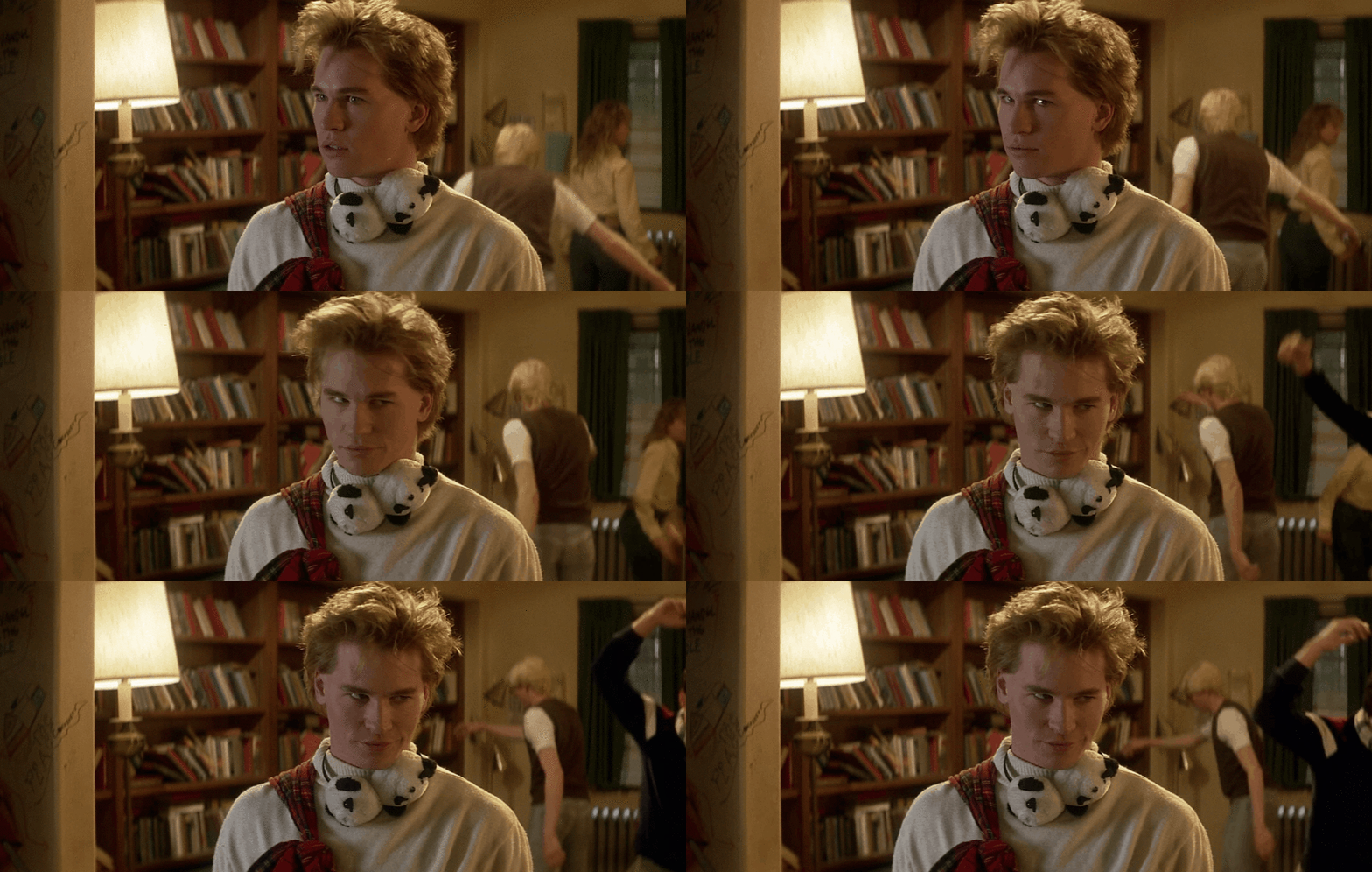
Martha Coolidge’s 80s sci-fi comedy definitely one of the finest films of the 1980s as it revolves around geniuses and how weird they are. While it revolves a group of college kids at a technical school trying to create a laser unaware of its professor’s intentions. It is a film that play into the life of these kids who are quite odd as it react to everything that is often stereotypical of nerds and geniuses with Val Kilmer, in his breakthrough performance, playing someone who wants to enjoy life as he guides a fifteen-year-old freshman to see there’s more to life than just being smart and do things.
3. Bobby Fischer Against the World
There’s prodigies and geniuses who are quite odd and weird but in a good way and then there’s Bobby Fischer. Liz Garbus’ documentary on the chess prodigy is a unique one as it play into individuals who were obsessed in playing the game and how they lose touch with reality as Fischer would be the most notorious. The film is a fascinating documentary on the man and those who knew him as they would be shocked by what had happened to him after his legendary 1972 game against Boris Spassky as he became insane, prejudiced, and all sorts of things that culminated with his death in 2008.
© thevoid99 2017

Directed by Ryan White, Good Ol’ Freda is the story of Freda Kelly who was a secretary the Beatles and its manager Brian Epstein as she helped ran their fan club and other aspects involving the band behind the scenes. The film chronicles the period of her work for the band as well as be someone who had a small but crucial part for their success. The result is one of the most enjoyable and fascinating films about one of the key people who were crucial to the success of the Beatles.
The story of the Beatles remains one of the most illustrious tales in the history of popular music as four lads from Liverpool who would change the world with their music in the course of nearly a decade. Yet, the Fab Four in John, Paul, George, and Ringo wouldn’t have done it without a handful of individuals who would help them get to the top such as their producer George Martin, manager Brian Epstein, road managers/personal assistants Neil Aspinall and Mal Evans, and band publicist Derek Taylor. There’s also another person that deserves who was part of that inner circle that many Beatle historians felt never got enough credit and that is Freda Kelly. Kelly’s role in the Beatles’ behind-the-scenes circle wasn’t just running the fan club and be Brian Epstein’s secretary but it would a role that became much bigger.
Though she started at playing her part age 17 in 1961 where she first saw them at the Cavern Club that year and later be hired by Epstein to be her secretary. She was first a fan of the band and would work for them against her father’s advice as it didn’t just involve answering fan letters and other jobs that is required for secretaries. She would play a very personal part for the band who consider her to be their sister as she was the one person who would be their contact with their families as she would be close with their families. Notably Ringo Starr’s mother whom she consider to be a maternal figure as he lost her own mother some time after her own birth. Her part in being the band’s contact to their families was something the Beatles treasured as she would also be the band’s greatest protector when it came to their personal life as Kelly would also be close to Starr’s first wife Maureen Starkey.
While the film does follow a simple narrative about Kelly’s time working for the Beatles, it does get inter-cut with aspects of her own life many years later as she goes through old memorabilia including a monthly fan club magazine that she ran. Even as she would lead a normal life away from the Beatles since leaving the fan club and Apple in 1972 just two years after the band broke up as she rarely talked about her time with the group for many years. Many of those scenes are very straightforward in the way director Ryan White would interview as well as her daughter Rachel and other people involved with the band or Epstein at the time as well as Paul McCartney’s stepmother Angie with the aid of cinematographer Austin Hargrave. With the help of editor Helen Kearns and sound editor Henry Auerbach, White would compile many photos and rare footage as well as old audio interviews to help tell Kelly’s story.
The film also reveal Kelly’s loyalty to the band and to Liverpool as she would stay in the city rather than move to London as she would be the band’s link to the city and when Brian Epstein died of a drug overdose in 1967. Kelly admitted that things did change after that as she knew that after the shooting of Magical Mystery Tour that the band’s disintegration was going to happen. She also talked about Apple and how it was mismanaged where it was fun early on but the business aspects of it became complicated as she knew that it wasn’t going to last. She would also become more evasive towards the press where Kelly revealed where, as much as she didn’t want to lie, she told the press a lot of things in order to protect the Beatles from bullshit as she also didn’t want to answer personal questions about the band to fans in their monthly magazine.
The film’s music by Paul Koch is very low-key as it play into 1960s style rock n‘ roll to play into the period of the early 1960s while music supervisor Matt Lilley would provide music from the period of the times including a few songs from the Beatles which is surprising for a film that was independently funded. Fortunately, Kelly’s connection with the Beatles would provide that including a post-credits video appearance from Ringo Starr saying hello and thanking Kelly for her part in the success of the Beatles.
Good Ol’ Freda is an incredible film from Ryan White about one of the key figures in the career of the Beatles. It’s a film that tells the story of the woman who didn’t just became the band’s great link to their family and home city but also would handle things that lesser fans would be unable to do as it also makes a great case for Freda Kelly to be named “the Fifth Beatle”. In the end, Good Ol’ Freda is a remarkable film from Ryan White.
© thevoid99 2017
Based on the autobiography by Robert Evans, The Kid Stays in the Picture is about the life and career of film producer Robert Evans who was the production chief of Paramount Picture in the late 1960s and early 1970s as well as becoming a successful producer of his own. Directed by Nanette Burstein and Brett Morgen and screenplay by Morgen, the film is a documentary told by Evans himself through excerpts of his 1994 autobiography from his years as an actor to being one of the top producers of the 1970s. The result is a stylish yet mesmerizing film from Nanette Burstein and Brett Morgen.
Robert Evans is a man that is considered a legend in Hollywood as he was running Paramount Pictures in the late 1960s where he would take the studio and put it back in prominence through hit films such as Rosemary’s Baby, True Grit, Love Story, and The Godfather while becoming a producer in the 1970s for films such as Chinatown, Black Sunday, Marathon Man, and Urban Cowboy. Evans was also notorious for his liaisons with many women as he was briefly married to actress Ali MacGraw in the early 1970s before she left him for actor Steve McQueen. Though he started off working for his brother Charles Evans in the Evans-Picone fashion company, it was a moment where he was swimming in a pool and taking phone calls at the Beverly Hills Hotel in 1956 that changed everything where was discovered by film legend Norma Shearer.
Shearer would give him the chance to star as her late husband Irving Thalberg for the film Man of a Thousand Faces as he would also be hired for an adaptation of Ernest Hemingway’s The Sun Also Rises against the wishes of Hemingway and the film’s stars in Ava Gardner and Tyrone Power. Yet, it was then 20th Century Fox studio chief Darryl F. Zanuck who liked Evans and told them “the kid stays in the picture”. Though his acting career was brief, Evans’ knack for finding projects for studios did get him a job working at Paramount Pictures which was going through a very dire period of flops and management shake-ups once it was purchased by Gulf+Western. Through one of its executives in Charles Bluhdorn, Evans would be made head of productions as he would get the studio out of its funk with the help of journalist Peter Bart who would be an executive at the studio.
The film doesn’t just play into Evans’ rise as a prominent figure in Hollywood as Nanette Burstein and Brett Morgen choose not just pictures but also some archival interviews into how Evans would become this revered figure in Hollywood. Even as there’s some rare footage such as a presentation filmed by Mike Nichols for the people at Gulf+Western into what Paramount Pictures was to do in the 1970s. The film also has many new images shot inside Evans’ Woodland home with the aid of cinematographer John Bailey who would bring in elements of beauty into the lighting for its scenes at night as it was Evans’ own paradise. Especially as Evans describes the time he invited Ali MacGraw into his home where she went into the pool and they fell in love that night. Aided by visual effects supervisors Yorgo Alexopoulos and Jason Stoff in bringing color and 3-D images to the photos, Burstein and Morgen would showcase many of the good things that was happening to Evans in the 1970s despite his split with MacGraw in 1972 as it would crash in 1980 when he was busted for cocaine trafficking.
Editor Jun Diaz help create montages as well as gather footage of archival interviews Evans has made throughout his life and career including footage of the Roy Radin murder trial which Evans was unfortunately tied to due to the fact that he met Radin who helped finance the 1984 film The Cotton Club. Sound designer Claude Letessier and sound editor Ahmad Shirazi would help gather many of the audio from the audio book that features everything Evans says about his life as it help add some humor into the film as well as unique personality. The film’s music by Jeff Danna is very low-key for its usage of strings and piano to play into some of the lively moments and dark moments involving the Radin murder trial while music supervisor Anita Serwacki provides a soundtrack that feature a lot of the music from the 70s that played into Evans’ rise in Hollywood.
The Kid Stays in the Picture is a phenomenal film from Nanette Burstein and Brett Morgen. It’s a documentary that doesn’t exactly play by the rules in telling the life of Robert Evans where it has the man himself telling everything including all of the good and bad that he’s done in his illustrious life. In the end, The Kid Stays in the Picture is an incredible film from Nanette Burstein and Brett Morgen.
© thevoid99 2017
Based on the novel by Judith Guest, Ordinary People is the story of a upper-middle class family who copes with the loss of their son while his younger brother deals with survivor’s guilt as he returns home from the hospital. Directed by Robert Redford and screenplay by Alvin Sargent, the film is an exploration of a family dealing with loss as well as a young man wondering about his own role in his family and his relationship with his own parents. Starring Donald Sutherland, Mary Tyler Moore, Timothy Hutton, Elizabeth McGovern, and Judd Hirsch. Ordinary People is a somber yet engaging film from Robert Redford.
The film is the story of a family reeling from the aftermath of the death of a son as well as the suicide attempt of another as they try to move on as if nothing is happening yet the surviving son still copes with survivor’s guilt. It’s a film that explores a family that slowly unravels as they’re forced to see things and reflect on aspects of their life. The film’s screenplay by Alvin Sargent is quite straightforward as it largely takes place during the autumn season in an upper-middle class suburbia near Chicago where its 18-year old son Conrad Jarrett (Timothy Hutton) has just got out of the hospital for a month as he returns to school trying to get back to his normal routine before his brother’s death and suicide attempt. Yet, he’s become withdrawn and unable to do what he’s done in the past while he’s having a harder time trying to express himself emotionally with his mother Beth (Mary Tyler Moore). For his father Calvin (Donald Sutherland), he is concerned for Conrad’s well-being as well as try to keep everything calm.
Conrad would turn to a psychiatrist in Dr. Berger (Judd Hirsch) for answers but finds himself not only dealing with memories of the boating accident that killed his brother Buck (Scott Doebler). He also copes with the fact that he’s still alive which hasn’t made him deal with things as easy as he wants to be. The script is really noted for its development as Conrad is just someone that is trying to make sense of everything he’s feeling as he would quit the swim team and befriend a young classmate in Jeannine (Elizabeth McGovern) who would give him a bit of hope. Yet, it’s at home where things become difficult where his mother remains cold and distant as she’s trying to maintain some sense of normalcy around family and friends. For Calvin, he tries to understand what his son is feeling and why his wife has been reacting at things where he eventually comes to realize that something is wrong as he becomes aware that not everything is alright. Even as Beth would snap him for talking about Conrad and their situation to family and friends as it show cracks starting to emerge.
Robert Redford’s direction is actually quite simple in terms of the compositions he creates as he doesn’t really go for any kind of flashy visuals in favor of just doing something that is direct and to the point. Shot on location in Lake Forest, Illinois and parts of Chicago, the film does play into the world of suburbia where everything looks nice and everyone is perfect which is really a façade. There are some wide shots that Redford uses yet his approach to medium shots and close-up add a lot to the drama from the sessions that Conrad would have with Dr. Berger or the moments involving the family. There are also flashbacks that would appear every now and then such as the boating accident but also time of the family before Buck’s death and Conrad’s suicide attempt. Those are the few moments in the film where Redford would show some aspect of style as it has a mixture of fantasy but also terror as it relates to the tragedy the Jarrett family is dealing with. Some of these flashbacks play into happier times where both Conrad and Calvin reflect on as if it feels like a fantasy.
Redford also create moments that play into the family unit cracking with such subtlety such as a dinner party that Calvin and Beth attend where the former is talking with someone who asked about Conrad where Calvin was being honest but gracious as Beth overhears him. She would later scold him for talking about something that is private and again late in the film during a holiday vacation with Beth’s brother and wife as it play into many things Calvin starts to see. Even as he would eventually go to Dr. Berger for one session as it opens up into things he never thought about or had been in his mind for so long. The third act isn’t just about Conrad dealing with the pain over the loss of his brother but also Calvin having a revelation about his wife and what had been lost since the death of their eldest son. Overall, Redford crafts a somber yet evocative film about a family coming to terms with loss but also the realization that nothing can be the same ever again.
Cinematographer John Bailey does excellent work with the film‘s cinematography with emphasis on low-key lights and textures for some of the daytime exterior and interior scenes with the usage of lights for the scenes at night including a nighttime session Conrad has with Dr. Berger. Editor Jeff Kanew does brilliant work with the editing as it feature some jump-cuts and stylish flashback montages to play into the drama. Art directors J. Michael Riva and Brook Simons, with set decorators William B. Fosser and Jerry Wunderlich, do fantastic work with the look of the Jarrett home as well as the pool in Conrad‘s high school and Dr. Berger‘s office with its more quaint appliances.
Costume designer Bernie Pollack does nice work with the costumes as it is largely straightforward in terms of the casual look of Conrad as well as the more clean-cut and refined look of Calvin and Beth. Sound editor Kay Rose is terrific for the scenes involving swim meets and parties but also in the quieter moments at home as it play into the tension at home. The film’s music by Marvin Hamlisch is amazing as it is very a low-key orchestral score with some piano that play into the drama as the soundtrack also include a few classical pieces with Johann Pachelbel’s Canon and Gigue in D as the opening and closing music piece of the film.
The casting by Penny Perry is great as it feature some notable small roles from Meg Mundy and Richard Whiting as Conrad’s grandparents, Scott Doebler as Conrad’s late older brother Buck, James B. Sikking as Calvin’s business colleague/friend Ray, Adam Baldwin as a teammate of Conrad in Kevin Stillman whom Conrad doesn’t really like, Fredric Lehne as Conrad’s best friend Joe who is trying to talk to him as he also misses Buck, and M. Emmet Walsh as Conrad’s swim coach Salan as someone who is wondering where Conrad’s head is at for the meets. Dinah Manoff is wonderful as Karen as someone Conrad met at the hospital as they meet to talk about their issues where she claims that she is doing great. Elizabeth McGovern is fantastic as Jeannine as a schoolmate of Conrad who befriends him as she provides some hope and kindness to Conrad. Judd Hirsch is excellent as Dr. Berger as a psychiatrist who is a very sympathetic figure that is trying to understand Conrad as well as not bullshit him about the ways of the world and things that Conrad needs to figure out.
Timothy Hutton is phenomenal as Conrad Jarrett as a young man dealing with survivor’s guilt and a suicide attempt as he tries to return to the world yet he is anguished and lost where Hutton show that sense of despair and loneliness as it is truly a breakthrough performance for the actor in his debut film role. Donald Sutherland is remarkable as Calvin Jarrett as a man trying to understand his son’s withdrawn behavior as well as dealing with the fact that he has some issues to face including his wife’s refusal to talk about some serious issues. Finally, there’s Mary Tyler Moore in a radiant performance as Beth Jarrett as a woman who is either in denial or refusing to face the things around her family in an attempt to try and move on as if nothing had happened as it’s a very eerie performance from Moore who plays a character that is very unlikable but also just as fragile as someone that isn’t ready to face the truth about herself.
Ordinary People is an incredible film from Robert Redford. Featuring a great cast and an entrancing portrait on grief, loss, and denial, it’s a film that explores a family dealing with life after loss and how those can’t face the truth about themselves and what was lost. In the end, Ordinary People is a tremendous film from Robert Redford.
Robert Redford Films: (The Milagro Beanfield War) - (A River Runs Through It) - (Quiz Show) - The Horse Whisperer - (The Legend of Bagger Vance) - (Lions for Lambs) - (The Conspirator) - (The Company You Keep)
© thevoid99 2017
Written and directed by Tony Gilroy, Michael Clayton is the story of a law firm fixer who uncovers some dark truths about a client involved in a class action lawsuit that revolves around the effects of toxic chemicals. The film is a legal thriller that explores a man trying to seek out the truth as he is also dealing with forces that want to stop as the titular character played by George Clooney. Also starring Tom Wilkinson, Tilda Swinton, and Sydney Pollack. Michael Clayton is a riveting yet compelling film from Tony Gilroy.
The film follows a man whose job is to clean up messes for a law firm and handle things so that he can the job done and let the firm succeed and make whatever deal is need to be made. It’s a job he’s good at but it hasn’t done him a lot of favors personally or financially as the film has him dealing with a friend, who is a top attorney at the firm, who had made a chilling discovery in a lawsuit over toxic chemicals made by a company that he’s supposed to defend. Tony Gilroy’s screenplay opens with a sequence of what Michael Clayton does in his line of work but also the danger of his work. The narrative then shifts to what he was doing four days earlier as he is struggling to pay off debts of a restaurant he co-owns with his troubled younger brother as well as cleaning things up for his firm. Yet, Clayton also has to deal with the sudden mental breakdown of friend and top attorney Arthur Edens (Tom Wilkinson) during a deposition as Clayton would have a hard time trying to watch Edens.
Gilroy’s script also play into not just what Edens would discover but also play into the morality that Clayton would gain in what Edens discovers. Still, he has to hide Edens from this company who has sent their general counsel Karen Crowder (Tilda Swinton) to handle things and to try and shut Edens down. Crowder is an interesting antagonist as someone who is also a fixer of sorts but is more ruthless in how she deals things. Yet, she is also someone that is just as troubled as she is first seen in the film exhausted while is also trying to be this embodiment of professionalism which is starting to take a toll on her. Once Clayton learn what Edens wants to unveil, it forces him to do what is right no matter how much it would put him into trouble. Especially with the people he’s worked for so many years.
Gilroy’s direction is very simple as he doesn’t go for anything stylish in favor of something that is straightforward. Shot on various locations in New York City and areas in upstate New York and Wisconsin, Gilroy would use some wide shots to establish some of the locations but he would aim for more intimate shots in the close-ups and medium shots to play into the drama. Especially in scenes where Clayton is talking to Edens about the latter’s mental condition as Gilroy creates moments that says a lot into what is happening where Edens isn’t just falling apart but is also seeking something that shows some good in the world. Gilroy also creates a world that is quite slick and unforgiving where there are often images of buildings as it would eventually become stifling for Clayton. Gilroy would also create moments that play into the suspense such as the scene of the car bomb and to show it again from a different perspective as it play into the forces that want Clayton gone. It shows how far some are willing to protect something they don’t want the public to hear all for something trivial as money and power. Overall, Gilroy creates a gripping and intoxicating film about a law firm’s clean-up man dealing with a mess that he knows that he can’t cover up.
Cinematographer Robert Elswit does excellent work with the cinematography from the way some of the scenes at night are lit to some of the scenes in the day that are quite natural including the car bomb scene. Editor John Gilroy does nice work with the editing as it very straightforward with a few jump-cuts to play into Crowder‘s own daily routine and rehearsing for her speeches. Production designer Kevin Thompson, with art director Clay Brown and a team of set decorators in Paul Cheponis, George DeTitta Jr., Christine Mayer, and Charles Potter, does fantastic work with the design of the offices as well as the apartment homes that the main characters live in as well as the home of Clayton‘s family in the suburbs.
Costume designer Sarah Edwards does nice work with the costumes as it‘s mostly low-key from the suits that the men wear as well as the clothes that Crowder wears and the clothes of the men she hires to do her dirty work. Sound editor Paul P. Soucek does terrific work with the sound as it play into many of the locations as well as a scene of Edens playing a tape over and over again to create something to blow the whistle on what he found. The film’s music by James Newton Howard is amazing for its low-key orchestral score that play into the drama as it also include some ambient-based electronic music that help add to the drama and suspense.
The casting by Ellen Chenoweth is great as it feature some notable small roles from Katherine Waterston as an aide of Clayton in Wisconsin, Austin Williams as Clayton’s son Henry, Sean Cullen as Clayton’s detective brother Gene, Denis O’Hare as a client Clayton deals with early in the film, David Lansbury as Clayton’s younger and recovering drug-addict brother Timmy, Terry Serpico and Robert Prescott as a couple of men Crowder hire to deal with Edens, and Ken Howard in a terrific performance as a company chief that Crowder is trying to protect. Michael O’Keefe is superb as Barry Grissom as a law firm executive that is trying to oversee the deal as he is someone that Clayton doesn’t like. Merritt Wever is fantastic as Anna as a young farm girl suing the company that she believed ruined her family farm and killed her parents.
Sydney Pollack is excellent as Clayton’s boss/friend in law firm partner Marty Bach as a man that is trying to keep things under wraps as well as be aware of the fact that the business of law is changing. Tilda Swinton is brilliant as Karen Crowder as a corporate general counsel that is trying to make sure that the settlement goes well as she is also dealing with the strain of her work. Tom Wilkinson is amazing as Arthur Edens as a senior litigator with bipolar disorder that would unravel mentally as he copes with the task he’s being forced to do as well as make a discovery that would impact everything. Finally, there’s George Clooney in a phenomenal performance as the titular character as a fixer who cleans up messes for his law firm as he deals with the mental breakdown of a friend as well as making a major discovery where Clooney is quite reserved in his performance but also someone who is conflicted in wanting to do what is right.
Michael Clayton is a remarkable film from Tony Gilroy that features an incredible performance from George Clooney in the titular role. Along with a great supporting cast that include top-notch performances from Tom Wilkinson, Tilda Swinton, and Sydney Pollock as well as a well-crafted script. It’s a film that play into the legal world and what some will do in the name of greed and power. In the end, Michael Clayton is a marvelous film from Tony Gilroy.
Tony Gilroy Films: (Duplicity) - (The Bourne Legacy)
© thevoid99 2017
For the first week of February 2017 of the Thursday Movie Picks hosted by Wanderer of Wandering Through the Shelves. We venture into films about artists in great painters. People who are known for their great art and painters as well as the paintings they have created.
1. Basquiat
Julian Schnabel’s bio-pic on Jean-Michel Basquiat is an unconventional film as it explores someone who known for his unique approach to street art that would become big in the New York art world. With Jeffrey Wright playing the titular role in a breakthrough performance, it’s a film that explores the fallacy of success as someone who struggles with wanting to be revered but also dealing with himself. It’s definitely one of the finest films about art and painters that features a great ensemble cast that includes Claire Forlani, Gary Oldman, Willem Dafoe, Christopher Walken, Parker Posey, Michael Wincott, Benicio del Toro, Dennis Hopper, and David Bowie as Andy Warhol in what many say is the most authentic version of Warhol on screen.
2. Girl with a Pearl Earring
In Peter Webber’s adaptation of Tracy Chevalier’s novel is definitely one of the most beautiful films of the 2000s though it’s more about the subject of the painting rather than its painter Johannes Vermeer. Still, it is a phenomenal film that explores the works of Vermeer from the perspective of a young maid who would become the subject of the titular painting. It showcases what an artist does as well as the maid who kind of understands what he wants in its painting as Colin Firth is incredible as Vermeer yet the film really belongs to Scarlett Johansson as the young maid Griet as it is one of her defining performances.
3. Pollock
Ed Harris’ bio-pic on Jackson Pollock is probably one of the most intriguing portraits of one of the great American artists of the 20th Century. It’s an unconventional film with Harris playing Pollock as it showcases a man who strives to be great but is also quite tormented. With Marcia Gay Harden giving a phenomenal performance as his wife, the film showcases many things that made Pollock so beloved as an artist but also the man who is quite complicated and fucked-up that led to his death in 1956 at age 44. It’s a film that anyone who loves art must see.
© thevoid99 2017

Based on the 1984 film written by Dan Aykroyd and Harold Ramis and directed by Ivan Reitman, Ghostbusters is the story of two scientists, a gadgets inventor, and a MTA worker who discover strange paranormal events around New York City as they stop them from wreaking havoc all over the city. Directed by Paul Feig and screenplay by Feig and Katie Dippold, the film is a remake of sorts of the 1984 film where it’s women taking charge in trying to stop ghosts from being unleashed in New York City. Starring Kristen Wiig, Melissa McCarthy, Kate McKinnon, Leslie Jones, Andy Garcia, Cecily Strong, Neil Casey, Michael K. Williams, Charles Dance, Ed Begley Jr., Matt Walsh, and Chris Hemsworth as Kevin. Ghostbusters is a dazzling and adventurous film from Paul Feig.
The film is a simple story about the formation of a group of women who come together after some encounters with ghosts where they decide to stop them. That is pretty much the plot as it follows the same idea of the 1984 film but the film’s screenplay by Paul Feig and Katie Dippold focuses a lot more on the bond of four women trying to reveal what could be true despite the fact that they live in a world that is a bit more cynical as well as not wanting to believe that there is such things as ghosts. For the four women who would form their own team called Ghostbusters, they have to overcome many obstacles but also themselves as two of the women in physicists Abby Yates (Melissa McCarthy) and Erin Gilbert (Kristen Wiig) both wrote a book about the existence of ghosts where they were seen as jokes leading to a falling out between the two as the latter would disown the book as she feels it would threaten her tenure bid at Columbia University.
Yet, Gilbert’s past over the book would return due to these recent events as she reluctantly reunites with Yates and Yates’ colleague in inventor/engineer Jillian Holtzmann (Kate McKinnon) where they would make a major discovery that led to Gilbert teaming with the two to create something to study and stop ghosts. When a MTA worker named Patty Tolan (Leslie Jones) reaches out to the three about her sighting of a ghost as well as seeing a mysterious man named Rowan (Neil Casey) doing something odd at the subway station. Patty, whose knowledge of the city, would round out the team as they would also be joined by handsome but dim-witted secretary named Kevin. Still, the Ghostbusters have to keep their work under wraps for the mayor (Andy Garcia) who doesn’t want these stories about ghosts publicized feeling it would threaten his image.
Feig’s direction is definitely stylish in terms of the vastness of the film as it is shot in not just New York City but also parts of areas in and around Boston. While there are some wide shots of the locations, Feig would keep things simple with the compositions as well as create something that is quite loose in its approach to humor. Still, it is about the story and the women needing to prove that there ghosts lurking around in New York City as Feig doesn’t allow the visual effects or some of the offbeat humor to detract from that. Another thing about the film that succeeds is Feig taking his time for the characters to develop as well as developing their gadgets while having the time to goof off and have fun. Even as Feig makes no qualms in putting in references relating to the original 1984 for fun as it would also include a few famous characters from that film. The moments involving the ghosts and capturing them are definitely spectacular in a visual sense where it does have this nice mix of humor and horror that would culminate in this enthralling climax that features large ghosts and Times Square be re-envisioned as it was back in the 1970s/1980s. Overall, Feig creates an exhilarating and fun film about a group of ladies kicking some major ass on some evil ghosts.
Cinematographer Robert Yeomen does excellent work with the film‘s colorful cinematography from the look of the daytime exteriors and some of its interiors to the scenes at night including the rock club and for the film‘s climax at Times Square. Editors Melissa Bretherton and Brent White do terrific work with the editing as it is quite straightforward with some rhythmic cuts to play into the action without deviating too much into conventional speed-cuts that is often prominent of action films. Production designer Jefferson Sage, with supervising art director Bret Frutiger and set decorators Dennis Colvin and Leslie A. Pope, does fantastic work with the look of the home base that the team live in above a Chinese restaurant as well as the look of the hotel where the character Rowan works at. Costume designer Jeffrey Kurland does nice work with the costumes from the design of the jumpsuits the women wear as well as the casual clothes that represent their personalities.
Visual effects supervisors Anthony Dunifer and Peter G. Travers do amazing work with the design of the ghosts as well as some of moments in the ghost battles as well as the film‘s lavish climax. Sound designer Tom Lamberti, along with sound editors Andrew DeCristofaro and Becky Sullivan, does superb work with the sound to play into the sound effects of the noises the ghosts make as well as the sounds of the gadgets and other moments in the film. Music composer Theodore Shapiro does wonderful work with the score with its mixture of orchestral music and electronics that include variations of the original theme song while music supervisor Erica Weis provides a fun soundtrack that features some old-school music from DeBarge and DMX and more contemporary music from Elle King, Mark Ronson with Passion Pit and A$AP Ferg, Zayn Malik, 5 Seconds of Summer, and a bad remake of the original song by Fall Out Boy with Missy Elliott.
The casting by Allison Jones is great as it feature some notable small roles from co-writer Katie Dippold as a rental agent, Zach Woods as a tour guide who would first see a ghost in the film’s opening scene, Steve Higgins as a technical college dean Yates and Holtzmann work for, Ed Begley Jr. as a man who comes to Gilbert about a ghost in his tour house, Charles Dance as Gilbert’s boss at Columbia, Matt Walsh and Michael K. Williams as Homeland Security agents, Cecily Strong as the mayor’s assistant who tries to clean up all of the things publicly, and Andy Garcia as Mayor Bradley as New York City’s mayor who tries to not get the public be aware of the ghosts that are haunting New York City. Neil Casey is superb as Rowan as a mysterious man who has been releasing devices to unleash ghosts all over the city to express his disdain for humanity. Chris Hemsworth is excellent as Kevin as this dim-witted yet hunky secretary that isn’t very good at his job but Gilbert likes him a lot as he is just fun to watch in every scene he’s in while not being afraid of being the object of affection.
Leslie Jones is amazing as Patty Tolan as a MTA worker who joins the group in capturing ghosts as her knowledge on New York City makes her a joy to watch as well as some of the funny comments she brings. Kate McKinnon is brilliant as Jillian Holtzmann as the team’s gadgets inventor who has a very funny sense of humor as well as be very lively and odd in a fun way. Melissa McCarthy is fantastic as Abby Yates as a physicist who has never stopped believing in ghosts where she brings a nice approach to the physical comedy and in her mannerisms. Finally, there’s Kristen Wiig in a marvelous performance as Erin Gilbert as a college professor who reluctantly returns to the world of the paranormal as she is the straight person of the film that tries to deal with what she is seeing as she also brings in the laughs.
Ghostbusters is a remarkable film from Paul Feig. Featuring a great cast, incredible visual effects, and an accessible story that is just to fun to invest to. It’s a film that isn’t just a fun homage to the 1984 film but also a film that manages to be its own. In the end, Ghostbusters is a sensational film from Paul Feig.
Paul Feig Films: (I Am David) - (Unaccompanied Minors) - (Bridesmaids) - (The Heat) - Spy (2015 film) - (A Simple Favor) - (Last Christmas) - (The School for Good and Evil)
Related: (Ghostbusters) - (Ghostbusters II) - Ghostbusters: Afterlife
© thevoid99 2017
Well, this has certainly been a very interesting start to a year that is likely to be pretty bad. With the passing of John Hurt, Emmanuelle Riva, and Mary Tyler Moore, it has been a strange month as we Americans get a new president in the form of Il Duce. Yet, it’s been a real fucking mess considering that not a lot of people showed up at the inauguration while Michelle Obama gave the new president the death stare. The next day was fun as there were a lot of people protesting the whole thing and stand up for women’s rights. Right on ladies!!!! Then we got the Muslim ban which hasn’t been good but there has been protests yet again. I’d say that it’s time for those that have the idea of what is good in the world to make things very difficult for Il Duce.

In the month of January, I saw a total of 37 films in 23 first-timers and 14 re-watches which is a good start so far for the new year. One of the highlights this month was my Blind Spot assignment in Swing Time as it helped kick off the Blind Spot series with a bang. Here are the top 10 first-timers I saw for January 2017:
1. Zabriskie Point
2. La La Land
3. Lady Snowblood
4. Postcards from the Edge
5. Rogue One: A Star Wars Story
6. Giant
7. High Anxiety
8. Bright Lights: Starring Carrie Fisher and Debbie Reynolds
9. Lady Snowblood 2: Love Song of Vengeance
10. David Bowie: The Last Five Years
Monthly Mini-Reviews
Catholics vs. Convicts
In the first of three entries of the 30 for 30 series that I saw, one of the newer entries to emerge revolves around the famed rivalry between Notre Dame and the Miami Hurricanes in the 1980s. The documentary revolved around the legendary 1988 game between the two where an infamous t-shirt only fueled the fire of the rivalry as it feature interviews from the individuals and fans of those teams. It’s a great entry of the series as well as showcase how a t-shirt can cause a whole lot of trouble.
The ‘85 Bears
Who is the greatest football team that ever lived? Many believe it’s the 1985 Chicago Bears led by coach Mike Ditka, defense coordinator Buddy Ryan, quarterback Jim McMahon, and other legendary names such as Walter Payton, William “the Refrigerator” Perry, Steve “Mongo” McMichael, and many others. It can be debated but can’t be denied into the impact that team had in popular culture as well as the 46 Defense created by Ryan. It is also a very somber documentary considering that some of the players are suffering from the after-effects of the game with McMahon dealing with early-dementia as the film also shows some of the final footage of Ryan in his final days.
I Hate Christian Laettner
The Duke college basketball team is definitely the most polarizing team in college basketball yet none was as divisive as its star player in the early 1990s in Christian Laettner. While he’s perceived as someone who is privileged and has everything coming to him, the film shows that isn’t exactly the case but it also display that he is a bully and can be arrogant. Still, he doesn’t apologize for it as it helped make his teammates better as several of them including coach Mike Krzyzewski talk about his methods and skills on the court. The film also feature comments from rivals and fans including pro wrestling legend Ric Flair as well as his detractors as they state every reason why he’s hated as it’s all narrated with such style by actor Rob Lowe.
Top 10 Re-Watches
1. The Squid & the Whale
2. Ziggy Stardust & the Spiders from Mars
3. Galaxy Quest
4. Star Trek II: The Wrath of Khan
5. What We Do in the Shadows
6. Going Clear: Scientology and the Prison of Belief
7. Hail, Caesar!
8. Star Trek III: The Search for Spock
9. The Death of "Superman Lives": What Happened?
10. Run, Fatboy, Run
Well, that is all for January as the Oscars is coming as I hope to see a few of the films that are nominated as well as some new releases if I ever get to see them. There’s also the Super Bowl as it’s big deal as I hope the Atlanta Falcons beat the New England Patriots. Based on my DVR list, there will be some films I’ll be watching as well as try to finish Twin Peaks as I’m currently re-watching the first season. Until then, this is thevoid99 signing off…
© thevoid99 2017