Originally Written and Posted at Epinions.com on 9/22/04 w/ Additional Edits & Revisions.
Directed by Federico Fellini and written with Ennio Flaiano, Tullio Pinelli, and Brunello Rondi, La Dolce Vita (The Sweet Life) is the story of an Italian reporter whose life of decadence leads to tragic consequences and realization after encounters with an actress, a socialite, a religious commune, and his suicidal girlfriend. While the film conveys realism, Fellini also brings mayhem to the screen where there are moments that questions morality, sexuality, socialism, and humanity itself. Shot in black-and-white with cinematographer Otello Martelli, the movie plays like a circus with surreal images that seem to bend the world of reality and fantasy. Starring Marcello Mastroianni, Yvonne Furneaux, Anouk Aimee, Anita Ekberg, and Alain Cuny. La Dolce Vita is a brilliant, sensational masterpiece from one of the greatest filmmakers ever put in the face of the earth.
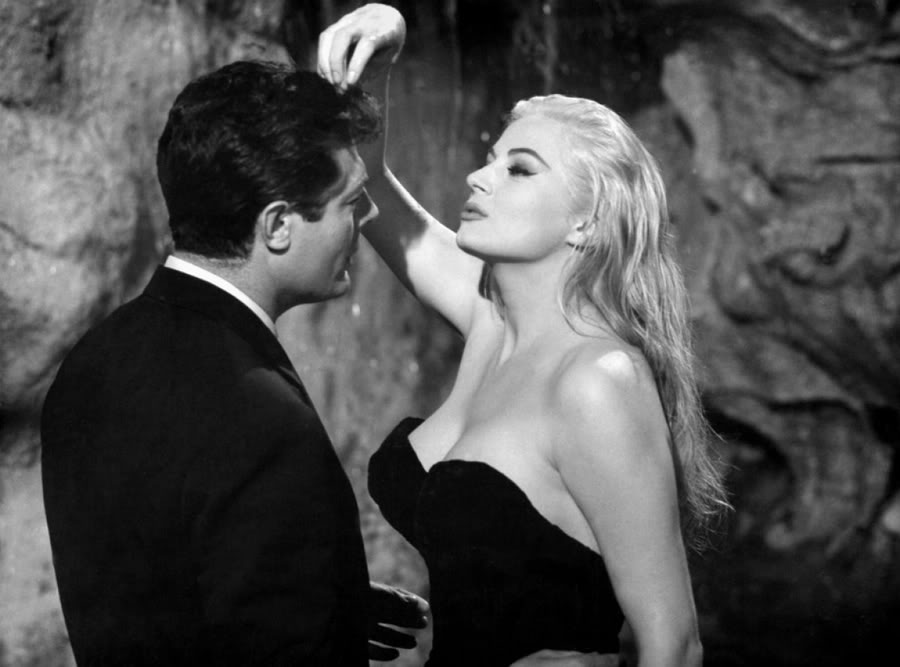
Marcello Rubini (Marcello Mastroianni) is a reporter riding on a helicopter that is carrying the statue of Jesus Christ above Rome as he later joins his photographer friend Paparazzo (Walter Santesso) at a nightclub. After meeting with a bored socialite in Maddalena (Anouk Aimee), Marcello takes for a ride and sleeps with her only to return home to deal with his self-destructive love Emma (Yvonne Furneaux). To report on the arrival of an American actress named Sylvia (Anita Ekberg), Marcello attends a press interview with the charming but not-so-bright actress who brought her boyfriend Robert (Lex Barker). Marcello takes Sylvia on a tour of Rome where they later go to a party with her friend Frankie Stout (Alan Dijon) and the alcoholic Robert. Leaving the party with Marcello, Sylvia frolics onto the Trevi Fountain as Marcello is in awe of her.
Despite having a life with all of its glamor, Marcello seeks to become a serious writer as he seeks the advice of his friend Steiner (Alain Cuny) who invites him to a party. Taking Paparazzo and Emma on an assignment on a sighting of the Virgin Mary claimed by two children. The event becomes an emotional turning point for both Marcello and Emma as they later attend Steiner's party as they meet his wife (Renee Longanni) and various friends. Envious of the life that Steiner has, he takes a job offer from Steiner only to realize that not everything is as it seems. In his attempt to write a novel and be away from Rome, Marcello meets a young waitress named Paola (Valeria Ciangotti) who gives him an idea of a life outside of the world he's lived in.
Reluctantly returning to Rome, Marcello takes his father (Annibale Ninchi) for a night on the town where they meet another of Marcello's friend in Fanny (Magili Noel). The night seems to be fun until his father had a brief heart attack prompting Marcello to question his own lifestyle. Attending another party with Maddalena and some friends to a strange party at a ruined home, Marcello starts to deal with his own faults as his relationship with Emma crumble. After another party and some tragic news, Marcello begins to question about the world he's lived in.
What makes La Dolce Vita such a rapturous film is Fellini's whimsical approach into taking a man's simple odyssey of life through a world of decadence. The film both plays itself to the point where things are way off and doesn't seem right yet at the same time, its lavish tone makes the film seem to make everything go crazy where it almost falls apart, but in a grand, Fellini way. The film truly belongs to Fellini since he's a man who likes everything to be a spectacle with the opening scene and all the cabaret things going in the night club to the decadence of the parties, including the final one where Marcello forces a woman named Nadia (Nadia Gray) to strip down. Every image, every frame, every thing that goes on in that movie clicks where it might seem too much for a three-hour movie but there was never a dull moment going on.
Fellini, the director, is a man who seems to love an image. With cinematographer Otello Martelli, the film has this evocative, wondrous black-and-white look where everything is huge, especially if you're watching it in the theater. Martelli brings a lush, romantic look to the film, notably the Anita Ekberg scene at the Trevi Fountain with Marcello. Still, the film is Fellini where he seems to fall in love with every image and there's always a great shot in that film where everything is going on. The film's screenplay doesn't lose itself to its excess since it plays to a simple story but is expanded by its excess. The film also has many questionable themes with characters of homosexuality and heterosexuality and also questions of spirituality, morals, and humanity itself.
Really, it's a story of a man trying to find answers to move forward and seeking love while wondering if he can move away from his playboy lifestyle. It's also an existential film of sorts while this man commits sins around him as he is helpless in his own faults as a man. The film is also a satire-of-sorts that would later foreshadow the world of fame with paparazzi and celebrities so this movie is isn't just a satire but it's also a romantic, comedic, dramatic film that really has no defining genre.
With Martelli bringing in a masterful photography to the film, credit also goes to the film's crew like production designer and costume designer Piero Gheradi for bringing in a detailed perspective of upper class Italian family homes. Even with its costumes ranging from the rich, lavish clothing of the socialites to the artier clothing that the character Nicollna (Nico) wears. With the a nice, stylized editing from Leo Cattozzo that helps brings the film a nice rhythm while playing true to its story. The film's music is also diverse ranging from rock n' roll, pop, and classical musical along with a comical and romantic film score from composer Nino Rota.
Then you have the film's huge cast of actors with small and memorable performances from Nadia Grey, Lex Barker, Alain Dijon, and Polidor as the clown in the nightclub scenes. Even future Velvet Underground vocalist Nico makes a memorable appearance as a model along with Ida Galli as the American debutante in the ghost search scene. Valeria Ciangottini brings a small, charming performance as Paola in her brief moment in the film while Renee Longanni and Magali Noel brought wonderful performances in their respective supporting roles. Annibale Ninchi is a standout as Marcello's father who seems to be the kind of man who is loved despite the fact that he wasn't around for Marcello very much. Walter Santesso is memorable as Paparazzo as a man who is just seeking for the right photographs while he has to forget the morality of his job since his job is to simply, take the pictures and don't ask questions.
Alain Cury gives a haunting performance as Steiner as a man who has everything but doesn't seem to have enough as he brings darkness to Marcello's mind. Anouk Aimee is lovely as the bored socialite Maddalena with her sexiness and manipulation, notably the ghost party scene where she asks for Marcello to marry her in a strange scene where's in one room and she's in another. Anita Ekberg is probably the most memorable performance of the entire group of actresses since she frolics around in the Trevi fountain as this actress who isn't very bright. While it's not a really a great character, Ekberg gives a defining performance that would be the inspiration for starlets consumed by their fame and wonderfulness. The film's best female performance is Yvonne Furneaux as the suicidal Emma who is a woman often neglected while believing she can save Marcello from his droll lifestyle. Furneaux brings a desperation to her performance as she seeks spiritual guidance while in the film's final act, she confronts Marcello as we also get the feeling that she may not save him because she barely save herself. It's a performance that doesn't get a lot of credit in the film.
The film's greatest and most iconic performance clearly goes to the late Marcello Mastroianni as Marcello Rubini. Mastroianni delivers a performance full of charisma and cool with his big-shade sunglasses and cocky swagger. Even after this movie, Mastroianni hasn't aged even when you see him in later fares. Mastroianni also brings emotional depth to a character that may look superficial but in his search for fulfillment, we see how much Marcello struggles. It's a performance that is defiant and by the end of the film, you love him and hate him at the same time as he accepts his own destiny where at the end, you wonder what will really happen to him. It's truly one of the greatest performances in cinema.
***Updated DVD Tidbits for 9/21/06***
Ever since the 1960 release of Federico Fellini's classic film La Dolce Vita, the film for the past 35-years has been a staple on not just an essential list of great films but also one of the greatest international films of all-time. In 2004, to coincide with a DVD release from Koch Lorber, the film was re-released for a brief period of time in the theaters as the 2-disc DVD presented the film in a new, digital remastered and restored edition for a new audience. A year later, Koch Lorber released a new box set of La Dolce Vita taking everything from the 2-disc set and added a lot more for this 3-disc Deluxe Collector's Edition which includes several collectible materials and new material of special features that runs at more than two-and-a-half hours.
The first disc of DVD includes a five-minute introduction from Sideways director Alexander Payne. Payne discusses on the film's influence and how he saw the film in the early 80s when he was just a film student in Spain. Notably talking about the influence of Fellini and how it would inspire him as a screenwriter and director where the film would show its influence for his 2004 classic film Sideways, notably the protagonist of Miles portrayed by Paul Giamatti. The film is shown in its 16x9 widescreen format along with original mono and 5.1 Stereo Surround Sound. Featuring English and Spanish subtitles in yellow and white letters, the film is presented both in English and Italian.
The feature-length audio commentary by noted film critic Richard Schickel reveals on the film's themes as Schickel gives his own interpretation on scenes, characters and such. Schickel takes break at times to watch a scene while giving his interpretation of the scene while giving insight into Fellini's background and the uproar he caused upon its release. Schickel's expertise in films really is educational on how he talks about the way Fellini shoots to the relationships Marcello has with all of the major characters. It's overall some of the best commentary of the film.
The second disc is filled with an hour's worth of material that starts off with a 35-minute collection of shorts and vingettes known as Fellini TV. Anyone aware of Fellini's work will get the idea. Everything from a puppet playing Dante selling watches, women in decadent, medieval clothing selling shoes, facial aerobics, a rock band going nuts, a singer executed, an Islamic heading mixed in with a debate on feminism to a funeral where it's a wine commercial. All of these little shorts and mock-commercials that are produced by the legendary Alberto Grimaldi are sometimes enjoyable and sometimes, purely self-indulgent. Still, they're very fun to watch right to the end about a joke involving a cow taking a dump. The four-minute Cinecetta-The House of Fellini is a musical montage that takes a tour of the offices and possessions of Fellini that reveals everything from statues, drawings, photographs, and chairs that is like a museum of sorts but shows his contribution to the famed studio.
The 12-minute Remembering the Sweet Life-Interviews with Marcello Mastroianni and Anita Ekberg includes a 1987 interview with Ekberg, a 1990 interview with Mastroianni at the 1990 Venice Film Festival, and an old footage of the two actors watching La Dolce Vita in the film Intervista. Ekberg recalls Fellini's sweetness along with the making of the film which she enjoyed. She admits that it didn't help her career since she got badly typecasted though she still enjoys being around Fellini and Mastroianni who at the time of making the film spoke little English and she spoke little Italian by then. Mastrioianni recalls how he worked with Fellini in the film and where originally, he wanted Paul Newman for the role but couldn't get him. The interview also showed a rare clip at the Venice Film Festival where Mastroianni is awarded a lifetime achievement Golden Lion presented by Fellini himself.
The six-and-a-half minute Fellini, Roma, and Cinecetta is a rare TV interview with Fellini in the 1980s as he discusses his love for Rome and his contributions to Cinecetta where he shot all of his films there. He recalls that Cinecetta is a part of Rome while shots of the city itself including the famed Trevi Fountain are shown as it reveals Fellini's love for Rome and his roots where his mother's family lived there for several generations.
The 8-minute Restoration Demo shows three important scenes on the film its old, 1960 film to its restored, remastered form. The first scene is the famous helicopter scene with the statue carrying where the original footage is light in black-and-white but with some spots on the film while on the other side of the same footage shows the restored version. The restored version is clearer yet a bit darker in its grey to show how the film looks now where it looks even better. Two other sequences for the second party scene with Anita Ekberg and the famed Trevi Fountain sequence reveals the difference in audio. The original footage shows the audio in full splendor where its loud yet some of the dubbing is off-track. In the restored version, the audio is fuller yet is aware of everything else that goes on while the dubbing is more on track while the force of the fountain in the Trevi Fountain scene is felt more.
The last major feature of the second disc is a large photo gallery feature that features stills from the film and the making of the film to present the richness and joy into the making of this masterpiece. The biographies section features the bios of Fellini along with composer Nino Rota and actors Mastroianni, Ekberg, and Anouk Aimee. The filmography section reveals the extensive work of Fellini, Mastroianni, Ekberg, Aimee, and Yvonne Ferneaux. The second disc also includes a link to the Koch Lorber label along with several trailers of films from the company including Jacques Demy's The Umbrellas of Cherbourg and The Five Obstructions from Lars von Trier and Jorgen Leth.
The third disc begins with one-hour documentary on film composer Nino Rota. Entitled A Musical Friend-The Maestro Nino Rota, the documentary explores his background as a child prodigy who made orchestras and operas by age 11 while considered to be one of the most gifted composers of his young age. Born in 1911, Rota came into films by the late 30s at a time when Italy was under the rule of Fascism and was only doing it to keep working. After World War II, Rota took his time away from his operas, film scores, and orchestral pieces to be a teacher at a conservatory where two of his pupils are interviewed about his work method and how he can create melodies through a theme he often uses. Directors Lina Wertmuller and Franco Zeferelli discuss his collaboration with directors, notably Fellini, Luchino Visconti, and Zeferelli himself who is aware that when he was making Romeo & Juliet, Rota took his time into making a score that was in tune with the time of the story. Wertmuller talks about his collaboration with Fellini where despite their different approach to creativity, it was magical as the two loved each other's company as Rota worked on nearly every film of Fellini since 1952 when they first met. The doc also discusses briefly on his work in other films including his most famous work for The Godfather movies.
Another interview with Anita Ekberg arrives in a new 2004 interview. The 19-minute interview reveals Ekberg talking about her film career and how she became an actress working in a production company for John Wayne. She also talked about her role in La Dolce Vita where she admits, wasn't much of a stretch as she played a bit of herself and other movie stars at the time. She also talked about how she often liked to go barefoot where she cut her foot on the night they were going to prepare the famous Trevi Fountain scene. When they went to prepare that scene before production in the winter, it was very cold and she felt very sorry for Marcello Mastroianni who was scared to go into the water and actually fell into the fountain flat on his face. She nearly got sick in that fountain while was more worried for Mastroianni. She also discussed her friendship with Fellini where his wife had suspected that they had an affair which she claims was untrue that she and Fellini were great friends. She also talked about the film's release where it nearly got banned by the Vatican in its release and for 20 years in Spain, the film was banned.
The next interview is an old 1960, four-and-a-half minute interview with Fellini about the film's controversy where he talked about an irate couple who tried to kill each other after watching the movie. He also talked about why his film shouldn't be taken seriously since it's a work of fiction while responding to the criticism he's received including from directors like Luchino Visconti and Roberto Rossellini. The 1960 Cannes Film Festival interview with Marcello Mastroianni is a two-and-a-half minute spot where Mastroianni tries to talk about the film's reaction at the Cannes Film Festival. Mastroianni is aware that the film has divided audiences while he does his best to respond to what people think and stuff.
Two more interviews arrive from colleagues of Fellini. First is an 8-minute discussion with one of Fellini's close friends in Rinaldo Gelend. Gelend discusses the themes of the film while doing a lot of the casting and talking about Fellini's own relationship with his often absent father. Geland also had claims that Fellini did have an affair with Ekberg along with other actresses because he loved women too much. The second interview is rare footage from Tullio Pinelli, one of the last surviving screenwriters behind the film. The six-minute interview revealed how Pinelli met Fellini and their collaboration on a script that eventually became La Dolce Vita. Pinelli discusses themes, notably about two characters he created, the girl Paola and the character of Steiner. A bonus interview comes from a recent documentary about Fellini from actor Donald Sutherland where he briefly talks about Fellini and La Dolce Vita and how Mastroianni almost didn't do the film. Sutherland also talked about when he was making Casanova, Fellini received a telegram from Universal who were honored to work with him and wanted to please him where Fellini gave a response.
Added to the box set which is presented in a large, leather-like packaging with a gold drawing of Anita Ekberg walking around are two different essays on the film. The first is a 40-page collector's booklet featuring an essay from Peter Bondanella, an expert in the works of Fellini. Bondanella discusses Fellini's career and the uproar of La Dolce Vita when it was released since it challenged a lot of moral behaviors and images that angered the Catholic church. The essay talked about the filming details which began in March of 1959 and finished shooting in August of that year before its official release in Italy on February 1960. Bondanella discusses the themes and character development that is in the film and its importance to cinema.
The second essay from Dennis Bartok discusses the film's impact on culture and media along with its success in giving Fellini international prestige. Though much shorter than Bondanella's essay, Bartok does revel in its impact along with its testament that when Marcello Mastroianni died in 1996, the famed Trevi Fountain was shut down and draped in black to mourn the famed superstar. Bartok also briefly discusses on the film's impact on fashion where the film has reveled in its decadence and such. Finally, there's two collectibles that fans of the film would enjoy. First is a large, 11"x17" poster of the film itself. The second collectible are five 5"x7" photographs in black-and-white that reveals the iconic images of the film. In the end, this 3-disc Deluxe Collector's Edition is a must-have for anyone who is a big fan of the film.
***End of DVD Tidbits***
La Dolce Vita is an extraordinary yet exciting film from Federico Fellini featuring an outstanding performance by Marcello Mastroianni. With dazzling yet surreal images, Nino Rota's sumptuous score, and an amazing ensemble cast. It's a film that remains very lively and hypnotic more than 50 years since its release. For anyone wanting to figure out who Fellini is, this is the best place to start. In the end, La Dolce Vita is a timeless yet magnificent film from Federico Fellini.
© thevoid99 2012