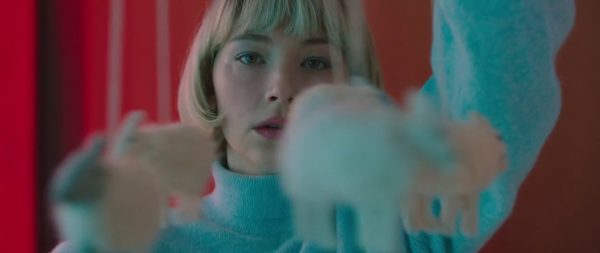
The film is the simple story of a poor woman who is married to a man from a wealthy family as she becomes pregnant yet becomes suffocated by her new environment and the role that she is meant to play where she starts to swallow inedible objects to cope with her issues. It is a film with a simple premise yet it is a character study of a woman who marries into a family of wealth where their son is expected for great things as he demands that his wife be this object of perfection and beauty. Carlo Mirabella-Davis’ script has a straightforward narrative yet it focuses largely on its protagonist in Hunter Conrad (Haley Bennett) who spends much of her time at home cleaning and such as a way to make her husband Richie (Austin Stowell) happy but she becomes unhappy due to his neglect and the presence of his parents who want her to be this figure that they need for their image. Still, Hunter begins to unravel as her condition, known as pica, would worsen as Richie’s parents hire a family friend in Luay (Laith Nakli) to watch over her yet he starts to see that something isn’t right as does Hunter’s psychiatrist Alice (Zabryna Guevara) who manages to get something from Hunter realizing what is wrong.
Mirabella-Davis’ direction is stylish in its compositions as there are little movements in the camera yet much of it has the camera not moving in order to create these shots to play into Hunter’s disconnect with the world she’s in. Shot on various locations in Highland, New York near the Hudson River where Richie and Hunter’s home is as well as other locations in upstate New York. Mirabella-Davis plays up this world that Hunter is in as it is spacious and posh with the finest furniture and decorations yet it is also quite cold as the usage of wide and medium shots play into this growing disconnect that Hunter has in her home as well as the world around her. The usage of close-ups come in whenever Hunter would swallow an object such as a marble, a paper clip, and other things eventually swallowing something as dangerous as a thumbtack. It adds to this air of danger and disruption into Hunter’s marriage to Richie while the signs that not everything as it seems come early when Richie complains about a silk tie that’s been ironed.
Mirabella-Davis also play up into the psyche of Hunter as she would fall apart but then get better and then fall apart again such as a key shot in the second act where Richie is having a phone conversation while Hunter is planting flowers. It is a moment where Hunter’s own secrets about her life begins to play into her head as she would later hide in shame with Luay realizing that something isn’t right in that house despite the fact that he’s working for Richie’s parents to watch her. The third act does play into not just the air of extremes that is pushed for Hunter but also revelations about her marriage along with the need to understand on who she is. Overall, Mirabella-Davis crafts a mesmerizing yet unsettling film about a woman with a troubling condition in pica as a way to cope with her new marriage and suffocating environment.
Cinematographer Katelin Arizmendi does excellent work with the film’s cinematography to play up the bright look of the house interiors in the day along with some low-key lighting for some scenes at night including a party scene where a co-worker of Richie uses a stupid flirt trick. Editor Joe Murphy does terrific work with the editing as a lot of it is straightforward with some long shots that do linger for a bit to play into Hunter’s own growing isolation. Production designer Erin Magill and set decorator Frank Baran do amazing work with the look of the interior at Richie and Hunter’s home including the room for the baby as well as their bedroom as it play into the disconnect that Hunter is coping with. Costume designer Liene Dobraja does fantastic work with the costumes from the expensive clothes that Richie wears along with some of the posh dresses and such that Hunter wears as it play into the role that she has to play for Richie’s family and friends that eventually becomes stifling.
Special effects supervisor Pete Gerner and visual effects supervisor Alex Nobel do wonderful work with some of the film’s minimal visual effects in a few of the objects along with some set dressing in a few scenes. Sound editor Michael Kurihara does superb work with the film’s sound as the usage of natural sounds at the house add to the tense and troubling atmosphere in the film as it also amps up the drama. The film’s music by Nathan Halpern is brilliant for its orchestral score as it play into the drama as well as Hunter’s own isolation while music supervisor Joe Rudge provides a soundtrack that add to that isolation ranging from classical, jazz, dance, and new wave.
The casting by Allison Twardziak is incredible as it feature some notable small roles from Babak Tafti as a co-worker of Richie that uses a pick-up line to win over women, Nicole Kang as a young girl named Bev, Lauren Velez as that girl’s mother Lucy, Zabryna Guevara as Hunter’s psychiatrist Alice who gets an understanding of what Hunter is dealing with, Laith Nakli as a family friend of Richie’s parents who watches over Hunter as he also has an understanding that Richie nor his parents are able to comprehend, and Denis O’Hare in a superb performance late in the film as a man that Hunter needed to meet as he would give her some answers. David Rasche and Elizabeth Marvel are excellent in their respective roles as Richie’s parents in Michael and Katherine Conrad with the former being a man of control as he is trying to make sure Hunter gets the best treatment but with motives of his own while the latter is also a person of control as she tries to get Hunter to read self-help books and such while also having a motive of her own.
Austin Stowell is brilliant as Richie Conrad as a wealthy man who is destined to take over his father’s business as he is someone that is also controlling while he has own reasons in wanting to marry Hunter. Finally, there’s Haley Bennett in a phenomenal performance as Hunter as this young woman from a poor background who marries this man thinking she’s got it made only to feel lost and suffocated in her new life. There is an element of restraint in Bennett’s performance as this woman that has no clue on the role she should play as her act of swallowing inedible objects is defiant as it play into the horrors of the role she is meant to play as it is a career-defining performance for Bennett.
Swallow is an incredible film from Carlo Mirabella-Davis that features a great leading performance from Haley Bennett. Along with its supporting cast, striking visuals, an unsettling tone, an offbeat music soundtrack, and its themes of identity and isolation. It is a psychological drama that doesn’t play by the rules as it explore a woman coping with her new life and how it leads to self-destruction along with revelations about the role she is meant to play for others. In the end, Swallow is a phenomenal film from Carlo Mirabella-Davis.
© thevoid99 2021
Directed by Jonathan Dayton and Valerie Faris and written by Simon Beaufoy, Battle of the Sexes is about the legendary 1973 tennis match between Bobby Riggs and Billie Jean King that was televised and held at the Houston Astrodome. The film is a dramatic account of the events where the legendary Riggs challenges King, who was then the top champion in tennis, as a publicity stunt as a way to get women more respect in the world of sports with Steve Carell playing Riggs and Emma Stone as King. Also starring Andrea Riseborough, Elisabeth Shue, Austin Stowell, Bill Pullman, Natalie Morales, and Sarah Silverman. Battle of the Sexes is a compelling yet exhilarating film from Jonathan Dayton and Valerie Faris.
The film is a dramatic re-telling of the 1973 Battle of the Sexes tennis match between Bobby Riggs and Billie Jean King from the events prior to the match as well as its set-up and outcome. It’s a film with a simple premise where King is the top tennis player of her time but feels that women aren’t being treated fairly in comparison to the men as she feels like women deserve equal pay or more money. Simon’s Beaufoy’s script opens with King’s sudden rise to fame in 1970 as a top tennis player but is upset that an upcoming tennis tour will have her and several other women players be paid much less than the men. This forces King and former tennis player/magazine publisher Gladys Heldman (Sarah Silverman) to create their own tournament with eight other players as they would gain a sponsor in Virginia Slim cigarettes though they would struggle early on to draw an audience despite being banned by legendary tennis player/promoter Jack Kramer (Bill Pullman) from the U.S. Lawn Tennis Association.
The first act is about King and her attempt to get equal pay for herself and other players as well as establish what Riggs was doing at the time as a man who loves to gamble much to the dismay of his wife Priscilla Whelan (Elisabeth Shue) who would kick him out of their home. Riggs who plays tennis to win cars decides to challenge the women as a publicity stunt where he would immediately challenge King who would turn him down as Riggs would challenge Australian tennis champion Margaret Court (Jessica McNamee) and defeat her prompting King to accept Riggs’ challenge. Beaufoy’s script also touch upon King’s affair with hairdresser Marilyn Barnett (Andrea Riseborough) despite the fact that King is married to a man named Larry (Austin Stowell) as it is a key part of the second act that would also play into King’s determination to beat Riggs unaware that he’s really playing a character for show.
The direction of Jonathan Dayton and Valerie Faris does have its elements of style in recreating the world of the early 1970s as it is shot mainly in Los Angeles where much of the film is set. There are some wide shots in establishing the locations as well as in the film’s climatic tennis match set at the Houston Astrodome. Yet, much of Dayton and Faris’ direction is more on the characters and their situations as well as their need to win. Particularly in the usage of close-ups and medium shots that play into the drama and some of the humor where the latter relates mainly to Riggs and his life including the things he would do in playing tennis for money. The direction would show that for all Riggs’ faults as a man, the persona as this chauvinist was really for show as he was someone that was devoted to his family including his wife. Dayton and Faris’ direction also showcase the growing air of sexism towards women’s tennis not just from men but also women as Margaret Court is more of a traditionalist who would glance at King’s relationship with Barnett with disapproval.
The direction also play into this tension between King and tennis organizations who don’t want to succeed nor want any kind of change in the world of tennis unaware that women are paying to see women play tennis. The climatic match at the Astrodome is shown in a massive scope to play up into how large the event is as well as this air of showmanship before the match is to commence. There is this air of excitement but also dramatic tension as the stakes are high while its aftermath show a sense of relief but also realization that things are to change. Overall, Dayton and Faris create an exhilarating yet engaging film about the real-life tennis match between Billie Jean King and Bobby Riggs and the events preceding this landmark tennis match.
Cinematographer Linus Sandgren does brilliant work with the film’s cinematography as its usage of colors for some of the exterior scenes as well as using grainy film stock to recreate the look of 1970s television coverage is a highlight of the film. Editor Pamela Martin does excellent work with the editing as it has bits of montages as well as some stylish moments that play into the energy of the tennis matches. Production designer Judy Becker, with set decorator Matthew Flood Ferguson and art director Alexander Wei, does amazing work with the look of the hotel/motel rooms the women players stayed in as well as the home of Riggs along with the look of the tennis court inside the Astrodome. Costume designer Mary Zophres does fantastic work with the design of the clothes of the 1970s including some of the uniforms the women tennis players chose to wear as well as some of the costumes that Riggs wear for his publicity tour.
Hair stylist Frioa S. Aradottir and makeup artist Torsten White do terrific work with the different hairstyles and looks of King and Riggs during that time as well as how they would evolve in those few years. Special effects supervisor Sam Dean and visual effects supervisor Cliff Welsh do superb work with the visual effects in some set dressing for the period as well as what footage looked like on TV. Sound designer Ai-Ling Lee does wonderful work with the sound in its creation of sound effects as well as how rackets sounded like back then and the massive layers of sounds for the film’s climatic game. The film’s music by Nicolas Britell is incredible for its rich and sumptuous music score with its lush piano and string arrangements that help play into the drama and sense of excitement into the climatic tennis match while music supervisor Steven Baker provides a soundtrack that played into the times as it includes music from Elton John, Bobbie Gentry, Ray Wills, Tommy James and the Shondells, Apollo 100, Norma Jenkins, George Harrison, and Hugh Masekala along with contemporary pieces from the Pretenders and Sara Bareilles.
The casting by Justine Arteta and Kim Davis-Wagner is great as it feature some notable small roles and appearances from John C. McGinley as a friend of Riggs, Matt Malloy as Riggs’ therapist, Eric Christian Olsen as Riggs’ friend/trainer Lornie Kuhle, Fred Armisen as Riggs’ nutritionist Rheo Blair, Lewis Pullman as Riggs’ eldest son Larry, and James MacKay as Court’s husband Barry. In the roles of the members of the Original 9 players, Martha MacIsaac, Mickey Sumner, Bridey Elliott, Lauren Kline, Ashley Weinhold, Fidan Manashirova, and Kaitlyn Christian play in their respective roles as the tennis players Jane “Peaches” Bartkowicz, Valerie Ziegenfuss, Julie Heldman, Nancy Richey, Kristy Pigeon, Judy Tegart Dalton, and Kerry Melville Reid while Christian also plays the tennis double of King with Vince Spadea as the tennis double of Riggs. Natalie Morales is terrific as an Original 9 tennis player in Rosie Casals as someone who is outspoken as well as be the one to provide commentary for the game.
Jessica McNamee is wonderful as Australian tennis champion Margaret Court as a tennis player who joins the women’s tour as she is someone that is conservative and would accept Riggs’ challenge. Austin Stowell is superb as King’s husband Larry as a man who is supportive of her while he is aware that she has feelings for someone else yet keeps to himself. Elisabeth Shue is fantastic as Riggs’ wife Priscilla as a wealthy woman who isn’t fond of her husband’s gambling as well as his pursuit to challenge women players only to realize what he’s really trying to do. Alan Cumming is excellent as costumer Cuthbert “Ted” Tinling as an openly-gay designer who supports the women in making clothes for them but also help King out in her relationship with Barnett. Bill Pullman is brilliant as famed tennis legend/organization leader Jack Kramer who doesn’t believe that the women would draw as he gains the ire of King for his sexist comments.
Sarah Silverman is amazing as legendary tennis player/publisher Gladys Heldman as a woman who doesn’t take shit from anyone where Silverman provides some humor but also some grit into someone who is championing this new generation of players. Andrea Riseborough is incredible as Marilyn Barnett as a hairdresser who falls for King as she accompanies her on the tour while becomes concerned whether or not she is a distraction to King. Finally, there’s the duo of Emma Stone and Steve Carell in phenomenal performances in their respective roles as Billie Jean King and Bobby Riggs. Stone brings a charm but also a seriousness as King as someone that is striving to be the best but is also deals with her sexuality as it relates to her relationship with Barnett which she wants to keep as a secret as homosexuality was still considered taboo. Carell brings this energy and wit as Riggs as someone who loves to gamble and have fun while knowing a good financial opportunity when he sees it while playing up this persona as a male chauvinist to help sell tickets. Stone and Carell have this chemistry in the way they deal with each other but also know there is an air of respect between the two tennis legends.
Battle of the Sexes is a marvelous film from Jonathan Dayton and Valerie Faris that feature great performances from Emma Stone and Steve Carell. Along with its ensemble cast, Simon Beaufoy’s engaging script, gorgeous cinematography, and Nicolas Britell’s rich score. It’s a film that manages to be exciting as a sports film but also provide some deep insights into the world of tennis during the 1970s and how one woman wanted to make things fair by playing against one of the sports’ great champions. In the end, Battle of the Sexes is a remarkable film from Jonathan Dayton and Valerie Faris.
Jonathan Dayton/Valerie Faris Films: Little Miss Sunshine - Ruby Sparks
© thevoid99 2019

Written and directed by Nacho Vigalondo, Colossal is the story of an unemployed writer who believes she is responsible for controlling a monster that is wreaking havoc somewhere on Earth. The film is an unconventional comedy in which a woman deals with her alcoholism and lack of progress in life as well as being strangely connected to a monster halfway across the world. Starring Anne Hathaway, Jason Sudeikis, Dan Stevens, Austin Stowell, and Tim Blake Nelson. Colossal is a strange yet exhilarating film from Nacho Vigalondo.
The film follows an alcoholic writer who is forced to return home to New Jersey after her boyfriend breaks up with her where she learns that is connected with a monster creating chaos in Seoul, South Korea. It’s a film that plays into a woman dealing with not just her failures and lack of progress in life but also this sense that she could be responsible for possibly killing people half a way across the world. Nacho Vigalondo’s screenplay follows the protagonist Gloria (Anne Hathaway) who spends much of her time going out to cope with her uncertainty which angers her boyfriend Tim (Dan Stevens) who kicks her out of their New York City apartment. Upon returning to her hometown and to her unfurnished family home, she reconnects with her childhood friend Oscar (Jason Sudeikis) who runs a local bar as she would eventually work there and drink there often until she learns about this monster destroying things in Seoul.
Realizing her connection to the monster and how it might’ve happened as she has to appear at a certain time and a certain location. Things would intensify during the second act is relates to Oscar and his own faults in his life in how he’s trying to run a bar that isn’t going well despite the fact that there’s so much he can do. Yet, his frustrations would eventually cause Gloria to deal with her own faults but what she can to control her life as well as being the monster who would eventually deal with another evil force that is causing more havoc in Seoul.
Vigalondo’s direction does have elements of style but balances it with humor and drama in order to create something that is straightforward which is sort of unexpected in comparison to films about monsters. Shot largely in Vancouver as New Jersey and parts of Seoul and New York City, the film is essentially set in the suburbs where in the middle of the area between Gloria’s family home and Oscar’s bar is this playground where much of the action involving this monster happens. There are some wide shots in some of the action that involve the monster as well as in some establishing location shots and scenes in the bar. Yet, Vigalondo would use close-ups and medium shots to play into some of the comedic and dramatic events including some unique compositions in how Gloria’s movements on a certain spot in the playground would match how the monster would move. The third act as it relates to how Gloria is connected with the monster and the location refers to a prologue that occurred 25 years earlier in Seoul as it all play into a recurring flashback involving a young Gloria and Oscar at the site before the playground emerged. Even as it would force Gloria to do something as it relates to the lack of control she’s had in her life and the need to take control of it. Overall, Vigalondo crafts a riveting yet witty film about a woman’s strange connection with a monster wreaking havoc in Seoul.
Cinematographer Eric Kress does excellent work with the cinematography from the damp, autumn-like look of the exterior scenes in New Jersey to the low-key lighting and moods for the scenes in the bar. Editors Ben Baudhuin and Luke Doolan do superb work with the editing as it does have some offbeat rhythmic cuts to play into the humor and action as it relates to Gloria’s connection with the monster. Production designer Sue Chan, with set decorator Josh Plaw and art director Roger Fires, does fantastic work with the look of Gloria’s family home without the furniture as well as the look of the bar that Oscar runs. Costume designer Antoinette Messam does nice work with the costumes as it is largely straightforward for the fact that most of the characters wear casual clothing.
Visual effects supervisor Phil Jones does brilliant work with the look of the monster as well as the evil force it would face including the film’s climax. Sound editor Mark Gingras does terrific work with the sound in the way the monster sounds as well as the atmosphere of Oscar’s bar and the air sirens that would pop up at a certain time. The film’s music by Bear McCreary is wonderful for its low-key mixture of orchestral music and electronic music to play into the elements of sci-fi and comedy while music supervisor Linda Cohen provides a fun soundtrack that features elements of rock, hip-hop, and indie music.
The casting by Maureen Webb is incredible as it feature a couple of notable small roles from Hannah Cheramy as the young Gloria and Nathan Ellison as the young Oscar. Austin Stowell is terrific as a friend of Oscar in Joel whom Gloria is attracted to while Tim Blake Nelson is superb as another friend of Oscar in Garth who often rambles yet is also struggling with his own sobriety from drugs. Dan Stevens is fantastic as Gloria’s boyfriend Tim who is pretty much an asshole that often berates her for her issues while not doing much to help her in order to make himself feel superior. Jason Sudeikis is brilliant as Oscar as an old friend of Gloria who is running a bar and is dealing with his own lack of progress in his life as it’s a complex performance that is filled with some dark aspects that makes him a very unique character. Finally, there’s Anne Hathaway in a sensational performance as Gloria as it’s an offbeat and lively performance from Hathaway who displays a charisma and vulnerability as well as showing someone that is troubled and in need of control as it’s really one of the best performances of her career so far.
Colossal is a phenomenal film from Nacho Vigalondo that features a tremendous performance from Anne Hathaway. Along with its top-notch visual effects, great ensemble cast, and its offbeat approach to sci-fi, black comedy, and drama. It’s a film that explore a woman dealing with her lack of progress and control in life until she starts to realize her strange connection to a monster wreaking havoc in Seoul. In the end, Colossal is an incredible film from Nacho Vigalondo.
Nacho Vigalondo Films: Timecrimes – (Extraterrestrial (2011 film)) – (Open Windows)
© thevoid99 2018