Showing posts with label tim blake nelson. Show all posts

Sunday, January 15, 2023

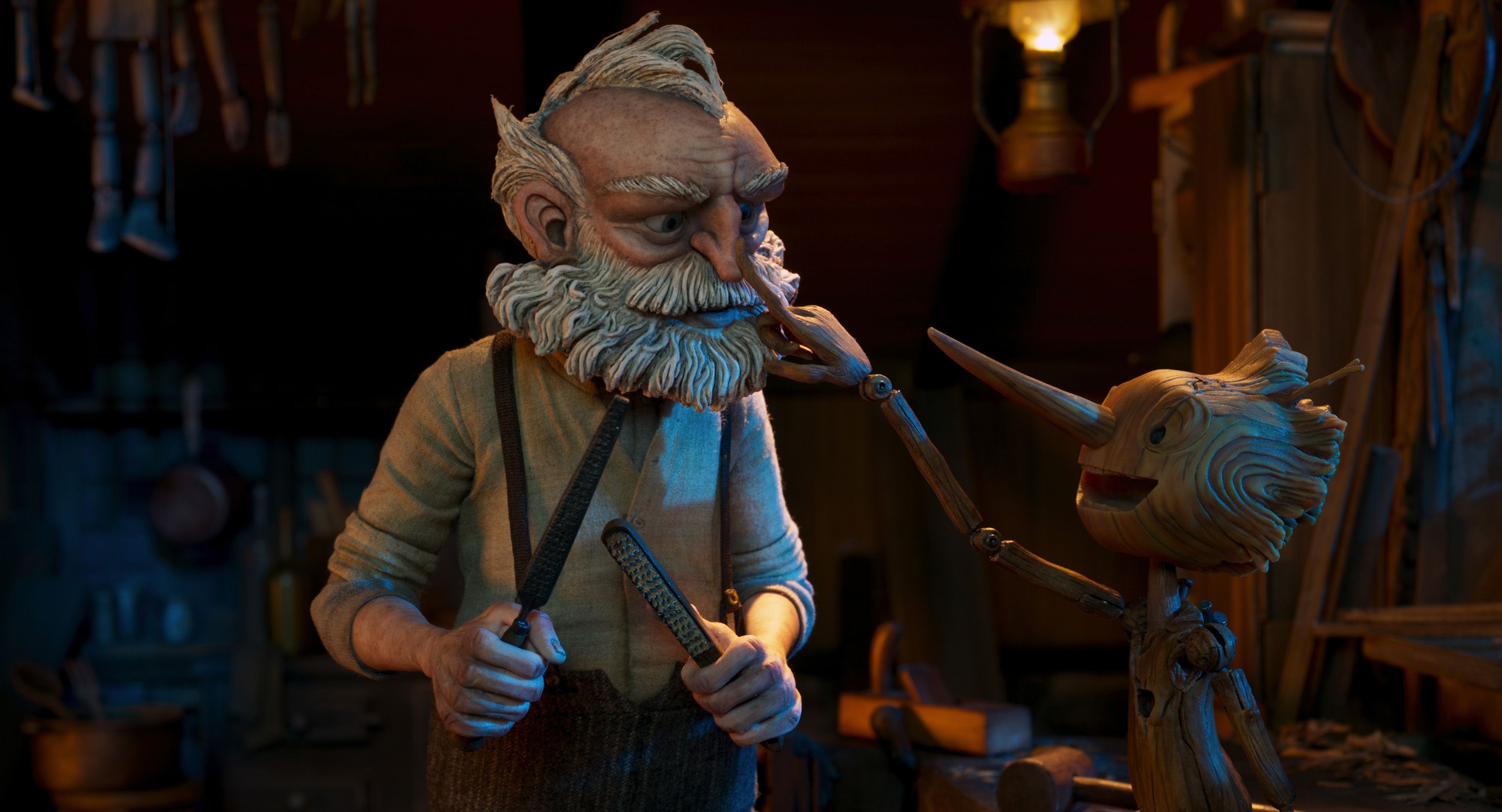
Pinocchio (2022 Animated Film)


Based on the novel The Adventures of Pinocchio by Carlo Collodi with illustrations by Gris Grimly, Pinocchio is the story of a wooden puppet who comes to life as he struggles with his well-being and winning the approval of his father. Directed by Guillermo del Toro and Mark Gustafson with a screenplay by del Toro and Patrick McHale from a story by del Toro and Matthew Robbins, the stop-motion animation film is set during the period of Fascist Italy as it plays into a man dealing with loss and a puppet trying to discover life during a period of chaos. Featuring the voices of Gregory Mann, David Bradley, Ewan McGregor, Burn Gorman, Ron Perlman, John Turturro, Finn Wolfhard, Cate Blanchett, Tim Blake Nelson, Christoph Waltz, and Tilda Swinton. Pinocchio is a rich and intoxicating film from Guillermo del Toro and Mark Gustafson.

Two decades after the death of son during World War I, the film follows a man who drunkenly creates a wooden boy to cope with his loss as it comes to life where the boy struggles with not just winning his father’s approval but also what it means to live. It is a film that takes the premise of the story of a man who creates a puppet who turns into a boy as it is set in Fascist Italy at a time when conformity and playing to certain rules are in tow which is something that a puppet with no strings is trying to deal with as well as the idea of love and what it means to exist. The film’s screenplay by Guillermo del Toro and Patrick McHale is told largely by a cricket in Sebastian J. Cricket (Ewan McGregor) about the titular character (Gregory Mann) and how he had been created by this lonely carpenter in Geppetto (David Bradley) after having lost his son Carlo (Gregory Mann) during an aerial bombing in World War I as he had been ravaged by grief until he cuts down a tree where Cricket was living and turned it into a puppet. It is then where a fairy in the Wood Sprite (Tilda Swinton) would cast a spell for the puppet to come to life while asking Cricket to watch over and guide him.

While Geppetto’s initial encounter with Pinocchio has him confused and frightened as does Pinocchio’s appearance at the town’s local church. Geppetto does what he can to steer Pinocchio the right way but also him wanting to be like Carlo yet there is also pressure from the Podesta (Ron Perlman) who wants Geppetto to ensure that Pinocchio becomes part of the Italian Royal Army upon a major discovery they would have much to Geppetto’s horror. Even as Pinocchio would encounter the failing circus ringmaster Volpe (Christoph Waltz) who would get Pinocchio to sign a contract that would keep him out of the eye of the Podesta but also keep Pinocchio performing in order to keep Geppetto out of debt. It all plays into Pinocchio’s development and his conversations with Cricket as it has him thinking about not just wanting to live but also to find his own voice as he watches the abuse that Volpe has on his longtime assistant monkey Spazzatura (Cate Blanchett) as well as a closer look into the world of Fascist Italy upon being watched by the Podesta at youth training camp.

The direction of del Toro and Mark Gustafson is astonishing in its overall presentation due to the attention to detail that both men put into its look as it is created on studio locations in Portland, Oregon and Guadalajara, Mexico. With Gustafson and his team of animators doing much of the stop-motion work with production designers Guy Davis and Curt Enderle, with set decorators Jesse Gregg, Gillian Hunt, Samantha Levy, Molly Light, Laura Savage, and Zach Sheehan plus art directors Andy Berry, Karla Castaneda, Robert DeSue, and Juan J. Medina, helping to create much of the backdrops in the look of the forests and woods in such grand detail. Even with Davis also creating some of the creatures including Cricket, Spazzatura, and the sea monster for the film’s climax, there is a look that is del Toro in terms of its approach to death as well as horror with the former involving a sequence in which Pinocchio meets a death fairy (Tilda Swinton) in a surrealistic presentation of the afterlife. Since the film is also based on the illustrations of Gris Grimly, del Toro and Gustafson maintain this look that quite wobbly in its presentation as there is a realism to the animation as well as a physicality in how they take this story and set it into a world where there are elements of politics and existentialism in the mix.

Even in a scene where Pinocchio asks his father why people don’t like him but love this model of the crucifixion as it is among these things that Pinocchio would go into. The compositions that del Toro and Gustafson create add to the drama that Pinocchio goes through in the wide and medium shots in a location or in one of Pinocchio’s stage performances as well as close-ups that play into the characters as they cope with whatever situation they’re in. Notably in the climax as it plays into Pinocchio and Geppetto dealing with a sea monster as all of the lessons that Pinocchio would learn allows him to deal with the situations as well as an understanding of both life and death. Overall, del Toro and Gustafson craft an exquisitely moving and ravishing film about a wooden boy who comes to life and learns about existence and identity during the era of Fascist Italy.

Cinematographer Frank Passingham does incredible work with the cinematography as it helps the look of the film give it a sense of physicality in the lighting while helping to set mood to help bring more texture to the production design. Editors Ken Schretzmann and Holly Klein do amazing work with the editing as it is largely straightforward to play into some of the musical numbers but also in some of the dramatic and terrifying moments with its rhythmic cuts. Visual effects supervisors Cameron Carson and Aaron Weintraub do excellent work with the visual effects as it is mainly set dressing for some scenes involving war and fire as it help broaden the visuals. Sound designer Scott Martin Gershin does brilliant work with the sound in the way certain objects sound as well as the way an instrument sounds on a location or how bombs sound from afar. The film’s music by Alexandre Desplat is phenomenal with its rich orchestral score that has elements of lush strings and orchestral pianos themes along with some offbeat percussive-based themes while the soundtrack also feature original songs written by Desplat along with lyrics by del Toro, McHale, and Roeben Katz that add to the drama and humorous moments in the film that are sung by its cast.

The casting by Mary Hidalgo is great as it feature some notable small voice roles from Tom Kenny in a trio of voice performances as a sea captain, a right-hand for Mussolini, and the Italian Fascist leader Benito Mussolini as well as Tim Blake Nelson as a quartet of black rabbits, John Turturro as a doctor in the small town Geppetto lives in, Burn Gorman as the local priest, Finn Wolfhard as the son of the Podesta in Candlewick who at first bullies Pinocchio only to befriend him late in the film, and Cate Blanchett in a superb voice cameo as Volpe’s monkey assistant Spazzatura who talks through puppets where Blanchett brings unique voices as a monkey who is jealous of Pinocchio only to realize the good in Pinocchio. Tilda Swinton is fantastic in a dual voice role as the magical fairy known as the Wood Sprite and her sister known as Death where Swinton brings different tones to the two characters as they lament on the ideas of both life and death. Ron Perlman is excellent as the Podesta as a Fascist government official who sees Pinocchio at first as a freak only to see that he could become a symbol for the government in their rise while trying to raise his son as a perfect soldier for Fascist Italy.

Christoph Waltz is brilliant as Volpe as a former aristocrat-turned circus ringmaster who sees Pinocchio as a way to get him back into aristocracy as well as a chance to get in the good graces of Mussolini as he brings a charm to this evil character. Ewan McGregor is amazing as Sebastian J. Cricket as the film’s narrator and conscience-of-sorts who tries to steer Pinocchio onto the right path while dealing with being squished and such as well as trying to do what he can where he laments over his role. David Bradley is incredible as Geppetto as a woodcarver/carpenter who laments over the loss of his son as well as dealing with Pinocchio as he is someone ravaged by grief while trying to understand the many flaws of Pinocchio while trying to go on a search for him when Pinocchio joins the circus. Finally, there’s Gregory Mann in a sensational voice performance in the dual role of Carlo and the titular character as he brings an exuberance and innocence to the former as well as an energy into the latter as well as this vulnerability of someone who is just trying to understand the ideas of life and death where Mann brings a lot of life into both of these roles.

Pinocchio is a tremendous film from Guillermo del Toro and Mark Gustafson. Featuring a great ensemble cast, gorgeous visuals, ravishing art direction, its story of existentialism and identity, amazing character/creature designs, and Alexandre Desplat’s enchanting music score. It is a film that takes a tale told many times but bring something new to it and set it during a tumultuous time in world history as it help play into a wooden boy trying to find himself as well as a physicality that gives the film an edge in its stop-motion animation presentation. In the end, Pinocchio is a magnificent film from Guillermo del Toro and Mark Gustafson.

Guillermo del Toro Films: Cronos - Mimic - The Devil's Backbone - Blade II - Hellboy - Pan's Labyrinth - Hellboy II: The Golden Army - Pacific Rim - Crimson Peak - The Shape of Water - Nightmare Alley (2021 film)

Related: (Pinocchio (1940 film)) - The Auteurs #10: Guillermo del Toro

© thevoid99 2023

Wednesday, September 29, 2021

Just Mercy


Based on the memoir Just Mercy: A Story of Justice and Redemption by Bryan Stevenson, Just Mercy is the story of a young attorney who takes on an appeals case of a man accused of murder as he deals with the many injustices that this man has dealt with. Directed by Destin Daniel Cretton and screenplay by Cretton and Andrew Lanham, the film is based on the real life story of Walter “Johnny D.” McMillian who was falsely accused of murder in Alabama where his attorney in Bryan Stevenson tries to prove his innocence as Michael B. Jordan portrays Stevenson with Jamie Foxx as McMillian. Also starring Brie Larson, Rob Morgan, Tim Blake Nelson, and Rafe Spall. Just Mercy is a riveting and heart-wrenching film from Destin Daniel Cretton.

Spanning from November of 1986 to March of 1993, the film follows the wrongful arrest and conviction of Walter “Johnny D.” McMillian over the murder of a young white woman in Ronda Morrison as he would be represented three years later by an idealist young attorney from Delaware in Bryan Stevenson who would do what he can to exonerate McMillian and prove his innocence. It’s a film with a simple premise yet it is more about a young man dealing with a world that he doesn’t know much of despite having to deal with the prejudices that he also faces as an African-American. The film’s screenplay by Destin Daniel Cretton and Andrew Lanham is straightforward as it opens with McMillian’s arrest after a hard day’s work cutting trees as he’s accused of killing this young white woman as the film then pushes a couple of years later where Stevenson meets a young convict just before Stevenson is officially an attorney where it is a scene that establishes the idealism that follows him and his determination to make things right in the unforgiving environment that is the American South in Monroe County in Alabama.

The script also play into Stevenson not only focusing on McMillian and trying to gain his support as well as the support of his family but also look into the cases of others including a former war veteran in Herbert Richardson (Rob Morgan) who is suffering from PTSD as Stevenson tries to save him from execution. Aiding Stevenson in these cases include a local in Eva Ansley (Brie Larson) who helps him find the Equal Justice Initiative as she is disgusted by not just the racism in her home state but also the indifference of prosecutor Tommy Chapman (Rafe Spall) who declines to help Stevenson out in favor of protecting the state. While Stevenson was able to get an alibi from a family friend of McMillian who later backs out, the script shows Stevenson’s determination where he questions another prisoner in Ralph Myers (Tim Blake Nelson) where some major revelations occur about why McMillian was convicted as it leads to major challenges for Stevenson to free McMillian.

Cretton’s direction is largely straightforward to play into its grounded presentation about a real-life story. While the film is set in Alabama and shot partially in Montgomery, much of it is shot on location in and around parts of Atlanta to play into the look and feel of late 1980s/early 1990s Alabama. Cretton does make the locations feel like a world of its own with prison cells also being characters as it is this place of fear where Stevenson has to endure some humiliation in his first visit in Alabama by stripping down where Cretton brings that sense of claustrophobia in the medium shots and close-ups. The usage of those shots add to the prison cell where McMillian is alone with Richardson next door to him on the left and another in Anthony Ray Hinton (O’Shea Jackson Jr.) who was also wrongly convicted. Cretton does use some wide shots to showcase some of the locations including images of trees during a scene where McMillian offer words of comfort to Richardson in one of his PTSD moments.

Cretton also play into this air of racism that is prominent in Alabama where Stevenson is an outsider of sorts as he does get a closer look of what it’s like being a black man in Alabama where a lot of the cops and local authorities are white. Cretton doesn’t paint them as typical villains as a young guard in Jeremy Doss (Hayes Mercure) becomes more sympathetic towards McMillian while the revelations about Myers showcase the similarities towards those who live below the poverty line as he too is a victim. The first act is about Stevenson’s idealism and his attempts to try and get McMillian a retrial while the second act is about these revelations and this retrial for McMillian. Yet, there’s this third act where Cretton goes into deep into the many injustices towards McMillian but also for black men as well as Chapman’s role who is someone disconnected from what is really going on as he has to deal with the status quo who are resistance towards change. Overall, Cretton crafts an engaging and evocative film about a young attorney who tries to free a wrongly-convicted man of murder in Alabama.

Cinematographer Brett Pawlak does brilliant work with the film’s cinematography with its usage of low-key lights for many of the interior/exterior scenes at night as well as some understated colors for some of the daytime exterior scenes. Editor Nat Sanders does excellent work with the editing as it is largely straightforward with a few jump-cuts to play into some of the film’s intensely-dramatic moments. Production designer Sharon Seymour, with set decorator Maggie Martin and art director Peter Borck, does amazing work with the look of the house that Stevenson and Ansley bought as their headquarters as well as the look of the jail cells the prisoners live in and the court rooms. Costume designer Francine Jamison-Tanchuck does fantastic work with the costumes as it is largely straightforward with some of the refined clothes of McMillian’s family during the trials and church scenes along with the expensive suits that Chapman wears. Makeup artist Bridgit Crider and hair stylist Crystal Woodford do terrific work with the look of McMillian early in the film as it played into the period of the times along with the look of Ansley in her ragged yet simple look.

Special effects supervisor Nicholas Coleman and visual effects supervisor Chris LeDoux do some fine work with the special effects as it is largely set-dressing for some of the film’s locations along with a few scenes in the prison. Sound editors Onnalee Blank and Katy Wood do superb work with the film’s sound as it help play into the tense atmosphere of the prisons as well as some of its sparse moments and scenes in some of the locations in the film. The film’s music by Joel P. West does wonderful work with the film’s music score as it features elements of orchestral music with some gospel to play into the world that is the American South while music supervisor Gabe Hilfer cultivate a soundtrack that largely features elements of soul, gospel, rock, and R&B as it features pieces from Martha and the Vandellas, J. Alphonse Nicholson, Alabama Shakes, Hilton Felton, Sister Emily Braum, The Mighty Indiana Travelers, Atlantic Starr, Ella Fitzgerald, and a few others.

The casting by Carmen Cuba and Tara Feldstein is incredible as it feature some notable small roles from Rhoda Griffs as a judge late in the film, Norm Lewis as the voice of a newscaster, Hayes Mercure as the young prison guard Jeremy Doss who becomes sympathetic towards McMillian during the film as he realizes that McMillian is innocent, Dominic Bogart as Eva’s husband Doug, C.J. LeBlanc as McMillian’s son John, Karen Kendrick as McMillian’s wife Minnie, Darrell Britt-Gibson as a family friend in Darnell who has an alibi for McMillian only to be spooked by the authorities, and Michael Harding as the racist Sheriff Tate who doesn’t care if McMillian is innocent as he is someone trying to instill his authority. O’Shea Jackson Jr. is fantastic as Anthony Ray Hinton as a wrongfully-convicted man who is a cell-neighbor of McMillian as he believes that Stevenson is a man of hope as Stevenson also tries to help him with his own case.

Rafe Spall is superb as Tommy Chapman as a prosecutor who is unwilling to help Stevenson as he would be the opposition as a political figure who is trying to protect his own community while dealing with the fallout of his own actions. Tim Blake Nelson is excellent as the convict Ralph Myers as a white man who made the claim that he saw McMillian commit the murder as he makes some startling revelations where Nelson provides some chilling monologues and moments that showcases a man who had been used as a pawn for a cruel system. Rob Morgan is amazing as the convicted war veteran Herbert Richardson as a man who suffers from PTSD as he awaits his execution as he hopes to save as his performance is heartbreaking to watch as someone who is consumed with guilt while coping about his own fate. Brie Larson is brilliant as Eva Ansley as a local who becomes Stevenson’s right-hand woman as well as a mother who is aware that she is targeted while also doing what she can to help as well as give Stevenson an understanding of the cruelty that is Alabama and the American South.

Jamie Foxx is tremendous as Walter “Johnny D.” McMillian as a man who is wrongly accused of murder as he is skeptical of Stevenson’s intentions due to past attempts by others as he also copes with the many challenges in getting a retrial where Foxx is just understated in his performance as well as a man who clings on to hope knowing that truth can save him. Finally, there’s Michael B. Jordan in a phenomenal performance as Bryan Stevenson as a Harvard-graduate attorney from Delaware who moves to Alabama with ideas to change the world only to deal with some reality that is intense yet Jordan maintains that determination of someone who wants to do what is right as well as understand his own identity as a black man in the South who is just trying to make a small change to a cruel world as it is a career-defining performance for Jordan.

Just Mercy is a sensational film from Destin Daniel Cretton that features great performances from Michael B. Jordan, Jamie Foxx, and Brie Larson. Along with its ensemble cast, understated presentation, an engaging music soundtrack, and its exploration of racism and injustice in the American South. It is a film that manages to explore a young man trying to save another man from injustice while also learning about what to do to combat hate in a world that is prejudice and resistant to change. In the end, Just Mercy is a phenomenal film from Destin Daniel Cretton.

Destin Daniel Cretton Films: (I Am Not a Hipster) – Short Term 12 - (The Glass Castle (2017 film)) – Shang-Chi and the Legend of the Ten Rings

© thevoid99 2021

Friday, December 14, 2018

The Ballad of Buster Scruggs


Written, produced, edited, and directed by Joel and Ethan Coen, The Ballad of Buster Scruggs is a collection of stories set in the American West as it play into the many adventures of misadventures of people in the West. The film is an anthology film of sorts that play into six different stories relating to the West. Starring Tim Blake Nelson, Tyne Daly, James Franco, Tom Waits, Zoe Kazan, Harry Melling, Liam Neeson, and Brendan Gleeson. The Ballad of Buster Scruggs is a majestic yet whimsical film from the Coen Brothers.

Set in the American West, the film follow six different stories in the American West as it all relates to the themes of death as well as people’s encounter with it. All of which is told in a book about these tales of the West and these characters as they encounter with some idea of death. In The Ballad of Buster Scruggs, a cowboy arrives into town singing songs as he also disposes challengers through gunfights while also commenting about the ideas of humanity where he meets a new challenger. Near Algodones is about a bank robber is attacked by the bank’s clerk where pots and pans where he’s later knocked out and captured by a mysterious man in black only for the day to get weirder following an attack by the Comanche, an encounter with a drover, and all sorts of bad shit in one strange day. Meal Ticket revolves around an impresario travels through the cold West with his performer in a young legless/armless artist who recites poetry, stories, and other texts where they endure a declining audience and lack of money prompting the impresario to find a new act.

All Gold Canyon, that is based on a story by Jack London, is about a prospector arrives on a mountain valley to find gold as he dwells into the land to find gold where he makes a discovery but also another one that is far more deadly. In The Gal Who Got Rattled that is inspired by story by Stewart Edward White, a young woman is on the Oregon Trail with her dim-witted older brother who dies suddenly of cholera where she befriends a train leader who is sympathetic to her plight as he thinks about having a future with her once the trail ends. The Mortal Remains is about five different people traveling on a stagecoach as tension arises during the journey as they all tell their own views while dealing with the fact that there’s a dead body on top of the stagecoach as some wonder why. These six different stories play into themes that play into the danger and uncertainty of the West as well as the realities of a world that is ever-changing.

The direction of the Coen Brothers definitely owe a lot to Westerns of the past but also provide their own visual language in the film as it relates to the presentation of the different stories in the film. Each story opens with a picture in the book and closes with the last page of that story as it’s told through a book as it would then cut to a landscape as many of the film’s locations are shot in the Nebraskan Panhandle, New Mexico, and Telluride in Colorado. The Coen Brothers’ direction would have these gorgeous wide shots of certain locations where they also create these striking compositions that add to the beauty whether it’s a shot of a man about to be hanged or a certain location in the valley. While there are comical elements in these stories with the titular story being the most comical of them all as it’s partially a musical. The rest range into elements of dark comedy as it relates to the theme of death as it play into the sense of melancholia and changing times of the West that is evident in stories such as Meal Ticket and The Gal Who Got Rattled as the former is largely dramatic and minimalist in its story while the latter is more about this uncertainty on the Oregon Trail.

Serving as editors under the Roderick Jaynes pseudonym, the Coen Brothers’ approach to the editing help add to not just the drama but also humor with its usage of jump-cuts and dissolves along with rhythmic cuts in certain aspects of the film. Most particularly in All Gold Canyon where the prospector (Tom Waits) is digging holes trying to find gold along with the montage of the artist in Harrison (Harry Melling) reciting famous texts to the growing declining audience in Meal Ticket. The usage of close-ups and medium shots are evident in The Mortal Remains as it is shot largely inside the stagecoach to play into the dramatic tension as well as the sense of intrigue of where the five passengers are going. It is the Coen Brothers playing into the dangers of the American West as they definitely show violent moments that are graphic as it add to the specter of death. Overall, the Coen Brothers craft an evocative yet offbeat film about six strange tales in the American West.

Cinematographer Bruno Delbonnel does brilliant work with the film’s cinematography with its usage of natural lighting for some of the exteriors in the daytime along with the usage of tints and filters for some interior scenes along with shots set at night or in the evening as it’s a highlight of the film. Production designer Jess Gonchor, with set decorator Nancy Haigh plus art directors Steve Christensen and Chris Farmer, does amazing work with the look of the buildings that some of the characters go to including the saloons as well as the stagecoach and wagons for some parts of the film. Costume designer Mary Zophres does fantastic work with the costumes as it play into the period of the times from the shiny look of the titular character to the rougher and ragged look of other cowboys as it’s a highlight of the film.

Makeup effects supervisor Robin Myriah Hatcher does terrific work with the look of the characters with the artist being the most notable as well as a few passengers on the stagecoach. Visual effects supervisors Michael Huber and Alex Lemke do excellent work with the visual effects where it does do bits of set-dressing in some parts while doing its best work on the look of the artist. Sound editors Craig Berkey and Skip Lievsay do superb work with the sound as it help play into the atmosphere of the locations as well as how gunfire and such sounds during a few gun battles in the film. The film’s music by Carter Burwell is incredible for its rich and bombastic musical score that feature some flourishing string arrangements along with elements of folk and country music to play into the air of the times.

The casting by Ellen Chenoweth is wonderful as it feature some notable small roles and appearances from E.E. Bell as a piano saloon player, Tom Proctor as a Cantina bad man, and David Krumholtz as a saloon Frenchman in the titular segment while Jesse Luken as the drover and Ralph Ineson as the Man in Black are terrific in their brief appearances in Near Algodones. In the titular opening segment, the performances of Clancy Brown as the gambler Curly Joe, Willie Watson as a young gunslinger, and Tim Blake Nelson as the titular character are great with Nelson being a jovial and engaging individual who sings about his exploits while being a great gunslinger. In Near Algodones, Stephen Root is fantastic as the bank teller who is more than prepared for a bank robbery while James Franco is superb as the robber who finds himself in dangerous situations. Liam Neeson and Harry Melling are incredible in their respective roles as the impresario and the artist named Harrison in the Meal Ticket segment with Neeson being largely silent as a man trying to make money while Melling displays a charisma through the things he says.

Tom Waits is brilliant as the prospector trying to find gold in All Gold Canyon while Sam Dillon is wonderful in his small role as a young man trying to rob the prospector. In The Girl Who Got Rattled, the performances of Zoe Kazan as Alice Longabaugh, Bill Heck as Billy Knapp, and Grainger Haines as Mr. Arthur are amazing with Kazan being the major standout as a young woman coping with her situation while there’s notable small roles from Jefferson Mays as Alice’s brother Gilbert and Ethan Dubin as Matt who is trying to cheat Alice. In The Mortal Remains, the performances of Tyne Daly as the devout Christian woman, Saul Rubinek as the Frenchman, Chelcie Ross as trapper, Jonjo O’Neill as the Englishman, and Brendan Gleeson as the Irishman all sitting at the stagecoach are excellent to play into the tension and differences of these individuals as they deal with the journey ahead and their destination as well as the reality of their environment.

The Ballad of Buster Scruggs is a sensational film from Joel and Ethan Coen. Featuring a great ensemble cast, compelling stories on death and the unexpected elements of life, gorgeous cinematography, and an incredible music score and soundtrack. It’s a film that is an unusual yet engaging anthology film of sorts set in the American West that play into all sorts of situations and stories that all relate to uncertainty in those times. In the end, The Ballad of Buster Scruggs is a phenomenal film from Joel and Ethan Coen.

Coen Brothers Films: Blood Simple - Raising Arizona - Miller's Crossing - Barton Fink - The Hudsucker Proxy - Fargo - The Big Lebowski - O Brother, Where Art Thou? - The Man Who Wasn't There - Intolerable Cruelty - The Ladykillers - Paris Je T'aime-Tulieres -To Each His Own Cinema-World Cinema - No Country for Old Men - Burn After Reading - A Serious Man - True Grit - Inside Llewyn Davis - Hail, Caesar!

The Auteurs #9: The Coen Brothers: Pt. 1 - Pt. 2

© thevoid99 2018

Saturday, March 10, 2018

Colossal (2016 film)


Written and directed by Nacho Vigalondo, Colossal is the story of an unemployed writer who believes she is responsible for controlling a monster that is wreaking havoc somewhere on Earth. The film is an unconventional comedy in which a woman deals with her alcoholism and lack of progress in life as well as being strangely connected to a monster halfway across the world. Starring Anne Hathaway, Jason Sudeikis, Dan Stevens, Austin Stowell, and Tim Blake Nelson. Colossal is a strange yet exhilarating film from Nacho Vigalondo.

The film follows an alcoholic writer who is forced to return home to New Jersey after her boyfriend breaks up with her where she learns that is connected with a monster creating chaos in Seoul, South Korea. It’s a film that plays into a woman dealing with not just her failures and lack of progress in life but also this sense that she could be responsible for possibly killing people half a way across the world. Nacho Vigalondo’s screenplay follows the protagonist Gloria (Anne Hathaway) who spends much of her time going out to cope with her uncertainty which angers her boyfriend Tim (Dan Stevens) who kicks her out of their New York City apartment. Upon returning to her hometown and to her unfurnished family home, she reconnects with her childhood friend Oscar (Jason Sudeikis) who runs a local bar as she would eventually work there and drink there often until she learns about this monster destroying things in Seoul.

Realizing her connection to the monster and how it might’ve happened as she has to appear at a certain time and a certain location. Things would intensify during the second act is relates to Oscar and his own faults in his life in how he’s trying to run a bar that isn’t going well despite the fact that there’s so much he can do. Yet, his frustrations would eventually cause Gloria to deal with her own faults but what she can to control her life as well as being the monster who would eventually deal with another evil force that is causing more havoc in Seoul.

Vigalondo’s direction does have elements of style but balances it with humor and drama in order to create something that is straightforward which is sort of unexpected in comparison to films about monsters. Shot largely in Vancouver as New Jersey and parts of Seoul and New York City, the film is essentially set in the suburbs where in the middle of the area between Gloria’s family home and Oscar’s bar is this playground where much of the action involving this monster happens. There are some wide shots in some of the action that involve the monster as well as in some establishing location shots and scenes in the bar. Yet, Vigalondo would use close-ups and medium shots to play into some of the comedic and dramatic events including some unique compositions in how Gloria’s movements on a certain spot in the playground would match how the monster would move. The third act as it relates to how Gloria is connected with the monster and the location refers to a prologue that occurred 25 years earlier in Seoul as it all play into a recurring flashback involving a young Gloria and Oscar at the site before the playground emerged. Even as it would force Gloria to do something as it relates to the lack of control she’s had in her life and the need to take control of it. Overall, Vigalondo crafts a riveting yet witty film about a woman’s strange connection with a monster wreaking havoc in Seoul.

Cinematographer Eric Kress does excellent work with the cinematography from the damp, autumn-like look of the exterior scenes in New Jersey to the low-key lighting and moods for the scenes in the bar. Editors Ben Baudhuin and Luke Doolan do superb work with the editing as it does have some offbeat rhythmic cuts to play into the humor and action as it relates to Gloria’s connection with the monster. Production designer Sue Chan, with set decorator Josh Plaw and art director Roger Fires, does fantastic work with the look of Gloria’s family home without the furniture as well as the look of the bar that Oscar runs. Costume designer Antoinette Messam does nice work with the costumes as it is largely straightforward for the fact that most of the characters wear casual clothing.

Visual effects supervisor Phil Jones does brilliant work with the look of the monster as well as the evil force it would face including the film’s climax. Sound editor Mark Gingras does terrific work with the sound in the way the monster sounds as well as the atmosphere of Oscar’s bar and the air sirens that would pop up at a certain time. The film’s music by Bear McCreary is wonderful for its low-key mixture of orchestral music and electronic music to play into the elements of sci-fi and comedy while music supervisor Linda Cohen provides a fun soundtrack that features elements of rock, hip-hop, and indie music.

The casting by Maureen Webb is incredible as it feature a couple of notable small roles from Hannah Cheramy as the young Gloria and Nathan Ellison as the young Oscar. Austin Stowell is terrific as a friend of Oscar in Joel whom Gloria is attracted to while Tim Blake Nelson is superb as another friend of Oscar in Garth who often rambles yet is also struggling with his own sobriety from drugs. Dan Stevens is fantastic as Gloria’s boyfriend Tim who is pretty much an asshole that often berates her for her issues while not doing much to help her in order to make himself feel superior. Jason Sudeikis is brilliant as Oscar as an old friend of Gloria who is running a bar and is dealing with his own lack of progress in his life as it’s a complex performance that is filled with some dark aspects that makes him a very unique character. Finally, there’s Anne Hathaway in a sensational performance as Gloria as it’s an offbeat and lively performance from Hathaway who displays a charisma and vulnerability as well as showing someone that is troubled and in need of control as it’s really one of the best performances of her career so far.

Colossal is a phenomenal film from Nacho Vigalondo that features a tremendous performance from Anne Hathaway. Along with its top-notch visual effects, great ensemble cast, and its offbeat approach to sci-fi, black comedy, and drama. It’s a film that explore a woman dealing with her lack of progress and control in life until she starts to realize her strange connection to a monster wreaking havoc in Seoul. In the end, Colossal is an incredible film from Nacho Vigalondo.

Nacho Vigalondo Films: Timecrimes – (Extraterrestrial (2011 film)) – (Open Windows)

© thevoid99 2018

Saturday, November 18, 2017

Billy Lynn's Long Halftime Walk


Based on the novel by Ben Fountain, Billy Lynn’s Long Halftime Walk is the story of a soldier who is taking part of a halftime show with his platoon during a football game as he deals with his time in Iraq in 2004. Directed by Ang Lee and screenplay by Jean-Christophe Castelli, the film is a look into a 19-year old soldier coping with loss and post-traumatic disorder as well as the demands he is given for being a hero. Starring Kristen Stewart, Chris Tucker, Vin Diesel, Garrett Hedlund, Makenzie Leigh, Steve Martin, and introducing Joe Alwyn as Billy Lynn. Billy Lynn’s Long Halftime Walk is a messy and overwrought film from Ang Lee.

The film follows a young private in Billy Lynn who is finishing up a two-week heroes tour around the United States as he and his platoon will be participating in the halftime show for a big Thanksgiving football game in Dallas, Texas. During the course of this day where he and his fellow soldiers are appearing at the game and be part of the halftime show with Lynn as the face of the platoon due to his heroism in Iraq. Yet, he is coping with the loss of his platoon sergeant he was trying to save that was captured on video as well as unsure if he wants to return to Iraq with his squad as his sister wants to take him to a hospital to be treated for post-traumatic stress disorder. Jean-Christophe Castelli’s screenplay does explore the sense of trauma that Lynn is enduring as well as the struggle he’s facing as there’s also a movie deal on the line. Unfortunately, there’s so much that is happening in the story that it ends up being a very jumbled mess with a narrative that moves back and forth from Lynn’s time in Iraq as well as what he’s dealing with inside this dome in Dallas.

Much of the film has Lynn looking back at certain events as well as deal with uncertain futures as it relates to a cheerleader named Faison (Makenzie Leigh) that he meets and falls for while thinking about the time he had with his family a few days earlier as his sister Kathryn (Kristen Stewart) implores him to seek medical help. The usage of flashbacks and going back into the present as it play into Lynn’s own emotional anguish ends up being a dramatic crutch that goes overboard. Especially where Lynn would see one thing and think of something back in Iraq as it gets repetitive while the scene where Lynn is at home are told more simply despite some of the heavy-handed politics that Kathryn is spewing as she is the reason Lynn joined the army as a way to not go to jail over destroying her boyfriend’s car. It’s not just the narrative that suffers but also some of the characters with the football team owner Norm Oglesby (Steve Martin) being this embodiment of wanting to sell the idea of American patriotism and urge Americans to support the War of Iraq as he’s just a caricature.

Ang Lee’s direction does have some nice moments visually in some of the scenes set in Iraq that is shot mainly in Morocco while the scenes in Dallas and parts of Texas is shot in Locust Grove, Georgia with the dome shot at the Georgia Dome in Atlanta. Much of Lee’s direction is straightforward in the close-ups, medium shots, and wide shots where he captures the scope of this dome to emphasize the magnitude of the Thanksgiving football game which is tradition in America as is the big halftime show. The scenes set in Iraq do have bits of style in its approach to some of the gunfights as well as some gorgeous compositions of Lynn conversing with his superior in Sgt. Shroom (Vin Diesel) who is this poetic individual that finds beauty in some of the harshest places in the world. It’s one of the highlights in the film that is unfortunately bogged down by not just a bad script but also some unfortunate visual decisions made by Lee in a film that emphasizes a lot on grand visuals.

The scenes set at the football stadium is where some of the visual aspects of the film become problematic where a small scene of Lynn and his platoon throwing footballs playfully is obviously meant for the 3D format as it’s just a waste of a scene. Another scene in which Lynn meets football players in the locker room looks really bad as it’s as if they added some visual effect background for scenes behind Lynn and a few football players. Then comes the big halftime show where it is meant for this high frame rate technology as it is this grand moment but it feels very bloated along with a few montage shots of flashback scenes as it is truly a lackluster moment. That is followed by some dramatic moments that do become heavy-handed including its ending which is obvious but never brings any surprises. Overall, Lee creates a messy and overblown film about a soldier dealing with loss and horror while being the centerpiece of a lame halftime show.

Cinematographer John Toll does excellent work with the film’s cinematography from the way the interior of the dome looks as well as the scenes set in Iraq as it does display the sense of beauty of the location despite the chaos of war. Editor Tim Squyres does good work with the editing as it has some stylistic usages of dissolves and jump-cuts though the montage towards the ending is really one of the most nonsensical and overwrought moments of the film. Production designer Mark Friedberg, with set decorator Elizabeth Keenan plus art directors Kim Jennings, Thomas Minton, Gregory S. Hooper, and Aziz Rafiq, does fantastic work with the interior of some of the rooms in the dome as well as the look of Lynn’s family home. Costume designer Joseph G. Aulisi does nice work with the costumes from the look of the uniforms and camouflage the soldiers wear to the skimpy cheerleader uniforms modeled after the Dallas Cowboys cheerleader clothes.

Hair stylist Rita Troy and makeup artist Jay Wejebe do terrific work with the scars on Kathryn’s face and body to play into her own encounter with chaos as a reminder of why Lynn joined the military. Visual effects supervisor Mark O. Forker does some terrible and wobbly work with some of the film’s visual effects in the scenes at the dome including that one scene of Lynn meeting the football players at the locker room where it just looks bad. Sound designer Eugene Gearty does superb work with the sound in the way some of the gunfire and rockets sound as well as the atmosphere of the dome during the game. The film’s music by Mychael and Jeff Danna is wonderful for is mixture of lush orchestral music along with ambient and country-folk pieces with the latter playing into Lynn’s home in rural Texas.

The casting by Avy Kaufman is pretty good despite the script’s shortcomings in giving the actors some effective performances as it include some notable small roles from Tim Blake Nelson as some contractor talking to the soldiers during a lunch, Dierdre Lovejoy and Bruce McKinnon as Lynn’s parents, Laura Lundy Wheale as Lynn’s older sister Patty, and Ben Platt as a liaison personnel accompanying the troops to events. In the roles as members of Lynn’s platoon, there’s Mason Lee as Theodore Yang, Barney Harris as Kenneth Sykes, Ismael Cruz Cordova as Sgt. Antonio Holliday, Brian Vaughn “Astro” Bradley Jr. as Lodis Beckwith, Arturo Castro as Mango Montoya, and Beau Knapp as the shell-shocked “Crack” Koch who reacts badly to a pyrotechnic as they all do some fine work.

Makenzie Leigh is alright as the cheerleader Faison as a young woman who takes a liking to Lynn though it’s a role that has her just being some love interest without much depth. Steve Martin’s performance as the Dallas football team owner Norm Oglesby has its moments in showing how devious he is but it’s a mixed bag due to the fact that he’s a caricature that is trying to be endearing but wants a big payday out of the story in this idea of patriotism. Chris Tucker’s performance as the platoon’s agent Albert is actually superb for the fact that he is someone that is trying to make sure the guys get paid as well as getting a chance for their story to be told in the right way. Garrett Hedlund is excellent as Staff Sergeant David Dime as a no-nonsense soldier that is making sure the platoon is on point while being very suspicious about Oglesby’s intentions for the film.

Vin Diesel is brilliant as Sgt. Shroom as Lynn’s superior that is kind of a fraternal figure for Lynn and the soldiers as he would also be the source of grief for Lynn. Kristen Stewart is amazing as Lynn’s sister Kathryn who is not happy that her little brother has to join the military because of what happened to her as she is consumed with guilt and later concern for his well-being as she hopes he can stay home and not serve. Finally, there’s Joe Alwyn as the titular character in a performance that can be described as OK where he can do a Texan accent and display the needs to be tough in war but he is hampered by the film’s script in having him be emotional where it’s overdone and he has to do so much to carry the film where he’s not really up to the task.

Billy Lynn’s Long Halftime Walk is a terrible and overblown film from Ang Lee. Despite some superb performances from Vin Diesel, Kristen Stewart, and Garrett Hedlund along with a few nice visuals. It’s a film that wants to be so much as well as display new technological tools for the medium of film where it ends up doing nothing for a story that is just heavy-handed. In the end, Billy Lynn’s Long Halftime Walk is just a bad film from Ang Lee.

Ang Lee Films: Pushing Hands - The Wedding Banquet - Eat Drink Man Woman - Sense & Sensibility (1995 film) - The Ice Storm - Ride with the Devil - Crouching Tiger, Hidden Dragon - The Hire: Chosen - Hulk - Brokeback Mountain - Lust, Caution - Taking Woodstock - Life of Pi

The Auteurs #19: Ang Lee

© thevoid99 2017

Tuesday, May 02, 2017

The Incredible Hulk (2008 film)


Based on the comic series by Jack Kirby and Stan Lee, The Incredible Hulk is the story of a man who turns into a green and destructive monster whenever he gets angry as he is pursued by the army while trying to find a cure for his condition. Directed by Louis Leterrier and screenplay by Zak Penn with contributions by Edward Norton, the film is a reboot of sorts of the 2003 film where it focuses on Bruce Banner’s quest to cure himself and evade the army unaware that a power-hungry soldier wants to use a similar formula to beat the Hulk. Starring Edward Norton, Tim Roth, Liv Tyler, Tim Blake Nelson, Ty Burrell, and William Hurt. The Incredible Hulk is a lively yet messy film from Louis Leterrier.

The film follows a man who was part of a gamma radiation experiment where he became a green monster that destroys everything whenever he’s angry as he finds himself being pursued by the U.S. army. During this pursuit, Bruce Banner/the Hulk (Edward Norton) is trying to find a cure as he is trying to meet a fellow scientist who claims to have a cure yet a soldier who is in pursuit of Banner wants what Banner has to destroy him. It’s a film with a simple premise which explores a man just wanting to maintain some control as he also copes with disconnecting himself with the life he previously had which includes a relationship with Betty Ross (Liv Tyler) whose father in General Thaddeus “Thunderbolt” Ross (William Hurt) is pursuing Banner. During this pursuit, General Ross gets the service of a revered British soldier named Emil Blonsky (Tim Roth) who wants to capture Banner as he also wants what Banner is carrying as a way to stop him.

The film’s screenplay doesn’t just try to explore Banner’s attempt to find a cure but also trying to figure out why he was able to stay alive despite the fact that the radiation was going to kill him. Yet, there is a lot going on as one of the reasons General Ross is pursuing him is so that he can find out what made Banner survive and turn this experiment into a weapon as General Ross isn’t exactly an antagonist. Especially as it relates to his estranged relationship with his daughter as well as come to the realization of how bad this kind of power can be after giving Blonsky a serum that can allow him to enhance his own abilities. While the script succeeds in establishing the plot and its characters, it does suffer from being too predictable while characters such as Betty Ross aren’t given much to do in terms of advancing the story as all she really is someone that can bring Banner back whenever he’s the Hulk.

Louis Leterrier’s direction is definitely big in terms of its setting and what is expected in blockbuster action films as it feature some extravagant action sequences as well as moments of suspense. Yet, Letterier knows when give the action a break to focus on the story as it relates to Banner trying to hide and evade the authorities despite some of the lackluster material involving him and Betty. Shot largely in Toronto with additional locations in New York City and Rio de Janeiro, the film does play into a large world where the first act has Banner in Latin America while the second act in Toronto and areas in Canada as Virginia and the third act in New York City. Leterrier does create some unique compositions with the close-ups and medium shots in focusing on the characters as well as wide shots to capture the action and the scenes involving the Hulk. The film’s climax is, not surprisingly, overblown as it pits the Hulk against a monster called Abomination where it is quite clunky at times but does deliver in what it aims to be which is two monsters going mano-a-mano. Overall, Leterrier creates a fine yet flawed film about a man who becomes a monster whenever he gets angry.

Cinematographer Peter Menzies Jr. does nice work with the cinematography as it is a bit desaturated in its look and approach to colors as it relates to the locations and some of the big set pieces in the film. Editors John Wright, Rick Shaine, and Vincent Taballion do nice work with the editing where it does have some stylish montages as well as some fast-cutting for some of the film’s action scenes. Production designer Kirk M. Petruccelli, with supervising art director Daniel T. Dorrance as well as set decorators Monica Delfino, Carolyn “Cal” Loucks, and Monica Rochlin, does fantastic work with the home in Brazil that Banner lives in as well as the college campuses where Betty and the mysterious Mr. Blue works at. Costume designers Denise Cronenbergh and Renee Fontana does terrific work with the costumes as it is mostly casual with the exception of the uniforms and clothes the Army personnel wears.

Visual effects supervisors Ian Hunter, Betsy Paterson, Colin Strause, Greg Strause, and Chris Wells does excellent work with the visual effects in not just the design of the Hulk but also the monster that would be Abomination though some of it does look spotty at times. Sound editors Greg Hedgepath and Eric Lindemann, with sound designer Michael Babcock, do superb work with the sound as it add to some of the intensity of the action as well as in the film’s climatic battle between Hulk and Abomination. The film’s music by Craig Armstrong is wonderful as it’s mostly orchestral with air of bombast for the action scenes and serene moments for the drama.

The casting by Robin D. Cook and Laray Mayfield is brilliant as it feature some notable small roles from Lou Ferrigno as a campus security guard, Martin Starr as a student at a lab, Jim Wilson and Jack Magee as a couple of students who capture footage of the Hulk’s battle with the Army, Michael K. Williams as a bystander during the Hulk-Abomination battle, Rickson Gracie as Banner’s martial arts teacher in Brazil, Peter Mensah as a fellow general who gives General Ross information on Blonsky, Paul Soles as a pizzeria owner who is a longtime friend of Banner, Christina Cabot as General Ross’ assistant Major Kathleen Sparr, Debora Nascimento as Banner’s Brazilian girlfriend Martina, and Ty Burrell as Betty’s boyfriend Leonard Samson who is also a psychiatrist as he learns why Betty never talks about her father. Tim Blake Nelson is superb as Samuel Sterns as a college professor/researcher who has been trying to analyze everything Banner’s given him where he makes a discovery into what could help Banner. William Hurt is excellent as General Thaddeus “Thunderbolt” Ross as an Army general who is eager to capture Banner and figure out what made him survive the gamma radiation as he hopes to have it weaponized only to see what can really go wrong.

Liv Tyler is alright as Betty Ross as she’s not given much to do but be there for Banner as well as scream or get herself into some bad situation as it’s a very badly-written role for Tyler. Tim Roth is fantastic as Emil Blonsky as a Russian-born British marine who is asked to help capture Banner as he wants to know what makes Banner the Hulk as he is eager to do whatever it takes to beat the Hulk anyway he can as it’s a very slimy yet fun performance from Roth. Finally, there’s Edward Norton in a marvelous performance as Bruce Banner/the Hulk as a scientist who is on the run following an experiment gone wrong as Norton brings a nice weight to his role as someone eager to rid of the persona he would unleash while also bringing some light-hearted humor to the role.

The Incredible Hulk is a good though flawed film from Louis Leterrier. Despite some excellent performances from Edward Norton, Tim Roth, and William Hurt as well as enough moments that are entertaining. It is a film that plays too much by the rules in terms of what it sets out to be with very little to make it more compelling. In the end, The Incredible Hulk is a worthwhile film from Louis Leterrier.

Louis Leterrier Films: (The Transporter) – (Unleashed) – (The Transporter 2) – (Clash of the Titans (2010 film)) – (Now You See Me) – (Grimsby)

Related: Hulk

Marvel Cinematic Universe: Infinity Saga: Phase One: Iron Man - Iron Man 2 - Thor (2011 film) - Captain America: The First Avenger - The Avengers (2012 film)

Phase Two: Iron Man 3 - Thor: The Dark World - Captain America: The Winter Soldier - Guardians of the Galaxy - The Avengers: Age of Ultron - Ant Man

Phase Three: Captain America: Civil War - Doctor Strange - Guardians of the Galaxy Vol. 2Spider-Man: HomecomingThor: RagnarokBlack PantherAvengers: Infinity WarAnt-Man & the WaspCaptain Marvel - Avengers: Endgame - Captain Marvel - Spider-Man: Far from Home

Multiverse Saga: Phase Four: Black Widow (2021 film) - Shang-Chi and the Legend of the Ten RingsEternalsSpider-Man: No Way HomeDoctor Strange in the Multiverse of MadnessThor: Love and ThunderWerewolf by Night - Black Panther: Wakanda Forever - The Guardians of the Galaxy Holiday Special

Phase Five: Ant-Man & the Wasp: Quantumania - Guardians of the Galaxy Vol. 3The Marvels – (Deadpool & Wolverine) - (Captain America: Brave New World) - (Thunderbolts*)

Phase 6: The Fantastic Four: First Steps - (Avengers: Doomsday) - (Avengers: Secret Wars)

Related: MCU is Cinema: Pt. 1 - Pt. 2 - Pt. 3Pt. 4 – (Part 5) – (Part 6) – (Part 7) - The MCU: 10 Reasons Why It Rules the World


© thevoid99 2017

Monday, April 24, 2017

Cherish (2002 film)


Written and directed by Finn Taylor, Cherish is the story of an eccentric young woman who is a major suspect in a hit-and-run manslaughter case as she is on house arrest while wondering where her stalker is as he was the one that put her in the situation. The film is a genre-bending film as it mixes suspense, romance, and comedy as it revolves around a woman trying to find the real killer as she gets help from a parole officer. Starring Robin Tunney, Tim Blake Nelson, Lindsay Crouse, Liz Phair, Brad Hunt, Nora Dunn, and Jason Priestley. Cherish is a charming and delightful film from Finn Taylor.

The film revolves around this shy and quirky woman who goes out one night only to be held hostage by a mysterious stalker in which she kills a cop in a hit-and-run as she is put on house arrest. It’s a film with a simple premise yet the character of Zoe Adler (Robin Tunney) is an odd protagonist as she is this computer animator with a lack of confidence as she is unaware that she is being stalked by a mysterious man who would later put her in trouble. Even as she is someone that escapes through music of the 70s and 80s where it would help her cope with being in house arrest as she would befriend this deputy named Bill (Tim Blake Nelson) who comes in occasionally to check on her bracelet where he would eventually help her. Finn Taylor’s screenplay doesn’t just explore Zoe’s eccentric behavior but also having her be determined to find the stalker who ruined her life. Even as she also copes with loneliness where she is also able to befriend neighbors and other people in the apartment she is forced to stay in.

Taylor’s direction definitely has some elements of style such as an intricately-filmed opening credits sequence at the building that Zoe works at with its usage of crane shots. Still, Taylor opts for something more simplistic to play into Zoe’s quirky personality with playful shots as well as compositions to showcase her sense of isolation and the need to connect. There are some usages of close-ups and medium shots to play into Zoe’s sense of intimacy while there are also some creative wide shots to play into the scope of the apartment she’s living in as well as the locations as a lot of it shot in San Francisco and places in the Bay Area. The film’s third act would change in tone where it does become a suspense film but it adds to a sense of growth to Zoe in her quest to find the man who ruined her life. Yet, Taylor would create a climax that is quite engaging as it play into everything that Zoe had been through and her determination to prove her innocence. Overall, Taylor creates an exhilarating yet lively film about a woman coping with isolation as she tries to find the stalker that ruined her.

Cinematographer Barry Stone does excellent work with the film’s cinematography as it is largely straightforward with some grainy film stock for some of the fantasy scenes shown from the stalker’s perspective. Editor Rick LeCompte does brilliant work with the editing as it emphasizes a lot on style from jump-cuts, montages, and other moments that play into its humor and suspense. Production designer Don Day, with set decorator Lisa Clark and art director Guy Harrington, does fantastic work with the look of the condo Zoe had early in the film to the apartment she is forced to stay at. Costume designer Amy Brownson does nice work with the costumes from the quirky clothes that Zoe wears to the more straight-laced look of Bill.

The visual effects work of Adrian Dimond is terrific for some of the minimal moments such as a few time-lapse sequences and some of the fantasy scenes involving the stalker. Sound editor David Nelson does superb work with the sound in the way it’s mixed and how music is presented as well as other moments that play into the world that Zoe is in. The film’s music by Mark De Gil Antoni is wonderful for its mixture of jazz and electronic music that play into the suspense and humor while music supervisor Charles Raggio an incredible soundtrack that features an array of music from the late 1960s to the early 1980s from acts such as the Association, Hall & Oates, Terry Jacks, Human League, Modern English, Soft Cell, Tom Petty & the Heartbreakers, America, 10cc, Maze, the Turtles, Togetherness, the Style Council, the Flamingos, the Impressions, and the Climax Blues Band plus more contemporary music from Noe Venable.

The casting by Joseph Middleton is remarkable as it feature some notable small roles from Ricardo Gil as a paralyzed-dwarf neighbor named Max, Kenny Kwong as a teen Zoe befriends in Yung, Kelvin Han Yee as an officer who often accompanies Bill, Nina Pescheke-Koedt and Daniel DeShara as Eastern European neighbors living above Zoe, Phil LeMarr as a yoga instructor, and Lindsay Crouse as Zoe’s therapist early in the film who analyzes Zoe’s own loneliness. Nora Dunn is terrific as Zoe’s attorney who tries to get Zoe a reduced sentence while Liz Phair is superb as Zoe’s very bitchy boss who doesn’t really care about her. Jason Priestley is excellent as Andrew as a hunky co-worker of sorts that Zoe meets at a bar and dances with on the night her life would go to shit.

Brad Hunt is brilliant as the voice of a DJ that Zoe listens to in retro music that he plays. Tim Blake Nelson is amazing as Bill Daly as a deputy who puts bracelets on criminals as he sympathizes and befriends Zoe where he would help as well as put some joy into his very mundane life. Finally, there’s Robin Tunney in a phenomenal performance as Zoe Adler as a shy and eccentric woman whose life changes by a fatal hit-and-run she was unfortunately involved in as she copes with her loneliness by looking at the world around her and try to find her stalker as it’s a very charming performance from Tunney.

Cherish is an incredible film from Finn Taylor that features a mesmerizing performance from Robin Tunney. Along with a strong supporting cast, an intriguing premise, and a fun soundtrack, the film is definitely a fascinating portrait of loneliness as well a woman’s determination to reclaim her life. In the end, Cherish is a marvelous film from Finn Taylor.

© thevoid99 2017

Monday, February 20, 2012

O Brother, Where Art Thou?


Originally Written and Posted at Epinions.com on 9/14/08 w/ Additional Edits & Revisions.


Written, produced, and directed by Joel and Ethan Coen, O Brother, Where Art Thou? is a loose re-telling of Homer's The Odyssey set during the Great Depression in Mississippi where three dim-witted convicts try to find lost treasure as they get into strange encounters with a trio of sirens, a KKK member, and other places while becoming hit musicians in the process. With an all-star cast that includes Coen Brother regulars Holly Hunter, Charles Durning, Michael Badalucco, John Goodman, and John Turturro along with two future regulars in George Clooney and Stephen Root. Also starring Tim Blake Nelson, Ray McKinnon, Chris Thomas King, Lee Weaver, Wayne Duvall, and Daniel von Bargen. O Brother, Where Art Thou? is a whimsical musical-comedy from the Coen Brothers.

Ulysses Everett McGill (George Clooney), Pete Hogwallop (John Tuturro), and Delmar O'Donnell (Tim Blake Nelson) have just escaped the chain gang as they go on the run where they meet a blind seer (Lee Weaver) who would reveal their destiny as they seek lost treasure in a soon-to-be flooded valley. With only four days to find it, the men stop at the farm of Pete's cousin Wash where they're betrayed to the authorities led by Sheriff Cooley (Daniel von Bargen). Thanks to Wash's son, they escape as they later encounter a baptism and meet a young black musician named Tommy (Chris Thomas King) who claims to have sold his soul to the devil to become great. In need of money, the three convicts and Tommy stop at a radio station owned by the blind Mr. Lund (Stephen Root) who records their song Man of Constant Sorrow as they become the Soggy Bottom Boys and with a hit song.

Evading Cooley, Ulysses, Pete, and Delmar encounter bank robber George "Baby Face" Nelson (Michael Badalucco) at a robbery as they help Nelson find salvation while gaining his robbery money in return. The journey gets stranger as they trio encounters a trio of beautiful sirens where Ulysses and Delmar awaken from their encounter with Pete missing as Delmar is convinced he's become a toad. A meeting with a one-eyed Bible salesman named Big Dan Teague (John Goodman) turns bad as Ulysses learns about an upcoming election between governor Pappy O'Daniel (Charles Durning) against reform candidate Homer Stokes (Wayne Duvall). Arriving at town, Ulysses also learns that his wife Penny (Holly Hunter) has divorced him and is engaged to Stokes' campaign manager Vernon T. Waltrip (Ray McKinnon) whom he tries to fight against. Learning that Pete is alive and captured by the authorities, Ulysses and Delmar bust him out as they fight about the whereabouts of the treasure.

Running into a Ku Klux Klan meeting where Tommy is about to be hanged, they discover who the leader is as well who is associated with the Klan. After saving Tommy, Ulysses decides to make a chance to win back Penny as he, Pete, Delmar, and Tommy disguise themselves as the Soggy Bottom Boys. Playing their hit song and winning over Governor O'Daniel, the outlook for the men is great as they get closer to the treasure where they would encounter Cooley leading to a fateful intervention for all involved.

What makes this film a unique adaptation isn't its setting but how the Coen Brothers manage to put a lot of references in relation to Homer's epic tale. At the same time, the Coen Brothers create a story that audiences who know of Homer's story can follow through as it's one of their most accessible and entertaining features. The script is filled with stylized dialogue that is in relation to the times as is the music that is an important part of the film. The music helps tell the story and setting as it's all enriched in the roots of American music.

The direction of the Coen Brothers is truly unique as Joel and Ethan Coen create a vision and compositions that are unique to the story. While a lot of the humor is based on slapstick, it's timing and take on simpletons aren't insulting but rather props as it's clear that the Coen Brothers aren't really making fun of them. Yet, put these not-so-bright men in situations and see how it will unfold. Yet, their presentation of each scene and situation is done with such style and energy. It's clear that the Coen Brothers are creating a vision that is true with the times as if it was a time machine while adding a sense of humor and style in the mix. The result is the Coen Brothers being at their finest.

The Coen Brothers' longtime cinematographer Roger Deakins creates superb work to the film and its compositions. With its use of yellowish, sepia-awash colors to create a dream-like style to some of the film's exterior settings. Deakins' emphasis on a depth of field is gorgeous to watch as his daytime exterior work is gorgeous while in the nighttime, there are shades of blues and other colors that are rich. Deakins' work is definitely amazing and true to the style of the Coen Brothers. The Coen Brothers in their Roderick Jaynes alias along with Ethan Coen's wife Tricia Cooke do great work in the film's editing. The rhythmic pacing works with its leisurely with its sense of style with jump-cuts, wipes, and other transitional cuts in dissolves show the Jaynes and Cooke's unique approach to the editing. Especially when it comes from composition to another that moves with such ease.

Longtime production designer Dennis Gassner with set decorator Nancy Haigh and art director Richard L. Johnson create amazing period sets with its decaying farms, landscapes, and other locations. Notably in the scenes that included old props like 1930s microphones and other 1930s objects as Gassner and his team do superb job. Costume designer Mary Zophres, another regular Coen Brothers collaborator, does an amazing job with the film's period costumes that is in tune with Deakins' cinematography of light colors and dresses that Holly Hunter wears to the suits that most of the actors with the exception of its main actors. Visual effects supervisor Erik Nash creates some great visual work in some of the film's visual effects scene that includes a river and a train scene. Longtime Coen Brothers sound editor Skip Lievsay along with sound designer Eugene Gearty do great work in the film's sound to capture the atmosphere of the times as well as the action and hijinks that goes on.

Longtime collaborator Carter Burwell contributes minor music pieces to the film as much of the film's score and soundtrack is supervised by T-Bone Burnett. The film's soundtrack is rich with roots-based American music like bluegrass and country with contributions from artists like James Carter, Alison Krauss, Emmylou Harris, Gillian Welch, and Harry McClintock. The album is one of those few Grammy-award winning albums that deserve its prize as it's filled with a lot of rich music and songs that are memorable that is true to Americana.

The casting by Ellen Chenoweth is superb with small but memorable performances from Georgia Rae Rainer, Marianna Breland, Lindsey Miller, and Natalie Shedd as Ulysses' daughters, Frank Hollison as Wash Hogswollop, Quinn Gasaway as Wash's son, Gillian Welch as a record buyer, and as the sirens, Christy Taylor, Musetta Vander, and Mia Tate. J. R. Horne and Brian Reddy are great as Pappy O' Daniel's campaign managers who aren't very bright while Del Pentecost is also funny as Pappy's dim-witted son. Ed Gale is great as Homer Stokes' little man who is voiced by Jennifer Jason Leigh. Lee Weaver is great as the blind seer who represents the character of Tiseras, the blind seer in The Odyssey. Stephen Root is excellent as the blind radio station manager Mr. Lund with his comments on the Soggy Bottom Boys while Michael Badalucco is also excellent as George Nelson, a manic-depressive bank robber.

Ray McKinnon is good as Vernon T. Waltrip, a man who threatens Ulysses' role as the pater familias while having some funny moments in his fight scene with Clooney. Wayne Duvall is great as reform candidate Homer Stokes who is very comical and carries a great presence while revealing a dark side into his character. Daniel von Bargen is brilliant as Sheriff Cooley, a man with dark sunglasses and a hound dog that proves to be very menacing as he carries a huge presence. Chris Thomas King, a real-life musician who also contributes to the soundtrack, is great as Tommy whose character is based on blues legend Robert Johnson. Charles Durning is amazing as Pappy O'Daniel with his crusty, frustrated attitude while in the Soggy Bottom Boys performance scene, he lets loose as the famed actor has some great scene-stealing moments. John Goodman is great in his usual role for the Coen Brothers as a Bible-selling, mugging man who is very vicious while his character is based on Cyclops from The Odyssey. Holly Hunter is excellent as Penny, a character based on Penelope of The Odyssey, as a woman disappointed in Ulysses and is trying to raise her family as Hunter is funny in her role.

Tim Blake Nelson is brilliant as the dim-witted yet simple-minded Delmar O'Donnell as he's the less intelligent of the three convicts. Nelson's performance is filled with lots of innocence and charm as Nelson provides a great balance between Clooney and Turturro. John Turturro is brilliant as Pete, a brutish man with dreams to run his own restaurant as he's the guy often arguing with Ulysses as Turturro brings a wonderful, funny performance to his character. Finally, there's George Clooney is a hilarious role as Ulysses. A man with lots of ideals and comments while demanding that he needs Dapper Dan hair gel as Clooney provides great comedic time and commentary as it's one of the actor's finest performances.

O Brother, Where Art Thou? is a wonderfully funny, entertaining, and gorgeous musical-comedy from the Coen Brothers. With a great cast, great look, and an amazing soundtrack, it's one of the Coen Brothers finest and most accessible films to date. Fans of the filmmaking duo will no doubt see this as one of their finest work. While it may not reach the hilarity heights of films like Raising Arizona and The Big Lebowski, the film does stand out on its own while it's famed soundtrack is one of the decade's finest. In the end, for a good time with American roots music, Dapper Dan hair gel, and telling people that you're the pater familias, you're goddamned bona fide! O Brother, Where Art Thou? is the film to go see that's worth watching over and over again.


(C) thevoid99 2012