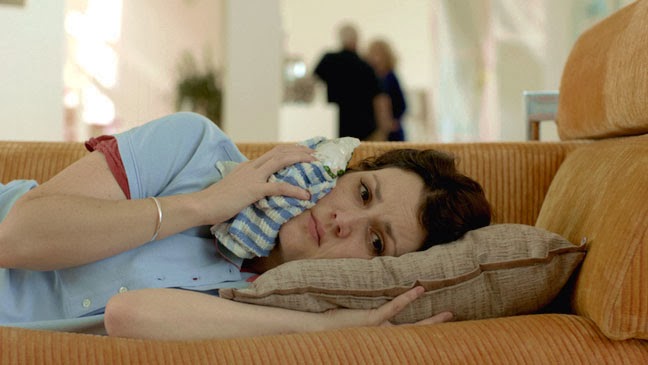
Directed by Todd Luiso and written by Susan Koskoff, Hello I Must Be Going is about a woman who moves back home with her parents following her divorce where she finds herself falling for a younger man. The film is an exploration of a woman trying to start over as she deals with divorce and failure. Starring Melanie Lynskey, Blythe Danner, John Rubenstein, Christopher Abbott, and Dan Futterman. Hello I Must Be Going is an extraordinary film from Todd Luiso.
The film is the simple story of a woman in her mid-30s who moves back home with her parents as she’s dealing with a divorce as she has no idea what to do as she’s in a state of depression. During a dinner party with her parents, her brother, her sister-in-law and a client of her father who brought his 19 year-old son, the woman engages into an affair with the young man where they’re both dealing with issues in their lives as the woman also feels being slighted by her mother who is hoping to go on a trip and retire. The film is essentially a character study of this woman named Amy (Melanie Lynskey) who spends her time at home moping as she is reluctant to get back into the world as she is trying to figure out why did she get divorced.
Susan Koskoff’s screenplay takes it time to explore Amy’s life as this new-divorcee who is angry over the fact that her ex-husband David (Dan Futterman) cheated on her and ended their marriage. She’s back at home not sure what to do and she annoys her mother Ruth (Blythe Danner) who is overlooking the renovation of the house while her father Stan (John Rubenstein) is doing one final job before he can retire. Upon meeting Jeremy (Christopher Abbott) at a dinner party where they have a secret affair, the two vent on their frustrations in life as Jeremy wants to stop acting while his parents think he’s gay. Amy’s affair with Jeremy would later cause some very strange moments where they’re nearly found out but it would also make Amy face her own faults but also try to figure out what went wrong in her marriage as she feels like her mother is blaming her for ruining her own life.
Todd Luiso’s direction is very understated in its simplicity where he uses a lot of close-ups and some medium shots to explore a woman dealing with the state of her life. Much of it includes some hand-held shots and some intimate moments such as a few scenes where Amy and Jeremy would have sex in the car and then talk about their frustrations in life. Shot largely in Westport, Connecticut, the film has a look and feel that seems like it could be anywhere yet it does maintain something that is low-key while Luiso also finds way to have some of the film’s humorous moments be played out naturally such as a scene of Amy coming out of the pool naked singing the Canadian anthem only to be caught by Jeremy’s mother. It’s among these moments that play into Amy’s growth and understanding as a woman as well as trying to find herself. Overall, Luiso crafts a very solid yet mesmerizing film about a woman trying to figure out the next stage in her life.
Cinematographer Julie Kirkwood does excellent work with the film‘s cinematography from the low-key use of lights for the scenes at night as well as the use of colors for some of the daytime scenes. Editor Tom McArdle does terrific work with the editing as it‘s very understated while using a few rhythmic cuts to play out some of the humor. Production designer Russell Barnes and set decorator Daniel R. Kersting do amazing work with the look of the home that Amy’s parents live as well as the house that Jeremy lives in with his parents.
Costume designer Bobby Frederick Tilley does nice work with the costumes from the casual look of the main characters to some of the dresses that Amy wears for dinner dates and such. Sound mixer Christopher J. Leone does fantastic work with some of the film‘s sound to convey some of the atmosphere of the locations as well as some of the mix of sounds in the party scenes. The film’s music by Laura Veirs is wonderful as it is a largely folk-based score with arpeggio guitars along with some original songs by Veirs while music supervisor Holly Adams creates a similar soundtrack that includes contributions from other lesser-known artists with the exception of a song from Billy Squier.
The casting by Kerry Barden, Allison Estrin, and Paul Schnee is brilliant for the ensemble that is created as it features some appearances from Meera Simhan as an old high school classmate of Amy’s, Tori Feinstein as Amy’s niece Caley, Daniel Eric Gold and Sara Chase in their respective roles of Amy’s brother Noah and his wife Missy, Jimmi Simpson as a guy Amy went on a blind date with, Damian Young as Jeremy’s stepfather, and Julie White in a very funny performance as Jeremy’s mother who tries to figure him out as she’s also a therapist. Dan Futterman is terrific in a one-scene performance as Amy’s ex-husband David who meets with Amy where they just try to settle things as he wonders about the things he did.
Christopher Abbott is excellent as Jeremy as a young 19-year old actor who is frustrated with his choice of profession as well as the fact that he is trying to figure out what to do as he falls for Amy. John Rubenstein is superb as Amy’s father Stan as someone who is always caring and making sure she is okay while dealing with the fact that he is set to retire. Blythe Danner is amazing as Amy’s mother Ruth as a woman just obsessed with renovating her house and making sure she will enjoy her husband’s retirement while being a bit snippy towards Amy and her situation. Finally, there’s Melanie Lynskey in a remarkable performance as Amy as this woman in her mid-30s dealing with divorce where Lynskey brings this nice mix of understated drama and humor to the performance that makes Amy a very unique and relatable woman.
Hello I Must Be Going is a phenomenal film from Todd Luiso that features an incredible performance from Melanie Lynskey. Along with strong supporting work from Blythe Danner, John Rubenstein, and Christopher Abbott, the film is a very witty yet engaging portrait of a woman dealing with divorce and failure as she tries to get herself back up. In the end, Hello I Must Be Going is a delightful film from Todd Luiso.
© thevoid99 2013
Written, directed, and starring Woody Allen, Husbands and Wives is the story about a couple’s marriage disintegrating following the announcement of their friends’ decision to divorce. The film explores the world of relationships coming to an end where people go into a journey to find new loves and such as the film would mark Allen’s final collaboration with Mia Farrow after a decade of 12 films in total. Also starring Sydney Pollack, Judy Davis, Liam Neeson, Lysette Anthony, and Juliette Lewis. Husbands and Wives is a provocative yet mesmerizing film from Woody Allen.
The film is a look into the world of marriage and relationships where a couple’s break-up forces another couple to face their own marriage as issues are eventually raised where it leads to certain things about themselves. It’s a film that explores the highs and lows of marriage and relationships as this couple in Jack (Sydney Pollack) and Sally (Judy Davis) have called it quits where both of them seek new lives individually while revelations are unveiled into why they decided to call it quits. For their friends Gabe and Judy Roth (Woody Allen and Mia Farrow), the news of Jack and Sally’s separation definitely brings a reaction where Gabe finds himself intrigued by a 20-year old student named Rain (Juliette Lewis) while Judy tries to set Sally up with her co-worker Michael (Liam Neeson) as Judy tries to deal with her feelings for Michael.
Woody Allen’s screenplay has a narrative that moves back-and-forth where it features the voice of a narrator played by Allen’s longtime costume designer Jeffrey Kurland. The narration plays into these dissolving relationships while characters are seen talking to a documentary film crew as if they’re in a therapy session about themselves and their reaction towards disintegrating relationships. Allen’s approach to his man characters are very unique as they’re all interesting individuals who are also very flawed. Sally is sort of very frigid as she doesn’t seem to be interested in sex and thinks the reason men lose interest in women because they age. Jack is a man who is looking for excitement in his life as Sally couldn’t provide it but a brief tryst with a hooker (Cristi Conaway) and a post-split relationship with an aerobics trainer named Sam (Lysette Anthony).
Eventually, Sally’s relationship with Michael and Jack’s time with Sam would create problems while Gabe and Judy’s relationship would start to disintegrate. Notably as Gabe is a revered novelist/college professor who is often accused of being very critical making Judy feel insecure as Judy herself is a very passive-aggressive person who always get what she wants as she is more affected by Jack and Sally’s break-up. The break-up would play into Judy’s moods where Gabe wants to make love to her at odd times as she’s often confused and flighty leaving Gabe frustrated as he becomes interested in his student Rain who is very smart and is talented in the art of writing. Yet, it would later play into the many confusions about what Gabe and Judy wants and what will happen to them.
Allen’s direction definitely recalls elements of cinema verite where he presents the film in a mixture of documentary with this very loose approach to drama. Notably as many of the film’s dramatic segments are shot in a hand-held style that features elements of the French New Wave where Allen just lets the camera shoot everything as if it’s all happening. It’s a very stripped-down approach for Allen where he wants to capture some semblance of realism in the drama. Especially in the way Allen let the actors act out their frustrations and anger where the dialogue is very frank and confrontational as the camera plays to that intensity. There’s a lot of moments in Allen’s direction where plays into that style while keeping this more simple for the film’s documentary segments where they are reveal but also poignant. Notably in the end where it plays to not just the realities of marriage but also people in what they bring into the relationship. Overall, Allen creates a very compelling and engaging film about relationships and their fallicies.
Cinematographer Carlo Di Palma does brilliant work with the film‘s colorful cinematography to play up the look of the some of the film‘s interiors and exteriors where it has this sense of realism but also a bit of style. Editor Susan E. Morse does fantastic work with the editing where it does play into a sense of style with its use of jump-cuts to capture the energy of the drama. Production designer Santo Loquasto, with set decorator Susan Bode and art director Speed Hopkins, does nice work with the set pieces from the look of the homes the character lives in to some of the places they go to.
Costume designer Jeffrey Kurland does terrific work with the costumes as it‘s mostly casual with the exception of Rain whose youthful clothing play into her personality. Sound editor Robert Hein does excellent work with the sound to play up that sense of realism in the dialogue and scenes set on location. The film’s music soundtrack mostly features some jazz standards and classical music where most of it is played on location to create the realism in the film.
The casting by Juliet Taylor is amazing for the ensemble that is created as it features appearances from Blythe Danner and Brian McConnachie as Rain’s parents, Ron August and John Bucher as a couple of Rain’s former older lovers, Ron Rifkin as Rain’s analyst who fell for her, Benno Schmidt as Judy’s first husband who is interviewed about Judy, and Cristi Conaway as a call-girl Jack briefly hooks up with in the final days of his marriage to Sally. Lysette Anthony is terrific as Jack’s new girlfriend Sam as this young and beautiful aerobics trainer who is full of energy though she isn’t a very smart woman. Liam Neeson is excellent as Judy’s co-worker Michael who goes into a relationship with Sally as he falls for her unaware of Judy’s attraction towards him. Juliette Lewis is wonderful as the student Rain as a young woman who loves Gabe’s work as she reads his manuscripts where her opinion proves to be very strong making Gabe more attractive to her.
Sydney Pollack is superb as Jack as a man seeking for some adventure in his life while admitting about his frustrations towards Sally as he eventually comes to terms with the fact that he might’ve not made the right decision. Judy Davis is brilliant as Sally as a woman who is upset over what Jack did to her as she tries to move on with her life while having a hard time finding herself sexually. Mia Farrow is great as Judy Roth as a woman shocked by Jack and Sally’s split as she starts to question about her own marriage as she finds herself attracted to Michael as it’s definitely Farrow’s best work with Allen. Finally, there’s Woody Allen in a marvelous performance as Gabe Roth as a man going into a journey of his own about himself as he becomes attracted to Rain while dealing with the issues in his own marriage.
Husbands and Wives is a remarkable film from Woody Allen that features amazing performances from Mia Farrow, Judy Davis, Sydney Pollack, Liam Neeson, and Juliette Lewis. The film is definitely one of the most intriguing portraits about marriage and relationships where all of the things talked about in marriage is real as does the sense of temptation to stray. In the end, Husbands and Wives is a phenomenal film from Woody Allen.
Woody Allen Films: What's Up Tiger Lily? - Take the Money & Run - Bananas - Everything You Always Wanted to Know About Sex* (*But Were Afraid to Ask) - Sleeper - Love and Death - Annie Hall - Interiors - Manhattan - Stardust Memories - A Midsummer's Night Sex Comedy - Zelig - Broadway Danny Rose - The Purple Rose of Cairo - Hannah & Her Sisters - Radio Days - September - Another Woman - New York Stories: Oedipus Wrecks - Crimes & Misdemeanors - Alice - Shadows & Fog - Manhattan Murder Mystery - Don’t Drink the Water - Bullets Over Broadway - Mighty Aphrodite - Everyone Says I Love You - Deconstructing Harry - Celebrity - Sweet & Lowdown - Small Time Crooks - The Curse of the Jade Scorpion - Hollywood Ending - Anything Else - Melinda & Melinda - Match Point - Scoop - Cassandra’s Dream - Vicky Cristina Barcelona - Whatever Works - You Will Meet a Tall Dark Stranger - Midnight in Paris - To Rome with Love - Blue Jasmine - Magic in the Moonlight - Irrational Man - (Cafe Society)
The Auteurs #24: Woody Allen Pt. 1 - Pt. 2 - Pt. 3 - Pt. 4
© thevoid99 2013
Written and directed by Woody Allen, Alice is the story about an upper-class New York housewife whose life changes after meeting a jazz musician as she thinks about her life as she turns to a mysterious Chinese man for help. Inspired by Federico Fellini’s 1965 film Juliet of the Spirits, the film is a mixture of romance and fantasy where a woman tries to find herself away from the life she’s lived. Starring Mia Farrow, William Hurt, Joe Mantegna, Alec Baldwin, Keye Luke, Judy Davis, Blythe Danner, Cybill Shepherd, Bernadette Peters, and Bob Balaban. Alice is an extraordinary film from Woody Allen.
The film plays into the life of a rich New York City housewife who goes to a mysterious Chinese man (Keye Luke) in Chinatown to get something for her aching back. What happens instead is that this woman named Alice (Mia Farrow) goes into a journey of self-discovery as she thinks about her 16-year marriage to Doug (William Hurt) while falling for a musician named Joe (Joe Mantegna) whom she had dreams about. In taking different amounts of herbs, Alice encounters these revelations about her life while wondering who to be with as she turns to her estranged sister Dorothy (Blythe Danner) for help while becoming driven to do something about her life.
It’s a film that takes this woman who for all of her life has lived a world where it’s very routine where she shops, goes to salons, gossip with various friends, and do all sorts of things as a rich woman. Yet, Alice is also quite prudish and unwilling to take risks where she seems to be content with her life despite the fact that she and Doug don’t spend much time together anymore as he’s always working. It’s only until she starts to have some backaches where she meets the mysterious Dr. Yang as she takes different herbs in her drinks to play into her attraction towards Joe as well as doing things like be invisible and pry into his life and other people’s lives.
The screenplay that Woody Allen creates is full of these revelations that Alice faces not just about herself but also her late mother (Gwen Verdon) and the things she does as well as her marriage that’s definitely lost steam. While she finds some happiness in Joe, it’s not enough as Joe is dealing with being a divorcee with a child to take care of. Though Alice is also a mother, her two kids are often in the care of a nanny as it adds more to her own existential plight as well as what kind of woman she needs to be.
Allen’s direction is quite straightforward in terms of compositions though there are moments of style in the way he brings up this idea of fantasy. Notably as it includes a sequence where Alice meets the ghost of her former lover Ed (Alec Baldwin) who observes her as well as Joe while having a very low opinion on Doug. There’s also some funny moments of Alice being invisible as she talks to a friend on the phone as only the phone is shown while another sequence has Alice and Joe both be invisible through the herbal drink that Alice had been carrying where it’s funny but also would become a key plot point for both characters. There’s also a moment where Alice has to face things about her childhood and her relationship with her estranged sister as it also plays some truths about her mother. All of these revelations where Allen uses medium shots and some close-ups are all to express Alice’s journey into finding herself and meaning in her life. Overall, Allen crafts a very majestic and compelling film about a woman’s personal journey in finding herself.
Cinematographer Carlo Di Palma does excellent work with the film‘s very colorful cinematography from some of the look of the interiors like Alice and Doug‘s home to the more low-key look of the scenes in Chinatown. Editor Susan E. Morse does nice work with the editing as it‘s mostly straightforward where it doesn‘t go for style except in a few rhythmic cuts for some of its comedic moments. Production designer Santo Loquasto, with set decorator Susan Bode and art director Speed Hopkins, does amazing work with the set designs from the look of Alice and Doug’s posh home to the school where her kids and Joe’s daughter go to.
Costume designer Jeffrey Kurland does fantastic work with the costumes from the posh clothes Alice and her friends wear to the more simplistic look of Dr. Yang. Visual effects supervisor Randall Balsmeyer does terrific work with some of the visual effects like the dissolved look of Ed to some of the moments where Alice and Joe become invisible. Sound editor Robert Hein does superb work with the sound to create some effects where dialogue is presented while the characters aren’t talking as well as some of the scenes in the locations. The film’s music soundtrack features a mix of jazz and classical music to play up the sense of adventure and fantasy that is prevalent in the film.
The casting by Juliet Taylor is brilliant for the ensemble that is created where it features some small appearances from Holland Taylor as a friend of Alice’s, June Squibb as Alice’s maid, Gwen Verdon and Patrick O’Neal as Alice’s late parents, filmmaker James Toback as a writing professor Alice briefly goes to for instructions on writing, Elle MacPherson as a model at a clothing store, Bob Balaban as a guest at Dorothy’s Xmas party, and Judy Davis as Joe’s ex-wife Vicki. Other notable small roles include Alec Baldwin as Alice’s deceased lover Ed, Bernadette Peters as a muse who appears through one of Alice’s herbal drinks, and Cybill Shepherd as an old friend of Alice’s who becomes a powerful TV executive who is uninterested in Alice’s ideas.
Keye Luke is amazing as Dr. Yang as a man who gives Alice mysterious herbs to help her as he would guide her into the journey that she must take. William Hurt is terrific in a small though sort of bland role as Alice’s husband Doug as a man who is always working while not really understanding about what his wife does. Blythe Danner is wonderful as Alice’s older sister Dorothy as a woman whom Alice hadn’t seen who becomes aware of Alice’s problems as well as giving her some harsh truths about Alice. Joe Mantegna is great as the musician Joe Ruffalo as a man whom Alice falls for as he is seeking for someone to overcome his life as a divorced man while being mystified by some of Alice’s experience with the herbs. Finally, there’s Mia Farrow in a remarkable performance as the titular character as a woman who learns about her life as well as finding more about herself as Farrow brings a bit of humor and humility to a character that becomes strong as the story progresses.
Alice is a marvelous film from Woody Allen that features a winning leading performance from Mia Farrow. Along with a great supporting cast that includes Joe Mantegna, William Hurt, Blythe Danner, and the late Keye Luke. It’s a film that isn’t just one of Allen’s more entertaining films but also one of his most thought-provoking about individuality and finding a role in life. In the end, Alice is a sensational film from Woody Allen.
Woody Allen Films: What's Up Tiger Lily? - Take the Money & Run - Bananas - Everything You Always Wanted to Know About Sex* (*But Were Afraid to Ask) - Sleeper - Love and Death - Annie Hall - Interiors - Manhattan - Stardust Memories - A Midsummer's Night Sex Comedy - Zelig - Broadway Danny Rose - The Purple Rose of Cairo - Hannah & Her Sisters - Radio Days - September - Another Woman - New York Stories: Oedipus Wrecks - Crimes & Misdemeanors - Shadows & Fog - Husbands & Wives - Manhattan Murder Mystery - Don’t Drink the Water - Bullets Over Broadway - Mighty Aphrodite - Everyone Says I Love You - Deconstructing Harry - Celebrity - Sweet & Lowdown - Small Time Crooks - The Curse of the Jade Scorpion - Hollywood Ending - Anything Else - Melinda & Melinda - Match Point - Scoop - Cassandra’s Dream - Vicky Cristina Barcelona - Whatever Works - You Will Meet a Tall Dark Stranger - Midnight in Paris - To Rome with Love - Blue Jasmine - Magic in the Moonlight - Irrational Man - (Cafe Society)
The Auteurs #24: Woody Allen Pt. 1 - Pt. 2 - Pt. 3 - Pt. 4
© thevoid99 2013
Written and directed by Woody Allen, Another Woman is the story about a philosophy professor whose life unravels after listening to a private psychoanalyst on another woman as she starts to question about her own life. The film is an exploration into the world of identity as well as the choices one makes in a person’s life. Starring Gena Rowlands, Mia Farrow, Ian Holm, Gene Hackman, Harris Yulin, Frances Conroy, Betty Buckley, Blythe Danner, Martha Plimpton, John Houseman, and Philip Bosco. Another Woman is an engrossing yet mesmerizing film from Woody Allen.
What happens when a woman accidentally listens to another woman talking about her own problems leading for this woman to deal with her own life? That’s essentially the premise of the film where a philosophy professor named Marion (Gena Rowlands) finds herself questioning about not just herself but the way she treated the people in her life as she‘s always been judgmental and at times, quite cruel. The revelations that Marion faces about herself and the people in her life forces her to reflect on her past while continually listen to the psychiatric sessions of this pregnant yet troubled woman (Mia Farrow). What Woody Allen does with the script is create a story about a woman’s life being told where Marion often narrates to play into her feelings as well as thinking about the people in her life such as her brother Paul (Harris Yulin) and father (John Houseman) as well as her own marriage to Ken (Ian Holm).
Allen’s direction definitely recalls the work of Ingmar Bergman, most notably Wild Strawberries, in terms of its visual language and its intimacy towards drama. Notably as it plays into the idea of memory and fantasy where this woman has to look back in parts of her life including the way she realizes how complicated things are. Allen’s direction is straightforward though there is a sense of style in terms of close-ups and compositions where Allen goes to Bergman for inspiration. Still, Allen does instill some of his own ideas such as a scene where Marion watches a recreation of a conversation she had with Ken as Marion is being played by her former friend Claire (Sandy Dennis) to establish some ideas about not just who Marion but also a look into her own marriage. Notably as it would force Marion to see her life and what can she do to regain some sense of who she is. Overall, Allen creates a very engaging yet captivating film about a woman reflecting on her life.
Cinematographer Sven Nykvist does brilliant work with the film‘s photography as it recalls many of his work with Ingmar Bergman from the lush look of some of its exterior scenes in the flashbacks to the more colorful look of the locations in New York City. Editor Susan E. Morse does excellent work with the editing to help create seamless transitions from reality to fantasy while keeping things straightforward without any overly-stylized cuts. Production designer Santo Loquasto, with set decorator George DeTitta Jr. and art director Speed Hopkins, does nice work with the look of the NYC apartments and homes the characters live including the look of an antiques shop where Marion meets the woman she‘s been listening to.
Costume designer Jeffrey Kurland does terrific work with the costumes as it‘s mostly sort of colorless and bland to represent the world of the characters and their sort of lack of emotions. Sound editor Robert Hein does wonderful work with the sound from the way Marion listens to the other woman in a session to some of the scenes set in New York City. The film’s music soundtrack is mostly a mix of jazz and classical music that includes a piece Erik Satie that often dominates the film.
The casting by Juliet Taylor is fantastic for the ensemble that is created as it features appearances from Fred Melamed as a guest at an engagement party for Ken and Marion in a flashback, Josh Hamilton as the boyfriend of Ken’s daughter, David Odgen Stiers as the younger version of Marion and Paul’s father, Stephen Mailer and Margaret Marx in their respective roles as the young Paul and Marion, Philip Bosco as Marion’s first husband Sam, Frances Conroy as Marion’s sister-in-law Lynn, and Betty Buckley as Ken’s ex-wife Kathy whose sole appearance at Ken and Marion’s engagement party is chilling to watch. Martha Plimpton is excellent as Ken’s daughter Laura who always turn to Marion for advice while Blythe Danner is very good as Marion’s friend Lydia who always likes to socialize with her and Ken. Harris Yulin is terrific as Marion’s brother Paul who is a man that lacks ambition but wants to do right for his family.
Gene Hackman is great in a small but memorable performance as Ken’s friend Larry who admits to having feelings for Marion as he would play a key part into Marion’s own revelations about her life. John Houseman is amazing as Marion and Paul’s father as a man who also thinks about his life while appearing in a fantasy where he expresses his own regrets. Sandy Dennis is wonderful as Marion’s old friend Claire who expresses her own bitterness towards Marion about their friendship as she later plays Marion in a recreation of a conversation scene. Mia Farrow is superb as the mysterious woman Marion discovers as she is a woman anguished by her own problems in life as she would play a key role into Marion’s own discovery.
Ian Holm is brilliant as Marion’s husband Ken as a man who seems to be content with his life but is sort of aloof in the fact that he and Marion don’t spend a lot of alone time together. Finally, there’s Gena Rowlands in a remarkable performance as Marion where Rowlands display a sense of restraint to a woman who becomes unaware of the life she’s leading. Notably as Rowlands adds that sense of distance to her character as someone who is sort of cruel as well as judgmental as she starts to realize some of the trouble aspects of her life as it’s a very mesmerizing performance from Rowlands.
Another Woman is a marvelous film from Woody Allen that features tremendous performance from Gena Rowlands. Armed with a great ensemble cast as well as themes of regrets and identity, the film isn’t just a fantastic tribute to the works of Ingmar Bergman. It’s also a drama that explores a woman searching for herself in a crucial period in her life as she ponders about the choices she’s made. In the end, Another Woman is a phenomenal film from Woody Allen.
Woody Allen Films: What's Up Tiger Lily? - Take the Money & Run - Bananas - Everything You Always Wanted to Know About Sex* (*But Were Afraid to Ask) - Sleeper - Love and Death - Annie Hall - Interiors - Manhattan - Stardust Memories - A Midsummer's Night Sex Comedy - Zelig - Broadway Danny Rose - The Purple Rose of Cairo - Hannah & Her Sisters - Radio Days - September - New York Stories: Oedipus Wrecks - Crimes & Misdemeanors - Alice - Shadows & Fog - Husbands & Wives - Manhattan Murder Mystery - Don’t Drink the Water - Bullets Over Broadway - Mighty Aphrodite - Everyone Says I Love You - Deconstructing Harry - Celebrity - Sweet & Lowdown - Small Time Crooks - The Curse of the Jade Scorpion - Hollywood Ending - Anything Else - Melinda & Melinda - Match Point - Scoop - Cassandra’s Dream - Vicky Cristina Barcelona - Whatever Works - You Will Meet a Tall Dark Stranger - Midnight in Paris - To Rome with Love - Blue Jasmine - Magic in the Moonlight - Irrational Man - (Cafe Society)
The Auteurs #24: Woody Allen Pt. 1 - Pt. 2 - Pt. 3 - Pt. 4
© thevoid99 2013