Showing posts with label dan futterman. Show all posts
Friday, March 18, 2016
The Birdcage
Based on the 1978 film La Cage aux Folles by Edouard Molinaro that was based on the play by Jean Poiret and Francis Verber, The Birdcage is the story of a gay nightclub owner and his partner who both pretend to be straight in meeting the family of their son’s fiancee whose father is an ultra-conservative Senator caught up in a scandal that he’s not involved in. Directed by Mike Nichols and screenplay by Elaine May, the film marks a twenty-five year reunion between Nichols and May who were a famous comedy duo in the late 50s as they explore two gay men struggling with meeting a man who might not approve of their lifestyle. Starring Robin Williams, Gene Hackman, Nathan Lane, Dianne Wiest, Dan Futterman, Calista Flockhart, Hank Azaria, Tom McGowan, Grant Heslov, and Christine Baranski. The Birdcage is a dazzling and witty film from Mike Nichols.
The film revolves around an openly gay couple in a nightclub owner and his partner who is the star of the show where they learn that their son is going to marry the daughter of a powerful, ultra-conservative senator who is embroiled in a scandal that involved the death of a colleague. When the son learns that his fiancee’s family wants to meet them, trouble brews forcing Armand Goldman (Robin Williams) to pretend to be straight as well as trying to get his partner in the effeminate Albert (Nathan Lane) to act straight so that they would make a good impression for Senator Kevin Keeley (Gene Hackman). Along the way, hilarity ensues which leads to a crazy night of confusion, chaos, and amazement while Keeley is trying to shield himself from the press.
Elaine May’s screenplay isn’t just filled with some funny dialogue and situations that add so much to the chaotic tone of the story. It’s also in the fact that Armand and Albert are portrayed as a loving couple that has been through ups-and-downs where Armand is a man that organize things as well as be the one to direct Albert for a performance. Albert is the maternal figure who deeply cares for Armand’s son Val (Dan Futterman) though Val’s real mother in Katherine Archer (Christine Baranski) had never seen her son until she is later asked by Armand to aid them in dealing with the Keeleys. Though Senator Keeley and his wife Louise (Dianne Wiest) aren’t bad people as the latter is the more sensible of the two, the senator is overwhelmed by the fact that one of his colleagues who had helped found this moral coalition was found dead with an underage, African-American prostitute.
When it is time for the two families to meet that would include Val’s fiancee Barbara (Calista Flockhart), it is one of the most tense moments in the film as it relates to what role Albert would play despite the many attempts to include him or to have him act straight. It plays into the fact that he is sort of a liability as Val doesn’t want to see him get chewed on for who he is but it also showcases that he really does underestimate exactly what kind of man Albert is. Especially where he pulls a surprising stunt that makes Armand and Val extremely nervous while displaying some revelations of his own in how views things into the world that would even amaze someone as conservative as Senator Keeley. All of which showcases that despite these lifestyle differences that both gays and straights can share similar views. Then there’s the subplot as it relates to Keeley being hounded by a tabloid reporter Harry Radman (Tom McGowan) who is eager to make Keeley’s life a living hell though Keeley isn’t doing anything wrong or scandalous but it does play into the viciousness of the American press who are more interested in headlines rather than the truth.
Mike Nichols’ direction is definitely exquisite for not just capturing that sense of intimacy and realness to the life of a gay couple but also in finding the humor of the situations Albert and Armand have to go through. Shot largely on location in Miami, notably the South Beach section of the city and some shots in California as part of the American Northeast, the film does have this sense of vibrancy that play into who Armand and Albert are as well as a world that is very in tune with the times as it is something that Senator Keeley would have a hard time understanding. While Nichols would create some unique compositions including medium shots and close-ups to play up the intimacy and interaction between multiple characters to showcase some similarities on the concept of family values. He also uses some wide shots to play into the world of South Beach but also in a key scene where Armand and Albert are on a bench together which then cuts to a medium shot as it play more into the idea of why they’re meant for each other.
Nichols’ approach to humor is definitely lively in the way it just camps up the element of gay stereotypes as well as make fun of tabloid media in how ruthless they are in getting the story. There are also these moments that are just naturally funny in a scene where Armand is directing a performance that Albert is planning to do along with the scene where Albert tries to walk straight. By the time the film reaches its third act where the Goldmans meet the Keeleys, there is that sense of tension and uncertainty that looms until Albert makes an appearance in only a way that he can make an appearance. It is as if Nichols decides to cut that unease and let things become funny and natural all over again though there is still that sense of danger of how it could go wrong as well as what is happening outside of the home that would lead to one of the most hilarious payoffs in film. Overall, Nichols creates a dazzling, touching, and extremely funny film about a gay couple pretending to be straight for an ultra-conservative Senator.
Cinematographer Emmanuel Lubezki does incredible work with the film‘s very lush and colorful cinematography with the vibrant look of Miami and South Beach in its exteriors to the usage of low-key lighting schemes for some of its interiors in the day as well as some stylish lighting for the scenes inside the club. Editor Arthur Schmidt does excellent work with the editing as it is largely straightforward to play into some of the humor as well as the film‘s climax with the families meeting each other. Production designer Bo Welch, with set decorator Cheryl Carasik and art director Tom Duffield, does amazing work with the look of the nightclub that Armand runs as well as the home that is next to the club that is quite stylish while the look of it when it is being changed is quite rich in its humor. Costume designer Ann Roth does fantastic work with the costumes from the stylish costumes that Albert wears in his performances to the colorful clothes of Armand and Albert to the more conservative clothes of the Keeleys.
Hair/makeup designers J. Roy Helland and Peter Owen do nice work with the wigs that Albert would wear as well as some of the makeup he sports for his performances onstage. Sound editor Ron Bachar does superb work with the sound to play into the atmosphere in the clubs as well as a few moments in the background during the tense meeting between the Goldmans and the Keeleys. The film’s music by Stephen Sondheim is brilliant for its mixture of show tunes, Latin-based music, and a few orchestral pieces to play into the different tones and landscape of the locations while music supervisor Steve Goldstein would maintain that mixture of styles of music featuring not just show tunes but also contemporary music from Sister Sledge and Gloria Estefan and the Miami Sound Machine.
The casting by Ellen Lewis and Juliet Taylor are phenomenal as it features some notable appearances from Kirby Mitchell as the Keeleys’ chauffer who will reveal anything to the press for money, Grant Heslov as a photographer for the National Enquirer, and Tom McGowan in a terrific role as the opportunistic tabloid journalist Harry Radman. Christine Baranski is wonderful as Val’s biological mother Katherine who was a former lover of Armand as she agrees to help them while admitting she still has some feelings for Armand. Hank Azaria is hilarious as Armand and Albert’s housekeeper Agador Spartacus who always wear very little clothing while his attempts to act like a straight butler are just a riot. Calista Flockhart is fantastic as Barbara Keeley as Val’s fiancee who is trying to protect Val and his family by lying to her parents in who they are where she realized that she and Val just only caused more trouble. Dan Futterman is excellent as Val as 20-year old man who is in love and wants to marry Barbara but becomes worried about what Barbara’s father would think of the two men who raised him as he copes with the chaos of what his father is trying to do to help.
Dianne Wiest is amazing as Barbara’s mother Louise as the most sensible one in the family who believes that Barbara’s wedding to Val would help her husband while being unaware of the truth of who Val’s family are. Gene Hackman is incredible as Senator Kevin Keeley as an ultraconservative political leader overwhelmed by scandal as he ponders what good will come of this union between Barbara and Val where Hackman would have some funny moments later in the film. Nathan Lane is brilliant as Albert Goldman as an effeminate performer who is really Val’s mother as he copes with what is going on while trying to act straight and such only to come with a plan of his own that is just hilarious. Finally, there’s Robin Williams in a remarkable performance as Armand Goldman as a club owner/performance director who does whatever he can to help his son as well as his partner Albert as Williams largely plays it straight while displaying some great comedic timing in a scene where he is directing Albert as well as some moments in the way he reacts to Albert’s stunt at the dinner meeting with the Keeleys.
The Birdcage is a magnificent film from Mike Nichols that features great performances from Robin Williams, Nathan Lane, Gene Hackman, and Dianne Wiest. It’s a film that isn’t just one of the funniest and most engaging stories about gay-and-lesbian relationships but also displaying how to different views can meet and find some common ground. Especially as it is told with such wit by screenwriter Elaine May and presented with such beauty by cinematographer Emmanuel Lubezki. In the end, The Birdcage is a spectacular film from Mike Nichols.
Related: La Cage aux Folles
Mike Nichols Films: Who’s Afraid of Virginia Woolf? - (The Graduate) - (Catch-22) - Carnal Knowledge - (The Day of the Dolphin) - (The Fortune) - (Gilda Live) - (Silkwood) - (Heartburn) - (Biloxi Blues) - Working Girl - Postcards from the Edge - (Regarding Henry) - (Wolf (1994 film)) - (Primary Colors) - (What Planet Are You From?) - (Wit) - (Angels in America) - Closer - (Charlie Wilson’s War)
© thevoid99 2016
Wednesday, November 27, 2013
Hello I Must Be Going
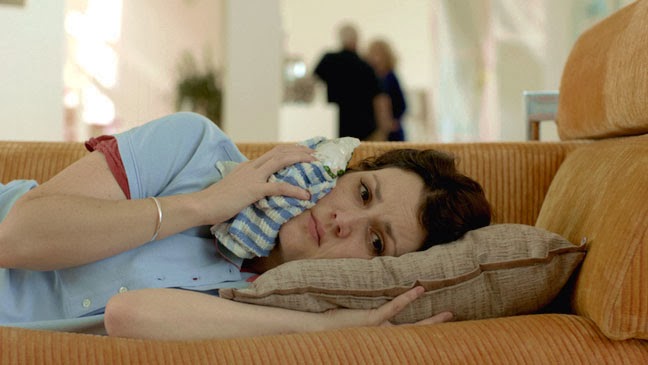
Directed by Todd Luiso and written by Susan Koskoff, Hello I Must Be Going is about a woman who moves back home with her parents following her divorce where she finds herself falling for a younger man. The film is an exploration of a woman trying to start over as she deals with divorce and failure. Starring Melanie Lynskey, Blythe Danner, John Rubenstein, Christopher Abbott, and Dan Futterman. Hello I Must Be Going is an extraordinary film from Todd Luiso.
The film is the simple story of a woman in her mid-30s who moves back home with her parents as she’s dealing with a divorce as she has no idea what to do as she’s in a state of depression. During a dinner party with her parents, her brother, her sister-in-law and a client of her father who brought his 19 year-old son, the woman engages into an affair with the young man where they’re both dealing with issues in their lives as the woman also feels being slighted by her mother who is hoping to go on a trip and retire. The film is essentially a character study of this woman named Amy (Melanie Lynskey) who spends her time at home moping as she is reluctant to get back into the world as she is trying to figure out why did she get divorced.
Susan Koskoff’s screenplay takes it time to explore Amy’s life as this new-divorcee who is angry over the fact that her ex-husband David (Dan Futterman) cheated on her and ended their marriage. She’s back at home not sure what to do and she annoys her mother Ruth (Blythe Danner) who is overlooking the renovation of the house while her father Stan (John Rubenstein) is doing one final job before he can retire. Upon meeting Jeremy (Christopher Abbott) at a dinner party where they have a secret affair, the two vent on their frustrations in life as Jeremy wants to stop acting while his parents think he’s gay. Amy’s affair with Jeremy would later cause some very strange moments where they’re nearly found out but it would also make Amy face her own faults but also try to figure out what went wrong in her marriage as she feels like her mother is blaming her for ruining her own life.
Todd Luiso’s direction is very understated in its simplicity where he uses a lot of close-ups and some medium shots to explore a woman dealing with the state of her life. Much of it includes some hand-held shots and some intimate moments such as a few scenes where Amy and Jeremy would have sex in the car and then talk about their frustrations in life. Shot largely in Westport, Connecticut, the film has a look and feel that seems like it could be anywhere yet it does maintain something that is low-key while Luiso also finds way to have some of the film’s humorous moments be played out naturally such as a scene of Amy coming out of the pool naked singing the Canadian anthem only to be caught by Jeremy’s mother. It’s among these moments that play into Amy’s growth and understanding as a woman as well as trying to find herself. Overall, Luiso crafts a very solid yet mesmerizing film about a woman trying to figure out the next stage in her life.
Cinematographer Julie Kirkwood does excellent work with the film‘s cinematography from the low-key use of lights for the scenes at night as well as the use of colors for some of the daytime scenes. Editor Tom McArdle does terrific work with the editing as it‘s very understated while using a few rhythmic cuts to play out some of the humor. Production designer Russell Barnes and set decorator Daniel R. Kersting do amazing work with the look of the home that Amy’s parents live as well as the house that Jeremy lives in with his parents.
Costume designer Bobby Frederick Tilley does nice work with the costumes from the casual look of the main characters to some of the dresses that Amy wears for dinner dates and such. Sound mixer Christopher J. Leone does fantastic work with some of the film‘s sound to convey some of the atmosphere of the locations as well as some of the mix of sounds in the party scenes. The film’s music by Laura Veirs is wonderful as it is a largely folk-based score with arpeggio guitars along with some original songs by Veirs while music supervisor Holly Adams creates a similar soundtrack that includes contributions from other lesser-known artists with the exception of a song from Billy Squier.
The casting by Kerry Barden, Allison Estrin, and Paul Schnee is brilliant for the ensemble that is created as it features some appearances from Meera Simhan as an old high school classmate of Amy’s, Tori Feinstein as Amy’s niece Caley, Daniel Eric Gold and Sara Chase in their respective roles of Amy’s brother Noah and his wife Missy, Jimmi Simpson as a guy Amy went on a blind date with, Damian Young as Jeremy’s stepfather, and Julie White in a very funny performance as Jeremy’s mother who tries to figure him out as she’s also a therapist. Dan Futterman is terrific in a one-scene performance as Amy’s ex-husband David who meets with Amy where they just try to settle things as he wonders about the things he did.
Christopher Abbott is excellent as Jeremy as a young 19-year old actor who is frustrated with his choice of profession as well as the fact that he is trying to figure out what to do as he falls for Amy. John Rubenstein is superb as Amy’s father Stan as someone who is always caring and making sure she is okay while dealing with the fact that he is set to retire. Blythe Danner is amazing as Amy’s mother Ruth as a woman just obsessed with renovating her house and making sure she will enjoy her husband’s retirement while being a bit snippy towards Amy and her situation. Finally, there’s Melanie Lynskey in a remarkable performance as Amy as this woman in her mid-30s dealing with divorce where Lynskey brings this nice mix of understated drama and humor to the performance that makes Amy a very unique and relatable woman.
Hello I Must Be Going is a phenomenal film from Todd Luiso that features an incredible performance from Melanie Lynskey. Along with strong supporting work from Blythe Danner, John Rubenstein, and Christopher Abbott, the film is a very witty yet engaging portrait of a woman dealing with divorce and failure as she tries to get herself back up. In the end, Hello I Must Be Going is a delightful film from Todd Luiso.
© thevoid99 2013
Monday, April 02, 2012
A Mighty Heart
Originally Written and Posted at Epinions.com on 6/24/07 w/ Additional Edits.
Following the attacks of 9/11/01 and the uproar over terrorism that included Al-Qaeda and other terrorists affiliates in Afghanistan and parts of Pakistan. There was a frenzy in the world of journalism on information into what was going on. The motives, who were people working for, and such. One of those journalists who was in Pakistan covering the world of terrorism was American journalist Daniel Pearl. In late January 2002, Pearl was kidnapped by a terrorist group on his way to interview a terrorist leader. Pearl was later killed on February 1, 2002 just days after photos of him handcuffed and with a gun to his head were shown. His body cut into pieces, and the horror of his death sent shockwaves around the world. Around this time, his wife Mariane was pregnant with their son Adam who would be born later in May 2002. A year later, Mariane Pearl released a memoir about her husband's life and death in the book entitled A Mighty Heart where years later, it's become a film of the same name.
Directed by British auteur Michael Winterbottom with an adapted script by John Orloff with screen story credit by Sarah Crichton. A Mighty Heart tells the story of Daniel and Mariane Pearl's time in Pakistan following the attacks of 9/11 that would eventually led to Daniel Pearl's death. The film is a detailed account based on Mariane Pearl's memoirs and the time of her husband's death. Playing the roles of the couple are Capote screenwriter Dan Futterman and Angelina Jolie in their respective roles of Daniel and Mariane Pearl. Also starring Archie Panjabi, Jillian Armenante, Irfan Khan, and Will Patton. A Mighty Heart is a powerful yet harrowing drama from Michael Winterbottom.
Following the attacks of 9/11 and the war against Al-Qaeda and the Taliban in parts of Pakistan, journalists all over the world are covering the war on terror as well as terrorism itself. Among them are the Pearls, Wall Street journalist Daniel Pearl and his French-born, multiracial wife Mariane, who is pregnant with their child. Living with another Wall Street journalist in Asra Nomani (Archie Panjabi) in Karachi, Pakistan, Daniel Pearl uncovers a possible link between a terrorist organization in Pakistan to the shoe-bomber Richard Reid, who tried to blow up a plane. On January 23, 2002, Daniel Pearl leaves for another typical assignment as he hopes to meet contacts to a man named Sheikh Gilani (Ikram Bhatti). He would never be seen again where on that day, Mariane went shopping for dinner waiting for her husband.
The next day, he doesn't come home as Mariane, Asra, and others wonder where is he as they call the police to report him missing. A police captain (Ifran Khan) is called upon to supervise the investigation with help from FBI agents Maureen Platt (Jillian Armenante) and Randall Bennett (Will Patton) who met Daniel on the day he disappeared during Daniel's meeting on whether or not he should meet the contact. The suspicions arises when everyone tries to find out where is Daniel and if he's alive. Finally, photos of him had surfaced through suspicious emails claiming to have Daniel Pearl in custody. The captain goes further into the city of Karachi as he tries to find the locations of computers and such. Wall Street journalist Steve LeVine (Gary Wilmes) and editor John Skelton (Demetri Goritsas) join in to help Mariane.
With Mariane often contacts Daniel's parents Judea (Jeffry Kaplow) and Ruth Pearl (Perrine Moran) for news, she helps along in the investigation since she too, is a journalist. When Sheikh Gilani is caught, the captain and Bennett learn that Gilani is not the man but bait. Another contact Daniel was supposed to meet for Gilani was a man named Bashir whose real name is Ahmed Omar Saeed Sheikh (Aly Khan). After capturing several associates, the captain learns that Omar has been caught already as he is interrogated to see if he knows where Daniel is. Time goes by when finally, a video tape was surfaced through a Pakistan journalist giving it to an American when the truth is uncovered breaking the hearts of everyone including Mariane.
A film like this based on a real-life tragedy could've been handled with a heavy-handed approach into melodrama. Fortunately, in the hands of the very prolific Michael Winterbottom. The film doesn't stray into traditional or conventional, Hollywood territory of huge dramatic moments and endings that aren't realistic. With John Orloff's adapted script based on Mariane Pearl's novel, the film is less plot-driven but rather plays itself as an unconventional thriller filled with suspense of what happens. While the audience knows what happens in the end, Michael Winterbottom goes for the same documentary-like style to tell the story. While the cinema verite style might not be everyone's cup of tea, the immediacy and intensity of Winterbottom's direction makes it feel like the audience is watching everything unfold.
The direction of Winterbottom with the film shot in India, rather than Pakistan for security reasons, is wonderfully handled. While not much is revealed on the film's politics though the film opens with reports of the world following the events of Pakistan. The film is not about politics but rather about this woman trying to cling on to some kind of hope that her husband is alive only to be wrecked by tragedy. Yet, the aftermath of Daniel's death shows it strength in the character of Mariane who gives a fascinating speech about terror that isn't preachy at all. Even the use of flashbacks about Daniel and Mariane's life shows the strength of that character. While the film has shots of Karachi, the locations as well as the hand-held camera style really gives the film a unique style that wouldn't work by Hollywood standards or in the hands of lesser director. In the end, it's Winterbottom's strength as a director and his unique style that brings a lot of attention to the film's story and drama.
Cinematographer Marcel Zyskind and his digital-camera photography really adds nuance to many of the film's locations with its natural, documentary-like photography on many of the film's exterior sequences. For the interior scenes, notably in the home base of the Pearls, the film looks very intimate while doesn't go into too many close-ups to capture the drama. Editor Peter Christelis does excellent work on using jump-cuts to bring an unconventional rhythm to the film's pacing while using stock footage to convey what was going on in early 2002. Production designer Mark Digby and art director Christopher Sull create a wonderful look to the home of the Pearls that include a marker board that creates a puzzle for the investigation. Charlotte Walter goes for realism in the film's look of clothes that shows the personality of Mariane and her connection to Daniel.
Makeup artist Toni G and hair stylist Adruitha Lee do wonderful work in recreating Angelina Jolie into the character of Mariane Pearl with her perm hair, dark eyes, and her unique look. Sound editor Joakim Sundstrom definitely captures the atmosphere of Karachi that includes the morning prayer blasted through the city as well as some of the film's highly, emotional moments. The film's score is by Harry Escott and Molly Nyman. Mostly using acoustic guitars to convey the suspense as well as a low-key orchestral score, the film also includes a wonderful piano piece by Nyman that reveals the film's emotions and Mariane's love for Daniel.
The film's cast is wonderfully assembled that features small performances from Denis O'Hare as John Bussey, Zachary Coffin as Matt McDowell, Jillian Armenante, Perrine Moran, Jeffry Kaplow, Demetri Goritsas, Gary Wilkes, Amy Shindler as Daniel's sister Michelle, and Chad Chenouga as Mariane's brother Satchi. In the roles of the suspects, Aly Khan and Ikram Bhatti are wonderfully performed, especially for not being portrayed as villains but real-life human beings. Will Patton gives an excellent performance as Randall Bennett, the FBI agent who is part of the investigation who tries to help things out while having a funny one-liner about the investigation. Archie Panjabi gives an amazing performance as Asra Nomani, the Wall Street journalist and friend who tries to use her connections to help the investigation while being the sympathetic friend for Mariane.
Ifran Khan is also great as the captain who leads the investigation while not being afraid to be rough in order to interrogate. Khan brings a presence that is very alarming to the film as a man who wants to do what is right for not just Mariane but his country who is starting to look real bad in front of the world. Dan Futterman is wonderful as Daniel Pearl where he's often seen mostly in flashbacks as a man who seems like a professional journalist and a good husband. Futterman definitely sells the wonderful human being that is Daniel Pearl to the way he adores Mariane and how he is with his fellow journalists.
In what has to be her best film role since her Oscar-winning performance in James Mangold's 1999 film Girl, Interrupted, Angelina Jolie definitely disappears into the character of Mariane Pearl. While some parts of Pearl's French accent may not be perfect nor does she look like Mariane. Jolie still manages to portray this woman like anyone who would go through a tragedy like this. What is more striking about her performance is how restrained she is through most of the film as she strips down all layers of her public persona and goes into character. When the moment of tragedy occurs, it's Jolie's strength in that character that is really shocking and powerful. Overall, it's a fantastic performance from Angelina Jolie.
While not up to par with films like Wonderland, 24 Hour Party People, or In This World, A Mighty Heart is still a powerful movie by Michael Winterbottom. Fans of Angelina Jolie will no doubt find her performance to be one of her best. Fans of Winterbottom will be amazed that the director didn't change his style, even to a film that is involved by the likes of Jolie and producer Brad Pitt. Yet, the film isn't about Jolie, Pitt, or Winterbottom but rather the Pearls. Daniel, Mariane, and Adam Pearl as their life may be marred by tragedy but its outcome proves that all you need is love. In the end, A Mighty Heart is a film that is mighty in itself.
Michael Winterbottom Films: (Rosie the Great) - (Forget About Me) - (Under the Sun) - (Love Lies Bleeding) - (Family (1993 TV film)) - (Butterfly Kiss) - (Go Now) - (Jude) - Welcome to Sarajevo - I Want You - (With or Without You (1998 film)) - Wonderland (1999 film) - The Claim - 24 Hour Party People - In This World - Code 46 - 9 Songs - Tristram Shandy: A Cock & Bull Story - The Road to Guantanamo - Genova - The Shock Doctrine (2009 film) - The Killer Inside Me - The Trip (2010 film) - (Trishna) - (Everyday) - The Look of Love - (The Trip to Italy) - (The Face of an Angel)
© thevoid99 2012
Subscribe to:
Posts (Atom)