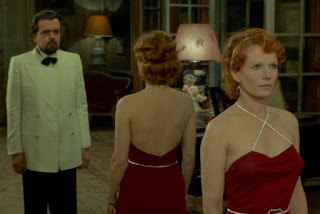
Set in late 1930s Calcutta at the French embassy, the film follows the wife of a French ambassador as she goes through boredom as she surrounded by different lovers at the embassy while also dealing with the arrival of a former lover. It is a film that plays into the life of this woman who feels trapped by her surroundings as well as the voices that loom throughout the house as she juggles her many affairs as well as shielding herself from the outside world including India. Marguerite Duras’ screenplay is largely minimalist as much of the film is told through voice-over monologues and dialogues that would dominate the film as it play into the emotions of the characters that spend a lot of time at the embassy and its grounds. They also deal with the voices from outside of the embassy such as an old beggar woman where much of the time has these people having small parties and such as well as walking in the grounds at the embassy.
Duras’ direction is stylish for not just her unconventional approach to voiceovers but also in the fact that much of the film for its first two acts is set inside this house and the grounds outside of the home. Shot on location at the Chateau Rothschild in Boulogne, France with areas outside of the chateau include the Grand Trianon at Versailles and two interior shots at apartments in Paris. Duras does use the location as this world that is ever-changing with an abandoned tennis court, a pond, and other places as if it’s going into ruins as well as not being tended to due to the lack of interest of those living at the embassy. The sense of ennui that looms throughout the film including its main protagonist in Anne-Marie Stretter (Delphine Seyrig) as she wanders around the house either in a lavish dress or in a robe. Even as there’s a shot where she and two of her lovers are lying on the floor sleeping with her right breast exposed from her robe as her former lover in the Vice-Consul of Lahore (Michael Lonsdale) watches from afar.
Duras’ direction also has these unique compositions while there are very little close-ups she uses in favor of these striking compositions in the medium and wide shots of the rooms an exteriors of the embassy. Even as the way Duras would have the actors appear in a shot and at a certain place in the frame as there’s an intricacy and attention to detail she would put into these shots. Even as it plays into this sense of disconnect with what is happening outside of the embassy where they spend much of the time at the embassy with voices playing to what is happening outside of the world as it relates to the idea of colonialism and France’s decline in that world. The film’s third act has a moment where all of the characters take a break from being in the embassy to go to a hotel to eat lunch where everyone is wearing some form of white with the exception of one character who is wearing the same clothes throughout the entirety of the film. It all plays into this sense of reality that everyone is dealing with as well as Stetter who becomes aware that her time in India within the home that she’s been living is running out. Overall, Duras crafts a haunting yet ravishing film about an ambassador’s wife growing sense of ennui at the French embassy in late 1930s Calcutta.
Cinematographer Bruno Nuytten does brilliant work with the photography as it largely emphasizes on low-key lighting and other stylish lighting for many of the scenes in and out of the embassy as it plays into this sense of artificiality these people are living in while the third act would showcase elements of natural lighting for some of its exteriors. Editor Solange Leprince does excellent work with the editing as it is largely straightforward by allowing shots to linger for more than a few minutes while the editing would be more abrupt in a few places for dramatic effect. The sound work of Antoine Bonfanti and Michel Vionnet is incredible for the mixing of the voice overs and the music as well as playing into this haunting atmosphere into the home that these characters are in. The film’s music by Carlos d’Alessio is wonderful for its low-key orchestral score while much of its music soundtrack features a lot of the music that was prevalent during those times.
The film’s superb ensemble cast as it features an array of voice actors including Marguerite Duras providing voices that would be prevalent during the film while other small roles include Claude Juan as the domestic who works at the embassy, Didier Flamand a young guest whom Stretter takes a liking to, and Vernon Dobtcheff as a government official in Georges Crawn who is also another lover of Stretter. Claude Mann and Matheiu Carriere are excellent in their respective roles as the official Michael Richardson and the embassy’s young attaché` as two of Stretter’s lovers with the former being a married official who could help her socially while the latter is someone who also spends time with Stretter and keep her attention at bay.
Michael Lonsdale is brilliant as the Vice-Consul of Lahore as a former lover of Stretter who had been exiled to India following an incident as he is someone eager to resume their old affair while being anguished over their break-up many years ago. Finally, there’s Delphine Seyrig in a phenomenal performance as Anne-Marie Stettler as the wife of India’s French ambassador as a woman who has many lovers but has become bored by her lifestyle while dealing with a world that is becoming chaotic. Even as she becomes unfulfilled by her many affairs while is clinging on to this lifestyle that is disconnected from the world including France’s own decline in their colonial powers as it is one of Seyrig’s finest performances.
India Song is an incredible film from Marguerite Duras that features a radiant leading performance from Delphine Seyrig. Along with its supporting cast, rapturous visuals, eerie sound design, and an exploration of a lifestyle that has gone past its due date during a tumultuous time in India and the rest of the world. It is a film that isn’t easy to watch in terms of its unconventional presentation yet it is rewarding for showcasing a woman and the world she couldn’t break away from. In the end, India Song is a sensational film from Marguerite Duras.
Marguerite Duras Films: (La Musica) – (Destroy, She Said) – (Jaune le soleil) – (Nathalie Granger) – (La Femme du Gange) – (Her Venetian Name in Deserted Calcutta) – (Entire Days in the Trees) – (The Lorry) – (Baxter, Vera Baxter) – (Les Mains negatives) – (Cesaree) – (Le Navire Night) – (Aurelia Steiner (Melbourne)) – (Aurelia Steiner (Vancouver)) – (Agatha et les lectures illimitees) – (L’Homme atlanique) – (Il dialogo di Roma) – (Les Enfants (1985 film))
© thevoid99 2023

Told in the span of a year from 1942 to 1943 in Vichy France during World War II, the film follows the lives of a few individuals who are involved in the French Resistance as they deal with fighting and scheming against Nazi Germany while also making uneasy decisions. It is a film that explore a few key individuals who are part of this resistance against the Nazis as they all have to make uneasy decisions as it would involving having to kill those who become a liability in exposing the Resistance. Jean-Pierre Melville’s screenplay is straightforward in its narrative yet it has strands of characters it follow with a Resistance leader in Philippe Gerbier (Lino Ventura) who is first seen arriving at a prison camp where he is later transferred to the Gestapo only to escape as he runs a network with longtime friend Felix Lepercq (Paul Crauchet), a burly veteran in Guillaume Vermesch aka Le Bison (Christian Barbier), and a young recruit in Claude Ullmann aka the Mask (Claude Mann). The first act is about Gerbier’s brief time in prison, his escape, and also uncovering a traitor prompting him to take action.
The second act is about an unexpected meeting between Lepercq and a former pilot in Jean-Francois Jardie (Jean-Pierre Cassel) whose older brother is the philosopher Luc Jardie (Paul Meurisse) whom Gerbier admires. Jean-Francois would also gain the support of a woman in Mathilde (Simone Signoret) who would become part of Gerbier’s network and later run things during the third act when Gerbier is captured. Still, there are a lot of complexities in the film’s second half about the demands of being in the Resistance but also the fact that someone can’t carry any sentimental value as it would have them link to family who might know something or be used as blackmail. Even as a few would be captured and endure brutal torment by the Nazis as it play into how dangerous things were during Nazi Germany’s occupation of France.
Melville’s direction is entrancing in its presentation as it is shot on various locations in France including parts of Paris including a shot of the Arc de Triomphe where Nazi soldiers are marching in the foreground with the Arc in the background. Melville’s direction definitely emphasizes less on many of Paris’ familiar sites in order to create an atmosphere of a world that is bleak and intense. Melville’s usage of the wide and medium shots do play into the world that is Vichy France where there is a lot of attention to detail in the prison camps, the prison cells, and other places as location is key to the film. Notably in the scene where Gerbier first escapes and then hides at a barbershop where a barber (Serge Reggiani) would help him as it helps set a tone for some of the moments of suspense. One of which include Gerbier trying to get aboard a British submarine to meet with British officials in aiding the Resistance as well as the return back on plane where they had to endure anti-aircraft attacks. There are also these elements in the direction such as a scene where Jean-Francois is stepping out on a train as he is carrying something important to the Resistance as he has to find a way to pass the Nazi guards.
Melville also maintains some offbeat elements such as Gerbier in London where he finds himself in a dancehall where British military personnel are dancing while bombs are falling around them as well as a scene in a prison where the Nazis give the prisoners a chance to survive. There are also these intense moments where Melville would use close-ups as things do intensify in the third act as it relates to not just setbacks and uneasy decisions but also what is at stake for the Resistance. Even as things get personal and an air of uncertainty emerges into who to trust and how the Resistance can move forward. Notably as the climax and its aftermath is about all of the uneasy decisions one have to make during war and the sacrifices they are forced to make to free their own country from the hands of another. Overall, Melville crafts a gripping and intoxicating film about the life of a few individuals working for the French Resistance.
Cinematographer Pierre Lhomme, with additional work from Walter Wottitz, does amazing work with the film’s cinematography with its emphasis on natural lighting along with soft light for some scenes including its emphasis on grey and blue colors to help set a visual tone for the film. Editor Francoise Bonnot does brilliant work with the editing with its stylish usage of transition wipes, jump-cuts, and other stylish cuts to help play into the suspense and drama. Art director Theobald Meurisse and set decorator Roger Volper do excellent work with the look of the prison cells, the houses the characters hide out at, and some of the places they go to. Costume designer Madame Colette Baudot does fantastic work with the costume as it does bear some style with the men wearing suits as well as the uniforms the French police and the Nazis wear with Mathilde wearing all sorts of clothes including a nurse’s uniform during an attempted prison break.
The makeup work of Maud Begon is terrific for the way two major characters look following their interrogations with the Nazis in how badly they were beaten by them. Sound designers Jacques Carrere, Alex Pront, and Jean Neni, with sound editing by Robert Pouret, do superb work with the sound in the way gunfire sounds as well as these scenes where it revolves around the location to play into the suspense. The film’s music by Eric Demarsan is incredible for its eerie music score with brooding string arrangements as well as its usage of an organ to help maintain a suspenseful mood as it is a highlight of the film.
The film’s marvelous cast feature some notable small roles from Adrien Cayla-Legrand as Charles de Gaulle, Nathalie Delon in an un-credited appearance as Jean-Francois’ date at a bar, Anthony Stuart as a Royal Air Force major, Colin Mann as a British pilot who gives Gerbier instructions on his return to France via parachute, Albert Michel as a policeman at a train station, Alain Mottet as a commander at a prison camp, Serge Reggianni as a barber who helps hide Gerbier following his prison escape, Alain Libolt as a young man who is revealed to be a traitor to the Resistance, Jean-Marie Robain as a baron who aids the Resistance in giving them a temporary home base and such, Denis Sadler as a Gestapo doctor, and Andre Dewavrin in a brief appearance as himself in the role of a Resistance colonel. Christian Barbier and Claude Mann are superb in their respective roles as the Bison and the Mask as two members of the Resistance who take part in some of the killings and such with the former being the most loyal including towards Mathilde while the latter is a newer recruit who proves to be resourceful.
Paul Crauchet is fantastic as Felix Lepercq as an older member of the Resistance who is close with Gerbier as he would later be captured by the Nazis and endure some of the most physical brutality in their interrogation methods. Simone Signoret is amazing as Mathilde as a member of the Resistance who helps in organizing things including an attempted prison break for Lepercq as well as other things as she proves to be loyal despite her own faults as it relates to her life at home. Jean-Pierre Cassel is excellent as Jean-Francois Jardie as a former pilot who joins the Resistance while giving Gerbier access to his older brother only to find himself at odds with some of the ideals of the Resistance. Paul Meurisse is brilliant as Luc Jardie as a philosopher who joins the Resistance as he is someone that Gerbier admires while also being someone who has ideas with the Resistance that would alienate some. Finally, there’s Lino Ventura in a phenomenal performance as Philippe Gerbier as a leader of the Resistance who gets captured while trying to maintain his rule as well as keeping the Resistance a secret from the Nazis as well as having to make uneasy decisions knowing what is at stake as it is a restrained yet unsettling performance from Gerbier.
L’Armee des ombres is a magnificent film from Jean-Pierre Melville. Featuring a great ensemble cast, mesmerizing visuals, an eerie music soundtrack, and chilling suspense in its relation to life during World War II in German-occupied France. It is a film that definitely showcases a lot of the actions of the French Resistance as well as why they had to operate in the shadows as well as doing things that others might not want to do in war. In the end, L’Armee des ombres is an outstanding film from Jean-Pierre Melville.
Jean-Pierre Melville: 24 Hours in the Life of a Clown – Le silence de la mer - Les enfants terribles - (Quand tu liras cette letter) - Bob le flambeur - (Two Men in Manhattan) – (Leon Morin, Priest) – (Le Doulos) – Magnet of Doom - Le deuxime souffle - Le Samourai - Le cercle rouge - (Un flic)
© thevoid99 2022
Written and directed by Jacques Demy, La baie des anges (Bay of Angels) is the story of a bank clerk who is introduced to the world of gambling as he falls for a woman with a gambling addiction. The film is an exploration into a man falling in love with a woman where he gets sucked into a world where the risks are very high. Starring Jeanne Moreau, Claude Mann, Paul Guers, Henri Nassiet, and Nicole Chollet. La baie des anges is a sensational film from Jacques Demy.
The film is a simple story of a bank clerk whose friend introduces him to the world of gambling where he gets sucked in as he travels to Nice to gamble some more where he meets a beautiful yet troubled woman with a gambling problem. There, the two endure the highs and lows of gambling where they win big and then lose big as it creates something that plays into whether or not is risking money and livelihood worth it all for a bunch of money? Jacques Demy’s script does play to a traditional structure yet it is largely told from the perspective of Jean (Claude Mann) who is just a bank clerk that is just trying to have a good life and help his father.
Yet, he gets sucked into this high-octane world of winning and losing money but manages to figure out the game of roulette and wins big through his wit. Upon meeting Jackie (Jeanne Moreau) in Nice, he falls in love and becomes consumed by winning big but also lose big as he would also know more about Jackie and her troubled addiction as she is someone that clearly has a problem. While she tries to act cool about it and pretend that it doesn’t affect her, Jean definitely knows she has a problem as he tries to make sense while he begins to realize the dangers of gambling.
Demy’s direction has an air of style in terms of the camera movements and compositions yet does maintain a sense of simplicity in its visuals and approach to storytelling. Notably as Demy creates something where the audience becomes invested into Jean’s discovery into the world of gambling where they too will probably guess a number and wonder if he’ll win or lose. Demy would create these intricate medium and wide shots to play into the world of casinos as he uses a lot of tracking shots to showcase how intimate and vast these small casinos are. The close-ups would add to the drama as it relates to Jackie’s own anguish and the sense of fear that looms over Jean when both of them have their backs against the wall when it comes to losing.
Especially as their trip to Monte Carlo becomes a disastrous one where it would add to the drama as well as Jean’s own revelation about gambling as it relates to what his father told him earlier in the film. It would all play into not just Jean trying to convince Jackie that she’s risking so much more but also the fact that there is a way out. Not just on the roulette table but in life itself. Overall, Demy creates a very compelling yet evocative film about a young man who encounters the world of gambling and a woman with a gambling problem.
Cinematographer Jean Rabier does excellent work with the film‘s black-and-white photography from its usage of lights for scenes set at night in its interior and exterior settings to the more naturalistic look into the streets of Nice where it looks more low-key and real. Editor Anne-Marie Cotret does fantastic work with the editing with its usage of jump-cuts to play into some of the excitement that occurs in winning as well as other stylish cuts to play into the drama. Set decorator/costume designer Bernard Evein, with costumer Pierre Cardin, does amazing work with the look of the casino halls and hotel rooms as well as the stylish clothes that Jackie and Jean wear.
The sound work of Andre Hervee is terrific for the naturalistic atmosphere that is created inside the casinos and in some of the locations including the beaches in Nice and Monte Carlo. The film’s music by Michel Legrand is phenomenal as it is a mixture of jazz and classical where it features a few playful pieces but also a piano flourish theme that plays into moments of good luck for Jean and Jackie along with a somber theme based on string instruments as it’s one of the film’s highlights.
The film’s superb cast includes a few notable small roles from Nicole Chollet as a customer of Jean’s father, Andres Certes as the bank director, Conchita Parodi as the hotel manager in Nice, Henri Nassiet as Jean’s father, and Paul Guers as Jean’s colleague Caron who would introduce him to the world of gambling. Claude Mann is brilliant as Jean as a young bank clerk who is seduced into the world of gambling as he tries to figure out how to play well while being cautious into every move he makes. Finally, there’s Jeanne Moreau in a remarkable performance as Jackie as this woman with platinum blonde hair who is the epitome of beauty but is a complete mess inside when things don’t go her way as she is upbeat when she wins but falls apart when she loses as it’s a performance filled with anguish and charm.
La baie des anges is an exquisitely rich and exhilarating film from Jacques Demy. Featuring great performances from Jeanne Moreau and Claude Mann as well as an amazing score by Michel Legrand. The film isn’t just a unique study into the world of gambling and addiction but also how a man become seduced into a world that is new as he falls for a woman whose descent would force him to take action. In the end, La baie des anges is an incredible film from Jacques Demy.
Jacques Demy Films: (Lola (1961 film)) - The Umbrellas of Cherbourg - The Young Girls of Rochefort - Model Shop - Donkey Skin - (The Pied Piper (1972 film)) - A Slightly Pregnant Man - (Lady Oscar) - (La Naissance du Jour) - Une chambre en ville - (Parking (1985 film)) - (Three Places for the 26th) - Turning Table)
© thevoid99 2015


