Showing posts with label jean-pierre cassel. Show all posts

Saturday, April 23, 2022

2022 Blind Spot Series: Army of Shadows


Based on the novel by Joseph Kessel, L’Armee des ombres (Army of Shadows) is the story of various individuals in the French Resistance during World War II as they deal with the sacrifices and struggles during the war against Nazi Germany. Written for the screen and directed by Jean-Pierre Melville, the film is a study of the live in the Resistance as well as what people had to do to fight against Nazi Germany as well as making uneasy decisions in the war. Starring Lino Ventura, Paul Meurisse, Jean-Pierre Cassel, and Simone Signoret. L’Armee des ombres is a rapturous and chilling film from Jean-Pierre Melville.

Told in the span of a year from 1942 to 1943 in Vichy France during World War II, the film follows the lives of a few individuals who are involved in the French Resistance as they deal with fighting and scheming against Nazi Germany while also making uneasy decisions. It is a film that explore a few key individuals who are part of this resistance against the Nazis as they all have to make uneasy decisions as it would involving having to kill those who become a liability in exposing the Resistance. Jean-Pierre Melville’s screenplay is straightforward in its narrative yet it has strands of characters it follow with a Resistance leader in Philippe Gerbier (Lino Ventura) who is first seen arriving at a prison camp where he is later transferred to the Gestapo only to escape as he runs a network with longtime friend Felix Lepercq (Paul Crauchet), a burly veteran in Guillaume Vermesch aka Le Bison (Christian Barbier), and a young recruit in Claude Ullmann aka the Mask (Claude Mann). The first act is about Gerbier’s brief time in prison, his escape, and also uncovering a traitor prompting him to take action.

The second act is about an unexpected meeting between Lepercq and a former pilot in Jean-Francois Jardie (Jean-Pierre Cassel) whose older brother is the philosopher Luc Jardie (Paul Meurisse) whom Gerbier admires. Jean-Francois would also gain the support of a woman in Mathilde (Simone Signoret) who would become part of Gerbier’s network and later run things during the third act when Gerbier is captured. Still, there are a lot of complexities in the film’s second half about the demands of being in the Resistance but also the fact that someone can’t carry any sentimental value as it would have them link to family who might know something or be used as blackmail. Even as a few would be captured and endure brutal torment by the Nazis as it play into how dangerous things were during Nazi Germany’s occupation of France.

Melville’s direction is entrancing in its presentation as it is shot on various locations in France including parts of Paris including a shot of the Arc de Triomphe where Nazi soldiers are marching in the foreground with the Arc in the background. Melville’s direction definitely emphasizes less on many of Paris’ familiar sites in order to create an atmosphere of a world that is bleak and intense. Melville’s usage of the wide and medium shots do play into the world that is Vichy France where there is a lot of attention to detail in the prison camps, the prison cells, and other places as location is key to the film. Notably in the scene where Gerbier first escapes and then hides at a barbershop where a barber (Serge Reggiani) would help him as it helps set a tone for some of the moments of suspense. One of which include Gerbier trying to get aboard a British submarine to meet with British officials in aiding the Resistance as well as the return back on plane where they had to endure anti-aircraft attacks. There are also these elements in the direction such as a scene where Jean-Francois is stepping out on a train as he is carrying something important to the Resistance as he has to find a way to pass the Nazi guards.

Melville also maintains some offbeat elements such as Gerbier in London where he finds himself in a dancehall where British military personnel are dancing while bombs are falling around them as well as a scene in a prison where the Nazis give the prisoners a chance to survive. There are also these intense moments where Melville would use close-ups as things do intensify in the third act as it relates to not just setbacks and uneasy decisions but also what is at stake for the Resistance. Even as things get personal and an air of uncertainty emerges into who to trust and how the Resistance can move forward. Notably as the climax and its aftermath is about all of the uneasy decisions one have to make during war and the sacrifices they are forced to make to free their own country from the hands of another. Overall, Melville crafts a gripping and intoxicating film about the life of a few individuals working for the French Resistance.

Cinematographer Pierre Lhomme, with additional work from Walter Wottitz, does amazing work with the film’s cinematography with its emphasis on natural lighting along with soft light for some scenes including its emphasis on grey and blue colors to help set a visual tone for the film. Editor Francoise Bonnot does brilliant work with the editing with its stylish usage of transition wipes, jump-cuts, and other stylish cuts to help play into the suspense and drama. Art director Theobald Meurisse and set decorator Roger Volper do excellent work with the look of the prison cells, the houses the characters hide out at, and some of the places they go to. Costume designer Madame Colette Baudot does fantastic work with the costume as it does bear some style with the men wearing suits as well as the uniforms the French police and the Nazis wear with Mathilde wearing all sorts of clothes including a nurse’s uniform during an attempted prison break.

The makeup work of Maud Begon is terrific for the way two major characters look following their interrogations with the Nazis in how badly they were beaten by them. Sound designers Jacques Carrere, Alex Pront, and Jean Neni, with sound editing by Robert Pouret, do superb work with the sound in the way gunfire sounds as well as these scenes where it revolves around the location to play into the suspense. The film’s music by Eric Demarsan is incredible for its eerie music score with brooding string arrangements as well as its usage of an organ to help maintain a suspenseful mood as it is a highlight of the film.

The film’s marvelous cast feature some notable small roles from Adrien Cayla-Legrand as Charles de Gaulle, Nathalie Delon in an un-credited appearance as Jean-Francois’ date at a bar, Anthony Stuart as a Royal Air Force major, Colin Mann as a British pilot who gives Gerbier instructions on his return to France via parachute, Albert Michel as a policeman at a train station, Alain Mottet as a commander at a prison camp, Serge Reggianni as a barber who helps hide Gerbier following his prison escape, Alain Libolt as a young man who is revealed to be a traitor to the Resistance, Jean-Marie Robain as a baron who aids the Resistance in giving them a temporary home base and such, Denis Sadler as a Gestapo doctor, and Andre Dewavrin in a brief appearance as himself in the role of a Resistance colonel. Christian Barbier and Claude Mann are superb in their respective roles as the Bison and the Mask as two members of the Resistance who take part in some of the killings and such with the former being the most loyal including towards Mathilde while the latter is a newer recruit who proves to be resourceful.

Paul Crauchet is fantastic as Felix Lepercq as an older member of the Resistance who is close with Gerbier as he would later be captured by the Nazis and endure some of the most physical brutality in their interrogation methods. Simone Signoret is amazing as Mathilde as a member of the Resistance who helps in organizing things including an attempted prison break for Lepercq as well as other things as she proves to be loyal despite her own faults as it relates to her life at home. Jean-Pierre Cassel is excellent as Jean-Francois Jardie as a former pilot who joins the Resistance while giving Gerbier access to his older brother only to find himself at odds with some of the ideals of the Resistance. Paul Meurisse is brilliant as Luc Jardie as a philosopher who joins the Resistance as he is someone that Gerbier admires while also being someone who has ideas with the Resistance that would alienate some. Finally, there’s Lino Ventura in a phenomenal performance as Philippe Gerbier as a leader of the Resistance who gets captured while trying to maintain his rule as well as keeping the Resistance a secret from the Nazis as well as having to make uneasy decisions knowing what is at stake as it is a restrained yet unsettling performance from Gerbier.

L’Armee des ombres is a magnificent film from Jean-Pierre Melville. Featuring a great ensemble cast, mesmerizing visuals, an eerie music soundtrack, and chilling suspense in its relation to life during World War II in German-occupied France. It is a film that definitely showcases a lot of the actions of the French Resistance as well as why they had to operate in the shadows as well as doing things that others might not want to do in war. In the end, L’Armee des ombres is an outstanding film from Jean-Pierre Melville.

Jean-Pierre Melville: 24 Hours in the Life of a Clown – Le silence de la mer - Les enfants terribles - (Quand tu liras cette letter) - Bob le flambeur - (Two Men in Manhattan) – (Leon Morin, Priest) – (Le Doulos) – Magnet of Doom - Le deuxime souffle - Le Samourai - Le cercle rouge - (Un flic)

© thevoid99 2022

Sunday, March 27, 2016

Les Rendez-vous d'Anna


Written and directed by Chantal Akerman, Les Rendez-vous d’Anna (The Meetings of Anna) is the story of a filmmaker traveling through Europe to promote her film as she meets various people during her journey. The film is a character study in which a woman doesn’t just deal with being on the road but also the encounters she has in her travels as she copes with isolation from her surroundings. Starring Aurore Clement, Helmut Griem, Magali Noel, Hans Zischler, Lea Massari, and Jean-Pierre Cassel. Les Rendez-vous d’Anna is a mesmerizing and provocative film from Chantal Akerman.

Told in nearly the span of 72 hours from Cologne to Paris, the film revolves around the travels of a filmmaker who is promoting her film as she copes with the growing detachment of her surroundings as well as the people she meets along the way. It’s a film that explores a woman dealing with the role she is in as she ponders about the world she left behind she makes a brief visit to Brussels to see her mother and then return home. Along the way, she meets a family friend, a stranger on a train, and two men whom she would sleep with as it adds to this growing sense of detachment towards the people around her.

Chantal Akerman’s script does have a traditional structure as the first act is set in Cologne, West Germany while the second act is set partially on the train as well as its train stops including one at Brussels, and the third set in Paris. Yet, it is more about the study of its protagonist Anna Silver (Aurore Clement) who deals with traveling constantly and the demands to show her film to the world where she feels lost in her travels. Though the script features a lot of monologues from characters that Anna meets, it is largely minimalist in terms of its settings and refusal to dwell into conventional plot-points in favor of dwelling on Anna’s actions and her reaction to the news along with her recollections in her travels.

Akerman’s direction is very intoxicating for the way she doesn’t just capture that sense of detachment between a woman and her surroundings but also in the way she creates these gorgeous compositions to play that sense of detachment. Since the film features very little close-ups in favor of wide and medium shots, Akerman finds way to compose these images with something that feels ordinary but has something that feels very engaging. Even in the way she would put her actors into a frame whether they’re looking outside of a hotel room or have a conversation outside of one’s house. It says so much by doing so little into exploring Anna’s detachment as it would include these wide shots of the train stop interiors where she would meet her mother (Lea Massari) and a family friend in Ida (Magali Noel). Akerman does go for a few dolly-tracking shot for some of the movements that occur in the film though much of it straightforward where it’s not about camera pans or angles.

Instead, Akerman is just about that that direct image into the way she creates these compositions as the wide shots are lined-up in the middle of train stop staircase or a ticket booth in a train station. It has this air of simplicity into the direction while proving that these scenes just need sound and a visual without the usage of heavy dialogue as these quieter moments in the film are just as entrancing as the ones that features lots of dialogues and monologues. The scenes set in the train showcase that growing sense of isolation and detachment where Anna would walk through train compartments where one compartment is cramped with a lot of people forcing her to go back to another where it seems like she’s reluctant to even want to connect with a bunch of people but rather this one person on his way to Paris. It has something that does feel very European not just visually but also in its tone where it is a world that is changing but in ways that has Anna feel detached from as it relates to her own sense of loneliness. Overall, Akerman creates an evocative and captivating film about a woman’s journey through Europe.

Cinematographer Jean Penzer does brilliant work with the film‘s cinematography from the low-key yet colorful look of many of the daytime exteriors to the naturalistic lighting for scenes set at night including the stylish lights in the train stops and inside the train. Editor Francine Sandberg does excellent work with the editing where it is quite straightforward with some jump-cuts in some parts while letting scenes play out in their long takes. Production designer Philippe Graf does fantastic work with the look of the hotel rooms that Anna would stay in throughout her journey. The sound work of Henri Morelle is amazing for how natural it sounds as well as capturing everything that is heard including whatever music is playing in the radios.

The film’s small yet superb cast includes Hans Zischler as a man Anna converses with on the train to Brussels and Jean-Pierre Cassel as her Parisian lover Daniel who copes with the unhappiness of his work. Magali Noel is wonderful as a family friend in Ida whom Anna is fond of as Ida tells her that her son is the right person for her despite Anna’s own uncertainty while Lea Massari is fantastic as Anna’s mother who reveals into a lot of things that is happening in Brussels as well as things involving the family. Helmut Greim is excellent as Heinrich as a German Anna meets early in the film as he sleeps with her and later invites her to his home where he frets over the changes of the world. Finally, there’s Aurore Clement in an incredible performance as Anna Silver as this filmmaker who is going on a road trip to promote her film as she deals with her growing isolation and detachment in her surroundings and encounter with people where it’s a very restrained performance for much of the film with one key moment she sings a song to Daniel.

As part of the 2010 Eclipse box set series of Chantal Akerman’s work in the 1970s from the Criterion Collection, the film features an essay about the film entitled Meetings with Chantal by essayist Michael Koresky. The essay discusses not just the period of where Akerman was when she was making the film but also the backlash she received from feminists for working with a male crew though Akerman never claimed to be a feminist. What Akerman wanted to do was play into that sense of longing and loneliness into the character of Anna while the film did sort of serve as the antithesis of sorts to her previous feature film in Jeanne Dielman, 23 Quai du Commerce, 1080 Bruxelles which she claimed was never meant to be a political nor a feminist film. Instead, the film would reflect on a period in her career where she would become nomadic in her travels while still longing to return home to her native Belgium as it’s a fascinating essay by Koresky.

Les Rendez-vous d’Anna is a phenomenal film from Chantal Akerman that features a magnificent performance from Aurore Clement. Not only is the film a compelling character study with these evocative themes of isolation and detachment. It’s also a film that explores the travels of a woman and her need to wanting to connect but feel lost in her surroundings. In the end, Les Rendez-vous d’Anna is a spectacular film from Chantal Akerman.

Chantal Akerman Films: La Chambre - Hotel Monterey - Je Tu Il Elle - Jeanne Dielman, 23 Quai du Commerce, 1080 Bruxelles - News from Home - (American Stories, Food, Family and Philosophy) - (Night and Day (1991 film)) - (A Couch in New York) - (La Captive) - (Tomorrow We Move) - (Almayer’s Folly) - (No Home Movie)

© thevoid99 2016

Friday, February 08, 2013

Pret-a-Porter


Directed by Robert Altman and written by Altman and Barbara Shulgasser, PrĂȘt-a-Porter is the story about a group of very different people who attend Fashion Week in Paris as some are reporting the events while some are just attending to see what is out there. The film is an exploration into the world of fashion that involves many people in the course of a week. Starring Marcello Mastroianni, Sophia Loren, Julia Roberts, Tim Robbins, Kim Basinger, Lili Taylor, Jean-Pierre Cassel, Chiara Mastroianni, Linda Hunt, Sally Kellerman, Stephen Rea, Anouk Aimee, Tracey Ullman, Rossy de Palma, Forest Whitaker, Rupert Everett, Lyle Lovett, and Lauren Bacall. Pret-a-Porter is a witty yet chaotic comedy from Robert Altman.

The film is about many different groups of people attending Fashion Week in Paris where a lot is happening while a prestigious fashion president had died believing that he had been murder. In the course of the film, a lot happens as a fashion TV reporter covers the events that is happening while lots of affairs between fashion designers are happening. Two American journalists are forced to share the same hotel room while covering what is happening and a fashion designer is dealing with possible bankruptcy. Fashion magazine editors spar with each other to go get a prestigious photographer while a woman goes on a shopping spree around the city. All in the course of an entire week as it leads to a climatic fashion show where a designer presents the ultimate show in grand style.

The screenplay by Robert Altman and Barbara Shulgasser doesn’t really have any kind of singular plot as it’s all about the chaos of Fashion Week. Notably as there’s journalists trying to cover the event and make sense of it as it involves a New York Times photographer (Lili Taylor) and a fashion TV reporter named Kitty Porter (Kim Basinger). Yet, there’s also this story about this French fashion president in Olivier de la Fontaine (Jean-Pierre Cassel) who meets a mysterious man named Sergei (Marcello Mastroianni) where something happens leading to de la Fontaine’s death as his wife Isabella (Sophia Loren) seems relieved though is lover in fashion designer Simone Lowenthal (Anouk Aimee) is saddened as she is dealing with losing her business where her son Jack (Rupert Everett) does something that will save her business but with some reservations. Things get crazier as two different American journalists in Anne Eisenhower (Julia Roberts) and Joe Flynn (Tim Robbins) are forced to share a hotel to cover what’s been happening.

Altman’s direction is definitely engaging for the way he explores the world of fashion and what goes on in Fashion Week. Taking on a style similar to cinema verite, Altman captures all of the craziness that occurs while going inside into what goes in the world of fashion as shows are being prepared and such. Notably as the film features cameos from celebrities, models, and fashion designers as they’re part of this crazy yet fascinating world. The direction is also intimate and straightforward for scenes inside the hotel rooms and offices where many people work out as well as some moments in the fashion runway. It is still about the show and the world that is happening which also includes Sergei trying to contact Isabella as they’re revealed to be former lovers. Their scenes together is essentially an ode to their appearance in Vittorio de Sica’s 1963 film Yesterday, Today, and Tomorrow. While it’s a film that can be described as a rambling mess due to the many storylines that happens. It is still a very enjoyable and very exhilarating film from Robert Altman.

Cinematographers Jean Lepine and Pierre Mignot do excellent work with the look of Paris during Fashion Week with its many landmarks as well as the scenes inside the fashion shows and some of the film‘s interior settings. Editors Geraldine Peroni and Suzy Elmiger do wonderful work with the editing to capture the sense of chaos that occurs in the world of fashion as well as more straightforward moments in the intimate scenes. Production Stephen Altman, with set decorator Francoise Dupertuis and art director William Abello, does nice work with the looks of the hotels and the runway shows that occur including the very street-based show one of the designers at a metro.

Costume designer Catherine Leterrier does terrific work with the non-designer clothes some of the characters wear to maintain their lack of style while most of the characters wear clothes that display their unique personalities. Sound editor Skip Lievsay does superb work with the sound to capture the atmosphere of the runway shows to the chaos in some of the parties. The film’s music by Michel Legrand is delightful for its playful piano pieces and other cuts to play out the humor. Music supervisor Allan F. Nichols creates a fantastic soundtrack that features music from Massive Attack, Bjork, U2, Ini Kamoze, Salt-N-Pepa, the Rolling Stones, M People, Janet Jackson, the Cranberries, Pizzicato Five, Robert Palmer, Grace Jones, and many others to capture the spirit of the fashion world.

Finally, there’s the film’s amazing ensemble cast as it features cameo appearances from Bjork, Harry Belafonte, Cher, and David Copperfield along with supermodels like Claudia Schiffer, Helena Christensen, Naomi Campbell, Linda Evangelista, Carla Bruni, and Christy Turlington, and fashion designers like Jean-Paul Gaultier, Sonia Rykiel, Issey Miyake, Christian Lacroix, and Gianfranco Ferre for Christian Dior as themselves. In small but notable roles, there’s Alexandra Vandernoot as a TV reporter, Jean Rochefort and Michel Blanc as police investigators, Teri Garr as an obsessed shopper, Danny Aiello as the shopper’s husband, Rossy de Palma as Simone’s assistant Pilar, Chiara Mastroianni as Kitty Porter’s aide Sophie Choiset, Ute Lemper as the pregnant model Albertine, Kasia Figura as the dim-witted assistant of magazine editor Sissy, and Jean-Pierre Cassel as the Fashion Week president Olivier de la Fontaine.

Sally Kellerman, Linda Hunt, and Tracey Ullman are great in their respective rules as the dueling magazine editors Sissy Wannamaker, Regina Krumm, and Nina Scant who all try to nab Stephen Rea’s very devious photographer Milo O’Brannigan who would provide a prank of his own all three where Rea is very funny. Lauren Bacall is wonderful as the colorblind fashionista Slim Chrysler while Lyle Lovett is terrific as the cowboy boots designer Clint Lammereaux. Julia Roberts and Tim Robbins are excellent as the dueling journalists Anne Eisenhower and Joe Flynn where they eventually fall for each other as they share a hotel room together. Lili Taylor is superb as the NY Times photojournalist Fiona Ulrich while Kim Basinger is hilarious as the somewhat dim fashion TV reporter Kitty Porter. Forest Whitaker and Richard E. Grant are fantastic in their respective roles as fashion designers in the street-wise Cy Bianco and the snobbish Cort Romney.

Rupert Everett is pretty good as the slimy Jack Lowenthal who does something without his mother’s consent while Anouk Aimee is phenomenal as the respected fashion designer Simone Lowenthal who deals with Olivier’s death as well as the prospect of losing her business. Finally, there’s Marcello Mastroianni and Sophia Loren in marvelous performances in their respective roles as Sergio/Sergei and Isabella where they play former lovers who finally meet after many years where Mastroianni brings a lot of humor with Loren bringing an element of class to her role as well as a sexiness that is still captivating.

Pret-a-Porter is an excellent film from Robert Altman. Featuring a wild ensemble cast full of actors, models, fashion designers, and all sorts of people. It’s a film that captures the craziness that is Fashion Week while taking time to inject humor into that world. While the film is a bit of a mess, it is still enjoyable for the way Altman explores a world that is fascinating. In the end, Pret-a-Porter is a remarkable film from Robert Altman.

Robert Altman Films: (The Delinquents) - (The James Dean Story) - Countdown (1968 film) - (That Cold Day in the Park) - M.A.S.H. - Brewster McCloud - McCabe & Mrs. Miller - (Images) - The Long Goodbye - Thieves Like Us - California Split - Nashville - Buffalo Bill and the Indians, or Sitting Bull’s History Lesson - 3 Women - (A Wedding) - (Quintet) - (A Perfect Couple (HealtH) - Popeye - (Come Back to the Five and Dime, Jimmy Dean, Jimmy Dean) - (Streamers) - (Secret Honor) - (O.C. and Stiggs) - Fool for Love - (Beyond Therapy) - (Aria-Les Boreades) - (Tanner ‘88) - (Vincent & Theo) - The Player - Short Cuts - (Kansas City) - (The Gingerbread Man) - Cookie’s Fortune - Dr. T & the Women - Gosford Park - The Company (2003 film) - (Tanner on Tanner) - A Prairie Home Companion

© thevoid99 2013

Sunday, June 19, 2011

The Discreet Charm of the Bourgeoisie


Directed by Luis Bunuel with a script co-written with Jean-Claude Carriere, Le charme discret de la bourgeoisie (The Discreet Charm of the Bourgeoisie) is the story about a group of upper class friends trying to have a dinner as they’re interrupted by surreal events. During these events, personalities begin to unfold during the course of the day. Starring Fernando Rey, Paul Frankeur, Delphine Seyrig, Stephane Audran, Bulle Ogier, Jean-Pierre Cassel, and Michel Piccoli. Le charme discret de la bourgeoisie is a whimsical yet mysterious film from Luis Bunuel.

A dinner party at the home of the Senechals as a foreign ambassador named Rafael Acosta (Fernando Rey) arrives with his friend Francois Thevenot (Paul Frankeur), Thevenot’s wife Simone (Delphine Seyrig), and her sister Florence (Bulle Ogier). Only Alice Senechal (Stephane Audran) is at the house unaware that there’s a party as her husband Henri (Jean-Pierre Cassel) isn’t home. They all decide to go to eat somewhere else unaware that the restaurant is closed only to discover why. Henri later apologizes for his absence as he invites Acosta and Thevenot for lunch only to be interested in having sex with his wife as the guests later leave as they meet Bishop Dufur (Julien Bertheau) who asks to be their gardener.

Attempts to eat and get together become troubling as they deal with interruptions from soldiers, associates, and other things. Even as they encounter men talking about weird dreams or memories and such. Rafael is dealing with political issues including a female terrorist (Maria Gabriella Maione) while Dufur becomes part of the party realizing something weird is happening.

The film is essentially about a group of bourgeoisie friends trying to have dinner together and have fun. Yet, they are continually interrupted by strange events or happenings that is going on around them. Even as the ladies try to have a simple tea party where there’s a lot of things going wrong. At the same time, there’s various people such as a lieutenant and a sergeant both recalling strange dreams or memories. At the same time, realities become blurred as the dinners seem more confusing and abstract. Luis Bunuel and co-screenwriter Jean-Claude Carriere create a story that is a very loose story that relies on not just repetition but also humor.

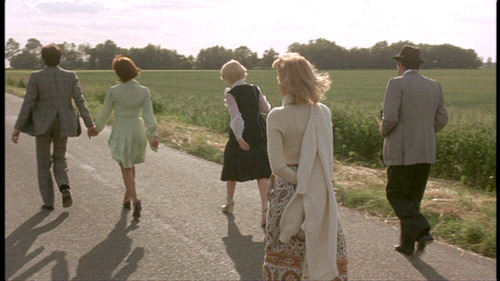
Bunuel’s direction is very entrancing from the repeated images of the people walking on a road in the middle of the French countryside to the intimacy he captures in the dinner scenes. Yet, he also plays up the surrealistic tone of the film by creating scenes where dreams are shot in a world that is artificial with fake backdrops intentionally shown. At the same time, Bunuel allows the camera to be engaging with some close-ups and wide shots to capture the world of the Senechal house as well as the places they go into such as the home of a colonel (Claude Pieplu). In scenes where there’s some expositions about the situations, Bunuel chooses to have strange sounds to cover all of that dialogue as if he doesn’t want to hear what they’re saying. Overall, Bunuel crafts an imaginative yet exhilarating film that is very funny and intriguing in its surrealism.

Cinematographer Edmond Richard does a wonderful job with the film‘s colorful cinematography from the gorgeous, naturalistic look of the daytime exterior scenes to the posh look of the interior scenes at night. Editor Helene Plemiannikov does a great job with the editing in creating a film with a leisured pace and straightforward cuts while playing along with its surrealist tone by utilizing stylistic cuts.

Art director Pierre Guffoy does an amazing job with the art direction from the home of the Senechals to the places they encounter. Notably the surrealistic sets that appears in dreams that play up the film’s idea of reality. Costume designer Jacqueline Guyot does a fantastic job with the closes, notably the dresses for two of the women in the film along with gowns for Simone that was created by Jean Patou. Sound mixer Jacques Carrere does an excellent job with the sound work from the intimacy of the dinner scenes to the chaos for some of the conversation as it blares over the dialogue.

The cast is definitely phenomenal as it features appearances from such Bunuel regulars as Marguerite Muni as a peasant woman and Michel Piccoli as a minister. Other notable small roles include George Douking as a dying gardener, Maria Gabriella Maione as the terrorist, Milena Vukotic as the Senechal’s maid, Claude Peiplu as a colonel, and Francois Maistre as an inspector. Another notable small but brilliant role is Julien Bertheau as a bishop who wants to be a gardener while revealing a story about his parents’ death. Bulle Ogier is excellent as the youthful yet intelligent Florence, the younger sister of Alice Thevenot who often feels like she’s not equal with everyone else because of her youth. Paul Frankeur is really good as Francois Thevenot, a man who is trying to get everyone to have dinners while trying to convince people to go to his place to eat his caviar.

Jean-Pierre Cassel is great as Henri Senechal, a man who also tries to get the dinners going while he is often more interested by having sex with his wife than having a gathering with his friends. Stephane Audran is wonderful as Henri’s wife Alice who often not ready for the party or trying to organize things while she befriends the bishop. Delphine Seyrig is brilliant as Simone Thevenot, Francois’s wife who is often trying to get the ladies to have some their own time together while having flirtatious moments with Rafael. Finally, there’s Fernando Rey in a fantastic performance as the ambassador Rafael Acosta who has a lot in his mind while wanting to have dinner and eat as he often engages in conversations with his friends.

Le charme discret de la bourgeoisie is a superb yet captivating film from Luis Bunuel. Featuring a great ensemble cast led by Fernando Rey and Delphine Seyrig, it is a film that plays with the idea of reality along with Bunuel’s fascination with surrealism. Among the films that Bunuel has done in his long yet glorious career, this film is truly among as one of his best. In the end, Le charme discret de la bourgeoisie is a mesmerizing yet intoxicating film from the late, great Luis Bunuel.

Luis Bunuel Films: Un Chien Andalou - L'Age d'Or - Land Without Bread - (Gran Casino) - (The Great Madcap) - Los Olvidados - (Susana) - (La hija de engano) - (Mexican Bus Ride) - (A Woman Without Love) - (El Bruto) - (El) - (Illusion Travels by Streetcar) - (Wuthering Heights (1954)) - Robinson Crusoe (1954) - (The Criminal Live of Archibaldo de la Cruz) - (El rio y la muerte) - (Cela S'apelle l'Aurore) - (Death in the Garden) - (Nazarin) - (La Fievre a El Pasao) - (The Young One) - Viridiana - The Exterminating Angel - Diary of a Chambermaid - Simon of the Desert - Belle de Jour - (The Milky Way) - Tristana - (The Phantom of Liberty) - (That Obscure Object of Desire)

© thevoid99 2011