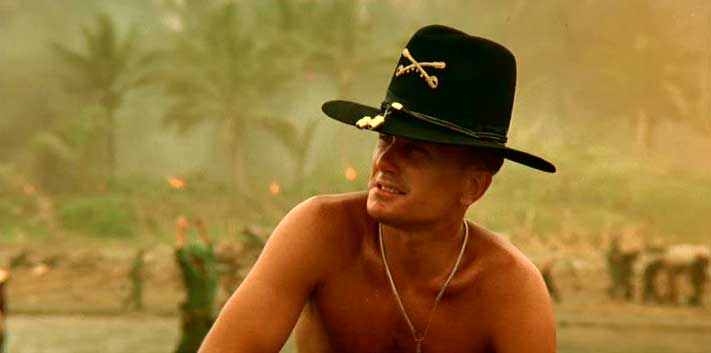
Showing posts with label frederic forrest. Show all posts
Wednesday, August 01, 2018
The Missouri Breaks
Directed by Arthur Penn and written by Thomas McGuane, The Missouri Breaks is the story of a rancher who hires a regulator to hunt down a horse thief whose gang has killed one of his men in an act of revenge while his daughter is in love with the head thief. The film is an offbeat western that play into a pursuit with some eccentric characters as it revolves around a man wanting to kill a thief. Starring Marlon Brando, Jack Nicholson, Randy Quaid, Harry Dean Stanton, Frederic Forrest, John McLiam, and Kathleen Lloyd. The Missouri Breaks is a whimsical yet engrossing film from Arthur Penn.
The film revolves around a horse thief whose gang kills a rancher’s foreman who hung their friend over angering a rancher as they would later buy land from that rancher just to piss him off. Yet, the rancher is trying to find out who killed his foreman as he hires an eccentric regulator who plays by his own rules and would later cause all sorts of trouble. It’s a film that is about a thief trying to maintain a life that is honorable and decent yet he also copes with this regulator being around him and causing trouble as well as having issues with a rancher whose daughter he falls for. Thomas McGuane’s screenplay opens with the rancher David Braxton (John McLiam) hanging a young man named Sandy (Hunter von Leer) whose friend is the horse thief Tom Logan (Jack Nicholson) who runs a gang of horse thieves as they learn about their friend’s death. The first act is about Logan and his gang robbing a train to buy land near Braxton’s ranch to start a ranch of their own yet Logan would be the one tending to the ranch while his gang led by Cal (Harry Dean Stanton) travel to Canada to steal horses from the mounted police force.
Logan would meet Braxton’s daughter Jane (Kathleen Lloyd) who is intrigued by Logan though their affair would be kept secret except that her father’s hired regulator in Robert E. Lee Clayton (Marlon Brando) is watching as he suspects Logan involved in the death of Braxton’s foreman. Clayton is this man who is a real oddball as he arrives to the Braxton camp holding on to his horse on the side as if he’s hiding while he has an Irish accent and wears strange costumes. Yet, there’s an aspect of him that is ruthless and cunning in his pursuits though his initial meeting with Logan with Braxton is based on curiosity yet Logan is aware of his reputation as he just tries to not get into trouble. Even as the third act is about Braxton realizing the trouble Clayton is bringing as it would lead to all sorts of chaos in his pursuit of Logan and his gang.
Arthur Penn’s direction is definitely mesmerizing in the way he presents the American West as it is shot on various locations in Wyoming to play into this world of the West and in areas near the Missouri River. Penn’s usage of the wide shots do play into the vast scope and the attention to detail into the landscape from the trees on the mountains as well as the rivers and other parts of the film while he would maintain an intimacy through medium shots and close-ups as it relates to the characters. Penn’s compositions play into moments that are comical such as the train robbery scene as well as the way Clayton introduces himself. Penn would also maintain that air of humor and low-key drama to play into the characters that are trying to do their work in stealing horses or Logan trying to tend to his land. The smaller moments showcase Penn putting time in the characters while letting the action take hold during the third act as it relates to Clayton’s methods and what he does where the violence is intense. Even as it would play into this confrontation between Logan and Clayton with Braxton having some part in playing to the chaos that he’s created. Overall, Penn crafts an exhilarating and quirky film about a horse thief being watched and hunted by an odd regulator.
Cinematographer Michael Butler does brilliant work with the film’s cinematography with its gorgeous yet natural look for many of the daytime exteriors with some stylish and low-key lighting for some of the interior scenes set in the day. Editors Dede Allen, Gerald G. Greenberg, and Steven A. Rotter do excellent work with the editing as it is largely straightforward for some of the dramatic and comedic moments while using some stylish rhythmic cuts for some of Clayton’s antics. Production designer Albert Brenner, with set decorator Marvin March and art director Stephen Myles Berger, does fantastic work with the look of the Braxton home as well as the ranch that Logan runs and the home that his gang live in.
Costume designer Patricia Norris does amazing work with the costumes from the ragged look of Logan and his gang to the odd clothes that Clayton wears including a dress that he would wear as part of his disguise. Sound editor Richard P. Cirincione does terrific work with the sound as it play into the atmosphere of the locations as well as some of the usage of gunfire and other weapons. The film’s music by John Williams is incredible for its offbeat approach to country and folk with some orchestral elements that add to the film’s odd yet enjoyable tone.
The film’s wonderful cast include some notable small roles from James Greene and Luana Anders as a rancher and his wife that Cy would hide out at, Danny Goldman as a baggage clerk during the train robbery, Hunter von Leer as Logan’s friend Sandy who gets hung by Braxton, John P. Ryan and Frederic Forrest as a couple of Logan’s friends in his gang in their respective roles as Cy and Cary, and Randy Quaid in a superb performance as a young member of the gang named Little Tod who gives Logan the idea to rob a train as he is an able though naïve hood who is always helpful. John McLiam is terrific as David Braxton as a rancher who wants retaliation for the death of his foreman as he is also suspicious of Logan buying land near him. Kathleen Lloyd is fantastic as Braxton’s daughter Jane as a young woman who is often caring for her father as she becomes fascinated by Logan whom she sees as someone who has a lot more to offer as well as an escape from her stuffy life. Harry Dean Stanton is excellent as Logan’s right-hand man Cal who gets some of the film’s best lines and dialogue as he’s kind of the conscience of sorts who often puts Logan in his place but also is aware of how dangerous Clayton is.
Jack Nicholson is great as Tom Logan as a horse thief that is trying to go straight and live a decent life while falling for the rancher’s daughter as he becomes aware of Clayton’s presence as it’s a restrained performance from Nicholson where he displays some charm but also a grounded approach of a man that becomes uneasy by what is happening around him. Finally, there’s Marlon Brando in a phenomenal performance as Robert E. Lee Clayton as this offbeat and odd regulator that has Brando sport an Irish-American accent as well as a twangy-western accent in one sequence as it’s a strange yet exuberant performance that has Brando be funny but also ruthless in the way he does his job as it’s one of his more overlooked performances of his career.
The Missouri Breaks is a sensational film from Arthur Penn that features incredible performances from Marlon Brando and Jack Nicholson. Along with its gorgeous visuals, top-notch supporting cast, John Williams’ exhilarating score, and a compelling screenplay by Thomas McGuane. It’s a western that doesn’t play by the rules while maintaining much of the visual tropes and plot devices expected from the genre with elements of dark humor. In the end, The Missouri Breaks is a spectacular film from Arthur Penn.
Arthur Penn Films: (Portrait of a Murderer) – (The Left Handed Gun) – (The Miracle Worker) – (Mickey One) – (The Chase (1966 film)) – (Bonnie and Clyde) – (Flesh and Blood) – (Alice’s Restaurant) – Little Big Man - (Visions of Eight) – (Night Moves (1975 film)) – (Four Friends) – (Target (1985 film)) – (Dead of Winter) – (Penn & Teller Get Killed) – (The Portrait (1993 film)) – (Inside (1996 film))
© thevoid99 2018
Wednesday, October 01, 2014
Hearts of Darkness: A Filmmaker's Apocalypse
Directed by Fax Bahr, Eleanor Coppola, and George Hickenlooper, Hearts of Darkness: A Filmmaker’s Apocalypse is about the making of Francis Ford Coppola’s 1979 film Apocalypse Now and its notorious production as it was captured by his wife Eleanor. The film showcases many of the aspects that nearly troubled the production from weather to all sorts of illness as the film also features new interviews with the film’s cast and crew. The result is a fascinating yet evocative documentary film about the making of Apocalypse Now.
In early 1976, production for what would be Francis Ford Coppola’s re-imagining of Joseph Conrad’s Heart of Darkness into a film set during the Vietnam War begins but what happens would be one of the most troubled productions ever in the history of cinema. Coppola’s wife Eleanor arrived to the Philippines with their three children in Gian-Carlo and future filmmakers Roman and Sofia where Eleanor was supposed to make some promotional footage for United Artists on the making of the film. What happened instead is that she would capture is the unthinkable as well as record private conversations with her husband unbeknownst to him at the time of the film’s production. Much of it would involve delays due to a typhoon that destroyed a film set, military personnel forced to take their helicopters to fight rebels in the south of the country, and Francis trying to figure out an ending and be faithful to John Milius’ original script.
The film would feature new interviews with the Coppolas plus actors Martin Sheen, Laurence Fishburne, Frederic Forrest, Albert Hall, Sam Bottoms, Robert Duvall, and Dennis Hopper plus cinematographer Vittorio Storaro, producer Fred Roos, and production designer Dean Tavoularis as they talk about a lot that went on in the production. A lot of it is revealed to be true as it showed a lot of things that went wrong where a week into shooting, Francis decided to replace Harvey Keitel with Martin Sheen as it was just the first of many things. The film begins with a rare footage of Francis at the 1979 Cannes Film Festival where he premiered a work-in-progress version of the film where Francis declared that the film isn’t about Vietnam. It is Vietnam.
Through Eleanor’s footage with a few of her camera operators, she showcases a lot of the things that went wrong as well as some of the things that really made the production one of the most maddening where her husband would have meltdowns during the production. There’s also moments where Eleanor would capture some of the things that happened in the Philippines where some of it would be surprising such as its ceremonies and such to showcase some of the light-hearted moments in the production. With the new interviews shot by cinematographers Larry Carney, Shana Hagan, Igor Meglic, and Steven Wacks, the actors, crew, and the Coppolas reflect on the craziness that went on as Francis often wondered how the hell he managed to continue.
With the help of editors Michael Greer and Jay Miracle along with sound editor Brian Risner, the film compiles many of the footage that occurs in the making of the film plus some of the film‘s deleted footage that would later be restored for its 2001 Redux version of the film. Even as Risner would use some of Francis own conversations that Eleanor had recorded to play into his own madness and his difficulty with the production as he would deal with the press who were already calling the film a disaster before it even finished. Especially as some of the audio features recordings by Orson Welles reciting the Joseph Conrad novel which he had hoped to adapt for many years. With some original music by Todd Boekelheide that is mostly low-key in its ambient score, much of the music in the documentary is from the original film to play into much of its madness and setbacks.
Hearts of Darkness: A Filmmaker’s Apocalypse is a phenomenal film from Fax Bahr, Eleanor Coppola, and George Hickenlooper. The film is something that anyone who loves Apocalypse Now must see over its troubled production as well as what happens when things can go wrong only for a director to persevere despite all of the obstacles he goes through. In the end, Hearts of Darkness: A Filmmaker's Apocalypse is a tremendous film from Fax Bahr, Eleanor Coppola, and George Hickenlooper.
Apocalypse Now/Apocalypse Now Redux
© thevoid99 2014
Monday, April 18, 2011
One from the Heart
In the 1970s, there was no director that had garnered much acclaim or accolades better than Francis Ford Coppola. While he had released four films in the 1970s with The Godfather, The Godfather Part II, The Conversation, and Apocalypse Now. He was also among the era of the New Hollywood movement of such auteur-driven directors like Peter Bogdanovich and Martin Scorsese. While Coppola was also a screenwriter and producer who also helped the careers of George Lucas and Carroll Ballard. Though the 1970s was a triumph for Coppola, he was about to enter a decade in which he faced failure, money woes, and other personal troubles.
For years, Coppola hoped to go independent and form his own studio where he can be the head and release his own films. While Zoetrope Studios started out as an independent studio that would allow first-time filmmakers a chance to create their own films. It was also a place where Coppola would be allowed to help develop projects for friends and himself. It would also be a place where he would create the kind of films he made without the interference of a major studio. For his next project, Coppola decided to make a film that would be an experiment of sorts as he tried out creating a film with new electronic cinema gadgets at the time in the early 80s. While it was supposed to be a small, romantic-musical set in Las Vegas. The film that would be called One from the Heart would become the film that would hurt Francis Ford Coppola’s career for several years.
Originally a $2 million budget, the film was to be shot inside a soundstage at the Zoetrope Studios to create an artificial version of Las Vegas. With help from cinematographer Vittorio Storaro and production designer Dean Tavoularis, the re-creation of Las Vegas along with other sets proved to be daunting. Even as Coppola wanted to experiment with new cameras as if he‘s watching the film via video feed and could have it edited around the same time like with TV. The production ballooned into a $26 million production towards its early 1982 release. When news broke about its budget and the production, it was clear that Coppola was about to enter into deep trouble.
Two years earlier, Michael Cimino released Heaven’s Gate which was a revisionist historical western set in the Johnson County Wars of the late 1800s. The film was Cimino’s follow-up to his 1978 Oscar-winning film The Deer Hunter as expectations ran high. Instead, the $40 million-budgeted film became a huge disaster that would help bankrupt United Artists as well as bring an end to era of New Hollywood and its auteur-driven directors. For Coppola, the production and release of One from the Heart made him nervous as he released it through a small, limited release in early 1982. The film was a massive flop as it would only pull more than $600,000 box office gross in less than a week. After that, Coppola decided to pull the film from theaters as he would spend the rest of the 1980s and part of the 1990s to make films to pay off his debts.
Though Coppola would eventually recover from the money he lost in making One from the Heart as well as reviving Zoetrope into American Zoetrope. Many people hadn’t seen One from the Heart but over the years, it was being praised by a small group of people that had seen it with interest raised over the film. In 2001, Coppola released an extended version of Apocalypse Now entitled Apocalypse Now Redux to great acclaim as he decided to revisit the film that gave him a lot of trouble. With help from Storaro and American Zoetrope executive Kim Aubry, Coppola decided it was time to revisit his great failure as he made a few changes in the editing as he gives his great 1982 failure a chance to be seen.
Directed by Francis Ford Coppola and screenplay by Coppola and Armyan Bernstein that is based on Bernstein’s story. One from the Heart is the story of a couple whose five-year relationship is starting to crumble. Living on the edge of Las Vegas on the 4th of July, the two would explore different worlds as the woman falls for a suave waiter while the man is amazed by a German circus performer. A throwback to the musicals and romantic films of the 1940s and 1950s with lavish production, it’s a film where Coppola blends that style of lavish production in tune with the colorful world of the 1980s. Starring Frederic Forrest, Teri Garr, Raul Julia, Nastassja Kinski, Lainie Kazan, and Harry Dean Stanton. One from the Heart is a dazzling, entertaining romantic-musical from Francis Ford Coppola.
It’s the 4th of July weekend approaching in Las Vegas as Hank (Frederic Forrest) and Frannie (Teri Garr) are to celebrate their five-year anniversary as a couple. Hank is a mechanic who works with his friend Moe (Harry Dean Stanton) while Frannie is a window dresser who works at a travel agency with her friend Maggie (Lainie Kazan). Yet, Hank and Frannie are having troubles due to Hank’s inability to do anything new while Frannie wants to be more adventurous. An argument leads to Frannie walking out as she leaves Hank to live with Maggie. Hank turns to Moe about the break-up with Frannie turning to Maggie. Both friends suggest that it’s time to move on and do something new.
One day at work, a waiter/pianist named Ray (Raul Julia) sees Frannie decorating as they talk for a while which would lead to a date later in the evening. Hank and Moe walk around the city where Hank comes across an exotic circus performer named Leila (Nastassja Kinski). With Hank and Frannie both going on different dates around the city of Las Vegas, lots of fun ensue for the both of them. With Frannie dancing with Ray in clubs and in the city, Hank takes Leila to his junkyard as both couples enjoy themselves. Hank however, realizes his love for Frannie as he decides to win her back.
The film’s plot and story is a simple one. A guy and gal approach their five-year anniversary, split up and meet their ideal partners until the guy realizes he is still in love with his gal. That’s pretty much what the film is about yet, it’s partially told through the film’s music. Coppola and co-screenwriter Armyan Bernstein do create a simple structure to the story as where the first act is about the split, the second act is Hank and Frannie meeting their ideal partners, and the third act is Hank wanting to get Frannie back. Again, that is the story in a nutshell as it’s one that is predictable and does stray into what is expected in a love story. The problem is that it’s kind of weak since both Hank and Frannie aren’t really that interesting. Then again, maybe that is intentional as when they each meet their new partners. There’s something different about them as they meet these exotic individuals who will fulfill their desire until Hank realizes what he wants.
The screenplay really is just a backdrop for what Coppola really wants is to create a film that is more about the visuals than the story. Since the story is a bit lackluster with its lack of tension and surprises. It allows Coppola to create scenes where it’s just about the moment and the visuals. Coppola’s direction is definitely marvelous to watch for not just re-creating Las Vegas but also having the place be a fantasy of sorts for the characters to be surrounded by.
While Coppola’s idea to recreate Las Vegas in a soundstage might seem like a crazy idea because of its costs. Still, even the idea of shooting the film on location in Las Vegas would’ve been just as troubling. Still, despite the issues he might’ve had with the money he spent, Coppola was able to create something that isn’t meant to be real but rather an artificial world that the characters live in. Notably scenes where Hank and Moe are having a conversation while in the next set, Frannie and Maggie are talking through dissolves or silhouette sets.
In some ways, even with the film’s full-frame aspect ratio of 1:37:1. Coppola is trying to recreate the old Hollywood musical as there’s some lavish dance numbers choreographed by Kenny Ortega that really stands out. One is this gorgeous dance between Frannie and Ray at a bar that later becomes this exotic, island set of sorts. The other is a bigger dance number with lots of extras and dancers on the street of Vegas. If it was shot on location in Vegas, it would’ve been impossible to create.
Coppola also has his camera go out there with long sequences whether its tracking shots or long shots to create a feeling of the location and where the characters are. Including scenes where both Frannie and Hank are in different directions as they’re near each other unaware of their presence. The camera is always moving to create a feeling about what is going on with the characters and such. Despite the film’s shortcomings with its story and its style-over-substance mentality, Coppola does create what is certainly a spectacular film that is very engaging and entertaining.
Cinematographers Vittorio Storaro and Ronald Victor Garcia do an amazing job with the film’s stylized yet colorful cinematography. Featuring many of the colorful palettes of blue and sepia-yellow that is a trademark of Storaro’s work. The cinematography has a dream-like look where many of the scenes shot on the streets of Las Vegas is filled with dazzling lights as it plays to the world that is Las Vegas. Even as the camera is always going somewhere while scenes such as Frannie and Ray’s dance along with Leila’s circus act in the junkyard are filled with lush colors from Storaro’s photography. The overall cinematography is definitely among one of the film’s technical highlights.
Editors Anne Goursaud, Rudi Fehr, and Randy Roberts do an excellent job with the editing as it plays up to the rhythm of the music. Particularly with some of the dance sequences in the film as it’s also very stylized including the fantasy scenes as they use wipes and jump-cuts to play up the sensation of what the characters are imagining. For the dramatic moments of the film, the editing is leisured with its pace as it plays to what the characters are doing including Hank’s eventual uncertainty.
Production designer Dean Tavoularis, along with set decorators Gary Fettis and Leslie McCarthy-Frankenheimer and art director Angelo P. Graham, does a phenomenal job with the set design and the re-creation of Las Vegas. Tavoularis and his team definitely create what is essentially an artificial world to Las Vegas along with the small suburb and house that Hank and Frannie lives. Even the airport for the film’s penultimate sequence is definitely out of this world. Despite the excessive tone of the art direction, it is definitely some fantastic work by Dean Tavoularis and company that also includes his brother Alex and two future renowned art directors in Dennis Gassner and James J. Murakami.
Costume designer Ruth Morley does a wonderful job with the costume design from the tuxedo that Ray wears to the lively red dress that Frannie wears on her date. Even as the character of Leila has clothes that truly plays to her exotic personality. Sound designer Richard Beggs and sound editor Leslie Shatz do a brilliant job with the film’s sound as it captures the lively world of Las Vegas in the dance scenes. Beggs and Shatz also help create an intimacy to the homes of Hank and Frannie’s along with the other places that they go into as the sound work is another of the film’s technical highlights.
The film’s music by Tom Waits is the real highlight of the film as it plays not just to the cool world of Las Vegas but also the longing of romance the characters go into. An entirely jazzy score with bits of dance, Waits has a score that is hypnotic in its arrangements. With songs and lyrics by Waits, the songs play up to the emotional crux of the film as it’s sung by Waits and Crystal Gayle. Gayle’s voice soars through many of the film’s heartbreaking moments as the overall soundtrack is one of the most overlooked soundtracks in the history of film.
The casting by Jennifer Shull is really good with its large array of extras and understudies that includes Rebecca De Mornay as a young woman in a restaurant along with cameo appearances by Tom Waits as a trumpeter, Allen Garfield as a restaurant owner, and Francis Ford Coppola’s parents Carmine and Italia as a couple in an elevator. Harry Dean Stanton and Lainie Kazan are excellent in their small but memorable supporting roles as Moe and Maggie, respectively. Stanton as a guy who tries to make Hank look modern while Kazan as the woman who tries to help Frannie as Stanton and Kazan stand out as they bring humor to the film.
Nastassja Kinski is great as the exotic Leila. A German circus performer who transfixes Hank with her physicality and stylish accent as Kinski really brings a lot of joy to her character with even the little moments in her performance. The late, great Raul Julia is superb as Ray, a suave musician who charms his way into Frannie’s hearts as he gives her hope and dreams about going to Bora Bora as Julia is just marvelous to watch. Teri Garr is very good as Frannie though her character is a bit whiny at times. Even as Garr does manage to show her sensual side while seemingly having a good time with the dance scenes. Frederic Forrest is also good as Hank, a good guy who is sort of lazy but also has his moments. Though his character is kind of pathetic, Forrest does succeed in making him sympathetic as he and Garr do have some chemistry.
While it’s nowhere near the brilliant work that he did in the 1970s or some of his other films in the 1980s and so on. One from the Heart is still a very good and spectacular romantic musical from Francis Ford Coppola. Fans of Coppola’s work will see this as a departure of sorts while they will be amazed by the film’s technical work that includes Dean Tavoularis’ set design and Vittorio Storaro’s photography. Even as Tom Waits’ score and soundtrack brings a lovely yet mesmerizing quality to the film. While it’s a film that has a very bad history, it’s one of those films that deserves another chance to be seen. In the end despite its flaws and a uninspiring script, One from the Heart is still a solid film from Francis Ford Coppola and company.
Francis Ford Coppola Films: Dementia 13 - (You’re a Big Boy Now) - (Finian’s Rainbow) - (The Rain People) - The Godfather - The Conversation - The Godfather Pt. II - Apocalypse Now/Apocalypse Now Redux - The Outsiders - Rumble Fish - The Cotton Club - (Peggy Sue Got Married) - (Garden of Stone) - (Tucker: The Man & His Dream) - New York Stories - The Godfather Part III - Bram Stoker's Dracula - (Jack) - (The Rainmaker) - (Youth Without Youth) - Tetro - (Twixt)
© thevoid99 2011
Thursday, January 06, 2011
Apocaplyse Now/Apocalypse Now Redux
Apocalypse Now
From 1972 to 1974, Francis Ford Coppola was clearly the hottest director in American cinema. He had released three films in that period. Two of which were The Godfather movies that both won Best Picture while in between was The Conversation that won the Palme D’or at the 1974 Cannes Film Festival. Then Coppola chose to produce a film based on an idea by John Milius which was a Vietnam film that is also an adaptation of Joseph Conrad’s Heart of Darkness. The project was called Apocalypse Now as Coppola and Milius worked on the project that included ideas from Michael Herr based on his article The Battle of Khe Sanh.
The project was originally going to be directed by George Lucas who turned it down to make Star Wars. Coppola ended up taking on the project as the director as he decided to make it into an ambitious film about Vietnam with a budget ranging from $12-14 million. Yet, finding the location proved to be tough as he found it in the Philippines despite the warning from his mentor Roger Corman to not shoot there. From March of 1976 to May of 1977, the production of Apocalypse Now was a chaotic experience as Harvey Keitel was replaced by Martin Sheen after a few days. What was to be a five-month shoot became longer.
When Marlon Brando arrived three months into production, he arrived overweight and not having read the material Coppola wanted him to read. Things got worse due to typhoons and in early 1977, Martin Sheen suffered a heart attack. After shooting wrapped, Coppola and company returned to California for what would be a two-year work on the film not just for editing but also for its sound. Even as Coppola and his longtime editor Walter Murch brought together a team of sound mixers and editors to create a new quadraphonic sound mix that would eventually become 5.1 Dolby Stereo Surround Sound.
The editing and sound work took a long two years as the film was screened in rough sketches including a showing at the 1979 Cannes Film Festival where it would co-win the Palme D’or with Volker Schlondorff’s The Tin Drum. In August of 1979 after extensive post-production and with a final budget of $31.5 million, which was massive at the time. Apocalypse Now was finally released.
Directed by Francis Ford Coppola with the screenplay written by Coppola, John Milius, and narration by Michael Herr as its told by Martin Sheen’s brother Joe Estevez. Apocalypse Now is the story of an army captain going upriver through Cambodia to assassinate a colonel who had supposedly gone insane. A classified mission as he’s accompanied by a Navy patrol boat crew where they would encounter strange things including a surf-crazed Lt. Col as they go deep into a dark jungle. Starring Marlon Brando, Martin Sheen, Robert Duvall, Laurence Fishburne, Sam Bottoms, Frederic Forrest, Albert Hall, Harrison Ford, G.D. Spradlin, and Dennis Hopper. Apocalypse Now is an eerie yet hypnotic masterpiece from Francis Ford Coppola.
It’s 1970 in Saigon as a burned-out and troubled special forces soldier by the name of Captain Benjamin L. Willard (Martin Sheen) is awaiting for his next assignment. He then gets a call for his next assignment as he’s briefed by Lt. General Corman (G.D. Spradlin), Col. Lucas (Harrison Ford), and a government official (Jerry Ziesmer) about his mission, which is also classified. The mission is to upriver to Nung River where he must find and kill Colonel Walter E. Kurtz. Kurtz is a special forces soldier who has feared to have gone rogue while forming an army of his own somewhere in Cambodia. Another captain (Scott Glenn) was supposed to kill Kurtz but has since disappeared.
Willard takes the mission as he joins the crew of a Navy patrol boat headed by Chief Phillips (Albert Hall) that also includes a surfer named Lance B. Johnson (Sam Bottoms), a guy named Chef (Frederic Forrest), and a young kid named Clean (Laurence Fishburne). Willard doesn’t tell anyone about his mission as he tells Phillips to go to a rendezvous point to meet Lt. Col. Kilgore (Robert Duvall) for transport to Nung River. Kilgore leads an air cavalry of helicopters as he decides to transport the team after learning that Lance is part of the patrol. He takes the team to a day of an attack where Willard and crew saw the chaos that Kilgore has created.
During the journey upriver, Willard begins to read about Kurtz’s background as they would make at a stop at a USO show with Playboy Bunnies. Later on during the journey, they stop to investigate a boat against Willard’s orders which leads to dire consequences. The journey darkens when they stop at a U.S. outpost at a bridge where a fight with the North Vietnamese is occurring where Willard receives more information about Kurtz and the captain who was supposed to assassinate him. With Lance on LSD and causing trouble, more chaos ensues as they’re getting closer where an encounter with villagers lead to dire consequences. After telling the crew what he’s doing as they reluctantly take him upriver.
Upon arriving into Kurtz’s outpost as Willard gives orders to call an air strike if he doesn’t return. He meets a freelance photographer (Dennis Hopper) who explains to Willard about Kurtz’s brilliance. Willard then meets Kurtz as he tells Kurtz why he is here. Even as Kurtz knows why as it’s clear that Willard is going to have a much harder time to complete his mission.
While the film is simply about an assassin going on a journey to find his target. It’s a much more complex film than what the plot suggests. Since Francis Ford Coppola and his co-screenwriters were basing their ideas from Joseph Conrad’s Heart of Darkness. Conrad’s novel explored the psychology of one of its protagonists as he goes into this journey in the Congo rivers. Along the way, he finds a world filled with chaos and despair as he gets closer to the man he’s trying to find. That idea is what probably attracted Coppola and John Milius to create Apocalypse Now by setting it in the Vietnam War.
Unlike the war films about Vietnam that were being made in the late 1970s, there is no political context since Coppola isn’t interested in going into ideas of anti-war or pro-war. Instead, he’s interested in this journey that Captain Willard is taking on. Willard is definitely a man that has seem to be in too many battles and is unable to return home as the same man he used to be. He is someone addicted to war and being of use for his country. When he’s finally given a mission, he goes head-on as he also decides to dwell into the psychology of Col. Kurtz.
The narration by Michael Herr, that is told by Joe Estevez (who filled in due to his brother’s health problems at the time), recalls Willard’s thoughts as he is going into his surroundings while reading about Kurtz. The voice-over narration of Willard also serves as a development for his character as it becomes clear that the closer he’s getting to Kurtz. The more troubled he becomes as he tries to keep his sanity together.
While the film is in some ways about Willard, it’s also about the journey with the patrol crew that Willard surrounds himself with. The characters of Chief, Chef, Clean, and Lance are just as interesting with all of their different personalities. Though Willard doesn’t try to interact or bond with them very much, they do effect his thoughts as at one point during the journey. Chief realizes that something bad is happening as he tells Willard that he has no idea where he is going. Even as Willard doesn’t tell them anything until the third act.
Another character Willard encounters in the journey is Lt. Col. Kilgore. Kilgore is an eccentric character who likes to create chaos and has a love for surfing. He is also someone who is very much into war and victory but also has a certain respect for the enemy. At one point, he says that anyone who had the guts to fight against him deserves a drink of water where a wounded Vietcong soldier is lying on the ground though he is waving a canteen around.
Then there’s Colonel Kurtz. A man with an amazing background in military and humanitarian services. Yet, the mystery of why he turned rogue and gave up all of these accomplishments to lead an army of his own. Though not everything is answered, it is clear that war had done a lot to damage the man as there’s a great monologue about the horrors he had seen in battle. Even as he has done a lot to protect himself where he’s become feared by those he opposed and those he had done his duties for.
The screenplay is definitely a complex story that involves a lot into the ideas of war as well as humanity in general. Capturing all of that terror is the direction of Francis Ford Coppola. Coppola’s broad, hypnotic direction is really the highlight of the film as he opens the film with an eerie scene of a jungle being bombed as it dissolves with burned-out face of Willard. The film has a dream-like yet eerie look where once the journey upriver takes place. It plays up as this eerie journey to Hell as Coppola mostly uses eerie camera shots for the movements on the boat. Many of the scenes in the river were obviously inspired by Werner Herzog’s 1972 film Aguirre, the Wrath of God. Even in using hand-held shots for the film’s battle scene along with aerial shots from helicopters.
It’s not just Coppola’s stylized shots that are the highlight of his direction. It’s also the way he creates the tension in the drama. Even as it leads to the climatic meeting between Willard and Kurtz where he just lets the camera roll as a keen observer wondering what kind of man Kurtz is. The way Coppola underplays the drama and maintain the tension between Willard and Kurtz is astounding as they’re surrounded by this world of chaos. Overall, this is Francis Ford Coppola at his finest.
Helping Coppola wield his surreal yet lush vision is cinematographer Vittorio Storaro. Storaro’s dream-like yet hypnotic photography is filled with arrays orange-like colors mixed in with dark green and elements of blue for a few nighttime scenes. For many of the daytime scenes including the famed air-cavalry which is mostly straightforward while adding a mostly dark, sepia-like tone for many of the scenes of the river. Not only is this Storaro’s best work as a cinematographer but it’s also the film’s real technical highlight.
The editing of Walter Murch, Richard Marks, Lisa Fruchtman, and Gerald G. Greenberg is phenomenal for the way the film moves in its leisured though chaotic approaching to pacing. Even in the more intense action scenes, the film moves with a kinetic rhythm that plays up to the excitement of war. For the scenes in the jungle and the journey, it moves slow but in a more methodical way as helps create the dramatic tension of the film. It’s definitely an idea of what great editing is.
Production designer Dean Tavoularis, along with set decorator George R. Nelson and art director Angelo P. Graham do a spectacular job with the look of the villages that Kilgore attacks as well as the apartment of Willard. Even the temple has a look that is truly mystical with its feeling of death as the art direction for the film is superb. The sound work by sound designer Walter Murch and sound editor Richard P. Cirincione is truly masterful for the way it invented the kind of sound that audiences hear in today’s film world. With additional help mixer Richard Beggs, the sound work is brilliant for the film’s spectacular air-cavalry attack as it’s another of the film’s technical achievements.
The music by Carmine Coppola and Francis Ford Coppola is another of the film‘s highlights for its calm but brooding tone of the film. With its use of soothing string arrangements mixed with electronics and percussions performed by Mickey Hart of the Grateful Dead. The score is truly mesmerizing for the way it captures the horrors of war. The film’s soundtrack includes a cover of Creedence Clearwater Revival’s Suzie Q in the Playboy USO show scene, the Rolling Stones’ Satisfaction during a water-skiing scene on the patrol boat, and Richard Wagner’s Ride of the Valkyries for the air cavalry attack. Another song that is used for the opening scenes of the film as well as the climatic ending is the Doors’ The End.
The casting by Terry Liebing and Vic Ramos is definitely inspiring for the use of memorable appearances of actors big and small. Among those who make an appearance in the film are famed music promoter Bill Graham as the USO Playboy promoter, Jerry Ziesmer as a government agent who tells Willard what to do about the mission, R. Lee Emrey as a helicopter pilot, Scott Glenn as the original assassin who becomes a part of Kurtz’s soldiers, and as Playboy Bunnies, Colleen Camp, Linda Carpenter, and Cynthia Wood. Also in the film making cameos as a film crew are Francis Ford Coppola and cinematographer Vittorio Storaro in the battle scene following the air-cavalry attack.
Other notable small but memorable appearances include Harrison Ford and G.D Spradlin as army officers debriefing Willard about his mission and Dennis Hopper as a crazed photographer who praises Kurtz and his ideologies. In the roles of the patrol boat crew, a then 14-year old Laurence Fishburne as wonderful as the young soldier Clean who has issues with Willard’s presence. Frederic Forrest is very good as Chef, a man obsessed with Playboy Bunnies while fearing over his own surroundings. Sam Bottoms is excellent as Lance, a surfer who gets himself into drugs as he tries to find a way to escape from the horrors of war. Albert Hall is great as Chief, the patrol boat leader who questions Willard’s authority while realizing that something bad is about to happen.
Robert Duvall is superb as Lt. Col. Kilgore, a man who cares for his soldiers while being someone that is completely eccentric. Even when he cares about making great waves for good surfs. It’s one of Duvall’s finest performances as he spouts one of the film’s most memorable lines. Martin Sheen is phenomenal as the film’s protagonist Captain Willard. A troubled man who is a product of the war as he goes deep into the dark jungles of Cambodia to find his target. He’s someone with little remorse as he often alienates himself from the patrol boat crew that is taking to his journey. It’s definitely Sheen at his best as he brings a lot to a character that is losing his humanity.
Finally, there’s Marlon Brando in what is definitely his last great performance as Col. Kurtz. While he would do more films over the years until his death in 2004, this would be one of Brando’s most iconic roles of his career. Playing a man troubled by war as well as the horrors of what he sees as inhuman. It’s a role that not only has Brando bald and overweight but also someone who is burned out as if he’s one the brink of insanity. It’s definitely a great role from the legendary actor.
When the film did premiere in August of 1979, it initially received mixed reviews as it did do well in the box office. At the Oscars, it would win two for Best Cinematography to Vittorio Storaro and Best Sound as well as several awards. The film would become Coppola’s last great hit as he spent the 80s in debt following the release of his 1982 film One from the Heart. Though he would be able to recover from his financial troubles in the 1990s, it would be many years before he decided to revisit his 1979 film.
Apocalypse Now Redux
In 1998, Francis Ford Coppola along with new American Zoetrope chief Kim Aubry decided to work on a new version of Apocalypse Now with additional footage that was cut from the film. With help from editor Walter Murch and cinematographer Vittorio Storaro to help with the new transfer of the film. Coppola also brought in some of the film’s cast to do new dubbing for the film while some new music was made with help from Mickey Hart. The result would be an expanded version of Apocalypse Now called Apocalypse Now Redux.
The 202-minute version is a different film of sorts in comparison to the original 153-minute cut of the film. A few scenes get altered like a water-skiing scene that was shown early in the film before Willard and crew meets Kilgore. In the Redux version, it’s shown much later with Willard reading the dossier on Kurtz. There’s also a new introduction to Kilgore as he arrives on a helicopter. Also altered in the Redux version is the ending that Coppola for years had issues with because he felt that audiences were confused about it. The new ending isn’t much of an alteration as it would clarify things about what Willard has done in the end.
The Redux version also includes some more humor in the film like a scene of Willard stealing Kilgore’s surfboard as well as a scene where Willard and crew try to hide the surfboard and their boat from Kilgore’s crew. Other new scenes in the longer cut include a rainy scene where Willard finds the Playboy Bunnies helicopter has landed on an abandoned army medical camp where Chef and Lance spend their time with a couple of Bunnies while Clean is waiting to score with one. Other new scenes have more interplay with Willard and crew as well as a scene where Kurtz reads some articles from Time magazine to Willard as he’s surrounded by children.
One significant scene that is restored for the Redux scene is the French Plantation scene. It’s where following the tragic death one of the patrol crew members, they stop at a foggy area as they encounter a group of French soldiers protecting a plantation in Cambodia. It is in this sequence where Chief’s duty of honor occurs during the funeral as they bury a fallen one while Willard and the remaining crew eat. The scene includes a child (Roman Coppola) reading a poem while the plantation head (Christian Marquand) talks about why the French shouldn’t give up as it features a cameo from Henri Martin Affair who argues with the plantation head. The scene also includes Willard’s encounter with Roxanne (Aurore Clement) who is a member of the family as she gets Willard in touch with his humanity as they smoke opium.
The scenes in the film definitely adds more to the story as they also fill in gaps that were probably unexplained in the original cut of the film. At the same time, it allows the film to move a bit faster while maintaining a leisured pace for the film. The new scenes have the same look and feel that Vittorio Storaro’s photography have as the French Plantation scene is the best looking scene in the Redux version. The score, which features additional material that wasn’t in the original film by Carmine Coppola, definitely brings more tension thanks in part to Mickey Hart’s percussion work and arrangements.
The performances from the cast who were in the original cut are given more nuance. Particularly Brando, Sheen, and Duvall as they show more humanity while Sheen gets to be funnier in a few scenes. More importantly, minor characters such as a couple of Playmates in Colleen Camp and Cynthia Wood are given more to do. For the French plantation scene, cameos by Francis’ sons Roman and Gian-Carlo as children of the plantation are good as is Henri Martin Affair as an old man commenting about the plantation’s history. Christian Marquand is great as the owner who talks about the French’s war record as he says they will not lose in Vietnam. Finally there’s Aurore Clement as Roxanne, a widow in the plantation who befriends Willard as she briefly gets him in touch with the humanity he seems to be losing.
Apocalypse Now Redux premiered at the 2001 Cannes Film Festival to a very positive reaction as the film was given a limited release in theaters where it did modestly successful. While audiences and critics were divided over the new scenes with the French Plantation receiving the brunt of the criticism. Still, it was successful enough for Coppola to help his revived American Zoetrope studio to keep going. In 2010, Coppola released both versions of the film along with the 1992 making-of documentary Heart of Darkness for a special Blu-Ray release as the legacy of Apocalypse Now remains intact.
Apocalypse Now is definitely one of the greatest war films ever from the dazzling yet eerie mind of Francis Ford Coppola. Featuring a great ensemble led by Marlon Brando, Martin Sheen, and Robert Duvall. It’s a film that is definitely hypnotic with grand visuals and intense moments that are truly unforgettable. Whether it’s the original cut or the extended Redux edition. It’s definitely a film that everyone must see whether they’re into war films or not. In the end, Apocalypse Now is a haunting yet mesmerizing film from Francis Ford Coppola.
Francis Ford Coppola Films: Dementia 13 - (You’re a Big Boy Now) - (Finian’s Rainbow) - (The Rain People) - The Godfather - The Conversation - The Godfather Pt. II - One from the Heart - The Outsiders - Rumble Fish - (The Cotton Club) - (Peggy Sue Got Married) - (Garden of Stone) - (Tucker: The Man and His Dream) - New York Stories - The Godfather Pt. III - Bram Stoker’s Dracula - (Jack) - (The Rainmaker) - (Youth Without Youth) - Tetro - (Twixt)
Related: Hearts of Darkness: A Filmmaker's Apocalypse
© thevoid99 2011
Sunday, January 02, 2011
The Conversation
Originally Written and Posted at Epinions.com on 1/25/05.
In the early 1970s, America was in a crucial spot with rising inflation, the falling out of the Vietnam War and most of all, the Watergate scandal that involved President Richard Nixon. Corruption, burglary, lies, and illegal wiretapping were surrounding the scandal that was around the 1972 Presidential election in which Nixon won. The cover-up and tape conversations from 1971-1973 were heard about that led to Nixon to resign in disgrace in August of 1974. There, a new sense of cynicism arrived to America along with a sense of disillusionment around the American government. Around that same time in 1974, a film about wiretapping and recorded conversations came out that reflected the paranoia and secrecy of American society. Now more than 30 years since its release, it's been hailed as one of the defining films of the 1970s entitled The Conversation.
Written, produced, and directed by Francis Ford Coppola, The Conversation is a part-homage film to Michaelangelo Antonioni's 1966 film Blow-Up and a reflection of the underlying sense of paranoia and morality of wiretapping in early 1970s America. Written around the early 70s as a script right before Watergate, Coppola wanted the film to be a modern suspense thriller with a sense of character study surrounding the film's protagonist Harry Caul. Coppola, who was coming off his success of his 1972 masterpiece The Godfather used the money from that movie to make a low-budget yet minimalist film for The Conversation. Though it wasn't as known as The Godfather movies when it came out in early 1974, the film is still relevant in the mind of American society. Starring Gene Hackman, John Cazale, Allen Garfield, Frederic Forrest, Cindy Williams, Teri Garr, Harrison Ford, and Robert Duvall, The Conversation is a smart, eerie masterpiece that sends chills to its audience.
It's a typical day for a couple walking in a park in the city of San Francisco. What Mark (Frederic Forrest) and Ann (Cindy Williams) doesn’t know is that they're being followed and bugged by a group of surveillance men led by sound expert Harry Caul (Gene Hackman). With his assistant Stan (John Cazale) in the van and another man named Paul (Michael Higgins) walking in the park with two other guys listening far away on buildings, they record every word of the conversation they can find. After the job is done, it's up to Harry and Stan to listen to every word, even through its distortion. For Harry, it's just another job as he is hired privately by a corporate director (Robert Duvall) to follow this couple. After calling the director, he goes back to his apartment where his day often ends in loneliness.
Privately away from his work, Harry is a very secretive man who triple-locks his apartment as he learned that his landlord broke in to give him a birthday present and later that night, he visits his girlfriend Amy (Teri Garr) for a night where she keeps asking about his secrets like why he comes in very quietly all the time. Harry doesn't have a normal life as he continues to work and filter through the sounds of the recorded conversation he’s been working on. After calling Stan's work sloppy, Harry does the work himself as he tries to turn the tapes into the director who asks for them. Instead, he meets his assistant Martin Stett (Harrison Ford) who wants the tapes but Harry decides to take them since he wanted to deliver the tapes personally to the director.
With an upcoming convention looming, Harry goes through all the distortions of the conversation where he learns of a plot that involves murder and blackmail. Haunted by a previous job he did in New York City that had a family killed, Harry feels he might happen again yet he can't let his own feelings get involved. Harry continues to work through every word and sound of the conversation as he shows up for the convention. After meeting some colleagues that included Stan, Paul, and an east coast rival in William P. "Bernie" Moran (Allen Garfield) who has been a really successful surveillance man. Harry learns he's being followed by Stett, who sends a message for the tapes to be presented to the director the next day.
A post-convention party at Harry's warehouse is held with a couple of hookers where Meredith (Elizabeth McRae) flirts with Harry as Bernie toasts Harry for his work yet keeps asking about the job he did in New York. Bernie also reveals to be a very innovative bugger who has created a bugging device shaped like a pen as he had recorded some of the conversations Harry had as he destroyed it. After Bernie, Stan, Paul, and a hooker left, Harry tried to listen to his tapes but ends up being seduced by Meredith. Dreaming that he has met Ann where he talks about his childhood illness, he wakes up learning that the tapes are gone. Then he gets a call from Stett that Meredith took them to Stett for the director to hear. Harry goes to meet Stett and the director to hear the tapes as he was given his fee. Learning that a murder might go on, Harry tries to figure out what's going on not only endangering the lives of those involved but also himself.
While comparing The Conversation to The Godfather movies is incomparable in its tone and style, both do have similar internal conflicts for its protagonists. Whereas Marlon Brando's Don Corleone is wanting a better life from his family from the mob, Harry Caul is conflicting with trying to save the life of some people in a plot that he had instigated. While The Godfather and The Godfather Part II are the more popular films, The Conversation is really Francis Ford Coppola’s best work. Bringing a diverse style in his directing were in some scenes, the camera is placed in detach setting while his close-ups and zooming in are very entrancing. It's directing at its masterful while as a screenwriter, Coppola delivers a script filled with surreal moments, especially in the third act and a restrained suspense that makes you build up for what happens. Each suspenseful moment is very unpredictable after watching it for the first time yet you're not sure if anything that you see is real. It's undoubtedly one of the best scripts ever written.
If The Conversation works in its suspenseful writing and directing, it also works in its technical achievements. The film is also a technical spectacle thanks to a wonderful film crew that includes a few of Coppola’s regular collaborators in production designer Dean Tavoularis and editor Walter Murch. The cinematography of Bill Butler (who shot most of the scenes except for the opening park scene which was done by Haskel Wexler) is wonderfully exquisite in some of the film's surreal moments along with its wonderful, dreamy lighting in the night interior scenes at the church and Harry's warehouse during the post-convention party. Dean Tavoularis also shines in the film's visual department with his wonderful detailed look of the scenes in the convention and in Harry's warehouse while getting some of the sound equipment used for the recordings that Harry works on that is very dead-on with the times.
Many of the film's genius, aside from its look and its wonderfully yet manically-paced editing of Richard Chew and Walter Murch, is the sound. The film is a masterpiece in sound thanks to the team of Murch, Art Rochester, Mike Evoe, and Nat Boxer. The sound design not only gives the film an eerie tone but also plays off with its suspense and its manipulation. There's moments where you're thinking you're hearing one thing but through its filters and distortions, you hear a whole lot more as it's a great film of sound. Also working well in the film is the film's score by David Shire that is filled with a smooth, jazz-like suspense and tone that really send chills through the film as it plays off with the sound design as well, even in the soundtrack of jazz cuts by Duke Ellington, Johnny Green, and Dave Brubeck.
The film's small, ensemble cast is excellently well-played with some small but memorable roles from Michael Higgins as one of Harry's bugging pals, Teri Garr as Harry's secretive mistress who keeps asking questions about him, and Elizabeth McRae as the model who flirts with Harry. Allen Garfield is wonderfully humorous in the role of Bernie Moran with his swagger and sneering attitude that is a great antithesis to Harry Caul. Robert Duvall is excellent in his brief role as the director while Harrison Ford brings a dark presence to his role as the director's assistant. Frederic Forest and Cindy Williams are excellent together in their complex roles as the couples of the conversation that is recorded, especially with the film's memorable line that Forest says, "He'd kill us if he had the chance". The late John Cazale delivers a great yet small performance as Harry's assistant who often asks questions about why they're recording and is seems to be the one guy who tries to get Harry out of his shell. It's really one of the more overlooked performances in the film.
The film's central performance that is widely regarded to be the best in the movie belongs to the always great, always versatile Gene Hackman. Hackman gives a very guarded, troubling performance as the secretive, paranoid, and moralistic Harry Caul. Hackman brings a sense of restraint to the role along with an intensity whenever he's driven by paranoia. We see that he's not a great man, he is very protective from himself, the way he treats women, his colleagues, and how acts towards people. Yet, we know that his life wasn't great, he also has a past that troubles him. It's really one of Gene Hackman's finest performances as an actor and he is the reason that he is considered to be one of the greatest American actors on the silver screen.
When The Conversation came out in early 1974, it was hailed by critics as a masterpiece and when it premiered internationally that year at the Cannes Film Festival in France, the film won Coppola his first ever Palme D'or (the second would be Apocalypse Now where he tied with another film in 1979). Despite the acclaim for the film, The Conversation got lost in the shuffle commercially since many film goers were anticipating the second Godfather movie. Still, 30 years since its release, it's been hailed a cinematic classic and is often considered to be Coppola's best film.
The 2000 DVD release which includes a wonderful widescreen presentation along with a remixed audio sound by Walter Murch and those at Zoetrope studios is a must-buy on DVD. The film looks even better on DVD while it includes a few features like the film's original trailer and an eight-minute featurette on the making of The Conversation where Coppola and Gene Hackman give a glimpse into the making of a few scenes. The DVD also include two audio commentary tracks, one from Coppola, and the other from sound wizard Walter Murch. Coppola's commentary on the film reveals some of the film's mystery along with some of his reasons into making the movie while giving his own feelings on why he loved The Conversation than most of his film. Walter Murch's commentary provides some more technical pointers into the film as well as his own insights into the movie. Murch admits that the gadget Harry used to filter the sounds for that infamous line doesn't really exist while he talked about some of the editing strategies he used from Coppola's notes while he was away doing work on The Godfather Part II. Murch doesn't reveal some of the secrets on the film anyway though he did mention a funny story involving him and porno magazines as a young kid.
Now thirty-years later since its release, The Conversation is still hailed as a cinematic classic thanks to Francis Ford Coppola's mind-bending script and eerie direction along with the great technical work of Bill Butler, Walter Murch, Dean Tavoularis, and company. With more recent films influenced by The Conversation that included Brian de Palma's widely underrated film Blow-Out starring John Travolta and Tony Scott's big-budgeted 1998 thriller Enemy of the State with Will Smith and Gene Hackman. The Conversation at repeated viewing remains intriguing along with the great performance from Gene Hackman and the supporting cast that includes Harrison Ford, Allen Garfield and the late John Cazale. While The Godfather movies may be his most well-known and popular work to date, The Conversation is a must-see film for anyone interested in cinema.
Francis Ford Coppola Films: Dementia 13 - (You're a Big Boy Now) - (Finian's Rainbow) - (The Rain People) - The Godfather - The Godfather Pt. II - Apocalypse Now/Apocalypse Now Redux - One from the Heart - The Outsiders - Rumble Fish - The Cotton Club - (Peggy Sue Got Married) - (Garden of Stone) - (Tucker: The Man & His Dreams) - New York Stories - The Godfather Pt. III - Bram Stoker's Dracula - (Jack) - (The Rainmaker) - (Youth Without Youth) - Tetro - (Twixt)
© thevoid99 2011
Subscribe to:
Posts (Atom)