Showing posts with label guillermo del toro. Show all posts

Sunday, January 15, 2023

Pinocchio (2022 Animated Film)


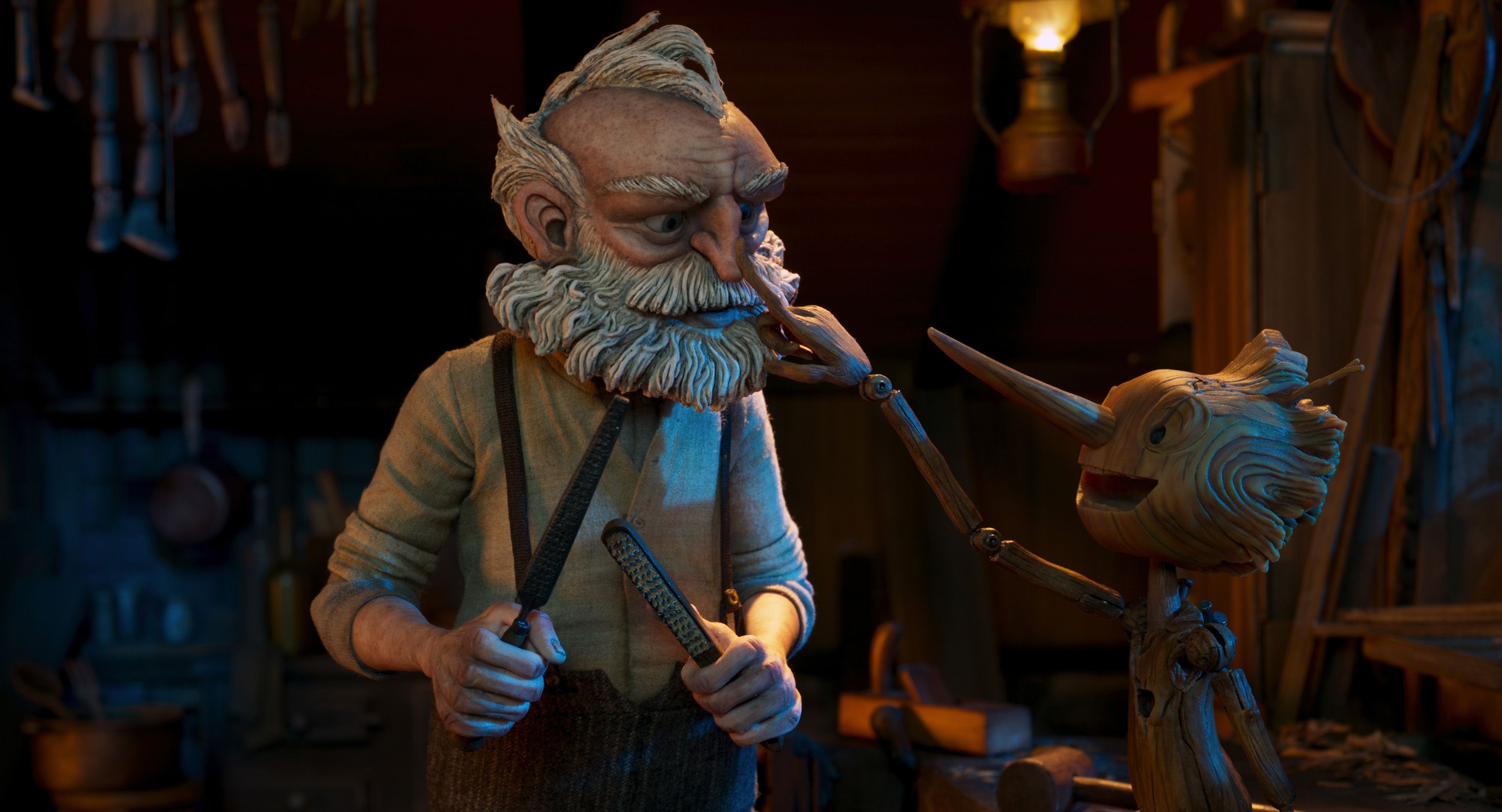
Based on the novel The Adventures of Pinocchio by Carlo Collodi with illustrations by Gris Grimly, Pinocchio is the story of a wooden puppet who comes to life as he struggles with his well-being and winning the approval of his father. Directed by Guillermo del Toro and Mark Gustafson with a screenplay by del Toro and Patrick McHale from a story by del Toro and Matthew Robbins, the stop-motion animation film is set during the period of Fascist Italy as it plays into a man dealing with loss and a puppet trying to discover life during a period of chaos. Featuring the voices of Gregory Mann, David Bradley, Ewan McGregor, Burn Gorman, Ron Perlman, John Turturro, Finn Wolfhard, Cate Blanchett, Tim Blake Nelson, Christoph Waltz, and Tilda Swinton. Pinocchio is a rich and intoxicating film from Guillermo del Toro and Mark Gustafson.

Two decades after the death of son during World War I, the film follows a man who drunkenly creates a wooden boy to cope with his loss as it comes to life where the boy struggles with not just winning his father’s approval but also what it means to live. It is a film that takes the premise of the story of a man who creates a puppet who turns into a boy as it is set in Fascist Italy at a time when conformity and playing to certain rules are in tow which is something that a puppet with no strings is trying to deal with as well as the idea of love and what it means to exist. The film’s screenplay by Guillermo del Toro and Patrick McHale is told largely by a cricket in Sebastian J. Cricket (Ewan McGregor) about the titular character (Gregory Mann) and how he had been created by this lonely carpenter in Geppetto (David Bradley) after having lost his son Carlo (Gregory Mann) during an aerial bombing in World War I as he had been ravaged by grief until he cuts down a tree where Cricket was living and turned it into a puppet. It is then where a fairy in the Wood Sprite (Tilda Swinton) would cast a spell for the puppet to come to life while asking Cricket to watch over and guide him.

While Geppetto’s initial encounter with Pinocchio has him confused and frightened as does Pinocchio’s appearance at the town’s local church. Geppetto does what he can to steer Pinocchio the right way but also him wanting to be like Carlo yet there is also pressure from the Podesta (Ron Perlman) who wants Geppetto to ensure that Pinocchio becomes part of the Italian Royal Army upon a major discovery they would have much to Geppetto’s horror. Even as Pinocchio would encounter the failing circus ringmaster Volpe (Christoph Waltz) who would get Pinocchio to sign a contract that would keep him out of the eye of the Podesta but also keep Pinocchio performing in order to keep Geppetto out of debt. It all plays into Pinocchio’s development and his conversations with Cricket as it has him thinking about not just wanting to live but also to find his own voice as he watches the abuse that Volpe has on his longtime assistant monkey Spazzatura (Cate Blanchett) as well as a closer look into the world of Fascist Italy upon being watched by the Podesta at youth training camp.

The direction of del Toro and Mark Gustafson is astonishing in its overall presentation due to the attention to detail that both men put into its look as it is created on studio locations in Portland, Oregon and Guadalajara, Mexico. With Gustafson and his team of animators doing much of the stop-motion work with production designers Guy Davis and Curt Enderle, with set decorators Jesse Gregg, Gillian Hunt, Samantha Levy, Molly Light, Laura Savage, and Zach Sheehan plus art directors Andy Berry, Karla Castaneda, Robert DeSue, and Juan J. Medina, helping to create much of the backdrops in the look of the forests and woods in such grand detail. Even with Davis also creating some of the creatures including Cricket, Spazzatura, and the sea monster for the film’s climax, there is a look that is del Toro in terms of its approach to death as well as horror with the former involving a sequence in which Pinocchio meets a death fairy (Tilda Swinton) in a surrealistic presentation of the afterlife. Since the film is also based on the illustrations of Gris Grimly, del Toro and Gustafson maintain this look that quite wobbly in its presentation as there is a realism to the animation as well as a physicality in how they take this story and set it into a world where there are elements of politics and existentialism in the mix.

Even in a scene where Pinocchio asks his father why people don’t like him but love this model of the crucifixion as it is among these things that Pinocchio would go into. The compositions that del Toro and Gustafson create add to the drama that Pinocchio goes through in the wide and medium shots in a location or in one of Pinocchio’s stage performances as well as close-ups that play into the characters as they cope with whatever situation they’re in. Notably in the climax as it plays into Pinocchio and Geppetto dealing with a sea monster as all of the lessons that Pinocchio would learn allows him to deal with the situations as well as an understanding of both life and death. Overall, del Toro and Gustafson craft an exquisitely moving and ravishing film about a wooden boy who comes to life and learns about existence and identity during the era of Fascist Italy.

Cinematographer Frank Passingham does incredible work with the cinematography as it helps the look of the film give it a sense of physicality in the lighting while helping to set mood to help bring more texture to the production design. Editors Ken Schretzmann and Holly Klein do amazing work with the editing as it is largely straightforward to play into some of the musical numbers but also in some of the dramatic and terrifying moments with its rhythmic cuts. Visual effects supervisors Cameron Carson and Aaron Weintraub do excellent work with the visual effects as it is mainly set dressing for some scenes involving war and fire as it help broaden the visuals. Sound designer Scott Martin Gershin does brilliant work with the sound in the way certain objects sound as well as the way an instrument sounds on a location or how bombs sound from afar. The film’s music by Alexandre Desplat is phenomenal with its rich orchestral score that has elements of lush strings and orchestral pianos themes along with some offbeat percussive-based themes while the soundtrack also feature original songs written by Desplat along with lyrics by del Toro, McHale, and Roeben Katz that add to the drama and humorous moments in the film that are sung by its cast.

The casting by Mary Hidalgo is great as it feature some notable small voice roles from Tom Kenny in a trio of voice performances as a sea captain, a right-hand for Mussolini, and the Italian Fascist leader Benito Mussolini as well as Tim Blake Nelson as a quartet of black rabbits, John Turturro as a doctor in the small town Geppetto lives in, Burn Gorman as the local priest, Finn Wolfhard as the son of the Podesta in Candlewick who at first bullies Pinocchio only to befriend him late in the film, and Cate Blanchett in a superb voice cameo as Volpe’s monkey assistant Spazzatura who talks through puppets where Blanchett brings unique voices as a monkey who is jealous of Pinocchio only to realize the good in Pinocchio. Tilda Swinton is fantastic in a dual voice role as the magical fairy known as the Wood Sprite and her sister known as Death where Swinton brings different tones to the two characters as they lament on the ideas of both life and death. Ron Perlman is excellent as the Podesta as a Fascist government official who sees Pinocchio at first as a freak only to see that he could become a symbol for the government in their rise while trying to raise his son as a perfect soldier for Fascist Italy.

Christoph Waltz is brilliant as Volpe as a former aristocrat-turned circus ringmaster who sees Pinocchio as a way to get him back into aristocracy as well as a chance to get in the good graces of Mussolini as he brings a charm to this evil character. Ewan McGregor is amazing as Sebastian J. Cricket as the film’s narrator and conscience-of-sorts who tries to steer Pinocchio onto the right path while dealing with being squished and such as well as trying to do what he can where he laments over his role. David Bradley is incredible as Geppetto as a woodcarver/carpenter who laments over the loss of his son as well as dealing with Pinocchio as he is someone ravaged by grief while trying to understand the many flaws of Pinocchio while trying to go on a search for him when Pinocchio joins the circus. Finally, there’s Gregory Mann in a sensational voice performance in the dual role of Carlo and the titular character as he brings an exuberance and innocence to the former as well as an energy into the latter as well as this vulnerability of someone who is just trying to understand the ideas of life and death where Mann brings a lot of life into both of these roles.

Pinocchio is a tremendous film from Guillermo del Toro and Mark Gustafson. Featuring a great ensemble cast, gorgeous visuals, ravishing art direction, its story of existentialism and identity, amazing character/creature designs, and Alexandre Desplat’s enchanting music score. It is a film that takes a tale told many times but bring something new to it and set it during a tumultuous time in world history as it help play into a wooden boy trying to find himself as well as a physicality that gives the film an edge in its stop-motion animation presentation. In the end, Pinocchio is a magnificent film from Guillermo del Toro and Mark Gustafson.

Guillermo del Toro Films: Cronos - Mimic - The Devil's Backbone - Blade II - Hellboy - Pan's Labyrinth - Hellboy II: The Golden Army - Pacific Rim - Crimson Peak - The Shape of Water - Nightmare Alley (2021 film)

Related: (Pinocchio (1940 film)) - The Auteurs #10: Guillermo del Toro

© thevoid99 2023

Sunday, January 02, 2022

Nightmare Alley (2021 film)


Based on the novel by William Lindsay Gresham, Nightmare Alley is the story of an ambitious carny who rises from being in a low-level circus to becoming a top mind-reader has him dealing with a psychiatrist who proves to be as dangerous as he is where they embark on a dangerous scheme. Directed by Guillermo del Toro and screenplay by del Toro and Kim Morgan, the film is a different take on Gresham’s novel in its exploration of human nature and how humans can become monsters as it had been previously made by Edmund Goulding that starred Tyrone Powell, Joan Blondell, Coleen Gray, and Helen Walker that explore the dark side of grief and the power to manipulate. Starring Bradley Cooper, Cate Blanchett, Rooney Mara, Toni Collette, David Strathairn, Richard Jenkins, Willem Dafoe, Mary Steenburgen, and Ron Perlman. Nightmare Alley is a ravishing yet eerie film from Guillermo del Toro.

Set in the late 1930s/early 1940s, the film follows a man who starts off as a carny for a low-level circus where he learns the art of mind-reading that he uses to become a top mind-reader in big cities only to attract the attention of a devious psychiatrist who helps him take part on a big scheme. It is a film that explore this man who is ambitious as he believes he has something that can make him a lot of money but ends up meeting someone who is more ambitious but also far more sinister. The film’s screenplay by Guillermo del Toro and Kim Morgan is straightforward as it is more based on Gresham’s novel with elements of the 1947 film by Edmund Goulding that featured Jules Furthman’s screenplay as it relates to these ideas that the film’s protagonist in Stanton Carlisle (Bradley Cooper) as he finds himself in a circus after burning down a house with the body of his late father where he sees what it has and takes a job as a carney.

The first act is about Carlisle’s time as a carny where he meets the clairvoyant Zeena Krumbein (Toni Collette) and her alcoholic husband Pete (David Strathairn) where Carlisle learns from the latter about their act while he proves to be loyal to the group when he helps out its owner Clem Hoatley (Willem Dafoe) who would give Carlisle a job after helping to handle a troubled circus geek. Carlisle also befriends another performer in Molly (Rooney Mara) who would later join Carlisle in his own version of the clairvoyant act though Zeena and Pete warned him about going too far as the film’s second act takes place in late 1941 where Carlisle becomes successful in his act with Molly. The second act would also introduce the character of Dr. Lilith Ritter (Cate Blanchett) who is intrigued by his act after fooling an acquaintance of hers where she decides to collaborate with him on a scheme on the reclusive millionaire Ezra Grindle (Richard Jenkins) that makes Molly uneasy.

Guillermo del Toro’s direction definitely does pay homage to Goulding’s film in some bits but much of it is entrancing in his presentation of the late 1930s/early 1940s as it was shot on location in and around Toronto as well as additional locations in Buffalo, New York including its city hall. The direction has del Toro definitely emphasize a lot on tracking shots to get a look into the carnival while having Carlisle early in the film not say much as he just stumbles into the circus out of curiosity where he just looks at an act and then walks out to check what else is out there. The usage of wide and medium shots allows del Toro to showcase the scope of the carnival that Carlisle is in as well as a scene where Carlisle and Clem go after a geek inside a monster house as it is one of these great set pieces in the film. The scenes during the second act in these posh restaurants where Carlisle and Molly are doing their act also has a lot of space in the visuals while del Toro also knows when to use close-ups to play into the suspense and drama. The film also has del Toro play into the dangers of what Carlisle is doing as both Zeena and Pete had warned about going too far into people’s grief as it would be a key factor for the film’s third act.

Notably in a scene where Zeena, the strongman Bruno (Ron Perlman), and diminutive Major Mosquito (Mark Povinelli) visit Carlisle and Molly with prompting from the latter where Zeena uses her tarot cards and warned Carlisle of what he’s doing. The third act that is about Carlisle’s scheme with Dr. Ritter on Grindle as it involves Grindle’s own sense of loss and guilt as the scheme would involve Molly who realizes what is going on. It all plays into not just the downside of greed and manipulation but also how far people are willing to go get closure on their grief as it relates to news on someone Carlisle did a séance for. Its aftermath is dark into not just the fact that Carlisle went too far but also the fact that there’s people who are much worse than Carlisle who will do whatever to exploit people’s grief. Its ending is about the fate of those who are lost as it relates to the troubled geek that Carlisle tried to subdue early in the film as it relates to people and monsters. Overall, del Toro crafts a haunting yet evocative film about an ambitious carny whose ambition as false clairvoyant leads him into a path of darkness.

Cinematographer Dan Laustsen does incredible work with the film’s cinematography as its usage of lush colors and low-key natural lighting to emphasize on its dark tone but also in some of the beauty in the desolate locations they’re in that is a direct contrast to the more stylish look in the city and at Grindle’s home. Editor Cam McLauchlin does excellent work with the editing as its usage of jump-cuts, transition wipes, and other stylish cuts to play into the suspense and drama. Production designer Tamara Deverell, with set decorator Shane Vieau and supervising art director Brandt Gordon, does phenomenal work with the look of the carnival as well as Clem’s massive collection of fetuses in mason jars, some of the carnival attractions, and Dr. Ritter’s office as the attention to detail in the rooms is a major highlight of the film. Costume designer Luis Sequeira does amazing work with the costumes from the red coat and beret that Molly wears in the second/third act as well as some of her casual clothing to the more refined gowns that Dr. Ritter wears along with the ragged to refined suits the men wear.

Hair designer Cliona Furey and makeup designer Jo-Ann MacNeill, with special makeup effects supervisor Mike Hill, do excellent work with the look of the characters from the different hairstyles from the women to a few of the gory elements in some of the violence that Hill would create. Special effects supervisors Michael Innanen, Shane Mahan, Philippe Maurais, and Shane Million, with visual effects supervisor Dennis Berardi, do terrific work with the visual effects as it relates to a few bits involving fire as well as Molly’s act as a woman who works with electricity as it is largely minimal except in some of the film’s violent moments. Sound editors Jill Purdy and Nathan Robitaille do superb work with the sound as it play into the way certain machines sound as well as how police sirens sound from afar as well as Dr. Ritter’s own recording equipment as it add a lot of drama and suspense into the film. The film’s music by Nathan Johnson is brilliant for its low-key orchestral score with elements of big-band jazz in some bits as it play into the music of the times with its soundtrack also featuring a lot of the standards that were popular in that period.

The casting by Robin D. Cook is marvelous as it feature some notable small roles that includes a cameo appearance from Tyrone Powell’s daughter Romina as a viewer of one of Carlisle’s show at the posh dining hall as well as notable small roles from Dian Bachar as a carnival performer, Paul Anderson as the geek that Carlisle tries to subdue early in the film, Lara Jean Chorostecki as Clem’s wife Louise, Stephen McHattie as a hobo late in the film, Troy James as a carnival performer known as the Snake Man, Clifton Collins Jr. as the carnival barker/musician Funhouse Jack, Bill MacDonald as Carlisle’s ailing father who is seen in flashbacks, Jim Beaver as a local sheriff who is trying to stop the carnival because of the skimpy clothing Molly is wearing, Mark Povinelli as a dwarf-carny who helps out in various performances including Molly’s act, Tim Blake Nelson as a carnival owner that appears late in the film, Peter MacNeill as Judge Kimball who is intrigued by Carlisle’s gift as he seeks help in relation to his late son, Holt McCallany as Grindle’s bodyguard Anderson who is suspicious towards Carlisle as he is protective of Grindle, and Mary Steenburgen in a small yet superb role as Judge Kimball’s wife as a woman who is still reeling with loss over her son.

Ron Perlman is fantastic as the strongman Bruno who is like a father figure to Molly as he knew her father as he is unsure of Carlisle’s intention towards her. David Strathairn is excellent as Pete Krumbein as an alcoholic performer who was once a great clairvoyant with a system of his own as he teaches Carlisle what to do but also warns him on what not to do. Richard Jenkins is brilliant as Ezra Grindle as a reclusive millionaire who is fascinated by Carlisle’s gift as it relates to a former lover he mourns dearly as he was once a patient of Dr. Ritter as he is the target of a scheme they’ve created as he is also a man with a very dark past. Willem Dafoe is amazing as Clem as a carnival owner who hires Carlisle as he shows him the ropes of what goes on as he also sees potential in Carlisle while being the owner of a bunch of dead fetuses in mason jars. Toni Collette is incredible as the clairvoyant performer Zeena Krumbein who takes has Carlisle working for her in helping her act while is also intrigued by him while later warning him about what he’s doing as well as reveal that he is headed for serious trouble.

Rooney Mara is remarkable as Molly Cahill as a carnival performer who works with electrical currents as part of her act as she falls for Carlisle where she joins him as his assistant while becoming troubled by his ambitions as she reluctantly takes part of his scheme only to become homesick towards the carnival family who cared for her. Cate Blanchett is tremendous as Dr. Lilith Ritter as a devious yet charismatic psychiatrist who is fascinated by Carlisle’s gift as she would seduce him to team up but also know that she is able to outsmart him. Finally, there’s Bradley Cooper in a phenomenal performance as Stanton Carlisle as this man who starts off as a low-level carny to becoming this in-demand clairvoyant who eventually becomes greedy in his ambitions where Cooper does display a lot of quiet observation early in the film but also a man that is filled guilt in his climb only to try and do something big that would eventually be his downfall as it is a career-defining performance from Cooper.

Nightmare Alley is a sensational film from Guillermo del Toro that features great performances from Bradley Cooper, Cate Blanchett, and Rooney Mara. Along with its ensemble cast, ravishing visuals, evocative art direction, its exploration on the ideas of loss and greed, and its luscious music score. The film is definitely a fascinating suspense-drama that is a tribute of sorts to the 1947 Edmund Goulding film but also its own beast as it play into del Toro’s fascination with humanity and their monstrous elements. In the end, Nightmare Alley is a phenomenal film from Guillermo del Toro.

Guillermo del Toro Films: Cronos - Mimic - The Devil's Backbone - Blade II - Hellboy - Pan's Labyrinth - Hellboy II: The Golden Army - Pacific Rim - Crimson Peak - The Shape of Water - Pinocchio (2022 film)

Related: Nightmare Alley (1947 film) - The Auteurs #10: Guillermo del Toro

© thevoid99 2022

Monday, February 05, 2018

The Shape of Water


Directed by Guillermo del Toro and screenplay by del Toro and Vanessa Taylor from a story by del Toro, The Shape of Water is the story of a mute custodian at a secret lab run by the American government who falls for a mysterious creature whom the lab is experimenting on. Set in the early 1960s during the Cold War, the film is an exploration of a woman who meets this amphibious creature and sees him for what he really is where she and friends try to protect it from dark forces. Starring Sally Hawkins, Michael Shannon, Octavia Spencer, Richard Jenkins, Michael Stuhlbarg, and Doug Jones as the mysterious sea creature. The Shape of Water is a rapturous and intoxicating film from Guillermo del Toro.

The film is a simple story set in early 1960s Baltimore where a mysterious creature had been captured by the American government for experiments where a mute custodian at the lab befriends and later falls for the creature. It’s a film that bear a lot of elements of the fairy tale but it is presented in a world that is teetering on the brink of world dominance as this mute woman and mysterious creature from the sea in the middle. The film’s screenplay by Guillermo del Toro and Vanessa Taylor has an unusual approach in which the creature and the protagonist in Elisa Esposito (Sally Hawkins) never speak a word with the latter communicating through sign language. It’s the supporting characters such as Elisa’s co-worker Zelda (Octavia Spencer), her neighbor Giles (Richard Jenkins), a scientist named Dr. Robert Hoffsetler (Michael Stuhlbarg) who is a Soviet spy, and a government official in Colonel Richard Strickland (Michael Shannon) who captured the creature that do much of the talking in the film.

Elisa is a woman with a routine as she works at nights to clean up with Zelda as the reason she doesn’t speak is due to a neck injury she had when she was a baby. Giles is considered like a caretaker of her of sorts who is struggling to create ads for companies that are changing their ideas of what they want. Yet, Giles is also coping with aging and the fact that he’s gay where he shares his loneliness with Elisa who knows that he’s gay and has no problem with it. Zelda is an African-American who isn’t afraid to say what is on her mind as she also protects Elisa from the suspicion of Colonel Strickland whom she isn’t fond of. Colonel Strickland isn’t a traditional antagonist as he is eager to do his job but also has a family to provide for where he is also paranoid about the Soviet Union spying on what they captured. Then there’s Dr. Hoffsetler as he is a Soviet spy but his interest in the creature is more about science rather than give the Soviets an advantage where he becomes sympathetic for the creature as he knows what it can do and wants to help it.

The direction of del Toro has this mixture of old-Hollywood mixed in with elements of fantasy as well as a look of early 1960s consumerism and conformity despite the sense of unrest that is looming in those times. Shot largely in Hamilton, Ontario in Canada with some of it shot in Toronto, del Toro captures a time in America where the Cold War is looming and things are changing to keep up with people wanting things like Cadillacs or diners that are safe. Yet, there is still something off as it relates to what is really happening as it’s something Giles doesn’t want to see as he has enough reality to deal where he tries to make a pass at a waiter at the diner who he thought was gay who also refuses to serve an African-American couple. It’s among these tropes that del Toro would put in the film to establish the tone of the times which also feels real as the only pleasure for Giles and Elisa they have are through old films they watch on TV or at the cinema that is below their apartment.

While del Toro would use some wide shots of the locations as well as the scope of the lab and a few scenes inside the movie theater. Much of del Toro’s direction would involve more intimate shots in the close-ups and medium shots as it play into the interaction with the characters including the scenes of Elisa and the creature in how they communicate and how they bond. Even as del Toro isn’t afraid to display this air of sexuality early in the film as it relates to Elisa’s routine and her own feelings for the monster who feels like he understands her much better than a lot of human beings. That is something that Col. Strickland isn’t able to understand yet he is still a complex individual as del Toro would create some unique compositions to play into his determination to find what the monster is useful for in the advantage of the Cold War.

It adds to the sense of misunderstanding of what humanity can’t deal with whenever they encounter something that is different where del Toro sees the creature as a being with a soul that is there for the good of the world. It’s something Giles, Zelda, and Elisa would see as does Dr. Hoffsetler who becomes aware that the Soviets have no interest in what the creature can do as it play into this tug-of-war between two superpowers who just want an advantage in this dangerous conflict. Still, del Toro is focused on this unlikely love story between Elisa and the creature as it is about two beings in love and wanting to be with each other without any complications in relation to the real world. Overall, del Toro creates a ravishing and enchanting film about a mute woman who falls for a mysterious creature from the sea.

Cinematographer Dan Laustsen does brilliant work with the film’s cinematography with its usage of colorful lighting schemes and moods with the usage of green and teal-like colors for many of the film’s interior settings as well as some colorful lighting for some of the exterior scenes at night including the usage of low-key colors for the scenes in the water as well as a black-and-white dream sequence. Editor Sidney Wolinsky does excellent work with the editing as it has elements of style in some jump-cuts though much of it is straightforward with some rhythmic cuts to play into the suspense. Production designer Paul D. Austerberry, with set decorators Jeffrey A. Melvin and Shane Vieau plus art director Nigel Churcher, does amazing work with the look of the lab in all of its detail to the water tanks and electronic equipment to the look of the apartments that Giles and Elisa live in as well as the interior of Col. Strickland’s home. Costume designer Luis Sequeira does fantastic work with the costumes as it play into the period of the early 1960s with the way the suits look as well as some of the dresses that the women wore in those times.

Special makeup effects by Mike Hill and Shane Mahan do incredible work with the look of the creature in all of its intricate designs including body parts that light up as it one of the finest feats of creature design. Visual effects supervisors Dennis Berardi, Trey Harrell, and Kevin Scott do terrific work with the visual effects that’s set in the water as well as some set dressing for some of the exterior scenes in the film. Sound editor Nathan Robitaille does superb work with the sound as it play into the atmosphere of the locations including some of the sounds in the lab with Robitaille and del Toro providing some of the vocals sounds of the creature. The film’s music by Alexandre Desplat is marvelous for its enchanting orchestral score that is filled with lush string arrangements and tingling percussion textures as it adds to the sense of fantasy and the suspense in the film while its soundtrack features music from Madeleine Peyroux, Benny Goodman, Andy Williams, Alice Faye, Glenn Miller, and Roger Suen.

The casting by Robin D. Cook and Jonathan Oliveira is remarkable as it feature some notable small roles from John Kapelos as the cinema owner Mr. Arzoumanian, Morgan Kelly as the diner waiter who sells pies, Wendy Lyon as Col. Strickland’s secretary, Madison Ferguson and Jayden Grieg as Col. Strickland’s children, Stewart Arnott as an advertising executive friend of Giles, Nigel Bennett as a Soviet spy that Dr. Hoffstetler talks to, Lauren Lee Smith as Col. Strickland’s wife Elaine, David Hewlett as one of the military scientists in Fleming who is asked to spy on Dr. Hoffstetler, and Nick Searcy as Col. Strickland’s superior General Frank Hoyt who wants the monster be used as a tool for the Cold War.

Michael Stuhlbarg is fantastic as Dr. Robert Hoffstetler as a scientist who is really a Soviet spy that is studying the creature where he realizes that the creature offers so much more as he decides to help Elisa rather than answer to Col. Strickland and the Soviets. Octavia Spencer is excellent as Zelda Delilah Fuller as a talkative custodian who often speaks for Elisa as well as be a conscience of sorts in the film where she would protect Elisa and the creature in the hope that Elisa could find some happiness. Richard Jenkins is brilliant as Giles as Elisa’s neighbor and an aging advertising agent who often wears a toupee where he struggles with age and the need for companionship as well as changing times as he sees the creature as a beacon of hope where he sees what kind of magic it could do as well as be a great sense of hope for Elisa.

Michael Shannon is amazing as Colonel Richard Strickland as a government agent who captures the creature in the hopes he can extract something that could be useful for the human race in the Cold War as he’s a complex man that loves his family and knows a lot of literature where Shannon brings a chilling and scary performance of a man that is willing to kill. Doug Jones is great in his role as the creature where, despite not having any dialogue, he manages to provide a sense of soul and intelligence where it’s just a marvel to watch. Finally, there’s Sally Hawkins in a phenomenal performance as Elisa Esposito as a mute custodian worker who speaks through sign language as she is fascinated by this sea creature where it’s Hawkins’ charm, child-like innocence, and adult-like desires that is key to her performance as it is really a career-defining performance for Hawkins.

The Shape of Water is a magnificent film from Guillermo del Toro. Featuring a great cast, gorgeous visuals, a compelling story that mixes various genres, an eerie setting, and a sumptuous music score by Alexandre Desplat. It’s a film that captures the sense of wonderment in something that is extraordinary where a woman tries to protect it from those who have inhuman means of using the creature for their own reasons. In the end, The Shape of Water is a spectacular film from Guillermo del Toro.

Guillermo del Toro Films: Cronos - Mimic - The Devil's Backbone - Blade II - Hellboy - Pan's Labyrinth - Hellboy II: The Golden Army - Pacific Rim - Crimson Peak - Nightmare Alley (2021 film) - Pinocchio (2022 film)

The Auteurs #10: Guillermo del Toro

© thevoid99 2018

Sunday, October 25, 2015

Crimson Peak


Directed by Guillermo del Toro and written by del Toro and Matthew Robbins, Crimson Peak is the story of a young woman who marries an aristocrat as she moves into her husband’s mansion as it is filled with ghosts and other things. The film plays into a woman with an interest in the supernatural as she gets more than she bargains for in her new life. Starring Mia Wasikowska, Tom Hiddleston, Jessica Chastain, Charlie Hunnam, and Jim Beaver. Crimson Peak is an entrancing yet eerie film from Guillermo del Toro.

Set in the early 20th Century, the film revolves around a young author who meets a British aristocrat as she falls for him where they later marry where she would live into his decayed mansion with his sister as the home is filled with ghosts and other mysterious things. It’s a film that plays into a young woman who has been fascinated with ghosts since she was a child as she wants to write stories with ghosts. Upon meeting this aristocrat, Edith Cushing (Mia Wasikowska) is intrigued by this man though appearance in clothing and other eccentricities raises the suspicions of her father (Jim Beaver) and family friend Dr. Alan McMichael (Charlie Hunnam). Once she marries Thomas Sharpe (Tom Hiddleston) and moves into their home, many mysterious occurs as well as the treatment she is receiving from his sister Lucille (Jessica Chastain).

The film’s screenplay by Guillermo del Toro and Matthew Robbins doesn’t just play into Edith’s fascination with ghosts but also with those that don’t play by conventional behavior or play by certain rules. It’s among the reasons why she would be attracted to someone like Thomas as he wears clothes that are out of style while having ideas that seem to be very radical. While Edith’s father is aware of what Thomas wants, he is suspicious about him and his sister as he asks for some investigation into who the Sharpes are. Upon realizing what they’re up to, things don’t go as they’re planned once Edith marries Thomas where she does question the things that go on in the house as well as other odd things. Thomas and Lucille Sharpe are strange not just for the Gothic clothes they wear but also in the house they live which is decaying and in need of work.

While the two do share ideas of what they want to, Thomas is the kinder of the two where it seems like he is falling for Edith for her money but he becomes more fascinated with her as the story progresses. Lucille however, is a very troubling woman as someone who has a very dark demeanor as she doesn’t seem to like having Edith around where she always gives her tea and pretend to be very kind towards her. Yet, even she knows that Edith knows what they’re probably up to which adds a much darker edge to her character. Once more revelations towards the Sharpe are unveiled, the story definitely becomes more engaging in terms of the drama and the stakes that occur. Though it does deviate from many of the conventions that is expected in horror, del Toro and Robbins do make it more about the setting and the relationship of the characters rather than going for the big scares.

Guillermo del Toro’s direction definitely owes a lot to not just Gothic imagery and set pieces but also mythological elements that explores the idea of ghosts and what they want. While it doesn’t play towards many of the conventions of horror in terms of big scares, del Toro is more concerned with the story as it relates to Edith’s own fascination with ghosts and her need to find more in her somewhat sheltered existence as a writer. Shot largely in Toronto as both Buffalo, New York and as England, the film maintains this look that is quite unique from the sepia-drenched look of Buffalo where everything feels modern and progressing as opposed to the world of the Sharpes which represents the old world that is decaying and trying to catch up with the modern world. The usage of the wide and medium shots gives del Toro the chance to breathe life into these landscapes with some unique tracking shots for many of those exteriors.

For the scenes set in England, del Toro definitely plays up the Gothic tone of the film where he knows how to create suspense as it relates to the ghosts that Edith encounters. It’s mixture of terror and mystery definitely play into the home of the Sharpes where it is a home is surrounded by red mud that is covered in snow and a basement filled with more red mud. The direction would have del Toro create some unique images but also a sense of dread which doesn’t just relate to the Sharpes and their past but also what is happening to Edith. Once the mysteries relating to the Sharpes are unveiled, the film does take on a darker yet more dramatic tone where lots of conflicts would occur as it’s not just about love but also death. Overall, del Toro crafts a mesmerizing yet thrilling film about a young woman’s marriage to an aristocrat and her encounter with dark spirits in the new home she moves into.

Cinematographer Dan Laustsen does phenomenal work with the film‘s ravishing cinematography from its usage of candles to maintain an atmosphere in some of the interior scenes as well as the usage of sepia-drenched colors for many of the scenes set in Buffalo along with the usage of blue at the Sharpes‘ mansion. Editor Bernat Vilaplana does brilliant work with the editing with its stylish usage of transition wipes as well as jump-cuts and other stylish cuts to play into its suspense and drama. Production designer Thomas E. Sanders, with art director Brandt Gordon and set decorators Jeffrey A. Melvin and Shane Vieau, does amazing work with the set design from the home of Edith lived in Buffalo to the many rooms and exterior setting at the Sharpes‘ family home. Costume designer Kate Hawley does excellent work with the clothes from the clothes that the men wear to the gowns that the women wear including the very colorful yet eerie dresses that Lucille wears.

Special effects makeup artists Jason Detheridge, Nacho Diaz, and Neil Morrill do fantastic work with the look of the makeup of some of the gore that occurs in a few characters including the hairstyles that Edith and Lucille sport. Visual effects supervisor Dennis Berardi do excellent work with the visual effects from the design of the ghosts as it has this very eerie yet evocative look to them that is scary but also entrancing. Sound editor Dennis Leonard and sound designer Randy Thom do superb work with the sound in creating some unique sound effects for the ghosts as well as creating some mixing for some of the atmospheric textures for its suspenseful moments. The film’s music by Fernando Velazquez does remarkable work with the music as it is this lush orchestral music that plays into the drama and suspense which features a mixture of string arrangements and piano pieces while music supervisors Peter Afterman and Margaret Yen provide some classical music that Lucille would often play.

The casting by Robin D. Cook does wonderful work with the casting as it features some notable small roles from Leslie Hope as Dr. McMichael’s mother, Emily Coutts as Dr. McMichael’s sister, Burn Gorman as an inspector named Holly that Edith’s father hired to find out about the Sharpes, Sofia Wells as the young Edith, and as ghosts, Doug Jones and Javier Botet who both provide their physical selves for movements of the ghosts. Jim Beaver is excellent as Edith’s father Carter Cushing as a self-made man who is suspicious about the Sharpes’ as he is more concerned for Edith’s safety and happiness as it’s a very engaging performance from the veteran actor. Charlie Hunnam is fantastic as Dr. Alan McMichael as a childhood friend of Edith who knows a lot about bodies and such where he is also suspicious of the Sharpes’ where his investigation about them would have him come to England.

Jessica Chastain is incredible as Lucille Sharpe as this woman who is reluctant about having Edith in her family as it becomes clear that she doesn’t really like her as it’s a performance that is very dark and also quite scary at times where Chastain goes all out towards the film’s third act as it is definitely one of Chastain’s finest performances. Tom Hiddleston is brilliant as Thomas Sharpe as a baronet who falls for Edith as he brings her to England while hoping some of her financial connections could help him with his mining machine as it’s an ambiguous performance which has Hiddleston showing some conflict in his devotion towards Lucille and love for Edith. Finally, there’s Mia Wasikowska in an amazing performance as Edith Cushing as an aspiring writer who falls for the mysterious Thomas Sharpe where she moves into his home and encounter ghosts which only furthers her fascination with them while dealing with the darker aspects of her home as it’s one of Wasikowska’s finest performances.

Crimson Peak is a phenomenal film from Guillermo del Toro. Featuring a great cast, dazzling visuals, a sumptuous score, and an entrancing story. The film is a very unusual yet enthralling one from del Toro that doesn’t play into the conventions of horror while bending all sorts of genres to create something that is very different. In the end, Crimson Peak is a sensational film from Guillermo del Toro.

Guillermo del Toro Films: Cronos - Mimic/Mimic (Director's Cut) - The Devil's Backbone - Blade II - Hellboy - Pan's Labyrinth - Hellboy II: The Golden Army - Pacific Rim - The Shape of Water - Nightmare Alley (2021 film) - Pinocchio (2022 film) - The Auteurs #10: Guillermo del Toro

© thevoid99 2015

Monday, July 22, 2013

Pacific Rim


Directed by Guillermo del Toro and screenplay by del Toro and Travis Beacham from a story by Beacham, Pacific Rim is the story about a small band of humans trying to save the world from gigantic monsters known as Kaijus who are destroying Earth in 2020 as they emerged from a portal in the sea. The film is a tribute of sorts to the Japanese monster movies like Godzilla that is mixed in with a human story as a man tries to find redemption with a young rookie in operating a robot that can defeat the monsters. Starring Charlie Hunnam, Rinko Kikuchi, Idris Elba, Charlie Day, Clifton Collins Jr., and Ron Perlman. Pacific Rim is a spectacular yet exhilarating film from Guillermo del Toro.

The film is an apocalyptic tale of sorts where humanity band together to fight these monsters called Kaijus who wreak havoc on humanity as they emerge from a portal in the pacific ocean. With the help of giant robots named Jaegers that are manned by two pilots, they’re able to battle the Kaijus but the monsters have gotten stronger and more dangerous as the world is about to go to an end where a retired pilot named Raleigh Becket (Charlie Hunnam) reluctantly returns to the fold to fight the monsters with a rookie named Mako Mori (Rinko Kikuchi). It’s a premise that is kind of simple in terms of what is expected in a monster movie where man-piloted giant robots have to battle these massive monsters to save the world. Yet, there’s a lot more that Guillermo del Toro and co-screenwriter Travis Beacham offer.

The film begins with Becket’s early successes as well as how the Kaijus arrived into the world and the war that forced many countries to come together and battle these monsters. It’s all told in a 20-minute sequence to establish key elements into the Kaijus as well as why Becket left the Jaeger program due to tragedy. Yet, it plays into Becket’s reluctance into returning to the program as well as the fact that his new partner Mako is someone who also had encountered tragedy due to Kaijus. Since the Jaegers had to be piloted by two people due to its size and need to be monitored mentally as it would be overwhelming for one person. It does play into the drama as well as the tragedies that Becket and Mako shared as well as Mako’s connection with Becket’s former superior Stacker Pentecost (Idris Elba).

There’s also elements of comedy where it plays into two scientists in Dr. Newton Geizler and Dr. Hermann Gottlieb (Burn Gorman) who are trying to understand the mind of the Kaiju where the former is a bit of a nutcase who considers himself to be a Kaiju-groupie. Yet, their story would play into not just the development of the monsters but more into their intentions as they would evolve into something far more treacherous leaving the small numbers of Jaeger pilots to be overwhelmed. Particularly as the pilots of those Jaegers have some dissent towards Becket for being responsible for the fall of the Jaeger program as well as Mori for being inexperienced. It allows Becket and Mori to connect in many ways as it would help them get ready for battle if anything is going to happen. While it has a storyline that is formulaic, del Toro and Beacham do create enough weight to the story and the characters to make sure that these are people to root for.

The direction of del Toro is quite vast in not just the scope that he presents but also in creating a world that’s in a state of war with monsters as it’s heading into its final days with very little options left. The direction has del Toro not just employing a lot of massive set pieces and battles between robots and monsters but add that human element where two people have to work together or else they will die in the hands of a monster that continues to evolve. The stakes add to the sense of drama where del Toro knows when to focus on the pilots but also balance it with the way they control the robots to fight these monsters. Films in that genre usually tend to overwhelm the audience with a lot of fast-cutting and such to present something chaotic where it’s almost nonsensical. What del Toro does in the action isn’t just slow things down a bit where he gives the audience exactly what is happening but also remind them that there’s a human story involved.

The direction also has some intimacy in the way the relationships between some of the characters are played out as it includes some comedy where it keeps the story lively without the need of too much exposition. Some of these moments include Dr. Geizler’s encounter with a black markets dealer named Hannibal Chau (Ron Perlman) who carries lots of Kaiju body parts that is full of humor as it provides some insight into what Dr. Geizler wants to do but also its dangers. Its climatic battle definitely lives up to not just the spectacle that is needed but also in how big the stakes are where characters have to make decisions in not just trying to save the world but also to stop the Kaijus from creating more havoc in the world just as they’re getting bigger and badder. Overall, del Toro creates a very sensational yet entertaining film that does a lot more than what is expected in a typical summer action-blockbuster.

Cinematographer Guillermo Navarro does brilliant work with the film‘s colorful cinematography from the stylish look of the scenes set in Hong Kong to the looks of the scenes set in the sea and at the station where the Jaeger pilots and crew live and work at. Editors Peter Amundson and John Gilroy do amazing work with the editing in creating some stylish yet rhythmic cuts for the film‘s action scenes without delving into the more common fast-paced chaotic editing style by slowing things down a bit while being more straightforward for the dramatic moments of the film. Production designers Andrew Neskorommy and Carol Spier, with supervising art directors Elinor Rose Galbraith and Richard L. Johnson and set decorator Peter P. Nicolakakos, do fantastic work with the set pieces from the look of the base where the Jaeger crew live at to the look of Hong Kong and Chau’s home.

Costume designers James Hagarty and Kate Hawley do excellent work with the costumes with Hagarty creating the Jaeger pilot suits while he and Hawley create more casual look for some of the characters with the exception of Chau. Visual effects supervisors John Knoll, Eddie Pasquarello, James E. Price, and Zachary Tucker do phenomenal work with many of the visual effects where it has a sense of realism in its look but also play to a world that is ravaged in chaos. Sound designers Scott Martin Gershin and Tim Walston do superb work with the sound to create layers of sound effects in the way the sounds of the robots and monsters as well as some of the locations they‘re in during the battles. The film’s music by Ramin Djawadi is wonderful for its sense of orchestral bombast mixed in with some low-key somber pieces while some of the heavier stuff includes contributions from Rage Against the Machine guitarist Tom Morello.

The casting by Margery Simkin is remarkable for the ensemble that is created as it features some small but notable appearances from Paul Michael Myers as the young Becket, Mana Ashida as the young Mori, Charles, Lance, and Mark Luu as a trio of Chinese Jaeger pilots, Robert Maillet and Heather Doerksen as two Russian Jaeger pilots, and Diego Klattenhofff as Becket’s brother who was also his co-pilot. Mark Martini and Robert Kazinsky are terrific in their respective roles as the father-son Jaeger pilot duo Herc and Chuck Hansen while Clifton Collins Jr. is excellent as the Jaeger technician Tendo Choi who is the brains of sorts behind the machines. Burn Gorman is very good as the very mathematics-based scientist Dr. Herman Gottlieb while Charlie Day is very funny as the more out there scientist Dr. Newton Geizler who finds a way to see what the Kaijus are going to do.

Ron Perlman is fantastic as the black markets dealer Hannibal Chau as Perlman brings a lot of chew-scenery and humor to the film as he is also someone that knows a lot about the Kaijus. Idris Elba is great as Stacker Pentecost as Elba brings a lot of gravitas as a man who is a true leader but also carries a past that haunts where Elba also gets the chance to have a speech before the final battle that is a truly unforgettable moment. Rinko Kikuchi is amazing as Mako Mori as a young woman who is definitely a skilled warrior and knows a lot about what to do in battle but is hampered by her own memories as she knows what she has to do to step up and fight. Finally, there’s Charlie Hunnam in an incredible performance as Raleigh Becket as a former Jaeger pilot who returns to the fold as he tries to deal with his own demons while helping Mako get ready as Hunnam has this sense of humility and guilt that he carries while having good rapport with Kikuchi.

Pacific Rim is an extraordinary yet exciting film from Guillermo del Toro. Thanks to a brilliant ensemble cast and amazing technical work, the film is definitely more than just a cut above most big blockbuster action films. It’s a film that pays tribute to the monster movies of the past while giving it a new spin for the 21st Century. It’s also a film that has enough drama and humor for audiences to be engaged to as well as action that can thrill them. In the end, Pacific Rim is a phenomenal film from Guillermo del Toro.

Guillermo del Toro Films: Cronos - Mimic/Mimic (Director's Cut) - The Devil's Backbone - Blade II - Hellboy - Pan's Labyrinth - Hellboy II: The Golden Army - Crimson Peak - The Shape of Water - Nightmare Alley (2021 film) - Pinocchio (2022 film) - The Auteurs #10: Guillermo del Toro

© thevoid99 2013

Friday, April 20, 2012

The Auteurs #10: Guillermo del Toro


Among the small group of filmmakers who would help save Mexican cinema from near-extinction. Guillermo del Toro is one of the key figures of Nuevo Cine Mexicano (New Mexican Cinema) that featured a group of young filmmakers who brought a new voice for the country. While del Toro focused more on horror and fantasy throughout his entire career. He would bring a new sensibility that harkened back to his love for comics and dark fiction as well as Spanish history. Set to return in 2013 with his eight feature film Pacific Rim, del Toro has already stamped an importance place in cinema.

Born in Guadalajara, Mexico on October 9, 1964, del Toro grew up in a Catholic upbringing as he was a lover of comics, dark fiction, and horror films. Notably the works of Mario Bava and Italian giallo horror films that would later inspire his work in the years to come. In the mid-1980s, del Toro would take part in creating makeup effects and special effects work under the tutelage of famed effects guru Dick Smith. In 1985, he would make a short called Dona Lupe that would play to his interest in horror and fantasy. While also taking work to do makeup effects for other films, he would take part in the cult Mexican show La Hora Marcada. While writing and directing episodes for that series, del Toro would meet another young filmmaker in Alfonso Cuaron who also had aspirations to create his own films. Though the two would forge different paths into the kind of films they would make, the two would definitely support each other throughout their career.

Geometria


During his time working on La Hora Marcada, del Toro made a short in 1987 that would combine his love for horror mixed in with his fascination towards religious themes and imagery due to his Catholic background. Loosely based on a short story by Fredric Brown, Geometria is the story of a teenager who refuses to take an upcoming geometry test by wishing for his father’s return from the dead with very dark results. 

The short would feature many of the colored palettes del Toro would use in his films inspired by the works of Mario Bava. Though the $2000 budgeted short played to a local short film festival in Guadalajara in 1987, del Toro felt the short was unfinished due to sound issues where he would later revisit the short in 2010 for the Criterion DVD release of his 1993 debut film Cronos. With a new sound mix, del Toro decided to have the short be shown to the public as it would exemplify not just his fascination with horror but also emphasizing his own quirky sense of humor.


After the end of La Hora Marcada in the late 1980s, del Toro and Cuaron decided to forge their own careers where del Toro would create a project that would eventually become his first film. Eventually titled Cronos, the film told the story of an old antiques dealer who finds a mysterious device with a bug inside where he would look and feel young. Yet, he would also deal with a dying businessman and his brutish nephew who both want the device for different reasons. The film would explore del Toro’s fascination with dark fiction that would include vampires and alchemy while infusing it with his fascination for Catholic imagery. The latter of which was inspired by his childhood in his tumultuous with his grandmother whom he dedicated the film to.

The film, that would eventually have a final budget of $2 million, was a co-production between Mexican producers Bertha Navarro and Alejandro Springall with American producer Arthur H. Gorason. The latter of which had already worked with the likes of top Hollywood filmmakers like Tony Scott and Taylor Hackford as del Toro wanted to make a film that had a high budget, in terms of Mexican film standards, but also looked like it was a low-budget film, from an international film industry perspective. With a largely Mexican film crew that was on board which would include an emerging art director named Brigitte Broch, who would become Alejandro Gonzalez Inarritu’s regular art director. The most important collaborator for del Toro, in the majority of his career, would be cinematographer Guillermo Navarro whom he met in the late 80s.

Wanting to have a palette that paid tribute to the visual style of the films by Mario Bava, del Toro and Navarro would create different palettes that would become definitive of their collaboration. Notably a mix of yellowish colors for daytime scenes while nighttime scenes would often be dominated by a mixture of blue and black. A lot of the look is to play up some of the film’s mystical tone while del Toro wanted to create something real for the scenes inside the device as he got help from his father-in-law with some of the special effects.

The cast would include consist of mostly veterans that included Mexican actress Margarita Isabel and Claudio Brook, the latter of which was a regular for some of the films by Luis Bunuel in the 1960s. The biggest coup for the film’s co-production would be getting two actors who would become del Toro’s regulars. The first is Argentine actor Federico Luppi in the lead role of Jesus Gris while the other is American cult actor Ron Perlman in the role of the antagonist’s brutish nephew Angel. With a child actress named Tamara Shanath to play Jesus’ granddaughter Aurora, del Toro wanted to maintain a sense of childlike innocence as she was a character that rarely spoke. In emphasizing this very touching relationship between grandfather and granddaughter to balance a lot of the chaos that involved this device. It would allow del Toro to give the film an emotional center to a genre that often emphasized on shock and gore.

The film was first released through Mexican film festivals in early 1993 as it later got a chance to play at the Cannes Film Festival for the Critics Week section where it got a surprisingly enthusiastic reaction. While the film would win several Ariel awards in Mexico despite some mixed reviews with Mexican film critics at the time. Though it got a limited release in the U.S., the film did draw a cult following among horror film fans as it would later receive a Criterion DVD/Blu-Ray release in 2010 to a great reaction.


The success of Cronos along with other films from Mexico in the early 1990s including Alfonso Cuaron’s 1991 film Solo con tu Pareja would help start a new wave for Mexican cinema. Though del Toro wanted to go beyond his native country, he was able to get the attention of the Weinstein brothers who were heading the already successful Miramax studios. The Weinstein brothers wanted to go beyond the world of art-house driven independent films as they were interested in the horror genre where del Toro would be involved in the development of a new project in the works called Mimic.

Based on Donald A. Wollheim’s short story, the film told the story of a scientist who creates an insect to stop a disease-carrying cockroaches only for the insect to later create a new breed a few years later. Collaborating with renowned screenwriter Matthew Robbins for the script adaptation with additional re-writes from Matt Greenberg and famed indie filmmaker John Sayles, the film carried del Toro’s interests in insects and dark places as he went straight ahead for the project. With a cast that would include Mira Sorvino, Jeremy Northam, Charles S. Dutton, F. Murray Abraham, Josh Brolin, and Giancarlo Giannini. The film would also mark del Toro’s first collaboration with Doug Jones who would play the creature that is killing everyone in the film.

With Guillermo Navarro unable to shoot the film due to scheduling conflicts as he worked with Quentin Tarantino for his 1997 film Jackie Brown. Dan Laustsen was hired to shoot the film while del Toro was able to get the services of production designer Carol Spier, who is a regular collaborator of one of del Toro’s favorite filmmakers in David Cronenberg. Utilizing computer visual effects for the first time as well as make-up effects for the creature, del Toro got a chance to create a creature that was to wreak havoc in tradition with the monster movies he loved.

Despite the chance he could take a horror movie premise something more, del Toro would have on-set clashes with Miramax co-founder Bob Weinstein over what should be shot and such. With producer Ole Bornedal shooting one of the film’s early sequences, del Toro had no creative control as he would later disown the film after its release in August of 1997 to decent reviews and a disappointing box office tally. Though the film would spawn straight-to-video sequels due to the film’s small popularity on TV and home video, del Toro chose not to discuss it due to its troubled production as well as personal issues over his father’s kidnapping in Mexico. The latter of which had del Toro’s family to pay more than the amounted ransom for his father’s safety that led to del Toro moving his entire family to California.

In 2011, del Toro revisited the film for a Blu-Ray release as he decided to create a new director’s cut version of the film. Wanting to add things to help improve the story a bit, del Toro removed a lot of second unit shots and some unnecessary subplots from the original film while revealing newly-expanded scenes to help add weight to some of the film’s dramatic narrative. While the film’s original look was awash with sepia-drenched colored schemes, del Toro stripped that down for many of the film’s scenes not shot in the dark subways. Though the director’s cut was a bit of an improvement, many fans cite the film as del Toro’s weakest film of his career.


Following the tumultuous production of Mimic as well as the personal turmoil over his father’s kidnapping. The director decided to return to his monster roots for a project that he would describe to be his most personal project to date. Entitled El espinazo del Diablo (The Devil’s Backbone), the film would mark del Toro’s first film that is set during the Spanish Civil War in the late 1930s. In collaboration with screenwriters Antonio Trashorras and David Munoz, the film told the story of a boy who goes to an orphanage where he discovers a ghost who had been murdered by a man who had been an orphan in the same orphanage.

Helping to develop the film into production would be renowned Spanish filmmaker Pedro Almodovar as he would help fund the film with his brother Augustin serving as executive producer. With Guillermo Navarro back in the cinematographer seat along with his sister/producer Bertha and Federico Luppi in the role of the kind Dr. Casares. The film’s cast would include some of Spain’s best actors including Almodovar regular Marisa Parades as the ailing orphanage administrator Carmen and Eduard Noriega as the film’s main antagonist Jacinto. The rest of the cast would be led by younger actors that included Fernando Tielve as the film’s protagonist Carlos.

The film explored a young boy’s meeting with this ghost as it would be a film that bended genres. Ranging from suspense, mystery, horror, and melodrama, it would become a key film in del Toro’s career where it would break him out of the horror genre. Notably as he chose to tell the film from the perspective of a young boy as he would deal with all sorts of things while is able to stand up for himself against the orphanage bully who would become his friend. A key part of the film’s success is del Toro’s way to build up suspense as it would slowly unravel throughout the course of the film.

Another part of del Toro’s success in his approach to storytelling is having characters that could play certain stereotypes to become more fleshed out. Notably the character of Carmen is a woman that cares for these kids but has a hard time dealing with the very manipulative Jacinto while being unaware of Dr. Casares’ feelings towards her. It’s del Toro finding a balance between the adult and children characters where their relationships prove to be far more complex than what is suggested in a suspense film.

Released in April of 2001 in Spain and a U.S. release later in November of that year, the film garnered rave reviews with critics. Particularly as it proved that there’s more to Guillermo del Toro than creepy insects and other chilling horror ideas. The film also proved to be a big art house hit internationally helping del Toro to recover from the disastrous experience in making Mimic.


During the time he was set to release El espinazo del Diablo, del Toro was asked by New Line Cinema president Michael de Luca to helm the sequel to the 1998 hit vampire film Blade. Based on Marvel comic by Marv Wolfman and Gene Colan, Blade was about a man who was born with vampire powers as he becomes a powerful vampire hunter. The first film directed by Stephen Norrington back in 1998 was a surprise hit as it starred Wesley Snipes in the title character. For del Toro to be involved in the sequel, he teamed with screenwriter David S. Goyer to create a sequel that would stand out from the first film. With Snipes and Kris Kristofferson returning for the sequel, del Toro also brought in Ron Perlman to play a key supporting role as well as another del Toro associate in Norman Reedus in the role of Blade‘s gadget-inventor Scud. The cast would include a group of international actors to play various parts that included Leonor Valera, Thomas Krestchmann, Luke Goss, Karel Roden, Donnie Yen, and Tony Curran. Though Guillermo Navarro was unavailable to shoot the film, del Toro was able to have some control for what he wanted unlike the experience he had in making Mimic.

With help from cinematographer Gabriel Beristain and production designer Carol Spier, del Toro wanted a look that was very different from its 1998 predecessor while going for bigger production values to create this world that Blade is unaware of. Notably as the film would have Blade make an unlikely alliance with a vampire council to fight a new form of vampire that feeds on both humans and vampires.

While the film is to have some of the attributes of the first film in terms of its martial-arts fighting and action sequences, del Toro also wanted to do different things where he and Goyer added bits of subtle humor to the film. Notably as it would come from Kristofferson and Perlman where the latter is always butting heads with Blade. Notably in the third act when a twist is revealed forcing Hellboy to fight off various forces to help save humanity as he is also this half-human, half-vampire that is still struggling with who he is. It is there that drew del Toro into making the film as he would allow Wesley Snipes to play that struggle in a very restrained manner.

The film was released in March of 2002 to mixed reviews though its box office proved to be very successful drawing $80 million in the U.S. with a $150 million worldwide total take. The critics who did praise the film found it to be more than just another action-blockbuster as famed film critic Roger Ebert highly praised the film as he had been one of the few critics to champion del Toro early in his career. The film would eventually be considered the best of the three Blade films as it would up del Toro’s reputation as a filmmaker who can get the job done.


The success of Blade II would give del Toro attention from Hollywood as a filmmaker who can take an action film and make it successful. For his next film, del Toro would develop another comic book film that would be very different from Blade II by taking on a comic that was a bit more obscure. It would be in Mike Mignola’s comic Hellboy about the son of the devil who was raised to do good by a professor while working secretly with the U.S. government to battle demons. The story would carry lots of del Toro’s themes that he teamed up with Revolution Studios to develop the film with help from Mike Mignola and co-screenwriter Peter Briggs.

To play the role of Hellboy, del Toro and Mignola only wanted one man to play the part in Ron Perlman. Though it was an unconventional choice as Perlman was already an internationally-recognized actor. The idea of him to carry a comic book film seemed risky but del Toro insisted as the cast would expand to include del Toro associates Doug Jones as Hellboy’s amphibious humanoid Abe Sapien and Karel Roden in the role of the film’s antagonist Rasputin. Along with Selma Blair as Hellboy‘s pyro-kinetic girlfriend Liz Sherman, Rupert Evans, Jeffrey Tambor, David Hyde Pierce as the voice of Abe Sapien, and John Hurt as Professor Trevor Bruttenholm, del Toro was ready to create his adaptation of Mignola’s comic.

Basing largely on Hellboy: Seed of Destruction, the film doesn’t delve into a lot of Hellboy’s origin but rather how he would learn about his roots as he faces the villainous Rasputin with help from Liz Sherman and members of Bureau of Paranormal Research and Department. Wanting to stray away from the conventions of the comics, del Toro wanted to focus more on Hellboy’s persona as a crime fighter as well as the complex relationship he has with Liz and Professor Bruttenholm who would raise Hellboy as a child. The latter of which was something del Toro wanted to delve into as Bruttenholm is a man that is falling ill as he is concerned with Hellboy who he knows is destined to bring destruction to the world.

Through Ron Perlman’s performance, the character of Hellboy is a monster with a soul. At times, he’s flawed due to his reckless behavior in his love for Liz while is always willing to risk the people he’s working with to fight off demons. Unlike a lot of monsters who are destined to bring chaos to the world, Hellboy had choices that would define his character. Notably in a moment when he had to do things to save those he cared for where just as he was to take part in his destiny, he would make a decision that would reveal his true character.

It’s among one of the key reasons for the film’s success as another is the work del Toro would do on a visual scale. Due to his mastery in the art of effects makeup, del Toro made sure that the Hellboy character would look just as real to the naked eye as well as the character of Abe Sapien and the other creatures they face. While del Toro would also employ some computer visual effects for some of the film’s action scenes as well as displaying Liz’s pyro-kinetic powers. He was smart enough to not have the visual effects overwhelm everything like a lot of blockbuster films of the time while was willing to create nice set pieces with a visual palette that he and Guillermo Navarro wanted for the different locations of the film.

Released in the spring of 2004, Hellboy was a modest hit in the U.S. box office despite having to contend with the already popular yet controversial Mel Gibson film The Passion of the Christ. Though it’s worldwide gross would help the film cover the $66 million budget, it would be through its DVD release and showing on TV that would help the film become successful. Critically, the film garnered excellent reviews as there was a lot of praise towards Ron Perlman’s performance as the titular character. More importantly, of all the films that del Toro had made before and since this one. This is definitely his most accessible work in terms of displaying the themes he wanted as well as creating something that is entertaining.


With some success under his belt, del Toro decided to go back to Spain to create another film that was set in the Spanish Civil War. This time around, it would center on the post-Spanish Civil War period under the regime of Franco where a rebellion is still happening a small group of Spaniards. Wanting to continue some of the themes from El espinazo del Diablo, del Toro would also draw back into another Spanish film in Victor Erice’s Spirit of the Beehive as a key influence for what would become his best film of his career so far.

Entitled El laberinto del fauno (Pan’s Labyrinth), the film told the story of a young girl who is accompanied by her pregnant mother to a remote home in the middle of Spain where she would meet her cruel stepfather in Captain Vidal. There, she would discover a fantasy world that would save her from her cruel stepfather’s tyranny while getting help from a sympathetic housekeeper who would become her mother figure. The film would be a mixture of fairy tale and fantasy with the harshness of war as a backdrop for the film. Yet, a lot of the film would be told from the perspective of its young protagonist Ofelia.

While the film would feature cameos from Federico Luppi and El espinazo del Diablo actors Fernando Tielve and Inigo Garces as guerilla soldiers. The cast largely included some of Spain’s great actors like Sergi Lopez as the villainous Captain Vidal, Ariadna Gil as Ofelia’s mother, and Maribel Verdu as the housekeeper Mercedes. For the role of Ofelia, young Spanish actress Ivana Baquero was selected for the part through the film’s casting process though she was older than what del Toro wanted where he would make changes for her in the script. Another del Toro regular in Doug Jones would play dual roles as the creature that Ofelia meets in the Faun who guides Ofelia into the fantasy world. Another character Jones played would be a monster known as the Pale Man.

With complete control of the film’s production in its $19 million budget, del Toro would gain a few new collaborators to join his team. Among them was sound designer Martin Hernandez whom del Toro knew as he worked with del Toro’s fellow Mexican friends in Alfonso Cuaron and Alejandro Gonzalez Inarritu. Editor Bernat Villaplana would join the group while Javier Navarrete would contribute music to the film as he had previously worked with del Toro in El espinazo del Diablo. Shooting on location in Spain, del Toro and Guillermo Navarro wanted a look that was dream-like but also menacing to contrast Ofelia’s fantasy world and the harsh world led by Captain Vidal.

The palette of naturalistic yet yellowish colors for some of the film’s daytime scenes as well as the fantasy world would play up the world Ofelia lives in. For some dark scenes including nighttime exteriors and scenes in the rain, the palette would be blue. With emphasis for the film’s look to have a sense of realism of fantasy, production designer Eugenio Caballero and visual effects supervisors Everett Burrell and Edward Irastorza wanted to make something that looked and felt real. Even in the design of the creatures were Doug Jones had to play these creatures with intricate make-up work from Jose Quetglas where it added to a style that was unlike anything in a production that is ambitious though seems modestly budgeted in comparison to Hollywood features.

Another factor to what del Toro wanted was to have the film be centered on this young girl as Ivana Baquero’s performance as Ofelia was key to the film’s success. Notably as she’s a girl who has to deal with the brutal presence of her stepfather while her mother is falling ill. It’s in the surprising relationship that Ofelia forms with Mercedes that becomes the heart of the film as Mercedes becomes this unlikely mother figure which is performed in a very stunning manner by Maribel Verdu. Since the character of Ofelia is a child, del Toro wanted to make sure that she is just as flawed when dealing with the creature of the Faun who would later give her another chance to help her be free from Captain Vidal. What del Toro would create is this fairy tale that goes beyond the parameters of what is expected in a fantasy film.

Making its premiere at the 2006 Cannes Film Festival along with another film by del Toro’s fellow Mexican filmmaker Alejandro Gonzalez Innaritu with Babel. The film became a major hit scoring rave reviews as it’s official release in Spain in the fall that year would follow through several countries becoming an international hit. The film’s limited U.S. release in late December also became a surprise as it would expand through theaters all over the U.S. making it the highest-grossing Spanish-language of all-time for the American box office at over $37 million with an overall $80 million gross worldwide. The film would garner several awards from critics and other international prizes including six Oscar nominations where it won three for its art direction, makeup, and cinematography to Guillermo Navarro. The film would officially establish del Toro as one of the top filmmakers working in the international scene as it would also give rise to the Mexican film scene.


The success of El laberinto del Fauno gave del Toro the clout to create a sequel to his 2004 film Hellboy after its plans had been scuttled due to the closing of Revolution Studios in 2006. With Universal Studios becoming its major distributor, del Toro had the chance to make a much grander film as well as a summer blockbuster release for Universal. Teaming up with its comic’s creator Mike Mignola to develop the story, del Toro decided to delve into the world of mythology and folklore for the film’s sequel.

Entitled Hellboy II: The Golden Army, the film would have Hellboy, Abe Sapien, Liz Sherman, and the BPRD deal with an elf prince intent on vengeance for the decline of the forest world his elf-father had run as he hopes to revive an indestructible army. With Ron Perlman, Selma Blair, Jeffrey Tambor, and Doug Jones returning for the sequel along with an appearance from John Hurt. The film would also feature Luke Goss, who had appeared in Blade II, as the film’s main protagonist Prince Nuada while Anna Walton would play his twin sister Princess Nuala and comedy actor Seth McFarlane as the voice of new BPRD agent Johann Krauss.

With an $85 million budget, del Toro retained most of the crew he worked with on El laberinto del Fauno to work on various set pieces, make-up design, and visual ideas that would be different from the first film. Notably as del Toro would have Jones play two different characters to emphasize these unique worlds that Prince Nuada is a part of that Hellboy would later visit for his climatic battle with Nuada. One key segment to establish the conflict that Hellboy would later encounter is in a rich prologue set in the 1950s where Professor Bruttenholm tells the story of the Golden Army to a young Hellboy. It is told in this gorgeous animated sequence where it reveals the conflict between man and magical creatures that led to a truce that Prince Nuada disagreed with as he left in exile.

It is among the many things that made Hellboy II stand out from its predecessor as well as del Toro’s emphasis to give more room to its supporting characters like Liz and Abe Sapien. The latter of which would fall for Princess Nuala as he asks Hellboy for advice on love in one of the film’s comical moments that involved music by Barry Manilow. Particularly as Abe Sapien is the most innocent character of the group who is known as this intellectual psychic that doesn’t understand a lot about human emotions. Jones’ performance in that role, as he also gets to voice the character for this film, would add a new dynamic to his relationship with Hellboy as they’re these two strange creatures both wanting to be accepted by the human race.

It’s part of the quirks that del Toro wanted for the film as it plays to his themes of finding the heart and soul of the monster and making them more relatable to the audience. Particularly for the Hellboy character who finds himself confused over humanity and whether Prince Nuada was right about humanity though Hellboy is still convinced that there’s good in them. Notably as the one human that Hellboy loves in his life, at this moment, is the pyro-kinetic Liz who also has a hard time believing that Nuada might be right about humans. Yet, she would play part into aiding Hellboy in this climatic battle as it allowed Selma Blair to bring more depth to her character while making her a compassionate badass.

The film was released in July of 2008 to excellent reviews while debuting at #1 in the North American box office with nearly $36 million in its opening weekend. Despite having to be release a week before Christopher Nolan’s The Dark Knight that would force the film to have a considerable drop-off. The film did manage to make more than $75 million in the U.S. while its overall worldwide gross was over $160 million. Still, the film was successful enough to help maintain del Toro’s status as one of the top filmmakers working in Hollywood as he would be attached to various projects in the coming years.


Following the release of Hellboy II, del Toro took a break to help develop various film projects for other filmmakers including friends like Alejandro Gonzalez Inarritu’s 2010 film Biutiful and Carlo Cuaron’s 2008 debut film Rudo y Cursi both for the Cha Cha Cha Films studio that del Toro co-founded with Inarritu and Alfonso Cuaron. Along with acclaimed horror films in Spain as well as involving himself as a producer for a few animated features for Dreamworks Animation. It was around the same time where del Toro was attached to direct The Hobbit with Peter Jackson serving as the producer. Excitement was in the air for del Toro’s involvement in the adaptation for J.R.R. Tolkien’s famed novel but delays over MGM Studio’s financial issues forced del Toro to leave the project in 2010.

It would be the many projects del Toro was attached to that included an adaptation of H.P. Lovecraft’s At the Mountains of Madness went through development hell. After the project’s shutdown, it was announced that del Toro would have a project that he would helm in the form of a monster movie entitled Pacific Rim. The film told the story of a futuristic world where soldiers controlling giant robots as they try to fight off giant monsters. The film is stated to be a homage to the monster films as its cast will include another collaboration with Ron Perlman while Idris Elba is set to play the lead role. Along with appearances from Charlie Hunnam, Rinko Kikuchi, Charlie Day, and Clifton Collins Jr., it is likely that this won’t be a typical blockbuster film as it’s slated for a July 2013 release.

With six features under his belt along with a new one coming out, it is clear that Guillermo del Toro is one of the best filmmakers working today. Whereas most filmmakers often try to stray away from the world of horror and monsters in order to go into more refined styles of filmmaking. Guillermo del Toro is still the kid who loves those monsters and is willing to tell stories about these fascinating monsters. Notably as he is willing to find the beauty of these monsters which often brings his audience back to see his films and fall for these monsters. It’s an indication into why Guillermo del Toro is among one of the most imaginative storytellers working today.

© thevoid99 2012