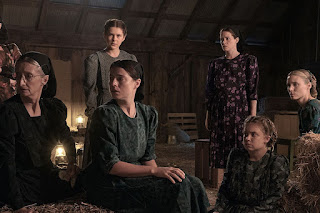
Set in a remote Mennonite colony in 2010, the film revolves the aftermath of an incident involving an attempted rape where one of the women attacked her attacker as a bunch of them discuss about what to do as many of the men have left the colony to bail out the attacker. It is a film that explores women as they talk about what had happened but also what they’ve experienced as they discuss what to do next in this remote community as well as the idea of whether things will change after what had happened. Sarah Polley’s screenplay is largely straightforward in its narrative though it is told by a teenage girl in Autje (Kate Hallett) to an unseen character where it mainly revolves around this meeting in a barn where a group of women plus a couple of teenage girls and a male schoolteacher. They all discuss about what to do after this violent incident as all of the women took a vote, despite being illiterate, on what to do as the choices were to do nothing and beg for forgiveness, stay and fight, or to leave the colony. The latter two choices led to a tie with some of the women discussing whether to stay and fight or to leave the colony into the unknown.
Throughout the course of the film, the women talk about their options as one of the elders known as Scarface Janz (Frances McDormand) who voted to do nothing believes that if they resist. They will bring more trouble and would be judged in the afterlife as she leaves the meeting early with her daughter and granddaughter who are both resistant of doing something. Salome (Claire Foy) is the one who had assaulted an attacker as she wants to fight after what had happened while her sister Ona (Rooney Mara) was raped and is currently pregnant is unsure though she has suggestions on what to do if they do stay and fight. The schoolteacher August (Ben Whishaw) records the meeting on paper as two of the elder women in Greta (Sheila McCarthy) and Ona/Salome’s mother Agata (Judith Ivey) take part in the meeting along with Mejal (Michelle McLeod), Greta’s granddaughter Autje (Kate Hallett), another teenager in Neitje (Liv McNeil), and Greta’s daughter/Autje’s mother Mariche (Jessie Buckley) are also in the meeting with Mariche is also unsure due to its possible outcome. Even as they receive news that Mariche’s husband is returning to get more bail money as the women do whatever to reach a decision on their fate.
Polley’s direction is definitely mesmerizing in not just its overall presentation but also the intimacy it has as it is shot on location near Toronto as the location itself with its harvest fields, barns, and houses in this farmland is a character in the film. Polley uses a lot of wide shots for the locations what include scenes of children playing in the fields and crops as well as Greta’s own stories about her own horses and the small amount of freedom she has driving her buggy. Much of Polley’s direction is set inside the second floor of this barn where the women talk about what to do with August moderating the whole thing as he is the only person that knows what the world outside of the colony is like despite the fact that his family had been excommunicated. Polley’s usage of close-ups and medium shots are key to the film as it does feature a few humorous moments while a lot of it is straightforward in its drama with arguments and such along with anecdotes on the idea of forgiveness.
Blood is a recurring image throughout the film as the first show is a shot from above of Ona waking up with blood and bruises around her crotch along with brief flashbacks of women waking up in bed with blood on the bed. There is also a shot from bird’s eye point of view in the barn that plays into the meeting as well as these intense discussions about what to do as well as making the ultimate decision after learning that Mariche’s husband is returning later in the night. The film’s third act is about this decision with many of the women aware of the consequences as well as the risks and sacrifices they’re taking as it also play into August’s own sacrifices as he is the only man that listened to the women as it relates to the young men and boys who are expected to carry on the ideals of their fathers in this remote community where August has to teach guide them to realize there’s more out there. Overall, Polley crafts a chilling yet intoxicating film about a group of women discussing the aftermath of a sexual assault incident in a Mennonite colony.
Cinematographer Luc Montpellier does amazing work with the film’s cinematography with its low-key naturalistic lighting along with a bit of desaturation in some of its exterior/interior daytime scenes along with low-key natural lighting for some of the scenes at night. Editors Christopher Donaldson and Roslyn Kalloo do excellent work with the editing as it features a few montages that play into the horror that these women endure while also using some straightforward cutting to capture the rhythm of the conversations. Production designer Peter Cosco, with set decorator Friday Myers and art director Andrea Kristof, does fantastic work with the look of the barn where the women have their meeting as well as some of the interiors of the homes they live in. Costume designer Quita Alfred does amazing work with the dresses that the women wear as well as the overalls that the men and boys wear as it play into the look of the colony as well as the details into the culture of the Mennonite.
Key hairstylist Antoinette Julien and makeup artist Ashley Rocha do terrific work with the makeup from the scar on Janz’s face as well as some of the bruises that the women have on their bodies. Visual effects supervisor Kevin Chandoo does nice work with some of the film’s minimal visual effects in bits of set dressing for some of the wider shots to showcase the world outside of the colony. Sound editors David McCallum and Jane Tattersall, along with sound designer Siamak Omrani, do superb work with the sound in the way some of the natural sounds appear on location as well as things sound from afar. The film’s music by Hildur Guonadottir is incredible for its mixture of orchestral textures, dissonant percussive arrangements, and folky instrumentation as it plays into the drama as well as a few of the film’s suspenseful moments while music supervisor Mandy Mamlet cultivates a soundtrack that features a few traditional hymns and the Monkees’ Daydream Believer that is played when the census man visits the farm for a census count.
The casting by John Buchan and Jason Knight is wonderful as it feature some notable small roles from Eli Ham as Mariche’s abusive husband Klaas, Nathaniel McParland as Salome’s son Aaron, Emily Mitchell as Salome’s sickly daughter Miep, Kira Guloien as Janz’s daughter Anna, Shayla Brown as Janz’s granddaughter Helena, and August Winter as a mute transgender boy in Melvin who had been raped as he rarely speaks except to the other children in the colony. Kate Hallett and Liv McNeil are fantastic in their respective roles as the teenage girls Autje and Neitje who both take part in the meeting as they were the ones to witness one of the attackers that Salome would go after with the former being Mariche’s daughter who wants to leave the colony. Michelle McLeod is superb as Mejal as a young woman who wants to stay and fight as she feels like little is going to change in doing nothing while is also unsure about leaving.
Frances McDormand is excellent in her brief role as Scarface Janz as an elder in the colony who prefers to do nothing in the hope that she and the other women can be forgiven in the hopes they will reach the Kingdom of Heaven. Judith Ivey and Sheila McCarthy are brilliant in their respective roles as the elders in Salome and Ona’s mother Agata and Mariche’s mother Greta as two women who have seen a lot and both express their own concerns but also realize that nothing is going to change if they don’t do anything about it. Ben Whishaw is amazing as August as one of the few men who stayed behind as many of them left to bail out the attacker as he observes and records the minutes of the meeting while also providing his own opinions as an outsider of sorts as he is also a schoolteacher for the colony who believes he can guide the young boys into doing something other than harming women.
Claire Foy is incredible as Salome as Ona’s older sister who had attacked the man that is in jail as she wants to stay and fight as she is a woman filled with rage over what happened while also willing to listen to reason as she is concerned for the well-being of her children. Jessie Buckley is phenomenal as Mariche as a woman who had endured a lot of abuse as she is hoping that forgiveness will defuse the situation while also revealing the lack of choices she has as a wife who is married to a man who treats her and her children terribly. Finally, there’s Rooney Mara in a sensational performance as Salome’s younger sister Ona as woman who is pregnant from a rape as she wants to leave the colony but also leave the door open for forgiveness with some ideas for change.
Women Talking is an outstanding film from Sarah Polley. Featuring a tremendous ensemble cast, Hildur Guonadottir’s eerie music score, evocative visuals, and its exploration of sexual assault and women trying to deal with the aftermath in a remote religious colony. It is a film that doesn’t just explore women dealing with being sexually assaulted in this remote colony but also having to confront that these ideals enforced by men has done nothing to keep themselves or their children safe. In the end, Women Talking is a magnificent film from Sarah Polley.
Sarah Polley Films: Away from Her - Take This Waltz - Stories We Tell
© thevoid99 2023

The film is a simple story of a college professor traveling to Greece for a vacation where she observes a young mother dealing with her daughter who had lost her doll prompting this woman to think about her own past and struggles as a young mother back then. It’s a film that explores the idea of motherhood and how not everyone embraced it as a woman is forced to look back when she was a young woman to two little girls and watch this woman endure the same issues. Maggie Gyllenhaal’s screenplay is largely a straightforward yet reflective narrative where it follows Leda Caruso (Olivia Colman) who goes to Greece on a holiday from work as she rents a small apartment for the time as she watches many people including this young woman in Nina (Dakota Johnson) struggling to take care of her young daughter Elena (Athena Martin). Even as Elena is surrounded by a group of people including family as many of them are terrible and not really helping Nina with her struggles.
For Leda, she is forced think about her time as a young woman (Jessie Buckley) in taking care of her two daughters with her often-absent husband Joe (Jack Farthing). Gyllenhaal’s script often shows Leda in situations where she is just trying to keep things to herself but is often surrounded by people in Nina’s circle who are quite cruel including a pregnant woman in Callie (Dagmara Dominczyk) who wants Leda to move her chair away from her party but Leda politely refuses. Leda would often encounter people who are quite mean to her with the exception of Nina and the apartment caretaker Lyle (Ed Harris) as with the former often coming to her for advice. It would force Leda to think about her own young life and how being a mother to two young girls wasn’t just overwhelming but also suffocating at times as the older Leda often looks on with a sense of regret but also warning Nina that things are going to be much tougher.
Gyllenhaal’s direction is definitely mesmerizing in terms of the setting but also in the air of intimacy into the two stories of this one woman dealing with her role as a mother but also observing this young woman struggling. Shot on location in Spetses, Greece as the small town, beaches, and houses are characters in the film as this tranquil getaway for Leda and many others. Gyllenhaal does use some wide shots to get a scope into some of these locations but uses medium shots to play into the conversations within the characters as well as lots of close-ups to play into some of the anguish as well as young Leda’s own sexual desires that include a scene of her masturbating while wearing headphones to block out her screaming kids. Gyllenhaal plays into this idea of motherhood and it’s not for everyone where the young Leda is more concerned with her own desires and her work rather than be with her daughters who are both seeking her attention. The doll that belong to Elena that Leda realized was in her bag following a moment where Elena had been lost and Leda found her is a symbol of Leda needing to redeem herself but also look back at her own faults as a mother.
Gyllenhaal’s direction also play into Leda struggling to deal with some of the other vacationers though she befriends Nina, Lyle, and a young Irishman named Will (Paul Mescal) who works at the bar at the beach. Gyllenhaal often has the camera in these locations of where Leda walks onto a hill that leads to the beach but also these small locations in the town where she wants to enjoy herself despite some of the awful young locals and tourists who say horrible things to her. The third act does play into the events that Leda regretted in her past during a conversation with Nina as it flashes back to the young Leda going on a trip for a lecture where her own desires come into play among meeting a college professor named Hardy (Peter Sarsgaard). Gyllenhaal would also reveal this key moment that opens the film of Leda walking down the beach at night with a wound in her stomach as it is also a symbolic moment about the many struggles of motherhood and the sacrifices it took to accept this role. Overall, Gyllenhaal crafts an evocative yet chilling film about a middle-aged woman looking back at her faults as a mother years ago as she observes the struggles of a young mother during a vacation in Greece.
Cinematographer Helene Louvart does incredible work with the film’s cinematography with its emphasis on natural lighting for some of the interior/exterior scenes at night as well as for some of the exterior scenes in the daytime. Editor Affonso Goncalves does excellent work with the editing as it does have some stylish jump-cuts as well as some unique transitions into the flashbacks. Production designer Inbal Weinberg, with set decorator Christine Vlachos and art director Monica Sallustio, does brilliant work with the look of the apartment that Leda lives in as well as the home she had when she was younger and some of the places she go to in the town nearby. Costume designer Edward K. Gibbon does fantastic work with the costumes as it is largely casual with a few of the stylish clothing and swimsuits that Nina wears.
Tattoo designer Panos Kondylis does nice work with some of the tattoos that Nina has as well as some of the people in her circle wear as it play into the idea of youth. Special effects supervisor Solon Giannoutos and visual effects supervisor Antonis Kotzias do terrific work with the special effects as it is largely minimal including a scene involving a young Leda and a doll and other bits of set dressing. Sound editor Leslie Shatz does superb work with the sound as it play into the atmosphere of the locations as well as some of the sparse sounds heard in a location to give it that sense of realism. The film’s music by Dickon Hinchcliffe is wonderful for its mixture of blues and orchestral string music that play into the drama while the film soundtrack features original music by Greek artist Monika along with music from the Talking Heads, Bon Jovi, Judy Garland, and Roberta Flack.
The casting by Kahleen Crawford is incredible as it feature some notable small roles from Alexandros Mylonas as an older professor that the young Leda meets in a flashback, Alba Rohrwacher and Nikos Poursanidis as a couple of hikers the young Leda, her daughters, and husband meet, Panos Koronis as a Greek man named Vassili who is one of the few in Nina’s circle that is kind to her, Oliver Jackson-Cohen as Nina’s husband Toni, Robyn Elwell and Ellie Blake in their respective roles as Leda’s daughters Bianca and Martha, Ellie James and Isabelle Della-Porta in their respective roles as the voices of the older versions of Bianca and Martha, Jack Farthing as the young Leda’s husband Joe who is trying to do his job as well as be a good father, and Athena Martin in a wonderful performance as Nina’s young daughter Elena. Peter Sarsgaard is superb in a small role as college professor named Hardy whom the young Leda has an affair with during her seminar trip over translations she had created.
Dagmara Dominczyk is fantastic as Callie as a pregnant American tourist who is part of Nina’s circle as she is quite cruel while often being bossy while her kindness never feels sincere as she is someone who thinks knows everything and makes Nina insecure. Paul Mescal is excellent as the bartender Will who works at a beachside bar whom Leda befriends as he helps her out with the locales on the island but also observes the people who frequent though he also takes an interest in Nina. Ed Harris is brilliant as Lyle as apartment’s caretaker as a man that Leda befriends where he spent much of his time in this small town knowing a lot of the good, the bad, and the ugly that comes along while sharing his own stories of struggle with Leda but in a different way. Dakota Johnson is amazing as Nina as a young woman who is struggling with taking care of her young daughter while feeling her marriage is crumbling prompting her to find her own desires as she is being suffocated by people in her circle where she turns to Leda for help.
Finally, there’s the duo of Jessie Buckley and Olivia Colman in tremendous performances in their respective roles as the younger and older version of Leda Caruso. Buckley’s performance showcases a woman that isn’t just struggling with taking care of two young girls but also someone who is just feeling suffocated in the role as she has her own desires. Even though she has rare moments where she shows affection and time towards her daughters as it only play into a woman that knows what she has to do but is overwhelmed by having to be a mother. Colman’s performance is more reserved as the older Leda with the exception of a scene where she is antagonized by a bunch of young asshole men at a movie theater and threatens them. Still, Colman has a performance that showcases a woman with a sense of regret but also harboring the pain that she had as a young woman as it is definitely one of Colman’s great performances who also can sing as she sings along to Bon Jovi.
The Lost Daughter is a phenomenal film from Maggie Gyllenhaal as it features great performances from Olivia Colman, Jessie Buckley, and Dakota Johnson. Along with its supporting cast, gorgeous visuals, a somber music soundtrack, and its exploration of the themes of motherhood and its many struggles. The film is a fascinating thematic study that explore a woman looking back about her time as a young mother as well as watch a young mother dealing with similar struggles including unhappiness. In the end, The Lost Daughter is a sensational film from Maggie Gyllenhaal.
© thevoid99 2022


