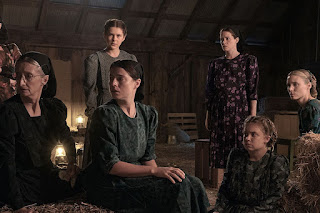
Set in a remote Mennonite colony in 2010, the film revolves the aftermath of an incident involving an attempted rape where one of the women attacked her attacker as a bunch of them discuss about what to do as many of the men have left the colony to bail out the attacker. It is a film that explores women as they talk about what had happened but also what they’ve experienced as they discuss what to do next in this remote community as well as the idea of whether things will change after what had happened. Sarah Polley’s screenplay is largely straightforward in its narrative though it is told by a teenage girl in Autje (Kate Hallett) to an unseen character where it mainly revolves around this meeting in a barn where a group of women plus a couple of teenage girls and a male schoolteacher. They all discuss about what to do after this violent incident as all of the women took a vote, despite being illiterate, on what to do as the choices were to do nothing and beg for forgiveness, stay and fight, or to leave the colony. The latter two choices led to a tie with some of the women discussing whether to stay and fight or to leave the colony into the unknown.
Throughout the course of the film, the women talk about their options as one of the elders known as Scarface Janz (Frances McDormand) who voted to do nothing believes that if they resist. They will bring more trouble and would be judged in the afterlife as she leaves the meeting early with her daughter and granddaughter who are both resistant of doing something. Salome (Claire Foy) is the one who had assaulted an attacker as she wants to fight after what had happened while her sister Ona (Rooney Mara) was raped and is currently pregnant is unsure though she has suggestions on what to do if they do stay and fight. The schoolteacher August (Ben Whishaw) records the meeting on paper as two of the elder women in Greta (Sheila McCarthy) and Ona/Salome’s mother Agata (Judith Ivey) take part in the meeting along with Mejal (Michelle McLeod), Greta’s granddaughter Autje (Kate Hallett), another teenager in Neitje (Liv McNeil), and Greta’s daughter/Autje’s mother Mariche (Jessie Buckley) are also in the meeting with Mariche is also unsure due to its possible outcome. Even as they receive news that Mariche’s husband is returning to get more bail money as the women do whatever to reach a decision on their fate.
Polley’s direction is definitely mesmerizing in not just its overall presentation but also the intimacy it has as it is shot on location near Toronto as the location itself with its harvest fields, barns, and houses in this farmland is a character in the film. Polley uses a lot of wide shots for the locations what include scenes of children playing in the fields and crops as well as Greta’s own stories about her own horses and the small amount of freedom she has driving her buggy. Much of Polley’s direction is set inside the second floor of this barn where the women talk about what to do with August moderating the whole thing as he is the only person that knows what the world outside of the colony is like despite the fact that his family had been excommunicated. Polley’s usage of close-ups and medium shots are key to the film as it does feature a few humorous moments while a lot of it is straightforward in its drama with arguments and such along with anecdotes on the idea of forgiveness.
Blood is a recurring image throughout the film as the first show is a shot from above of Ona waking up with blood and bruises around her crotch along with brief flashbacks of women waking up in bed with blood on the bed. There is also a shot from bird’s eye point of view in the barn that plays into the meeting as well as these intense discussions about what to do as well as making the ultimate decision after learning that Mariche’s husband is returning later in the night. The film’s third act is about this decision with many of the women aware of the consequences as well as the risks and sacrifices they’re taking as it also play into August’s own sacrifices as he is the only man that listened to the women as it relates to the young men and boys who are expected to carry on the ideals of their fathers in this remote community where August has to teach guide them to realize there’s more out there. Overall, Polley crafts a chilling yet intoxicating film about a group of women discussing the aftermath of a sexual assault incident in a Mennonite colony.
Cinematographer Luc Montpellier does amazing work with the film’s cinematography with its low-key naturalistic lighting along with a bit of desaturation in some of its exterior/interior daytime scenes along with low-key natural lighting for some of the scenes at night. Editors Christopher Donaldson and Roslyn Kalloo do excellent work with the editing as it features a few montages that play into the horror that these women endure while also using some straightforward cutting to capture the rhythm of the conversations. Production designer Peter Cosco, with set decorator Friday Myers and art director Andrea Kristof, does fantastic work with the look of the barn where the women have their meeting as well as some of the interiors of the homes they live in. Costume designer Quita Alfred does amazing work with the dresses that the women wear as well as the overalls that the men and boys wear as it play into the look of the colony as well as the details into the culture of the Mennonite.
Key hairstylist Antoinette Julien and makeup artist Ashley Rocha do terrific work with the makeup from the scar on Janz’s face as well as some of the bruises that the women have on their bodies. Visual effects supervisor Kevin Chandoo does nice work with some of the film’s minimal visual effects in bits of set dressing for some of the wider shots to showcase the world outside of the colony. Sound editors David McCallum and Jane Tattersall, along with sound designer Siamak Omrani, do superb work with the sound in the way some of the natural sounds appear on location as well as things sound from afar. The film’s music by Hildur Guonadottir is incredible for its mixture of orchestral textures, dissonant percussive arrangements, and folky instrumentation as it plays into the drama as well as a few of the film’s suspenseful moments while music supervisor Mandy Mamlet cultivates a soundtrack that features a few traditional hymns and the Monkees’ Daydream Believer that is played when the census man visits the farm for a census count.
The casting by John Buchan and Jason Knight is wonderful as it feature some notable small roles from Eli Ham as Mariche’s abusive husband Klaas, Nathaniel McParland as Salome’s son Aaron, Emily Mitchell as Salome’s sickly daughter Miep, Kira Guloien as Janz’s daughter Anna, Shayla Brown as Janz’s granddaughter Helena, and August Winter as a mute transgender boy in Melvin who had been raped as he rarely speaks except to the other children in the colony. Kate Hallett and Liv McNeil are fantastic in their respective roles as the teenage girls Autje and Neitje who both take part in the meeting as they were the ones to witness one of the attackers that Salome would go after with the former being Mariche’s daughter who wants to leave the colony. Michelle McLeod is superb as Mejal as a young woman who wants to stay and fight as she feels like little is going to change in doing nothing while is also unsure about leaving.
Frances McDormand is excellent in her brief role as Scarface Janz as an elder in the colony who prefers to do nothing in the hope that she and the other women can be forgiven in the hopes they will reach the Kingdom of Heaven. Judith Ivey and Sheila McCarthy are brilliant in their respective roles as the elders in Salome and Ona’s mother Agata and Mariche’s mother Greta as two women who have seen a lot and both express their own concerns but also realize that nothing is going to change if they don’t do anything about it. Ben Whishaw is amazing as August as one of the few men who stayed behind as many of them left to bail out the attacker as he observes and records the minutes of the meeting while also providing his own opinions as an outsider of sorts as he is also a schoolteacher for the colony who believes he can guide the young boys into doing something other than harming women.
Claire Foy is incredible as Salome as Ona’s older sister who had attacked the man that is in jail as she wants to stay and fight as she is a woman filled with rage over what happened while also willing to listen to reason as she is concerned for the well-being of her children. Jessie Buckley is phenomenal as Mariche as a woman who had endured a lot of abuse as she is hoping that forgiveness will defuse the situation while also revealing the lack of choices she has as a wife who is married to a man who treats her and her children terribly. Finally, there’s Rooney Mara in a sensational performance as Salome’s younger sister Ona as woman who is pregnant from a rape as she wants to leave the colony but also leave the door open for forgiveness with some ideas for change.
Women Talking is an outstanding film from Sarah Polley. Featuring a tremendous ensemble cast, Hildur Guonadottir’s eerie music score, evocative visuals, and its exploration of sexual assault and women trying to deal with the aftermath in a remote religious colony. It is a film that doesn’t just explore women dealing with being sexually assaulted in this remote colony but also having to confront that these ideals enforced by men has done nothing to keep themselves or their children safe. In the end, Women Talking is a magnificent film from Sarah Polley.
Sarah Polley Films: Away from Her - Take This Waltz - Stories We Tell
© thevoid99 2023

Five years following an assassination attempt in Italy, James Bond is coaxed out of retirement to find a scientist as it leads to something much bigger involving a mysterious figure who has gained access to biochemical weapons that would go after specific targets. It is a film in which the secret agent doesn’t just deal with a new foe who wants to go after Bond but also those close to him as well as his enemies including Ernst Stavros Blofeld whom had been involved in not just the assassination attempt on Bond but also another incident several years prior that involves this madman in Lyutsifer Safin (Rami Malek) who has a major grudge against Blofeld and his organization in Spectre. The film’s screenplay opens with a scene involving a young Madeleine Swann (Coline Defaud) who witnesses the murder of her mother (Mathilde Bourbin) and her own near-death experience from Safin as it then cuts to her as an adult (Lea Seydoux) who is vacationing with Bond in Italy where things went wrong as Bond believed that Swan betrayed him to Blofeld.
Much of the story takes place five years after Bond’s assassination attempt as he had retired in Jamaica when Felix Leiter (Jeffrey Wright) asks for his help following a break-in at a MI6 lab where the Russian scientist Valdo Obruchev (David Dencik) had been kidnapped as he had created a bioweapon with nanobots for MI6 called Project Heracles that was intended as an off-the-books project in the hope that it would kill intended targets. Instead, it goes in the wrong hands where M sends Nomi (Lashana Lynch) who is the new 007 to Cuba where Bond meets the novice CIA agent Paloma (Ana de Armas) who helps him retrieve Obruchev to Leiter but something goes wrong due to Leiter’s new partner Logan Ash (Billy Magnussen) who causes trouble for Bond and Leiter leaving Obruchev to escape. The second act revolves around not just revelations for Bond about Swann, who gets an unfortunate meeting with Safin, but also what happened in Cuba in what Bond and Paloma saw as the former meets with Blofeld as they both learn that they have a shared enemy. Yet, Bond’s journey leads him back to Swann who has another surprise that only add more stakes to what Bond is facing as well as what Safin is planning in the film’s third act.
Cary Joji Fukunaga’s direction definitely has an air of style in the way he presents the different locations Bond is in but also a world that is about to be in danger once again as Bond has to save it. Shot on various locations in Norway, Italy, Jamaica, the Faroe Islands, and London with some bits shot in Pinewood Studios in Britain. Fukunaga definitely plays into a spy that has been through a lot but he is also coping with loss and betrayal as he is unsure about returning to the world in general as it is often ever-changing. Fukunaga does make the sets feel important such as the scenes at Matera in Italy that includes a big chase scene that is captured through wide and medium shots where Bond and Swann are dealing with cars and motorcycles with the Aston Martin DB5 being the weapon to deal with these assassins. The scenes set in Cuba that were shot on location at Pinewood are also filled with these medium and wide shots but also this sense of movement and where the cameras are placed as it adds that air of location where there are moments of humor from Paloma but also moments that play into the suspense.
There are also close-ups in some of the film’s emotional moments where Fukunaga play into Swann’s own fear as it relates to Safin but also this meeting between Bond and Blofeld as it adds a lot of suspense and drama. Fukunaga definitely aims for something straightforward for these non-action scenes that also includes the scene where Bond discovers a major secret from Swann which add a lot of what is at stake for Bond. Notably as Safin is someone whose background as it relates to his family and what they’ve done for Spectre shows exactly why he wants revenge and sees Bond as an equal in the fact that they’re both killers yet Safin is just trying to tidy things up for a new world. Fukunaga’s approach to Safin’s island and the factory/lab he has definitely echoes a lot of Bond films of the past while he also creates some unique tracking shots for a key scene up the stairs where Bond deals with Safin’s soldiers. The film’s climax is immense with a lot at stake but there is so much more as it relates to not just the world in general but also Bond himself as it relates to Swann as well as everything he had went through. Overall, Fukunaga crafts an exhilarating and gripping film about a spy who deals with a new foe who is creating a bioweapon that would wreak havoc on the world.
Cinematographer Linus Sandgren does incredible work with the film’s cinematography with its usage of low-key lights for some of the interior/exterior scenes in Cuba to the natural lighting for scenes in Italy as well as some stylish interior lighting for the scenes at Safin’s island. Editors Elliot Graham and Tom Cross do amazing work with the editing with its usage of jump-cuts and rhythmic cuts as well as knowing when to let shots linger as well as to help create suspenseful moments. Production designer Mark Tildesley, with set decorator Veronique Melery and senior art director Mark Harris, does brilliant work with the look of the cabin home that Madeleine lived in as a kid as well as Safin’s island as well as his lab and factory. Costume designer Suttirat Anne Larlab does excellent work with the costumes from the clothes that Bond wears as well as some of the stylish clothing of Nomi and Swann and the robes that Safin wears.
Hair and makeup designer Mark Phillips, with prosthetic makeup designer Brian Gower, does fantastic work with the look of Safin from his disfigured look as well as the look of Blofeld following what happened to him previously. Special effects supervisor Chris Corbould, along with visual effects supervisors Yael Majors and Charlie Noble, does terrific work with the effects from the stunt work and set pieces as well as some of the visual effects that involve some of the bioweapon that Safin is developing. Sound designer Brian Bowen, with sound editor James Harrison and Oliver Tarney, does superb work with the sound in the way some of the gadgets sound as well as the way explosions sound and other sparse moments.
The film’s music by Hans Zimmer is phenomenal for its soaring orchestral-based music score that also feature elements of other compositions of past movie themes including the song We Have All the Time in the World from On Her Majesty’s Secret Service while the titular song by Billie Eilish and Finneas O’Connell that is performed by the former is this moody and somber song that is actually a really good song that does play into the drama. Music supervisor Randall Poster does create a wonderful soundtrack that includes We Have All the Time in the World as well as a French pop song from Dalida and some reggae for scenes in Jamaica.
The casting by Debbie McWilliams and Jemima McWilliams is marvelous as it feature some notable small roles from Hugh Dennis and Priyanga Buford as a couple of scientists who worked with Obruchev, Mathilde Bourbin as Madeleine’s mother, Coline Defaud as the young Madeleine, Dani Benssalah as Safin’s henchman Primo who wears a mysterious fake eye, and Lisa-Dorah Sonnet as a young girl named Mathilde. Billy Magnussen is terrific as the CIA agent Logan Ash who is Leiter’s assigned partner who annoys both Bond and Leiter as he has ulterior motives of his own. Rory Kinnear is superb as M’s chief of staff Bill Tanner who aides Bond in getting the chance to interrogate Blofeld as he also question M’s motives over the Heracles project. David Dencik is excellent as the Russian scientist Valdo Obruchev who created Heracles as someone who is this slimy yet comical villain who is willing to help Safin. Ana de Armas is fantastic in her brief role as the novice CIA agent Paloma who helps Bond in retrieving Obruchev as she has some funny lines while also being a total badass as she is just so fun to watch.
Christoph Waltz is brilliant in his brief role as Ernst Stavros Blofeld as the head of Spectre who is in prison as someone who is still running his operation as he becomes aware that he and Bond have a shared enemy as he also toys with Bond about Bond’s own motives. Ralph Fiennes is amazing as M as the head of MI6 who is reluctant to have Bond back on board while also revealing about his intentions for Heracles as he realizes that it was a bad idea as he hopes Bond can stop it from happening. Jeffrey Wright is incredible as Felix Leiter as a CIA agent and Bond’s friend who coaxes Bond out of retirement as he is aware of what Obruchev has created and hope that the project is stopped as he is also suspicious about Ash whom he’s not fond of. Naomie Harris and Ben Whishaw are remarkable in their respective roles as M’s secretary Moneypenny and the quartermaster Q as the two who stick by Bond with the former being a no-nonsense secretary who knows something is up and wants Bond to handle while the latter brings a lot of wit as someone who has a love-hate relationship with Bond as he would also uncover some deep secrets that involve Safin.
Lashana Lynch is phenomenal as Nomi as the 007 who Bond meets in Jamaica as he sees her as a threat of sorts though he realizes that she is a damn good spy as well as someone who doesn’t take any shit as Bond is aware of her worth. Lea Seydoux is tremendous as Dr. Madeleine Swann as a psychiatrist who is carrying secrets about her own past and her time with Safin as well as something that adds to the stake where Seydoux brings a lot of complexity to the character that play into a woman filled with regret and loss but also some hope for Bond. Rami Malek is sensational as Lyutsifer Safin as a madman who is trying to destroy Spectre as well as see Bond as a threat as he has this creepy presence to him as someone who wants to clean up the world but through nefarious means. Finally, there’s Daniel Craig in an outstanding performance as James Bond as the famed spy who is eager for a life outside of being in her majesty’s secret service only to deal with a much more sinister plot as Craig maintains that brooding persona but also someone who has humor and knows what is at stake as it is a fitting finale in the famed role as Agent 007.
No Time to Die is a sensational film from Cary Joji Fukunaga that features a tremendous performance from Daniel Craig in his final outing as James Bond. Along with its ensemble cast, riveting suspense and action, high-grade stakes, gorgeous visuals, and an incredible music score and soundtrack. The film isn’t just this sprawling and eerie spy-suspense film but also a film that plays into a man having to save the world with much more for him to deal with as it is also one of the finest films of the James Bond film series. In the end, No Time to Die is a spectacular film from Cary Joji Fukunaga.
James Bond Files: The EON Films: Dr. No - From Russia With Love - Goldfinger - Thunderball - You Only Live Twice - On Her Majesty's Secret Service - Diamonds are Forever - Live and Let Die - The Man with the Golden Gun - The Spy Who Loved Me - Moonraker - For Your Eyes Only - Octopussy - A View to a Kill - The Living Daylights - Licence to Kill - GoldenEye - Tomorrow Never Dies - The World is Not Enough - Die Another Day - Casino Royale - Quantum of Solace - Skyfall - SPECTRE
Non-EON Films: Casino Royale (Climax! TV Episode) - Casino Royale (1967 film) - Never Say Never Again
Bond Documentaries: Bond Girls are Forever - True Bond - Everything or Nothing: The Untold Story of 007
Cary Joji Fukunaga Films: Sin Nombre - Jane Eyre (2011 film) - (Beasts of No Nation)
© thevoid99 2022
(Winner of the Palm Dog Jury Prize to Bob the Dog, Queer Palm Special Mention, and the Jury Prize at the 2015 Cannes Film Festival)
Directed by Yorgos Lanthimos and written by Lanthimos and Efthimis Filippou, The Lobster is the story of a man who arrives at a compound where he’s given forty-five days to find a new partner or else he turns into an animal. It’s a film that explores isolation and the need to find someone in a world that is almost dystopian where human beings are desperate to connect or else they get themselves into serious trouble. Starring Colin Farrell, Rachel Weisz, John C. Reilly, Ben Whishaw, Lea Seydoux, Jessica Barden, Olivia Colman, Ashley Jensen, Ariane Labed, Angeliki Papoulia, and Michael Smiley. The Lobster is a whimsical and rapturous film from Yorgos Lanthimos.
Set in a futuristic dystopian world where a person has to have a partner as loneliness is forbidden, the film revolves around a man whose wife has left him for another man where he goes to a compound to find a new partner in 45 days or else he’s turned into an animal where he gets another chance to find a companion as that animal. It’s a film that plays into this absurdist dystopian world about the need to not be lonely as everyone has to be with someone and with a family in order for society to thrive or else they become animals or outcasts at worst. The film’s screenplay by Yorgos Lanthimos and Efthimis Filippou is largely told from the perspective of an outsider who narrates the film as her identity isn’t revealed until the film’s second half as she tells the story of David (Colin Farrell) who would enter this idyllic compound that is like a resort of sorts for lonely people to get their chance to find a partner. In this hotel, he would befriend a man with a lisp named Robert (John C. Reilly) and a man with a limp named John (Ben Whishaw) who are also trying to seek partners in this offbeat hotel resort.
Among their activities in order to prolong their time search in finding a partner include hunting loners who refuse to play by society’s rules and if they manage to hunt these loners, they would be given additional days to find a partner. When one finds a partner, they’re moved into a different part of the hotel where they would get to know each other and would be given a child in case there’s an argument or something. Then they’re moved to a yacht to continue the courtship until they’re moved to the city to spend the rest of their lives. Yet, there is something off as masturbation is forbidden as sexual stimulation from a staff member is mandatory though clothes are kept on. For David, it’s something he has to accept as much of the action takes place in the first half until he tries to partner up with a cold-hearted woman (Angeliki Papoulia) that goes horribly wrong. The film’s second half is set in the forest where David becomes a loner and meets up with a loner faction that forbids romance from happening yet David ends up falling for a short-sighted woman (Rachel Weisz). Their relationship is kept secret yet it becomes harder when their leader (Lea Seydoux) becomes suspicious as David would realize that both the loner faction and those wanting to people to be partnered up have their flaws in their methods.
Lanthimos’ direction is intoxicating for not just capturing this element of dystopia as it is set in a modern world but also creating something that does feel offbeat and strange. Shot largely in Ireland with the city shot on location in Dublin, the film does play into this clash of ideals in two worlds where the city is where society thrives on couples being together to maintain this idyllic society. Lanthimos would use wide shots to capture the look of the city where it does look futuristic in some areas yet maintains something that does feel like it’s near the present while he would also shoot in these locations such as the fields, mountains, and lakes. The hotel/compound where David would stay nearby these natural surroundings do give the film this look that is like a paradise of sorts but there’s also something off in Lanthimos’ direction from the fact that those without partners live in modest though posh-like rooms while the couples would live in a more spacious room that has more perks.
Lanthimos’ approach to close-ups and medium shots play into how characters interact with one another in which there’s a sequence where John tries to win over the nosebleed woman (Jessica Barden) by claiming he also gets frequent nosebleeds. It’s among some of the film’s comical events along with the scene of the loners dancing to music on their headphones which goes to show both the world of the couples and the world of the loners are. Still, there is that element of how repressed this world can be in a scene where David, short-sighted woman, the loner leader, and an associate walk to the city as they pretend to be couples as everyone has to have papers to prove they’re a couple or else they get sent to the compound. Lanthimos showcase a world where both sides is cruel as David’s infatuation with the short-sighted women is out of pure love but that’s not what the loners want nor does the people at the hotel want as they care about survival of the fittest rather than living. Overall, Lanthimos crafts a riveting yet abstract film about an absurd dystopian world where humans must find a mate or else become an animal.
Cinematographer Thimios Bakatakis does brilliant work with the film’s cinematography with its usage of low-key lighting and slightly-yellow color for some of the interiors set at night to a somewhat greyish look for the daytime exterior scenes in the forest and at the city. Editor Yorgos Mavropsaridis does excellent work with the editing as it is straightforward in terms of its lack of style with some slow-motion sequences such as a few of the hunting scenes. Production designer Jacqueline Abrahams does amazing work with the look of the hotel in its rooms and various outside activities including its spa as well as the home of the loner leader’s parents. Costume designer Sarah Blenkinsop does fantastic work with the costumes from the clothes the people at the compound have to wear to the raincoats that the loners wear at the forests.
Hair designer Eileen Buggy and makeup designer Sharon Doyle do terrific work with the look of the characters as much of it is straightforward to play into the look of conformity to a more ragged look for the loners when they’re in the forest. Visual effects supervisors Pierre Buffin and Olivier Cauwet do wonderful work with some of the film’s minimal visual effects as it relates to some of the animals that lurk around the forest and lakes. Sound designer/music composer Johnnie Burn does incredible work with the sound work in capturing the atmosphere of the locations and what goes on inside the hotels and cities while much of the music he creates is largely a low-key ambient score for a few scenes in the forest while music supervisor Amy Ashworth provides a music soundtrack that is a mixture of classical and contemporary music with contributions from Ludwig Van Beethoven, Igor Stravinsky, Richard Strauss, Benjamin Britten, Danai, and Nick Cave and the Bad Seeds with Kylie Minogue.
The casting by Jina Jay is tremendous as it features some notable small roles from Roger Ashton-Griffiths as an eye doctor for the short-sighted woman, Anthony Dougall as the 70-year old waiter at the hotel, Roland Ferrandi and Imelda Nagle Ryan as the loner leader’s parents, EmmaEdel O’Shea as the nosebleed woman’s best friend, Michael Smiley as the loner leader’s associate, Ashley Jensen as a woman who often carry biscuits at the compound, Ewen MacIntosh as a hotel guard, and Olivia Colman in a terrific performance as the hotel manager who spouts propaganda ideas of partnership yet forbids any idea of true happiness. Jessica Barden is fantastic as a young woman who has frequent nosebleeds as she tries to find a partner who would be her equal as well as handle her nosebleeds. Angeliki Papoulia is excellent as the heartless woman as someone who is a real cold-hearted bitch that doesn’t care if anyone gets hurt as well as being an able hunter who likes to hunt loners so she can extend her search for her equal.
Ariane Labed is brilliant as the hotel maid whose job is to dry-hump David as well as be someone to cater to everyone at the hotel yet also carries a secret about her role as it’s a great mixture of humor and restraint. Lea Seydoux is amazing as the loner leader as a woman who leads a faction of loners who believes that love only leads to trouble and that loneliness is the only way people can live despite her attachments to her parents whom she visits occasionally. John C. Reilly and Ben Whishaw are great in their respective roles as Robert and John with the former suffering from a lisp as he has trouble connecting with the women and the latter having a limp as he would find a way to get the woman with the nosebleeds. Rachel Weisz is incredible as the short-sighted woman who is part of the loner faction as she falls for David as she realizes that everything that the loners stand for is false as she and David try to keep their relationship a secret. Finally, there’s Colin Farrell in a sensational performance as David as a man whose wife has left him as he joins the hotel compound to find a new partner as he’s accompanied by his dog Bob as he copes with the need to find a partner only for things to go wrong as it’s an offbeat performance from Farrell who provides a sense of restraint but also an sweet awkwardness to his performance.
The Lobster is a phenomenal film from Yorgos Lanthimos. Featuring a great ensemble cast, an offbeat premise, gorgeous visuals, and a hypnotic soundtrack. It’s a film that plays into the absurdity of people needing to connect without the chance to find themselves or someone that they can spend their life with as it is filled with humor and drama as it’s told in a very abstract and hilarious style. In the end, The Lobster is a tremendous film from Yorgos Lanthimos.
Yorgos Lanthimos Films: (My Best Friend (2001 film)) – (Kinetta) – Dogtooth - (Alps (2011 film)) – (The Killing of a Sacred Deer) – The Favourite - Poor Things - Kinds of Kindness - (Bugonia)
© thevoid99 2018
Directed by Sarah Gavron and written by Abi Morgan, Suffragette is the story of a laundress who takes part of the Suffragette movement in the 1910s in the hopes that she and other women would have the right to vote. The film is a historical drama set in the real-life period of women’s suffrage in Great Britain before World War I. Starring Carey Mulligan, Helena Bonham Carter, Anne-Marie Duff, Brendan Gleeson, Natalie Press, Ben Whishaw, Romola Garai, and Meryl Streep. Suffragette is a compelling yet evocative film from Sarah Gavron.
Set in 1912 Britain after many attempts to get the right for women to vote, the film is about a young laundress who finds herself being part of the Suffragettes movement where she eventually becomes an active member. It’s a film that follows a woman who is lured into a movement she is reluctant to be part of yet is unable to ignore the treatment that she has endured working in the laundry factor as she notices the teenage daughter of a Suffragette activist is being sexually harassed by her boss. Even as she also realizes that she doesn’t have the legal right to determine the future of her own son which prompts her to not only take part full-on but also learn what it means to stand up for herself and other women. Abi Morgan’s screenplay doesn’t just follow the journey of this young woman in Maud Watts (Carey Mulligan) but also the women she would meet as she takes part in this movement.
While she would get herself into some trouble as well as risk losing her son who is forced to be cared by his father Sonny (Ben Whishaw), Maud would find a purpose about what to do as she thinks about the women in the future. Still, she and the other Suffragettes would face numerous challenges and obstacles as they’re seen by those in the government including authority figures such as Inspector Steed (Brendan Gleeson) who is this unconventional antagonist of sorts. Notably as he actually cares about the women yet is aware of the job he has to do while he becomes disgusted with the tactics of those he works for. One aspect of the script that is underwhelming is the appearance of Suffragette leader Emmeline Pankhurst (Meryl Streep) as she is this mysterious figure who makes her appearance in the second act for a big speech and then she is gone as her character would disappear.
Sarah Gavron’s direction is quite simple in terms of the compositions that are created as it also has some ambition for the fact that it is shot on location in London and in studios to recreate some of the old buildings. The usage of the wide and medium shots play into the locations as well as the tense and grimy atmosphere of the factories where Maud and Sonny work at as it feels repressive and hard. By the time the film hit the streets, Gavron’s direction definitely becomes richer where it does play into this sense of time where protests are happening as well as a very intimate scene where Maud testifies to the government about her own experience as it would lead to a key moment in her development. There are these moments of violence in how the women are beaten by police as well as do small guerilla-style warfare by blowing up mailboxes. Gavron’s usage of close-ups are definitely entrancing as it play into the anguish that Maud endures as well as what she would have to sacrifice. Notably in the climax as it would play into a real-life key moment that would be the catalyst for the Suffragette movement as it would end with images of a real-life event of the movement. Overall, Gavron creates a fascinating and riveting drama about a young woman joining the Suffragettes movement in their right to have a say in the world.
Cinematographer Eduard Grau does excellent work with the film‘s cinematography from the usage of low-key lights for the interior scenes at the factory as well as what London looked like at night including a key scene involving the bombing of a Parliament member‘s home. Editor Barney Pilling does nice work with the editing as it is largely straightforward with some rhythmic cutting to play into some of the intense moments in the film. Production designer Alice Normington, with art directors Jonathan Houlding and Choi Ho Man and set decorator Barbara Herman-Skelding, does amazing work with the look of the factory as well as the buildings that were prevalent in those times as well as a church where Maud would stay during her time as a Suffragette. Costume designer Jane Petrie does brilliant work with the costumes from the fancy dresses in those times as well as the ragged look of the women during that period of protest and activism.
Hair/makeup designer Sian Grigg does fantastic work with the look of the women in the hairstyles they had as well as some of the burns and scars in Maud‘s skin from years working as a laundress. Visual effects supervisor Simon Hughes does terrific work with the visual effects as it is mostly set-dressing to help create that look of 1912 London in its exterior setting. Sound editors Stephen Griffiths and Andy Shelley do superb work with the sound as it play into the frenzy of the crowd and the protests as well as in the sparse yet eerie moments at the prisons where some of the women would go for their actions. The film’s music by Alexandre Desplat is wonderful for its orchestral-based score with its lush string arrangements that play into the drama as well as some of the intense moments in the film while music supervisor Karen Elliot create a soundtrack that play into the music of the times.
The casting by Fiona Weir is remarkable as it feature some notable small roles from Adam Michael Dodd as Maud and Sonny‘s son George, Grace Stottor as Violet‘s teenage daughter Maggie, Finbar Lynch as Edith‘s loyal husband Hugh, Geoff Bell as the factory foreman Taylor whom Maud dislikes, Samuel West as a government official, and Adrian Schiller as Parliament minister David Lloyd George. Ben Whishaw is terrific as Maud’s husband Sonny as a man that is trying to maintain his role as a man while struggling to take care of his son when Maud isn’t around. Natalie Press is superb as Emily Davidson as a passionate activist who does a lot to herself for the cause as well as be the one person who would make a major sacrifice towards its climax. Romola Garai is fantastic as Alice Haughton as the wife of a government official who is trying to support the Suffragettes any way she can as well as get them to meet with the government. Meryl Streep is excellent in her brief role as Suffragette leader Emmeline Pankhurst as she does have this great presence about her though it’s a role that is just merely a cameo that doesn’t do enough to establish the character.
Brendan Gleeson is amazing as Inspector Steed as a law enforcer whose job is to watch out for the Suffragettes as he is trying to do his job yet is someone that is sympathetic into what these women do as he tries to get them to do less time and such while becoming disgusted with the tactics of his government. Anne-Marie Duff is brilliant as Violet Miller as a woman who had just worked at the laundry factory as she is also quite committed to her work as a Suffragette inviting Maud into the action until she would deal with things beyond her control forcing her to take a step back. Helena Bonham Carter is great as Edith Ellyn as a pharmacist who is one of the organizers of the movement as she is also someone who gives Maud some perspective about what happens if women don‘t get a say about matters into the world. Carey Mulligan is incredible as Maud Watts as this young laundress who is trying to do her role as she is sucked into the world of the Suffragettes where she realizes what it means to her as it‘s performance filled with determination and anguish as it‘s one of Mulligan‘s finest performances to date.
Suffragette is a remarkable film from Sarah Gavron. Featuring a great cast, gorgeous visuals, and some strong themes about women’s right to vote and say something about the world. It is a film that captures a moment in time that shows what women can do in a world that is afraid of change. In the end, Suffragette is a marvelous film from Sarah Gavron.
Sarah Gavron Films: (This Little Life) - (Brick Lane)
© thevoid99 2016

Based on the novels of Ian Fleming, SPECTRE is the story of James Bond trying to uncover a criminal organization that is threatening the world just as the MI6 is under threat of shutting down. Directed by Sam Mendes and screenplay by John Logan, Neal Purvis, Robert Wade, and Jez Butterworth from a story by Logan, Purvis, and Wade, the film has Bond encounter the organization that puts the world into chaos as Daniel Craig plays Agent 007 for the fourth time. Also starring Christoph Waltz, Lea Seydoux, Monica Bellucci, Dave Bautista, Ben Whishaw, Naomie Harris, Jesper Christensen, Andrew Scott, and Ralph Fiennes as M. SPECTRE is a thrilling yet exciting film from Sam Mendes.
The film plays into not just the recent events James Bond had encountered with mysterious organization known as Quantum but it all finally ties together when he not only uncovers what Quantum is part of but who is running this secret organization. Even as it relates to not just Bond’s past but also the emergence of a new world order as MI6 is being shut down by a new organization that wants to put the entire world under total surveillance. For Bond, this new criminal threat as well as the possibility of MI6 being shut down not only prompts him to go at it alone against the advice of M but also lead him to clues as it relates to a man named Franz Oberhauser (Christoph Waltz) whom Bond had known as a child and thought had died.
The film’s script doesn’t just play with Bond coping with aspects of his past and the new threats he is dealing with. He also is forced to go alone as MI6 are unable to be directly involved as M, Q (Ben Whishaw), Moneypenny (Naomie Harris), and Bill Tanner (Rory Kinnear) are all under surveillance from this new organization that is to replace MI6 where M had to fight to keep MI6 going. While Bond would create things that would put MI6 under further scrutiny such as the film’s opening sequence in Mexico City which has him trying to go after an assassin that is related to this secret criminal organization under the orders of the previous M. He would also turn to an old nemesis in Mr. White (Jesper Christensen) who would reveal not just what Quantum had become but asked Bond to protect his daughter in Dr. Madeline Swann (Lea Seydoux) who knows some things about what her father did as she would help Bond.
The script would also play into the growing sense that the world is changing as it makes Bond and M uneasy where the latter has to deal with Max Denbigh aka C (Andrew Scott) who wants to get rid of MI6 for a joint security organization as he believes surveillance on everyone is good for the future. It plays into this conflict of the old ways vs. the new ways where Bond is a representation of the old ways as he is about trying to figure out what is going on and make the decision to pull the trigger if necessary. While M and Bond do agree that their old tactics do have faults, they at least produce results which does prompt the latter to go deeper into what he is trying to uncover and why Oberhauser is alive. Even as it becomes clear about what is trying to do and why he is targeting Bond of all people.
Sam Mendes’ direction is definitely thrilling from the film’s cold open which begins with this intricate and gripping tracking shot where Bond is at the Day of the Dead ceremony in Mexico City as he is watching out for an assassin. It definitely opens the film with a bang while it establishes what Bond is going after and what it will lead him to. Shot in several locations such as Mexico City, Rome, London, Tangiers, and the Austrian Alps, the film does play into the emergence of a new world order emerging where there are several things happening while Bond would travel by himself as he is aware that he’s being watched under the new rules forcing his associates to cover for him. While it is largely a suspense film with lots of action and extravagant set pieces, Mendes does know where to slow things down as well as play into the formula that is often expected with Bond films. There are elements of humor in the film which definitely gives a nice balance to the action as it often comes from Q and Moneypenny while infusing bits of drama and character development into the story.
Notably the relationship between Bond and Dr. Swann as the latter is hesitant to trust Bond but realizes what he is doing while being the one person that could bring some redemption for her father. Mendes’ approach to compositions with its usage of medium shots and close-ups do help build up the drama while the wide shots allow Bond to be wherever he’s at to cope with what he’s facing When the film’s third act takes place in Tangiers where Bond and Dr. Swann with Oberhauser, it is clear that something is up but also there is a lot more that is being revealed. Especially in what he is up to where some of it isn’t surprising but it does have this payoff that Bond is up for a challenge with so much at stake. Overall, Mendes crafts an enthralling and entertaining film about a spy saving the world from an evil criminal organization bent on creating a new world order.
Cinematographer Hoyte Van Hoytema does brilliant work with the film‘s cinematography from the usage of the exterior lights for scenes set in Rome and London as well as playing up to some of the cold atmosphere of the scenes in the Alps as well as some crafty interior lighting for scenes in Tangiers. Editor Lee Smith does excellent work with the editing as it is straightforward while knowing when not to cut while creating some unique rhythms and jump-cuts for some of the action sequences. Production designer Dennis Gassner, with set decorator Anna Pinnock and supervising art director Chris Lowe, does amazing work with the design of places where Oberhauser conducts his business and meetings as well as Bond‘s home apartment and other rooms such as Q‘s workshop.
Costume designer Jany Temime does nice work with the costumes from the dresses that Dr. Swann and the other women wear to the Tom Ford suits that Bond wears. Hair designer Zoe Tahir and makeup designer Naomi Donne, with prosthetics makeup designer Mark Coulier, do terrific work with look of the characters in terms of the hair and such as well as the look of a character late in the film. Special effects supervisor Chris Corbould, along with visual effects supervisors Steven Begg and Mark Curtis, does fantastic work with the special effects as it relates to some of the action sequences along with some of the hacking devices from Q.
Sound designers Christopher Assells, Ann Scibelli, and Peter Staubi, along with sound editors Karen Baker Landers and Per Hallberg, do superb work with the sound to play into the many sound effects that occur in the action sequences as well as in some of the film‘s quieter moments to build up its suspenseful moments. The film’s music by Thomas Newman is wonderful for its bombastic orchestral score that play into the action and suspense while knowing when to be low-key for its drama while creating some variations of the franchise’s theme music. The film’s song Writing’s on the Wall by Sam Smith is an OK song that has its moments but Smith’s singing is just terrible.
The casting by Debbie McWilliams and Nicole Schmied is great as it features some notable appearances from Stephanie Sigman as Bond’s date in Mexico and Alessandro Cremona as the assassin Bond goes after in Mexico. Monica Bellucci is wonderful as the assassin’s widow Lucia who would give Bond some crucial information about Oberhauser while Jesper Christensen is terrific in his role as former Quantum figure Mr. White who would also reveal Bond some information as well as urging Bond to protect his daughter. Andrew Scott is fantastic as Max Denbigh aka C as a government official who wants to get rid of MI6 for a new security organization as he brings a smugness that is just fun to hate. Dave Bautista is superb as Oberhauser’s henchman Mr. Jinx as a henchman that doesn’t say anything but uses his actions and power to do the talking as he’s a fun henchman to watch.
Rory Kinnear is excellent as MI6 chief of staff member Bill Tanner who aids M in trying to keep MI6 from being shutdown while Naomie Harris is brilliant as Moneypenny as M’s secretary who helps Bond uncover some information that would relate to the secret organization. Ben Whishaw is amazing as Q as Bond’s quartermaster who provides him with some inventions and stuff while providing some witty banter that is essential to the series. Ralph Fiennes is incredible as M as Bond’s boss who copes with not just Bond’s tactics but also MI6 being shut down where he tries to deal with C and maintain his idea of the old ways.
Lea Seydoux is remarkable as Dr. Madeline Swann as Mr. White’s daughter who joins Bond in uncovering the secrets of this organization while being someone who is very smart and not afraid to throw down where Seydoux brings some depth to the character. Christoph Waltz is phenomenal as Franz Oberhauser as this mysterious man who knows Bond very well as he is the mastermind of this organization where Waltz brings a lot of charm and personality to a villain that could be Bond’s greatest opponent yet while bearing many attributes that is typical of the old ways but reinvent for a new world order. Finally, there’s Daniel Craig in a sensational performance as Agent 007 James Bond as this spy who is trying to save the world from evil where he copes with not just elements of his past but also in maintaining the role that only he knows as it’s changing for an uncertain future. It’s a performance that his Craig not only be the badass and be serious but also display some humor which shows he’s having fun as it’s definitely Craig at his best.
SPECTRE is a marvelous film from Sam Mendes that features Daniel Craig in another winning performance as Agent 007. Along with a great supporting cast that include standout performances from Christoph Waltz, Lea Seydoux, and Ralph Fiennes as well as thrilling action sequences and sprawling technical work from its crew. The film definitely stands as one of the finest films of the James Bond franchise in terms of its entertainment value as well as provide enough intrigue for audiences to be captivated by. In the end, SPECTRE is a riveting and exciting film from Sam Mendes.
James Bond Files: The EON Films: Dr. No - From Russia With Love - Goldfinger - Thunderball - You Only Live Twice - On Her Majesty's Secret Service - Diamonds are Forever - Live and Let Die - The Man with the Golden Gun - The Spy Who Loved Me - Moonraker - For Your Eyes Only - Octopussy - A View to a Kill - The Living Daylights - Licence to Kill - GoldenEye - Tomorrow Never Dies - The World is Not Enough - Die Another Day - Casino Royale - Quantum of Solace - Skyfall - No Time to Die
Non-EON Films: Casino Royale (Climax! TV Episode) - Casino Royale (1967 film) - Never Say Never Again
Bond Documentaries: Bond Girls are Forever - True Bond - Everything or Nothing: The Untold Story of 007
Sam Mendes Films: (American Beauty) - (Road to Perdition) - (Jarhead) - (Revolutionary Road) - (Away We Go) - (1917)
© thevoid99 2015
Based on the play by William Shakespeare, The Tempest is the story of a duchess who has been exiled to a remote island with her daughter as she seeks revenge through magic as well as uncover the conspiracy by those who betrayed her. Written for the screen and directed by Julie Taymor, the film is a different take of the Shakespeare play where the Prospero character is changed from a man to a woman as she is played by Helen Mirren. Also starring Russell Brand, Felicity Jones, Djimon Hounsou, Ben Whishaw, Reeve Carney, Tom Conti, Chris Cooper, Alan Cumming, David Strathairn, and Alfred Molina. The Tempest is a grand and stylish film from Julie Taymor.
Set in a remote island, the film plays into an exiled duchess who is seeking revenge through magic against those who usurped her as she hopes to reclaim what is hers as well as what her daughter is supposed to have. Much of it plays to Prospera’s thirst for vengeance as she had been wronged by many that includes the King of Naples Alonso (David Strathairn) and her own brother Antonio (Chris Cooper) as the latter was the mastermind for her exile. For 12 years, Prospera and her daughter Miranda (Felicity Jones) remain on this island as Prospera learns that Alonso’s ship is on route towards the island with his party as she sees this as an opportunity to exact her revenge. While she gets help from her spirit Ariel (Ben Whishaw), she deals with circumstances that are beyond her control once Miranda encounters Alonso’s son Ferdinand (Reeve Carney).
The film’s screenplay does retain much of the dialogue that Shakespeare wrote while Julie Taymor does create new interpretations in order to play into this drama about betrayal, conspiracies, and redemption. Even as Prospera is dealing with the betrayal from her brother as she was supposed to be in power as well as Miranda. Through a shipwreck that Prospera would cause from her magical powers, the survivors in Alonso, Antonio, Alonso’s brother Sebastian (Alan Cumming), and Alonso’s counselor Gonzalo (Tom Conti) go on a journey to find Ferdinand who was shipwrecked on another part of the island. There’s also another subplot involving a disgruntled slave of Prospera in Caliban (Djimon Hounsou) who would conspire with two of Alonso’s servants in Stephano (Alfred Molina) and Trinculo) into overthrowing Prospera. It all plays into people trying to get something while underestimating this duchess who finds herself dealing with not just her thirst for revenge but also for the future of her own daughter.
Taymor’s direction is definitely ambitious in terms of its visual scale while she would shoot the film entirely on islands in Hawaii and Lanai to play into its rugged look as well as its different settings such as woods and blacks sands. While Taymor’s use of wide shots are very prevalent, she does maintain a sense of intimacy in terms of the presentation of the performances. Notably in the use of close-ups and medium shots along with some inspiring usage of low-angles to play into the location where the actors use it as a stage and more. Taymor’s approach to directing actors doesn’t just have them recite Shakespeare but also in allowing the actors to create their own interpretations to those roles where there’s a looseness in the direction that is quite engaging to watch. Overall, Taymor creates a very thrilling and evocative film about a duchess seeking revenge from those who betrayed her.
Cinematographer Stuart Dryburgh does excellent work with the film‘s cinematography from the usage of lights for some of the interiors along with some of the nighttime exteriors as well as some colorful scenes set in the forests. Editor Francoise Bonnot does brilliant work with the editing with its usage of fast-cuts, dissolves, and other elements of style to play into the looseness of the film and its offbeat rhythm. Production designer Mark Friedberg and set decorator Alyssa Winter do amazing work with the look of Prospera‘s home and her workshop where she would create her own spells. Costume designer Sandy Powell does fantastic work with the costumes from the white dress that Miranda wears to the lavish cape and dress that Prospera wears.
Prosthetics makeup designer Mike Marino does superb work with the look of Caliban in his rugged look to play into his personality as well as the look of Ariel. Visual effects supervisor Mike Cooper does wonderful work with the visual effects as it plays into the world of mysticism and magic that surrounds Prospera. Sound designer Blake Leyh does nice work with the sound to convey the atmosphere of the locations as well as the sound effects from the spells that Prospera would make. The film’s music by Elliot Goldenthal is terrific for its mixture of bombastic orchestral music with elements of rock as it plays into its extravagance and some of its humor.
The film’s marvelous cast features some notable comic performances from Alfred Molina and Russell Brand in their respective roles as Stephano and Trinculo as two men who are eager to gain the riches of their employers while conspiring with Caliban in overtaking Prospera. Ben Whishaw is terrific as the spirit Ariel as he brings some humor as a figure who helps Prospera while Djimon Hounsou is excellent as the disgruntled slave Caliban who feels unappreciated by Prospera as he hopes to get rid of her. Tom Conti is superb as Alonso’s counselor Gonzalo who was a mentor of Prospera as he tries to make sense of the situation. Alan Cumming is wonderful as Alonso’s brother Sebastian who is a conspirator of Prospera’s exile as he is coerced into trying to do the same to his own brother.
David Strathairn is amazing as King Alonso of Naples as a king who is concerned with finding his son while dealing with some issues in the past as it relates to Prospera. Chris Cooper is brilliant as the devious Antonio who masterminded the exile on his sister as he tries to maintain some power for himself in the hopes that he can be important. Reeve Carney is fantastic as Ferdinand as Alonso’s son who meets Miranda and Prospera as he tries to win over the latter as he reveals to be a good person and a worthy match for Miranda. Felicity Jones is an absolute delight as Miranda as this young woman who falls for Ferdinand while trying to aid her mother in the plans as she knows the role that she is destined to play. Finally, there’s Helen Mirren in an incredible performance as Prospera as Mirren is just so commanding in everything she does while bringing a lot of gravitas to a woman betrayed and seeking vengeance while displaying some sensitivity as it relates to her daughter as Mirren is the star of the film.
The Tempest is a marvelous film from Julie Taymor that features a phenomenal performance from Helen Mirren. The film isn’t just a unique and stylish take on the William Shakespeare play but also a dazzling interpretation that manages to be funny and dramatic. In the end, The Tempest is a rapturous film from Julie Taymor.
Julie Taymor Films: Titus (1999 film) - Frida - Actross the Universe - The Auteurs #42: Julie Taymor
© thevoid99 2014
Directed by Terry Gilliam and written by Pat Rushin, The Zero Theorem is the story of a reclusive computer genius who tries to see if there’s any meaning to life through a formula where he endures a series of surreal misadventures. The film is a dystopian film of sorts set in the future as it recalls many of Gilliam’s films from the past while going into a man dealing with his own identity and his place in the world. Starring Christoph Waltz, Melanie Thierry, Lucas Hedges, Tilda Swinton, David Thewlis, and Matt Damon as the Management. The Zero Theorem is a dazzling yet whimsical film from Terry Gilliam.
Set in a futuristic world, the film explores the troubled life of an eccentric computer programmer whose job is to find the meaning of life through a theory as he ponders about his own existence where he encounters a series of oddball characters during his journey. Yet, it all plays into this programmer who is also very reclusive as he await a phone call that he thinks could have some meaning. During his time in his home where he works continuously to find answers, Qohen Leth (Christoph Waltz) deals with his own loneliness as he often refers to himself as “we” where he starts to fall for a young woman in Bainsley (Melanie Thierry) as well as gain the aid of his boss’ son Bob (Lucas Hedges) where they would get him to showcase a world outside of his work and obsession to find answers.
Pat Rushin’s screenplay does create some unique ideas about existentialism as well as faith where Qohen is a man who seeks answers that are beyond the world he works for as he often crunch numbers to see if there are any answers. Qohen is a man that often dreams about being sucked into a black hole in his feeling that there’s nothing in the world as he is asked by the mysterious known as Management to find these impossible answers. Qohen takes the job because he has nothing to live for where his meetings with Management would be very strange. While he spends a year working to prove this theory in his home, he rarely has human contacts where the odd visits he receives from Bob, Bainsley, and his supervisor Joby (David Thewlis) would be very strange. Even as he learns what Bainsley does as it would complicate things as she would be the one person who shows him that there’s more to life than nothingness.
Terry Gilliam’s direction is quite extravagant in some ways in not just the world that Qohen lives but also the idea of dystopia where it’s more offbeat rather than oppressive. Yet, it does have some satirical comedy about the way technology drives the world such as a party scene where everyone is holding tablets rather than communicate with words. Gilliam’s direction has him utilizing not just close-ups and medium shots but these intricate crane shots to play into Qohen’s sense of loneliness. Especially as he rarely goes outside as he prefers to stay home to await a phone call where there’s an intimacy that Gilliam creates. The artificial world that Qohen would encounter would display his own lack of humanity and struggles along with the idea of what it could be once the fear is gone. Overall, Gilliam creates a very sensational yet compelling film about a man seeking answers in a very troubled world.
Cinematographer Nicola Pecorini does excellent work with the many of the film‘s stylized interior lighting schemes for the party scenes and the main base of where Qohen works at plus an offbeat look to some of the film‘s exterior settings. Editor Mick Audsley does fantastic work with the editing with its rhythmic approach to play into the film‘s humor as well as in some of the dramatic moments. Production designer David Warren, with art director Adrian Curelea and set decorators Jille Azis and Gina Stancu, does amazing work with the set design from the home that Qohen lives in to the look of the city and the place where Qohen works at. Costume designer Carlo Poggioli does brilliant work with the stylized costumes that includes some of the camouflage suits that Management wears in his surroundings as well as the clothes that Bainsley wears.
Hair/makeup designer Kristin Chalmers does terrific work with the hairstyle that Qohen would wear in his fantasy as well as the wig that Bainsley wears in one of her visits. Visual effects supervisors Felix Lepadatu, Jonah Loop, and Fredrik Nord do superb work with the visual effects where it is minimal in some respects from the fantasy world that Qohen and Bainsley live in to the image of the black hole. Sound designer Andre Jacquemin does nice work with the sound work from the sound effects of the cameras that are watching Qohen to the scenes that occur that play into Qohen‘s troubled state of mind. The film’s music by George Fenton is wonderful for its mixture of eerie orchestral music with some offbeat electronic music with the soundtrack featuring electronic dance music and a jazz cover of Radiohead’s Creep.
The casting by Irene Lamb is incredible as it features an array of offbeat cameos from Gwendoline Christie, Ray Cooper, Lily Cole, and Rupert Friend as people seen on commercials, Sanjeev Bhaskar, Peter Stormare, and Ben Whishaw as a trio of oddball doctors, and Robin Williams in an un-credited appearance as televangelist. Other notable small roles include Emil Hostana and Pavlic Nemes as a couple of clones, Dana Rogoz as a sexy pizza girl, and Tilda Swinton in a very hilarious performance as Dr. Shrink-Rom as an artificial shrink who can bust some mad rhymes. Matt Damon is excellent in a small but very memorable performance as the boss known as Management as he appears in the oddest circumstances as it’s Damon playing it very straight.
David Thewlis is amazing as the supervisor Joby who tries to get Qohen to be more outgoing while also being a friend of sorts as he tries to prepare Qohen for what he will endure. Lucas Hedges is fantastic as Bob as this whiz-kid who helps Qohen in uncovering the theory as well as dealing with Qohen’s reclusive behavior. Melanie Thierry is brilliant as Bainsley as this mysterious young woman who meets Qohen at a party as she is intrigued by his personality while getting him to be more open as she would fall for him. Finally, there’s Christoph Waltz in a remarkable performance as Qohen Leth as this very reclusive man who deals with his own existence as well as faith as he tries to uncover a mystery as it’s a performance that features Waltz at his most vulnerable as well as his restrained approach to humor.
The Zero Theorem is an extraordinarily fun and exhilarating film from Terry Gilliam. Armed with a great cast led by Christoph Waltz as well as some amazing technical work and some compelling themes on faith and existentialism. The film is definitely one of Gilliam’s finest works as it proves that he still has a few tricks up his sleeve. In the end, The Zero Theorem is a marvelous film from Terry Gilliam.
Terry Gilliam Films: Jabberwocky - Time Bandits - Brazil - The Adventures of Baron Munchausen - The Fisher King - 12 Monkeys - Fear & Loathing in Las Vegas - The Brothers Grimm - Tideland - The Imaginarium of Dr. Parnassus
The Auteurs #38: Terry Gilliam
© thevoid99 2014

Based on the character by Ian Fleming, Skyfall is the story in which James Bond goes on a secret mission to find out who leaked out the identity of various undercover MI6 agents while his boss M is under scrutiny from the British government as they deal with an old nemesis of theirs. Directed by Sam Mendes and screenplay by John Logan, Neal Purvis, and Robert Wade with contributions by Peter Morgan, the film explores Bond dealing with his loyalty to M as he faces new challenges as well as dangerous villain. With Daniel Craig playing James Bond for the third time, the film also stars Javier Bardem, Naomie Harris, Berenice Marlohe, Ralph Fiennes, Helen McCrory, Ben Whishaw, Rory Kinnear, Albert Finney, and Judi Dench as M. Skyfall is a thrilling and visually-entrancing film from Sam Mendes.
When a hard drive that features a list of the identities of various undercover NATO agents, James Bond and an agent named Eve (Naomie Harris) tries to retrieve it from its thief Patrice (Ola Rapace). During the chase leading to a fight on a train, M orders Eve to take the shot only for Eve to accidentally shoot Bond as he is presumed dead. Following the incident in Istanbul, M meets with Intelligence and Security Committee chairman Gareth Mallory (Ralph Fiennes) who feels that M should retire. With the hard drive missing and M is under target from both the government and a mysterious enemy who had hacked into her office computer and blow up her office at the MI6 building. When news of the explosion happens, Bond returns from hiding to find out who is after M and why. Bond travels to Shanghai to track down Patrice where he finds Patrice assassinating a target only for Bond to stop him as he asks him who he works for.
Thanks to a gambling chip from Patrice’s briefcase, Bond goes to a casino in Macau with Eve where Bond meets a woman named Severine (Berenice Marlohe) who warns him about what is going on. After Bond seduces Severine on her boat, they’re taken to a mysterious island where Bond meets a man named Raoul Silva (Javier Bardem) who was a former MI6 agent that is responsible for the hackings and leaks of undercover NATO agents. After Bond gets Silva captured and taken back to London, Q (Ben Whishaw) tries to decode Silva’s computer only to realize that it’s a trap. With M facing an inquiry from the government, Bond goes after Silva who is planning to kill M forcing Bond to hide M at an old place with the help of a man named Kincade (Albert Finney). With Bond aware that Silva is going to come after M, Bond prepares for what would be a standoff between himself and Silva.
Throughout the 50 years of James Bond franchise, there’s always been the question about Bond’s place in the world as times have often changed. In this film, Bond faces a new enemy that is far more menacing than anything he and the MI6 had to face. It’s an enemy that lurks in the shadow and when it attacks, problems emerge forcing the British government to question whether to count on Bond to stop this menace. What makes it more interesting is that this enemy is going after M who has a very deep connection with this very mysterious villain as he wants her dead. Bond has to do whatever it takes to save M but also realize that not everything about his superior had been good as he starts to question about her past. Notably as they both are dealing with the fact that they’re considered irrelevant by some as many claims the old ways are out. What Bond would try to prove that sometimes, the old ways work.
The screenplay that is created by Neal Purvis, Robert Wade, and John Logan definitely shows a lot of complexities into the roles of the characters that are involved in the story. Particularly as Bond is presented as a man that is very flawed and a real liability as he’s still dealing with a painful physical wound. There’s also questions into whether Bond is able to get the job done as he’s not just a physical wreck but a mental one due to the fact that he is willing to harm himself. Bond’s flaws gives a lot of advantages to the film’s antagonist in Raoul Silva who is definitely a villain that is psychotic, intelligent, and very determined to reek chaos for the MI6 and destroy M anyway he can. There’s also a very demented side to Silva as he also has a lot of history with M about his work with the MI6 and why he turned against the MI6. For Bond, it does have him asking questions but also makes him realize that he still has a duty to do as a 00 agent.
Sam Mendes’ direction is definitely a marvel to watch from the opening sequence in Istanbul that includes a great chase scene involving motorcycles and trains to some amazing second unit shots of locations in Shanghai, Macau, London, and Scotland. Mendes is definitely aware that he’s making a Bond film but also infuses it with very direct and entrancing compositions that really establishes what is going on and what Bond is trying to do. Mendes also manages to take his time to build up the suspense where he wisely reveals Silva in the film’s second act. That approach to maintain an air of mystery in the first act has Mendes utilizing lots of intimate compositions and moments to help set up the plot and introduce a few key characters.
The action definitely comes back around the second act that includes this amazing fight scene between Bond and Patrice with this beautiful backdrop that shows a true sense of style that Mendes wants to bring. Even in the shot of Bond’s arrival to the Macau casino that is followed by amazing steadicam shots of Bond and Eve walking around the casino in separate directions. Things definitely intensify in the third act when it involves a brilliant chase scene through the London subways. Even in the climatic showdown in Scotland where Mendes definitely takes advantage to utilize the location for a wide canvas. While the film features a lot of amazing visuals and suspense, Mendes is aware that a James Bond film shouldn’t be taken too seriously as he also infuses some small moments of humor along with nods to Bond films from the past. Overall, Mendes crafts a truly engaging and exciting film that bears a lot of hallmarks of past Bond films as well as elements that keeps it fresh.
Cinematographer Roger Deakins does incredible work with the film‘s photography to display an air of style from the lush coloring of the nighttime settings in Shanghai and Macau to more evocative shots of the locations in Scotland with its mist as Deakins‘ work is really a major technical highlight. Editor Stuart Baird does excellent work with the editing to maintain a sense of intrigue in its suspenseful moments with some methodical cuts along with more rhythmic cutting to capture the action without delving into swift, chaotic editing style. Production designer Dennis Gassner, along with set decorator Anna Pinnock and supervising art director Chris Lowe, does superb work with the set pieces from the look of the MI6 offices underground to the lavish look of the Macau casino as it establishes a world that only James Bond can go to.
Costume designer Jamy Temime does wonderful work with the costumes from the lavish dress that Severine wears at the casino as well as Eve‘s dress to the clothes that Silva wears while Tom Ford provides the suits that Bond wears. Makeup designer Naomi Donne and hair designer Zoe Tahir do terrific work with the look of Silva including a surprising feature that adds to Silva‘s dark persona. Special effects supervisor Chris Corbould and visual effects supervisor Steve Begg do amazing work with the visual effects to create something that is realistic in some parts along with some action-driven scenes without going overboard. Sound designers Christopher Assells and Peter Staubli, along with sound editors Karen M. Baker and Per Hallberg, do great work with the sound to capture the array of sounds in some of the raucous moments along with a chilling atmosphere in some intimate moments including Silva’s meeting with M.
The film’s music by Thomas Newman is brilliant for its mix of orchestral flourishes with rock and electronic music to maintain an air of suspense and momentum while finding ways to incorporate the famous Bond theme into the mix and knowing when to use it. The title song performed by Adele is definitely one of the best Bond theme songs in the catalog where Adele and co-writer Paul Epworth go back to old-school Bond themes with its orchestral flourishes and slow rhythms while Adele’s voice soars in what is truly a magical song. The soundtrack also features a cover of John Lee Hooker’s Boom Boom by the Animals and music from Charles Trenet, Jun Chen, and the Ensemble Huseyin Turkmenler.
The casting by Debbie McWilliams is outstanding for the ensemble that is created as it features some noteworthy small roles from Helen McCrory as a government official leading M’s inquiry and Albert Finney in a terrific performance as a gamekeeper named Kincade. Ola Rapace is very good in a small but memorable role as the mercenary Patrice who steals the hard drive for Silva while Berenice Marlohe is wonderful as the very sensual yet mysterious Severine. Rory Kinnear is superb as M’s longtime aide and MI6 chief of staff Bill Tanner while Ralph Fiennes is amazing as government official Gareth Mallory who tries to deal with what role M has left as well as Bond’s place in the MI6. Naomie Harris is excellent as the agent Eve who helps Bond out while ensuring that he does his job while Ben Whishaw is amazing as Q where he provides a low-key sense of humor as well as someone who helps Bond with more realistic gadgets.
Judi Dench is incredible as M where she deals with the mistakes from her past as well as the fact that she might be irrelevant as Dench puts a lot and more into this character as she definitely gives out her best performance in the role of M. Javier Bardem is phenomenal as Raoul Silva where Bardem displays a sense of wit to his role but also someone who is quite sick and cunning in his motivations where he even will do things that are very surprising as Bardem makes Silva one of the great Bond villains. Finally, there’s Daniel Craig in a remarkable performance as James Bond where Craig is able to display Bond’s humanity as a man wrecked by failure as he tries to pick himself up to do his duty. It is Craig showing new sides to Bond that is gritty but also smooth as he finally creates his own interpretation of Bond that is also a tribute to the Bonds of the past.
Skyfall is a magnificent James Bond film Sam Mendes that features marvelous performances from Daniel Craig, Javier Bardem, and Judi Dench. Armed with great technical work led by Roger Deakins, a sumptuous film soundtrack, and a wonderful supporting cast that includes Ralph Fiennes, Naomi Harris, and Ben Whishaw. It’s a film that proves that James Bond is still vital after being on the big screen for 50 years. It’s also a film provides all sorts of suspense, action, romance, and humor that bears all of the hallmarks of Bond while emphasizing that James Bond will always return. In the end, Skyfall is a triumphant film from Sam Mendes.
James Bond Files: The EON Films: Dr. No - From Russia With Love - Goldfinger - Thunderball - You Only Live Twice - On Her Majesty's Secret Service - Diamonds are Forever - Live and Let Die - The Man with the Golden Gun - The Spy Who Loved Me - Moonraker - For Your Eyes Only - Octopussy - A View to a Kill - The Living Daylights - Licence to Kill - GoldenEye - Tomorrow Never Dies - The World is Not Enough - Die Another Day - Casino Royale - Quantum of Solace - SPECTRE - No Time to Die
Non-EON Films: Casino Royale (Climax! TV Episode) - Casino Royale (1967 film) - Never Say Never Again
Bond Documentaries: Bond Girls are Forever - True Bond - Everything or Nothing: The Untold Story of 007
Sam Mendes Films: (American Beauty) - (Road to Perdition) - (Jarhead) - (Revolutionary Road) - (Away We Go)
- (1917)
© thevoid99 2012


