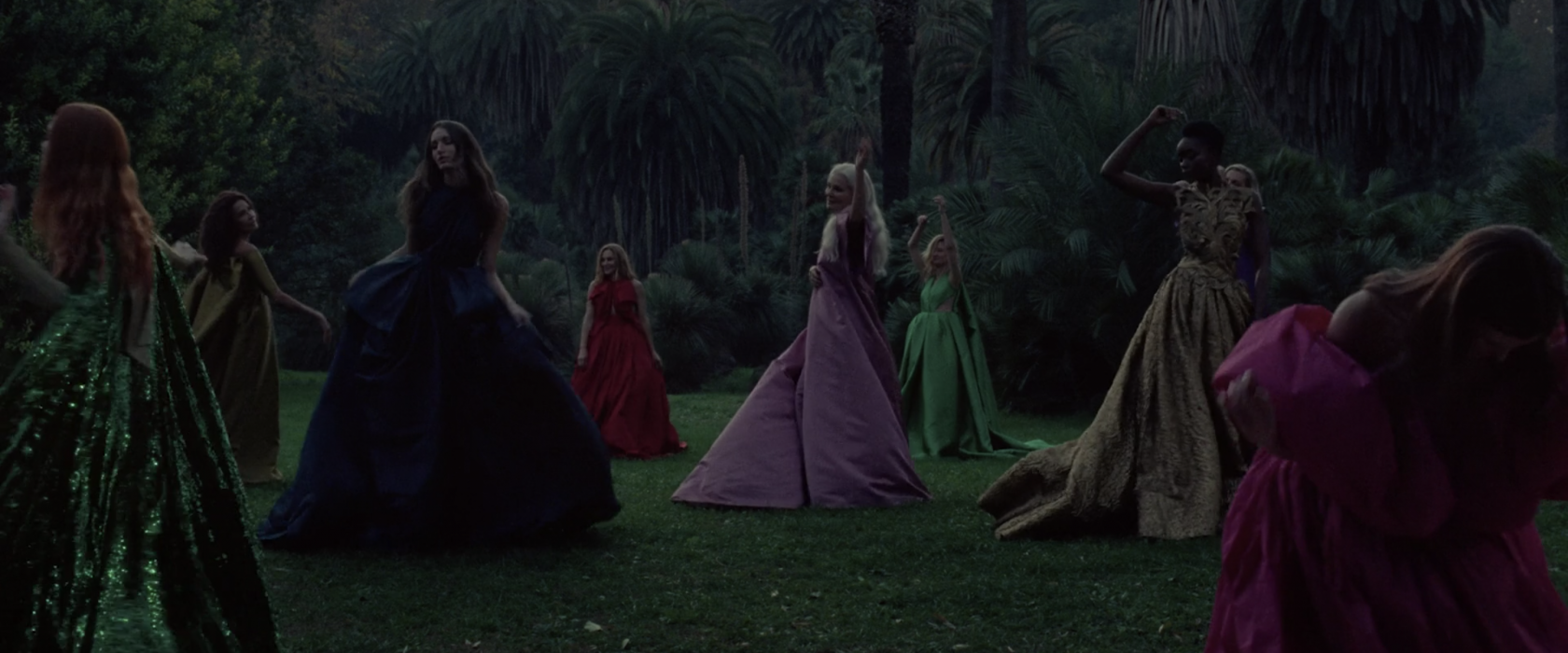
While the film is mainly an advertisement of sorts for Valentino’s haute couture line led by its current leader Pier Paolo Piccioli, the film does feature a narrative about a woman dealing with her ailing mother as she travels to Rome to be with her as they also think about the past. It is a film that doesn’t have much of a plot yet it does play into women thinking about their work but also a woman dealing with blindness as she is convinced her days as an artist is over. Yet, there are all of these mysterious things that occurs in the film along with flashbacks of the young woman with her daughter and other friends while they’re tended to a man throughout the film.
Luca Guadagnino’s direction is stylish as it is shot on locations in New York City and Rome as it play into these two worlds that its main characters live in. While there are some unique wide and medium shots, Guadagnino does play into this air of intrigue but also isolation that looms throughout the film while the flashbacks are lively in the scenes set in Rome. There is a sense of simplicity for the scenes in New York as well as the moments between mother and daughter in the present scenes in Rome while there are moments that are surreal. Notably as there’s a woman walking around in Valentino designer clothing as the clothes do play a key role in the story leading to its climax. Overall, Guadagnino crafts a rapturous and compelling film about a writer and her ailing artist mother thinking about their art and the next stage of their lives.
Cinematographer Sayombhu Mukdeeprom does brilliant work with the film’s cinematography with its emphasis on low-key natural lighting for many of the daytime interior scenes as well as the usage of little lighting for some of the exterior scenes in the evening scenes. Editor Walter Fasano does excellent work with the editing as it is largely straightforward with a few montage cuts in some bits of the film. Production designers Roberta Federico and Olivia Peebles do amazing work with the look of the homes of the woman in New York as well as a place she goes to for a party as well as the home of her mother in Rome. Visual effects supervisor Luca Saviotti does terrific work with some of the film’s minimal visual effects that play into some of the mystical elements of the film. Sound mixer Valentino Gianni does superb work with the sound as it is largely straightforward to play into the way everything sounds in a room. The film’s music by Ryuichi Sakamoto is wonderful for its low-key, piano-based orchestral score that help play into the drama as well as the sense of longing throughout the film while the soundtrack include a couple of pieces by Bruno Lauzi.
The casting by Francine Maisler is marvelous as it feature appearances from Sergio Di Nitto as an old boyfriend from the past, Arianna Pesce and Camilla Martellino in their respective versions as the young and teenage version of the protagonist Francesca, Edoardo Gabbriellini as a party host in Patrizio, Alba Rohrwacher as a friend of Francesca in Vera, and Mia Goth as a younger version of Francesca’s mother Sofia. KiKi Layne is excellent in her small role as a mysterious woman Francesca sees as is she a ghost or her neighbor in New York who is dealing with issues of her own. Kyle MacLachlan is brilliant in a trio of roles as a party guest, an old lover of Sofia, and Sofia’s caretaker where MacLachlan brings a lot of different personalities and sensitivity to those roles. Marthe Keller is amazing as the old Sofia as an artist who is going blind as she deals with aging but also isolation and the past as she looks back with sadness. Finally, there’s Julianne Moore in an incredible performance as Francesca as a writer who deals with her own struggles and loneliness where she goes to Rome to help her mother as well as aspects of her own past.
The Staggering Girl is a remarkable film from Luca Guadagnino. Featuring a great cast, amazing costumes, dazzling visuals, and a somber music score by Ryuichi Sakamoto. The short is a fascinating way in how to sell fashion design as well as tell a story about two women dealing with loneliness and creative drought. In the end, The Staggering Girl is a marvelous film from Luca Guadagnino.
Luca Guadagnino Films: (The Protagonists) - (Tilda Swinton: The Love Factory) - (Mundo civilzado) - (Cuoco contadino) - (Melissa P.) - (The Love Factory No. 3 Pippo Delbono - Bisogna morire) – I Am Love - (Bertolucci on Bertolucci) – A Bigger Splash - Call Me By Your Name - Suspiria (2018 film) - (Fiori, Fiori, Fiori) – (Salvatore: Shoemaker of Dreams) – (We Are Who We Are (2020 TV series)) – Bones & All – Challengers (2024 film) - (Queer) - (After the Hunt)
© thevoid99 2022

Set in both 1927 and 1977, the film follows two paralleling narratives involving two different kids who both embark on a journey of self-discovery as it relates to their own families but also a place where they can belong despite their deafness. It’s a film that is about not just loss but also the need to find some idea of family and a sense of belonging where the centerpiece of this journey relates to an exhibit in a museum. Brian Selznick’s screenplay does follow this paralleling narrative that takes place both in 1927 for this young girl named Rose (Millicent Simmonds) and in 1977 for this boy named Ben (Oakes Fegley) who are both connected in some way though the latter became deaf in a strange freak accident. The former is a young girl who lives at her father’s house in New Jersey who collects clipping of pictures of this famous silent film actress in Lillian Mayhew (Julianne Moore) just before the emergence of sound would come into cinema.
The latter is a boy who just lost his mother Elaine (Michelle Williams) in an accident as he lives with his aunt and cousins where he finds one of his mother’s belongings believing that’s where his long-lost father is. Rose is someone who is fascinated by this actress as well as create paper sculptures that would annoy her father prompting her to run away from home as it would be a similar situation for Ben as he decides to leave Minnesota to find his father as the destination for both Rose and Ben is New York City. Both of them are in the search for someone yet they also encounter an exhibit at a museum as the stories parallel one another with some surprising revelations that connects them both.
Todd Haynes’ direction is definitely stylish yet also magical in the fact it takes place in two different time periods with the 1927 portion shot in black-and-white and the 1977 portion shot in color. Shot on location in New York City for both settings but also in Peekskill, New York as some of the scenes in the older parts of the city as well as parts of Minnesota. Haynes employs a lot of paralleling imagery in some of the wide and medium shots in some of the locations that both Rose and Ben would venture into as well as some of the intimate moments as Rose often comes into conflict with her father while Ben is just trying to get to his old cabin that he lived with his mother unaware that it’s going to be sold. There are also some close-ups as it often play into the plight that Rose and Ben have with Rose being someone who was born deaf and is just eager to be loved while Ben is just confused as he can hear very little but has a hard time with his newfound deafness where Haynes’ camera is often playing up this sense of anguish and confusion.
Haynes’ presentation in some of the silent films that Lillian Mayhew stars in is a homage to the silent films of the past but also this emergence of change that is to emerge as there’s a lightness to the camera movements as it include a lot of scenes without sound to show the idea of being deaf. There are also scenes during the third act as it play into revelations that both Rose and Ben endure into their own destination but also their fascination into the world themselves when they both visit the Metropolitan Museum of Arts as it relates to a book about a certain exhibit that Rose encountered. A book that Ben believes belonged to his father with a bookmark from a store that maybe the key to the whereabouts of his father. What Haynes does is parallel these events which would represent an air of salvation for not just Rose and Ben but also in how they’re connected. Overall, Haynes craft an intoxicating and touching film about two deaf kids from different periods of time trying to find themselves and to be loved.
Cinematographer Edward Lachman does phenomenal work with the film’s cinematography with its usage of stylish lighting textures and schemes for many of the scenes set in 1977 to play up the look of the films of the 70s while the scenes in 1927 are shot in black-and-white to play into the world that Rose encounters. Editor Affonso Goncalves does amazing work with the editing in creating some stylish yet seamless cuts to create transitions for the two narratives and find a way to match them that include a few stylish montages. Production designer Mark Friedberg, with set decorator Debra Schutt plus art directors Ryan Heck and Kim Jennings, does brilliant work with the look of the cabin Ben and his mom used to stay in as well as the house Rose lived in with her father as well as some of the panoramas and such the two protagonists would encounter. Costume designer Sandy Powell does excellent work with the costumes from the dress that Mayhew wears for a play rehearsal and some of the clothes of 1927 to the stylish yet colorful clothing of the 70s.
Special effects makeup artists Adam Bailey and Michael Maddi do fantastic work with the look of a few characters including an old woman that Ben sees whom he would meet later on. Visual effects supervisor Louis Morin does nice work with the visual effects as it largely feature some set-dressing for some scenes in New York City in both 1927 and 1977 along with some other visuals in the panoramas that both kids encounter. Sound mixer Drew Kunin does superb work with the sound as it help play into the atmosphere of some of the locations but also the little bits of sound that Ben would hear in his growing deafness along with the lack of actual sounds to play into Rose’s perspective. The film’s music by Carter Burwell is incredible for its somber orchestral score that appears mainly in the Rose sequences with its string arrangement flourishes but also in some playful organ music for Mayhew’s film as well as some stylish ambient-style pieces while music supervisor Randall Poster cultivate this wondrous music soundtrack that features pieces by Robert Fripp & Brian Eno, Little Esther Phillips, Rose Royce, Gene Austin, Sweet, Eumir Deodato, and David Bowie including a performance of Space Oddity by the Langley Schools Music Project.
The casting by Laura Rosenthal is marvelous as it feature some notable small roles from Lauren Ridloff as a maid at Rose’s home in Pearl, Amy Hargreaves as Ben’s Aunt Jenny, Murphy Guyver as a security officer who catches Rose, Morgan Turner as one of Ben’s cousins in Janet who goes to his cabin to smoke and wear her aunt Elaine’s clothes, Raul Torres as a museum worker in 1977, James Urbaniak as Rose’s father Dr. Kincaid, Jaden Michael as a kid named Jamie that Ben meets who helps him out as his father works at the museum, Corey Michael Smith as a museum worker that Rose meets in Walter, and Tom Noonan as a bookstore owner. Michelle Williams is brilliant in her small role as Ben’s mother Elaine as she is seen in flashbacks as someone who doesn’t tell Ben about his father while is trying to maintain her own life not knowing what is going to happen.
Julianne Moore is incredible in a dual role as the silent film actress Lilian Mayhew and an old woman that Ben sees at the museum as the latter is someone that is a frequent visitor as Ben would see her again later while the former is this luminous presence as an actress on the screen while is also someone else off-screen upon her meeting with Rose. Oakes Fegley is remarkable as Ben as a young kid in the 1970s who becomes deaf in a freak accident as he deals with his newfound deafness but also the loss of his mother as well as the need to find his father. Finally, there’s Millicent Simmonds in a phenomenal performance as Rose as a deaf girl who is enamored with this silent film star while dealing with the cruelty she gets from her father. Though it is a largely silent performance, Simmonds conveys a lot of angst and emotion into her performance as she is a true discovery.
Wonderstruck is a sensational film from Todd Haynes that feature two great leading performances from Oakes Fegley and Millicent Simmonds. Along with its supporting cast, gorgeous visuals, study of identity and family, a mesmerizing music score and soundtrack, and its study of living with deafness. The film is an enchanting film that doesn’t just explore two kids dealing with their deafness and place in the world as it is a film about the desire to connect as it is one of Haynes’ more accessible films. In the end, Wonderstruck is a spectacular film from Todd Haynes.
Todd Haynes Films: Superstar: The Karen Carpenter Story - Poison - Dottie Gets Spanked - Safe (1995 film) - Velvet Goldmine - Far from Heaven - I'm Not There - Mildred Pierce (2011 TV Miniseries) - Carol (2015 film) - Dark Waters (2019 film) – The Velvet Underground – The Auteurs #3: Todd Haynes
© thevoid99 2022
Written and directed by Rebecca Miller from a story by Karen Rinaldi, Maggie’s Plan is the story of a woman who falls in love with a married man only for things go wrong years later as she schemes to get him back to his ex-wife. The film is a romantic comedy of sorts as it plays into a woman who put herself into a situation only to find herself in serious trouble as she becomes part of a messy love triangle. Starring Greta Gerwig, Ethan Hawke, Bill Hader, Maya Rudolph, Travis Fimmel, Wallace Shawn, and Julianne Moore. Maggie’s Plan is a witty and whimsical film from Rebecca Miller.
The film follows a young woman who meets a writer as they fall in love despite the fact that he’s married to a college professor as they would later marry and have a child only for the marriage to lose its luster where the woman believes her husband is hung up on his ex-wife. It’s a film that explores a woman’s desire to wanting to become a mother only for her plans to just have a child without any emotional attachments to the father only for things to not exactly go her way. Rebecca Miller’s screenplay follows the titular protagonist (Greta Gerwig) who works at the New School in New York City where she’s the director of business development and outreach for the art and design students as she would meet another person at the school in John Harding (Ethan Hawke) over a bill where they have somewhat similar last names as Maggie’s surname is Hardin. Learning that Harding is working on a novelist and married to the famed writer Georgette Norgaard (Julianne Moore) who tenures at Columbia University.
Maggie and Harding befriend one another due to the former’s interest towards the latter’s novel as they suddenly begin an affair where the story moves three years later where they have a daughter named Lily (Ida Rohatyn). Yet, things become complicated as their relationship has hit a funk where Harding would help his ex-wife over business deals with Maggie watching over her teenage stepdaughter Justine (Mina Sundwall) and stepson Paul (Jackson Frazer). Maggie is convinced her relationship with Harding is going to end in divorce where she meets Norgaard about the idea of her getting back with Harding. It all play into Maggie’s need to control the situations as well as reclaim some idea of individuality as she often had to cancel meetings in her job and do all of the things that a mother does with Harding often too consumed with his own work and such. Norgaard is reluctant at first about Maggie’s plan as she’s still got issues with Maggie over her affair with Harding but also realizes that she still has feelings for her ex-husband.
Miller’s direction is straightforward in terms of the compositions and setting as it is shot largely in New York City during the winter as well as locations at upstate New York as Quebec. While there are some wide shots in some scenes, much of Miller’s direction rely on close-ups and medium shots as it relates to the characters interacting with one another. Even in scenes that are lightly comical as it relates to Maggie being with her friends including a man named Guy (Travis Fimmel) whom she originally wanted to impregnate her by donating his sperm. It’s among the lightly-comical moments that include the night Maggie tries to use Guy’s sperm to impregnate herself where Harding has rung the intercom to meet her as it would play into some silliness.
The scenes that showcases Harding’s marriage to Norgaard display that air of inequality where Norgaard is presented as someone that might seem pretentious yet she is revealed to be someone that is an intellectual but with a chip on her shoulder. In the film’s third act, it does become dramatic as it relates to Maggie and Harding yet would have an air of humor in the growing friendship between Maggie and Norgaard as Miller would show the two having common ground as well as create something together that would benefit everyone. Overall, Miller crafts a charming and enjoyable film about a woman’s scheme to get her husband back with his ex-wife that would eventually cause chaos in her own life.
Cinematographer Sam Levy does excellent work with the film’s cinematography as it is largely straightforward for its exterior look including the scenes set in Quebec that includes its low-key lighting for the interior scenes at night. Editor Sabine Hoffman does terrific work with the editing as it is straightforward with a few jump-cuts and montages with the latter playing into Maggie’s relationship with Harding early in the film. Production designer Alexandra Schiller, with set decorator Kendall Anderson and art director Brian Goodwin, does fantastic work with the look of the apartments the characters live in from the posh-look of Norgaard to the more Bohemian look of Maggie when she lives with Harding.
Costume designer Malgosia Turzanska does nice work with the costumes as it has a sense of style from the colorful look of Maggie to the more posh look of Norgaard. Sound editor Marlena Grzaslewicz does superb work with the sound in capturing the atmosphere of the hotel in Quebec to the exteriors of New York City. The film’s music by Michael Rohatyn is wonderful for its low-key score that mixes folk and indie music to play into the world of New York City while music supervisor Adam Horowitz provide a mix of music from reggae to rock.
The casting by Cindy Tolan is great as it feature some notable small roles from Wallace Shawn as a Q&A interviewer for Norgaard and Harding early in the film, Kathleen Hanna as a singer at an inn in Quebec, Ida Rohatyn as John and Maggie’s daughter Lily, Jackson Frazer as John and Georgette’s son Paul, and Mina Sundwall as John and Georgette’s teenage daughter Justine who is wondering why her dad is eating with her mom. Bill Hader and Maya Rudolph are superb in their respective roles as Tony and Felicia as friends of Maggie who have a family of their own as they’re concerned about her scheme with Tony being uncomfortable with the situation. Travis Fimmel is terrific as Guy as a friend of Maggie who makes and sells pickles as she wants him to donate his sperm to her only for things to not happen. Ethan Hawke is excellent as John Harding as a college professor for the New School that is trying to create a novel yet often neglects his parental duties and still has feelings for Georgette unaware of what he’s doing to Maggie.
Julianne Moore is incredible as Georgette Norgaard as a Danish intellectual/writer who is also a professor at Columbia University as she has some resentment and anger towards her ex-husband yet still has feelings for him where she would go along with Maggie’s plan only to befriend Maggie as it’s a charming performance from Moore. Finally, there’s Greta Gerwig in a remarkable performance as Maggie Hardin as a director for the New School who is eager to have a child where things don’t go as planned as she tries to take control of the situation in getting her husband back with his ex-wife only to realize her faults and accept about the way things are.
Maggie’s Plan is a marvelous film from Rebecca Miller that features great performances from Greta Gerwig and Julianne Moore. Along with its supporting cast and a witty story of a complicated love triangle, it’s a film that manages to bring something new to the romantic-comedy genre while being a woman’s film in its exploration for them to find their place in the world. In the end, Maggie’s Plan is a brilliant film from Rebecca Miller.
Rebecca Miller Films: (Angela (1995 film)) – Personal Velocity: Three Portraits - The Ballad of Jack and Rose - The Private Lives of Pippa Lee - Arthur Miller: Writer
© thevoid99 2018
Directed by Ron Mann and written by Len Blum, Altman is a documentary that explores the life and career of one of American cinema’s great artists in Robert Altman. Featuring audio interviews with his widow Kathryn Reed Altman, their children, and the people who had worked with him. The film plays into Altman and his peculiar approach to filmmaking and storytelling along with rare footage of behind-the-scenes footage and rare home movies provided by his family. The result is an enchanting and exhilarating portrait of one of American cinema’s great voices.
The term “Altmanesque” is something that best describes the style of the kind of films that Robert Altman makes which are based on real things that are happening with overlapping dialogue while refusing to play by traditional and conventional aesthetics that usually happens in mainstream cinema. For those that had worked with him and those like Paul Thomas Anderson who was inspired by him, it’s a term that means many thing. Especially to a man that didn’t live his life by conventional means as he was someone that liked to have a good time and treat his actors and collaborators as part of his family. It’s a film that isn’t just a tribute to Altman but also to his body of work which were all defined by its refusal to play by the rules whether they were successful or not.
Each chapter opens with a collaborator of Altman such as Lily Tomlin, Lyle Lovett, Sally Kellerman, Elliott Gould, Michael Murphy, Paul Thomas Anderson, Keith Carradine, Robin Williams, and several others to each define the term “Altmanesque” in their own way. These chapters would play into Altman’s early life where he served in the U.S. Air Force in World War II and later found his way into the film industry when he co-wrote the screen story for a film called Bodyguard in 1948 for RKO Pictures. The film would also play into Altman’s time doing industrial films and documentaries during the 1950s, his work on various TV series where he would meet his third wife Kathryn Reed, and his first films as a feature-film director where he would clash with studio heads about how to tell a story.
By the time he broke through with M.A.S.H. in 1970, things would definitely go up as Altman would often have his own family on the set where director Ron Mann would reveal not just a few rare short films but also some rare behind-the-scenes moments and such to show how Altman’s children were part of the set. Notably as his son Stephen would start out as a props man and later be his father’s production designer while Matthew Reed Altman would become a camera operator for much of his father’s films. The success that Altman would have for much of the 1970s where he was able to remain independent while working with studios gave him the chance to create a studio of his own in Lion’s Gate Films (not the US/Canada studio of the same name) that launched the career of Alan Rudolph and several others.
The film would play into Altman’s own innovations as a filmmaker where he would find new ways to record a lot of overlapping dialogue through little microphones on the actors while Altman and a sound mixer would find out which dialogue to use and how to mix it right the way to make it feel natural. While his innovations would be used for a lot of films by other filmmakers including Hollywood, the film also played into Altman’s own exile from Hollywood until 1992’s The Player where he made a big comeback. Some of the scenes that Mann would create would be presented through the work of art directors/animators Matthew Badiali and Craig Small who would create some background images of what Altman might’ve been doing during those times.
With the aid of cinematographer Simon Ennis in shooting some of the testimonies from Altman’s collaborators and Kathryn Reed Altman for its ending along with editor Robert Kennedy to compile footage of Altman’s earlier work and rare home films. Even as the sound work of John Laing would help play into Altman’s innovations in capturing overlapping dialogue while the music of Phil Dwyer and Guido Luciani is playful with its jazz-based score. Music supervisor Mike Rosnick would maintain that sense of playfulness with the music to play into the different periods of time.
Altman is a phenomenal documentary film from Ron Mann. It’s a film that anyone who loves the work of Robert Altman must see this not just for some of the rare home movies and interviews he does but also into a study of his methods. For anyone new to Altman might think of the film as a nice place to start though his own work is the best way to look into the man and his work. In the end, Altman is a remarkable film from Ron Mann.
© thevoid99 2015

Directed by David Cronenberg and written by Bruce Wagner that is based on his own book Dead Stars, Maps to the Stars is a story set in Hollywood revolving around an aging actress dealing with her career as well as the presence of her late mother while a therapist tries to get his young son to return to the world of celebrity culture. A film that explores the world of celebrity and its emphasis on Western culture, it’s a film that is satirical as well as having commentary on a world lost in fame. Starring Julianne Moore, John Cusack, Mia Wasikowska, Robert Pattinson, Olivia Williams, Evan Bird, and Sarah Gadon. Maps to the Stars is a visceral and ominous film from David Cronenberg.
The film is an exploration into the world of fame and celebrity culture through a multi-layered narrative involving a young child star trying to return to the world of celebrity culture while an aging actress copes with painful memories as she is haunted by the presence of her late mother. It’s a film that plays into people trying to be part of a culture where there’s a lot of expectations and demands in order to succeed. At the middle of this is a young woman named Agatha (Mia Wasikowska) who arrives from Florida as she would work for the aging actress Havana Segrand (Julianne Moore) as an assistant. Segrand is coping with demons as she seeks the help of self-help therapist Dr. Strafford Weiss (John Cusack) whose son Benjie (Evan Bird) is a teen child-star that is trying to remain sober while dealing with the pressures of stardom as he endure strange hallucinations.
Bruce Wagner’s screenplay definitely plays into not just people’s desire to wanting to make it in Hollywood but also how far they will go to the point that they lose elements of their sanity as well as their own identity. While Agatha is just an outsider who would befriend a limo driver named Jerome (Robert Pattinson) who is trying to make as an actor and a writer. She is someone that manages to have some connections to be part of that world yet is more of an observer who has an element of innocence but with a dark edge as she wears gloves and lots of clothes as she is a burn victim with a past of her own. By working for Havana Segrand, she gets access to the world of productions and places but is also aware that there is a lot more going on. Especially as Havana is a woman living in the shadows of her late mother Clarice (Sarah Gadon) who was a famous star until she died of a car crash when Havana was a child.
In the hopes to star in a remake of a film that her mother did years ago, Havana is hoping for a comeback but Clarice’s presence haunts her. By going to Dr. Weiss, she tries to exercise her demons as well as get a role in order to fulfill her own ego. The Dr. Weiss character is also a representation of egotism as he is a man that is making money through is own self-help books as well as exploit his own son while his wife Cristina (Olivia Williams) is Benjie’s manager as she does whatever to get him a part in a sequel for a film that made him a star. Benjie however, is struggling with trying to stay sober as well as be out of the public eye as he is succumbing to peer pressure as well as the need to be this teen sensation as he starts to see strange hallucinations involving the dead. It’s a film that features a lot of characters who are despicable while the Jerome character is the most normal as he is also an outsider who is just trying to get his break no matter how humiliating things are. Though there’s aspects of Jerome that makes him unsympathetic, it’s only because he has to do things in order to be part of this very turbulent and troublesome world.
David Cronenberg’s direction is very mesmerizing for the way he depicts the world of Hollywood as this place of conformity and expectations that seem unreal. While a lot of it is shot in Los Angeles and Hollywood with a few interior scenes set in Toronto, it does play into a film that has a very warped view of what Hollywood is as many of the characters, with the exception of Agatha and Jerome, live in these spacious mansions and are invited to the biggest parties around. While there’s some wide shots in the direction, much of Cronenberg’s approach to the compositions are simple in terms of close-ups and medium shots. Especially in scenes involving Agatha where her close-ups play to how she looked with her burned scars around parts of her head to play into a sense of realism that she has while everyone in Hollywood is trying to look young or be part of that culture.
The direction is also full of dark humor that plays into aspects of satire such as the commercials that Dr. Weiss has as well as his approach to therapy which is quite odd. Even as it’s clear that he’s just a man that will do anything to be famous and use his son’s stardom to become famous. Once there’s some revelations about his own past as well as his family starts to emerge, it adds to the sense of drama that emerges as well as to the issues that Havana is going through. Havana’s story has elements of surrealism as it relates to the presence of her own mother which is similar to the hallucinations that Benjie would go through. All of which play into demons that they face with Agatha being caught in the middle as this observer as she is connected to these people in some ways while keeping herself at a distance. Overall, Cronenberg creates a very captivating yet harrowing film about celebrity culture and people dealing with their demons in that world.
Cinematographer Peter Suschitzky does brilliant work with the film‘s cinematography to play into the sunny look of the locations in Hollywood along with some straightforward lighting for some scenes at night including some of the interior shots. Editor Ronald Sanders does excellent work with the editing as it‘s straightforward while using some unique rhythmic cuts to play into some of the surreal moments of the film. Production designer Carol Spier, with set decorators Sandy Lindstedt and Peter P. Nicolakakos and art directors Edward Bonutto and Elinor Rose Galbraith, does fantastic work with the look of the homes of the Weiss family as well as Havana to play into their personalities as well as the offices to showcase that world of celebrity culture.
Costume designer Denise Cronenberg does terrific work with the costumes from the long leather gloves that Agatha wears to the different array of clothes that the other characters wear as it‘s very posh in its look. Visual effects supervisor Jon Campfens does nice work some of the film‘s minimal visual effects which includes a chilling scene late in the film that plays to the drama. Sound editor Michael O’Farrell does superb work with the sound to play into the atmosphere of the party scenes as well as the smaller moments such as the screams that Havana would endure in her moments where she‘s tested. The film’s music by Howard Shore is amazing for its mixture of somber orchestral music with a mixture of eerie electronic pieces that play into the sense of dread and dark drama that looms over the film.
The casting by Deirdre Bowen is phenomenal as it features some notable small roles from Carrie Fisher as herself, Jayne Heitmeyer as a rival actress of Havana, Domenic Ricci as that woman’s son, Kiara Glasco as a young girl Benjie visits at the hospital as she would haunt him later on, Gord Rand as a director that Havana hopes to work with, Sean Robertson as a young co-star of Benjie whom is seen as a threat, and Dawn Greenhalgh as Havana’s agent who tries to get Havana the role that she is coveting. Sarah Gadon is terrific as the ghost of Havana’s mother Clarice who is a manifestation of the bad memories that Havana has. Olivia Williams is superb as Benjie’s mother Cristina who also manages her son’s career as she tries to make sure he stays sober while dealing with some demons of her own. Robert Pattinson is excellent as Jerome as a limo driver that Agatha befriends as he tries to make it as an actor/writer as he tries to find ways to make it where he does things that he knows he isn’t proud of.
Evan Bird is brilliant as Benjie as this teen sensation trying to cope with fame and the need to be sober as he also deals with strange hallucinations that play into his fascination with death. John Cusack is amazing as Benjie’s father in Dr. Strafford Weiss as this self-help therapist who is trying to become famous while doing whatever to make sure his son stays famous as he’s a really despicable character. Mia Wasikowska is remarkable as Agatha as this young woman with burned skin who arrives to Los Angeles with some mysterious motives as she finds herself fascinated by celebrity culture as she works for Havana while dealing with things about herself as it’s a performance that is quite engaging but also very dark. Finally, there’s Julianne Moore in an incredible performance as Havana Segrand as this aging actress that is desperate to make a comeback while coping with issues as there’s a sense of vanity and smugness in Moore’s performance that is mixed with high-levels of insecurities as it’s Moore in one of her best performances to date.
Maps to the Stars is a rapturous yet exhilarating film from David Cronenberg. Armed with a great cast led by Julianne Moore and Mia Wasikowska as well as very unique insight into the world of celebrity, its culture, and all of the trappings of fame. Especially as it’s a film with some revelations about people and twists and turns that showcase how much people are willing to sacrifice to be adored only to fall apart by their own undoing. In the end, Maps to the Stars is a riveting and tremendously haunting film from David Cronenberg.
David Cronenberg Films: Stereo - Crimes of the Future - Shivers - Rabid - Fast Company - The Brood - Scanners - Videodrome - The Dead Zone - The Fly (1986 film) - Dead Ringers - Naked Lunch - M. Butterfly - Crash - eXistenZ - Spider - A History of Violence - Eastern Promises - A Dangerous Method - Cosmopolis - Crimes of the Future (2022 film)
The Auteur #26: David Cronenberg: Pt. 1 - Pt. 2
© thevoid99 2014
Written, directed, and starring Joseph Gordon-Levitt, Don Jon is the story of a modern-day Don Juan who falls in love with a beautiful woman until she discovers about his addiction to pornography. The film explores a young man dealing with his addiction as well as view on women. Also starring Scarlett Johansson, Tony Danza, Glenne Headly, Brie Larson, Rob Brown, and Julianne Moore. Don Jon is a witty yet fun film from Joseph Gordon-Levitt.
The film is really a look into the life of a young man named Jon “Don Jon” Martello Jr. (Joseph Gordon-Levitt) who is this very easy-going Italian-American living in New Jersey that lives a good life while being addicted to pornography. Upon meeting this beautiful woman Barbara (Scarlett Johansson), he thinks about having a real relationship with her while she gets him to try and improve himself by having him go to night classes where he meets an older woman named Esther (Julianne Moore). Barbara’s discovery about Jon’s addiction to porno has her repulsed where Esther also discovers about Jon’s addiction where she questions him about his views on women, sex, and love. Even where Jon wouldn’t just question about how he has sex with women but also what Barbara expect from him.
Joseph Gordon-Levitt’s script has this exploration about not just the way men view women from a sexual point of view but also what some women want in men. Notably as Barbara is this spoiled woman from New Jersey who loves bad romantic-comedies that she forces Jon to watch as she thinks these films represent the ideas of what love is. Even as Jon takes her to meet his family where it reinforces the idea of Jon finally settling down and having a family but he’s not sure if he wants that until his meetings with Esther has him realizing a lot about himself. The script doesn’t just succeed in fleshing out the many characters in the film but also play into the way women are presented to men as there’s a scene where Jon and his father (Tony Danza) watch a Carl Jr.’s commercial where a woman in a bikini is eating a fish sandwich as they’re entranced by the woman. It’s all told in a very funny manner as well as the way romantic-comedies are portrayed where it’s very obvious at how false they are where Gordon-Levitt pokes fun at the fallacy of the genre.
Gordon-Levitt’s direction is quite straightforward in terms of what he presents where he opens the film with this montage of women being used as sexual objects plus clips of porno to establish this idea of how men treat women. Even as he also maintains this idea of repetition in the way Jon lives his life where he likes to clean his apartment, drive his car, hang out with his boys, go to the gym to work out, go to church on Sundays, eat with his family, go to clubs to meet girls and later have sex with them, and end the day masturbating to porn. It all plays to the life that Jon has where he even gets Barbara to go to the gym with him but the cracks start to come in where she questions about why he talks to himself when he’s working out.
The first half is mostly a light-hearted comedy while the rom-coms that he and Barbara watch has the same kind of visual blandness that is expected in these films as well as the situations that goes on. The second half is a bit more dramatic in terms of Jon’s time with Esther yet it would be crucial to Jon’s growth as a man. Notably as Gordon-Levitt creates some unique compositions to play out the drama that would showcase Jon’s acceptance about what love is as well as what to expect from the people closest to him. Overall, Gordon-Levitt creates a very fascinating yet humorous film about a man’s addiction to pornography.
Cinematographer Thomas Kloss does excellent work with the film‘s cinematography from the nighttime locations of the places in New Jersey to the look of the clubs that Jon and his friends go to. Editor Lauren Zuckerman does amazing work with the editing in not just some of the inventive montages of Jon‘s daily routines but also in the way it plays to his own attempt to gain control for himself. Production designer Meghan C. Rogers, with set decorator Cindy Coburn and art director Elizabeth Cummings, does nice work with the set pieces from the look of Jon‘s apartment to the home where his family lives.
Costume designer Leah Katznelson does terrific work with the costumes from the clothes that Barbara wears to the stylish clothes that Jon would wear. Visual effects supervisor Karen E. Goulekas does some fine work with the film‘s minimal visual effects that involves one of the bad rom-coms that Barbara forces Jon to watch. Sound editor David Chrastka does superb work with the sound from the atmosphere of the clubs to the intimacy in the night classes that Jon and Esther go to. The film’s music by Nathan Johnson is wonderful for its array of folk-based and orchestral music to play up some of the humor while music supervisor John Houlihan brings a soundtrack that mostly consists of hip-hop and dance music including Marky Mark and the Funky Bunch.
The casting by Venus Kanani and Mary Vernieu is brilliant as it features some very funny cameo appearances from Anne Hathaway, Channing Tatum, Cuba Gooding Jr., and Meghan Good as the stars of the bad romantic comedies that Jon is forced to watch as well as Paul Ben-Victor as the voice of Jon’s local priest. Rob Brown and Jeremy Luke are terrific as Jon’s friends with the former as the more reserved Bobby and the latter as the dim-witted Danny. Brie Larson is wonderfully funny as Jon’s sister Monica who spends most of the film looking at her phone and texting where she only speaks in a key moment late in the film. Glenne Headly is amazing as Jon’s mother Angela who hopes for her son to meet a nice girl while Tony Danza is hilarious as Jon’s father who is kind of a sexist schmoe who likes to watch football games.
Julianne Moore is great as Esther as this older woman that Jon meets in night classes who questions him about his fascination with sex and pornography while she’s hiding some things of her own where Moore brings a very relaxed yet witty performance as a woman who would guide Jon to find something more. Scarlett Johansson is fantastic as Barbara as this very sexy yet vapid woman who spends half her time chewing gum and teasing Jon to get her way while proving herself to be just as shallow as he is. Finally, there’s Joseph Gordon-Levitt as the titular character where he brings in this very suave yet smug Italian-American persona that is full of himself. Gordon-Levitt not only makes the character funny but also endearing as someone who appreciates the finer things in life but also someone with a problem as he is forced to come to terms with who he is where Gordon-Levitt has some great scenes with Johansson and Moore to present the depth of his character making it one of his best performances.
Don Jon is a marvelous film from Joseph Gordon-Levitt that features some excellent supporting performances from Scarlett Johansson and Julianne Moore. The film isn’t just a funny look into the world of porno addiction but also the way men and women view their idea of the opposite sex and what they want from that view. In the end, Don Jon is an extraordinarily entertaining film from Joseph Gordon-Levitt.
© thevoid99 2013
Directed by Robert Altman and written by Anne Rapp, Cookie’s Fortune is the story about a small town in Mississippi where relatives of a wealthy dowager try to cover up her suicide as murder. The film is an exploration into small town life as well as a group of people coming together to help out. Starring Glenn Close, Julianne Moore, Liv Tyler, Chris O’Donnell, Charles S. Dutton, and Patricia Neal. Cookie’s Fortune is a strange yet whimsical film from Robert Altman.
The film revolves around a group of people who deal with the death of a wealthy widow who kills herself in order to reunite with her late husband. When one of her nieces decides to cover up the woman’s death as a murder in hopes to attain the woman’s home, things get crazy as a caretaker is accused of murder only for the woman’s granddaughter coming to his aid to help him. Things eventually get complicated though some of the cops believe that the caretaker didn’t do anything as questions are raised into what really happened.
Screenwriter Anne Rapp creates a film that is about a collection of oddballs that live in this small Mississippi town where they all know each other. When this wealthy woman known as Cookie (Patricia Neal) dies and suspicion of murder arises, a lot of questions are raised as it would take an outsider to finally piece everything together. Though the plot schematics does have an air of predictability, there are moments that does make up for it due to the characters that are created for this film.
Robert Altman’s direction is quite straightforward in terms of the way he presents life in a small town in Mississippi by actually shooting on location in that town. Yet, he does maintain that improvisational style that he’s known for in the way he approaches the characters. Notably as it includes a lot of mystery into not just all of these entanglements involving the relatives of this old woman but also her caretaker Willis Richland (Charles S. Dutton) who many people knew as this very kind man who always helped Cookie out. Still, there’s people like Cookie’s niece Camille (Glenn Close) who is intent on getting her house believing that she earned it and such. Altman does make sure that it’s about the characters and the way they interact as he’s able to do things to make up for some of the screenplay’s shortcomings. Overall, Altman creates a very engaging yet offbeat comedy-mystery about a group of oddballs in a small Mississippi town.
Cinematographer Toyomichi Kurita does excellent work with the film‘s very colorful photography to capture the beauty of small town Southern life with its natural lighting schemes along with more stylish work for scenes at night. Editor Abraham Lim does nice work with the editing as it‘s mostly straightforward while utilizing a few rhythmic cuts for some of the film‘s comical moments. Production designer Stephen Altman, along with set decorator Susan Emshwiller and art director Richard L. Johnson, does wonderful work with the set pieces from the staging of Camille‘s play to the home of Cookie.
Costume supervisor Susan Kaufmann does terrific work with the costumes to capture the more casual look of the characters as well as the more stylish clothes of Camille along with the costumes for the Salome play. Sound editor Frederick Howard does wonderful work with the sound to capture the atmosphere of church rehearsals to the intimacy of the bar. The film’s music by David A. Stewart is a real delight at it’s mostly blues-based music to play out the world that is the American South.
The casting by Pam Dixon is incredible for the ensemble that is created as it features notable small roles from Niecey Nash as a deputy, Rufus Thomas as a bar owner, Lyle Lovett as a catfish salesman, Donald Moffat as the town’s local attorney, Matt Malloy as a forensics expert, and Courtney B. Vance as an out-of-town investigator who tries to piece everything that’s happened. Ned Beatty is very funny in a small yet wonderful role as deputy Lester Boyle who believes that Willis is innocent while Patricia Neal is superb as the aging widow Cookie who longs to reunite with her late husband Buck. Chris O’Donnell is very good as the young deputy Jason Brown who tries to help out everyone as well as deal with his feelings for Emma. Liv Tyler is amazing as Emma Duvall as she is the granddaughter of Cookie as she returns to her small town to try and start over while helping out Cookie’s old caretaker Willis.
Charles S. Dutton is great as the kind caretaker Willis who is a very close friend of Cookie as he deals with loss as well as being accused of killing her as he and many know that he didn’t do it as it’s a very low-key yet charming performance from the actor. Julianne Moore is excellent as the very shy and childlike Cora who is often under Camille’s control while also carries a sense of ambiguity as she might know a lot more than Camille believes. Finally, there’s Glenn Close in a superb performance as Camille who tries to change the fate over Cookie’s death in order to gain Cookie’s home as she thinks she’s doing it for the greater good.
Cookie’s Fortune is a stellar yet entertaining film from Robert Altman. Featuring an amazing ensemble cast and an intriguing look into small town life in the American South. The film offers something that is unique while carrying that spirit of looseness that Altman is known for. In the end, Cookie’s Fortune is a very good film from Robert Altman.
Robert Altman Films: (The Delinquents) - (The James Dean Story) - Countdown (1968 film) - (That Cold Day in the Park) - M.A.S.H. - Brewster McCloud - McCabe & Mrs. Miller - (Images) - The Long Goodbye - Thieves Like Us - California Split - Nashville - Buffalo Bill and the Indians, or Sitting Bull’s History Lesson - 3 Women - (A Wedding) - (Quintet) - (A Perfect Couple (HealtH) - Popeye - (Come Back to the Five and Dime, Jimmy Dean, Jimmy Dean) - (Streamers) - (Secret Honor) - (O.C. and Stiggs) - Fool for Love - (Beyond Therapy) - (Aria-Les Boreades) - (Tanner ‘88) - (Vincent & Theo) - The Player - Short Cuts - Pret-a-Porter - (Kansas City) - (The Gingerbread Man) - Dr. T & the Women - Gosford Park - The Company (2003 film) - (Tanner on Tanner) - A Prairie Home Companion
© thevoid99 2013
Originally Written and Posted at Epinions.com on 3/23/07 w/ Additional Edits & Revisions.
Based on the nine short stories and a poem by Raymond Carver, Short Cuts is a multi-layered story involving 22 characters dealing with their lives in the course of a few days in California. Directed by Robert Altman and screenplay by Altman and Frank Barhydt, the film is an ensemble piece that explores the lives of various people some of whom are connected and those that aren't. With an all-star cast that includes Lily Tomlin, Tim Robbins, Jennifer Jason Leigh, Julianne Moore, Buck Henry, Peter Gallagher, Fred Ward, Anne Archer, Chris Penn, Robert Downey Jr., Huey Lewis, Jack Lemmon, Lyle Lovett, Andie MacDowell, Madeleine Stowe, Bruce Davison, Frances McDormand, Tom Waits, Annie Ross, Lori Singer, Lili Taylor, Dirk Blocker, Zane Cassidy, and Jarrett Lennon. Short Cuts is a sprawling yet exuberant film from Robert Altman.
Stormy Weathers (Peter Gallagher) is a helicopter pilot who is dropping off pesticides all over the suburban home and valleys in California while Dr. Ralph Wyman (Matthew Modine) and his wife/artist Marian (Julianne Moore) are watching a string quartet that features the cellist Zoe (Lori Singer) with their friends Stuart (Fred Ward) and Claire Kane (Anne Archer). Zoe's mother Tess Trainer (Annie Ross) is a nightclub jazz singer where Bill (Robert Downey Jr.) and Honey Bush (Lili Taylor) are watching the show. Honey's mother Doreen (Lily Tomlin) is a diner waitress who gets a visit from her limo driver husband Earl (Tom Waits) while Howard Finnigan (Bruce Davison) is making a report about the pesticide drops while his wife Ann (Andie MacDowell) and their son Casey (Zane Cassidy) watch him on TV. Meanwhile, an angry cop named Gene Shepard (Tim Robbins) leaves his wife Sherri (Madeleine Stowe) claiming he's going to a meeting when he's really having an affair with a realtor named Betty (Frances McDormand) whose ex-husband is Stormy who had just called their son Chad (Jarrett Lennon) about Betty's birthday.
With Finnigans planning a birthday party for Casey, a pool cleaner named Jerry Kaiser (Chris Penn) arrives to clean the pool while getting a call to clean Tess' pool. Stuart goes on a fishing trip with Vern Miller (Huey Lewis) and Gordon Johnson (Buck Henry) where they make a chilling discovery at the river where they're fishing at. Tired by Earl's drunk appearances, Doreen leaves in a huff where she accidentally hits Casey with her car only for Casey to recover quickly where he walks back home. After returning home from the bakery, Ann finds her son in a state of shock unaware of what's happened to him as she takes him to the hospital where Dr. Wyman checks up on him. With Howard also at the hospital to hear about Casey, he gets an unexpected visit from his estranged father Paul (Jack Lemmon) who makes a startling confession about his own infidelities. Earl goes to the jazz club to see Tess singing as she is dealing with her own issues with Zoe who is in a state of depression.
Jerry and his wife Lois (Jennifer Jason Leigh) goes on a trip with Bill and Honey as Jerry is having issues with Lois while Sherri visits her sister Marian where they talk about infidelity where Sherri learns about Marian and Ralph's marital problems. After a tense visit from Stormy, Betty tells Gene that she's going out for the weekend with her son though Gene thinks she's lying where he later spies on her. On the day of the Wymans' barbeque party where Stuart and Claire attend unaware of Ralph and Marian's issues. With everyone upset and unhappy about their lives, everyone would come together in a moment of clarity as well as deal with tragedy.
Whereas most ensemble features, especially as ambitious as this one, tend to connect characters with one another and at times, tend to be contrived. For this film, Altman chooses to throw away the idea of a plot and just let a story or some scene tell itself. Definitely inspired by the works of Raymond Carver, Short Cuts is a film that doesn't have a lot of themes or any sense of morality or judgement. The whole film is really about people, ordinary people living their life through the disappointments, the daily struggles, and frustrations of what goes on. The characters are people that audiences can relate to in every way and form. It's the many characters that drive the film's stories and how each group of characters relate to another group. It's all done in the Altman spirit of improvisation, overlapping dialogue, and intertwining moments that allows the audience to get to know the characters and the situations.
While some audiences might find some of the stories and characters' situation hard to follow, the payoff over what happens is fulfilling. From the story of Jerry being neglected by his wife to the story of a disgruntled baker being left with an expensive cake. Neglect is a small theme from a booze-drinking jazz singer who is unaware of her daughter's depression to a phone-sex operator not wanting to talk dirty to her husband. The characters of Tess and Lois aren't totally bad since Lois is trying to make money for her family while Tess is just depressed over environment. Infidelity is another issue whether it's Marian and Ralph in a very high-octane emotional scene, Gene's cheating and his awful lies that often entertain his wife, and the heartbreaking confession from Paul Finnigan telling his son what happened. All of these scenes through the script that Altman co-wrote and his direction is very observant. Even in some of the film's intense, emotional moments where Altman moves his camera to convey something that is powerful and not taking it too close to capture this emotional moment.
Cinematographer Walt Lloyd does an excellent job in capturing Los Angeles with his intimate, sprawling photography while making several scenes in the film's interior settings to be intimate and observant. Altman's late editor Geraldine Peroni does an amazing job in shifting the differing stories from one to another and connecting characters to another without making it too confusing. It's also very rhythmic to the energy and style of the film. Production designer Stephen Altman and art director Jerry Fleming do an excellent job in creating the look of the homes of the different characters and the personalities to represent each group. Costume designer John Hay also plays to the different atmosphere of the characters in the costumes from the hippie-like clothing of Honey Bush to the posh look that Marian wears. Sound editor Eliza Paley also goes for atmosphere in the film's opening sequences the sounds of helicopters flying over Los Angeles and in the places where people get together. Music composer Mark Isham brings a melodic, jazz driven score to play to the character of Tess while also doing some subtle, orchestral score work to convey the film's drama.
Finally, there's the film's huge ensemble cast. Included in the cast are some small yet memorable performances from comedian Charles Rocket, Michael Beach and Andi Chapman as a couple who asks Honey Bush to watch over her house, Susie Cusack and Deborah Falconer as a couple of bicyclists, Margery Bond, and Nashville actor Robert DoQui. Jarrett Lennon is excellent as the Captain Planet-obsessed Chad Weathers and Zane Cassidy is great as Casey Finnigan. Lyle Lovett is wonderful as the disgruntled baker Bitkower while 80s pop singer Huey Lewis and writer Buck Henry are great as the fishing buddies Vern and Gordon, respectively.
Robert Downey Jr. is funny as the quirky, horny Bill Bush with Lily Taylor as the eccentric yet concerned Honey, who seems troubled by her own relationship towards her stepfather. Jennifer Jason Leigh is excellent as the phone-sex operator Lois who tries to maintain her family's security with the late Chris Penn giving a great performance as the neglected, sexually-frustrated Jerry.
Penn's Footloose co-star Lori Singer is great as the depressed, neglected Zoe who channels all of her emotions through her cello playing. Annie Ross is wonderful as the drunk jazz singer whose drinking is caused by her hatred for her dead husband while being unkind towards her daughter. Andie MacDowell is excellent in her role as Ann Finnigan whose life is in chaos over her son's life hanging by a thread and the strange phone calls she's getting. Bruce Davison is also excellent as Howard Finnigan whose misguided anger over his son's accident leads him into trouble while having to face his own demons.
The late yet legendary Jack Lemmon gives an amazing, scene-stealing performance as Paul Finnigan with a heartbreaking performance in which he tells his son about his infidelity and the anticipation of meeting his grandson for the first time. Anne Archer is wonderful as the loving wife Claire who is in shock over her husband's reaction towards a dead body while Fred Ward is great as Stuart who is unsure of what to do in seeing a dead body. Matthew Modine is excellent as the conservative yet consumed Dr. Ralph Wyman whose work and home life has been in conflict.
Julianne Moore delivers a knock-out performance as Marian Wyman who is forced to reveal her own dark secret to her husband in a very powerful scene that also required her to do it in very naked way. It's a great performance from Moore. Madeleine Stowe is funny as Marian's sister Sherri who is amused by her husband's lies and awareness that he cheats on her knowing it'll get the best of him. Tim Robbins is excellent as the mean, cheating Gene Shepard who is forced to question his own infidelity which starts to go nowhere.
Frances McDormand gives a fine yet angst-ridden performance as a woman whose affairs start to crumble with the appearance of her ex-husband as McDormand shows the kind of selfishness and loneliness her character brings. Peter Gallagher is very funny as Stormy Weathers who learns of his ex-wife's affairs and decides to take some funny actions towards it. Singer Tom Waits is wonderfully touching as the verbally-abusive alcoholic Earl whose own life has taken a turn while trying to deal with his marriage. Lily Tomlin is great as Doreen whose own life is in a change of direction after an incident that forces her to re-examine things while dealing with her own tumultuous life with Earl.
Short Cuts is a magnificent film from Robert Altman. Armed with a spectacular array of actors and ideas about family and doing what is right. While it's a big film with lots of characters and storylines, it's a film that does lose itself in the sense of chaos that is prevalent in the film while it is also a showcase for the actors. In the end, Short Cuts is a towering achievement from Robert Altman.
Robert Altman Films: (The Delinquents) - (The James Dean Story) - Countdown (1968 film) - (That Cold Day in the Park) - M.A.S.H. - Brewster McCloud - McCabe & Mrs. Miller - (Images) - The Long Goodbye - Thieves Like Us - California Split - Nashville - Buffalo Bill and the Indians, or Sitting Bull’s History Lesson - 3 Women - (A Wedding) - (Quintet) - (A Perfect Couple) - (HealtH) - Popeye - (Come Back to the Five and Dime, Jimmy Dean, Jimmy Dean) - (Streamers) - (Secret Honor) - (O.C. and Stiggs) - Fool for Love - (Beyond Therapy) - (Aria-Les Boreades) - (Tanner ‘88) - (Vincent & Theo) - The Player - Pret-a-Porter - (Kansas City) - (The Gingerbread Man) - Cookie’s Fortune - Dr. T & the Women - Gosford Park - The Company (2003 film) - (Tanner on Tanner) - A Prairie Home Companion
© thevoid99 2013
Originally Written and Posted at Epinions.com on 10/8/05 w/ Additional Edits & Revisions.

Written and directed by Paul Thomas Anderson, Magnolia is a multi-layered story that chronicles a day in the life of various people in Los Angeles. Among them is a loser salesman, a cop, a gold-digging wife who realizes her love for her husband while his estranged son is a conflicted self-help guru. Other stories include a child in a game show while its host is dealing with personal problems that include his daughter's self-destructive behavior. The film explores the world of coincidences, chance, redemption, and failure that connects these characters in this very fascinating drama. With an all-star cast that includes P.T. Anderson regulars like Julianne Moore, Philip Seymour Hoffman, Ricky Jay, Philip Baker Hall, John C. Reilly, Melora Walters, William H. Macy, Luis Guzman, and Alfred Molina plus Jason Robards, Felicity Huffman, Melinda Dillon, Michael Bowen, April Grace, Michael Murphy, Jeremy Blackman, and Tom Cruise. Magnolia is an ambitious yet engrossing drama from P.T. Anderson.
Jimmy Gator (Philip Baker Hall) is a TV game show host who is about to reach 12,000 hours of broadcasting while his daughter Claudia (Melora Walters) is binging on sex and drugs in another part of Los Angeles. Set to be on Gator's TV show is a kid named Stanley Spector (Jeremy Blackman) who is intent to study while his father Rick (Michael Bowen) is doing auditions. A man named Donnie Smith (William H. Macy) is about to get corrective teeth surgery as he reflects on his time back in 1968 when he won Gator's show back in 1968 at the age of 10. Meanwhile, Earl Partridge (Jason Robards) is dying as he's in the care of nurse named Phil (Philip Seymour Hoffman) while Earl's wife Linda (Julianne Moore) run errands. Jim (John C. Reilly) is a police officer whose day starts off strange due to a disturbance by a woman named Marcie (Cleo King) over a dead body as he later meets a young rapping boy named Dixon (Emmanuel Johnson).
With Earl on his deathbed, he ponders about his life as he asks Phil to find his estranged son Frank (Tom Cruise), who has re-invented himself as seminar guru Frank T.J. Mackey as he's being interviewed by a reporter named Gwenovier (April Grace). Jimmy makes an unexpected visit to Claudia's apartment to reveal some startling news as the meeting doesn't go well as he hoped to be as he later calls his wife Rose (Melinda Dillon) about what happened. Claudia would react badly to the news as she causes a disturbance where she attracts the attention of Jim as the two fall for each other where they later see each other for a date. After visiting a doctor and her lawyer Alan Kligman Esq., Linda would make a confession of her own as she asks to be removed from Earl's will. After being fired by his boss Solomon (Alfred Molina) over lateness and incompetence, Donnie goes to a bar to cope with failure where he reveals some stories of his own as he tries to profess his love to the bartender Brad (Craig Kvinsland) while talking to a man named Thurston Howell (Henry Gibson).
Later that night on Jimmy's show, Stanley shows up to the studio nearly late as he gets ready to play the game. Yet, Jimmy starts to feel sick during the show while Stanley also succumbs to pressure leaving the show in trouble. Frank's meeting with Gwenovier starts off fine until she starts to press questions about his past as he gets a call from his assistant about Phil. Frank reluctantly talks to Phil as he hears the news while Linda comes home to learn that Phil contacted Frank. Just before his date with Claudia, Jim has a run-in with a supposed killer as he loses his gun as it would be a horrible moment for him as he later talks to Claudia about it during their date. After the show, Jimmy makes a confession to rose about a dark family secret while Donnie decides to do something about his job as everyone starts to face their own conscious in one big moment.
While the film and its overlapping storylines might include many influences from Robert Altman, P.T. Anderson definitely goes for that style to bring something that is very ambitious while using that to make a film about one simple theme, love. Some might call this an existential film of sorts or a psychological drama or an epic drama or anything yet it's definitely one of the most original films of the decade. Particularly the way the film carries so many stories without losing track of its theme and major characters. Every character in that film is connected to another, one way or later on.
What makes the film so interesting is its epic-length structure where none of the subplots lose itself or becomes a distraction. Anderson carefully constructs each scene and each act into what the film's theme is about. The first six minutes has an eerie prologue that returns later on in the third act with a narrator (the voice of Ricky Jay) talking about coincidences. Then, eight minutes go by into the first act where Anderson introduces all of the major characters in the film. The first act is really about all of those characters, their troubles, and what kind of people they are. The second act is them exposing themselves, trying to hide from reality or deal with simple problems like Stanley wanting to go to the bathroom or Phil trying to reach Frank. The dialogue throughout the film, though stylized is very real once it comes to an emotional breaking point which leads to the film's third act.
The third act of the film is those characters dealing with confrontation, guilt, failure, and desperation while the emotions and situations become more complex. With the rain being a part of the second act of the film, the rain dies down and we see every character stripped-down to their real selves no matter what the audience thinks of them, it's the payoff that matters in the end. This would lead to one of these moments that can be described as What the fuck? There, the film shifts into something that is really mind boggling and then talking about it afterwards into an understanding, particularly with the film's prologue.
If Anderson's ambitions as a writer reaches new heights, so does his directing as he continues to create long, running steadicam shots that would go on for a few minutes in one take. His presentation is very linear though it shifts back and forth into one story and into another where in the second act, it creates all sorts of tension that definitely sets up a classic moment in terms of its emotions. Even in the some scenes, he creates tense atmosphere for the characters that would lead to them reaching some emotional breaking point. It's some of the finest directing that has been captured onto a film.
Helping Anderson in his vision is longtime cinematographer Robert Elswit. Elswit's cinematography is filled with amazing lighting, notably in the exterior night sequences that is filled with a lot of atmosphere with a bit of grainy yet dreamy imagery that complements Los Angeles in its beauty. In interior scenes, the film is well-lit which helps create the tension of the film. Editor Dylan Tichenor helps create the multiple storyline of Anderson's script, notably the second act where the film is cut very swiftly but is given enough time for each character to tell their story. Production designers William Arnold and Mark Bridges help create atmosphere in the film's look including the bar scene that is filled with an intimacy and tension to the film. Mark Bridges also brings in some great costume, notably the loser clothing for William H. Macy, and the posh clothing of Julianne Moore.
The film's soundtrack even helps to tell the story whether its Emmanuel Johnson rapping or Gabrielle playing in Donnie Smith's car. Even Supertramp appears in a couple of songs in the bar that Donnie goes to. Yet the score is dominated by the score of Jon Brion that brings a lot of atmosphere and tension to the film with additional contributions from P.T. Anderson's then-girlfriend Fiona Apple who adds a lot of piano flourishes to Brion's score. Then there's the music of Aimee Mann who dominates many of the film's music including a cover of Harry Nilsson's One as well as a few cuts including the Oscar-nominated Save Me and the song Wise Up where each major character gets to sing a verse in one of the film's most emotional scene.
Then there's the film's amazingly glorious ensemble cast that includes great small performances from Anderson regulars like Luis Guzman, Alfred Molina, and Ricky Jay who also does a fine job in the narration of the prologue. Also noted for small performances are the kids Emmanuel Johnson, Natalie Marston and Bobby Brewer as Stanley's partners in the game, plus pre-Desperate Housewife maiden Felicity Huffman in a small role as a production assistant, Henry Gibson as a rival for Donnie for the affections of a bartender, Michael Bowen as Stanley's greedy father, and Michael Murphy as Linda's attorney. In smaller but very important roles, April Grace does an excellent job in her performance as Frank Mackey's interviewer who doesn't get herself intimidated by Mackey's presence. Cleo King is also wonderful as Marcie, the woman who is suspected of a murder in the film's first major scene. Melinda Dillon is amazing as Jimmy Gator's wife who has her moment in the scene when Jimmy confesses about his secrets as she brings her best dramatic moment.
Phillip Baker Hall gives a great performance as the dying, regret-filled Jimmy Gator who starts off with an iconic status but his exterior is stripped down as Hall brings a performance that is nothing short of brilliance. Another veteran actor who shines in one of his final performances is Jason Robards as the dying Earl Partridge who is filled with regret and anger in a way that only Robards can do as he gives a performance that goes out in a graceful, masterful way. Melora Walters is also excellent as the troubled, lonely Claudia with her desire to self-destruct and not be with anyone until John C. Reilly comes and gives her a bit of hope as Walters shines in her performance. Reilly is also amazing as the lonely cop Jim who tries to do the right thing but one mental mistake brings him to an emotional breakdown as he leans to Claudia for support. William H. Macy gives another great performance in playing another loser as Macy brings a lot of angst and heartbreak into his performance as a lonely man who is filled with a lot of conflict and his desire to bring love.
Jeremy Blackman gives a riveting performance as Stanley who is smart but once the pressure to continue comes in, all he wants to do is go to the bathroom. Blackman brings a lot of sympathy and angst to his role as a kid whose simple desire is ignored as he realizes that he's become a puppet of sorts with only one man sympathizing with him. Phillip Seymour Hoffman gives a great supporting performance as Phil who nurses Earl and is always at his side. Hoffman has great scenes with Robards as he desperately takes care of him, no matter how bad he is as Hoffman brings a character who doesn't go into a change but it's his heart and role that shows a true example of a true supporting character.
Julianne Moore gives another amazing performance in a P.T. Anderson film as a guilt-ridden woman who is desperately realizing her sins. Moore brings a lot of theatrics to her role as well as a lot of emotions as she plays a character whose actions are unforgivable as she asks to be punished for her sins. It's truly one of her more remarkable performances that leads to a troubling aftermath as Moore's desperation truly gives her character something that she really needed in the film's theme. Tom Cruise gives one of the best performances of his career as Frank T.J. Mackey. Cruise early brings in a lot of intensity with a winning personality and presence with one great line. "Respect the cock and tame the cunt!" Cruise goes for intimidation and fire early on but once his true character is revealed, he brings a lot of restraint to his role until the third act when he gives out some great, fiery emotions in his scene with Jason Robards.
Magnolia is a sprawling yet magnificent film from Paul Thomas Anderson. Armed with an outstanding ensemble cast, great technical work, and a captivating story, the film is definitely unlike anything out there in terms of the themes it presents and what it wanted to say. It's a very smart and ambitious ensemble-driven film with multiple storylines that manages to not lose sight of what it wants to say while giving characters that audiences can be engaged by. In the end, Magnolia is a phenomenal film from Paul Thomas Anderson.
Paul Thomas Anderson Films: Sydney/Hard Eight - Boogie Nights - Punch-Drunk Love - There Will Be Blood - The Master - Inherent Vice - Junun - Phantom Thread - Licorice Pizza - One Battle After Another
The Short Films & Videos of P.T. Anderson - The Auteurs #15: Paul Thomas Anderson
© thevoid99 2012