Showing posts with label luis bunuel. Show all posts
Wednesday, January 29, 2014
L'Age d'Or
Directed and edited by Luis Bunuel and written by Bunuel and Salvador Dali, L’Age d’Or (The Golden Age) is a film that explores the world of modern society in all of its craziness through bourgeois society and in the Roman Catholic Church. Presented in Bunuel and Dali’s idea of surrealism, it is a film that showcases the growing decadence that is emerging in Europe. Starring Gaston Modot and Lya Lys. L’Age d’Or is a strange yet fascinating film from Luis Bunuel.
The film doesn’t really much of a plot as it essentially explores the meeting between a man and a woman in Rome as they engage in bawdy behavior in their bourgeois surroundings. Much of it is told through all sorts of images that play into Luis Bunuel and Salvador Dali’s idea of surrealism. The film opens with a story about scorpions as it would be one of many loosely-connected vignettes that all play into this meeting between this man (Gaston Modot) and woman (Lya Lys) where the man was from a ragged group of men disconnected from the world until the bourgeoisie arrive onto the island where these two people fall in love. Though that is the main story, it would feature some strange images that Bunuel would put into the film like a cow on the girl’s bed, fly on a guy’s face, and all sorts of things.
Bunuel’s direction definitely adds to that element of surrealism where it would feature an array of rich images as it would include some inter-card text for exposition and scenes of dialogue. Yet, Bunuel is more concerned with pushing the boundaries of what can be presented in cinema where there’s a moment where the girl is sucking on a religious statue’s toe as it was definitely shocking for its time. Bunuel’s approach to editing also plays up to the film’s offbeat tone with its rhythmic cutting as he would use this to subvert the images that happen as if it would allow the audience to get a double-take in what they had just seen. Bunuel would also use text from Marquis de Sade’s 120 Days of Sodom to end the film as it plays into that world of decadence. Overall, Bunuel creates a very bizarre yet intriguing film about decadence.
Cinematographer Albert Duverger does excellent work with the film‘s black-and-white photography where its grainy camera-work does manage to convey a richness into the images that are shown in the film. Production designer Alexandre Trauner and set decorator Pierre Schild do fantastic work with the set pieces from the house where a big party is gathered to the final scene based on de Sade‘s book. The sound work of Peter Paul Brauer is amazing for its mixture of sound and sound effects to play into the scenes where nothing is at it seems in its idea of surrealism. The film’s music by Luis Bunuel and Georges van Parys is superb for its array of classical-based music with serene string arrangements to play into its drama and offbeat humor.
The film’s cast mostly consists of friends of Bunuel as it includes Duchange as the conductor, Josep Llorens Artigas as a governor, and Max Ernst as a cottage leader who tries to rally against the bourgeoisie. The film’s best performances definitely go to Gaston Modot and Lya Lys as the boy and girl who fall for each other where they both give very expressive performances as well as do some amazing reactions towards the surreal elements they encounter.
L’Age d’Or is a remarkable film from Luis Bunuel and co-writer Salvador Dali. While it’s not a film for everyone, it is still a very entrancing film for the way it explores the ideas of surrealism and its take on the world of decadence that was emerging in 1930s European bourgeois society. In the end, L’Age d’Or is a sublime film from Luis Bunuel.
Luis Bunuel Films: Un Chien Andalou - Land Without Bread - (Gran Casino) - (The Great Madcap) - Los Olvidados - (Susana) - (La hija de engano) - (Mexican Bus Ride) - (A Woman Without Love) - (El Bruto) - (El) - (Illusion Travels by Streetcar) - (Wuthering Heights (1954 film)) - Robinson Crusoe - (The Criminal Lives of Archibaldo de la Cruz) - (El rio y la muerte) - (Cela S’apelle l’Aurore) - (Death in the Garden) - (Nazarin) - (La Fievre a El Pasao) - (The Young One) - Viridiana - The Exterminating Angels - Diary of a Chambermaid - Simon of the Desert - Belle de Jour -(The Milky Way) - Discreet Charms of the Bourgeoisie - (The Phantom of Liberty) - (That Obscure Object of Desire)
© thevoid99 2014
Saturday, January 25, 2014
Land Without Bread
Directed and edited by Luis Bunuel and written by Bunuel, Rafael Sanchez Ventura, and Pierre Unik, Las Hurdes: Tierra Sin Pan (Land Without Bread) is a 27-minute documentary short film about an obscure land in Spain that is wracked by poverty. The film isn’t just a look into this land but also a surreal portrait into a world that is removed from the outside world. Through the narration of Abel Jacquin, the result is a harrowing yet engrossing documentary from Luis Bunuel.
The film is an exploration into a land north of Spain that is surrounded by mountains where it lies some poor villages where its inhabitants live in a horrific world of poverty. Some of which involve orphans who have no family and those who have to work in the most dire conditions. Though Luis Bunuel would exaggerate some of the events that occurs in the film, there are moments that do have this sense of realism that is just terrifying to watch. Especially when it concerns children who die from illness that includes a dead infant. There’s also images of goats walking on the narrow mountains where a goat would fall to its death.
Under the black-and-white photography of Eli Lotar, Bunuel creates images that are just filled with dire realism in the way he shoots the children as he opens the film with a village that is very lively and not so far removed from the outside world. Yet, those images early in the film that includes a rooster being hung upside down so that someone on a horse can try to grab its head as part of a wedding ceremony seems so strange in comparison to the events that happens in these remote villages. Through Bunuel’s own stylized editing with its use of dissolves and Jacquin’s narration that plays into that sense of despair. The film also includes pieces by Johannes Brahms and Darius Milhaud to emphasize the film’s tone while not being too overbearing.
Las Hurdes: Tierra Sin Pan is a fantastic film from Luis Bunuel. While it’s a film that isn’t easy to watch, it is still fascinating to showcase a world that was in absolute terror over its poverty in 1930s Spain. Especially in the way these people had to live in these poor conditions with so little resource at a time when Fascism was emerging in the country. In the end, Las Hurdes: Tierra Sin Pan is an extraordinary film from Luis Bunuel.
Luis Bunuel Films: Un Chien Andalou - L’Age d’Or - (Gran Casino) - (The Great Madcap) - Los Olvidados - (Susana) - (La hija de engano) - (Mexican Bus Ride) - (A Woman Without Love) - (El Bruto) - (El) - (Illusion Travels by Streetcar) - (Wuthering Heights (1954 film)) - Robinson Crusoe - (The Criminal Lives of Archibaldo de la Cruz) - (El rio y la muerte) - (Cela S’apelle l’Aurore) - (Death in the Garden) - (Nazarin) - (La Fievre a El Pasao) - (The Young One) - Viridiana - The Exterminating Angel - Diary of a Chambermaid - Simon of the Desert - Belle de Jour - (The Milky Way) - Discreet Charms of the Bourgeoisie - (The Phantom of Liberty) - (That Obscure Object of Desire)
© thevoid99 2014
Tuesday, November 26, 2013
Tristana
Based on the novel by Benito Perez Galdos, Tristana is the story of a young woman raised by a don as her adopted daughter and later his wife as she seeks to find her own voice upon meeting a young artist. Directed by Luis Bunuel and screenplay by Bunuel and Julio Alejandro, the film is an exploration into the life of a woman who tries to find her identity as an adult as she is played by Catherine Deneuve. Also starring Fernando Rey, Franco Nero, and Lola Gaos. Tristana is a chilling yet evocative film from Luis Bunuel.
The film is a simple story about a woman who is raised by a nobleman after the death of her mother as she grows to be his adopted daughter and later his wife. Yet, Tristana finds her life with Don Lope Garrido (Fernando Rey) suffocating as she seeks to find her own voice while Don Lope is unaware of a world that is changing where Tristana falls for the artist Horacio (Franco Nero) who would show her a world outside of the don yet she still needs him where she becomes ill some years later. It’s a film that explores a woman’s identity and her search to find herself. The film’s screenplay by Luis Bunuel and Julio Alejandro does have a unique structure where its first half is about Tristana as a woman in this relationship as she also is surrounded by the maid Saturna (Lola Gaos) and her deaf-mute son Saturno (Jesus Fernandez) as the latter has a crush on her.
Upon her meeting with Horacio, there’s something in the second half that seems to get lost in terms of its narrative where the second time Tristana and Horacio meet, they’re already having their affair. It’s obvious there’s some details that Bunuel and Alejandro cut out from the book to the script as well as the fact that there’s a lot of time-jumping which sort of confuses the story though it is set largely in 1920s Spain. The narrative does pick up steam in the third act where Horacio and Don Lope meet again where they’re careful around each other for Tristana but complications would emerge as it all plays to what Tristana wants to do. Especially as she’s a woman who had been pulled in many directions where she finds herself back in square one all over again.
The direction of Luis Bunuel does have an element of style but is also very intimate for the way he portrays life of a woman in 1920s Spain. Notably as he is always has his camera fixed on Tristana as she is someone who feels lost as she needed Don Lope as he always been a father to her. The compositions are quite simple in the way Bunuel showcases Tristana’s world where there’s not a lot of colors in her world where it’s a mixture of dark colors with white as there’s very little vibrancy in the film’s look. Even as Bunuel would create some strange dream sequences to play into whatever fate Tristana has for her as there’s some melodrama that occurs as well as some eerie suspense towards the end as it plays to everything Tristana went through in her journey to find herself. Overall, Bunuel creates an extraordinary film about a woman’s search for her identity.
Cinematographer Jose F. Aguayo does excellent work with the film‘s cinematography to display the palette that Bunuel wants while using some low-key lights for the scenes set at night. Editor Pedro del Rey does amazing work with the editing with its sense of style that includes some montages for Tristana‘s nightmares. Production designer Enrique Alarcon and set decorators Luis Arguello and Rafael Borque do superb work with the set pieces to play into the period of locations and homes while Arguello and co-costume designer Rosa Garcia do wonderful work with the period costumes that include the dresses that Tristana wears. The sound work of Bernardo Fronzetti is terrific for some of the sound effects that occur in the film as well as some of the moments that play out on location.
The film’s brilliant cast include some notable small roles from Fernando Cebrian as Dr. Misquis, Antonio Casas as Don Lope’s friend Don Cosme, and Jesus Fernandez as Saturna’s deaf-mute, trouble-making son Saturno who always like to do crazy things. Lola Gaos is excellent as Don Lope’s maid Saturna who is this conscience of sorts in the film despite her frustrations toward her son as she also oversee everything that Tristana and Don Lope do. Franco Nero is terrific as Horacio as a young artist who falls for Tristana as he tries to give her a different life only to deal with Don Lope’s power. Fernando Rey is fantastic as Don Lope as this nobleman who loves and cares for Tristana but also has a sense of control for her as he needs her but also knows how much she needs him. Finally, there’s Catherine Deneuve in a sensational performance as the titular character as a young woman trying to find her identity while being pulled left and right over what to do while becoming disillusioned and lost over the decisions she’s made in her life.
Tristana is a marvelous film from Luis Bunuel that features a radiantly mesmerizing performance from Catherine Deneuve. Along with notable supporting work from Fernando Rey, Franco Nero, and Lola Gaos, it’s a film that explores the world of womanhood as well as a woman finding her identity. Though it is flawed, it is still an engaging film that features some of Bunuel’s surreal trademarks to display a woman trying to find herself. In the end, Tristana is a majestically rich film from Luis Bunuel.
Luis Bunuel Films: Un Chien Andalou - L’Age d’Or - Land Without Bread - (Gran Casino) - (The Great Madcap) - Los Olvidados - (Susana) - (La hija de engano) - (Mexican Bus Ride) - (A Woman Without Love) - (El Bruto) - (El) - (Illusion Travels by Streetcar) - (Wuthering Heights (1954 film)) - Robinson Crusoe (1954 film) - (The Criminal Lives of Archibaldo de la Cruz) - (El rio y la muerte) - (Cela S’apelle l’Aurore) - (Death in the Garden) - (Nazarin) - (La Fievre a El Pasao) - (The Young One) - Viridiana - The Exterminating Angel - Diary of a Chambermaid - Simon of the Desert - Belle de Jour - (The Milky Way) - The Discreet Charm of the Bourgeoisie - (The Phantom of Liberty) - (That Obscure Object of Desire)
© thevoid99 2013
Thursday, November 21, 2013
Belle de Jour
Based on the novel by Joseph Kessel, Belle de Jour is the story of a housewife who spends her afternoons as a prostitute while her husband is at work as she deals with her sexual desires. Directed by Luis Bunuel and screenplay by Bunuel and Jean-Claude Carriere, the film is an exploration into a woman trying to find sexual fulfillment as she’s not finding that in her marriage prompting her to take drastic actions. Starring Catherine Deneuve, Jean Sorel, Francisco Rabal, and Michel Piccoli. Belle de Jour is a provocative yet entrancing film from Luis Bunuel.
The film explores the world of a bored housewife of a surgeon who decides to become a prostitute in the afternoons to fulfill her sexual desires. There, she encounters men who give her the sexual fulfillment she craves which would have an ironic effect in her relationship with her husband until she meets a troubled criminal who wants her. It’s a film that is largely told from the perspective of the protagonist Severine (Catherine Deneuve) who has these fantasies of being beaten and insulted yet has a hard time living that out in the real world as she is bored and aloof which confuses her husband Pierre (Jean Sorel) who often works. Yet, she is also quite cold to his friend Henri Husson (Michel Piccoli) who would mention about the brothel that one of Severine’s old friends used to work at which prompts the curious Severine to see what is there where she would find this strange balance of fantasy and reality.
The film’s screenplay by Luis Bunuel and Jean-Claude Carriere creates a unique story that is largely told from a woman’s perspective where it’s opening scene is where Severine and Pierre are riding in a carriage where Pierre demands the carriage drivers to beat her. It’s a very strange moment to open the film but the fact that it’s Severine’s fantasy makes it even stranger into why would this woman want to feel pleasure from being whipped by men and such? Pierre has no clue about Severine’s fantasies as he is also baffled by her reluctance to have sex with him but he respects her too much to not do anything against her will. Still, there is that question of maybe Severine wants Pierre to take action but it doesn’t happen where she also is also attracted to Husson in some respects though she also despises him greatly because of how flirtatious he can be.
The script is also intriguing in how Severine manages to be part of this world of sex where she works for this very stern brothel madam known as Madame Anais (Genevieve Page) who shows her the ropes of what to do. Under the name Belle de Jour, Severine would become one of class and intrigue to the clients she meets. Yet, it becomes more troubling in its third act with the arrival of a criminal named Hyppolite (Francisco Rabal) who is an old friend of Madame Anais as he is joined by his young protégé Marcel (Pierre Clementi) whose attraction to Severine is very unstable. Notably as it clashes with everything she wanted but also the stability that she craves for at home.
The direction of Luis Bunuel is very entrancing in the way he blurs the idea of fantasy and reality. Most notably with its opening sequence that seems real but it has an air of surrealism that is common with a lot of Bunuel’s work as there would be these scenes that are presented in some of the beautiful ways. Even as it has this degradation that makes it so strange where Husson throws mud at Severine in one scene while she’s tied up on a tree in another scene to showcase how extreme these fantasies of sadomasochism can be. Even where Severine finally gets to act in these fantasies where there is a sense of happiness that occurs where even the fantasies become more playful in some respects.
The compositions that Bunuel creates are mesmerizing in the way he puts his actors into a frame or how he maintains the idea of reality and fantasy colliding. Notably as some of the moments of reality where Severine interacts with the other prostitutes showcase an intimacy in some of these scenes as well as scenes between Severine and Pierre where it’s quite calm. Still, Bunuel does create some great scenes in these moments where he would also include moments of symbolism to suggest the fate that Severine might face. Most notably a sequence where Severine is hired to play the dead wife of a man in this elaborate yet strange funeral scene. Things get darker in the third act where her encounter with Marcel is one that is just chaotic as it also begins to blur the idea of reality and fantasy where Severine must make a choice. Overall, Bunuel creates a very fascinating and captivating film about a woman trying to find fulfillment in her sexual desires.
Cinematographer Sascha Vierny does amazing work with the film‘s very colorful cinematography from the way the scenes in the forests look with its vibrant colors to some of the lighting schemes that is created in some of the film‘s interiors. Editor Louisette Hautecoeur does brilliant work with the editing where it is stylized with its jump-cuts and dissolves as it plays to some of the film‘s humor and strange moments. Production designer Robert Clavel does fantastic work with the look of the brothel that Severine works at as well as her lavish home that she and Pierre live in. The costumes of Helene Nourry is superb for its sense of style in the clothes that Severine wears that ranges from quaint and innocent to some of the sensual clothing she has to wear for work. The sound work of Rene Longuet is excellent for some of the effects that is created to play up that blur of fantasy and reality as well as in creating an atmosphere in some big scenes in the film.
The film’s incredible cast includes some notable small roles from Marguerite Muni as Madame Anais’ maid, Georges Marchal as a duke who hires Severine to come to his home, Macha Merill as Severine’s friend Renee, Francoise Fabian and Maria Latour as a couple of women who work for Madame Anais, and Francisco Rabal as the notorious yet cautious criminal Hyppolite. Pierre Clementi is excellent as the unpredictable and fierce Marcel who falls for Severine as she has everything he wants yet has a hard time not being with her. Genevieve Page is superb as Madame Anais as a woman who is stern but also very kind as she helps Severine figure out how to play her part while dealing with the fact that Severine is only working in afternoons. Michel Piccoli is great as Henri Husson as a man who is attracted to Severine no matter how much she despises him as he’s one full of charm and wit while he would be the one that would play a key role into ending Severine’s time as a prostitute.
Jean Sorel is terrific as Severine’s husband Pierre as he’s sort of this aloof yet kind surgeon who loves his wife but doesn’t know what she wants as he’s quite oblivious to her activities while being a much more brutal person in her fantasies. Finally, there’s Catherine Deneuve in a remarkable performance as Severine as this woman who sort of has this cold yet lost personality early in the film to someone who seems to enjoy being beaten and humiliated in her fantasies as it’s definitely one of Deneuve’s finest performances in her career where she shows a bit of skin but also shows something much more in this film.
Belle de Jour is a phenomenal film from Luis Bunuel that features a radiant performance from Catherine Deneuve. The film is certainly one of the most interesting takes on the world of sexual fantasies and sadomasochism as well as what a woman wants in her life as she is just simply trying to find herself. Most notably as it would also play into the idea of reality and fantasy in what a woman wants. In the end, Belle de Jour is a sensational film from Luis Bunuel.
Luis Bunuel Films: Un Chien Andalou - L’Age d’Or - Land Without Bread - (Gran Casino) - (The Great Madcap) - Los Olvidados - (Susana) - (La hija de engano) - (Mexican Bus Ride) - (A Woman Without Love) - (El Bruto) - (El) - (Illusion Travels by Streetcar) - (Wuthering Heights (1954 film)) - Robinson Crusoe (1954 film) - (The Criminal Lives of Archibaldo de la Cruz) - (El rio y la muerte) - (Cela S’apelle l’Aurore) - (Death in the Garden) - (Nazarin) - (La Fievre a El Pasao) - (The Young One) - Viridiana - The Exterminating Angel - Diary of a Chambermaid - Simon of the Desert - (The Milky Way) - Tristana - Discreet Charm of the Bourgeoisie - (The Phantom of Liberty) - (That Obscure Object of Desire)
© thevoid99 2013
Wednesday, November 13, 2013
Robinson Crusoe (1954 film)
Based on the novel by Daniel Dafoe, Robinson Crusoe is the story of a man who spends year on a tropical island all by himself while he later deals with all sorts of things including cannibals. Directed by Luis Bunuel and screenplay by Bunuel, Luis Alcoriza, and Hugo Butler, the film is an adaptation of Dafoe’s novel that explores a man dealing with his isolation as he is played by Dan O’Herlihy. Also starring Jaime Fernandez, Felipe de Alba, and Chel Lopez. Robinson Crusoe is an excellent and engaging film from Luis Bunuel.
The film is essentially a simple story about a man who spends 28 years alone on a tropical island where he’s forced to fend for himself and such. Especially as he surrounds himself with animals such as birds, goats, a dog, and a cat where he has to endure isolation and later cannibals where he later befriends a captive that he would call Friday (Jaime Fernandez) whom he would help as the two find ways to survive and get out of the island. The film’s screenplay is quite simple in its approach where it is very straightforward where it is told largely from Robinson Cruose’s perspective as he narrates the film to express his own isolation and the loss he deals with where he has to grow up and do things on his own. Though the character of Friday would appear in the third act where Crusoe would have to deal with a group of cannibals and other forces later on. Friday would become someone he can talk to as Friday would grow into a civilized individual with his own thoughts and skills.
The direction of Luis Bunuel is very simple which is surprising for someone who is known for being a surrealist. Though he does put in a few strange moments such as scenes where Crusoe is troubled by fever and images of his past. It is mostly presented in a very straightforward manner in terms of compositions and such. Still, Bunuel does manage to create some very interesting scenes and such that plays into the drama as well as Crusoe’s despair in the years being all alone while later trying to deal with the idea of maybe wanting to go home. The first two acts are quite simple while the third is more adventurous when Crusoe has to deal with cannibals and gain Friday’s trust where it would play into a climax where Crusoe and Friday would fight against forces who may be the key to bringing Crusoe home. Overall, Bunuel crafts a very solid yet compelling film about a man dealing with isolation in an island.
Cinematographer Alex Phillips does excellent work with the film‘s colorful cinematography for many of the film‘s exterior settings and some interiors though there‘s aspects in the print that looks a bit tinted at times. Editor Carlos Savage and Alberto Valenzuela do nice work with the editing as it‘s mostly straightforward while using fade-outs to help structure the film. Production designer Edward Fitzgerald and set decorator Pablo Galvan do amazing work with the look of the cave home that Crusoe created as well as some of the interior of the ship where he gathered his supplies. Sound editor Teodulo Bustos does terrific work with the sound to play into the layers of location sounds as well as gun fire. The film’s music by Luis Hernandez Breton and Anthony Collins is superb for its orchestral-driven score to play into the drama and suspense that occurs in the film.
The film’s cast includes some notable small roles from Felipe de Alba as a ship captain Crusoe meets late in the film, Chel Lopez as the captain’s mate, and Emilio Garibay as a mutiny leader who captures the captain that Crusoe and Friday have to deal with. Jaime Fernandez is wonderful as the captured savage Friday whom Crusoe saves and later teaches as he becomes the one true friend that Crusoe would have late in the film. Finally, there’s Dan O’Herlihy as the titular character who deals with his isolation and situation as he tries to reflect on his life as well as his willingness to survive.
Robinson Crusoe is a stellar film from Luis Bunuel that features an amazing performance from Dan O’Herlihy as the titular character. While it’s a film that is faithful to Daniel Dafoe’s story as well as being something that is entertaining. For those who are into Bunuel’s work, it’s a sort of a baffling film in his oeuvre since it is a very simple film. In the end, Robinson Crusoe is a terrific film from Luis Bunuel.
Luis Bunuel Films: Un Chien Andalou - L’Age d’Or - Land Without Bread - (Gran Casino) - (The Great Madcap) - Los Olvidados - (Susana) - (La hija de engano) - (Mexican Bus Ride) - (A Woman Without Love) - (El Bruto) - (El) - (Illusion Travels by Streetcar) - (Wuthering Heights (1954 film)) - (The Criminal Lives of Archibaldo de la Cruz) - (El rio y la muerte) - (Cela S’apelle l’Aurore) - (Death in the Garden) - (Nazarin) - (La Fievre a El Pasao) - (The Young One) - Viridiana - The Exterminating Angel - Diary of a Chambermaid - Simon of the Desert - Belle de Jour - (The Milky Way) - Tristana - The Discreet Charms of the Bourgeoisie - (The Phantom of Liberty) - (That Obscure Object of Desire)
© thevoid99 2013
Saturday, November 09, 2013
Los Olvidados
Directed by Luis Bunuel and written by Bunuel and Luis Alcoriza, Los Olvidados (The Young and the Damned) is the story about a group of children living in the slums of Mexico City as a young boy tries to come to terms with his action. The film is an exploration into the poverty that was occurring in Mexico as Bunuel mixes elements of realism and surrealism to tell this story. Starring Alfonso Mejia, Stella Inda, Miguel Inclan, and Roberto Cobo. Los Olvidados is a mesmerizing yet harrowing film from Luis Bunuel.
The film explores the lives of young children living in the streets and slums of Mexico City where they have to steal and do things in order to survive. Even as they take advantage of those who are also poor and such as they’re a gang that is willing to do whatever. Yet, one boy in Pedro (Alfonso Meija) finds himself conflicted with his actions as he wants to go straight after his friend and gang-leader Jaibo (Roberto Cobo) killed a friend of theirs and later put Pedro in trouble. During these antics where Pedro and Jaibo would do schemes to get money and such, Pedro befriends a lost boy he called Ojitos (Mario Ramirez) by helping him find shelter and such. It’s a film that is largely rooted in realism where a boy tries to find redemption and win the approval of his mother whom he’s been mistreated by. Yet, he deals with circumstances that is beyond his control which really serves more as commentary on poverty and the people who suffer because of this.
The film’s screenplay doesn’t play to a traditional structure as it has a lot of narrative strands that explores the slums of Mexico City where one major character that is a victim of these antics by the boys is a blind musician named Don Carmelo (Miguel Inclan) whom Ojitos would stay with. Despite some of the troubling circumstances that many of these characters face, there is some good that is presented in the form of a family where some of the boys stay at where Jaibo tries to make out with the kind farm girl Meche (Alma Delia Fuentes) as he also would seduce Pedro’s mother (Stella Inda). While Jaibo isn’t a total villain as he is just trying to survive and not be sent back to reform school. His actions definitely would have dire consequences that would play into Pedro’s conflict as a boy who wants to be good again. Even where he is sent to a farm school in the third act where he finds that chance to redeem himself only to have his past crawl back in the worst ways.
Luis Bunuel’s direction is definitely unique for not just the way he presents a world that is very dreary but also do it in a very realistic way. Even as he always has the camera gazing into the locations and the dreariness that is prevalent in the story. Much of the direction is quite simple and to the point in the way Bunuel wanted to showcase that sense of realism. He also creates shots that are also filled with images to showcase that realist approach to storytelling while infusing it with some melodrama as it relates to Pedro’s story. There are elements of surrealism that occur in the film but it’s mostly in a dream-like fashion that plays to not just Pedro’s guilt but also his desire to gain redemption for his actions no matter how hard he tribulations he faces. Overall, Bunuel crafts a very powerful yet touching film about a boy trying to do right in his troubled environment.
Cinematographer Gabriel Figueroa does excellent work with the film‘s black-and-white photography to play into the realist look of the locations as well as using some stylish lights for some of the nighttime scenes. Editor Carlos Savage does amazing work with the editing where it‘s largely straightforward with the exception of the very stylized dream scenes that are presented in slow motion. Production designer Edward Fitzgerald and art director William W. Claridge do terrific work with the look of the homes and places the characters interact to maintain that air of realism while Claridge also does the film’s sound to maintain that sense of realism in the locations. The film’s music by Rodolfo Halffter and Gustavo Pittaluga is superb for its somber yet melancholic orchestral score to play into Pedro’s plight as the music also features some Mexican folk music.
The film’s brilliant cast includes some notable small roles from Francisco Jambrina as the very kind and fair farm school principal that gives Pedro a chance, Javier Amezcua as an old friend of Jaibo whom he confronts early in the film, Alma Delia Fuentes as the young farm girl Meche who dislikes Jaibo as she finds some kindness in Ojitos, and Mario Ramirez as the young lost boy Ojitos who arrives to the city from the country dealing with his surroundings. Miguel Inclan is excellent as the blind musician Don Carmelo who often comments on the chaos of the world and how awful things have become.
Stella Inda is wonderful as Pedro’s mother who is unsympathetic over his actions until she realizes what is happening to him as she faces up to her own mistakes as a parent. Roberto Cobo is great as the devious Jaibo as a young man who has no qualms about his actions as he survives in the streets any way he can while stepping on people to get what he wants. Finally, there’s Alfonso Mejia in an amazing performance as Pedro as a young boy striving to redeem himself following an incident while realizing that it’s much harder as it is as he tries to confront those that had tried to bring him down.
Los Olvidados is a remarkable film from Luis Bunuel. Armed with a great cast and a very touching portrait on the world of poverty and what kids had to face. It’s film that doesn’t try to embellish things while showcasing a young boy’s view into that world where he tries to find some semblance of hope. In the end, Los Olvidados is a marvelous film from Luis Bunuel.
Luis Bunuel Films: Un Chien Andalou - L’Age d’Or - Land Without Bread - (Gran Casino) - (The Great Madcap) - (Susana) - (La hija de engano) - (Mexican Bus Ride) - (A Woman Without Love) - (El Bruto) - (El) - (Illusion Travels by Streetcar) - (Wuthering Heights (1954 film)) - Robinson Crusoe (1954 film) - (The Criminal Lives of Archibaldo de la Cruz) - (El rio y la muerte) - (Cela S’apelle l’Aurore) - (Death in the Garden) - (Nazarin) - (La Fievre a El Pasao) - (The Young One) - Viridiana - The Exterminating Angel - Diary of a Chambermaid - Simon of the Desert - Belle de Jour - (The Milky Way) - Tristana - Discreet Charm of the Bourgeoisie - (The Phantom of Liberty) - (That Obscure Object of Desire)
© thevoid99 2013
Tuesday, October 08, 2013
Un Chien Andalou
Directed by Luis Bunuel and written by Bunuel and Salvador Dali, Un Chien Andalou (An Andalusian Dog) is a 16-minute surrealist short film consisting of various images with no sense of plot. The result is one of the strangest yet exhilarating short films ever made.
The film has no story as it all plays to a series of surrealistic images that doesn’t make any sense nor does it do anything to tell a story or advance a plot. Then again, what Luis Bunuel and co-writer Salvador Dali present doesn’t matter as it is about surrealism and how things that people see isn’t sometimes what they seem. Images such as a man cutting a woman’s eyeball with a razor, a man dragging two pianos with two men under the piano, the appearance of Death’s face on a moth, or ants coming out a hole in a man’s hand. None of it seems to make any sense but Bunuel doesn’t seem to care about what it all means nor give any kind of explanation. It doesn’t really matter at all because what these images showcase is something that is far more fascinating than it actually is.
With the black-and-white cinematography of Albert Deburgen and Jimmy Berliet as well as Bunuel’s own stylish editing, the film has these very mesmerizing images that just play into a world where it is dream-like. It also adds this sense of unpredictability that requires a lot of attention where it forces the audience to maybe want to revisit the whole film or a certain scene to think what just happened. Through the music of Richard Wagner, Bunuel just uses Wagner’s music to play up the energy as well as some of the drama that occurs in the main performances of Simone Mareuil and Pierre Batcheff. Bunuel and Dali both make appearances as does Fanno Messan as this androgynous woman who appears in a street poking at a severed hand. All of it just adds to that sense of surrealism where it might be real or it might not be. Yet, the overall result is a truly magnificent piece of art from Luis Bunuel.
Un Chien Andalou is an outstanding short film from Luis Bunuel. The film isn’t just one of the most definitive short films ever made but also the idea of what film can do and be when there is no need for plot or any idea of conventional storytelling. Notably as it also showcases the period of surrealism that Bunuel and co-writer Salvador Dali created to showcase a world where nothing makes sense at all and it call be a dream or something else. In the end, Un Chien Andalou is a stunning yet unforgettable short film from Luis Bunuel.
Luis Bunuel Films: L’Age d’Or - Land Without Bread - (Gran Casino) - (The Great Madcap) - Los Olvidados - (Susana) - (La hija de engano) - (Mexican Bus Ride) - (A Woman Without Love) - (El Bruto) - (El) - (Illusion Travels by Streetcar) - (Wuthering Heights (1954 film)) - Robinson Crusoe (1954 film) - (The Criminal Lives of Archibaldo de la Cruz) - (El rio y la muerte) - (Cela S’apelle l’Aurore) - (Death in the Garden) - (Nazarin) - (La Fievre a El Pasao) - (The Young One) - Viridiana - The Exterminating Angel - Diary of a Chambermaid - Simon of the Desert - Belle de Jour - (The Milky Way) - Tristana - Discreet Charm of the Bourgeoisie - (The Phantom of Liberty) - (That Obscure Object of Desire)
© thevoid99 2013
Thursday, December 06, 2012
Simon of the Desert
Directed by Luis Bunuel and written by Bunuel and Julio Alejandro, Simon del desierto (Simon of the Desert) is loose interpretation of 5th Century Syrian saint Simeon Stylites who lived on top of a column for 39 years. In this film, it’s a story about a man seeking to prove to God his devotion to him as he faces temptation from the devil as he lives in this land for 6 years, 6 weeks, and 6 days. Starring Claudio Brook and Silvia Pinal. Simon del desierto is a strange yet mesmerizing film from Luis Bunuel.
The film is essentially the story of a man named Simon (Claudio Brook) who has stood on top of a column for six years, six weeks, and six days as he’s being moved to much bigger column to stand on to continue his servitude for God. While standing on this taller column as he’s often met by priests, a dwarf goat herder, and his mother as they watch him bless his surroundings. He’s being tempted by Satan himself in the form of a beautiful woman (Silvia Pinal) as he deals with all sorts of things that would challenge his devotion to God. In turn, he becomes very detached to the world around him as he faces criticism from those who look at him from the earth.
The screenplay by Luis Bunuel and Julia Alejandro is the story of how faith and devotion can overwhelm someone who becomes out of touch with the world of around him. While he has his devotees in priests and people seeking to be blessed and gain some miracle. What Simon doesn’t know is that the people’s he’s blessing aren’t exactly good people. A young priest tries to get blessed by Simon for selfish reasons while there’s a dwarf goat herder who feels that Simon is neglecting him. The priests around him think of Simon as some sort of God-like figure but it adds to Simon’s doubts about his role and the fact that he thinks of himself as unworthy of God’s love. Then there’s Satan who comes in the form of a woman in three different personas as she would often tempt Simon any way she can. Even by possessing a priest in order to get his attention as she would do whatever to get him down from this pillar.
Bunuel’s direction is filled with amazing imagery as the film is largely set in Mexico where Bunuel was making his films at that time. Through the landscape of the Mexican desert, it is a film that is set in a world that is seemingly detached by its surroundings. There’s people who would walk miles to come to Simon but the reaction ends up being disappointing as they would walk back. Bunuel’s use of close-ups and wide crane shots allows the film to be big and full of life. Even in the way he places his actors in a frame to create these images that is about faith and devotion. Bunuel also places the camera on the ground in order to get a point of view from those below including Satan who would do whatever to tempt Simon.
The direction has Bunuel maintain that air of surrealism that he’s known for scenes involving Satan where Satan disguises himself as a schoolgirl wearing racy clothing, a sheepherder claiming to be Jesus Christ, or arriving via casket as a woman in a toga. Satan’s appearances is often filled with an element of craziness but there’s something that is very grounding for the way Satan speaks about man’s plight and the fact that miracles doesn’t necessarily bring happiness no matter how horrible man’s situation is going. The film spends most of its time in the desert and then, Bunuel creates something that is very abrupt where it plays to something that is more relevant to a modern audience. Overall, Bunuel creates a very fascinating yet intriguing film about faith and humanity.
Cinematographer Gabriel Figueroa does brilliant work with the film‘s black-and-white cinematography to capture the stark imagery that is created for the film from the robes of the priests to the vast landscape of the Mexican desert. Editor Carlos Savage does wonderful work by creating unique cuts to capture the reaction of the people as well as to establish Simon‘s plight. Production designer Jesus Bracho does nice work with the minimal set pieces created such as the home of Simon‘s mother nearby the pillar that Simon is standing on.
The sound work of James L. Fields is terrific for the sparseness that is needed in the desert location to maintain that sense of intimacy for its smaller moments. The film’s music by Raul Lavista is excellent for its mixture of low-key orchestral pieces to ominous cadence drum themes to establish Simon’s detachment from the world.
The film’s ensemble consists of some memorable small roles from Enrique Alvarez Felix as the young priest, Francisco Reiquera as an old witch Satan plays, and Hortensia Santovena as Simon’s mother who tries to get his attention from the ground. Silvia Pinal is incredible as Satan in the way she tempts Simon in every way from posting as a seductive schoolgirl, Jesus Christ as a sheep herder, and a woman in a toga. Pinal’s performance is just full of life as well being someone who is more connected to humanity including in its final moments. Finally, there’s Claudio Brook in a superb performance as Simon as a man who is devoted to God but finds himself in such conflict with himself as he becomes detached with the world around him.
Simon del desierto is a provocative yet exhilarating film from Luis Bunuel that explores the world of faith and devotion. Featuring marvelous performances from Claudio Brook and Silvia Pinal, it’s a film that truly reveals some of faith’s fallacies as well as the detachment a man faces in his desire to prove his devotion to God. In the end, Simon del desierto is a remarkable film from Luis Bunuel.
Luis Bunuel Films: Un Chien Andalou - L’Age d’Or - Land Without Bread - (Gran Casino) - (The Great Madcap) - Los Olvidados - (Susana) - (La hija del engano) - (Mexican Bus Ride) - (A Woman Without Love) - (El Bruto) - (El) - (Illusion Travels by Streetcar) - (Wuthering Heights (1954 film)) - Robinson Crusoe (1954 film) - (The Criminal Life of Archibaldo de la Cruz) - (El rio y la muerte) - (Cela s’appelle l’aurore) - (Death in the Garden) - (Nazarin) - (La Fievre Monte a El Pao) - (The Young One) - Viridiana - The Exterminating Angel - Diary of a Chambermaid - Belle de Jour - (The Milky Way) - Tristana - The Discreet Charm of the Bourgeoisie - (The Phantom of Liberty) - (That Obscure Object of Desire)
© thevoid99 2012
Sunday, June 19, 2011
The Discreet Charm of the Bourgeoisie
Directed by Luis Bunuel with a script co-written with Jean-Claude Carriere, Le charme discret de la bourgeoisie (The Discreet Charm of the Bourgeoisie) is the story about a group of upper class friends trying to have a dinner as they’re interrupted by surreal events. During these events, personalities begin to unfold during the course of the day. Starring Fernando Rey, Paul Frankeur, Delphine Seyrig, Stephane Audran, Bulle Ogier, Jean-Pierre Cassel, and Michel Piccoli. Le charme discret de la bourgeoisie is a whimsical yet mysterious film from Luis Bunuel.
A dinner party at the home of the Senechals as a foreign ambassador named Rafael Acosta (Fernando Rey) arrives with his friend Francois Thevenot (Paul Frankeur), Thevenot’s wife Simone (Delphine Seyrig), and her sister Florence (Bulle Ogier). Only Alice Senechal (Stephane Audran) is at the house unaware that there’s a party as her husband Henri (Jean-Pierre Cassel) isn’t home. They all decide to go to eat somewhere else unaware that the restaurant is closed only to discover why. Henri later apologizes for his absence as he invites Acosta and Thevenot for lunch only to be interested in having sex with his wife as the guests later leave as they meet Bishop Dufur (Julien Bertheau) who asks to be their gardener.
Attempts to eat and get together become troubling as they deal with interruptions from soldiers, associates, and other things. Even as they encounter men talking about weird dreams or memories and such. Rafael is dealing with political issues including a female terrorist (Maria Gabriella Maione) while Dufur becomes part of the party realizing something weird is happening.
The film is essentially about a group of bourgeoisie friends trying to have dinner together and have fun. Yet, they are continually interrupted by strange events or happenings that is going on around them. Even as the ladies try to have a simple tea party where there’s a lot of things going wrong. At the same time, there’s various people such as a lieutenant and a sergeant both recalling strange dreams or memories. At the same time, realities become blurred as the dinners seem more confusing and abstract. Luis Bunuel and co-screenwriter Jean-Claude Carriere create a story that is a very loose story that relies on not just repetition but also humor.
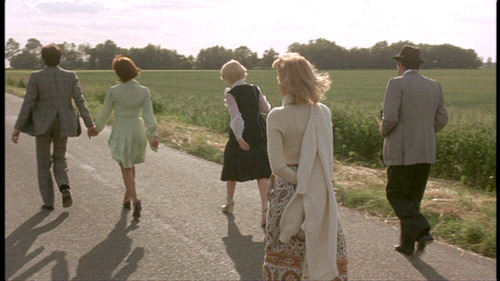
Bunuel’s direction is very entrancing from the repeated images of the people walking on a road in the middle of the French countryside to the intimacy he captures in the dinner scenes. Yet, he also plays up the surrealistic tone of the film by creating scenes where dreams are shot in a world that is artificial with fake backdrops intentionally shown. At the same time, Bunuel allows the camera to be engaging with some close-ups and wide shots to capture the world of the Senechal house as well as the places they go into such as the home of a colonel (Claude Pieplu). In scenes where there’s some expositions about the situations, Bunuel chooses to have strange sounds to cover all of that dialogue as if he doesn’t want to hear what they’re saying. Overall, Bunuel crafts an imaginative yet exhilarating film that is very funny and intriguing in its surrealism.
Cinematographer Edmond Richard does a wonderful job with the film‘s colorful cinematography from the gorgeous, naturalistic look of the daytime exterior scenes to the posh look of the interior scenes at night. Editor Helene Plemiannikov does a great job with the editing in creating a film with a leisured pace and straightforward cuts while playing along with its surrealist tone by utilizing stylistic cuts.
Art director Pierre Guffoy does an amazing job with the art direction from the home of the Senechals to the places they encounter. Notably the surrealistic sets that appears in dreams that play up the film’s idea of reality. Costume designer Jacqueline Guyot does a fantastic job with the closes, notably the dresses for two of the women in the film along with gowns for Simone that was created by Jean Patou. Sound mixer Jacques Carrere does an excellent job with the sound work from the intimacy of the dinner scenes to the chaos for some of the conversation as it blares over the dialogue.
The cast is definitely phenomenal as it features appearances from such Bunuel regulars as Marguerite Muni as a peasant woman and Michel Piccoli as a minister. Other notable small roles include George Douking as a dying gardener, Maria Gabriella Maione as the terrorist, Milena Vukotic as the Senechal’s maid, Claude Peiplu as a colonel, and Francois Maistre as an inspector. Another notable small but brilliant role is Julien Bertheau as a bishop who wants to be a gardener while revealing a story about his parents’ death. Bulle Ogier is excellent as the youthful yet intelligent Florence, the younger sister of Alice Thevenot who often feels like she’s not equal with everyone else because of her youth. Paul Frankeur is really good as Francois Thevenot, a man who is trying to get everyone to have dinners while trying to convince people to go to his place to eat his caviar.
Jean-Pierre Cassel is great as Henri Senechal, a man who also tries to get the dinners going while he is often more interested by having sex with his wife than having a gathering with his friends. Stephane Audran is wonderful as Henri’s wife Alice who often not ready for the party or trying to organize things while she befriends the bishop. Delphine Seyrig is brilliant as Simone Thevenot, Francois’s wife who is often trying to get the ladies to have some their own time together while having flirtatious moments with Rafael. Finally, there’s Fernando Rey in a fantastic performance as the ambassador Rafael Acosta who has a lot in his mind while wanting to have dinner and eat as he often engages in conversations with his friends.
Le charme discret de la bourgeoisie is a superb yet captivating film from Luis Bunuel. Featuring a great ensemble cast led by Fernando Rey and Delphine Seyrig, it is a film that plays with the idea of reality along with Bunuel’s fascination with surrealism. Among the films that Bunuel has done in his long yet glorious career, this film is truly among as one of his best. In the end, Le charme discret de la bourgeoisie is a mesmerizing yet intoxicating film from the late, great Luis Bunuel.
Luis Bunuel Films: Un Chien Andalou - L'Age d'Or - Land Without Bread - (Gran Casino) - (The Great Madcap) - Los Olvidados - (Susana) - (La hija de engano) - (Mexican Bus Ride) - (A Woman Without Love) - (El Bruto) - (El) - (Illusion Travels by Streetcar) - (Wuthering Heights (1954)) - Robinson Crusoe (1954) - (The Criminal Live of Archibaldo de la Cruz) - (El rio y la muerte) - (Cela S'apelle l'Aurore) - (Death in the Garden) - (Nazarin) - (La Fievre a El Pasao) - (The Young One) - Viridiana - The Exterminating Angel - Diary of a Chambermaid - Simon of the Desert - Belle de Jour - (The Milky Way) - Tristana - (The Phantom of Liberty) - (That Obscure Object of Desire)
© thevoid99 2011
Diary of a Chambermaid (1964 film)
Based on Octave Mirbeau’s 1900 novel, Le journal d’une femme de chambre (Diary of a Chambermaid) is the story of a chambermaid who becomes a servant for a family in rural France as she sees things that prompt her to use her sexuality for gain. For the 1964 adaptation directed by Luis Bunuel with an adapted script by Bunuel and his then-new collaborator Jean-Claude Carriere. Bunuel sets the story in 1939 France during a period of political unrest in France. Starring Jeanne Moreau, Georges Geret, Daniel Ivernel, and Michel Piccoli. Le journal d’une femme de chambre is an intriguing yet exhilarating drama from Luis Bunuel.
Celestine (Jeanne Moreau) is a Parisian woman in her 30s arriving in a rural town in France to work as a chambermaid for a rich family headed by the aging Monsieur Rabour (Jean Ozenne). His daughter (Francoise Lugagne) gives Celestine strict orders about what to do as Celestine learns about the family. Monsieur Monteil (Michel Piccoli) has an eye for Celestine as does Rabour who asks her to read to her and wear shoes for his enjoyment. Yet, Celestine still has to deal with Monteil, his wife, Rabour, and the gruff yet political groundskeeper Joseph (Georges Geret). Celestine chooses to continue with her work as she befriends the neighbor in the retired Captain Mauger (Daniel Ivernel) who despises Monteil.
With Celestine getting used to the tense world of the Monteil as she befriends a young girl named Claire (Dominique Sauvage) while having a hard time with Joseph. When she spends time with Rabour, she tries on some shoes for him to his excitement only for a couple of events to end this excitement. A murder has happened as Celestine has suspicions as she uses her sexuality to get a few answers. While she has also decided to stay to help out Monsieur and Madame Monteil, she also gets close with Mauger who gets involved with a lawsuit against Monteil. With Celestine finding out who possibly committed the murder, she finds a way out of being a servant to the rich.
The film is about a maid working for a rich family where things are very tense as she has to deal with a strict madam, a philandering man who likes to hunt, an aging master who has a fetish for women in leather shoes, and a groundskeeper who spouts political rhetoric. Yet, Celestine is a woman who is very beautiful and wears fine clothing as some wonder why a Parisian maid would work for a rich family in rural France? Well, she hopes to find someone who can help her give her a life without having to serve someone or be ridiculed. While she has to contend with Monsieur Monteil and Rabour along with Joseph. She does find some comfort in the elderly but honorable Mauger despite his suggestions to deal with Monteil.
The screenplay that Bunuel and Jean-Claude Carriere create is a wonderful character study that also a bit of sexual play into the film. At the same time, there’s some political elements in both Mauger and Joseph. The latter of which is very anti-Semitic, nationalist, and right-wing man who hates priests but loves religion as he hopes to have a café nearby this ongoing revolution against immigrants. Joseph is also a man who is very violent that makes him a likely suspect over what happened though he is not an easy person to peg since he can read people and often speaks the truth. Bunuel and Carriere play up this game of sexual politics between Celestine and Joseph while giving the idea of the home that Celestine works in as an idea of Fascist that some viewers might not understand.
Bunuel’s direction is truly mesmerizing in its imagery and composition. From the look of the town that he shoots in to the way he captures intimacy in the house that Celestine works in. Bunuel creates something that is very intoxicating along with shots to present something that is sexual but not too graphic. Notably a shot of Celestine showing Rabour a bit of leg in the leather shoes he wanted her to wear. There is also some wonderful shots such as close-ups and dollies that Bunuel brings into understand the behaviors and things that is happening throughout the film. While it has a few flaws, Bunuel does create something that is enriching and chilling in this provocative yet brilliant film.
Cinematographer Roger Fellous doe a wonderful job with the film‘s black-and-white cinematography to create a look that is a mix of the old-school cinema of the early 20th Century along with the more vibrant look of the French New Wave. Fellous also creates some wonderful lighting schemes with shades and nighttime shots to set an eerie mood for these particular scenes. Editor Louisette Hautecoeur does a great job with the editing while creating something that is very straightforward with a bit of style with some jump-cuts and transitional dissolves to keep the story moving.
Production and costume designer Georges Wakhevitch does an excellent job with the look of the film in creating a posh yet early 20th Century look to the home as well as the clothes the people wear. Notably the maid dress and stockings that Celestine wears to woo some of the men in the film. The sound work by Antoine Petitjean is very good for its intimate locations as well as the broad atmosphere of the town Celestine comes across in.
The cast is truly brilliant for the large ensemble that is assembled. Making small yet memorable appearances include co-screenwriter Jean-Claude Carriere as a priest, Claude Jaeger as a judge, Gilberte Geniat as Mauger’s maid, Marguerite Muni as the other maid that Celestine works with, and Dominique Sauvage as the little girl Claire. Francoise Lugagne is excellent as the strict yet icy Madame Monteil who likes to have things in her way while not giving her husband any kind of satisfaction. Jean Ozenne is really good as Rabour, Madame Monteil’s father who likes to keep things to himself while finding pleasure in Celestine wearing leather heels. Michel Piccoli is great as the skirt-chasing Monteil who wants Celestine while trying to deal with his wife and his neighbor.
Daniel Ivernel is brilliant as Captain Mauger, a former army officer who is a man of honor as he treats Celestine with kindness while having his own issues with Monteil whom he really dislikes. Georges Geret is superb as the brutish yet ambitious groundskeeper Joseph who engages into a battle of wit and sexual politics against Celestine while being a very political individual with some strong views. Finally, there’s Jeanne Moreau in a fantastic performance as the film’s protagonist Celestine. Moreau brings a very understated sexuality to her performance while being quite tough and not going overboard when she’s being harassed. It’s definitely one of her finest performances in a glorious career.
Le journal d’une femme de chambre is a phenomenal yet hypnotic film from Luis Bunuel featuring a radiant performance from the legendary Jeanne Moreau. While it is one of Bunuel’s finest films, some viewers might be lost in the satire that Bunuel is trying to say about Fascism while the sexual politics of the film makes it very engaging to watch. In the end, Le journal d’une femme de chambre is a fascinating character study from the revered Luis Bunuel.
Luis Bunuel Films: Un Chien Andalou - L'Age d'Or - Land Without Bread - (Gran Casino) - (The Great Madcap) - Los Olvidados - (Susana) - (La hija de engano) - (Mexican Bus Ride) - (A Woman Without Love) - (El Bruto) - (El) - (Illusion Travels by Streetcar) - (Wuthering Heights (1954)) - Robinson Crusoe (1954) - (The Criminal Live of Archibaldo de la Cruz) - (El rio y la muerte) - (Cela S'apelle l'Aurore) - (Death in the Garden) - (Nazarin) - (La Fievre a El Pasao) - (The Young One) - Viridiana - The Exterminating Angel - Simon of the Desert - (Belle de Jour) - (The Milky Way) - Tristana - The Discreet Charm of the Bourgeoisie - (The Phantom of Liberty) - (That Obscure Object of Desire)
© thevoid99 2011
Saturday, May 28, 2011
The Exterminating Angel
Originally Written and Posted at Epinions.com on 6/25/08.
After the release of 1961's Viridiana, Luis Bunuel, who was invited back to his native Spain by the country's leader Francisco Franco, made a film that angered Franco as his film was banned for nearly 15 years. Bunuel along with his film crew and entourage returned to Mexico where he had been working at for more than 15 years. Reuniting with his Viridiana star Silvia Pinal, the two collaborated once again for another film about an upper class dinner party where the guests find themselves unable to leave. Written and directed by Bunuel, El Angel Exterminador (The Exterminating Angel) is a film that explores the world of the upper class and how they've trapped themselves. Also starring Enrique Rambal, Claudio Brook, and Augusto Benedico. El Angel Exterminador is an eerie, surreal ensemble drama from Luis Bunuel.
Edmundo Nobile (Enrique Rambal) and his wife Lucia (Lucy Gallardo) are having a dinner party after a night in the opera. Earlier that night, the butler Julio (Claudio Brook) had just fired Lucas (Angel Merino) while the cooks and servants are all leaving for the night to run their own errands. The guests arrive with Julio and whatever servants are left to run the entire night. Attending are Dr. Conde (Augusto Benedico), Blanca (Patricia de Morelos), Leandro Gomez (Jose Baviera), Raul (Tito Junco), a young couple named Eduardo (Xavier Masse) and Beatriz (Ofelia Montesco), and a mysterious, foreign woman named Leticia (Silvia Pinal) among others. Things go fine as Blanca plays a sonata and everyone gets tired for the night unable to go home.
The morning begins as the guests find themselves unable to leave as an elderly guest named Sergio Russell (Antonio Bravo) is dying. Dr. Conde tries to examine everything that goes on as Julio becomes troubled this strange circumstance in which everyone including himself are unable to leave the room or the house. Russell dies as he's placed onto a large cupboard. Conde continues to examine everything that goes on as everyone is blaming Nobile for what’s going on as only Conde and Col. Alvaro (Cesar del Campo) defend him with Conde trying to maintain calm. Even as they break the water pipe for water as everyone is starved. Leonara (Bertha Moss) meanwhile, is becoming sick as she's also dying from a from a form of cancer with Conde needing to find her pills.
With police and onlookers holding vigil outside of the mansion, inside the mansion. Things become increasingly chaotic when they're trapped inside the room as a bear is outside while a flock of sheep had entered the room. With more deaths and claustrophobia ensuing, everyone wants to kill each other until Leticia calms everyone down as she tries to figure out everything while dealing with the ongoing sense of surrealism that's plaguing their minds.
A satire of sorts on the world of the upper class, Bunuel's admitted contempt for the upper class shows how a certain group of people. Absorbed by their own ideas and their own worlds, Bunuel takes them into a room and traps them where psychologically, they can't get out. What the film is about is a group of people who disintegrate themselves in their own mind as they're psychologically trapped inside a room. Just as the characters unravel, the roles of who they play start to flesh out as the audience get to see who they really are.
Bunuel's claustrophobic, eerie direction is truly magnificent where things start out slow at first only to give the sense of who these people are. Then as the first act ends with everyone realizing they can't get out. That's when the film really begins as the second act entails moments of death, anarchy, and character study. By the third act, everything unravels leading to a few characters to try and make sense of everything. The ending, like most of Bunuel's films tend to go into the surreal where everything becomes a circle. The film in some ways is also about a memory, particularly in the third act in relation to the first. The film also has moments where it's really mesmerizing whether it's a couple being affectionate with one another sexually, a moment of horror, or a something surreal in a strange dream sequence that emphasizes their state of mind. The result is truly a mesmerizing, harrowing study of character and of the minds from Luis Bunuel.
Cinematographer Gabriel Figueroa does a superb job with the film’s black-and-white photography to convey the sense of horror and tension with hand-held camera, tracking shots, and lighting design as Figueroa’s work is truly amazing. Editor Carlos Savage does a wonderful job with some of the film's cutting style with the use of stock footage intermixed with the guests sleeping along with excellent transitional cutting and fade-outs to help give the film its structure. Production designer Jesus Bracho does a wonderful job in the posh look of the film's mansion interior scenes along with the room where every character is trapped and such. Costume designer Georgette Somohano does a wonderful job in the look of the dresses and suits that are worn where as the film goes on, the look of the clothes start to decay.
Sound editor Abraham Cruz does a fantastic job with the sound work including the cutting of dialogue layered one another during one of the film's surreal sequences. Special effects supervisor Juan Munoz Ravelo does a great job in one of the film's strange sequences that involves a lone hand moving. The film's music by Raul Lavista is minimal for its sweeping introduction in the film's opening credits sequence as well as the upbeat, melodic for parts of the film's first act. After that, there's not much music with the exception of a piano sonata performed on the film.
The film's cast is truly superb in its ensemble with notable small performances from Jacqueline Andere as the young Alicia, Xavier Loya as the young but nervous Francisco, Ofelia Guilmain as Francisco's older sister Juana, Xavier Masse as Eduardo, Ofelia Montesco as Beatriz, Lucy Gallardo as Nobile's wife, Bertha Moss as Leonora, Patricia de Morelos as Blanca, Tito Junco as the slimy Raul, Jose Baviera as Leandro Gomez, Luis Beristain as Cristian, and Antonio Bravo as Sergio Russell. The standout performances come from the characters who try to maintain control and such. Claudio Brook is great as Julio, the butler who tries to do duties while being the one to break a pipe so everyone can get water and such. Cesar del Campo is excellent as Colonel Alvaro, a man who tries to remain calm only to have a brief moment where he becomes unhinged by the claustrophobia of the room.
Enrique Rambal is brilliant as Edmundo Nobile who is trying to maintain calm as he becomes an unlikely target while dealing with the fact that he might be guilty. Silvia Pinal is fine in her role as Leticia though she didn't have much to do in the middle of the film. Pinal's haunting performance in the film's final act is mesmerizing as she tries to pull everyone together to think about the first night. The film's best performance goes to Augusto Benedico as Dr. Conde, the film's moral conscience who keeps his cool and try to examine everything while helping people out and tell them to not panic.
Though not as great as Viridiana, El Angel Exterminador is still a mesmerizing yet haunting film from Luis Bunuel. With memorable performances from Silvia Pinal, Augusto Benedico, Enrique Rambal, Cesar del Campo, and Claudio Brook. It's a film that is truly essential to Bunuel's rich filmography. Those new to Bunuel will get a great example of his surreal take on the world while taking potshots at the upper class. In the end, for a great ensemble film that has its characters be stripped down to the core and give them a taste of surrealism. El Angel Exterminador is the film to watch.
Luis Bunuel Films: Un Chien Andalou - L'Age d'Or - Land Without Bread - (Gran Casino) - (The Great Madcap) - Los Olvidados - (Susana) - (La hija de engano) - (Mexican Bus Ride) - (A Woman Without Love) - (El Bruto) - (El) - (Illusion Travels by Streetcar) - (Wuthering Heights (1954)) - Robinson Crusoe (1954) - (The Criminal Live of Archibaldo de la Cruz) - (El rio y la muerte) - (Cela S'apelle l'Aurore) - (Death in the Garden) - (Nazarin) - (La Fievre a El Pasao) - (The Young One) - Viridiana - Diary of a Chambermaid - Simon of the Desert - Belle de Jour - (The Milky Way) - Tristana - The Discreet Charm of the Bourgeoisie - (The Phantom of Liberty) - (That Obscure Object of Desire)
© thevoid99 2011
Friday, May 27, 2011
Viridiana
Originally Written and Posted at Epinions.com on 5/29/07.
One of Spain's greatest and controversial artists, Luis Bunuel was a film director whose films of surrealism, religion, and imagery has captured the imagination of many. Yet, during the Spanish Civil War in 1936, Bunuel left Spain to sought artistry only to find freedom 10 years later in Mexico. During that period, he would make acclaimed films like Los Olvidados (The Forgotten Ones), El (This Strange Passion), Ensayo de un Crimen (The Criminal Life of Archibaldo de la Cruz), and Nazarin in 1958. In 1961, Bunuel finally makes a return to Spain during the time of the Franco where he made one of his most controversial films about a nun trying unsuccessfully to help the poor entitled Viridiana.
Written by Bunuel and Julio Alejandro, Viridiana tells the story of a nun who is sent by her convent to visit her uncle. The image of the nun reminds the uncle of his deceased wife. The visit shakes the nun's idealism as she hopes to do good in helping the poor. Directed by Bunuel, the film explores religion and its strictness as well as dark behaviors in some of its characters towards an innocent young woman. Starring Silvia Pinal, Fernando Rey, and Francisco Rabal. Viridiana is a superb yet controversial masterpiece from the legendary Bunuel.
Viridiana (Silvia Pinal) is expected to take her vows in the next few days until her Mother Superior suggests she should visit her uncle whom she hasn't seen in a long time. Her uncle Jaime (Fernando Rey) is living alone with a maid, her daughter, and a farmer as Viridiana decides to make the visit for a few days. Upon arriving, she meets the maid Ramona (Margarita Lozano) and her daughter Rita (Teresa Rabal) as Viridiana looks eerily like her late aunt. Jaime's newfound obsession of his wife and how his niece looks like her brought some troubling behaviors as Ramona watches. Noticing her often strict behavior and dedication to her faith, Jaime makes a plan to have her stay a bit longer. On Viridiana's final night, he attempts to seduce her but only receive an insult from his niece. Ramona drugs her later on as Jaime's attempt to seduce while asleep fails again.
With Viridiana finally leaving and learning about the truth of what happened last night, Jaime's guilt takes over as he feels he's sinned and does a final sinful act. Viridiana is then forced to come home to learn about what her uncle has done. With Viridiana now running the house with Ramona, Rita, and their farmer. Viridiana hopes to redeem herself by not returning to the convent and make her uncle's home into something that would help the poor. Taking on a group of beggars, she decide to help them while Jaime's estranged son Jorge (Francisco Rabal) arrives to become the new Don. With girlfriend Lucia (Victoria Zinny), Jorge hopes to bring the farm back to shape. Unfortunately, Jorge feels irritated by the beggars Viridiana has taken in while feeling tense with her. Lucia departs as Jorge finds himself attracted to Ramona.
When Jorge decides to leave town with Viridiana, Ramona, and Rita to conclude some business matters, the beggars decide to get into the house and enjoy a moment of debauchery until Jorge and his company return. The moment causes shockwave's as Viridiana's faith is now shaken to the core.
While the film reveals troubling themes such as incest, faith, and debauchery, the film is really about an innocent young woman whose good intentions are shaken to the core as she ends up questioning her own idealism. Even in a world that is cruel and indifferent to her faith. The film also explores moments of debauchery where although the beggars aren't necessarily bad people, they have a desire to live the rich, carefree life that Jorge and his late father had. There, it destroys everything that Viridiana had intended which is followed by a very horrific, sinful act that destroys her spiritually and emotionally. Then there's some of the film's sexual content which is done in a suggested way. Even in the film's final scene suggested something that was indeed Bunuel's intentions.
The direction that Bunuel made is not just observant but also filled with cynicism on faith, especially Catholicism at the time of Franco-era Spain. Largely because of how the repression of the government at that time caused the sense of alienation among the beggars. Even when the spiritual ideals of Viridiana is clashed in one wonderfully edited sequences with the newfound, industrious attitude that Jorge had. Then there's the infamous dinner sequence which includes a spoof of the Last Supper sequence that is followed by debauchery at its most unbridled. There, Bunuel captures anarchy in its purest form. It was there where the film, at that time, caused a lot of controversy followed by what would happen towards the end. The result is a powerful picture by Bunuel.
Helping Bunuel in his unique yet surreal vision is cinematographer Jose F. Aguayo whose black-and-white photography is exquisite in some of the film's exterior sequences and interior scenes. Yet, some of the camera work in showing the shadows is amazing as well as the close-ups to reveal the emotions and shock. Editor Pedro del Rey does amazing work in the film's editing, notably the scene of Viridiana's prayer cut back-and-forth into the moments of industry to convey her lack of realism. Production designer Francisco Canet does some wonderful work in creating the film's rich look in the home of Don Jaime's. Sound engineer Aurelio Garcia Tijeras does excellent in work in capturing the sound to contrast what's going on and where the scene's at. Composer Gustavo Pittaluga brings in an operatic score that is played on record throughout the film to convey the film's sense of emotion and debauchery in the third act.
The film's cast is wonderfully assembled with great performances by Jose Calvo, Jose Manuel Martin, Luis Heredia, Joaquin Roa, Maria Isbert, and many others playing the beggars whose moments in the film are a highlight. Victoria Zinny is fine in a small role as Jorge's frustrated girlfriend while Teresa Rabal is great as Ramona's young daughter Rita. Margarita Lozano is in excellent form as the loyal Ramona whose shift of servitude changes as she finds herself attracted to Jorge in which, she is allowed to be herself. Francisco Rabal is great as the charming yet cynical Jorge who is willing to find some kind of power, even as he tries to seduce both Ramona and Viridiana. The late yet legendary Fernando Rey is great as Jaime. A man whose surreal state of mind over his wife's death and guilt causes him to question his own morality and persona. Though it's a small, supporting role, Rey is in fantastic form.
Finally, there's the legendary Silvia Pinal in one of her great performances. Pinal brings a lot of restraint to her role as this innocent young woman unaware about the real world. Pinal's also exudes sexuality with her amazingly gorgeous looks though she only shows a bit of skin throughout the entire film. Her character goes through the biggest amount of development and through this restrained, very non-dramatic performance, it feels natural and just right. It is clear that while she is playing the title character, it's Pinal's performance that is the heart of the film.
When Bunuel was asked to return to Spain by Francisco Franco to make a film suitable for his country, Bunuel said yes but when he presented the resulting film Viridiana with plans to premiere at the 1961 Cannes Film Festival. Franco was extremely angry and had the film banned for many years in Spain while was denounced by the Vatican. The then-Fascist government of Spain tried to have the film banned in its premiere at the Cannes Film Festival but failed. Viridiana ended up sharing the prestigious Palme D'or along with Henri Colpi's The Long Absence. The controversy over Viridiana helped give the film international attention as a film that had to be seen. In 1977, the film finally premiered in Spain at the time when Bunuel had made his final film Cet Obscur Objet du Desir (That Obscure Object in Desire) in France. Bunuel retired until his death in 1983.
Viridiana overall, is an amazing film from Luis Bunuel. Featuring great performances from Silvia Pinal and Fernando Rey, it's a film that might not be as shocking in today's times. Yet, when audiences have to consider what's going on and what Bunuel suggested at the time, the shock value is still there. What is really surprising that when it won the Palme D'or that year, another film that won the year before that featured similar was Federico Fellini's La Dolce Vita that also reveled in debauchery and denounced by the Vatican. That film was also banned in Spain for several years until it was shown in 1981. In the end, for a film to reveal innocence lost in the real yet surreal world, Luis Bunuel's Viridiana is the film to check out.
Luis Bunuel Films: Un Chien Andalou - L'Age d'Or - Land Without Bread - (Gran Casino) - (The Great Madcap) - Los Olvidados - (Susana) - (La hija de engano) - (Mexican Bus Ride) - (A Woman Without Love) - (El Bruto) - (El) - (Illusion Travels by Streetcar) - (Wuthering Heights (1954)) - Robinson Crusoe (1954) - (The Criminal Live of Archibaldo de la Cruz) - (El rio y la muerte) - (Cela S'apelle l'Aurore) - (Death in the Garden) - (Nazarin) - (La Fievre a El Pasao) - (The Young One) - The Exterminating Angel - Diary of a Chambermaid - Simon of the Desert - Belle de Jour - (The Milky Way) - Tristana - The Discreet Charm of the Bourgeoisie - (The Phantom of Liberty) - (That Obscure Object of Desire)
© thevoid99 2011
Subscribe to:
Posts (Atom)