Showing posts with label romolo valli. Show all posts

Monday, August 15, 2022

The Garden of the Finzi-Continis


Based on the novel by Giorgio Bassani, Il giardino dei Finzi Contini (The Garden of the Finzi-Continis) is the story of an upper-class Jewish family living in Ferrera, Italy during the time of Fascist Italy as they deal with the growing political turmoil of the times. Directed by Vittorio De Sica and screenplay by Vittorio Bonicelli and Ugo Pirro with un-credited contributions by de Sica, Franco Brusati, Alain Katz, Tullio Pinelli, Cesare Zavattini, and Valerio Zurlini, the film is an exploration of a family whose lives are changed by Fascism as they find themselves lost with the young family members trying to find joy. Starring Lino Capolicchio, Dominique Sanda, Helmut Berger, Romolo Valli, and Fabio Testi. Il giardino dei Finzi Contini is a ravishing and somber film from Vittorio De Sica.

Set in the small town of Ferrera, Italy from 1938 to 1943, the film is an exploration of the life of an upper-class Jewish family who live nearby the home of a richer Jewish family known as the Finzi-Continis whose lavish garden is an idyllic landscape that becomes an escape during the growth of Fascism in Italy. The film is an exploration of the lives of these two upper-class Jewish families as one of them is in love with the daughter of the richer family ever since they were children as they deal with the growing world around them with this lavish garden being a place of wonder. The film’s screenplay by Vittorio Bonicelli and Ugo Pirro does feature bits of flashback as it relates to its two young leads in Giorgio (Lino Capolicchio) and Micol Finzi-Contini (Dominique Sanda) who knew each other as kids with the latter’s family home being this haven where they can play tennis and have fun at this lavish garden that includes Micol’s younger brother Alberto (Helmut Berger) and their friend Giampiero Malnate (Fabio Testi).

The first act is about the life of the Finzi-Continis and the garden that is their escape with the second act being about Giorgio’s pursuit of Micol as she rejects him believing he’s not good enough for her. Even as the second act also play into this chaos with Italy becoming a more Fascist state with Giorgio’s father Beniamino (Romolo Valli) trying to keep the family together as he sends his younger son Ernesto (Raffaele Curri) to France to study. It also play into the world that is crumbling where Giorgio had already been expelled from the tennis club and later a library where he is unable to study because he is Jewish while interracial marriages are also banned. The film explore Giorgio’s own encounter with the real world while Micol has isolated herself in the family home not wanting to deal with the real world with Alberto becoming ill. The third act does play into Italy entering World War II as life for Jews become more difficult with Giorgio pleading with Micol to be with him while also coming to terms that life will never be the same as the garden itself is a shell of its former self.

Vittorio De Sica’s direction is definitely full of gorgeous imagery and a sense of realism as it is shot largely on location in Ferrera with some of it in Venice with the garden shot at the park of Villa Ada near Rome. De Sica’s usage of the wide and medium shots do help play into the many locations in the film but also the world that is the garden at the Finzi-Contini estate where many of the young people play tennis and involve themselves with many activities as a way to escape from this growing threat of war that is to come. Even as De Sica would maintain this air of intimacy in the direction with the medium shots and close-ups inside the homes of Giorgio’s family and the Finzi-Continis where it showed a world where Giorgio’s family do perform certain Jewish traditions while the latter maintain this presentation of being posh and not overtly Jewish to raise concerns with the authorities.

De Sica also play into this sense of beauty that is the Finzi-Contini estate from the road way outside their home where Giorgio would ride his bike on as well as where he would park his bike and climb over its wall. The garden is the centerpiece of this estate filled with trees including a few palm trees and other things as it is a place where everyone can escape from the real world yet as the film progresses. The garden becomes less idyllic despite the beauty it presents itself but without many people there. It doesn’t feel the same as the third act has an air of coldness that looms along with a sense of danger in the fact that anyone who is Jewish, communist, or not wanting to be a part of this world of Fascist Italy is fucked. De Sica’s ending is ambiguous as it relates to the fate of characters but it also presents a world that is lost and could never return with those also filled with regret of the future they could’ve had. Overall, De Sica crafts an intoxicating yet harrowing film about two upper-class Jewish families dealing with the growing changes in Fascist Italy.

Cinematographer Ennio Guarnieri does amazing work with the film’s cinematography with its usage of soft lighting for a few interior scenes along with some natural and lush lighting for the scenes at the garden during the spring and summer as well as low-key lighting for the scenes at night and in the winter time. Editor Adriana Novelli does excellent work with the editing with some stylish jump-cuts for some of the bike ride scenes through the forest as well as a few montages including some of the flashbacks as it play into Giorgio and Micol’s time as teenagers. Production/costume designer Giancarlo Bartolini Salimbeni and set decorator Franco D’Andria does brilliant work with the look of the homes of Giorgio’s family with its modest furniture that is a sharp contrast to the more spacious interiors at the Finzi-Contini estate with its large library where Giorgio is allowed to study while the costumes are also exquisite in the posh dresses that Micol wears that is another sharp contrast to the modest suits that Giorgio wears.

Hair stylist Anna Cristofani and makeup artist Giulio Natalucci do fantastic work with the different hairstyles that Micol would wear throughout the film as it went from stylish to eventually becoming less so as the film progresses. The special effects work of Ettore Catalucci is terrific for some of the minimal shots that play into Alberto’s own sickly state as well as imagery to help make the film feel dreamlike. The sound work of Max Galinsky and Massimo Loffredi, with additional work for its restoration by Stefano Di Fiore, is superb for the sound as it help play into the atmosphere of the locations including the town with the speech over the declaration of war from Italy being a key moment. The film’s music by Manuel De Sica, with additional contributions by Bill Conti, is incredible for its lush and somber orchestral-piano score that play into the drama and romantic tension that looms throughout the film as well as themes that are upbeat that play into happier moments as it is a highlight of the film.

The film’s wonderful ensemble cast feature some notable small roles from Giampaolo Duregon as a friend of the Finzi-Contis in Bruno, Marcella Gentile as Giorgio’s young sister Fanny, Raffaele Curi as Giorgio’s younger brother Ernesto who goes to France to study, Barbara Pilavin as Giorgio’s mother, Ettore Gere as the majordomo Perotti, Inna Alexeievna as Alberto and Micol’s grandmother, Katina Morisani as Alberto and Mico’s mother, Cinzia Bruno as the young Micol, Alessandro D’Alatri as the young Giorgio, and Camillo Cesarei as Ermanno Finzi-Conti as the patriarch of the Finzi-Contini who allowed Giorgio to study in his library as he always liked Giorgio feeling he is a good match for Micol and a good friend to Alberto.

Romolo Valli is excellent as Giorgio’s father as a businessman who is proud of his Jewish heritage but would hide during the growth of Fascism as he is concerned for Giorgio as it relates to Micol as well as what will happen to the family knowing something is going wrong. Fabio Testi is brilliant as Giampiero Malnate as a family friend of the Finzi-Contis who is also a communist that isn’t fond of Fascism while he would later lament over the state of the Finzi-Conti with being isolated as he would be called up to military service as he and Giorgio also deal the world around them. Helmut Berger is amazing as Micol’s younger brother Alberto as a young man who idolized Malnate and love Giorgio as a friend as he also deals with illness while becoming aware of some of the drama involving Micol and Giorgio.

Lino Capolicchio is incredible as Giorgio as a young man from an upper-class Jewish family who is in love with Micol and wants to spend the rest of his life with her as he also deals with the changes around him as he’s kicked out of clubs and university because he’s Jewish as he also laments over everything as well as this paradise that is the Finzi-Conti garden that becomes less idyllic. Finally, there’s Dominique Sanda in a phenomenal performance as Micol Finzi-Conti as a young woman who is a childhood friend of Giorgio as someone who is trying to distance herself from the real world while isolating herself as a way to shield from that reality including Giorgio feeling that he’s not good enough for her. Even as she deals with the reality that she and her family eventually have to face as well as what she could’ve had.

Il giardino dei Finzi Contini is a magnificent film from Vittorio De Sica. Featuring a great ensemble cast, ravishing visuals, its themes of isolation and longing during a tumultuous time in Italy’s history, and a rich music score by Manuel De Sica. It is a film that explore life in Fascist Italy just before and during World War II as well as its effects on two upper-class Jewish families where one deal with what is happening while another is trying to not see the truth. In the end, Il giardino dei Finzi Contini is an outstanding film from Vittorio De Sica.

Vittorio De Sica Films: (Rose scarlatte) - (Maddalena, zero in condotta) - (Teresa Venerdi) - (Un garibaldino al convento) - (The Children Are Watching Us) - (La porta del cielo) - (Shoeshine) - (Heart and Soul (1948 film)) - Bicycle Thieves - Miracle in Milan – Umberto D. - (It Happened in the Park) - (Terminal Station) - (The Gold of Naples) - (The Roof) - (Anna of Brooklyn) - Two Women (1960 film) - (The Last Judgment) - (Boccaccio ‘70) - (The Condemned of Altona) - (Il Boom) - Yesterday, Today, and Tomorrow - Marriage Italian Style - (Un monde nouveau) - (After the Fox) - (Woman Times Seven) - The Witches (1967 film)- An Evening Like the Others - (A Place for Lovers) - (Sunflowers (1970 film)) - (Lo chiameremo Andrea) - (A Brief Vacation) - (The Voyage)

© thevoid99 2022

Tuesday, July 06, 2021

2021 Cannes Marathon: Death in Venice


(25th Anniversary Prize Winner at the 1971 Cannes Film Festival)
Based on the novella by Thomas Mann, Death in Venice is the story of a composer who is entranced by the beauty of a young boy who is staying at a hotel in Venice where the composer is recovering from illness. Directed by Luchino Visconti and screenplay by Visconti and Nicolas Badalucco, the film is an exploration of a relationship between this ailing composer and a young boy that is set during the turn of the century as it explores a man’s obsession with beauty. Starring Dirk Bogarde, Mark Burns, Marisa Berenson, Romolo Valli, Silvana Mangano, and Bjorn Andresen. Death in Venice is a majestic and evocative film from Luchino Visconti.

Set in turn of the century Venice, the film revolves around an avant-garde composer whose ailing health forces him to go to the Italian city where he stays at a hotel where he is stunned by the beauty of a young boy. It is a film that explores a man coping with loss and disappointment as he is also dealing with this search for ideal beauty as he would find it in this young Polish boy while also dealing with what is happening with the city as the hotel staff and some of people in the posh areas of Venice refuse to tell him. The film’s screenplay by Luchino Visconti and Nicolas Badalucco is straightforward as it plays into the world of Gustav von Aschenbach (Dirk Bogarde) who is trying to recover from his illness as he would look back at parts of his life from his family life and his own desire to find beauty and perfection through his music that often lead to arguments with his colleague Alfred (Mark Burns).

While in Venice trying to recover from illness, Gustav sees the young Polish boy Tadzio (Bjorn Andresen) who is with his mother and sisters at the Venetian resort. Tadzio is really more of a presence and idea of what Gustav is trying to find in his idea of beauty while the script also suggests homoeroticism where Gustav often stares at Tadzio and would follow him whenever Tadzio is with his family.

Visconti’s direction is ravishing for the world that he creates where much of the film is shot on location in Venice as well as locations in Germany while much of the interior scenes of the hotel is shot at Cinecetta Studios in Rome. Visconti’s compositions capture so much attention to detail the world that Gustav is living in as there is this air of disconnect with all of the people living in the hotel resort with its open beaches and exquisite meals are unaware of what is happening in the city. Something Gustav would notice as Venice is having this season where the hotel manager (Romolo Valli) is claiming that it’s just rumors as Gustav doesn’t notice anything about what is happening in the newspapers as well. It adds to the atmosphere of the film where Gustav’s flashbacks are often seen as idyllic and dream-like in scenes with his wife (Marisa Berenson) but also filled with unease in scenes with Alfred including a chilling flashback of Gustav at his lowest. They’re presented largely in medium shots and close-ups to play into Gustav’s own sense of longing and despair as he is in Venice in this hotel where nothing feels real except for this young boy who represents this idealism of beauty.

Visconti’s wide shots really capture not just the scope of the beach as well as a room where the guests are waiting to be served in the dining room. It also has him creating some unique compositions and visuals that add to the atmospheric beauty that surrounds Gustav and Tadzio where the former watches the latter from afar who is playing a piano piece as it would have Gustav go into a flashback. It’s among these images that also include a band playing music to the people at the hotel with Gustav asking the singer about what is going on in the city. There are also some homoeroticism that occurs but it’s only in subtle bits in the way Gustav looks at Tadzio as there is a beautiful shot in the film’s final minutes as it play into Gustav’s own desires despite his ailing health. Especially in a brief moment where Gustav briefly meets Tadzio as he begs his mother to leave Venice because of what is happening as it plays into a man who is trying to hold on to this idea of beauty. Overall, Visconti crafts a somber yet intoxicating film about an ailing composer’s fascination over the beauty of a young boy.

Cinematographer Pasqualino De Santis does amazing work with the film’s cinematography with its sunny look of Venice in the daytime along with lush colors for a few of the flashback scenes as well as some unique lighting for the interior/exterior scenes at night. Editor Ruggero Mastroiannni does excellent work with the editing as it does have a bit of style in a few jump-cuts yet much of it is straightforward to play into the drama of Gustav’s obsession. Art director Ferdinando Scarfioti does brilliant work with the look of the hotel interiors with its spacious dining and waiting rooms as well as the room that Gustav stays in.

Costume designer Piero Tosi does incredible work with the costumes from the sailor-like clothes of Tadzio to the suits of Gustav including a white suit he would wear in the film’s final moments. The sound work of Giuseppe Muratori and Vittorio Trentino is superb for the atmosphere that is created including scenes in the dining hall and the way the city sounds in its quiet yet unsettling moments. The film’s music from Armando Gill as well as pieces from Ludwig Van Beethoven, Gustav Mahler, and Modest Mussorgsky is phenomenal as its usage of classical music with Mahler being the dominant force in the film while Gill provides some of the operatic pieces as it adds to the rapturous tone of the film.

The film’s marvelous cast feature some notable small roles and appearances from Dominique Darel as an English tourist, Mascia Predit as the Russian tourist, Marco Tulli as the man who faints at the train station, Leslie French as a travel agent warning Gustav about what is going on in Venice, Nora Ricci as Tadzio’s governess, Franco Fabrizi as a barber in the film’s third act, Sergio Garfagnoli as a boy that Tadzio befriends, Luigi Battaglia as a peasant performer named Scapegrace who gives Gustav a slight clue of what is happening in Venice, Carole Andre as a young prostitute that Gustav meets in a flashback, and Romolo Valli in a superb performance as the hotel manager who tries to shield the truth about what is happening in Venice from Gustav. Marisa Berenson and Silvana Mangano are fantastic in their respective roles as Gustav’s wife and Tadzio’s mother with the former being an object of simplicity and joy in the former via flashbacks while the latter is someone that is unaware of what is going on in Venice.

Mark Burns is excellent as Gustav’s colleague Alfred as a man who is seen via flashbacks as someone questioning Gustav’s ambitions and aims while also vilifying him for his faults. Bjorn Andresen is incredible as Tadzio where despite his lack of dialogue where he is just this object of beauty. Andresen is still this astonishing presence where he provides an innocence but also someone who is aware of his beauty despite not really knowing who Gustav is. Finally, there’s Dirk Bogarde in a phenomenal performance as Gustav von Aschenbach as an avant-garde composer who is coping with ailing health as he is transfixed by Tadzio while dealing with what is happening in Venice as well as coping with his own past, failures, and loss where Bogarde maintains a restraint in the way he gazes at Tadzio as a way to deal with the fact that he is possibly dying and is hoping to connect personally with this young boy.

Death in Venice is a tremendous film from Luchino Visconti that features a sensational performance from Dirk Bogarde as well as an entrancing appearance from Bjorn Andresen. Along with its ensemble cast, gorgeous music soundtrack, its intoxicating look, and it study of obsession and longing. The film is a somber yet exhilarating film about a man’s fascination for a young boy and his search for beauty in a city that is unraveling from afar. In the end, Death in Venice is a spectacular film from Luchino Visconti.

Luchino Visconti Films: (Obsessione) – (Giorni di gloria) – (La Terra Firma) – (Bellissima) – (Appunti su un fatto di cronaca) – (We, the Women) – Senso – White Nights (1957 film) - Rocco and His Brothers - (Boccaccio ’70-Il lavoro) – The Leopard - Sandra – (The Stranger (1967 film)) – The Witches (1967 film)- The Witch Burned Alive – The Damned (1969 film) – (Alla ricerca di Tadzio) – (Ludwig) – (Conversation Piece) – The Innocent (1976 film)

© thevoid99 2021

Friday, October 12, 2012

Duck, You Sucker!


Originally Written and Posted at Epinions.com on 9/19/09 w/ Additional Edit.


Directed by Sergio Leone and screenplay by Leone, Sergio Donati, and Luciano Vincenzon from a story by Leone and Donati, Duck, You Sucker! or in the more well-known title, A Fistful of Dynamite tells the story of a Mexican outlaw who meets an ex-IRA revolutionary in 1910 Mexico. When they set out to rob a bank, they discover some political turmoil in Mexico that prompts the two men to be involved in the Mexican Revolution. Part-western and part-political drama, the film marks a transitional period for Leone as he would stray away from the west into something much broader for what was to come in his later work. Also starring Romolo Valli, Franco Graziosi, Antoine Saint-John, and David Warbeck. Duck, You Sucker! is a thrilling, powerful, stylish film from Sergio Leone and company.

After robbing a stagecoach with his six sons and father, Juan Miranda (Rod Steiger) has done another successful robbery when a man in a motorcycle rides past him. Juan shoots at the motorcycle where the man in the motorcycle decides to shoot a hole in the stolen stagecoach with explosives. He is revealed to be a former IRA terrorist named John Mallory (James Coburn). Impressed by his collection of dynamite and liquid explosives, Miranda asks Mallory if he could join them which Mallory declines. When Miranda mentions the Mesa Verde bank that he wants to rob, Mallory becomes interested though the two butt heads over who should run things. When Mallory takes a job to destroy a mine run by a German, he gets unexpected help from Miranda and his gang.

On their way to Mesa Verde as Mallory, Miranda, and their entourage are on horseback, they encounter a train that Mallory takes. Miranda and his team take the next train where they meet a man in glasses reading a book who quietly helps them in dealing with train conductors. Upon their arrival to Mesa Verde, Miranda is surprised to see that the town has changed as it's surrounded by soldiers under the orders of Governor Jaime (Franco Graziosi). Miranda finally founds Mallory at a restaurant where in the back is a revolutionary led by the man Miranda met at the train in Dr. Villega (Romolo Valli). Villega makes plans about organizing an attack on the troops in Mesa Verde while he wants Miranda and Mallory to lead an attack at the Mesa Verde bank. After Mallory sets up plans for explosives, Miranda goes into the bank where he makes a shocking discovery that would make him an unlikely hero in the Mexican Revolution.

Miranda, who had been through a previous revolution, becomes reluctant in taking part as he feels screwed by Mallory. Though the revolution could mean great things for his family, he isn't so sure since it often favors the rich. When an army led by Colonel Gunther Reza (Antoine Saint-John) is coming to the hills where a large group of revolutionaries are hiding. Mallory and Miranda stay put with machine guns where they succeed in blocking an entire battalion but return to their hideout at the caves with a shocking discovery. Miranda gets captured forcing Mallory to make another discover that recalls an event involving an old friend (David Warbeck) back in Ireland. After successfully freeing Miranda from Reza and his men, Miranda and Mallory hide in a train where they would encounter not just the Govenor. They also get an encounter from Pancho Villa's troops as they ask for the help of Miranda and Mallory where Mallory makes a drastic move.

A mixture of Leone's westerns but also political films and drama, the film marks as a transitional film for Leone as he moves away from the Western for something more ambitious. Leone, who had never delve into politics with his previous films shows his leanings towards Socialism. Though Leone doesn't dwell too much into his views, the film does reveal the fallacy of revolutions from the viewpoint of a man like Miranda who is poor and felt revolutions hasn't done much for the poor. For Mallory, it's a chance to make himself feel useful while dealing with guilt over what happened in his past in Ireland that involved his best friend.

The script definitely has Leone's trademark of playful dialogue, banter between characters, and set pieces. Yet, at the heart of the film is the love-hate relationship between the two Johns. Juan Miranda and John Mallory. Two different men from different backgrounds and intellects. Yet, they bring the best in each other for a revolution they're both reluctant to take part in. The film begins with a quote from Mao Zedong about class struggles and revolutions where the opening 20 minute sequence that involves a stagecoach robbery with rich people reveals rich people's view on peasants the poor with Miranda listening in as an observer before he robs them all. While Miranda is this ragged Robin Hood of sorts with little ambition. Mallory is a man who believes that explosives can change the world and hopes to get Miranda involved fully in the revolution. What neither expect is a friendship that would change their perspective on the world.

The script Leone co-wrote with his collaborators definitely show some ambition in the storytelling. Yet, it's Leone's direction that shows the man doing what he does best. While a lot of the compositions recall some of the ambitious set pieces and camera movements of his previous film Once Upon a Time in the West. Leone's visual approach is broader with its wide landscape of the Spanish mountains pretending to be Mexico while flashback scenes shot in Dublin which are more intimate and dream-like. With action sequences filled with grand explosions, battles, and gunfights. It looks like a Leone western but the difference is the time, setting, and event that is occurring throughout the film.

Some of the scenery Leone creates which involves moments of chaos has a strange beauty to its movement. Notably a crane shot that moves to emphasize the struggle between the poor and adversaries at the Mexican Revolution. Compositions include scenes of executions that are inspired the paintings of Francisco Goya. Part of Leone's grand visual styles include great close-ups that are prominent throughout, notably the first 20 minutes with all of these shots of rich people eating with their mouths full and talking. Plus the shot of eyes with these amazing close-ups that are a trademark of Leone. The grand visual style, depth of field and Leone's camera movements with fast-paced action shows the director still at the top of his game as a director.

Cinematographer Giuseppe Ruzzolini does an excellent job with the film's cinematography with amazing, broad shots of desert exterior of Spain that is a great mixture of rugged landscape and sunlight. The interiors for some of the scenes in the caves and trains are wonderfully lit to convey a sense of intimacy for the film while some of the best work comes in a battle sequence shot at night. With its mixture of fire and moonlight, it's got some beautiful compositions with movements by Ruzzolini's camera that is truly spectacular. Leone's longtime editor Nino Baragli does some brilliant cutting with rhythmic edits and fast-cuts to convey the sense of action and energy that happens. Baragli's stylish cutting for the close-ups has an amazing sense of rhythm and timing as it maintains the energy and pacing of the film without being too slow or too fast. Baragli's work is phenomenal as he is one of the most overlooked editors in cinema.

Art director Andrea Cristani and set decorator Dario Micheli does some fantastic work with the set design of the stagecoach, interior train sets, banks, and basements that reveal the idea of a new modern world against the old West that the main characters still live in. Costume designer Franco Caretti does some nice work with the lavish clothes of the woman in the stagecoach mixed in with the rugged look of the main characters and the clean look of Dr. Villega. The sound work by sound mixer Fausto Ancillai and editor Michael Billingsley is brilliant for its layering of sounds of explosions, gunshots, and everything else. Notably the climatic battle scene where the mixture of explosions, gunshots, and machine gun battery is amazing in its layering.

One of the film's technical highlights and often in a Sergio Leone film is the music score by the Maestro, Ennio Morricone. The themes Morricone brings from the comical score to accompany Juan Miranda to the opening, clavinet keyboard introduction of John Mallory. Yet, the score also has a mixture of intense action pieces with broad orchestral arrangements to the dream-like theme with the word "Sean" sung repeatedly for an operatic piece featuring an operatic vocal. While it may not be as memorable as some of his other score pieces, the music that Morricone does create works as it's one of his finest music scores of his career.

The cast is overall excellent with appearances from Franco Collace and Goffredo Pistoni as two of Miranda's kids plus Antonio Casale as a notary in the stagecoach, and Maria Monti as a woman in the stagecoach. Other notable small roles include David Warbeck as John's old friend Sean in a flashback scene along with Vivienne Chandler as the woman in the flashback. Franco Graziosi is excellent in his small role as the power-hungry governor while Antoine Saint-John is really good as the villainous Col. Reza. Romolo Valli is excellent as Revolution organizer Dr. Villega who is a man of great intelligence yet he isn't what he seems to Mallory as Valli does a fantastic job in underplaying his character with charm and humor.

The film's best performances definitely go to the duo of Rod Steiger and James Coburn as the two have an amazing rapport with each other as well as a sense of humor to their roles. Though Steiger's role is more comical than Coburn's, Steiger brings a lot of joy to the character of Juan Miranda with bravado and Old World values. While having to sport a tan and an accent to play a Mexican, Steiger manages to be great in his character while often being the guy who is deceived. James Coburn is great in the straight-man role of the two as he sports an Irish accent while having some deadpan humor of his own in his performance. Yet, Coburn is the most tortured performance of the two while Steiger gets to show his own mastery of drama as the two men are the heart and soul of the film.

The 2007 Region 1 2-Disc DVD from United Artists is part of the Sergio Leone Anthology Box Set with remastered 2-disc versions of A Fistful of Dollars, For a Few Dollars More, and The Good, the Bad, & the Ugly. Presented in the widescreen format for the 2:35:1 aspect ratio with 5.1 Dolby Surround Sound in English plus mono in English and Spanish while French is presented with Stereo with English & Spanish subtitles. The DVD set presents the film with a dual layer disc for the film while the special features disc is presented in a single layer disc. The first disc features the restored and remastered version of Duck, You Sucker! with footage not shown originally to U.S. theaters until 2007 for a brief theatrical run in art house theaters.

The big special feature in the first disc is an audio commentary track from film historian Sir Christopher Frayling. Frayling's insight, informative commentary recalls on the film and how it is linked to its predecessor Once Upon a Time in the West and the next film, Once Upon a Time in America. Notably in the film's original title as well as the idea of immigrants coming to America where they would make an impact on American society and help lay the groundwork for the gangster era. Frayling also recalled Leone's reluctance to direct the film when he originally wrote the project for other people to do with him in minimal involvement. The reason things between Leone and Peter Bogdanovich didn't work out due to their love of the Western. Whereas Bogdanovich came from the world of Howard Hawks and John Ford, Leone was something different.

The film also recalled the early tension between Leone and Rod Steiger due to Leone's directing style and Steiger's method acting approach. Though things didn't work out at first, Steiger immediately got into Leone's approach while did agree to do little post-production work for the sound which Steiger never liked to do. With James Coburn, it was easier as Coburn chose to work on the film due to the suggestion of Henry Fonda, who worked with Leone on Once Upon a Time in the West. Coburn, like Clint Eastwood, wanted less lines which Leone was gracious to do. Frayling also recalled on Leone's politics which got him in trouble with left-wing film critics because Leone was apolitical. Leone used the Mao Zedong quote to reveal the fallacies of revolutions and how characters become either disillusioned by it or are forced into it against their will.

Frayling also revealed the scenes that got cut of the film in its various versions for this restored, completed version. Among them was a scene where Miranda catches up with John as they blew a church where the entire sequence was cut. Explicit language was cut along with the Mao quote, the opening shot of the film, some flashback sequences, and some violent scenes. Often for length or the extreme nature of the film. Frayling also revealed Leone's relationship with some fellow Italian directors, notably Luchino Visconti whom he shared similar ideas of directing while Pier Paolo Pasolini said that Leone has never made an uninteresting film. Duck, You Sucker! Pasolini says, is Leone's most interesting to the very Socialist director who agreed with Leone's political commentary in relation to the state of Italy and its films. Frayling's commentary is overall superb and most insightful while never being boring at all.

The second disc is filled with loads of special features. First is the 22-minute featurette The Myth of Revolution in which Christopher Frayling discusses a lot of the things discussed in the audio commentary. Yet, he also divulges more about Leone's dissolution with Italian politics and his ambitions for the film. The segment also revealed some of the original casting for the John Nelson character that included Jason Robards, Malcolm McDowell, and Clint Eastwood, the last of which had never heard about. For Juan Miranda, Eli Wallach was originally cast but the studio wanted a bigger name that eventually led to a falling out between Wallach and Sergio Leone. The film also revealed that one of the reasons Eastwood and Leone fell out because of Leone's ambitions to make bigger films. At the same, Leone was becoming clearer about what he wanted as his improvisational approach in early films were traded for something more planned.

The seven-minute segment Sergio Donati Remembers Duck, You Sucker! features the film's co-screenwriter and longtime Leone collaborator as he discusses the film. He talked about writing a treatment for the script when Once Upon a Time in the West was in production. He also talked about Peter Bogdanovich's involvement and how it fell apart along with tension between Leone and himself. Donati likes the film though he wished Sergio made more films because he was alienated a bit by Leone's ambitions. The six-minute Once Upon a Time in Italy (The Autry Exhibition) is about a 2005 museum exhibition at the Autry National Center in Los Angeles dedicated to Sergio Leone. Headed by Christopher Frayling with people at the museum, the exhibition is more about posters and artifacts from the films of Leone as the team is creating a fascinating exhibition that Leone fans will love while getting as many people involved from Leone's film to talk about the man and those films.

The 11 ½ minute Sorting Out The Versions featurette is an analysis of what got cut from the film and the different versions of it. Featuring still pictures of deleted scenes involving Mallory dehydrated from a walk in the desert before the church blow-up scene and a torture scene involving Dr. Villega. The film also reveals scenes that were trimmed for international releases where in France, it was called Once Upon a Time... the Revolution and in the U.S., A Fistful of Dynamite where the U.S. version cut a lot of the political context of the film. The six-minute segment Restoration Italian Style featuring MGM Technical Operations Director John Kirk on the restoration of the film based on the 1996 Italian restored version. Kirk reveals one of the big problems in the restoration was the various versions of the film as it took years for a complete restoration of Duck, You Sucker! that Kirk feels is one of his best works in restoration.

The nine-and-a-half minute Location Comparisons Then & Now is basically a look into all of the locations from Ireland, Italy, and Spain from the scene where the film was shot to what it looks like in 2007. Some of which are now filled with grass and in ruins in the deserts while the train station looks great with its modern settings. The Ireland locations still look beautiful while the tree in the flashback scene is still there. The second disc also includes four minutes of 6 radio spots for the film back in 1972 along with its and several trailers. The trailers include the original theatrical trailer under the A Fistful of Dynamite title. Other trailers include DVD releases for The Good, the Bad, & the Ugly Collector's edition DVD, The Great Escape, Hoosiers, Raging Bull, and the Rocky anthology. Included in the DVD is a booklet about the film and DVD release.

Duck, You Sucker! is an exhilarating, entertaining, and exciting film by Sergio Leone featuring top-notch performances from James Coburn and Rod Steiger. Fans of Leone will no doubt see this film as essential while be overjoyed that it's finally shown in its completed version. While it may not live up to the brilliance of other Leone films like The Good, the Bad, & the Ugly, Once Upon a Time in the West, and Once Upon a Time in America. It's definitely a film that lives up to Leone's brilliance while serving as a great transitional film between West and America. It's also a film that reveals Leone finally taking on something that was modern but still relevant in the political sense about the fallacies of revolutions. In the end, Duck, You Sucker! is a mesmerizing, sprawling film from the late, great Sergio Leone.

Sergio Leone Films: The Last Days of Pompeii (1959 film) - The Colossus of Rhodes - A Fistful of Dollars - For a Few Dollars More - The Good, the Bad, & the Ugly - Once Upon a Time in the West - Once Upon a Time in America

Related: Once Upon a Time: Sergio Leone - The Auteurs #16: Sergio Leone

(C) thevoid99 2012

Tuesday, November 02, 2010

The Leopard


Originally Written and Posted at Epinions.com on 5/25/08 w/ Additional & Re-Edited Content.


One of Italy's finest directors, Luchino Visconti helped take part in Italy's postwar cinema into the venture of neo-realism with other contemporaries like Vittorio de Sica and Roberto Rosselini. Visconti's contributions in the 1950s helped shaped Italian cinema as he also marked the arrival of other important directors like Federico Fellini and Michelangelo Antonioni. By the 1960s, Visconti remained revered for his take on realism while also dabbling into other themes of filmmaking. In 1963, Visconti made one of his most personal films based on a novel by Guiseppe Tomasi di Lampedusa about the decline of the Sicilian empire just as Italian unification was to happen in the mid to late 1800s. The film adaptation would become one of Visconti's finest films of his career simply entitled Il Gattopardo (The Leopard).

Directed by Luchino Visconti with an adapted script written by Visconti, Pasquale Festa Campanile, Enrico Medioli, Massimo Franciosa, and Suso Cecchi d'Amico. The film is the story of a Sicilian prince whose life of prestige and royalty is coming to an end during the period of Risorgimento for Italian unification. Forced to deal with change around him, he becomes aware that his time is up with a new world starting to emerge. With an all-star cast starring Burt Lancaster, Claudia Cardinale, Alain Delon, Serge Reggiani, Mario Girotti, and Pierre Clementi. Il Gattopardo is an epic, fascinating, and beautiful film from Luchino Visconti.

Prince Don Fabrizio Corbera of Salina (Burt Lancaster) is living a great life of nobility and prestige as he is praying with his family and Father Pirrone (Romolo Valli). Yet, when they hear noises about a dead soldier near their garden, he gets word of a new revolution taking place for the unification of Italy. With is wife Maria Stella Corera (Rina Morelli) distraught, Corbera is convinced that the revolution will be short-lived. Often turning to Pirrone for spiritual counsel, he receives a visit from his beloved nephew Tancredi Falconeri (Alain Delon), who is taking part of the revolution for the middle class led by Garibaldi. Corbera suddenly becomes aware that times might change after all with his old order of nobility, royalty, and everything else is fading away.

During a battle in Palermo where Tancredi received a wound in his right eye, he returns home as he accompanies his relatives to their holiday home. Father Pirrone is suddenly becoming aware of the changing times as he joins the family for a holiday in Sicilian countryside of Donnafugata while Tancredi chats with his older cousins Concetta (Lucilla Morlacchi) and Francesco Paolo (Pierre Clementi). With the family choosing to meet Don Ciccio Tumeo (Serge Reggiani) and Don Calogero Sedara (Paolo Stoppa) for church service, Father Pirrone later tells Fabrizio about Concetta falling for Tancredi. Yet, later at a dinner Tancredi meets Sedara's daughter Angelica (Claudia Cardinale) as the two become attracted to each other much to Concetta's dismay.

During a hunt wit Don Ciccio, Ciccio admits to having problems with Sedara's plans for an Italian unification convinced that it will do nothing for Fabrizio. Fabrizio is aware of Sedara's scheming yet when Tancredi has interest in Angelica. He realizes that Tancredi's marriage to Angelica might help him in power much to Ciccio's pleas to not have it happen. After negotiating with Sedara over land and such, Fabrizio realizes that it might not be an easy alliance after all. When Tancredi returns wearing a uniform for the King's army, he's accompanied by Count Cavriaghi (Mario Girotti) who hopes to court Concetta. Angelica is surprised by her engagement to Tancredi, Concetta is more dismayed as she ignores Cavriaghi. Then comes the arrival of Cavaliere Chevelley (Leslie French) who reveals what future role Fabrizio might play politically.

Realizing his role, stature, and prestige might no longer be of use after all, Fabrizio and his family arrives at the ball of Don Diego (Howard Nelson Rubien) which is also Angelica's society debut. Realizing that he no longer fits in with anything or anyone, Fabrizio is saddened by his newfound loneliness despite being asked to waltz with Angelica. With Tancredi set for his own future, Fabrizio ponders everything he's lost as the world around him is changing.

The film is essentially about the last days of a Sicilian prince's reign as he tries to deal with the changing world around him only to realize he's unable to adapt to the changes while everyone and everything around him is. While the script and story is less-plot driven and more about character and its historical surroundings. It definitely tells of how a man is trying to hold on to this world that he's been living in for all of his life and then when everything is changing. He couldn't really adapt to it and when he tries to, for his gain, he realizes that it's only for his nephew who is clueless about all of these revolutionaries and political revolts. The character of Tancredi is someone who wants to change but only to realize that he's blinded by his youth where in the beginning, he believes in one thing and by the end of the film. He's into something else as if he's following some political faction for his gain and role in society.

The script is wonderfully structured with the first act opening in a quaint, serne countryside to the chaos in Palermo before the family goes on holiday at Donnafugata. The second act is about the arrival of Angelica and Fabrizio trying to hold on to his role as Prince only to get himself into these negotiations with Don Sedara who wants a lot of things while attaining an important, political role. The third act is Fabrizio's revelation and the alienation he goes through as he tries to cope with the changes that is in front of him. Not just the new generation of people he couldn't relate to but his old order who are conforming to the times.

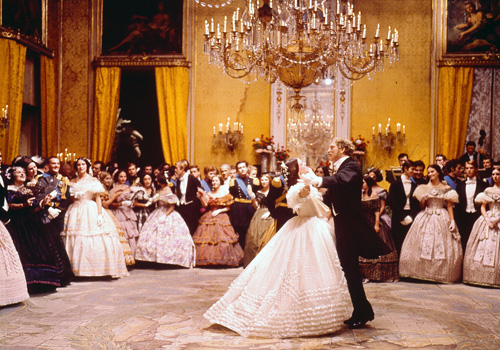
Luchino Visconti's direction is very fluid and mesmerizing in every scene he's shooting. From its wondrous, epic scope in the film's exterior settings in the country to the intimacy and atmosphere in the film’s interior sequences. Visconti's framing of the ball scene is wonderful in how he captures everything that goes on in the frame. The compositions later on are truly superb to capture the emotion of what is happening to the character of Fabrizio. The presentation and the way the dances are choreographed and capture show Visconti's talent in the directing front. The Don Diego ball sequence at forty-five minutes is truly mesmerizing with Visconti revealing everything that goes on. The result is truly a solid, engrossing, and certainly enchanting film that just doesn't stay true to the period but brings it to life in front of the audience.

Cinematographer Guiseppe Rotunno does amazing work with the film's look in its Technicolor, 35mm film stock with gorgeous coloring in every frame from the yellow, wheatfields in the countryside exteriors and hill tops on location in Sicily. Rotunno's camera work in the interiors with its use of day light for it sense of aura to the nighttime scenes in the interiors are filled with an array of color and richness that is exquisite in every frame shot. Rotunno's work is truly one of the film's highlights. Editor Mario Sarandrei does an excellent job in the transitional cuttings from scene to scene with the use of fade-outs and dissolves to help structure the story and most of all, maintain a meditative pacing style for the audience to get to know the characters and its surroundings.

Art director Mario Garbuglia along with set decorators Laudomia Hercolani and Giorgio Pes create exquisite interior set pieces for the homes that the character live in with authentic detailing of the furniture and silk for the look of the beds and such. The art direction in this film is truly divine for its attention to detail of the period of the mid-1800s in Italy. The costume design of Piero Tosi is just gorgeous to look at for its attention to detail and the sense of fluidity to the period. Notably in the ball scene where the dresses the women wear are jaw-droppingly beautiful for its coloring and stitching that is another highlight in its technical work. The music score of Nino Rota is truly mesmerizing from its sweeping arrangements, somber melodies, and orchestral power. The score is truly one of Rota's best work as he also arranged an old composition by Guiseppe Verdi in the waltz sequence as Rota's work is really one of the film's most memorable moments.

The casting of the film is superb with notable small performances from Howard Nelson Rubien as Don Diego, Ivo Garrani as Colonel Pallavicino, and Pierre Clementi as Fabrizio's son Francesco Paolo. Mario Girotti aka Terrence Hill is wonderfully dashing as the charming Count Cavriaghi who tries to woo Concetta with little success. Leslie French is great as Cavaliere Chevelley who tries to help out Fabrizio in his upcoming role while being clueless to his metaphorical line about his role and the world. Serge Reggiani is excellent as the loyal Don Ciccio who tries to warn Fabrizio about Sedara as he's forced to watch in horror the deal Fabrizio makes. Rina Morelli is good as Fabrizio's wife and princess who is trying to deal with the changes while being distraught towards Tancredi's rejection over her daughter Concetta. Paolo Stoppa is great as the scheming Don Sedara who hopes to gain everything from his deal despite his lack of manners and taste.

Romolo Valli is brilliant in his role as Father Pirrone, Fabrizio's spiritual guide who is one of the few trusted allies Fabrizio has while also wanting to speak matters of the heart when he wants some confessions from Fabrizio. Lucilla Morlacchi is excellent as Concetta, Fabrizio's eldest daughter who has fallen for her cousin Tancredi only to become cold by his rejection and his changing persona as she becomes bored by her own surroundings. Claudia Cardinale is superb in her role as Angelica, a beautiful woman who is touched by the kindness of Fabrizio while being aware of Concetta's feelings for Tancredi. Cardinale's sincere performance is lovely to watch, especially in her waltz with Burt Lancaster that shows how compassionate her character is to the man who is about to leave the world. Alain Delon is great as the charming Tancredi, a young man whose youthful ideals and enthusiasm is met with great love by his uncle despite his opinions. Yet, when he trades one faction for another, it becomes clear that he's merely a follower who is willing to try and maintain a position of power no matter where it comes from. It's a truly amazing performance from the French actor in his glory days in the early 1960s.

Finally, there's Burt Lancaster in what is truly one of his best performances in his legendary career. Lancaster's understated, world-weary performance is definitely one for the ages. Though in its full, uncut 185-minute Italian version, his performance is dubbed by another actor. Lancaster makes the most of it with his restraint and glorious presence as a prince who is trying to adapt to the changing time. Lancaster is most touching when he's not speaking or doing anything as he delves into all the emotions into what he's losing. It's a truly mesmerizing and powerful performance from the late yet legendary actor who even at the height of his fame is willing to take risks as an actor.

***The Following is DVD Content Relating to Il Gattopardo that was Written & Added on 11/2/10***

The 2004 3-disc Region 1 Criterion Collection DVD for Il Gattopardo presents the film in its two different versions in its two different discs.  The first disc is the definitive 185-minute cut of the film with a new high-digital transfer that is supervised by the film’s cinematographer Giuseppe Rotunno.  The film is also is presented with the its original Super Technirama letterboxed/widescreen aspect ratio of 2:21:1 along with restored sound and image.  The first disc also includes a new English subtitle translation and a full-length commentary track by film scholar Peter Cowie.

Cowie’s commentary reflects on many of the film’s themes, its historical setting, and on the life of Luchino Visconti.  Cowie also discusses what scenes were cut from the original film for the U.S. release which also included scenes where Don Fabrizio and Don Ciccio at the hunting scene is shortened in the America version along with a scene where Father Pirrone is talking about faith at an inn.  Cowie reveals Visconti’s own background as he grew up in an aristocratic family where during his time in Paris, he met Coco Chanel.  This would later him get some work for Jean Renoir where Renoir taught him the world of films.  Cowie says that during the early 60s, the most important Italian directors at that time were Visconti, Michelangelo Antonioni, Vittorio de Sica, and Federico Fellini.

Cowie also revealed that despite the fact that Burt Lancaster was the bigger star, Alain Delon was the only actor who got his own private dressing room which seemed insulting.  Though Lancaster remained professional throughout the film despite not speaking Italian with the rest of the cast.  Cowie also dwells on Claudia Cardinale, who was becoming one of Italy’s premier actresses at that time as she was breaking out internationally thanks to this film along with Fellini’s 8 ½.  The work of cinematographer Giuseppe Rotunno is widely discussed as he became a prominent cinematographer for the Italian industry, and a regular collaborator of Visconti.

For many of the historical aspects about the film, Cowie believes that the period of Italian reunification of the 1860s would spark the groundwork for the world of the Mafia in Sicily.  Cowie also dwells on the music of Nino Rota during the ballroom scene.  Even as he revealed that when worked with Francis Ford Coppola for a 2001 DVD release for The Godfather, they found audio tapes of Rota improvising various themes.  Cowie also goes deep into the discussion of the characters in the film while revealing many of the film’s themes that involve Don Fabrizio.  Cowie’s commentary is truly delightful and very informative with its relaxed and rhythmic tone.

The second disc of the DVD is filled with special features and documentaries relating to the film.  The first is a one-hour making-of documentary called A Dying Breed:  The Making of The Leopard.  Featuring interviews with Claudia Cardinale, screenwriters Suso Cecchi D’Amico and Enrico Medioli, and cinematographer Giuseppe Rutunno, plus several others including the late American filmmaker Sydney Pollack.  The six-part documentary recalls on everything that lead up to the making of the film and its release.  The first part talks about the contrast of backgrounds between Luchino Visconti and Giuseppe Tomasi di Lampedusa.  Even as some wondered if Visconti’s approach to the novel were too much since di Lampedusa died before the film ever came out.  By the time it was in the adaptation stage, it was very difficult since Visconti’s take on the book was much different from di Lampedusa.  Cut out of the story from the book were the last two chapters, the epilogues, where Visconti wanted to focus more on the Prince in his final moments for the third act of the film.  

Even the characterization of Tancredi and Angelica were different from what they were in the book as Visconti wanted them to be a more joyful, loving couple unaware of what will happen to them.  The casting of the film proved to be very difficult as they needed a big name to headline the film.  After the idea of casting a Russian actor to play Don Fabrizio didn’t work, they went to Laurence Olivier to see if he could go for the part.  The problem was that Olivier wasn’t available as producer Goffredo Lombardo made a real breakthrough in getting Burt Lancaster involved.  Though Visconti didn’t initially liked the idea of Lancaster as Don Fabrizio, he reluctantly agreed to the casting as the relationship between Lancaster and Visconti didn’t start out well.  

Yet, as the filming went on with Rutunno being the messenger for both men.  Lancaster and Visconti became the best of friends until Visconti’s death as Pollack revealed that the film proved to be a real acting breakthrough for Lancaster.  Even as Claudia Cardinale helped smooth out whatever issues Visconti and Lancaster had early on as she acted with Lancaster in English and with Alain Delon in French.  Cardinale had worked with Visconti in other film as did Delon as they were able to help things move quite seamlessly.  With the actors cast, production was set as costume designer Piero Tosi talked about the design of the costumes.  Notably the look of the soldiers where they wore early versions of blue jeans as their uniform while Rutunno and art director Mario Garbuglia talk about the look of Sicily and locations which were difficult to find.

Once the locations were found, Garbuglia and Rutunno went to great detail to recreate the interior designs of the home from the way it should be lit to the look of the walls.  For the ballroom sequence, it was a very difficult shoot due to the fact that there were several mirrors inside of the rooms.  Yet, Rutunno and Visconti were able to find ways to get the camera angles without the mirror showing the camera.  Tosi also talked about the costumes, notably the dress that Claudia Cardinale had to wear which was difficult to make.  Cardinale recalled the one thing she didn’t like about wearing the dress was the corset because it was half her size.

The fifth part of the documentary discusses about Visconti’s personality and his approach to making films.  Garbuglia and Tosi revealed that despite having a bad temper, Visconti was caring towards his collaborators and actors.  Cardinale also recalled about guiding her during her first dinner scene and got her to laugh in such a way.  The final part of the documentary recalls the American release where the people involved the film revealed how the Americans got it wrong.  Even as they had trouble with Visconti, who didn’t speak English and wasn’t very kind with the American producers at 20th Century Fox.  While Burt Lancaster was involved by dubbing his own voice with Sydney Pollack directing Lancaster during the syncing.  Pollack confesses that the American version of the film was lousy.  While he revealed that Lancaster ranked the film as his best role, the only qualm Lancaster had was that in the definitive version.  It wasn’t his voice while Pollack contended that it was the silent moments and graceful movements that gives reasons into why it’s one of Lancaster’s greatest roles of his career.

The second big feature is a 20-minute interview with producer Goffredo Lombardo.  Lombardo discusses about getting the film made because of the novel’s popularity as he went through early developments for the film until getting Luchino Visconti attached to the project.  Lombardo was responsible for getting Burt Lancaster involved as he had a hard time trying to talk to American producers, who treated the Italian producers with indifference.  Lancaster talked with Lombardo and decided to be involved after seeing a Visconti film called Rocco and His Brothers.  Though he knew Visconti wasn’t a fan of Lancaster, a meeting in Rome with Lancaster changed things.

Lombardo also discussed the production of the film as well as its release.  The reception for the film was good but in the way the film has been received many years later as a classic.  Lombardo also revealed that the film came out during a troubled period for Italian cinema because of a financial crisis.  Lombardo ends the interview talking about the idea of the DVD as he believes it’s a great thing so that it can be seen by people at their home.

The third and final big special feature is a fourteen-minute video interview with University of Pennsylvania professor Millicent Marcus about the Risorgimento period in Italy during the 19th Century.  Marcus revealed that the fall of the Roman Empire led to a separation of Italy where various sections of the country were run by different countries.  By the 1800s, there was a movement to reunify the country which finally happened in the mid-1800s.  Marcus revealed that the character of Chevelley was based on Camillo Benso, one of the leading figures of the Risorgimento.  Marcus talks about Giuseppe Garibaldi, a military figure who helped lead many battles that would lead to Italy’s reunification as Marcus reveals that he was seen as a romantic hero.

Marcus talks about the battle of Palermo, which was the big battle scene in the film as she talked about everything that was happening in that scene.  Even as it relates to the character of Tancredi where the battle would have a major effect on his views.  He starts out being a member of the revolution and then becomes part of the anti-revolution.  The Risorgimento was viewed as a failure because of power plays involving politics though there was an eventual reunification of the country though the real winner was the middle class.  Not the revolutionaries nor the aristocracy.  Marcus also talks about the idea of revolution in its various meanings while her last statement revolves around Don Fabrizio’s love of astronomy about how things would often go back.

Additional special features include a stills gallery that features rare pictures of Visconti on set, film posters, and scenes that didn’t make it to the final film or were in the original 205-minute cut of the film.  Also included in the promotional section of the special features are three trailers.  The original Italian trailer and two American trailers, the first of which featured Burt Lancaster presenting the trailer.  Finally, there’s two Italian newsreels that relates to the premieres of Il Gattopardo in Rome, where it was also an award ceremony for some of the finest in the Italian film industry including the film’s producer Goffredo Lombardo as well as Dino de Laurentiis and actress Gina Lollobrigida.

The third disc of the DVD is a remastered transfer of the 161-minute American release of the film from 20th Century Fox.  The film is presented in the widescreen aspect ratio of 2:35:1 with a remastered sound as it features the voices of Burt Lancaster and Leslie French in their respective roles as Don Fabrizio and Chevelley.  While the print of that version of the film does look great though doesn’t carry as much depth of field as the original did.  It’s not a bad version of the film as the differences isn’t what was cut from the original film as the only thing added was a text that appears after the opening credits about the Risorgimento.  The problem with the American version are in two factors.  First is the dubbing which affects the performances as they don’t have the same sense of regality in the original.  

Though there’s some moments where Lancaster is in great form as he dubs himself, the scenes where he displays some high emotions don’t seem right.  The other issue in the film is that the pacing, in some parts of the film, is off where things move slower in some parts including the ballroom scene while other scenes, notably the sequence where Don Fabrizio and his family go to their summer home where the scene at the inn was cut along with another scene of Tancredi talking to some soldiers.  It’s where some things become confusing because the audience has no idea what is happening.  To compare it to the original version, it would be a decent, adequate film.

Accompanied with the Criterion DVD set is an essay by film historian Michael Wood about the film.  Wood talks about the similarities between Visconti and novelist Giuseppe di Lampedusa.  Even as they have a fascination with the history of Italy as they both came from different ideas of aristocracy.  Wood also goes into the psychological aspects of the characters, notably Tancredi whose motivations are more to do with power as he’s unaware of the bleak future he and Angelica would have.  Yet, Wood reveals that the film is about a man of the old order trying to find a place in a world that is rapidly changing as he would make his way towards death.

The 3-disc DVD for Il Gattopardo is definitely one of the Criterion Collection’s finest releases as audiences get a chance to see the film in its definitive version.  Even as it includes the shorter, American version so audiences can see what 20th Century Fox did wrong though it’s not an entirely bad film.  It’s truly a must-have DVD for film buffs and fans of great Italian cinema.

***End of DVD Tidbits***

When it first played in Italy in the spring of 1963 with a cut of 205-minutes, reviews were good though some complained about the length of the film. Visconti eventually trimmed twenty-minutes of the film for its premiere at the Cannes Film Festival which won the Palme D'or. Despite the success at Cannes, 20th Century Fox decided to release the film with a new cut of 161-minutes and dubbing that included Burt Lancaster's own voice for the American version. The American version received mixed reviews while the film by itself lost its stature with Lancaster often saying it's one of the best films he's done. For years, Il Gattopardo had been rarely seen in its full version as in 1980, four years after Luchino Visconti's death. The film's cinematographer Giuseppe Rotunno supervised a restored version of the 185-minute cut that Visconti preferred to cinemas all over the world. The film was immediately hailed as a lost classic while its uncut version was seen by Americans in California in the groundbreaking pay-cable channel known as Z Channel.

Luchino Visconti's Il Gattopardo in its 185-minute, Italian version is a magnificent film for the ages led by a masterful and sprawling performance by the legendary Burt Lancaster. Fans of Italian cinema no doubt consider this film as essential in its full glory while it's suggested to avoid the American version since it doesn't carry the same sense of prestige and beauty of its full Italian version. With great technical work from Guiseppe Rotunno, Piero Tosi, and Nino Rota along with super supporting performances from Alain Delon, Claudia Cardinale, Lucilla Morlacchi, and Romolo Valli. It's a must-see for fans of art-house cinema while traditional audiences should be patient for its pacing and epic scope. In the end, Luchino Visconti's Il Gattopardo is classic period-piece cinema at its finest.

Luchino Visconti Films: (Obsessione) – (Giorni di gloria) – (La Terra Firma) – (Bellissima) – (Appunti su un fatto di cronaca) – (We, the Women) – Senso – White Nights (1957 film) – Rocco and His Brothers - (Boccaccio ’70-Il lavoro) – Sandra – (The Stranger (1967 film)) – The Witches (1967 film)- The Witch Burned Alive – The Damned (1969 film) – (Alla ricerca di Tadzio) – Death in Venice – (Ludwig) – (Conversation Piece) – The Innocent (1976 film)

© thevoid99 2017