Set during the Muromachi period in Japan, the film revolves around a young prince whose encounter with a demon-infested boar that would curse his right arm with imminent death as he travels west to find a cure only to be caught in the middle of a conflict involving a lady who is creating iron by destroying the forest and a mysterious princess who lives in the forest. It is a film with a simple premise, yet Hayao Miyazaki creates a film that is about the wonders of nature and its power with a young prince encountering the wonders of nature but also what happens when humanity destroys it. The protagonist in Prince Ashitaka (Yoji Matsuda) is part of a tribe that in decline as a wild boar covered by a strange and demonic substance tried to wreak havoc only Ashitaka to kill it but the substance has wounded part of his right arm with a curse that will eventually kill him as well as give him unexpected strength to kill. Traveling to find the source of its substance in the hope to find a cure, Ashitaka travels west he would meet a monk named Jigo (Kaoru Kobayashi) who tells him about a mysterious spirit known as the Deer God who becomes another god in the Nightcrawler at night.
Upon entering a mysterious forest and watching a battle unfold between a mysterious young woman riding with two gigantic white wolves and an army led by a royal figure in Lady Eboshi (Yuko Tanaka). He saves a couple of Lady Eboshi’s soldiers and bring them back to her fortress where she and the people in the fortress are making iron as well as muskets as they are also in conflict with another lord. Lady Eboshi is not a traditional antagonist since she has freed prostitutes who help make the iron as weapons and as shields while they also can be open to say things. Upon an attempted attack on Lady Eboshi by this mysterious young woman revealed to the film’s titular character (Yukiro Ishida), Ashitaka subdues the attack though he is seriously wounded upon his escape with Princess Mononoke who lives in the woods and has been raised by a giant white wolf in Moro (Akihiro Miwa). Ashitaka learns why Princess Mononoke is fighting Lady Eboshi as it relates to the forest and what it offers as well as where the source of the substance that is cursing him is coming from.
Miyazaki’s direction is truly wondrous in the world that he creates where he is aided by supervising animators Yoshifumi Kondo and Kitaro Kosaka in the design of the characters as well as the animals and mythical figures that is created for the film. Along with the contributions of art directors Satoshi Kuroda, Kazuo Oga, Yoji Takeshige, Naoya Tanaka, and Nizo Yamamoto in designing the forests, mountains, and landscape to recreate the Muromachi period in Japan that includes small towns and villages. Miyazaki’s usage of wide and medium shots capture so much attention to detail in the depth of field of the world that Ashitaka encounters along with the chaos that he would observe and reluctantly get himself involved in. Even as Miyazaki’s close-ups highlight the sense of fear and anguish that Ashitaka and Mononoke would go through in their own struggles. Notably as the former is also afflicted with this curse that would eventually kill him unless he finds a cure.
Along with the contributions of cinematographer Atsushi Okui, Miyazaki would create unique lighting schemes to help create a mood for scenes in the fortress and in the woods. Even in some of the action scenes where Miyazaki and his animators would create a sense of speed in some of the actions while there are some violent moments in the way Ashitaka would perform through his cursed arms in which Miyazaki would use digital computer animation that also has a hand-drawn feel to it. Notably with limbs being severed or heads being decapitated though there is nothing graphic that Miyazaki would do in his approach to violence. Still, he does manage to be a bit playful in the way he presents some of the women living in the fortress as they wear robes showing off a bit of cleavage. The film’s climax as it relates to Lady Eboshi hunting the deer god believing it would end her conflict with Mononoke is intense in not just the stakes but also in the outcome of a world being consumed with evil as it relates to the importance of nature. Overall, Miyazaki crafts a rich and intoxicating film about a prince trying to settle a chaotic conflict between a royal and a mysterious princess of the forest.
Editor Takeshi Seyama does brilliant work with the editing in creating unique rhythmic cuts to the action scenes as well as knowing when to slow things down and allow shots to linger for some of the dramatic and mystical moments. The sound work of Kazuhiro Wakabayashi is amazing in the way creatures would sound as well as gun fire and other elements in the sound as it is a highlight of the film. The film’s music by Joe Hisashi is phenomenal for its rich and bombastic music score with elements of sumptuous string and brass arrangements along with some somber themes with the usage of strings and percussions as well as some vocal performances by Yoshikazu Mera.
The film’s wonderful ensemble voice cast feature some notable small roles from Hisaya Morishige as the giant boar Okkoto, Mitsuko Mori as Ashitaka’s priestess Oracle, Akihiro Mira as the giant wolf and Mononoke’s adopted mother Moro, Makoto Sato as the cursed boar Nago, Tetsu Watanabe as one of Moro’s wolf pups, Akira Nagoya as Lady Eboshi’s lieutenant, Tsunehiko Kajimo as a wounded soldier that Ashitaka saves in Gonzo, Sumi Shimamoto as Gonzo’s wife Toki who helps run the iron mill in the fortress, and Kaoru Kobayashi in a superb performance as the monk/tracker Jigo that Ashitaka meets on his way to the forest as he also helps out Lady Eboshi in trying to track the Deer God. Yuko Tanaka is excellent as Lady Eboshi as this royal figure eager to bring iron to Japan and gain power while also dealing with her feud with another lord as well as her desire to kill the Deer God to become more powerful.
Yoji Matsuda is brilliant as Prince Ashitaka as a prince from a small village tribe who goes on a journey to find a cure for his cursed arm that gives him unexpected killing powers as he deals with the chaos around him as well as becoming fascinated by the world of nature. Finally, there’s Yukiro Ishida in an incredible voice performance as the titular character as a young woman who has been raised in the forest and by a giant wolf as she is trying to defend her home as she is also mistrustful towards humans while finding some understanding from Ashitaka as it is a great voice performance from Ishida.
Mononoke-hime is a magnificent film by Hayao Miyazaki. Featuring a great voice cast, gorgeous visuals, spellbinding animation, riveting set pieces, a compelling story of nature and war, and a beautiful music score. It is an animated film that does more than is expected as well as create an exhilarating story that is filled with wonder and imagination. In the end, Mononoke-hime is an outstanding film by Hayao Miyazaki.
Hayao Miyazaki Films: (The Castle of Cagliostro) – (Nausicaa of the Valley of the Wind) – (Castle in the Sky) – My Neighbor Totoro - Kiki's Delivery Service - (Porco Rosso) – Spirited Away - (Howl’s Moving Castle) – (Ponyo) – The Wind Rises - (The Boy and the Heron)
© thevoid99 2025

Set in the 1950s, the film revolves around a 13-year old witch who decides to move to a new town during a one-year mandatory period of independence to find herself where she uses her magic to be a delivery girl for a local bakery. It is a film with a simple premise that plays into this young girl who is trying to find her place in the world while befriending a few locals including a young boy who wants to be a pilot. It plays into this young girl who decides to do her mandatory one-year journey of independence in her training to become a witch as her mother lends her a broom while the titular character (Minami Takayama) is joined by her pet black cat in Jiji (Rei Sakuma) who can talk to her as they travel to a port town. Hayao Miyazaki’s screenplay is largely straightforward in its narrative as it explores a world for this young girl who is trying to make a living while maintaining her training but she also sees a world where there is a lot happening including girls in her age groups who go to parties and have fun in a world that feels like years removed from war. Still, Kiki has to cope with a world that is new and modern despite her ability to deliver things to people until changes in and around her life start to impact her while she ponders if she could still continue being a witch.
Miyazaki’s direction is rich in its imagery from the attention to detail he puts in towards the fictional port city of Koriko to the sense of realism and imagination he puts in towards the world that Kiki would encounter. Aided by supervising animators Yoshifumi Kondo, Shinji Otsuka, and Katsuya Kondo, who would also serve as the character designer, Miyazaki’s approach to the animation with its two-dimensional, hand-drawn style has this element of wonderment in how Kiki would encounter her new world along with the people she meets. The usage of wide and medium shots allows the city of Koriko to be a character in the film while Miyazaki would also allow the latter to play into some intimate moments in the film that also include close-ups such as Kiki’s encounter with an artist in the forest in Ursula (Minami Takayama) along with an old lady (Haruko Kato) whom she helps bake a pie with an old stone oven.
With the aid of cinematographer Shigeo Sugimura in terms of the lighting for some scenes set at night and in the rain along with production designer Hiroshi Ono for the look of Koriko. Miyazaki does play into this world that is vibrant and moving towards a postwar world that includes a dirigible that Tombo (Kappei Yamaguchi) is interested in as it’s about to launch. It would play into the film’s third act as it relates to Kiki’s own revelations about herself as she contends with being someone that wants to socialize with people in her age group but also wanting to support herself and to be a witch. Yet, Miyazaki would maintain this sense of fantasy in a world that is realistic as the two would converge in this climax as it plays into a young girl who is trying to find her purpose in life. Overall, Miyazaki crafts a rapturous and intoxicating film about a young witch who tries to find herself by becoming a delivery girl through magic.
Editor Takeshi Seyama does amazing work with the film’s editing in the way it plays into some of the suspense and drama with some jump-cuts and other rhythmic cutting as it adds to the sense of whimsy throughout the film. Sound mixer Shuji Inoue does superb work with the sound in the way certain objects sound as well as sound effects for the way Kiki would fly on her broom. The film’s music by Joe Hisaishi is incredible for its mixture of folk and orchestral music that play into the sense of wonderment that Kiki encounters as well as songs that add to the beauty of the film.
The film’s wonderful ensemble cast feature some notable small voice roles from Keiko Kagimoto as the granddaughter of the Madame, Hiroko Seki as the Madame’s maid, Koichi Miura and Mieko Nobusawa as Kiki’s parents, and Koichi Yamadera as Osono’s husband Fukuo who helps her in a lot of the baking for their bakery. Haruko Kato is fantastic as the voice of the Madame as an old woman who asks Kiki to deliver a pie to her granddaughter’s birthday party only to not be ready because she can’t fix an electric oven only to be saved by a rarely-used stone oven that Kiki knows how to use. Kappei Yamaguchi is excellent as the voice of Tombo as a young boy who befriends Kiki as he is fascinated by her while showing her his love for flying through a propeller he created with his bike in his hopes to be a pilot.
Keiko Toda is brilliant as Osono as the pregnant bakery owner who allows Kiki to live in a room at the bakery while giving her advice about life and such. Rei Sakuma is amazing as the black cat Jiji who is able to talk to Kiki while also helping her out in her deliveries and falling in love with a neighbor cat. Finally, there’s Minami Takayama in an incredible dual-voice performance as the titular character and the young artist Ursula. In the latter, Takayama brings a sense of maturity into this young artist that is still trying to find her own voice as she gets inspiration from Kiki while also helping Kiki to find herself. In the titular role, Takayama brings that sense of innocence and whimsy into the character but also some angst as this young girl that is determined to be a delivery girl although the temptation of being with kids her own age come into play as it adds to this conflict that she needs to find balance for.
Majo no Takkyubin is a spectacular film from Hayao Miyazaki. Armed with gorgeous animation, wondrous visuals, a compelling story of growing up, and a majestic music soundtrack. The film is a rich coming-of-age film set in a fictional world filled with wonder as well as exploring a young girl trying to find herself as a witch. In the end, Majo no Takkyubin is a tremendous film from Hayao Miyazaki.
Hayao Miyazaki Films: (The Castle of Cagliostro) – (Nausicaa of the Valley of the Wind) – (Castle in the Sky) – My Neighbor Totoro - (Porco Rosso) – Princess Mononoke – Spirited Away - (Howl’s Moving Castle) – (Ponyo) – The Wind Rises - (The Boy and the Heron)
© thevoid99 2023
Based on the semi-autobiographical short story by Akiyuki Nosaka, Grave of the Fireflies is the story of two siblings trying to survive and fend for themselves during the final days of World War II in Japan that includes the chilling encounter of the firebombing of Kobe. Written for the screen and directed by Isao Takahata, the film is a coming-of-age story set amidst the final days of Japan’s time in World War II as they deal with the war and the lack of humanity they endure. Grave of the Fireflies is a ravishing yet heart-wrenching film from Isao Takahata.
Set during the final days of World War II in the small Japanese town of Kobe during its firebombing, the film revolves around a young boy and his little sister trying to survive the war as their father is away on war and their mother horribly injured from the firebombing leading them to fend for themselves. It’s a film with a simple story though Isao Takahata’s screenplay has an offbeat narrative largely due to the fact that it doesn’t have a conventional beginning nor its ending as it’s told largely by the character of Seita (voice of Tsutomu Tatsumi) about what he and his little sister Setsuko (Ayano Shiraishi) would endure during the firebombing of Kobe and its aftermath. Yet, much of its narrative is straightforward as it play into the Seita and Setsuko dealing with air raids and the firebombing as they would live briefly with their aunt (Akemi Yamaguchi) who isn’t fond of having them around and becomes resentful towards them due to their lack of contributions at her home.
Takahata’s direction is full of wondrous imagery as well as images of war that are disturbing such as the images of American planes dropping firebombs as the attention to detail is immense. With the aid of animation director/character designer Yoshifumi Kondo, Takahata does open the film with bleak images set in the aftermath of the war where it is as if the world is starting to rebuild but not everyone is thriving. The presentation of 1945 Kobe as this small town with farmland nearby and all sorts of things as Takahata shows something that is idyllic yet it feels off by this idea of nationalism during a time when Japan was losing the war. Much of Takahata’s compositions are full of gorgeous imagery of that city yet when the aftermath of the destruction of war is one of the most startling images shown on film with some unique lighting by cinematographer Nobuo Koyama and the art direction Nizo Yamamoto. Notably in the scenes involving fireflies as they are this source of innocence and wonder for both Seita and Setsuko during the most trying of times.
Takahata’s direction also has these compositions and images that do play into this air of innocence during its second act where both Seita and Setsuko leave their aunt’s home to live in this cave where it seemed like things would be great. Yet, there is that reality of war that still looms but also this disconnect into what Seita has yet to know about what is going on. Even where he learns about what happened in the third act as it would definitely impact the struggle that Seita would endure as well as food shortage and illness for himself and Setsuko. It would play into this air of hopelessness and despair given the circumstances of what happened to Japan at the end of World War II but also the growing sense of inhumanity that Seita encounters. Its ending is surreal as it play into more into the aftermath of war and the peace that would emerge with Seita and Setsuko watching from afar at this new world. Overall, Takahata creates a majestic yet visceral film about two young Japanese kids dealing with the chaos of war and trying to find a decent life in the darkest of times.
Editor Takeshi Seyama does brilliant work with the editing as it is largely straightforward in playing up to some of the war scenes as well as some of the drama and light-hearted moments. Sound designer Yasuo Uragami does excellent work with the sound in the way bombs sound as well as the sounds of planes and other sound effects such as the natural sounds of nature are presented as it is a major highlight of the film. The film’s music by Michio Mamiya is amazing for its orchestral music core that does feature some upbeat themes in some of the lighter moments but also somber ones with its usage of woodwinds and lush strings as it is a highlight of the film.
The film’s fantastic voice cast feature some notable small contributions from Tadashi Nakamura in various voice roles in the film, Akemi Yamaguchi as Seita and Setsuko’s resentful aunt, and Yoshiko Shinohara as Seita and Setsuko’s mother. Finally, there’s the incredible voice performances of Tsutomu Tatsumi and Ayano Shiraishi in their respective roles as Seita and Setsuko as two young kids dealing the chaos of war and their need to find some good in the world and to have a decent life despite the cruelty of their aunt and the lack of humanity they endure as the voice roles contain some anguish but also an air of innocence.
Grave of the Fireflies is an audacious film from Isao Takahata. Featuring a great voice cast, eerie yet gorgeous images, a sumptuous music score, rich animation, and an unflinching look of life during wartime. The film is an immense yet wondrous film from Studio Ghibli in its simple story of two children trying to live and survive during the final days of World War II. In the end, Grave of the Fireflies is an outstanding film from Isao Takahata.
Isao Takahata Films: (The Great Adventure of Horus, Prince of the Sun) – (Panda! Go, Panda!) – (Heidi, Girl of the Alps) – (3000 Leagues in Search of Mother) – (Jarinko Chie) – (Anne of Green Gables (1979 animated TV film) – (Gauche the Cellist) – (The Story of Yanagawa’s Canals) – (Only Yesterday) – (Pom Poko) – (My Neighbors the Yamadas) – (The Tale of Princess Kaguya)
© thevoid99 2020
Written and directed by Hayao Miyazaki, Tonari no Totoro (My Neighbor Totoro) is the story of two young girls who befriend a mysterious wood spirit during the post-war years. The film is an animated fantasy film that explore two girls who meet a creature as they discover a world of adventure and hope. Featuring the voices of Chika Sakamoto, Noriko Hada, and Hitoshi Takagi. Tonari no Totoro is a majestic and enchanting film from Hayao Miyazaki.
Set in the late 1950s in Japan, the film revolves around two young girls who move into a rural area of Japan with their father as they befriend a mysterious wood creature who can bring magic as they’re only seen by children. It’s a film that play into these two girls who are awaiting for the return of their mother who is recovering from a long-term illness as they adjust to their new surroundings but also meet this creature and the world he lives in. Hayao Miyazaki’s screenplay doesn’t have much of a plot as it’s more about these two girls who are living in their new surroundings and try to make the best of it as well as lament over their mother’s absence. The youngest in Mei (Chika Sakamoto) would see a small creature that would turn invisible but then would appear as she would follow that and a creature that’s a tad bigger into the woods with this big tree at the center of it. There she meets this gigantic creature she would call Totoro as she tells her older sister Satsuki (Noriko Hada) as she would meet the creature and be amazed by its powers.
Miyazaki’s direction is full of beauty in its presentation of not just the world of rural Japan but also this fantasy world of forests and creatures. With the aid of supervising animator Yoshiharo Sato, Miyazaki creates a world that mixes fantasy and reality as if they’re the same though it’s only seen through the eyes of these two young girls. The look of the landscapes as well as the tree in the middle of this small town add to the wondrous look of the film as it play into the mystical elements of the world that includes a cat bus that Totoro and his family would ride on sometimes. With the help of art director Kazuo Oga and cinematographer Hisao Shirai in creating certain looks into the lighting and in the landscape, Miyazaki brings a lot of attention to detail in his hand-drawn, two-dimensional animation style as showcases some of the emotions of the characters as well as the look of the creatures including soot-like creatures and Totoro himself.
Miyazaki also play into these mysterious moments as it relates to the girls’ relationship with Totoro but also coping with some growing pains as it relates to their mother’s absence and their father having to go to city university for work. The usage of the wide shots play into this growing uncertainty for the two girls while the medium shots and close-ups play into their interaction with Totoro and his family as well as other characters including Kanta Ogaki (Toshiyuki Amagasa) who seems to have a crush on Satsuki. The film’s third act does play into this air of dread and harsh realities as it would allow Satsuki to go to Totoro for help as it would play into not just this air of fantasy and intrigue but also in how it would deal with reality. Overall, Miyazaki crafts a riveting yet exhilarating film about two young girls befriending a mysterious yet whimsical forest creature.
Editor Takeshi Seyama does excellent work with the editing as it is largely straightforward to play into the air of excitement in the world of fantasy as well as knowing where to slow things down for the dramatic moments. Sound mixer Shuji Inoue does amazing work with the sound in some of the sound effects that are created as well as the way wind and rain would sound. The film’s music by Joe Hisaishi is incredible for its soaring and majestic orchestral score that feature some low-key synthesizers in the background along with usage of woodwinds arrangements to play into the music that Totoro and his friends play while its music soundtrack features a few songs sung by Azumi Inoue.
The film’s superb voice cast feature some notable small roles from Masashi Horose and Hiroko Maruyama as Kanta’s parents, Naoki Tatsuta as cat-like purrs of the cat bus, Tanie Kitabayashi as Kanta’s grandmother who would take care of Mei whenever Satsuki would go to school, Toshiyuki Amagasa as a neighbor boy in Kanta who dislikes Satsuki though it’s really a front for the fact that he likes her, and Sumi Shimamoto as Mei and Satsuki’s mother who is recovering at a hospital. Shigesato Itoi is terrific as Mei and Satsuki’s father as a man trying to get his daughters adjust to their new home while being away for work and to check on his wife. In the voice of the titular character, Hitoshi Takagi provides some unique sounds for the character as he never speaks yet his grin and growls do provide a lot of personality to the character. Finally, there’s the duo of Noriko Hidaka and Chika Sakamoto in brilliant voice performance in their respective roles as the sisters Satsuki and Mei as two young girls who are trying to adjust to their new situation as well as befriend this mysterious creature as they have an air of energy and excitement in their voices that carry the air of innocence.
Tonari no Totoro is a magnificent film from Hayao Miyazaki. Featuring a great voice cast, gorgeous visuals, a touching story, a whimsical mix of fantasy and reality, and a soaring music score and soundtrack. It is definitely a film of wonders and magic that manages to do so much in the realm of animated films as well as provide a lot of innocence to the world of fantasy. In the end, Tonari no Totoro is an outstanding film from Hayao Miyazaki.
Hayao Miyazaki Films: (The Castle of Cagliostro) – (Nausicaa of the Valley of the Wind) – (Castle in the Sky) – Kiki’s Delivery Service – (Porco Rosso) – Princess Mononoke – Spirited Away - (Howl’s Moving Castle) – (Ponyo) – The Wind Rises - (The Boy and the Heron)
© thevoid99 2019
Directed and designed by Michael Dudok de Wit and written by de Wit and Pascale Ferran, La Tortue Rouge (The Red Turtle) is the story of a man who gets shipwrecked onto a desert island and finds a companion in a gigantic red turtle. The film is an animated feature with no dialogue as it play into the emphasis on storytelling through images and music. La Tortue Rouge is a gorgeous and evocative film from Michael Dudok de Wit.
The film is a simple story of a man who is washed ashore on a deserted island as he tries to leave only to end up being stranded where he encounters a gigantic red turtle who would change his life. It’s a film with a simple story as it plays into a man dealing with being stuck on an island as he tries to leave the island while trying to get to know his surroundings. Especially as the island is filled with an oasis, bamboo trees, tiny crabs, and all sorts of things as his encounter with this red turtle would mark a major change for this man. The film’s screenplay by Michael Dudok de Wit and Pascale Ferran from de Wit’s story contains no dialogue other than a few screams as it is more about this man on an island trying to survive as he would eventually something more in the course of the film.
The direction of de Wit is definitely beautiful in the way he presents the look of the sea, the island, and the creature. Also serving as the film’s production designer and animation director, de Wit would go into every detail of how everything would look including some of the stranger moments in the film. While there are voice actors who would do some of the screams for the characters in the film, there is never a word of dialogue heard other than “hey”. The direction would have de Wit use a lot of wide and medium shots for much of the imagery he would create throughout the film as a lot of it is hand-drawn animation which does have something that is quite rich in the detailing of how everything look including the bamboo forest and the design of the sea turtles. A sequence involving a tsunami is very intense in how de Wit would build up this event very slowly and have it unfold to play into life on a deserted island. Still, de Wit would show how a man would overcome that and maintain a life in this island. Overall, de Wit creates an enchanting and rapturous film about a man stranded on a deserted island with a red sea turtle.
Editor Celine Kelepikis does excellent work with the editing in emphasizing on some straightforward cuts to play into some of the drama and dream-like moments. Visual effects supervisor Mouloud Oussid does nice work with visual effects as it play into a few sequences to make it dream-like. Sound editor Sebastian Marquilly does brilliant work with the sound as it play into the sound of the oceans and parts of the island as well as the natural sounds of the creatures on the sea and the island. The film’s music by Laurent Perez de Mar is amazing as it is this somber score filled with orchestral textures in the strings and woodwinds to play into the drama.
La Tortue Rouge is a phenomenal film from Michael Dudok de Wit. It is a very simple yet entrancing animated film that manages to provide so much with very little in a film that is beautiful but also has a very engaging story. In the end, La Tortue Rouge is a sensational film from Michael Dudok de Wit.
© thevoid99 2017
Written and directed by Hayao Miyazaki, Spirited Away is the story of a young girl who moves to a new neighborhood as she encounters a magical world where she encounters dark magic and hopes to find ways to free herself and her parents back to the real world. A mixture of fantasy with elements of drama and humor, the film is told in an anime style that is filled with dazzling images that play into the world of fantasy and reality. Featuring the voices of Rumi Hiiragi, Miyu Irino, Mari Natsuki, Takeshi Naito, Yasuko Sawaguchi, and Bunta Sugawara. Spirited Away is a spellbinding and evocative film from Hayao Miyazaki.
The film revolves around a young girl who enters a fantasy world filled with spirits as she is suddenly trapped in that world, along with her parents who turn into pigs, where she tries to find ways to get out and save her parents. It’s a film that plays into this young girl not only dealing with new changes in her life but also being forced to grow up as she enters this new world that is full of mysticism and wonder. For this young girl in Chihiro (Rumi Hiiragi), she has to do things by working in a bathhouse where its guests are strange creatures as it’s run by an old woman named Yubaba (Mari Natuki) in order to find a way to free herself and her parents. In this world where there’s frogs and creatures that talk along with all sorts of strange things where humans are sort of frowned upon. Chihiro would endure the struggles she takes while helping the woman’s apprentice Haku (Miyu Irino) who is trapped in his duties as he also tries to help Chihiro.
Hayao Miyazaki’s screenplay is filled with ideas of a fantasy world where it begins with Chihiro feeling sad over the fact that she’s moving to a new town as her parents are suddenly lost on their way to their new home. By stumbling into a mysterious tunnel and a place that they think is an old amusement park, things suddenly go wrong where Chihiro’s fears definitely come true as she realizes she can’t escape and is trapped. While Haku would help her and try to keep her away from Yubaba, she has trouble adjusting to her new situation as she is also given a new name where Haku has to remind her to not forget her old name. While there’s a few individuals that do provide Chihiro with some comfort, there’s also these strange creatures she encounters as it’s part of this world of fantasy with elements of reality due to the severity of the situation she‘s facing.
Miyazaki’s direction is definitely magical which sort of understates exactly what he’s trying to do. In fact, it’s beyond that since is full of dazzling images and landscapes that is created where it has this mixture of reality and fantasy all rolled into one. Much of it involve these wide shots of the locations along with compositions and angles into the world that is set which includes this extravagant bathhouse that Chihiro has to work at. With the help of animation director Masashi Ando, Miyazaki creates images and creatures that play into the world of fantasy as there’s elements that can be funny. Plus, there’s these moments that are thrilling as well as exotic in its imagery and the texture of the animation. Especially in some amazing sequences in the bathhouses that is extravagant as well as full of adventure. All of which plays into a young girl dealing with her situation and finding a way to return home. Overall, Miyazaki creates a truly sensational yet touching film about a girl who enters a mysterious world.
Cinematographer Atsushi Okui does excellent work with the lighting schemes for some of the interior sequences in the film to play into its rich look. Editor Takeshi Seyama does brilliant work in creating some unique rhythms including a few montages that play to some recurring dreams that Chihiro would endure during her journey. Production designer Norobu Yoshida and art director Yoji Takeshige do fantastic work with the look of the places that Chihiro goes to including the town and the design of the bathhouse. The sound work of Kaz Hayashi does superb work with the sound to play into the sound effects in the film along with some mixing to convey the sense of adventure that is prevalent in the film. The film’s music by Joe Hisaishi is amazing for its quaint yet majestic piano score with some lush string arrangements and traditional Japanese percussion music as it’s a highlight of the film.
The film’s voice cast is incredible as it features notable voice performances from Takashi Naito and Yasuko Sawaguchi as Chihiro’s parents, Ryunosuke Kamiki as Yubaba’s baby son Boh, Yumi Tamai as the worker Lin who helps Chihiro, Akio Nakamura as the mysterious spirit No-Face, and Takehiko Kamijo in a funny role as the bathhouse assistant manager. Bunta Sugawara is excellent as the spider-like man Kamaji who runs the boiler room as he helps out Chihiro. Mari Natsuki is superb in dual voice work as the greedy witch Yubaba who runs the bathhouse as she hopes to own Chihiro as she is also the voice of the more generous witch in Zenbiba.
Miyu Irino is fantastic as Haku as a young apprentice who helps Chihiro in coping with her situation as he tries to figure out how to help her while being trapped as Yubaba’s apprentice. Finally, there’s Rumi Hiiragi in a brilliant voice performance as Chihiro as this young girl who enters a fantasy world as she tries to get out as she later gets the courage to do whatever it takes to free herself and her parents.
Spirited Away is an absolutely magnificent film Hayao Miyazaki. Not only is it one of the finest films from Studio Ghibli and in the world of animated films. It’s also a film that manages to be so much more as it has something for everyone where it’s adventurous, romantic, and funny as it’s supported by some of the finest work in animation. In the end, Spirited Away is an outstanding film Hayao Miyazaki.
Hayao Miyazaki Films: (The Castle of Cagliostro) - (Nausicaa of the Valley of the Wind) - (Castle in the Sky) - My Neighbor Totoro - Kiki’s Delivery Service - (Porco Rosso) - Princess Mononoke - (Howl’s Moving Castle) - (Ponyo) - The Wind Rises - (The Boy and the Heron)
© thevoid99 2014
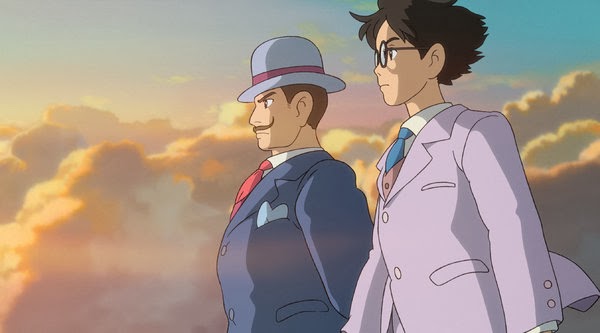
Written and directed by Hayao Miyazaki from his manga, Kaze Tachinu (The Wind Rises) is a fictionalized bio-pic about the life of Jiro Horikoshi as he was the man that designed the Mitsubishi A5M and its successor A6M Zero that played a key part in World War II. The film is a more dream-like portrait about Horikoshi’s life with some dramatic embellishments while not deviating too much from the real-life story. For the American-dubbed version of the film that is supervised by Gary Rydstrom, the voice cast includes Joseph Gordon-Levitt, Emily Blunt, John Krasinski, William H. Macy, Elijah Wood, Stanley Tucci, Mae Whitman, Mandy Patinkin, Jennifer Grey, and Werner Herzog. Kaze Tachinu is a mesmerizing film from Studio Ghibli and Hayao Miyazaki.
The film is fictionalized bio-pic about the life of Jiro Horikoshi that is presented in a dream-like fashion where it goes from Horikoshi as a young boy to becoming the man who would design the Mitsubishi A5M and its successor the A6M Zero that would become the key planes used in World War II. With a mixture of reality and a dream-like world, the film plays into Horikoshi’s desire to create the ultimate airplane that can endure wind resistance and not be intimidated by the advanced technology of other countries. Even as Horikishi (Joseph Gordon-Levitt) seeks the advice of the famed Italian plane designer Giovanni Battista Caproni (Stanley Tucci) in his dreams. Through Hayao Miyazaki’s screenplay, the film does have a conventional narrative in terms of structure that plays to Horikoshi’s life but he infuses with bits of surrealism and dreamy textures to make it much more interesting.
Notably as the film plays into key events that would mark Horikoshi’s development from his encounter at the 1923 Great Kanto Earthquake as well as his trip to Germany to see how the Germans created their airplanes. These moments would drive Horikoshi to see if he can create a war plane for Japan that would define them as they endure the Great Depression and such. While there would be some failures along the way, Hirokoshi would eventually find more inspiration when he re-meets Naoko (Emily Blunt) whom he had met years ago during a train ride with her sister where they encountered the Great Kanto Earthquake of 1923. His relationship with Naoko would prove to be a major catalyst to Horikoshi’s development as a man and as an engineer where he would try to balance both roles and later deal with his what he’s achieved.
Miyazaki’s direction is definitely dazzling in the way he creates Japan in the early half of the 20th Century as it’s a world that is trying to catch up with the modern world. Especially as he infuses bits of surrealism into the dream sequences that Horikoshi would have as it features some vast scenes of planes flying around and all sorts of things. Notably in the designs of the planes and how imaginative they look as it plays to what Horikoshi would want to create. The look of Japan from its different backgrounds of mountains, forests, and cities are presented with such great detail as there’s aspects in the background that are just as mesmerizing to look at. Even in the design of the characters which have all of the quintessential elements that is expected in Miyazaki’s work as an animator.
With the aid of cinematographer Atsushi Okui to help in the lighting where much of the animation is in 2-D hand drawn animated style with some computer-based animation for some of the backgrounds. Miyazaki creates something that is truly rich in scope but also infuse it with such artistry in the way the planes are flown as well as the way nature is presented as if it has the feel of a live-action film. Even in some of the compositions and camera work where it has a sense of action but also some drama and humor that just adds to the beauty of the film. Overall, Miyazki creates a truly evocative and sensational film about a dreamer who would create one of the greatest designs for a plane despite the fact that it’s being used as an instrument of war
Editor Takeshi Seyama does amazing work with the film‘s editing in its approach to rhythm for some of its action scenes as well as the dream sequences as it features lots of jump-cuts and disjointed rhythmic cuts to play into that sense of surrealism. Sound designer Koji Kasamatsu and sound editor Gwendolyn Yates Whittle (for its English version) do fantastic work with the sound in creating some of the sound effects used in the film with Whittle providing some low sound textures for some of the English dialogue as background textures. The film’s music by Joe Hisaishi is brilliant for its mixture of lush orchestral pieces with some playful and offbeat music driven by accordions and string instruments.
For the film’s English-language version, the cast includes some contributions from Elijah Wood as a co-worker of Horikoshi, Jennifer Grey as Mrs. Kurokawa, Darren Criss as another worker in Katayama, Mandy Patinkin as one of Horikoshi’s top bosses, Mae Whitman as Horikoshi’s sister Kayo, Zach Callison as the young Horikoshi, William H. Macy as Naoko’s father, Edie Merman as Horikoshi’s mother, and Werner Herzog in a superb voice performance as a German tourist Horikoshi meets in a retreat in the famed Magic Mountains in Japan. Martin Short is very funny as the comical boss Mr. Kurokawa who provides some humor as well as some guidance for Horikoshi while Stanley Tucci is brilliant as the famed Italian plane designer Giovanni Battista Caproni as Tucci sports an Italian accent as he displays warmth and humor into the role of the man who would guide Horikoshi.
John Krasinski is excellent as the voice of Horikoshi’s close colleague Kiro Honjo who aids Horikoshi in some of the designs as he would create his own planes that would also revolutionize planes in Japan. Emily Blunt is wonderful as Naoko as this woman who Horikoshi would meet early on as a young girl and later as a woman who would provide an inspiration and drive for Horikoshi after some of the failures he had to deal with. Finally, there’s Joseph Gordon-Levitt doing fantastic voice work as Jiro Horikoshi as this young man who dreams of designing an airplane that would define Japan in all of its glory though he is aware of what they’re being used for as he hopes they can provide some meaning into his life.
Kaze Tachinu is a remarkable film from Studio Ghibli and Hayao Miyazaki. It’s a film that is filled with rich images and a captivating story that manages to be wondrous as well as somber for what Jiro Horikoshi wanted to make. While it has some dark elements, it is balanced by the themes of being a dreamer which makes the story far more engaging. If this film is to become Miyazaki’s final contribution to cinema, he at least goes out with a winner. In the end, Kaze Tachinu is a phenomenal film from Hayao Miyazaki and Studio Ghibli.
Hayao Miyazaki Films: (The Castle of Cagliostro) - (Nausicaa of the Valley of the Wind) - (Castle in the Sky) - My Neighbor Totoro - Kiki’s Delivery Service - (Porco Rosso) - Princess Mononoke - Spirited Away - (Howl’s Moving Castle) - (Ponyo) - (The Boy and the Heron)
© thevoid99 2014