Showing posts with label werner herzog. Show all posts
Thursday, May 28, 2020
The Great Buster: A Celebration
Written, directed, and narrated by Peter Bogdanovich, The Great Buster: A Celebration is a documentary film that explores the life, career, and influence of silent film star/filmmaker Buster Keaton. Featuring interviews from various filmmakers, historians, actors, and comedians, the film follows the man’s life as well as his struggles to be relevant when silent films ended as well as the long overdue adulation he would ultimately receive before his passing in 1966 at the age of 70. The result is a rich and exhilarating film from Peter Bogdanovich.
In the 1920s, one of the biggest stars of the silent film era was Buster Keaton whose stone-faced look and elaborate approach to physical comedy and action as it would influence many in the years to come. The film explores not just Keaton’s life including his struggles to make movies during the post-silent film era but also in some of his failures he would endure and comeback during the late 1940s. Narrated by its writer/director Peter Bogdanovich who shows a clip of himself on The Dick Cavett Show in the early 1970s with filmmaker Frank Capra as they talk about Keaton’s influence in cinema as other filmmakers ranging from comedy filmmakers like Mel Brooks and Carl Reiner to the likes of Werner Herzog, Quentin Tarantino, and Jon Watts as they all talk about what Keaton brought to the world of cinema. Watts especially as he reveals that Keaton’s stone-faced expression was an inspiration to the look of Spider-Man under his mask in Spider-Man: Homecoming.
The film also goes into depth into Keaton’s personal life through historians and those who knew him including actors Norman Lloyd and Dick Van Dyke while comedian Richard Lewis talks about his friendship with Keaton’s widow Eleanor Norris as she would give him her husband’s famed hat. Actors/comedians such as Cybill Shepherd, Nick Kroll, Bill Hader, French Stewart, and Johnny Knoxville also talk about Keaton’s films and his approach to physical comedy as Knoxville reveals that part of the reasons he created Jackass and its films was to do stupid stunts but also to understand how Keaton was able to perfect the stunts and set pieces he created in his films. Much of the narrative that Bogdanovich creates is largely straightforward but it also play into the decline in his career as it relates to his time working with MGM where Keaton lost a lot of his creative control as several colleagues including Charles Chaplin urged Keaton to not sign with MGM but Keaton ended up taking the advice of those who were managing his business as it ended up being a bad business deal.
After two failed marriages and a career that is nearly dead, it would be his marriage to MGM dancer Eleanor Norris that would help as he would be hired by MGM to write gags and such as well as direct a gag for other filmmakers. The work for MGM and appearances in commercials and television would help revive Keaton’s career and financial fortunes as it would give him a memorable cameo in Billy Wilder’s Sunset Boulevard as well as a memorable appearance in Chaplin’s 1952 film Limelight where the two shared the screen together. Lloyd revealed that Chaplin brought Keaton just to work with him and help him out as they created a great scene while the finale was partially directed by Keaton who helped Chaplin out with the scene. Many also discussed that as great as a filmmaker and physical comedian that Keaton is, some say he is underrated as an actor as historians and filmmakers do feel that Keaton had a lot more to offer. Even in his final years as it play into the films he was doing such as Beach Blanket Bingo as he was dealing with ill health but was enjoying his work.
Much of Bogdanovich’s direction is straightforward in the interviews which were shot with cinematographer Dustin Pearlman as it allow those who are interviewed the chance to be in their own world but also express their love for Keaton. Yet, it is through the footage of Keaton’s films and other archival footage that is the meat of the film with the aid of editor Bill Berg-Hillinger who would cultivate all of the footage including some of the rare TV clips and commercials. One aspect of the film that is crucial to the film are clips from the documentary Buster Keaton Rides Again which was a making-of documentary about a short film Keaton was making as it would be one of his last films. Sound editor David Barnaby would gather some audio archives as well as do some remastering in some of the film clips while music supervisor Chris Robertson cultivates an array of music scores from all of the film that Keaton was in as it help play into the humor and somber aspects of his life.
The Great Buster: A Celebration is an incredible film from Peter Bogdanovich. It’s a documentary that does a lot to explore the genius of Buster Keaton as well as the legacy he’s created in the world of film and the admirers he had gained for many years. Even as it showcases his films and why people love them as well as a look into his struggles after his years of stardom and control had faded away only to regain his dignity and overdue adulation he would receive for his gift. In the end, The Great Buster: A Celebration is a marvelous film from Peter Bogdanovich.
Buster Keaton Films: (The Rough House) – (One Week (1920 Short)) – (Convict 13) – (The Scarecrow (1920 short)) – (Neighbors (1920 short)) – (The Haunted House (1921 short)) – (Hard Luck (1921 short)) – (The High Sign) – (The Goat (1921 short)) – (The Playhouse) – (The Boat) – (The Paleface) – (Cops) – (My Wife’s Relations) – (The Blacksmith) – (The Frozen North) – (The Electric House) – (Day Dreams (1922 short)) – (The Balloonatic) – (The Love Nest) – (Three Ages) – (Our Hospitality) – Sherlock Jr. - The Navigator (1924 film) - Seven Chances - (Go West (1925 film)) – (Battling Butler) – The General (1926 film) - (College (1927 film)) – Steamboat Bill Jr. - The Cameraman - (Spite Marriage) – (The Gold Ghost) – (Allez Oop) – (Tars and Stripes) – (Gland Slam Opera) – (One Run Elmer) – (Blue Blazes) – (Mixed Magic) – (Love Nest on Wheels)
Peter Bogdanovich Films: Targets - (Voyage to the Planet of Prehistoric Women) – (Directed by John Ford) – The Last Picture Show - (What’s Up Doc?) – Paper Moon - (Daisy Miller) – (At Long Last Love) – (Nickelodeon) – (Saint Jack) – (They All Laughed) – (Mask (1985 film)) – (Illegally Yours) – (Texasville) – (Noises Off) – (The Thing Called Love) – (To Sir with Love II) – (The Price of Heaven) – (Rescuers: Stories of Courage: Two Women) – (Naked City: A Killer Christmas) – (A Saintly Switch) – (The Cat’s Meow) – (The Mystery of Natalie Wood) – (Hustle (2004 film)) – (Runnin’ Down a Dream) – (She’s Funny That Way)
© thevoid99 2020
Tuesday, May 07, 2019
Queen of the Desert
Written and directed by Werner Herzog, Queen of the Desert is about the life of Gertrude Bell from her 20s to the final years of her life as she becomes a famed traveler, writer, archeologist, cartographer, and political officer. The film is a dramatic account of her life as she would also meet various figures who would be important to modern history as she is played by Nicole Kidman. Also starring James Franco, Damian Lewis, Jay Abdo, and Robert Pattinson. Queen of the Desert is a visually-entrancing yet underwritten film from Werner Herzog.
The film chronicles the life of Gertrud Bell from 1903 to 1916 though it begins in 1915 where various individuals are in the Middle East trying to figure out what to do with T.E. Lawrence (Robert Pattinson) suggesting Gertrud Bell to help negotiate matters. It’s a film that play into Bell’s desire to see the world where she would inhabit various roles in her life but also endure tragedy and adventures. Werner Herzog’s screenplay doesn’t do much to create a substantial narrative that play into Bell’s evolution from a lady of privilege into the famed traveler who would also be a writer, a cartographer, archeologist, and political officer who would befriend tribes and help bring brief peace to feuding tribes. It also play into her romantic dalliances with embassy employee Henry Cadogan (James Franco) and later on the military officer Lt. Col. Charles Doughty-Wylie (Damian Lewis). The romantic elements of the script never really fits in with the main story that revolves around Bell’s evolution into this woman who would travel throughout the Middle East and Northern Africa. Even as she would encounter different parts of the world and meet these unique individuals who live from the outside of conventional society.
Herzog’s direction is definitely entrancing for not just shooting on the Sahara desert but also to create a world that is vast and with a sense of the unknown. While much of the film is shot on location in Merzouga, Morocco along with shots in Marrakesh, Erfourd, and Ouarzazate in Morocco plus parts of London and establishing shots in Merzouga and Petra, Jordan. Herzog would capture the beauty of the deserts and locations through some intricate wide shots that gathers so much coverage as well as establish this depth of field that play into the vastness of the locations. Still, Herzog is focused on Bell’s travels and the things she encounter as he would create some nice intimate moments in the close-ups and medium shots upon her meeting with sheiks as she would understand them and they would be gracious in return. It’s among the moments that do make it interesting as well as scenes where Bell meets Lawrence and their views about the world itself.
While there are also some humorous moments in the film, the film unfortunately suffers from its shortcomings in the script where it would affect its pacing as it would plod from time to time including the romantic moments in the film. It’s where the film definitely loses interest as it also makes Bell seem like a homewrecker when it’s not exactly true considering that it was the men that were pursuing her. Herzog’s direction for those scenes do have some interesting compositions but it’s the script that doesn’t really flesh out the emotional aspect of those scenes. Overall, Herzog crafts a messy though fascinating film about the life and work of Gertrude Bell.
Cinematographer Peter Zeitlinger does excellent work with the film’s cinematography in emphasizing the natural lighting and look for many of the scenes set in the desert while emphasizing on a bluish look for the winter scenes in Britain. Editor Joe Bini does nice work with the editing as it has a few jump-cuts and some rhythmic cuts to play into some of the suspense and drama despite its shortcomings in the script. Production designer Ulrich Bergfelder, with art directors Rabiaa N’Gadi and Caroline Steiner, does brilliant work with the look of the homes that Bell would stay in as well as some of the old villages and such where the sheiks lived in. Costume designer Michele Clapton does fantastic work with the costumes from the lavish dresses that Bell and the women would wear at embassy galas and such to the more rugged look she would wear upon her travels through the desert.
Hair/makeup designer Alessandro Bertolazzi does terrific work with the look of the women hairstyles of the time as well as the messiness of Bell’s hair in the desert. Visual effects supervisors Kaspar Kallas and Olaf Przybyszewski do some fine work with some of the film’s visual effects as it largely minor work in bits of set-dressing. Sound designer Laurent Kossayan does superb work with the sound as it play into the atmosphere of the locations including the sounds of guns and cannons throughout the film. The film’s music by Klaus Badelt and Mark Yaeger is amazing for its somber orchestral score driven mainly by strings as it play into the mystique of the Sahara and its desolate locations as well as the world that Bell would encounter.
The casting by Salah Benchegra, Beth Charkham, and Shannon Makhanian is wonderful as it feature some notable small roles from Mark Lewis John as Bell’s uncle Frank Lascelles, Beth Goddard as Bell’s aunt, Holly Earl as her cousin Florence who has feelings for Cadogan, Assaad Bouab as a sheikh who invites Bell to his home as they share a love of poetry and literature, Sophie Linfield as Doughty-Wylie’s wife Judith, Younes Bouab as a young King Faisal I of Iraq, Christopher Fulford as a young Winston Churchill, David Calder as Bell’s father Hugh who disapproves her relationship with Cadogan, and Jenny Agutter as Bell’s mother Florence who is concerned about her daughter’s desire for adventure as she is reluctant to let her daughter seek it out. Jay Abdo is fantastic as Fattouh as a guide who would accompany Bell on her many journeys as well as be her most loyal companion who would help her trek through the land and be someone that Bell would really care for. Robert Pattinson is excellent as T.E. Lawrence as the famed archeologist, army officer, writer, and diplomat whom Bell would meet as he doesn’t care for any romantic interest in Bell but rather as a colleague and equal whom he shares his views on the world with.
Damian Lewis is terrific as Lt. Col. Charles Doughty-Wylie as a military official who becomes Bell’s second major love interest as someone who is fascinated by her views of the world where Lewis has his moments but he and Kidman don’t really radiate any kind of chemistry due in part to the script. James Franco’s performance as Henry Cadogan as this embassy employee isn’t very good due in part to the script’s shortcomings as well as the fact that Franco doesn’t do a good English accent as he and Kidman also don’t have any chemistry where it feels forced. Finally, there’s Nicole Kidman in an incredible performance as Gertrude Bell as the woman who do all sorts of things as she seeks adventure and challenges where Kidman displays a radiance to her character as well as some restraint in her facial reactions. Despite some of the drawbacks of the romantic aspects on Bell’s life, Kidman does display that anguish of a woman who had dealt with so much as she is also trying to move forward with her desire to explore the world.
Queen of the Desert is a stellar yet underwhelming film from Werner Herzog that features a great performance from Nicole Kidman. Along with its dazzling visuals, somber music score, and strong supporting performances from Jay Abdo and Robert Pattinson. It’s a film that does play into Bell’s life as an explorer though it fumbles into its exploration into aspects of her personal and romantic life which isn’t as interesting as what she does when she’s traveling. In the end, Queen of the Desert is a good but messy film from Werner Herzog.
Werner Herzog Films: Feature Films: (Signs of Life) - (Even the Dwarfs Started Small) - (Fatana Morgana) – Aguirre, the Wrath of God - (The Enigma of Kasper Hauer) - (Heart of Glass) – Stroszek - Nosferatu, the Vampyre - Woyzeck - Fitzcarraldo - (Where the Green Ants Dream) – Cobra Verde - (Scream of Stone) - (Lessons of Darkness) - (Invincible (2001 film)) - (The Wild Blue Yonder) – Rescue Dawn - (Bad Lieutenant: Port of Call New Orleans) – (My Son, My Son, What Have Ye Done?) – (Salt and Fire) – (Family Romance, LLC)
Documentaries: (The Flying Doctors of East Africa) - (Handicapped Future) - (Land of Silence and Darkness) - (The Great Ecstasy of Woodcarver Steiner) - (How Much Wood Would a Woodchuck Chuck) - (La Soufrière) - (Huie's Sermon) - (God's Angry Man) - (Ballad of the Little Soldier) - (The Dark Glow of the Mountains) - (Wodaabe) – Herdsmen of the Sun) - (Echoes from a Somber Empire) - (Jag Mandir) - (Bells from the Deep) - (The Transformation of the World into Music) - (Death for Five Voices) - (Little Dieter Needs to Fly) – My Best Fiend - (Wings of Hope) - (Pilgrimage) - (Ten Thousand Years Older) - (Wheel of Time) - (The White Diamond) – Grizzly Man - Encounters at the End of the World - Cave of Forgotten Dreams - (Into the Abyss) – (On Death Row) – From One Second to the Next - (Lo and Behold, Reveries of the Connected World) – (Into the Inferno) – (Meeting Gorbachev)
© thevoid99 2019
Saturday, September 16, 2017
Stroszek
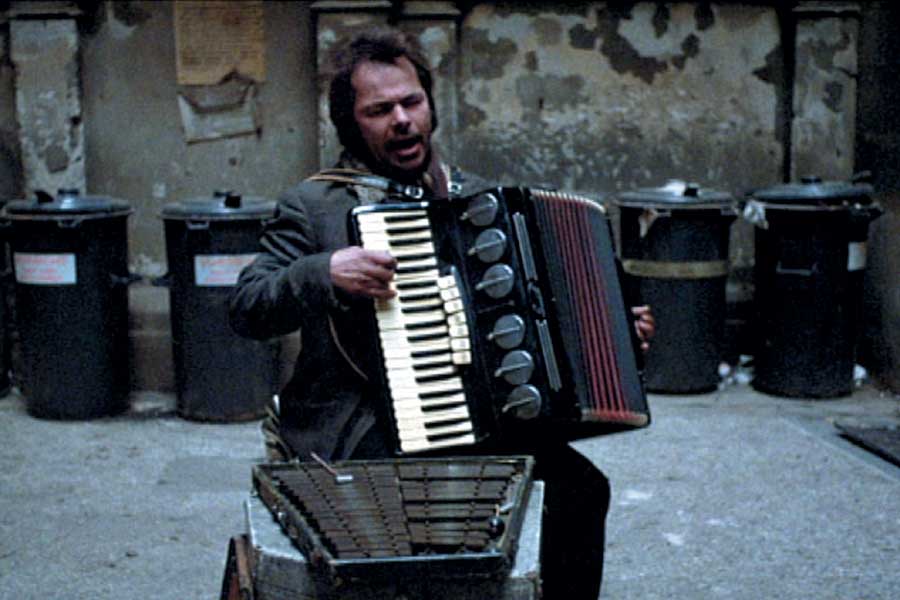
Written and directed by Werner Herzog, Stroszek is the story of a German street performer who is released from prison as he dreams of going to America in the hopes he can find great promise there as he is joined by a prostitute and an old man in his journey. The film is an unusual road film in which a man tries to go to America to see if there is such a thing as the American Dream only to face the realities of his new surroundings. Starring Bruno S., Eva Mattes, and Clemens Scheitz. Stroszek is a mesmerizing yet harrowing film from Werner Herzog.
The film follows a man named Bruno Stroszek (Bruno S.) who is released from prison as he has trouble trying to find his role in the world as he joins a down-on-her-luck prostitute and an old man to travel to America where the old man’s nephew lives and work at Wisconsin. It’s a film that is about a trio of misfits who don’t really fit in with the many ideas of modern-day West German society as they hope to go to America to find a new life and something good. Werner Herzog’s screenplay doesn’t just follow the struggle that Bruno, the prostitute Eva (Eva Mattes), and the old man in Scheitz (Clemens Scheitz) as they deal with their dreary surrounding in West Berlin. It’s also for the fact that there isn’t really anything for them as they hope going to America would change things.
The first act is set in West Berlin while the second act begins in New York City as they would go to the small town of Railroad Flats, Wisconsin to meet Scheitz’s nephew Clayton (Clayton Szalpinski). With Bruno getting a job working for Clayton in his garage and Eva working as a waitress at a diner, it seems like the idea of the American Dream would come true but it would turn out to be just a myth. Especially in what they had to do to get things they want as it causes all sorts of problems for Bruno, Eva, and Scheitz with Scheitz succumbing to paranoia. Adding to this problem is the language barrier and cultural differences as Bruno and Scheitz don’t speak nor understand a word of English with Eva being the only person who can as she becomes indifferent to her surroundings as well as towards Bruno.
Herzog’s direction is definitely straightforward for much of the film while it is also very offbeat in terms of how he showcases America from a foreigner’s point of view. Shot on location in West Berlin, New York City, parts of North Carolina, and various small towns in Wisconsin such as Madison, Nekoosa, and Plainfield. Herzog would create something where it play into individuals who have no place in the world as Bruno’s release from prison has him forcing to not do certain things like drink alcohol or get into trouble as the first place he goes to following his prison release is a bar and have a drink of beer. Yet, life in Berlin is quite troubling as he’s constantly bullied by a couple of pimps who often abuse Eva while finding places to play his accordion and glockenspiel become harder forcing him to believe that America might be the place to go. Much of Herzog’s approach to compositions has him using close-ups and medium shots to play into the way the characters deal with each other and their situations as there are a few wide shots for the scenes in Berlin. Once they arrive to America, the wide shots are more prominent as it displays this sense of culture shock and bedazzlement for the scenes in New York including a shot at the observatory floor at the Empire State Building.
The scenes in Wisconsin are also straightforward as Herzog would use non-actors to be in the film to give it a sense of authenticity as well as that sense of confusion the Germans would deal with upon their arrival. Much of the approach to compositions remain the same but the tone is different as it has bits of humor but also some low-key drama as it play into not just this sense of alienation for these characters but also the growing dissolution among the three as Scheitz’s interest in animal magnetism and Eva’s own interest toward truckers add to Bruno’s own sense of loneliness. The film’s climax which is set in another small town somewhere in America doesn’t just play into Bruno’s own realization of the myth of the American Dream but also wonder if there is a place for him in the world. The film’s ending is definitely brutal mainly for its imagery as it has something that is very dark in its humor but also says a lot about humanity trapped into the expectations of their role in society. Overall, Herzog crafts a haunting yet intoxicating film about three Germans traveling to America to find a new life only to face the realities of the world.
Cinematographer Thomas Mauch does excellent work with the film’s cinematography with the look of the low-key yet naturalistic lighting for the scenes set in Germany to the more colorful look of the scenes in America including some of the dreary scenes in Wisconsin. Editor Beate Mainka-Jellinghaus does brilliant work with the editing as its usage of jump-cuts play into some of the drama and humor as it is a highlight of the film. The sound work of Haymo Heyder and Peter van Anft is superb for the way it captures all of the natural elements of the location without the need to heighten the sounds. The film’s music consists of an array of musical pieces such as the stuff Bruno performs with his accordion as well as some country music from Chet Atkins and Sonny Terry.
The film’s incredible cast mainly consists of non-actors such as Clayton Szalpinski as Scheitz’s nephew Clayton, Scott McKain as a banker, Ely Rodriguez as Clayton’s assistant, Ralph Wade as an auctioneer, and the duo of Wilhelm von Homburg and Burkhard Driest as a couple of brutal pimps who bully Bruno and often abuse Eva. Clemens Scheitz is amazing as Scheitz as Bruno’s elderly neighbor who is given a chance to go to America as he becomes interested in animal magnetism while dealing with the downside of American society. Eva Mattes is great as Eva as a young prostitute who has endured a lot of abuse in Berlin as she is eager to go to America where she is able to find her role but becomes indifferent once she is unable to get what she wants forcing herself to take her own direction that wouldn’t involve Bruno. Finally, there’s Bruno S. in a phenomenal performance as the titular character who is this unemployed street performer who just got released from prison as he deals with his role in the world as well as the growing sense of alienation in America that forces him to question the decisions he’s made in his life and if there is a role for him in the world overall as it’s just an engaging and eerie performance from Bruno S.
Stroszek is a tremendous film from Werner Herzog that features sensational performances from Bruno S., Eva Mattes, and Clemens Scheitz. Along with its gorgeous visuals and compelling story on alienation and demystifying the myth of the American Dream. It’s a film that explores America from the point of view of those who had never been to the country and deal with the realities to fit in with society. In the end, Stroszek is a spectacular film from Werner Herzog.
Werner Herzog Films: Feature Films: (Signs of Life) - (Even the Dwarfs Started Small) - (Fatana Morgana) – Aguirre: The Wrath of God - (The Enigma of Kasper Hauer) - (Heart of Glass) – Nosferatu, the Vampyre - Woyzeck - Fitzcarraldo - (Where the Green Ants Dream) – Cobra Verde - (Scream of Stone) - (Lessons of Darkness) - (Invincible (2001 film)) - (The Wild Blue Yonder) – Rescue Dawn - (Bad Lieutenant: Port of Call New Orleans) – (My Son, My Son, What Have Ye Done?) – Queen of the Desert – (Salt and Fire)
Documentaries: (The Flying Doctors of East Africa) - (Handicapped Future) - (Land of Silence and Darkness) - (The Great Ecstasy of Woodcarver Steiner) - (How Much Wood Would a Woodchuck Chuck) - (La Soufrière) - (Huie's Sermon) - (God's Angry Man) - (Ballad of the Little Soldier) - (The Dark Glow of the Mountains) - (Wodaabe) – Herdsmen of the Sun) - (Echoes from a Somber Empire) - (Jag Mandir) - (Bells from the Deep) - (The Transformation of the World into Music) - (Death for Five Voices) - (Little Dieter Needs to Fly) – My Best Fiend - (Wings of Hope) - (Pilgrimage) - (Ten Thousand Years Older) - (Wheel of Time) - (The White Diamond) – Grizzly Man - Encounters at the End of the World - Cave of Forgotten Dreams - (Into the Abyss) – (On Death Row) – From One Second to the Next - (Lo and Behold, Reveries of the Connected World) – (Into the Inferno) - (Meeting Gorbechev)
© thevoid99 2017
Wednesday, September 13, 2017
Werner Herzog Eats His Shoe
Directed and shot by Les Blank, Werner Herzog Eats His Shoe is a documentary short film in which German filmmaker Werner Herzog fulfills a bet that he loses to another filmmaker in Errol Morris. The film chronicles what Herzog had to do after seeing that Morris had finally made a film that would be the documentary Gates of Heaven as Herzog would show what he had to do to live up to promise. The result is a hilarious documentary short film Les Blank.
The film follows filmmaker Werner Herzog who arrives to San Francisco for a screening of Gates of Heaven to spread the word about the film as well as eat his shoe in front of the public following its screening. Throughout the course of the film, Herzog comments on the industry and his views on film as he would stop at a restaurant to cook his shoes. With footage from Charles Chaplin’s film The Gold Rush, Herzog’s own film Even the Dwarfs Started Small, and bits of Errol Morris’ Gates of Heaven interspersed with Herzog holding his public feast of shoes. Shot with hand-held cameras by Blank, the film has Herzog making humorous anecdotes about what he’s about to eat as well as the recipes he put into his shoes to give it taste. With the aid of editor/sound recordist Maureen Gosling, Blank would put in footage of other films to play into everything Herzog is about to get himself into. Yet, it is all about honoring the wager that he had with another filmmaker all in the name of cinema.
Werner Herzog Eats His Shoe is a delightful film from Les Blank. It’s a very witty and enjoyable documentary short that follows a revered filmmaker doing what he says he was going to do as well as provide his own views on the world of film and the industry that often doesn’t take risk. In the end, Werner Herzog Eats His Shoe is an incredible film from Les Blank.
Related: (Gates of Heaven) – Burden of Dreams
© thevoid99 2017
Wednesday, March 02, 2016
Plastic Bag
Directed and edited by Ramin Bahrani and written by Bahrani and Jenni Jenkins, Plastic Bag is an 18-minute short film that revolves around the journey of a plastic bag. The film is an experimental short of sorts that play into the world seen from the view of a plastic bag who is voiced by renowned filmmaker Werner Herzog. The result is a fascinating and enchanting short from Ramin Bahrani.
The film is a simple story about the life of a plastic bag who is bought and then used until is thrown into the trash where it goes into a journey into the unknown. It’s a film with a very simple story where a plastic bag under the voice of Werner Herzog endures its plight and situations as if it has feelings. Even as it has this bag go into a journey where it encounters many things and different environments. The film’s direction by Ramin Bahrani is quite simple as it is largely shot from the perspective of this plastic bag in its close-ups and medium shots where a lot of it is shot on digital cameras.
With wide shots to capture the many different locations and Bahrani doing a lot of his own editing in creating unique jump-cuts and cut-to-black for moments that play into the bag’s view of the world. It adds to a world that is very unique that includes a major reference to the Pacific Trash Vortex where flown garbage would often be seen at. Overall, Bahrani creates an exhilarating and evocative film about the view of a plastic bag with the voice of Werner Herzog.
Cinematographer Michael Simmonds does brilliant work with the film‘s digital photography that captures a realist yet gritty approach to some of the close-ups of the bag as well as the beauty in some of the different locations in the film. Production designer Chad Keith and art director Adam Willis do excellent work with the look of the house that the bag lived early in the film as well as the disparate states it took in its journey. Sound designer Abigail Savage and sound supervisor Tom Efinger do amazing work with the sound to play into the different locations and atmosphere that adds to the bag‘s journey. The film’s music by Kjartan Sveinsson is fantastic for its mixture of ambient-based music and art-rock textures that play into the many moods that the bad would endure.
Plastic Bag is a phenomenal short film from Ramin Bahrani. It’s a short that manages to do so much with very little as it explores elements of environmentalism without the need to be heavy-handed in its message by just being simple and having intrigue in its story. In the end, Plastic Bag is a sensational film from Ramin Bahrani.
Ramin Bahrani Films: Man Push Cart - Chop Shop - Goodbye Solo - At Any Price - 99 Homes - (Fahrenheit 451 (2018 film)) - The Auteurs #55: Ramin Bahrani
© thevoid99 2016
Sunday, July 13, 2014
Life Itself
Based on the memoir Life Itself: A Memoir, Life Itself is a documentary about the life and works one of the most revered film critics of the 20th Century in Roger Ebert. Directed by Steve James, the film looks into Ebert’s career as a film critic that included his notable partnership with fellow critic Gene Siskel. The film also looks into the final months of Ebert’s life as he succumbed to the effects of thyroid cancer that eventually claimed him on April 4, 2013. Featuring appearances from filmmakers like Martin Scorsese, Werner Herzog, Ramin Bahrani, and many others including Ebert’s widow Chaz. The result is one of the most moving and exhilarating portraits of one of cinema’s great voices.
There is probably no film critic, aside from Pauline Kael and Andrew Sarris, who made a major impact for film criticism and film writing better than Roger Ebert in the second half of the 20th Century and in the early stages of the 21st Century. Yet, this film is about Ebert’s life not just a critic who championed films and filmmakers that a wide audience might’ve not known or heard of. It’s a film about the man himself who struggled with alcoholism until embracing sobriety in 1979 and the loving husband to his soul mate Chaz who would be there for him until the day he died. The film would move back and forth into Ebert’s life as a man and as a film critic but also in the final five months of his life as he was trying to recover from cancer that he had been battling for years as it would rob him of his voice and lower jaw.
Steve James’ direction is quite simple as he captures the final months of Ebert’s life as he spends that time in a hospital and rehab center while using his computer to talk and such. Chaz is a prominent figure in the film as she would comment everything as well as glimpse of Ebert’s step-children and grandchildren who were a major part of his life. Along with appearances from filmmakers like Werner Herzog, Martin Scorsese, Gregory Nava, Ramin Bahrani (who would visit Ebert at the hospital), and Errol Morris who talked about Ebert’s importance in their work. There’s also interviews with friends and colleagues like film critics A.O. Scott and Richard Corliss as well as Gene Siskel’s widow Marlene.
Ebert’s relationship with Gene Siskel was a unique one where the two had very different personalities yet loved films as it was one of the reasons why their show At the Movies became so important to film criticism. Even as it helped expose smaller films while bring a different appeal that allowed a wide audience to see what they had to say. Martin Scorsese talks about their infamous review of The Color of Money which still hurts him to this day. There’s also the story about Richard Corliss taking criticism over Siskel and Ebert’s show as Corliss talks about that little feud. With David E. Simpson aiding James in the editing, the film showcases a lot of footage of the show including outtakes where Siskel and Ebert take jabs at each other but do it with a lot of love.
With help from cinematographer Dana Krupper, the film has a very simple yet vibrant look into the way James captures Ebert’s final months as he struggles with his rehab and regaining the ability to walk. James knows how not to infuse a lot of sentimentality to the film as there’s this mixture of humor and drama as well as the moment when Ebert dies. The film’s music by Joshua Abrams doesn’t drown things out as it is mostly low-key in its jazz music setting while the soundtrack also features some jazz music from the artists that Ebert loves as well as a poignant Leonard Cohen song that really says a lot about Ebert’s relationship with Chaz. Overall, James crafts a very delightful yet heartfelt film about a guy who loved a woman named Chaz, a guy named Gene, and cinema.
Life Itself is a magnificent film from Steve James about the life and work of Roger Ebert. The film isn’t just a very touching and engaging documentary about an influential film critic but a man who loved life no matter how hard it was in the final years of his life. Even as he gets testimonials from those he championed as well as colleagues who think of him as a brother. In the end, Life Itself is an incredibly moving and wondrous film from Steve James.
© thevoid99 2014
Sunday, March 09, 2014
The Wind Rises
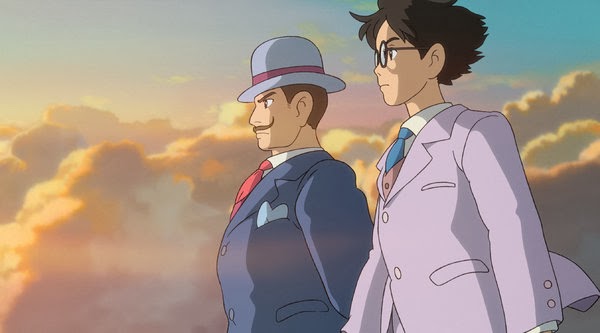
Written and directed by Hayao Miyazaki from his manga, Kaze Tachinu (The Wind Rises) is a fictionalized bio-pic about the life of Jiro Horikoshi as he was the man that designed the Mitsubishi A5M and its successor A6M Zero that played a key part in World War II. The film is a more dream-like portrait about Horikoshi’s life with some dramatic embellishments while not deviating too much from the real-life story. For the American-dubbed version of the film that is supervised by Gary Rydstrom, the voice cast includes Joseph Gordon-Levitt, Emily Blunt, John Krasinski, William H. Macy, Elijah Wood, Stanley Tucci, Mae Whitman, Mandy Patinkin, Jennifer Grey, and Werner Herzog. Kaze Tachinu is a mesmerizing film from Studio Ghibli and Hayao Miyazaki.
The film is fictionalized bio-pic about the life of Jiro Horikoshi that is presented in a dream-like fashion where it goes from Horikoshi as a young boy to becoming the man who would design the Mitsubishi A5M and its successor the A6M Zero that would become the key planes used in World War II. With a mixture of reality and a dream-like world, the film plays into Horikoshi’s desire to create the ultimate airplane that can endure wind resistance and not be intimidated by the advanced technology of other countries. Even as Horikishi (Joseph Gordon-Levitt) seeks the advice of the famed Italian plane designer Giovanni Battista Caproni (Stanley Tucci) in his dreams. Through Hayao Miyazaki’s screenplay, the film does have a conventional narrative in terms of structure that plays to Horikoshi’s life but he infuses with bits of surrealism and dreamy textures to make it much more interesting.
Notably as the film plays into key events that would mark Horikoshi’s development from his encounter at the 1923 Great Kanto Earthquake as well as his trip to Germany to see how the Germans created their airplanes. These moments would drive Horikoshi to see if he can create a war plane for Japan that would define them as they endure the Great Depression and such. While there would be some failures along the way, Hirokoshi would eventually find more inspiration when he re-meets Naoko (Emily Blunt) whom he had met years ago during a train ride with her sister where they encountered the Great Kanto Earthquake of 1923. His relationship with Naoko would prove to be a major catalyst to Horikoshi’s development as a man and as an engineer where he would try to balance both roles and later deal with his what he’s achieved.
Miyazaki’s direction is definitely dazzling in the way he creates Japan in the early half of the 20th Century as it’s a world that is trying to catch up with the modern world. Especially as he infuses bits of surrealism into the dream sequences that Horikoshi would have as it features some vast scenes of planes flying around and all sorts of things. Notably in the designs of the planes and how imaginative they look as it plays to what Horikoshi would want to create. The look of Japan from its different backgrounds of mountains, forests, and cities are presented with such great detail as there’s aspects in the background that are just as mesmerizing to look at. Even in the design of the characters which have all of the quintessential elements that is expected in Miyazaki’s work as an animator.
With the aid of cinematographer Atsushi Okui to help in the lighting where much of the animation is in 2-D hand drawn animated style with some computer-based animation for some of the backgrounds. Miyazaki creates something that is truly rich in scope but also infuse it with such artistry in the way the planes are flown as well as the way nature is presented as if it has the feel of a live-action film. Even in some of the compositions and camera work where it has a sense of action but also some drama and humor that just adds to the beauty of the film. Overall, Miyazki creates a truly evocative and sensational film about a dreamer who would create one of the greatest designs for a plane despite the fact that it’s being used as an instrument of war
Editor Takeshi Seyama does amazing work with the film‘s editing in its approach to rhythm for some of its action scenes as well as the dream sequences as it features lots of jump-cuts and disjointed rhythmic cuts to play into that sense of surrealism. Sound designer Koji Kasamatsu and sound editor Gwendolyn Yates Whittle (for its English version) do fantastic work with the sound in creating some of the sound effects used in the film with Whittle providing some low sound textures for some of the English dialogue as background textures. The film’s music by Joe Hisaishi is brilliant for its mixture of lush orchestral pieces with some playful and offbeat music driven by accordions and string instruments.
For the film’s English-language version, the cast includes some contributions from Elijah Wood as a co-worker of Horikoshi, Jennifer Grey as Mrs. Kurokawa, Darren Criss as another worker in Katayama, Mandy Patinkin as one of Horikoshi’s top bosses, Mae Whitman as Horikoshi’s sister Kayo, Zach Callison as the young Horikoshi, William H. Macy as Naoko’s father, Edie Merman as Horikoshi’s mother, and Werner Herzog in a superb voice performance as a German tourist Horikoshi meets in a retreat in the famed Magic Mountains in Japan. Martin Short is very funny as the comical boss Mr. Kurokawa who provides some humor as well as some guidance for Horikoshi while Stanley Tucci is brilliant as the famed Italian plane designer Giovanni Battista Caproni as Tucci sports an Italian accent as he displays warmth and humor into the role of the man who would guide Horikoshi.
John Krasinski is excellent as the voice of Horikoshi’s close colleague Kiro Honjo who aids Horikoshi in some of the designs as he would create his own planes that would also revolutionize planes in Japan. Emily Blunt is wonderful as Naoko as this woman who Horikoshi would meet early on as a young girl and later as a woman who would provide an inspiration and drive for Horikoshi after some of the failures he had to deal with. Finally, there’s Joseph Gordon-Levitt doing fantastic voice work as Jiro Horikoshi as this young man who dreams of designing an airplane that would define Japan in all of its glory though he is aware of what they’re being used for as he hopes they can provide some meaning into his life.
Kaze Tachinu is a remarkable film from Studio Ghibli and Hayao Miyazaki. It’s a film that is filled with rich images and a captivating story that manages to be wondrous as well as somber for what Jiro Horikoshi wanted to make. While it has some dark elements, it is balanced by the themes of being a dreamer which makes the story far more engaging. If this film is to become Miyazaki’s final contribution to cinema, he at least goes out with a winner. In the end, Kaze Tachinu is a phenomenal film from Hayao Miyazaki and Studio Ghibli.
Hayao Miyazaki Films: (The Castle of Cagliostro) - (Nausicaa of the Valley of the Wind) - (Castle in the Sky) - My Neighbor Totoro - Kiki’s Delivery Service - (Porco Rosso) - Princess Mononoke - Spirited Away - (Howl’s Moving Castle) - (Ponyo) - (The Boy and the Heron)
© thevoid99 2014
Wednesday, August 14, 2013
From One Second to the Next
Directed by Werner Herzog and presented by AT&T, Verizon, Sprint, and T-Mobile, From One Second to the Next is a 35-minute documentary about the dangers of texting while driving. The documentary isn’t just a public service announcement about the dangers of texting but also the damage that it brings as Herzog tells four different stories about the victims and those that had caused troubled all due to the dangers of texting while driving. The result is a sobering yet heart-wrenching documentary short from Werner Herzog.
This simple documentary tells the story of four people affected by the dangers of text and driving. First a boy named Xzavier from Michigan who was the victim of an accident that left him paralyzed and has to be on a ventilator. The second is a man named Chandler who had accidentally killed an Amish family in Indiana. The third is about a woman named Debbie who was hit by a car driven by a teenager while texting as she was just getting her mail with her dog who was killed. The fourth and final story is about a man named Reggie who caused a major accident that killed one person while a rancher had accidentally killed the other as he was trying to stop his truck.
These stories showcases not just the impact of how dangerous technology can be when not handled responsibly but also what it can do when one is driving a car on the road. Though Xzavier and Debbie are still alive, they’re not the same because of what happened as the latter can barely talk or do anything as she’s now in the care of friends and family. Chandler and Reggie are men who are forced to live with the guilt of their actions as the latter has become an advocate on the dangers of texting while driving. These people and their families all have a simple message as it’s to very directly without any embellishments nor in a heavy-handed manner.
With the help of cinematographer Peter Zeitlinger and editor Joe Bini, Herzog doesn’t go for any typical dramatic tricks to tell the story as he just goes for something that is very simple and understated. While he does use the music of Mark De Gil Antoni to underplay some of the drama, he doesn’t make it manipulative as he knows what is being told and just takes the time to talk to those who have been affected as well as a few police officers to showcase what happened as well as the damage it causes. Herzog doesn’t appear nor narrate the film by rather let the people do the talking and to just give out this message by just saying, it can wait.
From One Second to the Next is a powerful documentary short from Werner Herzog that is told with such care without the need to be overwrought. It’s a PSA that needs to be seen by not just licensed drivers but also young drivers who have just gotten their licenses or are getting their learner’s permit. It’s all about what not to do when one is driving on the road as it’s a truly harrowing documentary from Werner Herzog that needs to be seen.
Werner Herzog Films: Feature Films: (Signs of Life) - (Even the Dwarfs Started Small) - (Fatana Morgana) - Aguirre, the Wrath of God - (The Enigma of Kasper Hauer) - (Heart of Glass) - Stroszek - Nosferatu, the Vampire - Woyzeck - Fitzcarraldo - (Where the Green Ants Dream) - Cobra Verde - (Scream of Stone) - (Lessons of Darkness) - (Invincible (2001 film)) - (The Wild Blue Yonder) - Rescue Dawn - (Bad Lieutenant: Port of Call New Orleans) - (My Son, My Son, What Have Ye Done?) - Queen of the Desert
Documentaries: (The Flying Doctors of East Africa) - (Handicapped Future) - (Land of Silence and Darkness) - (The Great Ecstasy of Woodcarver Steiner) - (How Much Wood Would a Woodchuck Chuck) - (La Soufrière) - (Huie's Sermon) - (God's Angry Man) - (Ballad of the Little Soldier) - (The Dark Glow of the Mountains) - (Wodaabe – Herdsmen of the Sun) - (Echoes from a Somber Empire) - (Jag Mandir) - (Bells from the Deep) - (The Transformation of the World into Music) - (Death for Five Voices) - (Little Dieter Needs to Fly) - My Best Fiend - (Wings of Hope) - (Pilgrimage) - (Ten Thousand Years Older) - (Wheel of Time) - (The White Diamond) - Grizzly Man - Encounters at the End of the World - Cave of Forgotten Dreams - (Into the Abyss) - (On Death Row)
© thevoid99 2013
Friday, August 02, 2013
Cave of Forgotten Dreams
Written, directed, and narrated by Werner Herzog, Cave of Forgotten Dreams is a documentary about Herzog’s explorations into the Chauvet Caves in France that features some of the earlier artwork known to mankind. The film explores into the early world of civilization to trace back into the early years of man. The result is a fascinating yet extraordinary film from Werner Herzog.
In 1994, a man named Jean-Marie Chauvet along with two other people found a cave in the south of France near the Vallon-Pont-d’Arc that features some of the earliest artwork of mankind. Years later, Werner Herzog with a small film crew and a group consisting of archeologists, art historians, scientists, and geologists take a journey into the cave in late spring of 2010 under the permission of the French Minister of Culture. There, Herzog and this group explore the cave with its many drawings and features including animal tracks on its fragile grounds and other places but they couldn’t touch any of the features as they’re walking on very narrow, metallic platforms.
The film has Herzog interviewing many scientists, archeologists, artists, and such as they give their own theories about the cave and the paintings that is featured while Herzog through his own narration gives his own thoughts to the surroundings. With his cinematographer Peter Zeitlinger, sound recorder Eric Spritzer-Marlyn, and a production assistant, Herzog and his crew trek through the caves to see this artwork where they shoot in the cave for four hours in six days as the cave also include carbon dioxide and radon inside that is in near-toxic levels. Half of the film is set outside of the caves where some artifacts are revealed about the earliest findings in human history as well as an idea of how they lived.
Through the use of small digital cameras, Herzog, Zeitlinger, and the rest of the crew are able to get a nice look of the caves while using sticks to carry the camera to capture a few things that were unreachable. With the editing of Joe Bini and Maya Hawke, Herzog is able to create montages to showcase the numerous kinds of art work that is present as well as the atmosphere of the caves when it is presented with just silence. With the music of Ernst Reijseger that is filled with somber string arrangements and some choral music, it plays to that sense of mysticism inside the caves.
Cave of Forgotten Dreams is a phenomenal documentary by Werner Herzog. The film is definitely one of the most intriguing portraits about a part of the world that showcases many of the wonders of the world as well as some of the earliest images of art made by humanity. In the end, Cave of Forgotten Dreams is a remarkable film from Werner Herzog.
Werner Herzog Films: Feature Films: (Signs of Life) - (Even the Dwarfs Started Small) - (Fatana Morgana) - Aguirre, the Wrath of God - (The Enigma of Kasper Hauer) - (Heart of Glass) - Stroszek - Nosferatu the Vampire - Woyzeck - Fitzcarraldo - (Where the Green Ants Dream) - Cobra Verde - (Scream of Stone) - (Lessons of Darkness) - (Invincible (2001 film)) - (The Wild Blue Yonder) - Rescue Dawn - (Bad Lieutenant: Port of Call New Orleans) - (My Son, My Son, What Have Ye Done?) - Queen of the Desert
Documentaries: (The Flying Doctors of East Africa) - (Handicapped Future) - (Land of Silence and Darkness) - (The Great Ecstasy of Woodcarver Steiner) - (How Much Wood Would a Woodchuck Chuck) - (La Soufrière) - (Huie's Sermon) - (God's Angry Man) - (Ballad of the Little Soldier) - (The Dark Glow of the Mountains) - (Wodaabe – Herdsmen of the Sun) - (Echoes from a Somber Empire) - (Jag Mandir) - (Bells from the Deep) - (The Transformation of the World into Music) - (Death for Five Voices) - (Little Dieter Needs to Fly) - My Best Fiend - (Wings of Hope) - (Pilgrimage) - (Ten Thousand Years Older) - (Wheel of Time) - (The White Diamond) - Grizzly Man - Encounters at the End of the World - (Into the Abyss) - (On Death Row) - From One Second to the Next
© thevoid99 2013
Thursday, August 01, 2013
Dogme #6-Julien-Donkey Boy
Originally Written and Posted at Epinions.com on 9/27/ 09 w/ Additional Edits.
Julien Donkey-Boy/Dogme #6 tells the story of a young man who wanders around New York City while dealing with his schizophrenia. He also encounters his own dysfunctional family that included his gasmask-wearing, abusive father, his pregnant sister carrying his child, and a blind figure skater. Written by Harmony Korine and shot on digital video that was transferred to 16mm and later blown-up into 35mm film by cinematographer Anthony Dod Mantle, the film shows Korine's unique approach to the Dogme rules. Starring Ewan Bremner, Chloe Sevigny, Evan Neumann, Joyce Korine, and legendary German director Werner Herzog.
A young schizophrenic man named Julien (Ewam Bremner) is wandering around his New York City suburbs rambling incoherently and such. Living with a family that included his grandmother (Joyce Korine), his aspiring-wrestler brother Chris (Evan Neumann), his pregnant sister Pearl (Chloe Sevigny), and his gasmask-wearing father (Werner Herzog). Julien often spends his time with people with mental disorders and such including a young, blind figure skater named Chrissy (Chrissy Kobylak) as Julien often rambles on through his schizophrenic state of mind. With Pearl trying to find clothes for her newborn child and doing other activities. During a check-up on her child, a doctor asks who her father is but photos revealed that it was her brother Julien whom she has a maternal relationship with.
Julien's father however, is still dealing with the loss of his wife as he listens to blues records, talk with an armless man, and often abuse Chris in order to make him tougher for his wrestling career. The dysfunctional family often has a hard time dealing with day-to-day struggles as Julien would call his sister, who pretends to be their late mother while Julien continues to embark on strange events with his friends including an albino who claims to be a black albino which he raps about. During a wrestling practice for Chris, it doesn't go well when Julien doesn't want to play along. Julien spends more time alone and with Chrissy whom he falls for despite the fact that she's in her adolescents. When his father finally confronts the dysfunctions, things get really bad as Pearl is forced to defend him despite her own abuse from her father. During a day with Pearl and Chrissy, things go fine until something bad happens that leads to tragedy.
Since the film is a Dogme film in the purest sense of form. The director does break some rules in order to make his story more presentable. One rule which is against superficial action including murder has an opening scene involving murder. Another rule broken is the use of music that's not performed live while a rule involving a woman who isn't really pregnant is also broken due to a prop that wasn't found on location. The fourth rule that got broken was due to some of the camera work where at times, it was immovable and was placed in hidden places which broke the rule that all cameras had to be done and held by hand.
Despite the rules broken that was confessed by the director, the film does still manage to be unique due to its use of still shots, edits, and camera-work to convey the schizophrenic mind of its title protagonist. Though the film has an unconventional narrative by screenwriter Harmony Korine. The film plays like a scenic collection of fragmented stories but the main narrative of this dysfunctional family living with a schizophrenic is still there. Plus, the scenes and events in the film do tell a story that relates to the main plot, or lack thereof. The script and direction by the director works with wonderful style. Particularly through the distorted photography of Anthony Dod Mantle whose camera work is described as ugly at times but layered with beauty. Notably a scene in a skating rink that shows through its distorted, grainy photography its beauty through the scenes.
The editing by Valdis Oskarsdottir is unique in conveying the film's schizophrenic tone along with jump cuts and freeze frame to show the film's still shots. Sound recordist Brian Miksis does some amazing work to capture the film's natural sounds, notably the horror in the film's third act. The music used in the film is a mix of blues, hip-hop, and orchestral music from Puccini and Straus to convey the loneliness of Julien's father.
The film's casting is unique with several actors doing amazing performances including a cameo from indie-rocker Will Oldham, Alvin Law as Julien's father armless friend, and Joyce Korine as the grandmother. Chrissy Kobylak is great as a blind skater who seems very wise and is in fact, blind. Evan Neumann is great as an aspiring wrestler dealing with all of his family dysfunctions and such. Chloe Sevigny is brilliant as Pearl, a young woman who is dealing with her pregnancy as loss as she often plays a harp for the song Freres Jacques.
The legendary Werner Herzog gives an amazing, sprawling performances as an abusive, distraught father who wears a gas mask, drinking cough syrup, and doing all these things. One great scene involves Herzog's description of the film Dirty Harry that is imaginatively told. Ewan Bremner is great as the schizophrenic Julien by sporting gold teeth, an American accent to replace his native Scottish, and doing all sorts of things. His performance is a mixture of chaos and sadness as the depth he brings into this troubled character is truly amazing.
Julien-Donkey Boy is an incredible film that features an amazing cast and extraordinary visuals. It is definitely one of the key films of the Dogme 95 movement as well as one of the most fascinating portrayals about family dysfunction and mental illness. In the end, Julien-Donkey Boy is truly a tremendous film from Harmony Korine.
Harmony Korine Films: Gummo - (Mister Lonely) - (Trash Humpers) - Spring Breakers - (The Trap (2016 film)
© thevoid99 2013
Monday, May 14, 2012
Encounters at the End of the World
Originally Written and Posted at Epinions.com on 12/14/08 w/ Additional Edits.
Written, directed, and narrated by Werner Herzog, Encounters at the End of the World is about the exploration of Antarctica with Herzog and his cameraman Peter Zeitlinger meeting the people who are exploring the region as well as its animals, notably penguins. Instead of creating a film similar to the Oscar-award winning film March of the Penguins, Herzog goes for something more intellectual and not overly sentimental with his cynical view of nature. The result isn't just one of his best documentaries but a jaw-dropping look into one of the world's most fascinating places.
After seeing underwater footage of below the ice of Antarctica from friend, producer, and music composer Henry Kaiser. Werner Herzog and cinematographer Peter Zeitlinger travels to the continent as they hope to make a documentary with funding by the National Science Foundation. Hoping not to make a film similar to March of the Penguins, Herzog and Zeitlinger to go the McMurdo Station where they will live for seven weeks. The station is described as a mining town with activities and places that Herzog doesn't like which is dirty in comparison to the beautiful world of Antarctica. Talking to several of the people at the Station, Herzog reveals how newcomers must survive the cold winds and such at very low temperature where they also have to built igloos.
Learning about the long expeditions of Antarctica made famous by Ernest Shackleton, Roald Amundsen, and Robert Falcon Scott, Herzog interviews many scientists about the region and continuing studies and discoveries. Interviewing iceberg geologist Douglas MacAyeal, they learn about the power of icebergs while Herzog go to a colony of seals about the impact of milk from the mother seals. Going to meet Henry Kaiser at a diving camp, they meet with cell biologist Samuel Bowser who is about to take part on his final diving expedition. Uncovering the mysteries and wonders of the water underneath the ice along with new, mysterious species. Bowser along with zoologist Jan Pawlowski reveal some success as Bowser has an eccentric side while he and Kaiser have an impromptu outdoor concert with their guitars.
After more interviews with various people at McMurdo including an Apache plumber who also has Inca-Mayan bloodlines, they meet a computer expert in Karen Joyce who reveals her own adventures and is the most popular entertainer at the camp, and an Eastern European worker who carries a bag of survival gear in case things go wrong. Wanting to know about penguin colonies, Herzog interviews scientist David Ainley where he didn't get a lot of straight answers. Yet, Herzog notices a penguin walking alone towards the mountains where he reveals a rule about contacting them. When the journey goes to Mount Erbus, an active volcano, Herzog interviews volcanologists about its impact and studies revealing that it's still active. Yet, even when some get injured, they great treated and then go back to work. After exploring the cave and tunnels, Herzog interviews physicist Peter Gorham about neutrino detection as the mysteries of Antarctica still bring wonderment.
The film isn't a fluffy, enjoyable story about penguins that March of the Penguins had brought to the masses. Instead, Herzog goes for a more intellectual approach while finding moments that are entertaining. Yet, the legendary man with a cynical view on nature comments on everything he sees and the people he meets. For his cynicism, there's something in Herzog who is equally as fascinated in the world of Antarctica, it's underwater world, and creatures that he has an appreciation for. While Herzog allows his own commentaries and perspective of everything that he sees and thinks, he lets the scientists and personnel have the time to bring their own insight as Herzog becomes part of the audience.
The direction of Herzog is truly fascinating with help from Peter Zeitlinger's amazing camera that captures the beauty and also dangerous world of Antarctica. With Herzog also doing the production sound and being his own boom operator, he captures every moment that goes on. Yet, he also knows when an interview might go overlong where he would make comments and shorten stories. At the same, there's a disdain in Herzog's voice about the accomplishments of Ernest Shackleton where despite what Shackleton did in discovering the region. He criticizes Shackleton over his purpose while also taking shots at so-called tree-huggers and other environmental and animal activists for their ignorance about the language of nature.
While there's a scene where a seal is bagged just to get milk, it's a scene that might get animal-activists angry. Yet, the aftermath reveals from scientists and Herzog himself that the seals aren't being harmed and their behaviors don't change. It's a film that is about how these creatures live where the scientists are just trying to find out without disrupting them or doing any harm. That is something Herzog understands and respects while the underwater scenes that Henry Kaiser shoots are gorgeous and mystifying in the look of the creatures. More importantly, the sound of seals underwater recorded by Douglas Quin reveal something more fascinating as Herzog creates a film that is truly amazing and insightful to watch.
Longtime editor Joe Bini does an excellent job in the editing to gather all the footage and shorten interviews where Herzog is allowed to make commentary. In its 99-minute running time, it's a film that doesn't feel slow or moves very fast while Bini brings a lot of archival footage of the Shackleton expedition. The music of Henry Kaiser and David Lindley is rich in its mix of guitar, blues-based, melodic-driven music with banjos and arpeggio guitars. The soundtrack also features operatic score touches reminiscent of Herzog's previous film scores by Popol Vuh with operatic voices to help create the haunting tone for many of the film's underwater sequences.
Encounters at the End of the World is a rich, fascinating, and visually-amazing documentary from Werner Herzog. Fans of films about natures and science will be amazed in what Herzog has captured while revealing that there's more to tell. Fans of the legendary German director will no doubt be amazed at the story he told. More importantly, the film reveals the unique world of Antarctica without turning it into fluff or some average nature film. In the end, Encounters at the End of the World is an awe-inspiring film from Werner Herzog.
Werner Herzog Films: Feature Films: (Signs of Life) - (Even the Dwarfs Started Small) - (Fatana Morgana) - Aguirre, the Wrath of God - (The Enigma of Kasper Hauer) - (Heart of Glass) - Stroszek - Nosferatu, the Vampyre - Woyzeck - Fitzcarraldo - (Where the Green Ants Dream) - Cobra Verde - (Scream of Stone) - (Lessons of Darkness) - (Invincible (2001 film)) - (The Wild Blue Yonder) - Rescue Dawn - ((Bad Lieutenant: Port of Call New Orleans) - (My Son, My Son, What Have Ye Done?) - Queen of the Desert
Documentaries: (The Flying Doctors of East Africa) - (Handicapped Future) - (Land of Silence and Darkness) - (The Great Ecstasy of Woodcarver Steiner) - (How Much Wood Would a Woodchuck Chuck) - (La Soufrière) - (Huie's Sermon) - (God's Angry Man) - (Ballad of the Little Soldier) - (The Dark Glow of the Mountains) - (Wodaabe – Herdsmen of the Sun) - (Echoes from a Somber Empire) - (Jag Mandir) - (Bells from the Deep) - (The Transformation of the World into Music) - (Death for Five Voices) - (Little Dieter Needs to Fly) - My Best Fiend - (Wings of Hope) - (Pilgrimage) - (Ten Thousand Years Older) - (Wheel of Time) - (The White Diamond) - Grizzly Man - Cave of Forgotten Dreams - (Into the Abyss) - (On Death Row) - From One Second to the Next
© thevoid99 2012
Sunday, May 13, 2012
Rescue Dawn
Originally Written and Posted at Epinions.com on 11/27/07 w/ Additional Edits.
Based on a true story about Dieter Dengler's escape from a Laos prison during the Vietnam War, Rescue Dawn is a dramatic version of a story that German filmmaker Werner Herzog made back in 1997 in a documentary entitled Little Dieter Needs to Fly about Dengler and his escape. Playing the role of Dieter Dengler is Christian Bale. Also starring Steve Zahn and Jeremy Davies. Rescue Dawn is a thrilling yet engrossing film from Werner Herzog.
It's 1965 at the Gulf of Tonkin as Dieter Dengler and a few pilots are to take part in a classified mission to bomb a secret bases in Laos. For Dieter, it's his first mission as a flight lieutenant as the German-born man has dreamed of flying ever since seeing planes bombing his German village up above back in World War II when he was a child. Just as he arrived into Laos for the bombing, Dieter's plane is suddenly hit and crashes as he wanders around into the jungle. Trying to evade Vietcong troops and Laotian farmers, Dieter eventually gets captured as he endures a series of tortures and such. After being interrogated, Dieter refuses to sign a document that would've guaranteed his freedom as he's sent into a prison in the middle of the jungle.
He meets six prisoners from Air America that included Duane Martin (Steve Zahn), Eugene DeBruin (Jeremy Davies) and four Thai prisoners. After enduring months of imprisonment, Dieter plans an escape but Duane and Eugene tell him that outside the prison is the jungle that's a prison in itself. Despite the harsh times he stayed in the prison, he befriends Duane while making his plans slowly to try and escape. Finally, with the rain season starting to come, Dieter and his fellow prisoners prepare for their escape as they immediately succeed. With Eugene and the Thai prisoners splitting up to escape, Dieter and Duane make their way to the treacherous jungle as they battle a physical, mental, and emotional journey against the harsh world of nature. Yet, Dieter's optimism would be the catalyst for the journey as he hopes to come home.
While most films about the Vietnam War were often filled with grim themes and subject matters that were always cynical. A film like Rescue Dawn proved to be different since it's the story of an individual and his experience as a prisoner-of-war and his escape. For Werner Herzog, it's not a war film but a tribute to a friend whom he profiled back in 1997 for the documentary Little Dieter Needs to Fly. While he made dramatic changes for the story, Herzog is really paying tribute to a man whose lack of views about the war is overshadowed by his innocence and optimism that is rarely seen in a lot of war films.
The script by Herzog is told very simply with the first act being about Dieter's plane crash and his journey to prison with the second act being about his imprisonment and eventual escape. The third act is really about Dieter and Duane escaping through the treacherous jungle that becomes a part of Herzog's continuing theme of man vs. nature. While some audiences, particularly Herzog's more art-house film crowd, might complain about the film's ending which was dramatized. The ending works in ways for Herzog to pay tribute to Dengler, who died in 2001, by celebrating him as this great man whose optimism proved to be inspirational. Particularly in a war like the Vietnam War that was always filled with cynicism and unpopular.
The film isn't about the Vietnam War but a man maintaining this sense of optimism and hope in a moment that is harsh and cruel. Through his direction, Herzog goes deep into the jungles of Thailand and all of its landscape including treacherous rivers filled with snakes and such. Still, Herzog is willing to walk into the snake-infested rivers that are also filled with leeches to tell the story. More importantly, Herzog like his main actors was willing to shed pounds for the project in order to gain their trust. Through his observant camera and unconventional style, the film has a bit of cinema verite in conveying the action and drama of the film as if he makes it up along the way just for the story. Overall, Werner Herzog's work in both the writing and directing is his strongest feature-film work to date since 1982's Fitzcarraldo with Klaus Kinski.
Cinematographer Peter Zeitlinger does some amazing, evocative camera work to convey the beauty of the Thailand jungle with little style for a more documentary-like feel that is beautiful. Zeitlinger also uses a lot of hand-held camera for the action and dramatic sequences to maintain the verite style as he and his camera operator would go deep into the rivers and in the rain for the action of what is to come. Editor Joe Bini is superb for its meditative, elliptical style, even in the film's second act to convey the sense of boredom that goes on while a lot of the cutting in the film's plane crash in the first act doesn't fall into traditional, action-film style edits. Bini also uses stock footage from the original Laos bombing to open the film that works to convey when the film is taking place.
Art director Arin "Aoi" Pinijvararak and set decorator Peter Mayer do great work in creating the bamboo prison that Dengler and his fellow prisoners were staying including the houses and such. Costume designer Annie Dunn does great work in creating the look of fighter-pilot clothing as well as their decayed look throughout the entire film. Sound editor Peter Austin does some great work for the film's sound to convey the sense of violence in some scenes as well as the atmosphere of the jungle throughout the film. Music composer Klaus Badelt brings a contemplative, subtle score led by piano to convey the film’s drama without any kind of dramatic arrangements and such for the entire film until the end as Badlet's score is very memorable through and through.
The film's cast is wonderfully assembled with Abhijati "Meuk" Jusakul and Lek Chaiyan Chunsuttiwat as Dengler's fellow Thai prisoners, Francois Chau as the interrogator before Dengler's sent to prison, and as the prison guards, Teerawat Mulvilai, Mr. Yuttana Muenwaja, Mr. Kriangsak Ming-olo, and Somkuan "Kuan" Siroon as the quirky yet violent guards who each have a distinctive personality. Other notable small performances from GQ, Pat Healy, and Toby Huss are great as Dengler's fellow pilots while character actors Zach Grenier and Marshall Bell play Dengler's superiors. Jeremy Davies gives a phenomenal performance as the creepy yet cautious Eugene DeBruin who is hoping for the Americans to save him while not wanting to risk himself into the jungle. Davies' performance is superb for being a cynical, antagonist-of-sorts to Bale's unwavering optimism.
Steve Zahn delivers what has to be one of his best performances to date as Duane Martin. Zahn, known to many for his comedic performances, does bring a bit of humor to his character but his range as a dramatic actor is indeed a revelation. Notably for a man who no longer could take his imprisonment and becomes Dengler's friend in this horrific experience as Zahn captures his despair in the jungles as represents the struggles that soldiers go through as prisoners-of-war. Christian Bale delivers another solid performance that is no doubt inspiring as the late Dieter Dengler. While sporting a North American accent instead of a heavy, German-American accent, Bale proves his range as an innocent, optimistic fighter pilot who isn't wanting to give up. Bale, who is often criticized for his lack of humor, brings some humor to the character while his eerie performance as well as his look shows that he's an actor willing to take risks into any character he plays. It's a performance that will hopefully, won’t be overlooked by the end of the year.
Rescue Dawn is a sobering yet inspiring from Werner Herzog helmed by Christian Bale's exhilarating performance. With a great supporting cast, haunting imagery and locations, it's a film that fans of Herzog will enjoy. While the film would make a great companion piece to Herzog's 1997 documentary Little Dieter Needs to Fly. While it doesn't come close to Herzog's other feature-film classics like Aguirre, the Wrath of God or Fitzcarraldo, Rescue Dawn proves to an unforgettable film that shows that even through dark times and the treacherous jungles that there is hope. For a film that is inspiring and filled with hope, Rescue Dawn is the film to go see.
Werner Herzog Films: Feature Films: (Signs of Life) - (Even the Dwarfs Started Small) - (Fatana Morgana) - Aguirre, the Wrath of God - - (The Enigma of Kasper Hauer) - (Heart of Glass) - Stroszek - Nosferatu, the Vampyre - Woyzeck - Fitzcarraldo - (Where the Green Ants Dream) - Cobra Verde - (Scream of Stone) - (Lessons of Darkness) - (Invincible (2001 film)) - (The Wild Blue Yonder) - (Bad Lieutenant: Port of Call New Orleans) - (My Son, My Son, What Have Ye Done?) - Queen of the Desert
Documentaries: (The Flying Doctors of East Africa) - (Handicapped Future) - (Land of Silence and Darkness) - (The Great Ecstasy of Woodcarver Steiner) - (How Much Wood Would a Woodchuck Chuck) - (La Soufrière) - (Huie's Sermon) - (God's Angry Man) - (Ballad of the Little Soldier) - (The Dark Glow of the Mountains) - (Wodaabe – Herdsmen of the Sun) - (Echoes from a Somber Empire) - (Jag Mandir) - (Bells from the Deep) - (The Transformation of the World into Music) - (Death for Five Voices) - (Little Dieter Needs to Fly) - My Best Fiend - - (Wings of Hope) - (Pilgrimage) - (Ten Thousand Years Older) - (Wheel of Time) - (The White Diamond) - Grizzly Man - Encounters at the End of the World - Cave of Forgotten Dreams - (Into the Abyss) - (On Death Row) - From One Second to the Next
© thevoid99 2012
Subscribe to:
Posts (Atom)