In Memory of Roger Ebert (1942-2013)
Directed by Yasujiro Ozu, Floating Weeds is a remake of Ozu’s 1934 silent film A Story of Floating Weeds that explores an aging actor who arrives in a small town to visit his former mistress and his illegitimate son. Written by Ozu and Kogo Noda, the film is a simple story about a man trying to do right to the son he barely knew while his current lover becomes jealous about the other life that he has. Starring Ganjiro Nakamura, Machiko Kyo, Ayako Wakao, Hiroshi Kawaguchi, and Haruko Sugimura. Floating Weeds is a tremendous film from Yasujiro Ozu.
In this remake of Yasujiro Ozu’s 1934 silent film as it is presented in color and with sound, the story remains the same though Ozu and co-screenwriter Kogo Noda do make a few changes to update the story a bit. Still, it is about an aging actor of a traveling acting troupe who arrives at a small town to visit a former lover and his illegitimate son who only knows the man as his uncle. The actor’s time towards the son he barely knows causes jealousy in his current lover who hires a young actress to seduce the man’s son only for things to get complicated. It’s all part of Ozu’s exploration to see a man trying to reconnect with the family he abandoned while the current family he has in his acting troupe are starting to get lost without him.
Even as the script allows Ozu and Noda to take more time to not just explore the other actors of the troupe but also the prominent characters that are embroiled in a world full of secrets. While Komajuro (Ganjiro Nakamura) and Oyoshi (Haruko Sugimura) maintain the secret about who Komajuro really is just to protect their son Kiyoshi (Hiroshi Kawaguchi) from the shame of having a poor actor as a father. For Komajaru’s mistress Sumiko (Machiko Kyo), the news about Komajuro’s other life is a shock for her as she is jealous thinking she’s the most important thing he has. By goading the younger actress Kayo (Ayako Wakao) to seduce Kiyoshi, she would hope she would get Komajuro back but things not only get complicated as well as creating more trouble for Komajuro’s troupe that is already going through financial trouble and neglect from the manager that was supposed to help them.
The direction of Ozu is very understated and simplistic in terms of the compositions that he creates as well as the drama that is played out. In that style where he never moves the camera nor utilizes any close-ups, Ozu uses a lot of medium and wide shots in a full-frame setting to capture a world that is intimate but also full of life. Notably as Ozu maintains a point of view where it’s seen by the audience whether it’s a stage presentation from the acting troupe or some of the more intimate moments between the many characters in the film. Shot on a low-tripod stance, Ozu manages to create a lot of coverage in his framing while knowing where to position the camera to capture these little simple moments that cay say a lot by doing so little. It’s part of Ozu’s unique approach to minimalist filmmaking while letting the drama play out naturally though keeping the actors in certain places to be in the frame. Overall, Ozu creates a very mesmerizing and exquisite film about family, regrets, and the desire for redemption.
Cinematographer Kazuo Miyagawa does amazing work with the film‘s lush and colorful cinematography from the exteriors set in a small seaside town with its gorgeous colors to the some of the film‘s interiors including the stage scenes that includes some wonderful lighting by Sachio Ito to help enhance the film‘s beauty. Editor Toyo Suzuki does nice work with the film‘s editing where it maintains this slow yet methodical pace while doing a few rhythmic cuts to play out some of the drama. Production designer Hideo Matsuyama and art director Tomoo Shimogawara do great work with the set pieces from the bar that Sumiko runs to the stage house the actors stay in.
Sound recorder Takeo Suda does terrific work with the sound from the intimacy that goes on in the stage scenes to the more broader moments for the exterior scenes including the beaches and streets. The film’s music by Kojun Saito is brilliant as it features an array of themes that are just wonderful to listen to with its mixture of orchestral textures and folk music to play up the drama and some of the film’s light-hearted moments.
The film’s cast is excellent as it features a noteworthy ensemble that is filled with some memorable small performances from Chishu Ryu as a theater owner, Hitomi Nozoe as a girl working at a barbershop, Mantaro Urabe as an elder actor of the troupe, Mutsuko Sakura as a waitress, and as the trio of young actors looking for something to do in the town, Haruo Tanaka, Yosuke Irie, and Hikaru Hoshi. Another small performance that should be noted is from Koji Mitsui as one of the older actors of the troupe as he played the son in the 1934 silent film A Story of Floating Weeds. Ayako Wakao is wonderful as the young actress Kayo who is asked by Sumiko to seduce Kiyoshi only for things to become complicated as she has no idea what to do. Haruko Sugimara is terrific as Kiyoshi’s mother who is carrying Komajuro’s secret to protect everyone while dealing with the chaos that is happening around her.
Hiroshi Kawaguchi is amazing as Kiyoshi as a young postal clerk with an ambition to go to college as he is suddenly wooed by a young woman unsure about the path he’s taking as well as deal with the man he’s called his uncle. Machiko Kyo is remarkable as Sumiko as a woman who is envious of the other life Komajuro has where she schemes to ruin it only for things to get even worse as Kyo brings an element of heartbreak and anger to her role. Finally, there’s Ganjiro Nakamura in a brilliant performance as Komajuro as a man who is hoping to succeed as an actor to make his son proud while dealing with all of the chaos of maintaining his secret and not bring shame to his son as it’s a really mesmerizing performance to watch.
Floating Weeds is a magnificent film from Yasujiro Ozu. Armed with a great ensemble cast, beautiful cinematography, and a fantastic score, the film is definitely one of Ozu’s greatest triumphs. It’s also one of the most compelling pieces of cinema that explores the idea of family and the desire to find redemption in the wake of shame. In the end, Floating Weeds is an incredible film from Yasujiro Ozu.
Yasujiro Ozu Films: (Sword of Penitence) - (Days of Youth) - Tokyo Chorus - I Was Born, But… - (Dragnet Girl) - Passing Fancy - (A Mother Should Be Loved) - A Story of Floating Weeds - (An Inn in Tokyo) - (The Only Son) - (What Did the Lady Forget?) - (Brothers and Sisters of the Toda Family) - (There Was a Father) - Record of a Tenement Gentleman - (A Hen in the Wind) - Late Spring - Early Summer - (The Flavor of Green Tea Over Rice) - Tokyo Story - Early Spring - Tokyo Twilight - (Equinox Flower) - Good Morning - Late Autumn - The End of Summer - An Autumn Afternoon
© thevoid99 2013
Directed by Danny Boyle and written by Joe Ahearne and John Hodge from a story by Ahearne, Trance is the story about an art auctioneer who was involved in a robbery as he’s captured by a criminal who is trying to find a valuable painting with the help of a hypno-therapist. The film is a take on the film noir genre with a modern setting as it blurs the idea of reality and fiction where a man is being hypnotized to find a valuable painting. Starring James McAvoy, Rosario Dawson, Tuppence Middleton, and Vincent Cassel. Trance is a hypnotic yet entrancing film from Danny Boyle.
The film is about a robbery where the objective is to get an extremely valuable painting by Francisco Goya where everything goes well except that the actual painting is missing. The art auctioneer involved in the robbery has unknowingly hidden the painting unaware of its whereabouts as a crime boss decides to get a hypno-therapist to get into the mind of this man to see if he can remember where the painting is. What happens is that things get more complicated as reality and fiction begins to blur as does motives where those involved are unsure if everything they’re dealing with isn’t real. It’s a film that is really more about memory and the ability to remember but in the course of the story. Things eventually become more complicated as things aren’t exactly remembered as they were leading to all sorts of confusion where is everything that is happening real or is it part of something more?
The screenplay by Joe Ahearne and John Hodge is presented in a narrative style that recalls the idea of film noir where there are voice-over narration as well as archetypes of what is expected in film noir. Yet, there is much more that is present in the script as it has a narrative that is much more complex where it goes back to the idea of fiction and reality. Leading all of this is this young art auctioneer in Simon (James McAvoy) whose job is to get the painting and give it to the crime boss Frank (Vincent Cassel) who will wipe away his gambling debts in return. Instead, things don’t go that way as Simon tries to play hero where a hit in the head not only has him unsure of the painting’s whereabouts but also makes him vulnerable. By getting the hypno-therapist Elizabeth (Rosario Dawson) to go inside Simon’s mind with equal help from Frank and his associates. They hope to see if Simon can remember but under hypnosis, Simon’s mind gets more troubling.
The schematics of noir often has the protagonist falling for the femme fatale and to try and defy the antagonist but Ahearne and Hodge decide to play with those conventions by making these three archetypes much more realistic as well as add a sense of fantasy. Eventually, things become more troubling where Simon falls for Elizabeth though it becomes unclear whether it’s real or in his head as it triggers all sorts of events that happened on the day of the robbery. It creates problems for Elizabeth who realizes how damaged Simon’s head is where Frank starts to lose his patience as he starts to become aware that not everything is as simple as it seems. Even as he is unable to regain control of the situation as he and his goons have to play by not just Elizabeth’s rules but also wait to see if Simon can remember. It’s not just the structure and the way the characters that are created that makes the script so engaging but also its language where it is very stylized and has a certain rhythm that is part of the tradition of film noir.
Danny Boyle’s direction is very stylish in not just its presentation but also for allowing the script to guide him into the idea of fantasy and reality. The film opens with how an auction robbery can be staged as it is told in a noir-style narration as its first act does start off in a conventional manner. Even in the way characters are presented as it then leads to moments where it introduces Elizabeth and play off this world of fantasy and reality. The second act is where Boyle gets to play that world where he places a few scenes in the French countryside though the film is largely set in London. The scenes in France is an ode to not just the world of European art-house cinema of the 60s and 70s but also the idea of a fantasy that can lead to a world of surrealism.
Boyle infuses lot of strange camera angles to present the idea of fantasy and reality where things might seem confusing but there’s aspects of that conflict that maintain the idea that it’s all based on memory. Memory can allow someone to play parts of what happened but not everything can be told exactly at it could be where Boyle shows that things can get very confusing. Still, Boyle is all about emphasizing that world of film noir where there is a payoff and some twists where the third act reveals some more intense dramatic stakes that makes things much more unsettling. Overall, Boyle creates a truly exhilarating and intense ode to film noir about a robbery and a man’s desire to remember what happened.
Cinematographer Anthony Dod Mantle does brilliant work with the film‘s very colorful cinematography with its use of colorful lighting schemes and mood settings along with some lens flares to give an air of style to the camera work as Mantle‘s work is a highlight of the film. Editor Jon Harris does amazing work with the editing as it does play an air of style with jump-cuts, montages, and all sorts of cutting style while helping to play out the narrative with its blur of fiction and reality. Production designer Mark Tildesley, with set decorator Dominic Capon and supervising art director Denis Schnegg, does excellent work with the set pieces from the homes of the characters to the recreation of the paintings to establish the value of those works of art.
Costume designer Suttirat Anne Larlarb does terrific work with the costumes to play out that idea of film noir where some of the clothes are casual while a lot of it also stylized including the clothes that Elizabeth wears. Visual effects supervisor Adam Gascoyne does nice work with some of the film‘s minimal visual effects to play out that world of reality, fiction, and surrealism including some of the film‘s violent moments. Sound designer Glenn Freemantle does fantastic work with the sound from a few of the therapy scenes to some of the more quieter moments to play out some of its suspense. The film’s music by Rick Smith is superb for its moody electronic score with elements of pulsating electronic beats and some somber moments as the soundtrack also features music from UNKLE, Moby, M People, Kirsty McGee, Art & Dotty Todd, and a collaborative track with Emeli Sande and Rick Smith.
The casting by Donna Isaacson and Gail Stevens is incredible for the ensemble that is created. Notable small roles include Danny Sapani, Matt Cross, and Wahab Sheikh as Frank’s trio of goons who are always around Frank as they also get a chance to stand out on their own. Other small roles that are memorable include Tuppence Middleton as a woman Simon meets in one of his hypnosis fantasies and Simon Kunz as a surgeon who watches over Simon that Frank later talks to about the concept of memory.
Vincent Cassel is marvelous as the crime boss Frank who is a man that wants his painting as he deals with the idea of hypnosis as well as its complications as he adds a lot of layers to the film that makes him more than just a typical noir antagonist. Rosario Dawson is brilliant as Elizabeth as a hypno-therapist that is trying to get into Simon’s mind while being in control as she would later realize that there are things beyond her control that eventually complicate matters. James McAvoy is remarkable as Simon as a man who can’t remember about what happened in the robbery while being under hypnosis to see if he can remember only to realize that there’s a lot more trouble than he’s facing.
Trance is a phenomenal film from Danny Boyle that is highlighted by its technical brilliance, Rick Smith’s score, and the performances of James McAvoy, Rosario Dawson, and Vincent Cassel. It’s a film that is definitely one of Boyle’s most inventive and provocative features as well as a stylish spin on the film noir genre. It’s also a very captivating film that explores the world of memory and how things can either help or prevent someone from finding something. In the end, Trance is a sensational film from Danny Boyle.
Danny Boyle Films: Shallow Grave - Trainspotting - A Life Less Ordinary - The Beach - 28 Days Later - Millions - Sunshine - Slumdog Millionaire - 127 Hours - Steve Jobs (2015 film) - T2 Trainspotting - (Yesterday (2019 film))
© thevoid99 2013

Written and directed by Terrence Malick, To the Wonder is about an American man who falls for a European woman in France as he takes her and her daughter to America where their love dims as he starts to reconnect with a former flame. The film is an experimental feature of sorts for Malick that explores the world of love and its troubles as well as exploring the world of faith from the perspective of a priest. Starring Ben Affleck, Olga Kurylenko, Rachel McAdams, and Javier Bardem. To the Wonder is a enchanting and glorious film from Terrence Malick.
It’s a film that explores the idea of love in all of its splendor but also its trappings where everyone has these great intentions but there are forces that are unexplained that will tear them apart. While there isn’t much of a screenplay written for this film, there is still a structure of sorts into how Terrence Malick tells the story as the first act is about Neil (Ben Affleck) and Marina (Olga Kurylenko) meeting and falling in love where they go to America. The second act is about Marina going back to Paris after her visa expires where Neil is alone in Bartlesville, Oklahoma where he reconnects with an old flame in Jane (Rachel McAdams) as they have a brief affair. The third act is about Marina’s return to Bartlesville to marry Neil where their love starts to dim as they have no idea what went wrong where they turn to Father Quintana (Javier Bardem) who is going through his own crisis of faith.
A lesser script or a lesser filmmaker would’ve gone for some kind of plot schematics to flesh out the characters more or have them be placed into some kind of formula. In the hands of someone like Malick, it is very stripped down and very loose in order to explore the idea of love. Notably as it reveals the intentions of someone like Neil to give Marina and her daughter Tatiana (Tatiana Chiline) a good life that is free and enjoyable. The characters that Malick create are people who are flawed yet very realistic as Neil is a man who is kind and generous but is also a typical man who likes to look at other women. Marina is a free-spirit who likes to wander around any kind of surroundings as she’s somewhat childlike in the way she expresses herself. Upon her arrival to America, she has a hard time connecting with the people and the land as there is this sense of alienation that she and her daughter go through where Marina does have a brief rapport with Father Quintana who is also a foreigner.
Then there’s Jane who is a bit more grounded than Marina as she offers something to Neil that he finds appealing as well as the fact that they have a history together. Still, she knows that Neil is married as Neil is torn between his devotion to Marina but is also in love with Jane as she is hurt by these circumstances. The Father Quintana character is an interesting character but he is part of a subplot of his own as this foreign Catholic priest who lives in Bartlesville who is often questioning himself about his role in the world as he is trying to help others. Still, the sense of doubt he’s dealing with starts to overwhelm him where he and Neil start to connect by going directly to the people in Bartlesville to see what they can do. Still, Quintana is a commentator of sorts as he often talks about love and all of its complexities as it relates to Neil and Marina’s relationship. Even as Malick gives these four principle characters voice-over narrations (w/ Quintana in Spanish and Marina in French) to reflect on themselves and the people around them but it’s done in a mostly minimalist manner.
Malick’s direction is quite typical of what is known about him as a man who is known for creating these gorgeous images that only he could make as he’s spawned many imitators who have been influenced by his visual style. Still, there are things in Malick’s direction that sets him apart from not just his imitators but other filmmakers in the way he creates these free-flowing images filled with some unique framing devices and ethereal camera angles. Even as Malick would often incorporate images of nature to play up the idea of natural forces playing to the fates of these characters. While a lot of the film is shot in Bartlesville, Oklahoma where it is a unique slice of Americana that is filled with clean-cut grasses in the suburbs and places that is typical of American small towns. It does feel like a place that is quite foreign as well as a bit more structured opposed to some aspects of France that Marina lives in.
Malick’s direction is also taking some risks where it is definitely an experimental film of sorts where he also uses a bit of digital video early in the film through the use phone-cams and computers. Another thing that sets this film apart from his other films is that it takes place in a contemporary setting where Malick is going for this very cinema verite style of hand-held cameras of shooting a film just as things are happening around him where he would use a close-up of various real people in the film including convicts pleading to Father Quintana. While it’s a style that isn’t for everyone’s taste as there are things that do get a bit over-drawn in the third act as well as meanders a bit due to its lack of conventional script. It does have a payoff as it relates to the Mont St. Michel cathedral in France where Neil and Marina’s love reaches its apex as Marina through her voice-over calls it the Wonder. Overall despite a few flaws, Malick creates a film that is poignant and engrossing in its exploration into the world of love and faith.
Cinematographer Emmanuel “Chivo” Lubezki does what is absolutely some outstanding work with the film‘s very gorgeous and intoxicating photography with its emphasis on natural lighting to create images that are just jaw-dropping. Even in some of the film‘s exterior settings in France and in Bartlesville, Oklahoma where the camera is always gazing into something that is otherworldly as well as some scenes in the exteriors where it maintains something that feels real as Chivo‘s work is just another of his great accomplishments as a cinematographer. Editors A.J. Edwards, Keith Fraase, Shane Hazen, Christopher Roldan, and Mark Yoshikawa do excellent work with the film’s stylized editing with its use of rhythmic jump-cuts as well as a few fade-outs to help structure the film.
Production designer Jack Fisk, with set decorator Jeanne Scott and art director David Crank, does superb work with some of the film‘s set pieces such as the house that Neil and Marina stay in Bartlesville as well as a few sets in France and other locations in Bartlesville. Costume designer Jacqueline West does nice work with the costumes as it is all casual though she makes some nice dresses for both Marina and Jane to establish their characters. Sound editor Craig Berkey and sound designer Erik Aadahl do amazing work with the sound to create some textures in the sound from the voice-overs to the way things sound on location as it’s definitely another highlight of the film.
The film’s soundtrack that is supervised by Lauren Marie Mikus is largely a collection of orchestral music that features some original compositions by Hanan Townshend as well as piece from Francisco Lupica. Still, it is largely dominated by the compositions of pieces by Hector Berlioz, Richard Wagner, Joseph Haydn, Ottorino Respighi, Tchaikovsky, Johann Sebastian Bach, Avro Part, Dmitri Shostakovich, Sergei Rachmaninoff, and Henryk Gorecki. There’s also a few contemporary music that is played in the background by the Oh Sees and St. Vincent to establish the world of Bartlesville.
The casting by Chris Freihofer is remarkable as it consists largely of real people in the background with the exception of a few actors such as Charles Barker as a carpenter Marina befriends and Romina Mondello as an Italian friend of Marina who visits late in the film who questions about Marina’s love life. Tatiana Chiline is wonderful as Marina’s daughter Tatiana as a young girl who is like her mother while feeling out of place in a world as unique that is America. Javier Bardem is superb as Father Quintana as a man who is trying to deal with his doubt as well as trying to be there for the people in Bartlesville directly to see if he can make a difference in their life. Rachel McAdams is amazing as Jane as a woman dealing with her own loss as she and Neil reconnect in a love affair as it is a performance full of radiance and beauty.
Ben Affleck is excellent as Neil as a man who exemplifies all of the good natures of a man who can bring a lot to Marina but is also troubled by the fact that she’s a foreigner in a foreign land while he has temptations of his own as it’s a very engaging one from Affleck that doesn’t have him doing a lot but bringing exactly into what was needed. Finally, there’s Olga Kurylenko in a tremendous performance as Marina as a woman who is so full of life and wonderment as she thinks she has it all until arriving into America realizing how alien she feels in a new land while becoming more lost after marrying Neil as it’s definitely a performance that will be unforgettable.
To the Wonder is a rapturous and sensational film from Terrence Malick. Armed with a great ensemble cast and amazing technical work led by Emmanuel Lubezki’s ravishing cinematography. The film is definitely a very mesmerizing film that explores the world of love as well as faith. While it’s a film that will definitely baffle, annoy, and frustrate casual viewers though are moments that are quite accessible as it would recall some of Malick’s early films from the 1970s. The fact that it’s a very unconventional story is not going to be everyone’s cup of tea as it also contains some of more abstracts elements of Malick’s recent films. Still, there is nothing like this as To the Wonder is an incredible piece of cinema from one of its masters in Terrence Malick.
Terrence Malick Films: Badlands - Days of Heaven - The Thin Red Line - The New World - The Tree of Life - Knight of Cups - Voyage of Time: The IMAX Experience - (Voyage of Time: Life's Journey) - Song to Song - A Hidden Life - (The Way of the Wind)
© thevoid99 2013

Top of the Lake is a seven-part TV miniseries about a detective who is trying to find a 12-year old pregnant girl whose father is a local drug lord in a small yet remote New Zealand town. Written and created by Jane Campion and Gerard Lee and directed by Campion and Garth Davis, the miniseries is a suspense story that involves a world where many people are carrying secrets and some are trying to hide from the secrets just as a girl is disappearing from the world. Starring Elisabeth Moss, Peter Mullan, David Wenham, and Holly Hunter. Top of the Lake is a chilling yet mesmerizing miniseries from Jane Campion, Garth Davis, and Gerard Lee.
A 12-year old girl named Tui (Jacqueline Joe) is pregnant as she is the daughter of a local drug lord named Matt Mitcham (Peter Mullan) where people are wondering who got her pregnant. An investigation happens led by Robin Griffin (Elisabeth Moss) as she questions Tui about who the father is where the only thing Tui reveals are the words “no one”. When Tui suddenly disappears, a manhunt happens where Griffin turns to her former boyfriend and Tui’s half-brother Johnno Mitcham (Thomas M Wright) for help while getting aid from Detective Sergeant Al Parker (David Wenham). While the investigation progresses as it involves land disputes, drug trades, and all sorts of things in the underworld while a group of women are seeking sanctuary in a camp led by the enigmatic GJ (Holly Hunter).
Things eventually take an emotional and mental toll on Griffin, who was the victim of a rape at the age of 15, as her mother (Robyn Nevin) is dying while she becomes troubled by her own past. Secrets are unveiled that leads to Griffin to get more questions about Tui’s whereabouts as well as the mystery into who is the father of Tui’s baby. What the miniseries does is create a story that isn’t just a suspense-drama but a woman’s exploration into facing her own demons just as she is trying to find this young girl. Even as she is surrounded by women who are victims of abuse, neglect, or something incomprehensible as they try to save themselves in this camp led by this strange figure. Just as the series progresses in each episode, the stakes of trying to find Tui becomes much more troubling as it’s not just the police that are trying to find her but the girl’s father who is descending into madness over her disappearance.
The teleplay by Jane Campion and Gerard Lee does play with some of the conventions of a mystery where little clues do arrive to reveal something big or small. By breaking the story into seven parts, it allows each episode to reveal little clues on not just Tui’s disappearance but why Robin Griffin is so personally invested in this case as it relates to her own demons from the past. Even as each clue she finds brings her closer to not just about Tui but also a dark underworld involving the drug trade and prostitution. She also has to confront the people around her including her boss, her former boyfriend, and her ailing mother about these secrets where her mother is carrying one of her own that would later impact Robin to the brink of an emotional breakdown.
The script also plays into characters like Matt Mitcham, Johnno Mitcham, and Al Parker as they’re these three different men who are all connected to Robin Griffin as well as the case. While Matt Mitcham may be this local drug lord with a dark reputation as well as having casual conversations with the police, he’s also a man that is becoming troubled by Tui’s disappearance. Either he’s in denial or he might be involved about what happened to Tui yet he is someone that does have good intentions to get his daughter back. Matt’s estranged son Johnno is a man trying to start a new life after serving an eight-year prison in Thailand as he was living with Tui’s mother. Having Robin back in in his life creates complications as he remembers the night Robin was raped while his presence makes her mother uncomfortable which relates to the secret that she carries during her visit to GJ’s compound.
Al Parker is just as mysterious as the other characters as he is a leading police figure who is very rich and lives in a lavish home which causes Robin to raise questions about how he makes his money. Although he would help Robin and even ask her to marry him, there are still things about him that makes Robin uneasy as well as his connection to Mitcham. Then there’s the camp compound leader GJ who is easily the most mysterious person of the entire story. Though she doesn’t really do much when it involves Tui or the case, she is someone who provides shelter to women yet she says mysterious things that are very eccentric. Yet, she knows what these women are going through but doesn’t provide answers that will help them but rather point them in the right direction.
The direction of Jane Campion and Garth Davis is very entrancing for the way it presents this small town in New Zealand that is surrounded by mountains and a big lake where these locations are characters in the miniseries. Shot in the cities of Queenstown and Glenorchy, the miniseries does have this air of chilling ambiance in its settings where there’s a lot of bluish, grey colors while there is this mix between nature and the city. Notably for the scenes set in the day where there is this sense of unease throughout the town where there is something that is secretive but no one wants to speak out. The images that Campion and Davis create are full of mesmerizing imagery and lots of little tidbits such as deer heads, bones, and other things to establish a world that is modern but still reveled in something that harkens back to the idea of an old world order.
Filled with a mixture of shots ranging from hand-held to gazing establishing shots of the location, the direction is quite stylish but also intimate at times to play out some of the drama that occurs. Notably as it has this air of suspense that happens throughout including some flashback scenes where it plays into Griffin’s past and her motivation to find Tui. There are twists and turns that happens throughout the miniseries where it does reach a climax that isn’t just horrifying but also maintains an air of ambiguity where some answers are revealed though are also questions that don’t get answered. Overall, Jane Campion, Garth Davis, and Gerard Lee create a hypnotic yet engrossing suspense-drama that explores the world of demons and dark secrets.
Cinematographer Adam Arkapaw does excellent work with the look of the miniseries with its exotic blue-grey color to create an air of despair and uncertainty to many of the miniseries‘ locations as well as keeping things natural for the scenes at night and the scenes at the forest. Editors Alexandre de Franceschi and Scott Gray do fantastic work with the editing to give each episode some stylish cuts from jump cuts and fade-outs while building up the suspense with slow yet methodical cuts. Production designer Fiona Crombie does amazing work with the set pieces from the look of Parker‘s posh home to the more cabin-like home of Matt Mitcham that includes a drug lab under his bathroom.
Costume designer Emily Seresin does nice work with the costumes as a lot of it is mostly casual though the clothes do help out in establishing key parts of the film as it relates to clues about Tui‘s whereabouts. Sound designer Tony Vaccher does superb work with the sound to create an atmosphere in some of the party scenes as well as in the suspenseful moments to maintain that air of dread. The music by Mark Bradshaw is exquisite for its hypnotic mood with its plaintive sounds of guitar and piano to create a sense of melancholia and dread throughout the miniseries.
The casting by Kirsty McGregor is brilliant for the ensemble that is created for this miniseries. Notable appearances include Genevieve Lemon and Robyn Malcolm as a couple of women at the compound, Darren Gilshenan as the real estates agent Bob Platt who is hiding a dark secret about the town, Luke Buchanan as Tui’s friend Jamie, Mirrah Foulkes as Jamie’s mother Simone who also works for Mitcham, Kip Chapman and Jay Ryan as two of Mitcham’s adult sons, Calvin Tuteao as Jude Griffin’s Maori boyfriend, and Lucy Lawless as Platt’s wife who tells Robin about the secrets in Bob’s computer. Jaqueline Joe is excellent as the young girl Tui who finds herself the subject of a mysterious hunt about who the father of her baby is as she suddenly disappears. Robyn Nevin is wonderful as Robin’s mother Jude who is dealing with her illness while carrying a secret that would shake up Robin’s relationship with Johnno.
Thomas M. Wright is terrific as Matt’s estranged son Johnno who helps Robin out in finding Tui while dealing with his own issues as it relates to his relationship with Robin in the past as he yearns to start a new life for himself. Peter Mullan is great as the drug lord Matt Mitcham who is man eager to find his daughter while coming undone by her disappearance as he tries to hold on to his drug empire and finding some redemption. David Wenham is amazing as Detective Sgt. Al Parker who heads the investigation to find Tui while he being very ambiguous about his connection with Mitcham as well as his finances.
Holly Hunter is superb as GJ as she is just this very strange woman who is the head of a sanctuary as she says very weird things that would later prove to be helpful. Finally, there’s Elisabeth Moss in a remarkable performance as Robin Griffin where Moss brings a chilling intensity to a woman eager to find this young girl and face her own demons where Moss displays a sense of rawness and vulnerability to a role where a woman is trying to do something good in a chaotic world.
Top of the Lake is a phenomenal TV miniseries from Jane Campion, Garth Davis, and co-writer Gerard Lee that features top-notch performances from Elisabeth Moss, Peter Mullan, David Wenham, and Holly Hunter. It’s definitely one of Jane Campion’s fine works in terms of creating a suspense film led by a female protagonist while adding layers that makes the project far more compelling. It’s also a very provocative miniseries that explores a dark underworld as well as secrets that people don’t want to unveil. In the end, Top of the Lake is a fantastic TV miniseries from Jane Campion, Garth Davis, and Gerard Lee.
Jane Campion Films: Sweetie - An Angel at My Table - The Piano - The Portrait of a Lady - Holy Smoke! - In the Cut - Bright Star - (Top of the Lake-China Girl) - The Power of the Dog - The Auteurs #25: Jane Campion
© thevoid99 2013
Directed by Yasujiro Ozu and written by Ozu and Tadao Ikeda from a story by James Maki, A Story of Floating Weeds is the story about an aging actor who arrives to a small town with his troupe of actors where he meets his old lover and their illegitimate son much to dismay of his current lover. The film is an exploration into a man’s desire to get to know the son he barely knew while trying to give his time towards the people he abandoned while unknowingly abandoning those who also need him. Starring Takeshi Sakamoto, Chouko Iida, Koji Mitsui, and Yoshiko Tsubouchi. A Story of Floating Weeds is a majestic yet heartbreaking film from Yasujiro Ozu.
The film is simple story about an actor, who leads a traveling acting troupe, who arrives at a small town to do a show where yet what he wants to do is see an old lover and his illegitimate son. While wanting to get to know this young man whom he has provided money for so he can get an education and the chance to do something great. The man’s lover feels neglected as she realizes what’s going as she goads a young actress from the troupe to seduce the man’s son in order to create chaos. Instead, things don’t go as planned leaving the man to face all of the trouble he’s created in his past and the life that he has now. It’s all part of a world in which a man is trying to find redemption for his past actions while he’s unaware of the trouble he’s creating in his troupe of actors as they’re dealing with inactivity as well as a lack of money.
The screenplay explores the world of a man trying to do right to the family he had abandoned though he is known to his son as his uncle. Yet, Kihachi Ichikawa (Takeshi Sakamoto) just wants to his son to know that his father isn’t some failure by claiming that his real father was a civil servant who had died. His old lover Otsune (Chouko Iida) would maintain that lie to not just protect Kihachi from shame but also for their son Shinkichi (Koji Mitsui). Still, Shinkichi is happy to see the man he calls his uncle as they share moments together as if they’re father and son. For Kihachi’s current mistress Otaka (Rieko Yagumo), the discovery of Kihachi’s other life is shocking as she has no idea how to react to it as it later becomes a form of jealousy.
By getting the young actress Otoki (Yoshiko Tsubouchi) to seduce Shinkichi, she hopes that it would ruin things for Kihachi so she can get him back. Yet, the script doesn’t allow things to play out as what would’ve been expected in order to slowly create a moment of anxiety for Kihachi as he realizes what’s going on. Truths do get unveiled but it all has to do with what Kihachi wants for his son as well as the fact that Kihachi doesn’t want his son to endure the same struggle he went through as a traveling actor. Even as his troupe realizes the sacrifices he’s made for his son and why he’s been absent as of late yet the outcome would be one that Kihachi would have to live with.
The direction of Yasujiro Ozu is quite simple in the way he frames the film as he is often known for creating dazzling images while never moving the camera to explore any kind of action. Instead, he maintains this air of simplicity in the direction by just capturing all of the drama that is happening as well as some of the kabuki performances that is happening. Still, there is a sense of beauty to the way Ozu frames a shot or a scene where he says a lot by doing so little. Even in moments such as Kihachi and Shinkichi fishing on a river or the drama that occurs in the third act where Kihachi learns of Otaka’s plans. Ozu’s approach to drama is very direct in the way he frames the actors in a scene as well as to display the sense of emotion that is happening. Overall, Ozu creates a very poignant yet exhilarating film about redemption and family.
Cinematographer/editor Hideo Mohara does brilliant work with the film‘s understated black-and-white photography to play out the sense of simplicity in its small town setting with its gorgeous daytime exterior scenes to the scenes set at night with some amazing lighting by Toshimichi Nakajima for some of the film‘s interiors. Mohara’s editing is quite simple but effective to play out the drama that happens while maintaining a methodical approach to the pacing. Art director Toshio Hamada does wonderful work with the set pieces from the theater the actors work at to the home of Otsune. The film’s score by Donald Sosin for the film’s restored version is superb for its piano-based score to play out some of the drama as well as its light-hearted moments.
The film’s cast is excellent as it features some notable small roles from Tokkan Kozo as a child actor of the troupe and Reiko Tani as the boy’s father. Yoshiko Tsubouchi is wonderful as the young actress Otoki who is goaded by Otaka to seduce Shinkichi only for things to become more complicated than she realizes. Rieko Yagumo is terrific as Otaka as Kihachi’s mistress who feels neglected over Kihachi’s absence only to feel jealous over the other life that he has. Koji Mitsui is fantastic as Shinkichi as a young man who has a lot going for him as he’s happy to see the man he thinks is his uncle as they share moments that are just lovely to watch.
Chouko Iida is amazing as Kihachi’s former lover Otsune as a woman who is happy to see Kihachi while trying to protect all of the secrets she and Kihachi have been carrying. Finally, there’s Takeshi Sakamoto in a marvelous performance as Kihachi as he displays a great sensitivity to a man trying to connect with the son he barely knew while dealing with all of the anguish he’s made for himself.
A Story of Floating Weeds is a majestically-rich film from Yasujiro Ozu. Armed with a great cast and a captivating story about the desire to connect as well as dealing with regrets. The film is definitely one of Ozu’s finest as well as one of the key great films of the silent film era. In the end, A Story of Floating Weeds is a remarkable film from Yasujiro Ozu.
Yasujiro Ozu Films: (Sword of Penitence) - (Days of Youth) - Tokyo Chorus - I Was Born, But… - (Dragnet Girl) - Passing Fancy - (An Inn in Tokyo) - (The Only Son) - (What Did the Lady Forget?) - (Brothers and Sisters of the Toda Family) - (There Was a Father) - Record of a Tenement Gentleman - (A Hen in the Wind) - Late Spring - Early Summer - (The Flavor of Green Tea Over Rice) - Tokyo Story - Early Spring - Tokyo Twilight - (Equinox Flower) - Good Morning - Floating Weeds - Late Autumn - The End of Summer - An Autumn Afternoon
© thevoid99 2013

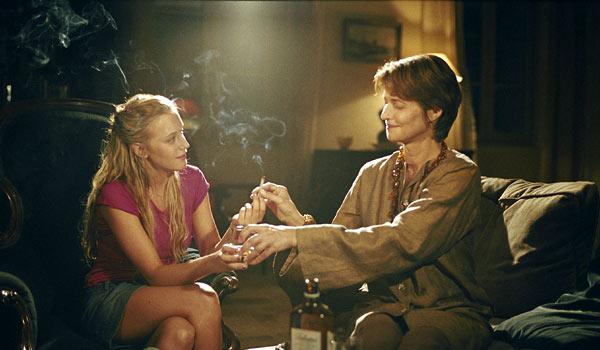
Directed by Francois Ozon and written by Ozon and Emmanuele Bernheim, Swimming Pool is the story about a murder-mystery novelist who travels to the French countryside to stay at her publisher’s house as she gets an unexpected visit from his outgoing daughter. The film is an exploration into the different generation gaps between two women as well as the similarities they have as one woman is trying to create a novel. Starring Charlotte Rampling, Ludivine Sagnier, and Charles Dance. Swimming Pool is a provocative and seductive film from Francois Ozon.
Seeking inspiration is something a writer must have when it comes to creating new material as the film is in some ways is about a famous British murder-mystery novelist in Sarah Morton (Charlotte Rampling) who is trying to write the next novel of her series involving a detective. Yet, she’s a woman who is unhappy with the outcome of some of her work while having to compete with younger writers who can the attention of her longtime publisher John Bosload (Charles Dance). By taking his offer to stay at his villa in the French countryside to work and relax, she soaks up the chance to enjoy a sense of peace until she gets the unexpected arrival of Bosload’s daughter Julie (Ludivine Sagnier) who causes trouble. Despite the tension between the two very different women, the two women do give something to each other where Sarah finds a muse while Julie gets someone to help after a night with a man has gone wrong.
The screenplay is definitely a thriller of sorts but acts more as a drama where it is about these two women sharing a villa as they don’t really know each other or want to do anything with each other. Especially since Sarah is a woman who had done her time as a young woman as she’s now middle-aged, bitter, and being usurped by younger writers. Julie is a young woman who is wild, likes to swim in the nude, have sex with various men, and is not afraid to get into a physical fight. Still, there is intrigue between the relationship of these two women where they share a few stories as well as interest towards a café waiter (Jean-Marie Lamour).
While the first two acts is about the relationship of these two women, the film’s third act is where the suspense comes in as it relates to not just a murder but also how to hide it as well as revelations about Julie’s mother whom her father had been estranged from for so many years. It would help play into the relationship between Sarah and Julie as the latter has been in need of a maternal figure. Yet, it would all help play into Sarah’s search for inspiration though its ending is very ambiguous as it ends up raising a lot of questions into what might’ve really happened.
Francois Ozon’s direction is quite straightforward for the most part in the way he presents scenes set largely in Southern France with a few scenes shot in London. Still, there is a degree of style to the way Ozon shoots some of his close-ups and medium shots to get his two leads into a frame. Even in playing up the element of suspense. There is also a sensuality to the film that can be quite serene at times but also a bit confrontational such as a scene of Julie lying on a chair outside as the café waiter stares at her as the two would masturbate to themselves. Yet, it is done with an air of subtlety that doesn’t make too graphic with the exception a different scene between Julie and the waiter in a pool. The film’s suspense has an air of mystery though its ending creates this ambiguity into whether anything that happened really happened as it mixes the idea of fantasy and reality. Overall, Ozon creates a very intoxicating and exhilarating film about mystery and the art of writing.
Cinematographer Yorick Le Saux does brilliant work with the film‘s very lush cinematography for many of the scenes set in France during the daytime while using more stylish lighting schemes for the scenes at night in its interior and exterior settings. Editor Monica Coleman does wonderful work with the editing to create some methodical cutting and stylish montages for its suspenseful moments along with some rhythmic cuts for a few of the film‘s dramatic moments. Production designer Wouter Zoon does excellent work with the look of the villa that Sarah stays at as well as a few places in France as well as the office of John Bosload.
Costume designer Pascaline Chavanne does nice work with the costumes from the more casual yet tightened clothes of Sarah to the more exotic look of Julie with the clothes and swimsuits she wears. The film’s sound by Benoit Hillebrant, Lucien Balibar, and Jean-Pierre Laforce is terrific for the way it creates an atmosphere in some of the quieter moments as well as some of the chaos for the scenes with Julie whenever she‘s partying with another man. The film’s music by Philippe Rombi is very evocative with its low-key yet playful piano-driven score for most of the film while intensifying things a bit for its suspenseful third act.
The casting by Antoinette Boulat is superb as it features a small ensemble with appearances from Frances Cuka as a fan that Sarah meets on the train, Sebastian Harcombe as a young writer Sarah has to compete with, Marc Fayolle as the villa’s gardener, Mirelle Mosse as the gardener’s daughter that Sarah meets late in the film to ask about Julie’s mother, and Jean-Marie Lamour as the café waiter Sarah meets early in the film who is entranced by Julie. Charles Dance is terrific as Sarah’s publisher John Bosload who gives Sarah the chance to stay at her home while is a man who is hoping for Sarah to deliver another hit novel so he can make more money.
Finally, there’s the duo of Charlotte Rampling and Ludivine Sagnier as they both give exquisite performances in their respective roles as Sarah Morton and Julie. Sagnier brings a liveliness to her role as a very vivacious young woman who isn’t afraid to appear nude as she uses her sexuality to get what she wants while exemplifying all of the attributes of a young woman who seems very troubled. Rampling is more reserved as Sarah by displaying someone who is lost and bitter as she craves for some peace while also showing she’s also a bit funny as well as being sexy for someone of her age.
The 2003 Region 1 DVD from Focus Features is released in two version in a theatrical and unrated cut where the latter shows more nudity and sexually explicit content. Presented in its 1:85:1 theatrical aspect ratio with 5.1 Surround Sound for English and French along with DTS sound and subtitles in English, French, and Spanish. The DVD’s extras includes a trailer for the film as well as trailers from other releases from Focus Features. Another extra that is included are four deleted scenes which all relates to Sarah in a scene where she arrives along with a scene walking around the locations, reading a book, and a conversation with Bosload on the phone.
Swimming Pool is a ravishing film from Francois Ozon that is highlighted by the performances of Charlotte Rampling and Ludivine Sagnier. The film is definitely not just one of Ozon’s accessible films but also one of his more defining works in the way he brings intrigue and sensuality into an entire film while playing up the idea of what goes in the world of suspense. In the end, Swimming Pool is a remarkable film from Francois Ozon.
Francois Ozon Films: See the Sea - Sitcom - Criminal Lovers - Water Drops on Burning Rocks - Under the Sand - 8 Women - 5x2 - Time to Leave - Angel (2007 film) - Ricky - The Refuge - Potiche - In the House - Jeune & Jolie - (The New Girlfriend) - (Frantz (2016 film)) - (Double Lover) - (By the Grace of God) - Summer of 85 - (Everything Went Fine) - (Peter von Kant) - The Auteurs #33: Francois Ozon
© thevoid99 2013

Based on the comic by Stan Lee and Steve Ditko, The Amazing Spider-Man is an origin story of how a teenage Peter Parker became Spider-Man as he searches for what happened to his parents while meeting a scientist who knew his father. Directed by Marc Webb and screenplay by James Vanderbilt, Alvin Sargent, and Steve Kloves from a screen story by Vanderbilt. The film is new interpretation into the Spider-Man saga by interpreting a new take on Spider-Man’s origin story as he is played by Andrew Garfield. Also starring Emma Stone, Rhys Ifans, Denis Leary, Campbell Scott, Irrfan Khan, Campbell Scott, Sally Field, and Martin Sheen. The Amazing Spider-Man is an enjoyable blockbuster from Marc Webb.
The film is essentially a re-telling of the origin story of how Peter Parker became Spider-Man as it relates to the disappearance of his parents and why he had to live with his uncle Ben (Martin Sheen) and aunt May (Sally Field). The film also explores his relationship with his high school classmate Gwen Stacy (Emma Stone) whose father is the police captain George Stacy (Denis Leary) who is suspicious about Spider-Man’s vigilante antics. Yet, the story follows Parker trying to find answers into why his parents disappeared which leads him to meet Oscorps scientist Dr. Curt Connors (Rhys Ifans) who had been trying to create a regeneration formula that can help restore limbs for humans where Parker helped out giving him an algorithm. Instead, things go wrong when Dr. Connors becomes the Lizard forcing Spider-Man to stop him unleash the formula all over New York City.
The screenplay by James Vanderbilt, Alvin Sargent, and Steve Kloves does allow the film to be both a superhero origin story as well as a bit of mystery where it relates to Peter Parker’s search for answers on not just about his parents but also some of the secrets his father had been hiding. Notably the algorithm in a folder that he had been hiding as he showed to Dr. Connors where Parker would unfortunately set off some things that he shouldn’t have. Along with other incidents that Peter Parker would have to endure, he realized the role he has to play along with the responsibility he would have to carry for all of his life. Still, the film is more about how Parker became Spider-Man and how he would have to bear the responsibility of his role though there are several things in the script like what really happened to Peter’s parents that remain unresolved.
While characters like Uncle Ben, Aunt May, Gwen, and Captain Stacy do get provide some key aspects to the story. It’s Dr. Connors who is the most interesting as he is a man who has good intentions for regeneration as he’s a man that had lost his right arm. Yet, there’s an ambiguity to Dr. Connors as he might know about what happened to Peter Parker’s parents or he doesn’t know what really happened as his superior Dr. Ratha (Irrfan Khan) makes a threat about revealing something that relates to Parker’s parents. Yet, Dr. Connors attempt to test his regeneration formula would have some dire consequences as he becomes this giant lizard that is wreaking havoc on New York City.
Marc Webb’s direction is pretty good as he does a lot of what is expected in a superhero blockbuster story while he also finds the time to make it standout a bit from the previous Spider-Man films that were helmed by Sam Raimi. Notably as he creates some engaging moments in the drama as well as some of the humor of the film that includes a hilarious scene of Spider-Man and the Lizard fighting in a library. While it is shot on location in New York City, there are some scenes where it’s a mix of real-life action and CGI where Webb creates moments that are engaging though there are some shortcomings which relates to the story. Overall, Webb creates a solid and entertaining blockbuster film that does what is needed to do though it doesn’t do enough to make it standout more against its predecessors.
Cinematographer John Schwartzman does nice work with the film‘s cinematography from the look of the day and nighttime exterior scenes to some stylish moments for some of the film‘s nighttime interiors with its lighting schemes. Editors Alan Edward Ball, Michael McCusker and Pierto Scalia do terrific work with the editing as it‘s stylized in a few montages as well as some rhythmic cuts for the film‘s action sequences. Production designer J. Michael Riva, with set decorator Leslie A. Pope and supervising art director David F. Klassen, does excellent work with the look of the Oscorp building and some of its labs inside the building.
Costume designer Kym Barrett does good work with the costumes as it is mostly casual. Visual effects supervisors Jerome Chen, Kevin Kolodinsky, and Jim Rygiel superb work with some of the visual effects of Spider-Man flinging his web from place to place as well as the look of the Lizard. Sound editor Shannon Mills and Addison Teague do wonderful work with the sound to create some nice sound effects as well as some moments in the film‘s action scenes. The film’s music by James Horner is brilliant as it is a mix of orchestral bombast as well as some somber piano pieces to play out some of the growing pains Peter Parker goes through. The soundtrack is decent as it features a few rock cuts by the Shins and Phantom Planet as well as a piece from Coldplay that is just terrible.
The casting by Francine Maisler is remarkable for the ensemble that is used for the film as it features some memorable small appearances from C. Thomas Howell as a father whose son was saved by Spider-Man as he would return the favor, Chris Zylka as school bully Flash Thompson, Hannah Marks as a classmate of Parker, Campbell Scott and Embeth Davidtz as Peter’s parents who appear early in the film, and a hilarious cameo from Stan Lee as a librarian who is oblivious to the fight Spider-Man and the Lizard. Irrfan Khan is OK as Dr. Connors’ superior Dr. Ratha where Khan doesn‘t really get much to do except be used as someone who would drive Dr. Connors into drastic situations. Sally Field is great as Aunt May who worries about Peter’s activities as she also has to remind him that she will always worry about him. Martin Sheen is superb as Uncle Ben Parker as a man who is concerned about Peter while instilling him the role that Peter would have to use as a person.
Denis Leary is excellent as Captain George Stacy as a man is trying to maintain his role as a man of law and order as he sees Spider-Man as a vigilante while trying to deal with the Lizard. Rhys Ifans is brilliant as Dr. Curt Connors as a man whose experiments on regeneration wants him to do good but has him becoming maniacal and ambitious as he nearly loses sight on himself. Emma Stone is very good as Gwen Stacy as a classmate of Peter who knows a lot about science as she also tries to deal with his role as Spider-Man as she would help him fight the Lizard. Finally, there’s Andrew Garfield in a marvelous performance as Peter Parker/Spider-Man as Garfield infuses all of the anxiety of a teenage boy as well as someone who is troubled by what he’s dealing with as Garfield adds a lot of dramatic weight to his performance that makes him a major highlight of the film.
The Amazing Spider-Man is a very stellar film from Marc Webb that features an amazing performance from Andrew Garfield. Along with a strong supporting cast and a unique take on the origin story, it’s a film that is definitely enjoyable and engaging to watch though it does have a few flaws in the shortcomings to the screenplay. In the end, The Amazing Spider-Man is a pretty good film from Marc Webb.
Spider-Man Films: Spider-Man - Spider-Man 2 - Spider-Man 3 - The Amazing Spider-Man 2 - Spider-Man: Homecoming - Spider-Man: Into the Spider-Verse - Spider-Man: Far from Home - Spider-Man: No Way Home - Spider-Man: Across the Spider-Verse - (Spider-Man: Beyond the Spider-Verse)
© thevoid99 2013
Written and directed by Michael Powell and Emeric Pressburger, A Matter of Life and Death is the story of an airman who survives death as he falls for an American radio operator while angels are trying to get him to the other side. Set during World War II, the film is an exploration into a man facing and cheating death while trying to continue his life without compromise. Starring David Niven, Kim Hunter, Roger Livesay, Marius Goring, and Raymond Massey. A Matter of Life and Death is an extraordinarily rich film from Michael Powell and Emeric Pressburger.
The film is about a man who had just survived a near-death experience as his bomber plane crashed where he jumped off his plane without a parachute. While he was on his plane, he communicates with an American radio operator where the two fall for each other as they eventually meet and become a couple. For the people in Heaven, they realize the man was supposed to die as they send an angel (Marius Goring) to meet with the man to tell him he’s supposed to be in Heaven. The angel gives the man time while Dr. Frank Reeves (Roger Livesay) examines the man as he would defend him in a trial to see if this man should stay alive or be sent to Heaven. It’s a film about life and death as well as the power of love where the people from above are to see if this man in Peter Carter (David Niven) should stay alive to fall in love with the American woman June (Kim Hunter).
The film’s screenplay explores the world of life and the afterlife where Peter Carter has accidentally cheated death where angels and those in the afterlife question should Peter Carter fulfill what has been expected him in life or should he continue to go on living? Yet, the people in Heaven didn’t expect for Peter and June to fall for each other in a moment like this as they send this French aristocratic angel to talk with Peter about what he should do. Dr. Frank Reeves listens to Peter talking about his meeting with the angels as he believes there is more to something that is beyond anything. Yet, he would play a crucial role into defending Peter in front of the people of the afterlife as he has to face a jury that despise the British led by its American prosecutor Abraham Farlan (Raymond Massey). What would happen in the third act is a trial for the life of a man as Peter would also face a judge and jury to see if he deserves to stay alive.
The direction of Michael Powell and Emeric Pressburger is definitely out of this world in terms of what they presented. Notably as they go for two very different approaches to life on Earth and the afterlife where the former is presented in gorgeous Technicolor and the latter is presented in black-and-white. The direction is often filled with a sense of style from the sense of danger that is presented in the opening moments of the film where Peter is flying his bomber plane as he talks to June. A lot of the scenes set on Earth do have some degree of style in some of its location shots as well as a scene of Dr. Reeves looking out at the town through a magnifying table. Other stylish shots in the film are the conversations between Peter and the angel where everything around them stops while the people who aren’t Peter or the angel stay still.
The scenes set in Heaven are very stylized in the set pieces that is created where there are things the dead have to do once they arrive in Heaven. There is a sense of control that occurs while the trial scene itself is filled with some wide shots to establish the scope of the case in hand. There is also the staircase scenes that is presented in black-and-white but also in color to establish the link between the two worlds. The third act is about the two worlds colliding to set the fate for Peter Carter as where some big decisions occur as well as the idea of life itself. Overall, Powell and Pressburger create a magnificent story about life and the power of love.
Cinematographer Jack Cardiff does exquisite work with the film‘s beautiful photography from the wonderful look of the scenes in Heaven shot in black-and-white with some amazing lighting schemes to the lush Technicolor look of the scenes on Earth from the look of the British countryside to some of the interiors in the film as Cardiff‘s work is a major highlight of the film. Editor Reginald Mills does excellent work with the film‘s editing with the use of abrupt cuts to play out some of the strange things that are happening around Peter to the use of freeze-frames and other stylish cuts to help give the film a brisk pace. Production designer Alfred Junge does amazing work with the set pieces from the look of the staircase to the look of Heaven itself as it is a work of beauty.
Costume designer Hein Heckroth does wonderful work with the costumes to play up some of its coloring in the scenes on Earth while keeping things simple and stylish for the scenes in Heaven. The special effects work by Douglas Woolsey and Henry Harris is terrific for its use of optical effects to create some look of the universe as well as the backgrounds for the staircase scenes. Sound recorder C.C. Stevens does nice work with the sound to create sound effects for the film‘s opening sequence of Peter‘s plane crumbling as well as some intimate moments between characters as well as the scenes where sound isn‘t used. The film’s music by Allan Gray is superb for its lush orchestral score to play out the drama and some of its humor through some sweeping string arrangements and a few bombastic moments in the percussions.
The film’s cast is brilliant as it features some small appearances from Richard Attenborough as an English pilot who arrives to Heaven, Abraham Sofaer as Heaven’s judge and the surgeon performing surgery for Peter, Robert Coote as Peter’s deceased co-pilot Bob Trubshawe, and Kathleen Byron as the head angel who greets the dead to Heaven. Raymond Massey is excellent as Abraham Farlan who believes that Peter should die and be sent to Heaven while Marius Goring is marvelous as the very charming French aristocrat who has become an angel as he tries to get Peter to Heaven while realizing the severity of the situation. Roger Livesay is superb as Dr. Frank Reeves as a man who believes Peter’s stories as he tries to help him in every way while finding himself in a situation of his own where he can play a crucial role in Peter’s trial.
Kim Hunter is remarkable as June as an American woman who falls for Peter through their radio conversation while trying to wonder what is wrong with him as she turns to Dr. Reeves for help. David Niven is fantastic as Peter Carter as a man who had just experienced a near-death experience as well as love as he realizes his fate is in the hands of people beyond him as he tries to comprehend the idea of life itself.
A Matter of Life and Death is an incredible film from Michael Powell and Emeric Pressburger. Armed with a great ensemble cast that includes David Niven, Kim Hunter, Roger Livesay, Raymond Massey, and Marius Goring as well as Jack Cardiff’s rapturous cinematography. It’s a film that explores the idea of life itself as well as how a man can put his own life in the hands of other to see if he should live. It’s also a film about the power of love and how strong it can be for a man’s fate. In the end, A Matter of Life and Death is a tremendous film from Michael Powell and Emeric Pressburger.
Powell/Pressburger Films: The Spy is Black - (The Lion Has Wings) - Contraband - (An Airman’s Letter to His Mother) - 49th Parallel - One of Our Aircraft is Missing - The Life and Death of Colonel Blimp - (The Volunteer) - A Canterbury Tale - I Know Where I‘m Going! - Black Narcissus - The Red Shoes - The Small Black Room - (Gone to Earth) - The Tales of Hoffman - (Oh… Rosalinda!!!) - (The Battle of the River Plate) - Ill Met by Moonlight - Peeping Tom - (They’re a Weird Mob) - (Age of Consent) - (The Boy Who Turned Yellow)
© thevoid99 2013
Written and directed by Michael Powell and Emeric Pressburger, I Know Where I’m Going! is the story of a woman traveling to the Scottish Hebrides to marry a tycoon only for things to go wrong as she meets a naval officer in the island. The film is a romantic-comedy of sorts of how a woman tries to go for one thing only for things not go the way she had planned. Starring Wendy Hiller, Roger Livesay, Pamela Brown, and Finlay Currie. I Know Where I’m Going! is an incredible film from Michael Powell and Emeric Pressburger.
The film is essentially a love story of sorts of a woman whose life has always gone her own way is about to marry a tycoon as she travels to Scotland to marry him at an island. Due to awful weather and raging tides that will prevent her to get to the island, the woman is forced to stay at a small Scottish town where she meets a naval officer who lives in the island as he is descended from a family who has a nearby castle that he never enters believing it’s cursed. Despite her time at this small village, the woman is determined to reach the island at any cost believing it’s destiny as she is forced to come to terms with her feelings for the naval officer and everything else in her life.
The screenplay by Michael Powell and Emeric Pressburger explores a woman has everything going her way in life as the film opens with an amazing opening credits sequence of Joan Webster (Wendy Hiller) growing up as a child as she gets what she wants and is very ambitious. By marrying a tycoon, she will have everything she has ever wanted as she believed she’s earned it as it will fulfill her destiny. By the time she arrives Isle of Mull which is nearby the island of Kiloran, she expects to immediately be on board to the island but bad weather prevents it from happening. There, Joan has to stay on the island until the weather dies down as she befriends the naval officer Torquil MacNeil (Roger Livesay) who is the Laird of Kiloran. MacNeil is a man who loves the Isle of Mull as he insists that Joan should stay but Joan’s stubborn behavior would lead to some trouble as she is also starting to fall for MacNeil.
The direction of Powell and Pressburger is very engaging for the way it explores a woman’s desire to fulfill her destiny and the circumstances she has to endure. While a lot of the shots are quite simple in its presentation, there is an element of style in the way some scenes are shot as well as the film’s opening sequence where the opening credits are placed on various things. Yet, there are an array of images that are quite stylish such as the use of layered dissolves in a dream sequence for Joan while the film also contains some very simplistic moments to cover the Scottish landscape and the small town of Mull. The direction is also intense for a very big moment in the third act where MacNeil tries to stop Joan from reaching the island as he and another man are on the boat with Joan where its as a catalyst for what Joan is facing. Though the ending is sort of predictable of what is expected in a romantic story, it works to convey the journey both MacNeil and Joan have endured. Overall, Powell and Pressburger create a captivating yet mesmerizing film about destiny and how to adjust to different circumstances.
Cinematographer Erwin Hiller does excellent work with the film‘s black-and-white photography as he creates some gorgeous shots of the Scottish locations in the daytime as well as more low-key lighting schemes in some of the film‘s nighttime interior settings. Editor John Seabourne Jr. does terrific work with the editing from the use of layered dissolves in the dream sequence to some of the more intense editing in the film’s climax. Production designer Alfred Junge does wonderful work with some of the film‘s set pieces such as the home Joan stays in to the dance hall where Joan and MacNeil watch a celebration.
Sound recorder C.C. Stevens does amazing work with the sound to capture the intensity of the winds as well as the noise of the waves during that terrible weather. The film’s music by Allan Gray is superb for its lush orchestral score to play out some of the melodrama and lighter moments while the rest of the music features an array of traditional Scottish folk music.
The casting by Pat MacDonnell and Adele Raymond is brilliant as it features a wonderful collection of actors including an early appearance from Petula Clark as a young girl Joan meets, Captain C.W.R. Knight as a falconer friend of MacNeil, Catherine Lacey as a talkative local who shows Joan around a large manor, Murdo Morrison as a young boatman named Kenny, and Margot Fitzsimons as Kenny’s girlfriend Bridie. Finlay Currie is terrific as an experienced boatman in Ruairidh Mhor as a man who tells Joan that crossing the sea to the island is a good idea due to the weather. Pamela Brown is wonderful as MacNeil’s friend Catriona as a woman who knows about MacNeil’s attraction towards Joan as well as the things that Joan wants.
Finally, there’s the duo of Wendy Hiller and Roger Livesay as they both give remarkable performances in their respective roles as Joan Webster and Torquil MacNeil. Hiller displays a great sense of determination to a woman who is unaware of how the world plays into things as she finds herself unable to maintain control of her situation. Livesay is more reserved in his role as a naval officer dealing with his family curse as he is full of charm and warmth while also being quite upfront about what Joan is trying to do. The two have amazing chemistry as their scenes together is definitely a highlight of the film.
I Know Where I’m Going! is a marvelous film from Michael Powell and Emeric Pressburger that features splendid performances from Wendy Hiller and Roger Livesay. It’s a film that reveals how some things don’t go the way one intends only for something else to happen where it would end up being even better. It’s also a very engaging romantic film that have a sense of conventional storytelling but takes its time to find ways to not go into formula. In the end, I Know Where It’s Going! is a phenomenal film from Michael Powell and Emeric Pressburger.
Powell/Pressburger Films: The Spy is Black - (The Lion Has Wings) - Contraband - (An Airman’s Letter to His Mother) - 49th Parallel - One of Our Aircraft is Missing - The Life and Death of Colonel Blimp - (The Volunteer) - A Canterbury Tale - A Matter of Life and Death - Black Narcissus - The Red Shoes - The Small Black Room - (Gone to Earth) - The Tales of Hoffman - (Oh… Rosalinda!!!) - (The Battle of the River Plate) - Ill Met by Moonlight - Peeping Tom - (They’re a Weird Mob) - (Age of Consent) - (The Boy Who Turned Yellow)
© thevoid99 2013