Saturday, October 08, 2011

Sideways


Originally Written and Posted at Epinions.com on 11/7/04 w/ Additional Edits & Extensive Revisions.


Since his 1996 feature film debut for the abortion comedy Citizen Ruth, Nebraska filmmaker Alexander Payne brought a mix of Americana and irreverent offbeat humor to many of films often based on books that he and longtime co-writer Jim Taylor adapted into scripts. In 1999, Payne released a hilarious satire film entitled Election about a high school election gone insane that became a breakthrough for Payne as it won him loads of acclaim including the prestigious New Generation Award from the L.A. Film Critics Association. In 2002, Payne and Taylor released About Schmidt, based on the novel by Louis Bagley. A more harrowing film than his previous efforts, About Schmidt still contained its irreverent but restrained humor largely due to lead actor Jack Nicholson's surprisingly quiet, restrained performance as an old man dealing with age and his existence. The film was also a hit as Payne in 2004 re-emerged with Taylor once again for another adaptation, this time for the Rex Pickett novel entitled Sideways.

Sideways is a movie about a failed novelist named Miles and his out-of-work actor buddy Jack going on a one-week trip to North California to sow their wild oats while trying out new wines in various winery places. With Jack getting married in a week, Miles tries to give him a last week of freedom only to learn more of his own failures while the men deal with everything about themselves. Then after meeting a couple of women in a town in North California, Miles deals with his own failures while trying to find some sense of hope and good wine. Starring Paul Giamatti, Thomas Haden Church, Virginia Madsen, and Payne's real-life wife Sandra Oh. Sideways is one of the most original and heartfelt comedies of 2004.

Miles Raymond (Paul Giamatti) is an 8th grade English teacher trying to catch a break as a novelist as he drives from San Diego to L.A. to pick up his best friend Jack (Thomas Haden Church) for a week trip before Jack's wedding to Christine (Alysia Reiner). After meeting Christine's family, the two head to Northern California for a wine exhibit as they stop to spend the night at the home of Mile's mother (Marylouise Burke). Mile however, remains haunted by the fact that he's a failure and already failed in his marriage to Victoria (Jessica Hecht). Upon arriving to the California vineyard, they stop to examine wine as Miles expertly tries different wines as stop at a town near Los Olivos to stay.

After a meeting a waitress named Maya (Virginia Madsen), who knows Miles over his wine expertise, at a restaurant. Jack claims they're celebrating over the publication of Miles' upcoming novel which isn't true as they continue to go wine-tasting where they meet another expert in the free-spirited Stephanie (Sandra Oh), who is also a friend of Maya's. Jack becomes smitten with Stephanie as Miles and Jack go to dinner with Maya and Stephanie to discuss wine as Miles still mopes over his ex-wife. Later that night at Stephanie's house for more wine-tasting, Miles and Maya talk about the brilliance of wine as well as the fact that they're both dealing with failed marriages. With Jack spending more time with Stephanie, Miles tries to deal with his own issues as the two go golfing one day where Jack tries to get Miles out of his slump.

During a lunch with Maya and Stephanie where they meet Stephanie's daughter Siena (Natalie Carter), Miles finds himself smitten with Maya where things seem to go well until he accidentally reveals about Jack's upcoming wedding. Things get worse when Miles learns about his novel as he vents out where the day worsens over what he revealed to Maya about Jack. Jack's womanizing ways starts to get him in trouble after flirting with a waitress (Missy Doty) where he asks for Miles help to deal with her husband (M.C. Gainey) as Miles wonders if there's any kind of hope for him.

Where in previous films, Alexander Payne took the time to establish himself as a director with irreverent satires of Citizen Ruth and Election while blending comedy and drama for About Schmidt. In Sideways, Payne not only fulfills his potential but also now becomes the most leading American auteur filmmaker for his heartfelt view of humanity while finding its inane humor in the smallest of things. Payne brings a creatively intelligent film with stylized split-screens and wonderful images where he moves the camera into giving a wonderful yet complex view of America. With his longtime co-writer Jim Taylor, the film's script is filled with hilarious moments and lines along with great emphasis on wine tasting and the kind of wine that is good. This film will make thirsty for some wine but it's really an adult film with a nice balance of romance, drama, and restrained comedy where Payne and Taylor bring out their best work to date where they click with every funny and sad moment in the right places.

Helping Payne with his vision is cinematographer Phedon Papamichael who beautifully captures the wonderful world of California wine fields and the Californian towns, which has a sense of purity and color that is truly imaginative. With Payne's longtime editor Kevin Tent bringing in a nice, masterful editing style in tune with the multiple-screen shots in the film, the film moves nicely as it doesn't move too slow or too fast for Payne's subtle, sublime story. Helping out more in the visuals is Payne's longtime art team of production designer Jane Ann Stewart and art director T.K. Kirkpatrick for giving a nice detailed view of the Californian wine world with its tan-like colors and wooden images where the movie gives you that great feeling that you're in a winery while longtime costume designer helps give personality to the clothing for its characters.

Then there's the film's music from longtime Payne collaborator Rolfe Kent who brings a lovely jazz score filled with bouncy rhythms and touches of melancholia that serves as an accompaniment to the varied mood of Miles along with music from Bonnie Raitt and Luna.

Then there's the film memorable if small cast, which includes some nice performances from Marylouise Burke as Mile's mother, Jessica Hecht as Victoria, Alysia Reiner as Christine, and Missy Doty as Cammi. Still, the film revolves solely on its four main actors. Sandra Oh is vibrantly amazing as the free-spirited Stephanie with her whimsical expertise on wine and down-home sense of humor while being vivacious in her sexiness as she carries some great scenes with Thomas Haden Church while stealing the show in the scene where she breaks his nose. Virginia Madsen truly gives the greatest performance of her career as the soulful Maya with her love for wine and life. Madsen not only brings great chemistry with Paul Giamatti but a wonderful depth in their conversation scenes as Madsen glows in her understatedly, rich performance as she and Oh are both worthy for Supporting Actress nods in the Oscars.

Thomas Haden Church is hilarious and amazing as the chauvinist Jack with his selfish, egomaniacal ways and immature behaviors. Church is really the comedy of the movie by doing stupid things where he and Giamatti have great scenes despite their different personalities where Church also has depth where he's trying to protect Christine from his affairs with Stephanie. Church is just filled with depth in his comedy, as he also deserves some recognition for his performance. Paul Giamatti is the film's best performance for his complex mix of emotionally depressed and self-defeating in the role of Miles. Giamatti shows that his performance in 2003's American Splendor was no fluke where he uses his shadowy eyes and face to bring out every sense of sadness into his role. While he maybe the role of a loser (though Church is playing the bigger loser), Giamatti brings sympathy to his role despite his selfishness and self-loathing where he also carries a sense of charm and heart as this role is truly one of his best of his flourishing career.

Sideways is a tremendous film from Alexander Payne and company with great performances from Paul Giamatti, Thomas Haden Church, Virginia Madsen, and Sandra Oh. Thanks to Payne's subtle, restrained humor and warm drama filled with romance and life lessons, the film is one of the brightest pieces of American cinema as Payne now becomes a director with a vast imagination. While not as funny in some parts in comparison to previous films, Sideways works more in its mix while giving away some great emphasis on wine tasting. If there's a nice movie that you can laugh and be moved at while getting a fine taste of wine, Sideways is the movie to go see.


(C) thevoid99 2011

Friday, October 07, 2011

Breaking the Waves


Directed by Lars von Trier and written by von Trier and Peter Asmussen, Breaking the Waves is the story of a young Scottish woman who tries to help her paralyzed husband by having sex with other men and tell him about it in order for him to feel closer to her. The film is von Trier’s first part of an unofficial trilogy exploring women in struggle through immense torment as it’s also the first film to reveal the aesthetics von Trier would use for the Dogme 95 movement. Starring Emily Watson, Stellan Skarsgard, Sandra Voe, Jean-Marc Barr, Adrian Rawlins, Jonathan Hackett, Udo Kier, and Katrin Cartlidge. Breaking the Waves is a heartbreaking yet soaring melodrama from Lars von Trier.

Bess McNeill (Emily Watson) is set to marry a Swedish oil rigger named Jan (Stellan Skarsgard) in her strict, religious small town in Scotland as she gets the blessings of the religious council. Her wedding to Jan is a blissful one as her sister-in-law Dodo (Katrin Cartlidge) makes a speech wishing them well as Bess’s life with Jan is one full of joy as she thanks God for making it happen. When Jan has to return to work, Bess is in despair as has a hard time dealing with Jan at work as she becomes desperate as she prays to God for his return. Jan returns but is paralyzed following an accident as Bess feels responsible as she tries to help her husband with help from Dodo, who is a nurse.

When Jan asks Bess to have sex with other men so he pretend that he’s making love with her, Bess refuses at first but decides to do it once Jan is back in the hospital. Bess tries to make various attempts by seducing Jan’s doctor Richardson (Adrian Rawlins) which doesn’t go well. With Dodo and Bess’ stern mother (Sandra Voe) realizing what is going on, it reaches the attention of the religious council led by its priest (Jonathan Hackett) to banish Bess. After meeting a sadistic sailor (Udo Kier), Bess begins to unravel as she asks Dodo to pray for Jan as she would the ultimate sacrifice.

The film is the story of a childlike yet woman in the 1970s who falls for this Swedish oil rigger as her devotion to him is tested following an accident as he becomes desperate to touch her as if they were making love. In this journey, the woman tries to seduce men around her town in hopes that her husband can feel her as if he is making love to her. Over the course of the film, both would start to unravel in different ways as one would find a way to save everything which requires a form of sacrifice.

The screenplay by Lars von Trier and Peter Asmussen is broken into several chapters to emphasize the course of the film which is often accompanied by dream-like paintings that come to life through visual effects. The chapters breaks, that are based on the art work of Pers Kirkeby, is often accompanied by a song from the late 1960s and early 1970s to emphasize the time frame of the story. Since the film features a lot of religious themes that is based partly on von Trier’s then-conversion to Catholicism in the 1990s as it provides a sense of motivation for Bess who often talks to God as she would speak his words in brash voice.

Bess McNeill is a character that is truly one of von Trier’s greatest creations as she is one that is full of innocence as she marries a man who has experienced the world. Through Jan, she discovers sex in its purest and most loving form as in her attempts to help the paralyzed Jan. She becomes desperate and unstable as she would later become a prostitute in order to have sex with other men. While some might claim that Bess’ descent into prostitution and how she gets treated will spark ideas of misogyny. That is not what von Trier is doing as it’s all about a woman trying to find the strength for what she does for her husband in a world where women can’t attend funerals in this religious society.

The script that von Trier and Asmussen creates is an exploration of a woman desperate to save her husband as she communicates to God who looks on at what she’s trying to do. In many ways, it’s God trying to test Bess in what she can do for her husband in a world where there’s a lot of religious oppression. For an outsider like Jan, he gets very close to see what goes on in a funeral scene while he asks the priest why there’s no bells in the church. It’s part of the world that von Trier and Asmussen creates which would allow for an ending where one character would defy this religious oppression while another would find some semblance of hope from above.

The direction of von Trier is probably his most potent and entrancing work of his career in the way he presents the film. Featuring a lot of dreamy chapter breaks, the film has a look that has a personal feel as von Trier goes for something that is reminiscent of a home movie as if it was shot in Super 8 film with natural light. Breaking from his more technical-driven yet more controlled filmmaking style of previous films, von Trier goes for a much looser yet more natural approach to the direction of the film. In this approach, hand-held cameras are used as there’s a shakiness to it without being too frenetic.

At the same time, there’s moments where the fourth wall is sort of broken as Bess is always looking directly at the camera which emphasize her innocent and playful persona. The film also has the feel and look of a storybook that comes to life through the chapter breaks as it includes an epilogue that dwells on melodrama without being too overly-sentimental and heavily-dramatic. There is a rawness to what von Trier aimed for while some of the sex scenes reach the line of being graphic at times though it’s meant to present sex in its purest form. The overall work that von Trier did is truly hypnotic and mesmerizing as he creates what is definitely his best film.

The cinematography of Robby Muller is definitely the film’s technical highlight for its grainy yet naturalistic look to emphasize the home-movie feel of the film. For some of the nighttime interiors, the film has a very dark look to play up its naturalistic look as there’s elements of a static look so that it plays to some of the aesthetics that von Trier is looking for. The daytime scenes with sunlight have a more heightened yet monochrome look where the colors of the film are de-saturated but in a dream-like look that is truly gorgeous. Editor Anders Refn does an amazing job with the stylized editing of the film that has a great emphasis on jump-cuts for some of the film’s playful yet unconventional rhythm that moves quite leisurely for a film with a 158-minute running time.

Art director Karl Juliusson does a great job with the set pieces created for the film such as Bess‘ home, the ship, and the oil rig scenes to create something that looks like that it comes from the world of the 1970s. Costume designer Manon Rasmussen does an excellent job with the costumes from the more plain clothes that Bess wears early on to the more thinner yet stylized dress that Jan bought for her including various clothes to play up the look of the 1970s. Sound designer Pers Streit and sound editor Kristien Eidnes Andersen do a superb job with the sound work to play up the naturalistic tone of the film with natural sounds presented throughout the film.

The film’s music soundtrack features a version of Johann Sebastian Bach’s Siciliana - Sonata BWV n. 1031 that plays in the final credit by a trumpet and organ while the rest of the film’s soundtrack features an array of music from the 1970s. For the chapter breaks, there’s music by the likes of Mott the Hoople, Python Lee Jackson with Rod Stewart, Jethro Tull, Procol Harum, Leonard Cohen, Elton John (who also has two more cuts in the film), Deep Purple, and (in the theatrical version) David Bowie. Additional music that appears in the film include Roxy Music, Bob Dylan, Thin Lizzy, and T.Rex all play up to the world that is the 1970s.

The casting by Joyce Nettles is brilliant as it features appearances from von Trier regulars like Udo Kier as a sadistic sailor and Jean-Marc Barr as Jan’s best friend Terry. Other notable small roles include Mikkel Gaup and Roef Ragas as fellow oil riggers as well as Robert Robertson as one of the leaders of the religious council. Jonathan Hackett is very good as the very strict and humorless priest while Sandra Voe is excellent as Bess’ stern yet grounded mother. Adrian Rawlins is wonderful as the sympathetic but conflicted Dr. Richardson who helps with Jan’s paralyzed state while also trying to help Bess. Katrin Cartlidge is superb as Dodo, Bess’ sister-in-law who tries to help Jan in the hospital while trying to protect Bess from trouble as she gives truly a mesmerizing performance.

Stellan Skarsgard is great as Jan, the oil-rigger that Bess falls for as he has a playful side to him but once he’s paralyzed, he gives a more reserved performance as a man desperate to please his wife though he couldn’t touch her. Finally, there’s Emily Watson in her film debut as Bess McNeill. Watson’s performance is truly one of the most iconic and heartbreaking performances captured on film. For the way she exudes a childlike innocence throughout the film while being all brash as she speaks the words of God. It’s also one full of charm and anguish as it’s definitely a performance for the ages from one of Britain’s great actresses.

***The Following Additional Material is Written from 1/1/16-1/16/16***

The 2014 Region 1/Region A 2-disc DVD/1-disc Blu-Ray dual-format release of the film from the Criterion Collection presents the film in a newly remastered 4K digital restoration print supervised by Lars von Trier with 5.1 surround DTS-HD Master Audio soundtrack on Blu-Ray and 5.1 Surround Sound for its DVD. In its 2:35:1 aspect ratio, the film is given a richer look while retaining the grainy look from Robby Muller’s de-saturated yet atmospheric cinematography. In the first disc of the DVD, the only special feature in the DVD is a trailer for the film that serves as a prototype of red-band trailers.

The second disc of the DVD features a 47-minute selected-scene audio commentary track from von Trier, editor Anders Refn and cinematographer Anthony Dod Mantle who was the film’s location scout in the production. The trio discuss not just the approach to editing where von Trier and Refn reveal that the reasons the way the film was edited in such a offbeat way was that it would serve as an emotional tool rather than something conventional. The trio also discuss the look of the film, the performances, and some of the locations where it was shot partially in Scotland while some of it was shot in Denmark. It’s a fine special feature that features some humorous anecdotes as well as some criticism where Refn reveals his own quibbles about aspects of the ending.

The ten minute interview with filmmaker/critic Stig Bjorkman who made a documentary on von Trier back in 1997 discusses the documentary but also where von Trier was at in his career when making the film. Bjorkman reveals many of these changes while making comparisons to Ingmar Bergman in the way both men were comfortable on a film set as well as have ideas that were similar visually. Bjorkman also talked about what von Trier was doing before this film in directing actors and what changed when he did this film which showcased him being more comfortable with them.

The seventeen-minute interview with Emily Watson has the actress talking about her experience making the film as it was the first film she had ever done. She was a theatre actress before the film as she admits to having very little knowledge about cinema. She talks fondly about von Trier, Stellan Skarsgard, and Katrin Cartlidge who were great help to her while Watson admitted that the film sort of mirrored her own life as she was living in a very religious community where she was cast out due to accepting the role for this film. Watson also talked about the character of Bess and what she felt she was going through while admitting her initial reaction to the film was negative until Cannes where she realized how extreme the reactions where as she looks back at the film very fondly as it’s one of the finest interviews for the DVD/Blu-Ray’s special features.

The thirteen-minute interview with Stellan Skarsgard has the actor talking about his collaboration with von Trier and how he got the part as he had been wanting to work with von Trier for years. Skarsgard also discusses many of the themes of the film as well as Watson’s performance and the many claims about von Trier being criticized as a misogynist. Skarsgard also talks about von Trier’s approach to actors in the way he wanted to them to be loose and make mistakes as it is one of the reasons why he continuously works with von Trier. A two-minute interview with Adrian Rawlins from 2004 has the actor talking about working with von Trier and why he enjoyed it as it had a sense of looseness as well as the need to improvise which something Rawlins enjoyed as opposed to what he usually does for British television.

A two-minute audition clip from Emily Watson features a commentary track from von Trier as the audition showcases not just the kind of naturalism and energy that Watson would put into the audition but also the reasons into why she was right for the role. The commentary track by von Trier, Mantle, and Refn talk about the audition and what impressed von Trier as he stated that something about Watson being barefooted that intrigued him and realized that she was right for the part.

Seven minutes of two deleted scenes and five minutes of two extended scenes are featured with optional commentary by von Trier, Mantle, and Refn as the two deleted scenes include a conversation between Jan and his friend Terry in the hospital and a meeting between Bess and Dr. Richardson just after she escaped from the police. The extended scenes include an extended conversation between Bess and Dodo in the mountains and the other is where Bess calls to her mother to open the door. In the commentary, von Trier revealed that the reasons the scenes were cut either due to the fact that he didn’t like the performances in the extended moments or in the deleted scenes as well as felt they didn’t fit in with the rest of the film.

A two-minute deleted clip featuring the late Katrin Cartlidge serves as a tribute to her which is a scene where Bess, Bess’ mother, and Dodo are in church during a service where Bess asks Dodo about Jan. It’s essentially an outtake where Cartlidge tries to hold her composure but it ends up being very funny which is fitting to the kind of talent that she is. A seventeen-second promotional clip for the 1996 Cannes Film Festival has von Trier revealing that he will not be showing any clips of the film but rather have the people at Cannes see the film as a whole as it is very funny.

The DVD/Blu-Ray set also features a booklet that features two pieces of text relating to the film. The first is an essay entitled Breaking the Rules by film critic/historian David Sterritt. The essay plays into where von Trier’s career was before and after he made the film but also into many of aspects of the story. Especially in some of the religious context and why would someone like Jan be intrigued by someone as naïve and as innocent as Bess. It also play into the element of fantasy vs. reality where the world Jan comes from is reality as his encounter with the community Bess lives in is an entirely different world where he comes from. The second piece of text in the booklet is an excerpt from Stig Bjorkman’s 1999 book von Trier on von Trier where Bjorkman interviews the director about the film. In the interview, von Trier talks about many of the themes of the film and some of the technical aspects of the film. He also talked about the origins of the film and why it was made in this way rather than in a conventional thing. It’s a fascinating interview about where von Trier was at the time as well as why the film is so revered.

***End of DVD/Blu-Ray Tidbits***

Breaking the Waves is an enchanting but provocative film from Lars von Trier featuring Emily Watson’s exhilarating performance. For anyone interested in the works of von Trier will find this as the best place to start since it definitely his most revered film. For fans of Emily Watson, whose career has flourished since this film, this remains her best performance of her career. While it’s not an easy film to watch since it dwells into elements of melodrama with a lot of graphic material. It is a film that challenges the conventions of melodrama as well as stripping down the aesthetics of traditional cinema. In the end, Breaking the Waves is Lars von Trier’s masterpiece that breaks down all barriers of what cinema is and could be.

Thursday, October 06, 2011

The Fall (2006 film)


Directed by Tarsem Singh and written by Singh, Dan Gilroy, and Nico Soultanakis, The Fall is the story of a young girl in the 1920s who meets an injured stuntman in a hospital as he tells her a story filled with adventure and fantasy. Based on a 1981 screenplay called Yo Ho Ho by Valeri Petrov, the film is a mix whimsical fantasy mixed in with real-life situations as it plays up Singh’s unique visual style. Starring Lee Pace, Catinca Untaru, Justine Waddell, and Leo Bill. The Fall is sprawling yet mesmerizing film from Tarsem Singh.

It’s 1920s Los Angeles as a young girl named Alexandria (Catinca Untaru) is currently recovering from a broken arm as she likes to play around the hospital. When trying to give Nurse Evelyn (Justine Waddell) a note, the note flies away and lands into the lap of an injured stuntman named Roy (Lee Pace). Roy meets Alexandria as he briefly tells the story of Alexander the Great in reference to her name. Alexandria would visit Roy again as he tells a much grander story about six different men all vowing vengeance against an evil tyrant named Odious (Daniel Caltagirone). The six different men would go on an adventure as they each carry special skills to defeat Odious’ men as they also capture his bride (Justine Waddell) as one of the men (Lee Pace) falls for the woman.

While Alexandria continues to be amazed by Roy’s story, he only continues to tell if Alexandria would get him pills as he learns about his health which only puts him in despair. When trying to retrieve more pills for Roy, Alexandria tries to help only for something bad to happen. Roy reveals why he needs the pill as he tries to finish the story for Alexandria as she helps him try to end it.

The film is a mixture of fantasy and reality as it is about a stuntman telling a young girl a story of adventure that spans through various locations around the world. Yet, the simple story of a man telling a story to a young Romanian girl, whose mother and daughter lives in the Californian orange groves, in hopes she can give him things to deal with his own personal issues. Throughout the film, characters that are seen in the 1920s period would be seen as characters in this fantasy story as it would add to the real-life feelings for both the girl and stuntman. The script has a nice way to balance the fantasy and 1920s sequence though by the third act, things get messy and a bit melodramatic despite a very good ending.

Tarsem Singh’s direction is truly a marvel to watch in the way he presents the film in its two different storylines. While the film starts off in a black-and-white sequence in the making of a stunt, the 1920s period has a lush yet more intimate look that is very lively in its approach to telling the story. For the fantasy story, Singh’s direction is truly hypnotic as he presents the film on a wide canvas that rivals the work of such filmmakers as Terrence Malick and Godfrey Reggio. There is a whimsical charm to that storyline while it’s all about the adventure that features large scene with wide depth of field shots and battle sequences. While Singh creates an amazing visual presentation that is gorgeous to look at. It does feel a bit flat due to its messy third act where things become a bit confusing and a bit sentimental. Singh does give the film a fitting payoff that gives both storylines a chance to have some sort of resolution while he creates a worthwhile yet visually-spellbinding film.

Cinematographer Colin Watkinson does an amazing job with the film‘s photography from the broad yet naturalistic look to many of the film‘s fantasy scenes to the more intimate yet lush look for the 1920s period and the opening black-and-white sequence. Editors Robert Duffy and Spot Welders do a very good job as they take a pretty straightforward approach to the pacing while seamlessly moving back and forth to the sequences while using stylized cuts for some of the film’s action sequences.

Production designer Ged Clarke, with set decorators Riccardo Pugliese and Cynthia Sleiter, does a brilliant job with the set pieces created for the fantasy scenes as well as creating a dream-like yet nostalgic look for the 1920s scenes. Costume designer Eiko Ishioka does a superb job with the stylish costumes for both the 1920s scenes and the fantasy sequences, the latter of which featured more lavish styles of clothing. Visual effects supervisors Alain Carsoux and Tom Sparks do some nice work with the visual effects that is used for some of the action sequences in the fantasy scenes.

Sound designers Vincent Guillon and Gerard Hardy do an excellent job with the sound work to exemplify the wondrous locations the characters are in in the fantasy sequences to the intimate yet raucous 1920s scenes that includes layers of voice-over narration. Krishna Levy’s score is wonderful for its low-key yet plaintive score filled with light-hearted string arrangements and harps along with the use of Beethoven’s 7th Symphony for some of the dramatic moments of the film.

The casting by Daniel Hubbard and Christa Schamberger is outstanding as it features a great ensemble cast that includes small appearances from Julian Breach as an elderly patient who befriends Alexandria as well as a mystic as well as Kim Uylenbroek as the doctor and Alexander the Great. Other notable characters who play dual roles include Leo Bill as an orderly and, in the fantasy sequence, Charles Darwin along with Jeetu Verma as a heartbroken warrior, Marcus Wesley as the ice delivery man/African warrior, Robin Smith as Roy’s friend/dynamite explosives guy, and Daniel Caltagirone as the villainous Odious and Roy’s actor rival Sinclair. Justine Waddell is very good in a trio of roles as Roy’s old girlfriend, the kindly nurse, and the woman that the bandit falls for.

Catinca Untaru is excellent as Alexandria, a lively child who is into fantasy while being the resourceful girl for the lonely yet depressed Roy. Lee Pace is great as Roy/the mysterious bandit as he brings a reserved though eerie performance as the melancholic Roy. For the masked bandit, Pace brings a whimsical though mysterious performance as a man seeking vengeance for the loss of his brother as well as to help the other bandits stop the man who had put them through hell.

The Fall is an ambitious yet charming film from Tarsem Singh that features a lot of great ideas and a pretty engaging story. While it’s definitely the kind of film that features a lot of broad ideas that isn’t seen much in a lot films. It is a movie that truly exemplify who Singh is in terms of a visual artist. While the screenplay does lack some strength in its third act, it does have something to keep the audience interest despite its shortcomings. In the end, The Fall is a spectacular film from Tarsem Singh.

Tarsem Singh Films: (The Cell) - (Immortals) - (Untitled Snow White Project)

© thevoid99 2011

Wednesday, October 05, 2011

Peppermint Frappe


Directed by Carlos Saura and written by Saura, Rafael Azcona, and Angelino Fons, Peppermint Frappe is the story of a man’s obsession with his friend’s wife whom he believes was the woman he fell in love with some years ago. The film is Saura’s fifth feature and his first collaboration with Geraldine Chaplin whom he was in a relationship with for more than a decade. Also starring Jose Luis Lopez Vasquez, Alfredo Mayo, and Ana Maria Custodio. Peppermint Frappe is a strange yet entrancing film from Carlos Saura.

Julian (Jose Luis Lopez Vasquez) is a physician who runs a clinic with a shy though helpful nurse named Ana (Geraldine Chaplin). When Julian decides to meet his old friend Pablo (Alfredo Mayo) and his mother (Ana Maria Custodio), Julian meets Pablo’s new wife in a beautiful yet young blonde named Elena (Geraldine Chaplin). Julian falls for Elena whom he believes was the same women he had met years ago at a small town during Holy Week where she was banging a drum. Though Elena doesn’t recall being in that town despite being gracious towards Julian as he takes around town. Julian feels like he’s not doing enough as he turns his attention towards Ana, who resembles Elena, as he tries to get her out of her quiet persona.

When Julian decides to take Elena and Pablo to his old countryside cottage for a weekend, he is wowed by Elena’s free-spirited persona as he begins to recall old childhood memories. Though Elena is impressed by Julian’s home, she still to give in to his advances though he takes pictures of her dancing as he is still yearning for her. After the weekend ends, Julian remains transfixed by Elena as he also has an affair with Ana who wonders about this other woman. When Julian realizes that Elena doesn’t really want to do anything with Julian other than be a source of amusement. Julian decides to create his own scheme as he asks Pablo and Elena to come to his cottage for the weekend where they would meet Ana.

The film is about a man’s obsession with a woman whom he believes looks like someone he knew years ago. Yet, when she politely refuses his advances and dodge his questions. His obsession intensifies while starting to turn his attention towards his nurse who resembles the woman he’s falling for though she is a completely different person than the one he’s falling for. Throughout the film, the man would have flashbacks about his childhood including a brief memory of the woman he had seen back at the march at Holy Week. The film also emphasizes on the peppermint frappe drink that he and his guests also drink which serves as a character in the film.

The script is a study of obsession and memory as Carlos Saura and his co-writers dwell into the mind of Julian and why he’s so entranced by Elena. Then there’s Ana, the woman who sort of resembles Elena as there’s more revelations about her which is why she presents the great opposite towards Elena. Saura’s direction is truly mesmerizing in the way he presents the film with slow yet steady camera movements to dwell into the location or a room. Plus, he’s always showing what is happening from the view of Julian as he watches with great attention towards Elena as she dances to a rock song on an old exterior dance floor.

The film also plays up to the idea of memory as all of the flashback scenes are presented in black-and-white. Saura’s direction is also intimate for the scenes that occurs throughout the film while features some amazing compositions such as Julian looking up Elena as she walks down a spiral staircase. There’s also a bit of surrealism that plays throughout the film due to the fact that Geraldine Chaplin plays the two prominent female figures in the film as Saura does pay tribute a bit to Luis Bunuel. The overall film is a superb yet rich study of obsession and memory in the mind of Carlos Saura.

Cinematographer Luis Cuadrado does an excellent job with the film‘s colorful yet hypnotic photography for many of the film‘s scenes while the black-and-white flashback scenes are done with a wonderful sense of grain and documentary-like style to emphasize the idea of memory. Editor Pablo G. del Amo does a nice job with the film’s editing in presenting it with a straightforward manner while using a bit of rhythmic cuts for some of the livelier moments of the film. Art director Emilio Sanz de Soto and set decorator Wolfgang Burmann do a great job with the look of Julian‘s apartment as well as the decayed world of his cottage to exemplify his old world ideals. The film’s score by Luis de Pablo is wonderful for its plaintive, harp-drive score along with a percussive-driven piece to play up Julian‘s memory as the soundtrack also includes an opera piece and a rock song by Los Canarios that Elena dances to.

The casting for the film is great as it features appearances from Emiliano Redondo as a friend of Pablo and Ana Maria Custodio as Pablo’s mother. Alfredo Mayo is amazing as Pablo, Julian’s old childhood friend who is a lively yet playful man that likes to mess around and do things that the more reserved Julian is reluctant to do. Jose Luis Lopez Vasquez is brilliant as Julian, physician who becomes obsessed with Elena while dealing with his memories of the woman he met as he also becomes more manipulative when dealing with Ana.

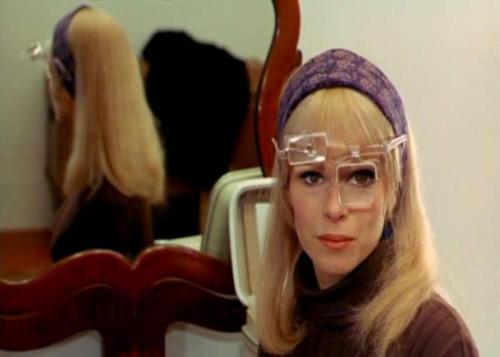
Finally, there’s Geraldine Chaplin in a spectacular performance in the dual roles of Elena and Ana. For Elena, Chaplin sports a blond wig as well as a loose performance as a woman who likes to mock Julian while being very playful. In the role of Ana, Chaplin goes for a more reserved look to be plain, shy, and vulnerable to exemplify Ana’s longing towards Julian. Chaplin truly brings something that is unique to both performance as it’s really one of her best in a long revered career that is just as good as her legendary father.

Peppermint Frappe is a vibrant yet enchanting film from Carlos Saura featuring a radiant yet adventurous performance from Geraldine Chaplin. Fans of Spanish cinema will definitely see this as a gem while it’s also a good starting point for those interested in the works of Carlos Saura. Notably as this film is among one of the key collaborations between him and former-lover Geraldine Chaplin that is among one of the best director-actor collaborations. In the end, Peppermint Frappe is a haunting but sensational film from Carlos Saura.

Carlos Saura Films: (Cuenca) - (The Delinquents (1960 film)) - (Weeping for a Bandit) - (La caza) - (Stress is Three) - (Honeycomb) - (The Garden of Delights) - (Ana and the Wolves) - (Cousin Angelica) - Cria Cuervos... - (Elisa, vida mia) - (Blindfolded Eyes) - (Mama Turns 100) - (Faster, Faster) - (Blood Wedding) - (Sweet Hours) - (Antonieta) - (Carmen (1983 film)) - (Los Zancos) - (El amor brujo) - (El Dorado (1988 film)) - (The Dark Night) - (Ay Carmela!) - (The South) - (Marathon) - (Sevillanas) - (Outrage) - (Flamenco) - (Taxi (1996 film)) - (Little Bird) - (Tango) - (Goya in Bordeaux) - (Bunuel and King Solomon’s Table) - (Salome) - (The 7th Day) - (Iberia) - (Fados) - (I, Don Giovanni) - (Flamenco, Flamenco)

© thevoid99 2011

Tuesday, October 04, 2011

Citizen Ruth


Originally Written and Posted at Epinions.com on 4/8/05 w/ Additional Edits & Revised Content.


Directed by Alexander Payne and co-written with Jim Taylor, Citizen Ruth is the story of a spray-paint huffing woman who becomes pregnant as she is caught in the middle of a war between pro-choice figures and pro-life people. The film is comedy that not only ridicules both political sides of the issue but shows the absurdity of humanity all because of one screwed up, dim-witted, drug addicted woman named Ruth Stoops played by Laura Dern. With a cast that includes Mary Kay Place, Kurtwood Smith, Alicia Witt, Swoozie Kurtz, Kelly Preston, M.C. Gainey, David Graff, Tippi Hendren, Dern's real-life mom Diane Ladd, and Burt Reynolds. Citizen Ruth is a funny, smart comedy about a political debate that goes terribly wrong.

After getting kicked out by her boyfriend, Ruth Stoops seeks to find money to buy some alcohol and spray-paint to sniff at. After getting arrested for her troubles, Rush learns she is pregnant for the fifth time as Judge Richter (David Graf) puts her in jail for endangering her fetus. While the judge offers to lessen the charge if she has an abortion, Ruth meets a conservative Christian in Gail Stoney (Mary Kay Place) and her friend Diane Siegler (Swoozie Kurtz) as they've been released by Gail's husband Norm who also bails out Ruth. Gail and Norm take Ruth in she meets their rebellious, heavy metal-loving teenage daughter Cheryl (Alicia Witt) while learning that Norm is the local head of an anti-abortion group called the Baby Savers. After learning about Ruth and her situation, Norm wants to take her situation public as a meeting with Dr. Rollins (Kenneth Mars) and his nurse (Joan Hennecke) has them claiming that abortion is a new version of the Holocaust.

With Ruth suddenly used as a pawn for Norm and Gail's cause, a protest towards an abortion clinic's guard named Harlan (M.C. Gainey) leads to chaos where Ruth steals money for her own drug use as she's caught by Norm. Diane decides to take Ruth in for protection where she reveals herself to be spy for a pro-choice group that she leads with her lesbian-lover Rachel (Kelly Preston). With Norm and Gail learning about Diane, a national debate happens as Norm calls in the entire Baby Savers group as Ruth is caught in the middle with Diane calling for Harlan for help as they learn Jessica Weiss (Tippi Hendren) will make a counterattack towards the Baby Savers. With the Baby Savers wanting to give Ruth money to keep her baby, Harlan makes the same offer to give Ruth a choice for her own. While the Baby Savers' national leader Blaine Gibbons (Burt Reynolds) arrives to help with the protest in front of Diane's farm. Ruth becomes unsure of the world she's in as well as her future as the abortion debate intensifies.

While films about political issues tend to tread into treacherous waters, what Alexander Payne does is find humor in these issues. While he is known as a liberal, Payne decides to go into neither side and make fun of both sides. Where he and co-writer Jim Taylor decide to paint the Baby Savers as a bunch of hypocritical, bland folks with a leader who likes to be massaged by his adopted son. The pro-choice advocates are seen as a bunch of kooky hippies. The genius of the film is in the screenplay and Payne's solid direction where both sides do have their points but the story is really about one woman and her own decision. The film does have an ending that will upset many not because of her choice but its unconventional approach, especially the fact that she's a very self-destructive, unemployed, and somewhat idiotic woman who doesn't know what to do. It's a satire film that doesn't try to play it safe and the result shows the brilliance of commentary that Payne and Taylor have in their subject matters.

If Payne and Taylor's script is well-written, so does Payne’s directing style and location choices where he chooses a rural, American landscape of his home state of Nebraska along with parts of Iowa. With cinematographer James Glennon, Payne goes for a somewhat gray, bleak outlook of Middle American culture with its small towns, poor houses in the ghetto to the more clean suburban outlook thanks to Glennon's grayish cinematography and the detailed production design of longtime Payne cohort Jane Ann Stewart. The film also includes some masterful and stylized editing from longtime editor Kevin Tent who utilizes a smart, playful approach to his editing that makes the film leisurely placed. Then there's the plaintive score of Rolfe Kent who brings in some fantastic orchestral pieces that plays to Tent's editing paces with a touch of jazz rhythms is familiar with many of Payne's films.

Part of the genius of Citizen Ruth is in its casting and all of the film's supporting cast plays their part with great hilarity and satire. While small performances from David Graff, Alicia Witt, Jeremy Sczepaniak, Kenneth Mars, Joan Hennecke, and Sebastian Anzaldo III are memorable, one of the funniest cameos comes from Dern's real-life mom and actress Diane Ladd in a hilarious dialogue confrontation between her and her daughter. Tippi Hendren is excellent in her brief performance as pro-choice leader Jessica Weiss while Burt Reynolds is extremely hilarious as the Baby Savers leader with his bad wig and conservative views that are out there, especially in a scene where he's topless.

Kurtwood Smith and Mary Kay Place also bring humor to their ultra-conservative caricatures while Place does write some of the film's original songs with Payne & Taylor that are downright funny and spiritual. Kelly Preston is also funny as Kurtz's lesbian lover with a kooky affinity for hippie songs about the moon. M.C. Gainey also shines as sleazy Harlan with his radical views on politics while Swoozie Kurtz pulls double duty as Diane with her high-pitch voice as the conservative Diane with the more stern, funny tone of the ultra-liberal Diane.

Laura Dern is the real stare of the film with her complex and hilarious performance as the film's title character. Dern doesn't make her character totally likeable despite her self-destructive behavior but her comedic antics are just so wonderful to watch. Dern makes her character a bit of an idiot but not a total idiot, especially when she thinks about her plans for her money while we sympathize with her about her knowledge as being the center of a huge political debate. Dern's performance is truly the spark that drives the film.

Citizen Ruth is one of the reasons why Alexander Payne is considered to be one of American cinema's leading voice, because of his subject matters and approach to satire. The acclaim of Citizen Ruth would lead him to direct the high school election satire of Election in 1999 that somewhat parallels are own electoral ideals and scandals. Payne's films are very American for their subject matters whether it's the satire of Citizen Ruth and Election, the discussion of ageism and value of life in About Schmidt, to his recent, Oscar-award winning view of a man's depression and affinity for wine in Sideways. It's clear that after four films, Payne is likely to become the one true American director that sees things in a realistic and funny way. Another thing that makes Payne's film so unique is that each of the central protagonists are loveable, flawed losers we can root for.

Citizen Ruth isn't a bad place to start when it comes to the works of Alexander Payne though Election seems like the better introduction. Fans of Payne will find this as a great debut though for those serious about the issue of abortion will find this film to be very offensive. With a great cast led by Laura Dern, Citizen Ruth is a winner for its witty satire and realistic views on politics as it stands as a fine debut for Alexander Payne and company.

Alexander Payne Films: Election - About Schmidt - Sideways - Paris Je T'aime-14e Arrondissment - The Descendants - Nebraska - (Downsizing) - The Holdovers - (Tracy Flick Can't Win) - The Auteurs #5: Alexander Payne

(C) thevoid99 2011

Monday, October 03, 2011

Jeanne Dielman, 23 quai du Commerce, 1080 Bruxelles


Written and directed by Chantal Akerman, Jeanne Dielman, 23 quai du Commerce, 1080 Bruxelles is the story of a single mother’s life in the course of three days as she takes care of her son while being a part-time prostitute for clients that she meets. The film is an exploration into a woman’s discipline life which starts off meticulously as it later unravels in the course of the three days that is explored. Starring Delphine Seyrig in the title character along with Jan Decorte, Henri Storck, Jacques Doniol-Valcroze, and Yves Bacal. Jeanne Dielman, 23 quai du Commerce, 1080 Bruxelles is an engrossing yet captivating film from Chantal Akerman.

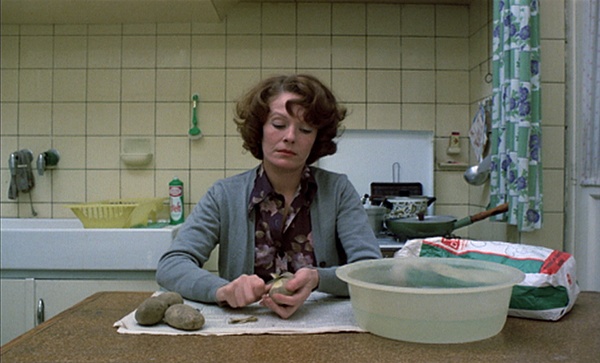
Jeanne Dielman is a widowed woman who lives a life where by day, she is a widowed housemother who is raising her teenage son Sylvain (Jan Decorte). During the afternoon when he’s away, she does a routine of cleaning her apartment and getting whatever things she needs like food, yarn, or anything. Before dinnertime, Dielman would have men visiting her as she plays the role of a prostitute. She gets paid and they leave as she continues to do her duty as a woman where once Sylvain comes home. She serves him dinner and helps out with his homework as they do all sorts of things in their lives.

After a good first day with her first client (Henri Storck) going well and the second day seems fine. Her second client (Jacques Doniol-Valcroze) comes in for the second afternoon where something happens as Dielman’s disciplined routine starts to unravel. With the third day happening, Dielman’s own world starts to crumble in the routines and in her search to find a button for a coat she received from her sister in Canada. When her third client (Yves Bacal) arrives, Dielman ponders about the life that she leads for herself and her son.

The film is an in-depth look into the life of a widowed housemother in the span of three days as she works part-time as a self-employed prostitute. Throughout the three days that is presented, the film dwells into this woman’s life in the way she conducts herself. Her typical day is to wake up in the morning, make breakfast for her son, polish his shoes so he can get ready for school. Then, she does some cleaning, run a few errands like going to the bank and get some food for the meals she’s to make for dinner. She returns home for a bit to have a bit of lunch, take care of a baby for a neighbor for a while, and leave the apartment for a bit for a few before she meets her client who goes to apartment. After that, she finishes making the dinner and waits for her son to return so they can eat. She checks on his homework, they go out for a bit, and go to bed.

That is what a day of Jeanne Dielman’s life is essentially as Chantal Akerman gets the audience to delve into this woman’s daily life in the course of three days. After the first day and everything else leading up to Dielman’s encounter with her second client, things would unravel as little by little. Things that the audience sees in the first day that Dielman does in her life starts to go out of order. There, a woman starts to realize something isn’t right as she tries to get things back in order. By the third day, it gets worse as Dielman’s own world leaves her unhinged and confused about the things she does leading to a climatic moment in the film.

Akerman’s direction is very entrancing in the way she presents the film based on an unconventional yet minimalist script that doesn’t feature a lot of dialogue. At the same time, the approach that Akerman tells the story is engaging but also detached in some respects since there are no close-ups nor any camera movements. Plus, there is no film score as the only music that is present is what’s heard on the radio or on location. The camera always remain still and observing everything that Dielman does in her daily routine. Akerman’s framing also serves as a way to make Dielman’s world seem oppressive in some ways where she is often in the frame while there’s one scene where she’s trying to get money at a bank where she’s at the edge of it.

The direction of the film has Akerman taking the film’s lack of conventional plot by letting Dielman’s life be told in a meticulous manner of the way she conducts her life. For a film with a 201-minute running time, not everyone will want to invest into the world of this woman as the first half of the film is an exploration of what a typical day the woman goes through in twenty-four hours. After her tryst with her second client, the details of what the audience sees in the first half on the way Dielman does her duties begin to unwind in the littlest of details. It’s all about the way Akerman deconstructs things where the film starts to feel looser though maintains its minimalist tone. The overall approach in its story and in its direction is a mesmerizing yet haunting portrait of a woman’s life told in such grand detail from the mind of Chantal Akerman.

Cinematographer Babette Mangolte does a superb job with the film‘s photography that is very simple and colorful in the way many of the film‘s interiors are present. Notably when Dielman turns on the lights and turns them off to give a very dark look to the rooms she’s in while many of the exteriors in Brussels show a wondrous but grainy look to maintain the intimacy of the film. Editor Patricia Canino does an excellent job with the editing in utilizing a few jump-cuts while keeping the film straightforward for its slow though methodical pacing for the film.

Art director Philippe Graff does a brilliant job with the look of Dielman‘s apartment filled with objects and things including Sylvain‘s bed which when folded back turns into a big chair. Sound editor Alain Marchal and mixer Jean Paul Loublier is amazing for the intimacy that is presented throughout the film for many of the film’s interiors. The exterior sound work play to the location of Brussels with sparse sound textures to exemplify Dielman’s quiet life.

The cast for the film includes some notable brief appearances by Henri Storck, Jacques Doniol-Valcroze, and Yves Bacal as the three clients Dielman meets in the film along with Akerman providing the voice as the unseen-neighbor who gives Dielman her baby to look after. Jan Decorte is very good as Dielman’s teenage son Sylvain who asks questions about his late father as well as the idea of what women go through in a very low-key but memorable performance. Finally, there’s Delpine Seyrig, in what is definitely a performance for the ages, as the title character. Seyrig’s performance is one that is definitely restrained and quiet in the way she makes Dielman into a compelling but also sympathetic figure. Particularly as there’s a complexity to this woman who at times seems oppressed but also a bit comforted by her routine until it unravels on her where Seyrig maintains that sense of restraint throughout her performance. It is truly a chilling but evocative performance from the late yet iconic actress.

***DVD Tidbits Written from 3/31/13-4/8/13***

The 2009 Region 1 2-disc DVD from the Criterion Collection presents the film in its 1:66:1 theatrical aspect ratio with Dolby Digital Mono sound. The first disc is the film itself supervised and approved by its creator Chantal Akerman in a new remastered digital transfer as well as new and improved English subtitles. The second disc of the DVD includes a slew of extras relating to the film as well as it’s filmmaker.

The first is a 69-minute documentary called Autour de “Jeanne Dielman” by actor Sami Frey as it chronicles the making of the film. The documentary explores the process of how Chantal Akerman wanted to make the film as she and Delphine Seyrig often talk about how to approach the character and do things in a meticulous manner. Shot in grainy black-and-white video, it’s a very compelling piece of footage that reveals Akerman’s approach as well as Seyrig’s view on feminism.

2 interviews with Akerman includes a 20-minute piece on the film as well as a 17-minute piece on Akerman’s view on filmmaking. The first interview has Akerman talking about how she got introduced to the world of films and her collaboration with cinematographer Babette Mangolte. Akerman also talks about her approach to filmmaking and how she met Delphine Seyrig at a film festival as well as the initial reaction to Jeanne Dielman when it premiered at the Director’s Fortnight in Cannes. The second interview is from a French TV show in which Akerman reads a text about herself in a self-portrait about her life and the journey she took to become a filmmaker. It’s an interesting piece that reveals a woman reading about herself as she comes of age.

The 23-minute interview with cinematographer Babette Mangolte has Mangolte talk about her collaboration and friendship with Akerman as well as their views on film. Mangolte talks about her first meeting with Akerman in the early 70s in New York City where they both shared a love for experimental films and how they used their background in experimental filmmaking for Jeanne Dielman. A lot of unveils some technical aspects of the film such as why the framing device for the film was so unique and how helpful Delphine Seyrig was during the production. It’s a very fascinating interview from someone who has very unique views on films and feminism.

The 28-minute interview with Akerman’s mother Natalia from 2007 as it’s directed by Akerman has Natalia Akerman talk about her daughter’s work and her opinions about film. With Chantal Akerman seen mostly off-camera asking her mother various questions, it is truly one of the most entertaining interviews as it’s shot largely in a still shot where Natalia Akerman reveals her love for her daughter’s films and how she can relate to them as opposed to the big-time Hollywood blockbusters. The 7-minute archival TV excerpt with Akerman and actress Delphine Seyrig from a February 1976 French TV program has Akerman and Seyrig talk about the film and what they wanted to say where Seyrig responds to men’s reaction about the realism of the film with Akerman supporting Seyrig’s response.

The 13-minute short film Saute ma ville is the first short film directed and starring Akerman back in 1968 when she was just 18-years old. It’s a very witty short set in a confined apartment space as a young woman cooks and clean her kitchen. It’s a very funny short that also has an air of darkness as the short also includes a two-minute introduction from Akerman explaining the film and how it would relate to some of the attributes that she would use in Jeanne Dielman. The DVD also contains a booklet that features an essay by film scholar Ivone Marguiles entitled A Matter of Time. The essay has Marguiles discussing Akerman’s filmmaking approach and why the film is considered a landmark for feminists. It’s an engrossing essay that unveils the film’s importance in cinema as well as the career of its creator Chantal Akerman.

***End of DVD Content***

Jeanne Dielman, 23 quai du Commerce, 1080 Bruxelles is an extraordinary yet provocative film from Chantal Akerman featuring a radiant yet soaring performance from Delphine Seyrig. While the film’s long running time and minimalist approach won’t be for everyone’s taste since it is a demanding film that requires patience. It is however a fascinating though haunting portrait of a woman as it is considered be one of the greatest films of the 1970s feminist movement. In the end, Jeanne Dielman, 23 quai du Commerce, 1080 Bruxelles is a brilliant but harrowing drama from Chantal Akerman.

Chantal Akerman Films: La Chambre - Hotel Monterey - Je Tu Il Elle - News from Home - Les Rendez-vous d’Anna - (American Stories, Food, Family and Philosophy) - (Night and Day (1991 film)) - (A Couch in New York) - (La Captive) - (Tomorrow We Move) - (Almayer’s Folly) - (No Home Movie)

© thevoid99 2011

Sunday, October 02, 2011

The Element of Crime


Originally Written and Posted at Epinions.com on 9/14/04 w/ Additional Edits & Additional Content.


Born in Copenhagen, Denmark in 1956, Lars Trier was a child actor to Communist parents before going to film schools and workshop where he earned his craft as a filmmaker and added "von" to his namesake. Amidst the time of Scandinavian cinema, the industry there was in decline and with old filmmakers of the past already being respected, they had nothing to prove. For von Trier, he saw this and everything as a decline of European civilization and ethics so the pretentious young director crafted a trilogy chronicling Europe's disintegration set in post-modern eras. He began the trilogy with his first film entitled Forbrydelsens Element (The Element of Crime).

Written with Tom Elling and Tomas Gislason based on Niels Vorsel's story with additional English dialogue, Forbrydelsens Element is stylish, film-noir crime thriller set in post-modern, water-logged Europe as a detective returns to Europe after 13 years to investigate a murder that is occurring concerning Lotto tickets. With help from an old advisor, the detective must contend with a killer who could be dead along with a gun-toting police chief, a Cairo therapist in his head, and an Asian hooker. Many years before the imperfect, stripped-down visual styles of movies like Breaking the Waves, Dogville, and Dancer in the Dark, Forbrydelsens Element doesn't seem like a movie that would be shot by von Trier. Yet the film's tone, camera aesthetics, and bizarre storylines are purely von Trier working with style. Though not up to par with his latter-day, groundbreaking films, Forbrydelsens Element is a hell of a debut feature from von Trier.

A European detective named Fisher (Michael Elphick) has returned to Cairo from Europe two months ago where he meets a therapist (Ahmed El Shenawi). The therapist asks Fisher to go back to two months ago to his story where Fisher tells a story about his return to Europe after being in Cairo for 13 years. Fisher has been asked by Osborne (Esmond Knight), his old advisor, to investigate a series of murders involving little girls with lotto tickets that has been tagged the Lotto Murders. Fisher sees Europe has become a place filled with water where there had been strange rituals of men jumping off construction towers from a rope. Upon his arrival, Fisher meets with his old police friend Kramer (Jerold Wells), who is now the chief of police. After meeting a little girl who Kramer tried to shoot, Fisher decides to stay at the town to investigate the murder.

After another meeting with Osborne, whose state of mind has become erratic, Fisher decides to use Osborne's Element of Crime book to guide him in the investigation as he notices the murders were done in four different towns like a square. After learning from Osborne that a man named Harry Grey, who is presumed dead, did the murders. Going through the first town of the murders, Fisher takes in Grey's name where he goes into a brothel and meets with a prostitute named Kim (Me Me Lai). Kim knew about Grey since she had met him before and thinks Fisher is Grey. After going through hotels and several towns, Kim joins Fisher in the investigation. Fisher learns more of the type of killings Grey has done and his victims while he would often have sex with Kim, just to have time to think.

After searching the four places where the bodies were found, he learned of a fifth location and learned that there were seven instead of four. The seventh murder was yet to take place. Fisher turns to Kramer for help to find the sixth body. Suddenly, Fisher's mind unravels more and more as he starts to enter into Grey's mind. Learning the murder is shaped in the letter H, Fisher goes to the final place for the coming murder where he meets the Schmuck of Ages (Lars von Trier) and learns more about Kim's connection to Grey. Finally, Fisher gets ready for Grey's appearance only to descend into madness and learning the truth about the murders while the therapists he talks to wonders if Fisher's mind was in Cairo or still in Europe.

While Forbrydelsens Element doesn't have the imperfect tone of his latter-day films, the movie does have a nice, stylish noir-tone many thanks to von Trier's bleak, post-modern vision. While the film's only flaw, aside from its lack of originality in comparison to previous noir-films, is that the film moves a bit slower due to its stylized dialogue and premise. Still, the film succeeds in giving the film noir genre a new, European tone with von Trier’s wondrous camera shots with his crane shots, slow-mo sequences, and hand-held movements.

The film's script is also very strange with its post-modern bleak outlook and its European surroundings where everything begins to fall apart. Even the film's twists and surprises become shocking due to the behaviors of its characters. While von Trier's script with his collaborators including Mogens Rukov (a collaborator and specialist in the Dogme 95 movement), it's von Trier the director that is really entrancing to watch. Especially with how he views things including violence, morals, rituals, and sex where there is an oral sex scene in the film though we don't actually see it, fully.

Helping von Trier with his maddening vision is cinematographer Tom Elling, who helps bring a septa-looking, orange-colored photography with very brief hints of blue. Elling's cinematography really helps give the film that post-modern look that is part sci-fi, part crime thriller. With production designer Peter Hoimark help bringing a chaotic, broken look to post-modern Europe, the film does have a strange, sci-fi look, especially since it's set in a world surrounded by water. The water photography is very eerie with its orange-colored look that is captured wonderfully in the stylized editing by Tomas Gislason. Helping with that film's strange tone is a score by Bo Holten who brings that sense of post-noir orchestral score and ominous string arrangements while the music sounds like it's made by electronics when really, it's from an orchestra.

The film's cast is wonderful with von Trier and Rukov; both bringing in wonderful cameos with their dubbed voices while Janos Hersko is hilarious as a quirky, offbeat coroner in the autopsy scene. Ahmed El Shenawi is excellent as the therapist though he carries a strange, narrative presence to the film that is very brooding when he's speaking with Fisher. Astrid Henning-Jensen is wonderful in her small performance as Osborne's maid while Me Me Lai is gorgeous and cunning her in role as Kim, who might not be innocent as she seems. British actor and former Benny Hill regular Jerold Wells gives a sadistic crazed performance as Kramer with his hard-nosed ethics and radical ideas that makes him likely to be a suspect.

Esmond Knight is wonderful as Osborne, with his wise but erratic role where Knight brings a complex, strange performance as a man who could be losing it and has descended into madness. The film's best performance goes to the late Michael Elphick in his role as Fisher. Elphick brings a troubling, scary performance as a detective that nearly loses his mind while in the end, we don't know how far he's gone as Elphick displays a determination and deceit in a detective role that is more complex than in previous roles of the genre.

***Additional DVD Content Written on 10/1/11***

The 2000 Region 1 DVD from the Criterion Collection presents the film in its original 1:85:1 theatrical aspect ratio that is enhanced for 16x9 televisions under a new digital transfer that was supervised by Lars von Trier plus Dolby Digital Mono. Featuring optional English subtitles for the hearing impaired as well as a trailer for the film that could be considered to be a red-band trailer.

The only special feature in the DVD is a Stig Bjorkman's 52-minute documentary Tranceformer: A Portrait of Lars von Trier. The film is an exploration of von Trier's career from his early years to the release of Breaking the Waves while working on the second part of his horror miniseries The Kingdom. The film reveals von Trier's own phobias along with some old TV footage of von Trier as a child actor for Scandinavian television. Bjorkman's documentary features some humorous moments as well as some amazing shots that revels into von Trier's life along with making-of footage for Breaking the Waves including interviews with longtime collaborator Morten Arnfred, producer Peter Aalbaek Jensen, and actors such as Katrin Cartlidge, Jean-Marc Barr, and Ernst-Hugo Jaregard. It's a great documentary that is a must-see for von Trier fans.

The DVD also includes a booklet that features an essay from Peter Cowie. Cowie's essay explains the film's importance to the history of Scandinavian cinema and how it would mark the arrival of von Trier into the film world. It's a short but fascinating essay that discusses the film and why it remains a debut that haunts people since its release.

***End of DVD Content***

Forbrydelsens Element is a wonderful, stylish film debut from Lars von Trier that really puts another strange spin on the genre of film noir and sci-fi. While it doesn't have the more honest, aesthetic approach of movies like Breaking the Waves or The Kingdom TV miniseries. Forbrydelsens Element does echo a lot of those things to come from the Danish enfant terrible. Fans who loved Breaking the Waves, The Kingdom, and Dogville will surely find something different from von Trier where this film would win a technical prize at the Cannes Film Festival.

Since this film is part of von Trier's European trilogy that would follow with 1987's Epidemic and 1991's Europa, seeing this film will show why later on, von Trier would rebel against that style. While Forbrydelsens is more clever than the post-modern noir films that would later come out, we can see that von Trier would stray far away from it when that genre became to stale. In the end, Forbrydelsens Element is a strange, complex film from international cinema's resident bad boy, who as just getting started.


© thevoid99 2011

Saturday, October 01, 2011

La Vie En Rose


Originally Written and Posted at Epinions.com on 12/20/07.


The name Edith Piaf to the French is a name they all know as the late singer is a beloved icon who sings songs of heartbreak and tragedy. Though her death at the age of 47 in 1963 was a sad moment, she was still beloved by her country as her fame had also grown around the world and in the U.S. during World War II despite singing for German forces in occupied France while she claimed she was supporting the resistance. In 2007, a film bio-pic was made about her life named after one of her most beloved songs entitled La Vie En Rose.

Directed by Olivier Dahan with a script he wrote featuring additional dialogue from Isabelle Sobelman based on numerous books. La Vie En Rose is the story Piaf's life from the streets of Paris to the world as she gained fame and infamy through her tumultuous life. Playing the role of the legendary singer is Marion Cotillard who had been previously seen in Tim Burton's Big Fish, Jean-Pierre Jeuneut's A Very Long Engagement, and Ridley Scott's A Good Year. Also starring Emmanuelle Seigner, Jean-Paul Rouve, Clotilde Courau, Sylvie Testud, and Gerard Depardieu. La Vie En Rose is an enthralling, enchanting portrait of one of France's enduring icons.

It's 1959 as Edith Piaf is in New York City singing but her health problems have finally caught up to her due to an addiction to injections. After collapsing, Piaf is sent to return home to France with her American boyfriend Doug (Harry Hadden-Paton) where she parties and makes more appearance before a car crash that killed Doug and left her injured. A few years later in 1963, the very ill Piaf reflects on her life as she recalls the time as a child (Manon Chevallier) living in the poor streets of Paris as her mother Anetta (Clotilde Courau) abandons her for a singing career. Forced to live with her maternal grandmother, her father Louis (Jean-Paul Rouve) returns from the war and takes her to live with his mother Louise (Catherine Allegret) who houses prostitutes. With Louis leaving for his job at the circus, Edith is in the care of her grandmother along with fellow prostitutes including Titine (Emmanuelle Seigner) who treats her like her own daughter.

When the young Edith is suffering from a disease that nearly caused her to go blind, it is with the help of the angel Therese that would make her eyes heel as her father would return to take her to his circus tour. For the next few years until she was 10 (Pauline Burlet), her father, who is a contortionist, quits the circus to go alone where he would find something in Edith's voice as she starts to sing. Years later in the mid-1930s, Edith is still a street singer singing for food and such with help from Momone (Sylvie Testud). During one day singing at a street corner, Edith suddenly gets the attention of a club owner named Louis Leplee (Gerard Depardieu) who books her at his club and brings her attention. Things go great until his sudden death in connection with the mob whom Edith is unaware she’s connected with. After that brief period of scandal, Edith is helped by her songwriter Marguerite Monnot (Marie-Armelle Deguy) and a new manager named Raymond Asso (Marc Barbe), Edith's fame rose.

In 1949 with a new manager in Louis Barrier (Pascal Greggory), she arrives to New York City where she falls for a French boxer named Marcel Cerdan (Jean-Pierre Martins) as they go on a date despite the fact he's married. Just as her life and fame was growing, tragedy would struck as Edith's life is suddenly in turmoil. After getting married and still touring the U.S., Edith's world starts to lose control as the Edith in her final years reflect on things she lost and such as she then recalls the final moment she sang to an audience.

With movies about singers starting to wear thin a bit with the typical cliche. Director and co-screenwriter Olivier Dahan wisely chose to not go convention by taking the film approach by taking the story back and forth to Piaf's own life from her final moments to her childhood to her last days, and so on. While that approach might take general audiences to be baffled by this approach, it works to tell the story of Piaf though some stories about her life are left out. Something that's likely to upset Piaf's hardcore fans but still, there's enough for them to watch and listen to. The structure of the script and Dahan's stylish direction works to reveal her humble beginnings, her discomfort towards worldwide fame, and notorious affairs including the one with Marcel Cerdan. Dahan's stylish direction definitely works to reveal the world that Piaf is in as it strays from becoming a bio-pic that is seen now lately in a lot of films. Yet, Dahan does fantastic work with the film and telling Piaf's story from her triumphs and tragedy.

Cinematographer Tetsuo Nagata does some great work with the film's tinted look of blue-green exterior shots in the streets of Paris and some of its country exteriors in Normandy to the more sepia-toned look for the film's interiors to convey the 40s-50s look of Paris and the U.S. Nagata's photography may be emphasized on style but it works to convey that dream-like look. Editor Richard Marizy does excellent work with the film's pacing that is very leisurely while using cuts to convey the moments of drama in Piaf's own life. Production designer Olivier Raoux does fantastic work in the design of the clubs and music halls that Piaf sings to the various environment she is in. Costume designer Marit Allen is also great for the look of Piaf's slender, thin dresses that she is famously is known for. Sound editor Pascal Villard does some wonderful work in capturing the sense of atmosphere in the music halls and clubs while conveying each moment in time.

Visual effects supervisors Seb Caudron and Hugh Welchman help in creating the film's look with its re-imagining of 1940s-1950s New York and Paris and the boxing scene as well. Music composer Christopher Gunning brings a plaintive yet dramatic score led by piano to emphasize the dramatic journey of Piaf's life. The rest of the music is largely driven by many of Piaf's famous songs that are played throughout the entire film that works for the film.

The film's cast is brilliant with small yet memorable performances from Andre Penvern as Jacques Canetti, Mario Hacquard as Charles Dumont, who are both two of Piaf’s songwriters, Marie-Armelle Deguy as Marguerite Monnot, Harry Hadden-Paton as Doug, Caroline Raynaud as Piaf's friend Ginou, Catherine Allegret as Edith's grandmother, Clotilde Courau as Edith's neglectful mother, and Jan-Paul Rouve as Edith's supportive father. Marc Barbe is excellent as Raymond Asso, Edith's manager who would make her sing with discipline while Pascal Greggory is brilliant as Louis Barrier, her manager to the end as he contends with her declining health. Sylvie Testud is good as Momone, Edith's street friend who just likes to drink with her while dealing with the presence of Marcel Cerdan. Jean-Pierre Martins is wonderful as the late Marcel Cerdan who charms Edith while becoming the love of her life for a brief moment.

In the child roles of Edith Piaf, Manon Chevallier and Pauline Burlet are great in conveying her innocence with Burlet doing the singing as the 10-year old Piaf. Emmanuelle Seigner is great as the prostitute Titine who becomes an unlikely maternal figure for Edith as a child. Gerard Depardieu is brilliant as Louis Leplee, the man who would discover Edith and become a father figure to her as he would pave the way for her brilliant career. Finally, there’s Marion Cotillard in what has to be a true, star-making performance as Edith Piaf. Cotillard's performance is spellbinding as she conveys the innocence of Piaf in her early years as well as her wild, drunken persona. In the other half of the film, Cotillard displays all of Piaf's performance mannerisms as well as her loud, drunken, diva-like behavior as it's shocking to see that it’s the same woman as Cotillard's performance is truly amazing.

The Region 1 DVD that presents the film in aspect ratio of 2:35:1 anamorphic widescreen with 5.1 Surround Sound in French that includes English, French, and Spanish subtitles. The only special feature, that is with optional English and Spanish subtitles, is a 10-minute special entitled Stepping Into Character is about Marion Cottilard's transformation into playing Edith Piaf in which the actress had to shave her eyebrows and the front parts of her hair while wearing loads of makeup for the character. Director Olivier Dahan talks about trying to convey each period of Piaf's life from her frizzy look early on to the regality of her great years to the decline where she has orange hair and such. It's a fine bonus feature on the DVD.

La Vie En Rose is an excellent and enchanting film from Olivier Dahan led by Marion Cottilard's performance. Those who don't know or barely know who Edith Piaf is will definitely have the urge to find her songs after this film. With film bio-pics about singers and musicians starting to become formulaic, credit goes to Dahan for not delving into conventions while giving audiences something to enjoy. For Marion Cottilard, this is truly a performance that will hopefully get some attention that is deserved. In the end, La Vie En Rose is a wonderful film to see.

(C) thevoid99 2011