Showing posts with label christoph waltz. Show all posts

Sunday, January 15, 2023

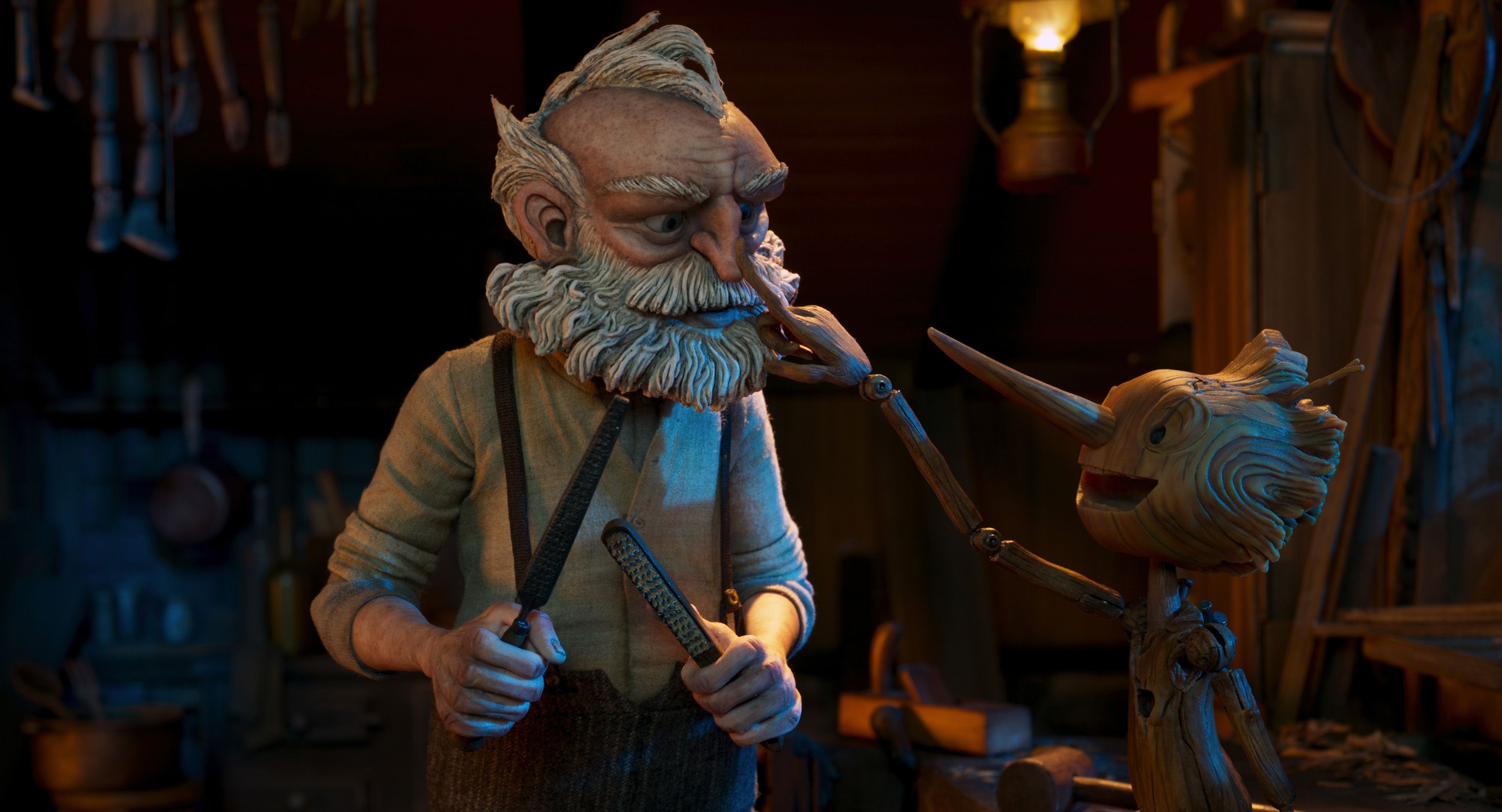
Pinocchio (2022 Animated Film)


Based on the novel The Adventures of Pinocchio by Carlo Collodi with illustrations by Gris Grimly, Pinocchio is the story of a wooden puppet who comes to life as he struggles with his well-being and winning the approval of his father. Directed by Guillermo del Toro and Mark Gustafson with a screenplay by del Toro and Patrick McHale from a story by del Toro and Matthew Robbins, the stop-motion animation film is set during the period of Fascist Italy as it plays into a man dealing with loss and a puppet trying to discover life during a period of chaos. Featuring the voices of Gregory Mann, David Bradley, Ewan McGregor, Burn Gorman, Ron Perlman, John Turturro, Finn Wolfhard, Cate Blanchett, Tim Blake Nelson, Christoph Waltz, and Tilda Swinton. Pinocchio is a rich and intoxicating film from Guillermo del Toro and Mark Gustafson.

Two decades after the death of son during World War I, the film follows a man who drunkenly creates a wooden boy to cope with his loss as it comes to life where the boy struggles with not just winning his father’s approval but also what it means to live. It is a film that takes the premise of the story of a man who creates a puppet who turns into a boy as it is set in Fascist Italy at a time when conformity and playing to certain rules are in tow which is something that a puppet with no strings is trying to deal with as well as the idea of love and what it means to exist. The film’s screenplay by Guillermo del Toro and Patrick McHale is told largely by a cricket in Sebastian J. Cricket (Ewan McGregor) about the titular character (Gregory Mann) and how he had been created by this lonely carpenter in Geppetto (David Bradley) after having lost his son Carlo (Gregory Mann) during an aerial bombing in World War I as he had been ravaged by grief until he cuts down a tree where Cricket was living and turned it into a puppet. It is then where a fairy in the Wood Sprite (Tilda Swinton) would cast a spell for the puppet to come to life while asking Cricket to watch over and guide him.

While Geppetto’s initial encounter with Pinocchio has him confused and frightened as does Pinocchio’s appearance at the town’s local church. Geppetto does what he can to steer Pinocchio the right way but also him wanting to be like Carlo yet there is also pressure from the Podesta (Ron Perlman) who wants Geppetto to ensure that Pinocchio becomes part of the Italian Royal Army upon a major discovery they would have much to Geppetto’s horror. Even as Pinocchio would encounter the failing circus ringmaster Volpe (Christoph Waltz) who would get Pinocchio to sign a contract that would keep him out of the eye of the Podesta but also keep Pinocchio performing in order to keep Geppetto out of debt. It all plays into Pinocchio’s development and his conversations with Cricket as it has him thinking about not just wanting to live but also to find his own voice as he watches the abuse that Volpe has on his longtime assistant monkey Spazzatura (Cate Blanchett) as well as a closer look into the world of Fascist Italy upon being watched by the Podesta at youth training camp.

The direction of del Toro and Mark Gustafson is astonishing in its overall presentation due to the attention to detail that both men put into its look as it is created on studio locations in Portland, Oregon and Guadalajara, Mexico. With Gustafson and his team of animators doing much of the stop-motion work with production designers Guy Davis and Curt Enderle, with set decorators Jesse Gregg, Gillian Hunt, Samantha Levy, Molly Light, Laura Savage, and Zach Sheehan plus art directors Andy Berry, Karla Castaneda, Robert DeSue, and Juan J. Medina, helping to create much of the backdrops in the look of the forests and woods in such grand detail. Even with Davis also creating some of the creatures including Cricket, Spazzatura, and the sea monster for the film’s climax, there is a look that is del Toro in terms of its approach to death as well as horror with the former involving a sequence in which Pinocchio meets a death fairy (Tilda Swinton) in a surrealistic presentation of the afterlife. Since the film is also based on the illustrations of Gris Grimly, del Toro and Gustafson maintain this look that quite wobbly in its presentation as there is a realism to the animation as well as a physicality in how they take this story and set it into a world where there are elements of politics and existentialism in the mix.

Even in a scene where Pinocchio asks his father why people don’t like him but love this model of the crucifixion as it is among these things that Pinocchio would go into. The compositions that del Toro and Gustafson create add to the drama that Pinocchio goes through in the wide and medium shots in a location or in one of Pinocchio’s stage performances as well as close-ups that play into the characters as they cope with whatever situation they’re in. Notably in the climax as it plays into Pinocchio and Geppetto dealing with a sea monster as all of the lessons that Pinocchio would learn allows him to deal with the situations as well as an understanding of both life and death. Overall, del Toro and Gustafson craft an exquisitely moving and ravishing film about a wooden boy who comes to life and learns about existence and identity during the era of Fascist Italy.

Cinematographer Frank Passingham does incredible work with the cinematography as it helps the look of the film give it a sense of physicality in the lighting while helping to set mood to help bring more texture to the production design. Editors Ken Schretzmann and Holly Klein do amazing work with the editing as it is largely straightforward to play into some of the musical numbers but also in some of the dramatic and terrifying moments with its rhythmic cuts. Visual effects supervisors Cameron Carson and Aaron Weintraub do excellent work with the visual effects as it is mainly set dressing for some scenes involving war and fire as it help broaden the visuals. Sound designer Scott Martin Gershin does brilliant work with the sound in the way certain objects sound as well as the way an instrument sounds on a location or how bombs sound from afar. The film’s music by Alexandre Desplat is phenomenal with its rich orchestral score that has elements of lush strings and orchestral pianos themes along with some offbeat percussive-based themes while the soundtrack also feature original songs written by Desplat along with lyrics by del Toro, McHale, and Roeben Katz that add to the drama and humorous moments in the film that are sung by its cast.

The casting by Mary Hidalgo is great as it feature some notable small voice roles from Tom Kenny in a trio of voice performances as a sea captain, a right-hand for Mussolini, and the Italian Fascist leader Benito Mussolini as well as Tim Blake Nelson as a quartet of black rabbits, John Turturro as a doctor in the small town Geppetto lives in, Burn Gorman as the local priest, Finn Wolfhard as the son of the Podesta in Candlewick who at first bullies Pinocchio only to befriend him late in the film, and Cate Blanchett in a superb voice cameo as Volpe’s monkey assistant Spazzatura who talks through puppets where Blanchett brings unique voices as a monkey who is jealous of Pinocchio only to realize the good in Pinocchio. Tilda Swinton is fantastic in a dual voice role as the magical fairy known as the Wood Sprite and her sister known as Death where Swinton brings different tones to the two characters as they lament on the ideas of both life and death. Ron Perlman is excellent as the Podesta as a Fascist government official who sees Pinocchio at first as a freak only to see that he could become a symbol for the government in their rise while trying to raise his son as a perfect soldier for Fascist Italy.

Christoph Waltz is brilliant as Volpe as a former aristocrat-turned circus ringmaster who sees Pinocchio as a way to get him back into aristocracy as well as a chance to get in the good graces of Mussolini as he brings a charm to this evil character. Ewan McGregor is amazing as Sebastian J. Cricket as the film’s narrator and conscience-of-sorts who tries to steer Pinocchio onto the right path while dealing with being squished and such as well as trying to do what he can where he laments over his role. David Bradley is incredible as Geppetto as a woodcarver/carpenter who laments over the loss of his son as well as dealing with Pinocchio as he is someone ravaged by grief while trying to understand the many flaws of Pinocchio while trying to go on a search for him when Pinocchio joins the circus. Finally, there’s Gregory Mann in a sensational voice performance in the dual role of Carlo and the titular character as he brings an exuberance and innocence to the former as well as an energy into the latter as well as this vulnerability of someone who is just trying to understand the ideas of life and death where Mann brings a lot of life into both of these roles.

Pinocchio is a tremendous film from Guillermo del Toro and Mark Gustafson. Featuring a great ensemble cast, gorgeous visuals, ravishing art direction, its story of existentialism and identity, amazing character/creature designs, and Alexandre Desplat’s enchanting music score. It is a film that takes a tale told many times but bring something new to it and set it during a tumultuous time in world history as it help play into a wooden boy trying to find himself as well as a physicality that gives the film an edge in its stop-motion animation presentation. In the end, Pinocchio is a magnificent film from Guillermo del Toro and Mark Gustafson.

Guillermo del Toro Films: Cronos - Mimic - The Devil's Backbone - Blade II - Hellboy - Pan's Labyrinth - Hellboy II: The Golden Army - Pacific Rim - Crimson Peak - The Shape of Water - Nightmare Alley (2021 film)

Related: (Pinocchio (1940 film)) - The Auteurs #10: Guillermo del Toro

© thevoid99 2023

Sunday, January 30, 2022

007 James Bond: No Time to Die


Based on the novels and characters by Ian Fleming, No Time to Die is the story Agent 007 James Bond as he is coaxed out of retirement to deal with an evil figure following the kidnapping of a scientist. Directed by Cary Joji Fukunaga and screenplay by Fukunaga, Neal Purvis, Robert Wade, and Phoebe Waller-Bridge from a story by Fukunaga, Purvis, and Wade, the 25th film in the James Bond film series follows the British secret agent dealing with a new world and new foes as he struggles to try and find a life outside of his majesty’s secret service as he is portrayed by Daniel Craig for his fifth and final outing as 007. Also starring Lea Seydoux, Rami Malek, Lashana Lynch, Ben Whishaw, Naomie Harris, Rory Kinnear, Billy Magnussen, Ana de Armas, Jeffrey Wright, David Dencik, Dali Benssalah, with Christoph Waltz as Blofeld and Ralph Fiennes as M. No Time to Die is a riveting and mesmerizing film from Cary Joji Fukunaga.

Five years following an assassination attempt in Italy, James Bond is coaxed out of retirement to find a scientist as it leads to something much bigger involving a mysterious figure who has gained access to biochemical weapons that would go after specific targets. It is a film in which the secret agent doesn’t just deal with a new foe who wants to go after Bond but also those close to him as well as his enemies including Ernst Stavros Blofeld whom had been involved in not just the assassination attempt on Bond but also another incident several years prior that involves this madman in Lyutsifer Safin (Rami Malek) who has a major grudge against Blofeld and his organization in Spectre. The film’s screenplay opens with a scene involving a young Madeleine Swann (Coline Defaud) who witnesses the murder of her mother (Mathilde Bourbin) and her own near-death experience from Safin as it then cuts to her as an adult (Lea Seydoux) who is vacationing with Bond in Italy where things went wrong as Bond believed that Swan betrayed him to Blofeld.

Much of the story takes place five years after Bond’s assassination attempt as he had retired in Jamaica when Felix Leiter (Jeffrey Wright) asks for his help following a break-in at a MI6 lab where the Russian scientist Valdo Obruchev (David Dencik) had been kidnapped as he had created a bioweapon with nanobots for MI6 called Project Heracles that was intended as an off-the-books project in the hope that it would kill intended targets. Instead, it goes in the wrong hands where M sends Nomi (Lashana Lynch) who is the new 007 to Cuba where Bond meets the novice CIA agent Paloma (Ana de Armas) who helps him retrieve Obruchev to Leiter but something goes wrong due to Leiter’s new partner Logan Ash (Billy Magnussen) who causes trouble for Bond and Leiter leaving Obruchev to escape. The second act revolves around not just revelations for Bond about Swann, who gets an unfortunate meeting with Safin, but also what happened in Cuba in what Bond and Paloma saw as the former meets with Blofeld as they both learn that they have a shared enemy. Yet, Bond’s journey leads him back to Swann who has another surprise that only add more stakes to what Bond is facing as well as what Safin is planning in the film’s third act.

Cary Joji Fukunaga’s direction definitely has an air of style in the way he presents the different locations Bond is in but also a world that is about to be in danger once again as Bond has to save it. Shot on various locations in Norway, Italy, Jamaica, the Faroe Islands, and London with some bits shot in Pinewood Studios in Britain. Fukunaga definitely plays into a spy that has been through a lot but he is also coping with loss and betrayal as he is unsure about returning to the world in general as it is often ever-changing. Fukunaga does make the sets feel important such as the scenes at Matera in Italy that includes a big chase scene that is captured through wide and medium shots where Bond and Swann are dealing with cars and motorcycles with the Aston Martin DB5 being the weapon to deal with these assassins. The scenes set in Cuba that were shot on location at Pinewood are also filled with these medium and wide shots but also this sense of movement and where the cameras are placed as it adds that air of location where there are moments of humor from Paloma but also moments that play into the suspense.

There are also close-ups in some of the film’s emotional moments where Fukunaga play into Swann’s own fear as it relates to Safin but also this meeting between Bond and Blofeld as it adds a lot of suspense and drama. Fukunaga definitely aims for something straightforward for these non-action scenes that also includes the scene where Bond discovers a major secret from Swann which add a lot of what is at stake for Bond. Notably as Safin is someone whose background as it relates to his family and what they’ve done for Spectre shows exactly why he wants revenge and sees Bond as an equal in the fact that they’re both killers yet Safin is just trying to tidy things up for a new world. Fukunaga’s approach to Safin’s island and the factory/lab he has definitely echoes a lot of Bond films of the past while he also creates some unique tracking shots for a key scene up the stairs where Bond deals with Safin’s soldiers. The film’s climax is immense with a lot at stake but there is so much more as it relates to not just the world in general but also Bond himself as it relates to Swann as well as everything he had went through. Overall, Fukunaga crafts an exhilarating and gripping film about a spy who deals with a new foe who is creating a bioweapon that would wreak havoc on the world.

Cinematographer Linus Sandgren does incredible work with the film’s cinematography with its usage of low-key lights for some of the interior/exterior scenes in Cuba to the natural lighting for scenes in Italy as well as some stylish interior lighting for the scenes at Safin’s island. Editors Elliot Graham and Tom Cross do amazing work with the editing with its usage of jump-cuts and rhythmic cuts as well as knowing when to let shots linger as well as to help create suspenseful moments. Production designer Mark Tildesley, with set decorator Veronique Melery and senior art director Mark Harris, does brilliant work with the look of the cabin home that Madeleine lived in as a kid as well as Safin’s island as well as his lab and factory. Costume designer Suttirat Anne Larlab does excellent work with the costumes from the clothes that Bond wears as well as some of the stylish clothing of Nomi and Swann and the robes that Safin wears.

Hair and makeup designer Mark Phillips, with prosthetic makeup designer Brian Gower, does fantastic work with the look of Safin from his disfigured look as well as the look of Blofeld following what happened to him previously. Special effects supervisor Chris Corbould, along with visual effects supervisors Yael Majors and Charlie Noble, does terrific work with the effects from the stunt work and set pieces as well as some of the visual effects that involve some of the bioweapon that Safin is developing. Sound designer Brian Bowen, with sound editor James Harrison and Oliver Tarney, does superb work with the sound in the way some of the gadgets sound as well as the way explosions sound and other sparse moments.

The film’s music by Hans Zimmer is phenomenal for its soaring orchestral-based music score that also feature elements of other compositions of past movie themes including the song We Have All the Time in the World from On Her Majesty’s Secret Service while the titular song by Billie Eilish and Finneas O’Connell that is performed by the former is this moody and somber song that is actually a really good song that does play into the drama. Music supervisor Randall Poster does create a wonderful soundtrack that includes We Have All the Time in the World as well as a French pop song from Dalida and some reggae for scenes in Jamaica.

The casting by Debbie McWilliams and Jemima McWilliams is marvelous as it feature some notable small roles from Hugh Dennis and Priyanga Buford as a couple of scientists who worked with Obruchev, Mathilde Bourbin as Madeleine’s mother, Coline Defaud as the young Madeleine, Dani Benssalah as Safin’s henchman Primo who wears a mysterious fake eye, and Lisa-Dorah Sonnet as a young girl named Mathilde. Billy Magnussen is terrific as the CIA agent Logan Ash who is Leiter’s assigned partner who annoys both Bond and Leiter as he has ulterior motives of his own. Rory Kinnear is superb as M’s chief of staff Bill Tanner who aides Bond in getting the chance to interrogate Blofeld as he also question M’s motives over the Heracles project. David Dencik is excellent as the Russian scientist Valdo Obruchev who created Heracles as someone who is this slimy yet comical villain who is willing to help Safin. Ana de Armas is fantastic in her brief role as the novice CIA agent Paloma who helps Bond in retrieving Obruchev as she has some funny lines while also being a total badass as she is just so fun to watch.

Christoph Waltz is brilliant in his brief role as Ernst Stavros Blofeld as the head of Spectre who is in prison as someone who is still running his operation as he becomes aware that he and Bond have a shared enemy as he also toys with Bond about Bond’s own motives. Ralph Fiennes is amazing as M as the head of MI6 who is reluctant to have Bond back on board while also revealing about his intentions for Heracles as he realizes that it was a bad idea as he hopes Bond can stop it from happening. Jeffrey Wright is incredible as Felix Leiter as a CIA agent and Bond’s friend who coaxes Bond out of retirement as he is aware of what Obruchev has created and hope that the project is stopped as he is also suspicious about Ash whom he’s not fond of. Naomie Harris and Ben Whishaw are remarkable in their respective roles as M’s secretary Moneypenny and the quartermaster Q as the two who stick by Bond with the former being a no-nonsense secretary who knows something is up and wants Bond to handle while the latter brings a lot of wit as someone who has a love-hate relationship with Bond as he would also uncover some deep secrets that involve Safin.

Lashana Lynch is phenomenal as Nomi as the 007 who Bond meets in Jamaica as he sees her as a threat of sorts though he realizes that she is a damn good spy as well as someone who doesn’t take any shit as Bond is aware of her worth. Lea Seydoux is tremendous as Dr. Madeleine Swann as a psychiatrist who is carrying secrets about her own past and her time with Safin as well as something that adds to the stake where Seydoux brings a lot of complexity to the character that play into a woman filled with regret and loss but also some hope for Bond. Rami Malek is sensational as Lyutsifer Safin as a madman who is trying to destroy Spectre as well as see Bond as a threat as he has this creepy presence to him as someone who wants to clean up the world but through nefarious means. Finally, there’s Daniel Craig in an outstanding performance as James Bond as the famed spy who is eager for a life outside of being in her majesty’s secret service only to deal with a much more sinister plot as Craig maintains that brooding persona but also someone who has humor and knows what is at stake as it is a fitting finale in the famed role as Agent 007.

No Time to Die is a sensational film from Cary Joji Fukunaga that features a tremendous performance from Daniel Craig in his final outing as James Bond. Along with its ensemble cast, riveting suspense and action, high-grade stakes, gorgeous visuals, and an incredible music score and soundtrack. The film isn’t just this sprawling and eerie spy-suspense film but also a film that plays into a man having to save the world with much more for him to deal with as it is also one of the finest films of the James Bond film series. In the end, No Time to Die is a spectacular film from Cary Joji Fukunaga.

James Bond Files: The EON Films: Dr. No - From Russia With Love - Goldfinger - Thunderball - You Only Live Twice - On Her Majesty's Secret Service - Diamonds are Forever - Live and Let Die - The Man with the Golden Gun - The Spy Who Loved Me - Moonraker - For Your Eyes Only - Octopussy - A View to a Kill - The Living Daylights - Licence to Kill - GoldenEye - Tomorrow Never Dies - The World is Not Enough - Die Another Day - Casino Royale - Quantum of Solace - Skyfall - SPECTRE

Non-EON Films: Casino Royale (Climax! TV Episode) - Casino Royale (1967 film) - Never Say Never Again

Bond Documentaries: Bond Girls are Forever - True Bond - Everything or Nothing: The Untold Story of 007

Cary Joji Fukunaga Films: Sin Nombre - Jane Eyre (2011 film) - (Beasts of No Nation)

© thevoid99 2022

Saturday, November 21, 2015

007 James Bond: SPECTRE


Based on the novels of Ian Fleming, SPECTRE is the story of James Bond trying to uncover a criminal organization that is threatening the world just as the MI6 is under threat of shutting down. Directed by Sam Mendes and screenplay by John Logan, Neal Purvis, Robert Wade, and Jez Butterworth from a story by Logan, Purvis, and Wade, the film has Bond encounter the organization that puts the world into chaos as Daniel Craig plays Agent 007 for the fourth time. Also starring Christoph Waltz, Lea Seydoux, Monica Bellucci, Dave Bautista, Ben Whishaw, Naomie Harris, Jesper Christensen, Andrew Scott, and Ralph Fiennes as M. SPECTRE is a thrilling yet exciting film from Sam Mendes.

The film plays into not just the recent events James Bond had encountered with mysterious organization known as Quantum but it all finally ties together when he not only uncovers what Quantum is part of but who is running this secret organization. Even as it relates to not just Bond’s past but also the emergence of a new world order as MI6 is being shut down by a new organization that wants to put the entire world under total surveillance. For Bond, this new criminal threat as well as the possibility of MI6 being shut down not only prompts him to go at it alone against the advice of M but also lead him to clues as it relates to a man named Franz Oberhauser (Christoph Waltz) whom Bond had known as a child and thought had died.

The film’s script doesn’t just play with Bond coping with aspects of his past and the new threats he is dealing with. He also is forced to go alone as MI6 are unable to be directly involved as M, Q (Ben Whishaw), Moneypenny (Naomie Harris), and Bill Tanner (Rory Kinnear) are all under surveillance from this new organization that is to replace MI6 where M had to fight to keep MI6 going. While Bond would create things that would put MI6 under further scrutiny such as the film’s opening sequence in Mexico City which has him trying to go after an assassin that is related to this secret criminal organization under the orders of the previous M. He would also turn to an old nemesis in Mr. White (Jesper Christensen) who would reveal not just what Quantum had become but asked Bond to protect his daughter in Dr. Madeline Swann (Lea Seydoux) who knows some things about what her father did as she would help Bond.

The script would also play into the growing sense that the world is changing as it makes Bond and M uneasy where the latter has to deal with Max Denbigh aka C (Andrew Scott) who wants to get rid of MI6 for a joint security organization as he believes surveillance on everyone is good for the future. It plays into this conflict of the old ways vs. the new ways where Bond is a representation of the old ways as he is about trying to figure out what is going on and make the decision to pull the trigger if necessary. While M and Bond do agree that their old tactics do have faults, they at least produce results which does prompt the latter to go deeper into what he is trying to uncover and why Oberhauser is alive. Even as it becomes clear about what is trying to do and why he is targeting Bond of all people.

Sam Mendes’ direction is definitely thrilling from the film’s cold open which begins with this intricate and gripping tracking shot where Bond is at the Day of the Dead ceremony in Mexico City as he is watching out for an assassin. It definitely opens the film with a bang while it establishes what Bond is going after and what it will lead him to. Shot in several locations such as Mexico City, Rome, London, Tangiers, and the Austrian Alps, the film does play into the emergence of a new world order emerging where there are several things happening while Bond would travel by himself as he is aware that he’s being watched under the new rules forcing his associates to cover for him. While it is largely a suspense film with lots of action and extravagant set pieces, Mendes does know where to slow things down as well as play into the formula that is often expected with Bond films. There are elements of humor in the film which definitely gives a nice balance to the action as it often comes from Q and Moneypenny while infusing bits of drama and character development into the story.

Notably the relationship between Bond and Dr. Swann as the latter is hesitant to trust Bond but realizes what he is doing while being the one person that could bring some redemption for her father. Mendes’ approach to compositions with its usage of medium shots and close-ups do help build up the drama while the wide shots allow Bond to be wherever he’s at to cope with what he’s facing When the film’s third act takes place in Tangiers where Bond and Dr. Swann with Oberhauser, it is clear that something is up but also there is a lot more that is being revealed. Especially in what he is up to where some of it isn’t surprising but it does have this payoff that Bond is up for a challenge with so much at stake. Overall, Mendes crafts an enthralling and entertaining film about a spy saving the world from an evil criminal organization bent on creating a new world order.

Cinematographer Hoyte Van Hoytema does brilliant work with the film‘s cinematography from the usage of the exterior lights for scenes set in Rome and London as well as playing up to some of the cold atmosphere of the scenes in the Alps as well as some crafty interior lighting for scenes in Tangiers. Editor Lee Smith does excellent work with the editing as it is straightforward while knowing when not to cut while creating some unique rhythms and jump-cuts for some of the action sequences. Production designer Dennis Gassner, with set decorator Anna Pinnock and supervising art director Chris Lowe, does amazing work with the design of places where Oberhauser conducts his business and meetings as well as Bond‘s home apartment and other rooms such as Q‘s workshop.

Costume designer Jany Temime does nice work with the costumes from the dresses that Dr. Swann and the other women wear to the Tom Ford suits that Bond wears. Hair designer Zoe Tahir and makeup designer Naomi Donne, with prosthetics makeup designer Mark Coulier, do terrific work with look of the characters in terms of the hair and such as well as the look of a character late in the film. Special effects supervisor Chris Corbould, along with visual effects supervisors Steven Begg and Mark Curtis, does fantastic work with the special effects as it relates to some of the action sequences along with some of the hacking devices from Q.

Sound designers Christopher Assells, Ann Scibelli, and Peter Staubi, along with sound editors Karen Baker Landers and Per Hallberg, do superb work with the sound to play into the many sound effects that occur in the action sequences as well as in some of the film‘s quieter moments to build up its suspenseful moments. The film’s music by Thomas Newman is wonderful for its bombastic orchestral score that play into the action and suspense while knowing when to be low-key for its drama while creating some variations of the franchise’s theme music. The film’s song Writing’s on the Wall by Sam Smith is an OK song that has its moments but Smith’s singing is just terrible.

The casting by Debbie McWilliams and Nicole Schmied is great as it features some notable appearances from Stephanie Sigman as Bond’s date in Mexico and Alessandro Cremona as the assassin Bond goes after in Mexico. Monica Bellucci is wonderful as the assassin’s widow Lucia who would give Bond some crucial information about Oberhauser while Jesper Christensen is terrific in his role as former Quantum figure Mr. White who would also reveal Bond some information as well as urging Bond to protect his daughter. Andrew Scott is fantastic as Max Denbigh aka C as a government official who wants to get rid of MI6 for a new security organization as he brings a smugness that is just fun to hate. Dave Bautista is superb as Oberhauser’s henchman Mr. Jinx as a henchman that doesn’t say anything but uses his actions and power to do the talking as he’s a fun henchman to watch.

Rory Kinnear is excellent as MI6 chief of staff member Bill Tanner who aids M in trying to keep MI6 from being shutdown while Naomie Harris is brilliant as Moneypenny as M’s secretary who helps Bond uncover some information that would relate to the secret organization. Ben Whishaw is amazing as Q as Bond’s quartermaster who provides him with some inventions and stuff while providing some witty banter that is essential to the series. Ralph Fiennes is incredible as M as Bond’s boss who copes with not just Bond’s tactics but also MI6 being shut down where he tries to deal with C and maintain his idea of the old ways.

Lea Seydoux is remarkable as Dr. Madeline Swann as Mr. White’s daughter who joins Bond in uncovering the secrets of this organization while being someone who is very smart and not afraid to throw down where Seydoux brings some depth to the character. Christoph Waltz is phenomenal as Franz Oberhauser as this mysterious man who knows Bond very well as he is the mastermind of this organization where Waltz brings a lot of charm and personality to a villain that could be Bond’s greatest opponent yet while bearing many attributes that is typical of the old ways but reinvent for a new world order. Finally, there’s Daniel Craig in a sensational performance as Agent 007 James Bond as this spy who is trying to save the world from evil where he copes with not just elements of his past but also in maintaining the role that only he knows as it’s changing for an uncertain future. It’s a performance that his Craig not only be the badass and be serious but also display some humor which shows he’s having fun as it’s definitely Craig at his best.

SPECTRE is a marvelous film from Sam Mendes that features Daniel Craig in another winning performance as Agent 007. Along with a great supporting cast that include standout performances from Christoph Waltz, Lea Seydoux, and Ralph Fiennes as well as thrilling action sequences and sprawling technical work from its crew. The film definitely stands as one of the finest films of the James Bond franchise in terms of its entertainment value as well as provide enough intrigue for audiences to be captivated by. In the end, SPECTRE is a riveting and exciting film from Sam Mendes.

James Bond Files: The EON Films: Dr. No - From Russia With Love - Goldfinger - Thunderball - You Only Live Twice - On Her Majesty's Secret Service - Diamonds are Forever - Live and Let Die - The Man with the Golden Gun - The Spy Who Loved Me - Moonraker - For Your Eyes Only - Octopussy - A View to a Kill - The Living Daylights - Licence to Kill - GoldenEye - Tomorrow Never Dies - The World is Not Enough - Die Another Day - Casino Royale - Quantum of Solace - Skyfall - No Time to Die

Non-EON Films: Casino Royale (Climax! TV Episode) - Casino Royale (1967 film) - Never Say Never Again

Bond Documentaries: Bond Girls are Forever - True Bond - Everything or Nothing: The Untold Story of 007

Sam Mendes Films: (American Beauty) - (Road to Perdition) - (Jarhead) - (Revolutionary Road) - (Away We Go) - (1917)

© thevoid99 2015

Friday, September 19, 2014

The Zero Theorem


Directed by Terry Gilliam and written by Pat Rushin, The Zero Theorem is the story of a reclusive computer genius who tries to see if there’s any meaning to life through a formula where he endures a series of surreal misadventures. The film is a dystopian film of sorts set in the future as it recalls many of Gilliam’s films from the past while going into a man dealing with his own identity and his place in the world. Starring Christoph Waltz, Melanie Thierry, Lucas Hedges, Tilda Swinton, David Thewlis, and Matt Damon as the Management. The Zero Theorem is a dazzling yet whimsical film from Terry Gilliam.

Set in a futuristic world, the film explores the troubled life of an eccentric computer programmer whose job is to find the meaning of life through a theory as he ponders about his own existence where he encounters a series of oddball characters during his journey. Yet, it all plays into this programmer who is also very reclusive as he await a phone call that he thinks could have some meaning. During his time in his home where he works continuously to find answers, Qohen Leth (Christoph Waltz) deals with his own loneliness as he often refers to himself as “we” where he starts to fall for a young woman in Bainsley (Melanie Thierry) as well as gain the aid of his boss’ son Bob (Lucas Hedges) where they would get him to showcase a world outside of his work and obsession to find answers.

Pat Rushin’s screenplay does create some unique ideas about existentialism as well as faith where Qohen is a man who seeks answers that are beyond the world he works for as he often crunch numbers to see if there are any answers. Qohen is a man that often dreams about being sucked into a black hole in his feeling that there’s nothing in the world as he is asked by the mysterious known as Management to find these impossible answers. Qohen takes the job because he has nothing to live for where his meetings with Management would be very strange. While he spends a year working to prove this theory in his home, he rarely has human contacts where the odd visits he receives from Bob, Bainsley, and his supervisor Joby (David Thewlis) would be very strange. Even as he learns what Bainsley does as it would complicate things as she would be the one person who shows him that there’s more to life than nothingness.

Terry Gilliam’s direction is quite extravagant in some ways in not just the world that Qohen lives but also the idea of dystopia where it’s more offbeat rather than oppressive. Yet, it does have some satirical comedy about the way technology drives the world such as a party scene where everyone is holding tablets rather than communicate with words. Gilliam’s direction has him utilizing not just close-ups and medium shots but these intricate crane shots to play into Qohen’s sense of loneliness. Especially as he rarely goes outside as he prefers to stay home to await a phone call where there’s an intimacy that Gilliam creates. The artificial world that Qohen would encounter would display his own lack of humanity and struggles along with the idea of what it could be once the fear is gone. Overall, Gilliam creates a very sensational yet compelling film about a man seeking answers in a very troubled world.

Cinematographer Nicola Pecorini does excellent work with the many of the film‘s stylized interior lighting schemes for the party scenes and the main base of where Qohen works at plus an offbeat look to some of the film‘s exterior settings. Editor Mick Audsley does fantastic work with the editing with its rhythmic approach to play into the film‘s humor as well as in some of the dramatic moments. Production designer David Warren, with art director Adrian Curelea and set decorators Jille Azis and Gina Stancu, does amazing work with the set design from the home that Qohen lives in to the look of the city and the place where Qohen works at. Costume designer Carlo Poggioli does brilliant work with the stylized costumes that includes some of the camouflage suits that Management wears in his surroundings as well as the clothes that Bainsley wears.

Hair/makeup designer Kristin Chalmers does terrific work with the hairstyle that Qohen would wear in his fantasy as well as the wig that Bainsley wears in one of her visits. Visual effects supervisors Felix Lepadatu, Jonah Loop, and Fredrik Nord do superb work with the visual effects where it is minimal in some respects from the fantasy world that Qohen and Bainsley live in to the image of the black hole. Sound designer Andre Jacquemin does nice work with the sound work from the sound effects of the cameras that are watching Qohen to the scenes that occur that play into Qohen‘s troubled state of mind. The film’s music by George Fenton is wonderful for its mixture of eerie orchestral music with some offbeat electronic music with the soundtrack featuring electronic dance music and a jazz cover of Radiohead’s Creep.

The casting by Irene Lamb is incredible as it features an array of offbeat cameos from Gwendoline Christie, Ray Cooper, Lily Cole, and Rupert Friend as people seen on commercials, Sanjeev Bhaskar, Peter Stormare, and Ben Whishaw as a trio of oddball doctors, and Robin Williams in an un-credited appearance as televangelist. Other notable small roles include Emil Hostana and Pavlic Nemes as a couple of clones, Dana Rogoz as a sexy pizza girl, and Tilda Swinton in a very hilarious performance as Dr. Shrink-Rom as an artificial shrink who can bust some mad rhymes. Matt Damon is excellent in a small but very memorable performance as the boss known as Management as he appears in the oddest circumstances as it’s Damon playing it very straight.

David Thewlis is amazing as the supervisor Joby who tries to get Qohen to be more outgoing while also being a friend of sorts as he tries to prepare Qohen for what he will endure. Lucas Hedges is fantastic as Bob as this whiz-kid who helps Qohen in uncovering the theory as well as dealing with Qohen’s reclusive behavior. Melanie Thierry is brilliant as Bainsley as this mysterious young woman who meets Qohen at a party as she is intrigued by his personality while getting him to be more open as she would fall for him. Finally, there’s Christoph Waltz in a remarkable performance as Qohen Leth as this very reclusive man who deals with his own existence as well as faith as he tries to uncover a mystery as it’s a performance that features Waltz at his most vulnerable as well as his restrained approach to humor.

The Zero Theorem is an extraordinarily fun and exhilarating film from Terry Gilliam. Armed with a great cast led by Christoph Waltz as well as some amazing technical work and some compelling themes on faith and existentialism. The film is definitely one of Gilliam’s finest works as it proves that he still has a few tricks up his sleeve. In the end, The Zero Theorem is a marvelous film from Terry Gilliam.

Terry Gilliam Films: Jabberwocky - Time Bandits - Brazil - The Adventures of Baron Munchausen - The Fisher King - 12 Monkeys - Fear & Loathing in Las Vegas - The Brothers Grimm - Tideland - The Imaginarium of Dr. Parnassus

The Auteurs #38: Terry Gilliam

© thevoid99 2014

Tuesday, December 25, 2012

Django Unchained


Written and directed by Quentin Tarantino, Django Unchained is the story of a slave who is freed by a bounty hunter as the two team up to find a group of vicious killers while the bounty hunter helps the slave in retrieving his wife from a plantation owner. The film is a mixture of not just the Spaghetti Westerns that Tarantino loved but also mixed in with a bit of blaxploitation as it explores the world of slavery and a man’s desire to claim back his wife. Starring Jamie Foxx, Christoph Waltz, Leonardo di Caprio, Kerry Washington, and Samuel L. Jackson. Django Unchained is a thrilling and adventurous revisionist western from Quentin Tarantino.

It’s 1858 in Texas as a man named Django (Jamie Foxx) is being taken to a slave auction by the Speck Brothers (James Remar and James Russo) where they encounter a German-born dentist named Dr. King Schultz (Christoph Waltz) who is looking for someone that knows the infamous Brittle Brothers. Django claims to know the Brittle Brothers as Dr. Schultz frees Django from the Speck Brothers as the two make a deal. With Django a free man, Dr. Schultz decides to train Django as a bounty hunter where they team up to find the Brittle Brothers and split the rewards. Django agrees to Dr. Schultz’s deal in which he hopes to retrieve his wife Broomhilda (Kerry Washington) who has been taken to a famous plantation known as Candyland owned by Calvin Candie (Leonardo DiCaprio). After a successful run of bounties that has made Django and Dr. Schultz famous, the two travel from Tennessee to Mississippi to meet Candie.

Upon arriving into Mississippi, Dr. Schultz and Django decide to play a role to woo Candie whose plantation is notorious for training male slaves into fighting and women into prostitution. After intriguing Candie, Dr. Schultz and Django go to Candyland where the two see Candie’s plantation that is filled with all sorts of things including an elderly servant named Stephen (Samuel L. Jackson). Upon learning that Broomhilda is working at the plantation, Dr. Schultz hopes to see her since he has learned that she speaks German. Once Broomhilda realizes what Dr. Schultz is doing, things seem to go well until Stephen believes something is up as he talks to Candie about his suspicions. Suddenly, trouble brews for Django and Dr. Schultz about their intentions as it leads to a showdown.

The film is essentially the story of a slave who is freed by a German bounty hunter as they team up to kill many targets and retrieve the slave’s wife from a charming yet brutal plantation owner. It’s also a film about a man who has endured slavery throughout his life where he not only gets his first taste of freedom but also find a reason to get back the woman he loves from the shackles of slavery. It’s a film that is mainly a western in terms of its visual setting and plot scenario but it’s much more than that it’s a love story, a revenge film, a buddy film, a comedy, and has elements of 70s blaxploitation in terms of its stylish dialogue and themes.

Quentin Tarantino’s screenplay is quite straightforward in terms of narrative structure yet it does feature a few flashback scenes to reveal what Django went through and how he got separated from his wife. A lot of the script revolves around Django and Dr. Schultz’s budding friendship and their partnership in the bounty hunting business. A lot of which has to involve lots of charm, trying to talk the way out of a situation, and intrigue someone. Yet, there’s also killing where Django and Dr. Schultz each play a character where Django plays valet to Dr. Schultz where both men keep their cool and then go about their business. Some of which would antagonize various plantation owners including a man named Big Daddy (Don Johnson) who tries to organize a rally that doesn’t work itself out.

While the character of Broomhilda doesn’t really get much to do as she’s really more of a plot device for Django who would often see her in his journeys. She is still important as someone who tries to endure all sorts of trouble as her past is just as interesting as she was taught to speak German by her mistress which definitely interests Dr. Schultz. Then there’s Calvin Candie who is this antagonist that is a man that loves to see slaves fight where he makes a lot of money and he gets a lot of pride in what he’s done for his plantation. Yet, he is also quite brutal through the men who work aside him including an elderly servant who is extremely loyal to Candie and is far more vicious in the way he believes slaves should be treated. It adds to this complexity of what Dr. Schultz and Django has to do where the former is disturb in how a slave is killed though it doesn’t surprise Django. Yet, it would play to the kinds of trouble Django would go through not just in the hands of Candie’s goons but Stephen most of all.

Tarantino’s direction definitely has a lot of unique compositions as well as various trademarks that he’s been known for such as the intimate table conversations where there’s a camera on a dolly capturing the conversation. Yet, it is also very stylish in the way Tarantino presents certain scenes such as the flashbacks where there’s an air of grainy stock film footage and de-saturated photography to play up the struggles Django and Broomhilda went through. Still, Tarantino does manage to keep things straight while creating some interesting compositions for the scenes between Dr. Schultz and Django as the way their friendship builds up. Notably as it goes beyond the student-mentor archetype of the relationship as both men are very clear about their intentions for each other.

The film also has Tarantino go into elements of black comedy with not just some of his stylish dialogue that has a lot of use of a certain racial slur. It also plays to the fact that white people are befuddled by the idea of a black man becoming a bounty hunter. The violence is definitely bloody and graphic at times yet it plays to what is happening as these men have to encounter someone like Django. There’s also some very chilling moments of suspense such as the dinner scene between Django, Dr. Schultz, and Calvin Candie where it’s about who can intrigue who in the art of negotiations. It then goes into a very dark turn due to the stakes that occur as it would be followed by what Django has to do and use everything he learned from Dr. Schultz to fight back. Overall, Tarantino creates a film that truly lives up to what is expected in the western but also create something that is engaging as well as entertaining.

Cinematographer Robert Richardson does brilliant work with the film‘s very colorful cinematography from the lushness of the winter scenes to the gorgeous colors of the Candyland exteriors along with the nighttime interiors inside the mansion. Editor Fred Raskin does excellent work by employing lots of stylish cuts including slow-motion cuts for some dramatic moments, methodical rhythms for the suspenseful moments, and some slight fast-cutting in the action scenes. Production designer J. Michael Riva, along with set decorator Leslie A. Pope and supervising art director David F. Klassen, does superb work with the set pieces from the look of the towns Django and Dr. Schultz encounter to the splendor that is Candyland.

Costume designer Sharen Davis does amazing work with the period costumes of the times from the lavish, stylish dresses some of the women wear including the female slaves of Candie to the suit that Candie wears that plays up to his persona. Sound editor Wylie Stateman does wonderful work with the sound from the sound of whips and gunfire to the more intimate moments such as the dinner scene at Candyland. Music supervisor Mary Ramos creates a fantastic film soundtrack that features many film scores from Ennio Morricone, Luis Bacalov, Don Straud, and Jerry Goldsmith as well as mixture of music from soul, hip-hop, country, and pop from artists like Johnny Cash, Jim Croce, Richie Havens, Rick Ross, James Brown, 2Pac, John Legend, and Anthony Hamilton as the music is definitely a highlight of the film.

The film’s casting by Victoria Thomas is just flat-out awesome due to the numerous cameos and appearances that were assembled for the film. In some great cameo appearances, there’s Tarantino associates Zoe Bell and Tom Savini along with Robert Carradine as Candie’s trackers, Michael Parks and Quentin Tarantino as a couple of men taking slaves to a mining company, Bruce Dern as Django’s old slave owner, M.C. Gainey as one of the Brittle Brothers, Tom Wopat as a marshal that Dr. Schultz deals with, James Russo as one of the Speck brothers, Jonah Hill as one of Big Daddy’s associates, and the original Django in Franco Nero as a businessman who shares a drink with Django.

Other notable small roles include Walton Goggins as a sadistic associate of Candie in Billy Crash, Dennis Christopher as Candie’s attorney Leonide Moguy, Laura Cayouette as Candie’s sister Lara Lee, James Remar in a dual role as one of the Speck brothers and an enforcer of Candie, and Don Johnson in an excellent performance as the old-school plantation owner Big Daddy. Kerry Washington is pretty good as Broomhilda though she doesn’t really get much to do though she does have a great moment in her scene with Dr. Schultz where they converse in German. Samuel L. Jackson is brilliant as the very devious servant Stephen where Jackson displays a lot of humor in response to Django only to be much more sinister in what he does to Django.

Leonardo diCaprio is outstanding as Calvin Candie where he exudes not just wit and charm to his role as a plantation owner but also a sense of terror into his character in the way he gives this very chilling monologue. It’s a performance that shows what kind of enthusiasm diCaprio brings as well as something that shows he can play the bad guy. Christoph Waltz is magnificent as Dr. King Schultz where he too exudes wit and charm into his role but also someone who is very intelligent and cool in the way he deals with things while being a mentor to Django as the chemistry between Waltz and Jamie Foxx is a true highlight of the film. Finally, there’s Jamie Foxx in a exhilarating performance as Django where he definitely makes his character a true archetype of what is expected in a Western hero. Foxx maintains that sense of cool in the way he deals with things and his enemies but also a restraint where he knows he has to be in control to save his wife.

Django Unchained is an incredible film from Quentin Tarantino that features a brilliant ensemble cast that includes Jamie Foxx, Christoph Waltz, Leonardo diCaprio, and Samuel L. Jackson. The film is definitely one of the most fun and exciting westerns that doesn’t just pay tribute to the genre but also gives it a nice sense of flair that makes it engaging and also thrilling. It’s also a film that isn’t afraid to not take itself seriously while also being funny. In the end, Django Unchained is an outstanding film from Quentin Tarantino.

Quentin Tarantino Films: Reservoir Dogs - Pulp Fiction - Four Rooms: The Man from Hollywood - Jackie Brown - Kill Bill - Grindhouse: Death Proof - Inglourious Basterds - The Hateful Eight - Once Upon a Time... in Hollywood

Related: The Auteurs #17: Quentin Tarantino - Growing Up with Quentin Tarantino


© thevoid99 2012

Saturday, April 14, 2012

LAMB Movie of the Month: Inglourious Basterds


Originally Written and Posted at Epinions.com on 8/23/09 w/ Additional Edits.


Written and directed by Quentin Tarantino, Inglourious Basterds is a World War II film that tells two different stories revolving around a sinister SS colonel known as the Jew Hunter. In one storyline, a group of Jewish-American soldiers go on a mission to take down Nazis with the help of a German actress and British/French officers. Another story involves a Jewish woman seeking revenge for the death of her family under the hands of the Jew Hunter. An ambitious film that is partially inspired by Spaghetti Westerns and World War II films. The film features an all-star cast including Brad Pitt, Diane Kruger, Melanie Laurent, Eli Roth, Christoph Waltz, Michael Fassbender, Daniel Bruhl, Mike Myers, B.J. Novak, Samm Levine, Rod Taylor, and longtime Tarantino associate Samuel L. Jackson. Inglourious Basterds is a fun, lively, entertaining, and thrilling revisionist war film from Quentin Tarantino.

It's 1941 in France as a German Colonel named Hans Landa aka the Jew Hunter (Christoph Waltz) arrives onto the home of a local diary farmer named Pierre LaPadite (Denis Menochet) as Landa interrogates the diary man. Landa is trying to find a Jewish family hiding somewhere where he charms LaPadite about milk and comparing Jews to rats. Landa through his charming ways and in English, gets LaPadite to reveal the whereabouts about the family where he succeeds in nearly killing a whole family with the exception of a surviving Jewish woman named Shoshana Dreyfus (Melanie Laurent). Three years later in 1944, Lieutenant Aldo Raine (Brad Pitt) is leading a small platoon of Jewish-American soldiers including Staff Sergeant Donny Donowitz aka the Bear Jew (Eli Roth), Wilhelm Wicki (Gedeon Burkhard), Smithson Uvitch aka the Little Man (B.J. Novak), Omar Ulmer (Omar Doom), Michael Zimmerman (Michael Bacall), and Gerold Hischberg (Samm Levine). Raine wants 100 Nazi scalps from each of his troops as debts paid.

After attaining the service of a psychopathic German soldier named Hugo Stiglitz (Til Schweiger) as part of the Basterds crew, the Basterds manage to succeed in killing several Nazis including an officer named Werner Rachtman (Richard Sammel) after being beaten by Donowitz's baseball bat. A surviving soldier tells all of this to Adolf Hitler (Martin Wuttke) about what the Basterds have done. In France, Shoshana has renamed herself as Emmanuelle Mimieux where she runs a local cinema in Paris as she comes across a young German soldier named Frederick Zoller (Daniel Bruhl). Zoller pursues her wanting to discuss films with her as he is starring in a film by Dr. Joseph Goebbels (Sylvester Groth). Mimieux reluctantly meets with Goebbels, his assistant (Julie Dreyfus), and later the security officer who is none other than Col. Landa.

Mimieux decides to plot revenge against Landa and the Germans by holding a private screening for German officers and officials where the cinema would burn through nitrate film with help from her lover Marcel (Jacky Ido). Meanwhile in Britain around the same time, a dispatch officer named Lt. Archie Hicox (Michael Fassbender) is called upon by his superior General Ed Fenech (Mike Myers) about a rendezvous with a spy in German actress Bridget Von Hammersmark (Diane Krueger) at a tavern where he will meet with the Basterds team. Hicox arrives to the small town of Nadine to meet with the Basterds but a party involving a German staff sergeant (Alexander Fehling) who is celebrating the birth of his newborn son. Hicox and Stiglitz arrive to the party pretending to be Nazi officers where Hicox's German accent seemed odd to the sergeant and an SS officer (August Diehl). Things seem to go well until something goes wrong as plans for what to do next has been altered. With the Basterds now having to take control, they make a plan to assassinate Hitler, Goebbels, and other top Nazi officials at the movie theater while Shoshana has her own plans to kill the Nazis as everything comes to ahead in one entire night.

World War II films often deal with some kind of historical context and artifacts that relates to a certain event and battle that happens in that historic war. It is often considered to be the last great war that was fought with honor and something to fight for. For Quentin Tarantino who is an avid film buff, his longtime dream to make his own World War II film was something that he's been doing for many years. Though he nabbed the title from a 1978 Italian B-movie by Enzo Castellari with some alterations, it's a film that is a part homage to that war film but also a homage to the genres that Tarantino loved. War films, Spaghetti westerns, French New Wave, and German cinema. Really, this film is a re-imagining of the World War II from Tarantino's own, unique, style of witty dialogue, quirky humor, and gratuitous violence.

Does Tarantino succeed with this approach? Most definitely, especially with the structure of the script which is told in five chapters. The first chapter is entitled Once Upon a Time in Occupied France about Landa's reputation as the Jew Hunter, chapter two is about the Basterds, and chapter three is about Shoshana's plot for revenge. Then the film moves into more intense, psychological action scenes involving the plot to kill Hitler and the climatic event in which the Basterds take control. Amidst all of this are three central characters that drive the story. The first is Shoshana Dreyfus, a woman who survived the massacre of her own family by Colonel Landa as she had reinvented herself as a cinema owner in hopes to avenge the death of her family in the hands of the Nazis.

The second and most interesting of all of the characters in the film is Colonel Landa. Now a villain is certainly a character that audiences want to hate but Landa is a character that exudes charm and wit where audiences can't help but kind of like the guy. He speaks multiple languages fluently, he can be very witty, and play it cool. He's the villain that you kind of want to hang out with, drink milk, and have a smoke with in hopes that he doesn't have you killed. Finally, there's Aldo Raine who is clearly the comic relief of the film he's part Apache with a huge knife while sporting a Southern accent who clearly wants to kill every Nazi out there.

Tarantino's witty dialogue, which featured additional translation in German by renowned German director Tom Tykwer, along with a tight story structure and memorable characters shows Tarantino's strength as a writer. As a director, Tarantino manages to create memorable scenes and compositions that are truly exhilarating to watch. From the high-octane scenes of gunfights and massacres to the intense close-ups of characters in long yet eerie dramatic scenes. Notably the meeting with Landa and LaPadite, Tarantino knows how to bring dramatic tension as well as a suspense that builds up to what will happen. In scenes of humor, Tarantino makes it playful and fun as he clearly lets the actor have some fun with the performances. Overall, this film shows that Quentin Tarantino isn't at the top of his game. He clearly reveals that he is among one of the best American film auteurs out there.

Cinematographer Robert Richardson does an incredible job with the photography from the majestic, broad look of the cinema that Shoshana runs to the eerie, intimate setting in the tavern scene. Richardson's work is phenomenal as he keeps the camera moving with nice movements in scenes following the characters as well as the exteriors in the forests in France. Tarantino's longtime editor Sally Menke does some excellent work in the editing from the rhythmic cutting of the action scenes to the slow but methodical pacing of the dramatic sequences. Menke's editing works in providing a sense of rhythm and structure to the chapter breaks where for a film of over two-and-a-half hours. She succeed in making the film feel shorter while wishing it would be longer.

Longtime Tarantino production designer David Wasco along with set decorator Sandy Reynolds-Wasco and art director Sebastian T. Krawinkel does a spectacular job with the look of the cinema from its marble floors, seats, balconies, and the Nazi banners where the look overall is grand. Even the scenes at the tavern and Nazi prisons are well-made and decorated to look like a grand World War II period film. The costume design by Anna B. Sheppard are wonderful from the red dress that Shoshana wears at the premiere, the dress that Bridget von Hammersmark wears at the tavern, to the Nazi SS uniforms that several actors wear as the costumes are phenomenal. The sound work by sound editor Wylie Stateman and designers Harry Cohen & Ann Scibelli is amazing from the sound of Donowitz's bat, the gunshot, projector machines, the sound of theater, and everything else is brilliant.

The soundtrack supervised by Mary Ramos is brilliant as a lot of the music features score material from various films including The Battle of Algiers. A lot of the score pieces come from the famed Italian film composer Ennio Morricone. Along with pieces from Billy Preston, Lalo Schifrin, and a song from the 1982 Paul Schrader remake of Cat People by David Bowie and Giorgio Moroder. It's a soundtrack that works in creating tension and moments of action as it works on all of its sequences from start to finish.

The casting by Simone Bar, Olivier Carbone, Jenny Jue, and Johanna Ray is amazing with voice cameos from two associates of Quentin Tarantino. Harvey Keitel as the voice of the Basterds superior and Samuel L. Jackson as a man narrating some back story for a couple of key characters. Small appearances from Lea Seydoux, Tina Rodriguez, and Lena Friedrich as the daughters of LaPedite, Rod Taylor as Winston Churchill, Julie Dreyfus as Goebbels' translator/assistant, Bo Svenson as an American officer in Goebbels' film, Jacky Ido as Shoshana's lover Marcel, Martin Wuttke as Adolf Hitler, Sylvester Groth as Dr. Joseph Goebbels, and Richard Sammel as Sgt. Werner Rachtman. Other notable small roles such as Samm Levine, Paul Rust, Michael Bacall, and Gedeon Burkhard as the Basterds have a few memorable moments while Soenke Mohring is good as Private Butz, the man who is sent alive by the Basterds to Hitler.

Notable appearances from Mike Myers as a British general is good while Michael Fassbender has an excellent role as Lt. Archie Hicox. In the tavern scene, August Diehl is great as a SS officer who notices Hicox's odd accent along with Alexander Fehling as a young German soldier celebrating his son's birth. Denis Menochet is excellent as LaPadite in the film's opening yet tense dramatic scene while Til Schweiger is great as Hugo Stiglitz, a psychopathic German who likes to kill Nazis. Daniel Bruhl is excellent as a young German soldier trying to win over Shoshana unaware of her true identity while Diane Krueger is very good as Bridget von Hammersmark, a German spy who finds herself in huge trouble. In other notable roles as the Basterds, Omar Doom is funny as Omar while B.J. Novak has a great scene as Uvitch. Famed horror director Eli Roth gets a huge standout role as Donny Donowitz aka the Bear Jew who loves to kill Nazis with a baseball bat.

In what has to be one of his best film roles, Brad Pitt is wonderful as Lt. Aldo Raine. Sporting a Southern accent with a drawl that is fun to hear. While Pitt has been known for being a lead in either action films or drama, he's definitely at his best when he's doing comedy. Here, he gets to be cool yet funny while a scene in which he attempts to speak Italian is comedy gold as it's definitely one of his best roles of his career. French newcomer Melanie Laurent is brilliant as Shoshana Dreyfus, a French-Jewish woman seeking revenge for the death of her parents as she deals with a young German soldier, Col. Landa, and Dr. Goebbels while wanting to make her own film signaling the death of Nazis. Laurent's performance is definitely wonderful in its subtleties, dramatic tones, and scenes where she is really the heart of the film as it's definitely a breakthrough role for the French actress.

Finally, there's Christoph Waltz in what has to be one of the best performances of the decade. In the role of Col. Hans Landa, Waltz's sense of charm, wit, exuberance, and sly coolness only tops Pitt's performance to a tilt. Yet, there's a subtlety to him where it's clear that he's dangerous but is willing to be cool about it while not be overly threatening or violent. Waltz's allows the Landa character to just smile, be a likeable guy, and is willing to just get his way with a glass of milk, some strudel with cream, a German cigarette, and smile. Whether it's in German, French, Italian, or English, Christoph Waltz is far and out the best performance of the film and certainly one of the most enjoyable villains on screen in years.

Inglourious Basterds is flat-out, one of the year's most entertaining, thrilling, and fun films of 2009 thanks to Quentin Tarantino's sprawling direction. With a top-notch cast that includes superb performances from Christoph Waltz, Melanie Laurent, and Brad Pitt, it's a film that is pure entertainment with lots of great action scenes, intense suspense, and lots of witty humor. While it may not be a great World War II feature in terms of historical context, it's a film that does make the idea of killing Nazis a whole lot of fun. In the end, for a film that has lots of gratuitous yet joyful violence, lots of witty dialogue, funny scenes, and something to cheer for. Inglourious Basterds is the film to see from Quentin Tarantino.


© thevoid99 2012

Saturday, January 21, 2012

Carnage (2011 film)


Based on the play God of Carnage by Yasmina Reza, Carnage is the story of a two parental groups discussing about an incident involving a fight between their two sons leading to an all-out chaotic war between the four people inside an apartment. Directed by Roman Polanski and adapted into script by Polanski and Reza, the film is an exploration adolescent fighting where four parents try to make a discussion where things go wrong. Starring Jodie Foster, John C. Reilly, Christoph Waltz, and Kate Winslet. Carnage is an insane yet thrilling comedy form Roman Polanski.

The film is this kid who hits another kid with a stick as trouble brews. Their respective parents try to sort it all out in a typical afternoon where things go from pleasant to devolve into full-on anarchy. That’s pretty much it for what the film is about in a 76-minute running time. Still, that doesn’t make it exciting as Yasmina Reza and Roman Polanski start the film out with the actual fight between the two boys in its opening credit scene and then cut to their parents all talking about what to do. Yet, there’s a lot that happens in the middle of this discussion as there’s a woman named Penelope (Jodie Foster) that wants to maintain some form of civility. Her husband Michael (John C. Reilly) wants to play it cool as he is later interrupted by phone calls from his mother. Nancy (Kate Winslet) wants the same thing as Penelope though her husband Alan (Christoph Waltz) is more interested in the business he conducts from his cell phone.

While Penelope and Michael serve as hosts to Nancy and Alan by giving them apple/pear cobbler, coffee, and later scotch. The conversation they have is all about the boys and wanting Nancy and Alan’s son to apologize for hitting Penelope and Michael’s son. Yet, it becomes more complicated as these four different people start to delve into their own theories about the way the world works and possibly consider that it’s Penelope and Michael’s son fault and vice versa. Eventually, discussions about sexism, violence, morality, suffering, and all sorts of subjects come into play where things like vomit, destruction, and all sorts of childish behavior occurs. The screenplay that Reza and Polanski create is very engaging into these themes as it ups the ante once the story progresses and the characters become not just despicable but also enjoyable in a very strange way.

Polanski’s direction is truly exhilarating in the way he can take this premise about four people in an apartment to discuss something be very exciting. Notably as he maintains an air of theatricality where all of the actors are in a frame discussing what they want to talk about. At one point, three could be talking while one is still somewhere doing something else. There is an energy to the way Polanski captures the conversation through the dialogue that plays into different rhythms as his compositions and framing are very vibrant in its very straightforward approach. There is also humor that is prevalent in the film where the actors definitely loosen up and go all out as it ranges from bawdy to juvenile. The overall work that Polanski does is sensational as he crafts what is truly a very fun yet crazy comedy that doesn’t get very dull.

Cinematographer Pawel Edelman does an excellent job with the cinematography to set the mood of the interior settings as the film gets darker and crazier in its approach to lighting. Editor Herve de Luze does a superb job with the editing as it maintains a very brisk pace and rhythmic cuts to play up the intensity of the dialogue and the action that occurs from the characters. Production designer Dean Tavoularis and set decorator Franckie Diago do nice work in the look of the apartment and its hallway outside of the apartment to maintain an upper-middle class look for the home of Michael and Penelope.

Costume designer Milena Canonero does some very good work with the costumes from the suits and more posh clothing of Alan and Nancy to the more casual look of Michael and Penelope. Visual effects supervisor Mikael Tanguy does some terrific work in the minimal visual effects uses by creating some exterior New York background of buildings as the film is shot on location in Paris. Sound editor Thomas Desjonqueres does a wonderful job with the sound to capture some of the backgrounds outside of the apartment along with its intimacy inside. The film’s score by Alexandre Desplat is fantastic for its bombastic arrangements as it only appears in the film’s opening and closing credits.

The casting by Fiona Weir is great as it features appearances from Eliot Berger and Elvis Polanski as the two kids who get into a fight along with a cameo from Roman Polanski as a neighbor of Michael and Penelope peering briefly when the two couples argue outside. Christoph Waltz is wonderfully charming as the very distracted and business-talking Alan who always talk into his cell phone and say snide things where he finds a comrade in Michael. John C. Reilly is fantastic as the laid-back Michael who starts off being nice and gracious only to become crude in his view about genders and parenting. Jodie Foster is excellent as determined Penelope who wants civility in the conversation only to lose it as she is under attack for socialist views on the world. Kate Winslet is phenomenal as the gracious Nancy who wants to go to the point until she becomes sick and annoyed as she starts to lash out at everyone in a drunken state.

Carnage is an extraordinary yet provocative comedy from Roman Polanski. Featuring an outstanding ensemble cast led by Jodie Foster, John C. Reilly, Kate Winslet, and Christoph Waltz. It’s a film that does a whole lot more than its premise suggests while giving its actors a chance to display their range in a theatrical setting and go all out. While the idea of watching four people argue for 76 minutes might not seem like a fun film to watch. It does take its time once things get to unfold as Polanski and his actors definitely raise the bar in terms of bawdy behavior and crass subject matters. In the end, Carnage is another glorious yet out-there film from Roman Polanski.

Roman Polanski Films: Knife in the Water - Repulsion - Cul-de-Sac - The Fearless Vampire Killers - Rosemary’s Baby - Macbeth (1971 film) - (What?) - Chinatown - The Tenant - Tess - (Pirates) - Frantic - Bitter Moon - Death and the Maiden - The Ninth Gate - The Pianist - Oliver Twist (2005 film) - The Ghost Writer - (Venus in Fur) - (Based on a True Story) - (An Officer and a Spy) - (The Palace)

© thevoid99 2012