Showing posts with label issach de bankole. Show all posts

Thursday, October 11, 2012

James Bond Marathon: Casino Royale (2006 film)


Originally Written and Posted at Epinions.com on 11/23/06 w/ Additional Edits.


Based on Ian Fleming's novel, Casino Royale is the story of James Bond going on the search for a terrorist as he teams up with an accountant during the mission. Directed by Martin Campbell and screenplay by Neal Purvis, Robert Wade, and Paul Haggis, the film marks a reboot of sorts for the franchise as it takes Bond back to basics. For the role of James Bond, Daniel Craig takes on the role in his first outing as Agent 007. Also starring Eva Green, Jeffrey Wright, Mads Mikkelsen, Giancarlo Giannini, Caterina Murino, Jesper Christensen, and Judi Dench as M. Casino Royale is a thrilling yet hard-boiled film from Martin Campbell.

After attaining the license to kill as a secret agent for the British government, James Bond is now on his first mission. In Madagascar, Bond is trying to retrieve a message that involves a plot to destroy a new super-plane. After chasing a bomb-maker named Mollaka (Sebastien Foucan) into the city, Bond enters into an embassy where he's been caught on camera killing a man despite a successful mission. Meanwhile in Uganda, a terrorist named Steven Obanno (Issach de Bankole) is talking to Mr. White (Jesper Christensen) about a man he needs to help raise funds for his own group. Mr. White brings in Le Chiffre (Mads Mikkelsen) who has been a brilliant, pokers player that often wins with the money going to fund terrorists. Back in the U.K., M is upset over Bond's actions as he tries to find the connection that leads him to a man named Alex Dimitrios (Simon Abkarian) where he goes to the Bahamas. After meeting Dimitrios' wife Solange (Caterina Murino), he gets a clue where Bond goes to Miami to find Dimitrios' plan where he has sent a henchman to try and destroy the super-plane.

Bond succeeds in his mission where M learns that the plot was part of a scheme involving Le Chiffre who plans to play a game in Montenegro. Bond, a skilled pokers player is accompanied by a mysterious accountant named Vesper Lynd (Eva Green) whom he meets on a train. Arriving in Montenegro, they meet up with Mathis (Giancarlo Giannini) who decides to help fund Bond in order to beat Le Chiffre. With Lynd posing as his wife, Bond goes into a battle of skills against Le Chiffre where the game becomes intense. With Bond's ego troubling him, so does Lynd's troubling emotions after an attack that involved Le Chiffre in conjunction with Obanno. Losing money, Bond unexpectedly gets help from CIA agent Felix Leiter (Jeffrey Wright) who helps fund Bond with his money as the game becomes more challenging. Despite being poisoned by Le Chiffre's henchwoman Valenka (Ivana Milicevic) and nearly dies from it, Bond succeeds with Vesper's help.

With Vesper warming up to him, things seem to go great until she was kidnaped as Bond tries to rescue her. Instead, he and Lynd gets captured by Le Chiffre into wanting to know the password to his account. Bond refuses where after being tortured, he was saved all of a sudden as he and Lynd settle some deals and Bond has fallen for her. It is at that moment, Bond has thoughts of giving up his role as an agent only to realize that he can never quit where he is forced to face tragedy and everything that requires to be a 00 agent.

The problem with some franchises, especially in the James Bond franchise, is that they tend to have cliches and everything else that follows a formula. Fortunately for this film, many of those cliches and formulaic ideas expected from Bond are thrown out of the table. While there's still Bond making out with fine women, tension with M, and doing all of the action stuff that he's done. What isn't there is some of the catchy one-liners (except for the famous one), gadgets, Moneypenny, swagger, or anything that can be considered parody. Instead, director Martin Campbell and his screenwriters went back to the old-school Bond and going more into text of its novelist, Ian Fleming. The result is old-school Bond with more action, more background story on him, more of his flaws, and how he became the 007 that audiences came to know and love.

While writers Neal Purvis and Robert Wade have added elements of action and humor to their previous work with Bond films, the duo strayed away from the silliness and everything else that would've made the film predictable. The major factor into the script is Paul Haggis who adds not just a sense of psychological drama but also the reality that Bond is actually human with some flaws as he learns on what it takes to be a 00 agent. Particularly in the relationship between Bond and Vesper Lynd that is filled with some sexual tension that becomes something more emotional as their relationship develops. The result is a fantastic script created by the trio of Purvis, Wade, and Haggis that brings enough depth and entertainment.

Returning to the franchise is GoldenEye director Martin Campbell who definitely uses the script to broader, fresh territory after the recent action-driven Bond films. With locations in Africa, the Bahamas, Miami, London, Venice, and Montenegro, Campbell definitely brings a more worldly presentation to the franchise while letting the drama and tension unfold for all the characters. While some of the humor often comes in Bond's tense relationship with M, Campbell definitely restrains himself by going more into a balance of intense, dramatic sequences and fantastic action sequences. While the card-playing scenes might feel like it slows the film down, it works to add the tense feel of Bond and Le Chiffre. Then there's the action scenes where the film starts off with a band of how Bond got his 00 status in a black-and-white sequence where he beats a man up in a bathroom and then killing another man. With some stuff done in handheld cameras, the action is definitely more engaging with some great stunt work and action sequences to give the feeling that its energetic and realistic at the same time while showing Bond actually going through some pain in some of those sequences. The result is a very tight, ass-kicking action film where Bond is badass.

Helping Campbell in his presentation is cinematographer Phil Meheux whose flashy colors in some of the film's night, exterior settings brings a dark mood to the film while some of the sunlight settings are wonderfully shot with the interiors, notably the opening sequence is wonderful with its grainy, handheld camera work that adds a new style to the Bond franchise. Production designer Peter Lamont and his team of art directors definitely add new style to the franchise with some flashy looks for the Bahamas sequences as well as the Montenegro setting with some sheer, icy look for the hotel room. The cars also play a role to the film and they definitely look cool. Costume designer Lindy Hemming definitely goes for a more classic style with the tuxedo along with some amazing dresses for Eva Green to wear in which, she looks very beautiful. The opening credit sequence for Bond by Daniel Kleinman definitely plays up to the card game scenario with some fine visual effects by Angela Barson.

Editor Stuart Baird does some wonderful cutting, notably the action sequences where it isn't too fast or extremely quick like most action films. Baird cuts it right to the point where the audience knows what's going on while other sequences, there's long cuts and perspective cuts that indeed work to give the film a nice pace to everything that goes on. Sound editor Eddy Joseph definitely plays up the intensity of the sound with nice design on the action sequences which are layered with a lot of sounds and the way it's mixed to the music from composer David Arnold. Arnold returns to the orchestral world of John Barry by adding dreamier arrangements for some of the film's romantic moments while more brooding notes in the dramatic scenes. Arnold also goes for some wonderfully screeching, intense music for the action scenes that works with the old arrangements that Barry did in previous Bond films with the theme from Monty Norman. Finally, there's the song You Know My Name by Chris Cornell where mixed with Arnold's musical score, the song is definitely one of the more rock-driven tracks that adds punch and power that hasn't been heard since the classic Paul McCartney song Live And Let Die.

Then there's the film's cast that's definitely less-star driven and has more to do with real actors. While actresses Ivana Milicevic and Caterina Murino don't have much but to look sexy and play their respective world as Bond henchwoman and Bond Girl, they do bring charm to their roles. Issach de Bankole, Sebastian Foucan, and Simon Abkarian are excellent as henchmen of sorts for Le Chiffre with de Bankole bringing an intimidating presence as Steven Obanno while Foucan is great for his action running, and Abkarian is more sly as Alex Dimitrios. Jesper Christensen also brings a complexity to his role as Mr. White in how he plays things while making sure that Le Chiffre does his job. Giancarlo Giannini is great as the complex, charming Mathis who is careful for Lynd's behavior while having some motives that is more about financial than personal. While Jeffrey Wright doesn't have much to do, he is good as Felix Leiter in how he helps Bond and being a smooth, American agent who knows that America isn't all that. Judi Dench remains at the top of her game as the irritable M with her authoritive personality and her love-hate relationship with Bond as she and Craig are great with the tense relationship they bring.

Mads Mikkelsen is excellent as the brooding Le Chiffre who brings a different personality than most Bond villians where he sheds a bloody tear and carries a respirator. Mikkelsen adds a lot of intelligence to his character that has a knowledge of numbers and knows how to play poker while proving that he can be menacing in a torture scene as it's a great role for the Danish actor. For anyone that wants to become a leading Bond girl, they will have to step up in their game as Eva Green gives a fantastic performance as Vesper Lynd. The French actress, who had recently made her film debut in Bernardo Bertolucci's The Dreamers in 2003 while appearing in the good but flawed 2005 Ridley Scott epic Kingdom of Heaven, definitely adds a new sense of beauty and depth that hasn't been seen from Bond girls in recent years. In fact, Green is more of a Bond woman who is more emotionally troubled and complex in her role where her motives are very ambiguous. While Green can play pretty and be sexy, she shows her worth in just being one of the rare women who can stand up to Bond and make sure he does things right. It's a great role from Eva Green who definitely has more promise than most of Bond girls from the past.

Ok, for anyone who enjoys the cock-sure swagger of Piece Brosnan, the brooding nature of Timothy Dalton, or the humorous vibe of Roger Moore. They're going to have to go because Daniel Craig is now James Bond. While purists may feel that Sean Connery may own the role, Craig's Bond is more of a badass. The man can take hits, show cuts and bruises, and will break his own body to get the job done. Daniel Craig is also a better actor than his Bond contemporaries, that includes Connery, by showing more flaws and emotions to his role. Craig also displays the kind of arrogance and charm that Bond has but he's more into his own in the way he displays himself dramatically while he's a real fighter in the film's action sequences. Plus for the ladies, he is also very sexy where he also makes a sexy entrance from the beach sporting some speedos and looking very good for a man's man. This is a new James Bond and Daniel Craig has what it takes to be 007.

Casino Royale is an incredible film from Martin Campbell that features a towering performance from Daniel Craig as James Bond. Along with a wonderful supporting cast that includes Eva Green, Jeffrey Wright, Giancarlo Giannini, Mads Mikkelsen, and Judi Dench. It's a film that definitely stands as one of the best films of the Bond franchises. Notably as it brings Bond back down to Earth after a period of misguided silliness. In the end, Casino Royale is a magnificent film from Martin Campbell.

James Bond Files: The EON Films: Dr. No - From Russia with Love - Goldfinger - Thunderball - You Only Live Twice - On Her Majesty's Secret Service - Diamonds are Forever - Live and Let Die - The Man with the Golden Gun - The Spy Who Loved Me - Moonraker - For Your Eyes Only - Octopussy - A View to a Kill - The Living Daylights - Licence to Kill - GoldenEye - Tomorrow Never Dies - The World is Not Enough - Die Another Day - Quantum of Solace - Skyfall - SPECTRE

Non-EON Films: Casino Royale (Climax! TV Episode) - Casino Royale (1967 film) - Never Say Never Again

Bond Documentaries: Bond Girls are Forever - True Bond - Everything or Nothing: The Untold Story of 007

© thevoid99 2012

Friday, July 08, 2011

The Limits of Control


Written and directed by Jim Jarmusch, The Limits of Control is the story of an assassin sent to Spain to find his target. Along the way, he meets various people who help him guide to the place he needed to go to find his target. The film isn’t just an assassin film but an ode to those films among many others as it continues with Jarmusch’s fascination with European cinema. Starring longtime Jarmusch regular Issach de Bankole along with Tilda Swinton, Gael Garcia Bernal, Hiam Abbass, John Hurt, Paz de la Huerta, Alex Descas, Youki Kudoh, Luis Tosar, Jean-Francois Stevenin, and Bill Murray. The Limits of Control is a stylish yet entrancing film from Jim Jarmusch.

The Lone Man (Issach de Bankole) is given specific instructions to go to Madrid where he’s to wait three days for a guide to give him more instructions. During his stay in Madrid, he meets a violinist (Luis Tosar), a nude woman (Paz de la Huerta), and a cowgirl (Tilda Swinton) who each give him instructions and such for his next journey. On a train trip to Seville, he meets a Japanese woman (Youki Kudoh) who gives him more incrustations as he waits for a man with a guitar (John Hurt) who tells him to go to Almeria. At Almeria, he meets a Mexican (Gael Garcia Bernal) and a driver (Hiam Abbass) who take him to his destination to meet his target (Bill Murray).

The film is about an assassin who goes to Spain where he’s to meet his target as he encounters various eccentrics throughout his journey. That’s pretty much it as Jim Jarmusch infuses various references to films, art, and music into some of the dialogue while a lot of it is just repeated. Many of which involves the wonders of the earth and such as each character talk about their own interests. Then there’s the Lone Man character who has a routine where he does Tai Chi, orders two cups of espressos, changes suits between locations, and exchange matchboxes with the people he meets. In the matchbox are pieces of paper with strange codes that he ends up eating.

The lack of a conventional script allows Jim Jarmusch to create a film that is very reminiscent to many of the cinematic style of the European filmmakers he love. Particularly the late Michelangelo Antonioni as there’s a few references to his film. Due to the lack of script, Jarmusch allows scenes to play out with little to no dialogue where the Lone Man often encounters various places and sometimes go to them every day in his journey. In the beginning of the film, he is given specific instructions of what he should do while the things he hears is something that he will eventually say when he meets his target.

Jarmusch’s direction also plays to an element of surrealism since the Lone Wolf is told to use his imagination for his journey. There, he encounters things where things could be real or not. It’s all about getting to the target where Jarmusch has scenes play out for long periods of time so it allows the Lone Man to soak in where he’s at. With a lot of still shots, wandering hand-held, and dolly shots to help complement the sense of style that Jarmusch goes for. It’s something that not everyone will get into as many will feel it’s extremely pretentious and will get people bored. It’s a film that is very minimalist in its presentation though it’s also something that people will feel is very tedious as Jarmusch creates a very engaging and stylish film that is more about the personal journey rather than the action.

Cinematographer Christopher Doyle does a magnificent job with the film‘s colorful cinematography as he adds a vibrant look to many of the locations set in Spain from the lush day and nighttime exteriors to the intimate settings for the interiors for all of the apartment scenes in the film. Editor Jay Rabinowitz, a longtime Jarmusch collaborator, does an excellent job with the editing as he creates a stylish array of cuts from jump-cuts, slow-motion, and half-frame speeds to help give the film some movement for a film that is elliptical in its pacing.

Production designer Eugenio Caballero does a fantastic job with the art direction in creating different set pieces and decorations for the apartment scenes along with village that the Lone Man stayed towards the end of the film. Costume designer Bina Daigeler does a wonderful job with the costumes in creating the different suits that the Lone Man wears along with the strange clothing that the people he meets wear including a transparent rain coat for the nude woman. Visual effects supervisor Eric J. Robertson does a great job with the visual effects in the film to play up the surrealism that the Lone Man encounters during his trip in Spain with psychedelic colors flashing around.

Sound editor Robert Hein does a superb job with the sound to capture the intimacy of the rooms the Lone Man is in along with the locations he encounters outside whether its quiet or chaotic. The film’s score is performed by the Japanese experimental rock band Boris. Boris’ score is largely ambient with elements of drone metal in a piece with the band Sunn O))). Other soundtrack pieces includes tracks from Bad Rabbit, Carmen Linares, Manuel el Sevillano, LCD Soundsystem, Earth with Bill Frisell, and the Black Angels as bits of flamenco is played during a scene in the film that breaks a bit of film’s esoteric tone.

The casting is definitely a highlight of the film as it features an array of wonderful small appearances from Alex Descas and Jean-Francois Stevenin as the men who tell the Lone Man his assignment, Luis Tosar as a man with a violin case, Hiam Abbass as a driver, Gael Garcia Bernal as the Mexican, John Hurt as the man with a guitar, Tilda Swinton as a blonde cowgirl, Youki Kudoh as the Japanese woman talking about molecules, Paz de la Huerta as the nude woman, and Bill Murray as the target. Many of these performances, as small as they are, all stand out in their unique way where they all provide some humor to the events that is happening.

Finally, there’s Issach de Bankole in a brilliant performance as the Lone Man. While it’s a very restrained role that has him just reacting and be still throughout while not saying very much. It’s a very compelling performance as de Bankole provides a sense of professionalism as a man who seems to be the best at what he does. Having two cups of espressos, no sex during the job, no cell phones, and always being focused is part of the film’s theme of control as it’s a truly sensational performance for the actor.

While it may not be at the top of many of the films Jim Jarmusch has done in the past. The Limits of Control is still an intriguing film from the always independent director who continually challenges the idea of minimalism in traditional narrative films. While fans of art films will enjoy it for its style as well as its ensemble cast, it’s a film that the average filmgoer will be annoyed and bored by because not much happens. Despite its arty approach, The Limits of Control is still a superb though challenging film from Jim Jarmusch.


© thevoid99 2011

Thursday, July 07, 2011

Coffee and Cigarettes


Written and directed by Jim Jarmusch, Coffee and Cigarettes is a collection of 11 vignettes relating to people having conversations about anything while drinking coffee and smoking cigarettes. The film is a collection of 11 shorts, three of which were made prior in 2003 including the 1993 Somewhere in California segment that won Jarmusch the short film Palme D’or at the 1993 Cannes Film Festival. With an all-start cast that includes Roberto Benigni, Steven Wright, Joie Lee, Cinque Lee, Steve Buscemi, Iggy Pop, Tom Waits, Cate Blanchett, Steve Coogan, Alfred Molina, Issach de Bankole, Jack & Meg White of the White Stripes, RZA & GZA of the Wu-Tang Clan, and Bill Murray. Coffee and Cigarettes is fun collection of shorts and vignettes from Jim Jarmusch.

In Strange to Meet You, Roberto Benigni and Steven Wright meet as Wright is nervous about a dentist appointment during a conversation about their love coffee and cigarettes. Twins is about twins (Joie Lee and Cinque Lee) drinking coffee and smoking cigarettes in Memphis as a waiter (Steve Buscemi) tells them his theories about Elvis Presley and his twin brother Jesse. Somewhere in California has Iggy Pop and Tom Waits have an awkward conversation as Waits claims he’s a doctor while Pop offers him a drummer he has just worked with. Those Things’ll Kill Ya has Joseph Rigano and Vinny Vella talking about their vices as Vinny’s son Vinny Jr. asks for money via sign language in an act of silence.

Renée has Renée French drinking coffee and looking at magazine while a waiter (E.J. Rodriguez) tries to serve her. No Problem is about two friends (Issach de Bankole and Alex Descas) talking as Issach keeps asking Alex questions about some issues. Cousins is about Cate Blanchett meeting her cousin Shelly (Cate Blanchett) at a hotel lounge where they talk about their lives as Shelly reveals she has a new boyfriend. Jack Shows Meg His Tesla Coil has Jack White showing Meg the Tesla Coil he had while talking about the brilliance of Nikola Tesla.

Cousins? has Alfred Molina and Steve Coogan having tea in Los Angeles talking about their career as Molina shows him something claiming he and Coogan are cousins. Delirium is about GZA and RZA talking about alternative medicines and the dangers of caffeine where Bill Murray appears drinking a mug of coffee. Champagne is about two old men (William “Bill” Rice and Taylor Mead) talking about nostalgia as the music of Mahler.

The concept of the film is about two or three people having conversations about practically anything while drinking coffee and smoking cigarettes. Throughout each segment, there is a looseness to the story as many of the conversations are improvised where people talk about many things throughout. Whether its about music, art, coffee, cigarettes, Nikola Tesla, anything, or maybe nothing at all. The idea of drinking coffee and having a smoke is something intriguing to Jim Jarmusch throughout many of these shorts that have been created from 1986 through 2003.

Through each short as they’re all presented in black and white with varying running times, Jarmusch is able to keep the camera still and often shooting the coffee and cigarettes. At the same time, he repeats a few motifs and dialogues to keep the all the shorts connected in one way or another. While a lot of the shorts work and a couple like Renée and Champagne don’t work entirely, Jarmusch does create what is certainly a fascinating film.

Helping Jarmusch with his vision are a team of cinematographers, editors, and production designers that get involved in the film throughout the years. With Frederick Elmes shooting a large portion of the material while Tom Di Cillo does Strange to Meet You, Robby Mueller on Twins, and Ellen Kuras for Renée and No Problem. The cinematography from the early parts have a grainy look while it becomes a bit more refined to complement the atmosphere of each section. Editor Jay Rabinowitz doing a lot of the segments while Jim Jarmusch and Terry Katz did Somewhere in California and Melody London doing Twins and Strange to Meet You. The editing is very tight and rhythmic to capture a lot of the conversations while Renée and Champagne kind of meanders a bit.

Mark Friedberg and Tom Jarmusch do a lot of the production design of the film to help set the mood for each segment that is happening while Dan Bishop does the Twins segment. For the sound work, longtime Jarmusch collaborator Anthony J. Ciccolini III does a lot of the sound work and mixing for all of the segments including the remixing for the older segments. The soundtrack is a mixture of music that is played the background though the film opens and closes with Louie, Louie by Richard Berry opening the film and Iggy Pop’s cover closing the film. The rest of the soundtrack includes pieces by Tom Waits, Jerry Byrd, the Stooges, Tommy James & the Shondells, the Skatalites, Funkadelic, and Gustav Mahler.

The cast is truly phenomenal as there’s a wonderful array of performers many of whom are playing themselves or exaggerations of themselves. Notable standouts include Bill Murray, RZA, and GZA in Delirium, Steve Buscemi in Twins, Steven Wright and Robert Benigni in Strange to Meet You, Steve Coogan and Alfred Molina in Cousins?, Iggy Pop and Tom Waits in Somewhere in California, and the White Stripes in Jack Shows Meg His Tesla Coil that features a cameo from Cinque Lee. The best performance easily goes to Cate Blanchett in the Cousins segment as she plays herself and her cooler cousin with long black hair and stylish clothes as it’s a funny, remarkable performance.

Coffee and Cigarettes is an entertaining yet captivating film from Jim Jarmusch. While it may not reach the heights of great films like Mystery Train and Night on Earth as a whole. Some of the vignettes do stand out as great little mini-masterpieces of Jarmusch as a filmmaker who likes to keep things simple and to the point. It’s a film that fans of his work will enjoy where they to get to revisit the older shorts and see some new ones. In the end, Coffee and Cigarettes is a stylish yet enjoyable film from Jim Jarmusch.


© thevoid99 2011

Wednesday, July 06, 2011

Night on Earth


Written and directed by Jim Jarmusch, Night on Earth is a collection of five stories set in five different cities all over the world where a taxi driver and a passenger would engage in various conversations during their brief time together. The film has Jarmusch going into various places with different actors in each city to explore the dynamic between passenger and driver. With an all-star cast that includes Winona Ryder, Gena Rowlands, Armin Mueller-Stahl, Giancarlo Esposito, Rosie Perez, Issach de Bankole, Beatrice Dalle, Roberto Benigni, Paolo Bonacelli, and Matti Pellonpaa. Night on Earth is an extraordinary yet hypnotic film from Jim Jarmusch.

In Los Angeles, tomboy cab driver Corky (Winona Ryder) picks up the rich casting agent Victoria Snelling (Gena Rowlands) at an airport on their way to Beverly Hills. During the ride, the two women discuss the fallacies of men and their differences as Victoria reveals to have night blindness while Corky aspires to be a mechanic. In New York City, a man named YoYo (Giancarlo Espositio) is trying to get a ride to Brooklyn as he gets a cab driver in an East German circus clown named Helmut Grokenberger (Armin Mueller-Stahl). Unfortunately, it’s Helmut’s first day as he doesn’t know the city nor how to drive as YoYo takes over where the two talk while picking up YoYo’s brash sister-in-law Angela (Rosie Perez).

It’s late at night in Paris as a frustrated cab driver (Issach de Bankole) had just been dealing with a couple of awful passengers (Pascal N’Zonzi and Emile Abossolo M‘bo) as he takes a blind woman (Beatrice Dalle). During the ride, the driver is fascinated by the blind woman as she reveals that she can still do things despite her blindness. In Rome, the talkative Gino (Roberto Benigni) wears sunglasses during the late night as he picks up an ailing priest (Paolo Bonacelli). During the ride, Gino reveals his many sins which overwhelms the priest. In Helsinki, Mika (Matti Pellonpaa) picks up three passengers (Kari Vaananen, Sakari Kuosmanen, and Tomi Salmela) where one of them has just had the worst day of life as Mika tells them a story that moves the two awake passengers.

The idea of a taxi as far as a driver and passenger is concerned is this. Driver takes the passenger on a ride. Passenger tells the driver to its desired location. Driver does that and once the destination is reached, driver gets paid and the passenger is at its desired location. Yet in a world as glorious as this, a simple cab drive could be something more as Jim Jarmusch creates five different stories in five different worlds with several different people in different situations. All in different races, nationalities, age groups, and personalities as Jarmusch creates something is truly engaging in the stories that are told.

In each segment of the film, there is something happening between passenger and driver where they all get something out of this little moment in their lives. For the L.A. segment, two different women bond over their frustration towards men along with their different lifestyles. In the NYC segment, an East-German man becomes fascinated by the city and the two people he meets as it’s a great sense of discovery on his first day as a taxi driver. In Paris, a man from the Ivory Coast is fascinated by this blind woman as he seems uninterested in what he’s doing. The segment in Rome has a very talkative man who drives very fast as he ends up overwhelming an ill priest that is strange dark comedy as it’s one of the strangest. The last segment in Helsinki has a driver taking in three passengers where he reveals to them a sad story that reveals that there’s always something worse from happening.

The script that Jarmusch creates is very loose as each segment is given enough time to develop the relationships and the stories told in these segments. In his direction, Jarmusch goes for the same kind of compositions of each segment to capture the driver and passengers with the camera always in front of the car. Yet, he also brings something different to the look and tone of each segment as some are light-hearted while some can seem grim and entrancing. Jarmusch keeps each segment and fresh so each can bring something different to the table. The film and each segment is preceded with a shot of five clocks where the camera zooms towards the clock with the city’s name above and a globe to reveal where what city is to be told.

Throughout the entirety of the film, each segment opens with a look of the city at night in a montage and a cab to introduce the driver, with the exception of the NYC segment, for each segment. During the entirety of the segments, shots of the cities at night are taken place to reveal what locations the driver and passengers are at. The overall approach to Jarmusch’s direction is very stylish yet intimate portrait of an entire night on earth in five different cities with different people musing about the world around them. What Jarmusch creates is a truly exciting and entertaining film that is unconventional yet engrossing in its simplicity.

Cinematographer Frederick Elmes does a wonderful job with the film‘s colorful cinematography from the evening look early in the Los Angeles airport scene to the colorful lights in New York and Los Angeles. Elmes’ work adds a wonderful beauty to the cities with blue lights for the Paris and Helsinki scenes to more intimate settings for the scenes in Rome. Editor Jay Rabinowitz does a great job with creating some stylish cuts for the film while maintaining a fascinating rhythm for many of the conversation scenes that occur in the film. Rabinowitz also keeps a tight pace for each segment at around 20-25 minutes in total to bring enough moments for each story.

Sound designer Anthony J. Ciccolini III does an excellent job with the sound to capture the differing atmospheres of each city along with the intimacy of the cab conversations between the characters in the film. The film’s music by Tom Waits is superb as it is a wonderful mix of jazz and folk that includes different instruments to play to each city. Featuring a few songs written by Waits and wife Kathleen Brennan, Waits score is definitely a highlight of the film as the rest of the soundtrack includes additional music pieces from Davie Allan and Blue Cheer for the L.A. segment.

The big ensemble cast is truly magnificent as each segment provides something different for the film. In very small roles include Lisanne Falk as a manager for band that Corky had brought in the L.A. segment while Pascal N’Zonzi and Emile Abossolo M‘bo are good as the two passengers who annoy the driver in the Paris segment. In the Helsinki scenes, Tomi Salmela is good as the drunk passenger who is passed out while Kari Vaananen and Sakari Kuosmanen are excellent as the other passengers who starts to befriend the cab driver Mika following his story. Matti Pellonpaa is amazing as Mika, the Helsinki cab driver who maintains a stoic approach to his performance as he holds his emotions together during the drive. Paolo Bonacelli is wonderful as the ailing priest who is forced to listen to his driver’s confessions while Roberto Benigni is hilarious as the talkative Gino whose confessed sins prove to be too much in an otherwise dark but funny segment.

Beatrice Dalle is brilliant as the blind passenger who can feel things around her despite her blindness while Issach de Bankole is superb as the quiet driver who is fascinated by the presence of his blind passenger. Rosie Perez is very funny as the brash Angela who spouts all sorts of profanities towards her brother-in-law while being a bit nice towards Helmut. Giancarlo Esposito is also funny but charming as YoYo who tries to help Helmut about being a cab driver and showing him New York City while Armin Mueller-Stahl is phenomenal as the East German cab driver on his first day in amazement on the world around him. Winona Ryder and Gena Rowlands are spectacular as the two different women in L.A. who share their disgust about men while bonding over their differences in low-key but fun performances.

Night on Earth is a fascinating yet magical film from Jim Jarmusch. Armed with a diverse yet exhilarating ensemble cast of actors and in five different locations. It’s a film that truly chronicles the idea of how big the world is and despite the different nationalities, races, genders, and personalities shown in the film. These characters all will have a brief experience that is profound in a world as vast as this one. In the end, Jim Jarmusch creates a lively yet exciting film with Night on Earth.

Jim Jarmusch Films: Permanent Vacation - Stranger Than Paradise - Down By Law - Mystery Train - Dead Man - Year of the Horse - Ghost Dog: The Way of the Samurai - Coffee and Cigarettes - Broken Flowers - The Limits of Control - Only Lovers Left Alive - Paterson - (Gimmie Danger) - The Auteurs #27: Jim Jarmusch

© thevoid99 2011

Saturday, June 11, 2011

Manderlay


Originally Written and Posted at Epinions.com on 10/17/06 w/ Additional Edits.


When Lars von Trier released Dogville at the 2003 Cannes Film Festival, some loved the film for its experimental approach to filmmaking but others found the film to be very anti-American in which, the plane-phobic von Trier has never been to. Dogville was the first of a three-part trilogy the Danish enfant terrible has planned in this exploration of America during the Great Depression. Whereas Dogville explored the elements of American politics and its foreign policy, some American critics were upset over von Trier's point-of-view. The result of the controversy only troubled von Trier's plan financially over the trilogy as his Dogville star Nicole Kidman decided back out due to scheduling conflicts. In 2005, von Trier returned to the Cannes Film Festival with the second part of USA-Land of Opportunities trilogy entitled Manderlay.

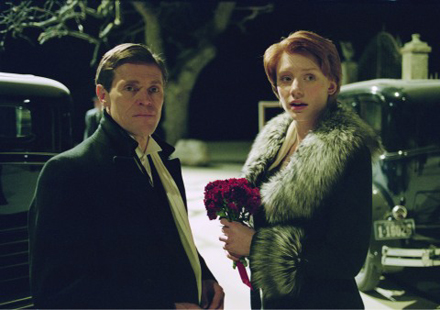
Written & directed by von Trier, Manderlay continues the story of Grace's exploration to America where she and her mob-boss father leave Dogville behind and stumble upon a Southern plantation called Manderlay where to the shock of the outsiders, slavery is still around. In an attempt to take control and free the slaves, Grace tries to impose her own ideals in order to make the slaves think freely only to cause more trouble after swaying her father's warning. Taking over the role of Grace for Nicole Kidman is Bryce Dallas Howard and taking over the role of her father for James Caan is Willem Dafoe. Also starring von Trier regulars Udo Kier, Jean-Marc Barr, Zeljko Ivanek, and from Dogville, Jeremy Davies, Chloe Sevigny, Lauren Bacall, and as narrator, John Hurt. Joining the cast for Manderlay along with Howard and Dafoe are Issach de Bankole and Danny Glover. Manderlay is a fierce, uncompromising study of race in America from the controversial Lars von Trier. 

After the events at the town of Dogville, Grace and her father drive through the American South where they stop at a plantation called Manderlay.  Grace sees a young black woman running away claiming she's about to be whipped.  Grace realizes that the plantation still has slavery around as she meets the plantation's owner Mam (Lauren Bacall) who is falling ill.  With an aging slave named Wilhelm (Danny Glover), Mam gives Grace a book of her laws as she lays on her deathbed.  After telling Wilhelm that slavery has been abolished 70 years ago, Wilhelm reveals that none of the slaves know what to do with this new freedom as Grace decides to help them get in touch with modern America.  Grace's father is convinced that Grace is only bringing trouble as he reluctantly lends Grace a few of her men including Niels (Jeremy Davies), Mr. Robinson (Jean-Marc Barr), Mr. Kirspe (Udo Kier), and business consultant Joseph (Teddy Kempner).

With the slave suspicious over Grace's plans including an African-born slave named Timothy (Issach de Bankole), they reluctantly welcome her as Grace also keeps Mam's family to help with things.  Grace looks into the book of Mam's law realizing the complexity of the laws as well as the categorization of slaves.  Meeting slaves such as Jack (Javone Prince), Old Wilma (Mona Hammond), and Elizabeth (Ginny Holder), Grace is intrigued by Timothy's presence as they get to work on giving new life to Manderlay.  During this slow period of reconstruction, Grace meets a doctor named Hector (Zeljko Ivanek) who makes some suggestions that Grace refuses to comply to as she takes trees from a garden to rebuild houses.  Yet, it doesn't go well as Grace hoped to be as she blames Mam's family by making them slaves as a dust storm happen as Grace learns about why the trees were placed in the garden.

Following the dust storm, Grace tries to get things started as her personal interests start to conflict with the things that Manderlay needed as Joseph decides to leave along with the gangsters.  Despite the progress of cotton growing in large amounts, Grace's attempts to make profit for herself and the former slaves are dashed.  Even as her feelings for Timothy would bring trouble, Grace learns some unexpected revelations about Mam's law that would force her to admit failure.

Ever since the day Africans were shipped into America as slaves, African-Americans definitely went through a struggle of oppression that's been going on for so long that it's unimaginable. Yet, the idea of slavery continuing in a tiny little plantation in Alabama 70 years after it was abolished is an astonishing idea. Then, the plot kicks in when a young woman imposes on her idealism on democracy in hoping to give them an idea of what freedom is. That plot idea is something that von Trier seems to comment on as an idea of how America is trying to bring democracy to Iraq. Yet, what von Trier brings is a different point of view of how things work. Whereas Grace had hopes to make things better her way, she begins to ignore and overlook everything else of what the former slaves wanted as well as what Mam's law was trying to do for its slaves.

Using an eight-chapter structure for his script, von Trier takes the same epic approach of Dogville but what it lacks in comparison to its predecessor is that Manderlay lacks a bit of its ambition and unpredictable commentary. Still, Manderlay remains unpredictable in its subject matter while taking several point of views on everything including its characters. For the African-American characters, they start off as stereotypes in terms of what some Americans think they are and everything only to reveal something far more complex. Even objects such as the Old Lady's Garden and the book of Mam's law which reveals to be more than simple objects. The dust storm is indeed a foreshadowing of what was to come with Hurricane Katrina in some ways while the book of Mam's law is far more complex than Grace had thought it would be. In many ways, von Trier comments on Grace's naivete and ignorance on these things that would end up making ways for her own doom. Therefore, what makes Grace end up leaving Manderlay is the result of what her point-of-view is on how things work when she doesn't realize of how things worked in Manderlay before.

The way von Trier sets things up and reveal the sense of how racism works reveals more about Mam's law and how its author sees things. There, it requires a lot of thinking of not just how America was post-slavery but America now when dealing with racism. Since von Trier chooses the same theatrical approach of Dogville, his vision is far bigger since the film starts off with an overhead shot of Grace, her father, and the gangsters driving from Dogville to Manderlay and the overhead shots of Manderlay itself reveal a much bigger land filled with a huge garden, little houses, a big plantation mansion, a well, and everything else a plantation needed. The approach is an observant of behaviors and politics in von Trier's fluid direction while his approach to narrative that is narrated by John Hurt reveals the idea of what the characters are thinking and how Grace’s point-of-view and emotions deal with the situation. Overall, it's a very strong film from Lars von Trier.

Helping von Trier with his vision is longtime cinematographer Anthony Dod Mantle. With him and von Trier serving as camera operators, many of the camera work is handheld to reveal an intimacy of where the characters are from the perspective shots to give hit a human feel while the only stillness is overhead shot to reveal the landscape of Manderlay and its plantation. Mantle's work is brilliant for using bright lights for the day with wonderful bluish nights for the night scenes and full-on sepia for the dust storm sequence. Art director Peter Grant and set decorator Simone Grau created an amazing set inside the sound stage that included a two-floor idea of Mam's plantation mansion that only shows a fireplace, a stair, and a bed. The rest of the production features the same kind of sparse, minimalist design of Dogville with small things like a window, door, and a broken roof. Costume designer Manon Rasmussen also created stark, poor-like clothing for most of the cast while giving a tattered suit for Wilhelm, a bunch of clean suits for the gangsters, and a fashionable dress for Grace in the look of the depression.

For the dust storm sequence, Peter Horjth created a realistic, harrowing look of the dust in its sepia color that is made in a minimalist style of visual effects. Editors Bodil Kjaerhauge and Molly Marlene Stensgard use the film's 140-minute running time to create a tight, leisurely paced film with elements of jump cuts to give the film some rhythm on many of the film's more intimate sequences. Sound designers Kristian Eidnes Andersen and Per Streit do excellent work in the sound to create the atmosphere of theatricality to the film with sounds of objects to represent the times. Music composer Joachim Holbek creates an ominous orchestral score to accompany the narration where it adds dramatic intensity in the situations where Grace and the characters are.

The film's cast includes several actors of African descent where most of them are British with the exception of a few American actors like Danny Glover and French actor Issach de Bankole. The small performances from the likes of Wendy Juel, Nina Sosanya, Ginny Holder, Javone Prince, Emmanuel Idowu, Joseph Mydell, Mona Hammond, Llewella Gideon, Suzette Llewellyn and Geoffrey Bateman are excellent as the slaves of the film. Other small performances from Chloe Sevigny, Rik Launspach, and Michael Abiteboul are excellent as Mam's family who have a moment when they're forced to wear black face that really is degrading in some way. Lauren Bacall is great in her brief appearance as Mam while Zeljko Ivanek, who replaced John C. Reilly, is funny as the sleazy entertainment doctor Hector. Other small performances from Jeremy Davies, Udo Kier, Jean-Marc Barr, and Teddy Kempner as the gangsters all each have memorable, individual moments.

Willem Dafoe gives a more subdued yet charismatic performance in the role of Grace's father. While he is more subtle than James Caan, Dafoe brings a sense of realism and cynicism to his character as a man who understands power yet doesn't want to get involved in anything else other than his own affairs. Dafoe is brilliant in his role as he doesn't overshadow Caan or out-act him. Danny Glover is great in a very complex role as a wise slave who isn't sure about the idea of freedom while letting Grace know about how Manderlay worked. When the film is about to end, Glover's performance is very subdued in how complex his character is in the way it counterpoints Grace's point of view as Glover is amazing in his performance.

Issach de Bankole is excellent in his performance as the prideful Timothy who refuses to give in to any kind of change until he's open to it only to reveal a darker side. The performance de Bankole gives is complex in his intentions as a character who is a lot smarter than he appears while he has some fine chemistry and tension with Bryce Dallas Howard.

Taking over for Nicole Kidman in a role and character that is strong and complex, Bryce Dallas Howard definitely managed to fulfill the character's expectations by bringing a newfound sense of naivete and youthful understanding to her character. Howard brings an energy and aggressiveness to her character as a young woman who imposes on ideas that she thinks will work only to be forced into understanding about how things worked before. Howard manages to reveal her range in many ways, including an emotional full-frontal nude scene that leads to a graphic sex scene with de Bankole that suggests something more. Howard really gives a fantastic performance while proving that she's more than just Ron Howard's daughter.

When Manderlay premiered at Cannes in 2005, reviews like Dogville were mixed and when it was officially released in the U.S. in early 2006, it divided everyone. Still, the film did manage to raise issues in which von Trier wanted to talk about. More importantly, the film will make anyone who has seen Dogville to go back and revisit the film on how it came to Manderlay. What both films share aside from its Brechtian staging and questions on American morality and politics is irony, notably the ending.

The title of von Trier's trilogy, USA-Land of Opportunities is a very ironic title considering that both films have grim endings that are very ironic to the situations. Whereas Dogville was about an outsider coming into town to be protected only to be humiliated by the rules and everything that led to the town's doom. Manderlay is really about how one plantation's old ways is being changed only to have things go really wrong in the end. It's in that film's ending where race is again that's the main issue in what Wilhelm says was relevant to what was happening in mid-2000s America.

Manderlay is a compelling yet haunting film from Lars von Trier that features superb performances from Bryce Dallas Howard, Danny Glover, Willem Dafoe, and Issach de Bankole.  While it doesn't have the big ambitions of its predecessor Dogville, it still a wonderful yet daring film from von Trier that has him commenting on the state of American idealism circa-2005.  It's not an easy film to watch that features themes that not everyone will want to discuss.  Yet, it's the kind of film that will provoke and challenge ideas as Manderlay, despite its flaws, is an intriguing film from Lars von Trier.


© thevoid99 2011